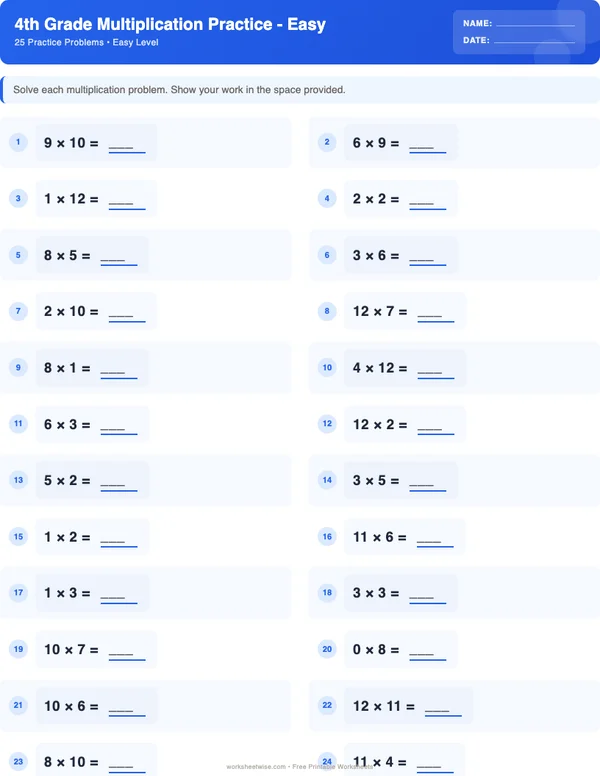
Complete guide
How to teach and practise 4th grade multiplication worksheets - standard theme (easy)
A practical way to use this 25-item worksheet
The free 4th Grade Multiplication worksheet is best used as a focused practice session, not as a complete multiplication lesson. It contains 25 easy-level multiplication exercises and asks the learner to solve each problem and show work in the space provided. The targeted skills are multiplication facts, times tables, mental math, and number sense.
A useful session has five parts: preview a few items, model one or two examples, solve a short group together, assign independent work, and examine errors before using the answer key. Let the learner’s observed work determine how quickly you move. A learner who explains accurate strategies may be ready for all 25 items; one who is guessing, counting inefficiently, or confusing operations may benefit from a shorter first round.
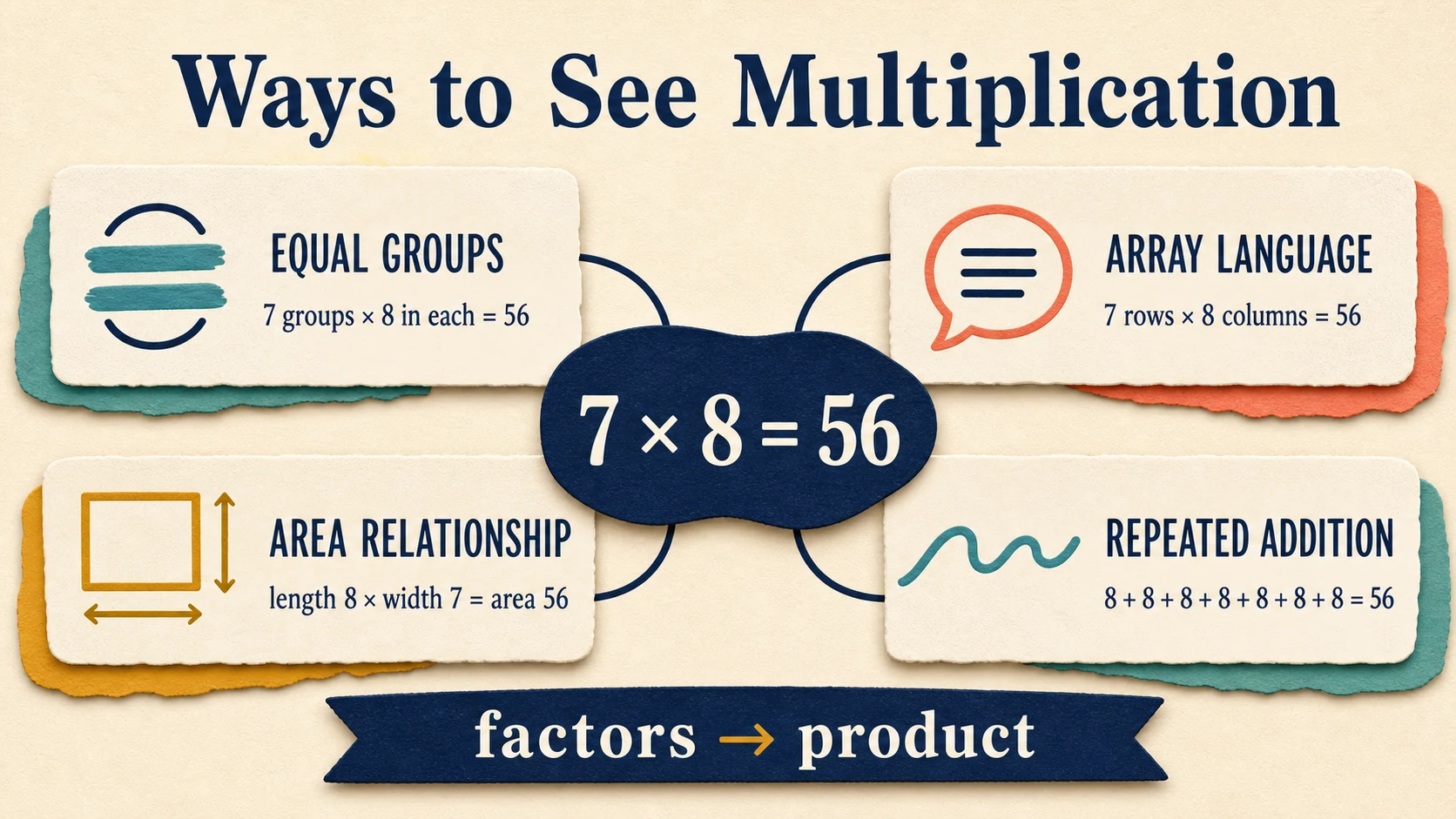
Preview, model, guide, release, check, and revisit the skill later.
| Lesson phase | Suggested use of the worksheet | What the adult watches for |
|---|---|---|
| Preview | Look at two or three problems without solving the whole page | Does the learner recognize the multiplication sign and identify both factors? |
| Model | Demonstrate a similar problem and show how to record reasoning | Can the learner connect equal groups, a known fact, or a derived fact to the product? |
| Guided practice | Complete several worksheet items together | Does the learner choose a strategy rather than wait for an answer? |
| Independent practice | Assign a manageable set, possibly followed by the remaining items | Are answers accurate, work readable, and effort reasonably steady? |
| Review | Discuss selected correct answers and errors before consulting the key | Can the learner explain why an answer is reasonable? |
| Retrieval | Revisit a few facts after a delay | Does the learner recall or reconstruct the products with less support? |
These phases are instructional suggestions for using the printable. They are not a universal timetable. Some learners will move through them in one sitting; others will need the work divided across several sessions.
Understand what this worksheet is designed to practice
Its specific purpose
This easy-level printable provides 25 straightforward multiplication exercises for a 4th Grade learner. It is intended to reinforce foundational computation through practice with multiplication facts, times tables, mental math, and number sense. A separate printable answer key is included.
The worksheet can fit classroom practice, homework, tutoring, or homeschool instruction. Its most useful role is to reveal how the learner currently approaches familiar multiplication:
- Does the learner recall a fact directly?
- Can the learner derive an unknown fact from a known one?
- Does the learner understand the factors as equal groups?
- Can the learner notice when an answer is too small or too large?
- Can the learner show enough work for another person to follow?
Showing work does not have to mean writing a long explanation for every fact. Depending on the problem and the learner’s needs, useful work might be an array sketch, a repeated-addition equation, a split into easier products, or a brief note naming a known fact.
What the grade label does and does not mean
The grade label describes the intended practice level. Local school, district, state, homeschool, and tutoring sequences differ. A worksheet labeled “4th Grade” does not establish that every fourth grader should complete it at the same speed or without support.
The broader catalogue progression includes multiplication facts before advancing to multi-digit multiplication through area models, partial products, and the standard algorithm. This particular worksheet is described as easy-level practice emphasizing facts, times tables, mental math, and number sense. Do not assume that completing it demonstrates mastery of every multiplication expectation associated with fourth grade.
The Common Core State Standards for Mathematics provide broader grade-level context for multiplication, including multi-digit work in Grade 4. That source has not evaluated this WorksheetWise printable, and the catalogue information supplied here is not enough to claim comprehensive alignment. For the fuller topic progression, use the 4th Grade multiplication guide rather than trying to make this one page cover every stage.
Prepare the learner and the workspace
Gather only what the task requires
Print the worksheet and keep the separate answer key out of the learner’s immediate view. Provide a pencil and, if it helps the learner explain thinking, blank paper or a simple grid for arrays. Avoid covering the page with extra aids before observing what the learner can do.
Begin by reading the printed direction together: “Solve each multiplication problem. Show your work in the space provided.” Ask the learner to point to the multiplication sign, the two factors, and the place where the product will go. This quick orientation separates task-reading difficulties from multiplication difficulties.
If the learner appears uneasy about the full page, cover the lower portion with another sheet of paper and expose a small group of items. The mathematics remains unchanged; only the amount visible at one time changes.
Take a brief starting sample
Choose two worksheet items from different parts of the page. Ask the learner to solve them without the answer key. Use neutral prompts such as:
- “Tell me what the two numbers mean.”
- “Which fact or pattern might help?”
- “How could you check whether that product makes sense?”
Do not turn the preview into a test of speed. Its purpose is to select an appropriate amount of support. If the learner gives accurate answers and clear explanations, move promptly into practice. If the learner guesses, changes the operation, or cannot begin, model the meaning and strategy before assigning a larger set.
The Institute of Education Sciences practice guides offer broad instructional framing around explicit teaching, mathematical representations, and responsive support. See Teaching Math to Young Children and Assisting Students Struggling with Mathematics. These guides do not evaluate WorksheetWise or prescribe a fixed routine for this exact worksheet. Here, their relevance is limited to high-level choices such as making thinking visible, modeling clearly, and responding to observed difficulty.
Model the task with fully checked examples
Use examples similar to the worksheet rather than pre-solving its items. Keep the model concise: read the expression, identify a strategy, calculate, and check. The following products are fully worked and verified.
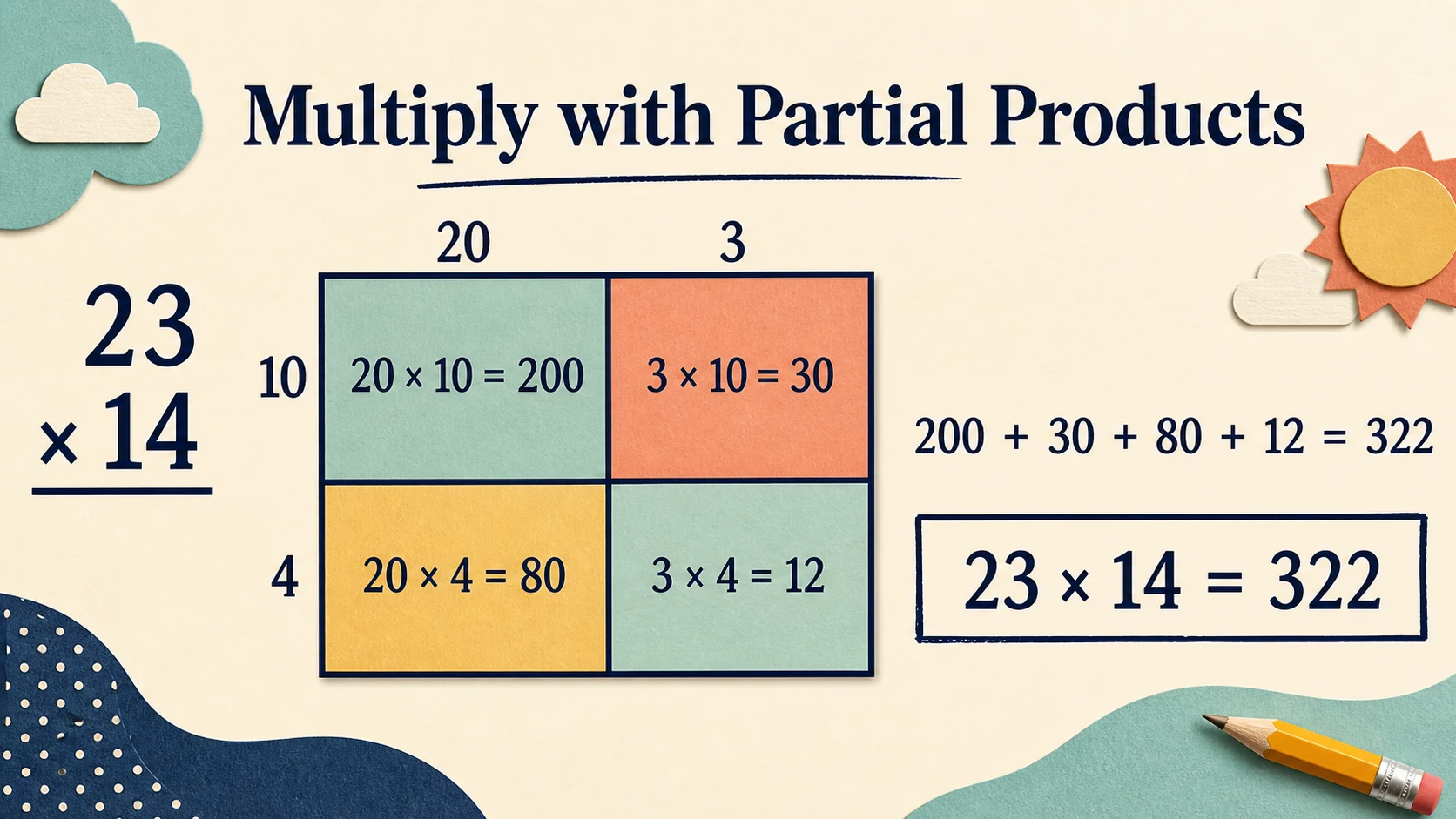
A model should make both the calculation and the reasonableness check visible.
Example 1: Use equal groups for
Interpret as six groups of four:
Therefore:
Check by grouping the addition:
You might say, “The first factor tells me there are six equal groups. Each group has four. Six groups of four make 24.”
Repeated addition is useful for showing meaning, but it can become inefficient for larger factors. Once the learner sees the equal groups, encourage use of known facts or derived facts.
Example 2: Derive by splitting one factor
If is not recalled immediately, split 8 into 5 and 3:
Calculate each partial product:
Combine them:
Thus:
Check by using a different split:
Both routes produce 56. This is a concrete use of the distributive property, though the learner does not need to recite the property’s name to use the strategy correctly.
Example 3: Use a known fact for
Start with :
Because nine groups of six are one group of six fewer than ten groups:
Check by reversing the factors and building from five groups of nine:
Therefore:
This example also shows that reversing the factors does not change the product:
The arrangement of the groups changes, but the total remains 54.
Example 4: Use place-value structure for
Split 12 into 10 and 2:
Then:
So:
Therefore:
Check by repeated groups in a more efficient form:
The long addition confirms the product, but the split calculation is easier to manage.
Boundary cases worth discussing
Zero and one can reveal misunderstandings even when other facts are accurate.
For , there are eight groups with zero in each group:
The answer is not 8. No objects appear in any group.
For , there is one group of nine:
For a square fact such as :
An array would have five rows of five. If the learner writes 10, the response may show addition of the factors rather than multiplication.
These are instructional examples, not a statement that the exact worksheet contains these particular expressions.
Move from guided practice to independent work
Solve a short group together
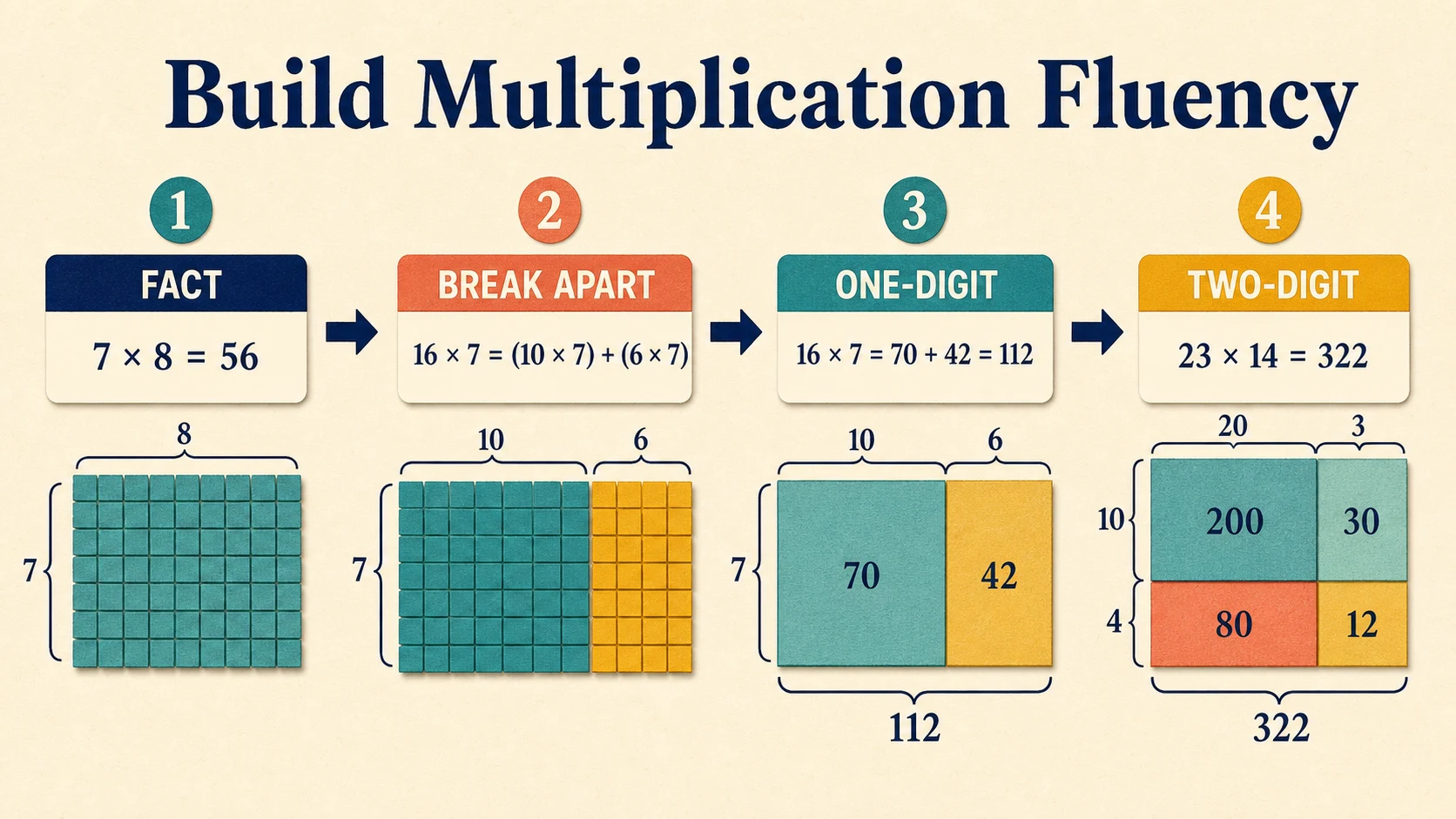
Guided practice should gradually transfer the explaining and checking to the learner.
Select three to five actual worksheet items. On the first, ask the learner to identify a strategy while you record it. On the next, let the learner calculate while you ask a checking question. By the final guided item, have the learner complete and explain the entire process.
A useful prompt sequence is:
- “What multiplication expression do you see?”
- “Is this a fact you know, or will you build it from another fact?”
- “Show the calculation.”
- “How can you check it?”
- “Does the size of the answer make sense?”
Fade prompts when they are no longer needed. If the learner independently selects a valid method, avoid requiring a different method merely because it is the one you planned to teach. The important evidence is whether the reasoning is mathematically sound and the product is correct.
Assign a manageable independent set
After guided practice, decide whether the learner should complete all remaining items or a smaller set. Possible choices include:
- All remaining problems when work is accurate and self-directed.
- Five to ten problems followed by a check-in when strategy use is uneven.
- One row or section at a time when the visible quantity is distracting.
- Alternating independent items with brief adult review when errors repeat.
This adjustment changes workload and support, not the skill. The learner still solves the worksheet’s multiplication problems.
During independent practice, avoid correcting every answer immediately. Mark an item for later discussion or say, “Check that one once more.” Immediate explanation is more appropriate when the learner has misunderstood the operation or is repeating the same faulty procedure across several items.
Speed is not the only evidence to consider. Look at accuracy, strategy, independence, and the ability to check. A slower learner using dependable reasoning may be demonstrating stronger understanding than a fast learner producing unexplained guesses.
Adapt support without replacing multiplication
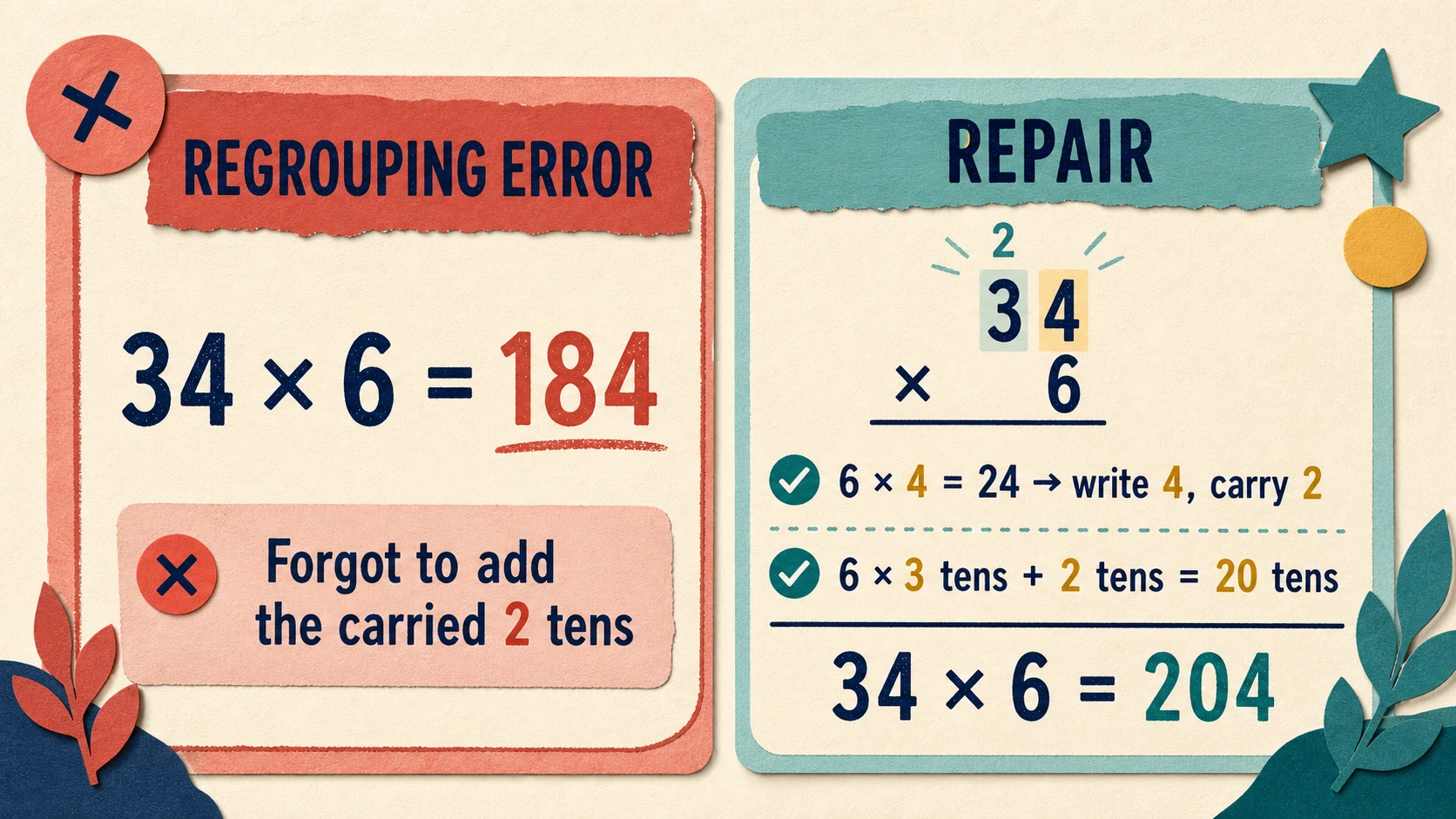
Adjust visibility, representation, or prompting while keeping the multiplication target intact.
When the learner needs more access support
Reduce visual load by showing one row at a time. Read directions aloud if task reading is interfering with the mathematics. Allow an array, equal-group sketch, or written decomposition such as:
These supports preserve the multiplication work. In contrast, supplying products, allowing the learner to copy the key, or converting every item into unrelated addition practice would no longer provide a useful sample of independent multiplication.
If fact retrieval is weak but conceptual understanding is present, let the learner use known facts to derive unknown ones. For example:
The learner is still calculating the product rather than receiving it.
When the learner is ready for less support
Ask for a brief oral explanation on selected items rather than adding a large quantity of new work. Another option is to request two different checks for one product, such as a factor split and a reversed-factor calculation.
Do not change an easy fact worksheet into a timed contest simply because the learner finishes accurately. Timing can shift attention away from explanation and checking. The next challenge should follow the learner’s evidence: perhaps more varied fact practice, perhaps strategic work with harder facts, or perhaps the next step in the broader multiplication progression.
When attention or stamina is the main barrier
Divide the 25 items into smaller blocks and preserve the unfinished portion for later. Record where the learner stopped so the second session begins cleanly. A short break is more useful than allowing frustration to turn into random responding.
Keep the interpretation cautious. One incomplete page does not establish why the learner stopped. The cause could involve mathematical difficulty, task length, distraction, or something else not visible on the worksheet. This article does not provide medical or child-specific guidance.
Interpret errors as evidence
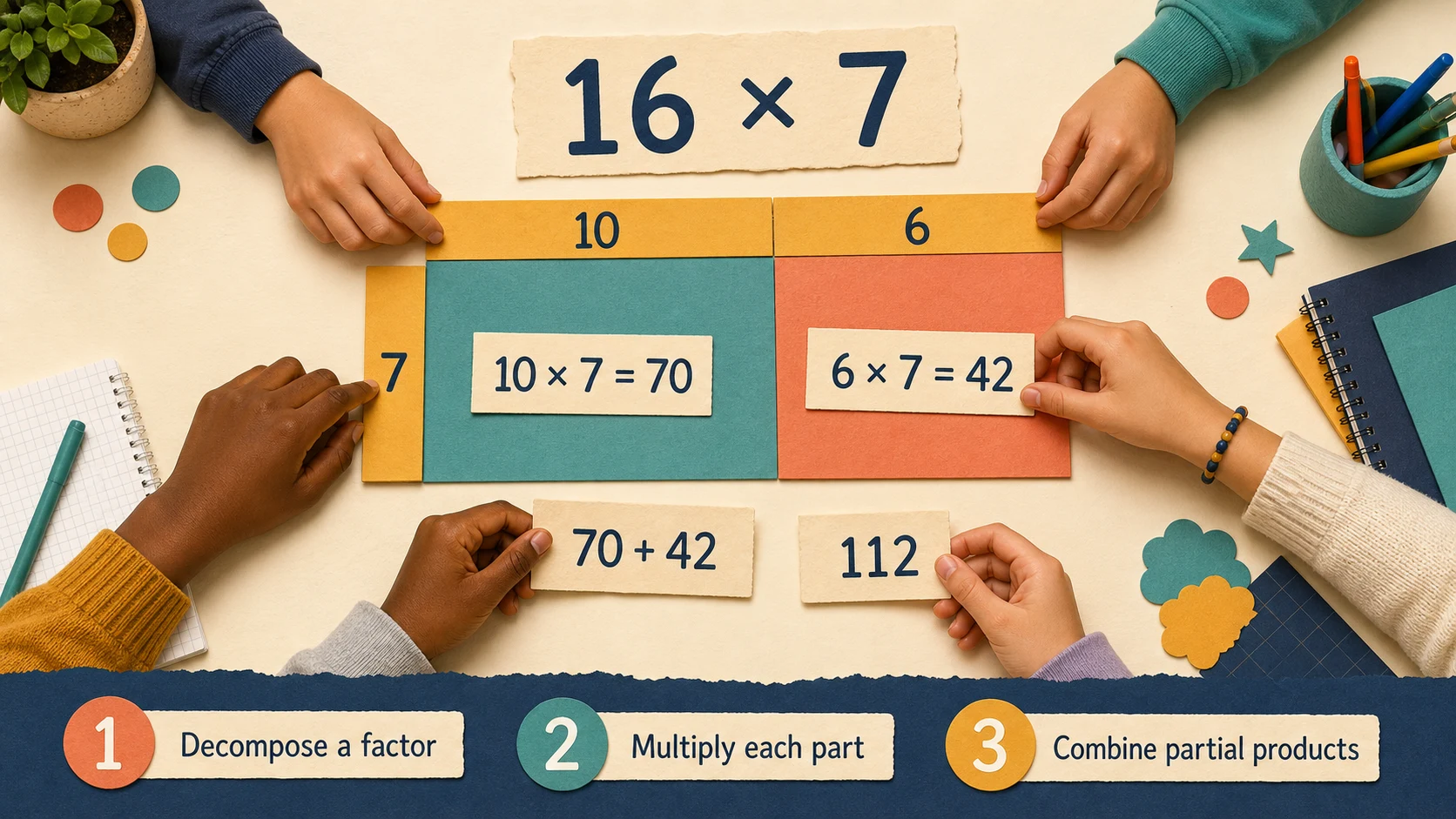
Identify the error, reconstruct the reasoning, correct it, and verify the new product.
Do not begin error review by announcing the number wrong. Select one item and ask the learner to recreate the thinking. A written answer shows the result, but the explanation often reveals the cause.
| Observed work | Possible interpretation to investigate | Useful response |
|---|---|---|
| The learner may have added the factors | Return to five equal groups of four or draw a -by- array | |
| A nearby fact may have been confused with the target fact | Derive the answer from and , then check | |
| The learner may have started from but omitted the subtraction | Write explicitly | |
| Zero may be treated as if it were one | Model eight empty groups and compare with one group of eight | |
| Correct product with no visible reasoning | The fact may be known, or the answer may be an unsupported guess | Ask for one oral check rather than assuming either mastery or guessing |
| Several correct products followed by unrelated answers | Attention, stamina, or increasing difficulty may be involved | Pause, revisit the transition point, and assign a shorter block |
The “possible interpretation” column is deliberately tentative. The same written error can arise from different reasoning. Ask before concluding.
Use a repeatable correction routine
For each selected error:
- Copy or point to the original expression.
- Ask the learner to explain the first attempt.
- Choose a representation or known fact that fits the problem.
- Recalculate the product.
- Check it using a different route.
- Write the corrected answer clearly.
For example, suppose the learner wrote:
A correction could use:
Then check by doubling :
The corrected product is 56. Ask the learner to state what changed: “I used five groups and two groups, and I added 40 and 16.”
Check the answer key responsibly
The printable answer key is useful for confirming products, but it cannot explain how an answer was produced. Keep the learner’s paper available while checking so that you can compare the product, visible work, and any oral explanation.
A sound checking order is:
- Have the learner review selected answers first.
- Ask for a reasonableness check on any uncertain item.
- Compare the work with the separate key.
- Mark items that need discussion rather than simply replacing answers.
- Correct a small number carefully.
- Revisit the corrected facts after a delay.
If your calculation and the key appear to disagree, solve the expression independently in at least two ways before deciding what happened. Confirm that you are looking at the answer key for this exact worksheet and that the item numbers match. A shifted row or mismatched printable can create an apparent disagreement.
Avoid reporting only a percentage. A total such as 21 correct out of 25 is useful, but the pattern matters more for planning. Four unrelated slips call for a different response from four errors involving multiplication by nine.
Decide what should happen next
Continue, pause, or step back
Use the learner’s actual work to select the next move.
Continue with similar practice when most products are accurate, strategies are understandable, and errors can be corrected with light prompting. The 4th Grade Math worksheet collection can provide broader practice choices.
Pause and revisit selected facts when errors cluster around a pattern, such as facts involving 7 or 8. Practice the strategy that repairs that pattern, then return to two or three previously missed items without showing the old answers.
Step back to equal groups or arrays when the learner repeatedly adds the factors, cannot explain what multiplication represents, or treats unrelated guesses as products. This is not a reason to abandon multiplication. It is a reason to make its meaning visible before returning to the same computation.
Move forward only when the next work matches the evidence. Accurate completion of an easy fact sheet may support more varied multiplication practice, but it does not by itself prove readiness for every multi-digit procedure. The multiplication topic guide provides the wider path from visual models and fact practice toward multi-digit computation.
Consider the whole practice record
Retain the completed worksheet, date it, and write a brief neutral note such as “Used factor splits for 7s and 8s” or “Independent except for three zero/one facts.” This is more informative than labels such as “good at multiplication” or “struggling.”
If additional worksheets are useful, the catalogue includes a 4th Grade Multiplication Worksheet Pack containing 18 worksheets. It is priced at $4.79. The pack is an optional source of additional practice, not a requirement and not a guarantee of progress.
Schedule retrieval instead of ending after one page
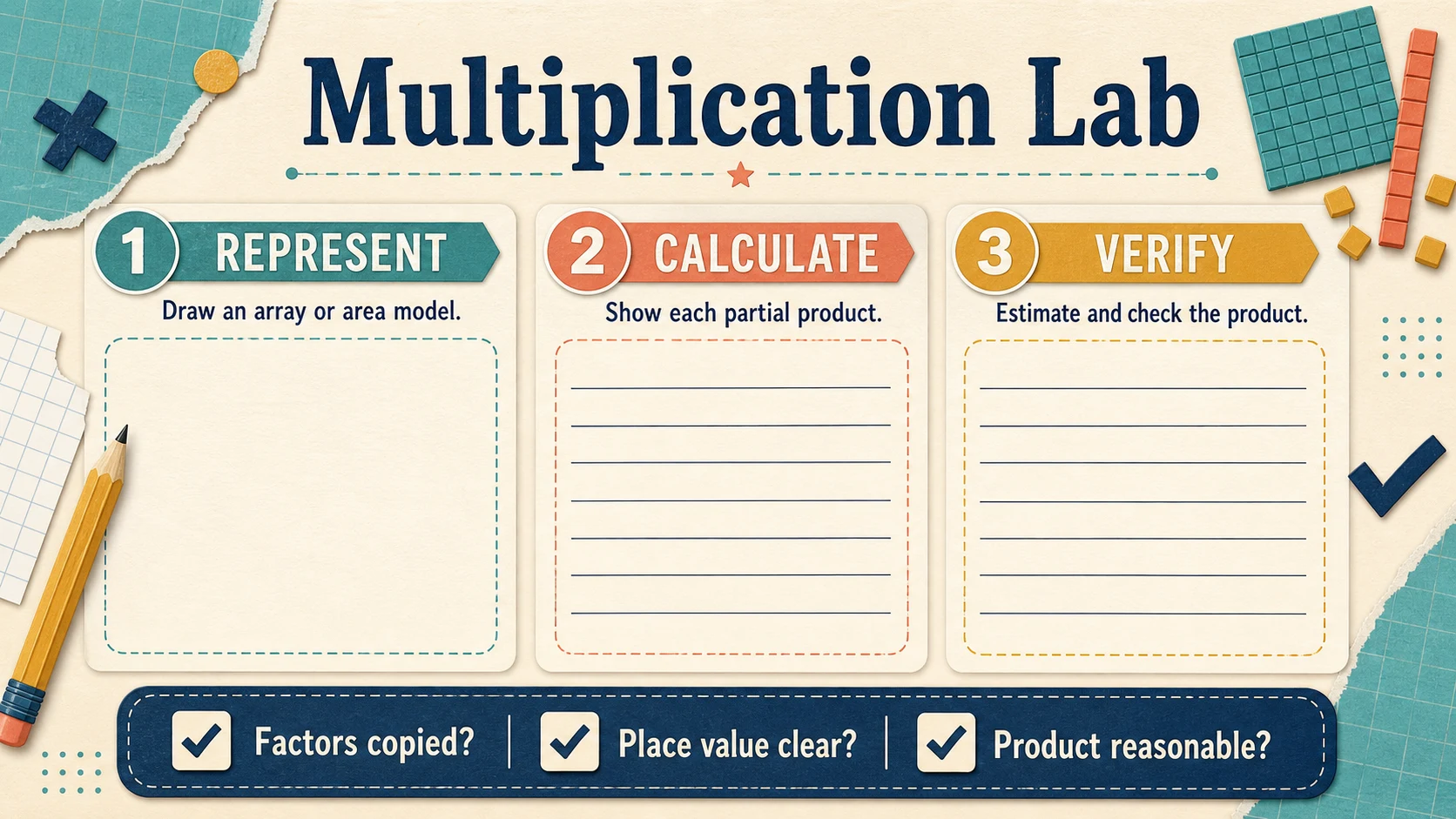
Revisit a small selection after increasing delays and adjust the schedule from the learner’s responses.
A practical retrieval plan can be brief:
| Review point | Suggested task | Decision |
|---|---|---|
| End of the session | Re-solve two corrected items without looking at the correction | If the same error returns, model the strategy again |
| Next study session | Solve three to five selected facts, including one previous error | Note whether recall or reconstruction is more independent |
| Several days later | Mix previous facts with a few similar facts | Look for retention across a changed order |
| One or two weeks later | Use a short mixed check rather than repeating all 25 items | Continue review only where evidence shows it is needed |
This schedule is a flexible instructional suggestion, not a sourced or universal timetable. Shorten or extend the intervals according to observed work. If a product is repeatedly secure, it needs less attention. If the learner reconstructs it accurately but slowly, occasional retrieval may still be useful. If the underlying meaning remains unclear, return to representation and guided calculation rather than repeatedly testing recall.
Keep the worksheet’s limitations in view
This printable gives a focused sample of easy-level multiplication practice. It does not provide a complete diagnosis, establish comprehensive standards alignment, or certify mastery. It cannot show everything the learner knows about arrays, word problems, properties, multi-digit multiplication, or mathematical explanation. It also cannot reveal the cause of every error without conversation.
Its value comes from careful use: model clearly, preserve the multiplication target, observe strategies, verify calculations, and let the resulting evidence guide the next assignment.
The honest next action is to download the free worksheet and answer key, teach it with the short model–guide–practice routine above, and save two or three representative facts for later retrieval. After reviewing the learner’s work, use the broader 4th Grade Multiplication guide to choose the next appropriate practice—or create a more targeted follow-up through the free worksheet generators.
Put it into practice
Use the guide with a real printable
Move from explanation to a short, observable practice task. Check the first item together, then adjust the next session from the learner's actual work.
See the 18-worksheet pack