Complete guide
How to teach and practise 4th grade fractions worksheets - standard theme (easy)
A practical way to use this 22-item fraction worksheet
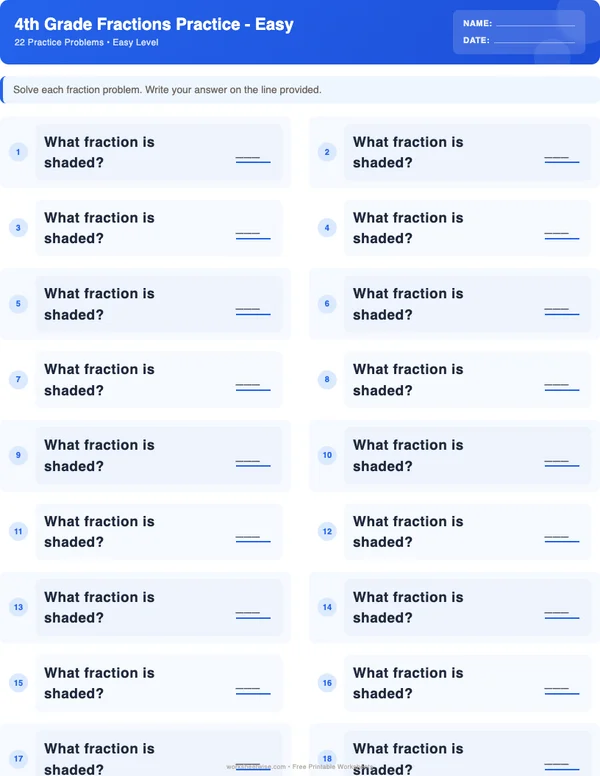
Use the free 4th Grade Fractions worksheet as a short lesson followed by practice—not as a one-sitting test of everything a learner knows about fractions. The printable contains 22 easy-level exercises involving fractions, equivalent fractions, comparisons, and fraction operations. A separate answer key is included.
Begin by reviewing what the numerator and denominator mean. Model two or three problems while naming each decision aloud. Complete several items together, then let the learner attempt a manageable group independently. Check the work for patterns rather than simply counting correct answers. If an error reveals a misunderstanding, return to a fraction strip or number line before assigning more symbolic practice.
A productive session may take this form:
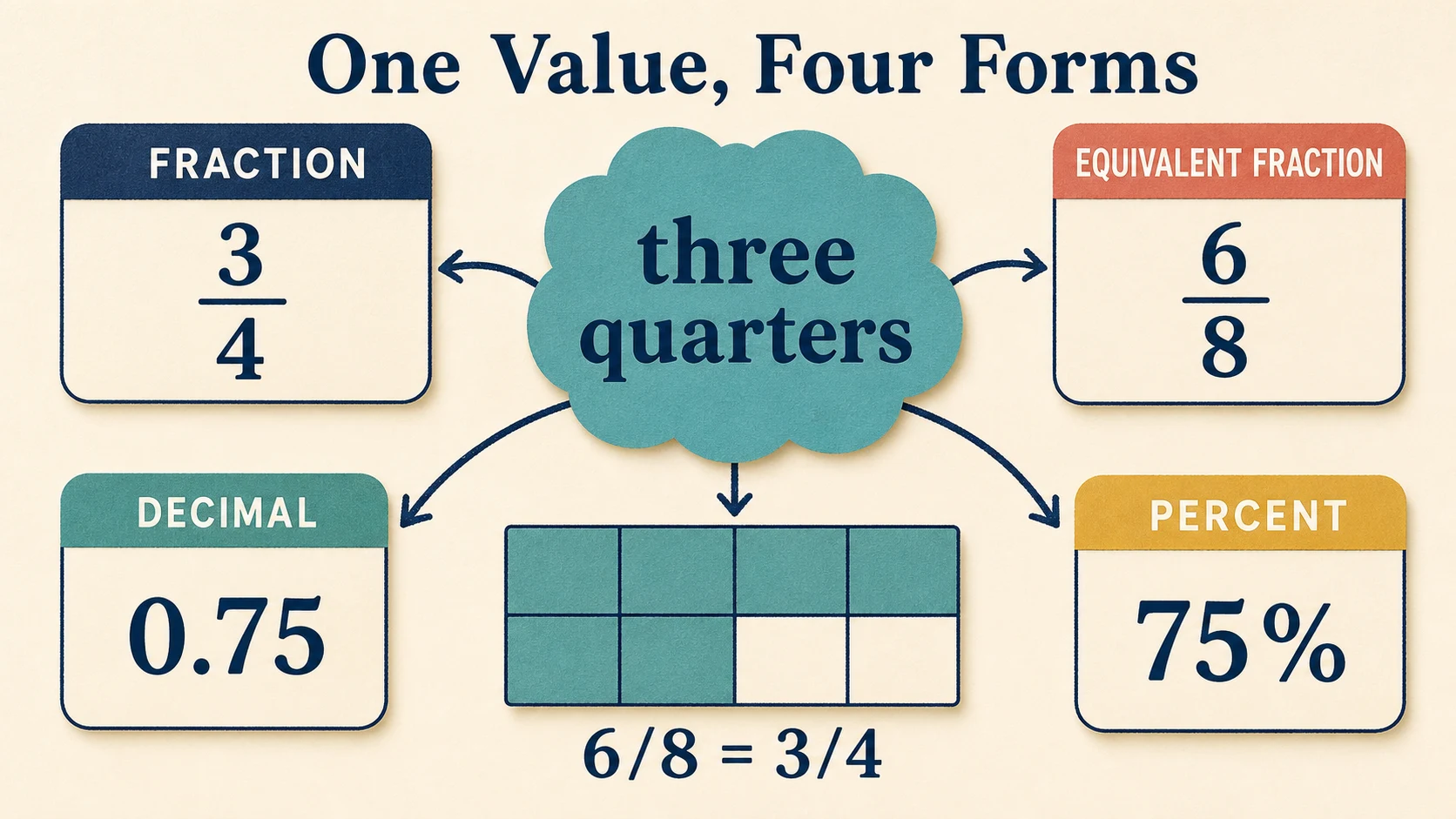
Move from a brief concept check to modeling, guided practice, independent work, and review.
| Lesson phase | Suggested use | What the adult watches for |
|---|---|---|
| Readiness check | 3–5 minutes | Can the learner identify the numerator, denominator, and whole? |
| Adult modeling | 5–8 minutes | Does the explanation connect symbols to fraction size? |
| Guided practice | 4–6 items | Can the learner explain a choice with a model or equation? |
| Independent practice | 6–10 items | Are errors isolated, repeated, or caused by rushing? |
| Review | 5 minutes | Can the learner correct an error and explain the correction? |
| Later retrieval | 2–4 items at a time | Is the skill still available after a delay? |
These times are instructional suggestions, not a universal timetable. A learner’s observed work should determine whether to continue, pause, or return to a model.
What this worksheet covers—and what it does not show by itself
The catalogue identifies four skill areas:
- fractions
- equivalent fractions
- comparing fractions
- fraction operations
The instruction on the printable is: “Solve each fraction problem. Write your answer on the line provided.” Because the catalogue does not specify the exact distribution or order of the 22 items, preview the page before teaching. Notice which representations and operations actually appear. Do not assume that each listed skill receives the same number of problems.
This worksheet is labeled easy and is intended for learners beginning this level of fraction work or needing reinforcement. “Easy” describes the designed difficulty of the exercises; it does not predict how any particular learner will experience them. Likewise, grade labels describe intended practice level, and local curricula and teaching sequences differ.
The broader fourth-grade catalogue includes generating equivalent fractions, comparing fractions with unlike denominators, adding and subtracting fractions with like denominators, and multiplying fractions by whole numbers. The Common Core mathematics standards provide one authoritative description of Grade 4 fraction expectations, but that does not establish comprehensive alignment for this individual printable. Consult the learner’s school materials or local curriculum when standards documentation matters.
For the full topic sequence—from identifying fractions through equivalence, comparison, mixed numbers, and operations—use the fractions topic guide. This lesson should stay focused on the problems actually present on the worksheet rather than trying to duplicate that entire progression.
Prepare the learner and the workspace
Print the worksheet and keep the separate key out of sight during instruction. Have a pencil, an eraser, and one visual model available. Useful options include fraction strips, paper strips that can be folded, fraction circles, or a hand-drawn number line.
Before starting, check three foundations:
- A fraction describes equal parts of a whole or a location on a number line.
- The denominator names how many equal parts make the whole.
- The numerator names how many of those parts are being considered.
Draw a rectangle divided into four equal sections and shade three. Ask the learner to identify the whole, count the equal parts, and name the shaded amount as . Then draw a number line from 0 to 1 divided into fourths and locate . The two representations emphasize different ideas: one shows parts of a whole, while the other shows the fraction as a number.
The IES guide on teaching mathematics to young children supports broad practices such as using representations and helping learners connect mathematical ideas. It did not evaluate this worksheet. Here, the practical application is simple: keep a visual available whenever the symbols stop carrying meaning.
Do not turn the readiness check into a long pretest. If the learner can explain the three foundations, begin. If not, spend a few minutes constructing and naming fractions before using the printable.
Model a repeatable fraction routine
Tell the learner that every problem will be handled through the same sequence:
- Identify what the problem asks.
- Name the denominator and the size of each part.
- Determine what must stay the same or change.
- Solve.
- Check whether the answer is reasonable.
Model the routine with examples similar to the listed skills. These examples are fully checked illustrations for teaching; they are not presented as exact items from the worksheet or its answer key.
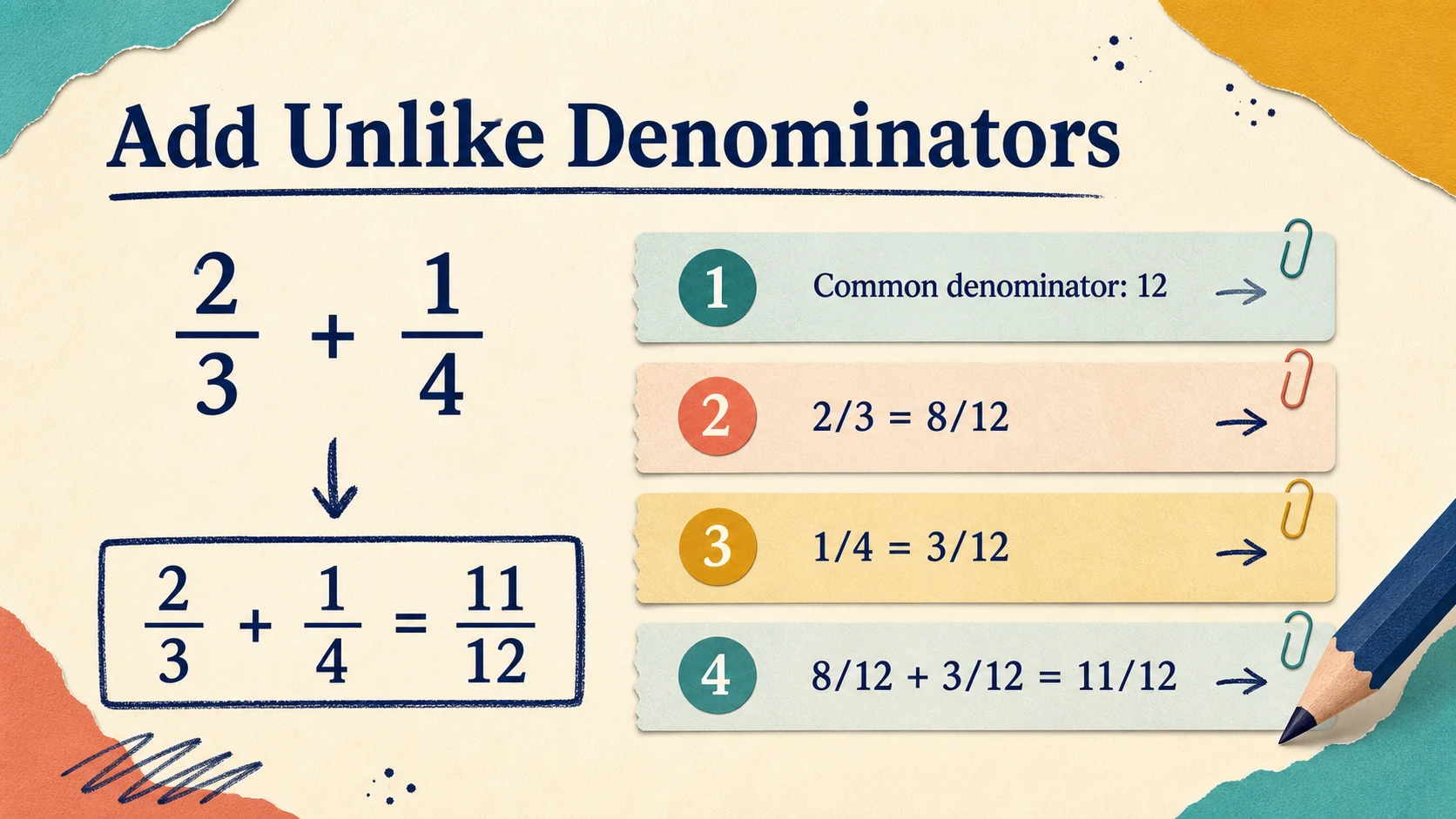
Show the mathematical decision, not only the final fraction.
Worked example 1: generate an equivalent fraction
Find a fraction equivalent to with denominator 6.
To change 3 into 6, multiply by 2. Multiply the numerator by the same number:
Check with a model: two out of three equal sections cover the same amount as four out of six smaller equal sections. The checked answer is .
The important idea is not merely “multiply top and bottom.” Multiplying both by the same nonzero number changes the number of named parts without changing the amount.
Worked example 2: compare fractions with the same numerator
Compare and .
Both fractions contain three parts, but fourths are larger than eighths when the wholes are equal. Therefore,
A number-line check supports the comparison: , while . Decimal conversion is only a verification here, not a required method. The checked comparison is .
This example addresses a frequent faulty rule: a larger denominator does not automatically make a larger fraction. With the same numerator and the same-sized whole, more pieces mean smaller pieces.
Worked example 3: add fractions with like denominators
Solve .
Both fractions are measured in sevenths. Combine the number of sevenths:
The denominator remains 7 because the size of each part has not changed. A strip divided into seven equal sections would show two shaded sections plus three more, for five shaded sevenths. The checked answer is .
Do not teach this as “leave the bottom number alone” without meaning. Say, “We are combining sevenths, so the answer is still measured in sevenths.”
Worked example 4: subtract fractions with like denominators
Solve .
Remove three eighths from seven eighths:
The direct difference is . Simplifying gives , and a fraction strip confirms that four of eight equal sections cover half the whole. If a worksheet item expects an equivalent simplified form, is appropriate; if its directions or examples accept an unsimplified equivalent fraction, still represents the correct amount. Check the page’s conventions and answer key rather than imposing an unstated format.
Include boundary cases before independent work
Boundary cases help reveal whether the learner understands the idea or is following a narrow pattern.
Fractions equal to one whole
Consider . The numerator and denominator are equal, so all four fourths are present:
This remains true for , , and any nonzero number divided by itself. A learner who says is “less than one because it is a fraction” may be treating every fraction as a proper fraction rather than as a number.
Zero as a numerator
Consider . There are zero fifths, so:
The denominator still indicates fifth-sized parts, but none are being counted. Do not generalize this to a denominator of zero. Division by zero is not defined, and is not a valid fraction value.
Comparing fractions near zero and one
Compare and . They have the same denominator, so compare the numerators:
Now compare with 1. Eight eighths make one whole, and seven eighths is one eighth short:
These benchmarks provide a reasonableness check. A learner does not need a complicated procedure to recognize that is close to, but less than, one.
Run guided practice without taking over
Begin the worksheet with a small group of items chosen from the top or from one visible skill cluster. Keep the printed order if it moves clearly from simpler to more demanding work. If the skills are mixed, select representative items while preserving the worksheet numbers so that review remains easy.
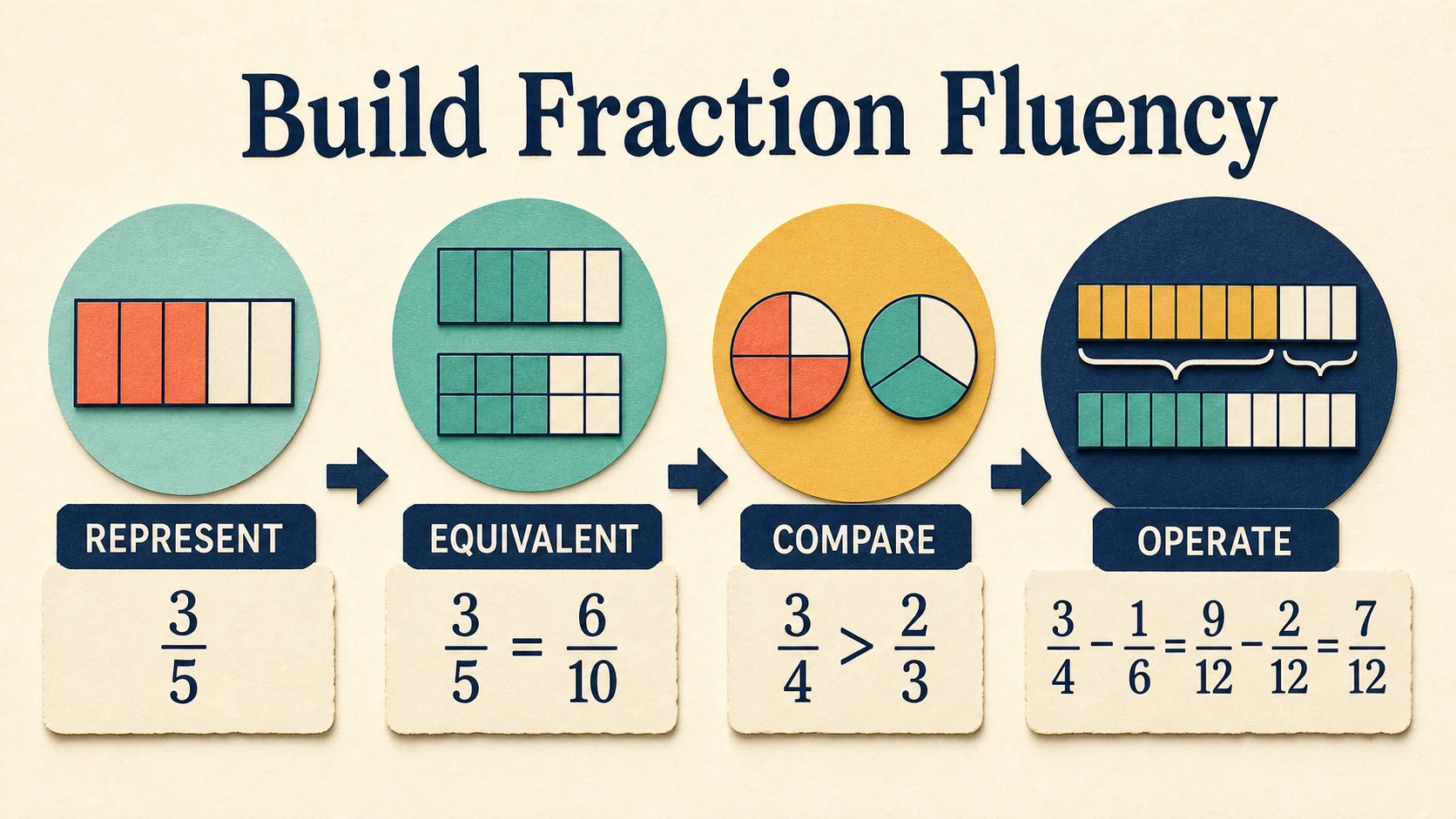
During guided practice, prompt the learner to explain the choice that leads to the answer.
Use prompts that reveal reasoning
Instead of supplying the next step, use short prompts:
- “What does the denominator tell you?”
- “Are the pieces the same size?”
- “Where would each fraction sit between 0 and 1?”
- “What must happen to the numerator if the denominator is doubled?”
- “What unit are you adding: thirds, fifths, or something else?”
- “How could a strip or number line check that answer?”
After an answer, ask for one brief justification. The learner might draw a model, write an equivalent fraction, point to a benchmark, or explain the part size. Requiring every available method would add unnecessary load; one valid justification is enough.
If the learner gives two correct answers in a row with clear reasoning, reduce the prompts. If the answer is correct but the explanation is confused, complete another guided item. Correct notation can sometimes hide a fragile rule.
Fade help deliberately
A useful prompt sequence is:
- General prompt: “What is the problem asking?”
- Focused prompt: “Look at the denominators.”
- Representation prompt: “Show both fractions on equal-length strips.”
- Adult remodelling: demonstrate a similar example, then return to the original item.
Record the least amount of help needed. That information is more useful than a raw score because it shows whether the learner solved independently, with a cue, or only after a complete model.
Shift to independent practice in manageable sets
Assign six to ten items rather than automatically requiring all 22 at once. Tell the learner which items to complete and what to do when unsure: circle the item, try a model, and continue to the next problem. This keeps one difficulty from consuming the whole session.
Watch without correcting every mark immediately. Notice whether the learner:
- reads comparison symbols in the correct direction;
- treats the numerator and denominator as related quantities;
- uses equivalent fractions consistently;
- keeps like-denominator units unchanged during addition or subtraction;
- simplifies only when appropriate;
- checks answers against 0, , or 1 when useful.
Stop the set if errors become repetitive, the learner begins guessing, or explanations deteriorate. Continuing through all 22 items under those conditions is unlikely to provide clean evidence of skill. Re-model one idea, complete a fresh example together, and either resume with two problems or end the session.
If the learner works accurately and explains the reasoning, allow the remaining items to function as independent practice, homework, or later retrieval. The printable can be split across more than one day without changing its intended skills.
Adapt support while preserving the fraction skill
Adaptations should change access, pacing, or the amount of support—not replace fraction reasoning with answer-giving.
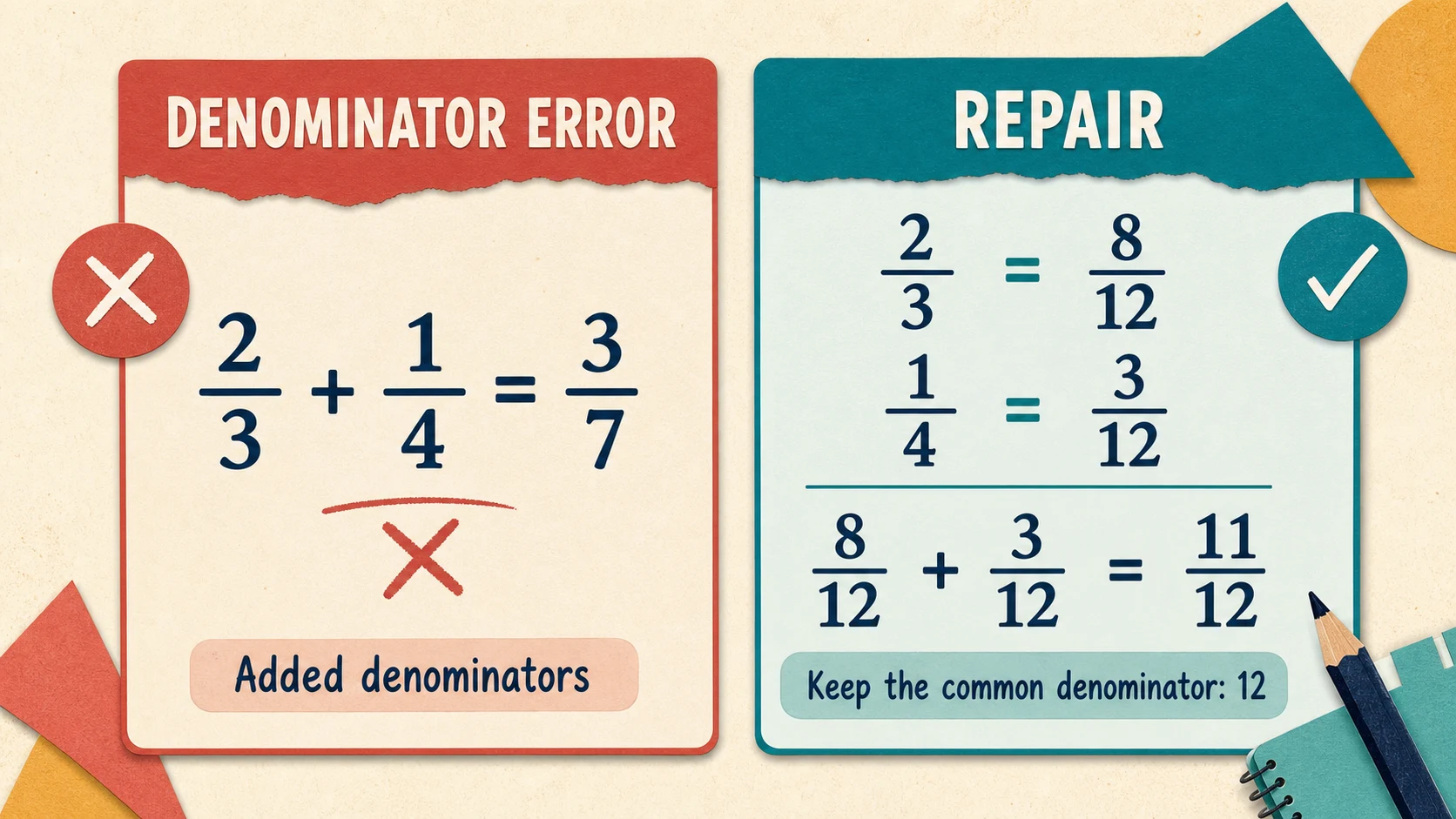
Adjust the number of visible items, the representation, or the prompting while keeping the mathematics intact.
For a learner who needs more structure
Cover unused rows with blank paper so only one or two problems remain visible. Read the directions aloud, but let the learner interpret and solve each fraction. Provide equal-length fraction strips or a 0-to-1 number line.
Mark numerator and denominator with consistent visual cues if that helps the learner attend to their different roles. Remove the cues once the learner begins using the structure correctly. Avoid color choices that accidentally suggest the numerator and denominator are separate numbers with unrelated jobs.
For a learner who understands models but struggles with notation
Have the learner build or draw the amount first, then write the matching symbols. For , the sequence can be:
- Partition the whole into four equal parts.
- Mark three parts.
- Write .
- Explain that 4 names the part size and 3 counts those parts.
For equivalence, place equal-length strips beneath one another. A strip showing and another showing make the shared amount visible before the learner writes the equation.
For a learner ready for less support
Ask for a quick estimate or benchmark before exact calculation. The learner could classify a fraction as less than, equal to, or greater than , then solve the printed item.
Another extension is to request a second valid representation after the answer: a number-line point, a fraction strip, or an equivalent fraction. Do not introduce unlike-denominator operations or other new skills merely to make an easy worksheet harder. Enrichment should deepen the listed skill unless the learner’s current sequence explicitly calls for a new one.
The IES practice guide for assisting students struggling with mathematics offers high-level guidance about systematic instruction, mathematical language, representations, and review. It does not prescribe a response for this particular learner or certify this worksheet. Use the learner’s actual explanations and error patterns to select support.
Interpret errors before assigning more work
A wrong answer is evidence, but its meaning depends on the work that produced it. Ask the learner to show or explain the step rather than immediately naming the rule that was broken.
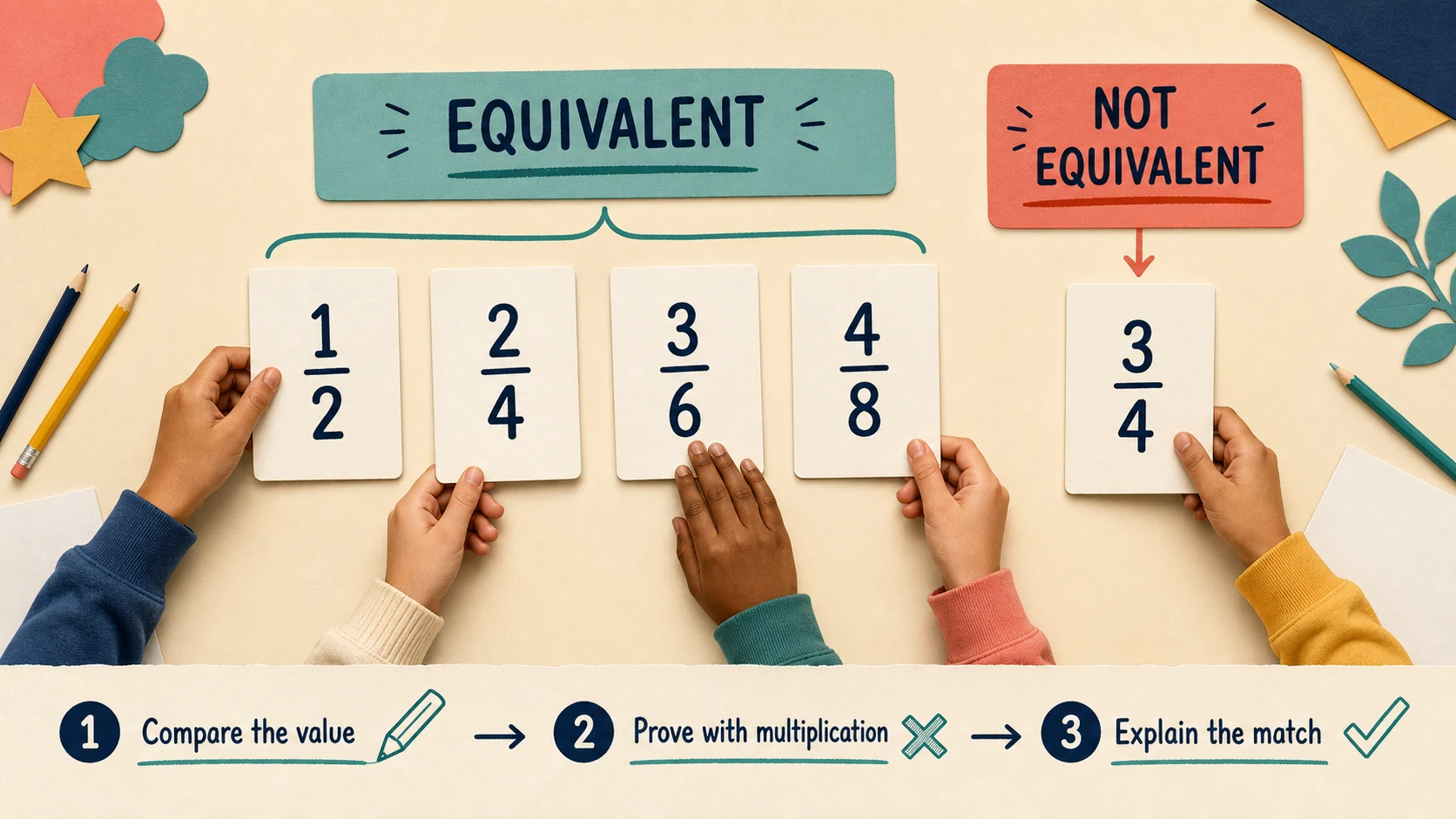
Classify the error, rebuild the meaning, and then test the correction on a new problem.
Larger-denominator-means-larger thinking
If a learner writes , draw equal-sized wholes. Divide one into fourths and the other into eighths. Compare one piece from each. The correction is:
Then test transfer with a fresh pair such as and . One corrected item does not yet show that the misconception has changed.
Adding or subtracting denominators
A learner may write:
Return to the unit. Two fifths plus one fifth makes three fifths:
Ask, “Did the pieces become tenths, or are they still fifths?” A five-part strip makes the unchanged unit visible.
Changing only one part of an equivalent fraction
If a learner writes , compare the sizes. The numerator stayed 2 while each part became smaller, so the total amount changed. To create denominator 6 while preserving the amount, multiply both numerator and denominator by 2:
Correct concept, incomplete notation
Sometimes the reasoning is sound but the answer line contains a copied denominator, reversed comparison sign, or omitted simplification. Treat this as a notation or checking issue, not automatically as a conceptual failure. Have the learner read the completed statement aloud and compare it with the model.
Use one corrected problem and one new problem to check whether the repair transfers. If the same conceptual error appears again, pause the worksheet and return to the representation.
Use the answer key responsibly
Check the learner’s work only after the selected set is complete, unless immediate feedback is needed during guided practice. The separate printable answer key is useful for efficient checking, but it cannot explain why an answer is wrong or how much support the learner used.
For each missed item:
- Compare the learner’s answer with the key.
- Rework the problem independently to verify the mathematical result.
- Check whether an equivalent form may also be valid.
- Ask the learner to explain the original method.
- Classify the issue as conceptual, procedural, notation-related, or a likely attention slip.
- Have the learner correct the item without copying the key.
- Give one similar, newly created problem to test transfer.
Equivalent fractions require particular care. For example, and name the same value. Whether the expected written form must be simplified depends on the problem’s directions, examples, and answer-key convention. Do not mark a mathematically equivalent response wrong solely because its appearance differs from the key unless a required form was clearly stated.
Also verify any answer that appears inconsistent. Keys are checking tools, not substitutes for mathematical judgment. Keep the original response visible beside the correction so progress can be reviewed later.
Decide what comes next from the evidence
Sort the completed work into one of three practical outcomes.
| Observed work | Instructional interpretation | Next move |
|---|---|---|
| Accurate answers with clear explanations and little prompting | The practiced form appears secure in this session | Finish remaining items later and schedule retrieval |
| Mixed accuracy, but models or brief prompts restore reasoning | The concept is developing | Use a shorter second session with the same representations |
| Repeated misconception across similar items | The underlying idea is not yet stable | Pause symbolic practice and rebuild with strips or number lines |
Do not advance based only on a percentage. A learner who answers eight comparison items correctly by an unreliable shortcut may need more instruction than a learner who makes two copying errors but explains fraction size accurately.
If the main difficulty is identifying or representing fractions, remain with concrete and visual work. If equivalence is secure but comparison is weak, focus the next practice on benchmarks, equal-sized wholes, and number lines. If like-denominator operations are correct, ask the learner to explain why the denominator remains unchanged.
The 4th Grade math hub can help place fraction practice among the grade’s other math topics. Use the more focused fractions guide when deciding among identification, equivalence, comparison, mixed numbers, and operations.
Schedule retrieval instead of immediate repetition alone
A corrected problem is not necessarily a retained skill. Revisit a few items after time has passed, using fresh numbers where possible.
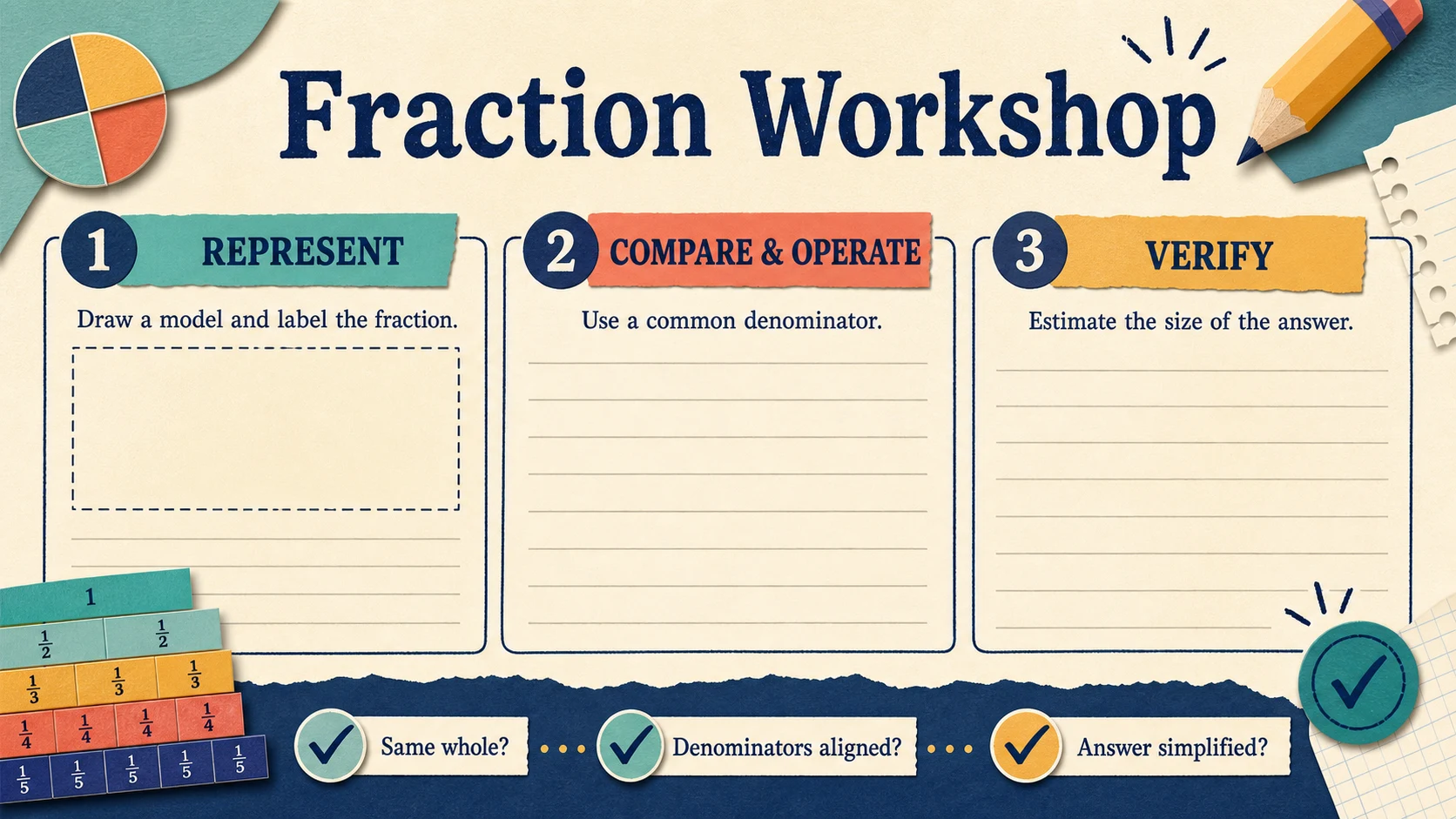
Brief delayed checks show whether the learner can retrieve the idea without the original model beside it.
| Review point | Suggested task | Decision |
|---|---|---|
| End of the lesson | Correct one error and solve one similar problem | Confirm that the immediate correction makes sense |
| 1–2 days later | Solve two to four mixed fraction problems | Note which ideas return without prompting |
| About one week later | Revisit one item from each practiced skill | Look for retention across different problem forms |
| Two or more weeks later | Include fractions in a short mixed review | Decide whether continued review or new instruction is appropriate |
This is a practical schedule, not a sourced universal timetable. Shorten or lengthen the intervals according to the learner’s observed retrieval and local teaching plan. If a misconception returns, rebuild meaning before adding more repetitions. If performance remains accurate and explainable, reduce the frequency of review while continuing occasional mixed practice.
Limitations and an honest next step
This printable offers 22 easy-level exercises and a separate key. It can provide useful evidence about the specific fraction forms on the page, but it is not a complete assessment of fraction understanding. Written answers alone may not show whether a learner used a valid model, memorized a narrow rule, guessed, or received substantial help. The worksheet also should not be treated as proof of comprehensive standards alignment, guaranteed progress, or readiness for every subsequent fraction skill.
Keep a brief record of three things: what the learner solved independently, which representation helped, and which error—if any—reappeared. That record gives the next adult a clearer starting point than a score alone.
For the next session, return to the free worksheet and select two unfinished items plus one fresh example matching the learner’s main error. Then use the 4th Grade fractions topic guide to choose the next focused skill. If broader, sustained practice is appropriate, the 4th Grade Fractions Worksheet Pack contains 18 worksheets; use it selectively according to demonstrated need rather than assigning the entire pack at once.
Put it into practice
Use the guide with a real printable
Move from explanation to a short, observable practice task. Check the first item together, then adjust the next session from the learner's actual work.
See the 18-worksheet pack