Complete guide
How to teach and practise 4th grade division worksheets - standard theme (easy)
How to Use This 25-Item Division Worksheet
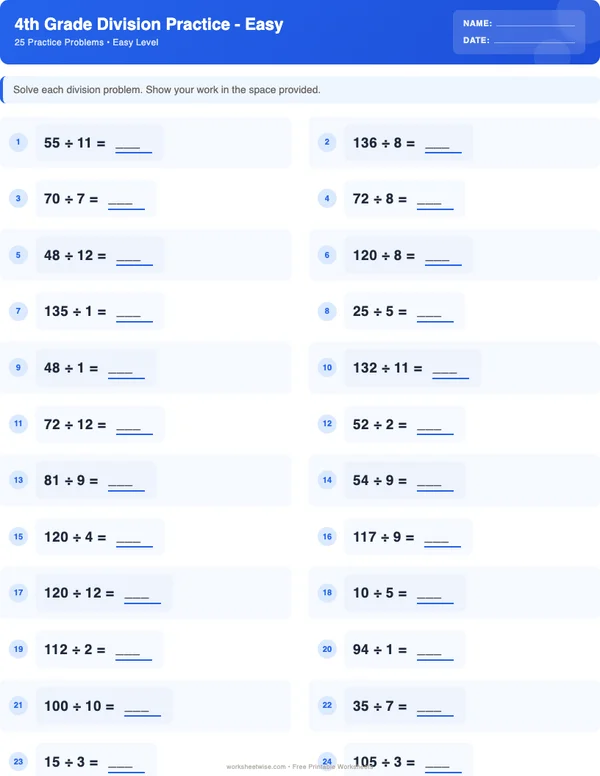
The free 4th Grade Division worksheet provides 25 easy-level exercises covering division facts, long division, mental math, and number sense. The learner is instructed to solve each problem and show work in the space provided. A separate printable answer key is included.
The short answer: begin with a brief multiplication-and-division review, model one problem, solve two or three problems together, and then release the learner to work independently in a manageable set. Check both answers and written reasoning. When errors appear, identify whether the difficulty involves multiplication facts, place value, the division procedure, or remainders before assigning more practice.
This printable can serve as introductory practice, reinforcement, homework, or a short homeschool lesson. It is not a complete division course or a diagnostic assessment. For the larger sequence from equal groups through multi-digit division, use the division topic guide.
Grade labels describe the intended practice level; local curricula and instructional sequences differ. A learner’s observed work should determine the pace, amount of support, and next activity.
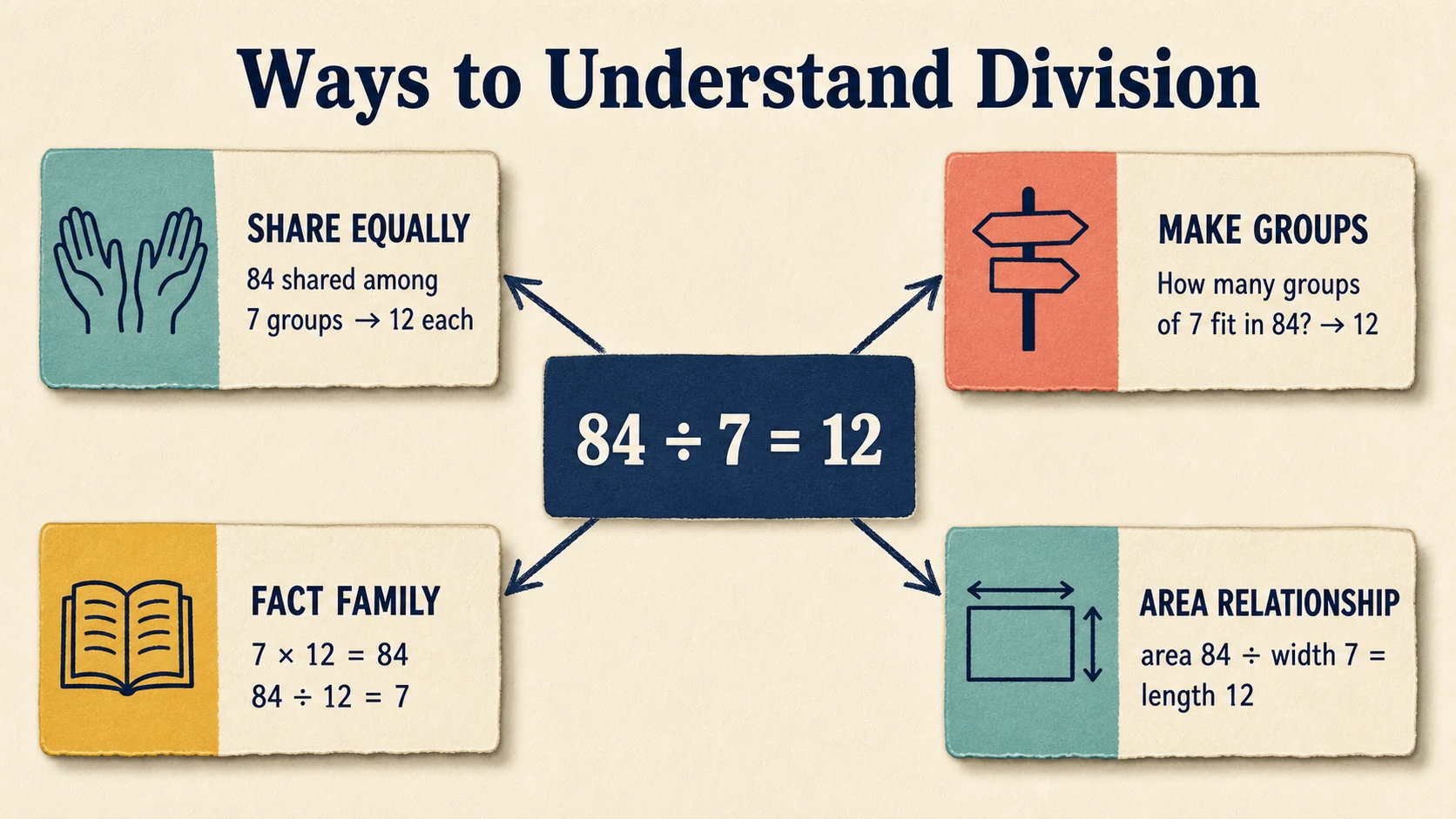
Preview, model, practice together, work independently, check, and revisit.
What This Worksheet Practises
This worksheet combines four connected skills:
- Division facts
- Long division
- Mental math
- Number sense
These skills should not be treated as isolated tricks. A learner can use multiplication to reason about a division fact, place value to estimate a quotient, and written work to confirm a mental calculation.
For example, a learner considering might reason that , leaving 16, and . Therefore, . That reasoning connects mental math, multiplication facts, and division.
The worksheet’s “easy” label describes its position within the WorksheetWise catalogue. It does not guarantee that every item will feel easy to every learner. A child who knows multiplication facts but has not yet organized long-division work may need procedural support. Another learner may write the steps correctly but lack a reasonable estimate of the answer. Those are different needs.
The Common Core State Standards for Mathematics describe grade-level work involving whole-number quotients with multi-digit dividends and one-digit divisors. That source provides broad instructional context. This guide does not claim that one printable comprehensively addresses every standard, interpretation, or local requirement.
Prepare the Learner and the Materials
Print the worksheet and, if needed, the separate answer key. Keep the key out of sight during practice so the learner’s work remains useful evidence. Provide a pencil, an eraser, and optional blank or grid paper. Grid paper can help align digits without changing the mathematics.
Before beginning, scan several items yourself. Notice their notation, the available workspace, and whether the learner is likely to solve them mentally or with a written method. Do not preteach every possible difficulty. A short launch leaves enough time to see what the learner can actually do.
Run a three-minute readiness check
Use two multiplication prompts and two division prompts, such as:
These are suggested prompts, not reported items from the worksheet. Ask, “How did you know?” The response reveals more than speed alone.
A learner who answers by saying, “Six times seven is 42,” is using the inverse relationship efficiently. A learner who draws 42 marks and circles groups of six may understand equal grouping but need a bridge toward more efficient reasoning. Both responses provide useful starting information.
Establish a reasonable-answer habit
Before formal calculation, ask for a rough range. For , a learner might notice that , so the answer should be a little more than 50. Estimation makes misplaced quotient digits and arithmetic slips easier to detect.
The IES guide on teaching mathematics to young children offers high-level guidance about using representations, mathematical language, and purposeful instruction. Although its scope is broader and younger than this exact worksheet, those principles support a clear launch: connect symbols to meaning and ask the learner to explain a strategy. IES did not evaluate this WorksheetWise printable.
Follow a Scannable Lesson Progression
A complete session might take the following shape. The times are flexible instructional suggestions, not a universal timetable.
| Lesson phase | Suggested action | Evidence to watch |
|---|---|---|
| Preview | Read the printed instruction and inspect the layout | Learner can state what the task requires |
| Activate prior knowledge | Review two multiplication facts and their related division facts | Learner connects division to an unknown factor |
| Model | Demonstrate one similar problem and check it | Learner can explain why multiplication verifies division |
| Guided practice | Solve two or three worksheet items together | Learner chooses and follows a workable method |
| Independent practice | Assign a small set, then pause | Accuracy, organization, strategy, and stamina |
| Check and discuss | Compare work with the answer key | Learner can locate and revise an error |
| Close | Record one strength and one next focus | Next practice responds to observed work |
| Retrieval | Revisit selected problems after a delay | Learner can reproduce the method with less support |
For a learner new to the written procedure, begin with perhaps five independent items and inspect the work before continuing. If the first five are accurate and clearly organized, release another set. If several reveal the same misconception, pause. Completing 25 repetitions of an unstable method can strengthen the wrong habit.
Model the Mathematics Before Independent Work
Use an example similar in skill and difficulty rather than completing one of the learner’s assigned items. Make your thinking visible, but keep the explanation concise.
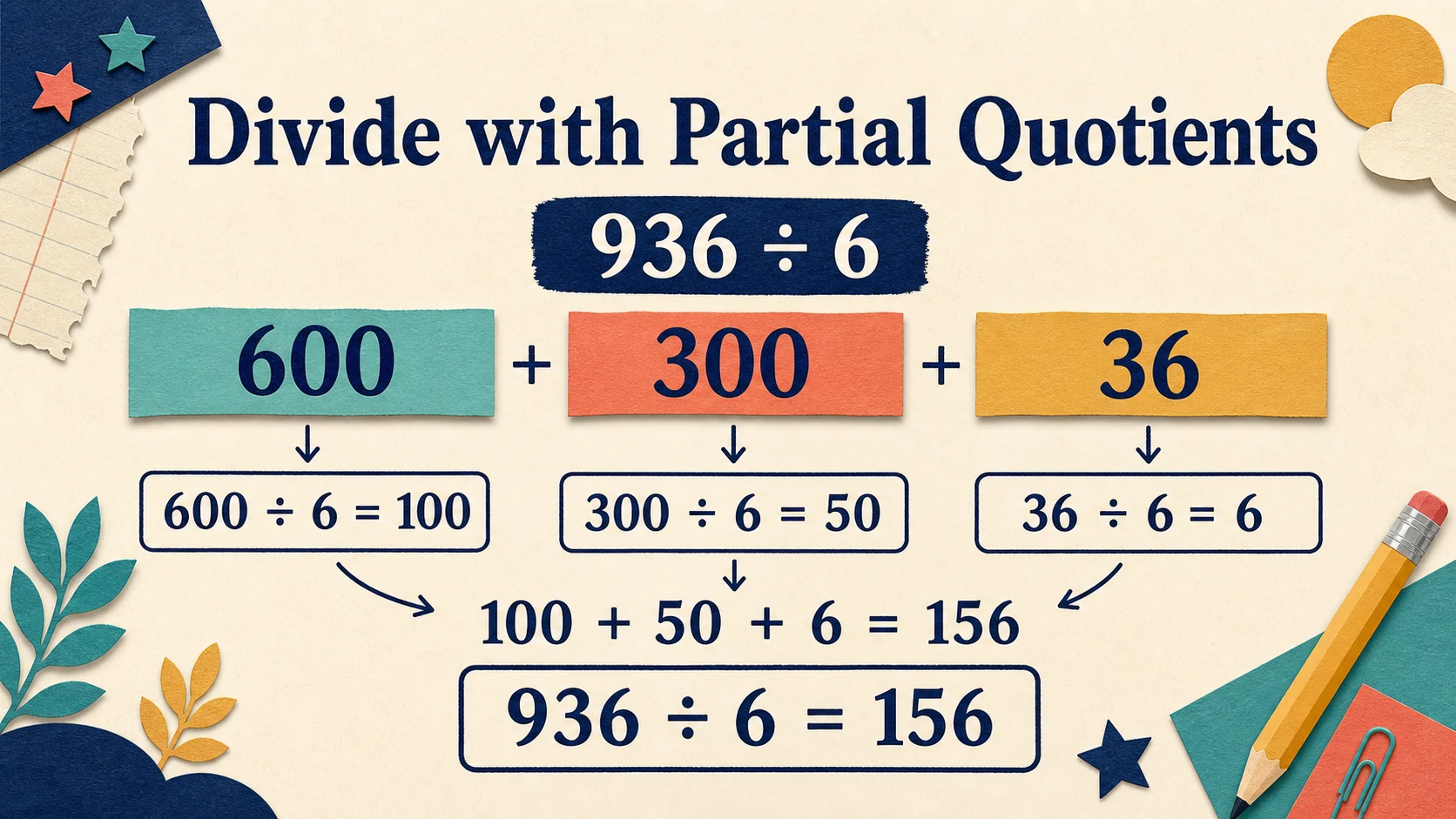
Estimate, divide, multiply, subtract, and verify the result.
Worked example 1: A division fact
Solve .
Think of the related multiplication fact:
Therefore:
Check:
The quotient is exactly 8. There is no remainder because the product of the quotient and divisor equals the dividend.
Worked example 2: Mental division by place value
Solve .
Break 84 into convenient parts:
Divide each part by 4:
Combine the partial quotients:
So:
Check:
This method reinforces number sense and provides a conceptual bridge to written division.
Worked example 3: Multi-digit division with no remainder
Solve .
First estimate. Since , expect a quotient near 50.
Using place value:
- Fifteen tens divided by 3 gives 5 tens.
- Bring the 6 ones into consideration.
- Six ones divided by 3 gives 2 ones.
Thus:
Check:
The answer 52 also fits the estimate.
Worked example 4: Division with a remainder
Solve .
We know:
Subtract:
Therefore:
Check using:
The remainder is valid because . A remainder must always be smaller than the divisor.
These four examples are fully checked, but they are teaching examples rather than a claim about the worksheet’s exact operands.
Move from Guided to Independent Practice
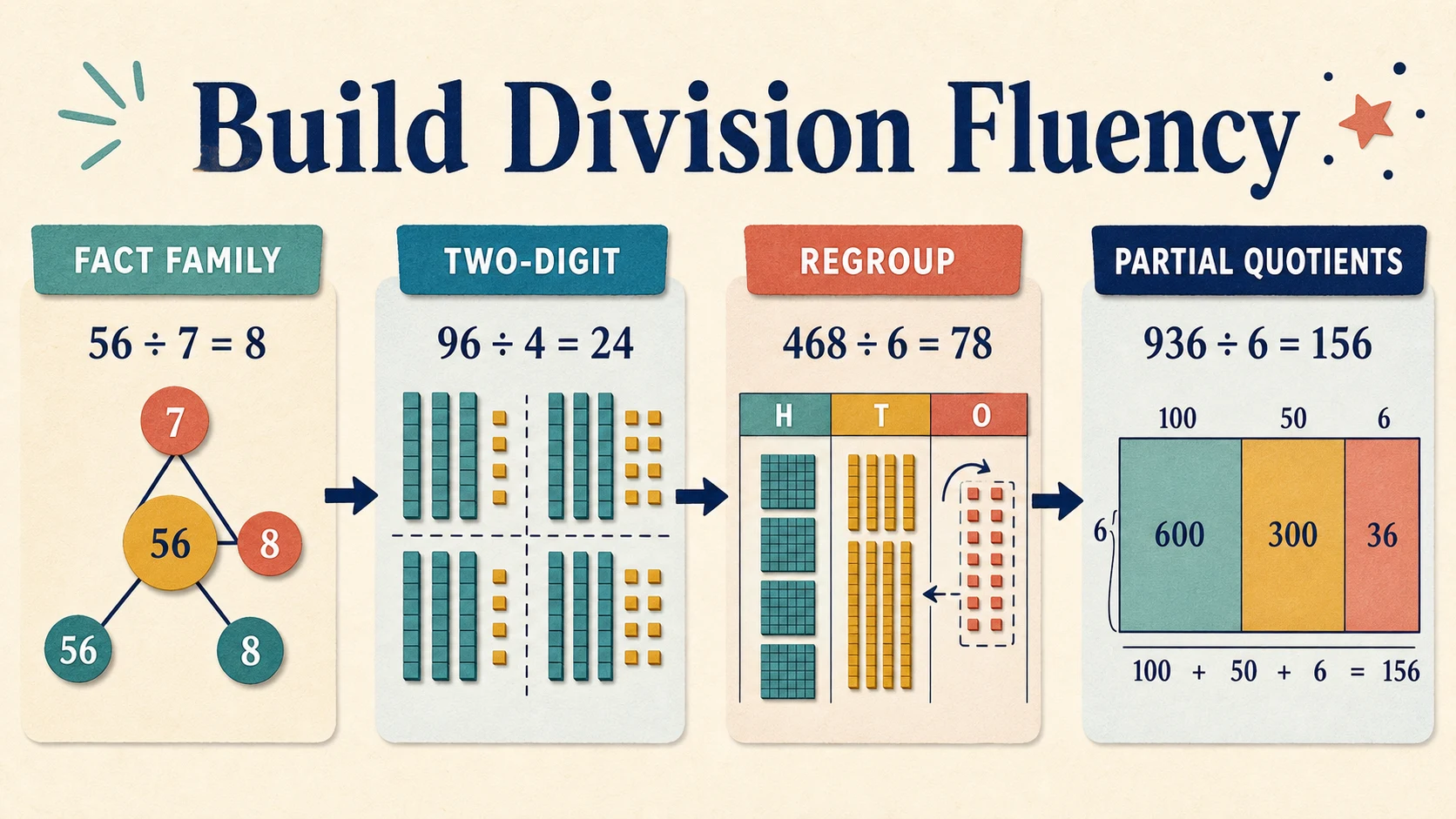
Keep the learner doing the mathematical thinking while the adult supplies prompts and structure.
Use “I do, we do, you do” briefly
During the model, the adult selects and explains a method. For the next item, ask the learner to direct the steps:
- “What should we estimate first?”
- “Which multiplication fact can help?”
- “Where does the quotient digit belong?”
- “What does the subtraction tell us?”
- “How can we check this result?”
Avoid turning guided practice into an adult demonstration with the learner merely supplying single facts. The learner should make the key decisions.
For the third item, reduce support. Ask the learner to solve while narrating. Intervene only if the work becomes mathematically unproductive or the notation hides the learner’s reasoning.
Release work in short sets
A practical first release is a small set of worksheet items. After the learner completes it, inspect:
- Whether answers are accurate
- Whether digits are aligned
- Whether multiplication and subtraction steps are legible
- Whether remainders are smaller than divisors
- Whether the learner can verify an answer
- Whether the pace reflects thinking rather than guessing
If the learner is consistently successful, continue toward the remaining items. If errors cluster, provide one targeted correction and then ask the learner to try a new item. Do not erase or rewrite all the work for the learner.
Preserve productive independence
Helpful prompts point attention without giving away the answer. “Check your multiplication” is more useful than “The quotient should be 24.” “Is the remainder smaller than the divisor?” is better than supplying the corrected remainder.
The IES practice guide for assisting students struggling with mathematics supports explicit and systematic instruction, clear mathematical language, visual representations, and ongoing attention to learner performance at a high level. In this lesson, those ideas can inform modeling and feedback. They do not establish a required script or show that this particular worksheet is suitable for every learner.
Adapt Support Without Changing the Division Skill
An adaptation should remove an avoidable barrier while preserving the intended mathematical work. Do not replace division with unrelated easier tasks simply because the learner hesitates.
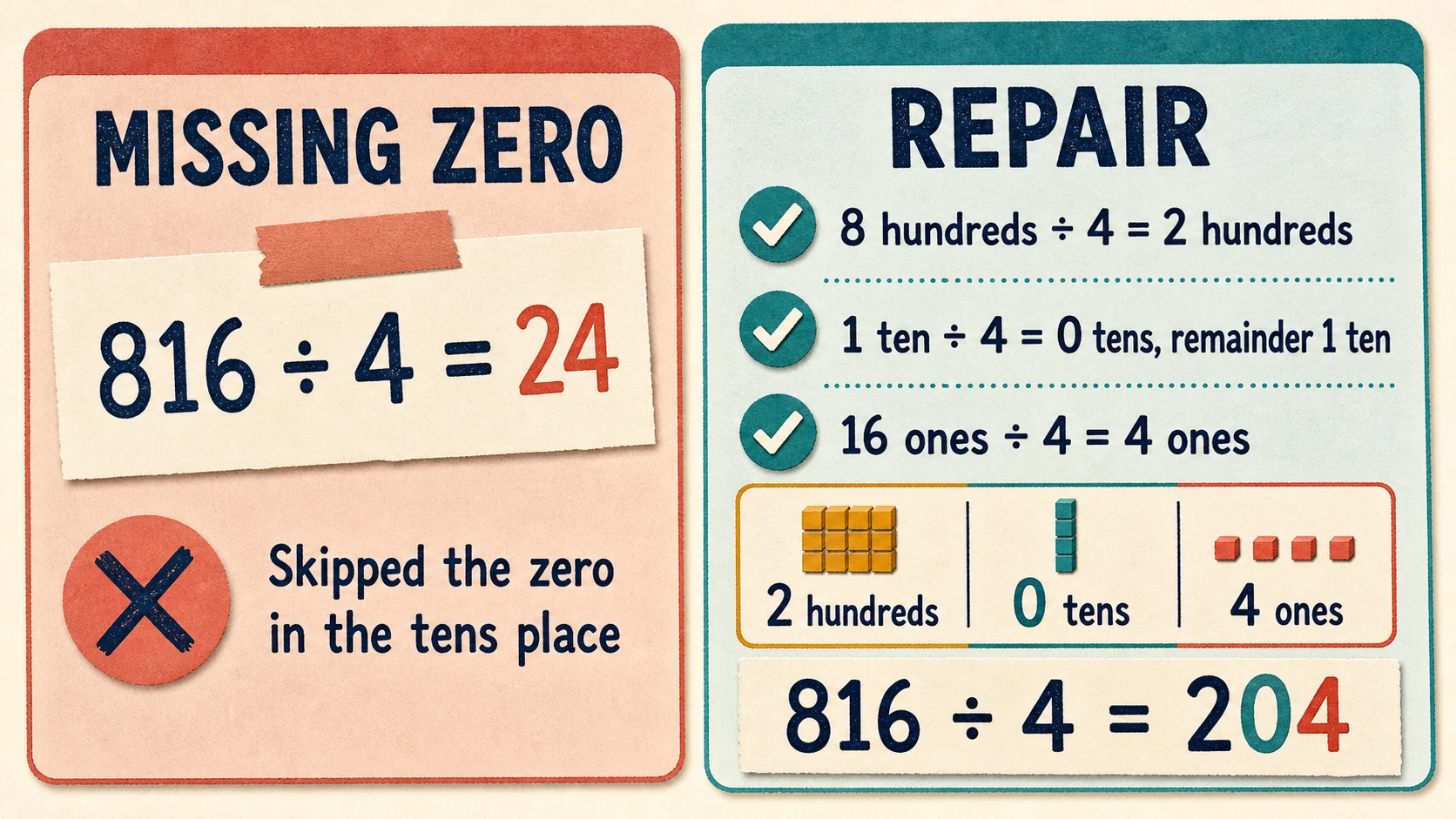
Adjust the amount, representation, or recording support while keeping division central.
When multiplication facts are slow
Allow a multiplication chart or a small fact-family reference during the first attempt. Ask the learner to locate the needed product rather than having the adult state it. Then rework one or two selected problems later without the reference.
You can also write a short sequence beside a problem. For , list , , and . The learner can reason that the quotient lies between 20 and 25 before finding 24.
This preserves division reasoning while reducing the burden of immediate fact recall.
When written work is disorganized
Provide grid paper or draw light place-value columns on separate paper. Ask the learner to write one digit per square. Use a straight edge to keep multiplication and subtraction aligned.
Do not treat untidy handwriting as proof of weak mathematical understanding. Instead, determine whether poor alignment is causing incorrect subtraction or misplaced quotient digits.
When the learner needs a concrete model
Use counters for a small related example. Show both interpretations:
- Equal sharing: distribute 12 counters equally among 3 groups.
- Equal grouping: make groups of 3 from 12 counters and count the groups.
Both give , but they answer different questions. Once the learner explains the model, return to the symbolic worksheet item.
When stamina is the main barrier
Fold the page or cover later rows so only a few items are visible. Offer a short pause between sets. The total skill remains division; only the presentation and workload timing change.
A learner does not need to finish all 25 items in one sitting for the work to be informative. Resume later if calculation quality is declining because of fatigue. Conversely, do not fragment the page automatically when a learner is working accurately and steadily.
Teach Boundary Cases Explicitly
Boundary cases expose whether a learner understands division or is following a memorized sequence without checking meaning.
A zero in the quotient
Consider:
Four goes into 4 hundreds once, into 0 tens zero times, and into 8 ones twice:
Check:
The zero in 102 is necessary. Writing 12 would give , which is far below 408. Place-value reasoning and estimation reveal the mistake.
A dividend smaller than the divisor
For a whole-number quotient with remainder:
There are zero complete groups of 5 in 3, with 3 left over. The remainder 3 is smaller than the divisor 5.
This case may not appear on the printable; it is useful as a quick conceptual check. If the learner’s local course has already introduced fractions or decimals as quotient forms, the expression may be represented differently. Follow the notation used in that course.
An exact quotient that looks like a remainder problem
Consider:
Since:
the quotient is 24 with no remainder. A learner who writes has produced a remainder equal to the divisor. That remainder can form one more complete group, so the quotient must increase to 24.
A remainder in context
The numerical statement does not by itself determine what a real-world answer should say.
If 25 learners need vans holding at most 6 learners each, four full vans leave one learner without a place, so five vans are needed. If 25 stickers are shared equally among 6 learners with unused stickers set aside, each learner receives four and one remains. Context determines the interpretation.
Because this printable is described as division practice rather than specifically as a word-problem set, use contextual extensions only after the learner can calculate the quotient and remainder.
Interpret Errors Before Assigning More Problems
A wrong answer is the beginning of the analysis, not the diagnosis.
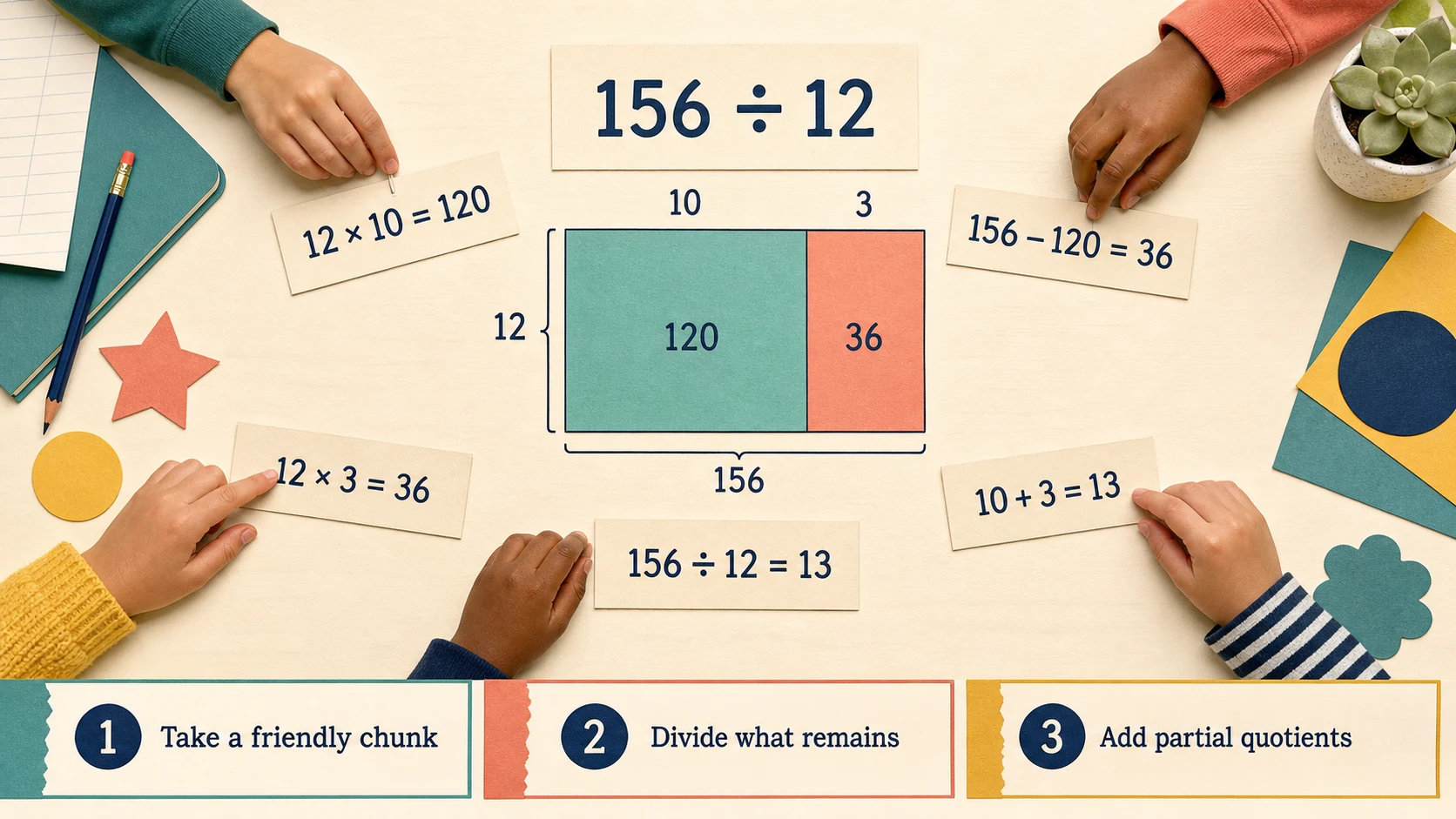
Estimate, locate the first incorrect step, revise it, and verify with multiplication.
Fact error
Example:
If the learner checks , the mismatch shows that the division fact is incorrect. Ask for the unknown-factor equation:
The needed factor is 9, so .
Respond with a brief fact-family review, then return to division. Requiring an entire page of multiplication may be unnecessary if the error was isolated.
Place-value error
A learner may write:
The digits suggest that the learner found 5 tens and 2 ones but inserted an unnecessary zero. Ask the learner to read the answer aloud and estimate. Five hundred two cannot be reasonable because is about 1,500, not 156.
Respond by representing 156 as 15 tens and 6 ones, then reconstruct 52.
Procedure without meaning
A learner may recite “divide, multiply, subtract, bring down” yet be unable to explain what a quotient digit represents. Ask:
- “Is this digit tens or ones?”
- “What amount have you divided so far?”
- “What does this subtraction remove?”
- “What remains to be divided?”
If explanations break down, return to partial quotients or a place-value model. The mnemonic may organize steps, but it cannot replace understanding.
Invalid remainder
Suppose a learner records:
The remainder 10 is greater than the divisor 6, so another group can be made. Since , the corrected result is:
Check:
Respond by teaching the boundary rule: .
Isolated arithmetic slip
A learner might select the correct method but subtract incorrectly. Have the learner identify the first line where the work stops being true and revise from that line. Requiring a full conceptual reteach after one subtraction slip would not match the evidence.
Use the Answer Key Responsibly
The separate answer key allows an adult to check work efficiently, but it should not replace mathematical verification.
First, solve or inspect any item that appears ambiguous before marking it. Then compare the learner’s final answer with the key. If they differ, read the written work from the beginning and locate the first incorrect step.
For a quotient with remainder, verify:
Also confirm that the remainder is nonnegative and smaller than the divisor.
Marking only the final answer can hide useful distinctions:
- Correct answer and sound method
- Correct answer after an unrecorded mental strategy
- Correct answer produced by a flawed method that happened to work
- Incorrect answer after mostly sound reasoning
- Incorrect answer caused by a fact, place-value, subtraction, or remainder error
Invite the learner to correct selected errors in a different pencil color. The correction should show the changed reasoning, not merely copy the key. If the learner cannot explain why the key’s result works, model a check with multiplication and return the item later.
If you suspect a printing or key error, verify the calculation independently. An answer key is a checking aid, not an authority that overrides arithmetic.
Decide What to Do After the Worksheet
Use a simple evidence-based decision rather than one score cutoff.
Continue within the same level
Stay with comparable practice when the learner:
- Understands the task but makes several correctable fact or recording errors
- Needs prompts to check answers
- Produces valid reasoning inconsistently
- Loses accuracy mainly as the set becomes longer
Select a few problems for correction and use the 4th Grade math worksheet hub to locate related practice. Avoid assigning an identical full page immediately unless the learner needs and tolerates that amount.
Add targeted support
Return to multiplication relationships, place-value models, or partial quotients when errors share a clear cause. Keep the next lesson narrow: model one example, guide one, and test transfer on one new problem.
The 4th Grade worksheet hub can help coordinate division practice with the learner’s broader work, but the observed division errors should still determine the immediate focus.
Move to broader or more varied division work
Move forward when the learner solves the items accurately, records enough work to make reasoning visible, catches slips through checking, and handles remainders appropriately. Success is stronger when it persists on a delayed attempt, not only during the original lesson.
The 4th Grade Division Worksheet Pack contains 18 worksheets and can provide a larger practice set. Choose from it selectively; the catalogue count and price do not establish which page should come next for a particular learner.
Schedule Retrieval Instead of One-Time Completion
Retrieval means asking the learner to reconstruct the method after some time has passed, without simply rereading completed work.
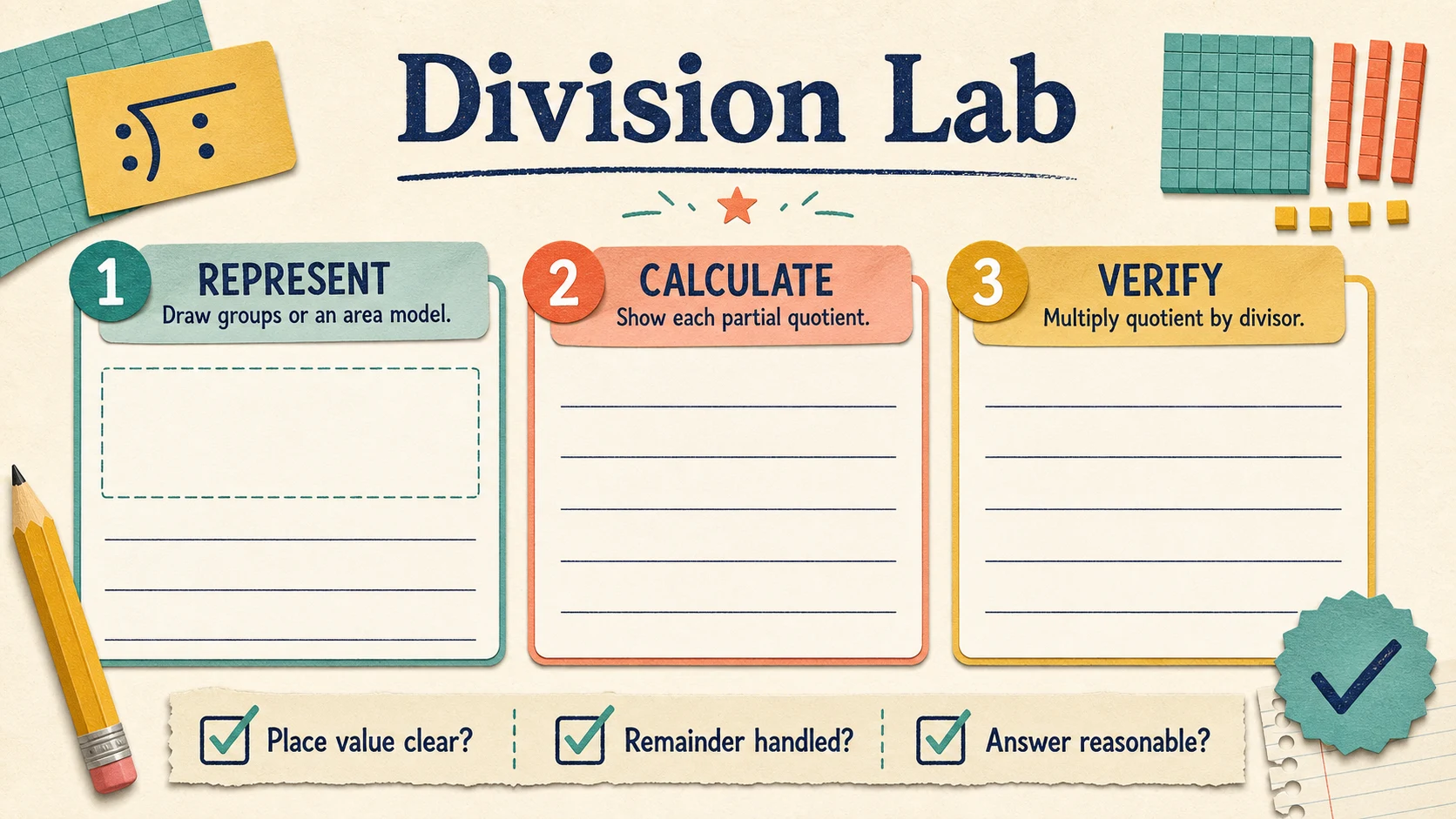
Revisit a small, mixed selection after increasing delays and adjust from the learner’s response.
A practical schedule might be:
| Time | Suggested retrieval task |
|---|---|
| End of the lesson | Recheck one answer using multiplication |
| Next practice day | Redo one fact item and one written-division item without looking back |
| Several days later | Solve three mixed problems, including one with a remainder if appropriate |
| One or two weeks later | Complete a brief mixed review or a fresh generated set |
This is an instructional suggestion, not a sourced or universal timetable. Shorten the interval if the method disappears completely. Lengthen it when the learner recalls the process accurately and explains it independently.
Do not use only the easiest previously completed items. Include one item that required correction, one that was originally secure, and one fresh problem. That combination checks both repair and transfer.
Free worksheet generators can supply new numbers so the learner must retrieve the strategy rather than remember a page position or previous answer.
Limitations and the Honest Next Step
This worksheet offers 25 easy-level division exercises with an answer key. It can provide useful evidence about division facts, long division, mental math, and number sense. It cannot by itself establish complete mastery, explain every error, cover the entire division progression, or guarantee readiness for a particular local assessment.
Performance may also depend on familiarity with notation, multiplication recall, place-value understanding, attention, and the amount of prompting provided. Record the conditions under which the learner worked. “Solved independently and checked with multiplication” is more informative than a percentage alone.
Use grade and difficulty labels as planning signals, not rigid judgments about a learner. Local sequences differ, and support should respond to the work in front of you.
The most useful next action is to print the free 4th Grade Division worksheet, teach it in short sets, and save two corrected items for delayed retrieval. After that review, use the broader division topic guide to choose the next skill instead of automatically assigning a harder page.
Put it into practice
Use the guide with a real printable
Move from explanation to a short, observable practice task. Check the first item together, then adjust the next session from the learner's actual work.
See the 18-worksheet pack