Complete guide
How to teach and practise 4th grade decimals worksheets - standard theme (easy)
How to use this 22-item decimals worksheet
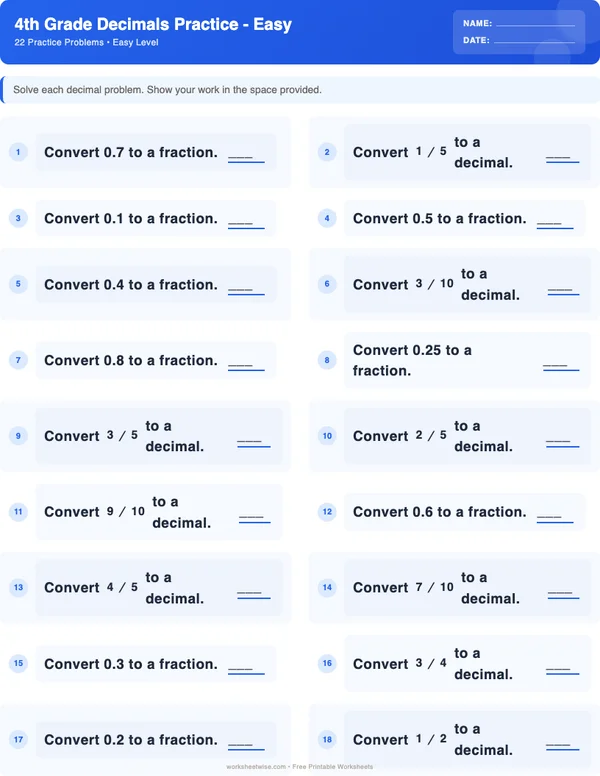
The free 4th Grade Decimals worksheet is an easy-level printable for practicing decimal operations, fraction-decimal conversion, and number sense. It contains 22 exercises, asks learners to show their work, and includes a separate answer key.
For a productive lesson, preview the page, model one example of each unfamiliar task type, complete a small group of items together, and then release the learner to work independently. Do not require all 22 items in one sitting if the work shows that understanding is fading. Accuracy, written reasoning, and the kinds of errors made should determine the pace.
Grade labels describe the intended practice level, and local instructional sequences differ. This worksheet may be introductory practice for one 4th Grade learner and review for another. It should support—not replace—the sequence used by the learner’s school, homeschool curriculum, or tutor.
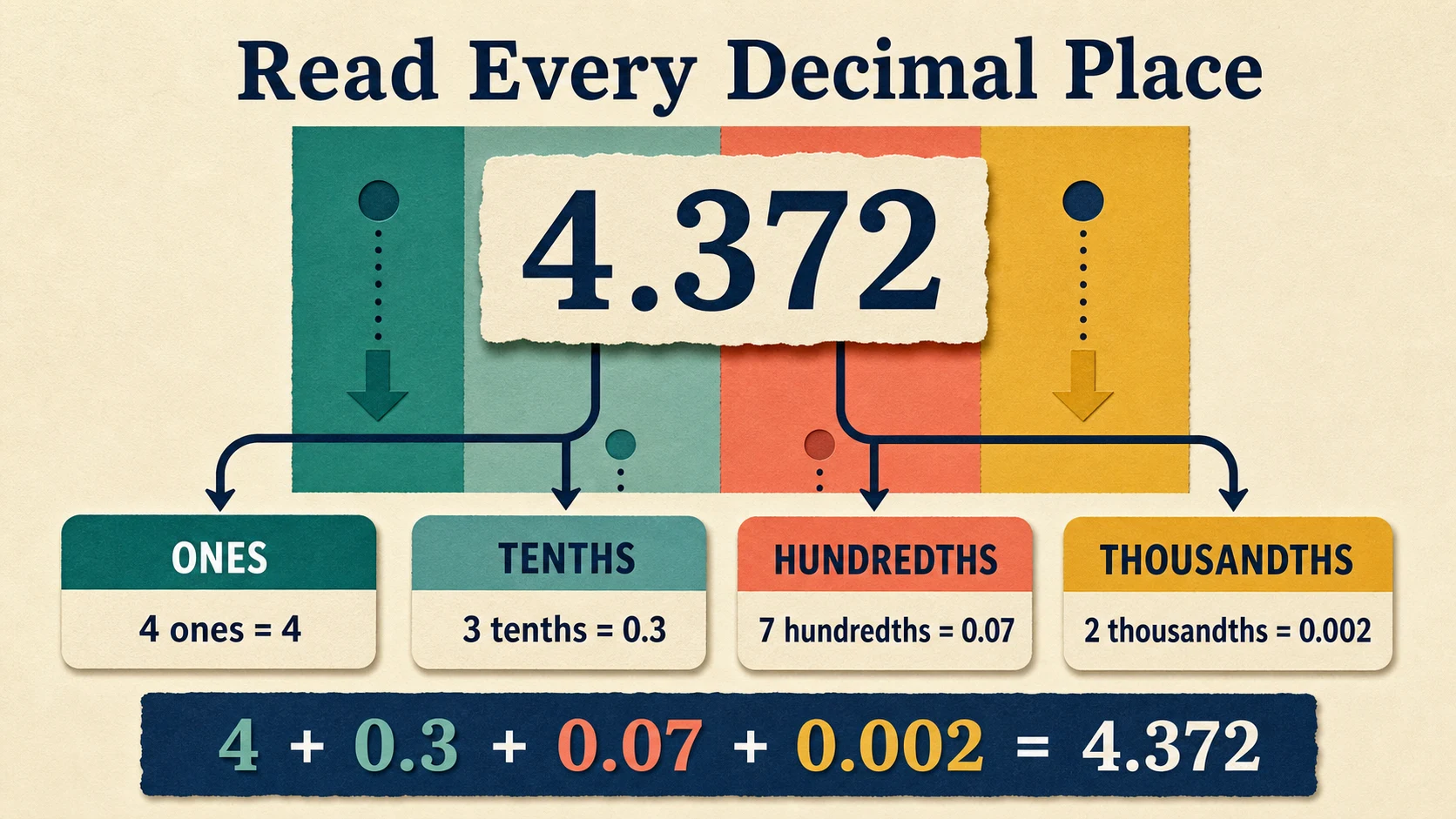
Preview, model, guide, release, check, and revisit.
Know exactly what the worksheet covers
According to the catalogue, this printable includes conversion, addition, subtraction, and multiplication of decimal numbers. Its named skills are decimals, decimal operations, fraction-decimal conversion, and number sense. The directions are simple: solve each decimal problem and show the work in the space provided.
That description sets useful boundaries. The worksheet can provide focused written practice, but it is not identified as a complete decimal unit, a diagnostic assessment, or a comprehensive standards-alignment document. It also does not cover every skill listed in the broader decimals catalogue, such as all four operations, rounding, and every possible comparison task.
For the larger learning sequence, use the Decimals topic guide. That guide places this printable within work involving place value, fractions with denominators of 10 and 100, decimal notation, comparison, and later decimal computation. Adults looking across subjects can also visit the 4th Grade worksheet hub or narrow the collection through the 4th Grade Math hub.
The official Common Core State Standards for Mathematics describe mathematical understanding and procedural skill as complementary. In practical terms, a correct answer is useful evidence, but a learner’s explanation and written setup reveal whether the procedure rests on place-value understanding. This source provides broad standards context; it did not evaluate WorksheetWise or this particular printable.
Prepare a short, responsive lesson
Before giving the page to the learner, scan the problems and identify where the format changes. Mark the first conversion, addition, subtraction, and multiplication item for possible modeling. Keep the answer key out of the learner’s view during the initial attempt.
Useful optional materials include blank paper, a pencil, a ruler or index card for tracking across the page, a place-value chart, and drawings of tenths or hundredths grids. These supports do not need to appear in every lesson. Select them in response to what the learner actually does.
A practical lesson progression follows:
| Phase | Adult action | Learner action | Evidence to notice |
|---|---|---|---|
| Launch | Establish the meaning of tenths and hundredths | Read or represent one decimal | Names each digit by place |
| Model | Solve one similar example aloud | Watch, then explain a step | Connects notation to value |
| Guided practice | Share two or three worksheet items | Writes while explaining | Uses decimal points and placeholders accurately |
| Independent practice | Step back for a manageable group | Solves without prompts | Maintains the method across items |
| Check | Compare work with the key | Locates and repairs differences | Explains the source of an error |
| Retrieval | Revisit selected items later | Solves from memory | Retains the idea after a delay |
This table is an instructional suggestion, not a universal timetable. A learner who completes the guided work accurately may move quickly to independence. A learner who guesses, copies steps without explanation, or repeats the same place-value error needs another model or representation before doing more items.
Establish the starting point
Use one brief prompt before teaching: ask the learner to write a decimal that represents seven tenths and explain the zero, digit, and decimal point. If the learner writes 0.7 and identifies 7 as the tenths digit, proceed. If not, draw a whole divided into ten equal parts and shade seven parts.
Avoid turning the launch into a long oral quiz. Its purpose is to choose the amount of support, not to assign a label to the learner.
Set expectations for written work
Tell the learner that “show your work” means leaving enough evidence to reconstruct the thinking. Depending on the item, that might be:
- an equivalent fraction;
- vertically aligned decimal numbers;
- a regrouping mark;
- repeated addition for a multiplication item; or
- a short place-value statement.
A row of answers with no setup may conceal a sound mental method, but it also makes an error difficult to interpret. Ask for one visible step whenever the operation or conversion is not immediately obvious.
Model the mathematical thinking
Use examples similar in skill and difficulty to the worksheet rather than completing its actual first items for the learner. The examples below are independently checked models; they are not presented as copies of the 22 printable problems.
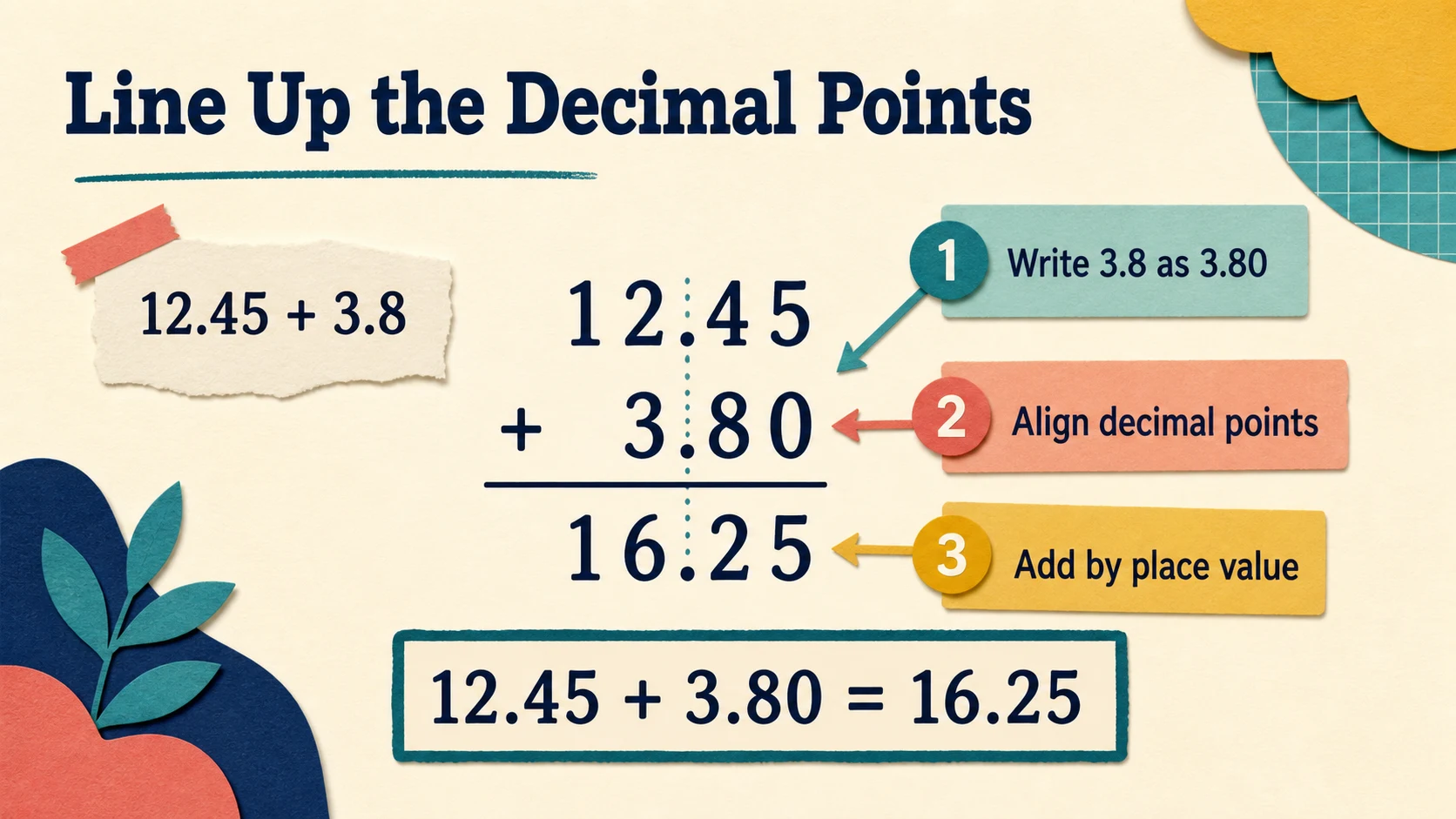
Name the place value, show the operation, and verify the result.
Worked example 1: convert tenths to a decimal
Convert to decimal notation.
Because the denominator is 10, the numerator names tenths:
The 7 belongs in the tenths place. The zero shows that there are no whole units.
Check the result by renaming both quantities in hundredths:
and
Both forms represent the same amount, so 0.7 is correct.
Worked example 2: preserve a placeholder
Convert to decimal notation.
The denominator is 100, so the numerator must occupy the hundredths place:
The zero in the tenths place matters. Writing 0.9 would mean nine tenths, or , which is ten times the intended value.
Check:
so 0.09 represents nine hundredths.
Worked example 3: add by place value
Find .
First write 1.2 as 1.20. This does not change its value:
Hundredths: . Tenths: . Ones: . Therefore,
Check with the inverse operation:
The subtraction returns the starting addend, confirming the sum.
Worked example 4: subtract across zero
Find .
Align the decimal points and regroup:
One whole is regrouped as ten tenths, and one of those tenths is regrouped as ten hundredths. Then hundredths, tenths, and whole.
Check by addition:
The difference is therefore 1.32.
Worked example 5: multiply through equal groups
Find .
Three groups of four tenths can be written as repeated addition:
It can also be checked through fractions:
Both methods give 1.2. This model keeps the focus on the value of the decimal instead of treating the decimal point as a mark to move mechanically.
Move from guided to independent practice
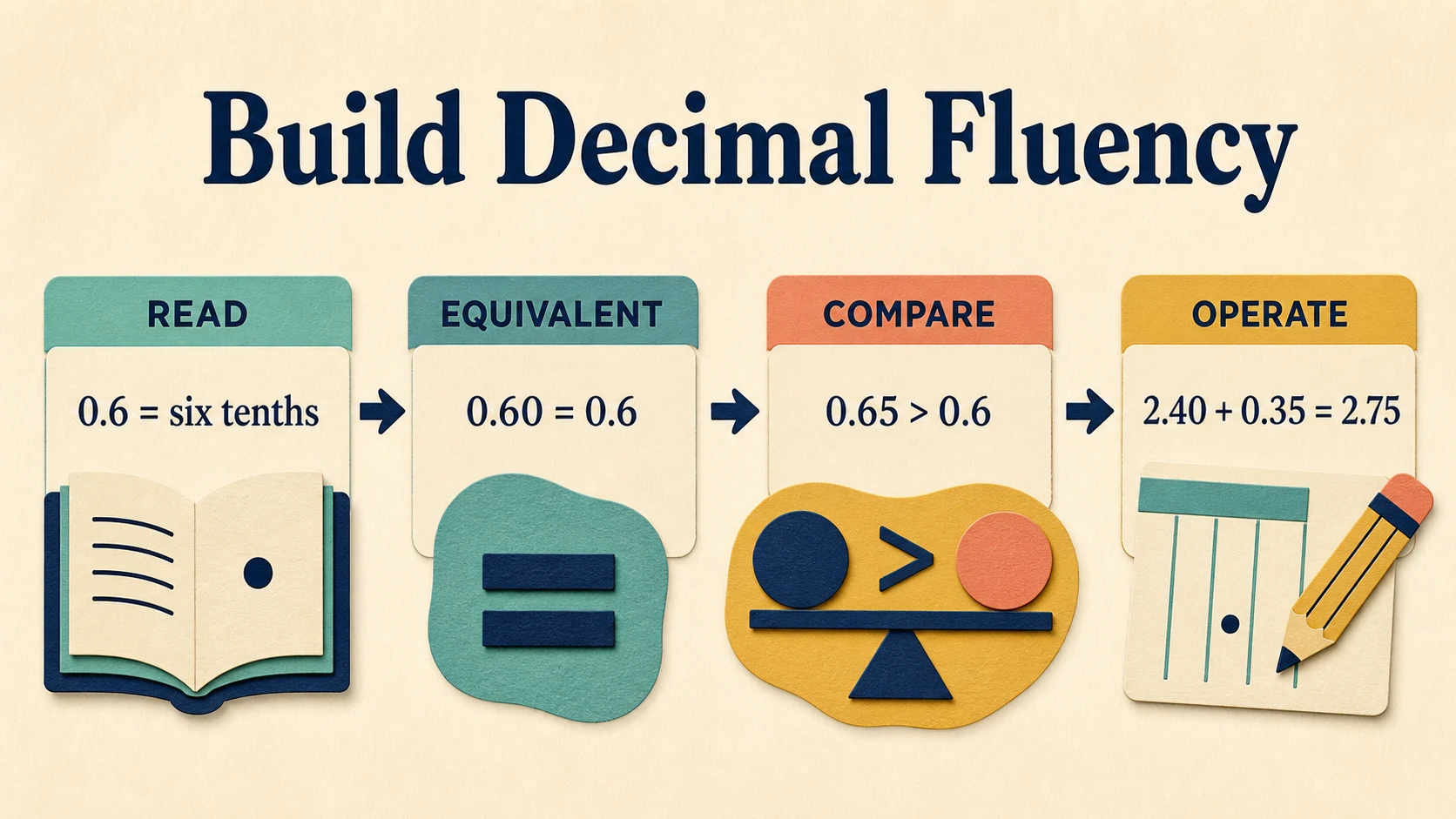
During guided practice, prompts should expose thinking without supplying the result.
Use a model-prompt-release sequence
During the model, the adult does the writing and explains each decision. During the next item, invite the learner to direct the writing. Useful prompts include:
- “Which place does this digit represent?”
- “Where should the decimal points line up?”
- “Does a zero preserve an empty place here?”
- “Which operation could check this answer?”
- “Is the result larger or smaller than the starting number, and does that make sense?”
For the following item, reverse the roles: the learner writes, and the adult asks only when needed. Once the learner completes two or three items with a stable method, stop prompting and assign a small independent set.
Prompts should decrease as control transfers to the learner. Repeating a prompt before every item can create dependence even when the learner already understands the mathematics.
Divide the 22 items by evidence, not habit
A reasonable first independent set might contain four to six items representing task types already modeled. Check that set before assigning the remainder. This pause helps distinguish an isolated slip from a repeated misunderstanding.
Continue when the learner:
- sets up the problems independently;
- preserves place value;
- explains at least one result; and
- catches or repairs a small error after checking.
Pause when the learner repeatedly misaligns digits, confuses tenths with hundredths, changes a fraction incorrectly, or cannot explain a procedure that produced a correct answer. Return to one representative item. More repetitions of the same misunderstood procedure are unlikely to clarify it by themselves.
A confident learner may complete the whole page in one lesson. Another may use two or more sessions. The learner’s observed work should drive pacing; the catalogue does not prescribe a completion time.
Adapt support without changing the skill
Differentiation should make the target more accessible while preserving the underlying decimal work. Reading an item aloud, enlarging a place-value chart, or reducing the number attempted at once does not change the mathematical objective. Replacing decimal conversion with unrelated whole-number facts would.
Adjust representation, prompting, or workload while retaining the decimal target.
When the learner needs concrete support
Represent one whole as a flat, one tenth as a rod, and one hundredth as a small unit, following the modelling convention supplied in the catalogue teaching tips. A hundredths grid can serve the same purpose. For 0.36, shade 36 hundredths. For 0.4, shade 40 hundredths.
The IES guide for assisting elementary students who struggle with mathematics recommends systematic instruction, clear mathematical language, and well-chosen concrete or semi-concrete representations. Applied here, an adult might connect a shaded grid to 36/100 and then to 0.36. The guide supplies high-level instructional framing; it does not endorse this worksheet or prescribe an individual intervention.
Keep the representation tied to the written notation. If the learner builds 0.36, ask them to point to the 3 tenths, the 6 hundredths, and the matching digits.
When the learner understands but works slowly
Cover all but one row of the worksheet with blank paper. Give a smaller set, allow a break, and resume later. Preserve the original operation and numbers. Do not turn speed into the goal unless a separate curriculum objective calls for fluency work.
Slow, accurate work may indicate careful processing rather than weak understanding. Inspect the setup and explanations before deciding that additional teaching is necessary.
When the learner is ready for less support
Ask for a second representation or an inverse check on selected items. For example, after converting to 0.6, the learner can also write 0.60 and . After an addition problem, the learner can verify the sum by subtraction.
These extensions deepen the same skill. They should not become extra requirements for every item, especially if they distract from completing the assigned practice.
The earlier IES guide on teaching mathematics to young children concerns preschool, prekindergarten, and kindergarten rather than 4th Grade. Its broad emphasis on developmental progression and monitoring what children know can still inform an adult’s general stance, but it should not be treated as direct evidence about this worksheet or this grade-level lesson.
Teach the boundary cases explicitly
Decimals often look simple until a zero changes position or two numbers contain different numbers of digits. Use a boundary case when the learner’s work suggests a rule based on appearance rather than value.
Compare 0.4 and 0.36
A common incorrect claim is that 0.36 is greater because 36 is greater than 4 or because it has more digits. Rename 0.4 as 0.40:
In hundredths, the comparison is 40 hundredths versus 36 hundredths. Therefore,
The trailing zero in 0.40 does not change the value. By contrast, the placeholder zero in 0.09 does affect the digit’s place and cannot be removed to make 0.9.
Distinguish equal forms from unequal forms
These are equal:
These are not equal:
Five tenths is fifty hundredths; five hundredths is only five hundredths. A learner who confuses these forms needs place-value representation, not merely a reminder to “watch the zero.”
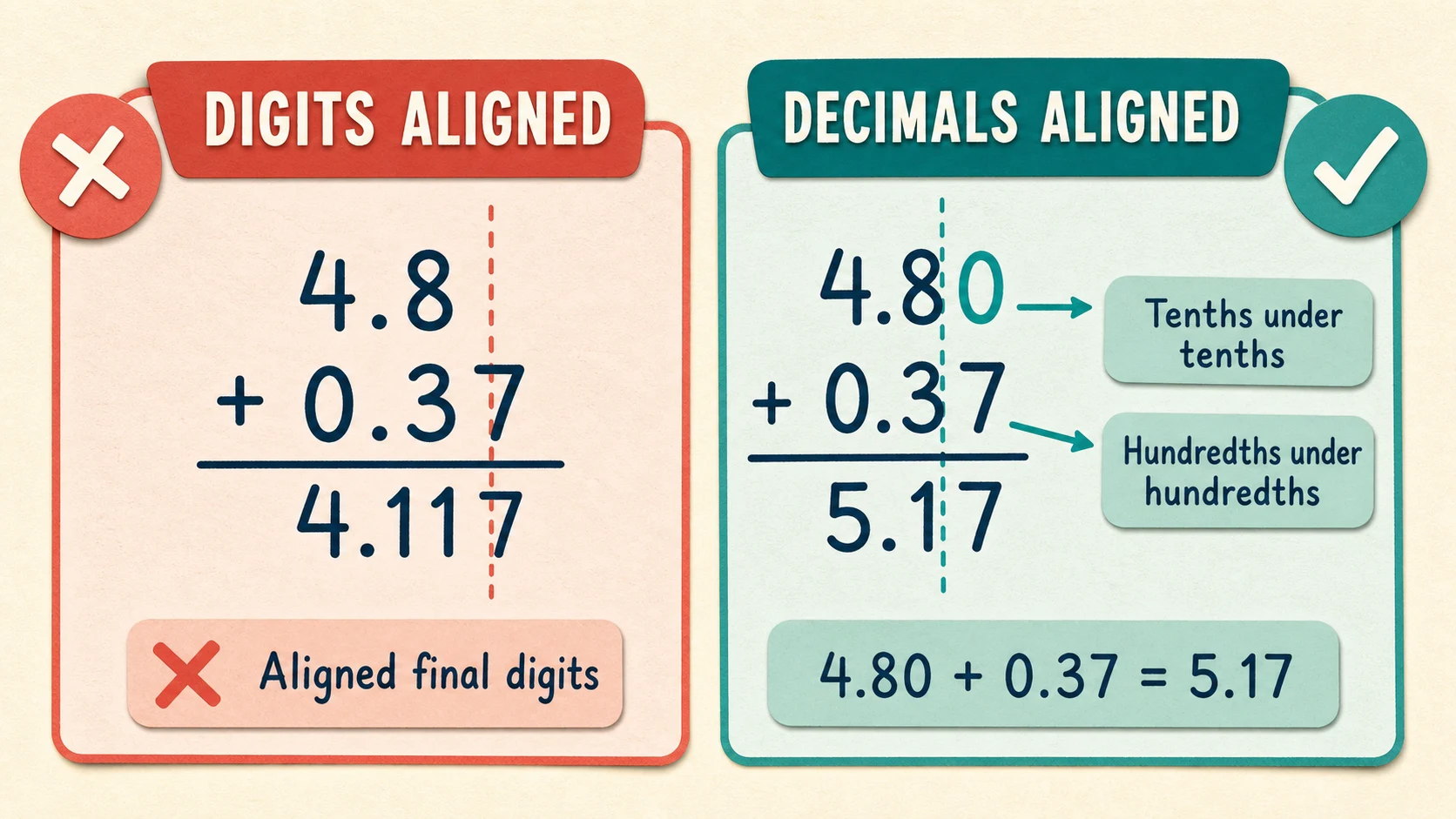
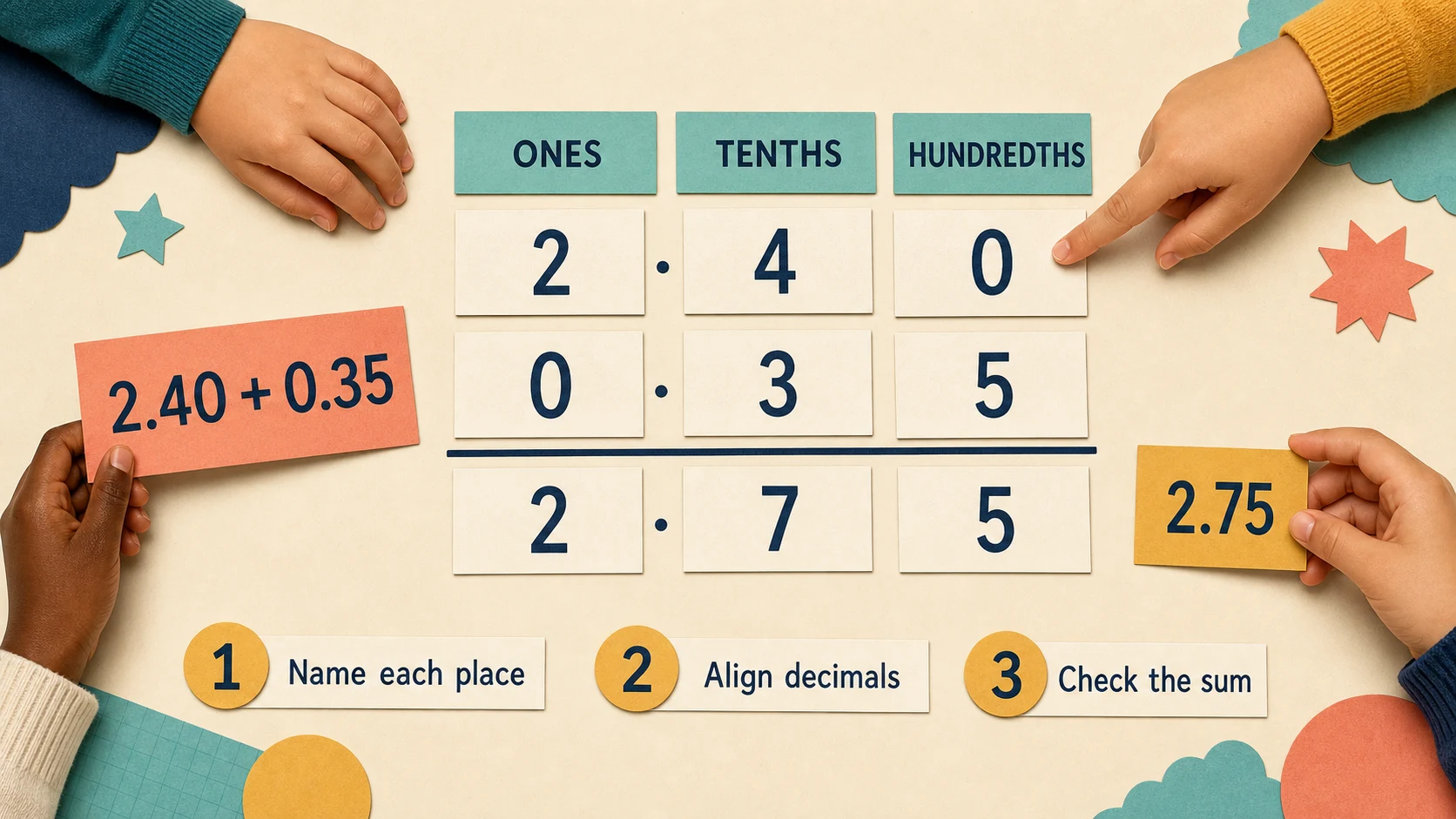
Also distinguish decimal-point alignment from right-edge alignment. In addition and subtraction, align places:
not the final nonzero digits. Writing the addends as hundredths makes the structure visible:
Check by subtraction:
Interpret errors before assigning more practice
A wrong answer is a starting point for analysis. Compare the incorrect answer, written setup, and learner explanation. Then select the smallest response that addresses the cause.
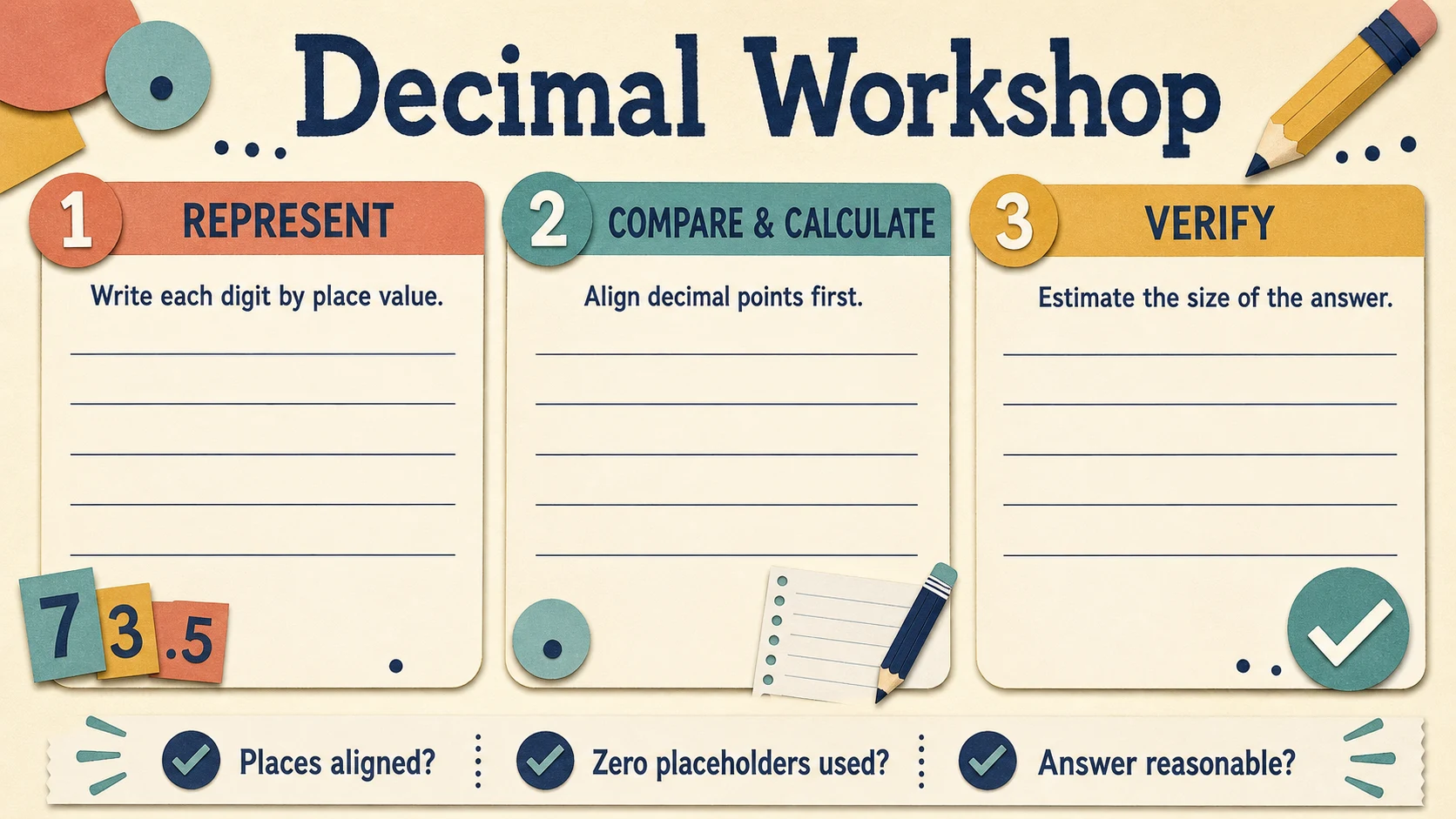
Locate the first incorrect decision, name it, repair it, and verify the revision.
Separate slips from misconceptions
An isolated copying error followed by several correctly structured problems is probably a slip. Ask the learner to correct it and continue.
A repeated pattern points to an underlying misconception:
| Observed work | Possible interpretation | Useful response |
|---|---|---|
| Hundredths treated as tenths | Place 8 on a ones-tenths-hundredths chart | |
| More digits assumed to mean greater value | Rename 0.4 as 0.40 and compare hundredths |
|
| Decimal points drift in addition | Digits aligned by edge rather than place | Draw a vertical guide through the decimal points |
| Operation sign ignored or subtraction not understood | Estimate first, then model regrouping and check by addition | |
| Whole-number digits combined without considering value | Use repeated addition or | |
| Correct answers with no explainable method | Procedure may be copied or guessed | Ask for one representation or inverse check |
These are interpretations to investigate, not diagnoses. Confirm them by asking the learner to explain a fresh, similar example. One unusual answer is not enough to establish a stable misconception.
Use estimation as a reasonableness check
Before exact calculation, identify a broad expectation. Since subtracts a quantity less than 1 from 2, the answer should be greater than 1 and less than 2. That does not prove 1.32 is correct, but it quickly rejects 2.68.
For , three groups of an amount smaller than one can reasonably total a little more than one. An answer of 12 would be inconsistent with the size of the factors.
Check the answer key responsibly
The separate printable answer key allows efficient checking, but it should not replace looking at the learner’s work. First solve or inspect the item independently. Then compare the final answer with the key.
If the answers match, ask for an explanation on a small sample rather than every item. A correct result can come from sound reasoning, a mental calculation, a guess, or an unrecorded mistake that happened to cancel another mistake.
If the answers differ:
- Re-read the operation and copy the numbers carefully.
- Find the first line where the learner’s work departs from a valid method.
- Check the adult’s interpretation against the key.
- Recalculate using another method.
- Let the learner revise in a different color or on nearby paper.
Do not erase the original work immediately. The first attempt provides useful evidence about the point of confusion. Record corrections clearly enough that the learner can later identify the repaired step.
If an adult believes the answer key is inconsistent, verify the arithmetic independently before telling the learner that the key is wrong. A calculator may confirm a computation, but it will not explain a fraction-decimal relationship or expose a place-value misconception.
Decide what comes next
Use patterns across the page, not a single percentage or a universal cutoff. The catalogue provides an answer key but does not provide mastery thresholds.
Continue within this worksheet
Complete the remaining items when the learner shows stable place-value setup, mostly independent work, and the ability to correct isolated slips. If attention is declining, stop at a natural break and resume later.
Revisit the same skill
Choose two or three representative items when one error pattern repeats. Model a similar example, use a grid or place-value chart if helpful, and then return to an uncompleted worksheet item. Avoid restarting all 22 exercises unless the learner’s work shows that most task types were inaccessible.
Broaden or extend practice
After accurate, explainable work, move to the 4th Grade Decimals Worksheet Pack, which contains 18 worksheets and is listed at $4.79, or use the free worksheet generators to create additional practice suited to the current skill.
The pack offers more material, but additional volume is not automatically the right next step. Consult the broader topic guide when deciding whether to revisit fraction-decimal connections, compare values, or continue into other decimal work.
Schedule brief retrieval after the lesson
Finishing the printable once shows current performance. Later retrieval checks whether the learner can reconstruct the idea after time has passed.
Revisit a few representative items after increasing intervals.
A flexible review plan might be:
| Review point | Suggested task | What to observe |
|---|---|---|
| Next learning session | One conversion and one operation | Can the learner begin without a model? |
| Several days later | Two previously missed or similar items | Is the earlier error repaired? |
| About one week later | A mixed set of three or four items | Does the method transfer across task types? |
| During a later decimals unit | One conversion plus one computation | Is the knowledge still available? |
This is a practical scheduling suggestion, not a sourced universal timetable. Shorten or lengthen the interval according to the learner’s observed work and the local curriculum. Do not simply recopy the same answer from memory; change the numbers or select a parallel item so the learner must retrieve the method.
During review, provide less help than during the original lesson. If the learner cannot begin, offer one cue—such as “name the place of each digit”—and note whether that cue restores the method.
Keep the worksheet’s limitations in view
This printable provides 22 easy-level exercises in the named skills. It cannot by itself show everything a learner understands about decimals. Written items may not reveal how well the learner explains a representation, applies a decimal in an unfamiliar context, or retains a procedure over time.
The worksheet also includes multiplication even though local grade-level sequences may introduce or emphasize decimal operations differently. Use the learner’s curriculum to determine whether an item is new instruction, supported practice, or review. The presence of a skill on the page is not evidence that every learner should already perform it independently.
No worksheet guarantees progress, replaces professional educational judgment, or supplies child-specific guidance. When errors persist, document the exact task, the learner’s written response, the prompts already tried, and the result. That record is more useful to a teacher, tutor, or curriculum lead than a broad statement that the learner “doesn’t understand decimals.”
For the next lesson, download the free 4th Grade Decimals worksheet, preview its task changes, and select one conversion and one operation to model before the learner begins. After checking the work, use the Decimals topic guide to choose the next skill from the evidence on the page.
Put it into practice
Use the guide with a real printable
Move from explanation to a short, observable practice task. Check the first item together, then adjust the next session from the learner's actual work.
See the 18-worksheet pack