Complete guide
How to teach and practise 4th grade addition worksheets - standard theme (easy)
How to use this 25-item addition worksheet
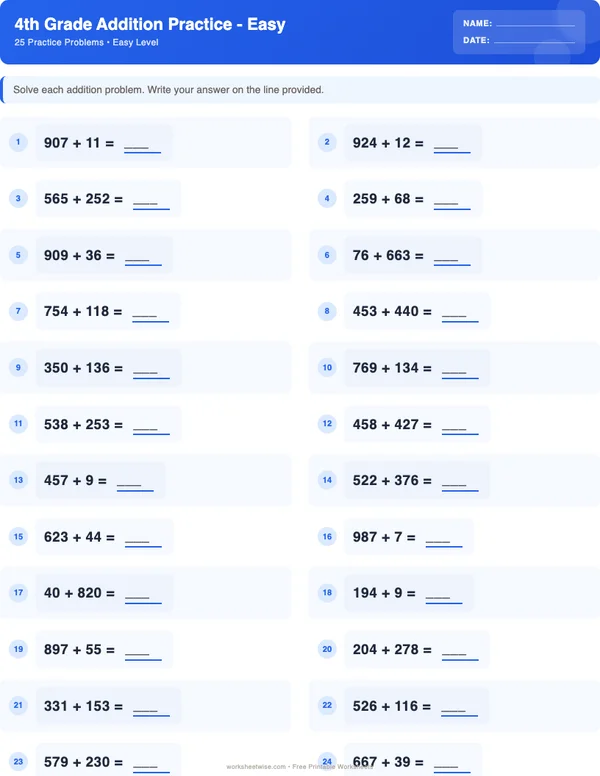
The free 4th Grade Addition worksheet provides 25 easy-level addition exercises, a line for each answer, and a separate printable answer key. Use it as focused practice in addition facts, mental math, number sense, and place value—not as a complete assessment of everything a fourth grader knows about addition.
A practical lesson is simple: preview a few items, model one comparable problem, solve two or three items together, assign a manageable set independently, and then examine the learner’s written work before deciding whether to continue. Correct answers matter, but the written digits, place-value alignment, regrouping marks, explanations, and error patterns provide more useful instructional information than a score alone.
Grade labels describe the intended practice level; local curricula and instructional sequences differ. The learner’s observed work should determine pacing. A learner who explains each step accurately can move through the page efficiently. One who repeatedly confuses place values needs a shorter practice set and more direct support, even if that means leaving part of the worksheet for another day.
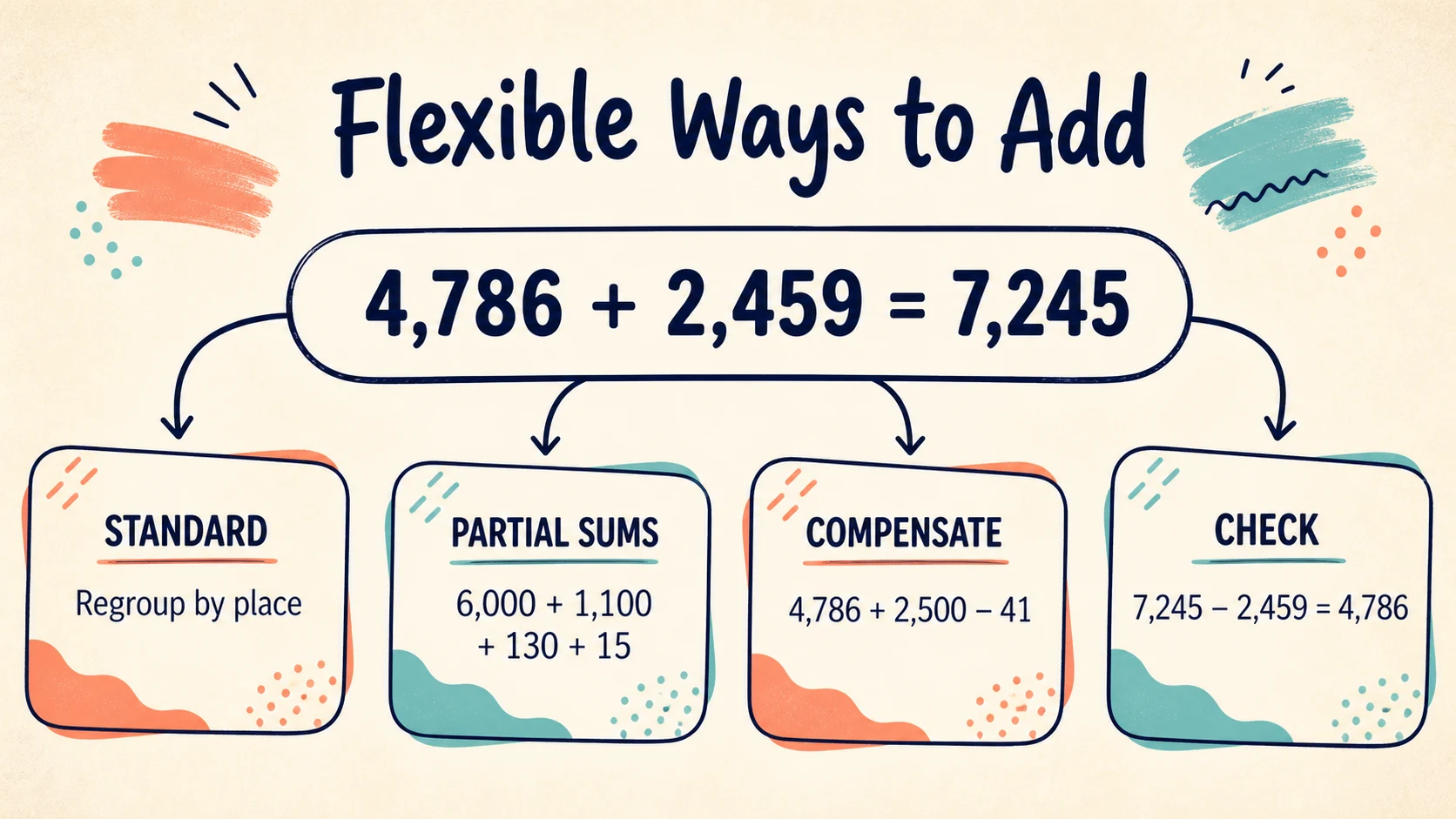
Move from a brief readiness check to modeling, guided practice, independent work, feedback, and later retrieval.
What this worksheet does—and does not—cover
The worksheet’s stated directions are: “Solve each addition problem. Write your answer on the line provided.” Its 25 exercises are categorized as easy-level fourth-grade practice. The catalogue identifies four skill areas:
- Addition facts
- Mental math
- Number sense
- Place value
That combination makes the printable useful for practice, homework, homeschool review, or a short classroom lesson. It may also reveal whether a learner has a dependable checking routine. For example, an adult can notice whether the learner estimates before calculating, keeps digits organized, or recognizes an answer that is much too large or too small.
The worksheet is not described as a comprehensive diagnostic, a timed-fluency measure, or a complete addition unit. A strong result does not establish mastery of every fourth-grade addition situation. A difficult result does not identify a learning condition or explain its cause. Fatigue, unfamiliar formatting, rushed work, weak fact recall, and place-value confusion can produce similar-looking errors.
The broader 4th Grade Addition topic guide covers the larger progression. Use that guide when you need to choose instruction before or after this printable instead of trying to turn one 25-item page into an entire curriculum.
The Common Core mathematics standards include fourth-grade work with fluently adding multi-digit whole numbers using the standard algorithm. That source provides high-level curricular context; it did not evaluate this WorksheetWise printable, and this guide does not claim comprehensive standards alignment.
Prepare the lesson before handing over the page
Preview the actual problems
Look over the worksheet before the learner begins. Identify the approximate number sizes, whether any problems appear to require regrouping, and how much writing space is available. Do not assume that every example in this guide matches an item on the page; the worked problems below are independently checked examples for modeling the same general skill.
Print or open the answer key separately. Keep it out of the learner’s immediate view during the first attempt. Also have blank paper available so cramped workspace does not become an arithmetic obstacle.
Choose a starting amount based on recent work:
- Use the full page when the learner already works accurately and sustains attention across comparable exercises.
- Begin with 8–10 items when the learner’s readiness is uncertain.
- Begin with 4–6 items when the learner has recently struggled with digit alignment, regrouping, or task stamina.
These are instructional suggestions, not universal time or workload rules. Pause when the work shows that the learner needs feedback.
Run a short readiness check
Before writing on the worksheet, ask two or three oral questions:
- “In 4,372, what value does the 7 represent?”
- “About how much is 2,190 + 3,810?”
- “What happens when the ones in an addition problem total more than 9?”
Listen for reasoning rather than polished vocabulary. A useful response might be, “The 7 is seventy,” “That sum is about six thousand,” or “I make another ten and put it in the tens column.”
If place values are unclear, briefly use a place-value chart or base-ten representation. If the learner understands the ideas but calculates slowly, proceed with a smaller set and allow sufficient thinking time.
Follow a clear lesson progression
The following sequence keeps the worksheet central while making room for explanation and correction.
| Phase | Adult action | Learner action | Evidence to notice |
|---|---|---|---|
| Launch | Read the directions and identify the operation | Restate what to do | Recognizes that every item requires addition |
| Estimate | Model a rough magnitude check | Predict a reasonable range | Notices answers that are implausibly large or small |
| Model | Solve one comparable example aloud | Watch, question, and explain a step | Connects regrouping to place value |
| Guided practice | Complete two or three worksheet items together | Supplies steps and records work | Uses support without merely copying |
| Independent practice | Assign a limited group of items | Solves without step-by-step prompting | Maintains accuracy and organization |
| Review | Compare work with the answer key | Locates and repairs differences | Can explain what changed |
| Retrieval | Revisit selected problem types later | Solves from memory on a fresh attempt | Retains the process after a delay |
Do not make the guided phase longer than the evidence requires. Likewise, do not move immediately to independent work because the learner nodded during the demonstration. Ask the learner to perform or explain a step.
The Institute of Education Sciences guide Teaching Math to Young Children offers broad guidance about helping learners connect representations, mathematical language, and ideas. Although its stated age range is younger than fourth grade, that high-level framing can still inform a brief return to objects or drawings when place-value meaning is weak. It does not provide a review of this worksheet.
Model addition as a place-value process
Worked example 1: no regrouping
Use a clear vertical setup:
  2,413
+ 3,526
-------
  5,939
Check each place:
- Ones:
- Tens: , representing 30
- Hundreds: , representing 900
- Thousands: , representing 5,000
Therefore, .
Check by subtraction:
A rough estimate also supports the answer: is about , so 5,939 is reasonable.
This example isolates alignment. Say, “I am adding ones to ones, tens to tens, and so on.” Avoid presenting the columns as disconnected digits.
Worked example 2: regrouping from ones
    1
  1,248
+ 2,137
-------
  3,385
Work from right to left:
- Ones: . Write 5 ones and regroup 1 ten.
- Tens: tens.
- Hundreds: hundreds.
- Thousands: thousands.
Therefore, .
Check by decomposing:
The two methods agree.
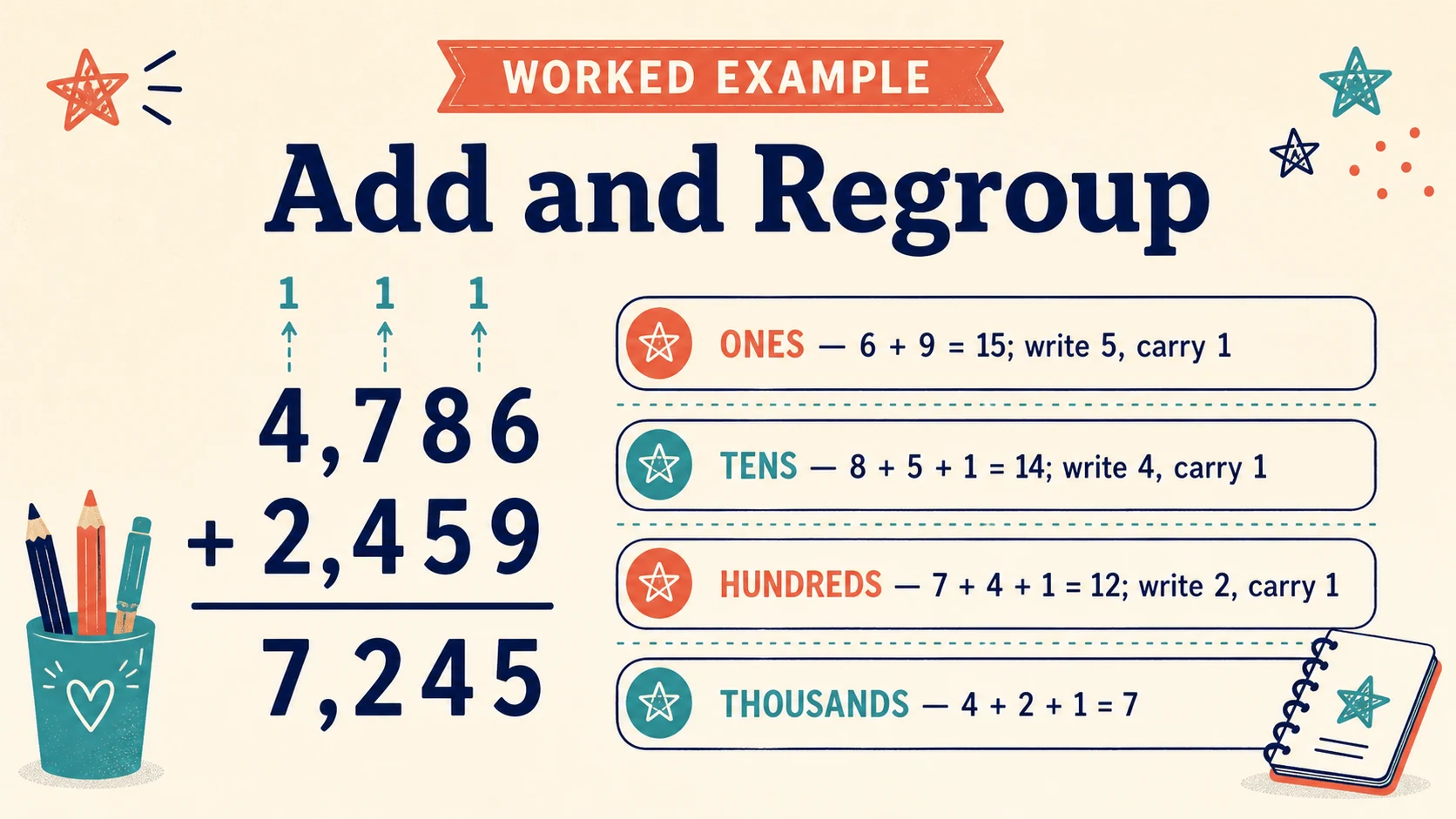
The model should show where each digit belongs and why a regrouped unit moves to the next place.
Use precise language while modeling
Instead of saying only, “Carry the one,” connect the notation to value:
- “Ten ones have been composed into one ten.”
- “I write the remaining ones in the ones place.”
- “The new ten joins the other tens.”
The catalogue’s topic guidance recommends beginning multi-digit addition with place-value understanding so that a learner can explain the regrouping step rather than only imitate it. That is the instructional purpose of the language above.
Keep the demonstration interactive. Before completing a column, ask, “What place are we adding?” or “What does this regrouped 1 represent?” A correct response reveals more than asking, “Do you understand?”
Move from guided practice to independent work
Guided practice without doing the thinking
Choose a worksheet item that looks representative, but do not immediately narrate every step. Use prompts in descending levels of support:
- “What operation does the sign show?”
- “Where will you begin?”
- “Which digits are in the ones place?”
- “Does that total require regrouping?”
- “How could you check the completed sum?”
If the learner answers accurately, reduce the prompting on the next item. If the learner waits for each cue, solve another item together and then ask for a complete explanation.
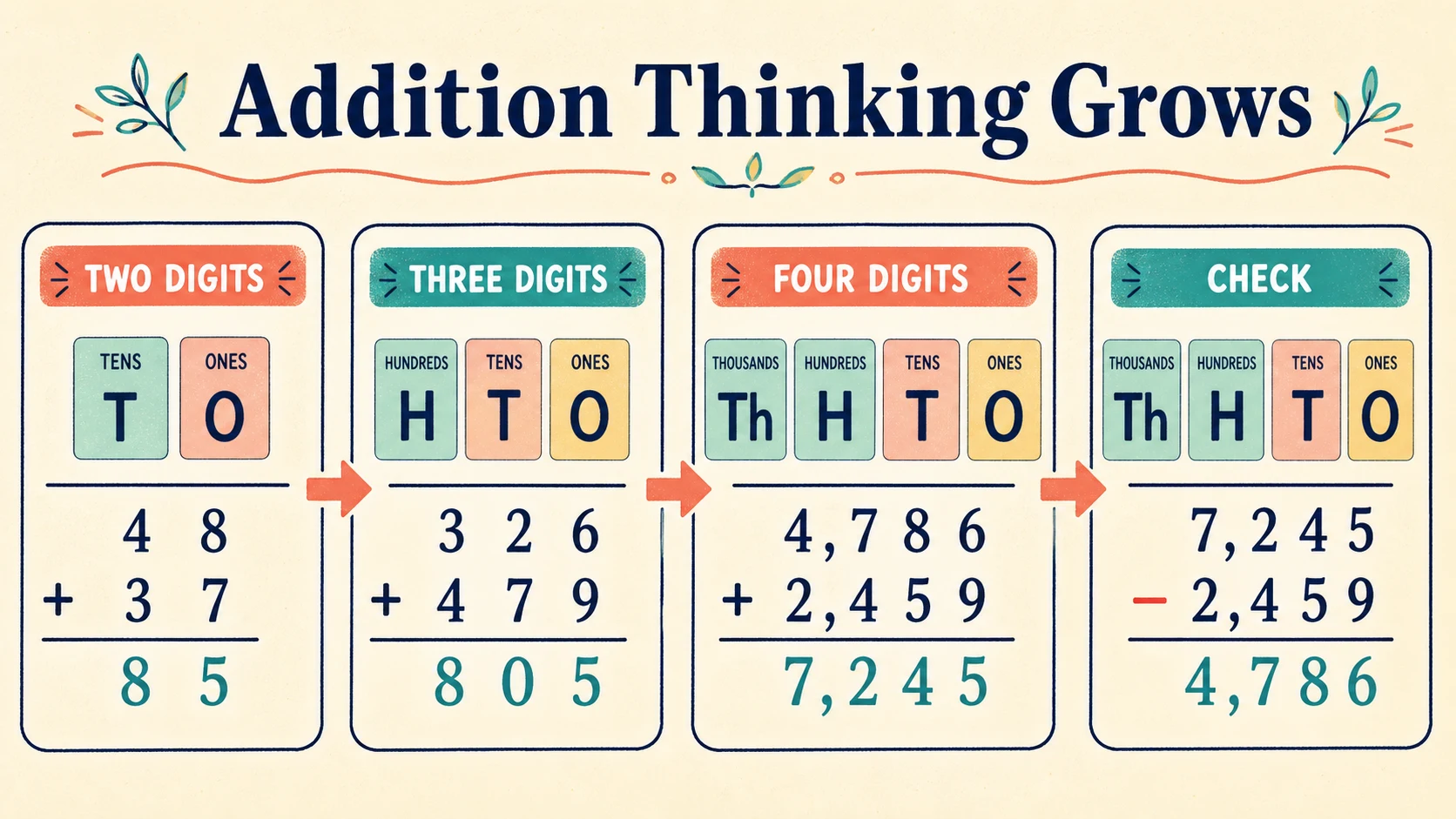
Guided practice should transfer decisions to the learner one step at a time.
Worked example 3: regrouping across two places
    1 1
  2,586
+ 1,749
-------
  4,335
Verify carefully:
- Ones: . Write 5 and regroup 1 ten.
- Tens: tens. Write 3 tens and regroup 1 hundred.
- Hundreds: hundreds. Write 3 hundreds and regroup 1 thousand.
- Thousands: thousands.
So, .
Check by subtraction:
Check the magnitude by rounding:
The exact answer, 4,335, fits that estimate.
This problem is useful for guided practice because forgetting either regrouped unit changes the answer. Ask the learner to point to the source of each small 1.
Set up independent practice
Once the learner completes two or three guided items with accurate explanations, assign a group to solve independently. State what independence means: the learner may use scratch paper or a place-value guide but should not receive the next calculation step from the adult.
Watch quietly at first. Intervene when an error is becoming a repeated procedure, such as writing every regrouped digit in the wrong column. A single uncertain pause is not necessarily a reason to interrupt.
After the assigned group, inspect the work before adding more items. A learner who solves 8 items carefully may gain more than one who rushes through all 25. The page can be completed in more than one sitting.
Adapt support without changing the addition skill
Differentiation should preserve the mathematical target. The learner still adds; the adult changes access, pacing, representation, or response space.
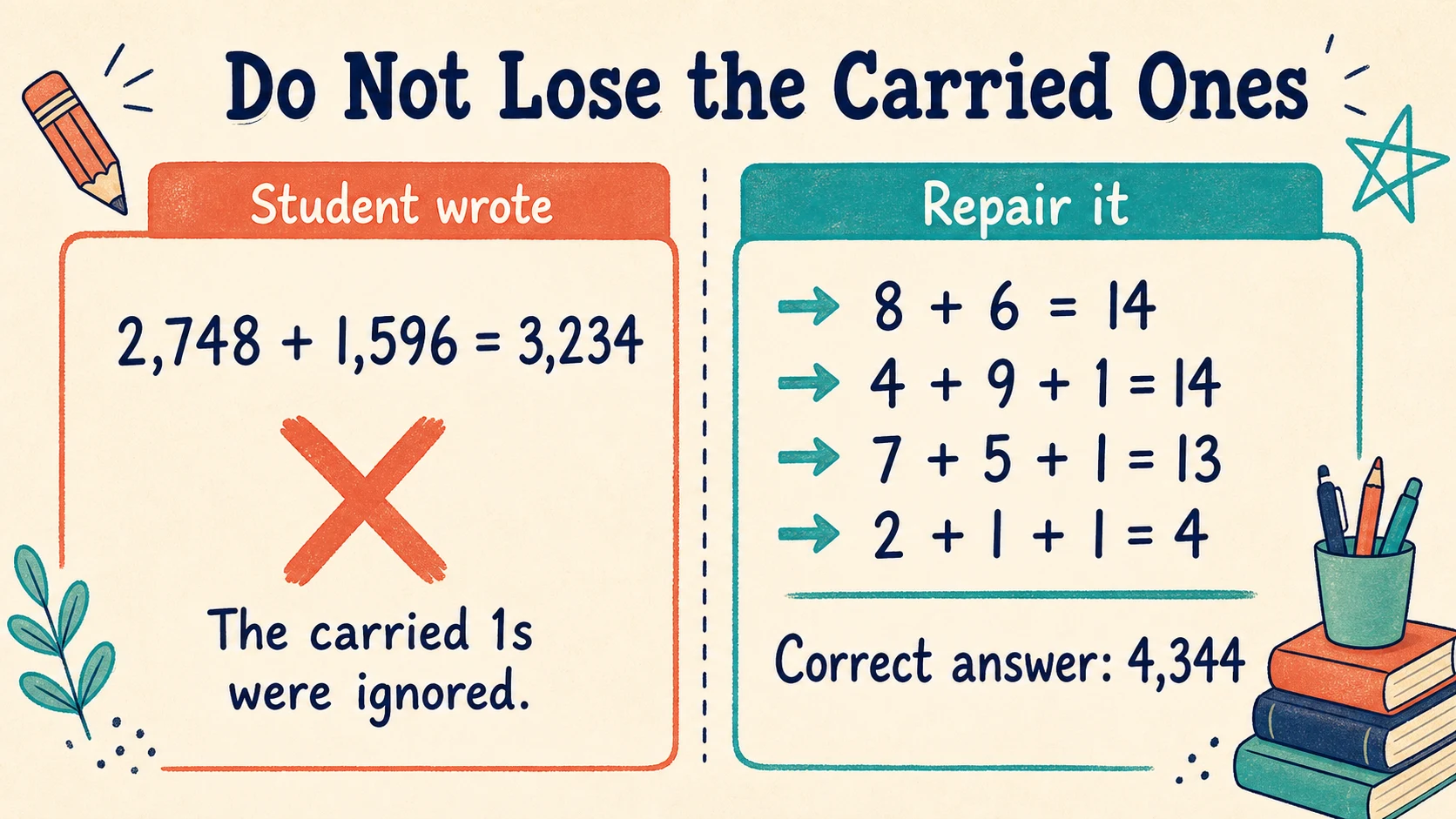
Adjust the amount, representation, or recording support while keeping addition as the task.
For a learner who loses place alignment
Provide graph paper, lined scratch paper turned sideways, or a hand-drawn place-value chart. Place one digit in each box and label the columns ones, tens, hundreds, and thousands. The learner should transfer the final answer to the worksheet line.
Do not prewrite the answer or complete the regrouping marks. The support organizes space; it does not perform the calculation.
For a learner who needs conceptual support
Represent one comparable problem with base-ten blocks, quick sketches, or expanded notation:
Then combine like places. When , show that 13 ones can be viewed as 1 ten and 3 ones. Return to the written algorithm while the connection is fresh.
The IES practice guide Assisting Students Struggling with Mathematics supports high-level practices such as systematic instruction, clear mathematical language, suitable representations, and deliberate review. Those principles can guide adult support, but the source did not test this exact printable or prescribe one universal schedule.
For a learner who is accurate but easily overloaded
Cover the problems that are not currently being solved, or fold the page so only one section is visible. Assign a short batch, review it, and then decide whether to continue. Allow a brief pause between batches.
This changes the visible workload without reducing the arithmetic demand of each selected item. Avoid adding a timer merely to make an easy worksheet harder. Speed is not listed as the worksheet’s target.
For a learner who finishes easily
Ask for verification rather than unrelated enrichment. The learner can:
- Estimate each sum before calculating.
- Check selected answers with subtraction.
- Solve one item using both the standard algorithm and expanded form.
- Explain which columns required regrouping.
- Create a comparable addition problem and verify its answer.
These extensions deepen attention to the existing skill. If the entire page is accurate, organized, and readily explained, move to the next appropriate addition resource rather than repeating identical work without a clear purpose.
Include boundary cases in instruction
Easy-level practice can still expose important edge cases. Use separately written examples if the worksheet does not contain the case you need.
Worked example 4: a zero in one addend
  3,405
+ 2,170
-------
  5,575
Verify by place:
- Ones:
- Tens: tens
- Hundreds: hundreds
- Thousands: thousands
Therefore, .
Check by subtraction:
The zero holds a place. It does not mean that the tens digit in 2,170 should slide into the ones column.
Worked example 5: a new place in the answer
    1 1 1
    7,856
+   2,944
---------
   10,800
Verify:
- Ones: . Write 0; regroup 1 ten.
- Tens: tens. Write 0; regroup 1 hundred.
- Hundreds: hundreds. Write 8; regroup 1 thousand.
- Thousands: thousands.
Thus, .
Check by subtraction:
An answer may contain more digits than either addend. The new digit records the composed ten-thousands unit; it is not an extra digit added by mistake.
Other useful boundaries include addends with different numbers of digits and sums containing internal zeros. In each case, align by place value rather than by the left edge of the numbers.
Interpret errors before assigning more practice
A marked answer tells you that two values differ. It does not, by itself, tell you why. Compare several errors and inspect the learner’s written process.
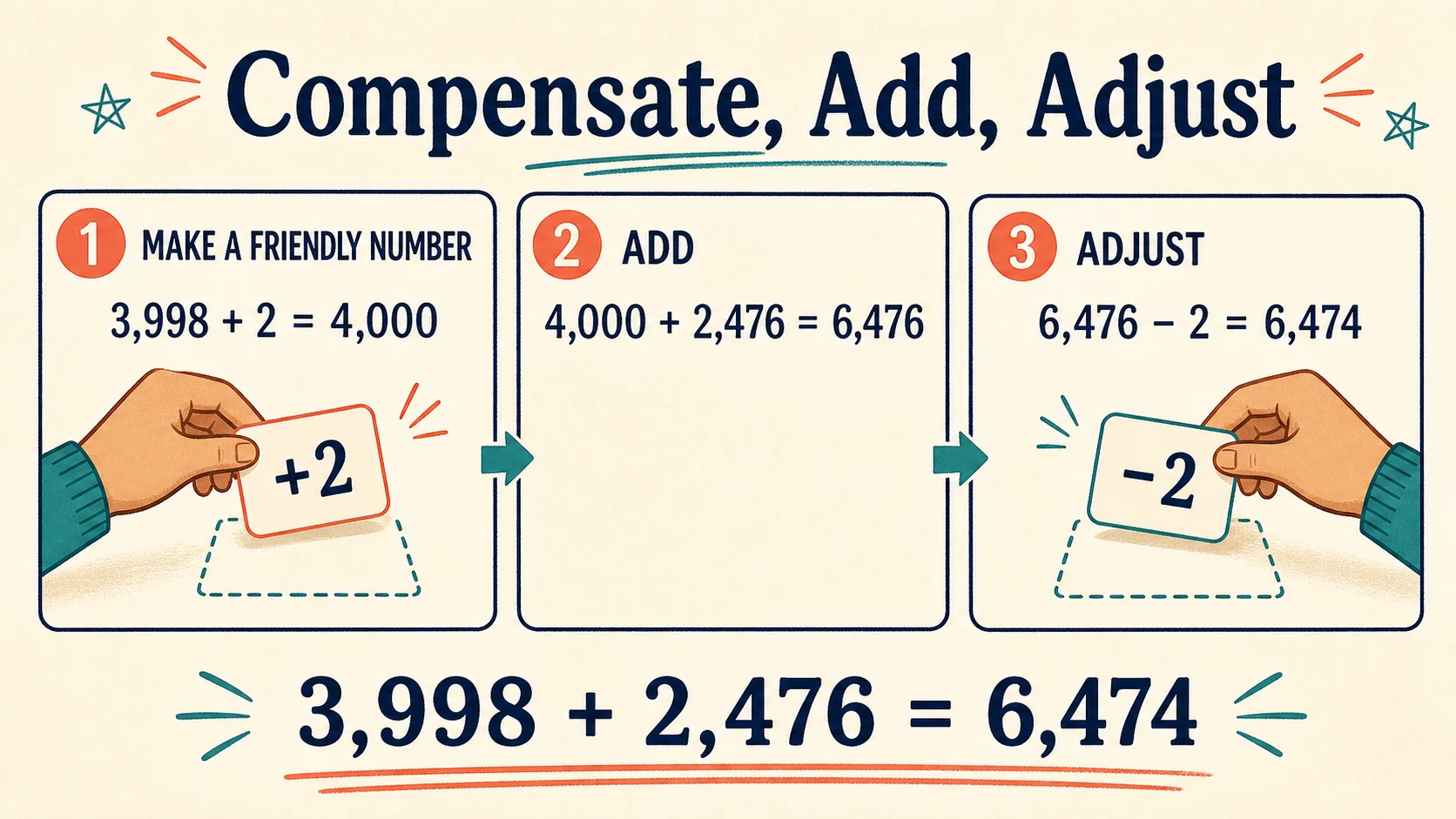
Identify the first incorrect step, name its place value, repair it, and verify the new answer.
Misalignment
Example:
  2,345
+   612
The correct alignment places 2 beneath 3 in the hundreds column, 1 beneath 4 in the tens column, and 2 beneath 5 in the ones column. If the learner aligns both numbers at the left edge, the resulting columns represent unlike places.
Response: use a place-value chart for the next two problems, then remove it and check whether alignment holds.
A missing regrouped unit
The learner correctly finds and writes 5, but does not include the regrouped ten in the next column.
Response: ask, “Where are the ten ones represented?” Have the learner circle the regrouping mark and recalculate only the affected column onward. Recopying the entire page is usually unnecessary.
Regrouping the wrong amount
A learner may write 15 in the answer space under one column instead of recording 5 ones and regrouping 1 ten.
Response: return briefly to 15 counters, a ten-and-ones drawing, or expanded notation. Ask the learner to separate 15 into 1 ten and 5 ones before returning to the algorithm.
Fact error inside a correct procedure
The columns and regrouping may be organized correctly, but the learner records .
Response: distinguish fact recall from algorithm understanding. Revisit that fact with a known strategy, correct the affected calculation, and check whether similar fact errors recur. Do not reteach the entire algorithm when the written structure is sound.
An implausible answer that goes unnoticed
If is reported as 58,220, the issue includes checking as well as calculation. The addends total only a little more than 5,800.
Response: require a rough estimate before exact calculation for the next few items. Estimation is a reasonableness check, not a replacement for the exact sum.
Use the answer key responsibly
The separate answer key supports efficient checking, but it should begin a conversation rather than end one.
First, compare each response carefully. If an answer differs, recalculate the item independently before discussing it. Adults can misread digits or compare the wrong lines. Then ask the learner to locate the first point where the work diverged.
Use simple marks with distinct meanings:
- A check can mean the answer and reviewed work agree.
- A dot can mean “revisit this item.”
- A short note such as “align tens” or “include regrouped hundred” can identify the next action.
Avoid displaying only a percentage when the goal is instruction. Record patterns such as “3 alignment errors,” “2 fact errors,” or “accurate after one reminder.” These descriptions help determine the next lesson.
The answer key should not be treated as infallible without inspection. If a listed answer appears inconsistent, solve the item another way—such as subtraction, expanded form, or a calculator used by the adult for verification—before drawing a conclusion. Report a suspected resource error rather than teaching the learner to accept a contradiction.
Decide what to do after the worksheet
Use accuracy, independence, explanation, and consistency together.
| Observed work | Reasonable next move |
|---|---|
| Accurate, organized, and independently explained | Continue to the next suitable addition task or mixed review |
| Mostly accurate with one isolated slip | Correct it, verify a similar item, and move forward |
| Correct only after repeated adult prompts | Repeat a short guided set before assigning more independent work |
| Several regrouping errors | Model one regrouping example and practice a small matched set |
| Several alignment errors | Add place-value recording support, then fade it |
| Mixed, inconsistent errors | Shorten the set and observe a fresh attempt before choosing instruction |
| Accurate today but uncertain after a delay | Schedule retrieval rather than immediate massed repetition |
The 4th Grade Math hub can help place addition beside other fourth-grade math topics. The 4th Grade worksheet hub provides broader subject choices. Neither should replace attention to what the learner actually did on this page.
If more addition practice is appropriate, the 4th Grade Addition Worksheet Pack contains 18 worksheets and is listed at $4.79. That is an optional resource, not an automatic next step. A learner who needs a very specific problem type may be better served by a deliberately chosen short set.
Schedule retrieval instead of assuming completion
Retrieval means asking the learner to reconstruct the process after some time has passed. It tests access to learning more honestly than solving another nearly identical item immediately after correction.
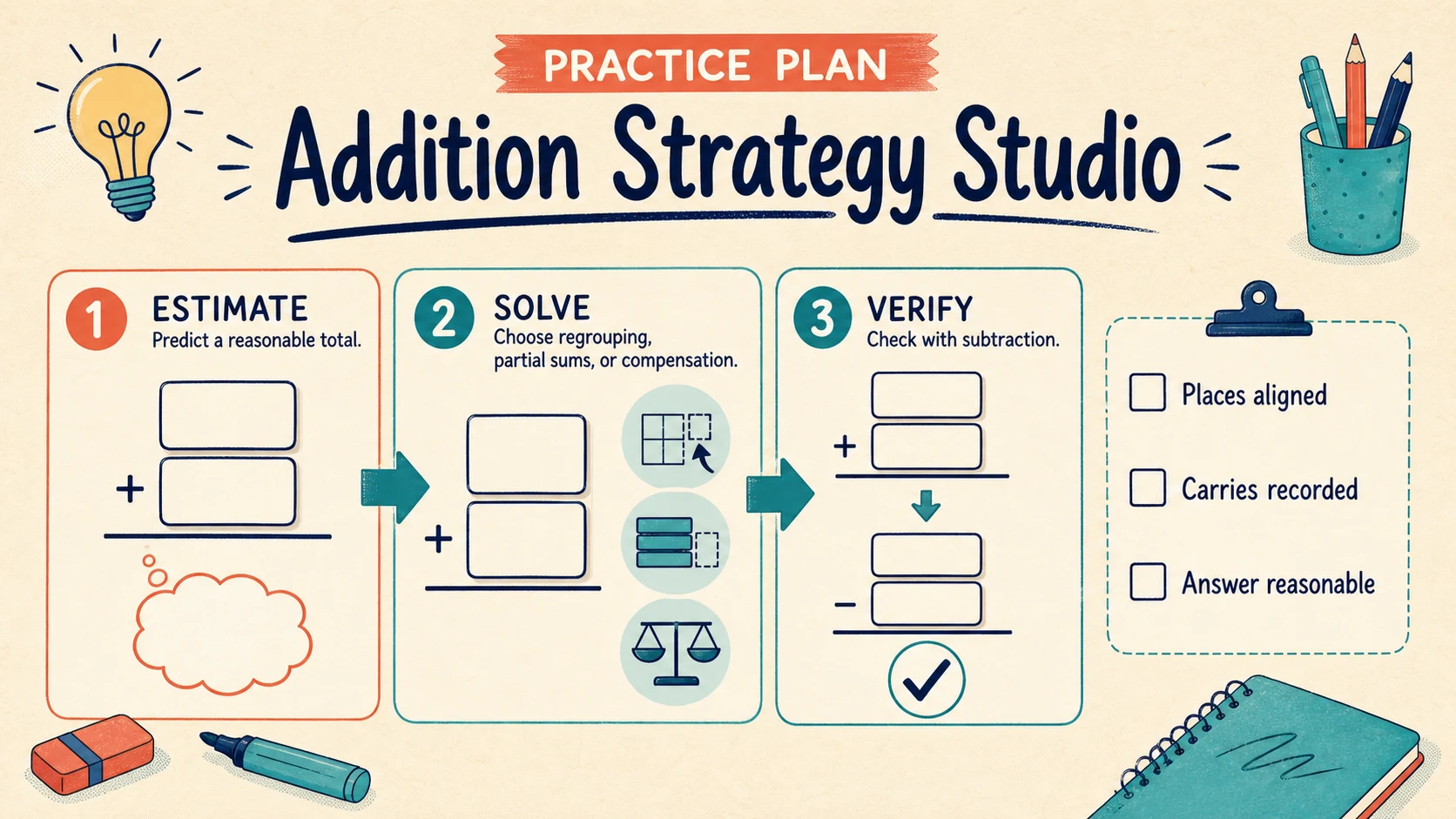
Revisit a few representative problems after increasing gaps, adjusting the schedule from observed performance.
A flexible plan might be:
| Review point | Suggested task | Decision |
|---|---|---|
| End of the lesson | Correct one error and explain the repaired step | Finish when the explanation is accurate |
| Next learning session | Solve two fresh comparable problems without notes | Continue support if the same error returns |
| Several sessions later | Include one addition problem in mixed review | Look for independent operation choice and setup |
| A later weekly review | Solve one straightforward and one boundary-case problem | Move on if the process remains accurate and explainable |
This is a practical example, not a universal timetable or a sourced requirement. Shorten or lengthen the gaps according to the learner’s work. If the learner cannot retrieve the process at the next session, provide a brief cue, practice again, and schedule another attempt. If performance remains stable, use fewer addition items and devote time to the next needed topic.
Keep the worksheet’s limits visible
This printable gives 25 easy-level exercises and an answer key. It can support practice and reveal useful patterns, but it cannot establish why a learner struggles, predict future achievement, or cover every form of addition. It also does not replace local curriculum requirements or professional evaluation when broader concerns exist.
Avoid drawing conclusions from one sitting. Record what was observed: the kinds of items attempted, the support used, the nature of any errors, and whether corrections were retained later. Keep claims narrower than the evidence.
For the next lesson, begin with the learner’s most informative item: one correctly explained problem if the work was secure, or one repaired problem if an error pattern appeared. Then return to the free 4th Grade Addition worksheet to complete the next appropriate set, or use the broader Addition topic guide to choose the next step.
Put it into practice
Use the guide with a real printable
Move from explanation to a short, observable practice task. Check the first item together, then adjust the next session from the learner's actual work.
See the 18-worksheet pack