Complete guide
How to teach and practise 4th grade sentence structure worksheets - standard theme (easy)
What this worksheet practices
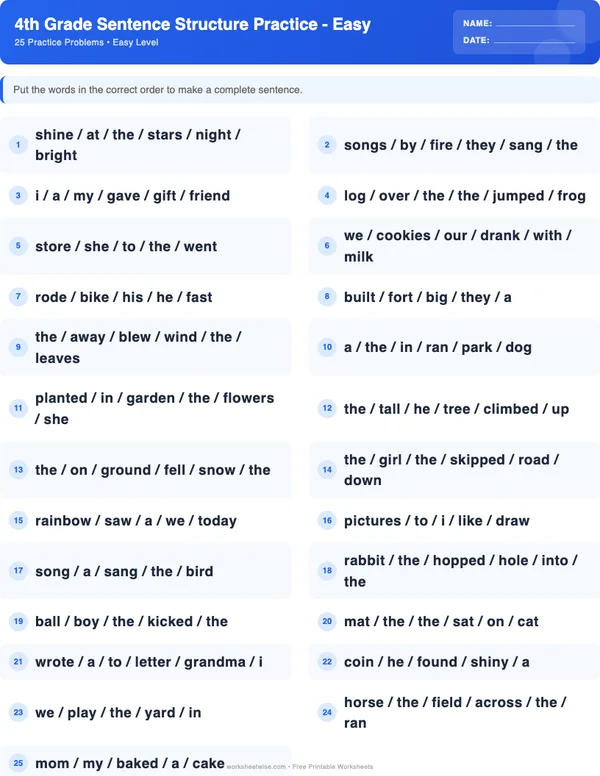
The free 4th Grade Sentence Structure worksheet gives a learner 14 easy-level exercises with one consistent direction: Put the words in the correct order to make a complete sentence. The task focuses on word order, sentence formation, syntax, and grammar. A separate printable answer key is included.
The direct teaching goal is simple: help the learner rearrange every word into a sentence that expresses a complete thought and follows conventional English word order. For each item, the learner should:
- Find the likely subject: who or what the sentence is about.
- Find the predicate: what the subject does, has, or is.
- Place any describing or location words where they make sense.
- Read the result aloud.
- check capitalization and end punctuation if those features appear in the item.
This is a focused practice page, not a complete sentence-structure course. It does not, by itself, cover the full progression from subjects and predicates through fragments, run-ons, sentence combining, compound sentences, complex sentences, and varied beginnings. Use the broader Sentence Structure topic guide when you need that larger sequence.
Grade labels describe the intended practice level; local school, district, state, and homeschool sequences differ. A learner’s observed work should determine whether this sheet is review, current instruction, or a supported entry point.
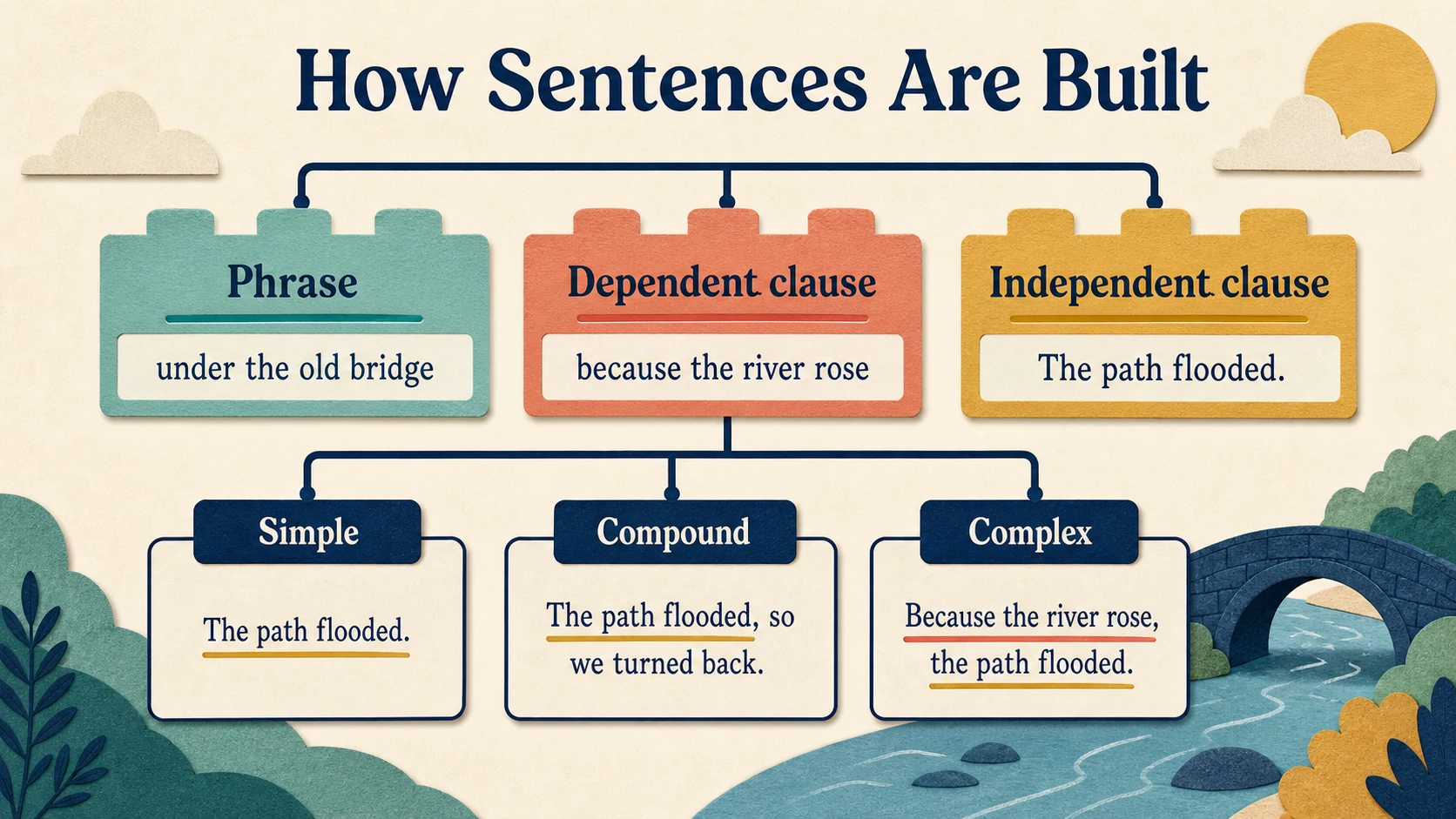
Use the map to move from a brief explanation to modeling, supported practice, independent work, and later review.
Prepare a short, focused lesson
Before the learner begins, print or open the worksheet but keep the answer key out of view. Have a pencil and a blank sheet of paper available. The blank paper is useful for moving or rewriting words without crowding the printable.
A practical first session can follow this sequence. The times are instructional suggestions, not a universal timetable. Shorten or extend each phase according to the learner’s responses.
| Lesson phase | Suggested action | What the adult watches for |
|---|---|---|
| Launch | Explain “subject plus predicate” in plain language | Can the learner say what a complete sentence needs? |
| Model | Think aloud through one invented example | Does the learner follow how word positions are chosen? |
| Guided practice | Solve two or three worksheet items together | Can the learner propose and justify an order? |
| Independent practice | Assign a manageable group of items | Can the learner work without repeated prompting? |
| Check and discuss | Compare responses with the answer key | Can the learner locate and repair an error? |
| Transfer | Ask for one original sentence using the same pattern | Can the learner produce, not merely rearrange? |
| Retrieval | Revisit selected items after a delay | Does the learner remember the checking routine? |
Introduce the task without overexplaining
Say something close to:
“Every item gives you the words for a sentence, but the words are mixed up. Your job is to decide who or what the sentence is about, find what that subject does or is, and arrange the remaining words so the whole sentence sounds complete.”
This wording is an instructional suggestion, not text taken from an outside source. It translates the catalogue’s subject-and-predicate teaching tip into a usable launch.
Ask the learner to repeat the task in their own words. If the response is vague, point to a practice group of scrambled words and ask, “Which word or words tell us who or what?” Then ask, “What happens?”
Connect speech to print
Before writing, let the learner say a possible sentence aloud. Oral rehearsal reduces the number of decisions that must be managed while writing. It also makes awkward word order easier to hear.
This activity should remain a sentence-order task. If spelling or handwriting slows the learner, the adult may write a sentence the learner has correctly arranged orally. That adaptation changes the response method, not the grammar skill being practiced.
High-level literacy guidance provides useful context here. The IES foundational reading guide addresses younger learners and does not evaluate this worksheet, but it includes academic language and connected text within its broader recommendations. For this fourth-grade activity, reading a completed sentence aloud is a reasonable instructional bridge between arranging isolated words and making sense of connected language.
Model a repeatable solving routine
Do not begin by telling the learner the finished sentence. Model how to discover it. Use an example similar to the worksheet rather than consuming one of its 14 items.
Write:
the library / Mia / visited / after school
Then think aloud:
- “I see a name, Mia, so that is a strong subject candidate.”
- “What did Mia do? She visited.”
- “Visited what? The library.”
- “When? After school.”
- “The complete sentence is: Mia visited the library after school.”
- “I will read it once more to make sure every supplied word appears exactly once.”
That last check matters. A sentence can sound correct while accidentally omitting a small word.
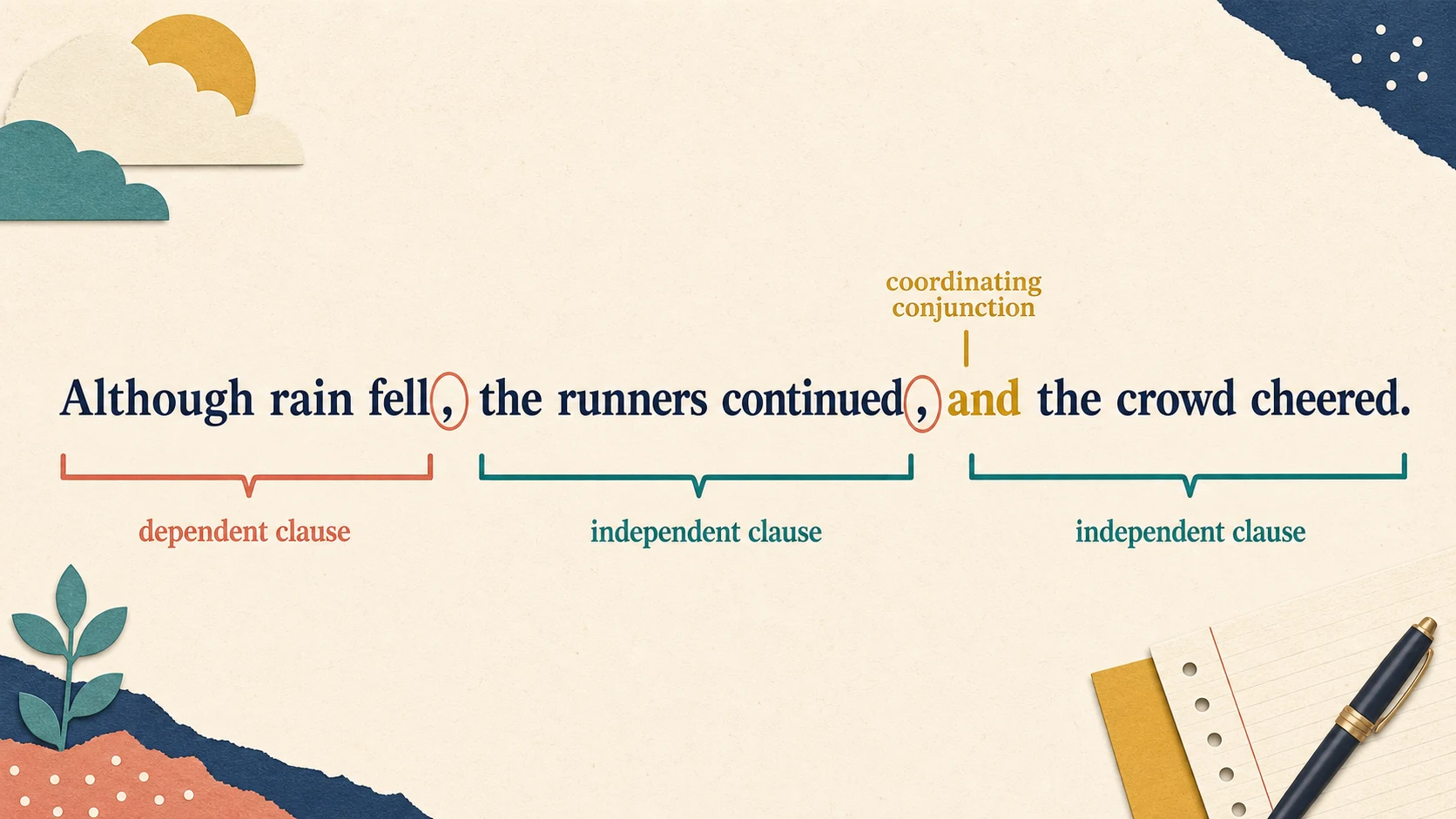
The model makes the invisible decisions visible: identify the subject, locate the action, attach details, and reread.
Use a five-step check
Teach a compact routine that can be repeated on every item:
- Find the subject. Who or what is the sentence about?
- Find the action or state. What does the subject do, have, or seem to be?
- Build the core. Put the subject and predicate together.
- Attach details. Add words that explain what, where, when, or how.
- Verify. Use every supplied word once, then read the sentence aloud.
Terms such as subject and predicate are useful, but the learner does not need to recite definitions before solving an item. “Who or what?” and “Did what?” provide a simpler entry point.
Mark word groups when needed
Some words belong together. For example, in under the tree, the phrase will usually stay intact even though it may fit at more than one point in a sentence. Lightly bracket likely groups before rearranging:
[under the tree] [the puppy] [slept]
The core is the puppy slept. The location phrase can then be attached:
The puppy slept under the tree.
This marking technique is an instructional support. It should be removed once the learner can recognize useful word groups without it.
Work through fully checked examples
The examples below are newly created demonstrations of the worksheet’s task. They are not claims about the exact wording of its 14 items.
Example 1: A direct subject–verb–object sentence
Scrambled words:
the window / opened / Carlos
Reasoning:
- Likely subject: Carlos
- Action: opened
- What was opened: the window
Correct sentence:
Carlos opened the window.
Check:
- The sentence identifies who acted.
- The verb agrees with the singular subject in this sentence.
- The object follows the verb.
- Every supplied word appears once.
- The result expresses a complete thought.
Incorrect boundary case:
The window Carlos opened.
That word order can occur inside a larger construction, such as “The window Carlos opened was stuck,” but by itself it does not express the intended straightforward statement. In this easy rearrangement task, Carlos opened the window is the clear complete sentence.
Example 2: A describing word belongs with a noun
Scrambled words:
a bright kite / flew / above the field
Correct sentence:
A bright kite flew above the field.
Reasoning:
- A bright kite names what the sentence is about.
- Flew tells what it did.
- Above the field tells where.
- Moving bright away from kite would break the natural noun phrase.
Check the sentence orally: “What flew?” A bright kite. “Where?” Above the field. The sentence uses every word and forms a complete thought.
A learner might write Above the field flew a bright kite. That is also grammatical English. Whether it should be accepted depends on the exact item, its capitalization and punctuation clues, and the answer key’s intended order. Do not label a grammatical alternative wrong without examining those clues.
Example 3: A time phrase can occupy two positions
Scrambled words:
before dinner / we / finished / the puzzle
One correct sentence is:
We finished the puzzle before dinner.
Another grammatically possible sentence is:
Before dinner, we finished the puzzle.
The second version requires a capital letter at the beginning and conventionally uses a comma after the introductory phrase. If the supplied worksheet tokens or punctuation fix one form, follow those constraints. If the words are neutral and the learner independently creates the other complete sentence, recognize the grammatical reasoning before comparing it with the key.
This is an important boundary case: word order is constrained, but English does not always permit only one arrangement.
Example 4: A linking verb connects the subject to a description
Scrambled words:
was / the soup / warm
Correct sentence:
The soup was warm.
Reasoning:
- Subject: the soup
- Linking verb: was
- Description of the subject: warm
Check:
- Was the soup warm. has statement punctuation but question-like order; it is not the intended declarative sentence.
- Warm the soup was. may resemble stylized speech, but it is not the conventional order expected in this foundational exercise.
- The soup was warm. is complete, clear, and conventional.
Example 5: Helping words must stay with the main verb
Scrambled words:
will plant / our class / seeds / tomorrow
Correct sentence:
Our class will plant seeds tomorrow.
Reasoning:
- Subject: our class
- Complete verb phrase: will plant
- What will be planted: seeds
- When: tomorrow
Do not separate will from plant in the finished sentence. Our class plant will seeds tomorrow contains all the words, but word inclusion alone does not make a grammatical sentence.
These examples show why the learner should build the subject–predicate core before attaching details. For more practice across grammar topics, use the 4th Grade Grammar hub rather than turning one 14-item page into an extended drill.
Move from guided to independent practice
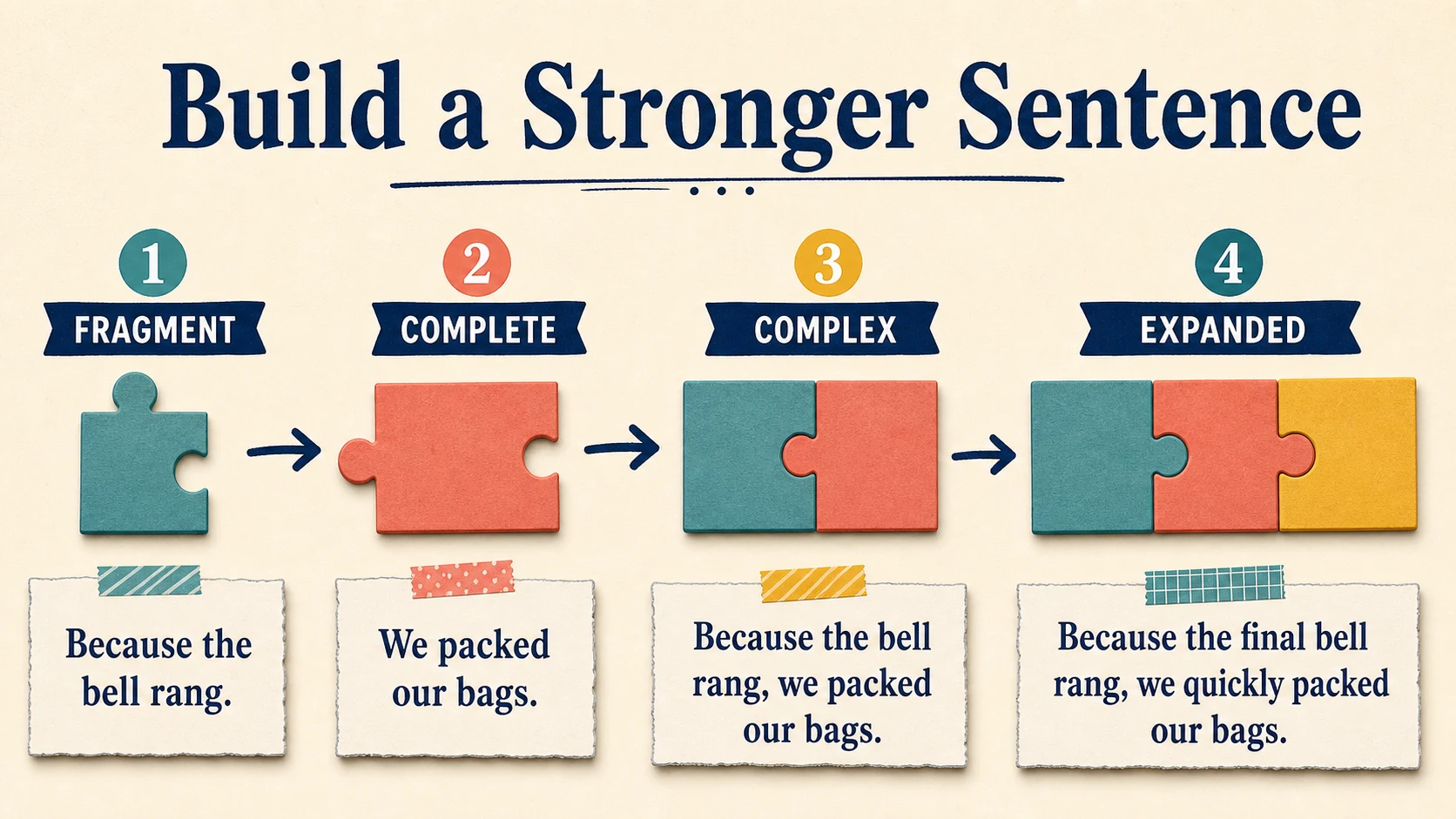
Guided practice should reveal the learner’s reasoning while leaving the final decisions increasingly in the learner’s hands.
Guide with prompts, not answers
For the first worksheet item, ask:
- “Who or what might be the subject?”
- “Which word tells what happens?”
- “Can you say the core sentence without the extra details?”
- “Where would this phrase sound natural?”
- “Did you use every word?”
For the next item, use fewer prompts. By the third guided item, pause and let the learner initiate the routine. If the learner can arrange the words and explain the result, move to independent work.
If confusion continues, model another invented example instead of completing several worksheet items for the learner. The objective is to hand over a method, not create a page of adult-assisted correct answers.
Choose the independent amount from observed work
The worksheet contains 14 items, but all 14 do not have to be completed in one sitting. A learner who solves the guided items accurately and explains the order may be ready to finish the page. A learner who guesses, omits words, or needs a prompt at every step may benefit from a smaller set followed by feedback.
Use neutral directions such as, “Complete the next three using the five-step check.” When those are done, inspect the reasoning and decide whether to continue.
The IES elementary writing guide includes sentence construction within a broader recommendation about fluency with foundational writing skills. It also addresses writing processes and regular opportunities to write. The guide did not test WorksheetWise or prescribe this lesson sequence. It supports the high-level reason for connecting a short sentence exercise to authentic writing rather than treating the worksheet as the entire lesson.
After independent practice, ask the learner to write one original sentence that follows a pattern from the page. For instance, after arranging a subject, verb, object, and time phrase, the learner can create a new sentence with those same parts.
Adapt support without changing the skill
Differentiation should preserve the central demand: the learner must determine correct sentence order. Avoid supports that quietly turn the task into copying.
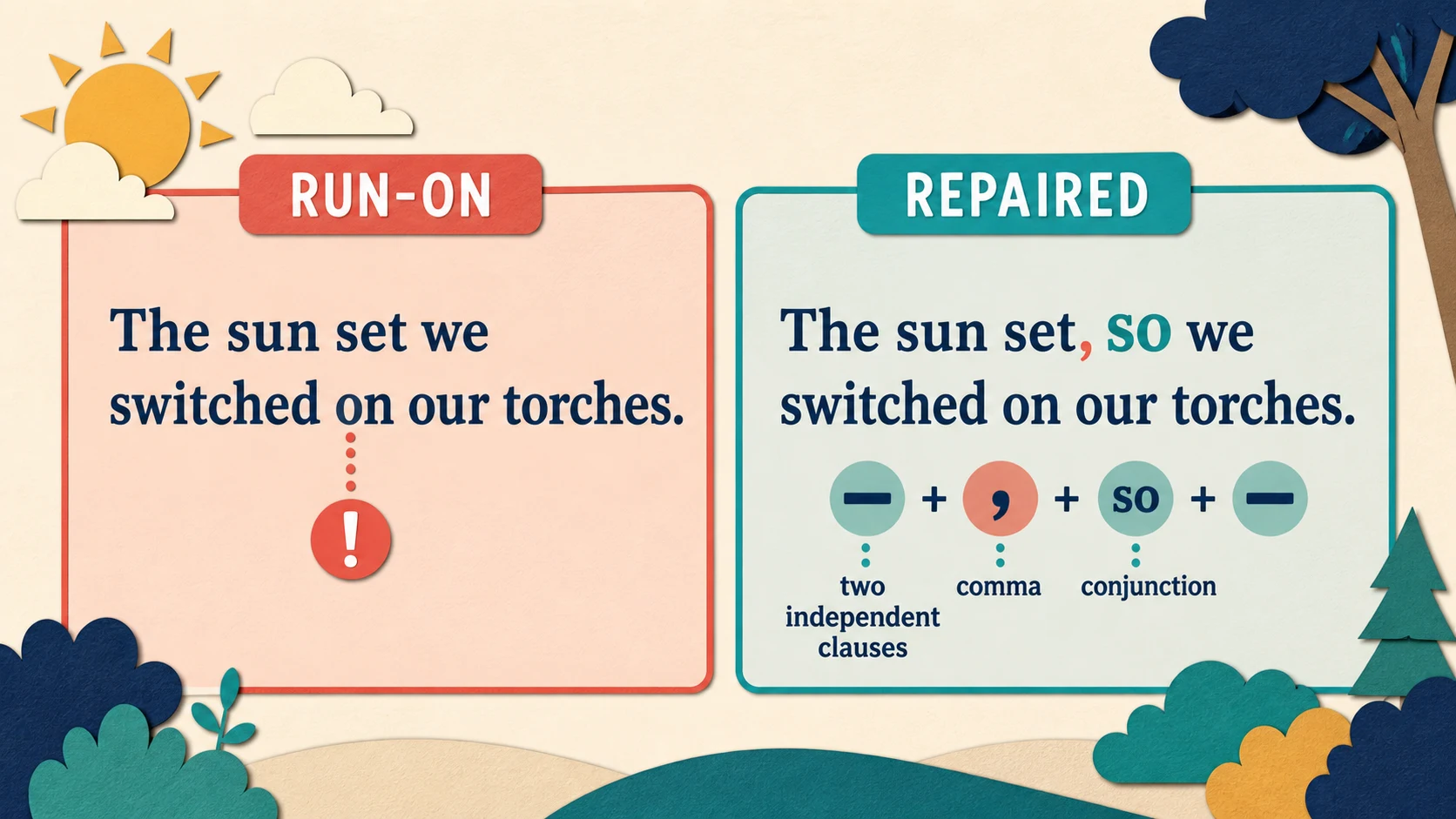
Change the amount of visual, oral, or physical support while keeping sentence construction at the center.
When the learner needs more support
Try one support at a time:
- Cover the remaining items so only one is visible.
- Copy an item onto separate word cards and let the learner move them.
- Read each supplied word or phrase aloud without giving its position.
- Ask the learner to locate only the subject first.
- Draw one line under the subject candidate and two under the verb candidate.
- Let the learner arrange the sentence orally before writing.
- Provide a simple frame: “Who or what? — did what? — where or when?”
If reading a particular word is the obstacle, pronounce it. That assistance removes a decoding barrier while retaining the word-order decision. If the learner knows the correct oral sequence but handwriting is laborious, allow pointing, numbering the word groups, or dictating the order.
When the learner is ready for less support
Remove the frame and ask the learner to annotate independently. Then request a brief explanation: “Why did you place that phrase there?”
A suitable extension is to ask whether another order could also form a complete sentence. The learner must read both versions and explain punctuation changes, if any. Do not introduce compound or complex sentence terminology unless the item or current instruction calls for it; that would broaden the lesson beyond this worksheet’s stated focus.
Another extension is sentence expansion. After the learner correctly forms Birds gathered near the fountain, ask for one added detail: Several birds gathered near the fountain at noon. Keep the original complete sentence visible so the distinction between rearranging and expanding remains clear.
Keep the difficulty label in perspective
“Easy” describes the catalogue difficulty, not a judgment about the learner. A fourth grader may find the task difficult because of unfamiliar vocabulary, uncertain subject–verb recognition, reading effort, attention to small words, or limited experience with rearrangement formats. The worksheet alone cannot identify the cause.
Likewise, quick completion does not establish mastery of all sentence structure. It shows success with these 14 easy-level word-order exercises under the conditions in which they were completed.
Interpret errors before correcting them
A wrong answer is most useful when classified by what the learner did. Marking every error simply “incorrect” hides important differences.
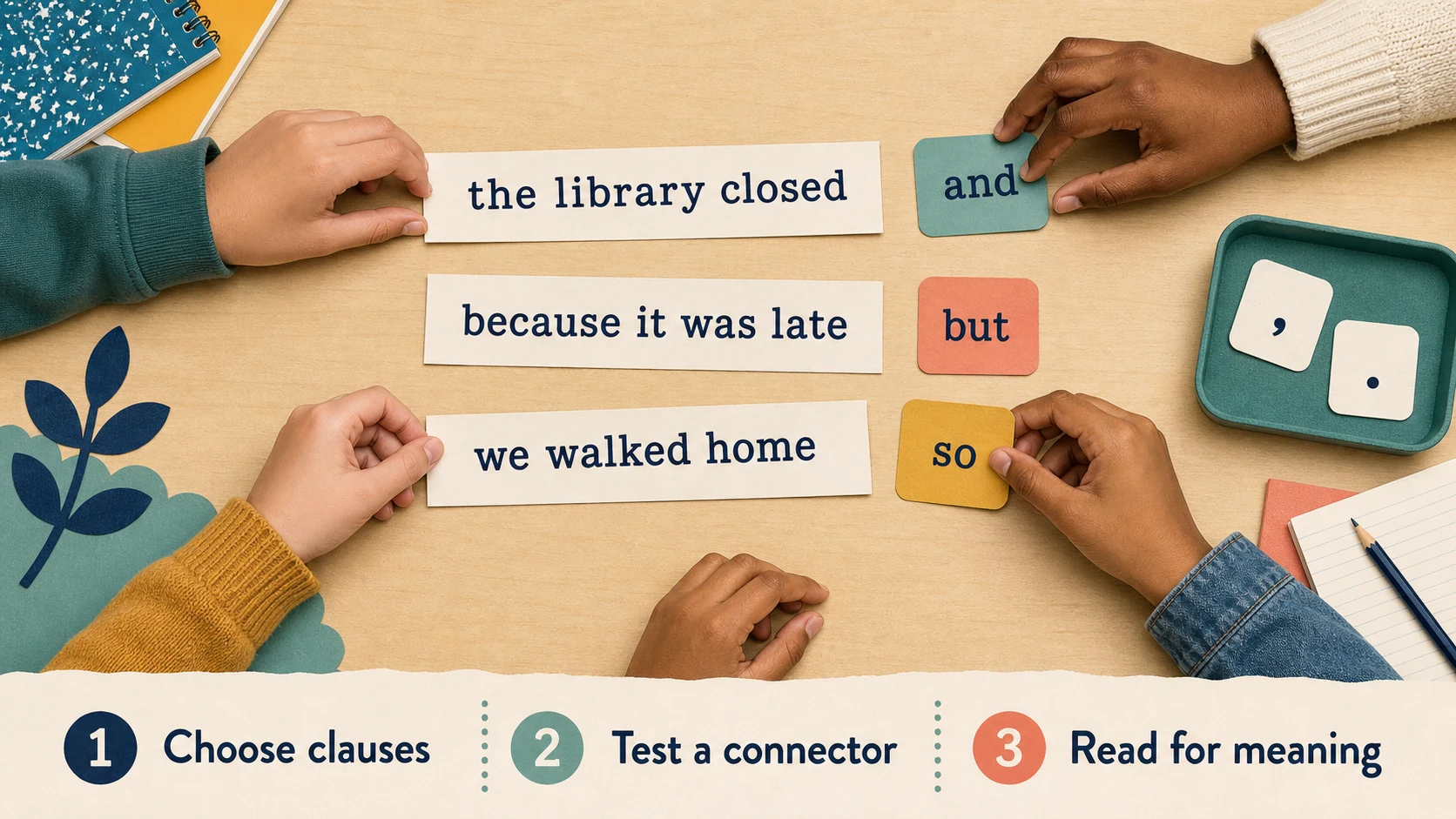
Check for completeness, word use, grammatical order, meaning, capitalization, and punctuation in a consistent sequence.
Common error patterns and responses
| Observed work | Possible interpretation | Focused instructional response |
|---|---|---|
| The subject appears after an unrelated phrase and the sentence sounds incomplete | The learner may not have identified the sentence core | Ask “Who or what?” and “Did what?” before moving any details |
| A small word is omitted | The learner may be arranging by overall meaning without checking every token | Have the learner touch and cross-check each supplied word |
| All words are present, but the verb phrase is split | The learner may not recognize helping and main verbs as a unit | Say the complete verb phrase aloud and bracket it |
| A describing word is far from its noun | The learner may not recognize the noun phrase | Ask, “Which thing does this word describe?” |
| The sentence is grammatical but differs from the key | There may be more than one defensible order | Check capitalization, punctuation, meaning, and all supplied words before deciding |
| The order is correct orally but copied incorrectly | The grammar decision may be stronger than the written record suggests | Let the learner rebuild it, then copy while checking one word group at a time |
| Repeated guessing begins after several items | The current practice amount may exceed productive attention | Stop, review one item, and schedule the remainder for another session |
These are possible interpretations, not diagnoses. One error rarely supports a firm conclusion. Look for a repeated pattern across several responses.
Misconceptions to address directly
“A capital letter tells me the answer.”
Capitalization can identify a likely first word, but it does not explain the sentence’s structure. Ask the learner to justify the subject and predicate too.
“If I used all the words, the sentence must be right.”
Every word can be present in an ungrammatical order. The completed line must also express a coherent, complete thought.
“The verb always comes immediately after the first word.”
Subjects can contain several words: The small brown rabbit hopped away. The main verb follows the full subject, not necessarily the first word.
“There is always exactly one possible order.”
Some phrases can move. After lunch, we read quietly and We read quietly after lunch are both grammatical. Worksheet clues may still indicate the intended response.
“A sentence that sounds unusual must be wrong.”
Unusual and ungrammatical are not identical. Ask whether the sentence has a complete thought, whether the words relate correctly, and whether punctuation supports the order.
Use the answer key responsibly
The printable answer key makes checking efficient, but it should confirm reasoning rather than replace it.
First, solve or review the item yourself. Then compare the learner’s response with the key. If they match, ask for an explanation on one or two representative items rather than requiring a justification for all 14.
If they differ, follow this order:
- Read the learner’s sentence exactly as written.
- Confirm that every supplied word appears once.
- Identify the subject and complete predicate.
- Check whether modifiers and phrases attach clearly.
- Inspect capitalization and punctuation clues.
- Compare the meaning and structure with the keyed answer.
If the learner’s alternative is grammatical, complete, uses every supplied word, and respects the available punctuation, do not dismiss it solely because it differs from the key. Record it as a defensible alternative or discuss why the worksheet intended another order. If a supplied capital letter or punctuation mark makes the alternative impossible, explain that concrete constraint.
The Common Core ELA standards overview places language alongside reading, writing, speaking, and listening across grade-specific literacy expectations. The supplied catalogue connects this topic with producing complete sentences and recognizing fragments and run-ons at fourth-grade level. This page offers narrow practice within that wider area; it should not be described as proof of comprehensive standards alignment or mastery.
Decide what to teach next
Use the completed work to select a next step rather than relying on a single score.
If the learner is not yet secure
Return to oral sentence building with short subject–predicate cores. Use pairs such as:
the kitten / sleptour bus / arrivedthe leaves / were wet
Then add one detail at a time. Once the learner can state the core reliably, return to a few unfinished worksheet items. Avoid repeating the entire page immediately if only one pattern caused difficulty.
If omitted words are the main issue, keep the grammar level the same and add a word-by-word verification routine. If movable phrases cause confusion, contrast two grammatical arrangements and discuss the punctuation. If the learner cannot distinguish complete sentences from fragments, consult the Sentence Structure topic guide for the broader progression.
If the learner is secure
Ask for transfer rather than more identical copying:
- Write a new sentence with a clear subject and predicate.
- Add a location phrase.
- Move a time phrase from the end to the beginning and adjust punctuation.
- Combine two related short ideas only if that skill has already been taught.
- Find one sentence in current reading and identify its subject, verb, and added details.
The catalogue describes sentence structure as progressing beyond word order to expansion, combining, compound and complex sentences, fragments and run-ons, and varied beginnings. Choose only the next step that fits the learner’s observed work and local sequence.
The 4th Grade worksheet hub can help place grammar practice alongside other fourth-grade materials. For concentrated practice beyond this free page, the 4th Grade Sentence Structure Worksheet Pack contains 18 worksheets and is listed at $4.79. Check the current pack page before relying on price or contents in future planning.
Schedule retrieval and keep a useful record
A correct page completed once shows immediate performance. To see whether the routine is retained, revisit a small sample after time has passed.
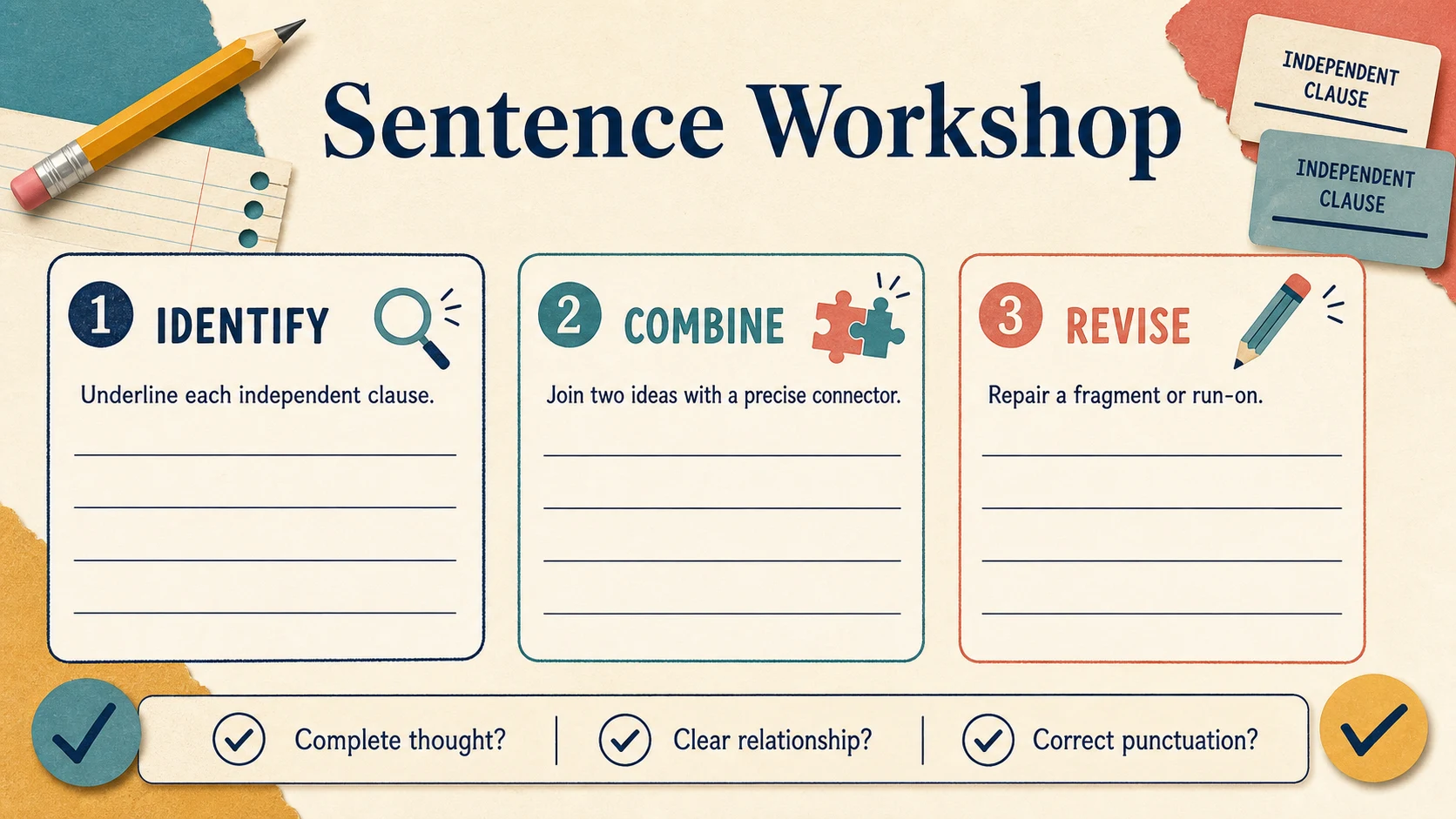
Reuse a few representative structures over time and adjust the spacing according to what the learner remembers.
A practical, adjustable schedule is:
| Review point | Suggested retrieval task | Decision |
|---|---|---|
| Later in the same lesson | Rebuild one corrected item without looking | Reteach the routine if the same error returns |
| A few days later | Rearrange two previously difficult items or parallel examples | Increase support only for the recurring pattern |
| About one week later | Solve two mixed examples and write one original sentence | Move forward if the method transfers |
| In a later writing activity | Check one self-written sentence for subject, predicate, and word order | Return to focused practice if sentence completeness breaks down |
This schedule is an instructional suggestion, not a sourced universal interval. Move reviews closer together when the learner forgets the routine; space them farther apart when performance remains accurate and explainable.
Keep a brief record with three columns: date, observed pattern, and next action. “9/8: used every word but split will carry; bracket verb phrases next time” is more useful than “9/8: needs grammar help.”
Limitations and the next useful action
This 14-item printable provides focused easy-level practice in arranging words into complete sentences. It can reveal whether a learner handles straightforward word order, but it cannot by itself establish broad writing ability, reading comprehension, mastery of all fourth-grade grammar, or the cause of persistent difficulty. The answer key supports checking; it does not replace adult judgment about a genuinely grammatical alternative.
Keep the final action concrete: download the free worksheet, model one invented example, guide only as much as the learner’s work requires, and save two representative structures for later retrieval. After checking those responses, use the Sentence Structure topic guide to choose the next narrow skill, or create fresh parallel practice with the free worksheet generators.
Put it into practice
Use the guide with a real printable
Move from explanation to a short, observable practice task. Check the first item together, then adjust the next session from the learner's actual work.
See the 18-worksheet pack