Complete guide
How to teach and practise 4th grade punctuation worksheets - standard theme (easy)
Quick answer: how to use this 14-item worksheet
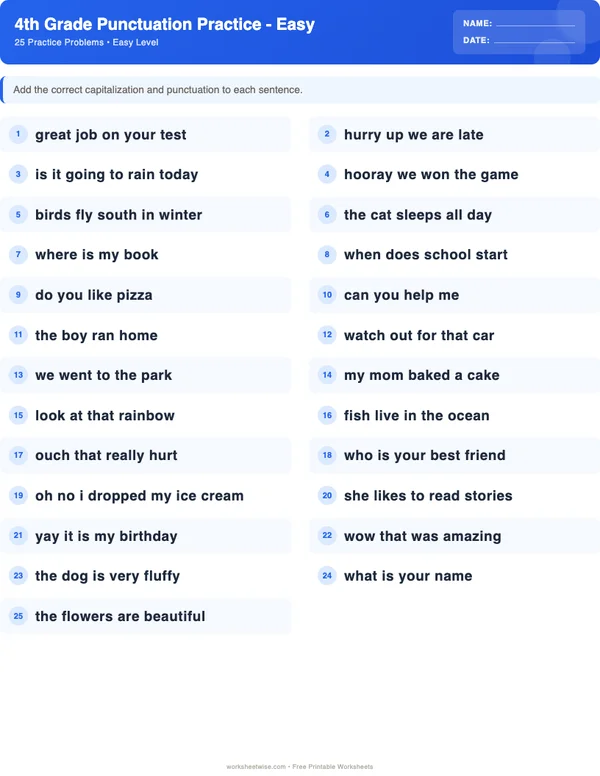
Use the free 4th Grade Punctuation worksheet as a short lesson on two decisions: where capitalization is needed and which end mark completes each sentence. The printable contains 14 easy-level items, and its direction is: “Add the correct capitalization and punctuation to each sentence.” The targeted skills are capitalization, periods, question marks, and exclamation marks.
Begin by modeling two or three similar sentences. Complete several worksheet items together, asking the learner to explain each choice. Then let the learner finish independently. Review errors by type rather than treating every incorrect mark as a separate problem. Revisit a small selection after a delay so that the learner must retrieve the rules instead of merely remembering the answer key.
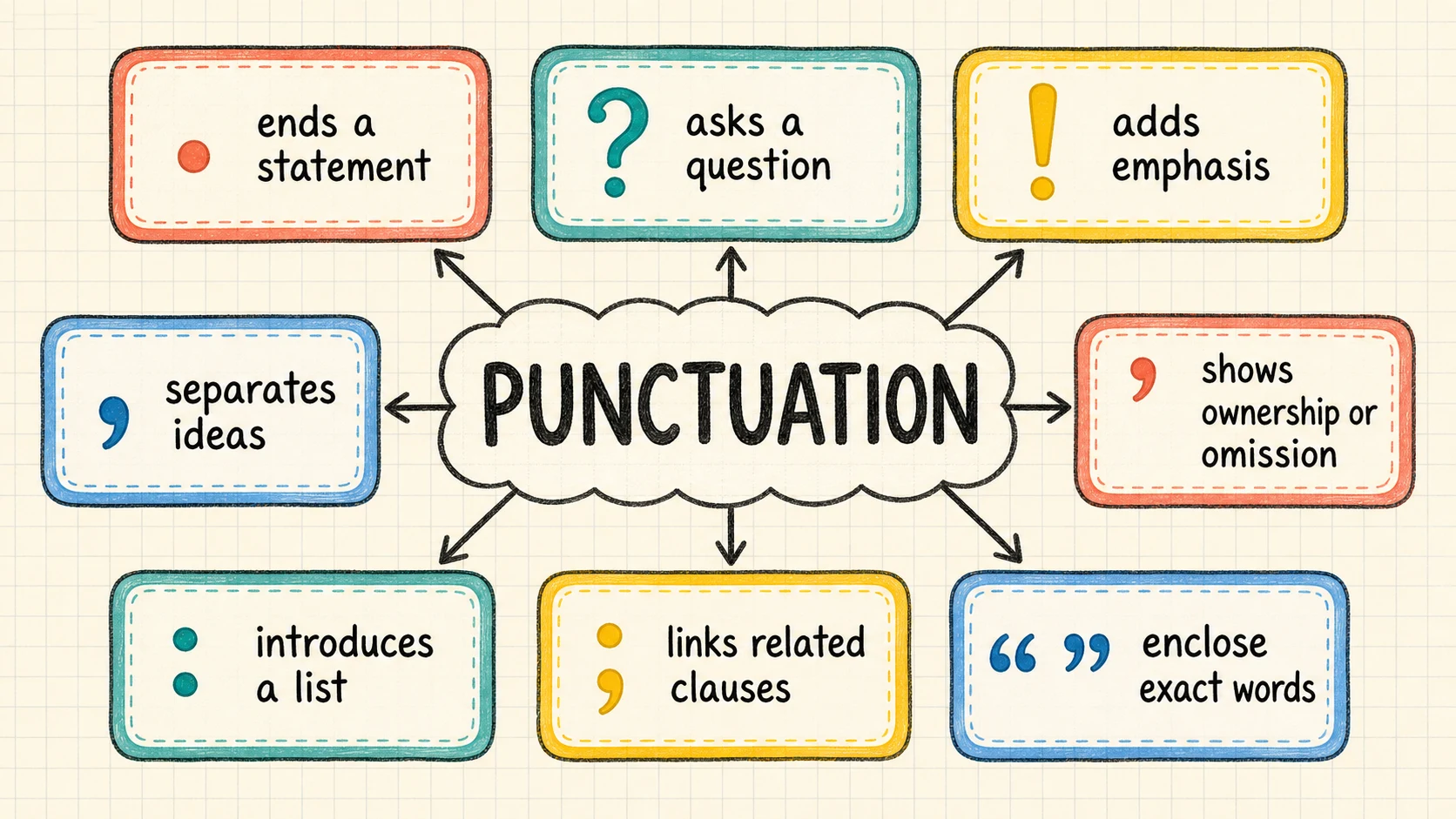
The lesson moves from explanation and modeling to supported practice, independent work, feedback, and later retrieval.
A practical sequence looks like this:
| Phase | Suggested use | What the adult watches for |
|---|---|---|
| Launch | Read the direction and name the four target skills | Does the learner understand that every item may require more than one correction? |
| Model | Demonstrate two or three new examples | Can the learner connect sentence meaning to the end mark? |
| Guided practice | Complete a few worksheet items together | Does the learner explain capitalization and punctuation separately? |
| Independent practice | Learner completes the remaining items | Does accuracy continue without prompts? |
| Check and discuss | Compare work with the separate answer key | Can the learner identify the reason for a correction? |
| Retrieval | Revisit selected skills on later days | Can the learner apply the rule to a fresh sentence? |
This is an instructional suggestion, not a universal timetable. The learner’s observed work should determine whether each phase lasts two minutes or needs another short session.
Understand the exact practice target
This printable is narrower than the complete topic of fourth-grade punctuation. Its 14 exercises focus on correcting capitalization and adding periods, question marks, or exclamation marks. It does not, according to the catalogue description, provide comprehensive practice with commas, apostrophes, quotation marks, colons, or semicolons.
That narrow scope is useful when the learner needs a manageable editing task. It also means that success on this page should be interpreted precisely: the learner has shown some ability to correct capitalization and end punctuation in these items. It does not prove mastery of every punctuation convention expected in longer writing.
Grade labels describe an intended practice level, and local school, district, state, and homeschool sequences differ. The Common Core English Language Arts standards provide one reference point for grade-level language expectations, but their fourth-grade conventions extend beyond the four skills on this easy worksheet. Do not describe the printable as a complete standards assessment.
For a broader sequence—including commas, apostrophes, and quotation marks—use the punctuation topic guide. The guide is the better place to see how this foundational review connects to later punctuation work. The wider fourth-grade grammar collection can help when errors suggest that sentence structure or another grammar skill also needs attention.
What the learner must do in each item
Although an item may look simple, the learner is making several decisions:
- Read the entire group of words for meaning.
- Decide whether it forms a statement, question, or exclamation.
- Capitalize the first word.
- Notice whether any name or other clearly recognizable proper noun also needs a capital.
- Choose one appropriate end mark.
- Reread the corrected sentence to check the result.
The learner should not choose punctuation solely from the first word. A sentence beginning with what can be a question, but it can also be an exclamation. Meaning and sentence structure matter.
What “easy” should and should not imply
“Easy” is the worksheet’s catalogue difficulty label. It describes straightforward foundational practice; it does not describe a learner’s intelligence or guarantee that the page will feel easy. A learner may understand sentence meaning but overlook capitals, or may know punctuation orally yet struggle to coordinate reading, editing, and handwriting.
Use neutral language such as, “This page gives us a focused check of beginnings and endings.” If the learner needs support, preserve the punctuation decision instead of turning the task into copying completed answers.
Prepare a brief, explicit launch
Keep the opening focused on the marks actually used in the printable. Write or say:
- A period closes a statement.
- A question mark closes a direct question.
- An exclamation mark closes a sentence expressing strong feeling, urgency, or force.
- A sentence begins with a capital letter.
- Names and other proper nouns also begin with capitals when they appear.
These are working reminders for this activity, not a full punctuation curriculum.
The IES practice guide on teaching elementary students to be effective writers offers high-level instructional framing for writing instruction, including explicit teaching of writing skills and opportunities to apply them. It did not evaluate WorksheetWise or this particular printable. Here, that broad framing can be applied through a short explanation, a visible model, supported attempts, and independent editing.
Gather only what the lesson needs
Prepare the worksheet, a pencil, and the separate printable answer key. Keep the key out of view during initial practice. If erasing slows the learner, allow corrections by drawing one line through an unwanted mark and writing the replacement clearly.
You may also provide a small reference strip:
| Sentence purpose | Likely end mark |
|---|---|
| Tells or states | Period |
| Asks directly | Question mark |
| Shows strong feeling or urgent force | Exclamation mark |
Call it a reference, not an answer chart. The learner still has to interpret each sentence.
Before starting, ask the learner to read one practice sentence aloud. Listen for whether the learner notices where the thought ends. Oral reading can help reveal meaning, but voice alone is not an infallible test: a reader can raise their voice at the end of a statement or read a question with flat expression.
Model the task with fully checked examples
The following examples are created for instruction and are not presented as actual items from the printable. They demonstrate the same stated skills.
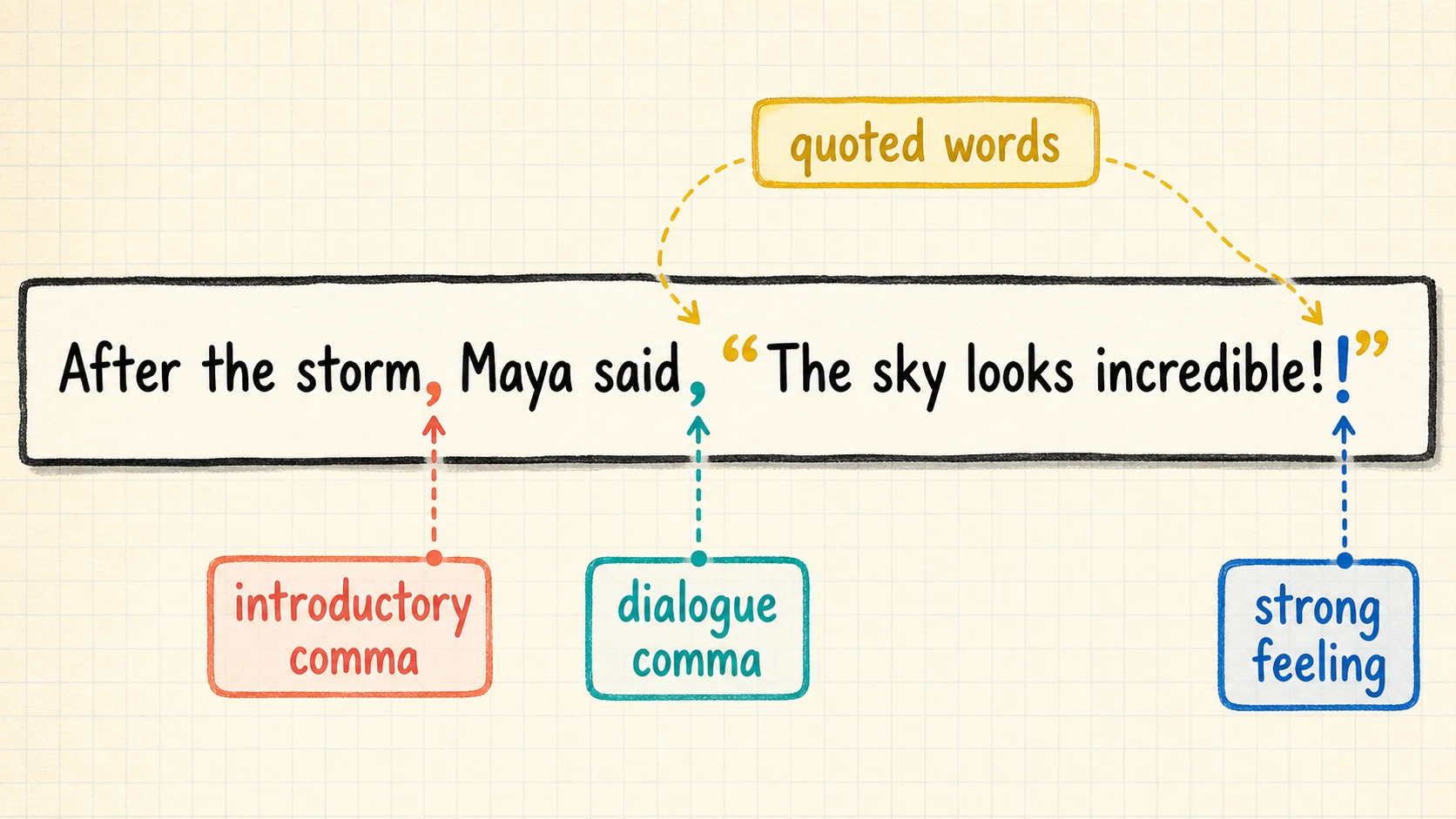
Model both parts of the task: correcting capitalization and selecting an end mark from the sentence’s meaning.
Example 1: a statement
Uncorrected:
my brother packed his lunch
Corrected:
My brother packed his lunch.
Check the decisions:
- my becomes My because it is the first word.
- The sentence tells what happened; it does not ask a question or express urgent force.
- A period completes the statement.
A concise think-aloud would be: “This sentence tells me something. I capitalize the beginning and use a period at the end.”
Example 2: a direct question
Uncorrected:
where did maria put the markers
Corrected:
Where did Maria put the markers?
Check the decisions:
- where becomes Where at the beginning.
- Maria is a person’s name, so it needs a capital.
- The sentence directly asks for information.
- A question mark belongs at the end.
Ask the learner to point to the evidence for each capital. This separates “first word” capitalization from “name” capitalization.
Example 3: an urgent exclamation
Uncorrected:
watch out for the falling branch
Corrected:
Watch out for the falling branch!
Check the decisions:
- watch becomes Watch because it begins the sentence.
- The sentence gives an urgent warning.
- An exclamation mark communicates that force.
Do not teach that every command automatically requires an exclamation mark. A calm direction such as “Place the books on the table.” can appropriately end with a period. The context and intended force matter.
Example 4: a statement containing a place name
Uncorrected:
we traveled to texas in june
Corrected:
We traveled to Texas in June.
Check the decisions:
- we becomes We at the beginning.
- Texas is a specific place name and requires a capital.
- In ordinary sentence use, June is capitalized as the name of a month.
- The sentence makes a statement, so it ends with a period.
This example contains more than one capitalization decision. If that distracts from end punctuation, use a simpler sentence first and return to names later.
Example 5: a boundary case beginning with “what”
Uncorrected:
what time does the movie begin
Corrected:
What time does the movie begin?
The sentence directly requests information, so it needs a question mark.
Compare it with:
What a surprising ending!
This sentence does not ask for an answer. It expresses strong feeling, so an exclamation mark is reasonable. The shared opening word does not determine the punctuation by itself.
Example 6: a polite request with question form
Uncorrected:
could you pass the blue pencil
Corrected:
Could you pass the blue pencil?
Although the speaker is requesting an action, the sentence is phrased as a direct question. The question mark follows the grammatical form. This is a useful check when a learner assumes that requests always take periods.
Run guided practice without taking over
Begin the printable together. The adult can read an item aloud, but the learner should make the decisions. Avoid announcing the correct mark through exaggerated voice before the learner has considered the sentence.
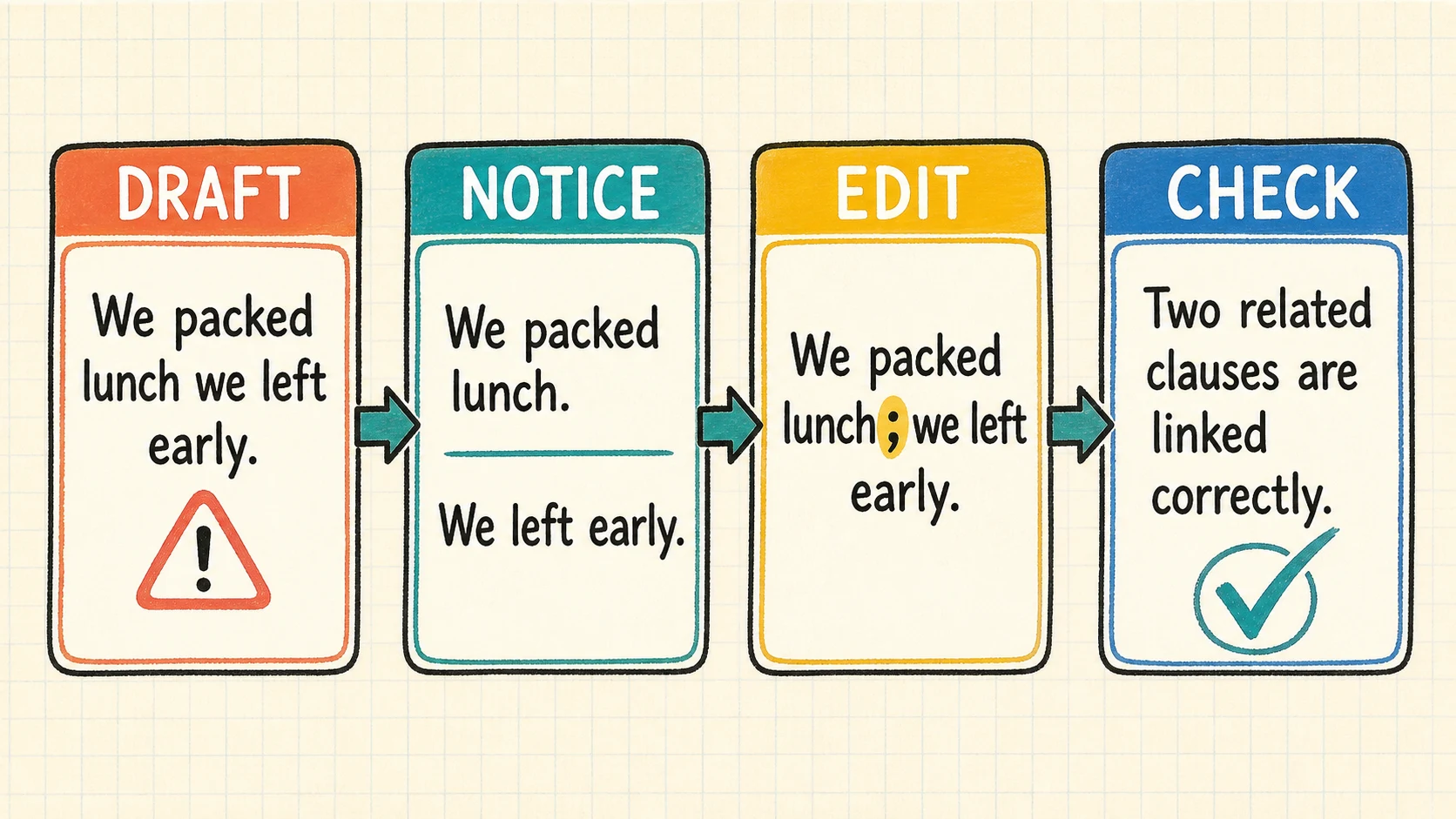
Guided practice should expose the learner’s reasoning while leaving the actual punctuation choice to the learner.
Use a consistent prompt sequence
For each guided item, ask:
- “What is the sentence doing—telling, asking, or expressing something strongly?”
- “Which end mark matches that purpose?”
- “Which letter must be capitalized because it begins the sentence?”
- “Is there a name or another obvious proper noun?”
- “Read the corrected sentence again. Does it make sense?”
The questions should fade as the learner becomes more accurate. If the learner answers correctly without prompts, move toward independence. If the learner chooses incorrectly, ask for the sentence’s purpose before naming the mark.
A useful correction exchange might sound like this:
- Learner: “I think it needs a period.”
- Adult: “Read the sentence again. Is it telling you information, or is it asking you to supply information?”
- Learner: “It is asking.”
- Adult: “Which end mark shows a direct question?”
That exchange keeps the reasoning with the learner.
Separate the two editing passes when needed
Some learners may find it difficult to check capitals and end punctuation simultaneously. Keep the same skill but divide the process:
- First pass: mark necessary capitals.
- Second pass: decide on the end punctuation.
- Final pass: reread the whole sentence.
This adaptation reduces the number of decisions made at once without replacing or simplifying the target conventions.
Decide when to release responsibility
Move to independent work when the learner can explain several consecutive choices without the adult supplying the category. Consecutive correct answers alone are less informative if the learner is guessing. Listen for explanations such as, “It asks where something is, so I need a question mark,” or, “This is a statement, so I use a period.”
If explanations remain uncertain, model one fresh example and try another guided item. Do not complete most of the page for the learner and then interpret the resulting score as independent performance.
Protect the independent portion
Tell the learner which items to complete without help. The exact split should respond to observed performance. One learner may need only two modeled examples and two guided items; another may benefit from a shorter first sitting followed by a second sitting. There is no universal item split.
During independent work, avoid correcting each sentence immediately. Immediate interruption can hide whether the learner can monitor a full set of work. Instead, note patterns quietly unless the learner has misunderstood the direction and is performing the wrong task on every item.
A neutral direction is:
“Finish these sentences by correcting capitalization and adding the best end mark. When you finish, reread each one before we check.”
The learner may use the reference strip if that support was available during guided practice. Record that support when interpreting the result. Work completed with a reference is still useful evidence, but it is different from fully unaided recall.
The IES foundational reading practice guide concerns kindergarten through third-grade reading foundations, not this fourth-grade punctuation page. Its scope is relevant only as background: reading words and connected text supports access to written sentences. It should not be cited as proof that this worksheet improves reading or punctuation achievement.
Adapt support without changing the skill
Support should make the intended decision accessible. It should not reveal every answer or replace punctuation work with an unrelated activity.
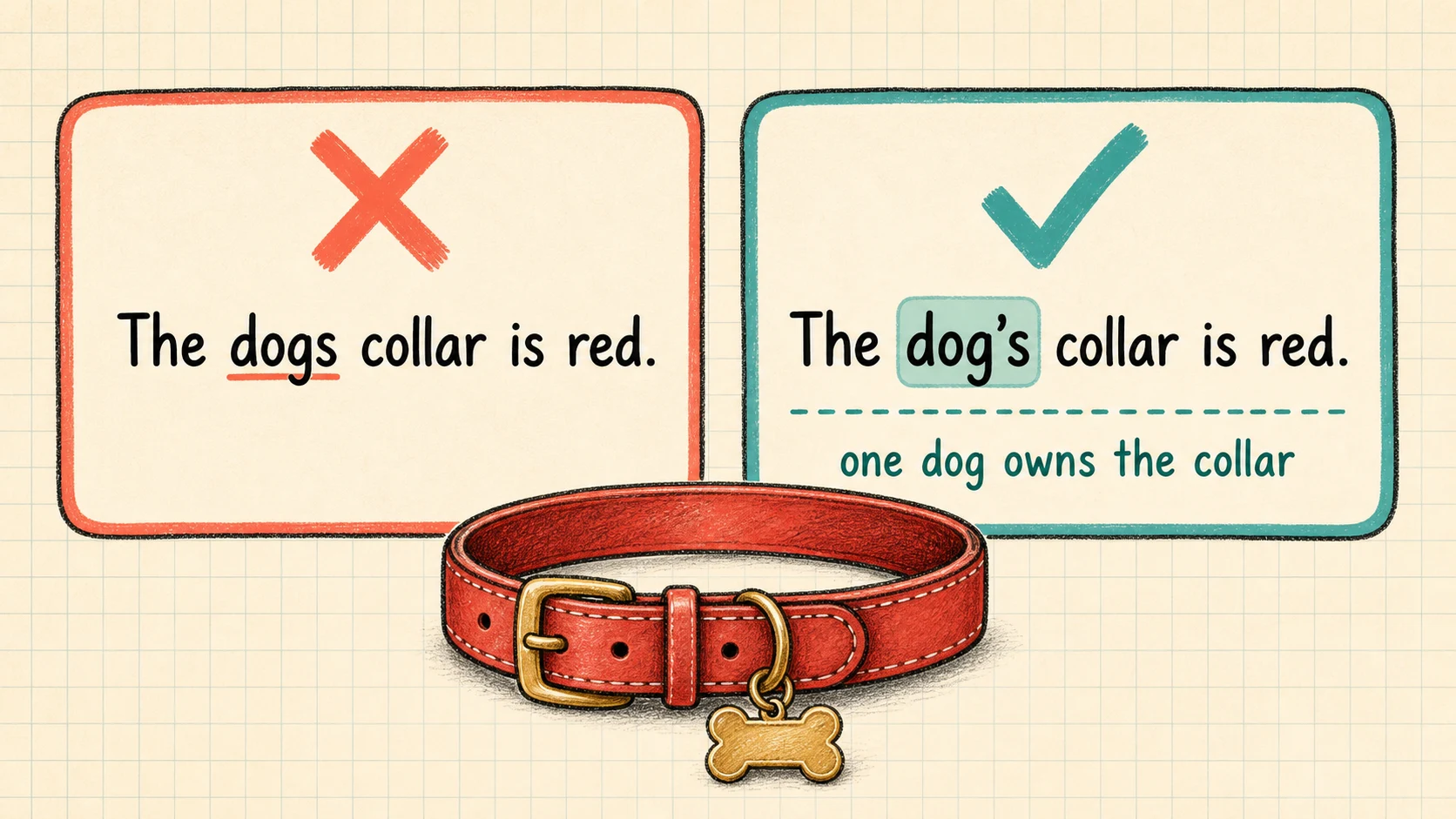
Adjust the amount of reading, prompting, or visual support while preserving capitalization and end-punctuation decisions.
If reading load interferes
Read the item aloud once in a neutral voice, then ask the learner to follow the printed words and make the punctuation decision. This preserves the editing task while reducing the chance that a decoding difficulty alone prevents access.
If a word is unfamiliar, explain that word without interpreting whether the sentence is a question or exclamation. The adult may say what a word means; the learner should still decide what the sentence is doing.
If the learner rushes
Cover all but one item with a blank sheet of paper. After each correction, use a two-point check:
- “Capital at the beginning?”
- “Mark at the end?”
This changes the visual presentation, not the target skill. It is especially useful when skipped items or missing end marks appear alongside otherwise sound reasoning.
If handwriting is the barrier
Let the learner circle the first letter that needs changing, say the capital aloud, and write only the end mark. Alternatively, the adult may copy the learner’s dictated correction after asking the learner to identify every change. Note that the response was dictated rather than handwritten.
This adaptation can show punctuation knowledge, but it does not provide evidence about independent transcription.
If the work is consistently accurate
Do not add harder punctuation rules to the current page without teaching them. Instead, ask the learner to write one new statement, one direct question, and one forceful exclamation, then edit those sentences using the same conventions.
That extension raises the production demand while keeping the target on capitalization and end marks. When the learner is ready for commas, apostrophes, or dialogue punctuation, move to the broader punctuation guide rather than silently changing the rules of this activity.
Interpret errors as patterns
An incorrect answer is useful when it reveals which decision broke down. Mark the sentence, discuss the reason, and sort the error into a small number of categories.
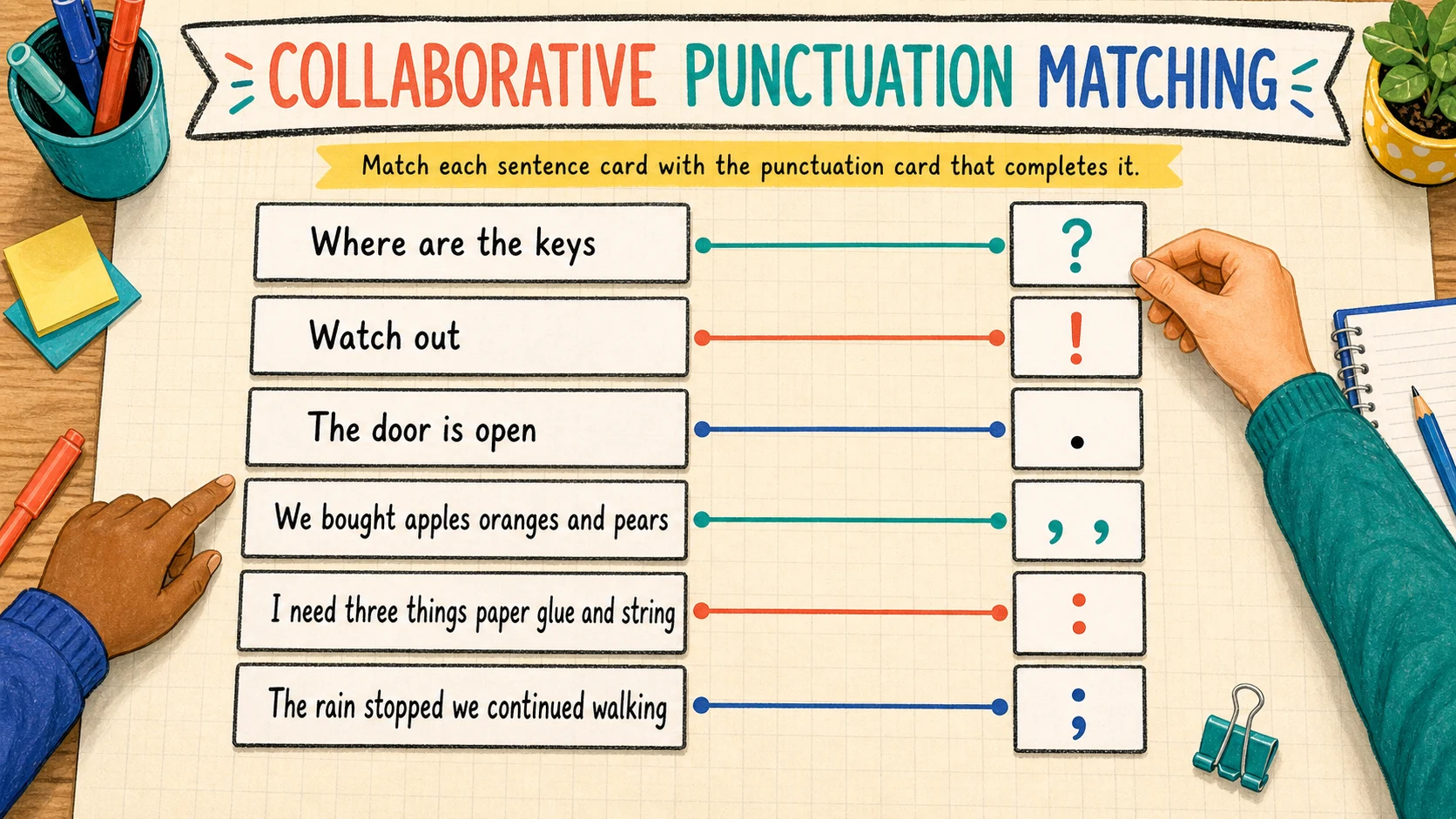
Check meaning first, then capitals, then the final mark; use the pattern to choose the next teaching move.
| Observed pattern | Possible interpretation to check | Useful next move |
|---|---|---|
| First word remains lowercase | The learner may be attending only to the end mark | Use a separate capitalization pass on three sentences |
| Names remain lowercase | The learner may know sentence-beginning capitals but not notice proper nouns | Contrast a common noun with a specific name |
| Every item ends with a period | The learner may be using a default mark rather than reading for purpose | Sort fresh oral examples into statements and questions |
| Questions receive exclamation marks | The learner may equate expressive reading with exclamation | Ask whether the sentence requests an answer |
| Exclamations receive periods | The learner may recognize statements but miss urgency or strong feeling | Compare a calm command with an urgent warning |
| Correct answer appears after repeated prompting | The rule may be emerging but not independently retrievable | Provide one more guided set, then retry without prompts |
| Marks are correct but capitals are missed | End punctuation may be stronger than capitalization monitoring | Require a final “beginning and names” scan |
| Mixed errors occur only late on the page | Attention, reading load, or task length may be involved | Recheck selected items after a pause before reteaching every rule |
These are interpretations to investigate, not diagnoses. A single error does not establish a misconception. Ask the learner to explain the choice and use another comparable sentence to see whether the same reasoning recurs.
Common misconceptions to address directly
“Questions always begin with who, what, when, where, why, or how” is too broad. Yes-or-no questions may begin with words such as can, did, or is. Conversely, a sentence beginning with what may express strong feeling rather than ask a question.
“Exciting topics always need exclamation marks” is also unreliable. “The roller coaster is tall.” remains a statement even if the writer likes roller coasters. The punctuation depends on how the sentence is presented, not merely whether its subject is exciting.
“Commands always use exclamation marks” confuses sentence purpose with intensity. “Close the door.” can be a calm direction. “Stop!” signals urgent or forceful expression.
“Only the first word needs a capital” overlooks names and other proper nouns. At the same time, avoid asking the learner to capitalize random important-looking words.
Check the answer key responsibly
The separate printable answer key is useful for confirming intended corrections, but it should follow the learner’s attempt. Using it during the independent phase turns an editing task into answer matching.
Use a three-step checking routine
First, have the learner reread and self-check before revealing the key. Ask the learner to place a small check beside items they feel certain about and a dot beside items they want to reconsider.
Second, compare one item at a time. For a mismatch, ask the learner to identify whether the difference involves a capital letter, an end mark, or both. The learner should make the correction.
Third, record patterns rather than only a total. A note such as “question marks secure; missed two sentence-opening capitals” is more useful for planning than a score alone.
If a sentence seems open to more than one reasonable tone, distinguish grammatical function from expressive choice. A direct question still needs a question mark. A sentence that could be either a calm statement or a forceful exclamation may depend on context. Consult the supplied key for the worksheet’s intended answer, explain that intention, and avoid presenting every possible stylistic choice as universally wrong.
Do not use this 14-item result as a diagnosis, a guaranteed indicator of grade-level mastery, or a comprehensive standards judgment. It is a focused sample of performance on the page’s stated skills.
Decide what to teach next
The next step should follow the error pattern, not the learner’s age label alone.
| Evidence from the worksheet | Appropriate next step |
|---|---|
| Frequent confusion among all three end marks | Reteach sentence purpose with short statement, question, and exclamation contrasts |
| End marks are accurate; capitals are inconsistent | Practice a separate capitalization scan before combining the skills again |
| Work is accurate only with prompts | Repeat a short guided set, then remove one prompt at a time |
| Work is accurate but slow | Use another brief set for fluency without imposing a universal speed target |
| Most work is independently accurate | Apply the same conventions in original sentences or a short editing passage |
| Errors involve punctuation not covered here | Teach that convention explicitly through the topic guide before expecting independent correction |
If the learner needs continued practice across this subject, browse the fourth-grade grammar worksheets. If the four target skills are secure, the 4th Grade Punctuation Worksheet Pack contains 18 worksheets and is listed at $4.79. That pack is an option for broader practice, not a required purchase or a guarantee of progress.
Free worksheet generators can also provide fresh material. Keep generated sentences within the convention already taught, and personally check every sentence for clarity before giving it to a learner.
Schedule retrieval after the first lesson
A corrected page can look fluent while the answers are still fresh. Later retrieval asks the learner to reconstruct the rule after some forgetting has occurred.
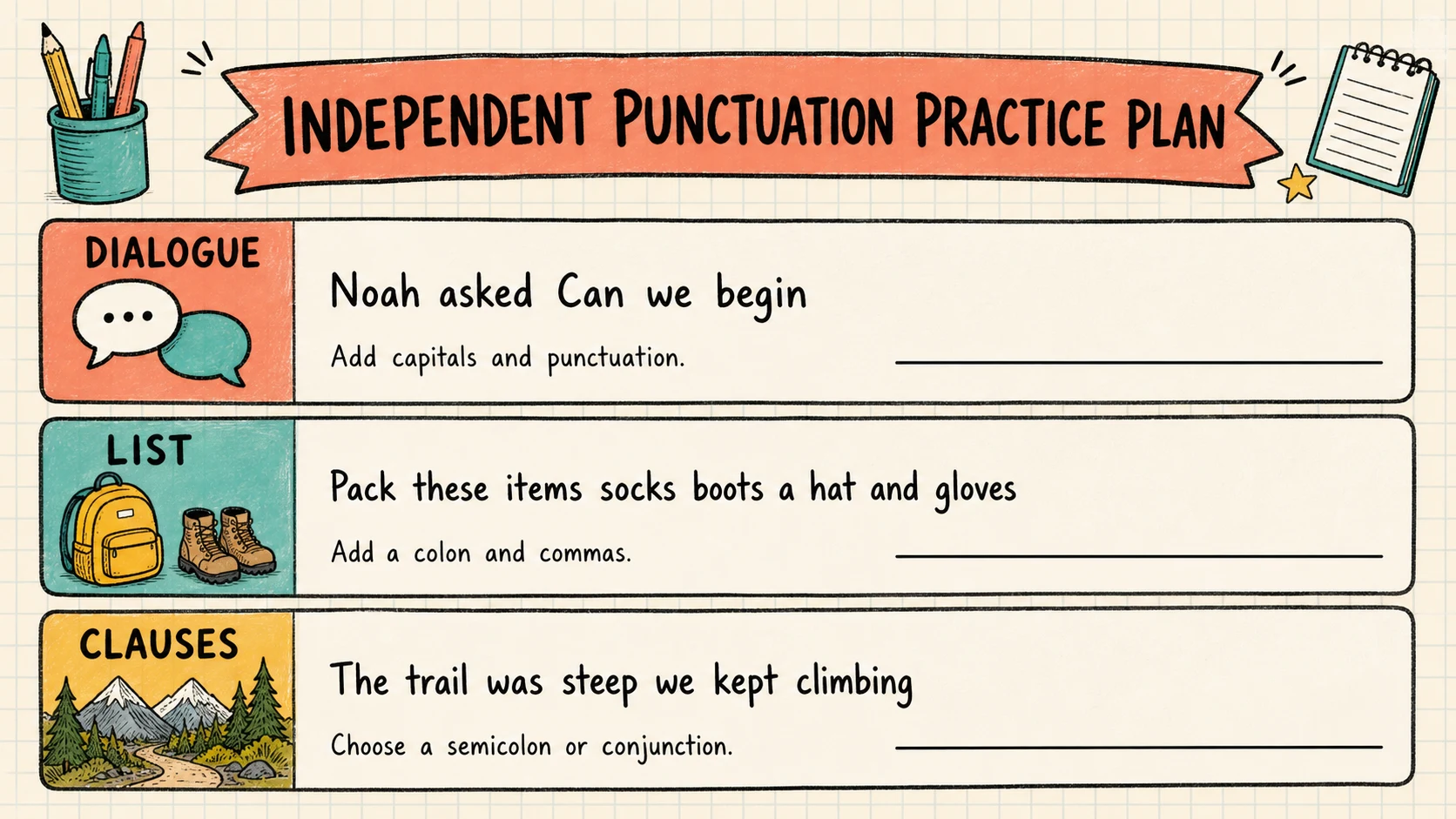
Use brief delayed checks and adjust the spacing from the learner’s actual responses.
The following is a practical plan, not a sourced or universal timetable:
| Time | Retrieval task | Decision |
|---|---|---|
| End of the lesson | Learner explains one period, one question mark, and one exclamation mark | If an explanation is unclear, clarify it before ending |
| Next suitable study day | Correct three fresh sentences without the key | If the same error returns, provide a brief contrast and retry |
| Several days later | Edit a short mixed set containing the four target skills | If performance is independent, widen the interval |
| About one or two weeks later | Correct fresh sentences or edit a short paragraph | If accuracy drops, shorten the interval and revisit the specific pattern |
| During later writing | Check one authentic piece for capitals and end marks | Confirm whether the skill transfers beyond isolated items |
The calendar should remain flexible. A learner who retrieves the conventions easily does not need repeated full-page practice. A learner who continues to confuse sentence purpose may need shorter, more frequent contrasts rather than another long session.
Include new sentences during retrieval. Reusing one or two previous errors can be helpful, but repeating only memorized items does not show whether the learner can apply the convention elsewhere.
Keep the result within its limits
This worksheet provides 14 easy-level exercises in capitalization, periods, question marks, and exclamation marks. It can support a focused mini-lesson, homework review, homeschool practice, or a brief classroom check. A separate answer key is included.
It cannot, by itself, establish complete punctuation mastery, comprehensive standards alignment, writing quality, reading ability, or the cause of persistent errors. It also does not cover the full punctuation progression described in the catalogue. Instruction with commas, apostrophes, quotation marks, dialogue, colons, or semicolons requires other teaching and practice.
The most honest next action is to use the free 4th Grade Punctuation worksheet, record which choices the learner makes independently, and then follow the matching section of the broader punctuation topic guide for the next convention the learner is ready to study.
Put it into practice
Use the guide with a real printable
Move from explanation to a short, observable practice task. Check the first item together, then adjust the next session from the learner's actual work.
See the 18-worksheet pack