Complete guide
How to teach and practise 4th grade parts of speech worksheets - standard theme (easy)
How to use this 14-item worksheet
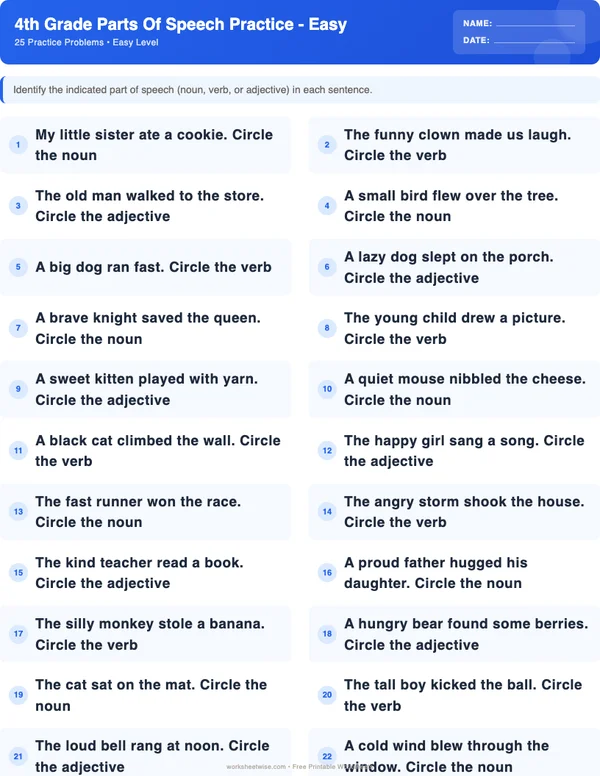
The free 4th Grade Parts of Speech worksheet gives a learner 14 easy-level exercises on identifying nouns, verbs, and adjectives in sentences. Use it as a focused lesson, not merely as a page to finish. Briefly review the three word classes, model one item aloud, solve several items together, and then release the learner to work independently. Review errors by type before deciding whether to repeat, extend, or move on.
The worksheet’s direction is specific: identify the indicated part of speech—noun, verb, or adjective—in each sentence. It does not assess all eight parts of speech. Its narrow scope is useful for learners who are beginning sentence analysis or need additional practice with these three foundational categories.
Grade labels describe the intended practice level; local curricula and teaching sequences differ. A fourth grader may find this page introductory, appropriately challenging, or in need of extra support. The learner’s observed work should determine the pace.
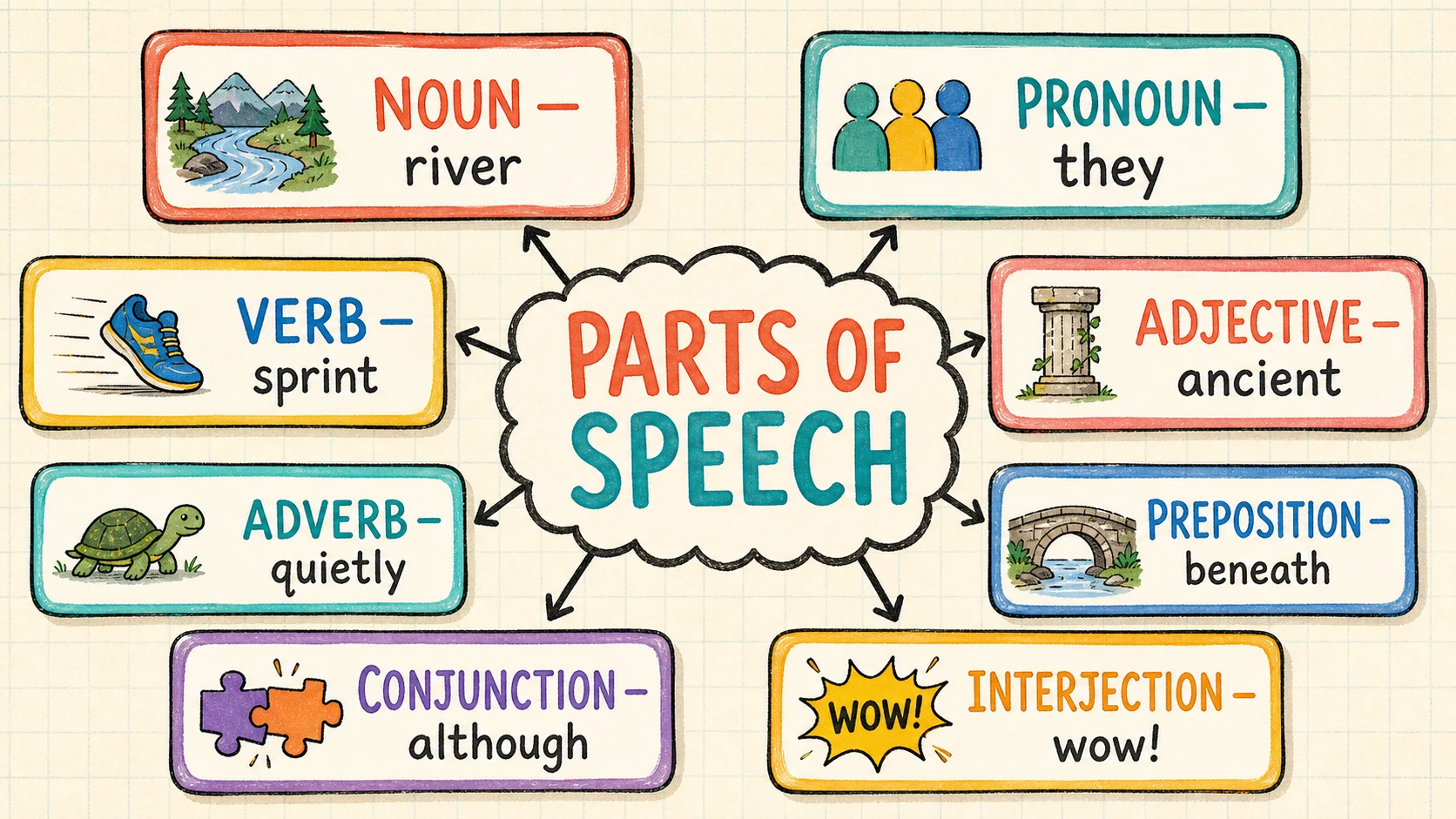
Move from a short review to modeling, guided practice, independent work, and a delayed check.
| Lesson phase | Suggested use of the 14 items | Adult’s role | Evidence to notice |
|---|---|---|---|
| Launch | Before item 1 | Review noun, verb, and adjective with one oral example each | Can the learner explain the categories in workable language? |
| Model | Item 1 or a separate example | Think aloud without asking the learner to guess the adult’s reasoning | Does the learner follow the target named in the direction? |
| Guided practice | About 3 items | Prompt, listen, and reduce help gradually | Can the learner justify an answer using the sentence? |
| Independent practice | Remaining items | Observe without supplying answers | Which decisions are secure, slow, or inconsistent? |
| Review | Incorrect and uncertain items | Compare reasoning with the answer key | Does the learner understand why an answer works? |
| Retrieval | Selected items on later days | Re-present examples without reteaching first | Is the distinction remembered after a delay? |
These item divisions are instructional suggestions, not fixed requirements. A learner who is already secure may need only one guided item. A learner who confuses categories may need a shorter independent set followed by another model.
Prepare the page and the lesson target
Print the worksheet and keep its separate answer key out of sight during the first attempt. Have a pencil and, if useful, three colored pencils available. Color is optional; it should clarify the categories rather than become another rule the learner must remember.
Before starting, tell the learner exactly what the page measures:
“Each sentence asks you to find a noun, verb, or adjective. First read which kind of word is requested. Then read the whole sentence and find the word doing that job.”
This wording keeps attention on a word’s function in its sentence. It also prevents a common procedural error: circling an obvious noun when the item asked for a verb.
Use a compact working definition for each category:
- A noun names a person, place, thing, or idea.
- A verb shows an action or serves as a linking verb.
- An adjective describes a noun.
For this easy worksheet, do not front-load every exception in English grammar. The immediate goal is accurate classification in the supplied sentences. More complex categories and sequences belong in the broader Parts of Speech topic guide.
If this page is part of a longer grammar session, place it after a brief oral review and before unrelated material. The 4th Grade Grammar collection can help you choose related practice without turning one focused lesson into a survey of every grammar topic.
Launch with meaning before labels
Establish the noun–verb core
Begin with a short sentence such as:
Birds sing.
Ask two meaning-based questions:
- “Who or what is this sentence about?”
- “What do the birds do?”
The answers are birds, a noun, and sing, a verb. Then add an adjective:
Small birds sing.
Ask, “Which word tells more about the birds?” The answer is small, an adjective describing the noun birds.
This oral launch gives the learner a sentence structure to inspect. It is more useful than reciting three definitions without applying them.
Use a repeatable decision routine
Teach the learner to follow the same sequence on every item:
- Read the requested category.
- Read the complete sentence.
- Find a likely word.
- Test the word’s job in that sentence.
- Mark only the requested answer.
- Reread the sentence and explain the choice briefly.
The explanation can be short: “Rabbit names an animal,” “whispered tells the action,” or “wooden describes the bridge.” Requiring an explanation during modeling and guided practice reveals whether the learner is reasoning or guessing.
The IES foundational reading practice guide addresses kindergarten through third grade, not this fourth-grade worksheet. At a high level, it includes academic language and vocabulary among its instructional concerns. That supports defining grammar terms clearly, but it does not constitute an evaluation of this worksheet or a fourth-grade pacing recommendation.
Model the task with fully checked examples
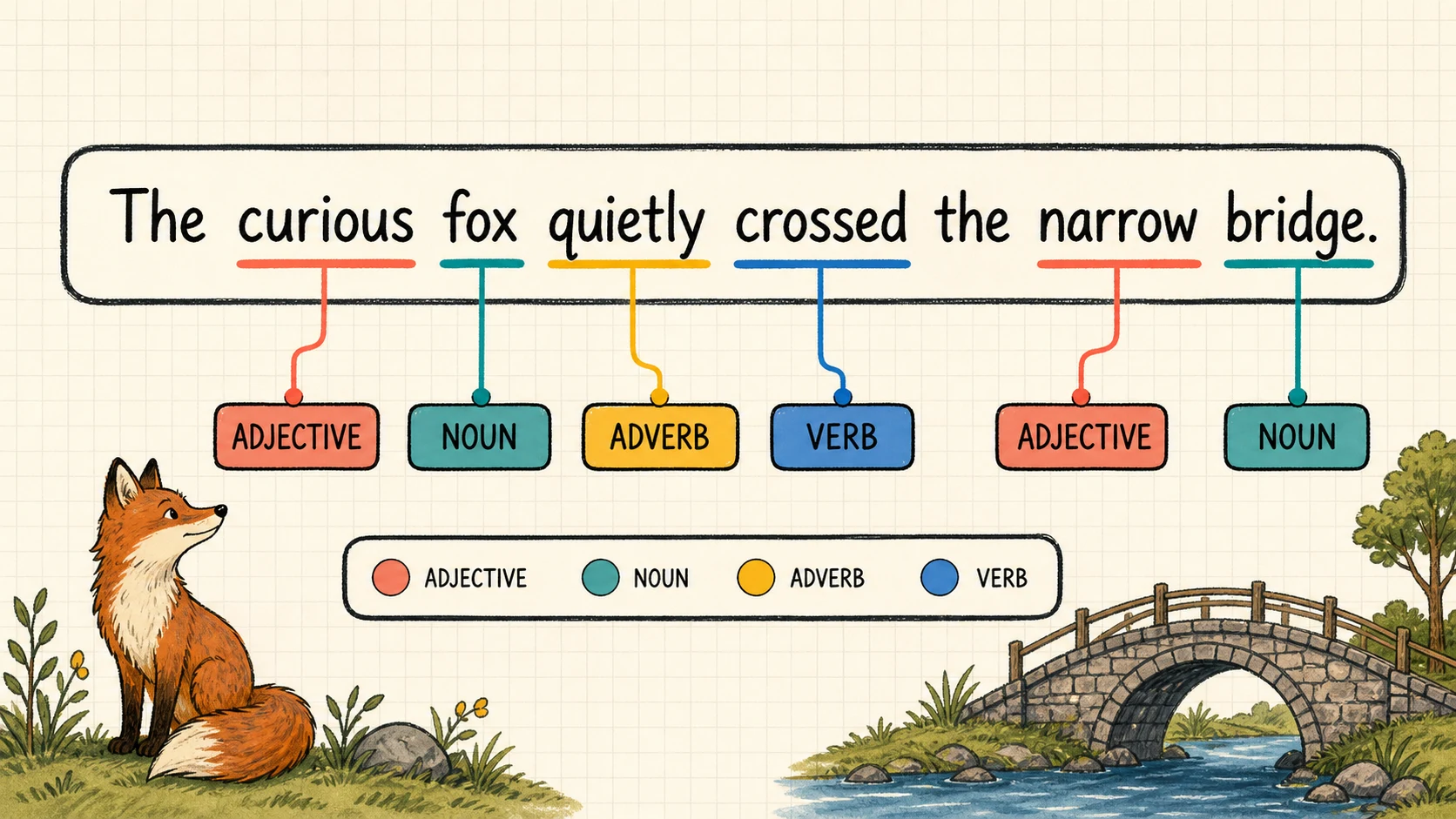
Read the requested category first, then test the selected word in the complete sentence.
The following examples are newly written models similar to the worksheet’s skill. They are not claims about the exact sentences printed on the page.
Example 1: identify a noun
Sentence: The rabbit hops.
Task: Identify the noun.
Answer: rabbit
Check: Rabbit names an animal, so it functions as a noun. Hops tells what the rabbit does, so it is the verb. The is not the requested noun.
A useful think-aloud is: “I need a noun, not just any word I recognize. Rabbit names the animal in the sentence, so I will mark rabbit.”
Example 2: identify a verb
Sentence: Maya carried the basket.
Task: Identify the verb.
Answer: carried
Check: Carried tells what Maya did, so it functions as the verb. Maya and basket name a person and a thing; both are nouns. The task requests the verb, so carried is the answer.
This example also checks whether the learner can ignore two clear nouns when the instruction asks for a different category.
Example 3: identify an adjective
Sentence: We crossed the narrow bridge.
Task: Identify the adjective.
Answer: narrow
Check: Narrow describes the noun bridge by telling what kind of bridge it is. Crossed is the action verb. Bridge is a noun. Therefore, narrow is the requested adjective.
Ask the learner to connect the adjective to its noun: “Narrow describes what?” The answer should be “the bridge.”
Example 4: distinguish an adjective from a noun
Sentence: Three candles flickered.
Task: Identify the adjective.
Answer: three
Check: Candles names things and is a noun. Flickered tells what the candles did and is a verb. Three tells how many candles, so it modifies the noun candles and functions as an adjective here.
This example is useful because some learners expect every adjective to describe color, size, or appearance. Number words can also modify nouns.
Example 5: check a linking verb carefully
Sentence: The soup smells delicious.
Task: Identify the verb.
Answer: smells
Check: Smells connects the subject soup with the description delicious. It functions as a linking verb in this sentence. Delicious describes the soup and is an adjective.
Do not assume the printable contains linking verbs. This model simply shows why “verb” is broader than a visible physical action.
Move from guided to independent practice
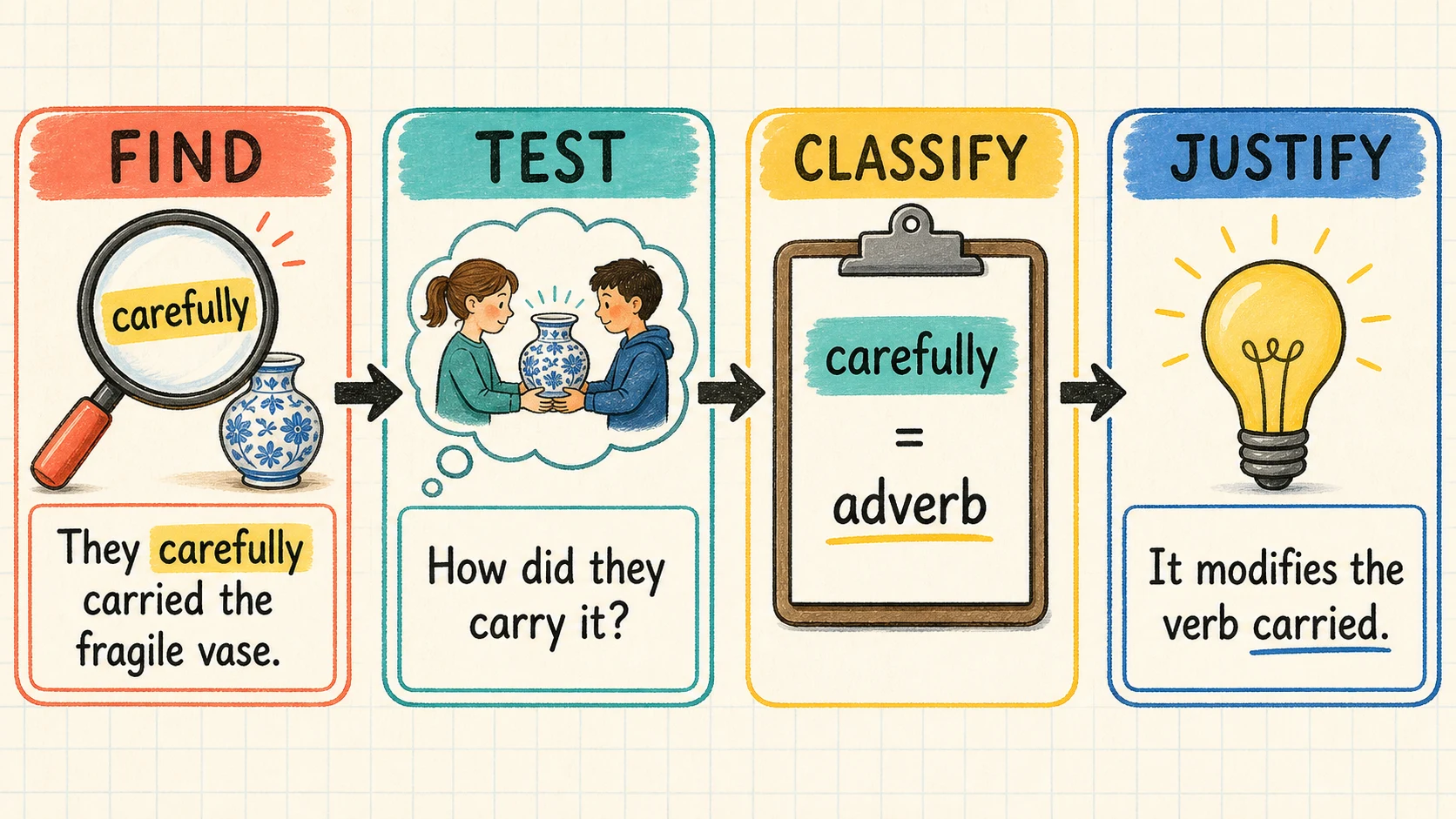
During guided practice, ask for reasoning and gradually remove prompts.
Model one complete item
For the first item, the adult should demonstrate the entire routine:
“The direction asks for an adjective. I will read the complete sentence. Now I will look for a noun and ask which word describes it. I found the describing word, so I will mark only that word.”
Avoid turning a model into a rapid series of questions. A model is the adult’s clear demonstration of the thinking process.
Solve a few items together
On the next items, shift responsibility to the learner. Use prompts in this order:
- “Which category does the item request?”
- “What is the sentence about?”
- “Which word shows the action or links the subject to a description?”
- “Which noun does that word describe?”
- “How can you check your choice?”
Ask only the prompt that is needed. If the learner can identify the requested word after reading the direction, do not add extra questions.
When an answer is correct, occasionally ask for the reason. When it is incorrect, ask the learner to reread the requested category before giving a definition. This distinguishes a direction-reading error from a category misunderstanding.
Release the learner to work alone
Once the learner completes several items with decreasing help, assign a manageable group independently. Depending on the observed work, that might mean the rest of the page or only the next four items before a check-in.
During independent work, record observations without interrupting every hesitation. Notice whether the learner:
- checks the requested category before answering;
- reads the whole sentence;
- identifies words by their function rather than their appearance;
- changes correct answers repeatedly;
- skips items with more than one noun;
- works accurately but slowly;
- marks more words than the direction requires.
The IES elementary writing practice guide includes sentence construction among the skills addressed in writing instruction and recommends regular opportunities to write. That high-level framing supports connecting grammar analysis to sentence use. It does not show that completing this worksheet alone improves writing.
After the page, ask the learner to write one short sentence containing a noun, verb, and adjective. Have the learner label those three words. Treat this as a transfer check, not as item 15 in the worksheet score.
Adapt support without changing the skill
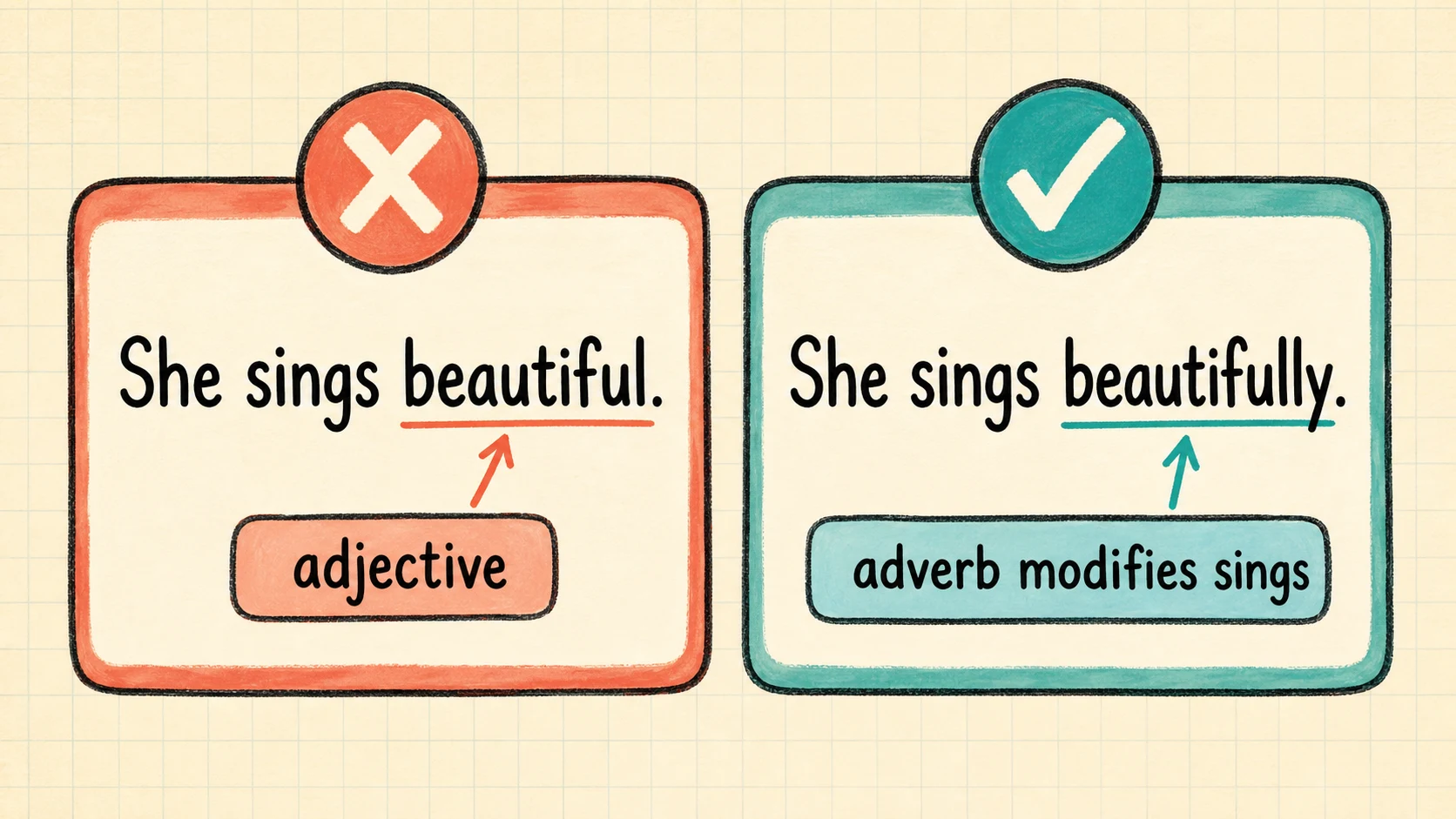
Adjust how much support surrounds the sentence while preserving the noun–verb–adjective decision.
When the learner needs more support
Keep the printed sentence and requested category intact. Add support around the task:
- Read the sentence aloud while the learner follows the words.
- Cover later items so only one sentence is visible.
- Write noun, verb, and adjective on a small reference card with one example of each.
- Underline the noun only when the learner is being asked to find its adjective.
- Let the learner explain orally before writing or circling.
- Complete fewer items in one sitting and resume later.
These changes reduce reading, visual, or memory demands without replacing sentence analysis with an easier sorting task. If you provide two answer choices, return to an unprompted item afterward to see whether the learner can perform the original task.
When performance is uneven
Separate the categories temporarily. Ask the learner to mark only noun items first, then verb items, then adjective items, if the worksheet layout permits this without revealing answers. Another option is to pause after each item and have the learner name the requested category aloud.
Do not correct every error with the same explanation. A learner who identifies nouns accurately but misses adjectives needs a different review from a learner who knows all three categories but overlooks the directions.
When the learner is ready for more challenge
Keep the original answer first. Then ask for one extension:
- Name another noun in the sentence, if one is present.
- Identify the noun that an adjective describes.
- Replace an adjective with a more precise one.
- Change the verb while keeping the sentence complete.
- Write a new sentence in which a chosen word performs a different job.
The extension should follow successful completion, not interfere with the 14-item task. For broader or more sustained practice, the 4th Grade Parts of Speech Worksheet Pack contains 18 worksheets. That pack is an optional source of additional practice, not a required next step.
Teach boundary cases without creating confusion
English words must be classified in context. A memorized word list is not always enough because the same spelling can perform different jobs.
Consider light:
- The light shone. Here, light names a thing, so it is a noun.
- We carried a light bag. Here, light describes the noun bag, so it is an adjective.
- Please light the candle. Here, light names the requested action, so it is a verb.
All three classifications are correct because the sentences assign different functions to the word.
Consider paint:
- The paint dried. Paint is a noun because it names a substance.
- Artists paint murals. Paint is a verb because it tells what artists do.
Use boundary cases after the learner can handle clear examples. Introducing them too early can make a concrete lesson seem arbitrary. The point is not “words can be anything.” The point is “the sentence tells us what job a word is doing.”
Other boundaries deserve careful wording:
- An adjective describes a noun; it does not merely appear near one.
- A verb can express action or link a subject to a description.
- A sentence can contain more than one noun even when the item requests only one particular answer.
- A word that describes an action is often an adverb, not an adjective. Adverbs are outside this worksheet’s stated three-category focus.
- Articles such as a, an, and the should not distract the learner from the requested noun, verb, or adjective.
The official Common Core ELA standards overview presents grade-specific expectations within a broader language and literacy framework. Local adoption and sequencing vary, and the overview does not verify this particular printable. Use local requirements when formal standards reporting is necessary.
Interpret errors as evidence
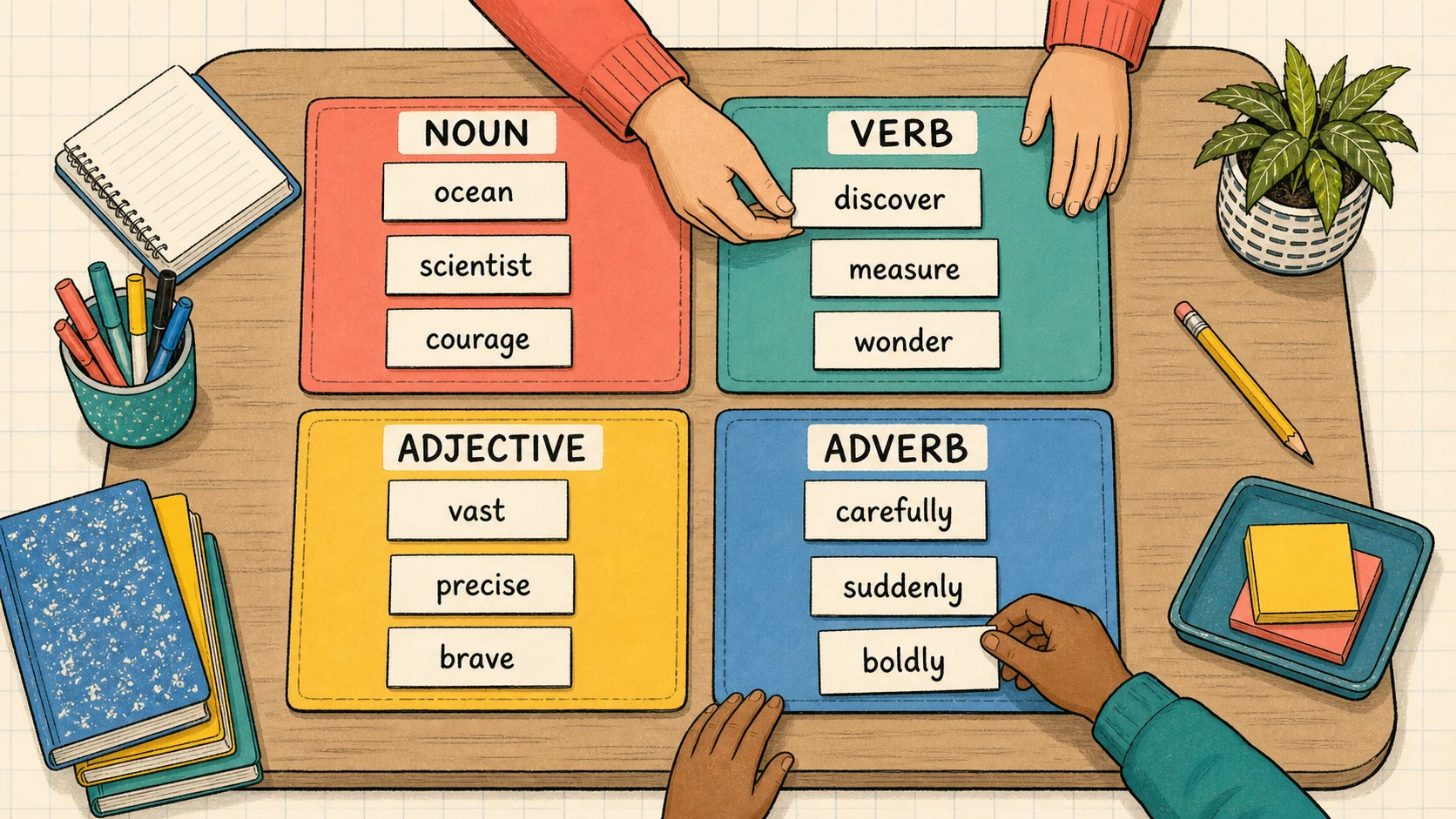
Classify the reason for an error before selecting more practice.
A total score tells you how many answers matched the key. It does not tell you why errors occurred. Revisit incorrect answers and answers that were correct only after substantial prompting.
Direction errors
Pattern: The learner marks a valid noun, but the item requested a verb.
Interpretation: The learner may know the categories but is not attending to the target.
Response: Have the learner box or say the requested category before reading each sentence. Then retry a similar item without the reminder.
Definition errors
Pattern: The learner consistently calls action words nouns or describes a noun as “what it does.”
Interpretation: The category meanings are not yet stable.
Response: Return to two-part oral sentences such as “Dogs bark.” Ask who or what, then what happens. Add adjectives only after noun and verb choices become consistent.
Adjective attachment errors
Pattern: The learner finds a describing word but cannot say which noun it describes.
Interpretation: The learner may be selecting a word because it sounds descriptive rather than because it modifies a noun.
Response: Require the frame “___ describes ___.” For the narrow bridge, the learner should say, “Narrow describes bridge.”
Context errors
Pattern: The learner insists that light is always a noun or that paint is always a verb.
Interpretation: The learner is classifying a familiar word from memory rather than using its sentence function.
Response: Place two contrasting sentences side by side and ask what job the word performs in each one.
Reading or marking errors
Pattern: Oral answers are accurate, but written responses are skipped, placed on the wrong line, or changed during copying.
Interpretation: The worksheet record may not reflect the learner’s grammar reasoning.
Response: Reduce visual clutter, use a ruler or blank sheet as a line guide, or allow the learner to point and explain orally. Do not treat this pattern as a diagnosis.
Avoid attaching a broad label to one worksheet result. Fourteen easy-level items provide a limited sample of noun, verb, adjective, and sentence-analysis performance. Fatigue, unfamiliar vocabulary, rushed reading, or the page format may influence the result.
Check the answer key responsibly
The separate printable answer key is useful for verification, but it should not replace discussion.
First, review the learner’s original work without erasing it. Mark answers as correct, incorrect, or uncertain. An uncertain answer is one the learner guessed, changed repeatedly, or could not explain, even if it matches the key.
For each mismatch:
- Read the exact task again.
- Let the learner explain the original choice.
- Identify the job performed by the selected word.
- Compare that reasoning with the keyed answer.
- Correct the item in a different color or beside the original response.
- Ask the learner to state why the corrected answer fits.
If an item appears ambiguous, inspect the whole sentence and its direction before assuming either the learner or key is wrong. Check whether more than one word belongs to the broad category but only one satisfies the worksheet’s indicated target or marking format. Preserve reasonable questions for later review rather than forcing agreement without an explanation.
Do not show the key and ask the learner to copy corrections. A copied answer confirms only that the learner can reproduce the key. A short explanation provides better evidence of understanding.
You may record a raw result such as “11 of 14 matched the key,” but pair it with a pattern: “The three mismatches were adjective items,” or “Two errors came from answering the wrong requested category.” These descriptions are more useful for planning.
Decide what to do next
Treat the following as practical decision rules, not research-based cut scores.
Repeat or reteach
Pause for direct review when errors cluster around one category, explanations remain unclear, or the learner depends on prompts for most items. Use fresh oral sentences rather than immediately repeating the identical page. Then return to two or three missed items and ask for both the answer and the reason.
Practice the same skill in new sentences
Choose additional easy practice when the learner understands corrections but remains hesitant or inconsistent. Keep the categories limited to nouns, verbs, and adjectives until the learner can identify them in context with little support.
The free worksheet generators can provide another route to practice if you want fresh material. Check any generated sentences before using them and keep the task aligned with the three categories being reviewed.
Move toward application
When identification is accurate and explanations are clear, ask the learner to revise sentences:
- Replace a vague noun with a more specific noun.
- Replace a general verb with a precise action verb.
- Add an adjective that contributes useful information.
- Remove an unnecessary adjective and compare the effect.
This connects identification to writing without claiming that worksheet completion automatically transfers to composition.
Broaden the progression
This printable covers nouns, verbs, adjectives, and basic sentence analysis. It does not provide comprehensive instruction in pronouns, adverbs, prepositions, conjunctions, interjections, antecedents, verb tense, agreement, or complex sentence analysis. Use the broader topic guide to choose the next category instead of attempting to fit the entire progression into this lesson.
Schedule retrieval after the first lesson
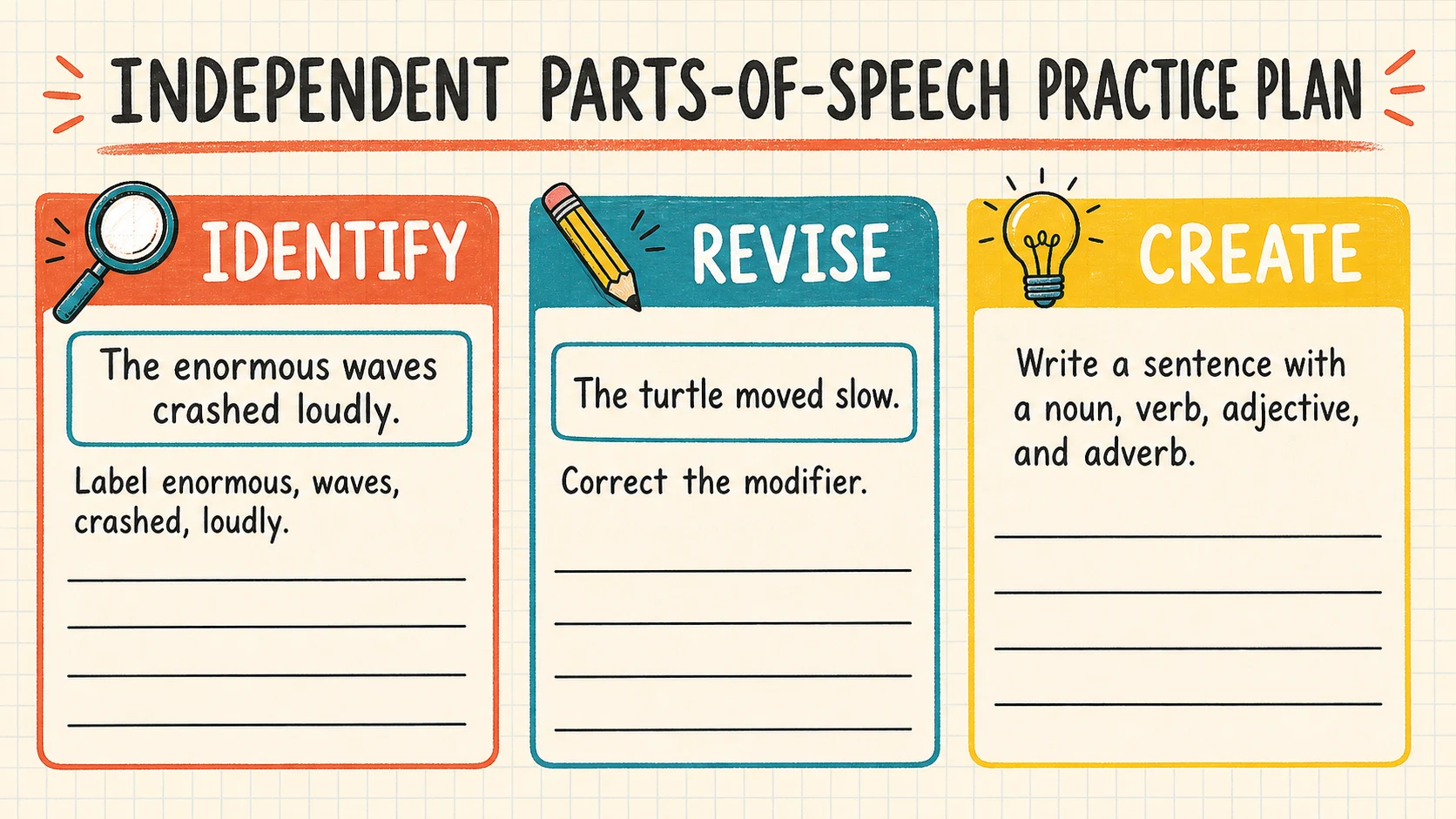
Revisit the classification process after increasing delays and adjust from the learner’s responses.
A workable review sequence might be:
| Review point | Short retrieval task | What to observe |
|---|---|---|
| One or two days later | Revisit three original items without showing corrections first | Are corrected ideas remembered? |
| Several days later | Classify noun, verb, and adjective in two new sentences | Does learning transfer beyond the page? |
| About one or two weeks later | Mix clear examples with one context-dependent word | Can the learner use sentence function rather than memory? |
| During later writing | Label one noun, verb, and adjective in the learner’s own sentence | Can the learner apply the categories during composition? |
This is an example schedule, not a universal timetable. Shorten the interval when the learner cannot retrieve the categories. Lengthen it when responses remain accurate and well explained. Retrieval should begin with an opportunity to remember, followed by feedback; it should not become repeated guessing without correction.
Keep each review brief. One carefully discussed sentence can reveal more than a full page completed with automatic marks. Record the date, the category reviewed, the level of prompting, and one observation. For example: “Identified nouns and verbs independently; needed the frame ‘___ describes ___’ for adjectives.”
Keep the worksheet in perspective
The “easy” label describes the catalogue difficulty, not a judgment about the learner. The worksheet offers 14 focused opportunities to identify nouns, verbs, and adjectives, plus a separate answer key. It can support classroom practice, homework, tutoring, or homeschool instruction, but it is still one short sample.
It does not establish mastery of all parts of speech, comprehensive standards alignment, reading comprehension, or writing quality. It should not be used to diagnose a learning condition or prescribe child-specific intervention. When persistent difficulty extends across reading, speaking, and writing tasks, families and educators can document examples and consult the learner’s school or an appropriately qualified professional.
For the next lesson, revisit any missed category with two fresh sentences, then open the free Parts of Speech topic guide and select practice that extends the learner’s demonstrated understanding.
Put it into practice
Use the guide with a real printable
Move from explanation to a short, observable practice task. Check the first item together, then adjust the next session from the learner's actual work.
See the 18-worksheet pack