Complete guide
How to teach and practise 3rd grade spelling words worksheets - standard theme (easy)
How to Use This 25-Item Spelling Worksheet
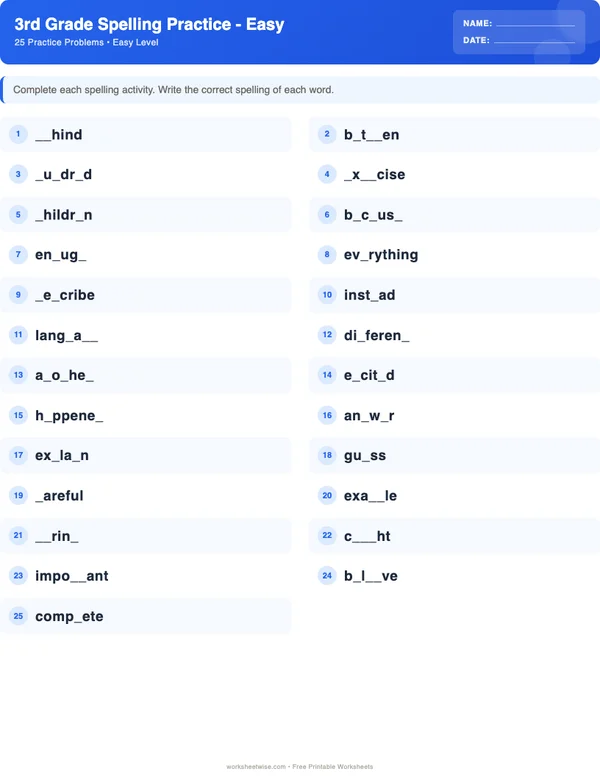
The 3rd Grade Spelling Words Worksheets - Standard Theme (Easy) printable provides 25 exercises in three activity forms: fill-in-the-blank, word scrambles, and misspelling correction. It practices spelling, word recognition, vocabulary, and attention to letter patterns. A separate printable answer key is included.
For most learners, the clearest way to use it is to:
- Preview the directions and activity formats.
- Model one similar example without completing a worksheet item for the learner.
- Complete a few actual items together.
- Assign a manageable group of items independently.
- Check the work with the answer key.
- Study the location and type of each error.
- Revisit missed words after a delay.
Do not assume that “easy” means every learner should complete all 25 items in one sitting. The learner’s observed work should determine pacing. Grade labels describe the intended practice level, and local curricula and instructional sequences differ. This worksheet can support third-grade practice, but it is not a complete spelling curriculum or a universal measure of grade-level performance.
Use the free spelling worksheet alongside this guide. For the wider sequence of spelling patterns and activities, consult the Spelling Words topic guide rather than trying to turn this single printable into a complete progression.
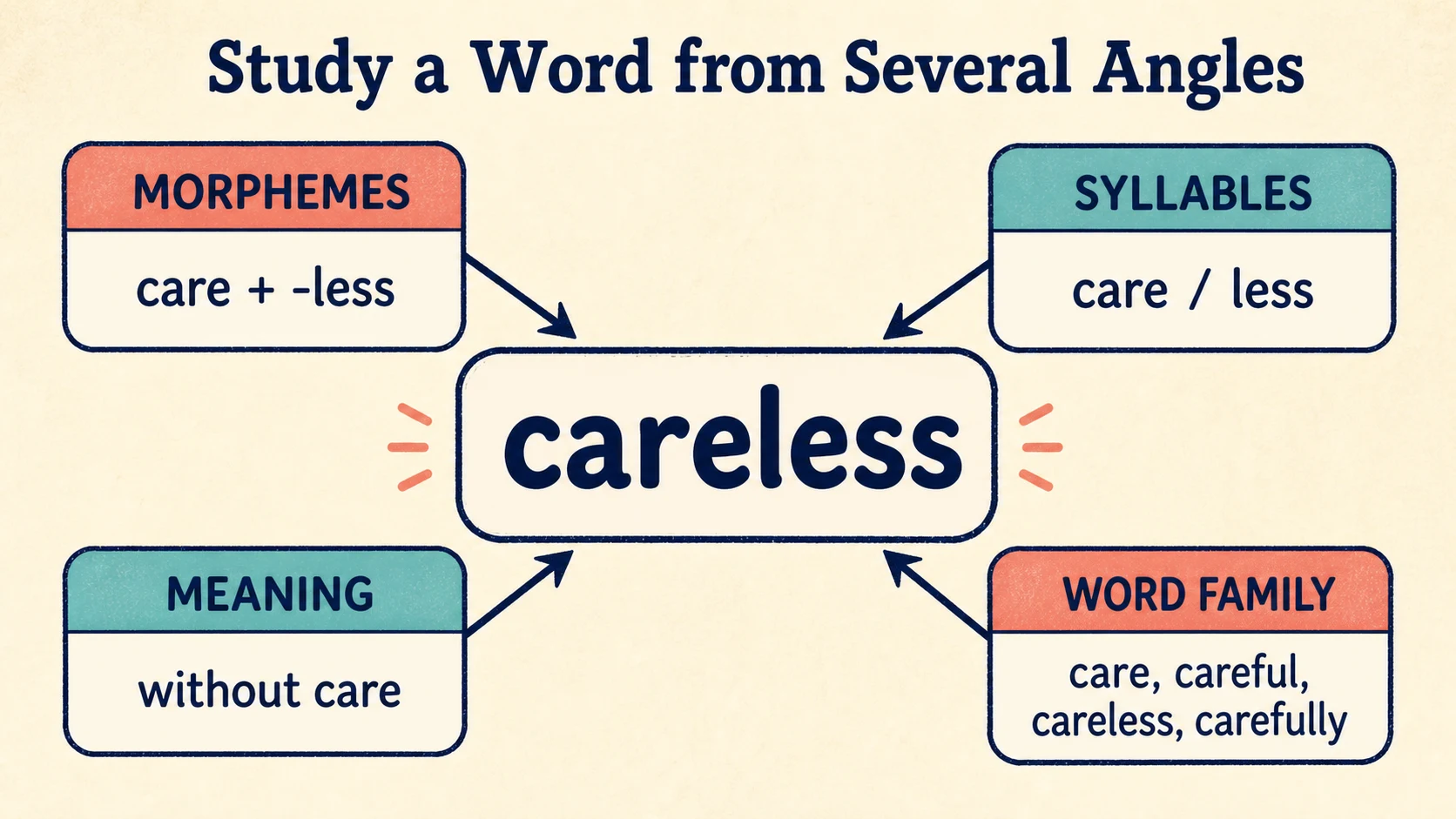
Preview, model, guide, release, check, and revisit in a deliberate sequence.
What This Worksheet Does—and Does Not Do
The printable asks learners to complete spelling activities and write each word correctly. Its varied formats require more than copying. Depending on the item, the learner may need to recognize a word from context, reorder letters, or identify and repair an incorrect spelling.
These formats provide several useful kinds of practice:
- A fill-in-the-blank item connects spelling with meaning and sentence context.
- A word scramble requires the learner to account for every supplied letter and arrange those letters into a recognizable word.
- A misspelling-correction item asks the learner to compare an incorrect form with a known or inferred correct pattern.
- Writing the final answer requires producing the complete spelling, not merely pointing to it.
The worksheet does not, by itself, show why every word is spelled as it is. It also cannot establish whether an error came from weak pattern knowledge, unfamiliar vocabulary, hurried handwriting, misunderstanding the activity, or loss of attention. Adult observation is therefore important.
The IES foundational reading practice guide provides high-level support for explicit work with speech sounds, letter relationships, decoding, and word parts in the primary grades. That guidance can frame careful spelling instruction, but the source did not evaluate this WorksheetWise printable. Similarly, the IES elementary writing guide addresses explicit instruction and regular opportunities to write. It supports connecting spelling practice with actual writing, not making claims about outcomes from this particular worksheet.
The Common Core English Language Arts standards include grade-level language expectations involving conventional spelling, spelling patterns, generalizations, and reference use. However, standards documents do not dictate one universal local sequence. This worksheet’s catalogue lists relevant spelling expectations, but completing one printable does not demonstrate comprehensive standards alignment or mastery.
A Practical Lesson Sequence
A short, orderly launch makes the independent work more informative. If the adult explains too little, activity-format confusion may look like a spelling weakness. If the adult supplies too much of each answer, the completed page may overstate what the learner can do independently.
| Lesson phase | Adult action | Learner action | Evidence to notice |
|---|---|---|---|
| Preview | Read the printed direction and scan the three activity types | Explain what each type appears to require | Whether the task format is understood |
| Model | Solve one similar, off-page example aloud | Watch and restate the checking steps | Whether the learner can describe the process |
| Guided practice | Work through a small number of actual items without giving answers immediately | Say, arrange, write, and check | Where prompting is needed |
| Independent practice | Assign a manageable group from the 25 items | Complete answers without coaching | Accuracy, pace, erasing, and self-correction |
| Check | Compare responses with the separate answer key | Mark matches and examine differences | Whether errors cluster in a pattern |
| Repair | Select missed or uncertain words | Correct the inaccurate part and rewrite the whole word | Whether the correction is understood |
| Retrieval | Revisit selected words after a delay | Spell from memory in a new order or sentence | Whether learning remains available later |
Prepare the page before the learner begins
Print or open the worksheet separately from the answer key. Keep the key out of view during initial practice. Have a pencil, eraser, and a blank sheet available for modeling or arranging letters.
Scan the worksheet yourself first. This is not an invitation to preteach all 25 answers. The purpose is to identify where the activity format changes so that you can introduce each format clearly. If a learner is likely to tire, lightly mark stopping points such as five-item groups without modifying any words.
Ask the learner to read the printed instruction: “Complete each spelling activity. Write the correct spelling of each word.” Then have the learner point to an example of each activity type visible on the page. A simple prompt—“What will you need to do in this section?”—can reveal whether the learner understands the procedure.
Model the thinking, not an actual answer
Use a made-up example on blank paper that is similar in form but is not taken from the printable. Say the word normally, inspect its parts, write it, and verify it. Keep the explanation brief enough for the learner to imitate.
For a scramble, model tracking every letter. For a correction item, model finding the exact questionable part instead of replacing letters at random. For a contextual blank, model using both sentence meaning and spelling information.
Avoid turning the demonstration into a long lecture about every possible pattern. The goal is to make the process visible before the learner applies it to the actual page.
Four Fully Checked Examples
The following examples illustrate the worksheet’s activity types; they are not represented as actual questions from the printable. Each is fully checked so an adult can use it for modeling without revealing one of the 25 worksheet answers.
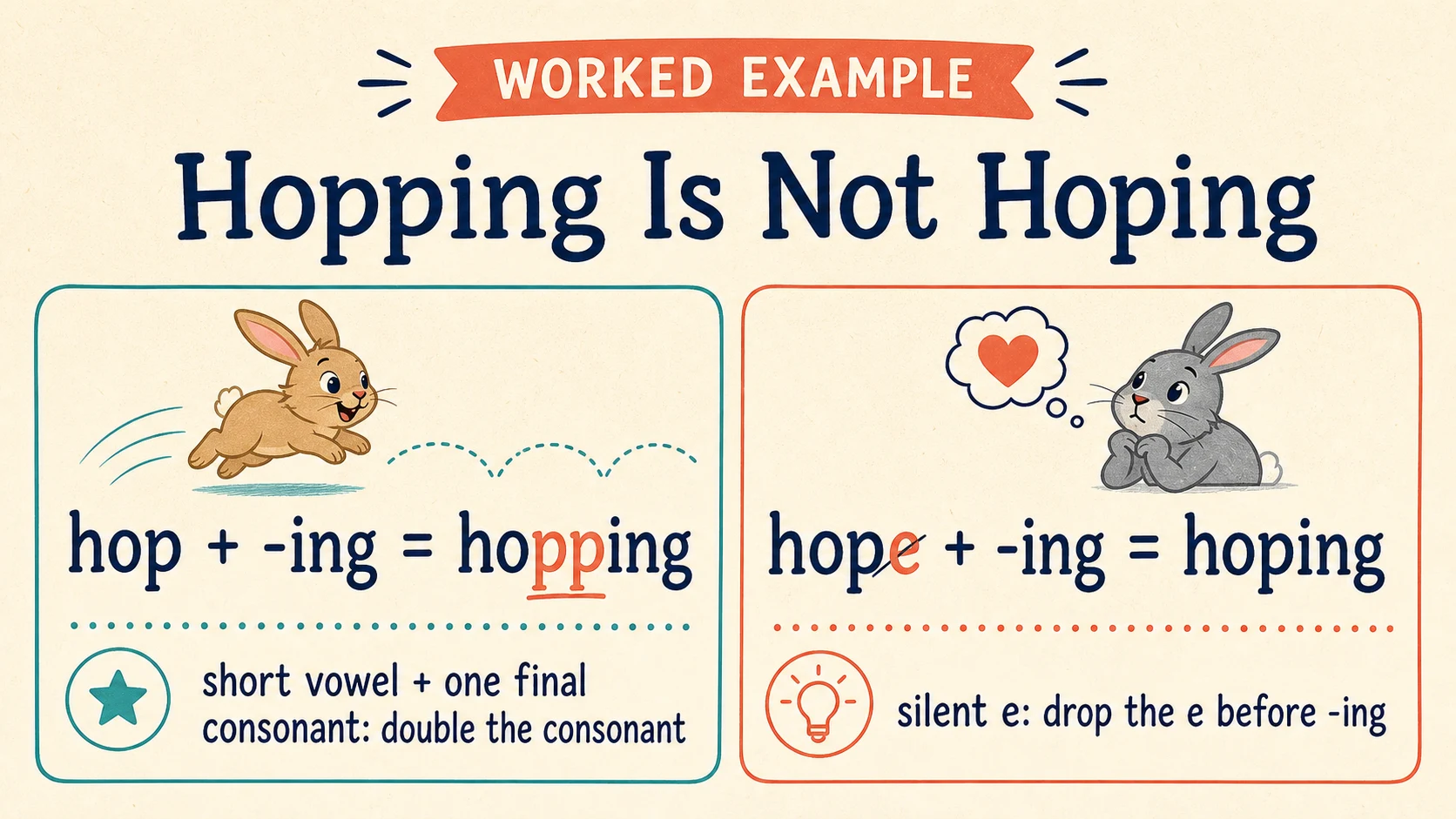
The model accounts for meaning, sounds, letters, and the final written form.
Example 1: Complete a word from sentence context
Practice sentence: “Please bring your coat because it may ___.”
Suppose the activity provides the letters r a i n.
Reasoning: The blank needs a word that makes sense after “may.” The letters can form rain. Say the sounds slowly: /r/ /ā/ /n/. Write the whole word.
Answer: rain
Check: The answer uses all four supplied letters once: r, a, i, n. The sentence “It may rain” is meaningful. The spelling has the vowel team ai between the initial r and final n.
This model shows why context alone is insufficient. A learner might suggest storm, which fits the meaning but does not use the supplied letters. Both constraints matter.
Example 2: Unscramble every letter
Scrambled letters: p m u j
First identify a possible ending or beginning. Rearranging the letters gives jump.
Answer: jump
Check: Compare the inventories:
- Scramble: j, u, m, p
- Answer: j, u, m, p
No letter is omitted, added, or repeated. The answer is a recognizable word, and its four letters match the scramble exactly.
A response such as jum may sound close when spoken quickly, but it fails the letter check because p remains unused. A response such as jummp also fails because it adds an extra m.
Example 3: Correct a misspelled word
Incorrect form: hopingg
Examine the end of the word. The intended word is hoping, formed from hope with -ing. The final silent e is removed before the ending is added; an extra g is not needed.
Answer: hoping
Check: Spell the corrected form aloud by letter: h-o-p-i-n-g. It contains one final g, not two. Use it in a sentence: “We are hoping for sunshine.”
This is also a useful boundary case. Hopping is a different correctly spelled word. It comes from hop, doubles the final consonant before -ing, and means making jumps. The sentence meaning must distinguish hoping from hopping.
Example 4: Correct the internal vowel pattern
Incorrect form: sed
If the intended word is the past-tense verb in “Mia said hello,” the correct spelling is said.
Answer: said
Check: The corrected word is s-a-i-d. It uses ai even though its pronunciation does not provide a simple one-letter clue for each sound. Read the completed sentence: “Mia said hello.”
This example demonstrates a limit of sound-only spelling. A plausible phonetic attempt can still differ from conventional spelling. The learner may need to remember the word’s visual form and notice the internal letter sequence.
Example 5: Keep the base word visible
Prompt: Add -ful to help.
Reasoning: The base word help remains visible, and the suffix -ful is added.
Answer: helpful
Check: help + ful = helpful. The ending contains one final l in -ful. The answer retains every letter of the base word and adds the three suffix letters.
Although this exact format may not appear as a standalone item, it models how to inspect meaningful word parts when a worksheet answer contains a familiar base and ending.
Guided Practice Before Independent Work
Begin guided practice with a small number of actual worksheet items. Two or three may be enough to determine whether the learner understands the directions. Help through prompts that preserve the spelling decision.
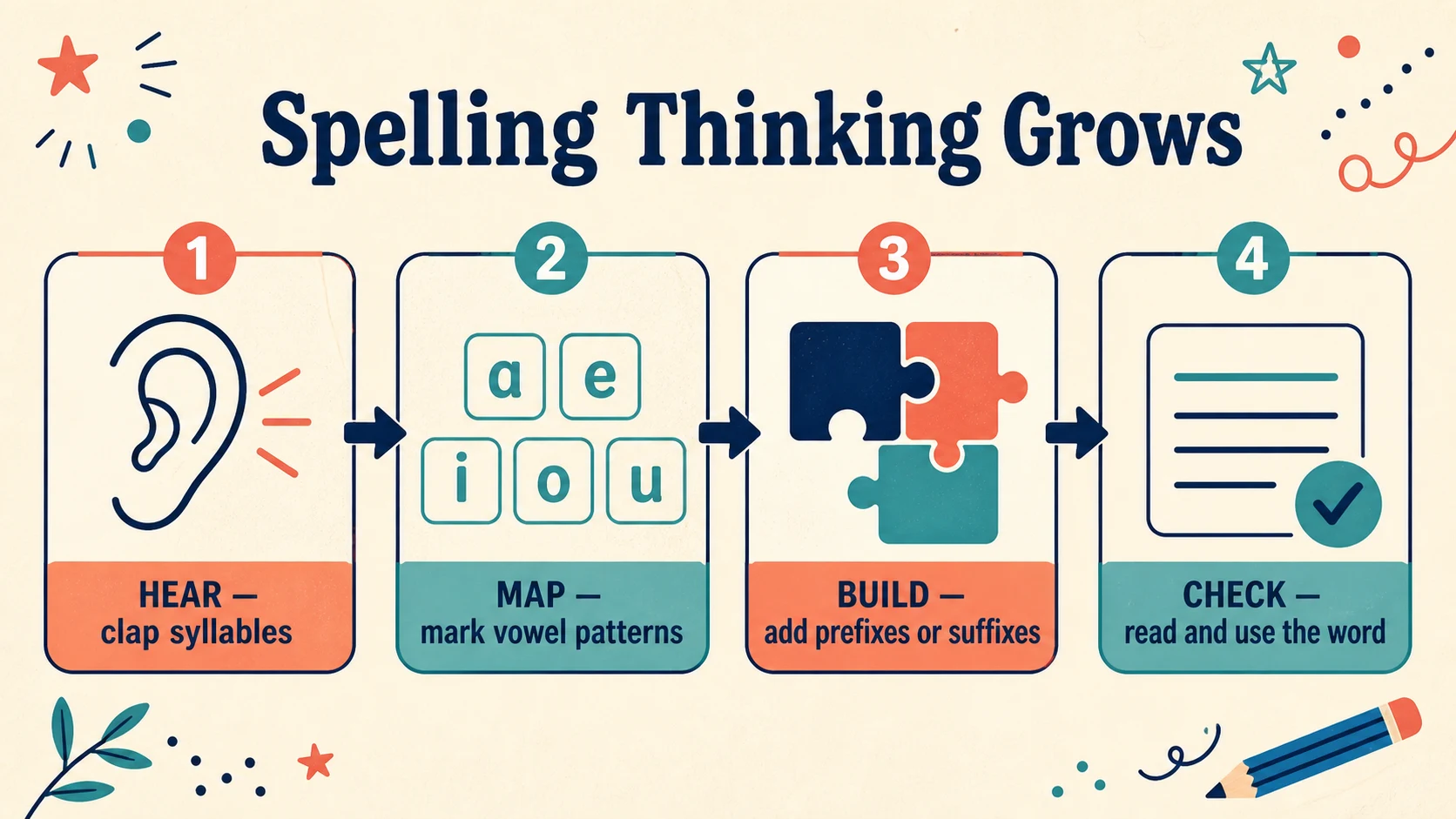
Prompts direct attention while leaving the learner responsible for the answer.
Use a consistent prompt ladder
Start with the least revealing prompt and add support only when necessary:
- “Read the whole item.”
- “What kind of activity is this?”
- “Say the word you think belongs.”
- “What part are you sure about?”
- “Check each supplied letter” or “Look closely at the part that may be misspelled.”
- “Write the whole word and reread it.”
If the learner answers correctly after the first or second prompt, stop prompting. If you routinely name the missing letters, reorder the scramble, or pronounce the word in an exaggerated way that reveals every letter, you are no longer observing the intended skill cleanly.
For a scramble, the learner can cross off or point to each source letter as it is used. For a correction item, ask the learner to underline only the suspected part before rewriting the complete word. For a fill-in-the-blank item, have the learner read the entire completed sentence after writing.
Decide when to release responsibility
Move to independent practice when the learner can explain the activity and complete at least one item of that type without answer-giving support. “Independent” does not require completing all remaining items at once. It means the learner is making the spelling choices.
A learner who works carefully but slowly might complete five items, pause, and return later. Another might complete a longer group without reduced attention. There is no universal timetable supplied for this worksheet. Watch for changes in handwriting, guessing, skipped directions, repeated erasing, or a sudden drop in checking. Those signs may justify a break even if the page is unfinished.
Adapt Support Without Changing the Skill
Adaptation should improve access while keeping the learner responsible for producing correct spellings. The same 25-item worksheet can be divided, enlarged, read aloud, or paired with letter tracking without replacing the spelling task.
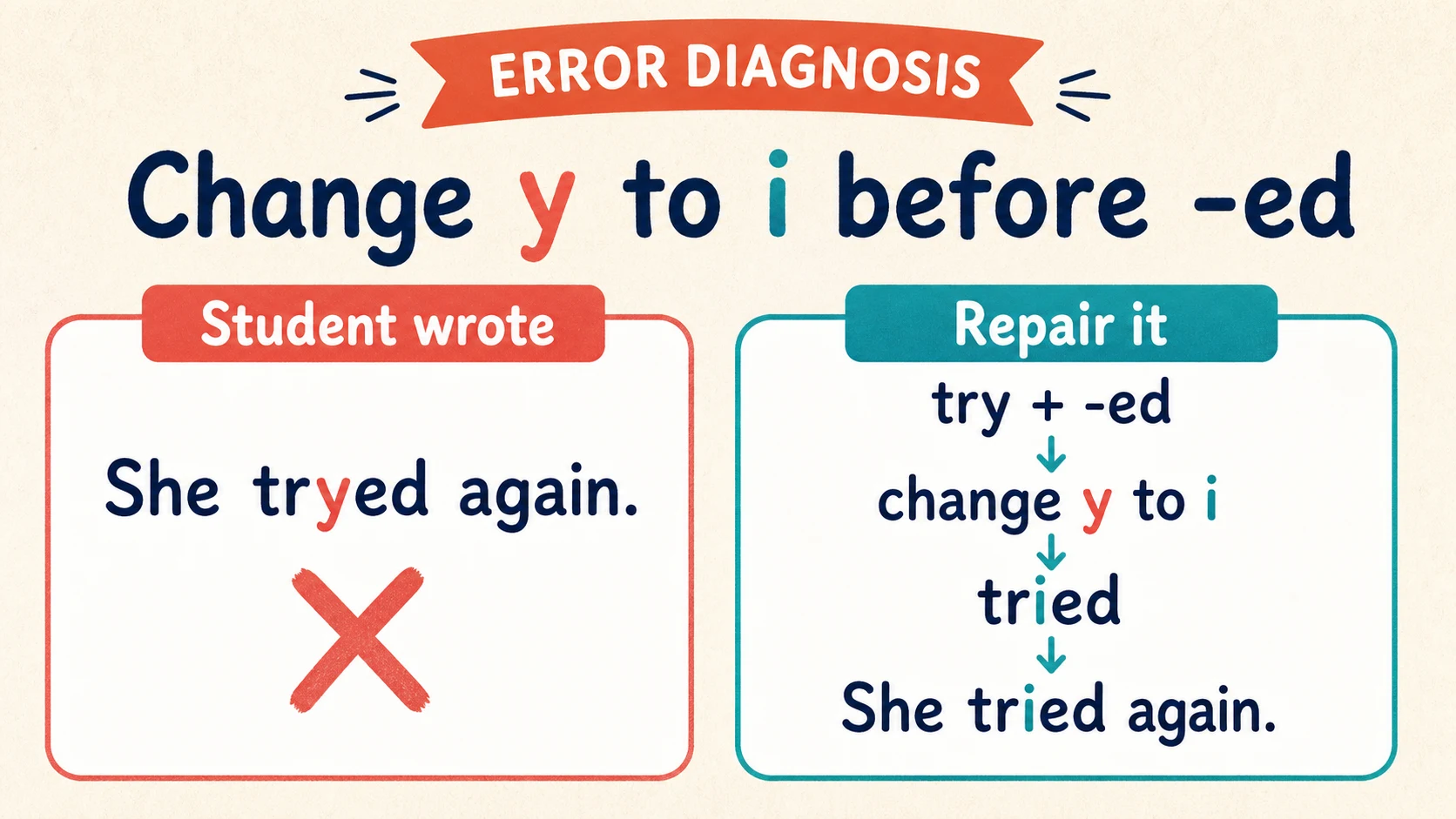
Adjust the amount, presentation, or prompting while preserving the spelling decision.
Reduce the amount visible
Cover later rows with blank paper and reveal one group at a time. This changes visual load, not the words or required answers. It can also help an adult observe accuracy by section.
Do not treat a shorter sitting as an easier word list. The learner can finish the remaining items later. Record the stopping point so resumed work begins cleanly.
Make letters easier to track
For word scrambles, allow the learner to mark each supplied letter after using it. The learner still has to identify and spell the word. If handwriting space is tight, permit answers on lined paper labeled with item numbers.
Reading the general direction aloud is also reasonable when the purpose is spelling rather than testing whether the learner can independently decode the instruction. Be cautious about reading an item in a way that supplies the answer or emphasizes a hidden spelling.
Add pattern attention after an attempt
When a learner misses a word, draw attention to the relevant location: beginning, vowel section, middle consonants, ending, base, or suffix. Ask, “Which part differs from the correct form?” This preserves analysis.
A letter bank can support a scramble because its letters are already part of that activity. Giving an unrestricted list of complete answers would change the task into copying or matching. Copying may be useful during correction, but it should not be confused with independent retrieval.
For stronger performance, ask the learner to use a correctly spelled word in a new sentence or sort several completed words by a visible letter feature. Treat this as extension, not proof that the learner has mastered a broader spelling rule.
Interpret Errors Before Assigning More Work
A total score tells you how many answers matched the key. It does not explain why the mismatches occurred. Review the learner’s original writing before erasing or correcting it.
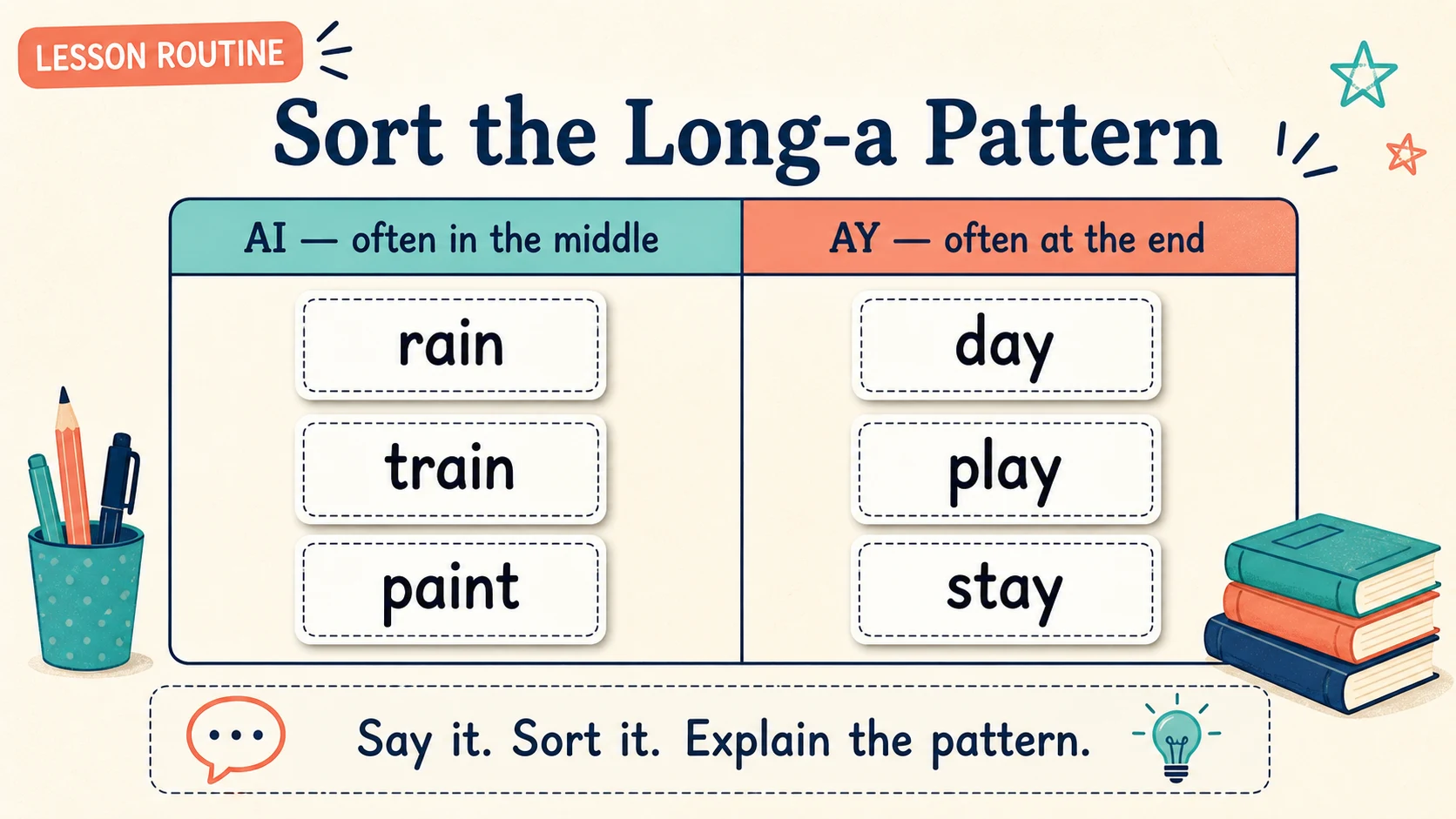
Locate the difference, name its type cautiously, correct it, and check again later.
Sort errors by what is observable
Use plain descriptions rather than diagnostic labels:
| Observed response | Possible interpretation to investigate | Useful next check |
|---|---|---|
| A scramble answer omits one supplied letter | Incomplete letter tracking or uncertain spelling | Ask the learner to match each answer letter to the scramble |
| The word fits the sentence but not the supplied letters | Context was used while spelling constraints were ignored | Recheck both meaning and letter inventory |
| The beginning is accurate but the ending changes | The learner may be less secure with an ending or may have rushed | Compare the endings and spell the word again later |
| The response is phonically plausible but unconventional | Sound information was used, but the stored conventional form may be uncertain | Study the exact differing section |
| Several correct letters are transposed | Letter order may not have been checked | Have the learner point and read left to right |
| The learner gives the word orally but leaves the blank empty | The writing step or task completion was missed | Ask for the complete written answer |
| Accuracy falls only near the end | Attention or stamina may have changed | Retry a few late items after a break |
These are hypotheses for instruction, not medical or developmental conclusions. One worksheet cannot identify a disorder or explain a persistent learning difficulty.
Distinguish spelling errors from task errors
If the learner can spell a word aloud but misunderstands how to enter it, clarify the format and provide another opportunity. If the learner knows how to unscramble but produces an incorrect letter sequence, that is more directly relevant to spelling or checking.
Also distinguish handwriting ambiguity from spelling knowledge. If a letter is genuinely unreadable, ask the learner what was intended before marking it. Do not silently reinterpret an unclear response to raise or lower the score.
Misconceptions worth addressing include:
- “If it sounds right, it must be spelled right.”
- “A word that fits the sentence is correct even if the letters do not match.”
- “All supplied letters do not need to be used in a scramble.”
- “Checking means looking only at the first letter.”
- “A corrected word is learned permanently after one rewrite.”
- “A high worksheet score guarantees accurate spelling in ordinary writing.”
Correct these ideas through demonstration and later retrieval, not through a longer lecture.
Use the Answer Key Responsibly
The separate answer key supports efficient checking, but it should verify work rather than replace reasoning. First confirm that its title or file corresponds to the worksheet version being used.
Check one item at a time. A correct response should have the same complete letter sequence as the keyed answer. Capitalization may need contextual judgment if the blank begins a sentence, but do not alter the spelling criteria. If the learner’s answer differs, preserve the original long enough to compare it.
A productive correction routine is:
- Circle or underline the exact differing section.
- Read the intended word.
- Compare the learner’s version with the key from left to right.
- Write the correct whole word.
- Cover it.
- Write it once from memory.
- Check again.
The catalogue’s broader topic guidance suggests repeated correct writing for missed words. Repetition is most useful here when the learner is attending to the inaccurate part, not copying mechanically while looking elsewhere. Record uncertain words separately so that they can return in delayed practice.
Do not calculate a percentage and treat it as a complete instructional judgment. Note whether an answer was independent, self-corrected, prompted, or corrected only after viewing the key. Those distinctions make the next lesson more precise.
If you believe the key and an item conflict, reread the directions and verify that you have matching worksheet and key files. Do not teach a doubtful answer merely because it appears in a file. Set that item aside while using the unambiguous responses for practice.
Schedule Retrieval Instead of Ending at Correction
Immediate correction shows the right form while it is visible. Retrieval asks whether the learner can produce it after that support is removed.
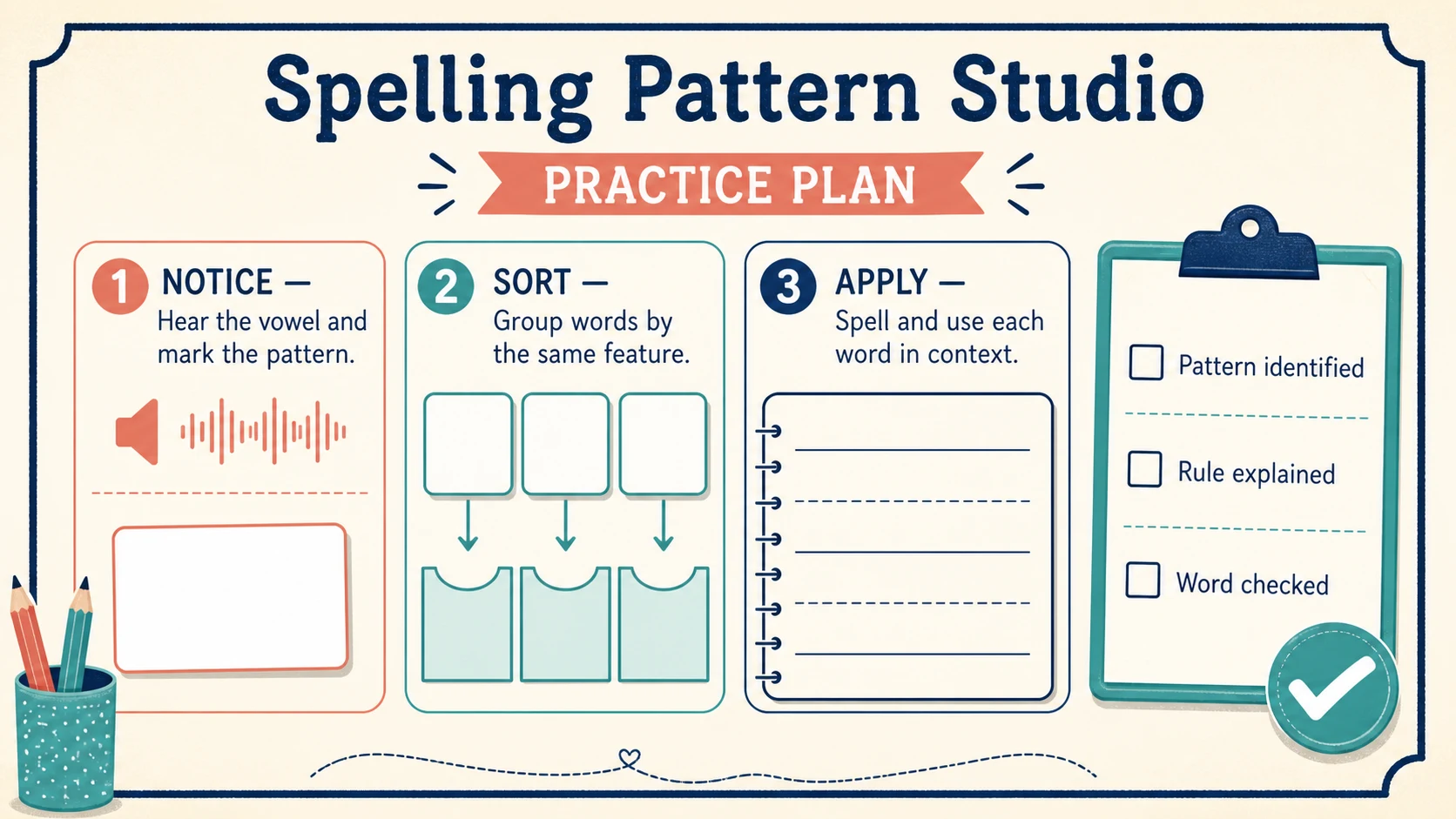
Return to a small set after increasing delays, adjusting the schedule to the learner’s work.
A practical, adjustable schedule might look like this:
| Time | What to revisit | Suggested format |
|---|---|---|
| End of the lesson | Missed and heavily prompted words | Look, cover, write, check |
| Next practice period | The same words in mixed order | Oral prompt followed by written spelling |
| Several days later | Missed words plus a few secure words | Short mixed review |
| The following week | Words still uncertain | Dictation or a brief sentence |
| Later cumulative review | A small selection from this and other practice | Mixed word sort or writing check |
This is an instructional suggestion, not a universal timetable or a sourced requirement for every child. Shorten or lengthen the interval based on observed recall. If the learner retrieves a word accurately more than once without help, reduce its frequency while continuing to sample it occasionally. If the same section remains inaccurate, return to the relevant letter pattern or meaningful word part before asking for more memorization.
To check transfer, invite the learner to write a brief original sentence containing one or two reviewed words. Sentence writing adds meaning and composition demands, so a spelling error there does not automatically erase earlier success. Instead, compare performance across isolated spelling and connected writing.
Decide What to Do Next
Use the work pattern, not the worksheet title alone, to choose the next step.
If most responses are accurate and independent, revisit the few uncertain words through delayed retrieval. Then consider a slightly broader activity such as sorting words by shared spelling features, using selected words in sentences, or continuing through the 3rd Grade spelling collection.
If accuracy is mixed but errors cluster in one visible feature, teach that feature with a few examples and nonexamples before returning to the missed items. The broader Spelling Words topic guide explains the larger range of practice, including pattern-focused study, word sorting, contextual use, and cumulative review.
If many answers are incorrect for different reasons, first verify that the directions and activity formats are understood. Reduce the number presented at one time, model with an off-page example, and resume guided practice. More items are unlikely to clarify performance if the learner is still unsure what each section requires.
If the learner completes this easy-level printable comfortably but does not carry the spellings into writing, add short dictated or original sentences. If isolated words remain difficult, stay with direct word study rather than increasing writing demands immediately.
This single page has clear limitations. It samples 25 exercises, includes several activity formats, and offers an answer key, but it cannot cover every third-grade spelling pattern, every local curriculum sequence, or spelling in extended writing. It cannot establish lasting retention from one sitting. It should inform the next teaching choice, not serve as the sole basis for a broad conclusion about the learner.
For ongoing practice, the catalogue also offers the 3rd Grade Spelling Words Worksheet Pack, which contains 18 worksheets, and free worksheet generators for creating additional practice. A useful next action is to complete the free 25-item worksheet, record only the words that were missed or heavily prompted, and schedule a five-word retrieval check for the learner’s next practice period.
Put it into practice
Use the guide with a real printable
Move from explanation to a short, observable practice task. Check the first item together, then adjust the next session from the learner's actual work.
See the 18-worksheet pack