Complete guide
How to teach and practise 3rd grade word problems worksheets - standard theme (easy)
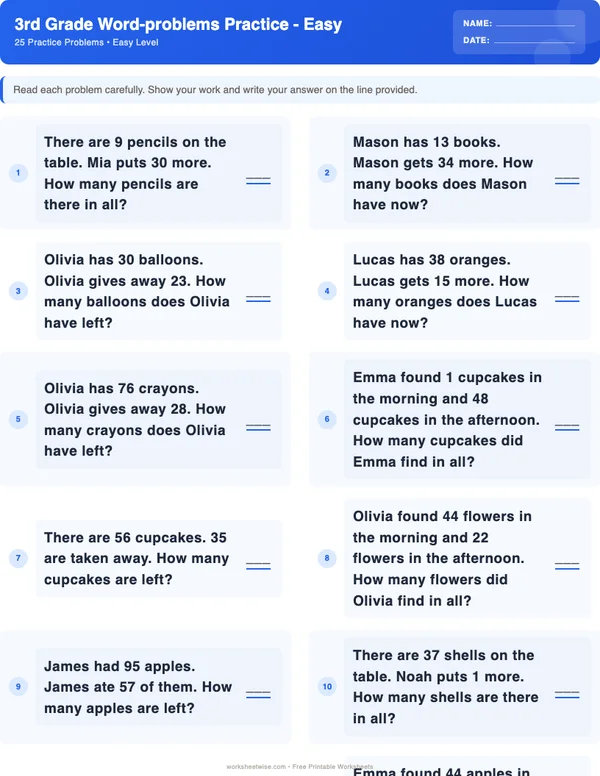
Quick answer: how to use this 14-item worksheet
Use the free 3rd Grade Word Problems worksheet as a short teaching sequence, not merely as a page to finish. Begin by modeling one similar problem. Then solve two or three items together, asking the learner to explain the quantities and operation before calculating. Assign a manageable set for independent work, review errors by type, and save several unused or corrected items for later retrieval practice.
The printable contains 14 easy-level story problems involving mixed operations, reading comprehension, problem solving, and multi-step reasoning. Its directions ask learners to read carefully, show their work, and write each answer on the provided line. A separate printable answer key is included.
“Easy” describes the worksheet’s catalogue difficulty, not how every learner will experience it. Likewise, the 3rd Grade label describes the intended practice level. Local curricula and teaching sequences differ, so use the learner’s observed work—not the label alone—to decide the pace and amount of support.
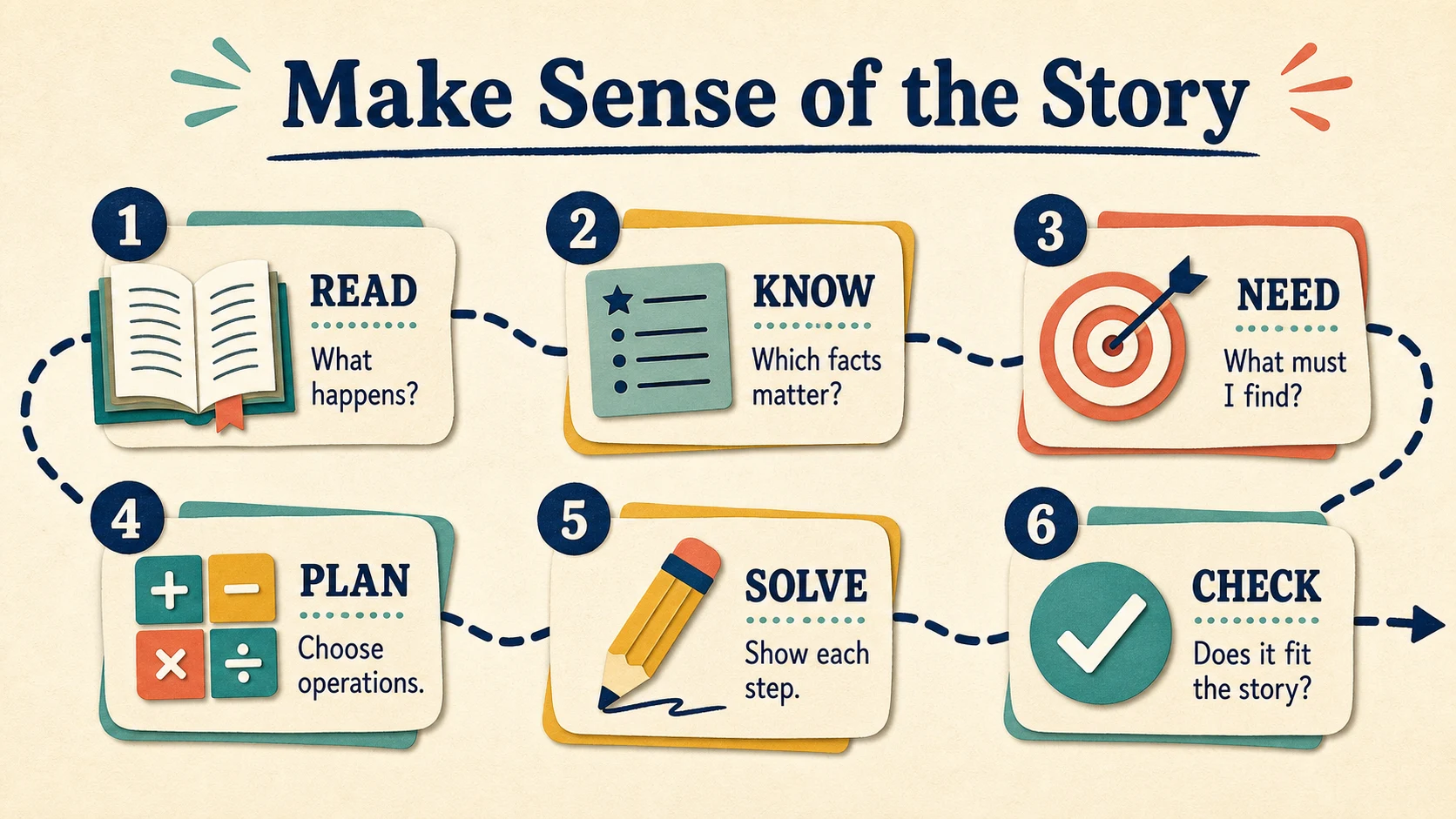
Move from a brief launch to modeling, guided practice, independent work, feedback, and later review.
Know what this printable is designed to practice
This worksheet gives a learner 14 opportunities to read mathematical situations, identify relevant quantities, decide what must be found, choose operations, calculate, and communicate answers. Those actions should remain the center of the lesson.
The page is suitable for classroom practice, homework, tutoring, or homeschool use. It can be particularly useful when a learner is beginning this level of word-problem work or needs reinforcement. It is not, by itself, a complete unit, a diagnostic assessment, or evidence that every related skill has been mastered.
The catalogue identifies four areas of practice:
- Problem solving
- Reading comprehension
- Multi-step reasoning
- Mixed operations
These areas overlap. A wrong numerical answer does not automatically mean weak computation. The learner may have misunderstood a comparison, combined the wrong quantities, stopped after the first step, or calculated accurately but answered a different question.
Grade 3 mathematics commonly includes multiplication, division, their relationship, and two-step word problems. The Common Core State Standards for Mathematics provide one broad reference point for grade-level expectations, including solving two-step problems with the four operations. That source has not evaluated this WorksheetWise printable, and the worksheet should not be presented as proof of comprehensive standards alignment.
For a fuller sequence of problem types and representations, use the 3rd Grade Word Problems topic guide. This lesson guide stays focused on launching and learning from this particular 14-item page.
Prepare a focused lesson before handing over the page
A little preparation makes it easier to see what the learner understands independently.
Preview the materials
Print or open the worksheet and keep the answer key separate. Have a pencil, scrap paper, and—if useful—small counters available. A blank strip of paper can become a simple bar model. Avoid placing the answer key where the learner can glance at it while solving.
Scan the 14 items before the session. Notice which appear to require one operation and which may require more than one. Do not announce the operation for each problem. That decision is part of the skill.
Choose one of these starting plans according to recent work:
| Learner’s current pattern | Initial assignment | Adult role | Decision point |
|---|---|---|---|
| Needs substantial help understanding stories | 1 modeled example plus 2 worksheet items | Read, retell, and represent together | Continue only if the learner can state what is unknown |
| Understands stories but chooses operations inconsistently | 3–4 items | Prompt for a model and equation before calculation | Reduce prompts when choices become explainable |
| Usually solves one-step problems accurately | 5–7 items | Observe quietly, then discuss reasoning | Add remaining items only if attention remains steady |
| Is reviewing previously learned work | Selected mixed items | Require independent work and a reasonableness check | Schedule missed types for later retrieval |
These are instructional options, not a universal timetable. A learner who works slowly but reasons accurately may need fewer items per sitting. A learner who rushes through many items may need a shorter set with stronger expectations for showing work.
Set a visible solving routine
Write this routine where the learner can see it:
- Read the whole problem.
- Retell what is happening.
- Mark what is known and what must be found.
- Draw or organize the quantities.
- Write an equation.
- Solve and label the answer.
- Check whether the answer fits the story.
The topic guidance recommends understanding the situation rather than relying on isolated keywords. Treat that as an instructional suggestion for this worksheet: words such as “left,” “each,” or “in all” can be clues, but no single word should decide the operation without reference to the relationships in the story.
Model the task without taking over the thinking
Use a made-up problem similar in structure to the worksheet rather than completing the learner’s first assigned item for them.
Think aloud through meaning first
Consider this example:
A teacher puts 4 pencils at each of 6 tables. Then she places 3 extra pencils near the board. How many pencils did she put out?
Model the reasoning in a compact way:
- “I need the total number of pencils.”
- “Six equal groups of four pencils gives .”
- “The 3 extra pencils are also part of the total, so .”
- “The teacher put out 27 pencils.”
Now check it. The equal groups account for 24 pencils, and adding 3 makes the total slightly larger. The answer has a label and responds to the question.
Do not reduce the explanation to “each means multiply.” The important relationship is six groups with four in every group. If the question instead asked how many more pencils were at the tables than near the board, the same numbers would require .
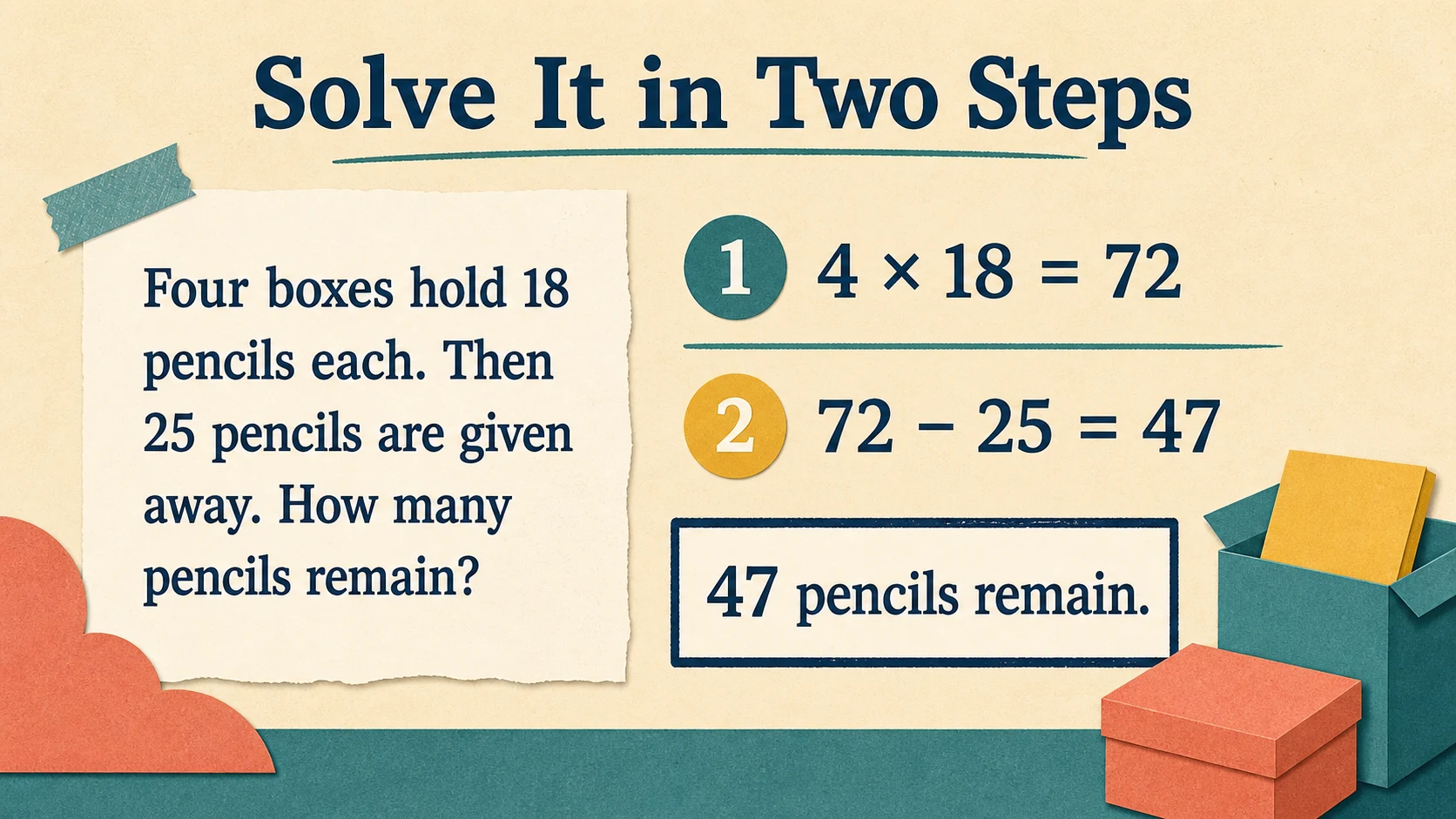
Connect the story, representation, equations, calculation, and labeled answer.
Show an economical written record
A complete record need not be lengthy. For the pencil example, an acceptable solution might be:
Answer: 27 pencils
If the learner benefits from a visual, draw six equal boxes containing four dots each, followed by three separate dots. The representation should clarify the quantities; it should not become an art task.
The IES practice guide on assisting students struggling with mathematics offers high-level instructional guidance that includes systematic instruction and the use of visual representations. It does not review this worksheet or prescribe one fixed procedure for every learner. Here, the practical application is modest: make the reasoning visible, connect the visual to equations, and gradually remove help.
Move from guided practice to independent work
The shift to independence should depend on what the learner does, not on how many minutes have passed.
Use prompts that preserve the mathematical decision
On the first guided item, ask:
- “What is happening in this story?”
- “Which quantities do we know?”
- “What does the question ask us to find?”
- “Could you draw equal groups, a part–whole model, or a comparison?”
- “What equation matches your drawing?”
- “How can you check the result?”
These prompts support comprehension without naming the operation. If the learner is stuck, narrow the choice through representation: “Are these quantities being combined, compared, separated, or arranged in equal groups?” That still requires reasoning.
On the next item, shorten the prompts. Ask only, “What do you know, and what do you need to find?” On a third item, wait while the learner starts independently. Help should fade as soon as it is no longer needed.
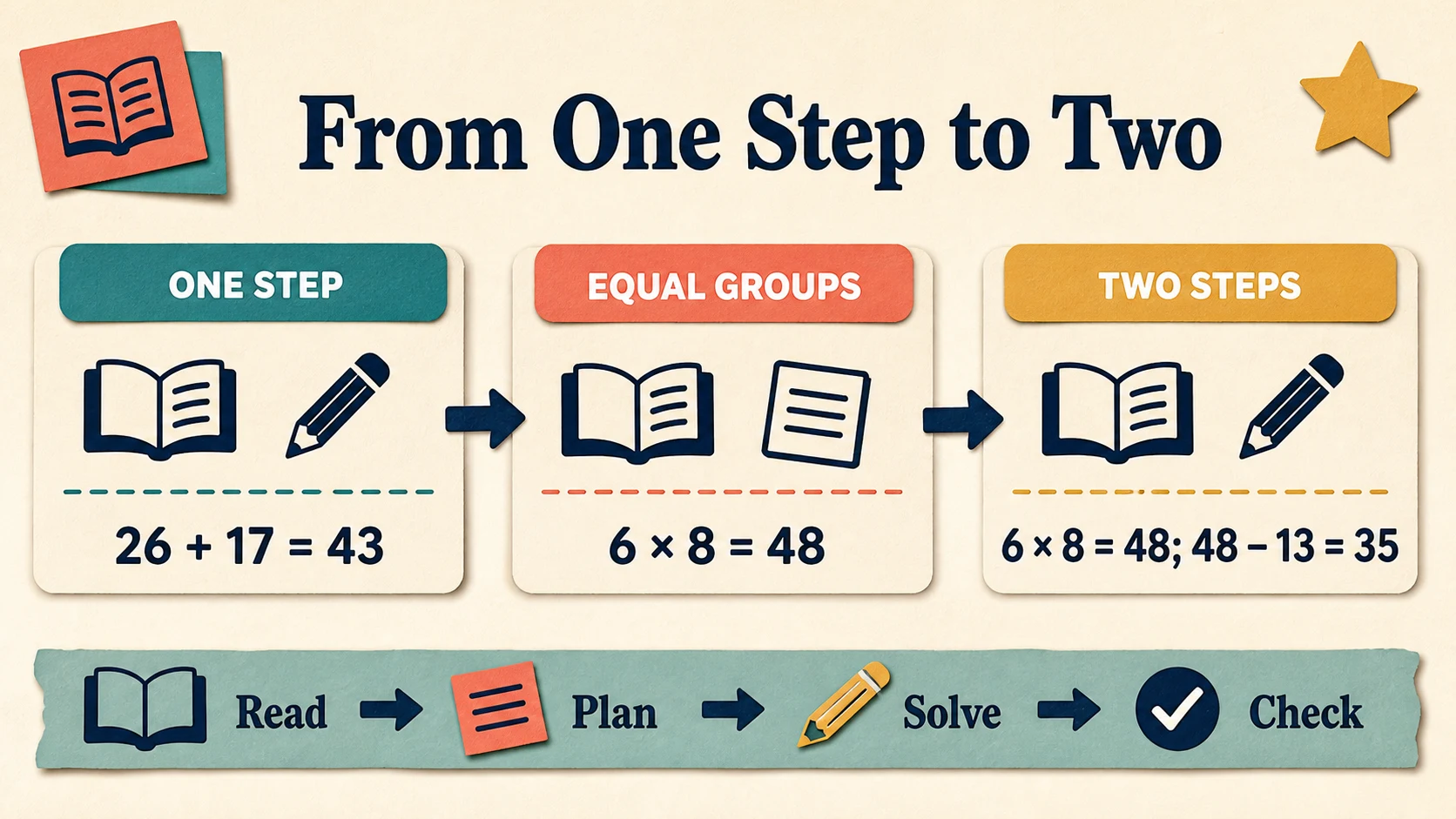
Demonstrate one complete process, solve a small set together, and then observe independent use.
Watch for readiness to work alone
Independent practice is reasonable when the learner can usually:
- Retell the situation without changing its meaning
- Identify the unknown
- Select a suitable representation or equation
- Complete the calculation with tolerable effort
- Attach a unit or meaningful label to the answer
- Recheck an answer when prompted
If those behaviors disappear after several items, pause. Fatigue is not the same as lack of understanding. Split the printable across sessions rather than turning the final items into endurance work.
The IES guide on teaching mathematics to young children provides broad framing for intentional mathematics instruction, monitoring what learners know, and building on their thinking. Its age scope is not identical to this Grade 3 worksheet, so it should inform general teaching habits rather than be treated as a direct evaluation of this material.
Use checked examples to teach distinct relationships
The following examples are newly written for this guide. They are not transcriptions of the 14 worksheet questions and should not be mistaken for its answer key.
Example 1: addition as a total
Elena has 126 blue beads and 238 green beads. How many beads does she have altogether?
Known quantities: 126 blue beads and 238 green beads.
Unknown: the total number of beads.
Check with subtraction:
Answer: Elena has 364 beads.
The check returns the original blue-bead quantity, so the arithmetic is consistent. A learner who subtracts may be reacting to the presence of two numbers rather than understanding that both parts belong in one total.
Example 2: comparison subtraction
A class collected 415 cans. Another class collected 287 cans. How many more cans did the first class collect?
Known quantities: 415 cans and 287 cans.
Unknown: the difference between the collections.
Check by recombining the smaller amount and the difference:
Answer: The first class collected 128 more cans.
A bar model can show a length of 415, a shorter length of 287, and the missing segment between them. This keeps the focus on comparison rather than on the word “more,” which can appear in stories that require other operations.
Example 3: multiplication with equal groups
There are 7 shelves with 8 books on each shelf. How many books are on the shelves?
Known quantities: 7 equal groups and 8 books per group.
Unknown: the total number of books.
Check with repeated addition:
A related division check is:
Answer: There are 56 books.
The multiplication follows from the equal-group structure. It is not justified merely because the story contains the word “each.”
Example 4: division as fair sharing
A tutor shares 48 counters equally among 6 learners. How many counters does each learner receive?
Known quantities: 48 counters divided into 6 equal shares.
Unknown: the size of each share.
Check with multiplication:
Answer: Each learner receives 8 counters.
Distinguish this from a grouping question such as, “How many groups of 6 can be made from 48?” Both produce 8, but one asks for the amount in each group and the other asks for the number of groups.
Example 5: a two-step situation
A shop has 5 boxes with 9 markers in each box. It sells 17 markers. How many markers remain?
First find the starting total:
Then subtract those sold:
Check the second step:
Check the first step:
Answer: 28 markers remain.
A common incomplete response is 45. That result answers “How many markers were there before the sale?” but not the question actually asked.
Adapt support without changing the target skill
Support should make the story and relationships more accessible while preserving the learner’s responsibility to choose and justify a solution.
If reading is the main barrier
Read the problem aloud once while the learner follows the text. Then ask the learner to retell it. Explain an unfamiliar everyday word if necessary, but do not translate the entire problem into an operation.
You can divide a long sentence into meaningful clauses or cover later lines until the first line has been processed. Keep all quantities and the original question visible before the learner solves. The target remains interpreting and solving the story, not guessing from a simplified substitute.
If representation is the main barrier
Offer a limited menu:
- A part–part–whole bar for combining or separating
- Two aligned bars for comparison
- Equal boxes or an array for multiplication
- Equal boxes with shared objects for division
Ask the learner to choose the model that matches the situation. If you select and draw it every time, the learner practices calculation but not mathematical modeling.
If computation is slowing the reasoning
Allow multiplication facts, number lines, counters, or written place-value work according to the learner’s normal instructional setting. Have the learner state the equation before using the aid. This preserves operation choice as the central word-problem skill.
You may also separate the work into two passes: first represent and write equations for two problems; then calculate. Do not supply the equations, because that would remove a core decision.
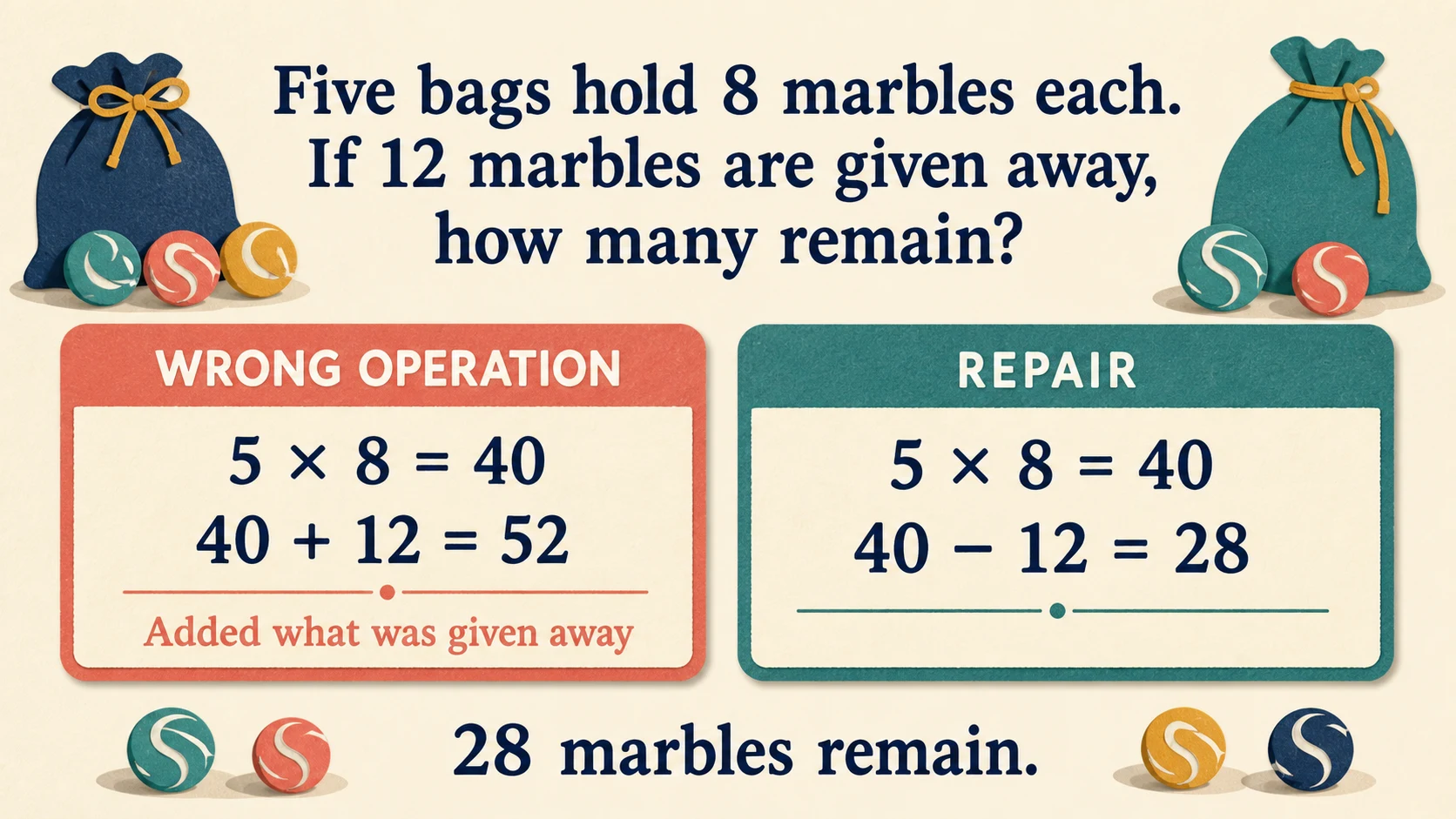
Adjust access through reading, representation, or computation support while keeping the same mathematical question.
Teach boundary cases rather than keyword habits
Boundary cases show why understanding the situation matters.
Suppose a story says, “Mia had 32 stickers and received some more. Now she has 47.” The word “more” appears, but the unknown is the amount received:
This can be solved with . A rigid “more means add” rule does not identify the useful calculation.
Now compare two division stories:
- “42 apples are placed equally in 7 baskets. How many apples are in each basket?”
- “42 apples are placed 7 per basket. How many baskets are needed?”
Both use , yet the answer labels differ: 6 apples per basket versus 6 baskets. Ask the learner what each number represents.
Also discuss information that does not affect the answer. In “A shelf has 6 rows of 5 books, and the shelf is 4 feet tall,” the shelf height is irrelevant if the question asks for the number of books. The learner should explain why 4 is unused.
A missing-information case is different: “There are some bags with 4 oranges in each. How many oranges are there?” The number of bags is absent, so a unique total cannot be found. Do not reward an invented number simply because an operation seems likely.
These boundary cases need not be added to the printable as extra written work. A one-minute oral comparison can reveal whether the learner is reasoning about relationships.
Interpret errors before correcting them
Marking an answer wrong identifies a result, not its cause. Use the learner’s written work and explanation to classify the error.
| Observed work | Likely issue to investigate | Useful response |
|---|---|---|
| Uses every number in one equation | Assumes all information must be used | Ask which quantities affect the question |
| Chooses an operation from one word | Relies on a keyword shortcut | Remove the numbers and retell the relationship |
| Writes a correct first step but stops | Misses the final question or second step | Ask what the intermediate result represents |
| Chooses the right equation but miscalculates | Computation rather than comprehension | Keep the equation and correct the arithmetic separately |
| Gives only a number | May not connect the result to the context | Request a unit and a complete answer statement |
| Produces an unreasonable result | Does not yet check magnitude or meaning | Compare the result with the starting quantities |
| Changes operation after seeing the key | Is matching answers rather than revising reasoning | Rebuild the model before recalculating |
Use a short correction conference
Ask the learner to point to:
- The sentence or phrase that defines the question
- The quantities used
- The drawing or equation that connects them
- The calculation
- The final labeled answer
Change only the first place where the reasoning breaks. If the model and equation are correct, there is no need to reteach comprehension; address the calculation. If the calculation is flawless but the equation does not represent the story, recomputing will not fix the underlying error.
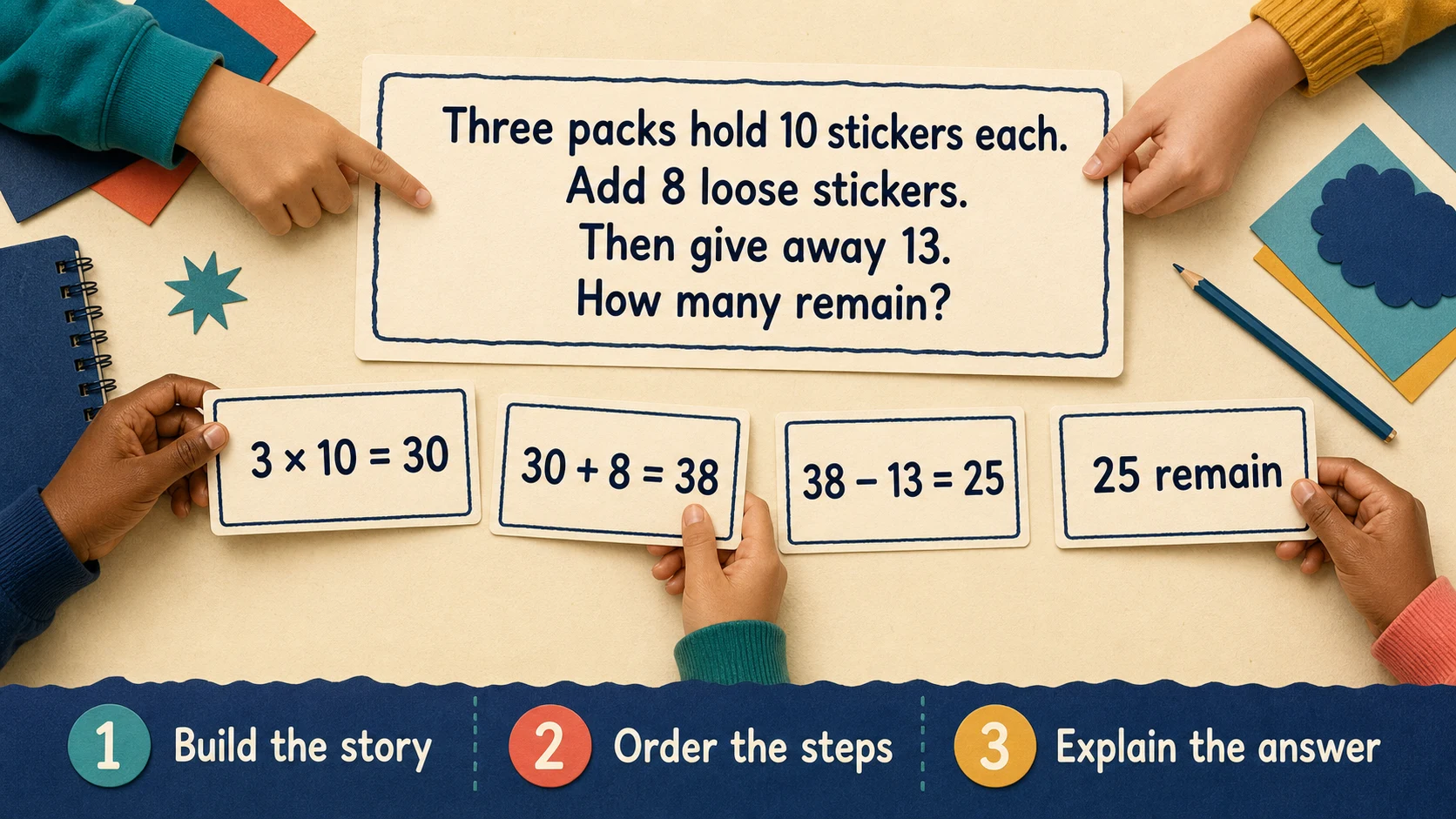
Locate the first mismatch among the story, model, equation, calculation, and answer.
Check the answer key responsibly
Use the separate key after the learner has attempted the selected items. The key can confirm final answers quickly, but it cannot show why a particular mistake occurred unless its format includes the reasoning you need.
For each mismatch:
- Recalculate the learner’s equation independently.
- Confirm that the equation represents the question.
- Check whether the answer has the correct unit.
- Ask the learner to explain the result before revealing the keyed answer.
- If the learner revises, keep the original work visible so the change can be discussed.
Adults can make mistakes too. If the learner’s reasoning and the printed key appear to conflict, solve the problem independently from the original wording. Verify each operation and the placement of the unknown. Do not force the learner’s work to match the key without that check.
Record patterns, not just a total score. “Two comparison problems were modeled as totals” is more useful for planning than “12 out of 14.” A score can hide whether errors came from reading, operation choice, multi-step organization, or computation.
This printable also has limits. Fourteen items provide a useful practice sample, but they cannot establish broad mastery or explain every difficulty. The page does not replace conversation, observation, varied examples, or instruction. It should not be used to make medical or developmental conclusions.
Decide what comes next from observed work
Choose the next action according to evidence from the session.
If the learner solves accurately and explains the relationships, move to a broader mix of word problems rather than adding more copies of the same easy page immediately. The focused 3rd Grade Word Problems pack contains 18 worksheets and can provide additional practice options.
If the learner computes correctly but chooses operations inconsistently, return to the topic guide and practice classifying situations with drawings before assigning another full page.
If basic calculation interrupts every problem, select focused computation practice from the 3rd Grade Math hub, while continuing one or two word problems so the reasoning skill is not abandoned.
If the learner completes the sheet easily but gives thin explanations, ask for equations, labels, and checks on a few selected problems. More difficult numbers are not the only way to deepen the work.
If the worksheet is consistently too demanding, use fewer items, model more explicitly, and revisit prerequisite representations. The 3rd Grade worksheet hub can help an adult choose practice across subjects and skills, but local sequence and current learner performance should guide selection.
Schedule retrieval without creating unnecessary repetition
Do not treat completion day as the end of practice. Revisit a small number of problems after time has passed.
A practical, adjustable schedule is:
| Time | Retrieval task | What to observe |
|---|---|---|
| Later the same session | Explain one completed item without looking at the solution | Can the learner reconstruct the relationship? |
| About 2 days later | Rework one missed item and one previously correct item | Does the routine return without extensive prompting? |
| About 1 week later | Solve two fresh, similar problems or two saved items | Can the learner choose operations after a delay? |
| About 2–3 weeks later | Complete a small mixed set | Does understanding transfer across problem types? |
This is an instructional planning example, not a universally recommended timetable. Shorten or lengthen the intervals according to observed recall. If the learner cannot begin after a delay, provide one prompt and record what helped. If recall is strong, mix the skill with other Grade 3 math rather than repeating the whole worksheet.
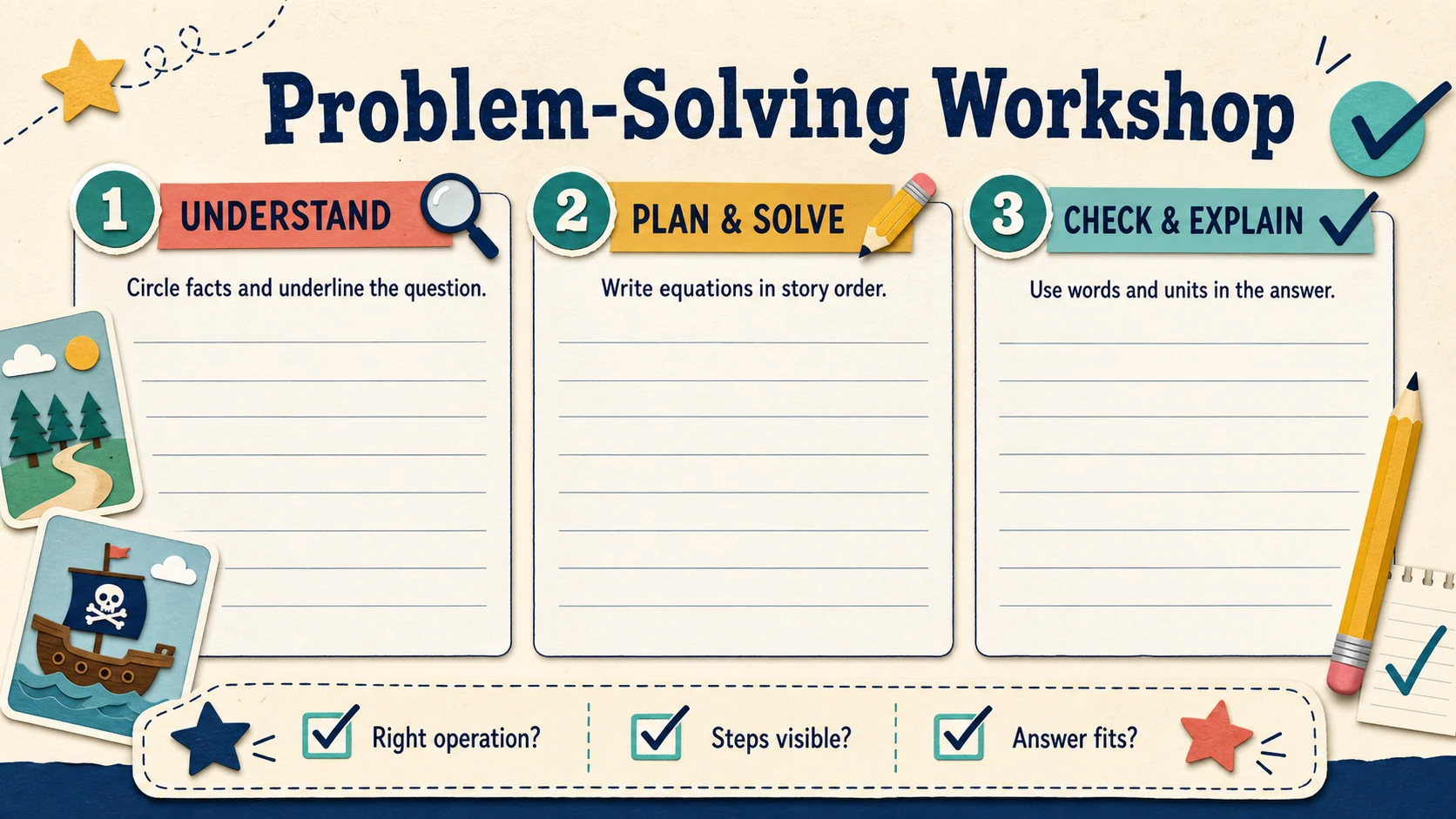
Revisit a few items after increasing delays, adjusting the schedule to the learner’s demonstrated recall.
The honest next step is to print the free Standard Theme easy worksheet, model one similar problem, and assign only enough of the 14 items to reveal how the learner reads, represents, solves, and checks. After reviewing that evidence, select follow-up practice from the topic guide, the focused pack, or the free worksheet generators rather than assuming that either completion or one score tells the whole story.
Put it into practice
Use the guide with a real printable
Move from explanation to a short, observable practice task. Check the first item together, then adjust the next session from the learner's actual work.
See the 18-worksheet pack