Complete guide
How to teach and practise 3rd grade telling time worksheets - standard theme (easy)
How to use this 12-item telling-time worksheet
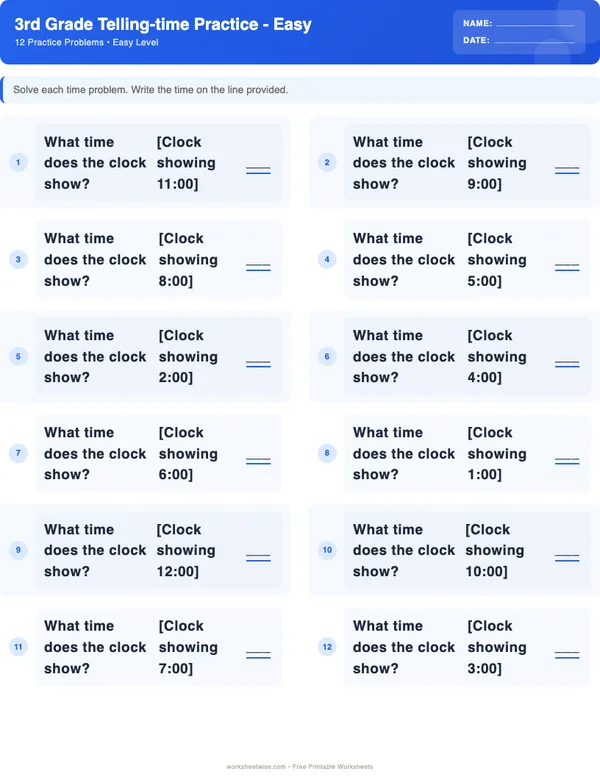
The free 3rd Grade Telling Time worksheet gives a learner 12 easy-level exercises involving analog and digital clocks, elapsed time, and time intervals. A productive session is simple: preview the task, model one example, solve two or three together, let the learner complete a manageable group independently, and then discuss selected answers using the separate answer key.
Do not make speed the goal. Watch how the learner reads each clock, chooses an hour, counts minutes, and explains an interval. That observed work should determine whether to continue, add support, or stop and review. The worksheet is useful for practice and informal observation, but it is not a complete assessment of telling time.
Grade labels describe the intended practice level; local school and homeschool sequences differ. Some third graders will use this page as introductory work, while others will use it for reinforcement. For the broader sequence from reading clock faces through elapsed-time problems, see the 3rd Grade telling-time topic guide.
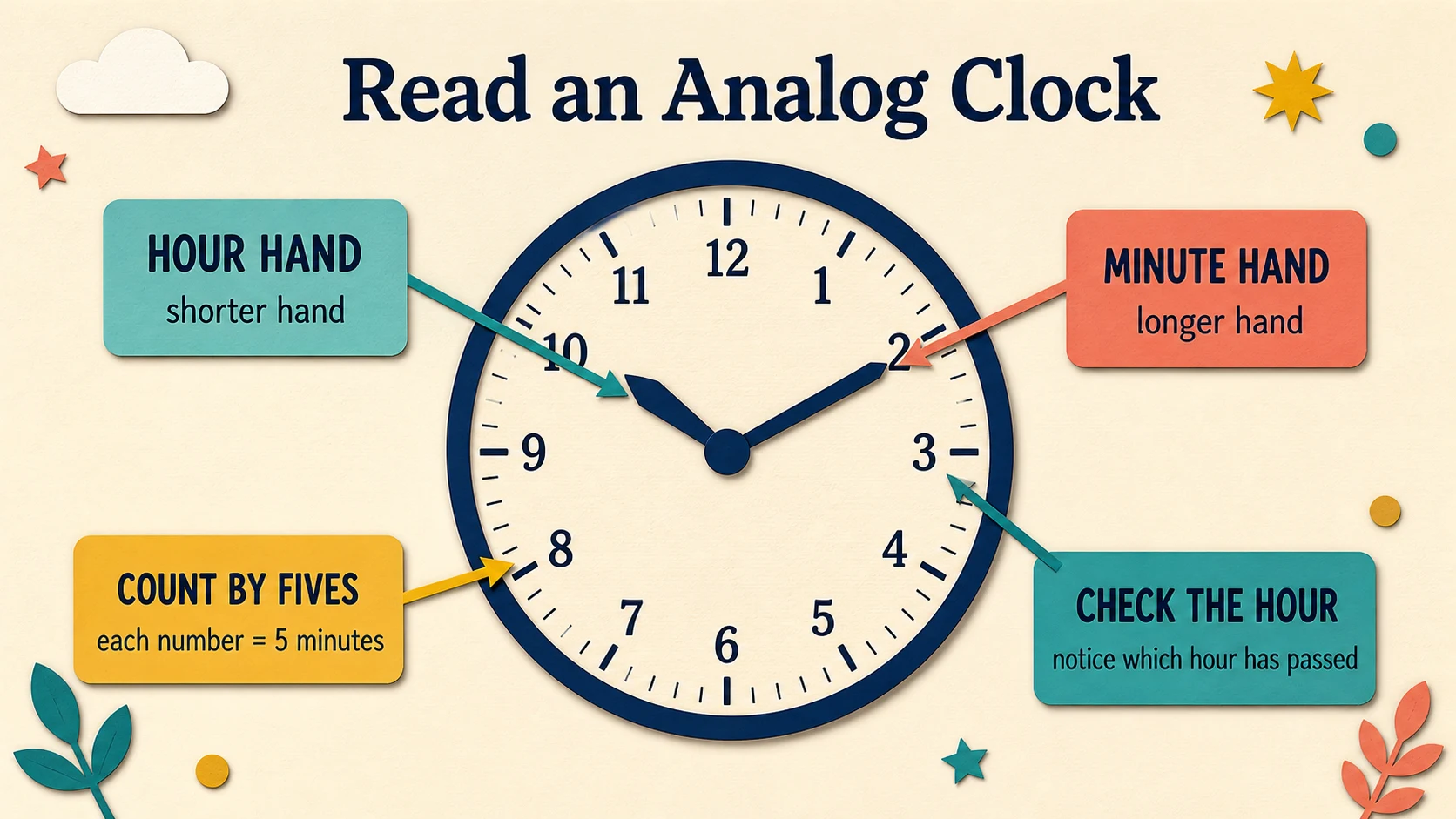
Preview, model, practice together, release responsibility, and review the reasoning.
What this worksheet covers—and what it does not
The printable is titled “3rd Grade Telling Time Worksheets - Standard Theme (Easy).” Its directions are: “Solve each time problem. Write the time on the line provided.” The 12 exercises provide practice with four catalogue-listed skills:
- Telling time
- Reading clocks
- Elapsed time
- Time intervals
The worksheet includes analog and digital clock work and asks learners to tell time at various increments. Because the page is labeled easy, it is best treated as an accessible entry point or reinforcement opportunity, not proof that a learner has mastered the full topic.
The supplied topic scope extends beyond reading a single clock. It includes progression from hours and half-hours to five-minute and one-minute intervals, followed by a.m./p.m., elapsed time, unit relationships, schedules, and time-based word problems. This one printable cannot examine that whole progression in depth. Use the topic guide when you need to locate the current lesson within the larger skill.
The catalogue associates third-grade telling time with telling and writing time to the nearest minute and solving addition-and-subtraction problems involving time intervals. The Common Core mathematics standards provide the original standards context. That connection is useful for understanding the broad instructional destination, but it should not be read as a claim that this 12-item worksheet provides comprehensive standards coverage.
Prepare the lesson before handing over the page
A few minutes of preparation can prevent the worksheet from turning into guess-and-check practice.
Print or open the student page and keep the answer key separate. Look over all 12 exercises so you know where the task format changes. Identify one item you can use for modeling without completing a large share of the page. If the learner may need concrete support, have an analog demonstration clock available. A clock with connected or geared hands is especially useful because moving the minute hand also changes the hour hand’s position.
Also prepare:
- A pencil and eraser
- A blank clock face or quickly drawn circle
- Space for an open number line
- A card or sheet of paper for covering later items
- A short list of prompts that do not reveal answers
Useful prompts include “Which hand tells the hour?”, “Has the hour hand reached the next number?”, “How many groups of five minutes have passed?”, and “Where does the interval begin?” These keep attention on the relevant relationship without completing the reasoning for the learner.
Check prerequisite understanding briefly
Before beginning, show or draw one uncomplicated clock. Ask the learner to identify the hour hand and minute hand and to explain what each one communicates. Then ask for skip-counting by fives from 5 through 60, either orally or while pointing around a clock face.
This is not a separate test. It is a quick way to choose the right amount of support. A learner who cannot yet distinguish the hands needs a more concrete launch than one who reads five-minute times accurately but struggles with elapsed time.
Use a short, observable lesson goal
A useful goal is: “Read each time carefully and show how you know.” That goal applies to both clock reading and interval work. It also makes the learner’s process visible.
Avoid setting a universal time limit. A suitable pace depends on the learner’s accuracy, attention, familiarity with analog clocks, and ability to explain the work. Twelve items can be completed in one sitting or divided across two sessions without changing the skill being practiced.
A practical lesson progression
The following plan keeps the worksheet central while leaving room to respond to the learner’s work.
| Phase | Suggested worksheet use | Adult role | Evidence to watch |
|---|---|---|---|
| Launch | Preview directions and one task format | Clarify what an answer should include | Can the learner identify what the problem asks? |
| Model | Demonstrate one similar example | Think aloud and record each step | Does the learner attend to both hour and minute information? |
| Guided practice | Complete 2–3 items together | Prompt, wait, and ask for reasons | Which prompts help without giving the answer? |
| Independent practice | Assign 3–5 items at a time | Observe quietly and note strategies | Is the method accurate and repeatable? |
| Review | Discuss selected correct and incorrect responses | Compare reasoning with the answer key | Can the learner locate and repair an error? |
| Retrieval | Revisit a few skills later | Use fresh examples or selected items | Is the learning available after a delay? |
The phase lengths are suggestions, not sourced requirements. The learner’s responses should control the release from guided to independent work.
The IES practice guide on teaching mathematics to young children offers high-level instructional framing around systematic mathematical instruction, monitoring children’s understanding, and helping them connect representations. The IES guide for assisting students who struggle with mathematics discusses explicit, systematic instruction and the use of visual representations. Neither source evaluates WorksheetWise or prescribes a fixed routine for this exact printable.
Model the task without doing the worksheet for the learner
Tell the learner that you will demonstrate the thinking used for one similar problem. Keep the model short enough that the learner still has meaningful work to do.
Model reading the hour before the minutes
On an analog clock, begin with the hour hand. If it lies between 3 and 4, the time is still in the 3 o’clock hour because the hand has not yet reached 4. Then read the minute hand.
A concise think-aloud might sound like this:
The short hand has passed 3 but has not reached 4, so the hour is 3. The long hand points to 9. Nine groups of five minutes equal 45 minutes. The time is 3:45.
That sequence directly addresses a common error: naming the number nearest the hour hand instead of the hour that is currently in progress.
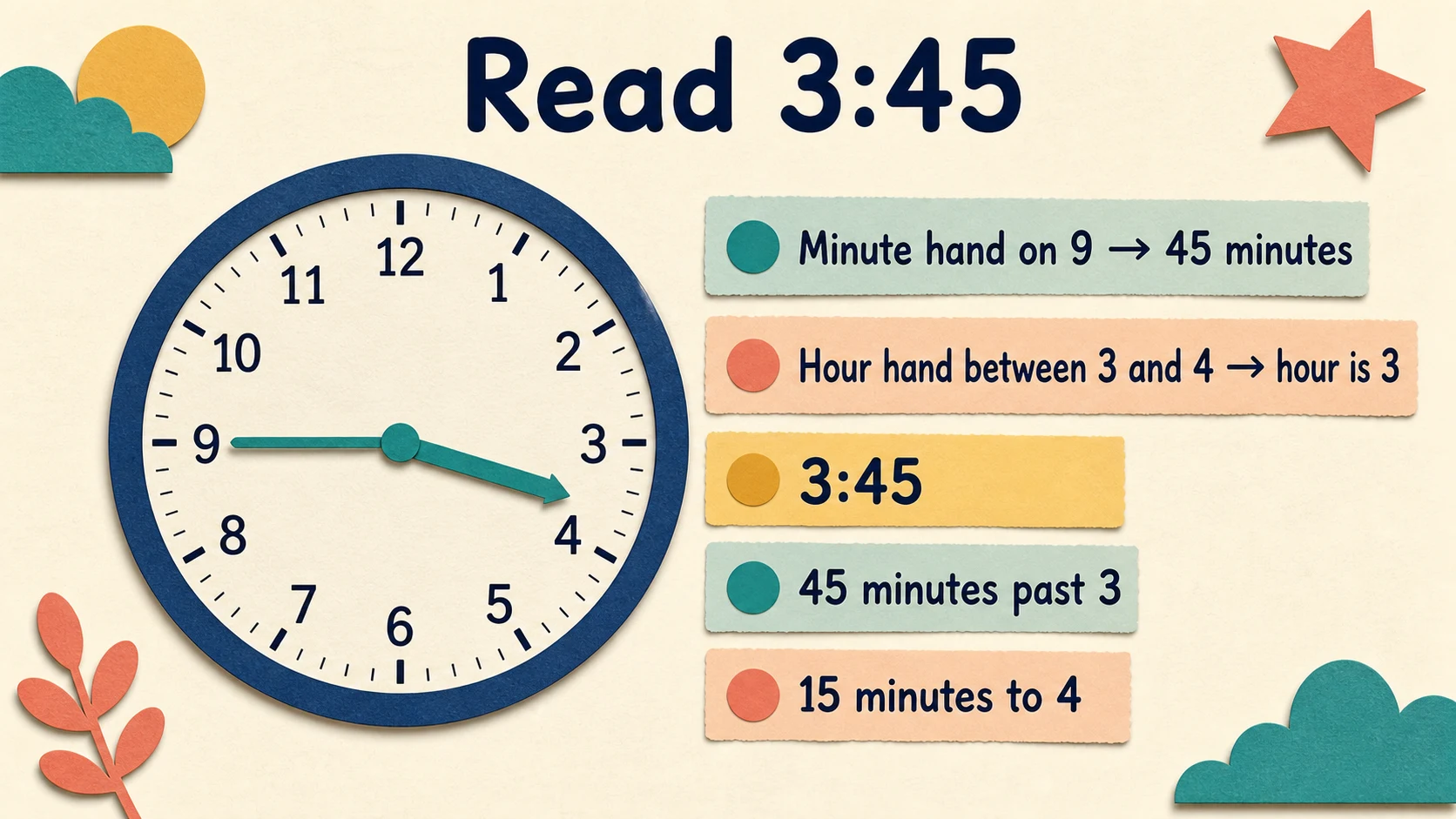
Read the hour in progress, count the minutes, and verify that both hands agree.
Model elapsed time with forward jumps
For an elapsed-time problem, mark the beginning time on an open number line. Make convenient forward jumps until reaching the ending time. Label every jump and combine the durations.
For example, from 2:35 to 3:10:
- Jump from 2:35 to 3:00: 25 minutes.
- Jump from 3:00 to 3:10: 10 minutes.
- Combine the jumps: minutes.
Check by adding 35 minutes to 2:35: 25 minutes reaches 3:00, and the remaining 10 minutes reaches 3:10. Therefore, the elapsed time is 35 minutes.
This representation keeps the base-60 structure visible. It avoids treating clock time as though minutes behaved like ordinary two-digit decimal subtraction.
Run guided practice, then release responsibility
Choose two or three worksheet items that expose different parts of the skill if the page permits—for example, a clock-reading item and an interval item. Ask the learner to do the writing while you prompt.
A useful guided sequence is:
- Ask what information is shown.
- Ask what the problem requires.
- Let the learner propose a first step.
- Request a reason or representation.
- Pause before adding help.
- Check whether the answer is reasonable.
If the learner answers correctly, do not automatically move on. Ask one brief verification question: “What tells you that the hour is 6 rather than 7?” or “How could you check those 25 minutes?” Correct answers can come from solid reasoning, a remembered pattern, or a lucky guess. The explanation helps distinguish them.
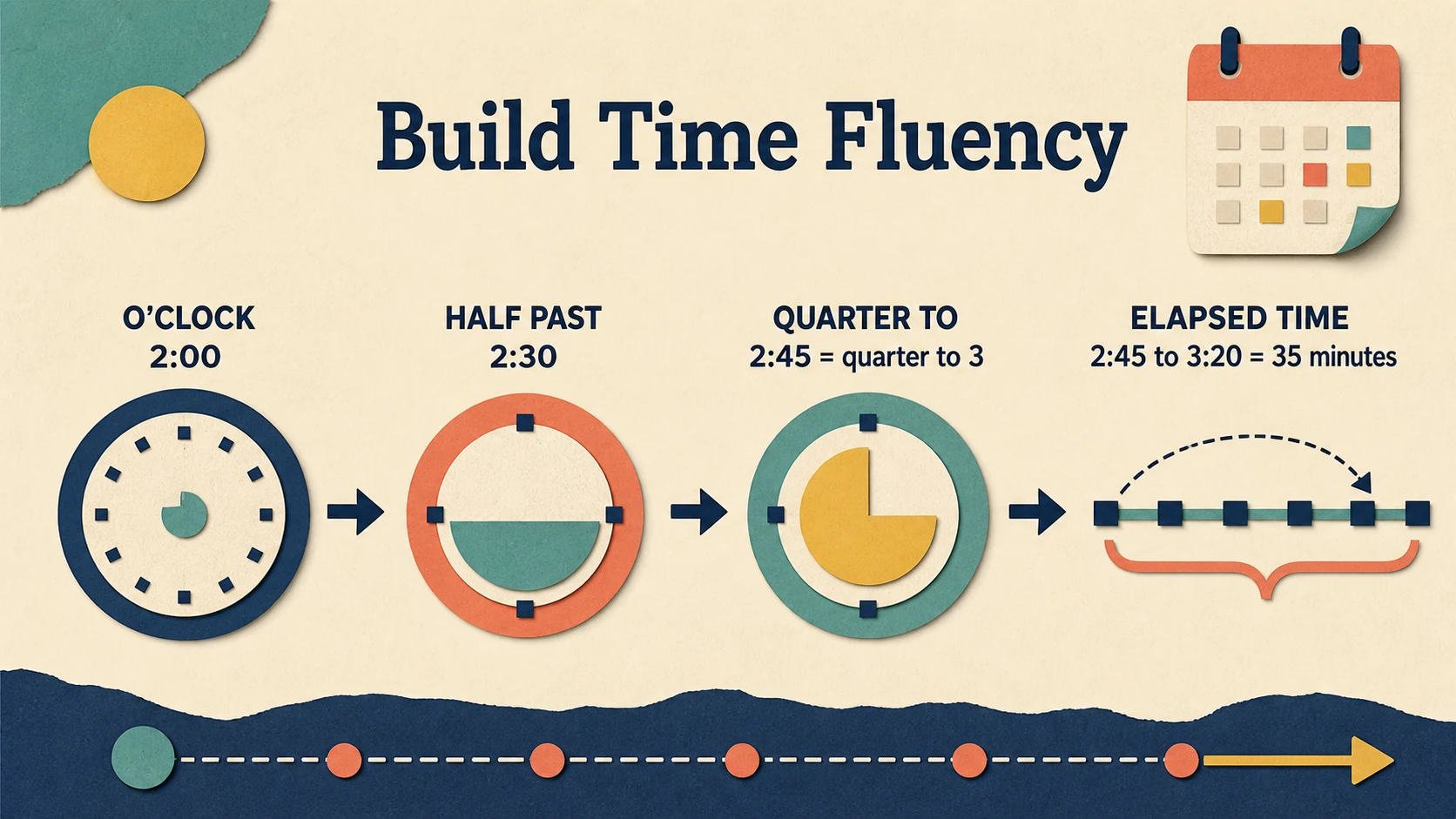
Use prompts to reveal the learner’s thinking, then reduce the prompts as the method becomes stable.
Decide when the learner is ready to work alone
Move to independent practice when the learner can start an item without being told the first step and can explain the role of the hour and minute information. Assign a small group of items rather than automatically requiring all remaining exercises at once.
During independent work, observe without correcting every hesitation. Note whether the learner:
- Reads the hour hand before the minute hand
- Counts minute marks or groups of five consistently
- Records times with clear hour-and-minute notation
- Uses the stated beginning and ending times in the correct order
- Checks whether an interval is plausible
If the same error appears twice, pause the independent block. Re-model with a fresh example, then return to the next uncompleted item. Repeated incorrect practice is less informative than a timely reset.
Four fully checked examples
These examples illustrate reasoning similar to the worksheet’s listed skills. They are not presented as copies of particular numbered items.
Example 1: Reading an exact hour
Suppose the minute hand points to 12 and the hour hand points to 7.
The minute hand at 12 represents 0 minutes after the hour. The hour hand identifies 7. The time is therefore 7:00.
Check: at exactly 7:00, the hour hand should be on 7 and the minute hand should be on 12. Both conditions match.
This example also establishes an important notation point: write 7:00, not 7:12. The 12 is a position on the clock face; it does not mean 12 minutes.
Example 2: Reading a five-minute increment
Suppose the hour hand is a little past 4 and the minute hand points to 5.
Count by fives from 12 around the clock: 1 represents 5 minutes, 2 represents 10, 3 represents 15, 4 represents 20, and 5 represents 25. The hour hand has passed 4 but has not reached 5, so the hour remains 4. The time is 4:25.
Check: 25 minutes is less than half an hour, so the hour hand should be less than halfway from 4 to 5. “A little past 4” is consistent with 4:25.
Example 3: Reading a boundary case near the next hour
Suppose the minute hand points to 11 and the hour hand is close to 9 but has not reached it.
The minute hand at 11 represents minutes. Because the hour hand has not reached 9, the time remains in the 8 o’clock hour. The answer is 8:55, not 9:55.
Check: five more minutes after 8:55 would be 9:00. That explains why the hour hand is close to 9 while the hour is still 8.
Example 4: Finding an interval that crosses an hour
Suppose an activity begins at 10:50 and ends at 11:20.
Use forward jumps:
- 10:50 to 11:00 is 10 minutes.
- 11:00 to 11:20 is 20 minutes.
- .
The elapsed time is 30 minutes.
Check by adding: 10 minutes after 10:50 is 11:00, and 20 more minutes is 11:20. The end time matches.
A second check is to divide the interval into two equal 15-minute parts: 10:50 plus 15 minutes is 11:05; another 15 minutes reaches 11:20. The total is again 30 minutes.
Adapt support without changing the skill
An adaptation should make the same reasoning more accessible. It should not replace the target with a simpler, unrelated task.
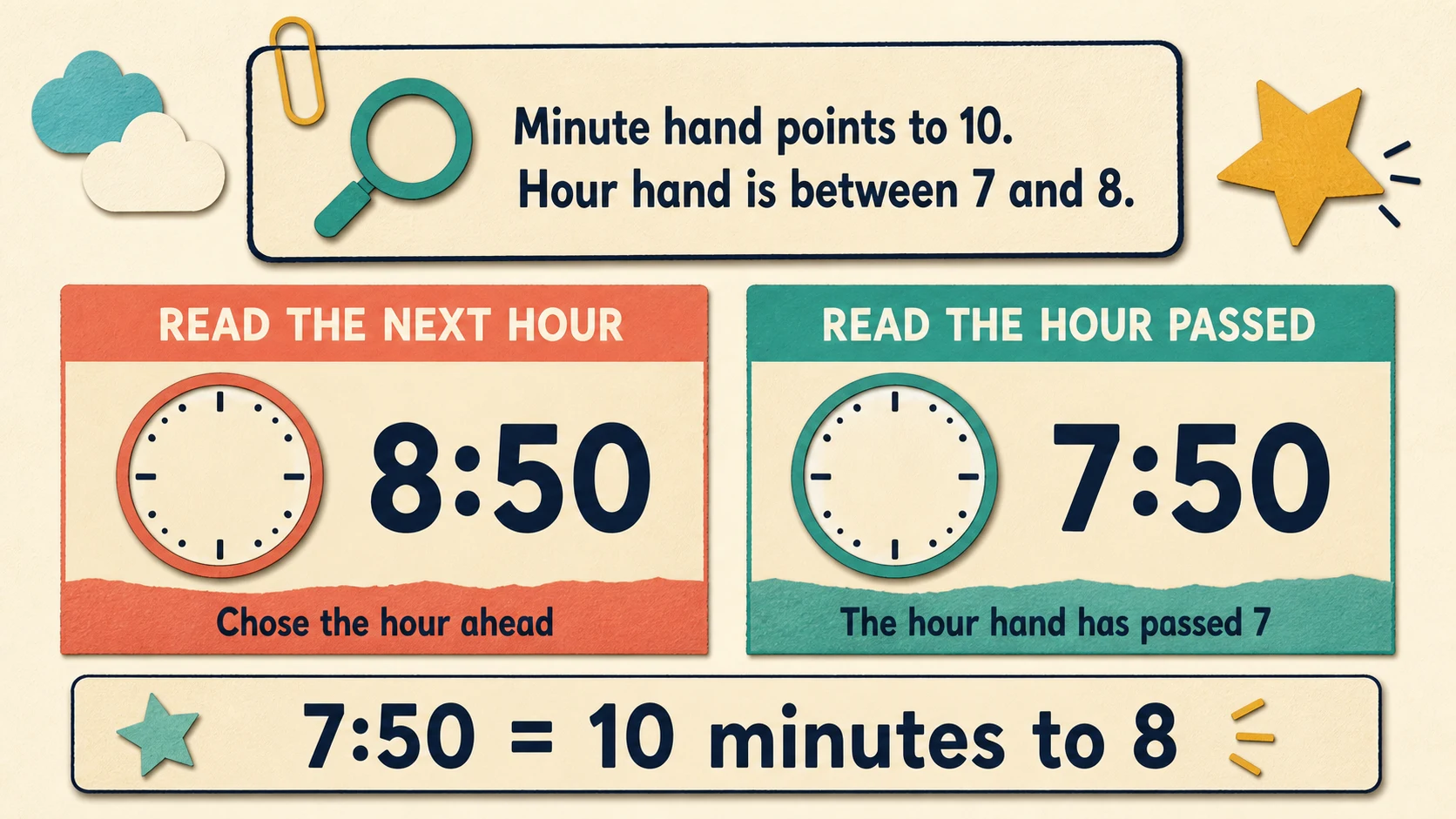
Adjust visibility, representation, or workload while preserving the time-reading or interval decision.
For a learner who loses place visually
Cover all but one item with a blank sheet. Enlarge the page if the clock faces or labels are difficult to inspect. Let the learner point to the relevant hands before writing.
These changes reduce visual competition without changing the time being read. Avoid tracing over a hand or circling the correct hour in advance, because that completes part of the mathematical decision.
For a learner who needs a concrete representation
Rebuild the displayed time on a demonstration clock. Ask the learner to move the hands and narrate what changes. For elapsed time, pair the clock with an open number line.
If using a movable clock, preserve the relationship between the hands. At 6:30, for example, the hour hand should sit between 6 and 7 rather than remain fixed exactly on 6. That position helps the learner understand the hour as progressing continuously.
For a learner who understands but tires quickly
Divide the 12 items into smaller sets. Complete one set, take a break or change activity, and return later. The learner can still solve all 12 exercises, but endurance is no longer confused with time-telling knowledge.
You can also alternate response modes during guided practice: say the time, build it on a clock, and then write it. The final independent response should still match the worksheet direction to write the time.
For a learner ready for a small extension
Ask for one verification after a completed item:
- “How many minutes until the next hour?”
- “Where would the hour hand move next?”
- “Can you show that interval with different jumps?”
- “What would the clock show five minutes later?”
Keep the extension brief. The aim is to deepen the same skill, not turn an easy-level practice page into a separate advanced lesson.
Interpret errors before correcting them
An incorrect answer is useful only when the adult identifies the decision that produced it. Instead of saying “Try again,” compare the learner’s response with the clock or interval and ask which part still fits.
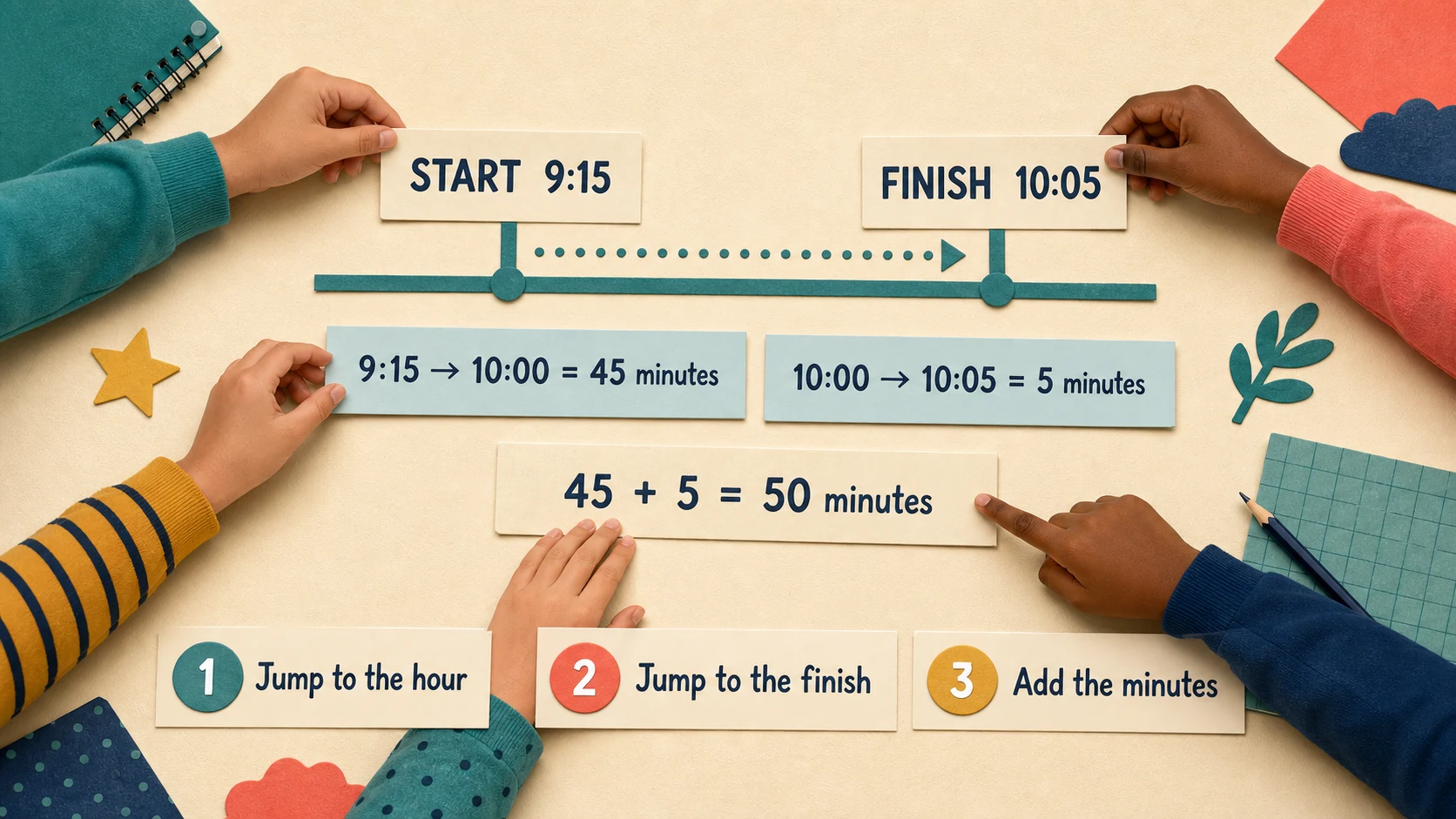
Identify the hour, verify the minutes, test the interval, and repair only the step that failed.
Confusing the two hands
A learner may use the long hand as the hour or read both hands as ordinary numerals. Return to the hands’ jobs: the short hand tracks the hour, while the long hand tracks minutes. Ask the learner to point before naming any numbers.
Do not rely only on “short” and “long” if the printed hands are visually similar. Connect each hand to its movement and purpose.
Naming the next hour too early
A clock showing 3:45 may be misread as 4:45 because the hour hand is closer to 4. Ask, “Has the hour hand reached 4 yet?” If not, the time is still 3-something.
Use boundary examples such as 3:55 followed by 4:00. Seeing the transition can be more useful than repeating a rule.
Treating clock numerals as minute values
A learner may read the minute hand on 8 as 8 minutes. Have the learner count five-minute groups: . A labeled practice clock can be used temporarily, then removed when the counting pattern becomes reliable.
Subtracting time as ordinary base-10 numbers
For 11:20 minus 10:50, a learner might attempt or manipulate 1120 and 1050 as ordinary whole numbers. Return to a clock or open number line. Ten minutes reaches 11:00, and 20 more reaches 11:20, for 30 minutes total.
Reversing the interval
If a learner counts from the ending time back toward the beginning without recognizing the direction, ask which event occurs first. Mark “start” and “end,” then draw an arrow showing time moving forward.
A backward strategy can be mathematically valid when used deliberately, but it should not arise from confusing the two times. Ask the learner to explain the direction before accepting the method.
Check the answer key responsibly
The separate printable answer key is designed for quick checking, but it should confirm reasoning rather than replace it.
First, solve or inspect each problem yourself. Then compare the learner’s response with the key. If an answer differs, return to the original item before showing the keyed answer. Ask the learner to reread the clock, reconstruct the interval, or check the notation.
For each reviewed item, classify the result more precisely than right or wrong:
- Accurate and explained: The answer and reasoning agree.
- Accurate but uncertain: The learner needs a verification routine.
- Method sound, recording error: The reasoning works, but the written time is incomplete or reversed.
- Conceptual error: The learner misunderstands a hand, hour boundary, minute value, or interval.
- Unclear evidence: The learner guessed, erased extensively, or cannot reproduce the method.
If you suspect a mismatch between the worksheet and key, do not force the learner’s work to fit the key. Recalculate independently, inspect the clock-hand positions, and compare representations. An answer key is a checking aid, not a substitute for mathematical verification.
Keep corrections focused. Asking a learner to copy every correct answer may produce a neat page without revealing whether the underlying misunderstanding changed. Have the learner repair selected errors and explain the corrected step.
Decide what to do after the 12 items
Use patterns across the page rather than a raw score alone.
If the learner reads clocks accurately and explains intervals consistently, move to a nearby telling-time skill or a modestly more varied practice set. The 3rd Grade Math hub can help place telling time alongside other math work.
If analog-clock errors cluster near the next hour, continue with examples such as 2:45, 5:50, and 7:55. Ask whether the hour hand has reached the next numeral. Keep the focus narrow until the learner stops advancing the hour prematurely.
If five-minute counting is unstable, practice mapping clock numerals to minute totals before adding elapsed-time demands. If clock reading is secure but intervals are not, preserve the given times and add an open number line. This isolates interval reasoning without lowering the underlying time-reading level.
If performance deteriorates only late in the page, repeat a few comparable items in a shorter session before concluding that the concept is weak. If errors occur from the first item and continue despite modeling, return to an earlier point in the telling-time progression.
The 18-worksheet 3rd Grade Telling Time Worksheet Pack is an available source of broader practice, but more pages are useful only when they match the learner’s current need. Repetition without examining the error pattern can reinforce an ineffective method.
Schedule retrieval after the first lesson
Completing the page once shows what the learner could do during that session. Later retrieval checks whether the method remains available after attention has moved elsewhere.
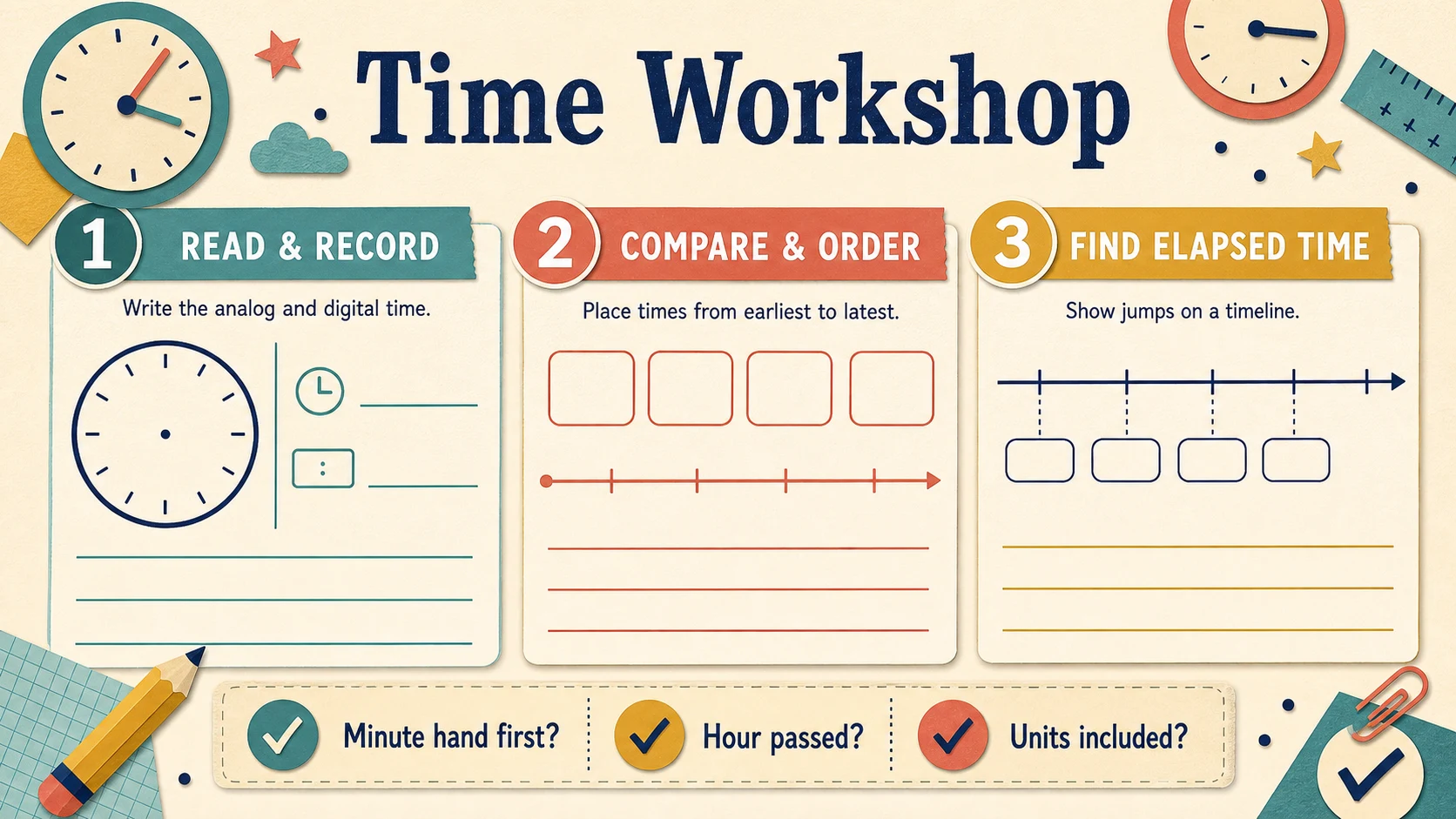
Revisit a small sample after a delay and let observed performance determine the next interval.
A practical, adjustable schedule is:
| Review point | Suggested task | What to observe |
|---|---|---|
| Later the same session | One fresh oral clock example | Can the learner state the hour-first routine? |
| Next study session | Two or three fresh examples | Is the method recalled without re-teaching? |
| Several days later | Mix clock reading with one interval | Does the learner choose the appropriate representation? |
| The following week | Use a short mixed review | Are earlier boundary errors still absent? |
This is an instructional suggestion, not a universal timetable. Shorten the delay when the learner cannot retrieve the method, and lengthen it when responses remain accurate and well explained. Use fresh examples where possible so recall is not confused with remembering an answer’s position on the page.
Limitations and the honest next step
This worksheet offers 12 easy-level exercises and a separate answer key. It can support modeling, guided practice, independent work, and informal review. It cannot by itself establish comprehensive mastery of analog clocks, digital notation, a.m./p.m., one-minute precision, schedules, unit conversions, or every kind of elapsed-time word problem. It also does not diagnose why a learner struggles beyond the evidence visible in the work and explanation.
Keep notes modest and factual: “read 8:55 as 9:55 twice” is more useful than a broad label such as “doesn’t understand time.” Do not draw medical, developmental, or high-stakes placement conclusions from this page.
For the next session, choose one action from the evidence. If the learner needs consolidation, reopen the free Standard Theme worksheet and revisit only the relevant items with a fresh representation. If the 12 items are accurate and independently explained, use the 3rd Grade telling-time topic guide to select the next skill rather than repeating easy practice automatically.
Put it into practice
Use the guide with a real printable
Move from explanation to a short, observable practice task. Check the first item together, then adjust the next session from the learner's actual work.
See the 18-worksheet pack