Complete guide
How to teach and practise 3rd grade subtraction worksheets - standard theme (easy)
How to Use This 25-Problem Subtraction Worksheet
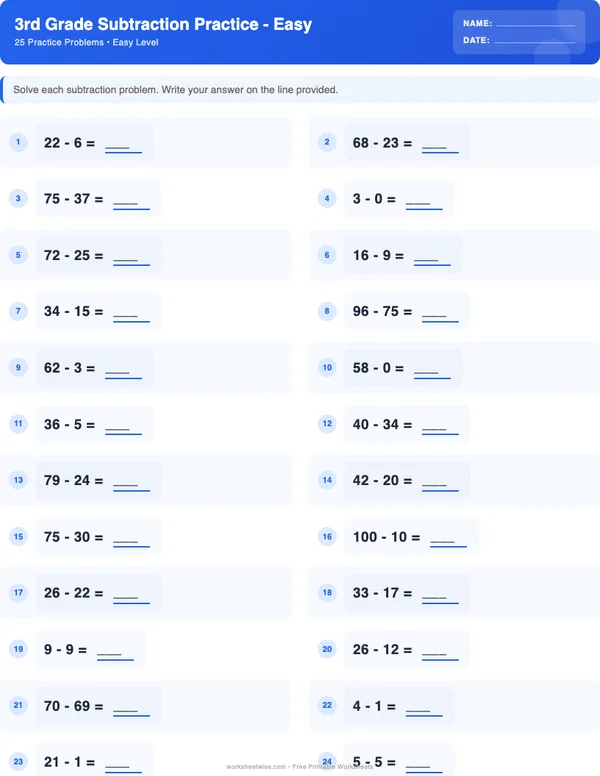
The free 3rd Grade Subtraction worksheet provides 25 easy-level exercises involving subtraction facts, mental math, number sense, and regrouping. A productive lesson is simple: preview the page, model one or two representative problems, complete a short guided set, and then release the learner to work independently. Check the answers afterward, study the method behind any errors, and schedule a brief return to the skill.
Do not assume that “easy” means every problem should be completed quickly or without support. The learner’s observed work should determine the pace. If place-value notation is secure, the full page may be reasonable in one sitting. If regrouping causes confusion, divide the worksheet into smaller sets while preserving the subtraction skill.
Grade labels describe the intended practice level, not a guarantee that every third grader has encountered the same sequence. Local curricula and instructional sequences differ. The broader subtraction topic guide provides the surrounding progression; this guide focuses specifically on launching, teaching, and reviewing this 25-item printable.
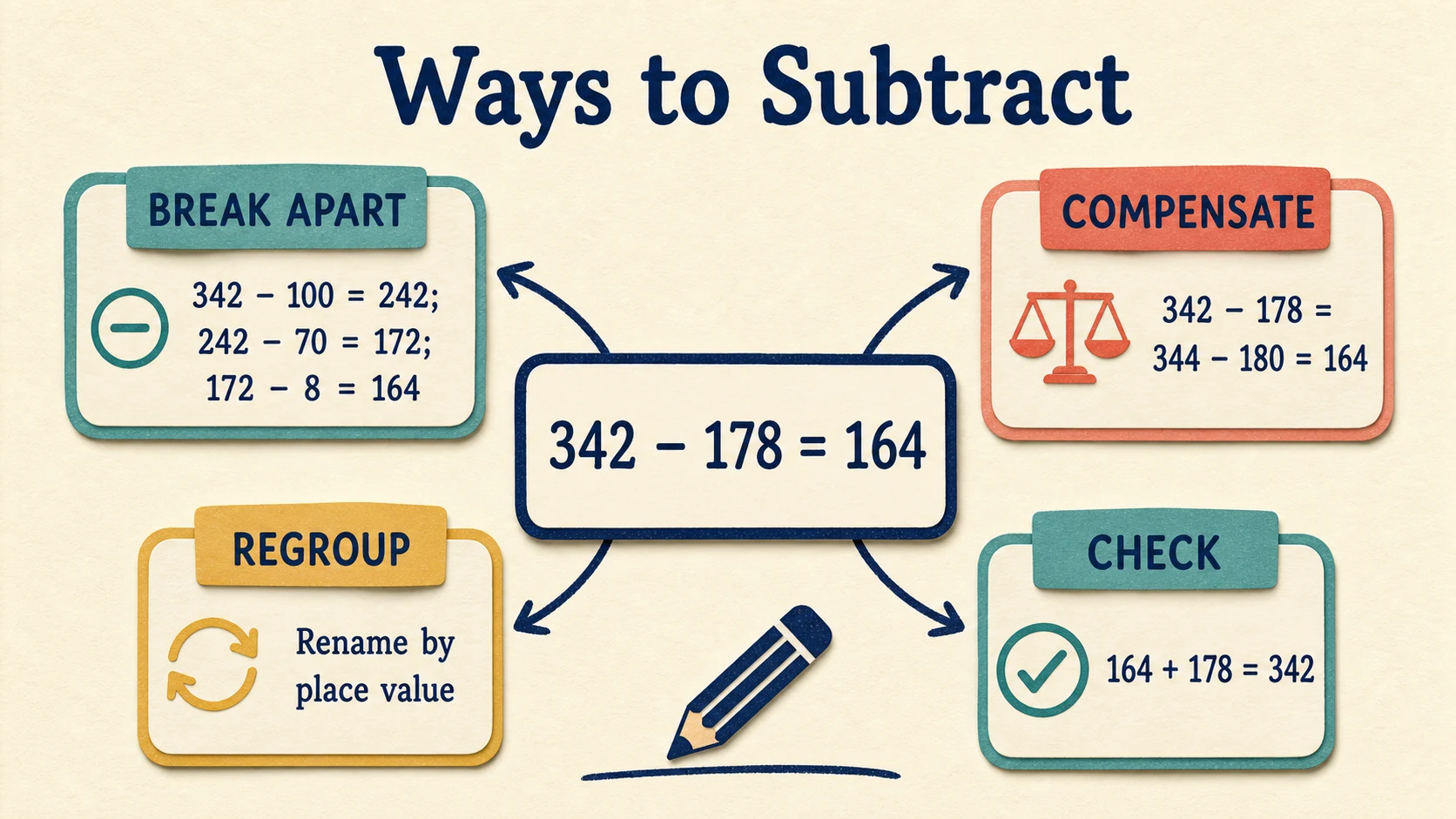
Preview, model, guide, release, check, and revisit the skill.
What This Printable Is Designed to Practice
The worksheet’s directions are direct: “Solve each subtraction problem. Write your answer on the line provided.” Its 25 exercises are catalogued as easy-level practice for learners beginning this work or needing reinforcement. The listed skills are:
- Subtraction facts
- Mental math
- Number sense
- Regrouping
Those labels describe the practice focus, but they do not tell an adult exactly which strategy a particular learner should use on every item. A known fact may be answered mentally. A larger calculation may be solved with place-value reasoning, a written method, or regrouping. What matters is that the learner can explain enough of the method to show that the answer was produced through subtraction rather than guessing.
The worksheet also includes a separate printable answer key. That key is useful for efficient checking, but it cannot show how the learner thought. Two learners can write the same incorrect answer for entirely different reasons, and a correct answer can occasionally result from an unclear or unreliable method. Responsible checking therefore includes looking at both the result and, when needed, the written work.
For nearby grade-level materials, use the 3rd Grade worksheet hub or the more focused 3rd Grade math collection. These links provide context without requiring this single worksheet to cover the entire subtraction progression.
Prepare the Lesson Before the Learner Begins
A short preview makes the session more purposeful. Print the student page and keep the answer key out of the learner’s view. Have a pencil, eraser, and blank paper available. If regrouping is not yet stable, prepare a simple place-value aid such as labeled hundreds, tens, and ones columns. Base-ten blocks may also help a learner represent a trade physically.
The IES guide on teaching mathematics to young children supports high-level instructional practices that include helping learners connect mathematical ideas with representations and mathematical language. It did not evaluate WorksheetWise or this particular printable. Here, a place-value chart or blocks should be treated as a temporary representation for understanding the subtraction, not as a separate activity that replaces the worksheet.
Preview without preteaching every answer
Scan the page for changes in problem form:
- Are some facts immediately recognizable?
- Which items appear to invite mental math?
- Where might regrouping be needed?
- Is there enough room for written work, or should the learner use separate paper?
Do not solve all 25 items aloud in advance. The goal is to identify one suitable example for modeling and a few for guided practice while leaving enough unseen work for meaningful independent practice.
Establish a clear purpose
Tell the learner what you will watch for. For example:
We are practicing accurate subtraction. You may use a fact you know, place-value thinking, or written regrouping. If you regroup, show the trade clearly enough that we can check it.
This is an instructional suggestion, not a sourced requirement. It keeps attention on the mathematical process without adding a speed target that the worksheet does not specify.
Use a flexible lesson map
| Phase | Suggested action | Evidence to observe |
|---|---|---|
| Readiness check | Try one fact and one place-value example | Does the learner understand subtraction and align digits? |
| Adult model | Think aloud through one representative calculation | Can the learner identify the starting amount and amount removed? |
| Guided practice | Solve two or three items together | Does support decrease across the set? |
| Independent practice | Complete an appropriate section or the remaining page | Are methods accurate and reasonably organized? |
| Review | Compare work with the answer key | Can the learner locate and explain discrepancies? |
| Retrieval | Revisit selected problems after a delay | Can the learner solve without copying the earlier procedure? |
This is a practical sequence rather than a universal timetable. A learner who is accurate and confident may move through it quickly. A learner whose work shows unstable place value may need several shorter sessions.
Model the Mathematical Task Clearly
Modeling should make the invisible decisions visible: read the expression, identify place values, choose a method, calculate, and check. Keep the explanation concise enough that the learner still has substantial work to do.
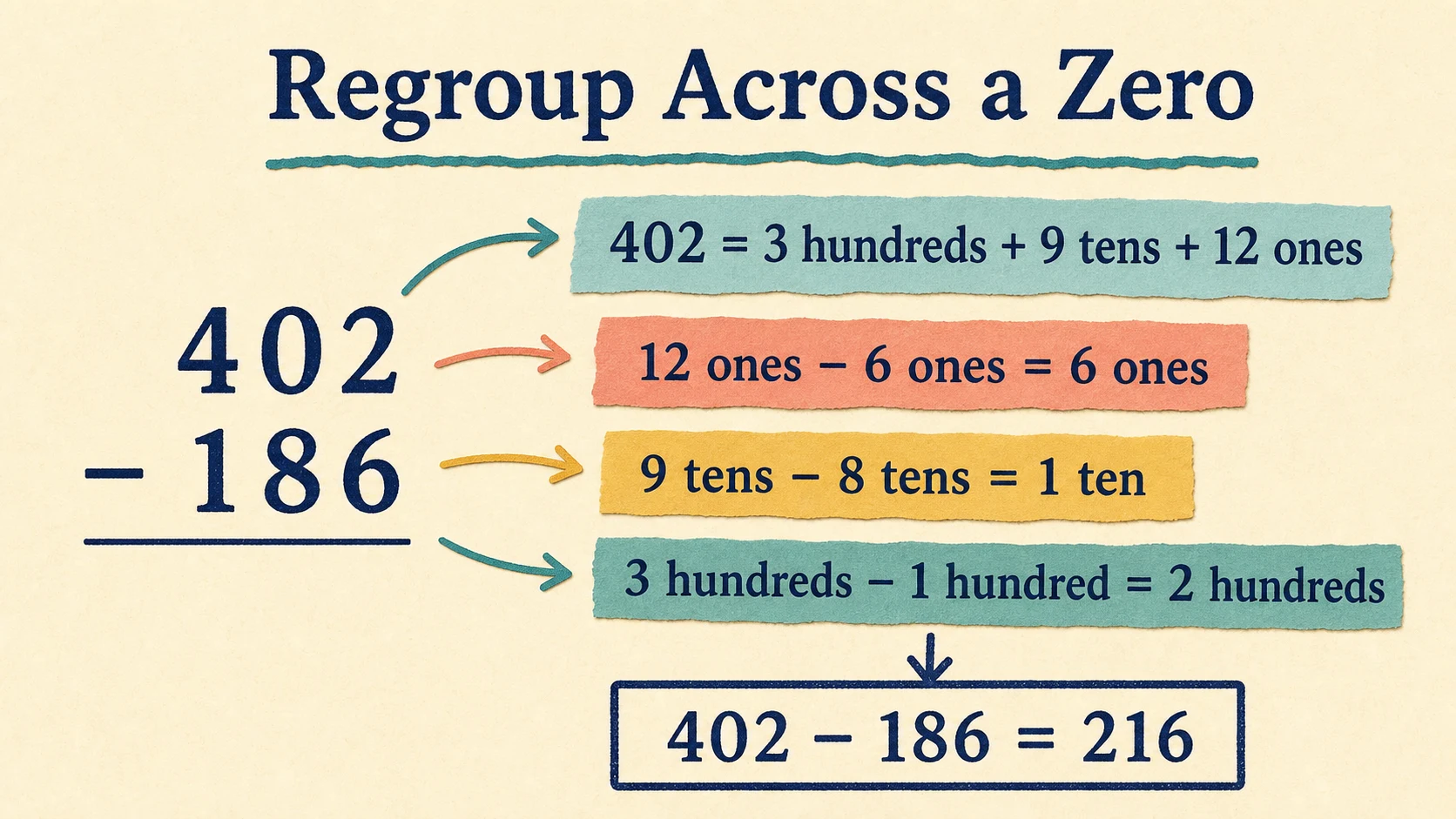
Use a checked example to show the method, not to reveal worksheet answers.
Example 1: Use a related addition fact
Consider:
Ask, “What number added to 7 makes 15?” Since , it follows that:
Check:
This example uses the inverse relationship between addition and subtraction. The catalogue’s subtraction guidance explicitly recommends practicing related addition facts. It is especially useful when the learner knows the addition combination more securely than the corresponding subtraction fact.
Example 2: Subtract by place value without regrouping
Consider:
Separate tens and ones:
Combine the parts:
Therefore:
Check with addition:
This calculation works cleanly because each place can be subtracted without a trade. If writing vertically, align the ones under the ones and the tens under the tens:
  76
- 24
----
  52
Example 3: Regroup one ten
Consider:
The ones calculation cannot be completed using nonnegative whole-number ones without regrouping. Trade one of the 6 tens for 10 ones. The quantity remains 63:
Now subtract by place:
Combine:
Therefore:
Check:
Written vertically, the regrouped notation should show 6 tens becoming 5 tens and 3 ones becoming 13 ones. Emphasize that no value disappeared: one ten was renamed as ten ones.
Example 4: Regroup across a zero
Consider:
This is a useful boundary case because the tens digit in 402 is zero. To subtract 6 ones from 2 ones, a hundred must ultimately be regrouped.
Rename 402 as 3 hundreds, 10 tens, and 2 ones. Then trade one of those tens for 10 ones:
Now subtract by place:
Combine:
Therefore:
Check:
This example may or may not match an item on the printable. It is a fully checked teaching example used to clarify a regrouping boundary, not a statement about the worksheet’s exact problem list.
Move from Guided Practice to Independent Work
Guided practice is the bridge between watching and doing. Choose two or three worksheet items that represent the page without completing too much of it for the learner.
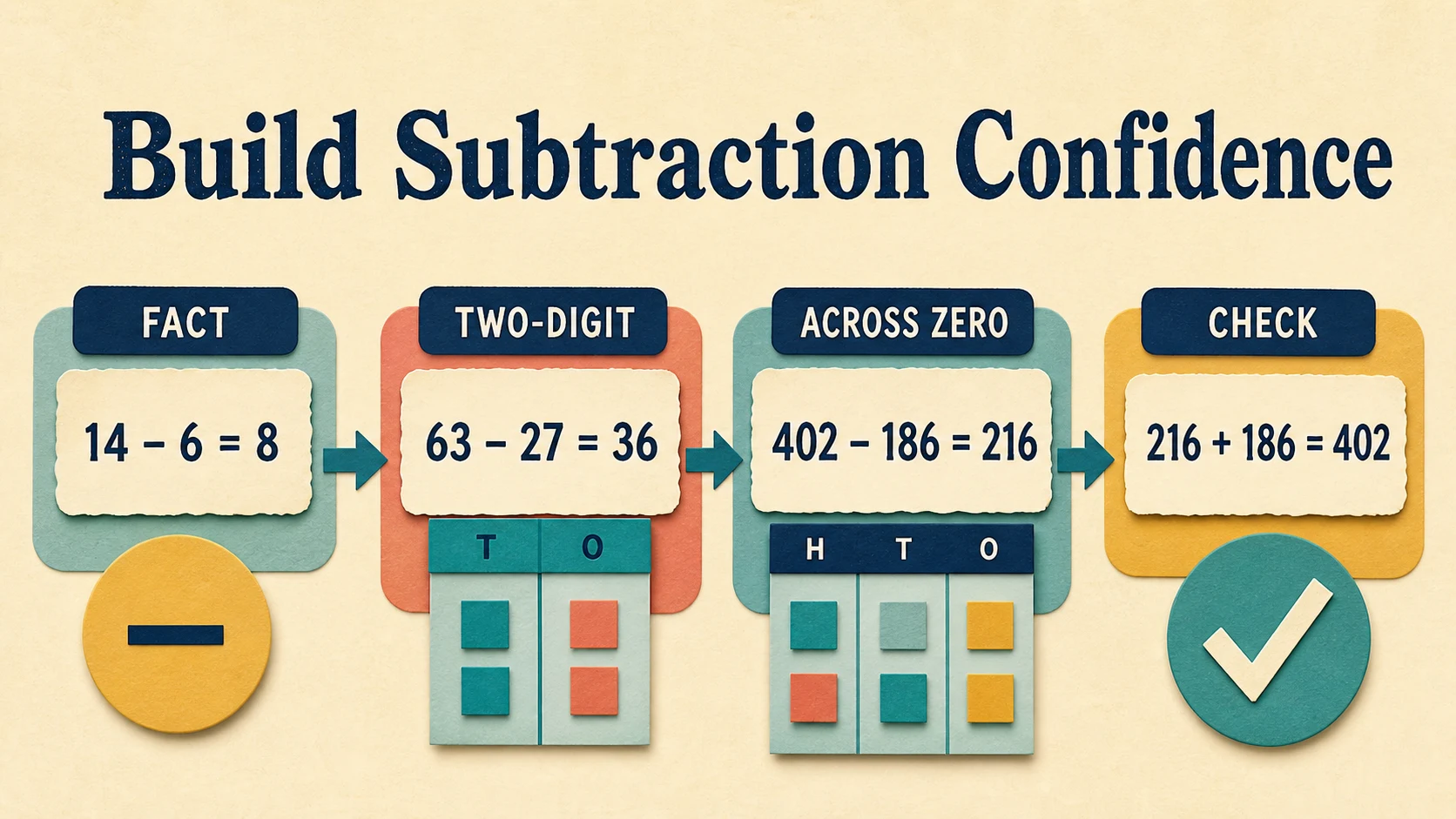
Prompt the learner’s decisions, then gradually reduce the prompts.
Use prompts that reveal thinking
Instead of immediately naming the next step, ask focused questions:
- What quantity are you starting with?
- What amount are you subtracting?
- Are the ones, tens, and hundreds aligned?
- Can each place be subtracted as written?
- If not, what place can supply a trade?
- What addition equation could check the result?
- Is the answer reasonably smaller than the starting number?
These prompts preserve the original skill. They do not convert subtraction into an unrelated task or provide the answer.
During the first guided item, the adult may point to each place and record the learner’s explanation. During the second, the learner should write while the adult prompts only when necessary. By the third, pause before helping. The learner’s response to that pause is useful evidence: independent initiation matters as much as completing a procedure after every step has been supplied.
Decide how much independent work to assign
Assigning all 25 items at once is reasonable only when the learner’s guided work suggests that the task is accessible. Consider a smaller initial set when the learner:
- Misaligns digits repeatedly
- Cannot explain a regrouping trade
- Changes methods unpredictably
- Shows declining accuracy after several items
- Needs an adult prompt for nearly every step
Dividing the page does not change its subtraction content. For example, the learner might complete five items, review one error pattern, and then continue with another five. Preserve the original problem order unless there is a clear instructional reason to choose a representative subset.
Avoid correcting every mark while the learner is still working independently. Constant interruption can make it difficult to see what the learner can actually sustain alone. A quiet note beside an item, or a request to mark uncertain answers with a small dot, can preserve useful evidence for the review.
Adapt Support Without Changing the Skill
Support should improve access to the subtraction while leaving the learner responsible for the essential calculation. The IES practice guide for assisting students who struggle with mathematics provides high-level guidance about systematic instruction, clear mathematical language, representations, and cumulative review. It does not prescribe how this exact worksheet must be taught.
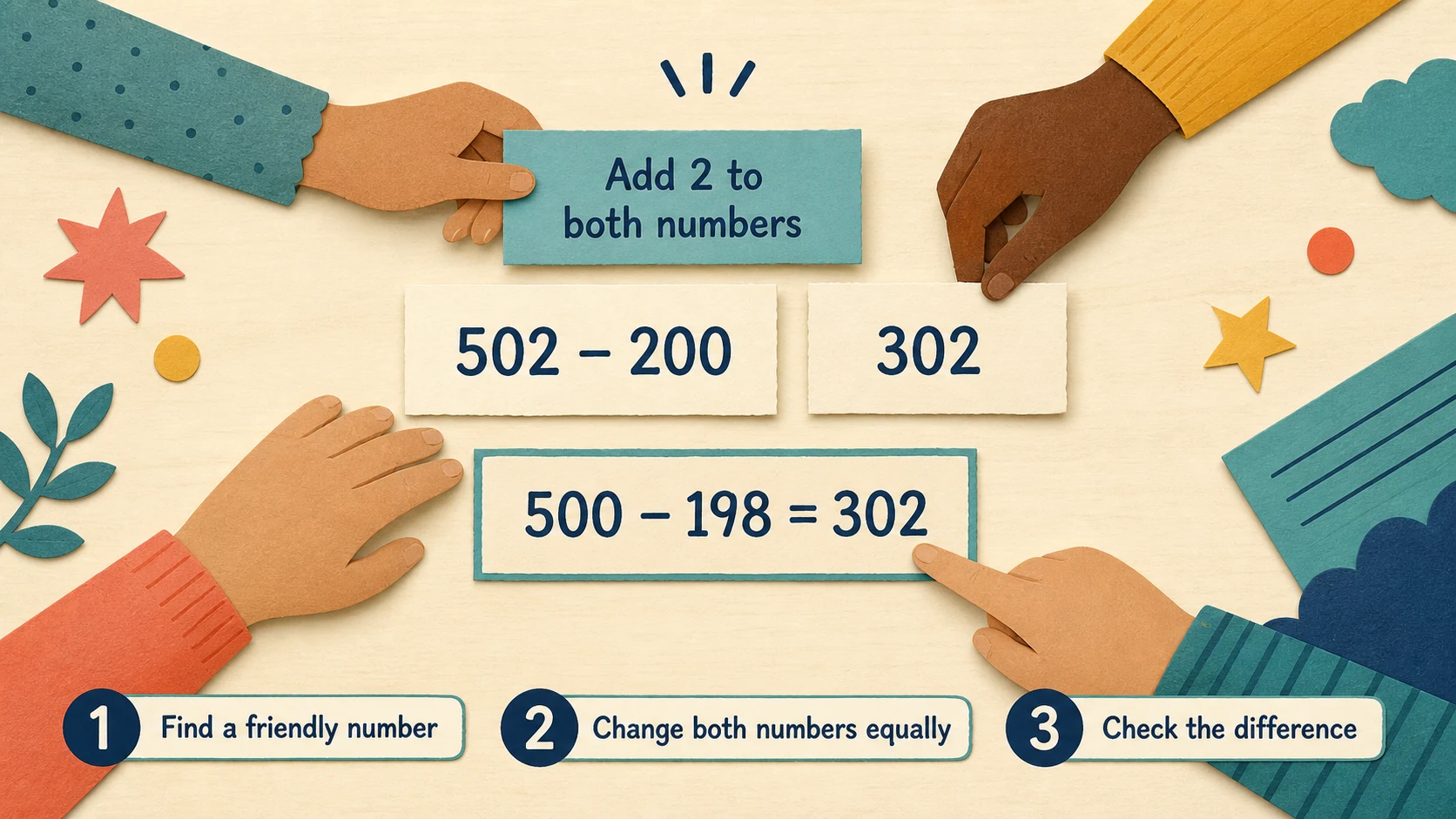
Adjust representation, quantity, or prompting while retaining subtraction as the target.
When place-value organization is the barrier
Give the learner separate paper with columns labeled hundreds, tens, and ones. Ask the learner to copy one problem into those columns before solving it. If digits were copied correctly and the answer improves, alignment—not the meaning of subtraction—may have been the immediate obstacle.
For regrouping, use base-ten blocks if available. Represent 63 as six tens and three ones, then physically exchange one ten for ten ones before subtracting 28. Connect the physical trade directly to the written notation. Remove the blocks when the learner can explain and record the trade without them.
When the page feels visually or mentally crowded
Cover the unassigned portion with blank paper, or fold the sheet so that only a short set is visible. Keep the original numbers and operation intact. This changes how much is presented at once, not what the learner must calculate.
A learner may complete fewer problems in one sitting and return later. Use observed accuracy, independence, and effort to determine the break point. Do not infer a diagnosis from difficulty with a single worksheet.
When facts slow down a larger method
If a learner understands regrouping but pauses over facts such as , briefly connect the fact to addition:
The missing addend is 5, so . Then return immediately to the original multi-digit problem. This keeps the support connected to subtraction rather than replacing the entire task with an answer list.
A subtraction fact reference can help identify which combinations need later review, but allowing unrestricted copying would make the completed worksheet less informative. If a reference is used, note which answers required it.
When the work is already secure
Do not make the learner race simply because the page is labelled easy. A useful extension is to select two completed items and ask for a second method or an addition check. The learner might solve by place value and then verify that .
Another extension is to ask for a brief context that matches an expression: removal, comparison, or a missing part. The catalogue identifies all three as subtraction situations. The extension should remain brief so that it deepens interpretation without turning the printable into a separate writing assignment.
Interpret Errors Before Correcting Them
An incorrect answer is evidence, but it is not yet an explanation. Compare several errors and look for a repeated pattern. Then ask the learner to reconstruct one problem without first showing the correct result.
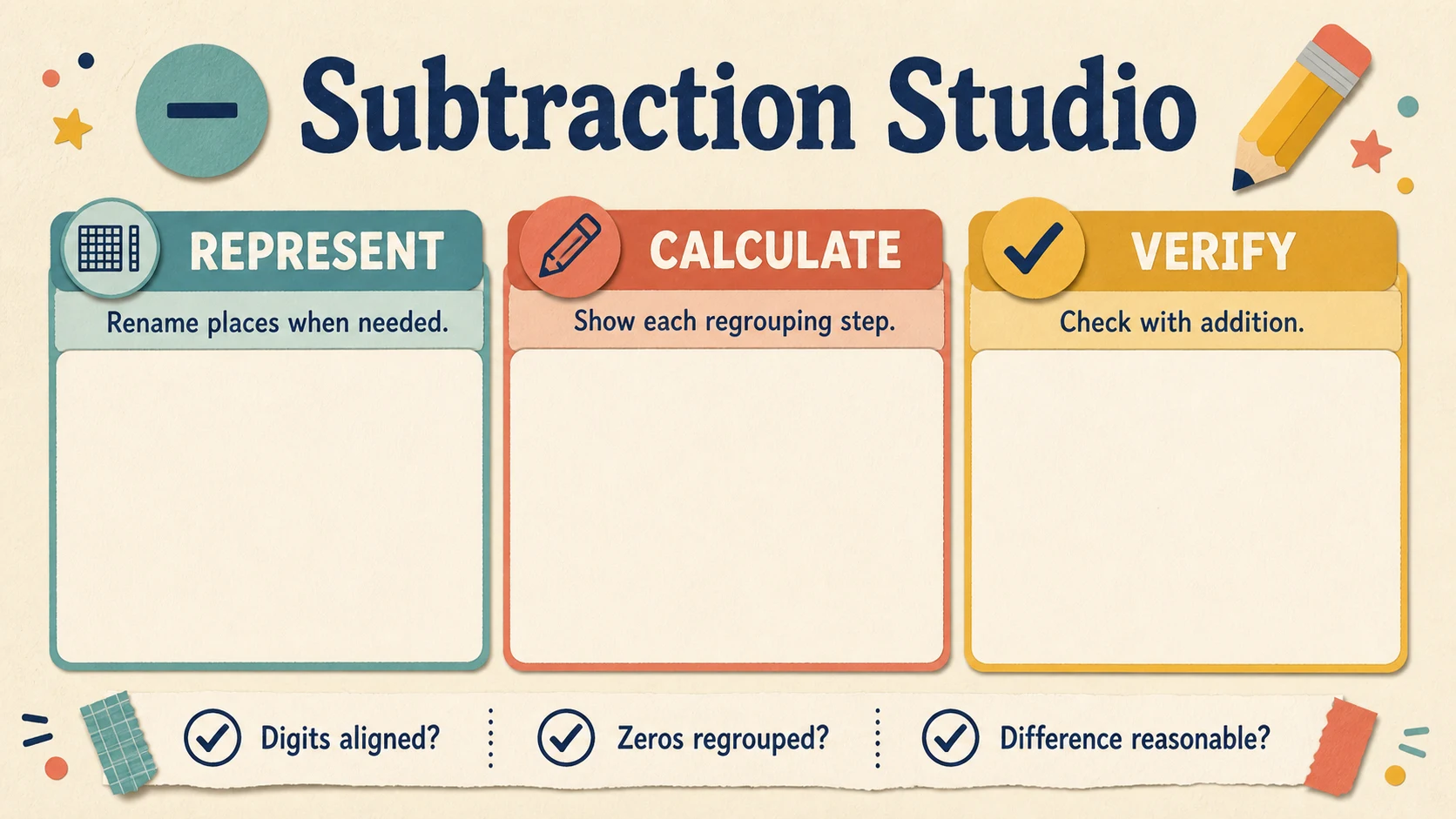
Read, align, regroup if needed, compute, estimate, and verify.
Reversing digits within a place
Suppose a learner writes:
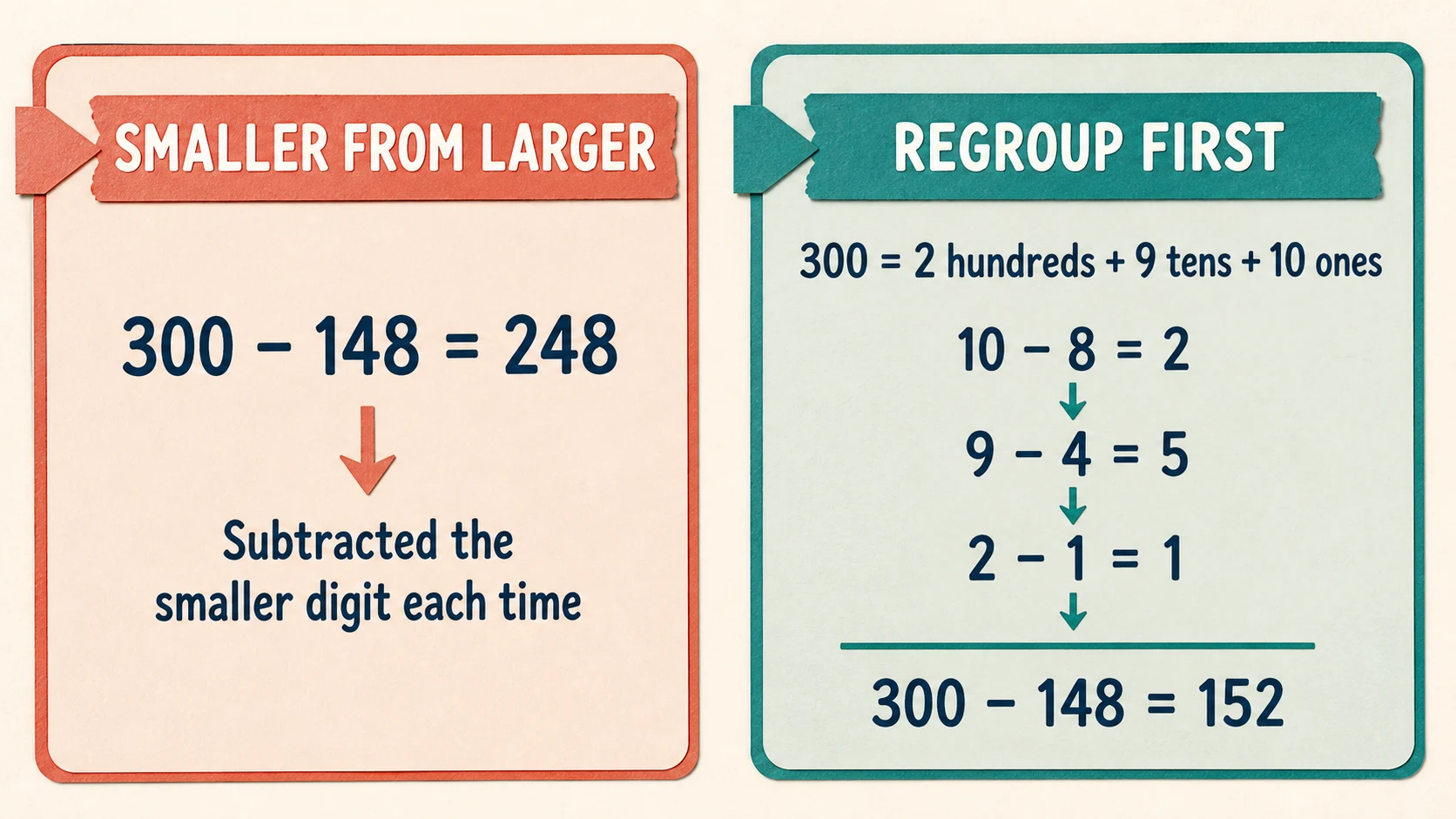
The work may show in the ones place and in the tens place. This suggests the learner is subtracting the smaller digit from the larger digit in each column rather than respecting the order of the numbers.
Return to the meaning of : begin with 43 and remove 25. Regroup:
Check:
The catalogue specifically identifies this smaller-from-larger error as a reason to make regrouping concrete.
Regrouping without reducing the neighboring place
A learner might change 3 ones into 13 ones but leave the original number of tens unchanged. This creates ten extra units. Ask the learner where the additional ten ones came from. Then show the equality:
The 13 ones are valid only because 60 decreased to 50.
Misaligned place values
If the learner subtracts a two-digit number from a three-digit number, check that the ones digits share a column. Misalignment can produce a procedural error even when the underlying facts are known. Ask the learner to label each digit’s value rather than merely saying “move it over.”
Treating a zero as if it can supply a trade
In a problem such as , the zero tens cannot directly give one ten to the ones place. The learner must regroup from the hundreds into tens and then from tens into ones. A place-value representation can show why the written changes occur.
Correct answer, unclear method
A correct answer should not automatically end the discussion if the written work is inconsistent. Ask for one short explanation or an addition check. Do this selectively; requiring a full explanation for all 25 problems may add unnecessary writing and obscure the worksheet’s main purpose.
Use Estimation and Addition as Checks
A check should be independent enough to catch the original mistake. Repeating the same subtraction in the same way may reproduce it.
For , addition provides a direct inverse check:
A rough estimate also tests reasonableness. Since 63 is close to 60 and 28 is close to 30, the difference should be near 30. An answer such as 85 would be inconsistent with both the operation and the estimate.
Boundary checks can be even quicker:
- When subtracting a positive whole number, the answer should be less than the starting whole number.
- Subtracting zero leaves the starting number unchanged: .
- Subtracting a number from itself gives zero: .
- Numbers close together have a small difference: .
These checks do not replace an exact calculation. They help the learner notice answers that deserve another look.
The Common Core State Standards for Mathematics provide broad grade-related context for place-value strategies, subtraction within 1,000, and later use of standard algorithms. Refer to local curriculum expectations when deciding which written method is expected. The standards site has not evaluated this WorksheetWise page, and the worksheet should not be described as comprehensive standards coverage on the basis of one practice set.
Check the Answer Key Responsibly
First, let the learner finish the assigned independent set. Then compare each response with the separate answer key included for this worksheet. Mark agreement clearly and neutrally. For a discrepancy, return to the original expression and the learner’s work before announcing that the key is correct.
A reliable checking routine is:
- Confirm that the problem was copied correctly.
- Compare the learner’s final answer with the corresponding key entry.
- Recalculate any disagreement independently.
- Ask the learner to identify the first step where the work diverged.
- Correct that step and complete the problem again.
- Verify the revised answer with addition or another suitable method.
Adults can make checking errors too, especially when moving between the worksheet and a separate answer sheet. Matching item numbers carefully matters. If a key entry appears questionable, calculate the expression independently rather than forcing the learner’s work to match it.
Record categories rather than only a total when that will guide the next lesson. A simple note might read: “facts secure; two digit-alignment errors; regrouping needed prompts.” Such a note is more actionable than “21 out of 25” alone. The score describes performance on this page under these conditions; it does not by itself establish mastery or diagnose a learning difficulty.
Decide What the Learner Should Do Next
The next step should follow the pattern in the work, not a fixed percentage rule.
Continue with similar practice
Choose another easy-level subtraction set when the learner generally understands the task but needs more independent consistency. Signs include isolated fact errors, one or two corrected regrouping mistakes, or accurate work that still requires occasional prompts.
The 3rd Grade Subtraction Worksheet Pack contains 18 worksheets and is listed at $4.79. It may be useful when an adult wants a larger supply of related practice. Its size does not mean every learner should complete every page.
Step back to representation and guided work
Return to place-value models when errors repeatedly show that the learner does not understand what is being traded. Use one or two calculations with blocks or expanded notation, connect each action to the written method, and then retry a small selection from the printable.
If basic facts consume most of the learner’s attention, practice a focused group of related addition and subtraction facts before returning to larger calculations. Keep the link explicit: , , and .
Increase challenge cautiously
Move to a more demanding worksheet only when the learner can complete representative items accurately, explain regrouping, and detect unreasonable answers with limited adult prompting. Finishing once is weaker evidence than succeeding again after a delay.
Use the broader subtraction guide to select the next part of the progression rather than assuming that a longer number, more regrouping, or faster completion is automatically appropriate.
Schedule Retrieval Instead of One-Time Completion
A completed page is most useful when some of its learning is revisited. Retrieval means solving again from memory or applying the same idea after a delay, not simply rereading corrected work.
Revisit a small, purposeful sample and adjust the spacing from observed performance.
A practical, adjustable schedule might be:
| Time | Short review |
|---|---|
| Later the same lesson | Rework one corrected item without copying |
| One or two days later | Solve two similar calculations, including one regrouping problem |
| About one week later | Revisit three mixed items or use a fresh worksheet sample |
| Later review | Include one subtraction item among other math practice |
This is an instructional suggestion, not a universal timetable. Shorten the interval if the learner cannot begin without substantial help. Lengthen it when the method remains accurate and explainable. If an earlier error returns, teach that specific step again rather than assigning a large amount of undifferentiated repetition.
Keep retrieval brief enough that it provides evidence without recreating the entire original session. A fresh calculation is usually more informative than memorizing an answer from the completed sheet.
Limits of This Worksheet
This printable supplies 25 easy-level subtraction exercises and an answer key. It can support practice with facts, mental math, number sense, and regrouping, but one page cannot establish the learner’s full understanding of subtraction.
It does not, by itself:
- Show how the learner interprets every removal, comparison, or missing-part situation
- Guarantee fluent or durable performance
- Replace direct teaching when place value or regrouping is misunderstood
- Demonstrate comprehensive alignment with every local curriculum
- Determine why a learner is struggling
- Provide a universal pace or timetable
Written exercises also reveal less about mathematical language and representation than a short conversation can. Ask the learner to explain a carefully chosen item, but avoid turning every calculation into an oral examination.
Use the result as one piece of evidence alongside guided work, later retrieval, and performance on related tasks. If difficulty persists across repeated, well-supported practice, document the exact error patterns and consult the learner’s teacher or another appropriate educational professional. This worksheet does not provide medical or diagnostic guidance.
A Practical Next Action
Download the free 3rd Grade Subtraction Worksheets – Standard Theme (Easy), choose one fact problem and one regrouping problem for your opening check, and teach only the support the learner’s work shows is needed. After the independent set, record one successful method and one error pattern, then schedule two or three fresh subtraction problems for retrieval within the next few days.
When that review is accurate and largely independent, use the 3rd Grade subtraction topic guide to choose the next worksheet. If you need a narrowly targeted follow-up rather than a fixed sequence, create fresh practice through the free worksheet generators.
Put it into practice
Use the guide with a real printable
Move from explanation to a short, observable practice task. Check the first item together, then adjust the next session from the learner's actual work.
See the 18-worksheet pack