Complete guide
How to teach and practise 3rd grade place value worksheets - standard theme (easy)
How to use this 25-item place value worksheet
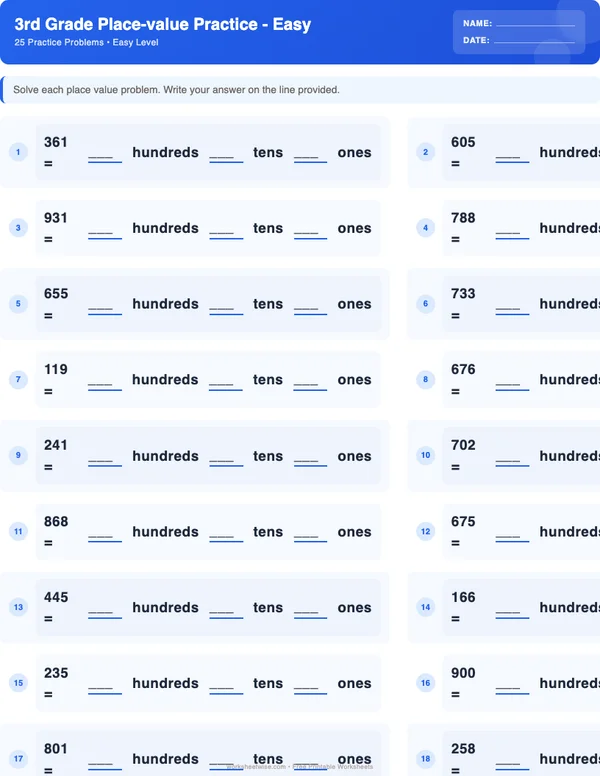
The free 3rd Grade Place Value worksheet gives a learner 25 easy-level exercises involving place value, expanded form, number comparison, and rounding. A productive lesson is usually:
- Preview the four task types.
- Model one example aloud.
- Solve two or three items together.
- Let the learner complete a manageable section independently.
- Review errors by reasoning through them before consulting the answer key.
- Return to a few related problems on later days.
The goal is not merely to finish all 25 items. Look for evidence that the learner understands what each digit represents, can decompose numbers by place, compares numbers from the greatest place first, and rounds to the requested unit. The learner’s observed work should determine the pace. One learner may complete the sheet in a sitting; another may benefit from dividing it across several short sessions.
Grade labels describe the intended practice level, not a guarantee that every local curriculum introduces the same material at the same time. Local sequences differ. If you need the broader progression—including composing and decomposing numbers, forms of numbers, comparison, and rounding—use the Place Value topic guide rather than expecting one worksheet to cover the whole topic.
A practical lesson map
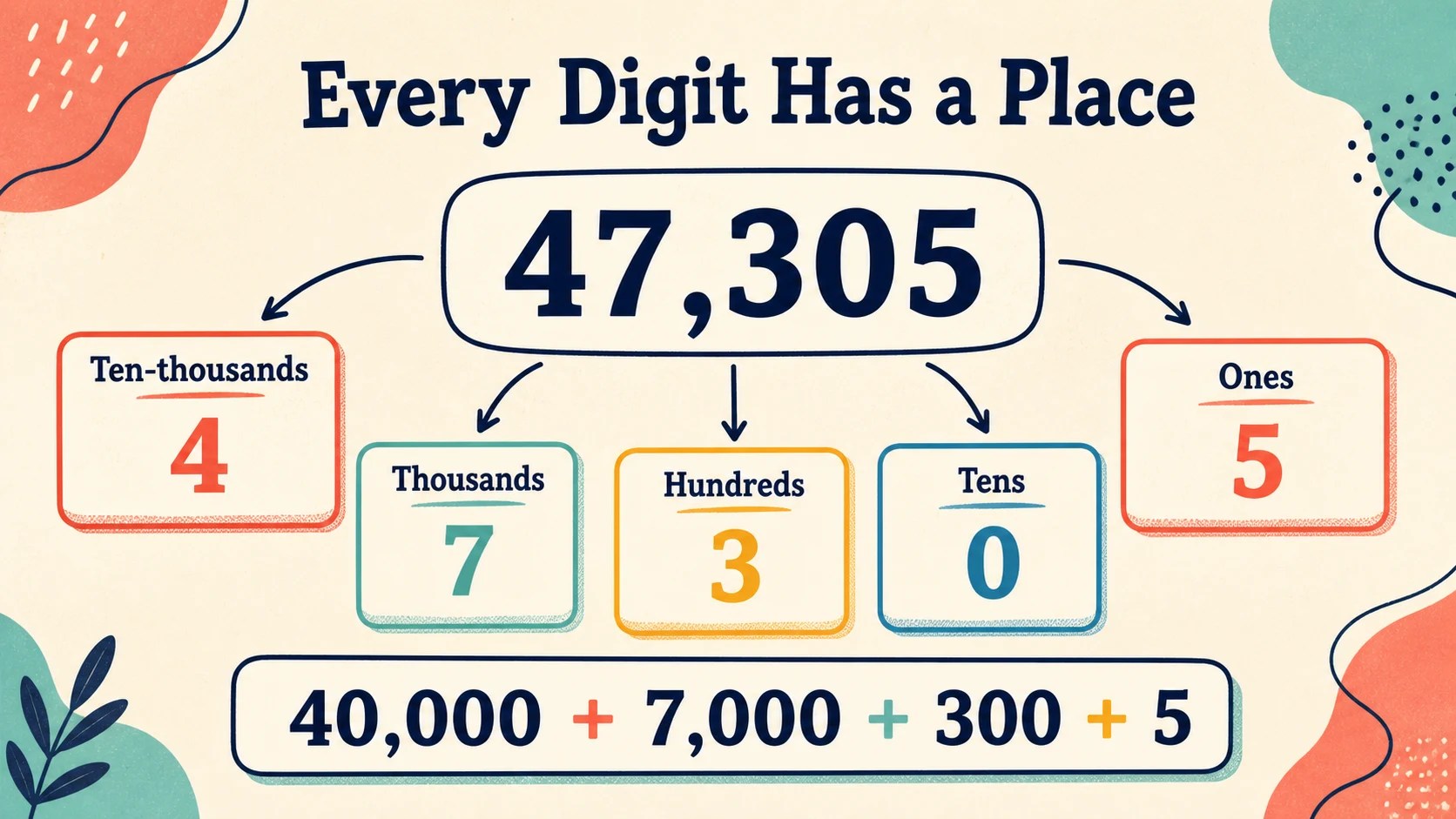
Preview, model, guide, release, check, and revisit instead of treating the page as a one-step assignment.
| Lesson phase | Adult action | Learner action | Evidence to notice |
|---|---|---|---|
| Preview | Identify the directions and task types | Explain what each prompt appears to ask | Recognizes expanded form, comparison, and rounding language |
| Launch | Review ones, tens, hundreds, and any larger places shown | Read a number and name its digits by place | Connects a digit’s position with its value |
| Model | Demonstrate one similar problem aloud | Follow and restate the reasoning | Explains why each step is valid |
| Guided practice | Complete two or three selected items together | Supply the next step or justify an answer | Uses place-value language rather than guessing |
| Independent practice | Assign a short run of items | Work without step-by-step prompting | Maintains accuracy across more than one task type |
| Review | Discuss selected answers and errors | Correct work with an explanation | Can locate and repair a specific misconception |
| Retrieval | Revisit a few problems after a delay | Solve without copying earlier work | Recalls the method after time has passed |
This sequence is an instructional suggestion, not a required timetable. The Institute of Education Sciences recommends using representations and mathematical language to help children connect informal ideas with formal mathematics. Its guidance also emphasizes monitoring what learners understand as instruction proceeds. Those broad principles support modeling and checking for understanding, but the guidance did not evaluate this WorksheetWise printable specifically. See IES, Teaching Math to Young Children.
Prepare the worksheet without over-teaching it
Print or open the worksheet and its separate answer key, but keep the key out of the learner’s immediate view. Read the printed instruction together: “Solve each place value problem. Write your answer on the line provided.” Then scan the page to identify where the task format changes.
Do not pre-solve every item for the learner. Your preview is meant to remove avoidable confusion about directions, not remove the mathematical decisions.
Establish a small set of place-value language
Before starting, ask the learner to read one number from the page and name the places represented. Use precise statements such as:
- “The digit is 6.”
- “It is in the hundreds place.”
- “Its value is 600.”
These are related but different answers. A learner who says that the value of the 6 in 6,241 is “hundreds” has named the place, not the value. A learner who says “6” has named the digit. The complete value is 6,000 because the digit occupies the thousands place.
A simple place-value chart can help:
| Thousands | Hundreds | Tens | Ones |
|---|---|---|---|
| 6 | 2 | 4 | 1 |
Read across the chart as “six thousands, two hundreds, four tens, and one one.” Then connect the parts to .
Choose only the supports the learner needs
Useful materials include a pencil, scrap paper, and a hand-drawn place-value chart. Base-ten blocks or place-value disks can be added if the learner does not yet connect written digits with quantities. When using objects, make the relationship explicit: ten ones can be exchanged for one ten, and ten tens can be exchanged for one hundred.
Do not require manipulatives when the learner already reasons accurately without them. A support should clarify the same skill, not become an extra task.
Decide on a starting amount
For a learner who is new to the format, begin with five to eight items and then pause. For a learner who starts confidently, allow a longer run before checking in. Stop sooner if errors show a consistent misunderstanding, such as reading comparison symbols backward or rounding to the wrong place.
Fatigue, handwriting speed, and attention can affect a completed page, so the number correct is not the only useful evidence. Notice whether the learner can explain an answer, maintain a method, and correct an error after a neutral prompt.
Launch with one clear model
Tell the learner what you will demonstrate: “I am going to show how I use each digit’s place to decide its value. Listen for the place names.”
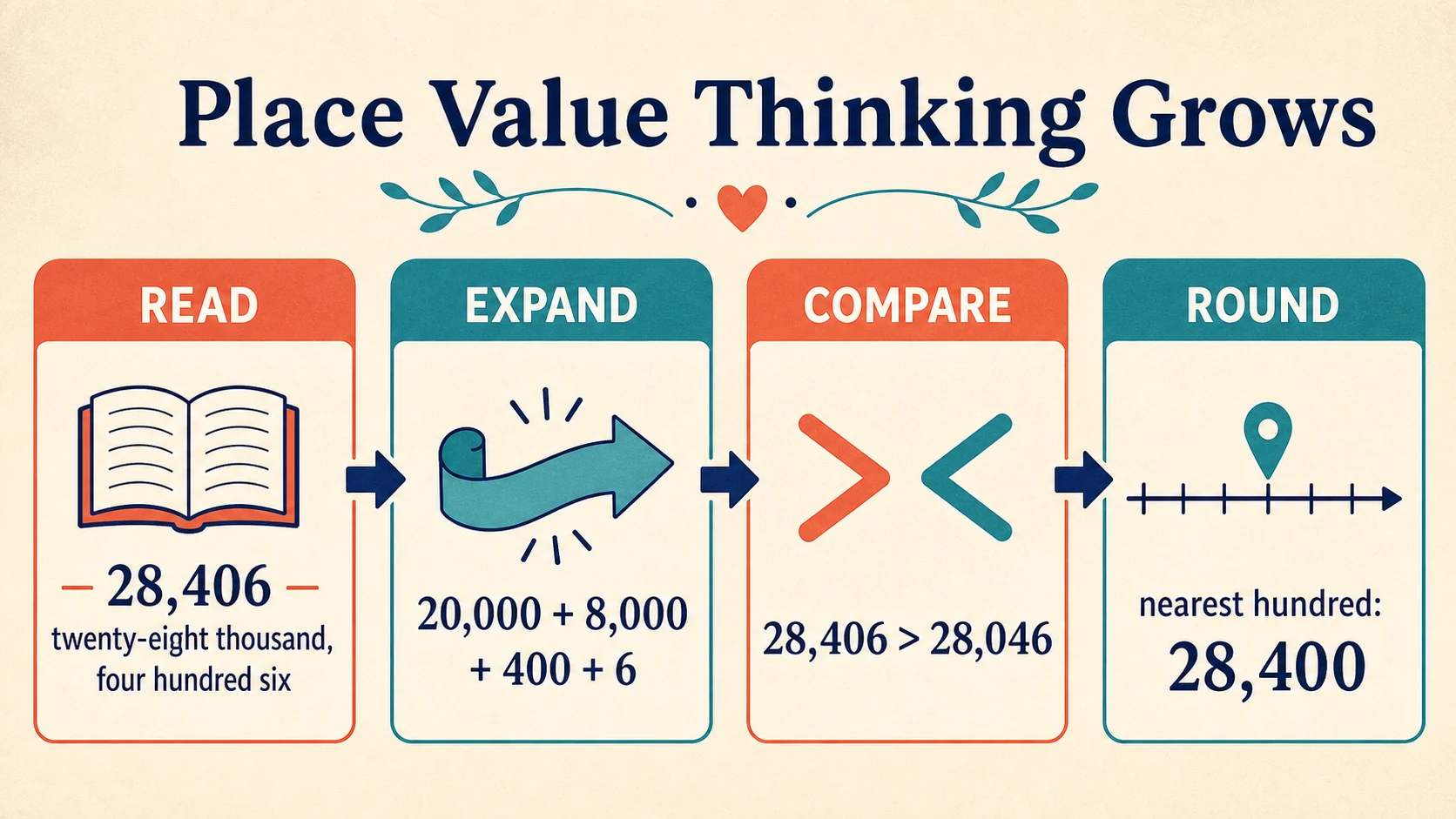
Model the mathematical decision, then ask the learner to supply the next decision on a similar item.
Use a made-up example that is similar to the worksheet rather than revealing one of its answers. Write 4,372 and say:
“I can read this as four thousand, three hundred seventy-two. The 3 is in the hundreds place, so its value is 300. I know this because three hundreds means .”
Then ask the learner to name the place and value of the 7. A complete response is: “The 7 is in the tens place, and its value is 70.”
Keep the model short. Ask the learner to restate the reasoning rather than repeat your exact words. A useful prompt is, “How did the position of the digit affect its value?”
Work through four checked examples
The following examples are not claims about the worksheet’s exact item wording. They are verified examples of the four catalogued skills and can be used for modeling on separate paper.
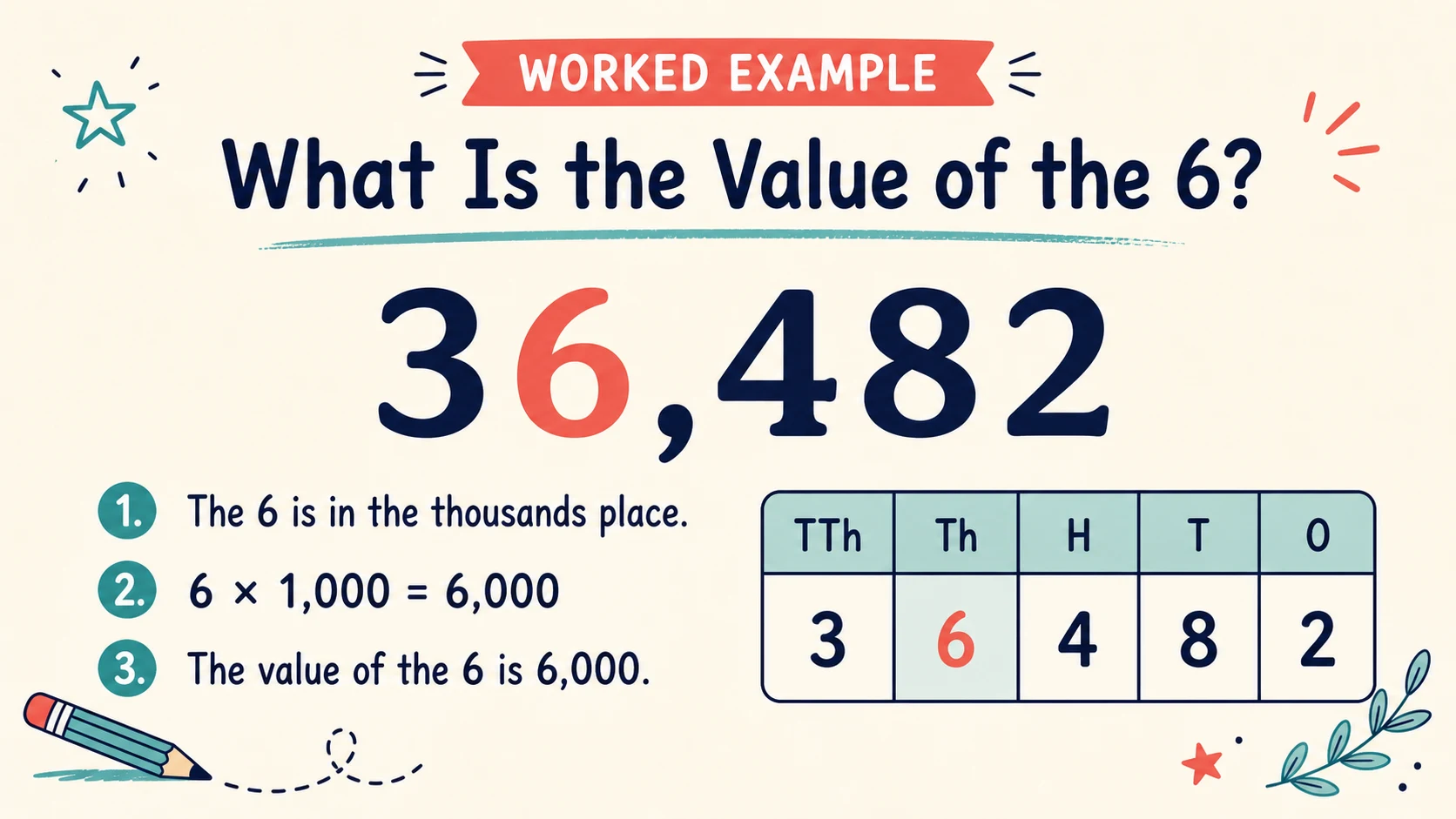
Keep the digit, its place, and its value distinct while showing each step.
Example 1: Identify a digit’s value
Problem: What is the value of the 5 in 3,582?
Write the number in a chart:
| Thousands | Hundreds | Tens | Ones |
|---|---|---|---|
| 3 | 5 | 8 | 2 |
The 5 is in the hundreds place, so it represents five hundreds:
Checked answer: 500
To verify, decompose the entire number:
The 500 appears as the contribution of the digit 5.
A common incomplete answer is “hundreds.” That correctly names the place but does not give the digit’s value. Ask, “How many hundreds, and what amount is that?”
Example 2: Write a number in expanded form
Problem: Write 7,406 in expanded form.
Consider every place, including the zero tens:
- 7 thousands contribute 7,000.
- 4 hundreds contribute 400.
- 0 tens contribute 0.
- 6 ones contribute 6.
Therefore:
Checked answer:
The zero term may be omitted because adding zero does not change the sum. Writing also displays the tens place explicitly. Follow the format expected by the worksheet when it is clear.
Check the result by recomposing:
The boundary issue here is the internal zero. Writing would produce 7,046, not 7,406. The digit 4 must remain in the hundreds place.
Example 3: Compare two numbers
Problem: Compare 4,298 and 4,315 using , , or .
Start at the greatest place:
- Thousands: 4 and 4 are equal.
- Hundreds: 2 and 3 are different.
- Since 2 hundreds is less than 3 hundreds, the comparison is already decided.
Checked answer:
There is no need to compare the tens and ones after finding the first different place. The 9 in 4,298 may look larger than the 1 in 4,315, but it is in a smaller place. Nine tens cannot overcome a difference of one hundred in these two numbers.
To check the symbol, read the complete statement aloud: “Four thousand two hundred ninety-eight is less than four thousand three hundred fifteen.”
Example 4: Round to a requested place
Problem: Round 463 to the nearest ten.
The two nearest multiples of ten are 460 and 470. The number 463 is 3 away from 460 and 7 away from 470, so it is closer to 460.
Checked answer: 460
A number line can make the decision visible:
For the boundary case 465, the conventional whole-number rounding rule sends the midpoint to 470. The digit in the ones place is 5, so the tens digit increases by one.
If the prompt instead asks for the nearest hundred, use hundred benchmarks. For example, 463 lies between 400 and 500 and is closer to 500, so:
Always identify the requested rounding place before deciding. A correct rounding method applied to the wrong place still produces the wrong answer.
Move from guided to independent practice
Select two or three worksheet items that represent different formats. Ask the learner to do the thinking while you provide only enough structure to keep the task moving.
Use prompts that reveal reasoning
Try prompts in this order:
- “What is the problem asking you to find?”
- “Which place matters first?”
- “Can you show the number in a place-value chart?”
- “What two benchmarks surround the number?”
- “How could you check that answer?”
These prompts preserve the mathematical work. In contrast, “Look at the 5, so round up” gives away the decision and may encourage a procedure without understanding.
During guided practice, listen for whether the learner uses place names accurately. If a comparison answer is correct but the explanation is “because it looks bigger,” ask for a place-by-place justification. If an expanded-form answer is wrong, ask the learner to recombine the written parts.
Release responsibility in small steps
After the learner completes two guided items accurately, assign a short group independently. State exactly what independence means: “Try these four without help. Circle any item where you are unsure, and we will discuss it afterward.”
When reviewing the group, distinguish between an isolated slip and a repeated pattern. One reversed comparison symbol may be a notation error. Reversing every symbol points to a misconception or an unstable symbol-reading habit.
If the learner cannot begin several items, return to a single modeled example. Continuing through all 25 with step-by-step adult directions would measure the adult’s prompting more than the learner’s current understanding.
Adapt support without changing the skill
Differentiation should change access, amount, representation, or prompting—not replace place-value reasoning with an easier but unrelated task.
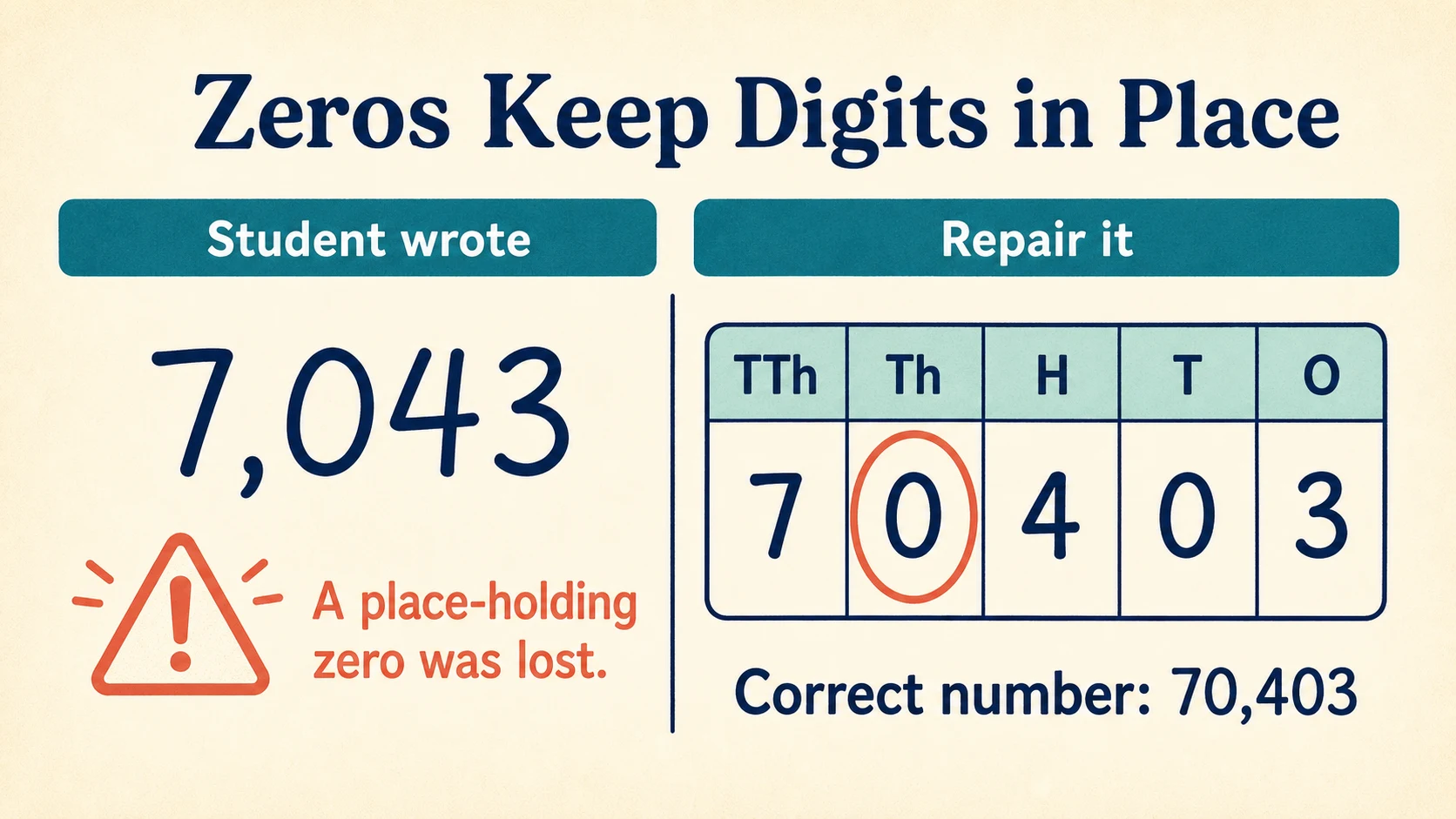
Adjust the representation, workload, or prompt while keeping the original place-value decision intact.
When the learner needs more concrete support
Draw a chart and have the learner place one digit in each column. If available, represent the number with base-ten materials or place-value disks. Ask the learner to connect each object or disk to the corresponding written term.
For 326, the representation should connect to:
Then return to the printed item. The support is successful only if it helps the learner make sense of the numeral, not if the adult manipulates everything while the learner watches.
The IES guide on assisting students who struggle with mathematics supports systematic instruction, clear mathematical language, representations, and deliberate review as broad instructional practices. It does not prescribe a diagnosis or a child-specific intervention from one worksheet. Persistent difficulty across settings may warrant discussion with the learner’s teacher or other qualified school personnel.
When writing is the main obstacle
Allow the learner to state an answer orally before writing it. The adult may say, “Tell me the expanded form first; then copy your own statement onto the line.” Scrap paper can provide more room than the printed answer line.
Do not silently correct digits or rewrite answers into neater form before evaluating them. If handwriting makes an answer ambiguous, ask the learner to read it. This keeps the mathematical interpretation tied to the learner’s intent.
When the full page is too much at once
Cover later sections with a blank sheet or fold the page so that only a few items are visible. Complete a short set, pause, and resume later. Preserve the original order within each visible set unless there is a clear reason to select a particular skill.
A shorter session is not a lesser lesson if it yields clearer evidence. Record where the learner stopped so the next session begins predictably.
When the learner is ready for more explanation
Ask for justification rather than simply adding larger numbers. For example:
- “Prove that your expanded form recomposes to the original number.”
- “Explain why the smaller digit can belong to the greater number.”
- “Name both rounding benchmarks before choosing one.”
- “Create another number that would round to the same ten.”
These prompts deepen the existing skill without pretending that this easy-level worksheet is an advanced or comprehensive assessment.
Interpret errors before correcting them
An error is most useful when it points to a specific part of the learner’s reasoning. Ask the learner to explain or reconstruct the work before supplying the right answer.
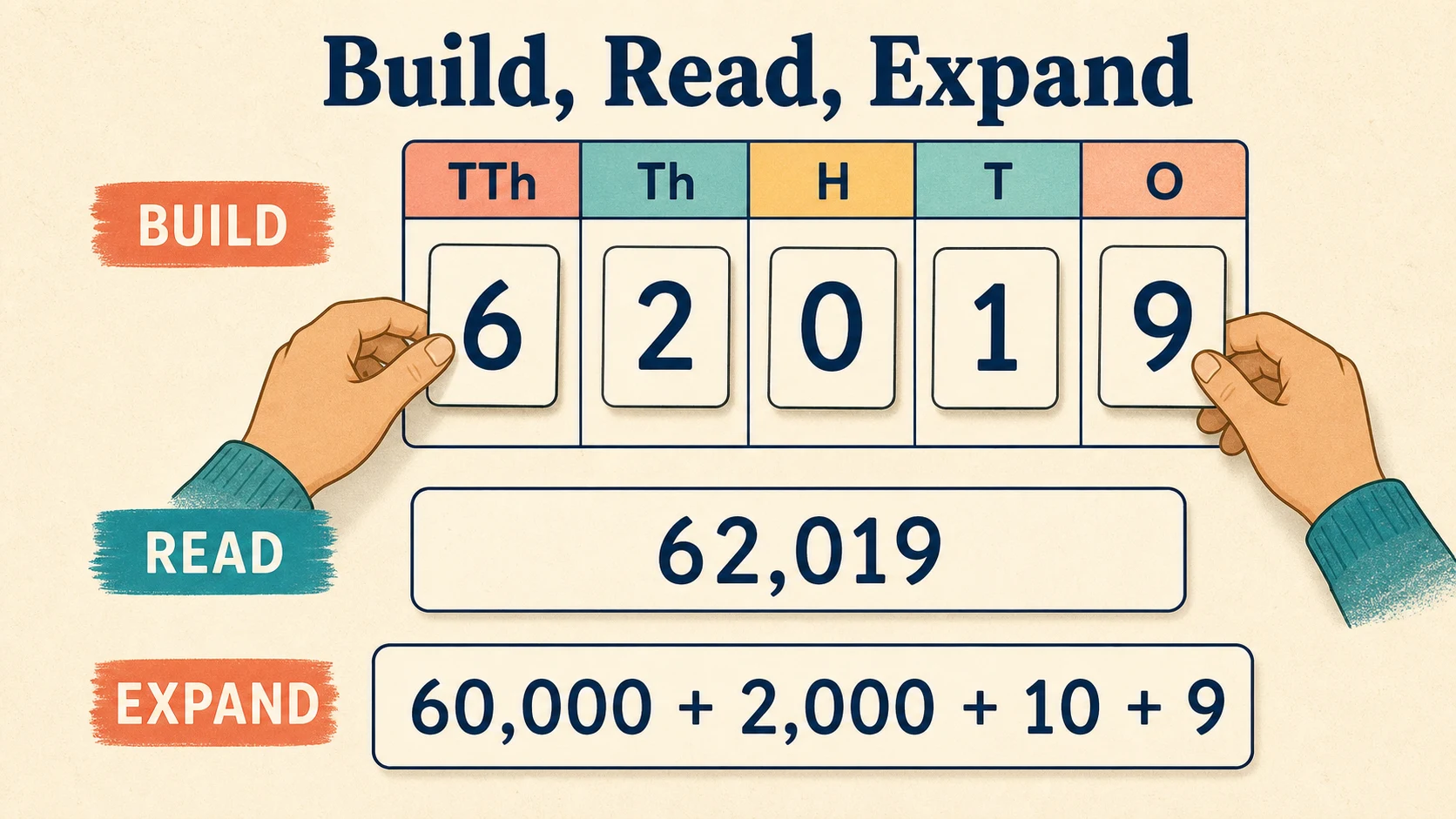
Name the task, locate the first incorrect decision, repair it, and verify the revised answer.
| Observed work | Possible interpretation | Useful check |
|---|---|---|
| Says the value of 8 in 8,241 is 8 | Confuses digit with value | Ask for the place, then calculate |
| Writes for 5,602 | Omits the hundreds contribution | Place every digit in a chart, including zero |
| Chooses 3,491 as greater than 3,509 | Compares later digits before the first differing place | Compare thousands, then hundreds, and stop when they differ |
| Uses the wrong comparison symbol with a correct verbal statement | Understands magnitude but not notation | Read the completed number sentence aloud |
| Rounds 347 to 300 when asked for the nearest ten | Attends to the wrong target place | Underline or name the requested place and identify its benchmarks |
| Rounds every number upward | Treats rounding as automatic increase | Compare distances to the lower and upper benchmarks |
| Produces different answers to identical task types | Method may not yet be stable | Ask the learner to use one stated checking routine |
These are possible interpretations, not diagnoses. Confirm them through a brief conversation or a similar fresh example.
Use a repair routine
For a missed item:
- Identify the task type.
- Ask the learner to explain the original choice.
- Find the first step where the reasoning changed course.
- Rework the item with a chart, decomposition, comparison sequence, or number line.
- Check the revised answer.
- Try one new, similar example without copying.
Avoid erasing all evidence immediately. The contrast between the first attempt and the repair helps the learner and adult see what changed.
Check the answer key responsibly
The printable includes a separate answer key for quick checking. Use it after the learner has attempted the assigned items, not as a substitute for solving them yourself.
First, compare each response carefully with its matching item number. For comparison problems, check both the numbers and the direction of the symbol. For expanded form, determine whether an equivalent expression is mathematically correct even if its formatting differs. For rounding, verify that the answer matches the place named in the prompt.
If the learner’s answer and key differ:
- Re-read the original prompt.
- Solve the item independently.
- Compare the methods, not just the final entries.
- Check for a copied digit, skipped place, or mismatched item number.
- Use the key as confirmation only after the mathematics has been reconsidered.
Marking an entire page with crosses and a total score gives limited instructional information. Group errors by skill instead: place value, expanded form, comparison, or rounding. A learner who misses three rounding items needs a different next step from one who makes three unrelated copying slips.
The Common Core State Standards for Mathematics provide broad grade-level context for place-value work, including third-grade rounding within the base-ten domain. That source can help an adult understand the surrounding instructional context, but it should not be used to claim comprehensive standards alignment for this single printable. Local curricula may organize or assess the content differently.
Decide what to do after the page
Use the completed work to select the next action rather than relying only on a percentage.
- Mostly accurate with clear explanations: Revisit a few items after a delay, then move to varied place-value practice.
- Accurate only with prompts: Repeat a small set using fewer prompts before increasing difficulty.
- One skill is unstable: Give focused practice on that skill while briefly retrieving the others.
- Several skills show place-position confusion: Return to a place-value chart and concrete composition or decomposition before assigning another full page.
- Errors appear to come from directions or notation: Practice interpreting the task format separately, then try fresh items.
- Work deteriorates late on the page: Divide future practice into shorter sessions and compare early and late accuracy.
The worksheet is useful practice, but it is not a diagnostic evaluation, a complete place-value curriculum, or evidence of mastery by itself. It samples four listed skills in 25 easy-level exercises. It cannot show whether understanding transfers to every number range, representation, word problem, or later computation task.
For related material and a wider view of third-grade learning, browse the 3rd Grade Math worksheet collection. The 3rd Grade hub also provides access to other subjects without implying that every learner should follow one universal sequence.
Schedule brief retrieval instead of immediate repetition only
Do not rely exclusively on correcting the sheet once and putting it away. Ask the learner to retrieve the reasoning again after time has passed.
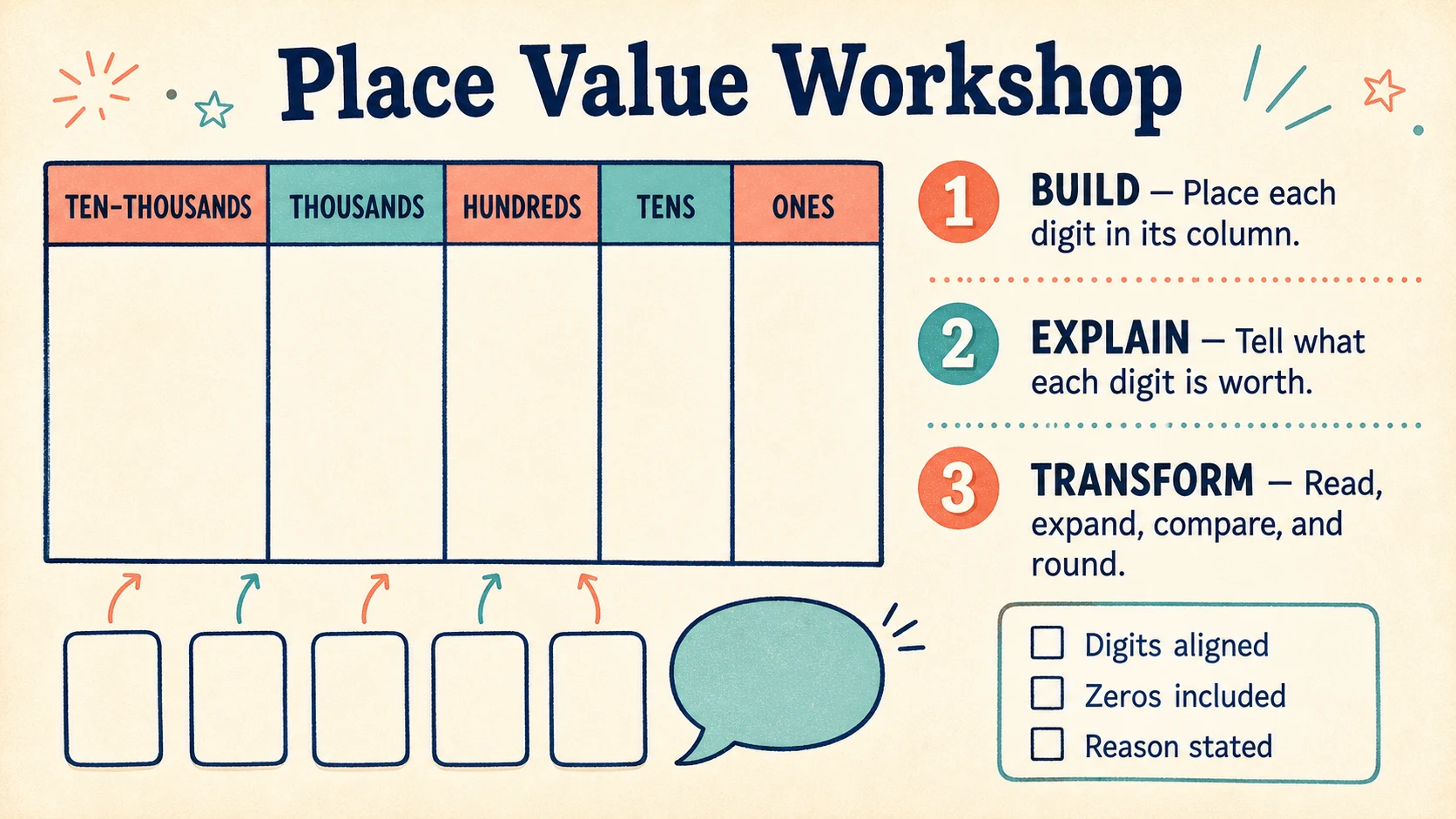
Revisit a small, mixed selection after delays and adjust the schedule from the learner’s responses.
A practical, adjustable schedule is:
| Time | Suggested activity | What to observe |
|---|---|---|
| Same session | Correct one or two instructive errors | Can the learner explain the repair? |
| Next study session | Solve two fresh examples from weaker skills | Is the method recalled without copying? |
| Several days later | Mix place value, expanded form, comparison, and rounding | Can the learner identify the task type independently? |
| One or two weeks later | Use a short mixed review | Has the reasoning remained available after a longer delay? |
This is a practical plan, not a universal timetable. Shorten or extend the intervals according to observed work, the local teaching sequence, and how readily the learner retrieves the method. If a skill is not retained, return to explanation and representation rather than scheduling more unsupported repetition.
For the next step, review the broader Place Value topic guide and choose practice that matches the learner’s specific error pattern. If this page is secure and a larger coordinated set would be useful, the 3rd Grade Place Value Worksheet Pack contains 18 worksheets. For fresh practice without reusing memorized answers, create a suitable set through the free worksheet generators.
Put it into practice
Use the guide with a real printable
Move from explanation to a short, observable practice task. Check the first item together, then adjust the next session from the learner's actual work.
See the 18-worksheet pack