Complete guide
How to teach and practise 3rd grade multiplication worksheets - standard theme (easy)
A practical way to use this 25-item worksheet
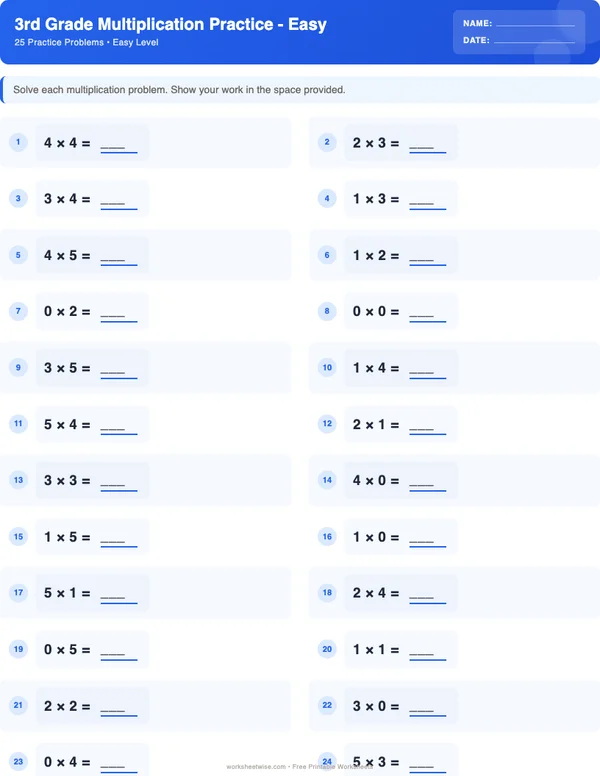
The 3rd Grade Multiplication Worksheets - Standard Theme (Easy) printable provides 25 straightforward multiplication exercises. Use it to observe whether a learner can solve foundational facts accurately, explain at least some products through equal groups or arrays, and work with growing independence.
A productive session can follow this sequence:
- Briefly review what multiplication means.
- Model two or three problems.
- Solve several items together.
- Let the learner complete a manageable section independently.
- Discuss errors before consulting the answer key.
- Choose the next activity from the learner’s actual work.
Do not require all 25 items in one sitting if attention or accuracy deteriorates. The worksheet is a practice tool, not a race or a complete multiplication assessment. Grade labels describe the intended practice level; local curricula and instructional sequences differ.
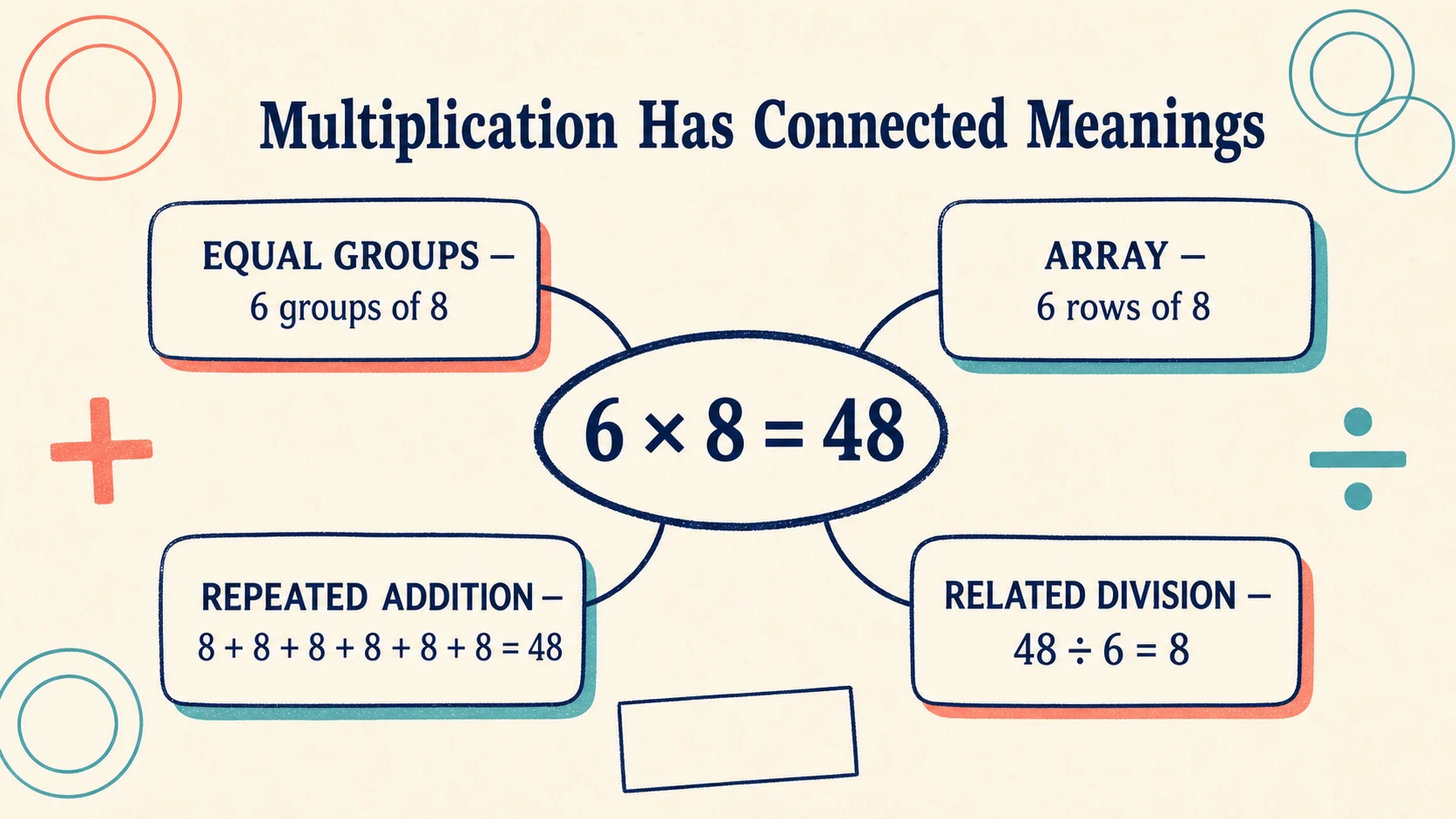
Move from a short meaning review to modeling, guided practice, independent work, correction, and later retrieval.
| Lesson phase | Suggested use | What the adult watches for |
|---|---|---|
| Launch | Review equal groups and the multiplication sign | Does the learner understand what a product represents? |
| Model | Demonstrate two or three similar examples | Can the learner follow the representation and written equation? |
| Guided practice | Solve a small set together | Which facts require support, and which are already secure? |
| Independent practice | Assign an appropriate portion of the 25 items | Accuracy, strategy choice, pacing, and persistence |
| Error review | Rework selected errors without immediately giving answers | Whether the learner can locate and repair a mistake |
| Retrieval | Revisit a few facts on later days | Whether learning can be recalled after a delay |
Prepare the printable and set a clear purpose
Open the free 3rd Grade multiplication worksheet and print both the student page and its separate answer key. Keep the key out of view during initial practice. The printed directions are simple: solve each multiplication problem and show work in the space provided.
Before beginning, decide what you want to learn from the session. A useful purpose might be:
- finding out which foundational facts the learner can recall;
- checking whether the learner can use equal groups when recall is uncertain;
- building careful written habits;
- providing reinforcement after multiplication has already been introduced.
This worksheet practices multiplication facts, times tables, mental math, and number sense. It is described as easy-level work for learners beginning multiplication or needing reinforcement. That makes it suitable for supported practice, but the label does not tell you exactly how any individual learner will respond.
Gather only the supports you may need
A pencil and the worksheet may be enough. For a learner who still needs a concrete model, prepare small counters such as buttons, cubes, coins, or dry beans. Grid paper can support arrays. A blank sheet can provide extra space for drawings or repeated addition.
Keep these materials available without requiring them for every problem. The goal is to preserve the multiplication skill while allowing the learner to represent an unfamiliar fact. If a learner knows immediately, asking for twenty counters every time adds work without revealing more understanding. If the learner guesses at , counters may expose the meaning that recall alone did not.
Preview without turning the page into a test
Say what the learner will do and how help will work. For example:
“These are multiplication problems. We will review a few together. Then you will try a section on your own. If you are unsure, you may draw equal groups or an array.”
This is an instructional suggestion, not a sourced universal script. Change the wording to fit the learner, but keep the expectation concrete. Avoid announcing that the page should be “easy.” Difficulty is better judged from observed work than from a catalogue label.
Model multiplication before assigning independent work
Multiplication should refer to a quantity, not just a string of symbols. Begin with an example that is similar in form to the printable but is not presented as one of its exact items.
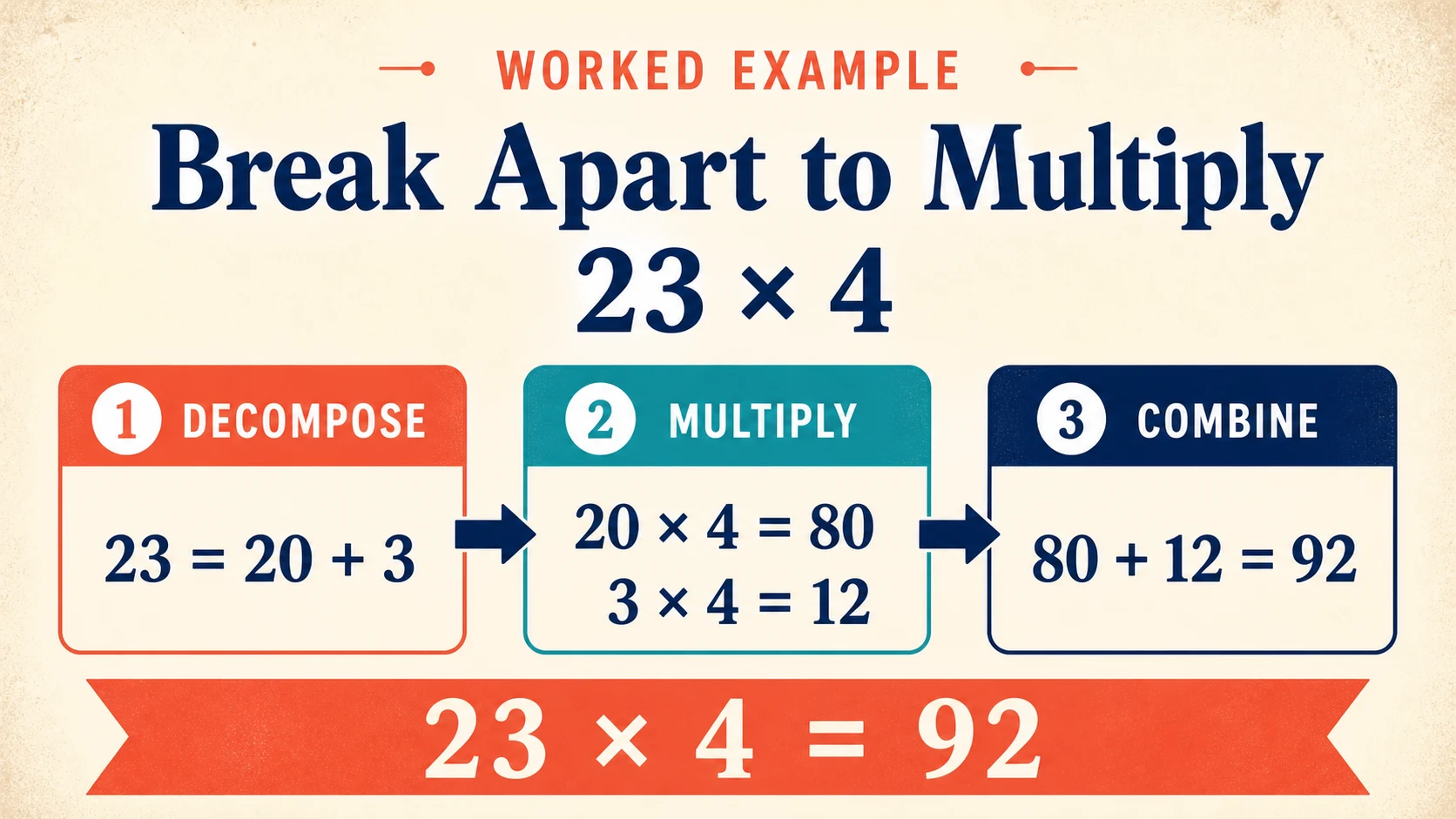
Connect the written equation to equal groups, an array, or a known fact before relying on recall.
Worked example 1: equal groups
Solve:
Interpret this as three equal groups with four objects in each group:
Therefore:
Check the result by counting the three groups: 4, 8, 12. The multiplication equation and repeated-addition representation agree.
When modeling, say what each factor means in your chosen representation: “I have 3 groups. Each group contains 4.” Consistent language helps the learner distinguish the number of groups from the amount in each group.
Worked example 2: an array
Solve:
Draw four rows with five marks in each row:
Each row contains 5, so the total is:
Thus:
A second check is skip-counting by fives four times: 5, 10, 15, 20.
Worked example 3: reverse the factors
Solve:
A learner may already know:
Reversing the factors does not change the product:
The arrays look different when described as six rows of three and three rows of six, but both contain 18 objects. This is a useful strategy when one orientation of a fact is easier to recall.
Do not treat reversal as permission to ignore meaning. Ask the learner to explain why the total stays the same, perhaps by imagining the array turned sideways.
Worked example 4: build from a known fact
Solve:
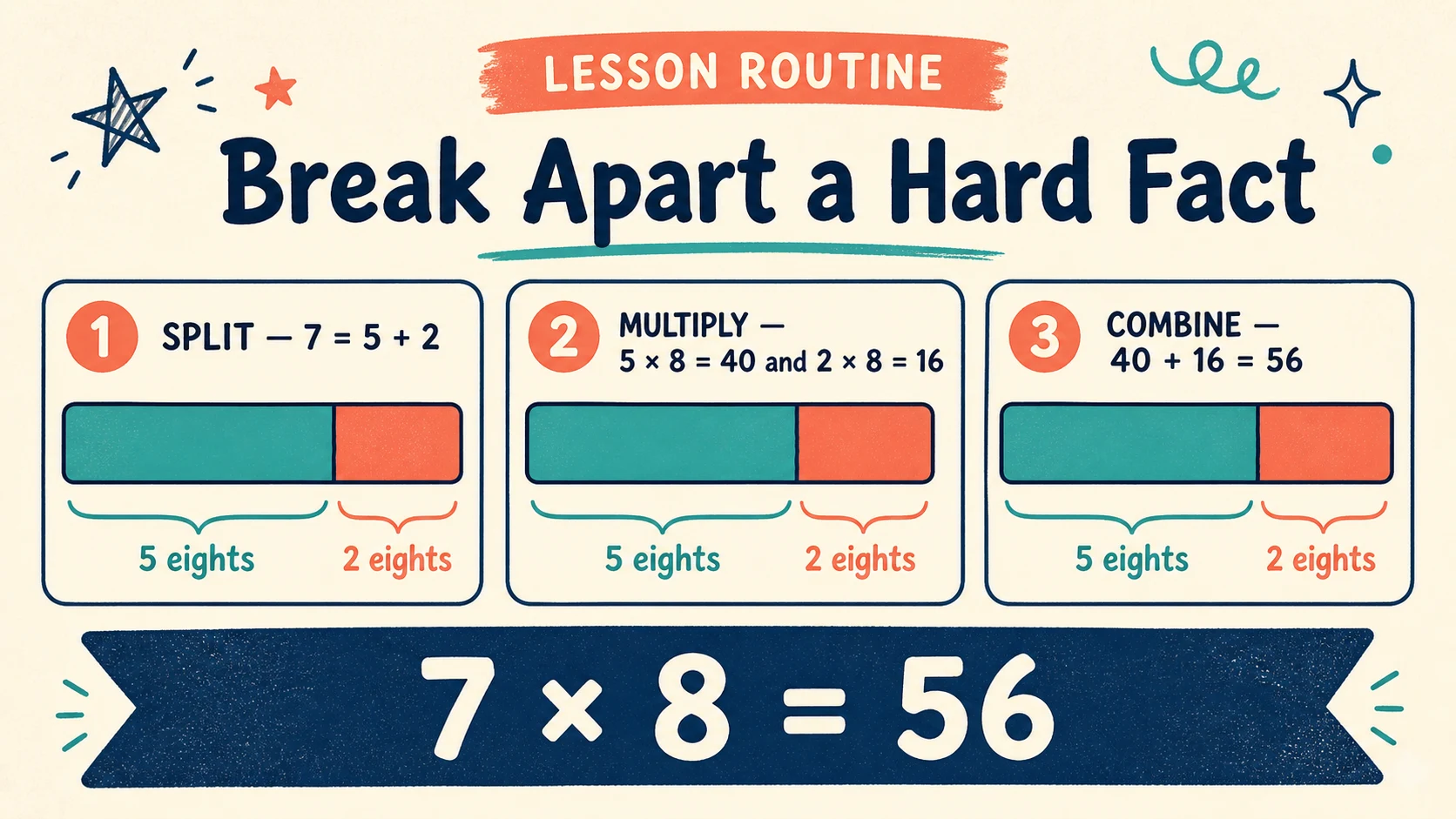
If is known, split 6 into 5 and 1:
Calculate each part:
Therefore:
Check with repeated addition:
This example shows a strategy rather than demanding immediate recall. The supplied multiplication topic guidance recommends building harder facts from familiar facts, including through the distributive property.
Worked example 5: multiplication by one
Solve:
One group containing eight objects has a total of eight:
The factor 1 does not make the other factor larger. A learner who answers 9 may be treating the multiplication sign as addition.
Worked example 6: multiplication by zero
Solve:
Five groups with zero objects in each group contain no objects:
So:
This boundary case can reveal whether the learner is reasoning about groups or following an incorrect rule such as “write the other number.”
Move through guided practice deliberately
Guided practice should require the learner to think while giving the adult enough information to identify the next useful prompt.
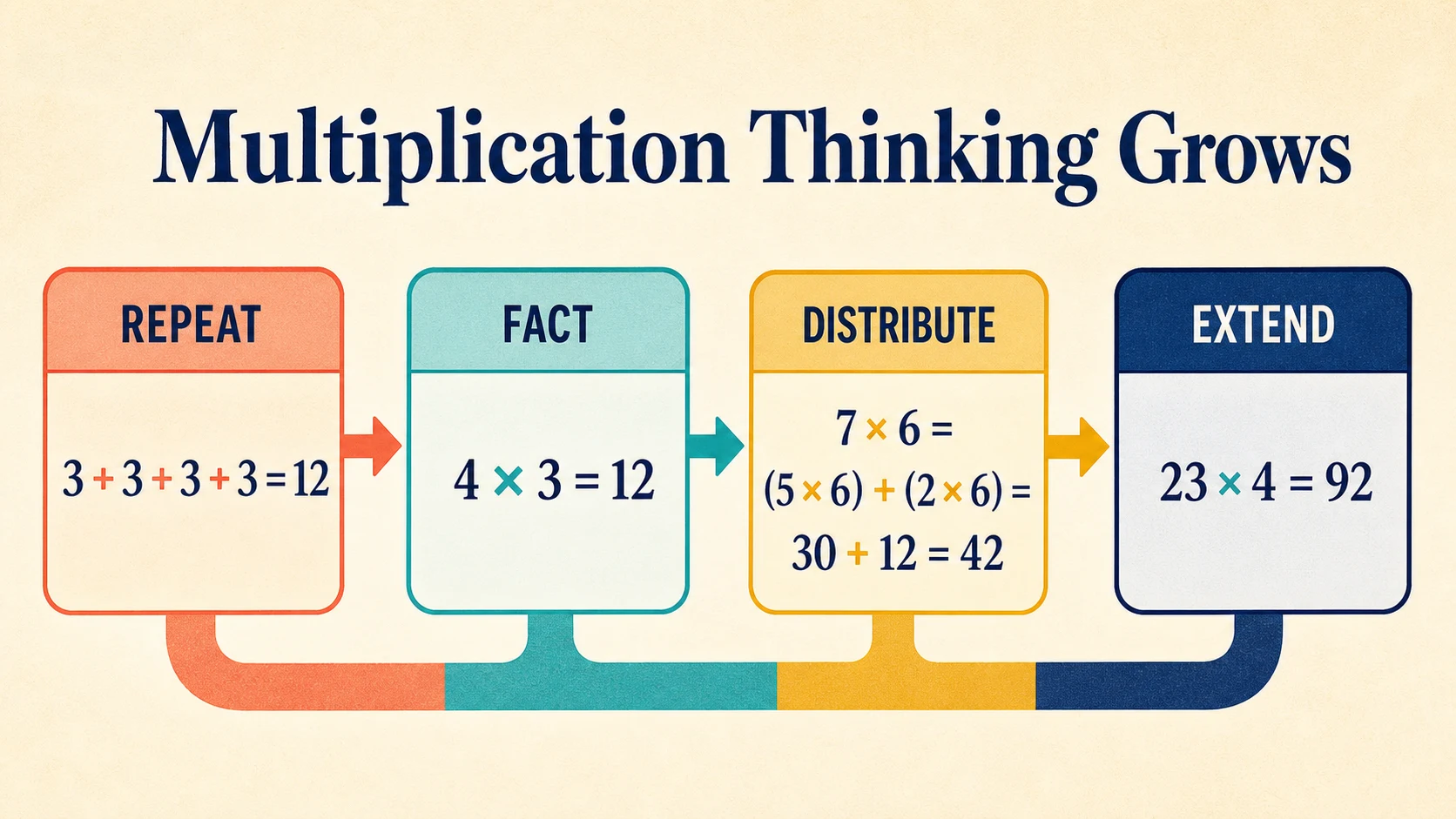
Reduce adult support gradually: model a problem, solve one together, and then watch the learner attempt one.
Use an “I do, we do, you do” sequence
First, demonstrate a similar problem while explaining the representation. Next, invite the learner to solve another problem with you. Finally, ask the learner to try one without step-by-step prompting.
During the shared problem, use prompts such as:
- “How many equal groups could this equation represent?”
- “How many objects belong in each group?”
- “Is there a fact you already know that could help?”
- “Could turning the array help you recognize the product?”
- “How will you check that total?”
These prompts preserve the mathematical decision. By contrast, “Count by four seven times” selects the strategy for the learner. That may be appropriate during direct modeling, but repeated use can conceal whether the learner can choose a method independently.
Watch the first few responses closely
The first three to five attempts can guide the rest of the session. Notice whether the learner:
- reads the multiplication symbol correctly;
- copies both factors accurately;
- recalls the product or selects a reasonable strategy;
- records one answer for each problem;
- checks a surprising result;
- becomes less accurate when working quickly.
If the learner solves the opening problems accurately and can explain at least one answer, begin independent work. If the learner guesses, changes multiplication into addition, or cannot represent a basic fact, remain in guided practice longer.
The IES guide on teaching math to young children provides broad instructional framing around purposeful mathematics teaching, progress monitoring, and helping learners build mathematical understanding. It did not evaluate this WorksheetWise printable, so use its recommendations as general context rather than an endorsement of this specific page.
Run independent practice without making endurance the goal
Independent practice means that the learner chooses and carries out a strategy without continuous adult direction. It does not have to mean completing all 25 exercises at once.
Choose a workable chunk
Possible formats include:
- five problems followed by a brief check-in;
- one row or visible section at a time;
- half the page now and the remainder later;
- the full page when accuracy and attention remain stable.
These are practical options, not a universal timetable. Let observed work determine the chunk. If the first eight answers are accurate and the learner remains attentive, continuing may be reasonable. If errors begin after ten correct responses, fatigue or rushed work may be affecting performance. That pattern differs from misunderstanding every example of one fact family.
During independent work, avoid confirming each answer immediately. Frequent confirmation can make the learner wait for approval instead of checking the mathematics. A neutral response such as “Show how you decided” provides information without revealing whether the answer is correct.
Preserve evidence of the learner’s thinking
The direction to show work does not require the same representation for every item. Appropriate evidence might include:
- a small equal-groups drawing;
- an array;
- repeated addition;
- a split fact such as ;
- a corrected equation after checking.
Mental recall is also part of the worksheet’s stated skill set. A learner who recalls a fact correctly need not manufacture a long calculation. Ask for an explanation on a few selected items so that recall and understanding can both be observed.
Adapt support while keeping multiplication intact
An adaptation should make the same multiplication task more accessible. It should not quietly replace the skill with unrelated work or supply every product.
Adjust representation, amount, or prompting while preserving the multiplication problems.
When the learner needs more representation
Allow counters, array drawings, or repeated addition. Cover most of the page so that only one problem is visible. Read the directions aloud if reading the instruction is interfering with the math. Offer extra blank space when the printed area is not sufficient for a model.
For , the learner might build four groups of three and count 12. The problem remains ; only the route to the product has changed.
Avoid replacing the page with answer copying or filling in a multiplication chart without discussing how products are found. Such activities may reduce immediate difficulty but provide little evidence that the learner can solve the original task.
When recall is uneven
Sort errors by fact pattern rather than reviewing the entire table indiscriminately. A learner may know facts involving 2, 5, and 10 but struggle with 6 or 7. Practice the uncertain set through known facts.
For example:
Check by reversing the factors:
This keeps attention on relationships among facts. Skip-counting can serve as a bridge, but the broader 3rd Grade multiplication topic guide is the better place to review the complete progression from equal groups and arrays through fact strategies. This worksheet guide intentionally does not duplicate that full sequence.
When the page is already secure
Do not increase difficulty merely by adding time pressure. Instead, ask the learner to explain two answers, show a second strategy, or identify a related division fact.
For example, from:
the learner might state:
and, if division has already been introduced locally:
This extension should follow secure multiplication work. It is not necessary for completing the printable.
Interpret errors before assigning more practice
A wrong product is evidence to examine, not a diagnosis. Look at the equation, any written work, the learner’s explanation, and where the error occurs on the page.
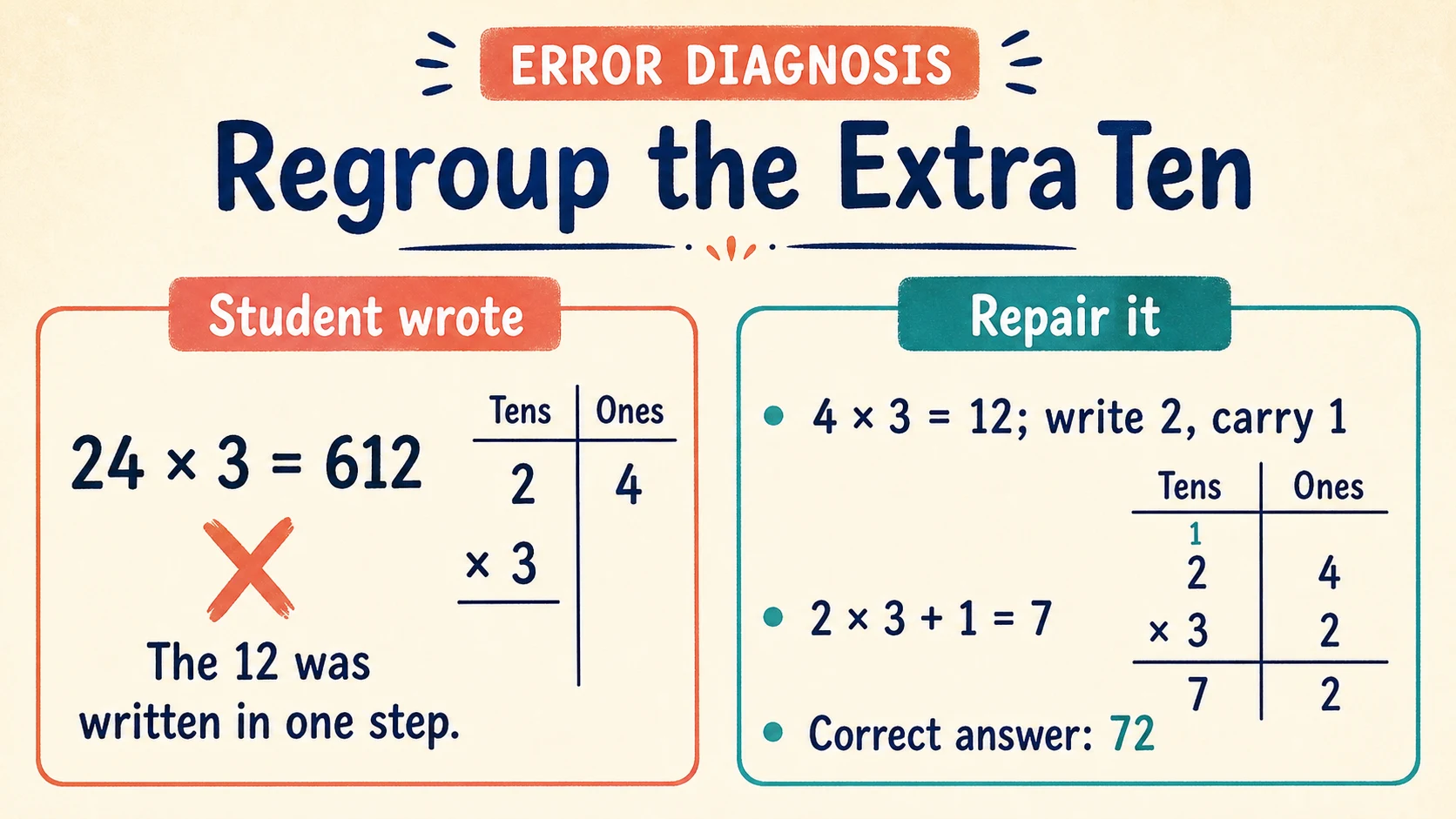
Read the factors, name the strategy, recompute, and compare the corrected result with the original answer.
Distinguish common error types
| Observed work | Possible interpretation | Useful response |
|---|---|---|
| The learner may have added the factors | Build three groups of four and compare 7 with the actual total | |
| Zero groups or zero in each group may be misunderstood | Model five empty groups | |
| with written below | Counting or addition error | Recalculate the written representation before reteaching the multiplication meaning |
| with no work | The fact may be confused with a nearby product | Rebuild from , then add 7 |
| Correct early answers followed by scattered late errors | Attention, pacing, or fatigue may be affecting work | Pause and revisit a shorter set later |
| Reversed factors with a correct product | The learner may be using the commutative property | Ask for an explanation; do not mark correct reasoning as an error |
| Correct model but incorrect copied answer | Recording may be the problem | Compare the counted total with the numeral written on the answer line |
These interpretations are possibilities, not conclusions about the learner. Ask for an explanation before deciding what support is needed.
The IES guide for assisting students struggling with mathematics offers high-level guidance on systematic instruction, mathematical language, representations, and monitoring progress. It does not establish what caused a particular learner’s mistake and does not evaluate this worksheet.
Use a short correction routine
For each selected error:
- Read the original equation aloud.
- Explain what the factors represent.
- Choose a strategy or representation.
- Recompute the product.
- Compare the new result with the first answer.
- State what changed.
Do not require the learner to redo all 25 problems because of two mistakes. Correct representative errors first. If several mistakes share one pattern, give one fresh similar problem to see whether the correction transfers.
Check the answer key responsibly
The separate printable answer key is useful for efficient checking, but it should confirm computation rather than replace mathematical discussion.
Check in two passes
In the first pass, mark items as correct, incorrect, or worth discussing. Do not write the correct product beside every error immediately.
In the second pass, ask the learner to revisit selected problems without seeing the key. Encourage a different check: draw an array, use a known fact, reverse the factors, or repeat the addition carefully. Then compare the repaired answer with the key.
If the learner’s answer and the key differ, independently recompute the problem before assuming either is correct. Adults can misread factors, and learners can copy a problem incorrectly. Verify the printed equation, calculate it, and only then use the key as confirmation.
Record patterns rather than relying only on a total score. “Three errors involving facts with 7” is more useful for planning than “22 out of 25.” A score can summarize performance on this page, but it cannot by itself show conceptual understanding, lasting recall, or readiness for every later multiplication task.
Decide what to do next from the evidence
Use the learner’s strategy, accuracy, independence, and error pattern together.
| What the work shows | Reasonable next step |
|---|---|
| Accurate answers with clear explanations and independent checking | Revisit a small sample after a delay, then move to varied multiplication practice |
| Accurate answers only when counters or arrays are available | Continue linking models to equations while gradually reducing support |
| Mostly accurate work with one weak fact family | Practice that family through known facts and mixed retrieval |
| Addition used instead of multiplication | Return to equal groups and arrays before assigning another full fact sheet |
| Many counting errors despite correct representations | Use shorter quantities and deliberate counting checks |
| Accuracy falls mainly near the end | Shorten the practice set and compare performance across sessions |
| Fast recall but little explanation | Ask for models or relationships on a few selected facts |
| Persistent difficulty across representations and repeated instruction | Document the work and coordinate with the learner’s teacher or instructional team |
The last step is an educational coordination suggestion, not medical guidance or a child-specific conclusion.
The Common Core mathematics standards describe broad Grade 3 expectations that include interpreting products as equal groups, using multiplication in problem solving, applying operation properties, and developing fluency within 100. Local standards and teaching orders may differ. The presence of related catalogue standards does not establish comprehensive alignment for every item on this single worksheet.
Schedule retrieval after the first session
A correct answer immediately after modeling does not show what the learner will recall later. Bring back a small selection after a delay, mixing previously difficult facts with secure ones.
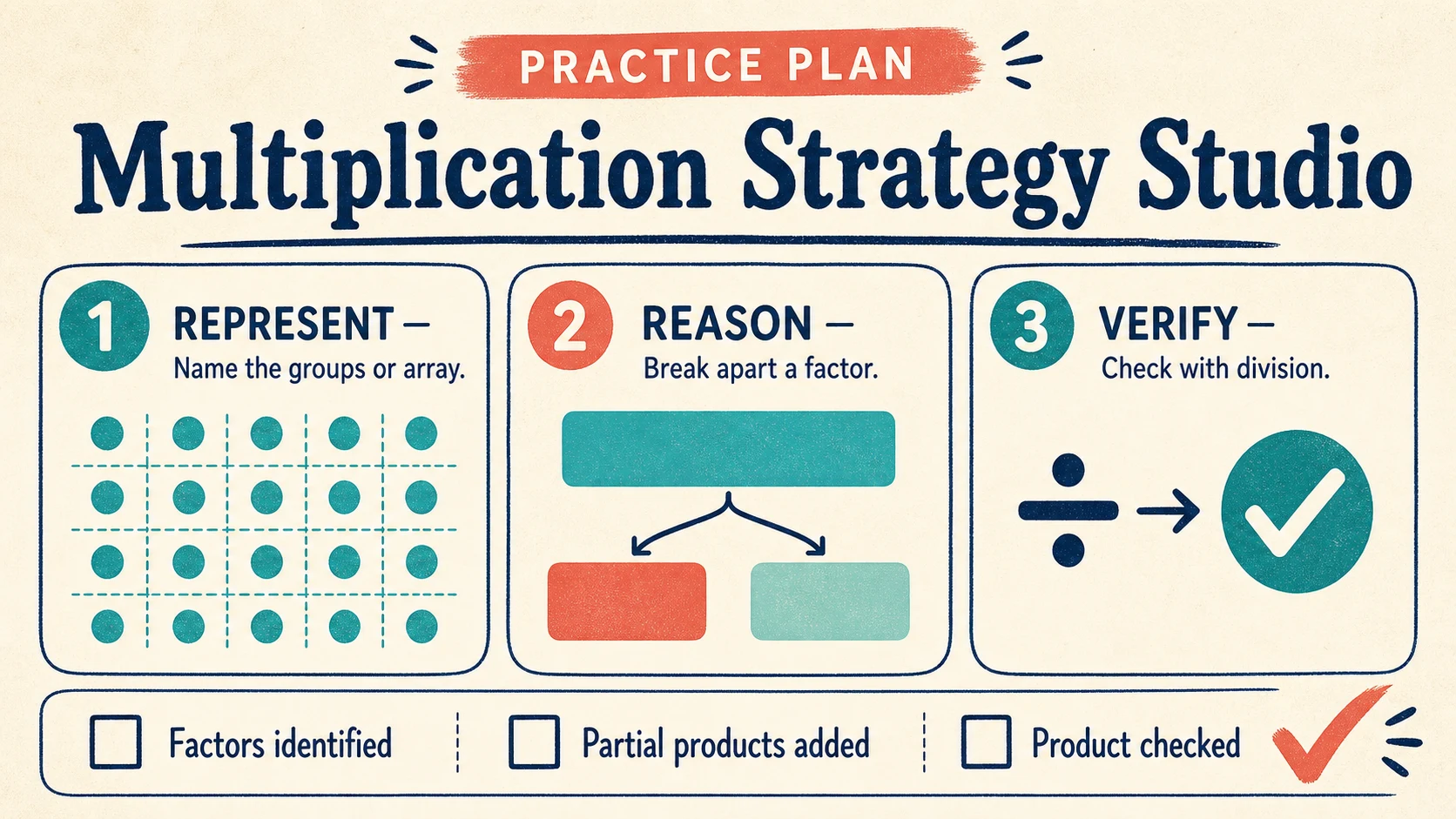
Use brief, delayed reviews and adjust the spacing according to what the learner remembers.
Here is one practical schedule:
| Time | Activity | Decision point |
|---|---|---|
| Initial session | Complete an appropriate portion of the worksheet | Identify secure facts, strategy-dependent facts, and errors |
| Next practice day | Revisit three to five selected facts without displaying prior answers | If recall fails, restore a model or known-fact strategy |
| Several days later | Mix a few reviewed facts with other multiplication facts | Check whether the learner selects strategies independently |
| About one or two weeks later | Give a short mixed review | Continue, widen the spacing, or return to focused support |
This schedule is an instructional example, not a universal requirement. A learner who forgets quickly may need a shorter interval. A learner who retrieves accurately may benefit from a longer interval and more varied problems. Keep reviews brief enough that they reveal recall rather than endurance.
Recognize what this worksheet can and cannot show
This printable offers 25 easy-level multiplication exercises in a standard theme. It can provide useful evidence about foundational fact practice, mental calculation, written accuracy, and selected strategies.
It cannot, by itself, establish complete mastery of multiplication. It does not fully assess whether a learner can interpret every product in context, solve varied word problems, connect multiplication and division, retain facts over long intervals, or apply multiplication in unfamiliar situations. One successful page may reflect genuine learning, recent rehearsal, strong visual recognition, or a combination of these.
Likewise, one difficult session does not justify a broad judgment about mathematical ability. The learner may need a representation, a shorter set, more experience with a particular fact family, or simply another opportunity when attention is stronger.
For wider planning, use the 3rd Grade math collection and the multiplication topic guide to place this printable among models, fact strategies, fluency practice, and later applications. Families or educators wanting a larger coordinated set can also review the 18-worksheet 3rd Grade Multiplication Worksheet Pack, listed at $4.79. That is an optional resource, not a necessary next purchase.
Take the next useful action
Print the free worksheet and answer key, model one equal-groups example, and begin with a five-problem sample. Use the learner’s work to decide whether to continue independently, add an array or known-fact strategy, or pause for concept review.
After correcting one representative error, choose three facts for delayed retrieval. Then use the broader multiplication topic guide to select the next free practice activity that matches the observed need rather than automatically assigning a harder page.
Put it into practice
Use the guide with a real printable
Move from explanation to a short, observable practice task. Check the first item together, then adjust the next session from the learner's actual work.
See the 18-worksheet pack