Complete guide
How to teach and practise 3rd grade money worksheets - standard theme (easy)
How to use this 25-item money worksheet
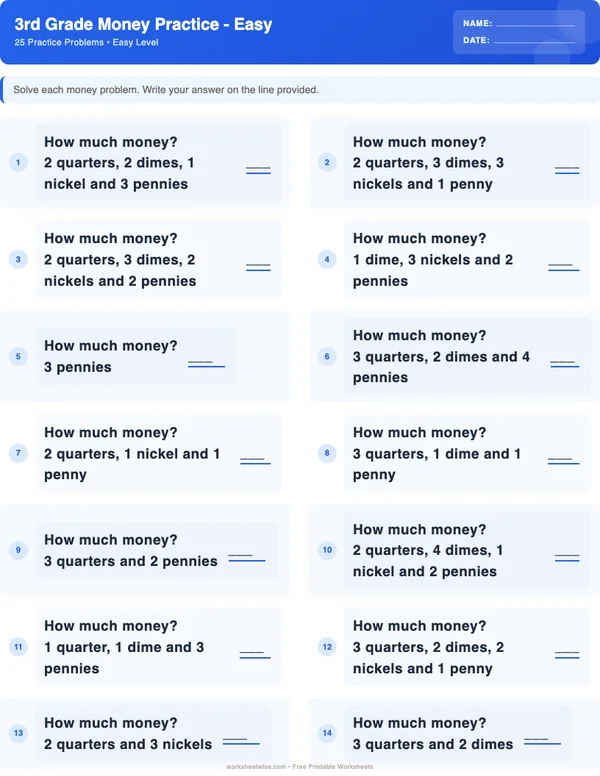
Use the free 3rd Grade Money worksheet as a short cycle of modeling, guided practice, independent work, correction, and later retrieval—not simply as a page to complete. The printable contains 25 easy-level exercises covering coin values, counting money, adding money amounts, making change, and money operations. Its directions are: “Solve each money problem. Write your answer on the line provided.” A separate printable answer key is included.
The concise plan is:
- Preview the page and identify the types of money problems it contains.
- Model one similar problem without asking the learner to guess.
- Complete two or three items together.
- Assign a manageable independent set.
- Check the reasoning as well as the written answers.
- Revisit errors with coins, drawings, or cent notation.
- Schedule a few unused or corrected items for later review.
Do not assume that all 25 items must be completed in one sitting. The learner’s observed work should determine the pace. Accurate but slow work, uncertain coin identification, repeated notation errors, and efficient independent solving call for different responses.
Grade labels describe the intended practice level; local curricula and instructional sequences differ. Money may be introduced, reviewed, or applied at different points in different schools. Consult the broader 3rd Grade Money topic guide when you need a wider progression instead of trying to make this single worksheet cover every stage of money instruction.
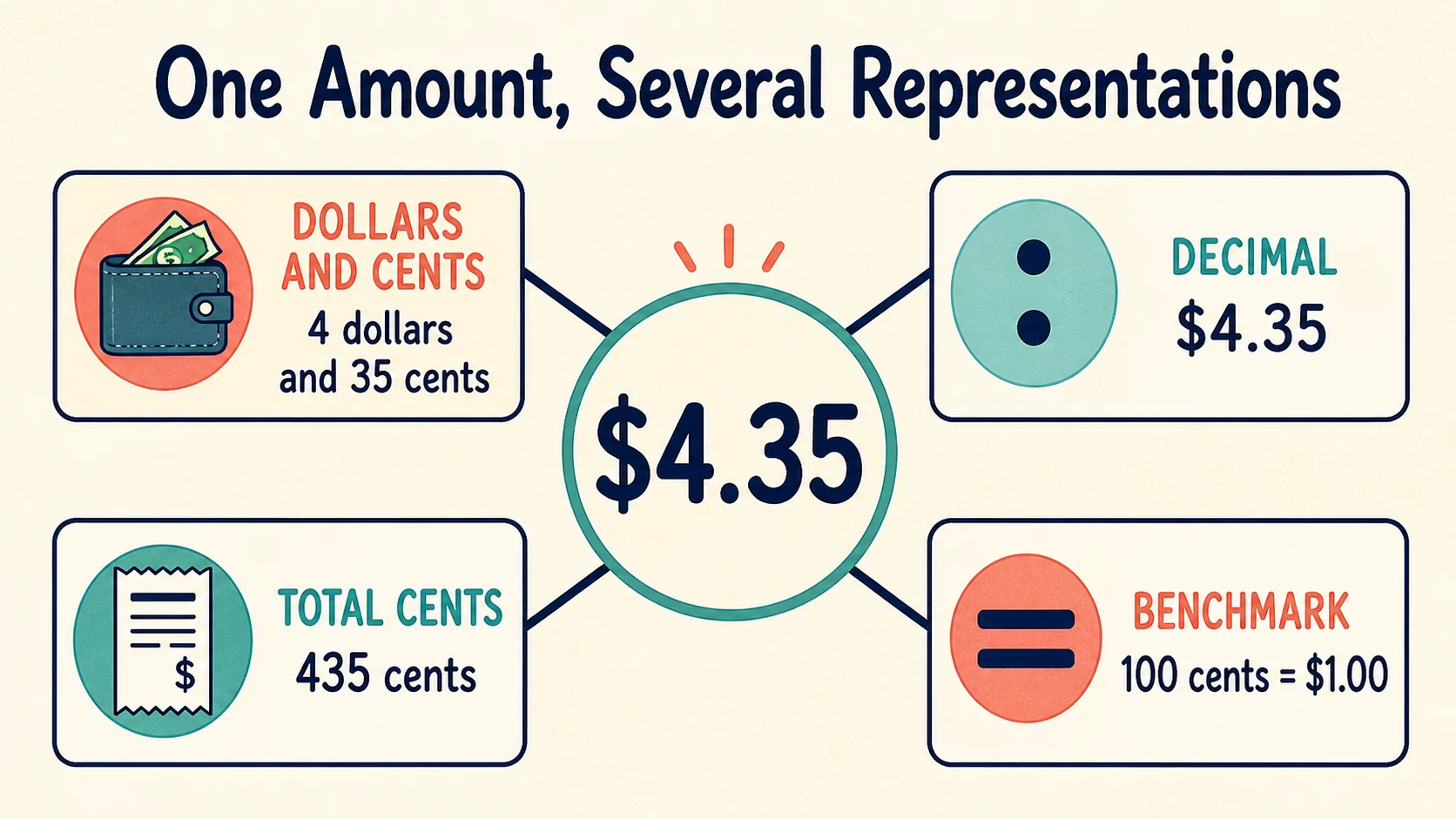
Preview, model, practice together, release responsibility, check, and revisit.
Understand the exact practice goal
This worksheet is designed for foundational practice. Its catalogue identifies four skill areas:
- recognizing and using coin values;
- counting collections of money;
- adding money amounts;
- making change and completing related money operations.
“Easy” does not mean effortless for every learner. It describes the worksheet’s intended difficulty within the catalogue. A learner who can add whole numbers may still confuse a nickel with a dime, write 1.4 for $1.04, or subtract money correctly but attach the wrong symbol. Those errors reveal different instructional needs.
The worksheet is also not a complete money curriculum. The catalogue does not specify how many of the 25 items address each skill or the exact order in which those skills appear. Preview the printable before teaching. Mark the first example of each problem type so that you do not accidentally assign an unfamiliar format during independent practice.
Name the skill before choosing the method
For each item, decide what the learner is being asked to do:
- Identify: State a coin’s name or value.
- Count: Combine the values in a collection.
- Add: Find the total of two or more money amounts.
- Find change: Determine the difference between a price and the amount paid.
- Interpret: Decide which operation a short purchase situation requires.
This classification keeps support focused. If the difficulty is identifying a quarter, extra subtraction practice will not solve it. If the learner recognizes every coin but loses track while counting a mixed collection, teach an orderly counting routine.
Prepare a small, useful workspace
Have the worksheet, pencil, answer key, and scrap paper ready. Real coins or realistic play coins are useful when available. If they are not available, draw circles and label them 25¢, 10¢, 5¢, and 1¢. A small place-value sketch with columns for dollars and cents can support addition.
Keep the answer key out of the learner’s view during initial work. It is a checking tool, not a substitute for deciding what each problem means.
Follow a flexible lesson progression
The following plan is an instructional suggestion for this printable. It is not a universal timetable. Shorten, divide, or repeat stages according to the learner’s work.
| Stage | Suggested use | Adult’s role | Evidence to notice |
|---|---|---|---|
| Preview | 2–3 minutes | Identify item formats and needed materials | Which skills and representations appear? |
| Launch | 3–5 minutes | Review coin values and money notation | Can the learner name values without guessing? |
| Model | 5–8 minutes | Solve one similar example aloud | Does the learner follow why each step is used? |
| Guided practice | 2–4 items | Prompt, observe, and reduce help gradually | Which prompts are still necessary? |
| Independent practice | 5–10 items at first | Observe without steering every step | Is the method accurate and sustainable? |
| Check and correct | 5–10 minutes | Compare answers and investigate discrepancies | Is an error conceptual, procedural, or notational? |
| Retrieval | Later sessions | Reuse a few items or create close variants | Does the skill remain available after a delay? |
A learner who quickly demonstrates accurate, explained work may continue through more of the page. A learner who makes repeated errors should pause after a small set. Completing 25 incorrectly rehearsed procedures is less useful than correcting one underlying misunderstanding.
The IES guide on teaching mathematics to young children addresses younger grades than this worksheet, so it should not be treated as a direct evaluation of third-grade money practice. Its high-level recommendations nevertheless illustrate two relevant principles: instruction can follow a developmental progression, and ongoing observation can help adults build from what a learner already knows.
Model a repeatable money routine
Model with an example similar to the worksheet rather than solving one of the learner’s assigned items. Write every step. Use exact language: coin name, coin value, cents, dollars, total, price, amount paid, and change.
The IES elementary mathematics intervention guide recommends systematic instruction, clear mathematical language, and well-chosen concrete or visual representations for learners who need additional support. Those are high-level instructional recommendations; the guide did not evaluate this WorksheetWise printable.
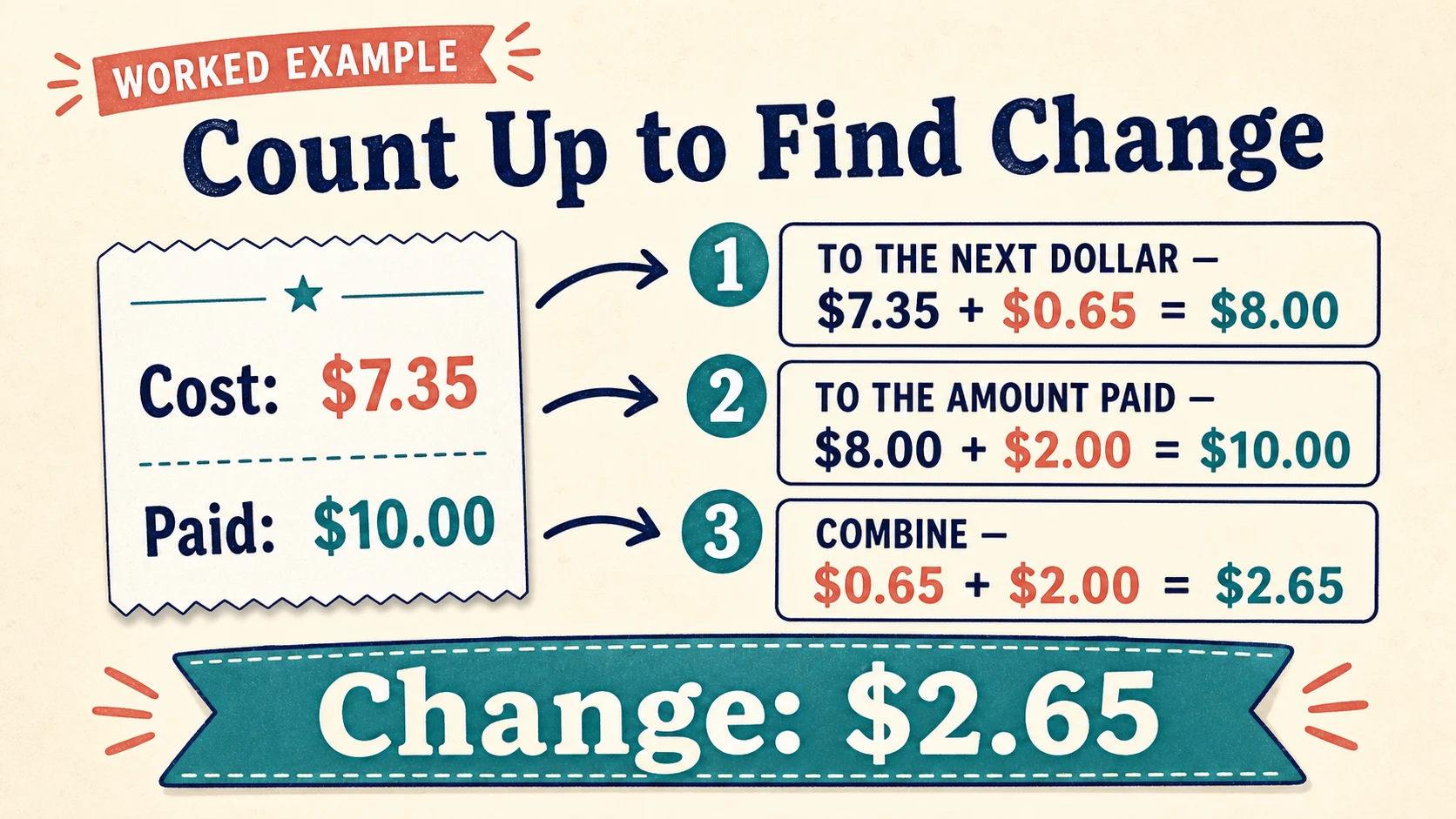
Show the value of each part, the operation, and the correctly labeled result.
Worked example 1: count a mixed coin collection
Suppose a collection has 3 quarters, 2 dimes, 1 nickel, and 4 pennies.
Start with the greatest-value coins:
- 3 quarters:
3 × 25¢ = 75¢ - 2 dimes:
2 × 10¢ = 20¢ - 1 nickel:
1 × 5¢ = 5¢ - 4 pennies:
4 × 1¢ = 4¢
Now combine the values:
75¢ + 20¢ + 5¢ + 4¢ = 104¢
Because 100¢ = $1.00, then:
104¢ = $1.04
Checked answer: $1.04.
A useful spoken count is: “25, 50, 75; 85, 95; 100; 101, 102, 103, 104 cents.” Starting with the greatest-value coin reduces unnecessary counting. The multiplication notation is optional; its purpose here is to make the groups visible.
Worked example 2: add two money amounts
Find the total of $2.35 and $1.47.
Align dollars with dollars and cents with cents:
  $2.35
+ $1.47
-------
  $3.82
Check in cents:
$2.35 = 235¢$1.47 = 147¢235 + 147 = 382382¢ = $3.82
Checked answer: $3.82.
The decimal points must align because the digits represent different units. In $2.35, the 2 represents dollars, the 3 represents tens of cents, and the 5 represents single cents.
Worked example 3: find change by counting up
An item costs $3.67, and the customer pays $5.00.
Count from the price to the amount paid:
$3.67 + $0.03 = $3.70$3.70 + $0.05 = $3.75$3.75 + $0.25 = $4.00$4.00 + $1.00 = $5.00
Add the increases:
$0.03 + $0.05 + $0.25 + $1.00 = $1.33
Check by addition:
$3.67 + $1.33 = $5.00
Checked answer: $1.33 change.
Counting up is an instructional option that makes the distance between the price and payment visible. Direct subtraction also works:
$5.00 − $3.67 = $1.33
Worked example 4: compare two equivalent amounts
Compare 85¢ with 3 quarters and 1 dime.
Find the coin collection’s value:
- 3 quarters:
3 × 25¢ = 75¢ - 1 dime:
10¢ - Total:
75¢ + 10¢ = 85¢
Therefore:
85¢ = 85¢
Checked answer: the amounts are equal.
This example separates appearance from value. Four coins can equal an amount written with two digits and a cent symbol.
Worked example 5: cross the dollar boundary
Add $0.86 + $0.27.
Add the cents:
86¢ + 27¢ = 113¢
Regroup:
113¢ = 100¢ + 13¢ = $1.13
Check with column addition:
  $0.86
+ $0.27
-------
  $1.13
Checked answer: $1.13.
This boundary case matters because the answer cannot remain $0.113 or 113¢ written as $113. The units determine the notation.
Run guided practice before independent work
Choose two to four worksheet items that represent the formats the learner will later solve alone. On the first item, ask the learner to explain what is being found. On the next, ask for the first step only. By the last guided item, wait quietly and see whether the routine begins without prompting.
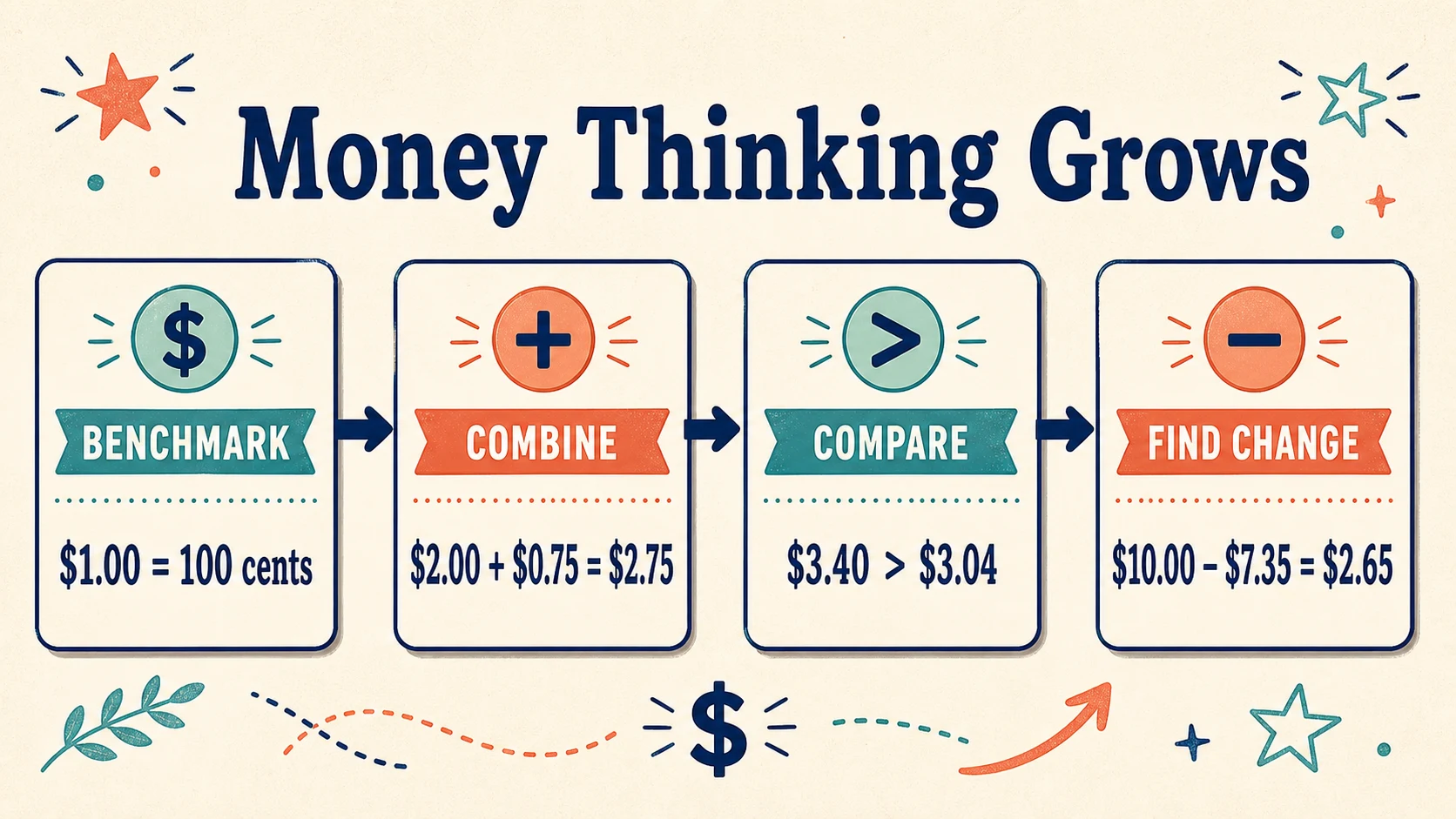
Move from explicit demonstration to brief prompts, then to an independent attempt.
Use prompts that expose reasoning
Helpful prompts include:
- “What is the value of each coin?”
- “Which coin has the greatest value?”
- “Are you working in cents, dollars, or both?”
- “What total do you have before adding the pennies?”
- “Which amount is the price, and which amount was paid?”
- “How could you check that change?”
- “What does the
0in$2.05tell us?”
Avoid prompts that disclose the answer, such as “Shouldn’t that be 75 cents?” A better prompt is, “Show how you counted the three quarters.” The learner then has an opportunity to reveal the method.
Decide when to release responsibility
Independent work is appropriate when the learner can:
- identify the problem type;
- select a reasonable method;
- keep track of dollars and cents;
- record an answer with the correct unit.
Correct answers produced only after repeated adult cues are still guided performance. Give a small independent set—perhaps five items—and then check before assigning more. The purpose is to find the point at which the learner can sustain the process accurately.
If concentration or handwriting becomes the main obstacle, divide the page across sessions. This changes the amount completed at once, not the mathematical skill.
Adapt support without changing the skill
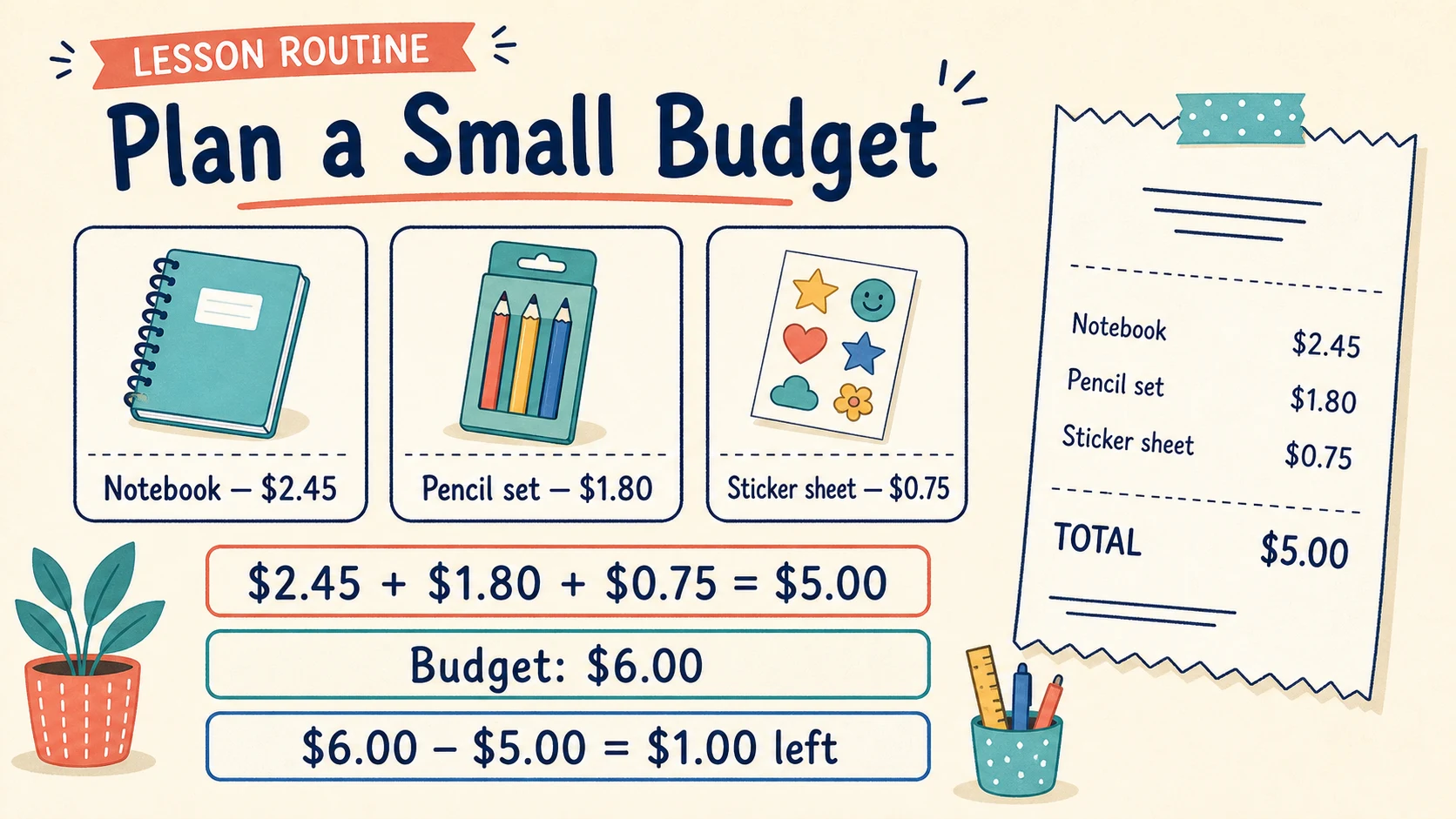
An adaptation should make the target accessible while preserving the same money reasoning. If the item asks for the value of mixed coins, replacing it with counting identical pennies would change the skill. Providing labeled coin references while the learner counts the original mixed collection would preserve it.
Adjust representation, prompting, or workload while keeping the mathematical target intact.
Provide more representation
For a learner who confuses coin values:
- place a real or play coin over each printed coin;
- use a small reference card showing each coin and its value;
- have the learner annotate each image with
25,10,5, or1; - sort coins by denomination before counting.
Remove one support at a time. For example, retain the reference card but stop labeling every coin in advance.
For a learner who loses track during mixed counting, draw a line through each coin as it is counted. Arrange manipulatives from greatest to least value. The learner still calculates the same total.
Reduce language or writing demands
Read an item aloud if decoding the text is masking the money skill. Ask the learner to restate it in plain language: “I know the price and payment. I need the difference.” This preserves the operation.
If writing alignment is difficult, provide a place-value frame:
| Dollars | Cents |
|---|---|
| 2 | 35 |
| 1 | 47 |
The learner must still add the amounts. The frame merely makes the units visible.
Increase challenge without skipping the foundation
For a learner who completes the page accurately and explains the work, ask for a second method or a check:
- Count coins by grouping and then by counting on.
- Find change through subtraction and counting up.
- Express
$1.25as125¢. - Create two different coin collections with the same value.
- Write a short purchase problem that has the computed answer.
Do not add difficulty merely by imposing speed. Efficient work can develop over time, but accuracy and interpretable reasoning should remain visible.
Interpret errors instead of counting only wrong answers
A total score summarizes performance but does not explain it. Group errors by pattern. One mistaken item may be a recording slip; three errors with the same structure suggest a specific teaching target.
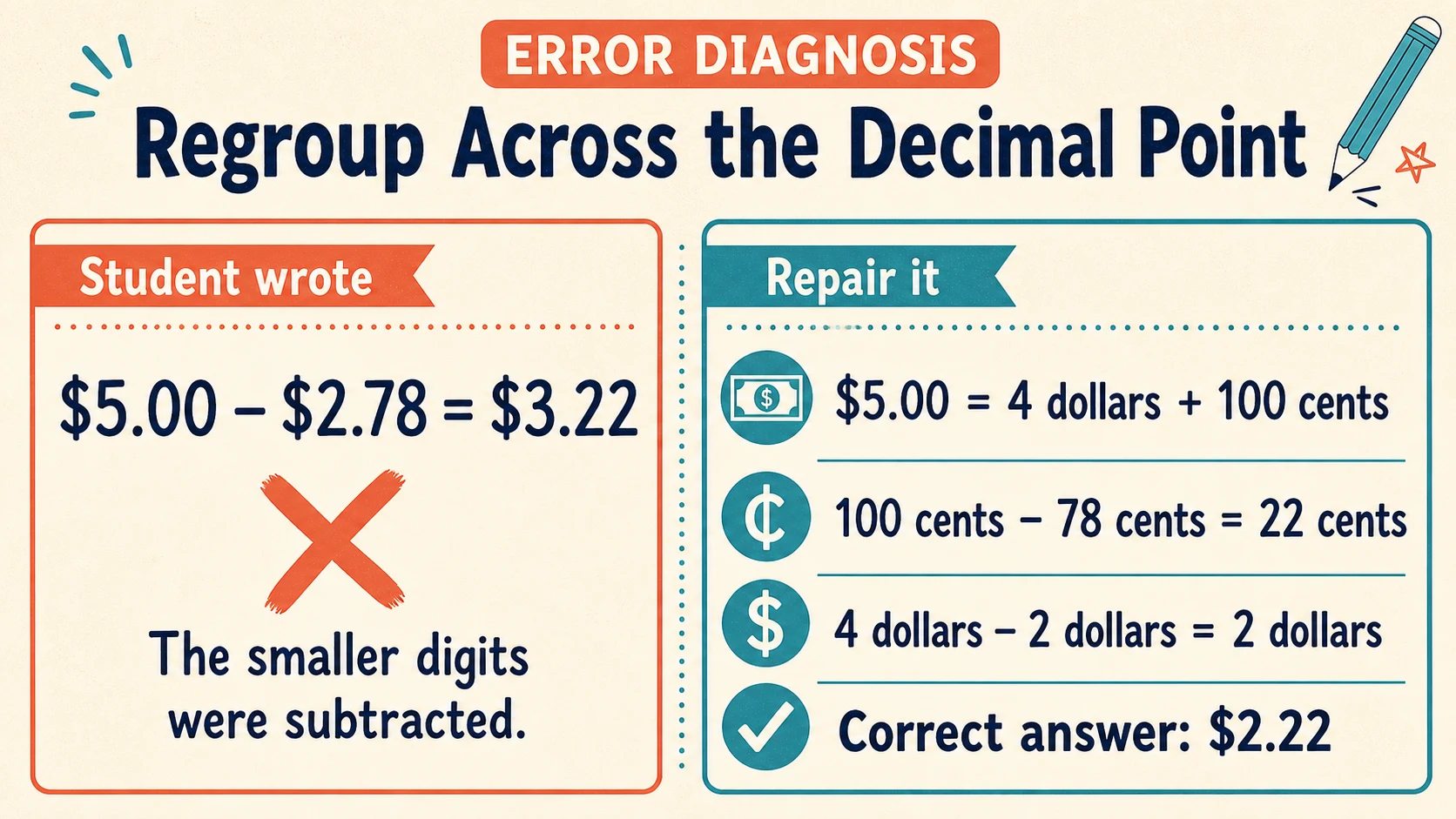
Identify the error pattern, reconstruct the reasoning, correct it, and verify the correction.
Common patterns and instructional responses
| Observed work | Likely issue to investigate | Immediate response |
|---|---|---|
A dime is counted as 5¢ |
Coin name and value are not secure | Match and label coins before recounting |
| Mixed coins are counted randomly | Tracking or counting sequence breaks down | Order coins from greatest to least value |
75¢ + 40¢ = 115¢, written as $115 |
Unit conversion or notation confusion | Separate 115¢ into 100¢ + 15¢ |
$2.05 is read as “two dollars fifty cents” |
Place value in decimal money notation | Compare $2.05, $2.50, 205¢, and 250¢ |
| Change is larger than the amount paid | Operation or reasonableness is unclear | Restate price and payment; count up to verify |
| Decimal points are not aligned | Dollars and cents were combined by digit position alone | Use a dollars-and-cents frame |
| Correct total, no unit | Recording convention is incomplete | Ask whether the answer is cents or dollars |
| Several answers are one coin short | A coin is being skipped during counting | Mark each coin as it is included |
Treat these as hypotheses to test, not diagnoses. Ask the learner to reconstruct one example. The explanation will usually show whether the issue lies in coin knowledge, counting, operation choice, place value, or notation.
Correct an error with a close example
Suppose the learner writes:
2 quarters + 3 dimes = 80¢
Ask for the value of each group:
2 × 25¢ = 50¢
3 × 10¢ = 30¢
Then combine:
50¢ + 30¢ = 80¢
That answer is correct. Do not require a change merely because the adult expected a different-looking method.
Now suppose the learner writes 70¢. Rebuild the groups with coins or labels, obtain 50¢ + 30¢, and correct the original item. Follow with a close but new example, such as 2 quarters and 4 dimes:
50¢ + 40¢ = 90¢
This distinguishes a corrected understanding from copying the answer.
Use the answer key responsibly
Check the learner’s completed set against the separate answer key after independent work. Mark discrepancies neutrally. A dot beside an item leaves room for the learner to find and repair the error; immediately writing the correct answer removes that opportunity.
For every discrepancy:
- Reread the original item.
- Ask the learner to show the method.
- Confirm that the worksheet and key were matched correctly.
- Recalculate independently.
- Correct the reasoning or notation.
- Verify the corrected answer using another method when practical.
Answer keys support efficient checking, but adults should still inspect the work. If a result differs from the key yet the learner’s reasoning appears sound, recalculate before declaring it wrong. Printing mismatches, overlooked symbols, or adult reading errors are possible.
Record patterns rather than only a percentage. A note such as “accurate coin totals; needs support converting more than 100¢ to dollars” gives clearer direction than “20 out of 25.”
The Common Core mathematics overview describes mathematical understanding as including age-appropriate explanation, not only production of correct answers. That broad framing supports asking a learner to justify selected responses. It does not establish that this exact worksheet has been reviewed or certified for comprehensive standards alignment.
Pay attention to money boundary cases
Boundary cases reveal whether the learner understands units rather than following a surface rule.
Zero as a placeholder
$4.06 means 4 dollars and 6 cents, not 4 dollars and 60 cents. Compare:
$4.06 = 406¢$4.60 = 460¢
Both amounts use two digits after the decimal point, but the positions matter.
Exactly one dollar
Four quarters equal:
4 × 25¢ = 100¢ = $1.00
Writing $1 communicates the same value in ordinary contexts, but $1.00 makes the dollars-and-cents structure explicit during instruction.
No change and insufficient payment
If an item costs $2.50 and the customer pays $2.50, the change is $0.00.
If the customer offers $2.00, the difference is not “change” returned to the customer. The payment is 50¢ short:
$2.50 − $2.00 = $0.50
Attend to the wording before applying subtraction mechanically.
Equivalent collections
One quarter equals 25 pennies, 5 nickels, or 2 dimes plus 1 nickel. Equivalent values do not require equivalent numbers of coins. Asking for two collections worth the same amount is a useful check of flexible understanding.
Decide what instruction should follow
Use the completed worksheet to select one next step, not five.
- Coin-value errors: Return to matching, naming, and sorting denominations.
- Accurate values but disorganized mixed counting: Practice ordering coins and counting on from the greatest value.
- Errors when totals exceed 100¢: Work on converting between cents and dollars.
- Addition errors with secure notation: Practice aligned money addition with a check in cents.
- Making-change errors: Contrast price, payment, and change; use counting up with a number line or coins.
- Mostly notation errors: Practice translating among coin collections, cent notation, and dollar notation.
- Consistent accuracy with explanations: Move to varied purchase problems, equivalent coin combinations, or a less supported set.
Do not infer a broad mathematical weakness from one worksheet. Performance can be affected by unfamiliar coin images, reading demands, fatigue, attention, or the presentation of the page. Recheck the suspected skill with one or two close examples in a quieter format.
For a wider view of related elementary mathematics materials, use the 3rd Grade Math hub. The topic guide provides the more appropriate place to consider progression across money skills.
Schedule short retrieval opportunities
Revisiting the skill after a delay helps determine whether the learner can retrieve the method rather than merely repeat a recent demonstration. The schedule below is a practical option, not a sourced universal timetable.
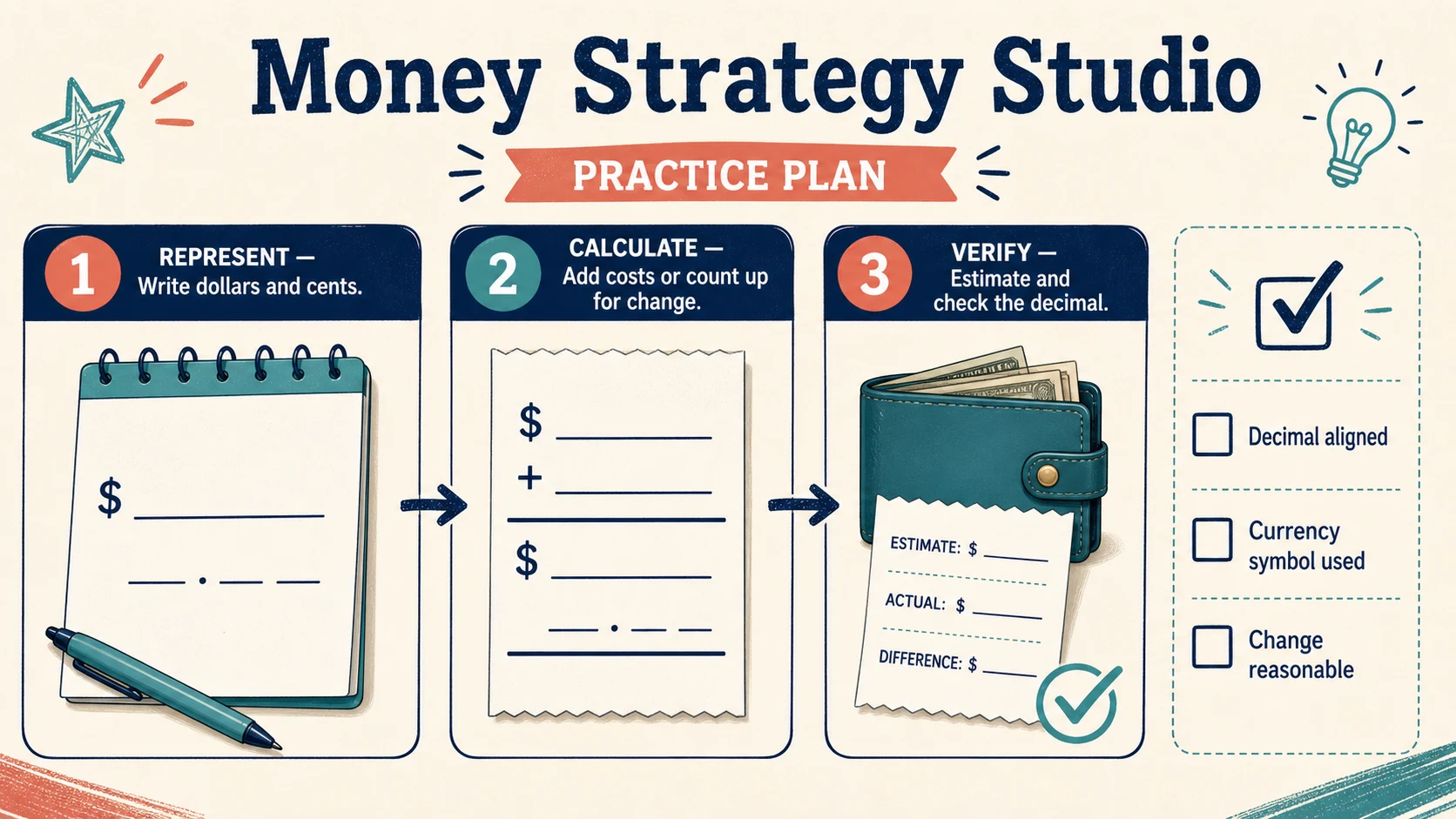
Use brief delayed checks and adjust their timing from the learner’s actual performance.
A workable review plan
| Time | Retrieval task | Decision |
|---|---|---|
| Same session | Correct one missed item and solve one close example | Continue only when the correction is explained |
| 1–2 days later | Solve 3 mixed items without the previous model | Restore a support if the method cannot be started |
| About 1 week later | Solve 2–4 items covering different money skills | Note which skill remains available |
| About 2–3 weeks later | Complete a short mixed review in a new order | Move forward, review selectively, or reteach |
Use unused worksheet items when possible. If all items have been completed, change only the numbers or coin combinations while preserving the structure. For example, after reviewing change from $5.00 for a $3.67 purchase, try change from $5.00 for a $3.45 purchase:
$5.00 − $3.45 = $1.55
Check:
$3.45 + $1.55 = $5.00
If retrieval is accurate, reduce supports. If the learner cannot begin, briefly remodel the routine and schedule another small check. The learner’s observed work—not the calendar alone—should determine the interval and amount.
Keep the worksheet’s limitations visible
This printable offers 25 easy-level exercises and an answer key. It can provide focused practice, evidence of current methods, and material for later review. It cannot, by itself, establish mastery across every money context.
The worksheet does not replace handling coins, discussing why two collections are equivalent, or applying money operations to a simple purchase situation. It also should not be used to make clinical, developmental, or diagnostic judgments. The catalogue facts do not establish guaranteed outcomes, a universal completion time, or comprehensive alignment with every state or local curriculum.
The title’s “3rd Grade” label indicates intended practice level. The supplied catalogue also identifies money-related standards language associated with earlier elementary grades, which is another reason to avoid treating the title as a universal placement rule. Local sequences differ, and learners may encounter this material as initial instruction, review, intervention, or application.
Take the next useful action
Print the free 3rd Grade Money worksheet, preview its problem types, and select one model plus a five-item independent starting set. After checking the work, use the observed error pattern to choose either targeted review from the Money topic guide or broader mixed practice from the 18-worksheet 3rd Grade Money pack.
Put it into practice
Use the guide with a real printable
Move from explanation to a short, observable practice task. Check the first item together, then adjust the next session from the learner's actual work.
See the 18-worksheet pack