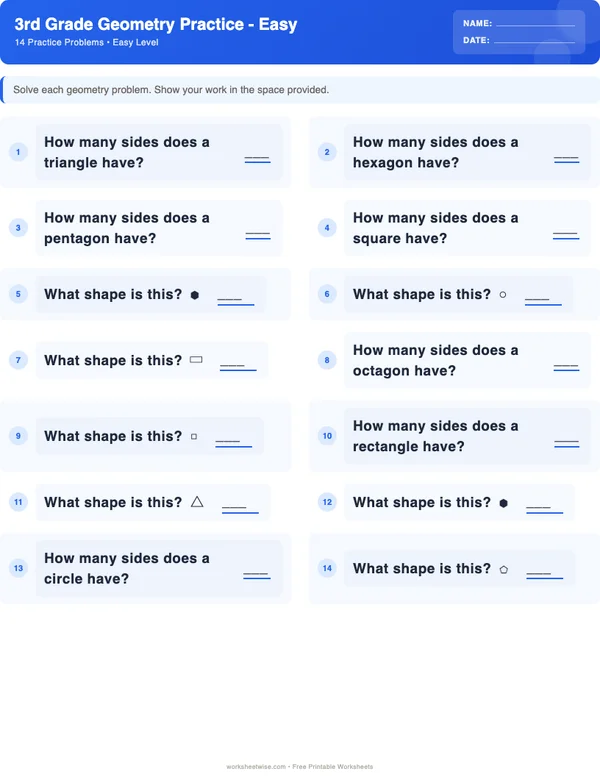
Complete guide
How to teach and practise 3rd grade geometry worksheets - standard theme (easy)
What this 25-item geometry worksheet is for
The free 3rd Grade Geometry worksheet provides 25 easy-level exercises on identifying shapes, counting sides and vertices, recognizing geometric properties, and calculating perimeter and area. Use it as a focused practice lesson—not as a race, a complete geometry assessment, or a substitute for hands-on exploration.
A practical approach is to preview the page, model one representative problem, solve a few items together, and then release the learner to work independently in short sections. Ask the learner to show how an answer was found. Their observed work—not the grade label, the number of items, or a fixed timetable—should determine the pace and amount of support.
Grade labels describe the intended practice level. Local school, district, state, and homeschool sequences differ, so a third-grade learner may meet these ideas earlier, later, or in another order. The Common Core mathematics standards provide one useful reference point for grade-level expectations, but this guide does not claim that the worksheet comprehensively assesses every geometry standard.
Preview the worksheet before teaching
Before handing over the printable, review both the worksheet and its separate answer key. Confirm that the print is clear, that no diagrams have been cut off, and that the learner has enough space to record thinking. Gather a pencil, eraser, ruler, and a few square objects or tiles if available.
The catalogue identifies four skill areas:
- Shapes
- Perimeter
- Area
- Geometric properties
Do not assume that every item uses the same response process. A learner might need to name a shape, count visible features, add side lengths, or count equal square units. Previewing lets you decide which language and tools will be useful without revealing answers.
If the learner is new to the vocabulary, prepare a small reference card containing only the terms needed on the page. For example:
- Side: a straight boundary segment of a polygon
- Vertex: a corner where two sides meet
- Perimeter: the distance around a shape
- Area: the amount of flat space inside a shape
Keep the definitions available during instruction if vocabulary is not the skill you intend to test. Remove the card later only when the learner’s work shows that the language is secure.
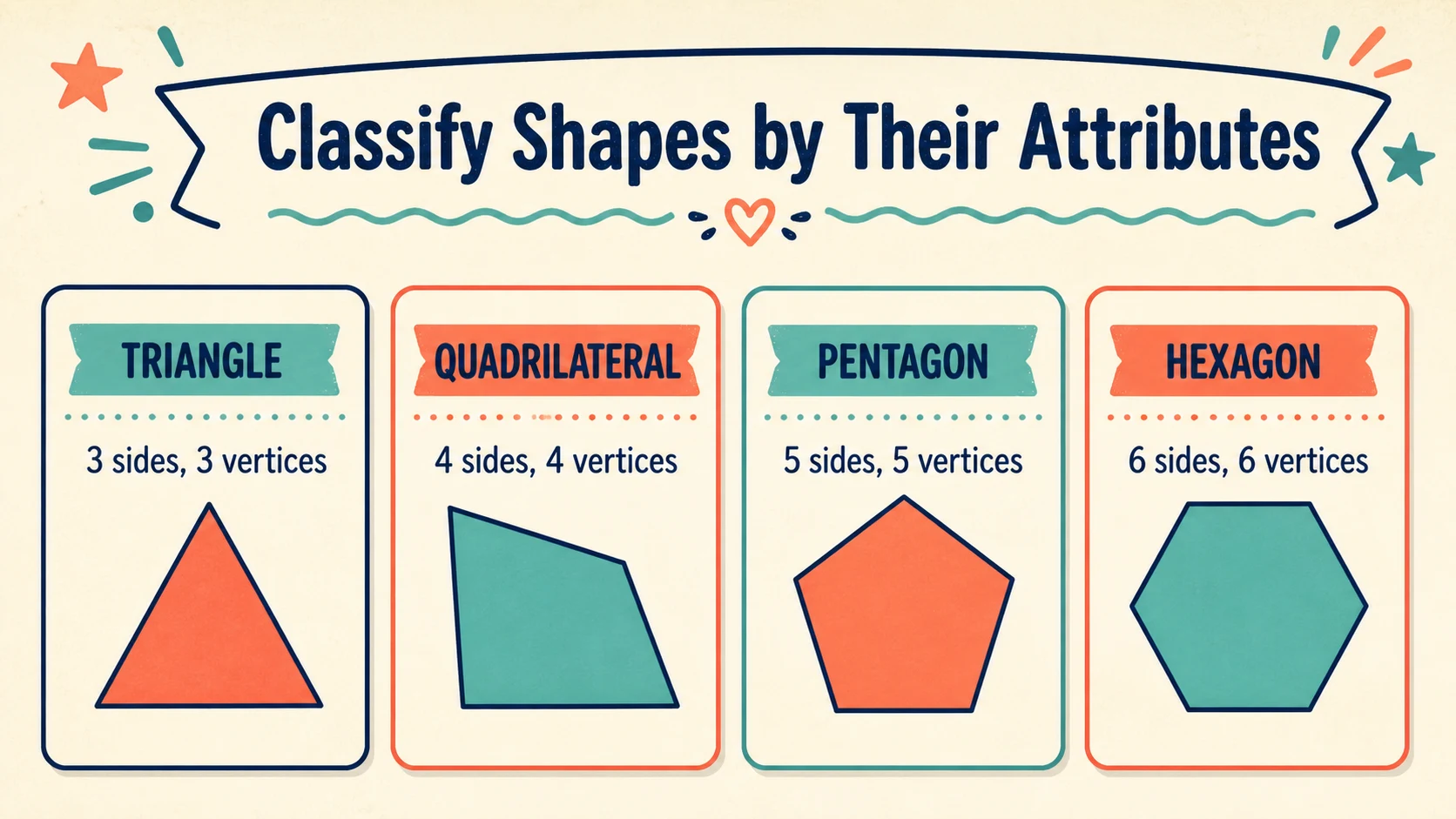
Preview, model, practice together, release, review, and revisit.
Plan a short lesson around the printable
The following progression is a flexible instructional plan. It is not a universal timetable. Expand, shorten, or split the stages according to the learner’s explanations, accuracy, attention, and independence.
| Lesson stage | Adult action | Learner action | Evidence to notice |
|---|---|---|---|
| Orient | Name the four possible task types and review directions | Scan the page and point out familiar formats | Recognizes whether an item concerns a shape, property, perimeter, or area |
| Model | Think aloud through one representative example | Watches, predicts the next step, and asks questions | Connects the words and diagram to a suitable operation |
| Guided practice | Complete two or three worksheet items together | Explains counts, labels, or calculations | Uses sides, vertices, perimeter, and area distinctly |
| Supported release | Ask the learner to complete a small group of items | Works while the adult observes quietly | Begins without prompting and records useful work |
| Independent practice | Assign the remaining appropriate items or another short section | Solves and marks uncertain items | Maintains a method without constant confirmation |
| Review | Compare reasoning with the answer key | Corrects errors and explains changes | Identifies where the original method went off course |
| Retrieval | Revisit selected ideas after a delay | Solves a fresh or previously missed example | Recalls the process without copying a recent model |
A learner does not need to complete all 25 items in one sitting. Five carefully explained answers can reveal more about understanding than 25 hurried responses. When the learner’s method remains sound, continue. When several answers show the same confusion, pause the printable and reteach that distinction with a concrete example.
The IES guide on teaching mathematics to young children supports high-level practices such as using developmental progressions, monitoring learners’ knowledge, and helping them describe mathematical ideas. It did not evaluate WorksheetWise or this particular worksheet.
Launch the lesson with a shape and its features
Begin with an object or drawing that makes the language visible. A rectangular index card, book cover, or drawn rectangle is sufficient.
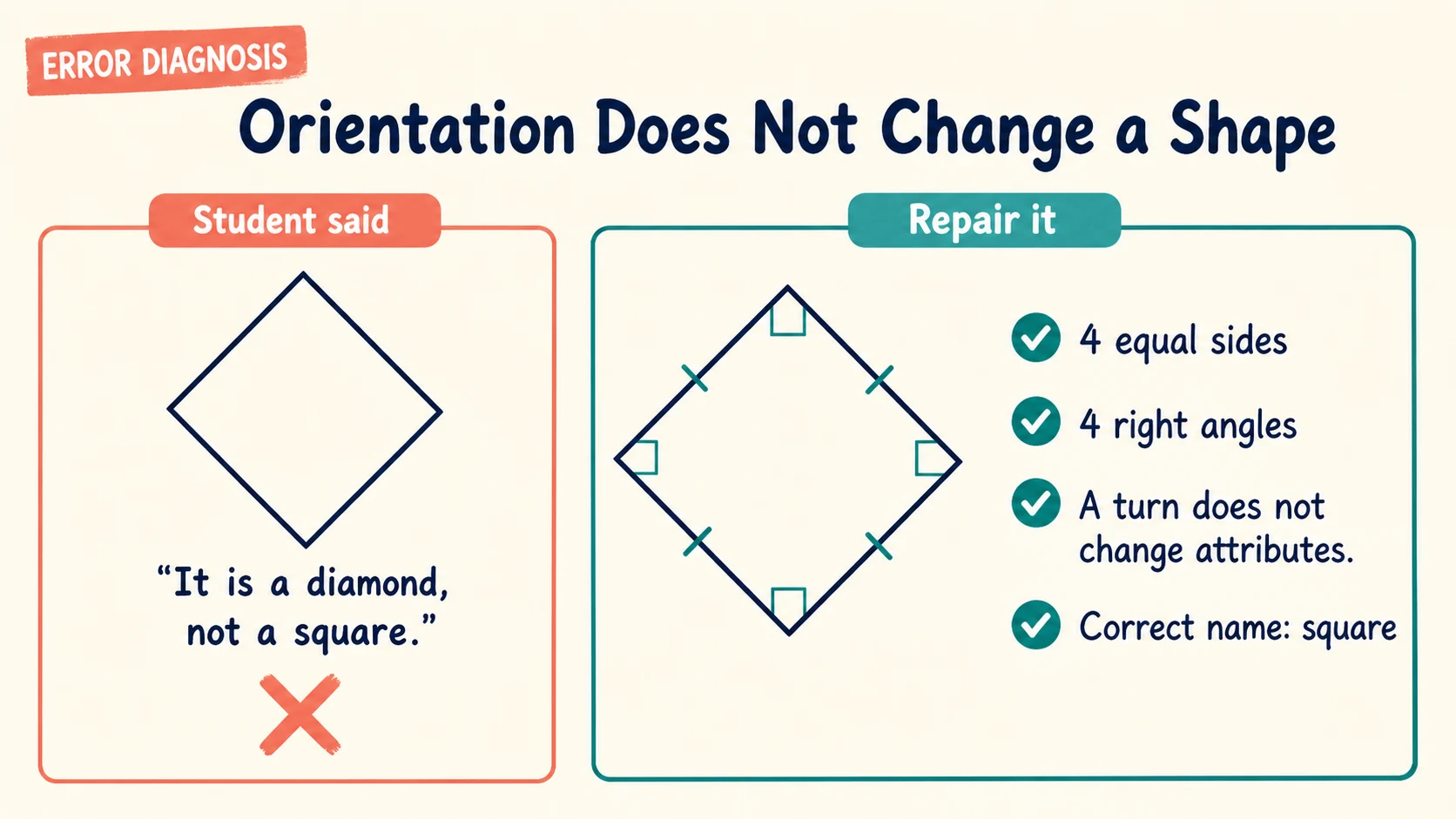
Trace one edge and say, “This is one side.” Move around the boundary and count each side once. Then touch each corner and count the vertices. Rotate the object and repeat the count. Rotation changes the object’s orientation, but it does not change its defining properties.
Ask the learner to compare two questions:
- “What shape is this?”
- “What properties support that name?”
The first asks for a label. The second asks for evidence. A useful response might be, “It is a rectangle because it has four sides and four square corners.” Use only properties the learner can observe or has already learned; do not turn an easy practice sheet into a test of advanced terminology.
Model the directions, not just the answer
The worksheet says, “Solve each geometry problem. Show your work in the space provided.” Explain what showing work can look like for different item types:
- Numbering the sides or vertices on a diagram
- Writing an addition expression for perimeter
- Marking counted square units for area
- Writing a short property statement beside a shape
Model a simple decision routine:
- Read the prompt.
- Identify what is being asked.
- Mark the relevant part of the diagram.
- Calculate or count.
- Check whether the answer names the correct kind of quantity.
This last check matters. An answer of “14” is incomplete when the task expects “14 units” or “14 square units,” and it may conceal confusion about perimeter and area.
Work through fully checked examples
The following examples are created for this guide and are similar to the catalogue skills. They are not presented as copies of the worksheet’s actual items. Each calculation can be checked independently.
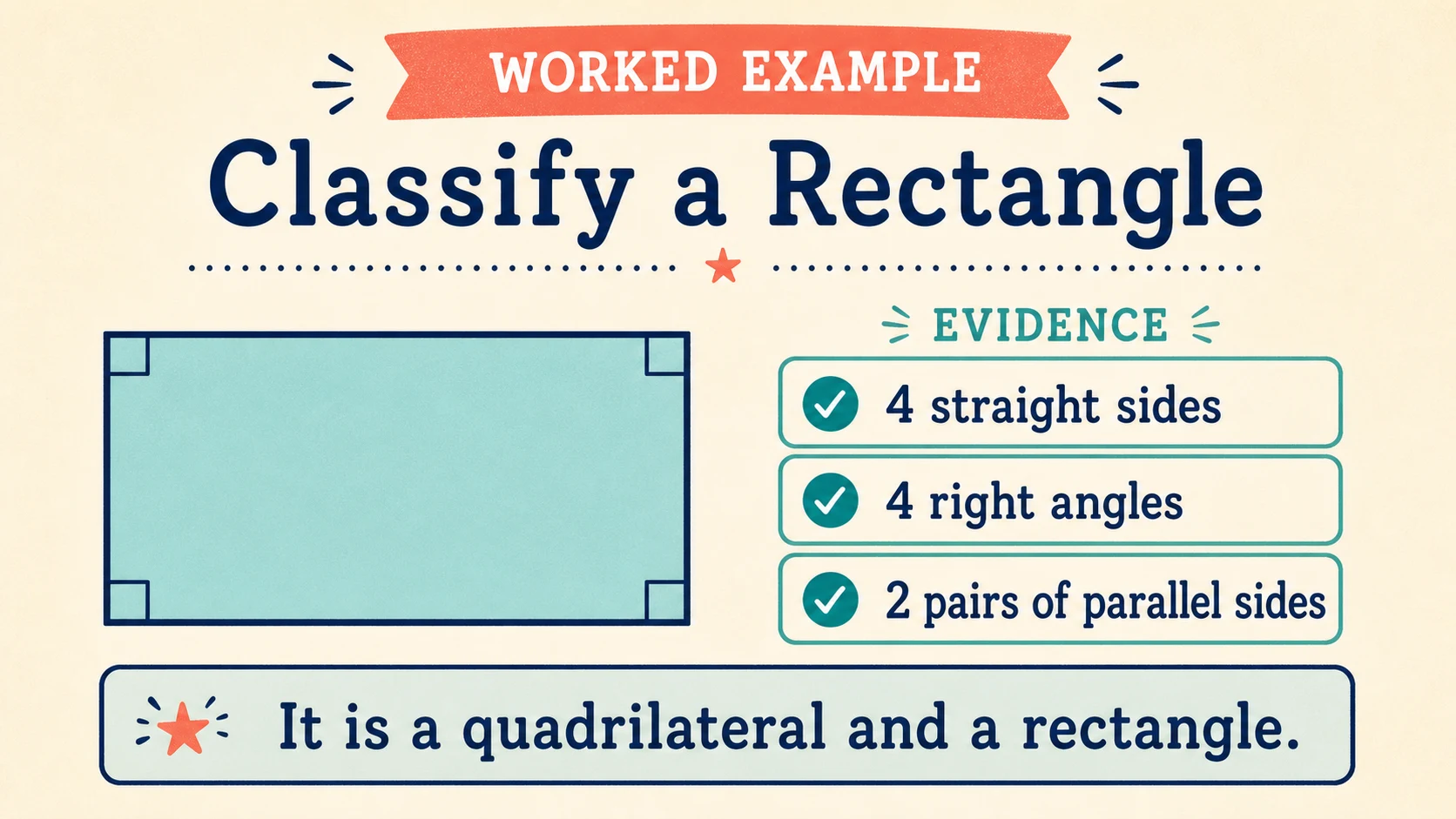
Mark the relevant features before naming or calculating.
Example 1: Count sides and vertices
Problem: A pentagon is drawn with five straight sides. How many sides and vertices does it have?
Work:
- Trace the boundary and label the sides 1, 2, 3, 4, 5.
- Touch each meeting point and label the vertices 1, 2, 3, 4, 5.
Answer: 5 sides and 5 vertices.
Check: In a simple polygon, each side meets the next at a vertex. Following the boundary produces five side segments and five meeting points. A point drawn inside the shape would not be a vertex because it is not a corner on the boundary.
Example 2: Identify a rotated shape
Problem: A square is turned so that one vertex points upward. Does it remain a square?
Work: Count and inspect its properties:
- Four sides
- All four sides equal in length
- Four square corners
Answer: Yes, it remains a square.
Check: Turning a shape changes its position, not its side lengths or corner properties. Calling it a “diamond” based only on orientation does not describe a new geometric category.
This is a useful boundary case. A four-sided figure that merely looks slanted is not automatically a square. The equal sides and square corners, not the direction in which it points, support the classification.
Example 3: Calculate perimeter
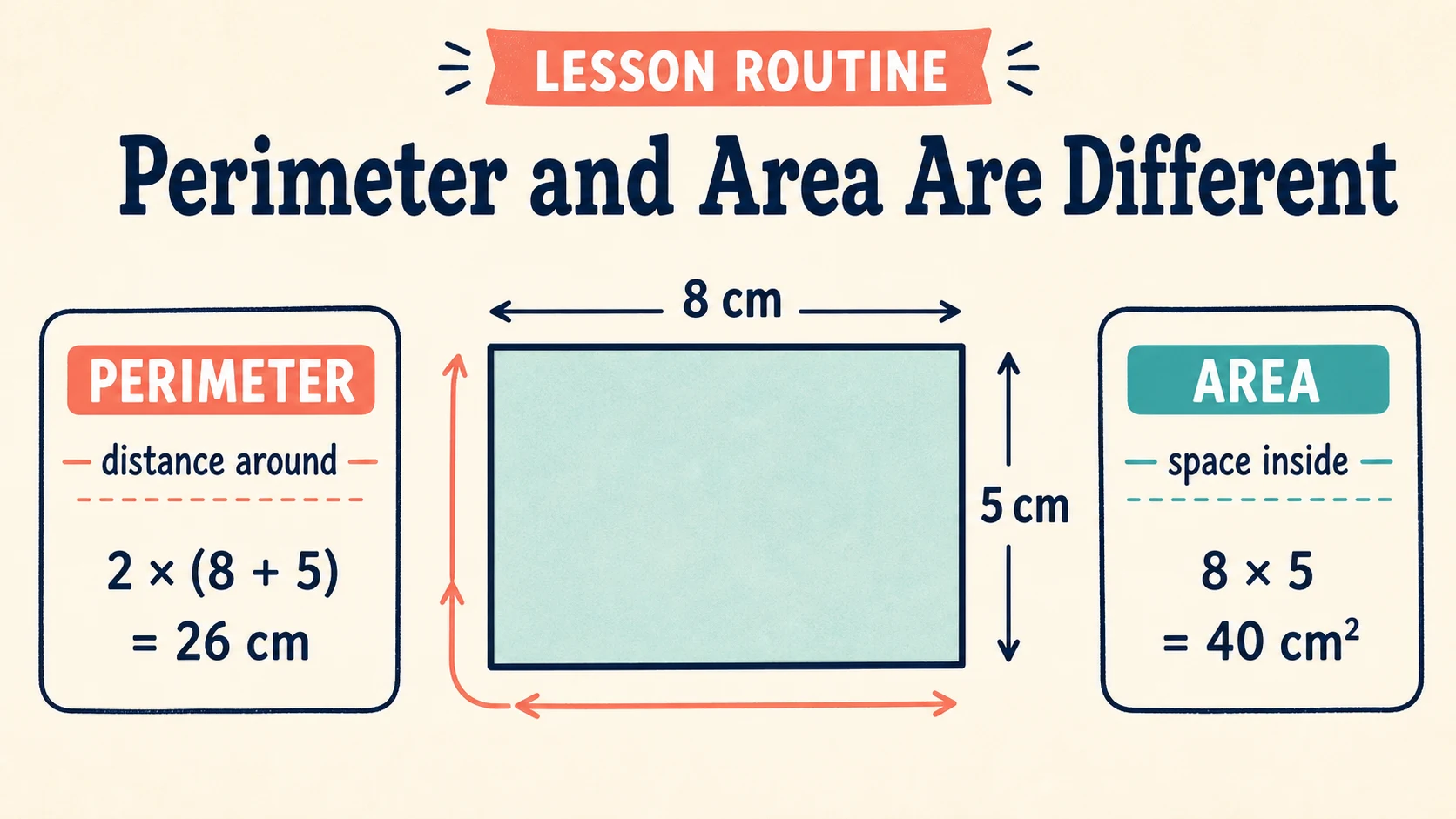
Problem: A rectangle has side lengths of 6 units and 3 units. What is its perimeter?
Work:
Answer: 18 units.
Check: The rectangle has two sides of 6 units and two sides of 3 units:
Both methods agree. Perimeter measures the complete distance around the outside, so all four sides must be included.
A common incomplete answer is . That counts only two adjacent sides. Ask the learner to trace an imaginary walk around the entire rectangle and stop only upon returning to the starting point.
Example 4: Calculate area by counting square units
Problem: A rectangle is covered by 4 rows of 3 equal unit squares. What is its area?
Work:
or
Answer: 12 square units.
Check: Count the squares by rows: 3, 6, 9, 12. Count by columns: 4, 8, 12. Both counts give 12. Area describes the interior covering, so the unit is square units.
The factors can be written as or . The arrangement is unchanged, and both products equal 12.
Example 5: Separate area from perimeter
Problem: A rectangle is 5 units long and 2 units wide. Find both its area and perimeter.
Area work:
Area answer: 10 square units.
Perimeter work:
Perimeter answer: 14 units.
Check: A 5-by-2 array contains two rows of five squares, so its area is 10 square units. Walking around the four outside edges covers 14 linear units. The different answers are expected because the measurements describe different features.
This example prevents an important misconception: area and perimeter are not two names for the same calculation.
Example 6: A boundary case with equal results
Problem: A square has side length 4 units. Find its area and perimeter.
Area:
Perimeter:
The numerical values happen to be equal, but the measurements are not interchangeable. One 16 counts square units inside; the other 16 counts linear units around the boundary. Use the units and the model to preserve the distinction.
Move from guided to independent practice
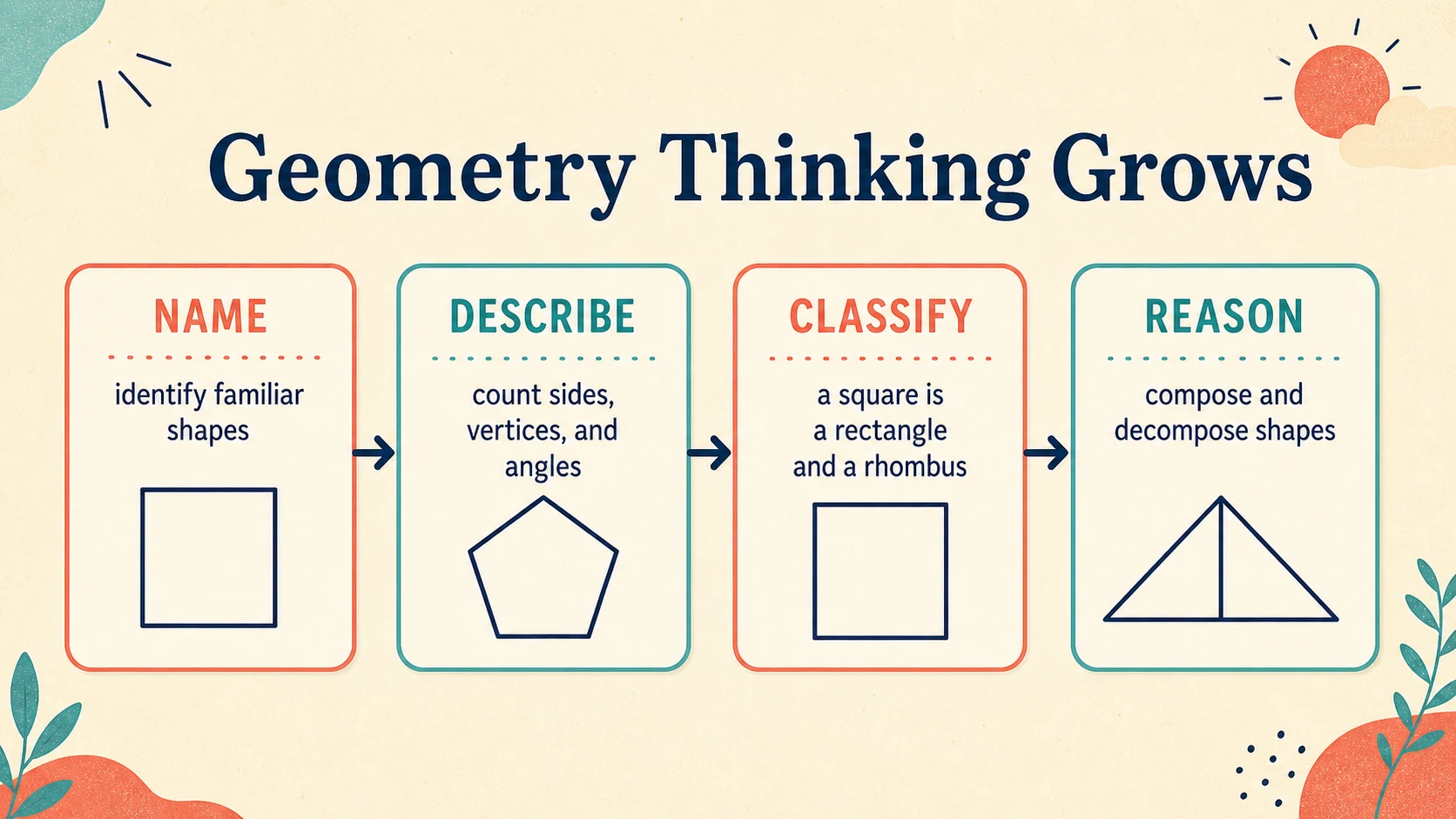
Release responsibility when the learner can explain and repeat the process.
Use prompts that reveal thinking
For the first few worksheet items, avoid telling the learner which operation to use. Ask prompts such as:
- “What is the problem asking you to find?”
- “Which parts of the diagram matter?”
- “Are you measuring around or covering inside?”
- “How could you mark what you have already counted?”
- “What unit would fit this answer?”
- “How can you check it another way?”
If the learner responds correctly, ask for a brief explanation and move on. Requiring a long verbal defense for every easy item can interrupt fluency. If the response is incorrect, use the explanation to locate the misunderstanding.
Release support in observable steps
A learner is ready for a small independent section when they can:
- Begin an item without waiting for the adult to name the method
- Count each side, vertex, or square once
- Include all boundary sides in a perimeter calculation
- Distinguish linear units from square units
- Check a result by recounting or using another expression
Assign a manageable group of items. Ask the learner to circle any item that feels uncertain rather than guessing silently or waiting after every answer. During independent work, observe without correcting each mark immediately. Repeated intervention can make it difficult to tell whether the learner can carry out the process alone.
When the section is complete, review the circled items first. Then inspect a sample of apparently confident answers. Confidence and accuracy do not always match.
Adapt support without changing the skill
Adaptation should make the target skill more accessible while preserving what the learner is supposed to do. If an item asks for perimeter, for example, supplying the final addition expression would remove part of the task. Highlighting the boundary and asking the learner to construct the expression preserves it.
Adjust visibility, quantity, or prompting while keeping the geometry goal intact.
When visual tracking is difficult
Give the learner a transparent counter, small sticky note, or pencil mark for recording the starting point. For side and vertex counts, have them move clockwise and number each feature. For area, place a dot in each square as it is counted.
These supports reduce double-counting without supplying the answer. Avoid adding marks that obscure printed lengths, corners, or grid lines.
When vocabulary is the obstacle
Read the prompt aloud or provide the small reference card described earlier. Ask the learner to point to an example of a side, vertex, interior region, or boundary before beginning the calculation.
This is an instructional support, not a sourced requirement. Its purpose is to separate difficulty reading a term from difficulty applying the geometry concept.
When calculation load hides geometry understanding
Allow skip-counting, repeated addition, or a multiplication fact the learner already knows. A learner finding the area of a 3-by-4 rectangle may use , , or . The target is understanding the equal rows or columns and the total square units.
For perimeter, a learner may write every side length first and then add. Do not insist on a shortcut before the full boundary is understood.
When 25 items are too many at once
Cover later problems with blank paper and present a short section. Stop at a natural point, record where to resume, and return later. Reducing the number visible at one time does not lower the geometric demand of the items completed.
For a learner ready for less support, remove the vocabulary card, ask for a second checking method, or request a labeled sketch. Do not introduce unrelated advanced content merely to make an easy sheet feel harder.
The IES practice guide for assisting students struggling with mathematics provides broader, evidence-based instructional framing, including systematic instruction, clear mathematical language, representations, and deliberate practice. It does not prescribe how every learner must complete this worksheet, and it does not provide child-specific or medical guidance.
Interpret errors before assigning more work
An incorrect answer is evidence about a step in the process, not a complete description of what the learner understands. Look for patterns across several items.
Identify the task, inspect the representation, recompute, and explain the correction.
| Observed work | Possible interpretation | Useful instructional response |
|---|---|---|
| Counts a starting vertex twice | Tracking problem rather than classification confusion | Mark the starting point and count once around |
| Calls every turned square a diamond | Relies on orientation instead of properties | Rotate the same square and repeatedly check sides and corners |
| Uses only length plus width for perimeter | Counts two sides instead of the whole boundary | Trace all edges and write each length in order |
| Multiplies side lengths when asked for perimeter | Associates rectangles with one memorized operation | Contrast “around” with “inside” using the same rectangle |
| Adds all grid squares around the edge for area | Treats area as a boundary measure | Shade or count every interior square by rows |
| Gives area in units rather than square units | May know the count but not the measurement label | Ask what one counted object represents: a segment or a square |
| Produces inconsistent counts on the same figure | May be scanning randomly | Use rows, columns, or clockwise order |
| Leaves blank items containing unfamiliar words | Vocabulary may be blocking access | Read the prompt and ask the learner to restate it |
Treat these as possible interpretations, not diagnoses. Confirm them by asking the learner to demonstrate a similar problem and explain the process.
Correct one decision at a time
Suppose the learner writes for the perimeter of a 5-by-2 rectangle. Do not immediately replace the whole solution. Ask:
- “Show me the path that 7 measures.”
- “Have we returned to the starting point?”
- “Which sides are still missing?”
- “What expression represents the full trip?”
The corrected work becomes:
This approach preserves what was correct—the learner recognized two relevant side lengths—while repairing the incomplete boundary model.
Use the answer key responsibly
The separate printable answer key is designed for quick checking, but checking should include more than matching final numbers.
Check in three passes
First, verify the response against the key. Second, inspect the learner’s work. Third, ask for an explanation when the method is unclear or an answer appears accidental.
A correct answer deserves a closer look when:
- No work is shown on a calculation item
- The unit conflicts with the quantity
- A later item uses a contradictory method
- Erasing makes the reasoning impossible to follow
- The learner cannot reproduce the process on a similar example
An incorrect answer may still contain useful understanding. Mark the exact point where reasoning changed direction. For example, the learner may list all four perimeter lengths correctly but make a single addition error. That calls for a calculation check, not a complete reteaching of perimeter.
Do not use the key to prefill hints or steer the learner toward a result. Keep it separate during independent practice. If the worksheet diagram or printed key ever appears ambiguous, recompute the problem from the visible information before deciding that the learner is wrong.
Record patterns, not just a score
A total such as “21 out of 25” does not explain what to teach next. Add a brief note:
- Shape properties secure
- Vertex counting accurate after marking a start
- Perimeter method understood; one addition error
- Area and perimeter still confused on mixed items
This record supports a more precise next lesson. It also prevents unnecessary repetition of skills the learner already demonstrates reliably.
Decide what should happen next
Use observed work to choose among three routes.
Continue within this worksheet
Continue with the remaining items when the learner’s method is accurate, explanations are sensible, and mistakes are isolated. Gradually reduce prompts. If the sheet was divided across sittings, begin the next session with one quick retrieval item before resuming.
Reteach a narrow distinction
Pause when the same misconception appears more than once. Use one concrete contrast:
- Side versus vertex
- Orientation versus defining property
- Perimeter versus area
- Linear unit versus square unit
- Counting individual squares versus counting equal rows
Then return to one similar worksheet item. If the learner can now solve and explain it independently, proceed cautiously. If not, continue with concrete or drawn representations rather than adding more near-identical questions.
Broaden or extend practice
When the learner completes the easy-level work accurately and independently, consult the broader 3rd Grade Geometry topic guide for the surrounding progression rather than trying to make this one printable cover everything. The 3rd Grade math collection and 3rd Grade worksheet hub can help place geometry alongside other current practice.
The topic guide covers a wider geometry scope. This worksheet’s catalogue description is narrower: shapes, sides and vertices, geometric properties, perimeter, and area. It should not be treated as a comprehensive measure of all geometry knowledge.
For additional practice across the topic, the 3rd Grade Geometry Worksheet Pack contains 18 worksheets and is listed at $4.79 in the supplied catalogue. Choose it only if broader repeated practice fits the learner’s observed needs; purchasing more pages is not itself an instructional next step.
Schedule retrieval after the first lesson
A completed worksheet can show immediate performance. It does not by itself show whether the learner can recall the ideas after time has passed. Use brief delayed checks rather than immediately repeating the entire printable.
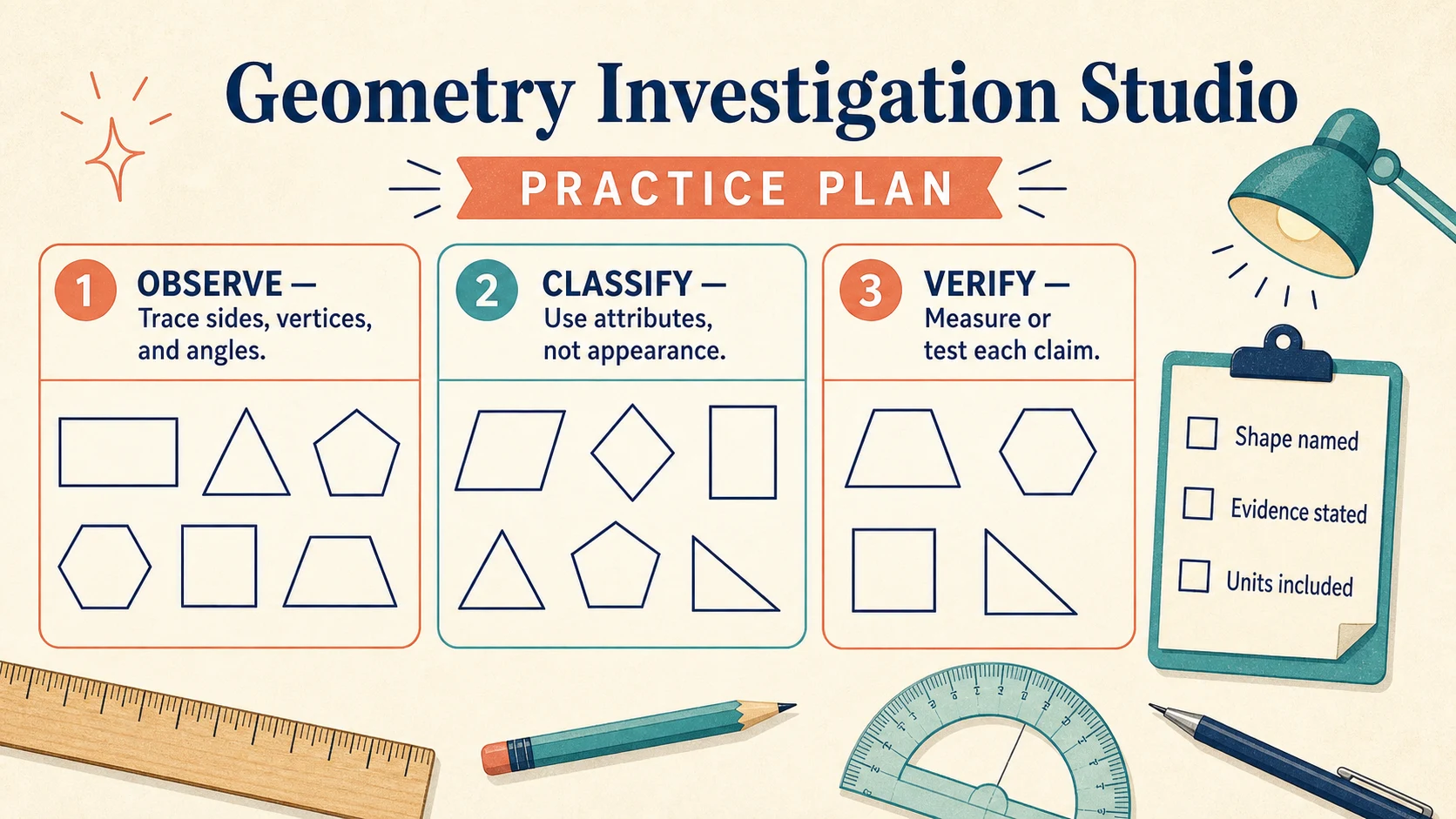
Revisit a few selected skills after increasing delays and adjust from the learner’s response.
| Suggested point | Retrieval task | What to observe |
|---|---|---|
| End of the lesson | One shape-property item and one measurement item | Can the learner explain the method without copying the model? |
| A day or two later | One perimeter example and one area example | Does the learner distinguish around from inside? |
| About a week later | A mixed set of three or four brief problems | Can the learner select the method without being told the category? |
| Later review | A new diagram or a previously missed item | Does understanding transfer when numbers or orientation change? |
These intervals are practical suggestions, not a universal timetable or a claim about guaranteed outcomes. Shorten the delay if the learner cannot recall the basic process. Lengthen it or reduce the number of prompts when recall is accurate and independent.
Do not rehearse only the exact corrected answers. Change a side length, rotate a shape, or draw a different array while retaining the same skill. For example, after reviewing a 6-by-3 perimeter problem, ask for the perimeter of a 7-by-2 rectangle. Recalculation shows more than remembering “18.”
Keep the worksheet’s limitations clear
This printable supplies 25 easy-level exercises and a separate answer key. It can support classroom practice, homework, tutoring, or homeschool instruction, but one worksheet cannot establish complete geometry mastery.
Performance may also be affected by reading, calculation fluency, diagram tracking, unfamiliar vocabulary, fatigue, or the amount of adult prompting. Record those conditions when they matter. Avoid drawing a broad conclusion from a single score.
The worksheet is not described as a diagnostic instrument, a certification, or a source of medical guidance. It does not guarantee outcomes. Although the catalogue places its skills within a wider standards-related mathematics collection, this guide does not claim comprehensive standards alignment for the individual printable. Refer to the Common Core mathematics standards or the requirements used by your local program when formal alignment decisions are necessary.
The most honest next step is determined by the learner’s work: finish a short remaining section, reteach one identified distinction, or move to a fresh geometry task. Start by downloading the free 3rd Grade Geometry worksheet, select two items to model and two to check independently, and use the results to choose the next practice from the geometry topic guide or create targeted follow-up material with the free worksheet generators.
Put it into practice
Use the guide with a real printable
Move from explanation to a short, observable practice task. Check the first item together, then adjust the next session from the learner's actual work.
See the 18-worksheet pack