Complete guide
How to teach and practise 3rd grade fractions worksheets - standard theme (easy)
A direct answer about using this worksheet
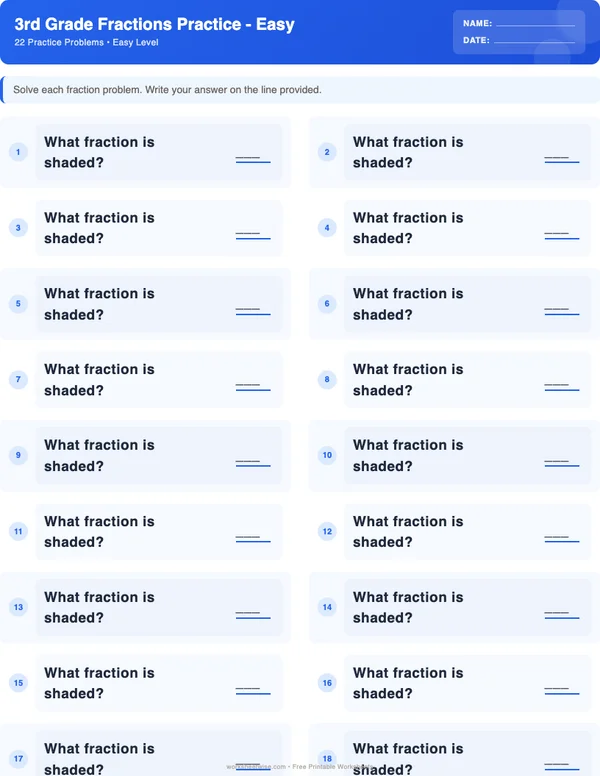
Use the free 3rd Grade Fractions worksheet to practice one focused task: naming the fraction represented by shaded equal parts. The learner should count all equal parts for the denominator, count shaded parts for the numerator, and write the fraction without automatically simplifying it.
The printable contains 22 prompts labeled “What fraction is shaded?” A separate answer key is provided. Although the catalogue associates the resource with fractions, equivalent fractions, comparison, and fraction operations, the reviewed learner page presents fraction-identification prompts rather than explicit comparison or operation questions.
There is also an important pre-use limitation: in the current PDF reviewed for this guide, the shaded models were not visible on the learner page. The prompts and answer lines appeared, but the mathematical figures did not. Before giving the page to a learner, open the downloaded file, zoom in, and print one test page. If the models remain absent, do not ask the learner to infer answers from the key. Use the lesson below with adult-drawn models, or choose another resource from the 3rd Grade Fractions topic guide until the printable is corrected.
Grade labels describe an intended practice level, not a universal timetable. Local curriculum sequences differ, and the learner’s observed work should determine whether this page is timely.
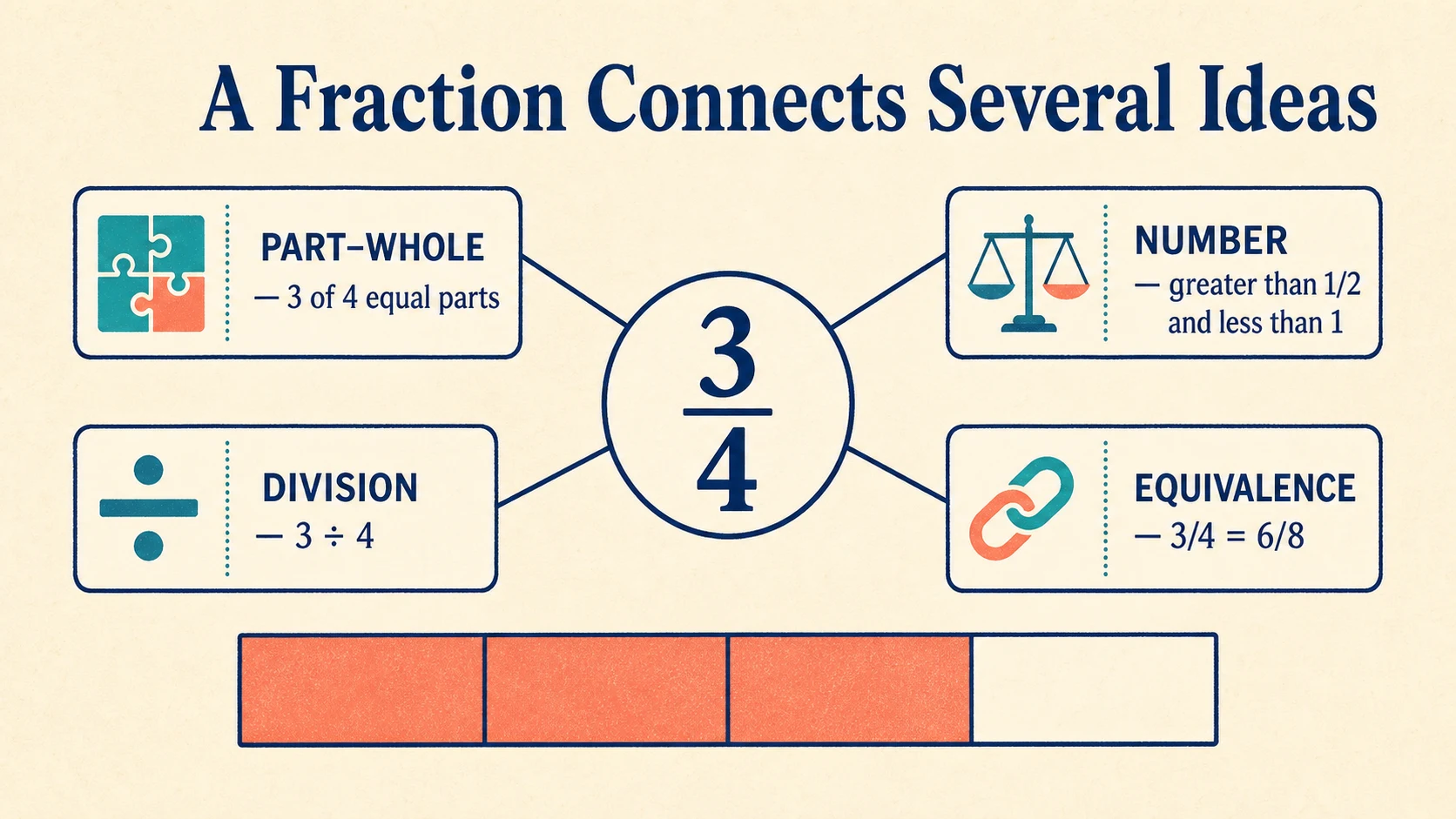
Preview, model, practice together, release responsibility, check reasoning, and schedule a short return to the skill.
What the 22-item printable is meant to reveal
Each item uses the same written prompt. That repeated format reduces reading demands and keeps attention on the fraction model. A complete response requires three connected decisions:
- Identify one whole.
- Verify that the whole is partitioned into equal parts.
- Count the total parts and the shaded parts in the correct order.
If a figure has six equal parts and four are shaded, the response is . The 4 records the shaded parts; the 6 records the total equal parts in the whole.
This task supports the foundational meaning of a fraction as an amount built from equal parts. The Common Core State Standards for Mathematics places understanding fractions as numbers, representing fractions, recognizing simple equivalence, and making appropriate comparisons within the Grade 3 fraction domain. That source provides broad instructional context; it does not certify or evaluate this WorksheetWise printable.
What success looks like
A correct answer alone is useful but incomplete evidence. Listen for an explanation such as:
“There are eight equal parts altogether, so 8 is the denominator. Five are shaded, so 5 is the numerator. The fraction is .”
You can treat the task as secure when the learner usually:
- identifies the whole without prompting;
- checks that the regions are equal;
- counts every region exactly once;
- places the shaded count above the fraction bar;
- places the total count below it; and
- explains the answer using shaded parts, equal parts, and whole.
Do not require speed while the learner is still coordinating these ideas. A slow, accurate explanation is better evidence than a fast answer produced by guessing.
What this page does not show by itself
The worksheet does not independently demonstrate that a learner can place fractions on a number line, compare two fractions, generate equivalent fractions, or perform fraction operations. Even when an answer such as is equivalent to , naming a shaded model as is not the same task as explaining equivalence.
For the wider sequence, including number lines and comparison, use the broader fractions teaching guide instead of trying to make one identification page cover the entire topic.
A practical lesson progression
The following plan is an instructional suggestion, not a prescribed timetable. Pause, repeat, or shorten a phase according to the learner’s work.
| Phase | Adult action | Learner action | Evidence for moving on |
|---|---|---|---|
| Preflight | Confirm that the shaded models display or print | Look over the page without solving | Every necessary figure is visible |
| Readiness check | Show one whole with equal parts and one with unequal parts | Identify which model can represent a fraction of the whole | Learner treats equal parts as necessary |
| Model | Think aloud through one example | Watch, then restate numerator and denominator meanings | Learner can explain the two counts |
| Guided practice | Solve two or three models together | Count and justify each answer | Prompts become less necessary |
| Independent practice | Assign a small block, not automatically all 22 | Solve and mark uncertain items | Answers and explanations are mostly consistent |
| Feedback | Discuss patterns rather than only scores | Correct errors using the model | Learner can explain what changed |
| Retrieval | Revisit selected models after a delay | Solve without copying earlier work | Skill remains available over time |
The IES guide on teaching mathematics to young children offers high-level support for using developmental progressions, monitoring what learners know, and connecting informal mathematical knowledge with representations. Applied here, that means beginning with visible equal parts and moving to fraction notation only after the learner can explain the model. The guide did not review this worksheet.
Prepare the page and establish the meaning of equal parts
Run a visual preflight
Download the worksheet and answer key separately. Check the learner page at normal size and at increased magnification. Confirm that each numbered prompt has a visible whole, clear partition lines, and distinguishable shading.
A valid model must provide enough information to answer these questions:
- Where is the boundary of the whole?
- How many equal parts make that whole?
- Which parts are shaded?
- Can every part be counted without ambiguity?
If any figure is absent, clipped, too faint, or visibly unequal when equality is intended, omit that item. The answer key cannot repair missing visual information because several different models could lead to the same written fraction.
Prepare a pencil and, if helpful, two colored pencils. One color can trace every part; the other can mark the shaded parts. Paper strips or quickly drawn rectangles are enough for modeling. Special fraction materials are optional.
Establish the whole before counting
Point to the outside boundary and say, “This complete shape is one whole.” Then trace each region within it. Ask the learner to decide whether the regions are equal shares of that whole.
This order matters. Counting three shaded regions is not sufficient if the whole is unclear or the regions are unequal. A learner who immediately writes after seeing five regions may be applying a visual counting rule without understanding what the fraction describes.
Use boundary cases deliberately
Show these cases before assigning a long block:
- Four equal parts with one shaded represents .
- Four equal parts with all four shaded represents , which is one whole.
- Four equal parts with none shaded represents , although this form does not appear in the supplied answer key.
- Four unequal regions with one shaded do not establish of the area.
The last case is especially useful. It keeps “fraction” tied to equal shares rather than merely to the number of pieces drawn.
Model the exact task with checked examples
The examples below rehearse the worksheet’s task and use fractions found in its answer key. Because the figures were not visible in the reviewed learner PDF, these are adult-created models, not claims about the unseen design of particular items.
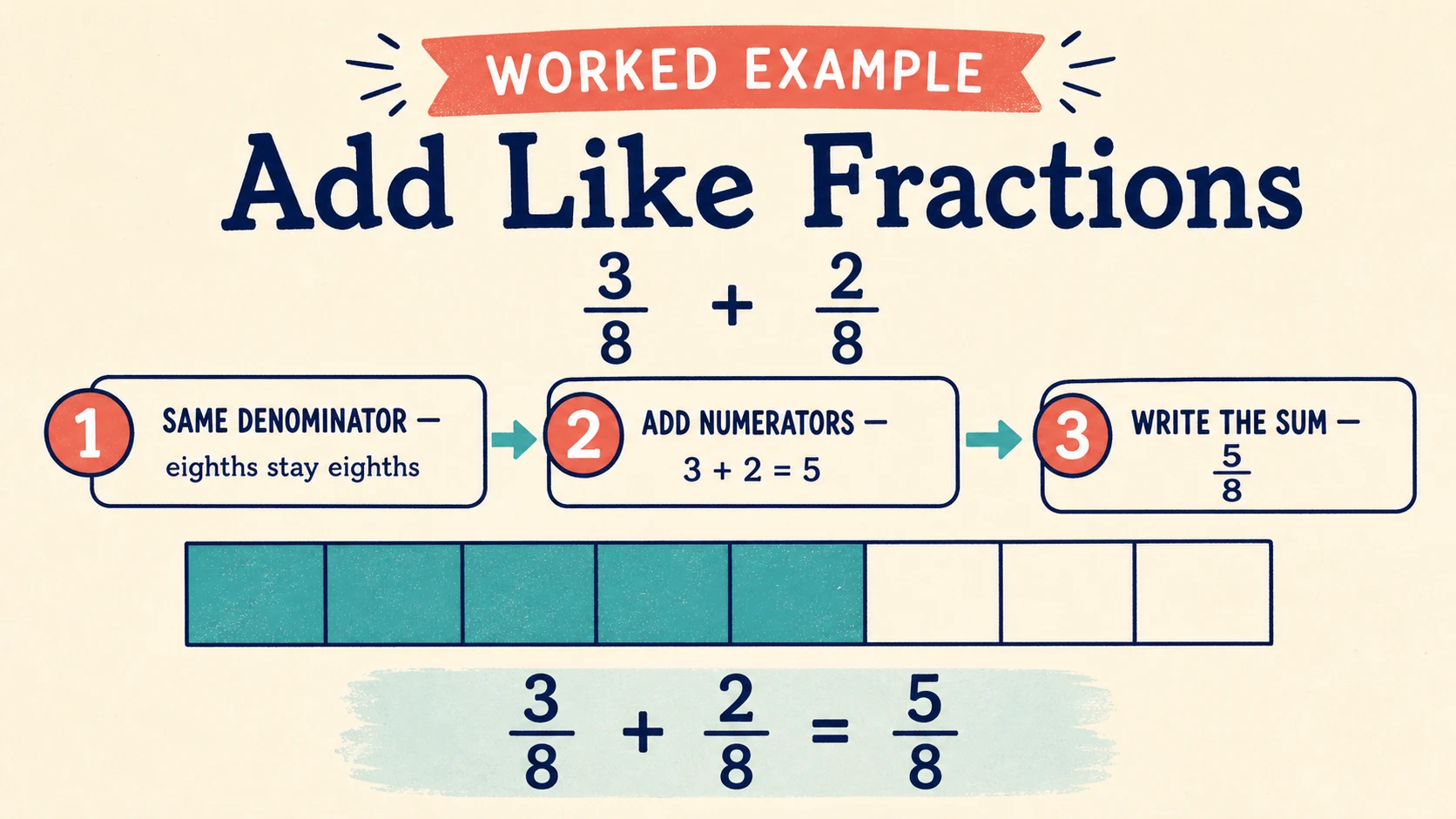
Name the whole, verify equal parts, count all parts, and then count the shaded parts.
Example 1: Four of six parts are shaded
Draw a rectangle and partition it into six equal sections. Shade four.
- The rectangle is the whole.
- Six equal parts make the whole, so the denominator is 6.
- Four parts are shaded, so the numerator is 4.
- The fraction shaded is .
Check: Count from left to right: six sections total and four shaded. The written fraction records those counts in the correct places.
Do not change the response to unless the direction asks for simplest form. Both fractions name the same amount, but directly describes four shaded parts out of the six displayed parts. The supplied key gives for item 1.
Example 2: One of four parts is shaded
Draw a strip divided into four equal sections. Shade one.
- There are four equal sections altogether.
- One section is shaded.
- The answer is .
Check: The denominator cannot be 1, because the whole was divided into four parts. The numerator cannot be 4, because only one part is shaded. The supplied key uses for item 6.
This example exposes a numerator-denominator reversal. A learner who writes may have counted correctly but assigned each count to the wrong position.
Example 3: Seven of eight parts are shaded
Draw eight equal boxes in one row and shade seven.
- The whole collection of eight boxes is the model.
- Eight equal parts make the whole.
- Seven parts are shaded.
- The fraction is .
Check: One part is unshaded, so seven must be shaded because . The answer is less than one whole because not all eight parts are shaded. The supplied key gives for item 5.
This is a useful near-whole case. If the learner writes , ask whether the prompt requests the shaded or unshaded fraction.
Example 4: Four of eight parts are shaded
Partition an identical whole into eight equal pieces and shade four.
- The denominator is 8.
- The numerator is 4.
- The model is labeled .
Check: Four shaded and four unshaded parts account for all eight parts. The shaded region covers half the whole, so . However, the supplied key gives for item 11 because that notation matches the displayed partition count described by the answer.
Accepting requires a deliberate scoring decision. It is mathematically equivalent, but it does not show whether the learner counted eight displayed parts. Ask the learner to explain, then record both forms: .
Example 5: One of eight parts is shaded
Draw a whole divided into eight equal parts and shade one.
The total count is 8, the shaded count is 1, and the fraction is .
Check: A unit fraction has numerator 1. Because the same whole is split into eight equal pieces, each piece is one eighth. The supplied key gives for item 21.
Contrast this with using equal-sized wholes. One fourth is larger because dividing the same whole into four parts produces larger pieces than dividing it into eight. That contrast prepares comparison reasoning without changing the current identification task.
Move from guided practice to independent work
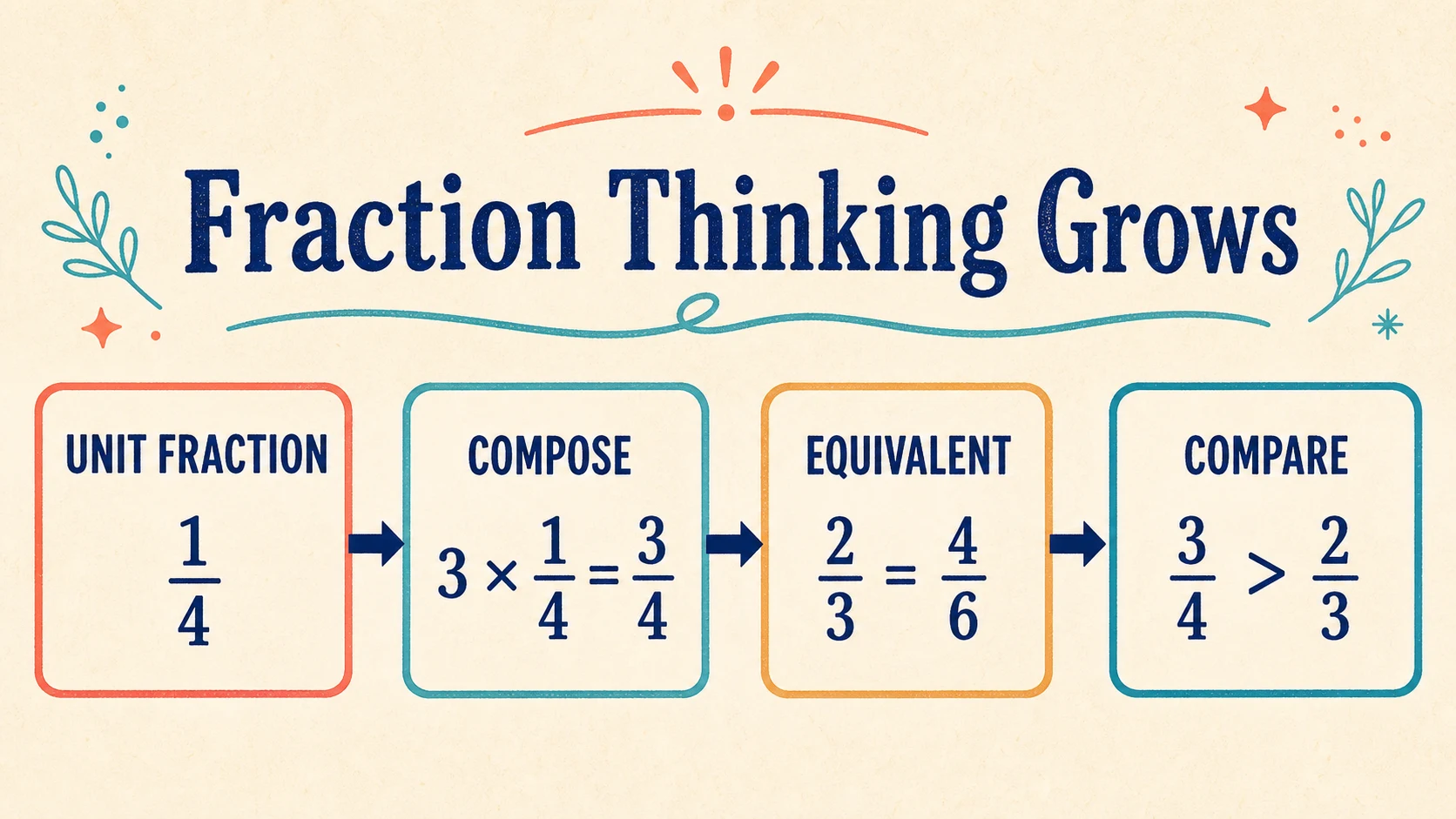
Reduce prompts only after the learner can connect both counts to the fraction symbol.
Start with one complete think-aloud
Use a model that is not one of the assigned practice items. Point and narrate:
“I find the whole first. I see six equal parts in the whole, so 6 goes below the bar. I count two shaded parts, so 2 goes above the bar. The fraction is .”
Then ask the learner to repeat the reasoning in different words. Avoid memory devices that disconnect the number positions from their meanings.
Share responsibility across three models
For the first guided model, identify the whole while the learner performs both counts. For the second, ask the learner to identify the whole and denominator; supply help only if needed. For the third, let the learner complete the entire explanation.
Useful prompts include:
- “What is one whole here?”
- “Are these equal parts?”
- “Which count tells how many parts make the whole?”
- “Which count tells how many are shaded?”
- “How can you check that no part was counted twice?”
If the learner answers after each prompt but cannot begin independently, continue guided practice. Prompt-dependent accuracy is not yet independent control of the task.
Assign the 22 items in purposeful blocks
Do not assume that “easy” means all 22 should be completed at once. Try items 1–4 as the first independent block if the models are visible. Review the work, then decide whether to continue.
A sensible release might be:
- two adult-created warm-up models;
- two or three guided examples;
- four independent worksheet items;
- a brief accuracy and explanation check;
- another block only if the learner remains accurate and attentive.
Stop when errors become repetitive or the learner begins guessing. Continuing through the page may rehearse the wrong method.
Adapt support without changing the skill
Differentiation should preserve the target: identifying the shaded fraction of one whole partitioned into equal parts. Changing to unrelated arithmetic or supplying the answers would remove the skill rather than support it.
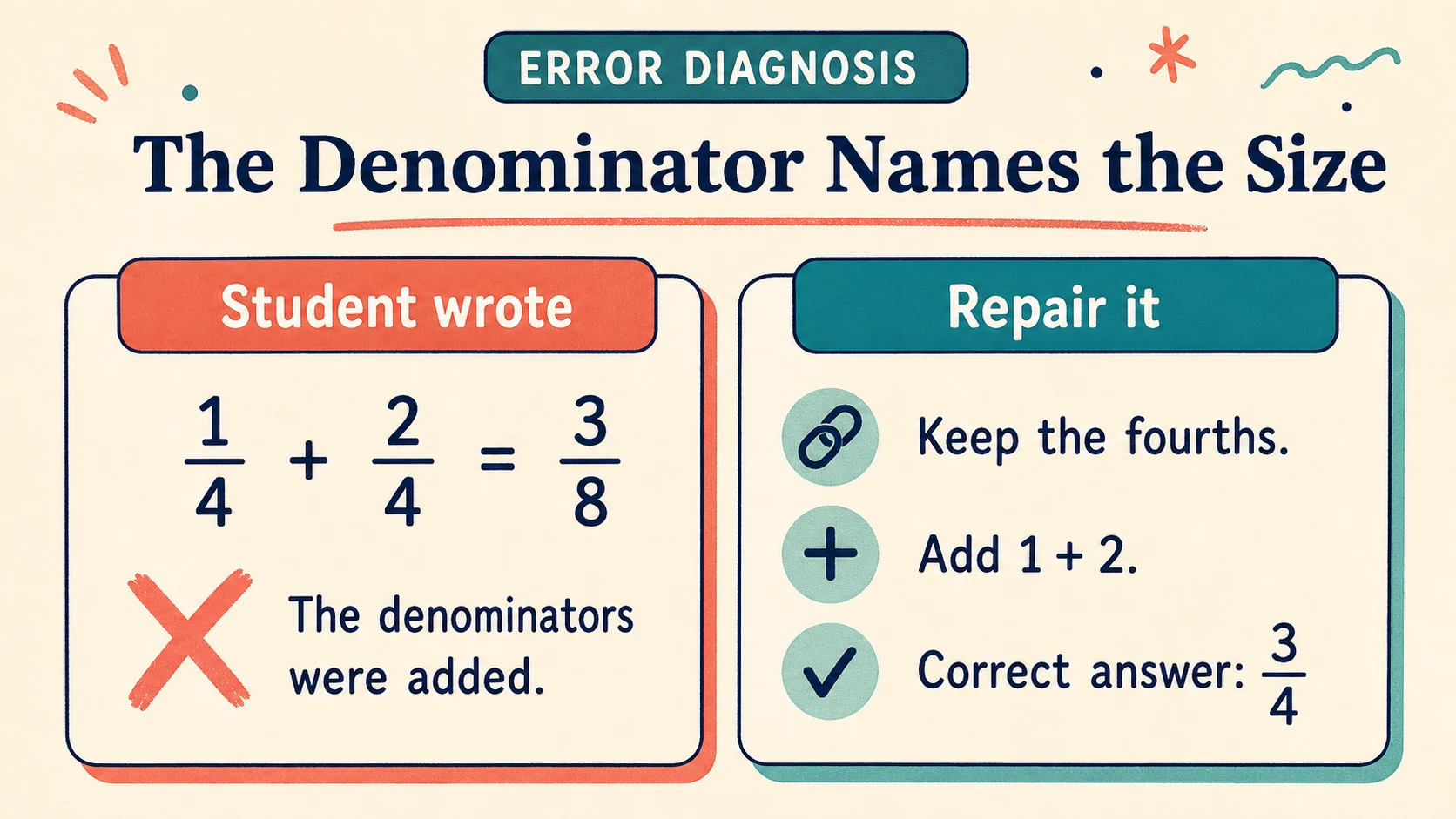
Adjust visual clarity, prompting, and response load while keeping the fraction-identification goal intact.
Provide more structure
For a learner who loses track while counting:
- number each equal region lightly;
- trace the outside boundary of the whole;
- place a dot in every shaded region after it is counted;
- provide a fraction frame with boxes above and below the bar;
- cover later rows so only one item is visible.
Say, “Total equal parts go below; shaded parts go above.” Then fade the reminder once the learner uses it reliably.
If the learner is not yet secure with eighths, rehearse halves, thirds, and fourths with separate adult-drawn models. Return to the worksheet when the smaller number of parts can be handled without guessing. This changes the temporary visual load, not the mathematical goal.
Reduce writing demands
A learner may understand the model but struggle to form a compact stacked fraction. Allow the learner to say “three fifths,” point to numerator and denominator cards, or write 3/5 with a slash. Follow with one conventional written example.
This is an instructional access suggestion, not medical or child-specific guidance. If an individual learner has an established accommodation plan, follow that plan and local professional guidance.
Extend reasoning without skipping ahead
For a learner who identifies every fraction accurately, add one explanation rather than more of the same:
- “What fraction is not shaded?”
- “Is this amount less than, equal to, or greater than one half? Show why.”
- “Can you draw a different-looking whole with the same fraction shaded?”
- “Can this fraction have an equivalent name?”
Keep the original fraction visible so the extension remains connected to the model. For instance, after naming , the learner can show why it is equivalent to . Do not treat this extension as evidence that all comparison or equivalence skills are secure.
The IES guide for assisting students struggling with mathematics provides high-level framing for systematic teaching, clear mathematical language, representations, and deliberate review. It does not offer a judgment about this worksheet or prescribe one response for every learner.
Interpret mistakes before assigning more practice
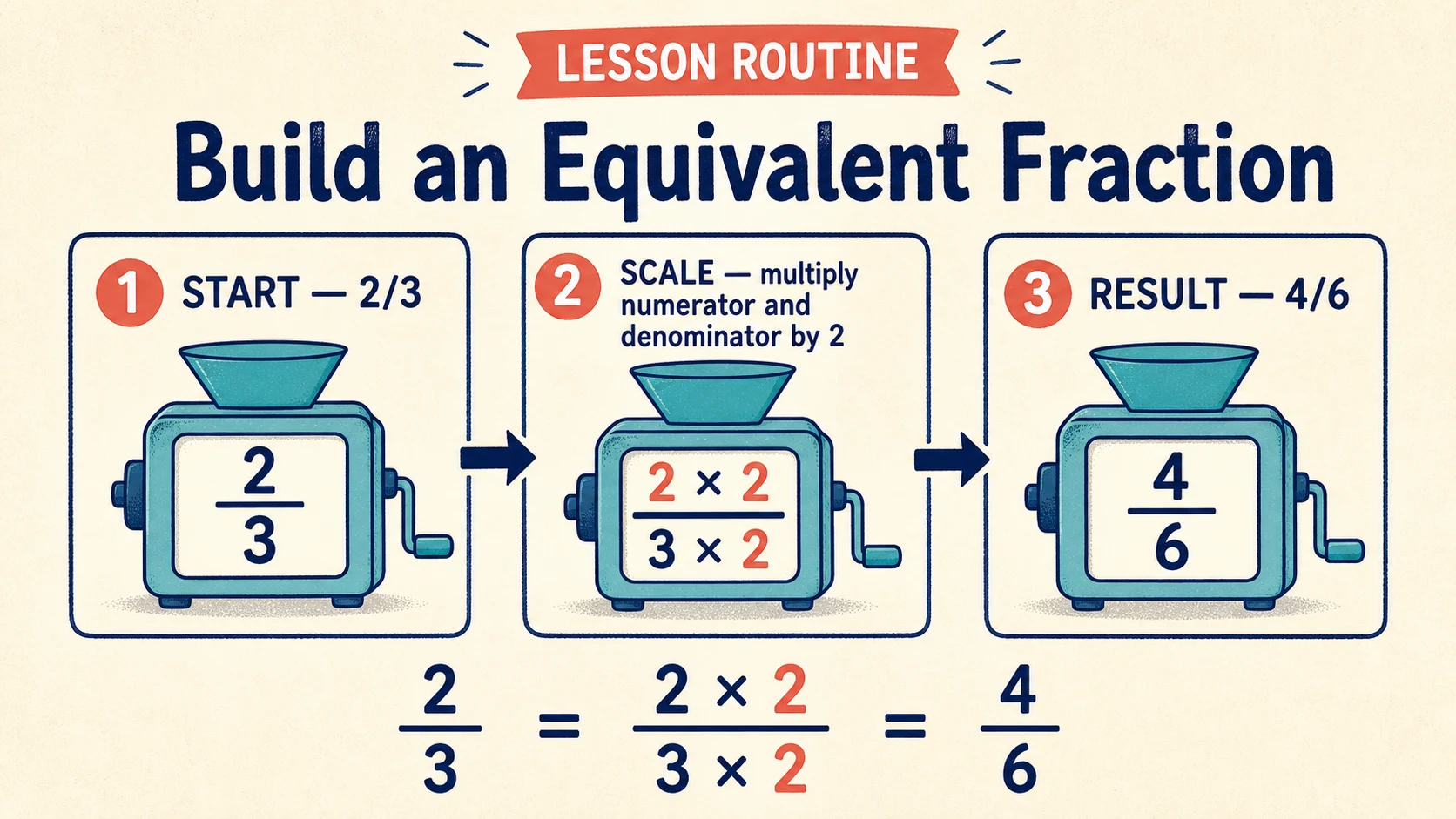
Locate the decision that broke down: whole, equality, total count, shaded count, or notation.
A raw score cannot explain why an answer is wrong. Sort errors by their likely source and confirm your interpretation by asking the learner to demonstrate the method.
| Observed work | Possible interpretation | Immediate response |
|---|---|---|
| Writes for four shaded parts out of six | Numerator and denominator reversed | Recount, label “shaded” and “total,” then rewrite |
| Writes when four of six are shaded | Counts unshaded parts | Reread the prompt and mark shaded regions |
| Writes when six parts exist | Misses a faint or boundary region | Trace every partition and count once |
| Accepts unequal regions as equal shares | Equal-part condition is not secure | Compare equal and unequal partitions |
| Writes for a four-of-eight model | Simplifies rather than records the displayed parts | Ask for both and , then discuss the task |
| Gives inconsistent answers to similar models | May be guessing or losing count | Reduce the block and require a brief explanation |
| Cannot answer because the model is absent | Resource display failure, not a mathematical error | Omit the item or replace the model |
Separate conceptual and recording errors
A learner who says “four out of six” but writes understands the counts and needs work connecting meaning to notation. A learner who says there are five total regions when six are visible has a counting or visual-tracking problem within the task. A learner who never checks equality needs conceptual work on fractions as equal shares.
These are different teaching needs. Repeating 22 undifferentiated items is unlikely to clarify which decision should change.
Correct through reconstruction
Instead of erasing the answer and supplying the right one, have the learner:
- trace the whole;
- mark every equal part;
- circle or touch each shaded part;
- say both counts aloud;
- write a new fraction; and
- explain why the two number positions are correct.
Then use a fresh but similar model. Correcting the original with heavy prompting does not show whether the learner can transfer the reasoning.
Use the answer key responsibly
The separate answer key lists these responses in item order:
| Items | Keyed answers |
|---|---|
| 1–4 | |
| 5–8 | |
| 9–12 | |
| 13–16 | |
| 17–20 | |
| 21–22 |
Use the key after the learner has attempted visible, valid models. Compare one item at a time and return to the corresponding figure whenever an answer differs.
Do not use the key to manufacture a score for the currently reviewed learner PDF if its shaded figures remain missing. Without the models, the prompts do not contain enough mathematical information to derive those answers. A blank response in that circumstance is not evidence of fraction difficulty.
Equivalent responses require judgment. If a model shows two shaded parts out of four and the learner writes , the amount is correct, while the key’s preserves the model’s actual part counts. Ask for an explanation and note the distinction rather than marking the response wrong without discussion.
Also avoid converting the key into a public read-aloud list before practice. The purpose of checking is to examine reasoning, not to help the learner remember an answer sequence.
Decide what to teach next
Use patterns across several items, not a single mistake.
- If the learner cannot identify equal partitions, return to folding and partitioning identical paper strips.
- If total counts are accurate but shaded counts are not, practice distinguishing shaded from unshaded regions.
- If numerator and denominator are reversed, continue identification with labeled fraction frames.
- If identification is consistently accurate, connect the same fractions to number lines.
- If , , and prompt observations about halves, begin visual equivalence work.
- If the learner can justify simple equivalents, introduce appropriate comparisons using the same whole.
The complete sequence belongs in the 3rd Grade Fractions topic guide. Related practice can also be found through the 3rd Grade Math collection. The focused 3rd Grade Fractions Worksheet Pack contains 18 worksheets, but a larger practice pool is useful only when its tasks match the learner’s demonstrated next need.
Schedule retrieval from observed work
Retrieval means returning to the idea after some time has passed, without simply copying the previous solution. The schedule below is a practical option, not a universal timetable.
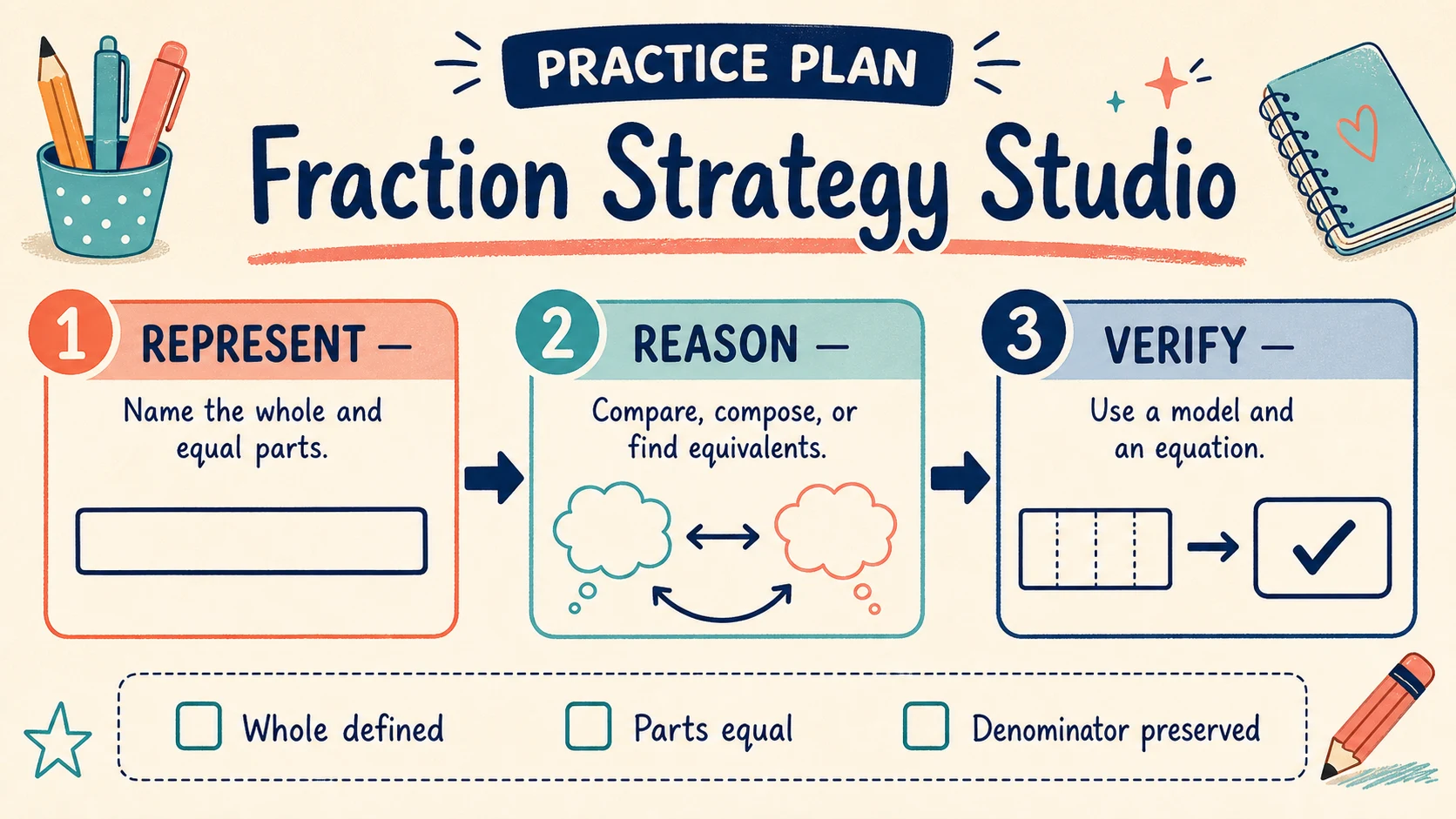
Revisit a small, varied sample and adjust the interval according to what the learner remembers.
| Suggested point | Brief task | What to observe |
|---|---|---|
| End of the first lesson | One new adult-drawn model | Can the learner apply the routine immediately? |
| Two or three days later | Three models with different denominators | Are numerator and denominator meanings retained? |
| About one week later | Two identifications and one equal-versus-unequal boundary case | Does the learner still require prompts? |
| About two weeks later | One shaded model, one equivalent-fraction connection | Can the learner explain rather than merely label? |
| During later fraction work | One mixed review item | Is identification still available within a broader task? |
When retrieval is accurate and well explained, increase the interval or move to the next representation. When the learner reverses the numbers or ignores equal parts, shorten the interval and return to a clear model. When visual figures fail to display, replace them before interpreting performance.
Limitations and the honest next action
This worksheet is a narrow practice resource. It can support fraction identification, but it cannot by itself establish a complete understanding of equivalence, comparison, number lines, or operations. Its “easy” label describes catalogue difficulty, not a promise that every learner will find the page easy. It carries no guarantee of outcomes, no universal pacing recommendation, and no comprehensive claim about local standards alignment.
Most importantly, the reviewed learner PDF did not display the shaded models needed to solve its 22 prompts. Check the current download before use. If the figures are visible in your copy, teach one model, guide a few items, assign a small independent block, and use the key to investigate reasoning. If they are not visible, set the page aside rather than scoring it.
Your most useful next action is to open the free worksheet and run that visual preflight. If the models are unavailable—or if identification is already secure—move directly to the broader fractions guide and related free practice to choose the next representation from the learner’s observed work.
Put it into practice
Use the guide with a real printable
Move from explanation to a short, observable practice task. Check the first item together, then adjust the next session from the learner's actual work.
See the 18-worksheet pack