Complete guide
How to teach and practise 3rd grade division worksheets - standard theme (easy)
How to Use This 25-Item Division Worksheet
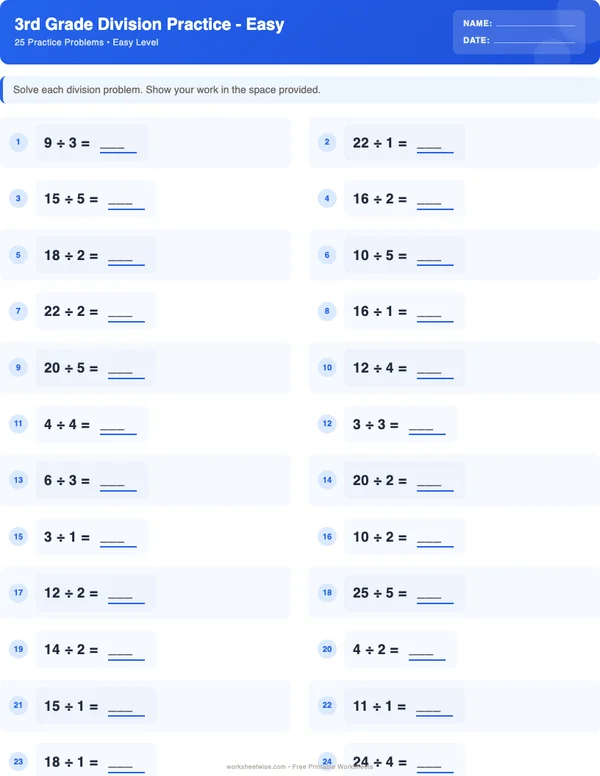
The free 3rd Grade Division worksheet provides 25 easy-level exercises covering division facts, mental math, number sense, long division, and remainders. The learner is asked to solve each problem and show work in the available space. A separate printable answer key is included.
The short answer: preview the page, model one or two comparable problems, complete a small group of items together, and then release the learner to work independently. Check reasoning as well as answers. If errors follow a pattern, reteach that specific idea before assigning more problems.
Grade labels describe the intended practice level, not a guarantee that every local curriculum presents the material at the same time. Local sequences differ. Use the learner’s observed work—not the label alone—to decide the amount of modeling, the length of the session, and the next task.
This guide concentrates on using this particular printable. For the wider development from equal groups through more advanced division, use the broader 3rd Grade Division topic guide.
A Practical Lesson Map
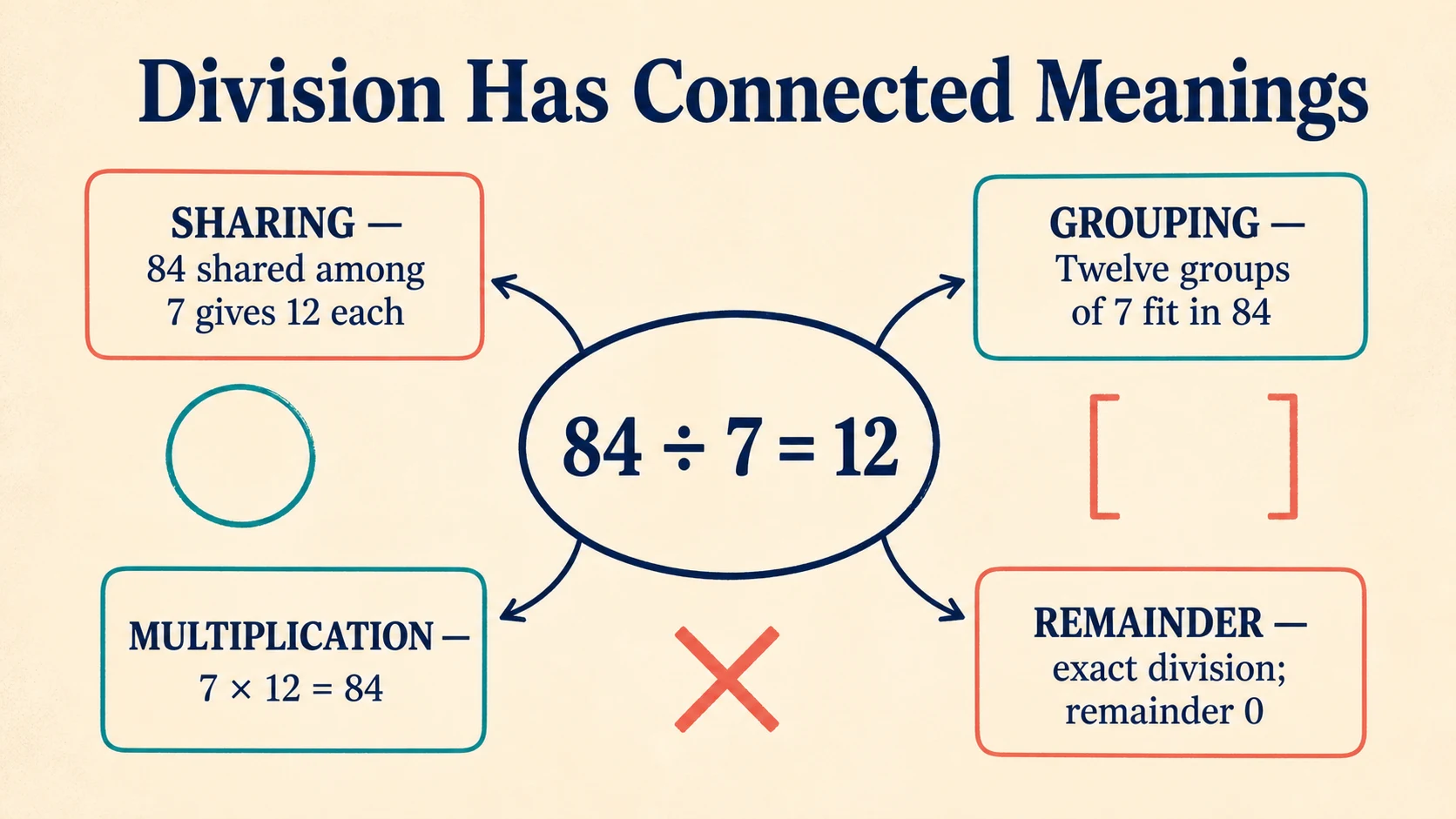
Move from a brief readiness check to modeling, guided practice, independent work, feedback, and later retrieval.
The entire sheet does not have to be completed in one sitting. A learner who explains the first several items accurately may be ready for a longer independent block. A learner who counts uncertainly, confuses multiplication and division, or cannot interpret a remainder will benefit from a shorter set followed by immediate discussion.
| Lesson phase | Suggested use of the worksheet | What the adult observes |
|---|---|---|
| Preview | Scan all 25 items before teaching | Changes in notation, number size, or remainder demands |
| Readiness check | Ask two oral equal-group questions | Whether the learner understands sharing and grouping |
| Adult model | Demonstrate one comparable fact and one written problem | Whether each written step has meaning |
| Guided practice | Solve two or three selected worksheet items together | Strategy choice, multiplication recall, and recording |
| Independent practice | Assign a manageable block from the printable | Accuracy, stamina, and whether work can be explained |
| Review | Discuss selected correct and incorrect responses | Whether the learner can verify and revise |
| Retrieval | Revisit a few comparable problems later | Whether learning is retained without immediate prompting |
This is an instructional suggestion, not a universal timetable. A homeschool family might pause between phases. A tutor might use only part of the sheet during one appointment. A classroom teacher might use selected items for a small group and reserve the rest for independent practice.
Prepare the Worksheet Before the Learner Begins
Print both the worksheet and its separate answer key, but keep the key out of view during initial practice. Read every problem yourself. The catalogue describes a mixture of division facts, mental math, number sense, long division, and remainders, so do not assume all 25 items make the same demand.
Notice where the task changes. Look for questions such as these:
- Are some quotients exact while others leave remainders?
- Does the learner need to recall a fact mentally, record written steps, or do both?
- Are all divisors familiar?
- Is there enough workspace for the learner’s current handwriting and method?
- Would the learner need a separate sheet of paper to keep place-value work clear?
Do not preteach every possible method. Instead, identify the first meaningful hurdle and prepare one comparable example. The worked examples below are created for instruction; they are not presented as copies of the worksheet’s actual items.
Run a two-minute readiness check
Before displaying the division symbol, try two oral situations:
- “Twelve counters are shared equally among three people. How many does each person receive?”
- “Twelve counters are placed into groups of four. How many groups can be made?”
Both situations lead to 12 ÷ 3 = 4 or 12 ÷ 4 = 3, but they frame division differently. The first asks for the amount in each share. The second asks for the number of groups. This distinction comes from the supplied topic guidance and gives the adult a useful way to test meaning without changing the target skill.
If the learner can build or describe both situations, proceed to symbolic work. If not, use counters, buttons, cubes, or quick circles and dots before returning to the printable. That support preserves the division skill; it simply makes the quantities visible.
The IES guide on teaching mathematics to young children supports high-level practices such as using progressions, monitoring what learners know, and helping them connect informal mathematical ideas with more formal representations. It did not evaluate this WorksheetWise printable.
Model the Meaning Before the Procedure
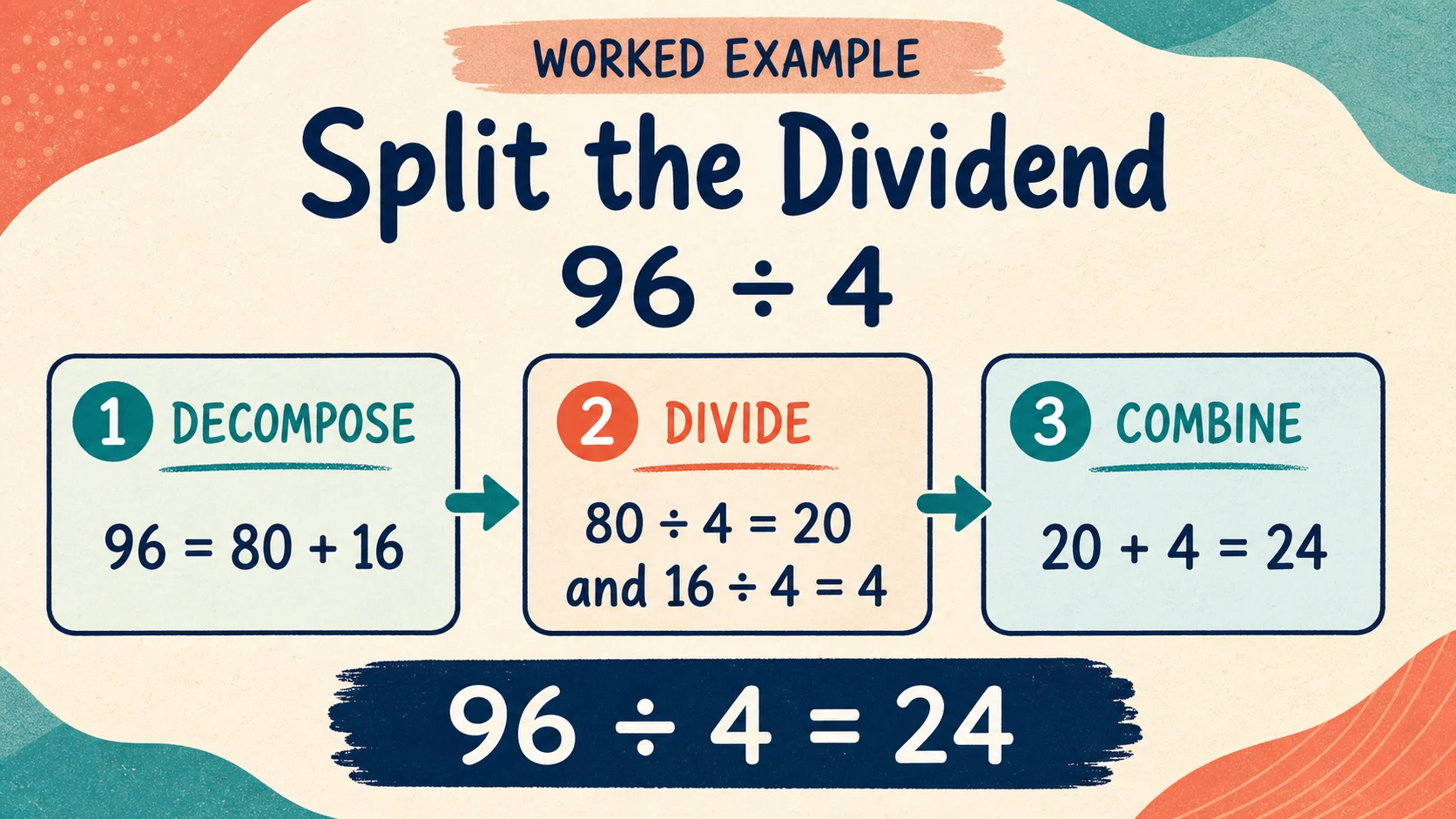
Connect the quotient to equal groups, multiplication, and a verification step.
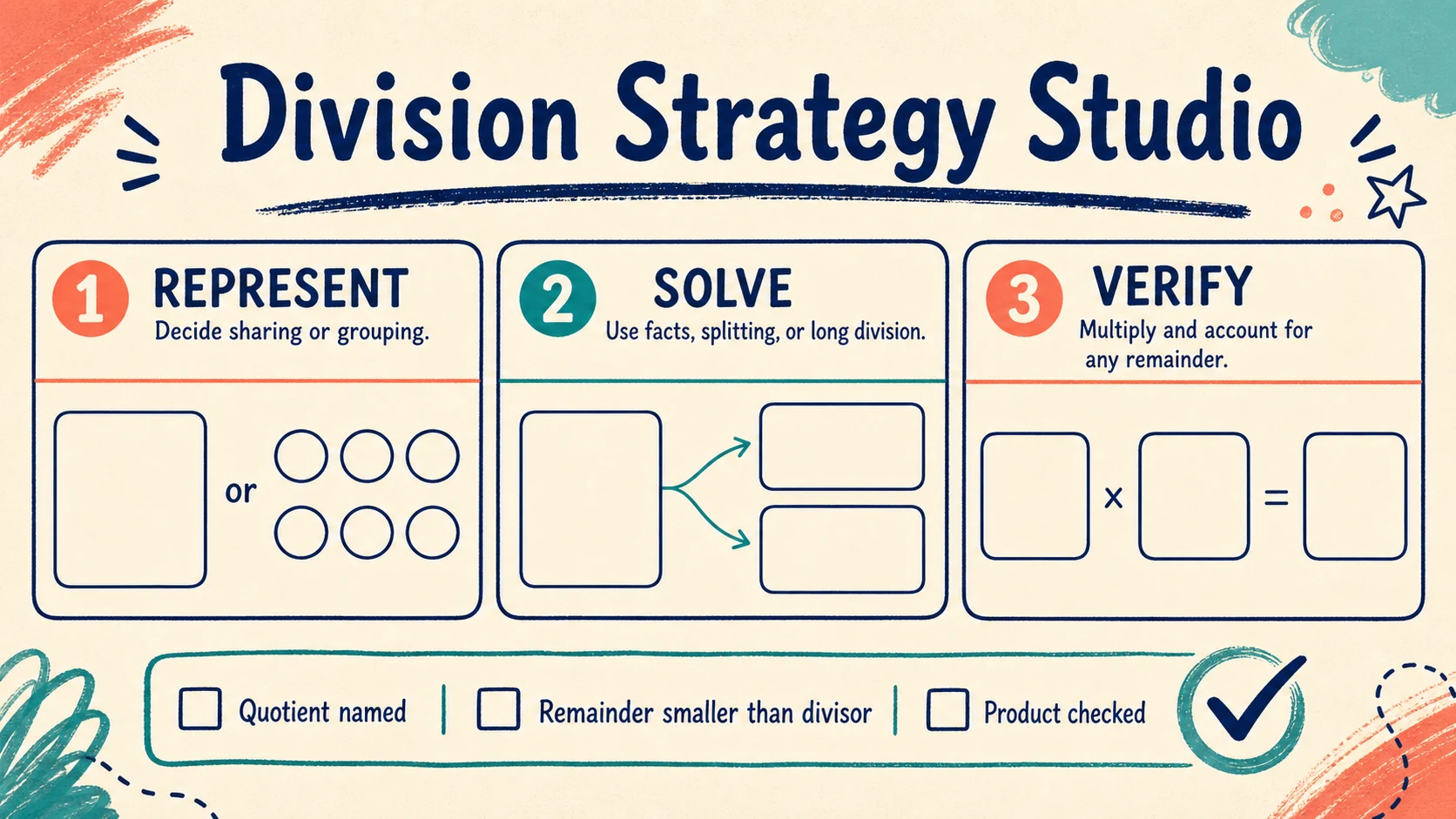
Keep the model concise. The learner needs to see what to notice, what to write, and how to check—not listen to a long lecture. A useful script is:
“I am dividing a total into equal groups. I will use a multiplication fact to find the quotient. Then I will multiply to check.”
Worked example 1: an exact division fact
Solve:
24 ÷ 6 = ?
Ask, “Six times what number equals 24?”
Because:
6 × 4 = 24
the quotient is:
24 ÷ 6 = 4
Check:
4 × 6 = 24
The product returns exactly to the dividend, so the answer is verified.
A concrete interpretation is also possible: 24 objects arranged in groups of 6 make 4 equal groups. Alternatively, 24 objects shared equally among 6 recipients give 4 to each recipient. Either interpretation supports the same equation.
Worked example 2: use the inverse relationship
Solve:
35 ÷ 5 = ?
Write the related unknown-factor equation:
5 × □ = 35
Since:
5 × 7 = 35
then:
35 ÷ 5 = 7
Check:
7 × 5 = 35
This example makes the relationship between multiplication and division explicit. A learner who does not instantly recall the quotient can skip-count by fives—5, 10, 15, 20, 25, 30, 35—and count seven groups. That is a temporary strategy, not evidence that the learner has failed.
The supplied topic description identifies division as the inverse of multiplication. The Common Core mathematics standards also frame Grade 3 division through equal groups, word problems, unknown factors, and work toward fluency within 100. That source provides broad curricular context; it should not be read as certification or comprehensive standards alignment for this exact worksheet.
Move Through Guided Practice Deliberately
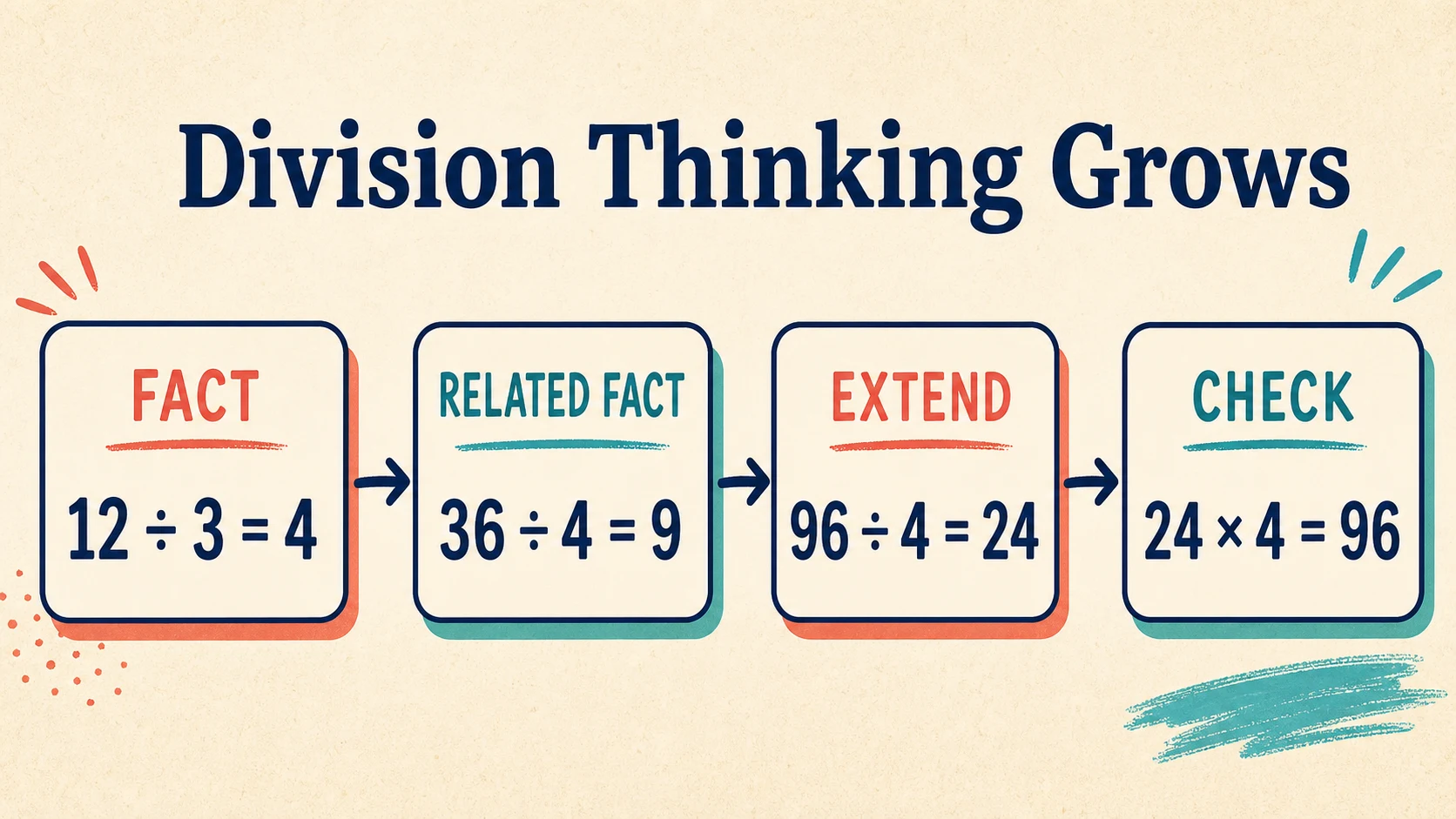
During guided practice, ask for the learner’s next step before supplying it.
Choose two or three worksheet items that represent the demands you noticed during preview. Avoid selecting only the first items automatically; the first section may not show every skill included later on the page.
For the first guided item, let the learner identify the dividend, divisor, and needed quotient. For the next one, ask the learner to select a strategy. By the third, reduce prompting and observe whether the process continues independently.
Useful prompts include:
- “What total is being divided?”
- “What does the divisor tell you?”
- “Which multiplication fact could help?”
- “Will the answer be exact?”
- “What can you multiply to check?”
- “If there is a remainder, is it smaller than the divisor?”
Avoid prompts that reveal the answer, such as “Is it seven?” A prompt should direct attention to the mathematical relationship.
Worked example 3: a quotient with a remainder
Solve:
29 ÷ 4
Find the greatest multiple of 4 that does not exceed 29:
4 × 7 = 28
Subtract:
29 − 28 = 1
Therefore:
29 ÷ 4 = 7 remainder 1
A compact notation is:
29 ÷ 4 = 7 R1
Check:
4 × 7 + 1 = 28 + 1 = 29
Also check the boundary condition:
1 < 4
The remainder is smaller than the divisor, so the result is valid.
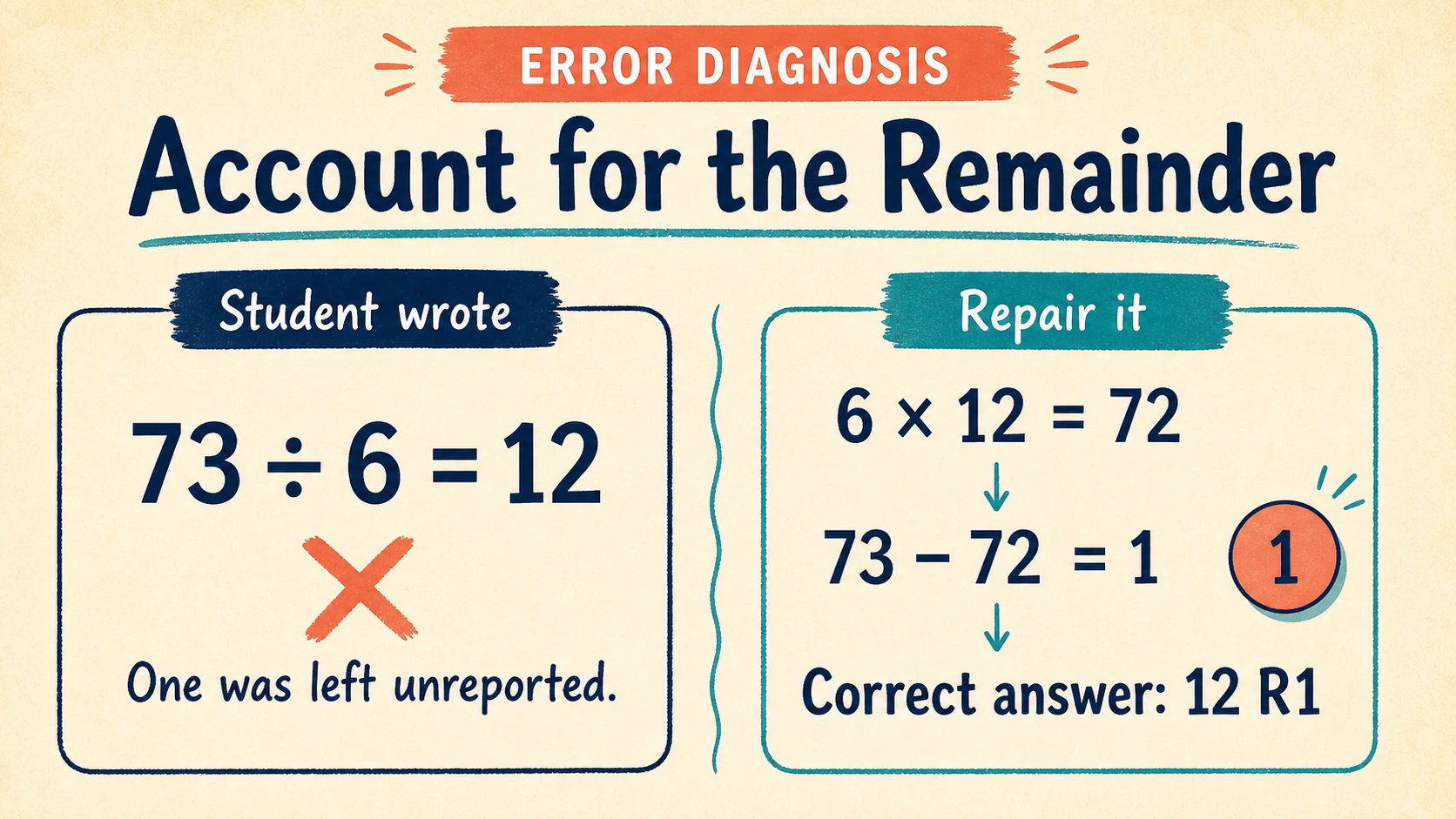
A learner who writes 6 R5 has accounted for the total because , but the form is not finished: the remainder is at least as large as the divisor, so another complete group of 4 can still be made. Regrouping gives 7 R1.
Worked example 4: a boundary case with zero
Solve:
0 ÷ 6 = ?
The question asks how many groups of 6 can be made from zero objects. The answer is zero:
0 ÷ 6 = 0
Check:
0 × 6 = 0
This is different from dividing by zero. An expression such as 6 ÷ 0 does not have an ordinary whole-number quotient, because there is no number that can satisfy 0 × □ = 6. If such a notation question arises, state the distinction briefly. Do not turn an easy practice session into an extended lesson outside the sheet’s target.
Worked example 5: a written place-value example
For a comparable written-division model, solve:
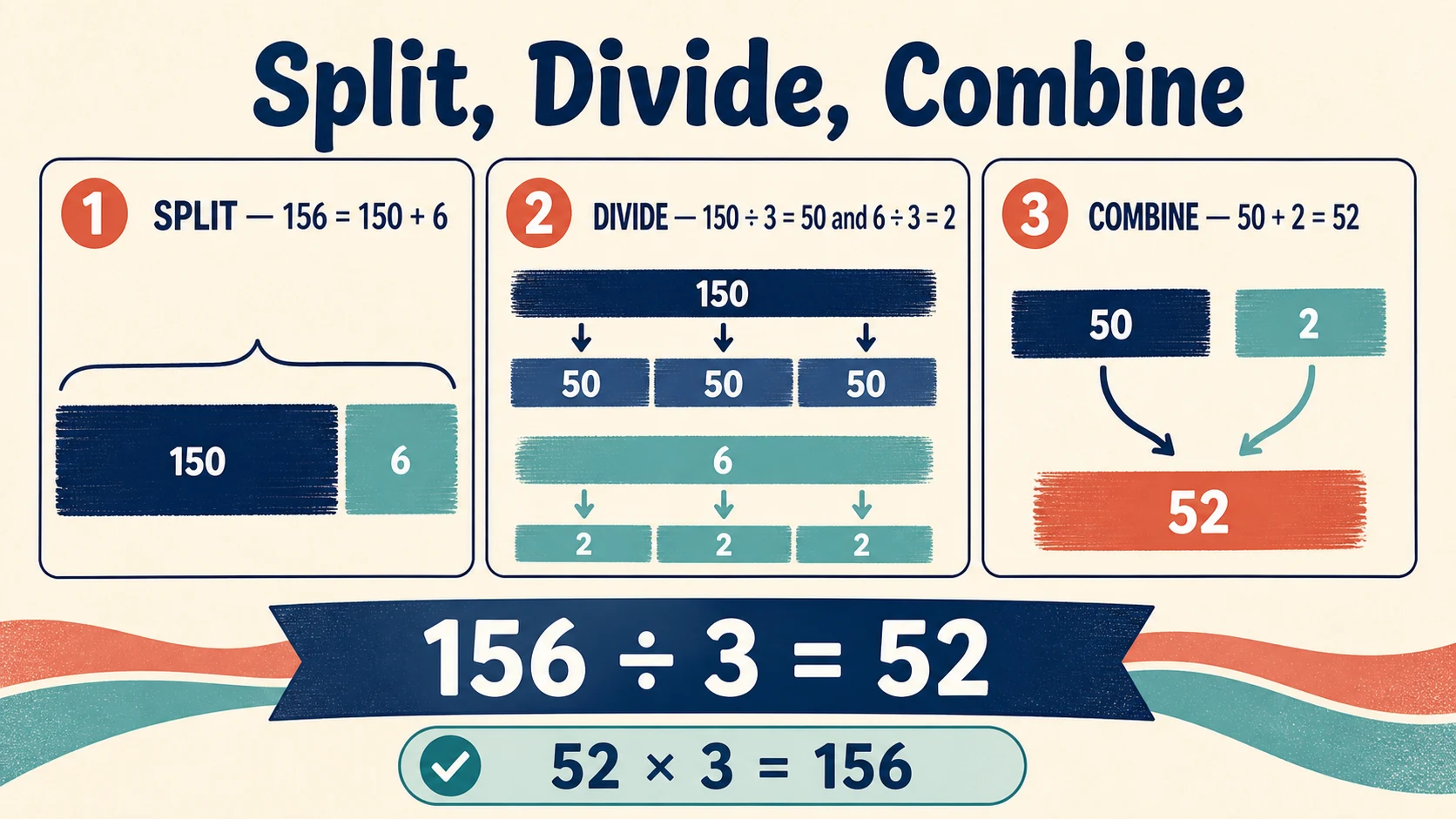
84 ÷ 4
Interpret 84 as 8 tens and 4 ones.
- Divide 8 tens into 4 equal groups: each group gets 2 tens.
- Divide 4 ones into 4 equal groups: each group gets 1 one.
- Combine 2 tens and 1 one: the quotient is 21.
Therefore:
84 ÷ 4 = 21
Check:
21 × 4 = 84
If using long-division notation, connect every recorded step to this place-value account. The supplied topic guidance says that a procedural reminder can be useful only after the learner understands what each step means. For this easy-level sheet, clarity matters more than speed.
Release the Learner to Independent Work
Independent practice begins when the learner can start a problem, choose a workable strategy, and explain a check with limited prompting. It does not require perfect fact recall.
Give a specific assignment, such as “Complete the next five items and mark any one you are unsure about.” That is more useful than saying, “Do the page.” After the block, inspect the work before deciding whether to continue.
Watch the process without hovering
During independent work, observe quietly:
- Does the learner use multiplication to recover division facts?
- Are written numbers aligned clearly?
- Are remainders recorded and smaller than their divisors?
- Does the learner erase repeatedly without trying a check?
- Does accuracy fall when the numbers or notation change?
- Can the learner explain one answer without reconstructing the entire problem?
A correct answer with unreadable or unexplained work may deserve a brief conversation, especially because the worksheet explicitly asks learners to show their work. However, showing work need not mean using the same layout for every fact. For 18 ÷ 3, writing 3 × 6 = 18, so 18 ÷ 3 = 6 is meaningful evidence. Requiring a full long-division setup for every simple fact could obscure rather than reveal understanding.
Pause when the error pattern becomes stable. Ten repetitions of the same misunderstanding usually provide less useful information than one carefully discussed correction. The learner’s observed work should drive pacing.
Adapt Support Without Changing the Division Skill
Adjust visibility, quantity, and prompting while keeping the mathematical goal intact.
Adaptation should help the learner access the same division reasoning. It should not quietly replace the task with unrelated arithmetic or have the adult do the thinking.
For a learner who needs more concrete support
Use counters to build one selected fact. For 18 ÷ 3, the learner can share 18 counters into three equal groups and count six in each group. Then record:
18 ÷ 3 = 6
Finally connect it to:
3 × 6 = 18
Remove the counters on the next comparable problem if the learner can draw equal groups or use the related multiplication fact. The goal is a bridge from objects to symbols, not permanent dependence on materials.
For a learner with uneven fact recall
Provide a blank multiplication grid, equal-group sketches, or permission to write skip-counting sequences. Ask the learner to circle the multiplication fact that verifies each quotient.
Keep the division decision with the learner. A completed fact chart can reduce memory demand, but it also makes the answer easy to copy. If using one, ask for an explanation such as, “I found 32 in the row for 4, so 32 ÷ 4 = 8.”
For a learner who becomes overloaded by a full page
Cover unused rows with blank paper and reveal one short block at a time. Enlarge the page or supply lined scratch paper if alignment is the main difficulty. Schedule a brief pause between blocks.
These changes adjust visual load and work quantity without lowering the mathematical target. Do not infer a diagnosis from worksheet behavior. This guide offers instructional suggestions, not medical or individualized clinical guidance.
For a learner ready for a modest extension
Ask for a second representation rather than simply assigning much larger numbers. After solving 27 ÷ 3 = 9, the learner might draw three equal groups, write 3 × 9 = 27, or create a short sharing situation.
For a remainder answer such as 22 ÷ 5 = 4 R2, ask the learner to explain why R2 is possible and R5 is not. These extensions deepen the existing skill without moving into an entirely different progression.
The IES practice guide for assisting students struggling with mathematics offers high-level guidance about systematic instruction, clear mathematical language, representations, and deliberate practice. It does not prescribe a response for an individual learner and did not review this worksheet.
Interpret Errors Before Correcting Them
Classify the error, revisit the relevant relationship, and then try one comparable problem.
An incorrect quotient is evidence to investigate, not a complete diagnosis. Ask the learner to talk through the work before naming the mistake. The explanation often reveals whether the problem concerns division meaning, multiplication recall, place value, recording, or attention.
| Observed work | Possible interpretation | Productive response |
|---|---|---|
| A nearby multiplication fact was chosen | Compare and ; identify which returns 24 | |
| Division may have been confused with subtraction | Build or draw five equal groups and reconnect to | |
| The remainder was omitted | Compute , compare 24 with 29, and account for the five left | |
| The learner stopped before making every full group | Ask whether another group of 4 fits inside the remainder | |
| Place-value recording may be unstable | Rebuild 84 as 8 tens and 4 ones, then divide each place | |
| Correct answer, no visible reasoning | The fact may be known, guessed, or solved mentally | Ask for a multiplication check rather than assuming either mastery or confusion |
Separate fact errors from division errors
Suppose a learner writes:
42 ÷ 6 = 8
The structure may be understood—the learner knows that a multiplication fact is needed—but the recalled fact is wrong. Ask for a check:
8 × 6 = 48
Since 48 does not equal 42, test a nearby factor:
7 × 6 = 42
Thus:
42 ÷ 6 = 7
That response targets fact retrieval while preserving the learner’s correct strategic idea.
By contrast, if the learner treats 42 ÷ 6 as 42 − 6, the issue is not merely fact recall. Return briefly to equal groups or the unknown-factor equation 6 × □ = 42.
Treat inconsistent errors cautiously
One wrong answer among several well-explained responses may be a copying or calculation slip. Repeated errors of the same type justify focused reteaching. Errors that appear only when a remainder or written layout is introduced suggest that the new feature—not division as a whole—needs attention.
Do not assign labels such as “careless” based on a page. Ask the learner to check, explain, and revise. The resulting conversation provides better instructional evidence.
Use the Answer Key Responsibly
The separate key makes checking faster, but it should confirm mathematical work rather than replace review. Complete or mentally verify the selected items yourself before discussing them. This reduces the risk of reading the wrong row or treating a notation difference as a conceptual error.
A responsible checking routine is:
- Compare the learner’s answer with the key.
- Inspect the written reasoning.
- Verify exact quotients by multiplication.
- Verify remainder results with
divisor × quotient + remainder = dividend. - Confirm that the remainder is nonnegative and smaller than the divisor.
- Invite the learner to revise before supplying the correction.
For example, check 31 ÷ 6 = 5 R1 by calculating:
6 × 5 + 1 = 30 + 1 = 31
and confirming:
1 < 6
If the key and the learner differ, do not immediately announce that the learner is wrong. Recalculate. Check whether the worksheet expects a remainder notation, an exact whole-number quotient, or another presentation. If a genuine discrepancy remains, record the problem number and use a verified calculation rather than forcing agreement with the printed key.
Letting learners check selected answers can be useful after independent effort. Ask them to mark differences and return to the original work before viewing a correction. Copying the key onto unfinished items does not provide evidence of learning.
Decide What to Do After the Worksheet
A score alone does not determine the next lesson. Review accuracy, the kinds of errors, independence, explanations, and whether performance changed across the page.
When to revisit the same level
Stay with comparable easy practice when the learner:
- understands equal groups but recalls facts inconsistently;
- solves exact quotients but mishandles remainders;
- understands the method but loses place value in written work;
- succeeds with guidance and needs another chance to work independently.
Do not immediately repeat all 25 items. Choose a small set that targets the observed need. Similar problems can be created through the free worksheet generators, or another resource can be selected from the 3rd Grade Math hub.
When to broaden practice
Move to varied division practice when the learner solves representative items accurately, checks with multiplication, handles remainders correctly, and explains the method without continual prompting. The 3rd Grade Division Worksheet Pack contains 18 worksheets and may be useful when a family, tutor, or teacher wants a larger bank of related practice. Its catalogue price is $4.79.
Broader practice should still be purposeful. Select work that addresses the next observed need rather than assigning the entire pack by default.
When to step back
Return to equal sharing, equal groups, and related multiplication facts if the learner cannot explain what a quotient represents. Use the division topic guide to place that work within the broader progression instead of trying to reproduce the whole progression through one printable.
This worksheet has useful limits. It is a 25-item practice resource, not a complete division curriculum, diagnostic instrument, universal pacing guide, or guarantee of mastery. It cannot by itself show how well a learner applies division in every context. Written responses should be considered alongside oral explanations, models, and later recall.
Schedule Brief Retrieval After Practice
Revisit a few representative problems after time has passed, and adjust the spacing from observed recall.
Retrieval means asking the learner to solve again after the original work is no longer immediately visible. Do not use the completed sheet as a model during the first attempt.
A practical, adjustable schedule is:
| Time | Retrieval task | Decision |
|---|---|---|
| Later the same session | Explain one completed item and its multiplication check | Clarify reasoning if the explanation is uncertain |
| About 1–2 days later | Solve two comparable facts and one remainder problem | Add a brief model only where needed |
| About one week later | Solve three to five mixed division items | Continue spacing if work is accurate and independent |
| About two weeks later | Include division among other familiar operations | Revisit the specific weak feature if errors return |
These intervals are an instructional example, not a sourced or universal timetable. Shorten the gap when the learner cannot begin without prompts. Lengthen it when recall is accurate and explanations remain clear.
Finish by asking the learner to state one reliable check: “Multiply the quotient by the divisor, then add the remainder if there is one.” For the next session, return to the free 3rd Grade Division worksheet, choose two previously difficult item types, and pair them with the broader division guide before deciding whether more same-level practice or a new division task is appropriate.
Put it into practice
Use the guide with a real printable
Move from explanation to a short, observable practice task. Check the first item together, then adjust the next session from the learner's actual work.
See the 18-worksheet pack