Complete guide
How to teach and practise 3rd grade decimals worksheets - standard theme (easy)
How to Use This 22-Item Decimal Worksheet
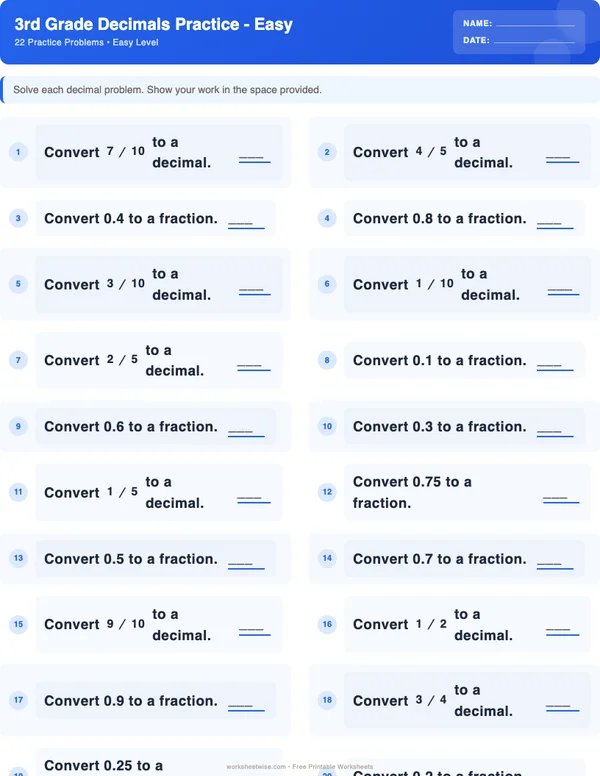
The free 3rd Grade Decimals worksheet provides 22 easy-level exercises involving decimal operations, fraction-decimal conversion, and number sense. The learner is asked to solve each problem and show the work in the space provided. A separate printable answer key is included.
A practical way to use the worksheet is to model one problem, solve two or three together, assign a short independent set, and check the work before continuing. Do not assume that all 22 items should be completed in one sitting. Let the learner’s observed work determine the pace. If the first independent items reveal uncertainty about place value or fraction-decimal relationships, pause for a brief model rather than pushing through the page.
Grade labels describe the intended practice level, not a universal teaching timetable. Local curricula and instructional sequences differ. In particular, the Common Core State Standards for Mathematics place explicit work with decimal notation for tenths and hundredths in Grade 4 and broader decimal computation in later grades. Therefore, this worksheet may serve as an introduction, enrichment, review, or extra reinforcement for a third-grade learner, depending on what has already been taught.
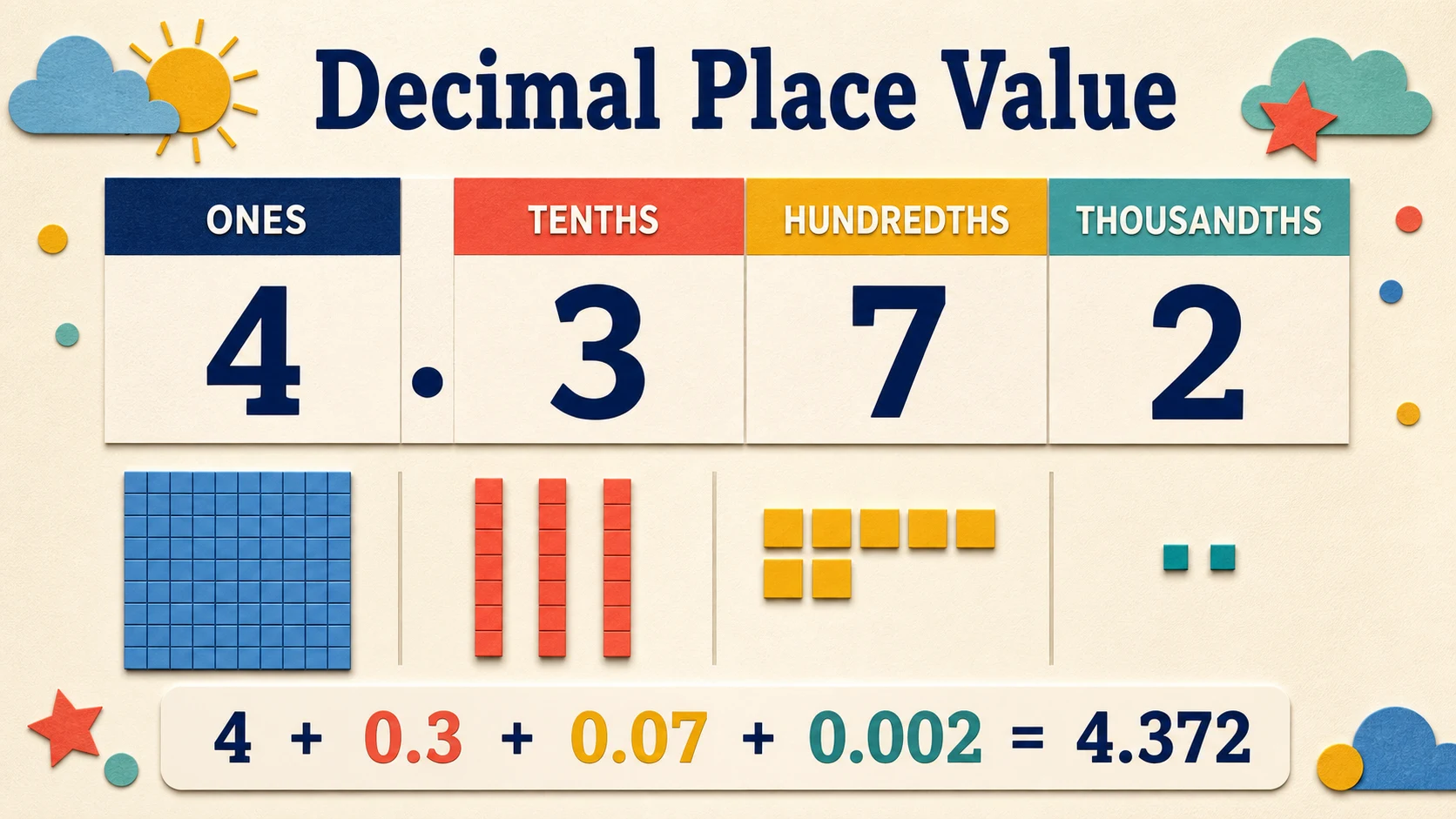
Use a short model–guided practice–independent practice sequence, with checking built in.
What This Worksheet Practices—and What It Does Not Establish
The printable covers four catalogue-listed skill areas:
- Decimals
- Decimal operations
- Fraction-decimal conversion
- Number sense
Its exercises include conversion, addition, subtraction, and multiplication of decimal numbers. Because the difficulty is labeled easy, it is most useful when the adult wants straightforward practice rather than an extensive investigation of why decimal notation works.
The worksheet alone does not establish mastery of the entire decimals topic. Twenty-two written responses can show whether a learner can handle the represented formats under the conditions of that session. They cannot, by themselves, show whether the learner can explain every decimal concept, transfer the skill to unfamiliar contexts, or retain it over time.
For the broader sequence—including place value, comparison, rounding, conversion, and computation—use the Decimals topic guide. That guide provides the wider context; this lesson guide stays focused on launching, supporting, and reviewing this particular printable.
A sensible instructional purpose
Choose one primary purpose before beginning:
- Introduction: The learner has relevant fraction and place-value knowledge but has had limited experience with decimal notation.
- Guided practice: The learner has seen the ideas and needs supported repetition.
- Independent practice: The formats are already familiar, and the adult wants evidence of current accuracy.
- Review: The learner completed similar work previously and needs retrieval after a delay.
- Error analysis: The learner has attempted the page, and the adult wants to identify patterns in the mistakes.
The purpose affects how much help is appropriate. During an introduction, modeling and visual support are expected. During an independent check, extensive prompting would make the result harder to interpret.
Prepare the Lesson Before the Learner Starts
Print the worksheet and keep the answer key separate. Have a pencil, eraser, and blank paper available. If the learner uses concrete or visual support, prepare a place-value chart, a number line from 0 to 1, fraction strips, or a hundredths grid. These supports clarify the underlying quantities without changing the target skill.
Review the page yourself first. Identify where the exercise type changes—for example, from fraction-decimal conversion to addition or multiplication. Those transitions are natural stopping points. They also help you avoid treating all 22 items as though they make identical demands.
The catalogue instruction is: “Solve each decimal problem. Show your work in the space provided.” Explain what “show your work” means for the current task. It might mean writing an equivalent fraction, aligning numbers by place value, recording an intermediate calculation, or drawing a quick model. Do not require decorative steps that provide no information.
Check three prerequisites briefly
Before assigning the page, use three oral checks:
- Ask what the digits represent in a familiar whole number such as 34.
- Ask what one tenth of a whole means.
- Ask whether two equal fractions, such as and , represent the same amount.
These checks are instructional probes, not a formal test. If the learner struggles, give a short review of place value or equal parts before introducing several written decimal operations.
The IES guide on teaching mathematics to young children provides broad support for using progressions, monitoring learners’ understanding, and helping them connect mathematical representations. It did not evaluate WorksheetWise or this particular page. Here, those principles translate into starting with a quantity the learner can represent and moving to notation only after the meaning is reasonably clear.
Run a Short, Observable Lesson
The following plan can be divided across more than one session. The time ranges are instructional suggestions, not sourced requirements or universal limits.
| Lesson phase | Suggested action | What to observe | Decision |
|---|---|---|---|
| Readiness check | Review tenths, equal parts, and place value | Can the learner explain the quantities? | Review a prerequisite if needed |
| Adult model | Demonstrate one representative problem | Does the learner track the meaning of each digit and symbol? | Repeat with a visual if meaning is unclear |
| Guided practice | Solve two or three items together | Can the learner choose and carry out a step with a small prompt? | Reduce or continue support |
| Independent set | Assign four to six items | Are errors isolated or repeated? | Continue, pause, or reteach |
| Second set | Complete another short group | Is accuracy stable without new prompts? | Finish now or defer remaining items |
| Check and correct | Compare methods and answers | Can the learner locate and explain an error? | Select a focused follow-up |
| Retrieval | Revisit selected items after a delay | Is the skill still available? | Schedule further review if necessary |
Launch with quantity, language, and notation
Begin with a simple relationship such as:
Say, “Three tenths means three of ten equal parts. In decimal notation, the 3 is in the tenths place.” Point to the denominator, the shaded or imagined parts, and the decimal digit.
Then contrast the roles of the digits in , , and . The learner does not need a long lecture, but should see that moving a digit changes its value. Ask for an explanation in the learner’s own words before moving to computation.
Model one complete response
Use a think-aloud that is short enough to imitate:
“I will identify the operation, note each number’s place value, calculate, and then check whether the answer is reasonable.”
For an addition item such as , show tenths explicitly:
The spoken explanation matters: four tenths plus three tenths equals seven tenths. Avoid presenting the decimal point as a mark that is moved or copied without meaning.
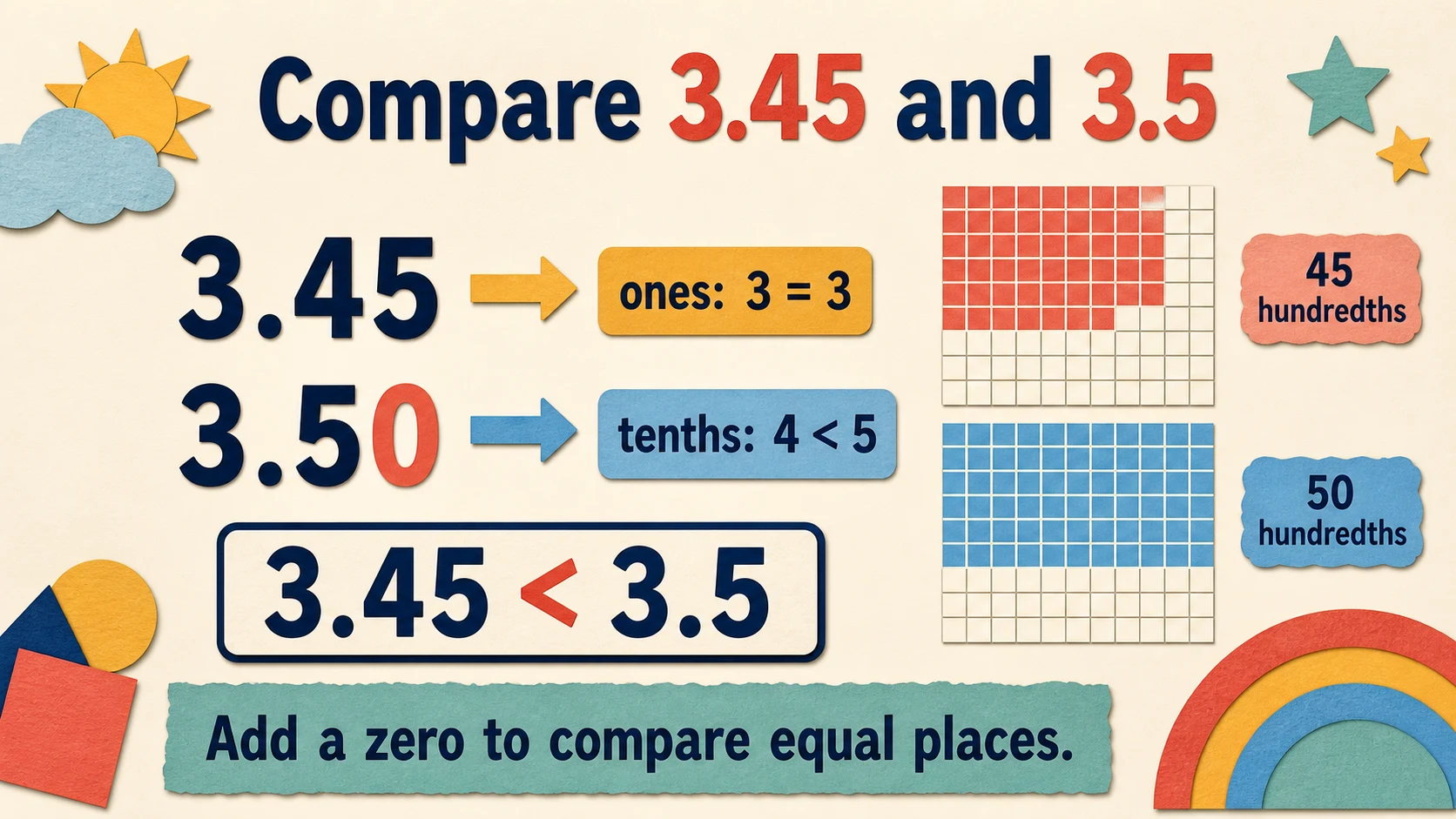
Connect each written step to tenths, hundredths, or an equivalent fraction.
Use Fully Checked Examples to Establish the Method
The examples below practice the worksheet’s listed skill types. They are teaching examples, not claims about the exact wording or order of the printable’s numbered items.
Example 1: Convert a fraction to a decimal
Convert:
A denominator of 10 indicates tenths. Six tenths is written with 6 in the tenths place:
Check: Multiply the decimal by 10 to count the tenths:
The result confirms that contains six tenths.
A useful boundary comparison is:
These endpoints show that tenths range from none of the whole to the complete whole. They also prevent the mistaken idea that every fraction written with 10 as its denominator must remain below 1.
Example 2: Add decimal tenths
Solve:
Interpret both numbers as tenths:
Check with subtraction:
The inverse operation returns the original addend, so the calculation is consistent.
Reasonableness check: Both addends are positive, so the sum should be greater than . It should also be less than 1 because two tenths plus five tenths makes only seven tenths.
Example 3: Subtract decimals
Solve:
Write the quantities as tenths:
Check with addition:
This confirms the difference.
A boundary case helps clarify zero:
Equal quantities have a difference of zero. An answer such as represents the same value as , although a particular answer key may choose one form.
Example 4: Multiply a decimal by a whole number
Solve:
Interpret the expression as three groups of two tenths:
The fraction interpretation gives the same result:
Check by repeated addition: The three addends total six tenths. Since , the tenths-based answer is consistent.
A useful boundary case is:
Zero groups contain no quantity. Another is:
One group leaves the amount unchanged.
Example 5: Work with hundredths without confusing digit length and value
Convert:
Twenty-five hundredths places 2 in the tenths position and 5 in the hundredths position.
Check with an equivalent fraction:
Both describe one quarter of a whole.
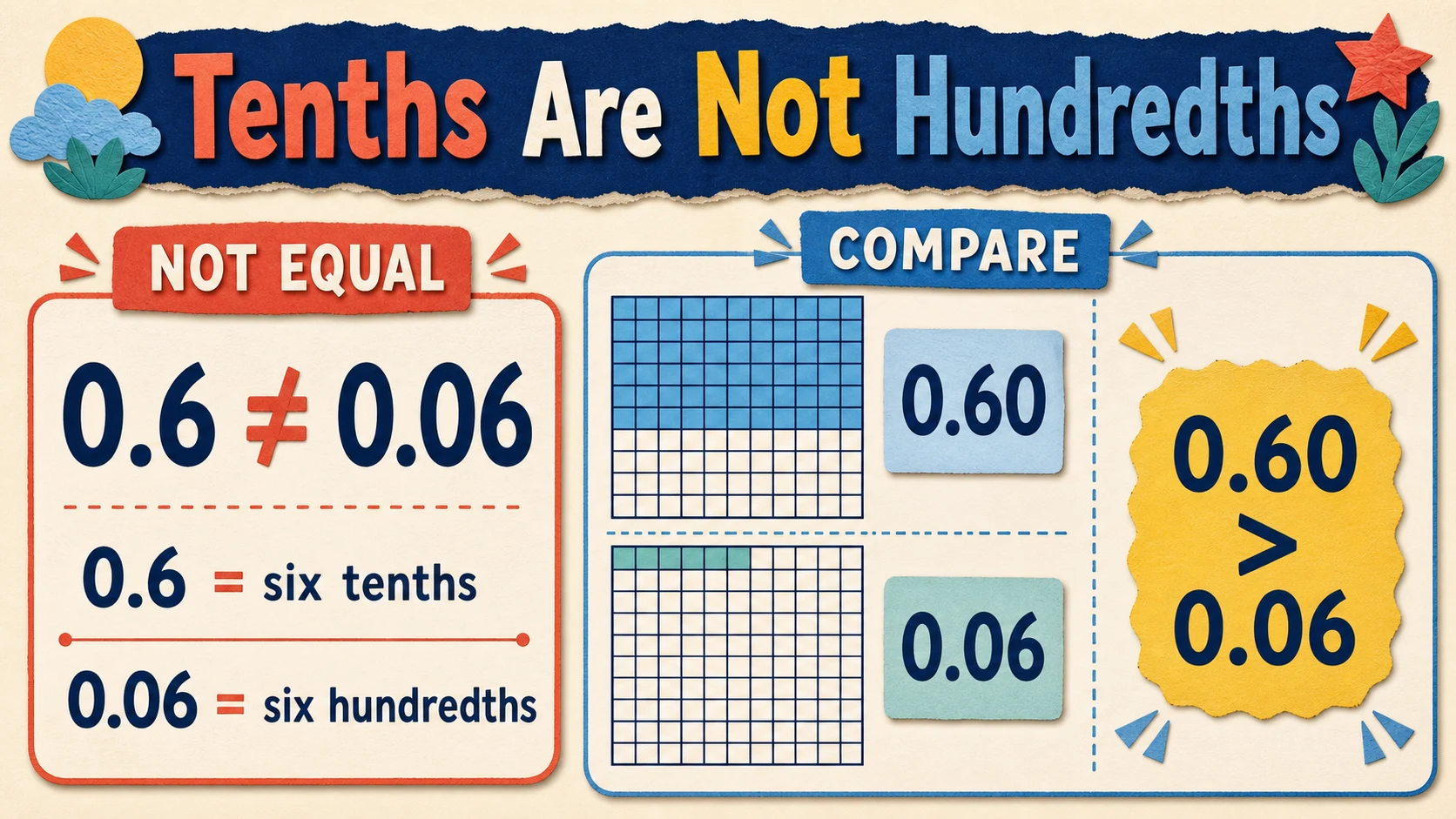
Now compare and . Rewrite as thirty hundredths:
Because ,
This boundary comparison directly addresses the misconception that a decimal with more digits must be larger. Decimal length does not determine value; place value does.
Move from Guided Practice to Independent Work
After the adult model, solve two or three representative items together. Ask the learner to supply the next step rather than merely copy yours. Useful prompts include:
- “What does this digit represent?”
- “Can you name the quantity in tenths or hundredths?”
- “Which operation is required?”
- “What answer would be too large or too small?”
- “How could you check it?”
These prompts preserve the mathematical work. By contrast, saying “Put a 7 here” or “Move the decimal point” may produce a correct entry without showing whether the learner understands it.
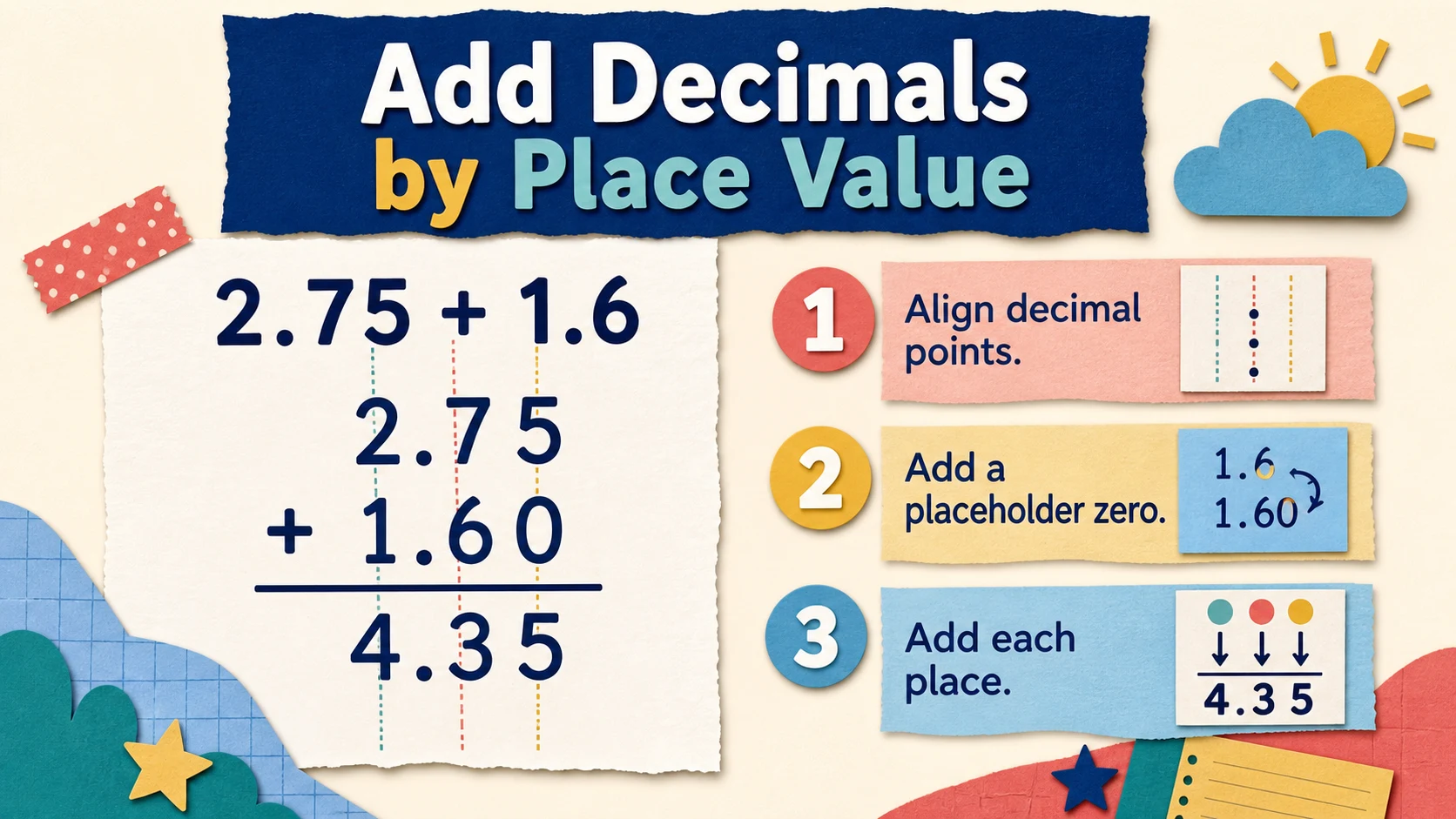
During guided practice, prompt the learner to choose the step and explain its meaning.
Decide when to release responsibility
Move to independent work when the learner can do all three of the following on a familiar item:
- Identify the operation or conversion required.
- Begin without being told where to write each digit.
- Give a reasonable explanation or check.
Assign a short set of four to six items. Watch without correcting each mark immediately. If the learner makes one isolated slip but continues with a sound method, let the set finish. If the same misunderstanding appears twice, pause before it becomes rehearsed.
Independent practice does not have to mean completing the whole sheet alone. It means that the assigned items are attempted without step-by-step coaching. A learner may complete one section independently and need guided support when the format changes.
Adapt Support Without Changing the Skill
Adaptation should make the decimal relationship more visible or reduce unrelated demands. It should not replace the learner’s reasoning with the answer.
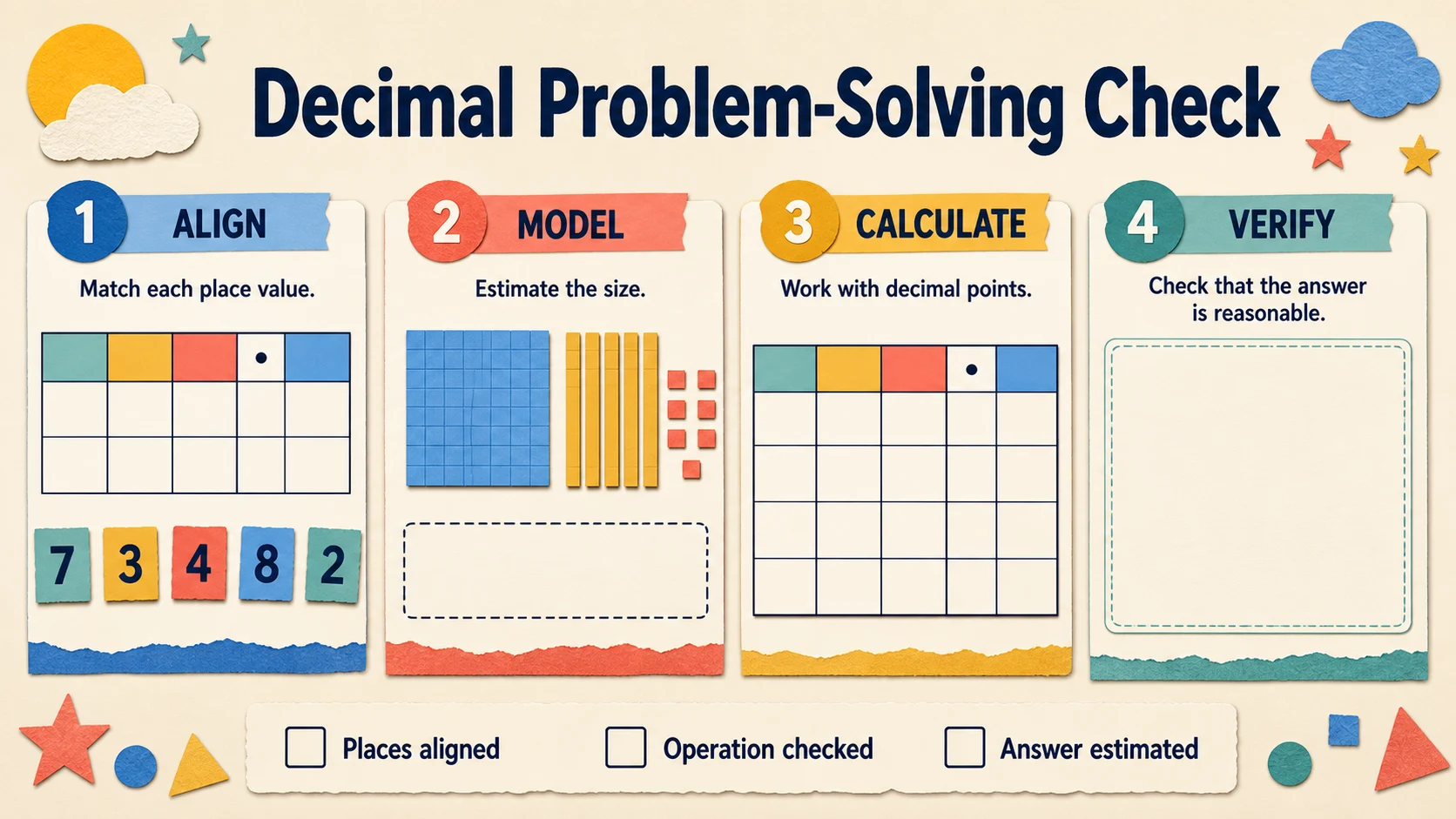
Adjust representation, amount, or response format while keeping the decimal task intact.
If the learner needs more concrete support
Represent tenths with a bar divided into ten equal sections or hundredths with a 10-by-10 grid. Ask the learner to shade the first number, add or remove the required parts, and then write the decimal.
For multiplication, draw equal groups. Three groups of can be shown as three bars with two tenths shaded in each. Combine the shaded tenths only after the grouping is visible.
Money may be used carefully when it matches the place-value relationship. For example, 25 cents is of a dollar. However, money should not become the only representation, because not every decimal problem is naturally about dollars and cents.
If the learner understands but works slowly
Cover the unassigned portion of the page and reveal one short set at a time. Allow blank paper for larger writing. Read the printed direction aloud if decoding the instruction interferes with beginning the math, but do not interpret each mathematical expression for the learner during an independent check.
Reduce the number completed in one sitting while retaining examples from each relevant skill type. The remaining items can become later practice. This changes the amount presented at once, not the mathematical demand.
If the learner finishes accurately and quickly
Ask for a second representation or verification rather than immediately moving to more difficult arithmetic. For example:
- Rewrite as a fraction with denominator 10.
- Draw a model for .
- Explain why .
- Create an addition problem with an answer of .
These extensions deepen attention to number sense while staying connected to the worksheet’s listed skills. For a wider selection of third-grade material, use the 3rd Grade Math worksheet hub.
The IES practice guide for assisting students struggling with mathematics offers high-level guidance concerning systematic instruction, mathematical language, representations, and monitoring progress. It does not prescribe a response to this exact worksheet. The adaptations above are practical instructional suggestions based on the page’s stated content and the learner’s observed work.
Interpret Errors Before Assigning More Practice
A wrong answer is most useful when it can be connected to a decision. Marking every error as simply “incorrect” hides whether the issue concerns notation, place value, operation choice, or calculation.
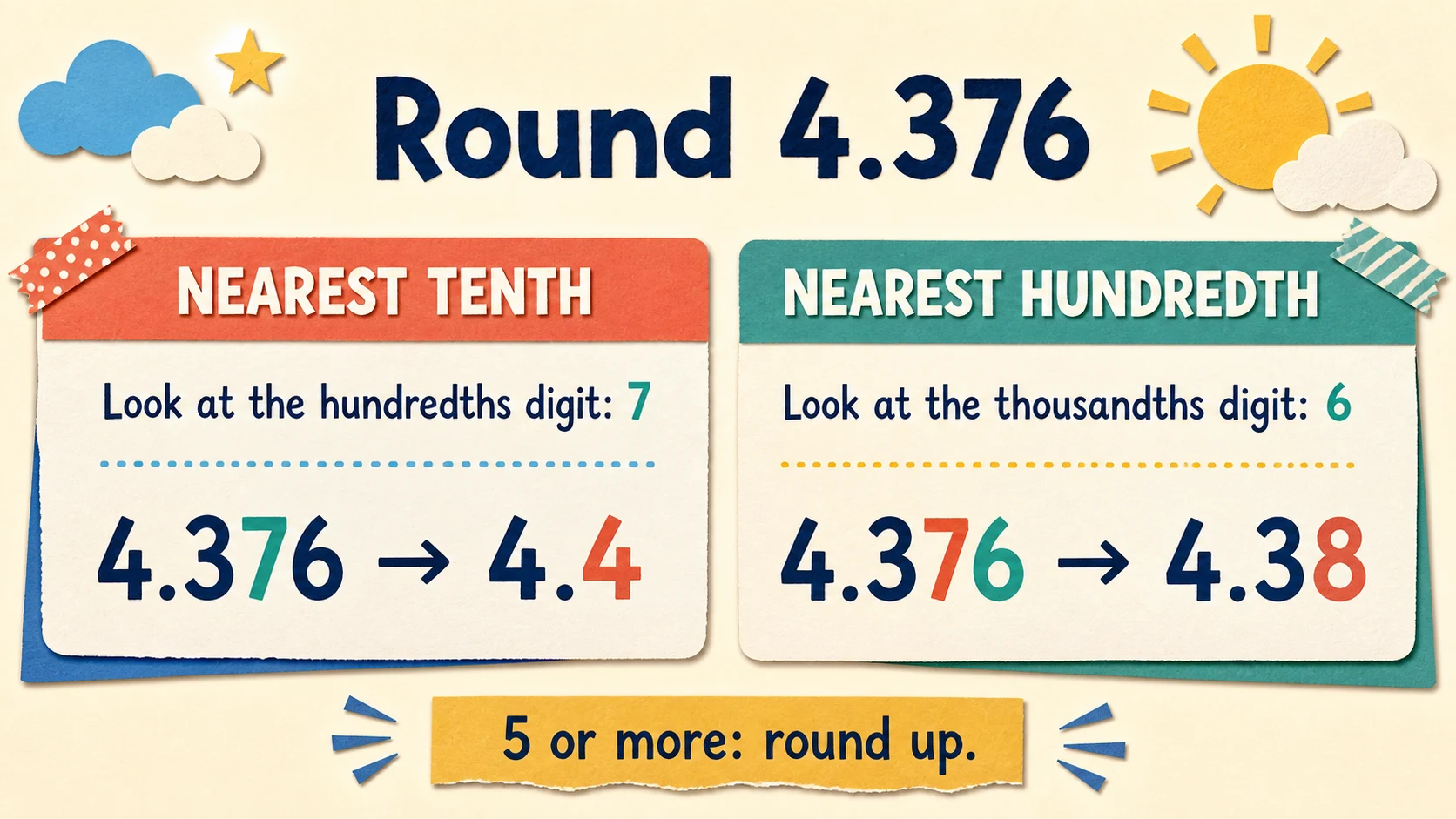
Identify the error type, revisit one representation, correct the item, and test a nearby example.
Place-value and notation errors
A learner might write:
This places 4 in the hundredths position rather than the tenths position. Return to a place-value chart and compare:
Then ask the learner to label the tenths and hundredths positions. Give one nearby check, such as converting , before returning to the worksheet.
Whole-number reasoning applied to decimals
A learner may judge to be greater than because 36 is greater than 4. Rewrite:
Now compare 36 hundredths with 40 hundredths:
Use a hundredths grid or number line if the written equivalence is not convincing. The correction should emphasize value, not a rule such as “the shorter decimal wins,” because that shortcut will fail in other comparisons.
Operation-choice errors
If an addition item is subtracted correctly, the arithmetic may not be the main problem. Ask the learner to circle the operation sign and state what action it calls for. Then have the learner estimate whether the result should increase or decrease.
Similarly, multiplication such as means three equal groups of . If the learner adds , return to the meaning of the multiplication sign and build the groups.
Calculation slips
If the representation and method are sound but a fact is miscalculated, correct the fact and check the answer with an inverse operation or repeated addition. One slip does not automatically justify reteaching the entire concept.
Look for recurrence. Two or more related errors provide stronger evidence of a misconception than one isolated mistake. At the same time, a repeated error near the end of a long sitting may reflect lost attention or fatigue. Compare early and late work before deciding.
Check the Answer Key Responsibly
The separate answer key makes checking efficient, but it should support diagnosis rather than replace it. Keep it out of view during the initial independent attempt unless the learner is intentionally practicing self-checking.
Use this sequence:
- Read the original problem again.
- Compare the learner’s answer with the key.
- Inspect the written method, not only the final number.
- Ask the learner to locate the first step that no longer makes sense.
- Correct the item in a different color or on separate paper.
- Solve one similar example without looking at the correction.
Equivalent decimal forms may look different. For example:
Trailing zeros to the right of a decimal do not change the value. If the learner’s answer and the key use equivalent forms, treat the mathematical value as correct unless the direction specifically requires a particular notation.
Also distinguish an unexplained answer-key disagreement from a learner error. Recalculate the item yourself using place value, fractions, an inverse operation, or repeated addition. If the learner’s reasoning is valid and the printed key appears inconsistent, do not ask the learner to replace sound mathematics merely to match it.
A useful record is more informative than a single percentage. Note:
- Number attempted independently
- Number correct on the first attempt
- Error types
- Prompts or models required
- Whether corrections were completed independently
- One or two items selected for delayed review
This record helps the next lesson respond to actual performance.
Decide What Comes Next
Do not use one fixed cutoff for every learner. Review the pattern across the work.
If the learner is accurate and can explain representative answers, move to another set or a broader decimals task. The 3rd Grade Decimals Worksheet Pack contains 18 worksheets and can provide additional practice when a larger collection is useful.
If accuracy is mixed but corrections are successful, assign a short follow-up containing the same types of problems. The goal is to confirm that the corrected method can be used without immediate help.
If errors cluster around one relationship, narrow the next lesson:
- For fraction-decimal confusion, return to tenths or hundredths models.
- For place-value confusion, compare nearby decimals on a chart or number line.
- For operation-choice errors, sort problems by operation before solving.
- For multiplication errors, use equal groups and repeated addition.
- For frequent copying mistakes, reduce the visible set and check transcription separately.
If the page is substantially beyond the learner’s current instruction, pause it. Review prerequisite place value and fraction ideas, then return later. A grade label should not overrule clear evidence from the learner’s work.
Schedule Retrieval Instead of One Long Repeat
A completed worksheet shows performance at one point in time. A few selected problems revisited after a delay provide better information about whether the method remains available.
Revisit a small mixed set after increasing delays, adjusting the schedule from observed work.
The following is a practical example, not a universal timetable:
| Review point | Suggested task | What to look for |
|---|---|---|
| Next session | Redo one corrected item and solve two similar items | Can the learner begin without the previous prompt? |
| Several days later | Solve three mixed items involving conversion and operations | Can the learner identify the item type independently? |
| About one to two weeks later | Complete four mixed decimal problems | Is the method retained across a longer delay? |
| Later unit review | Include one or two decimal items among other math topics | Can the learner retrieve the skill without being cued by a decimal-only page? |
Change the interval when the evidence calls for it. If the learner cannot recall the method at the first review, shorten the delay and add a representation. If the learner remains accurate and explains the work, increase the delay or mix the skill with other topics.
The purpose of retrieval is not to repeat all 22 problems on every occasion. Select examples that represent the skill categories and any earlier errors. New numbers are preferable when you want to determine whether the learner remembers the method rather than a specific answer.
Limitations and an Honest Next Step
This printable offers a finite set of easy-level written exercises. It can reinforce decimal operations, fraction-decimal conversion, and number sense, but it does not replace a full teaching sequence, ongoing observation, discussion, or varied representations. It also should not be used to claim comprehensive standards alignment or guaranteed progress.
The local curriculum should determine whether decimal computation is current instruction, early exposure, enrichment, or review. The Common Core source is useful for checking one widely used progression, but states, schools, homeschool programs, and individual courses may organize content differently.
After completing and reviewing the worksheet, choose the next action from the evidence:
- If one skill remains uncertain, revisit the relevant section of the Decimals topic guide and complete a short, focused review.
- If the learner is ready for more practice, select another printable from the 3rd Grade worksheet hub.
- If you need fresh problems that match a specific amount of practice, use the free worksheet generators.
Start by printing the free 22-item worksheet and answer key, model one representative problem, and reserve two corrected or successful items for the learner’s next retrieval session.
Put it into practice
Use the guide with a real printable
Move from explanation to a short, observable practice task. Check the first item together, then adjust the next session from the learner's actual work.
See the 18-worksheet pack