Complete guide
How to teach and practise 3rd grade addition worksheets - standard theme (easy)
How to use this 25-item addition worksheet
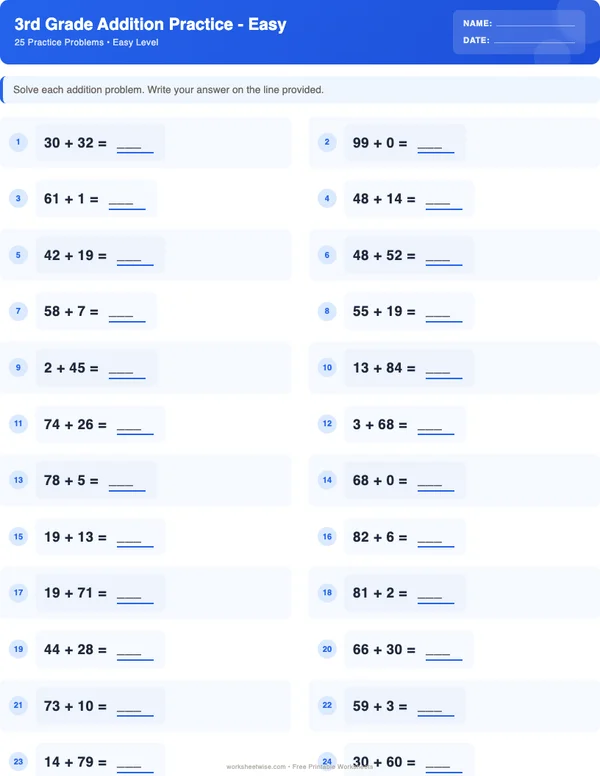
The free 3rd Grade Addition worksheet provides 25 easy-level exercises with one direction: solve each addition problem and write the answer on the line. It is intended to reinforce addition facts, mental math, number sense, and place-value understanding. A separate printable answer key is included.
A practical lesson is to model one or two problems, solve several together, assign a manageable portion independently, and then study errors before deciding whether to continue. Do not require all 25 items in one sitting merely because they fit on one printable. The learner’s observed work—accuracy, explanations, corrections, and signs of fatigue—should determine the pace.
Grade labels describe the intended practice level, not a guarantee that every local curriculum introduces skills in the same order. Local sequences differ. Before beginning, scan the actual operands and note whether the page asks for fact recall, place-value reasoning, regrouping, or a mixture. The catalogue identifies the worksheet as easy, but it does not specify every number range or whether every item uses the same addition structure.
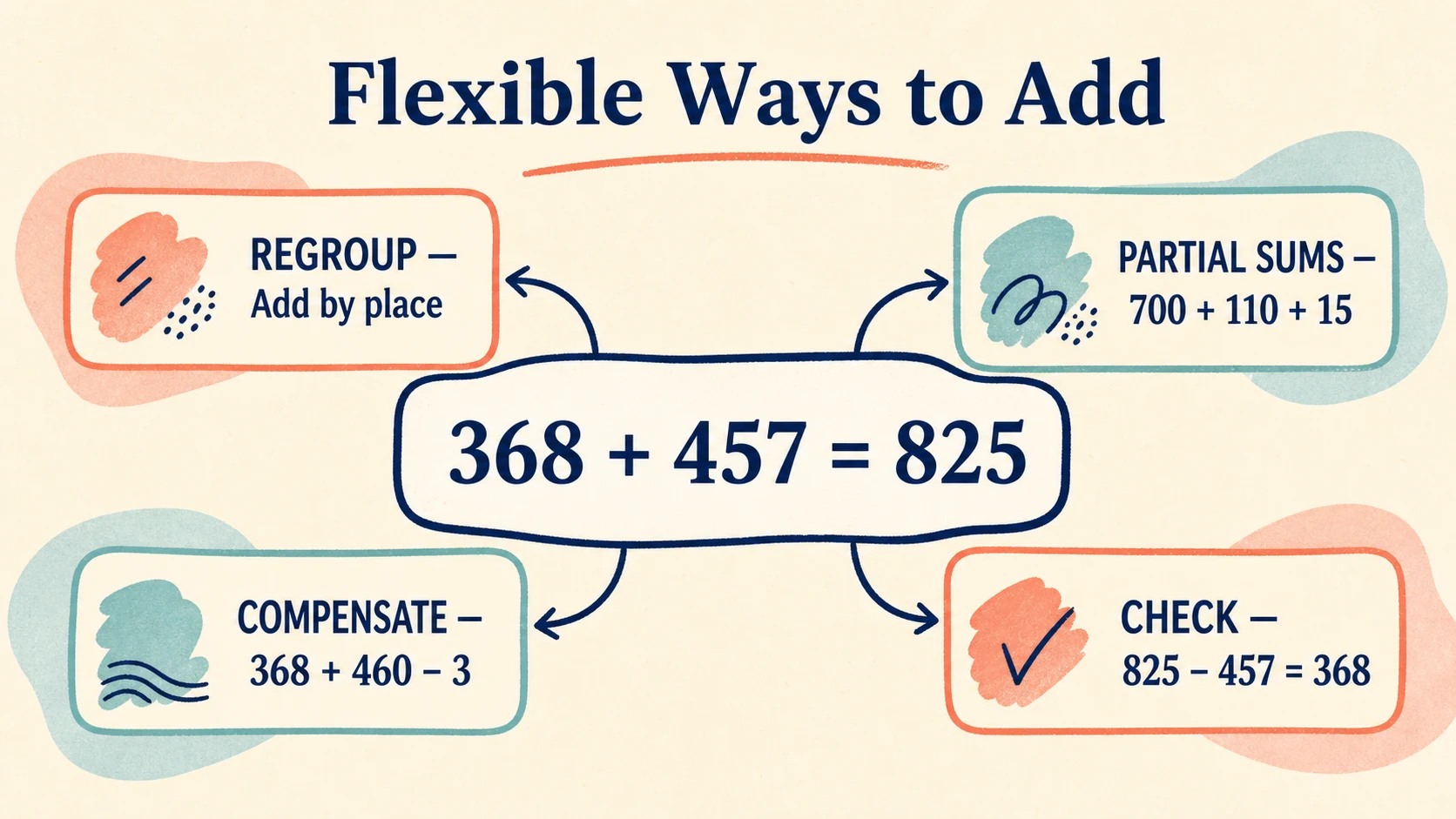
Move from a brief launch to modeling, guided work, independent practice, review, and later retrieval.
A flexible lesson map
The table offers an instructional suggestion, not a universal timetable. Shorten or extend any phase according to what the learner demonstrates.
| Lesson phase | Adult’s role | Learner’s role | Evidence to notice |
|---|---|---|---|
| Preview | Scan the printable and select a few representative items | Read the direction and inspect the page | Can the learner explain what each symbol and answer line means? |
| Launch | Activate a known addition idea with one oral example | Explain or show a solution | Does the learner use facts, counting, decomposition, or place value? |
| Model | Think aloud through one problem without rushing the notation | Watch, answer brief prompts, and restate the method | Can the learner connect the spoken reasoning to written work? |
| Guided practice | Prompt only where needed on two to four items | Solve while explaining important decisions | Does support decrease from one item to the next? |
| Independent practice | Observe quietly and avoid correcting every move immediately | Complete a reasonable group of items | Are answers accurate, organized, and produced with a workable strategy? |
| Error review | Select one or two errors and ask for a recheck | Locate, explain, and correct the error | Can the learner repair the work rather than merely replace an answer? |
| Closure | Summarize demonstrated strengths and choose the next step | State one strategy and verify one result | Is the learner ready for more practice, review, or greater challenge? |
| Retrieval | Revisit a small sample after time has passed | Solve without copying earlier work | Is the method still available after a delay? |
The broader 3rd Grade Addition topic guide covers the larger progression. Use this lesson to work with this particular printable rather than trying to reproduce that entire sequence in one sitting. The 3rd Grade Math hub can help when addition needs to be coordinated with other current math work.
Prepare the worksheet before the learner begins
Print the worksheet and answer key separately. Keep the key out of the learner’s immediate view during the first attempt. Have a pencil, eraser, and optional place-value supports ready. Useful supports may include counters, bundled sticks, base-ten blocks, blank paper, or a hand-drawn tens-and-ones chart. These are instructional options; the catalogue does not require a particular manipulative.
Preview the mathematical demand
Look at several problems from the beginning, middle, and end of the page. Determine what the actual items demand instead of treating the title as a complete diagnosis. Ask:
- Are the addends single-digit, multi-digit, or mixed?
- Would a known fact solve the problem directly?
- Can an addend be decomposed to make a ten?
- Do the ones combine to ten or more?
- Is there a zero in a place that must be preserved?
- Is there enough written space for the learner’s current method?
This preview helps you choose a truthful model. If the worksheet contains only straightforward facts, do not introduce a longer column algorithm merely to make the work appear more advanced. If it contains multi-digit addition, do not reduce the lesson to rapid fact recall.
Set a clear purpose
Use a precise opening such as:
“This page has 25 addition problems. We will first look at how the numbers are organized. I will model one, we will solve a few together, and then you will try a group independently. We will use your work to decide what comes next.”
That statement establishes the task without promising speed, mastery, or a particular score. It also makes correction part of the lesson rather than a punishment after it.
The IES practice guide on teaching mathematics to young children provides high-level support for purposeful instruction that connects mathematical ideas, representations, and language. It did not evaluate this WorksheetWise printable, so use it as general instructional framing rather than as an endorsement of the page.
Model addition in a way the learner can reuse
A useful model exposes the mathematical decision, not just the final notation. Read the expression, identify the relevant place values or fact relationship, choose a strategy, calculate, and check whether the answer is reasonable.
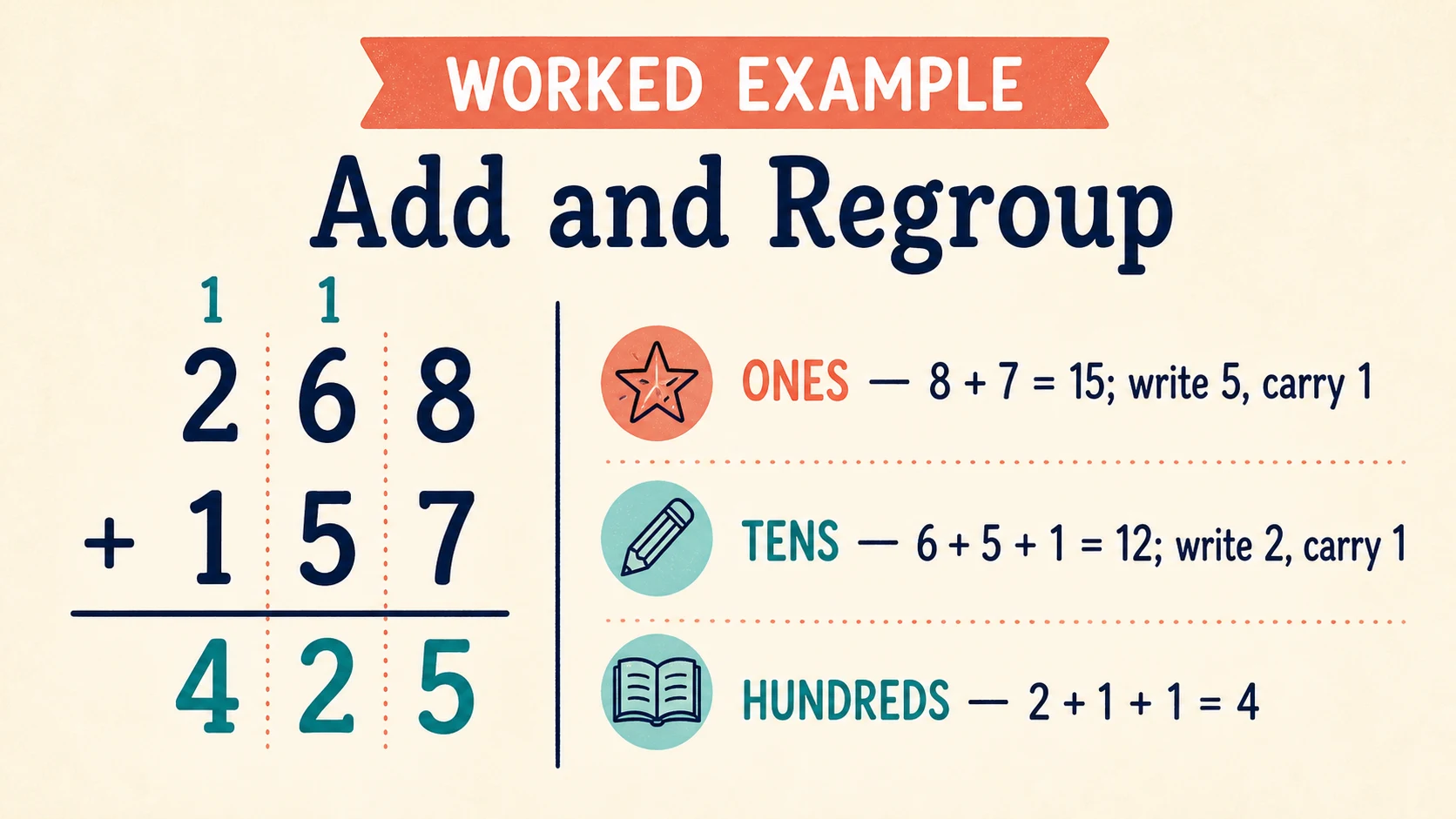
The examples below are verified models similar to the worksheet’s addition skill; they are not claimed to be copied from its 25 items.
Worked example 1: Use a known fact
Consider:
A learner might know the fact directly. If not, decompose 6 into 3 and 3:
First make ten:
Then add the remaining 3:
Therefore:
Check by reversing the addends:
The order changes, but the total remains 13. The point of the model is not to require decomposition every time. It gives the learner a reliable path when the answer is not immediately recalled.
Worked example 2: Bridge through a multiple of ten
Consider:
The next multiple of ten after 38 is 40. Decompose 7 into 2 and 5:
Then:
and:
So:
Check by counting back 7 from 45:
The inverse check returns to 38, supporting the answer. This example connects a small addition fact to place-value structure.
Worked example 3: Add by place value
Consider:
Decompose each number:
Combine like place values:
Therefore:
A quick reasonableness check is to use nearby tens:
An exact answer of 177 is close to 170, so its size is plausible. Estimation does not prove the exact answer, but it can expose an answer with the wrong magnitude.
Worked example 4: Regroup the ones
Consider:
Add by decomposing 47:
Then:
So:
The same result appears in vertical form. The ones are:
Write 5 ones and regroup 10 ones as 1 ten. The tens are then:
Write 1 ten and regroup 10 tens as 1 hundred. The hundreds are:
The result is 315.
Check with subtraction:
This example should be used only if the actual page includes addition for which regrouping is relevant, or if it serves as a carefully chosen extension after the worksheet. Do not imply that regrouping occurs on this printable unless you can see it there.
Move from guided practice to independent work
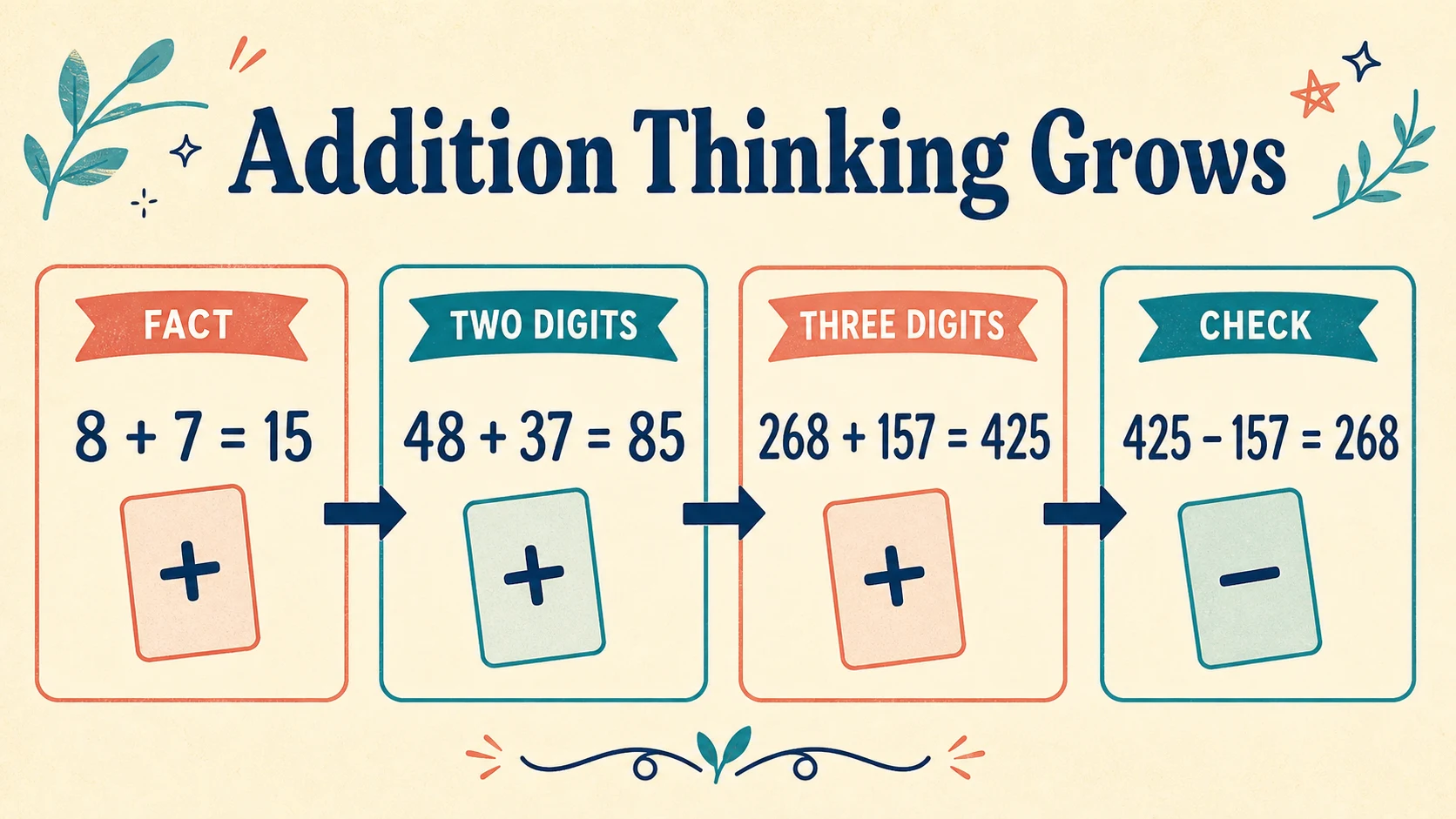
Guided practice should reveal the learner’s reasoning while gradually reducing adult prompts.
Use prompts that preserve the thinking
Choose two to four actual worksheet items that represent what you saw during the preview. For the first item, ask the learner to narrate each step. For the next, use fewer prompts. By the last guided item, wait before speaking.
Helpful prompts include:
- “What do the two numbers tell you to combine?”
- “Which addition fact do you already know here?”
- “Can you make the next ten?”
- “Which digits represent ones? Which represent tens?”
- “What does the regrouped 1 mean?”
- “About how large should the total be?”
- “How could you check this without repeating exactly the same mistake?”
Avoid turning every prompt into a direction. “Add the ones, carry the 1, and then add the tens” may produce an answer, but it gives little evidence that the learner can make those decisions independently.
Release responsibility in small steps
A simple release sequence is:
- The adult models and explains.
- The adult and learner solve together.
- The learner solves while the adult asks occasional questions.
- The learner solves without help.
- The learner checks and explains one item afterward.
Independent work does not have to mean completing all remaining problems at once. You might assign five items, inspect the pattern, and then assign another group. If the first group shows sound reasoning and organized work, increase independence. If it shows repeated place-value confusion, pause and reteach before repetition makes the error more familiar.
During independent practice, record brief observations instead of interrupting each error. Note whether the learner counts every quantity, uses known facts, decomposes numbers, lines up place values, records regrouping clearly, or skips items. These observations are more useful than a total score alone.
Adapt support without changing the addition skill
Differentiation here means changing access, pacing, representation, or response demands while keeping the learner engaged in addition. It does not mean supplying answers or replacing the task with an unrelated easier activity.
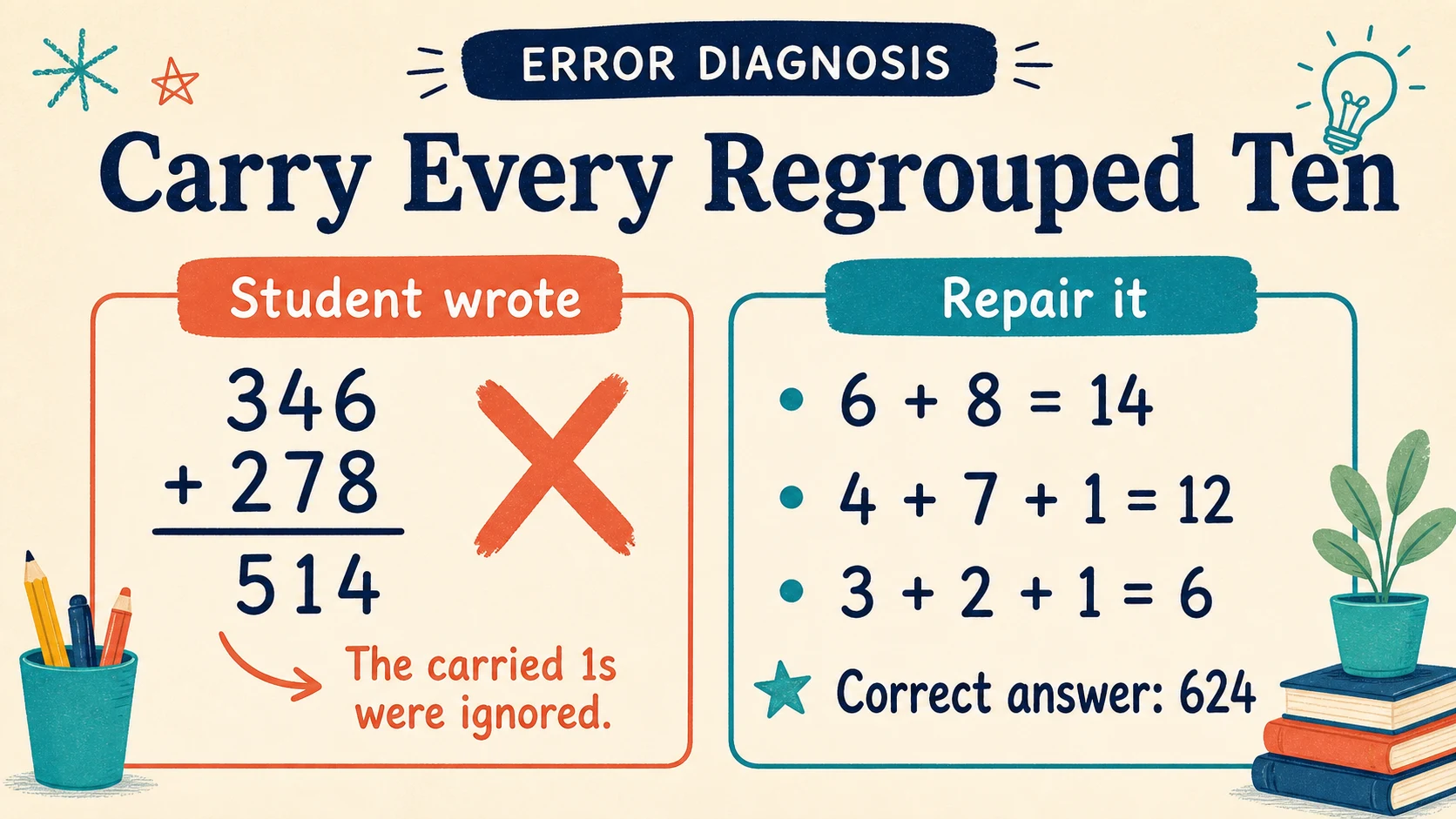
Adjust how the learner enters and records the work while preserving the central addition demand.
When the learner needs more support
Cover part of the page so only one row or a small group of items is visible. Read the printed direction aloud if decoding it competes with the mathematics. Permit a place-value chart, counters, base-ten blocks, or expanded notation. Ask the learner to solve fewer items before receiving feedback.
For a multi-digit problem, draw labeled columns:
| Hundreds | Tens | Ones |
|---|---|---|
| 2 | 6 | 8 |
| 0 | 4 | 7 |
The chart keeps 268 and 47 aligned without changing the required calculation. The learner still decides how to combine the quantities.
The IES guide for assisting students who struggle with mathematics offers high-level guidance concerning systematic instruction, mathematical language, representations, and cumulative review. That guidance can inform adult support, but it does not diagnose a learner and does not establish that this exact worksheet is appropriate for every child.
When the learner is accurate but slow
First determine what “slow” means. Careful written work is different from being unable to select a strategy. Ask the learner to explain two representative items. If the explanation is sound, divide the page into smaller sets and preserve accuracy. Speed pressure is not necessary merely because the sheet contains 25 items.
A useful efficiency prompt is, “Is there a fact or friendly number that would save you from counting every step?” For , bridging through 40 may be more efficient than counting seven individual numbers. Offer the strategy as an option, then see whether the learner can use it on a similar problem.
When the learner needs greater challenge
Keep the original calculation, but deepen the response. Ask for a second method, an estimate before solving, an inverse-operation check, or a written explanation of why a regrouped ten changes columns. The learner can also compare two expressions and predict which sum is greater before calculating.
Do not convert every easy worksheet into an acceleration exercise. If the learner completes the page accurately, explains methods, and retains them later, moving to the broader topic sequence may be more useful than decorating the same level with increasingly elaborate requirements.
Treat boundary cases as diagnostic opportunities
Boundary cases are ordinary addition situations that reveal whether the learner understands place value and notation. Use them when they appear on the sheet, or introduce one separately to clarify a misconception.
Zero in an addend
For:
the 0 in 206 holds the tens place, while 30 contributes 3 tens:
An answer of 209 may indicate that the learner treated 30 as 3. An answer of 506 may suggest that digits were combined by appearance rather than by value.
A sum that lands exactly on ten
For:
the ones make exactly one new ten:
Therefore:
Writing 410 would show that the learner placed “10” beside the 4 instead of exchanging 10 ones for 1 ten.
Unequal numbers of digits
For:
the 8 belongs in the ones place:
Placing 8 under the hundreds digit changes the intended value. A place-value chart or vertical alignment can make the relationship visible without changing the problem.
An answer that requires two regroupings
The checked example requires regrouping from ones to tens and then from tens to hundreds. If the learner completes the first exchange but misses the second, the issue is not necessarily an unknown addition fact. The written procedure may be losing track of the value created in the previous step.
These cases help separate fact errors, place-value errors, and recording errors. One example cannot establish a broad conclusion, so confirm a suspected pattern with another suitable item.
Interpret errors before assigning more problems
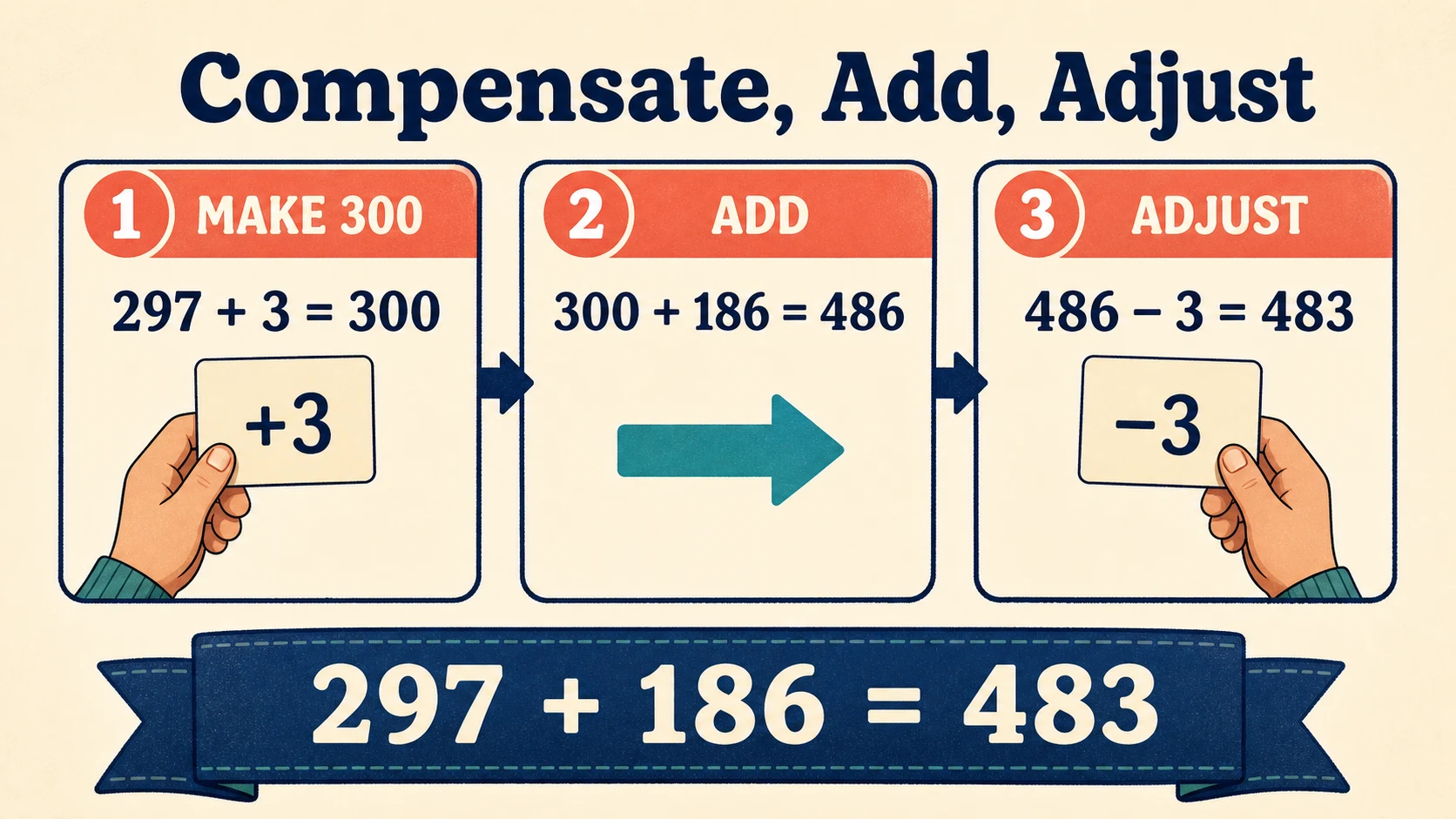
Read the expression again, estimate, inspect place value, recompute, and explain the correction.
Addition-fact errors
Suppose the learner calculates . Ask for a representation or decomposition:
If the learner can construct 13 with support, the issue may be fact retrieval rather than the meaning of addition. A short review of related facts is more focused than repeating the entire worksheet immediately.
Place-value alignment errors
If a learner treats 47 as though the 4 were ones when adding it to 268, ask the learner to read 47 as “4 tens and 7 ones.” Then align or decompose it:
The correction should reconnect each digit with its value. Simply saying “move it over” may fix the layout without fixing the concept.
Regrouping errors
Common procedural errors include forgetting a regrouped ten, adding it twice, or writing 15 entirely in the ones column. Return to the exchange:
Have the learner point to where each part is recorded. The notation should represent the exchange, not function as a mysterious extra digit.
Operation and copying errors
A learner may misread a plus sign, copy 63 as 36, omit an addend, or write a correct calculation on the wrong answer line. These errors need a page-management routine:
- Point to the current item.
- Read both addends and the operation sign.
- Solve.
- Compare the written expression with the printed one.
- Check that the answer is on the matching line.
Do not treat every incorrect answer as evidence that the learner lacks addition understanding. Likewise, do not dismiss a recurring copying or alignment problem if it repeatedly prevents accurate work.
Use the answer key responsibly
The separate answer key makes checking efficient, but efficient checking is not the same as useful feedback. First compare each response with the matching item number. Mark correct answers consistently and circle or flag incorrect or blank responses without writing the replacement answer immediately.
Ask the learner to revisit selected items using this sequence:
- Read the original expression accurately.
- Estimate the likely size of the sum.
- Solve again on clean space.
- Compare the two attempts.
- Explain what changed.
- Confirm with the key only after the correction.
The key confirms the expected result. It does not reveal why an error occurred, whether the learner guessed, or whether a correct answer came from a reusable method. When a key and learner response differ, recalculate independently before discussing the mistake. This protects against mismatched item numbers, transcription errors, or checking the wrong line.
Record error patterns rather than only a percentage. A note such as “3 fact errors; place-value alignment accurate; corrected 2 independently” is more actionable than “22 out of 25.” Keep interpretation proportional: one page is a sample of work, not a comprehensive assessment.
Decide what to do after the worksheet
Use accuracy together with explanation, independence, and delayed recall. The following decision guide is practical rather than diagnostic.
| Observed work | Reasonable next move |
|---|---|
| Mostly accurate, methods can be explained, and corrections are independent | Continue within the addition progression or use a modestly more demanding worksheet |
| Accurate only with frequent prompts | Repeat a short guided set, then retry a fresh independent sample |
| Several errors share one cause, such as fact recall or alignment | Teach that cause directly and assign a small matching set |
| Errors are varied and the learner appears fatigued | Stop, preserve the work sample, and revisit a shorter set later |
| Work is accurate but based on counting every unit | Introduce one efficient strategy, then compare it with the learner’s existing method |
| Work is accurate during the lesson but not after a delay | Schedule brief retrieval before increasing difficulty |
The Common Core State Standards for Mathematics can provide broad context for grade-level mathematical expectations. The supplied catalogue associates the overall Addition topic with a progression from early addition through multi-digit work, including 3.NBT.A.2 in its standards list. That topic-level association should not be used to claim that this single worksheet comprehensively covers a standard. Consult local curriculum documents when formal alignment matters.
For a fuller sequence, return to the Addition topic guide. For a wider collection of material at the same intended grade level, use the 3rd Grade worksheet hub.
Schedule retrieval without creating a rigid timetable
Retrieval means asking the learner to solve again after some time has passed, without copying the previous page. It checks whether the strategy remains available beyond the original lesson.
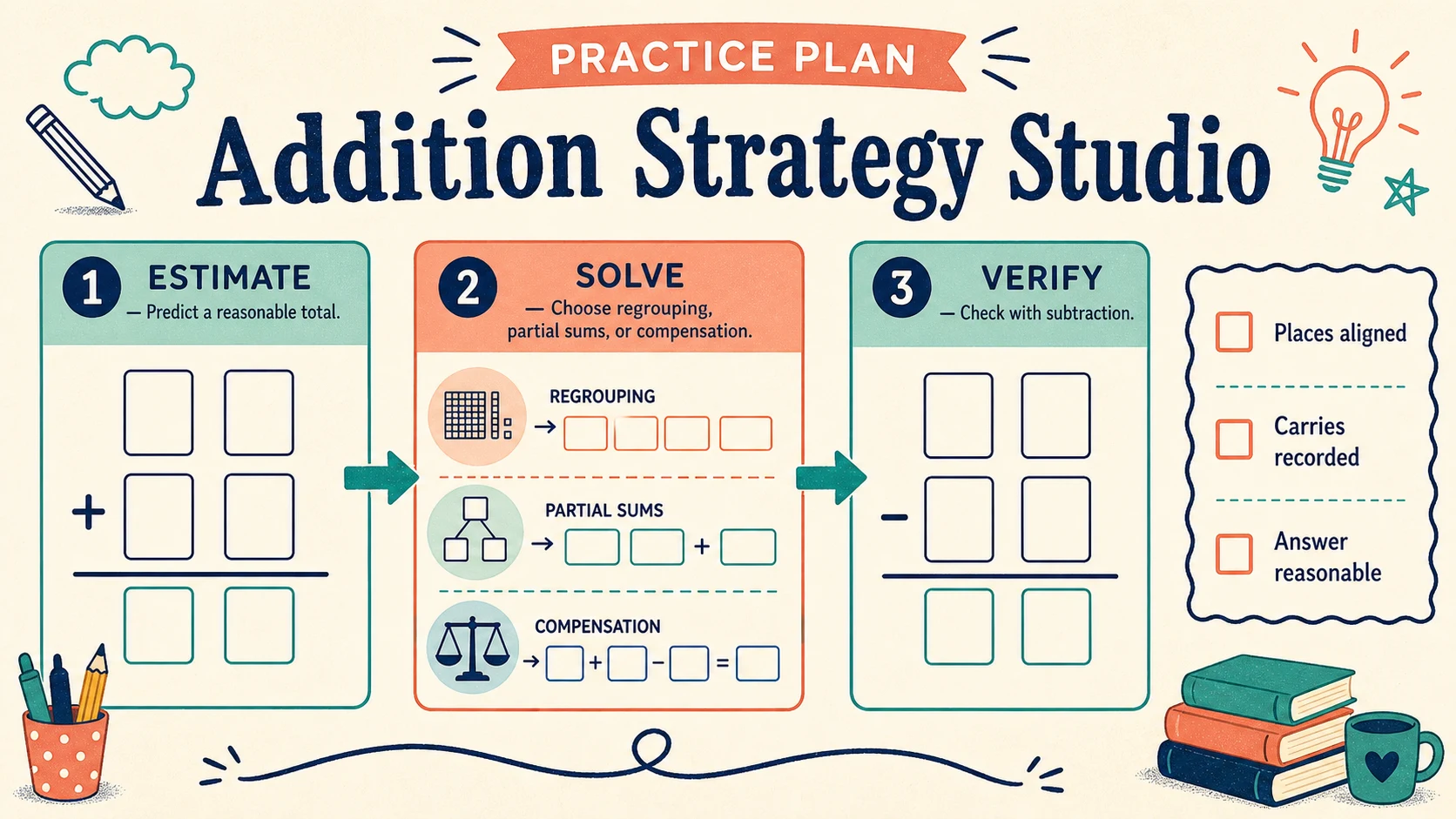
Revisit small, varied samples and let the learner’s retained performance determine the next interval.
A flexible plan could look like this:
| Review point | Suggested activity | What to observe |
|---|---|---|
| End of the lesson | Re-solve one corrected item and explain the change | Can the learner state the relevant fact or place-value idea? |
| Next suitable study session | Solve three to five fresh or previously uncorrected items | Does the learner begin without reconstructing the entire lesson? |
| Several days later | Mix a few addition items with other familiar math | Can the learner identify and carry out addition independently? |
| A later review | Use a fresh worksheet or generator-created sample | Does accuracy and strategy use persist with different numbers? |
These intervals are suggestions, not a universal timetable. Review sooner when the learner cannot reconstruct the method. Widen the interval when work remains accurate and explainable. If delayed performance declines, return to a small set and restore the underlying strategy instead of assigning all 25 items again automatically.
Limitations and the honest next step
This printable offers 25 easy-level addition exercises and an answer key. It can provide useful practice and a visible sample of current work. It cannot, by itself, establish durable mastery, diagnose a learning difficulty, represent every form of addition, or confirm comprehensive standards alignment. Correct answers on one occasion may reflect understanding, successful use of a temporary support, or recall of a recently modeled procedure. Delayed and varied practice provides better information.
The most useful next action is to print the free Standard Theme worksheet, preview its actual number demands, and mark five representative items for the first independent set. After reviewing the resulting work, use the 3rd Grade Addition topic guide to choose the next level. If the learner needs a broader set of related practice, consider the 18-worksheet 3rd Grade Addition pack; if fresh numbers at a matched level would be more useful, create a new sample with the free worksheet generators.
Put it into practice
Use the guide with a real printable
Move from explanation to a short, observable practice task. Check the first item together, then adjust the next session from the learner's actual work.
See the 18-worksheet pack