Complete guide
How to teach and practise 3rd grade sentence structure worksheets - standard theme (easy)
Quick answer: how to use this 14-item worksheet
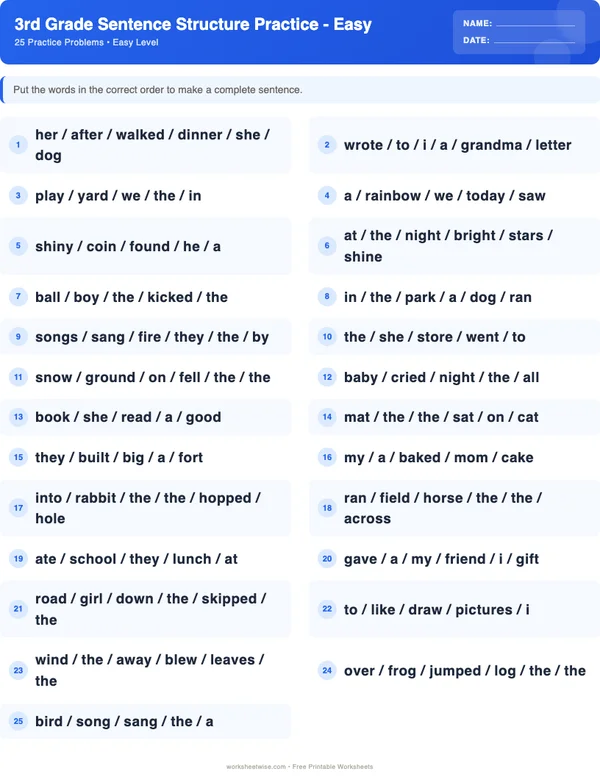
The free 3rd Grade Sentence Structure worksheet asks a learner to put scrambled words in the correct order to make complete sentences. Its narrow focus is useful: the learner must recognize sensible English word order, form a complete thought, and write the resulting sentence accurately.
Use the first item to explain the routine, complete the next two or three together, and then release the learner to work independently. Ask the learner to read each completed sentence aloud before moving on. Afterward, review errors by type rather than simply counting them. A misplaced describing word calls for different support than an omitted word or an incomplete thought.
This is an easy-level, 14-item printable with a separate answer key. It practices word order, sentence formation, syntax, and grammar. It does not cover the whole sentence-structure progression. For fragments, run-ons, sentence combining, expansion, and varied sentence forms, use the broader Sentence Structure topic guide.
Grade labels describe the intended practice level; local curricula and instructional sequences differ. The learner’s observed work—not the label alone—should determine how much modeling, practice, or challenge comes next.
What this worksheet teaches—and what it does not
The worksheet’s direction is precise: “Put the words in the correct order to make a complete sentence.” Every item therefore asks the learner to solve two related problems:
- Find an order that sounds natural in English.
- Check that the ordered words express a complete thought.
A useful oral frame is “Who or what? Did what?” In a sentence such as “The rabbit hops,” the rabbit identifies who or what the sentence is about, and hops tells what it does. Some sentences include more information, but these two parts give a practical starting point.
The activity also requires attention to details that support sentence formation:
- Every supplied word should normally appear in the answer.
- Words that belong together should stay together: a red wagon, not red a wagon.
- The action word needs a suitable subject: The birds sing, not Sing the birds.
- A written sentence conventionally begins with a capital letter and ends with appropriate punctuation.
Keep the instructional claim modest. Rearranging words is controlled sentence practice. It can reveal whether a learner notices basic word order, but it does not by itself show that the learner can independently generate, expand, or revise sentences in original writing.
The IES elementary writing practice guide recommends attention to sentence construction as part of developing writing fluency, alongside regular opportunities to write. That is high-level instructional framing; the source did not evaluate WorksheetWise or this particular printable.
A practical lesson map
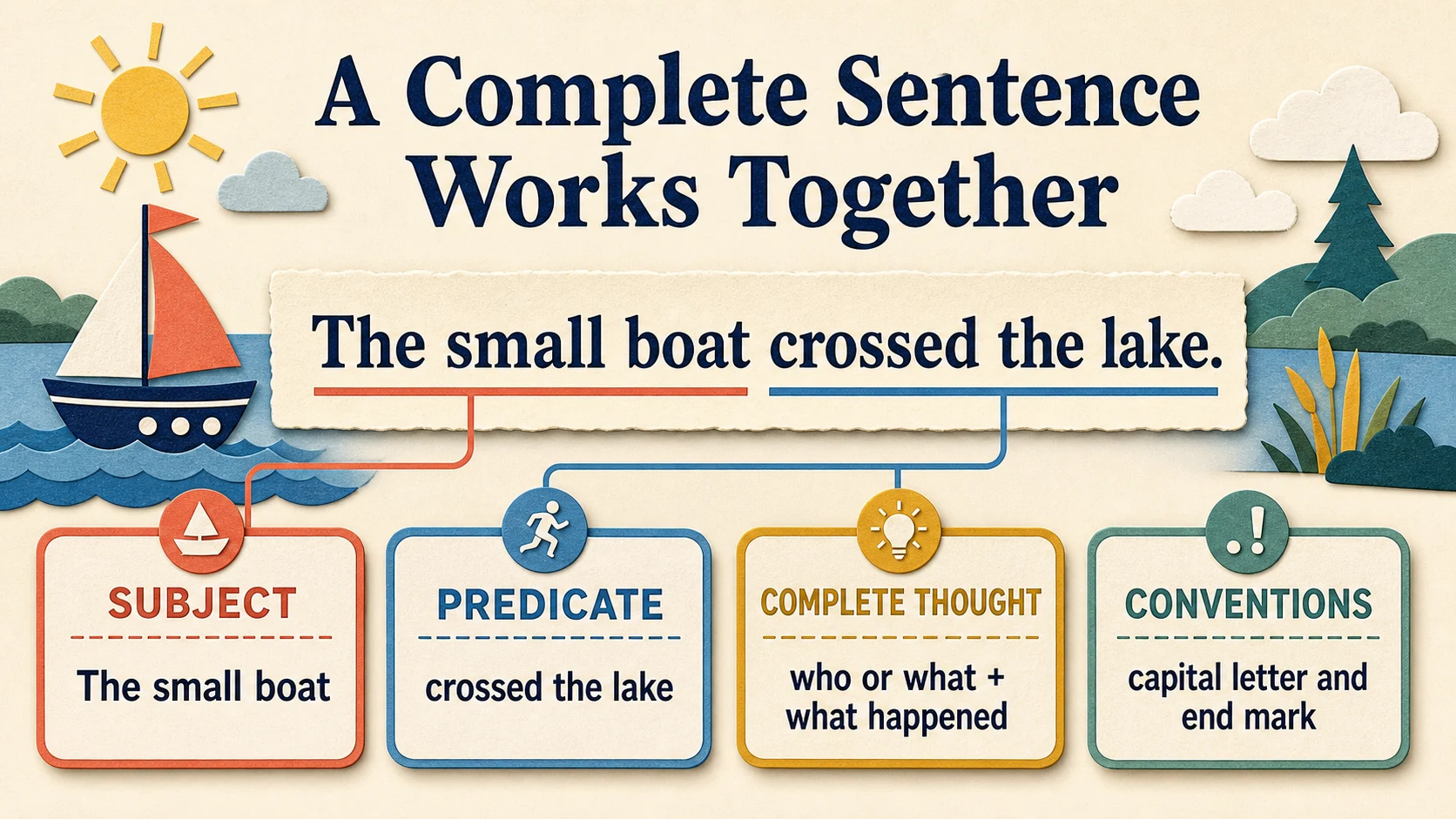
Move from a brief oral check to modeling, supported practice, independent work, and review.
The entire sheet does not have to be completed in one sitting. Divide it when the learner’s work shows that accuracy or attention is falling. The following sequence is an instructional suggestion, not a universal timetable.
| Lesson phase | Suggested use | What the adult watches for |
|---|---|---|
| Oral warm-up | 2–3 spoken examples | Can the learner tell a complete sentence from a loose phrase? |
| Model | 1 worksheet item | Does the learner understand the direction and checking routine? |
| Guided practice | 2–3 items | Can the learner explain why a word belongs in a position? |
| Independent practice | Remaining items or a manageable portion | Can the learner apply the routine without prompts? |
| Review | Incorrect and uncertain items | Is there a pattern in the errors? |
| Transfer | 1 original sentence | Can the learner use the structure without scrambled words? |
| Retrieval | Short later reviews | Does the skill remain available after a delay? |
This progression protects the actual skill. The adult demonstrates the thinking without rearranging every item for the learner. Independent work then provides more useful evidence about what the learner can do.
Prepare for a clean launch
Gather only what the task requires
Print the worksheet and keep its separate answer key out of sight during instruction. Provide a pencil and, if helpful, a blank strip of paper for covering later items. Cutting words into cards is optional; it can reduce handwriting demands while preserving the word-order decision.
Before teaching, glance over the worksheet yourself. The catalogue confirms the format and item count, but it does not provide the 14 item texts here. Reviewing the actual printable prevents an adult from assuming an answer that does not match the supplied words.
Begin with oral language
Say a complete sentence such as:
The turtle rests.
Then say a phrase:
Under the table.
Ask the learner to decide which one expresses a complete thought. If the learner identifies the phrase as incomplete, ask what could be added:
The turtle rests under the table.
This brief contrast establishes the purpose without turning the lesson into a long lecture. Do not require technical labels before the learner can demonstrate the underlying distinction.
You can also read a scrambled set aloud: outside / plays / Maya. Invite the learner to “make it sound like a sentence.” Oral rehearsal separates the language decision from handwriting. That is particularly useful when the goal is sentence order rather than penmanship.
Model one item from start to finish
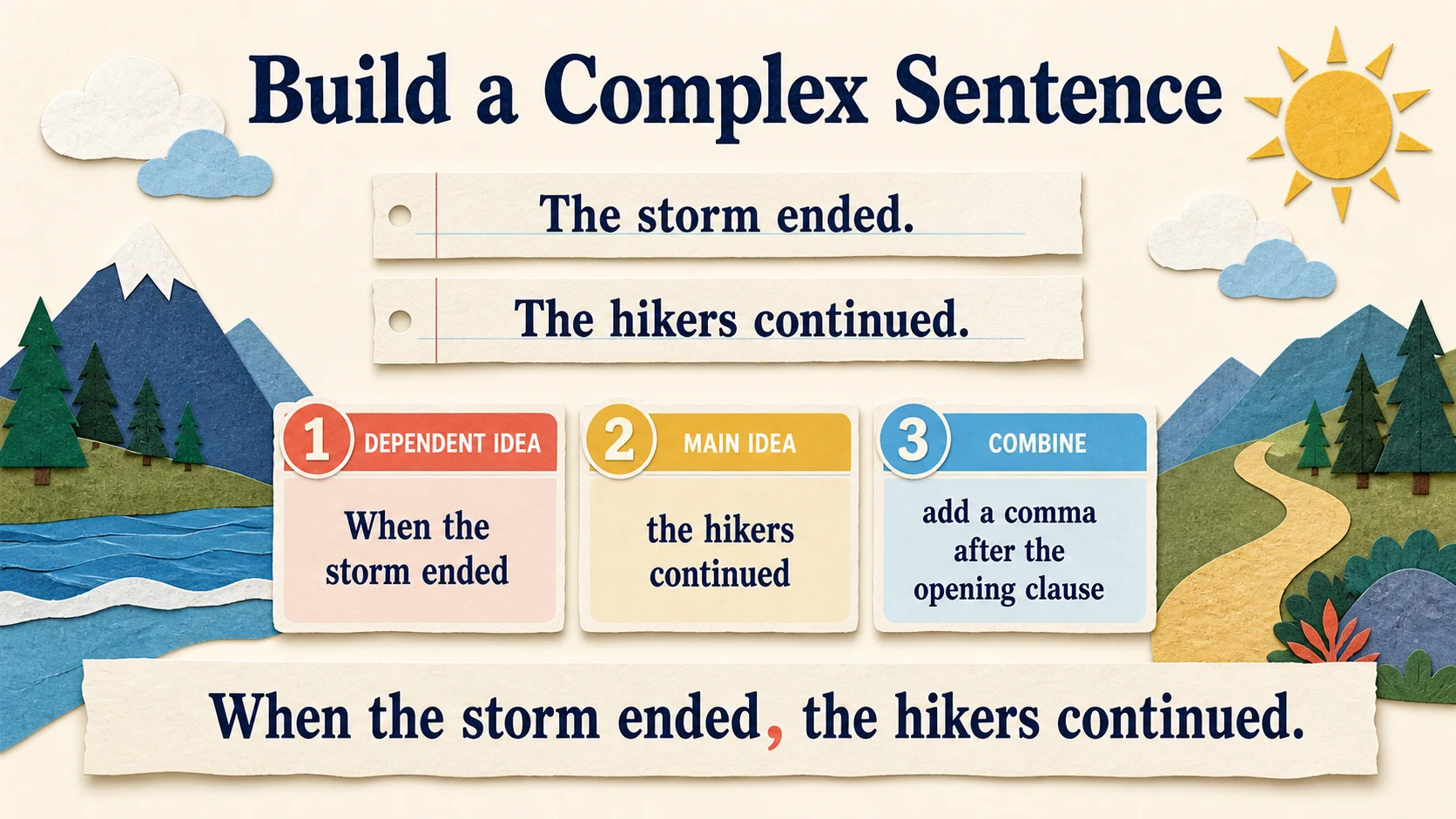
The model shows a repeatable process: use every word, build the thought, and check the result.
The examples below are adult-created examples similar to the worksheet format. They are not transcriptions of its items or substitutes for its answer key.
Suppose the scrambled words are:
outside / plays / Maya
Model the decision aloud:
- Find who or what. Maya names the person.
- Find the action. plays tells what Maya does.
- Place the remaining information. outside tells where she plays.
- Build the sentence. Maya plays outside.
- Check every word. Maya, plays, and outside have each been used once.
- Read it aloud. The sentence sounds natural and expresses a complete thought.
- Check writing conventions. Maya begins with a capital, and the sentence ends with a period.
Use a short think-aloud
Keep your explanation tied to visible evidence:
“Maya is the person, so I will begin with Maya. Plays tells what she does. Outside adds where. My sentence is ‘Maya plays outside.’ I used every word, and the sentence makes sense.”
Avoid unexplained directives such as “That word always goes first.” English word order can vary, and such a rule may fail on a later item. Explain why the choice works in this sentence.
Give the learner a reusable check
A compact routine is:
- Build: Arrange all the words.
- Read: Say the sentence aloud.
- Check: Confirm that it is complete and that no word was lost.
Write those three words at the top of a scrap sheet if the learner needs a visual reminder. The reminder supports self-monitoring without supplying an answer.
Move through guided and independent practice
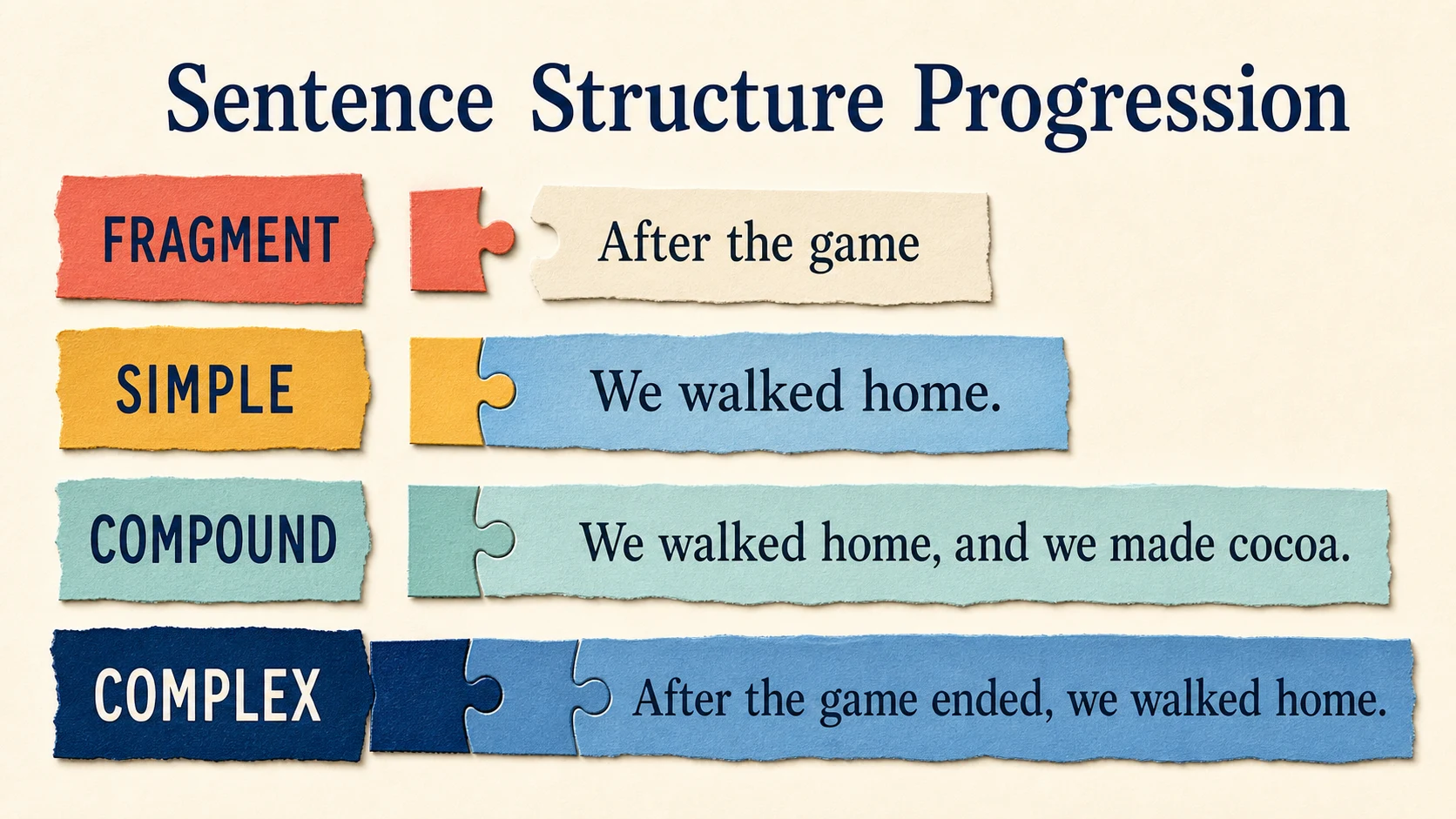
Prompts should reveal the learner’s reasoning and then gradually disappear.
Guide without taking over
For the next two or three items, prompt only as much as needed. Start with an open prompt:
“Read all the words. What could the sentence be about?”
If the learner stalls, narrow the prompt:
“Which word names the person, animal, place, or thing?”
Then ask:
“Which word tells what that person or thing does or is?”
Once the learner proposes an order, request evidence:
“Read the whole sentence. Did you use every word?”
The learner should physically write the completed sentence, not merely point to the words. That keeps the task connected to sentence formation while allowing you to see capitalization, spacing, and punctuation. If handwriting becomes the main barrier, let the learner arrange word cards first and copy the confirmed sentence afterward.
Release responsibility based on observed work
Move to independent practice when the learner can:
- propose a plausible order;
- read the complete result;
- notice an omitted or repeated word when prompted; and
- explain at least one placement decision.
During independent work, avoid correcting each item immediately. A simple neutral mark beside an uncertain item lets the learner continue. Immediate correction after every response can make the activity feel like a guessing exchange with the adult.
If several consecutive items show the same unresolved problem, pause. Re-model one fresh example, then return to the sheet. If accuracy remains steady, allow the learner to finish without additional prompting.
Four fully checked examples
These examples clarify the reasoning adults can model. Because they are not drawn from the printable, use them for instruction rather than for grading its numbered items.
Example 1: basic subject–action order
Scrambled words: jumps / Liam
Completed sentence: Liam jumps.
Check: Liam answers “Who?” and jumps answers “Did what?” Both supplied words appear once. The result expresses a complete thought. It begins with a capital letter and ends with a period.
Likely error: Jumps Liam. This uses both words but does not follow the ordinary statement pattern expected here. Ask the learner to say who performs the action.
Example 2: keeping a noun group together
Scrambled words: the / sleeps / cat / soft
Completed sentence: The soft cat sleeps.
Check: The soft cat forms the subject: soft describes cat, and the introduces the noun group. Sleeps supplies the action. All four words appear once, and the sentence is complete.
Likely error: The cat sleeps soft. A learner may produce this because the order resembles speech they have heard. Return to the supplied words and ask which word describes the cat. Do not introduce a larger lesson about adverbs unless the learner’s work makes that necessary.
Example 3: placing an object after the verb
Scrambled words: a / Ben / blue / has / kite
Completed sentence: Ben has a blue kite.
Check: Ben is the subject, has is the verb, and a blue kite tells what Ben has. A belongs before the noun phrase, and blue describes kite. Every word is present once. The sentence is meaningful and complete.
Likely error: Ben a blue kite has. The learner has grouped the object correctly but misplaced the verb. Ask, “What does Ben do or have?” Then place has directly after Ben and reread.
Example 4: adding when information
Scrambled words: after lunch / reads / our teacher / a story
Completed sentence: Our teacher reads a story after lunch.
Check: Our teacher names who acts. Reads is the action. A story receives the action, and after lunch tells when. All four supplied units are used. The sentence begins with a capital and ends with a period.
Another grammatical order is After lunch, our teacher reads a story. That version requires capitalization and a comma after the opening phrase. When checking a rearrangement task, accept an alternative only if it uses all supplied words, forms a complete and natural sentence, and follows the punctuation expectations of the task.
Boundary cases require judgment
Some word sets may allow more than one defensible sentence:
today / we / swimcan form We swim today.- It can also form Today, we swim.
Both are complete, but the second order uses an introductory word and comma. Do not mark a grammatical alternative wrong merely because it differs from the key. First confirm that the learner used exactly the supplied words and preserved a sensible meaning.
Other apparent alternatives change the meaning or sound unnatural. Ask the learner to read the answer aloud and explain it. The goal is not to reward any possible permutation; it is to identify a complete, conventional sentence supported by the given words.
Adapt support without changing the skill
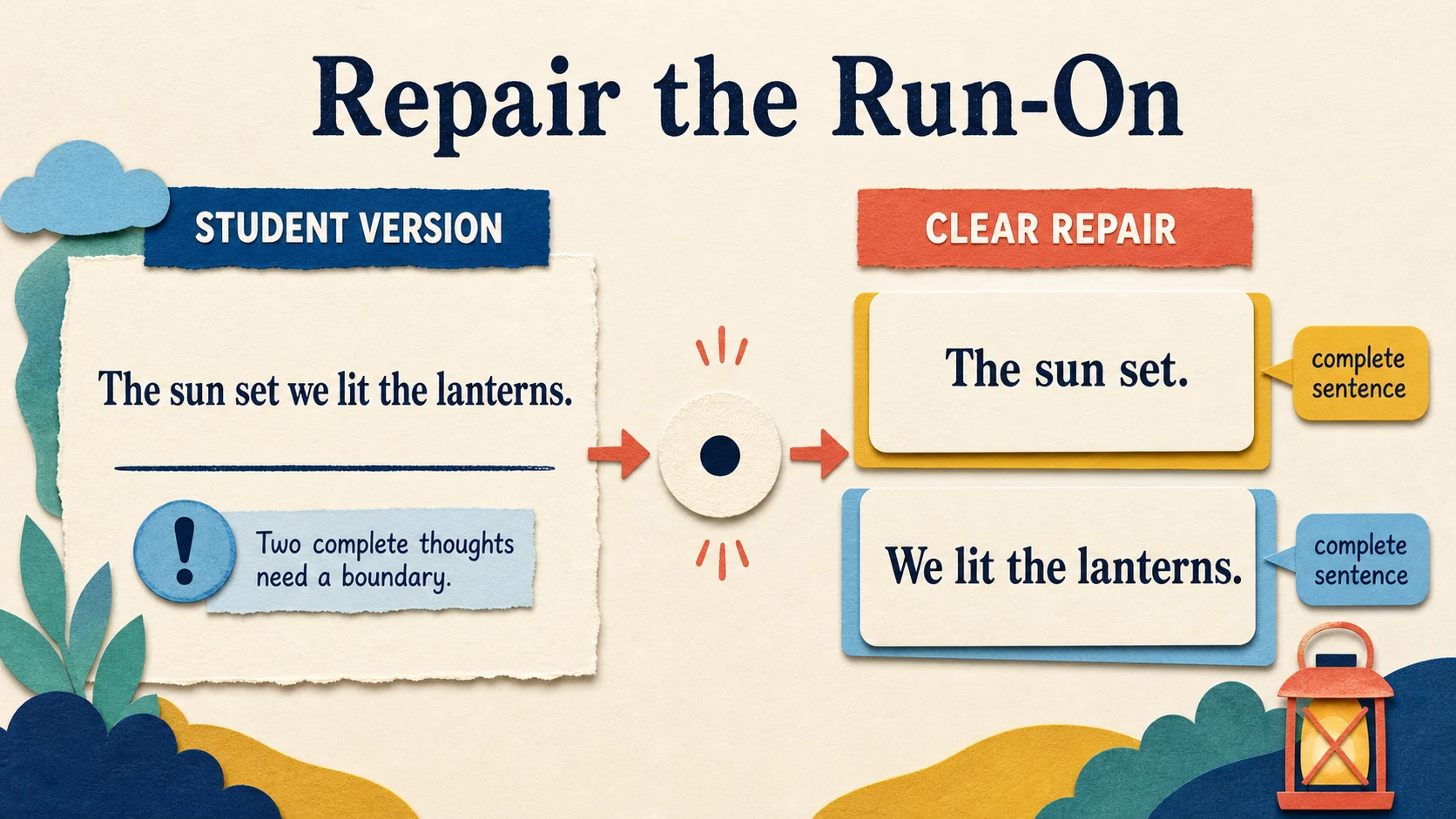
Adjust access, amount, and prompting while keeping word order and sentence formation at the center.
When the learner needs more support
Use one or more of these adjustments:
- Cover all but one item to reduce visual load.
- Read the scrambled words aloud once, without rearranging them.
- Let the learner move word cards before writing.
- Underline a likely subject and circle the likely action after the learner attempts the item.
- Offer the oral frame “Who or what? Did what?”
- Complete fewer items in one sitting and resume later.
- Ask the learner to point to each supplied word while checking the final sentence.
These supports preserve the core decision: the learner still determines the correct order. By contrast, numbering every word for the learner changes the task into copying.
If decoding individual words is interfering, read the words accurately and return the ordering decision to the learner. The IES foundational reading guide addresses high-level reading foundations through areas such as academic language, sound–letter connections, word reading, and daily connected-text reading. This worksheet is not connected-text reading practice, so use ordinary books or passages for that separate purpose.
When the learner is ready for more challenge
Increase reasoning rather than merely adding more of the same items:
- Ask for an explanation of one placement decision.
- Have the learner create a scrambled version of an original sentence for an adult to solve.
- Ask the learner to expand a completed sentence with where, when, or how information.
- Compare two grammatical orders and discuss how punctuation changes.
- Have the learner use one completed structure to write a new sentence with different content.
For example, expand Liam jumps to Liam jumps over the puddle. The original sentence remains complete; the added phrase supplies detail. This extension belongs after the worksheet response has been checked, because adding new words during the original task would make it harder to see whether the learner can arrange the given set.
Interpret errors before choosing a response
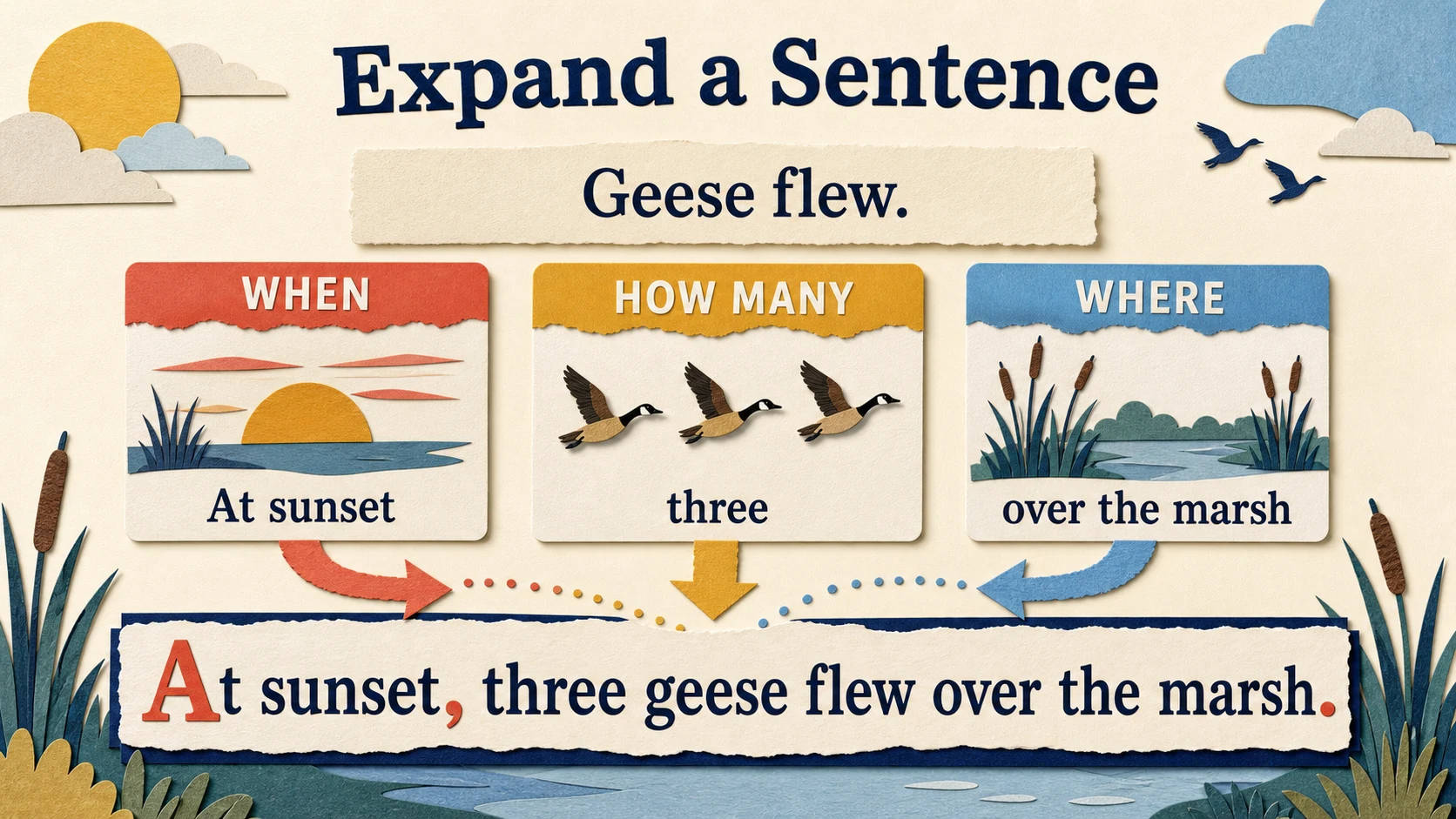
Classify the problem, give the smallest useful prompt, and ask the learner to try again.
A wrong answer is evidence, not a diagnosis. Examine what the learner actually wrote and look for repeated patterns.
| Observed pattern | Possible task-level interpretation | Useful instructional response |
|---|---|---|
| Words remain scrambled | The learner may not understand the direction or cannot locate a starting point | Re-model one item with the subject-and-action frame |
| One word is omitted | The learner may be checking meaning but not the supplied set | Have the learner touch each source word and match it to the sentence |
| A word is copied twice | Attention may have shifted during copying | Cross off or cover each word after it is used |
| Subject and verb are reversed | Basic statement order is not yet stable | Ask who performs the action, then place the action after that subject |
| Describing word is separated from its noun | The learner may not recognize the noun group | Ask which word tells more about the person, place, animal, or thing |
| Sentence sounds right but lacks capitalization or punctuation | Formation may be stronger than written conventions | Separate the checks: first meaning and completeness, then capitals and end marks |
| Oral answer is correct but written order changes | Copying or transcription may be interfering | Let the learner arrange cards, reread, and then copy from the stable model |
| Several plausible answers appear | The item may permit more than one grammatical order | Compare meaning, completeness, word use, and punctuation before grading |
Correct with a short cycle
Use this sequence:
- Ask the learner to read the written sentence.
- Ask whether every supplied word appears.
- Identify who or what the sentence is about.
- Identify what that subject does or is.
- Rearrange only the part causing the problem.
- Read and check the revised sentence.
Avoid erasing and rewriting the entire answer yourself. The learner needs to carry out the correction for it to function as practice.
A single mistake may be a momentary slip. Two or more similar errors provide stronger reason to revisit that feature. Even then, describe only what the work shows: “The describing words were separated from their nouns in three items.” Do not infer a disability, developmental condition, motivation problem, or child-specific need from this worksheet.
Check the answer key responsibly
The printable includes a separate answer key for quick checking. Use it after the learner has attempted the assigned items, not as a prompt sheet during independent work.
A reliable checking routine is:
- Compare the learner’s response with the key.
- Confirm that every supplied word was used once.
- Read the learner’s sentence independently.
- If it differs from the key, test whether it is still grammatical, complete, meaningful, and correctly punctuated.
- Mark the specific point to reconsider rather than replacing the whole response.
- Ask the learner to revise and explain the change.
The key is a checking aid, not evidence that only one word order can ever work. It also does not establish mastery. A learner may remember an answer, rely on the visible words, or succeed with this easy format while still needing support in original writing.
For a brief transfer check, hide the scrambled words and ask the learner to write one complete sentence about a familiar object or action. Review that sentence using the same questions. This adds useful evidence without pretending that one original sentence is a comprehensive assessment.
Decide what to teach next
The next step should follow the pattern in the learner’s work.
If the learner is not yet secure
Return to oral sentence building and use shorter scrambled sets. Work with a clear subject and action before adding describing, where, or when information. Reuse two or three corrected structures on a later day, but change the nouns or verbs so the learner must reconstruct the pattern.
Within the worksheet, assign a smaller group of items and stop after accurate, explained responses. Completing all 14 is less informative if the learner is guessing or becoming less accurate.
If performance is accurate but slow
Keep the skill the same and reduce adult prompts. Ask the learner to use the Build–Read–Check routine independently. Speed should come from a stable process, not from pressure to finish.
If performance is accurate and independent
Move beyond rearrangement:
- write an original simple sentence;
- expand it with a useful detail;
- combine two closely related ideas;
- compare complete sentences with fragments;
- examine how different sentence beginnings affect punctuation.
The full sequence belongs in the 3rd Grade Sentence Structure guide, not in this single worksheet lesson. Additional grammar practice is available through the 3rd Grade Grammar collection, while the broader 3rd Grade worksheet hub can help coordinate practice across subjects.
The Common Core ELA overview describes grade-specific literacy expectations within a broader framework for reading, writing, speaking, listening, and language. Consult the standards adopted by your state or school when formal alignment matters. Success on this printable should not be presented as proof of comprehensive standards alignment.
Schedule retrieval instead of immediate repetition
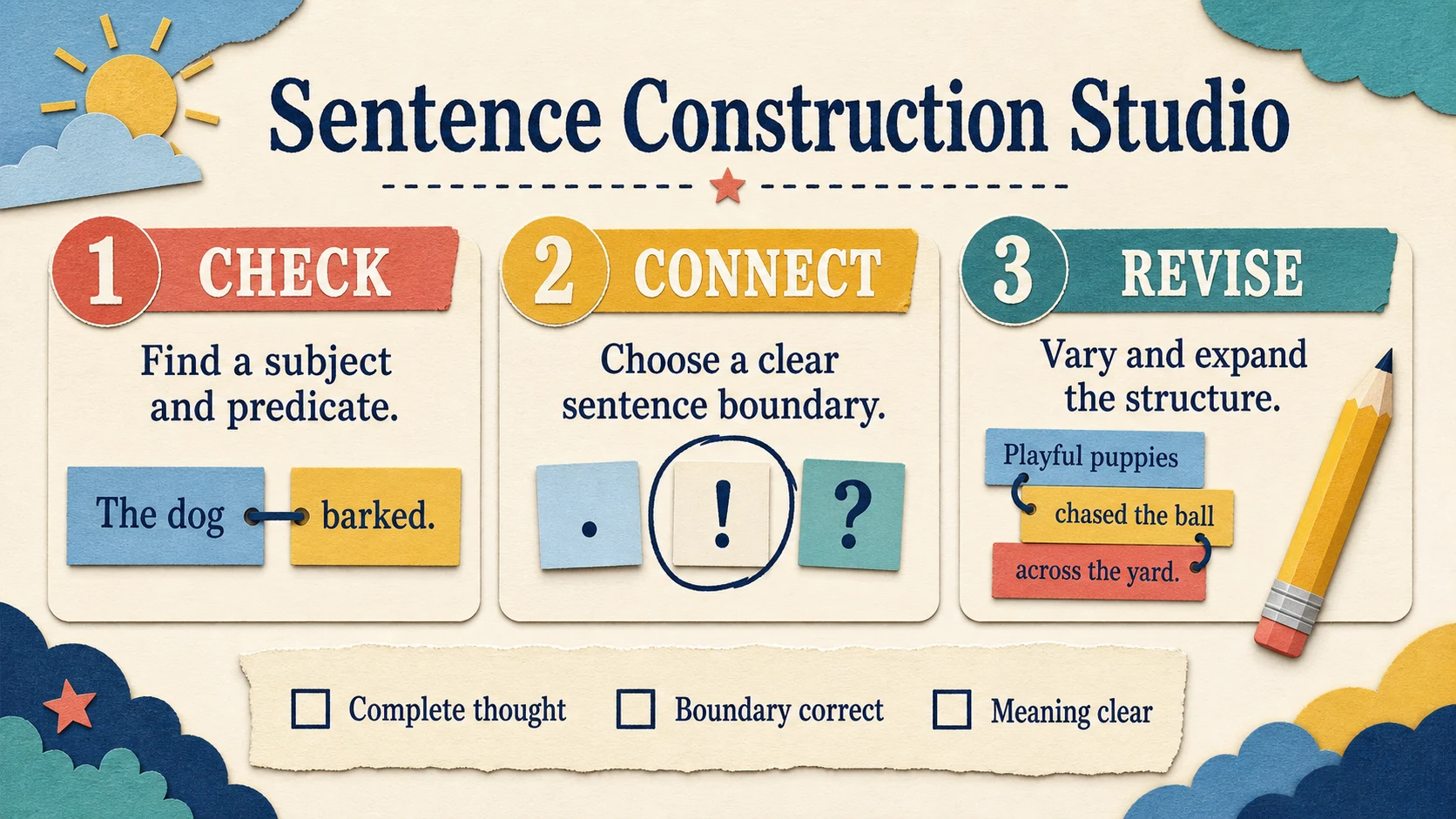
Short delayed checks show whether the learner can retrieve the sentence-building routine later.
Use a flexible review schedule based on observed work. One practical option is:
| Review point | Suggested task | Decision |
|---|---|---|
| Later the same lesson | Correct one missed item without viewing the answer | If the error repeats, model the relevant feature again |
| About 1–2 days later | Solve two fresh scrambled sentences | If both are accurate and explained, reduce prompting |
| About one week later | Solve one scrambled sentence and write one original sentence | If rearrangement succeeds but original writing does not, practice transfer |
| About two weeks later | Include one item in a mixed grammar warm-up | If the routine remains secure, move to a later sentence-structure skill |
This schedule is an instructional suggestion, not a sourced or universal timetable. Review sooner when the learner cannot reconstruct the process. Increase the delay when the learner responds accurately, independently, and with a sound explanation.
Do not reuse all 14 items until they have been memorized. A remembered answer tells less about sentence construction than a fresh example. You can make new, controlled items with the free worksheet generators, checking each generated sentence yourself before assigning it.
Important limitations
This worksheet provides 14 easy-level rearrangement exercises in a standard theme. It is suitable for focused practice, homework, a grammar warm-up, or homeschool instruction, but it is not a complete grammar curriculum or a comprehensive measure of writing.
It does not, by itself, establish that a learner can:
- recognize every fragment or run-on;
- produce varied simple, compound, and complex sentences;
- combine ideas effectively;
- sustain accurate sentences in a paragraph;
- revise sentences for meaning, interest, or style; or
- apply the skill consistently across subjects.
Adult-created examples in this guide illustrate how to teach and check the format. They are not the worksheet’s numbered answers. Likewise, the authoritative sources cited above support broad literacy and writing instruction; they did not review this WorksheetWise resource or guarantee an outcome from using it.
A useful next action
Print the free 14-item worksheet, model one item, and record the type—not merely the number—of any errors. Then use the Sentence Structure topic guide to choose the next lesson, or continue with the 18-worksheet 3rd Grade Sentence Structure pack when the learner needs additional practice across the topic.
Put it into practice
Use the guide with a real printable
Move from explanation to a short, observable practice task. Check the first item together, then adjust the next session from the learner's actual work.
See the 18-worksheet pack