Complete guide
How to teach and practise 3rd grade punctuation worksheets - standard theme (easy)
What This Worksheet Teaches
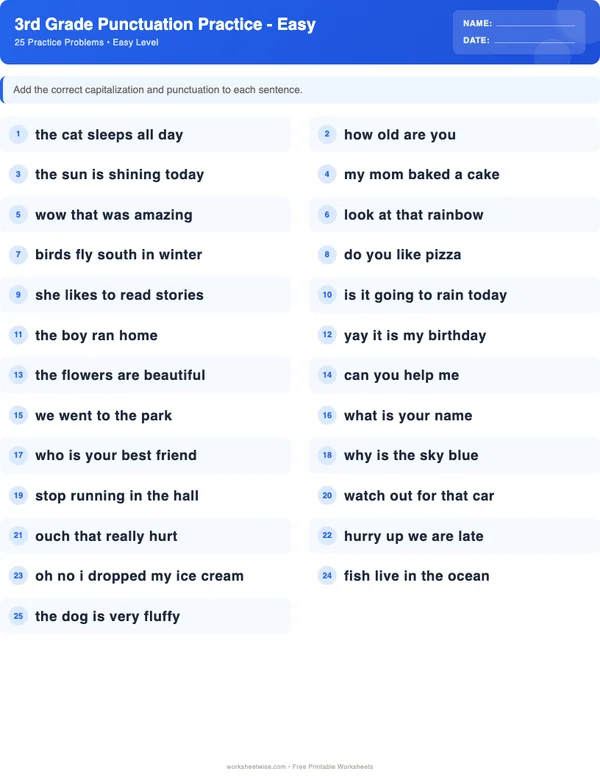
The free 3rd Grade Punctuation worksheet gives a learner 14 easy-level sentences to correct. For each item, the learner adds appropriate capitalization and end punctuation. The target marks are periods, question marks, and exclamation points.
The concise answer is this: model how to identify the sentence’s purpose, complete a few items together, let the learner finish a manageable group independently, and then discuss errors by type. Do not treat the answer key as a substitute for explaining why each sentence needs a particular mark.
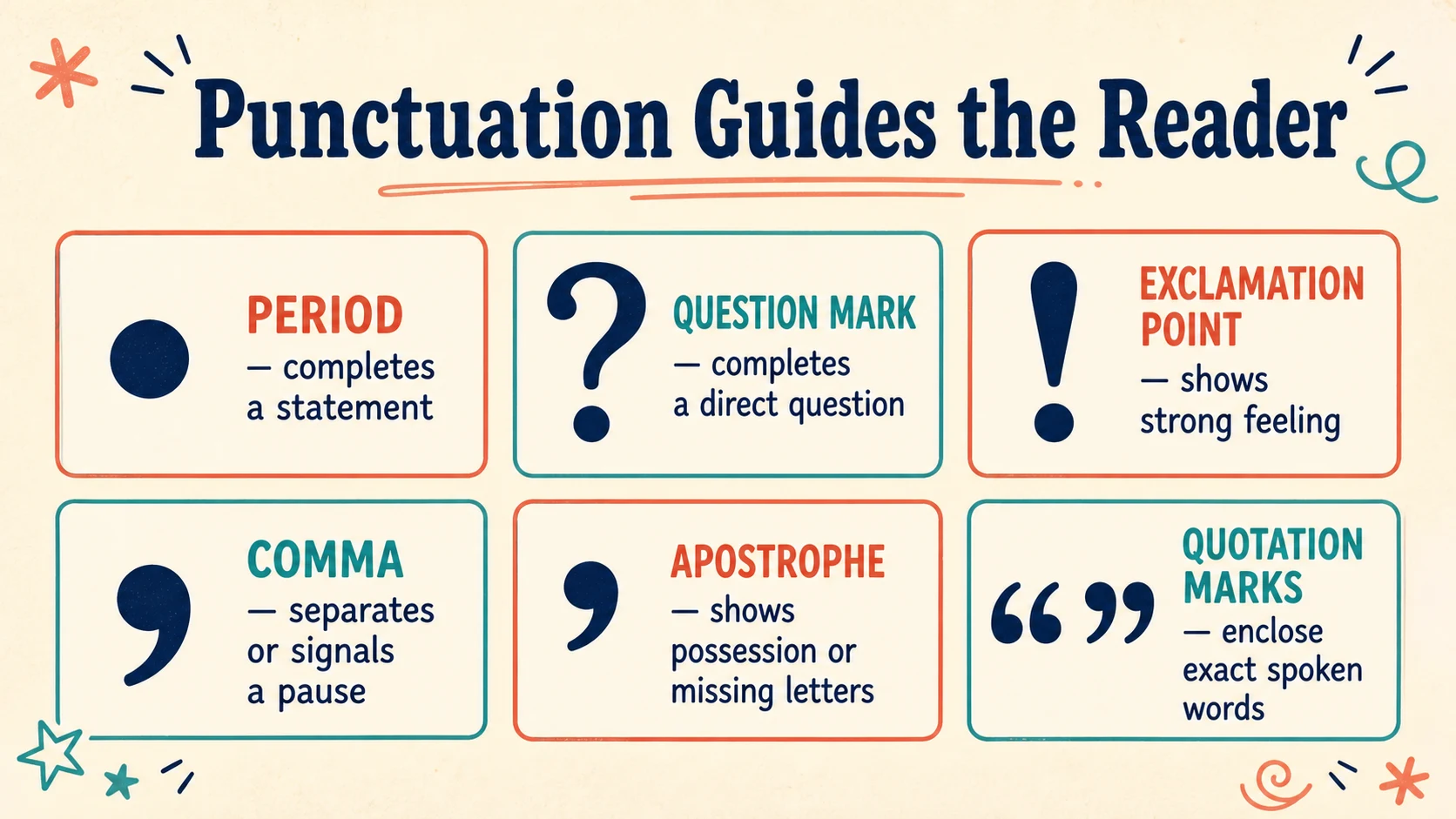
This printable is especially suitable when a learner is beginning punctuation practice or needs reinforcement with foundational writing mechanics. It does not cover the full punctuation sequence described in the broader 3rd Grade Punctuation topic guide, such as commas, apostrophes, or quotation marks. Use that guide when you need to place this lesson within a longer progression.
Grade labels describe the intended practice level, not a guarantee that every third grader should complete the page at the same speed or with the same support. Local curricula and instructional sequences differ. Let the learner’s observed work determine whether to continue, pause for more modeling, or return later.
The lesson moves from a short explanation to modeling, guided practice, independent work, feedback, and later review.
A Practical Lesson Map
The worksheet can fit into one focused lesson, but it does not need to be completed in a single sitting. A learner who explains punctuation choices accurately may move through the page quickly. A learner who guesses, loses track of capitalization, or becomes less accurate after several items may benefit from a shorter first session.
| Lesson stage | Suggested activity | What the adult watches for |
|---|---|---|
| Launch | Review the directions and name the three possible end marks | Can the learner explain statement, question, and exclamation in simple language? |
| Model | Correct one similar sentence aloud | Does the learner follow how meaning leads to punctuation? |
| Guided practice | Complete two or three items together | Can the learner choose a mark and give a reason? |
| Independent practice | Assign a small group of worksheet items | Is the learner applying both capitalization and punctuation without prompting? |
| Check and discuss | Compare work with the separate answer key | Can the learner locate and explain corrections? |
| Immediate follow-up | Retry selected errors without copying | Does the correction remain accurate when the answer is covered? |
| Retrieval | Revisit a few sentence types later | Can the learner recall the decision process after time has passed? |
This sequence is an instructional suggestion for using this particular printable. It is not a universal timetable. The IES guide on teaching elementary students to be effective writers provides broader support for explicitly teaching writing skills and giving students opportunities to practice them. It did not evaluate WorksheetWise or this worksheet.
The IES foundational reading guide addresses early literacy instruction more broadly. Its emphasis on clear instruction, modeling, guided application, and attention to learner performance is useful context for planning a gradual handoff, but it should not be read as a specific endorsement of this punctuation activity.
Prepare Before the Learner Starts
A minute of preparation can keep the lesson centered on punctuation instead of logistics.
Have the worksheet, a pencil, and the separate printable answer key available. Keep the key out of the learner’s sight during initial practice. If handwriting effort could distract from the target skill, provide enough writing space or allow the learner to say the corrected sentence before writing it. The learner should still make the capitalization and punctuation decisions.
Read the worksheet direction exactly: “Add the correct capitalization and punctuation to each sentence.” Then translate it into two checks:
- What needs a capital letter?
- Which mark belongs at the end?
This wording matters because every item involves more than selecting a final mark. A learner can identify a question mark correctly and still leave the opening word lowercase. Likewise, a capital letter alone does not complete the correction.
Establish three sentence purposes
Use plain descriptions rather than relying only on voice:
- A statement tells something and usually ends with a period.
- A direct question asks something and ends with a question mark.
- An exclamation shows strong feeling or emphasis and ends with an exclamation point.
“Usually” is useful when describing statements because punctuation decisions depend on how a sentence is written and intended. For this easy-level worksheet, however, the expected choice is among the three listed end marks.
Reading aloud can help reveal meaning, but voice should support the decision rather than replace it. A learner may raise their voice at the end of a sentence simply because they are uncertain. Ask what the sentence does: tells, asks, or strongly exclaims.
Use a quick readiness check
Before opening the 14-item task, say three short sentences aloud:
- “The bus is here.”
- “Is the bus here?”
- “The bus is here!”
Ask the learner to name the likely punctuation and explain each choice. If the learner distinguishes all three, move into the worksheet. If the learner cannot yet distinguish a statement from a question, model that contrast first. This keeps the skill unchanged while adjusting the amount of preparation.
Model the Complete Decision Process
Demonstrate one sentence that is similar to the worksheet but not presented as an actual worksheet item. Write:
where is my blue backpack
Think aloud in a short, repeatable sequence:
- “The first word begins the sentence, so I change where to Where.”
- “The sentence asks for information.”
- “A direct question ends with a question mark.”
- “My corrected sentence is: Where is my blue backpack?”
The checked correction is:
Where is my blue backpack?
This example has one opening capital and one question mark. No other punctuation is required for the skill being modeled.
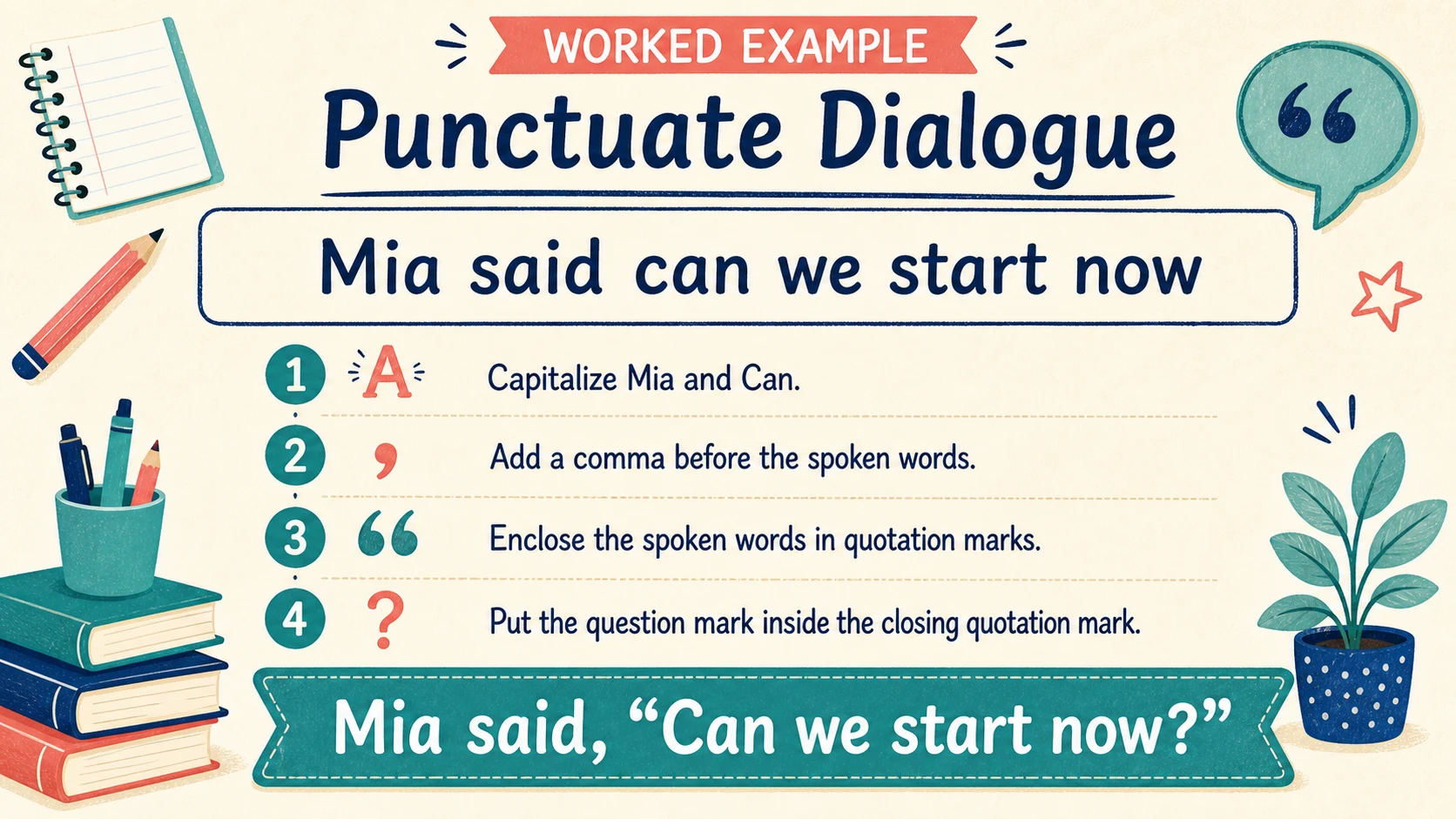
The adult identifies the opening capital, determines the sentence’s purpose, and then selects the end mark.
Model meaning before appearance
Avoid teaching shortcuts such as “sentences beginning with what always take a question mark.” Compare these two fully checked examples:
-
what time does the movie start
What time does the movie start? -
what a huge pumpkin
What a huge pumpkin!
The first sentence directly asks for information, so it needs a question mark. The second expresses strong reaction, so an exclamation point fits. Both begin with what, but their purposes differ.
The distinction is a useful boundary case. It shows why the learner must read the whole sentence instead of choosing punctuation from the first word alone.
Show how capitalization and punctuation work together
Model a straightforward statement:
the rabbit sat beside the fence
The checked answer is:
The rabbit sat beside the fence.
Explain that The receives a capital because it begins the sentence. The sentence tells something rather than asking or exclaiming, so it ends with a period.
If a practice sentence includes a familiar proper name, demonstrate that a name may also need a capital:
maya found the missing mitten
The checked answer is:
Maya found the missing mitten.
This correction contains two capitals for different reasons: Maya is a name, and it also happens to begin the sentence. Keep the explanation tied to visible features in the example. Do not turn the lesson into a broad capitalization unit unless the learner’s work shows that such review is needed.
Move Through Guided and Independent Practice
Guided practice should reveal the learner’s reasoning without turning every item into an adult-led performance. Complete two or three worksheet items together, then release a small group for independent work.
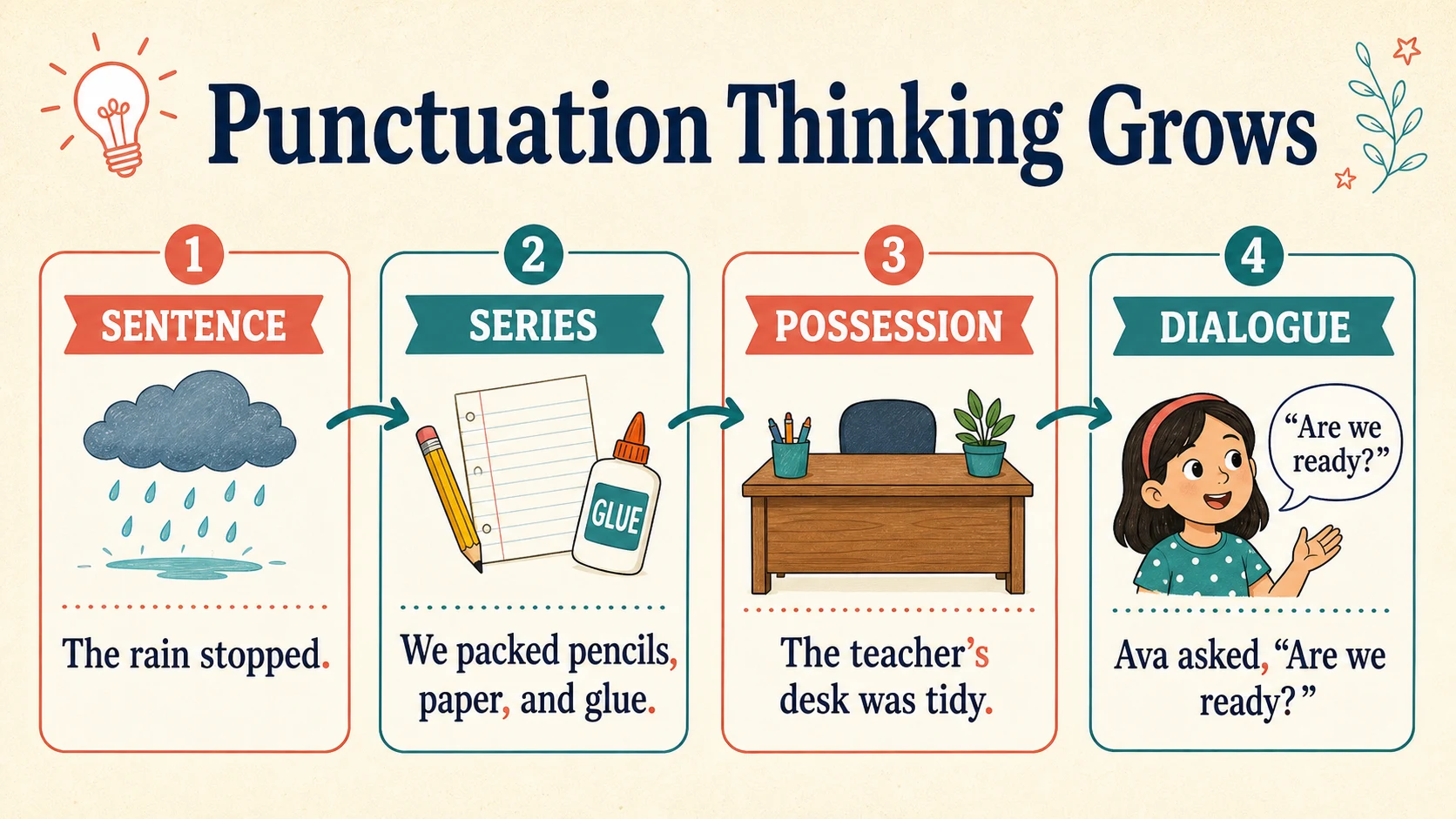
Guided practice keeps the decision visible before the learner applies it without prompts.
Prompt without supplying the mark
For a guided item, ask:
- “What does the sentence do?”
- “Which word needs attention at the beginning?”
- “Does it tell, ask, or strongly exclaim?”
- “Which end mark matches that purpose?”
- “Read the corrected sentence back to me.”
These prompts direct attention without naming the answer. If the learner chooses correctly, ask for one brief reason and move on. Requiring a long explanation for every easy item can make the mechanics lesson unnecessarily tiring.
If the learner hesitates, narrow the choice: “Is the sentence asking something, or telling something?” Once the learner decides, return to the full three-way choice on a later item.
Use a fully checked guided example
Present:
did you feed the goldfish
A useful exchange might proceed as follows:
- Adult: “What is the sentence doing?”
- Learner: “Asking.”
- Adult: “What mark matches a direct question?”
- Learner: “A question mark.”
- Adult: “What else must change?”
- Learner: “The first letter.”
The checked sentence is:
Did you feed the goldfish?
This is correct because Did begins the sentence and the complete sentence asks a direct question.
Release the work in small groups
Rather than automatically assigning all 14 items at once, consider an initial group of four or five. Review that group before deciding how much support the learner needs next.
Continue independently when the learner:
- remembers both parts of the instruction;
- selects marks by meaning rather than guessing;
- rereads corrected sentences; and
- maintains roughly the same care across the group.
Return to guided work when the learner:
- repeatedly forgets capitalization;
- uses one end mark for nearly every sentence;
- changes answers after looking at the adult;
- cannot explain the difference between asking and telling; or
- becomes less attentive as the set continues.
These are practical observations, not diagnoses. They describe what happened during the task and help determine the next instructional move.
Four More Worked Examples and Boundary Cases
The examples below are original practice sentences checked against the worksheet’s stated skill set. They illustrate the reasoning an adult can use without claiming to reproduce the actual printable items.
A calm statement
Uncorrected:
our class planted six seeds
Corrected:
Our class planted six seeds.
Reason: Our begins the sentence, so it needs a capital. The sentence tells what happened and does not signal a direct question or strong exclamation. A period completes it.
A direct question
Uncorrected:
can we read another chapter
Corrected:
Can we read another chapter?
Reason: Can needs an opening capital. The sentence directly asks whether another chapter can be read, so it takes a question mark.
A clear exclamation
Uncorrected:
that was an amazing catch
Corrected:
That was an amazing catch!
Reason: That begins with a capital. The wording communicates a strong reaction, so an exclamation point is appropriate for this example.
A period could make similar wording calmer in another context. For a worksheet item, the answer key represents the intended reading. If a sentence seems genuinely open to more than one interpretation, discuss the possible readings before deciding whether the learner misunderstood the skill.
A sentence with a name
Uncorrected:
leo packed his lunch
Corrected:
Leo packed his lunch.
Reason: Leo is a name and begins the sentence, so it needs a capital. The sentence makes a statement and ends with a period.
An exclamation that resembles a question-word sentence
Uncorrected:
how bright the stars are
Corrected:
How bright the stars are!
Reason: The sentence expresses wonder rather than directly requesting an answer. It therefore takes an exclamation point in this reading.
Compare it with:
How bright are the stars?
This version changes the word order and directly asks for information, so it needs a question mark. This pair is a useful boundary case because punctuation follows sentence purpose, not the presence of how alone.
Adapt Support Without Changing the Skill
Adaptation should make the same capitalization-and-end-punctuation decision more accessible. It should not quietly replace the task with tracing, copying, or guessing from visual cues.
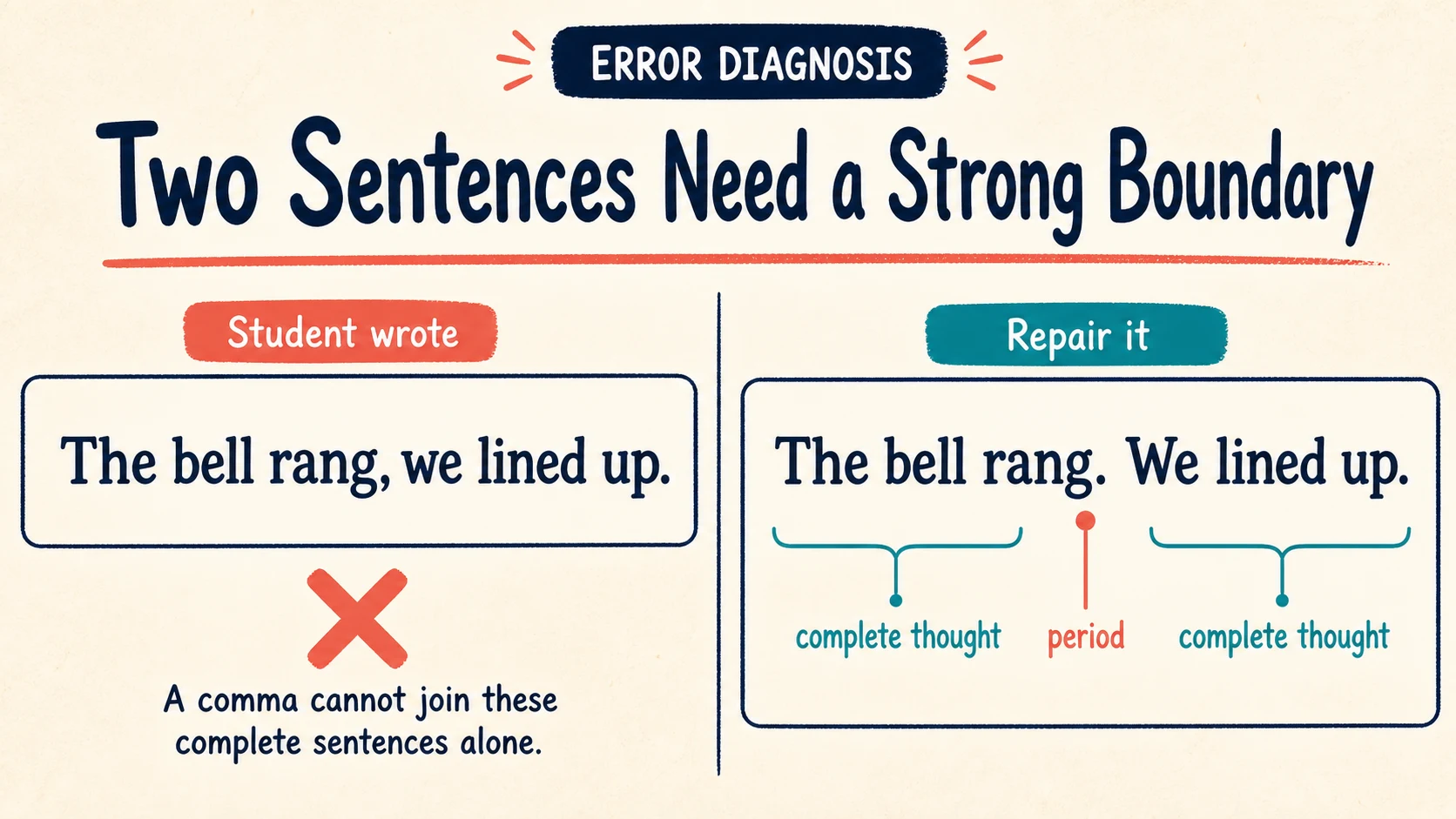
Support can change how much the learner handles at once while preserving the original punctuation decisions.
When the learner needs more support
Cover the lower part of the page so only one sentence is visible. Read the sentence aloud once, then ask the learner to read or repeat it. Provide a small reference card showing:
- statement →
. - question →
? - strong exclamation →
!
This card supports recall but does not identify the answer for a particular item.
You can also separate the two required actions. First, have the learner mark the letter that needs capitalization. Second, have the learner choose the end mark. After several successful items, combine the steps again.
If writing the entire corrected sentence creates unnecessary friction, the learner can initially rewrite only the opening word and add the end mark on the printed line. Use this only when it still demonstrates the listed skills clearly.
When attention fades
Divide the 14 items into two or three short sets. Stop at a natural boundary rather than waiting for rushed answers. Record which item comes next and resume later.
A break is appropriate when accuracy changes alongside visible rushing, skipped words, or abandoned checking. It is less useful to assume every error is caused by fatigue. Ask the learner to explain one recent choice. That response gives better evidence about whether the difficulty is attention, sentence meaning, capitalization, or the punctuation rule itself.
When the learner is ready for more
Keep the same skill but remove some scaffolding. Ask the learner to:
- correct an item silently and then explain the choice;
- sort completed sentences into statements, questions, and exclamations;
- write one new example of each type; or
- change a statement into a question by revising both wording and punctuation.
For example:
The game begins at noon.
can become:
Does the game begin at noon?
Changing only the period to a question mark would produce The game begins at noon? That wording can appear in conversational writing, but it is not the clearest model for a foundational exercise. Revising the word order makes the direct question explicit.
Interpret Errors Before Assigning More Practice
A total score shows how many responses matched the key. It does not, by itself, show what the learner understands. Sort errors by the decision that went wrong.
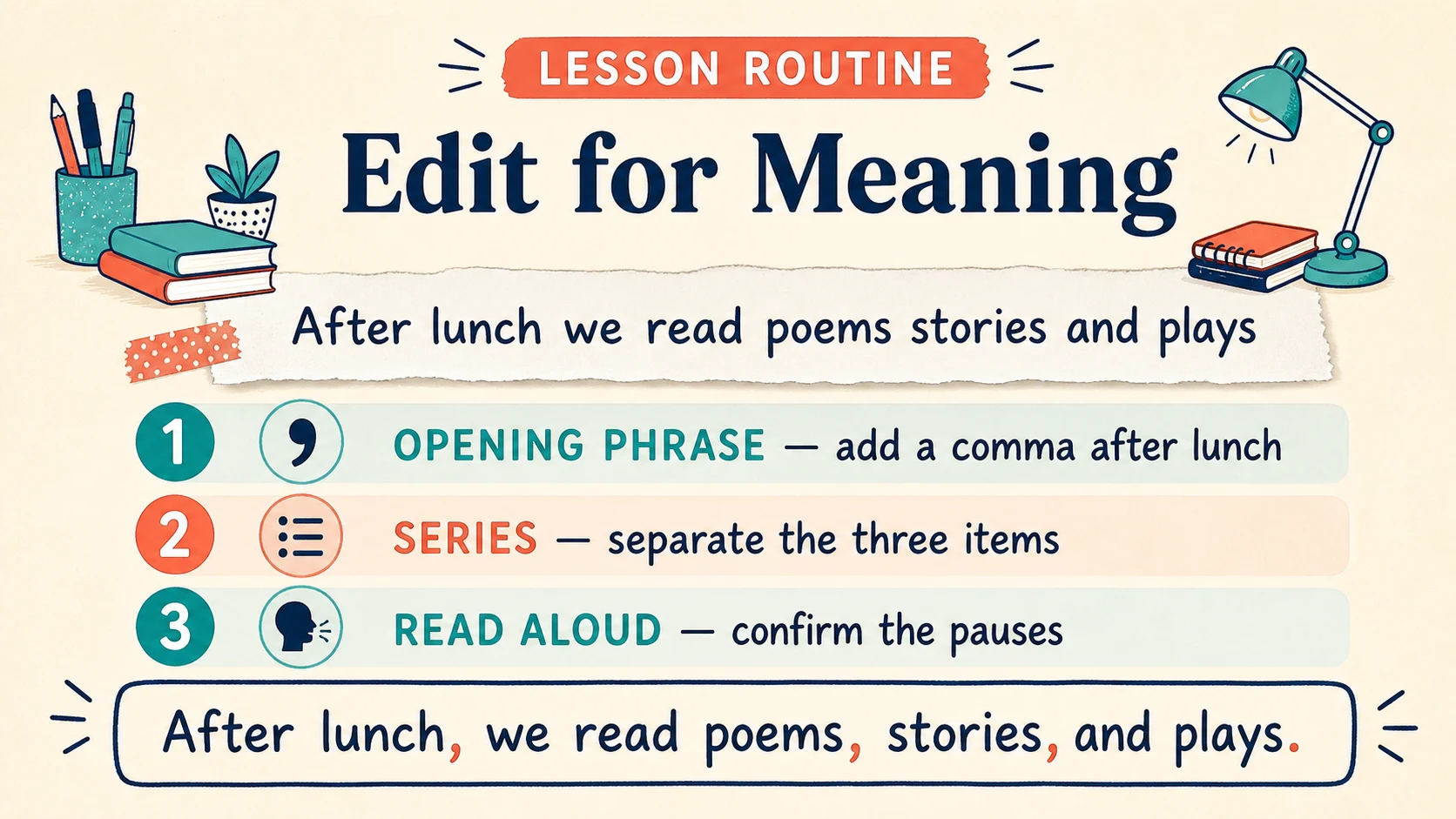
Classify the error, revisit the rule, and ask the learner to make a fresh correction.
Capitalization-only errors
Example:
where is the library?
The end mark is correct, but the opening word remains lowercase. This suggests that the learner may understand sentence purpose while overlooking the first half of the directions.
Try a two-point check after each sentence: “capital at the beginning; mark at the end.” Then give one fresh item to see whether the learner applies the routine independently.
End-mark errors
Example:
Where is the library.
The capital is correct, but the period does not match a direct question. Ask the learner whether the sentence tells information or requests it. Avoid merely saying, “That one is wrong.”
If question marks and periods are frequently confused, contrast matched examples:
- The library is beside the park.
- Is the library beside the park?
The topic remains similar while the sentence purpose changes.
Exclamation-point overuse
Some learners may treat an exclamation point as a “more exciting period” and add it to many statements. Explain that strong feeling or emphasis should be evident in the intended sentence. Then compare:
- The puppy is in the yard.
- What a playful puppy!
The goal is not to ban expressive punctuation. It is to connect the mark to meaning.
Correct marks with weak explanations
A learner may answer accurately by pattern recognition but be unable to explain any choice. Do not automatically count every such response as a misunderstanding. Ask for reasons on a small sample.
If the learner can explain several varied items, further oral explanation may be unnecessary. If explanations reveal guesses—such as “questions always start with can”—provide a contrasting example before moving on.
Errors that do not belong to this lesson
Spelling, handwriting, and sentence composition may affect the finished page, but this worksheet’s stated targets are capitalization, periods, question marks, and exclamation marks. Note unrelated issues without letting them obscure the punctuation evidence.
Child-specific intervention, diagnosis, and medical guidance are outside the scope of this printable. If broader concerns persist across tasks and settings, use the support processes available through the learner’s school, program, or qualified professional.
Check the Answer Key Responsibly
The worksheet includes a separate printable answer key for quick checking. Use it after the learner has attempted the assigned items.
A sound checking routine is:
- Compare one response at a time.
- Mark the exact feature that differs: opening capital, other required capital, or end punctuation.
- Ask the learner to reread the sentence.
- Have the learner explain the intended sentence type.
- Cover the key before the learner writes the correction.
- Give a similar new sentence when you need evidence of independent understanding.
Copying the key can produce a correct-looking page without showing that the learner can make the decision. A fresh example is a better check after correction.
The key should normally guide scoring for the printable because it records the intended reading of each item. Still, punctuation can sometimes change with intended emphasis. If an item appears debatable, distinguish between a plausible alternative reading and a mismatch with the exercise’s expected sentence type. Do not penalize first and discuss meaning later.
The Common Core State Standards for English Language Arts provide a broad public reference for grade-level language expectations, including conventions of standard English. They can help adults understand the wider instructional context, but they do not certify this worksheet, determine every local sequence, or establish comprehensive standards alignment for one 14-item page.
For a wider range of grammar materials, use the 3rd Grade Grammar hub. For resources across subjects, visit the 3rd Grade worksheet hub.
Decide What to Do Next
Base the next step on patterns across the work, not on one isolated mistake.
If the learner accurately handles statements, direct questions, exclamations, and opening capitals, move to a brief application task. Ask for three original sentences—one of each type—and check whether the same conventions transfer to writing.
If one category remains uncertain, choose focused contrast practice. For example, place statements and questions side by side rather than assigning another mixed page immediately. Once the distinction is stable, return to mixed practice.
If capitalization is the main issue, retain the punctuation choices but add a deliberate beginning-of-sentence scan. If accuracy drops only near the end, shorten the next session and compare the first and second groups. These adjustments preserve the target skill while responding to observed performance.
Do not infer mastery from a single perfect attempt. Equally, do not infer a lasting problem from one difficult session. Look for whether the learner can explain, correct, and later retrieve the skill.
Schedule Brief Retrieval
Later review asks the learner to recall the decision process after some time has passed. The schedule below is a practical option, not a universal recommendation.
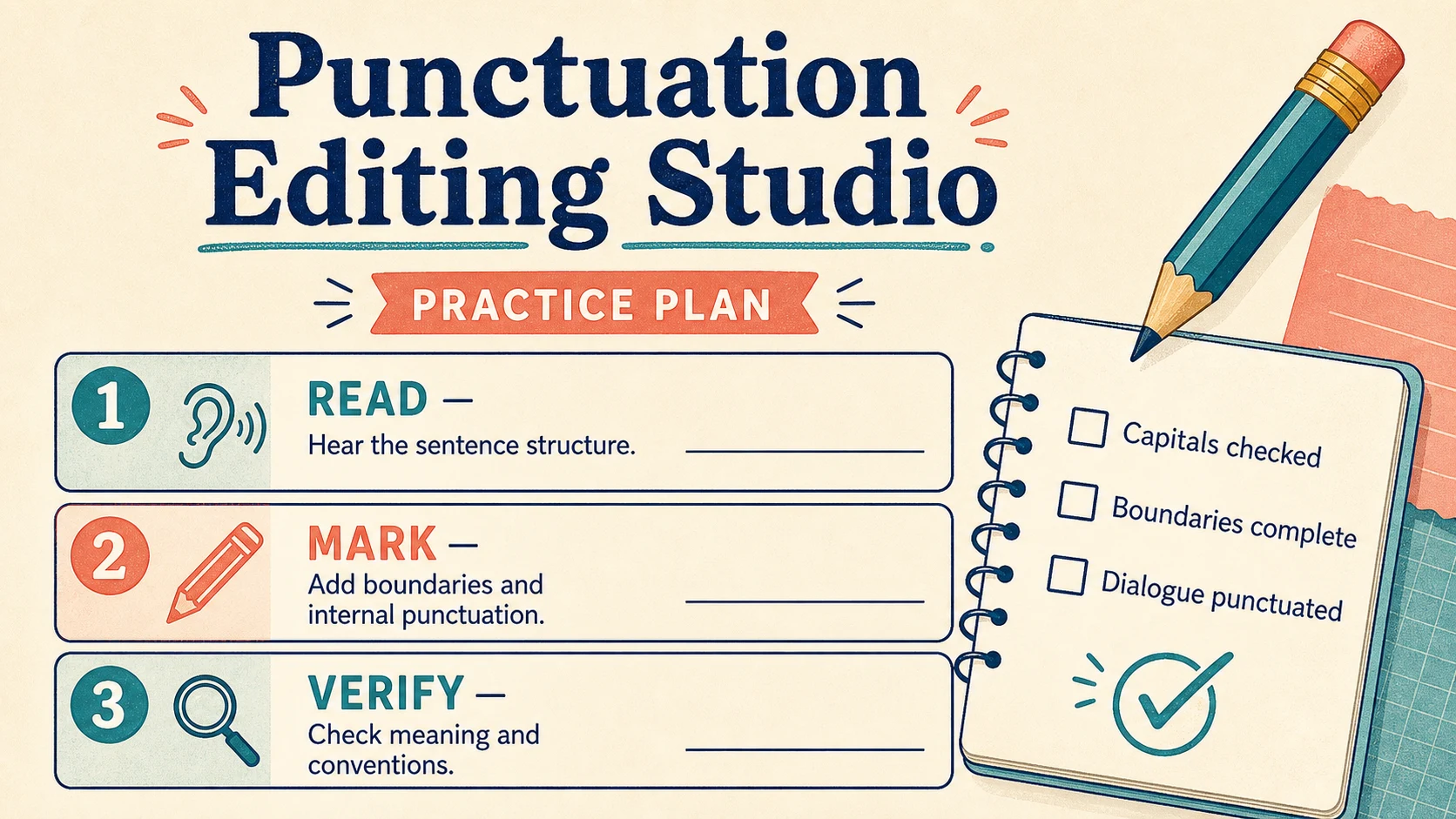
Short return visits can check whether the learner still distinguishes sentence purposes without relying on the completed page.
| Review point | Suggested task | Evidence to collect |
|---|---|---|
| Later the same day or next session | Correct three new sentences: one statement, one question, one exclamation | Does the learner remember both capitalization and the end mark? |
| A few days later | Mix four new sentence types without labeling them | Can the learner identify purpose without a category cue? |
| About a week later | Write and punctuate one sentence of each type | Does the skill transfer from editing to original writing? |
| During later writing | Review selected sentence endings in the learner’s own work | Is punctuation used when attention is shared with ideas and spelling? |
Use the learner’s responses to adjust timing. If recall is secure, lengthen the interval and continue into the broader punctuation sequence. If errors return, briefly model the distinction again and schedule another short check. Repeating the entire page is not always necessary; a few carefully chosen items may provide enough information.
Limitations and the Honest Next Step
This easy worksheet offers 14 exercises in capitalization and three forms of end punctuation. It does not provide comprehensive instruction in commas, apostrophes, quotation marks, dialogue formatting, or every capitalization rule. It also cannot show by itself whether a learner will use punctuation consistently in longer original writing.
Its best use is as one observable practice sample: launch the rule clearly, watch how the learner reasons, inspect the error pattern, and revisit the skill after a delay.
Next, use the free Punctuation topic guide to choose the next skill rather than jumping randomly. If the learner needs more varied punctuation practice, review the 3rd Grade Punctuation Worksheet Pack, which contains 18 worksheets. If you need fresh sentences targeted to a particular distinction, use the free worksheet generators to create a short follow-up set based on what the learner’s work actually showed.
Put it into practice
Use the guide with a real printable
Move from explanation to a short, observable practice task. Check the first item together, then adjust the next session from the learner's actual work.
See the 18-worksheet pack