Complete guide
How to teach and practise 3rd grade parts of speech worksheets - standard theme (easy)
How to Use This 14-Item Parts of Speech Worksheet
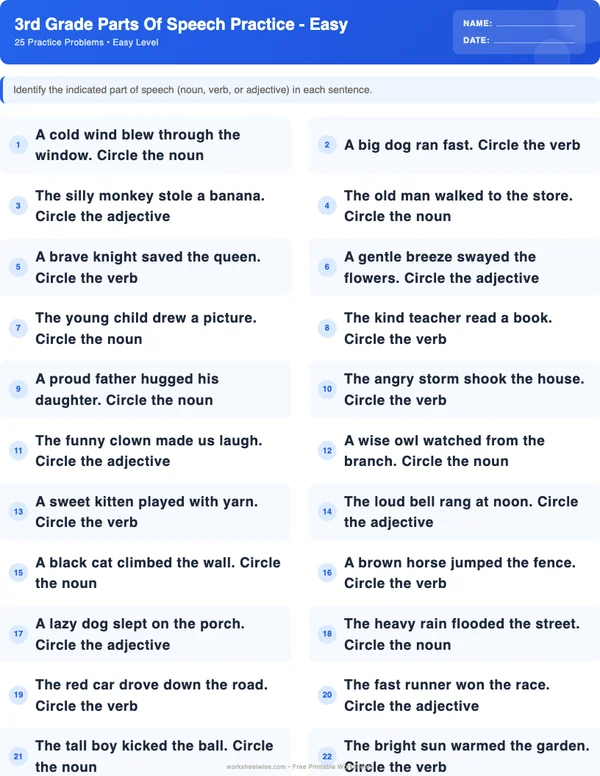
The free 3rd Grade Parts of Speech worksheet gives a learner 14 easy-level exercises on identifying nouns, verbs, and adjectives in sentences. The adult’s role is to make the directions clear, model how to examine a sentence, provide brief guided practice, and then step back. Use the learner’s observed work—not a fixed timetable—to decide when to offer support, when to continue independently, and what to practice next.
A practical lesson can take one sitting or be divided across two shorter sessions. Begin with a quick review of the three word classes, model one or two examples, complete several items together, and assign the remaining items independently. Afterward, check the separate answer key carefully and discuss patterns in the learner’s reasoning rather than treating the score as the whole result.
Grade labels describe the intended practice level. Local curricula and instructional sequences differ, so confirm that nouns, verbs, and adjectives are appropriate current targets for the learner you are supporting.
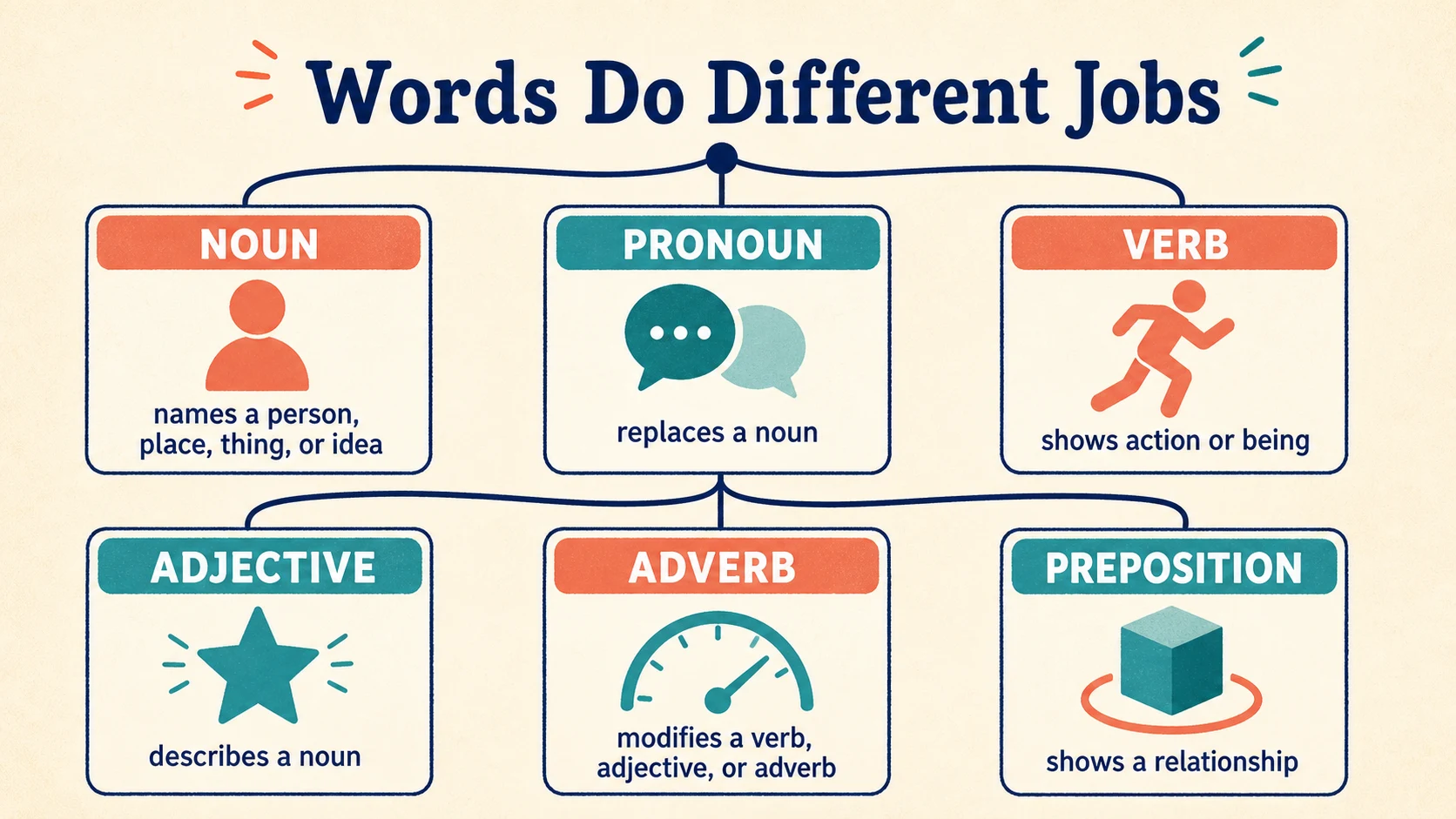
Preview, model, practice together, release responsibility, check reasoning, and revisit the skill later.
What This Worksheet Does—and Does Not Do
This printable focuses on a deliberately limited task: identifying an indicated noun, verb, or adjective in a sentence. Its 14 items provide practice with four connected skills:
- recognizing nouns;
- recognizing verbs;
- recognizing adjectives;
- analyzing how a word functions within a sentence.
That scope makes the worksheet suitable for an introductory lesson, a review after instruction, a grammar warm-up, homework, or homeschool practice. Because the difficulty is labeled easy, the activity is especially relevant when a learner is beginning this type of sentence analysis or needs reinforcement with the three foundational categories.
The printable does not cover all eight commonly taught parts of speech. It does not, by itself, establish mastery of pronouns, adverbs, prepositions, conjunctions, or interjections. It also cannot show whether a learner can apply grammatical knowledge consistently in original writing. For the larger sequence, use the Parts of Speech topic guide instead of trying to turn this one page into a complete grammar course.
The Common Core English Language Arts standards provide a broader grade-by-grade language framework. They should be consulted alongside local requirements when standards information matters. The source has not evaluated this particular WorksheetWise printable, and using the worksheet does not establish comprehensive standards alignment.
Prepare the Learner Before Printing or Starting
A short oral check can reveal whether the learner is ready to work with all three categories. Say a simple sentence such as:
The small rabbit hops.
Ask the learner to point to:
- the word naming an animal;
- the word telling what the animal does;
- the word describing the animal.
If the learner identifies rabbit, hops, and small, connect those answers to the labels noun, verb, and adjective. If the learner can explain the choices, move quickly into the worksheet. If the learner can answer only by guessing, spend a few minutes rebuilding the meanings before introducing all 14 items.
Establish three usable definitions
Keep the definitions short enough to apply:
- A noun names a person, place, thing, or idea.
- A verb tells an action or state of being.
- An adjective describes a noun.
These definitions are starting tools, not complete accounts of English grammar. For this easy worksheet, they direct attention to the intended distinctions without adding unnecessary terminology.
Set up a repeatable sentence routine
Ask the learner to use the same sequence on every item:
- Read the full sentence.
- Notice which part of speech the item requests.
- Find the main noun and verb.
- Look for a describing word if an adjective is requested.
- Reread the sentence with the selected word emphasized.
- Explain what job that word performs.
The fourth and fifth steps discourage visual guessing. A learner should choose a word because of its function in the sentence, not because it “looks like” a familiar noun or verb.
Decide how much of the page to show
Some learners can manage all 14 items in view. Others may attend more carefully when the adult covers the lower part of the page and reveals four or five items at a time. That change reduces the amount visible without changing the target skill, wording, or expected response.
A Flexible Lesson Progression
The following plan is a teaching sequence, not a universal timetable. Shorten or extend each phase according to accuracy, explanation quality, attention, and signs of fatigue.
| Phase | Suggested portion | Adult action | Learner action | Evidence to watch |
|---|---|---|---|---|
| Preview | 2–4 minutes | Review noun, verb, and adjective meanings | Give or identify one example of each | Can the learner distinguish naming, doing, and describing? |
| Model | 1–2 items | Think aloud and verify each choice in context | Follow the reasoning and answer one prompt | Can the learner explain why the choice fits? |
| Guided practice | 3–5 items | Prompt only where needed | Read, select, and explain | Are prompts becoming less necessary? |
| Independent practice | Remaining items | Observe without supplying answers | Complete each requested identification | Does accuracy continue without immediate help? |
| Review | 5–10 minutes | Compare with the answer key and discuss errors | Correct and explain selected items | Are errors isolated or patterned? |
| Retrieval | Later sessions | Present fresh oral or written sentences | Identify the requested word class from memory | Is the distinction retained after a delay? |
A learner who understands the model may need only two guided items. A learner who confuses categories may need several more. Do not require independence simply because a preset number of minutes has passed.
Model the Task With Fully Checked Examples
A useful model makes the invisible decision process audible. Read the entire sentence, name the requested category, test a possible answer, and explain why it belongs. Avoid telling the learner to rely only on a question such as “Can you touch it?” That shortcut fails for places, ideas, actions, and words whose function changes with context.
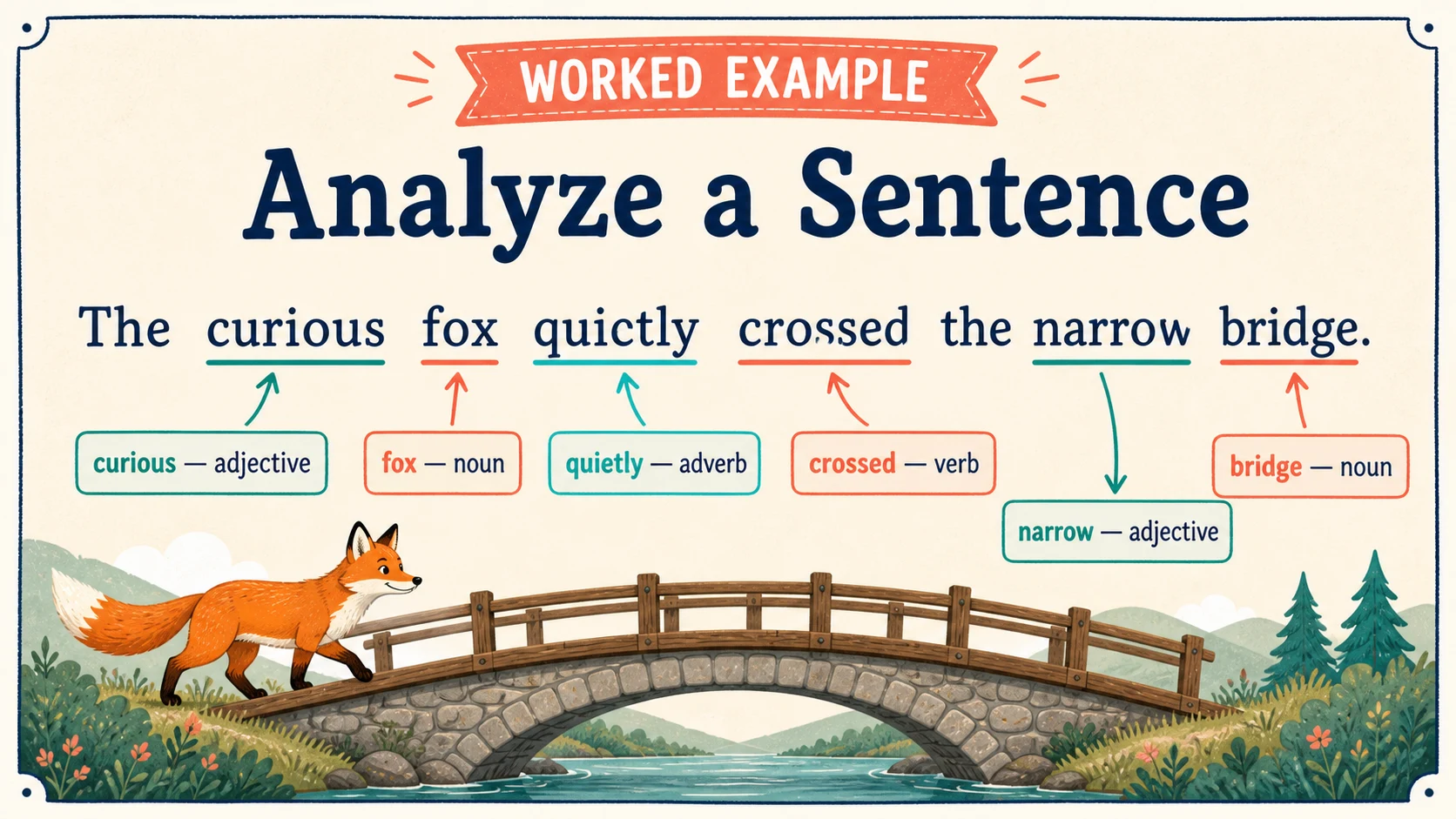
The word’s job in the complete sentence determines its part of speech.
Worked example 1: identify a noun
Sentence: The kitten slept beside the basket.
Prompt: Identify a noun.
Checked answer: kitten is a noun because it names an animal. Basket is also a noun because it names a thing.
This example reveals an important checking issue: a sentence may contain more than one word in the requested category. If a worksheet item is designed for one answer, consult its exact wording and answer key. Do not mark a grammatically valid alternative wrong without examining whether the prompt or formatting indicates a particular target.
An adult think-aloud might be:
“I need a noun. I will look for naming words. Kitten names an animal, so it is a noun. Basket names a thing, so it is also a noun. I need to see which response the item expects.”
Worked example 2: identify a verb
Sentence: Maya carried the heavy box.
Prompt: Identify the verb.
Checked answer: carried is the verb because it tells what Maya did.
Verification:
- Maya names a person, so it is a noun.
- box names a thing, so it is a noun.
- heavy describes the box, so it is an adjective.
- carried expresses the action.
This cross-check is more dependable than choosing the word with the most interesting meaning.
Worked example 3: identify an adjective
Sentence: The bright lantern glowed.
Prompt: Identify the adjective.
Checked answer: bright is the adjective because it describes the noun lantern.
A useful test is to remove the word temporarily:
The lantern glowed.
The sentence still identifies the same object and action, but it loses information about the lantern. That supports the conclusion that bright is descriptive.
Worked example 4: distinguish description from action
Sentence: The playful dogs chased a ball.
Prompt: Identify the adjective.
Checked answer: playful is the adjective because it describes the noun dogs.
Do not choose chased. It gives information about what the dogs did, but its sentence job is a verb. “Tells us more about” is too broad a definition for adjectives because verbs also tell us more about a subject. The more precise question is: Which word describes a noun?
Worked example 5: recognize a state-of-being verb
Sentence: The soup is warm.
Prompt: Identify the verb.
Checked answer: is is the verb. It does not show a physical action; it links soup to the description warm. The word warm is an adjective because it describes the soup.
This is a useful boundary example if the learner has learned that every verb is an action word. The action definition is helpful at first, but it is incomplete.
Move From Guided to Independent Practice
Guided practice should reveal the learner’s thinking without turning the adult into an answer provider. Sit beside the learner for the opening items and ask prompts that can be reused independently.
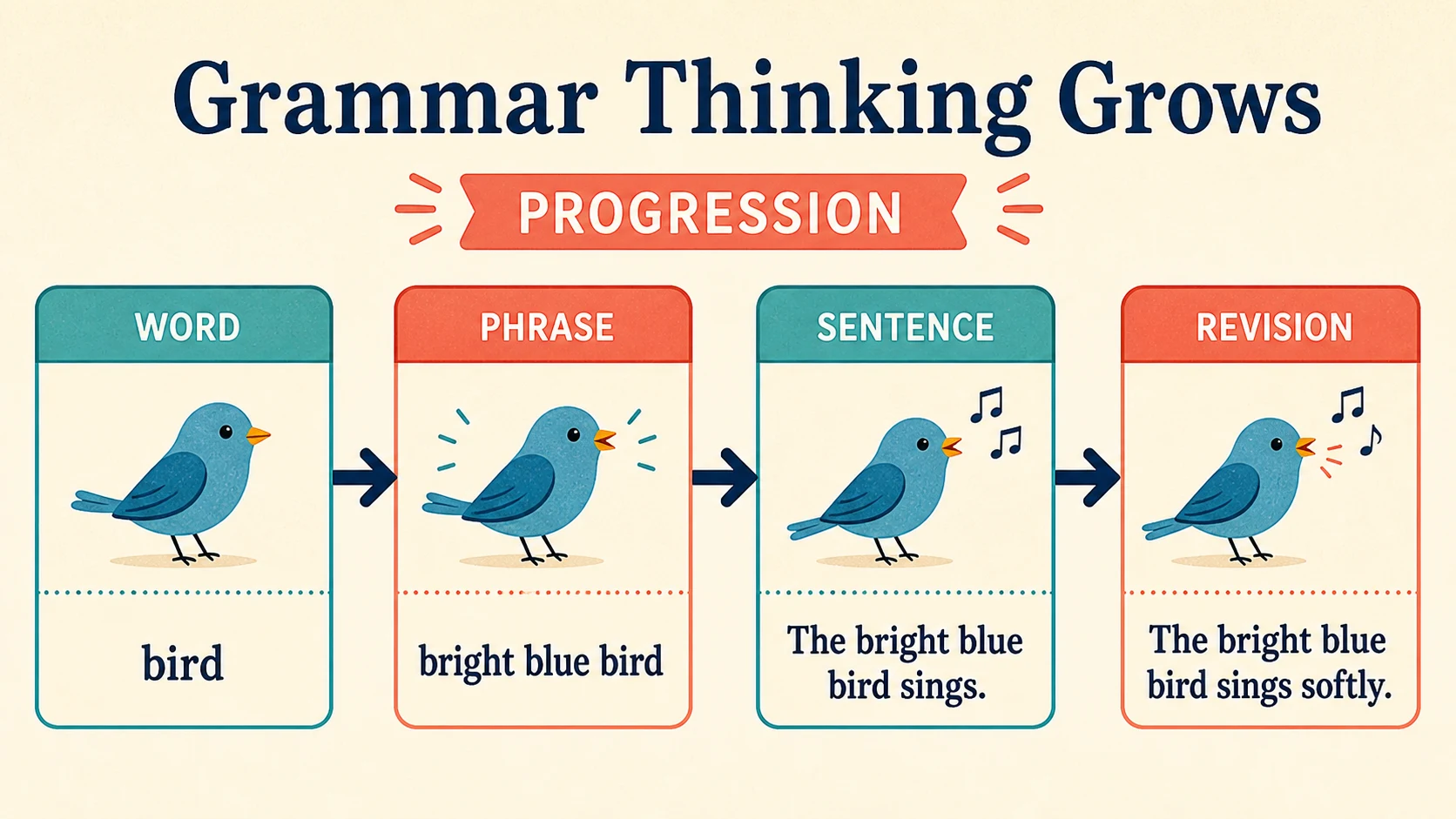
Use prompts to reveal reasoning, then remove them as the learner becomes accurate.
Use a fading prompt sequence
Begin with the least help likely to work:
- “What part of speech are you looking for?”
- “Read the entire sentence aloud.”
- “Which word names, acts, or describes?”
- “What noun does that adjective describe?”
- “Show me the evidence in the sentence.”
If the learner answers after the first prompt, stop there. If the adult repeats the full definition and points toward the answer on every item, the page measures prompt-following more than independent sentence analysis.
A simple release pattern is:
- Adult models one item.
- Adult and learner solve one item together.
- Learner solves one while explaining aloud.
- Learner completes a small group silently.
- Adult checks whether the reasoning remains sound.
Return to guided practice if the learner begins using a repeated position-based guess, such as selecting the first word in every sentence.
Protect the independent portion
For the independent items, give the learner enough uninterrupted time to read and decide. Neutral reminders are acceptable: “Check which category the directions request” or “Reread the sentence.” Avoid confirming every response as it is written. Immediate confirmation can make the learner dependent on facial expressions, tone, or approval before continuing.
The IES elementary writing practice guide offers broader instructional framing for teaching writing through explicit instruction and supported practice. It does not evaluate this worksheet, but its focus is consistent with using a clear model, guided application, and meaningful language work rather than presenting a page without instruction.
Adapt Support Without Changing the Skill
An adaptation should improve access to the noun–verb–adjective task while preserving the need to analyze sentences. Copying the answer, replacing every sentence with isolated words, or reducing the activity to matching colors without explanation changes what the learner is practicing.
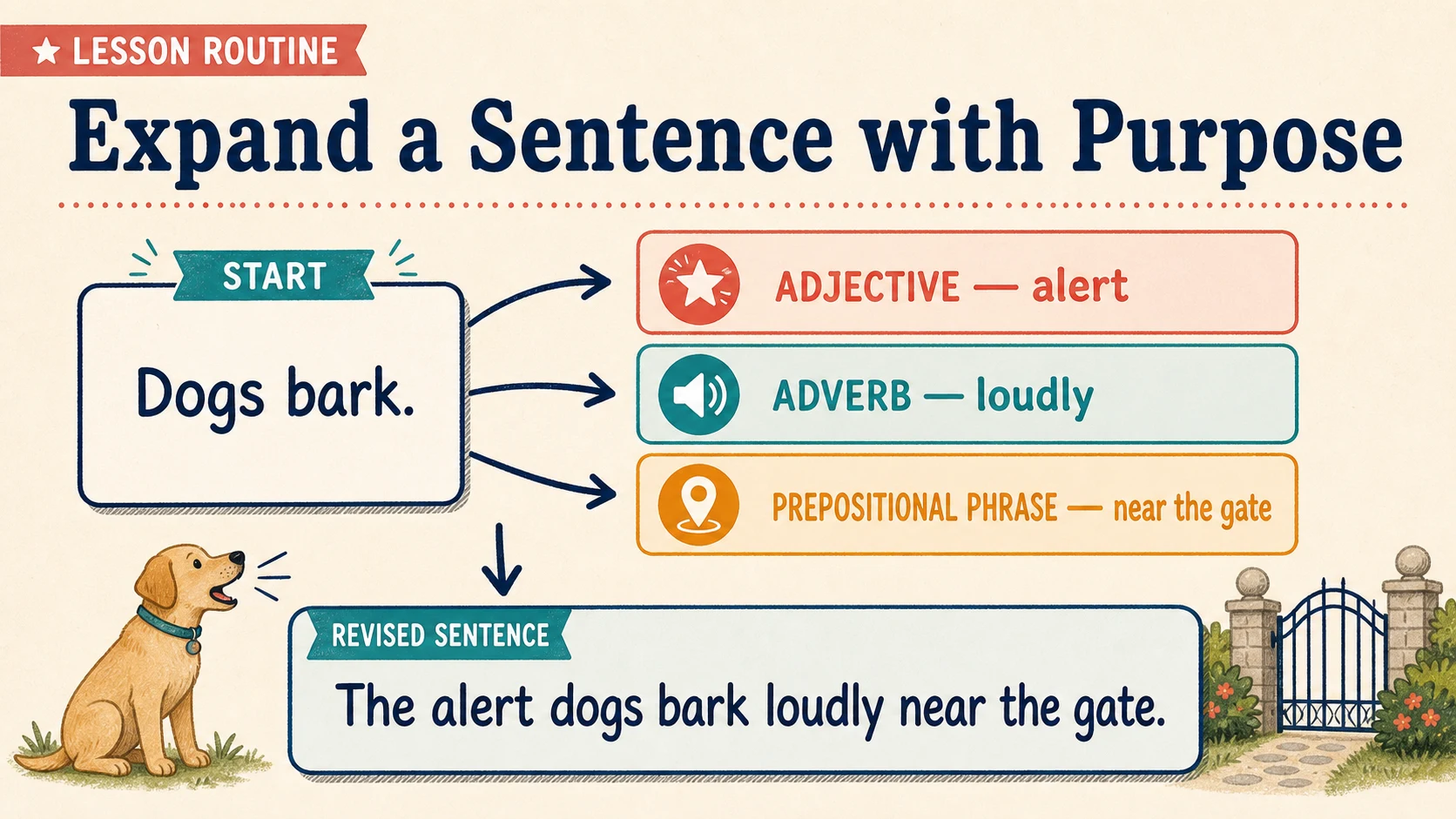
Adjust visibility, response mode, or prompting while keeping sentence-level identification intact.
When reading the sentence is the obstacle
Read the sentence aloud while the learner follows the printed words. Then ask the learner to identify the requested part of speech and explain its job. This separates support for reading access from the grammar decision.
You can also let the learner reread the sentence aloud, point to each word, or use a plain index card as a line guide. Do not paraphrase the sentence so heavily that the grammatical structure changes.
For broad guidance on foundational literacy instruction through Grade 3, consult the IES foundational skills practice guide. That source supplies high-level instructional context; it is not an evaluation of WorksheetWise or a prescription for an individual learner.
When handwriting slows the work
Permit circling, underlining, pointing, or saying the answer while the adult records it. The learner should still make and explain the grammatical choice. If you need evidence of independent written responding, ask the learner to write answers for a smaller subset after demonstrating the skill orally.
When three categories overload attention
Keep all three categories in the lesson, but present a small reference card:
| Noun | Verb | Adjective |
|---|---|---|
| names | acts or links | describes a noun |
Before each item, have the learner touch the requested column. Another option is to complete a few noun items, pause, and restate the definitions before continuing. Do not silently convert the worksheet into noun-only practice unless you intentionally plan a separate prerequisite lesson.
When the work is accurate but too easy
Ask for a brief justification: “How do you know?” The learner might also name another noun in the sentence, replace an adjective with a different sensible adjective, or write a new sentence using the identified word in the same grammatical role.
Keep extensions short enough that the original 14-item task remains visible. If the learner consistently identifies the categories and explains them, move to a broader resource rather than adding endless decoration to an easy page.
Handle Boundary Cases Carefully
English words do not have permanent labels independent of context. A word’s function can change between sentences, and simple classroom definitions sometimes hide that fact.
Consider light:
- The light shines. Here, light names a thing, so it functions as a noun.
- Please light the candle. Here, light expresses an action, so it functions as a verb.
- We carried a light bag. Here, light describes bag, so it functions as an adjective.
Consider paint:
- The paint dried. Paint is a noun.
- We paint the fence. Paint is a verb.
These are useful teaching examples, but do not introduce them in the middle of independent work if they would distract a learner who is still establishing the basic categories. Save them for review or extension.
Proper nouns and sentence position
A learner may think the first word is a noun because it begins with a capital letter. Test the belief with:
Yesterday, Lena baked bread.
Lena is a noun naming a person. Yesterday is capitalized because it begins the sentence, not because capitalization automatically makes it a noun.
Articles are not the target adjectives here
Some school materials differ in how they introduce words such as a, an, and the. For this worksheet, concentrate on the requested nouns, verbs, and descriptive adjectives shown by its items and answer key. If a disagreement arises from terminology rather than the target skill, consult the local curriculum instead of turning one easy exercise into a technical dispute.
Multiple valid words may appear
“The cheerful child opened the wooden box” contains several nouns and adjectives. A prompt that says “identify an adjective” could reasonably allow cheerful or wooden unless formatting selects one target. Record such ambiguity and use the key as evidence of intended design, not as permission to deny valid grammar.
Interpret Errors Before Correcting Them
A total correct count is useful, but the error pattern tells you what to teach. Review incorrect responses by asking the learner to reread the item and explain the choice.
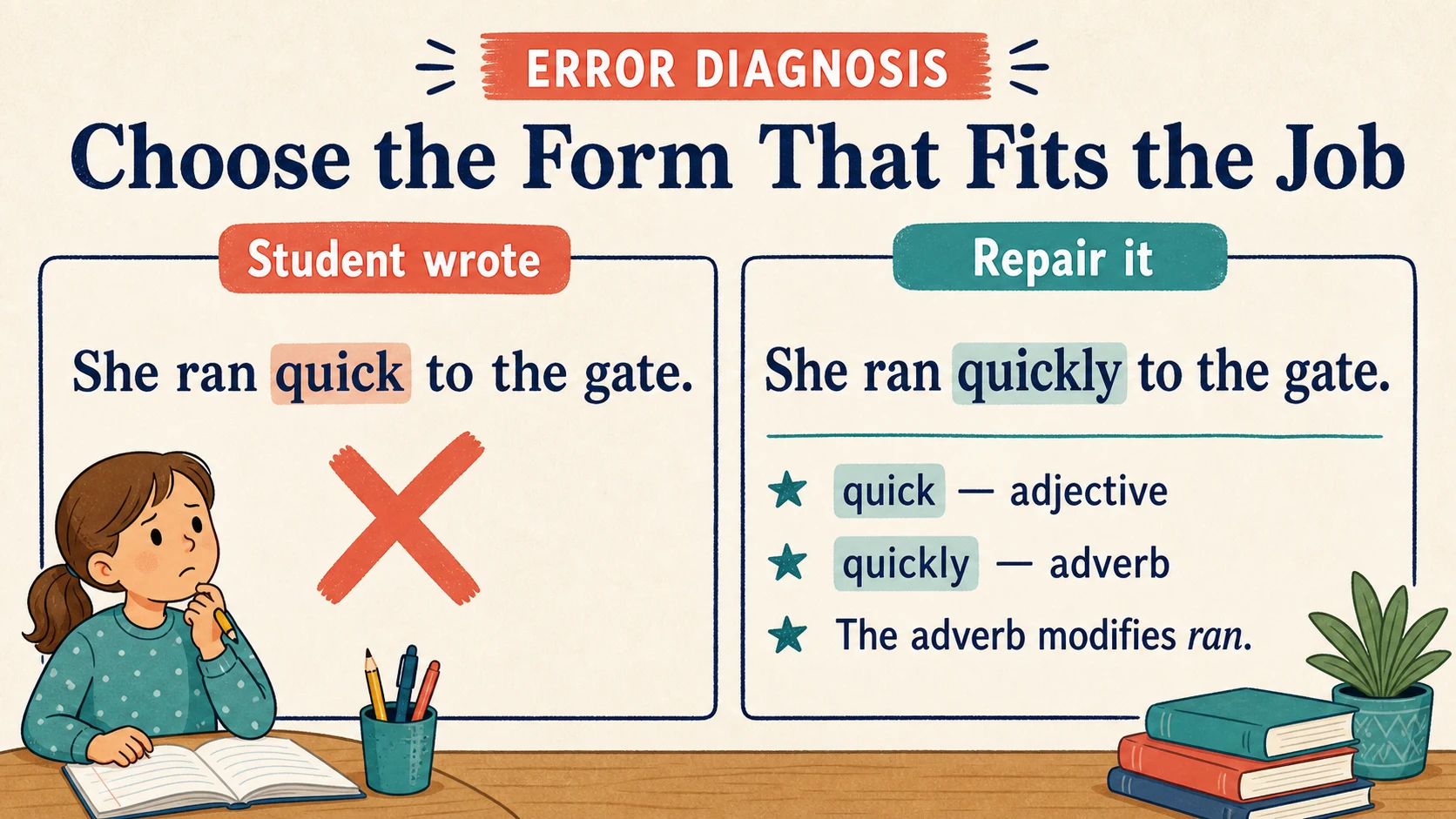
Name the requested category, inspect the word’s sentence job, correct it, and explain the change.
Common error patterns
| Observed response | Possible interpretation | Useful next prompt |
|---|---|---|
| Selects any person or object, even when asked for a verb | Learner knows nouns but overlooks the requested category | “What part of speech does this item ask you to find?” |
| Chooses the first word repeatedly | Learner may be using position rather than function | “Could the noun or verb appear later in the sentence?” |
| Marks an adjective as a verb | Learner treats any informative word as an action | “What did the subject do? Which word describes a noun?” |
| Misses is, are, or was as verbs | Learner recognizes only physical-action verbs | “Does this word connect the subject to a description?” |
| Finds the right word but cannot explain it | Recognition may be fragile or based on guessing | “What job does the word do in this sentence?” |
| Gives a grammatically valid answer different from the key | The item may contain multiple words from one category | “Can you prove your choice from the sentence?” |
| Accuracy drops late on the page | Attention or fatigue may be affecting performance | Pause, then retry only the missed items later |
These are instructional interpretations, not diagnoses. A single worksheet cannot determine the cause of a learner’s difficulty or provide medical, developmental, or specialist guidance.
Correct through comparison
Instead of saying only “That is wrong,” compare the chosen and intended words:
“You chose blue. The prompt asks for the verb. Blue describes the noun kite, while flew tells what the kite did. Which word should be selected?”
Then ask the learner to make the correction. The adult supplies enough information to rebuild the distinction but leaves the final response with the learner.
Check the Answer Key Responsibly
The printable includes a separate answer key for quick checking. Keep it out of view during independent practice, then compare one item at a time.
Use this routine:
- Read the original direction again.
- Compare the learner’s response with the key.
- If they differ, inspect the complete sentence.
- Decide whether the response is incorrect, an acceptable alternative, or evidence that the item needs clarification.
- Ask the learner to explain or revise.
- Record the category of error, not merely a mark.
The key represents the intended response. It remains important to check grammatical reasoning, especially when a sentence contains more than one noun, verb, or adjective. Do not alter a correct answer merely to force agreement with the key.
Avoid displaying the key first and asking the learner to copy corrections. A copied answer provides little evidence that the category distinction is understood. After a correction, use a fresh oral sentence with the same contrast. If the learner initially chose an adjective when asked for a verb, for example, try:
The noisy truck stopped.
Ask for the verb and then the adjective. Correctly identifying stopped and noisy provides stronger evidence than copying one worksheet response.
Decide What to Do After the 14 Items
Do not use one universal cutoff. Consider accuracy, independence, explanations, and the types of errors together.
If performance is accurate and independent
When the learner identifies the requested categories reliably and can justify representative answers, proceed to slightly more varied sentence work. Suitable next tasks include locating more than one target word, classifying the same word in different contexts, or using nouns, verbs, and adjectives in original sentences.
The 3rd Grade Grammar hub can help you choose a connected grammar activity. For a fuller parts-of-speech sequence, use the topic guide.
If one category causes most errors
Teach that contrast directly before repeating the whole page. For adjective–verb confusion, place examples in two columns:
| Describes a noun | Tells action or links |
|---|---|
| noisy truck | truck rumbled |
| cold water | water is cold |
| quick rabbit | rabbit hopped |
Then present two or three new sentences. Return only to selected missed worksheet items after the learner succeeds on the fresh examples.
If errors occur across all three categories
Reduce the immediate load. Reestablish noun and verb roles in short sentences, then add adjectives once the learner can explain the sentence core. The broader topic guide contains the progression; this worksheet should remain practice rather than being stretched into every stage of instruction.
If answers are correct but heavily prompted
Do not advance solely on the correct count. Repeat a small set of fresh sentences with fewer prompts. Independence improves when assistance fades while accuracy remains stable.
Schedule Brief Retrieval Instead of Immediate Repetition
A learner may perform well immediately after a model yet struggle to retrieve the distinction later. Revisit the categories after some time has passed, using new sentences rather than requiring repeated completion of the entire page.
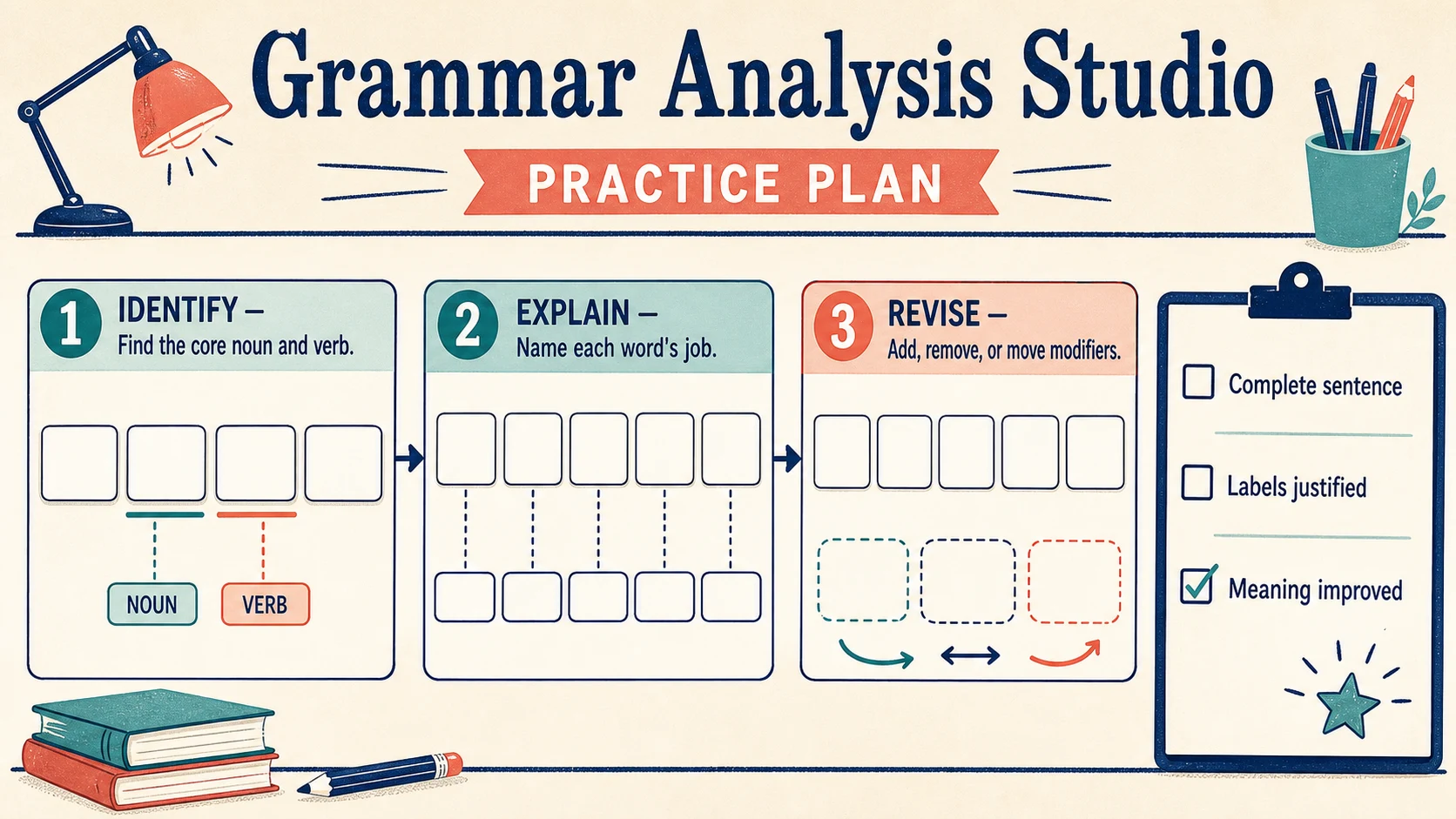
Use short, delayed checks and adjust their spacing according to the learner’s observed recall.
One possible schedule is:
| Review point | Activity | Decision |
|---|---|---|
| End of the lesson | One fresh noun, verb, and adjective sentence | Reteach immediately only if the distinction is still unclear |
| Next learning session | Three oral identifications without the reference card | Restore a brief prompt if recall is weak |
| Several days later | Mix three to five examples into another grammar activity | Continue spacing if responses are accurate |
| The following week | Ask for identification plus one original sentence | Revisit the troublesome category if errors return |
This is an instructional option, not a universally recommended timetable. A learner who recalls the categories easily may need less frequent review. A learner whose explanations remain uncertain may benefit from shorter gaps and smaller sets.
Keep the Result in Perspective
This worksheet can show how a learner handles 14 easy-level sentence-analysis items involving nouns, verbs, and adjectives at one point in time. It cannot establish complete grammar proficiency, writing quality, reading comprehension, or readiness for every other parts-of-speech task.
Use the result cautiously:
- Treat errors as clues for the next explanation.
- Distinguish grammar confusion from difficulty reading or recording a response.
- Look for successful explanations, not only checked boxes.
- Confirm learning with fresh examples after a delay.
- Keep local curriculum expectations in view.
- Avoid claiming guaranteed outcomes from completing the page or pack.
When you want more practice across the same topic, the optional 3rd Grade Parts of Speech Worksheet Pack contains 18 worksheets and is listed at $4.79. A larger pack may provide variety, but it should follow observed need rather than replace careful teaching.
For the most useful next action, download the free 14-item worksheet, choose one model sentence, and prepare three fresh retrieval examples—one noun, one verb, and one adjective—for the learner’s next session.
Put it into practice
Use the guide with a real printable
Move from explanation to a short, observable practice task. Check the first item together, then adjust the next session from the learner's actual work.
See the 18-worksheet pack