Complete guide
How to teach and practise 2nd grade spelling words worksheets - standard theme (easy)
How to Use This 20-Item Spelling Worksheet
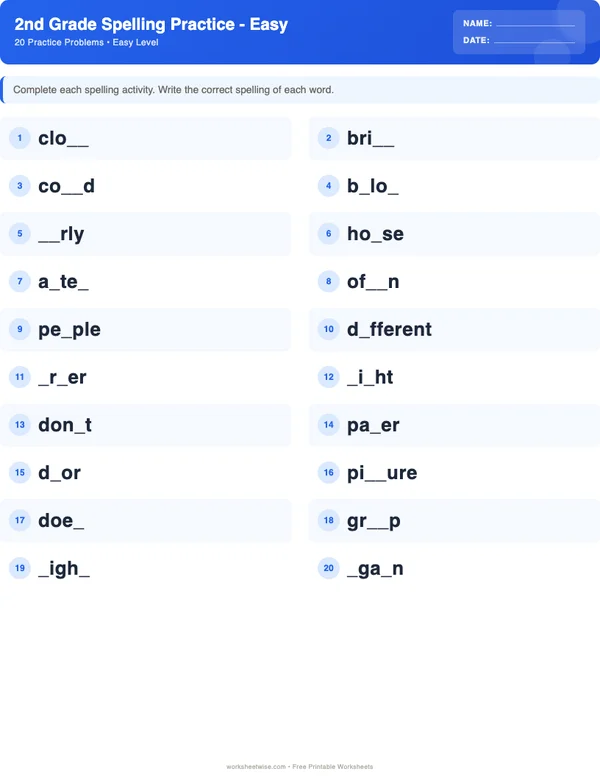
The free 2nd Grade Spelling Words worksheet provides 20 easy-level exercises using fill-in-the-blank tasks, word scrambles, and misspelling correction. It practices spelling, word recognition, vocabulary, and attention to letter patterns. A separate printable answer key is included.
For a productive lesson, preview the activity, model one example, complete a few items together, and then let the learner attempt the remaining items independently. Review errors by examining the incorrect part of each word—not merely by counting wrong answers. Use the answer key after the learner has committed to an answer, and revisit missed words on later days.
Grade labels describe the intended practice level, not a fixed rule about what every learner should already know. Local curricula, instructional sequences, and individual experience differ. The learner’s observed work should determine the amount of support and the pace.
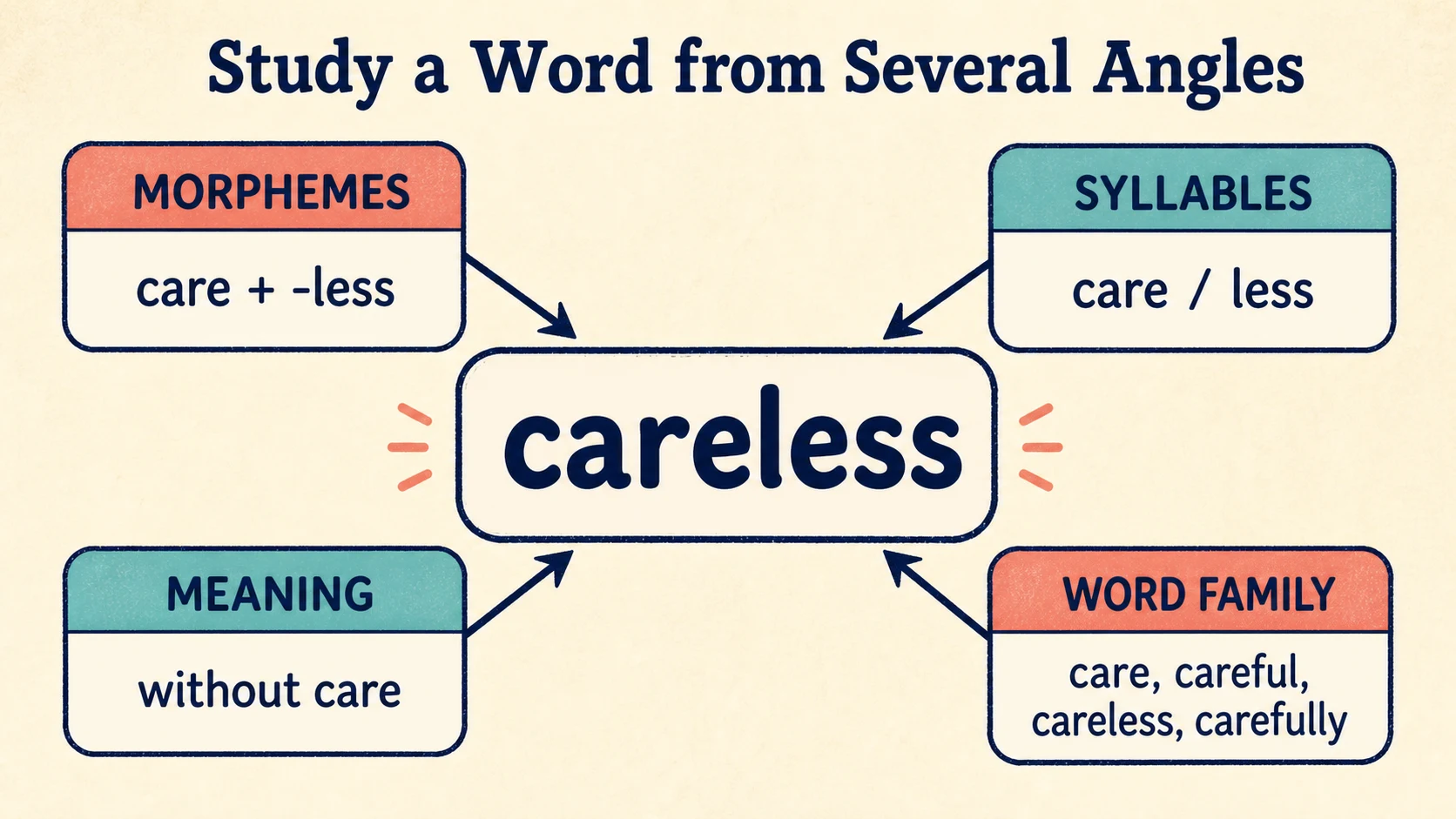
Preview, model, guide, release, check, and review in a deliberate sequence.
What This Worksheet Does—and Does Not Do
The worksheet’s instruction is concise: “Complete each spelling activity. Write the correct spelling of each word.” Across 20 items, the learner encounters three activity forms:
- Filling in a missing word or completing a word
- Rearranging scrambled letters
- Identifying and correcting a misspelling
These forms ask for more than copying. The learner must recognize a likely word, organize its letters, or compare an incorrect spelling with a known pattern. That makes the sheet useful for seeing whether a spelling remains available when the presentation changes.
The “easy” label means that this worksheet is intended for learners beginning this level of spelling-word practice or needing reinforcement. It does not guarantee that every item will feel easy to every second grader. A learner may quickly solve scrambles but struggle to correct misspellings, or recognize a word while being unable to produce it from memory.
This printable is a short practice and observation tool. It is not a complete spelling curriculum, a diagnostic assessment, proof of comprehensive standards alignment, or a guarantee that the learner will use every word correctly in independent writing. For the wider sequence of patterns and activity types, use the Spelling Words topic guide rather than expecting one page to cover the entire progression.
The broader instructional rationale is consistent with the IES foundational reading skills guide, which addresses systematic work with sound-spelling relationships and word reading in the primary grades. The source provides high-level instructional framing; it did not review WorksheetWise or this particular printable.
Prepare Before the Learner Starts
A few minutes of preparation can make the learner’s work easier to interpret.
Print or open the worksheet without placing the answer key beside it. Keep the separate answer key PDF available to the adult, but do not use it as a word bank unless an item explicitly provides one. The goal is to see what the learner can recognize, assemble, and spell.
Scan the page for the three activity forms. You do not need to teach every word in advance. Instead, decide which item can serve as a clean model. Choose one that demonstrates the directions without giving away another answer.
Have these simple materials ready:
- A pencil and eraser
- A blank sheet or small whiteboard for modeling
- A strip of paper for covering a word during memory practice
- One colored pencil for marking the specific part of a corrected word
If handwriting effort is likely to obscure spelling knowledge, provide adequate writing space or allow the learner to say the letters before writing. That support changes the method of response, not the spelling target.
Begin with a brief readiness check
Ask the learner to read the directions aloud or listen while you read them. Then point to one item of each visible type and ask, “What will this item have you do?” Do not ask for the answer yet.
Listen for a task description such as:
- “I have to find the word that fits.”
- “I have to put these letters in order.”
- “I have to fix the word that is spelled incorrectly.”
If the learner cannot explain the task, clarify the format before judging the spelling. A direction error and a spelling error are not the same.
Set an observable purpose
Give the lesson a narrow purpose: “We are going to notice how you use letters and word patterns when the task changes.”
Avoid promising a perfect score or presenting speed as the goal. Accuracy, a reasonable attempt, and the ability to explain a correction are more informative than rushing through all 20 items.
A Practical Lesson Progression
The following plan is flexible. Item counts are more useful than a universal number of minutes because learners differ in reading fluency, handwriting pace, and familiarity with the formats.
| Lesson phase | Suggested worksheet use | Adult action | Evidence to notice |
|---|---|---|---|
| Preview | Survey the page | Clarify the three task forms | Can the learner explain what each format requires? |
| Model | 1 similar example off the page | Think aloud and verify every letter | Does the learner attend to the whole word? |
| Guided practice | About 3–5 worksheet items | Prompt without supplying answers | Which prompts lead to successful correction? |
| Independent practice | Most remaining items | Observe quietly and record patterns | Can the learner sustain the process independently? |
| Review | Revisit uncertain or missed items | Compare, identify, correct, and explain | Is the error visual, phonetic, directional, or attentional? |
| Retrieval | Selected words on later days | Ask for spelling without showing the answer first | Is the corrected spelling retained after a delay? |
This progression is not a mandatory timetable. Shorten independent work if errors begin to multiply because the learner no longer understands the task or stops checking the full word. Extend it when the learner remains accurate and can explain the process without adult prompting.
Model the Task Without Taking It Over
Use an example similar to the worksheet rather than completing the first several worksheet items yourself. The learner needs to see a repeatable process, not a collection of answers.
Model four deliberate moves
For each format, demonstrate this sequence:
- Identify what the item asks.
- Read all available information.
- Build or select the word.
- Check every letter against the prompt.
A useful think-aloud is concrete: “I think the word is cake. I will not stop there. I need to check that I used all four letters: c, a, k, e.”
Avoid vague comments such as “Just sound it out” when the spelling cannot be determined from sound alone. Sound information can help generate a possibility, but the learner must also inspect letter order and known patterns.
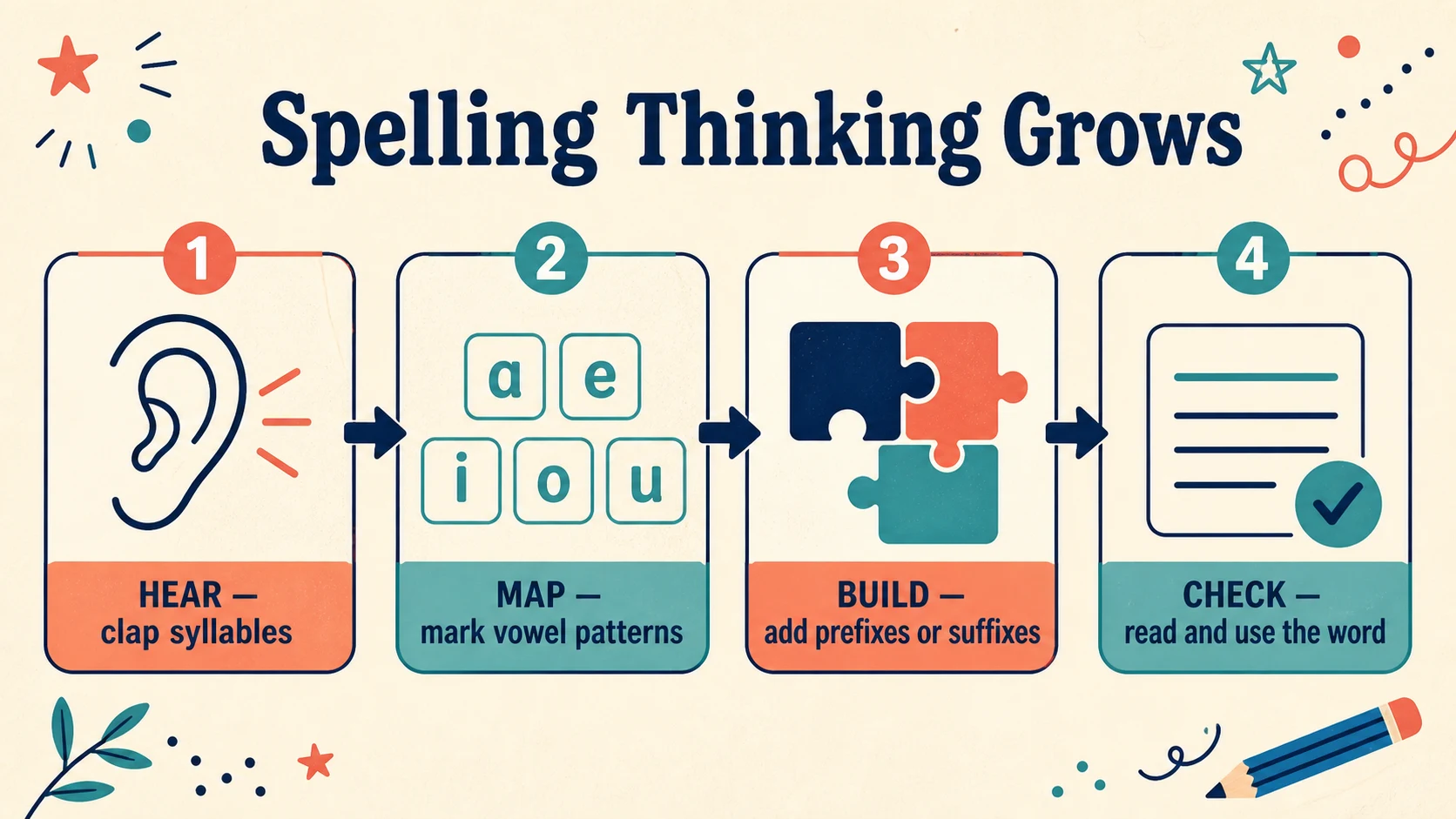
The adult demonstrates a checking routine, then gradually transfers responsibility.
Keep prompts neutral
During guided practice, prompts should direct attention without revealing the answer:
- “Read the entire sentence again.”
- “Which letters have you used?”
- “Is there a letter left over?”
- “Point to the part that looks uncertain.”
- “Say the word slowly, then check the written word.”
- “Does your answer make sense in the sentence?”
- “Compare the beginning, middle, and end.”
A prompt such as “Remember, it has ai in the middle” supplies the spelling feature. That may be appropriate during reteaching, but it should be recorded as adult help rather than treated as an independent response.
Fully Checked Examples for Teaching the Routine
The examples below are created for instruction and are similar to the activity types in the printable. They are not claims about the exact words or item order on the worksheet.
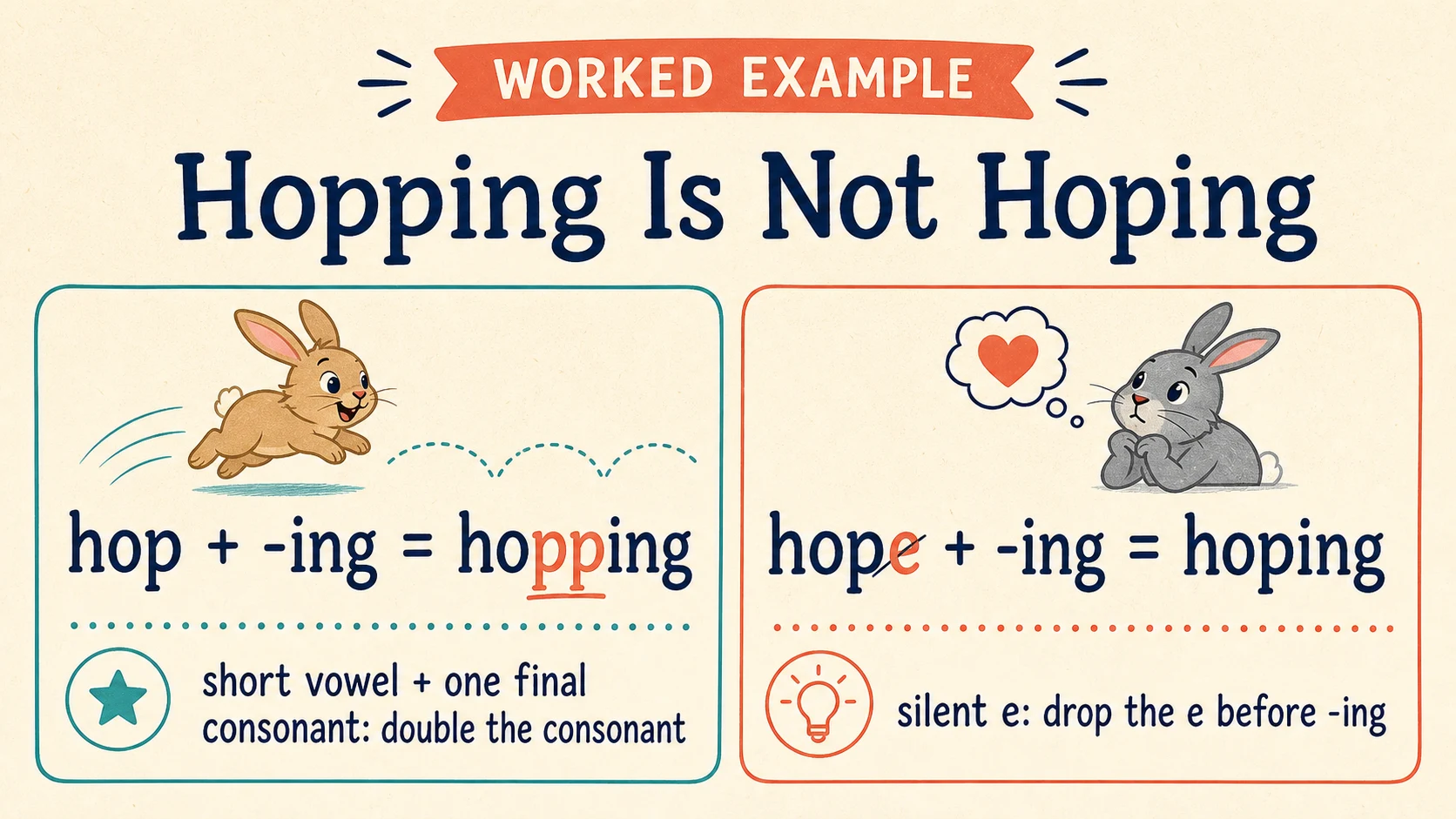
Each answer is checked for meaning, letter choice, letter order, and completeness.
Example 1: Fill in the missing word
Prompt: We will ___ after lunch.
Word choice: play
Worked answer: We will play after lunch.
Check:
- The completed sentence makes sense.
- The answer is one word.
- Its letters are in the order p-l-a-y.
- No letter is omitted or added.
- The final written word is play, not paly.
This example shows why reading after writing matters. Paly contains the same four letters but uses the wrong order.
Example 2: Unscramble all the letters
Prompt: Unscramble ekac.
Worked answer: cake
Check:
- The supplied letters are e, k, a, and c.
- Cake uses c, a, k, and e exactly once each.
- No supplied letter remains unused.
- No new letter has been introduced.
- The result is a correctly spelled word.
A learner who writes cak may have recognized the word by sound but failed to use every supplied letter. That is partly a checking error, not evidence that the learner knew nothing about the word.
Example 3: Correct a misspelling
Prompt: Correct the misspelled word: frend.
Worked answer: friend
Check:
- The incorrect form is frend.
- The beginning fr and ending end are already present.
- The correction adds i after r.
- The final letter sequence is f-r-i-e-n-d.
- The corrected spelling is friend.
The important action is locating the incorrect section. Recopying the whole word without comparing frend and friend can hide what changed.
Example 4: Complete a partial word
Prompt: Complete the word in the sentence: The dog will b_rk.
Worked answer: bark
Check:
- The sentence calls for the word bark.
- The given letters b, r, and k remain in place.
- Adding a produces b-a-r-k.
- The completed sentence, “The dog will bark,” makes sense.
- The final spelling is bark.
This example also illustrates a boundary: the sentence supports meaning, while the visible letters constrain the spelling. The learner should use both.
Example 5: Check a tempting near-answer
Prompt: Unscramble sotp.
Two recognizable results are possible: stop and post. Both use s, o, t, and p exactly once and both are correctly spelled words.
Without a sentence, picture, definition, or other constraint, the letter set alone does not identify one unique answer. The responsible response is to examine the full worksheet item and then use the official key if the prompt remains ambiguous. Do not tell the learner that a valid arrangement is linguistically impossible merely because the key selected another valid word.
This boundary case is especially important with short scrambled words. Context can make one answer intended; absent context, more than one correct word may exist.
Move from Guided to Independent Practice
Begin the worksheet itself with a small guided sample. Ask the learner to solve the item, explain the choice, and check the complete answer. Help only as much as the observed response requires.
A gradual release might look like this:
- First guided item: prompt through all four moves.
- Second guided item: ask, “What will you check?”
- Third guided item: wait silently while the learner works, then request an explanation.
- Next item: remove the verbal prompt and observe.
The transition should depend on performance. If the learner can state the task, attempt the word, and check it, independent work is reasonable. If the learner repeatedly scrambles correct letters, ignores sentence meaning, or changes letters that were supplied, continue guided practice.
Preserve the spelling skill while changing support
Support can reduce unnecessary difficulty without converting the task into copying.
For a learner needing more structure:
- Present one item at a time by covering the rest of the page.
- Read directions or sentence context aloud.
- Ask the learner to touch each scrambled letter after using it.
- Provide movable letter tiles matching the letters already printed.
- Let the learner say the spelling before writing it.
- Draw boxes corresponding to the required number of letters.
For a learner ready for less support:
- Remove the one-item cover.
- Ask for silent self-checking.
- Have the learner mark uncertain items with a small dot and return later.
- Ask the learner to explain one correction without an adult prompt.
For a learner who completes the page accurately:
- Select a few completed words for delayed dictation.
- Ask for an original sentence containing one word.
- Sort selected words by a visible letter feature when a defensible grouping exists.
- Look for the same spelling in a book the learner is already reading.
An extension should deepen attention to spelling and use, not merely add more copying.
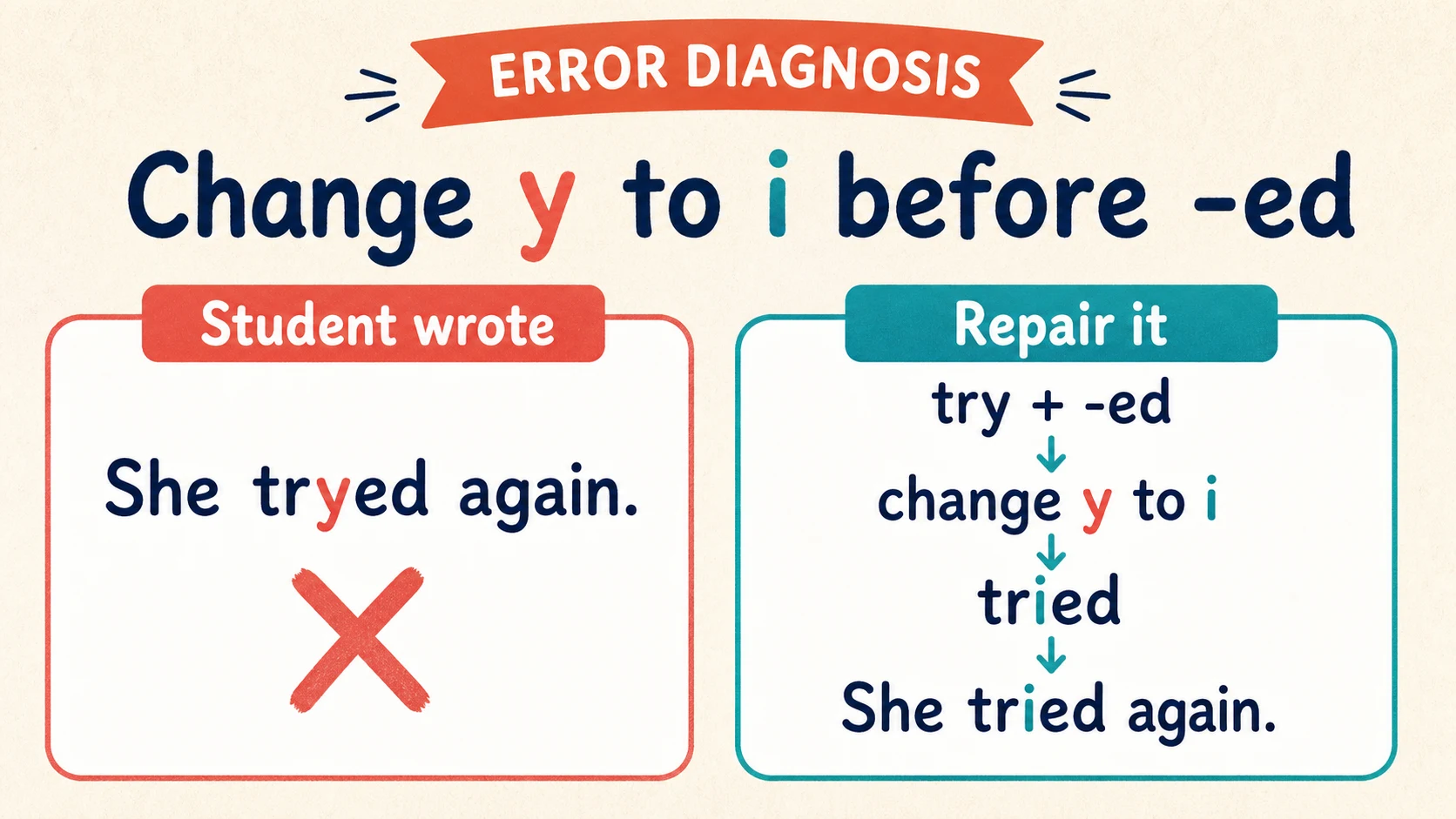
Adjust visibility, response method, or prompting while keeping the spelling decision with the learner.
Interpret Errors Before Assigning More Practice
A total score tells you how many keyed responses matched. It does not explain why an answer was missed. Look across items for repeated behaviors.
Letter-order errors
Examples include writing paly for play or from when the intended unscramble is form.
Check whether the learner can orally spell the intended word. If the oral spelling is correct but the written order changes, slow the recording process. Have the learner point to or cross off each scrambled letter as it is used.
Do not automatically label every transposition as lack of spelling knowledge. The item format itself may be contributing.
Omitted or added letters
A learner might write cak for cake, leaving out a supplied letter, or produce a word containing a letter that was not in the scramble.
Ask the learner to compare the answer with the complete set of printed letters. For scrambles, a simple one-to-one check is appropriate: every supplied letter must be accounted for exactly once unless the prompt states otherwise.
If omissions also appear in fill-in tasks and ordinary writing, record that broader pattern for later instruction. One worksheet cannot establish its cause.
Plausible sound-based spellings
A learner may produce a spelling that represents much of the spoken word but is not the conventional form, such as frend for friend.
Acknowledge what is represented accurately, then contrast the uncertain portion: “You captured /f/, /r/, and the ending. The middle of this word is written ie.” This is a reteaching statement, not an independent-answer prompt.
The catalogue’s broader spelling topic guide emphasizes learning patterns and reviewing previously taught spellings. Use that guide for progression decisions instead of inventing a general rule from one irregular-looking example.
Meaning or vocabulary errors
In a fill-in-the-blank item, the learner may spell a word correctly that does not fit the sentence. That response shows some spelling knowledge but not successful completion of the whole task.
Ask the learner to read the completed sentence. If the learner does not know a word’s meaning, explain the meaning briefly and retry the item. Record that vocabulary support was provided.
Format and direction errors
Some learners may correct every printed word even when only one is misspelled, copy a scramble unchanged, or fill a blank with a sensible word that does not match the provided letters.
These responses indicate that task interpretation needs attention. Re-model the format using a fresh example. Do not increase the spelling difficulty until the learner can demonstrate what the item requires.
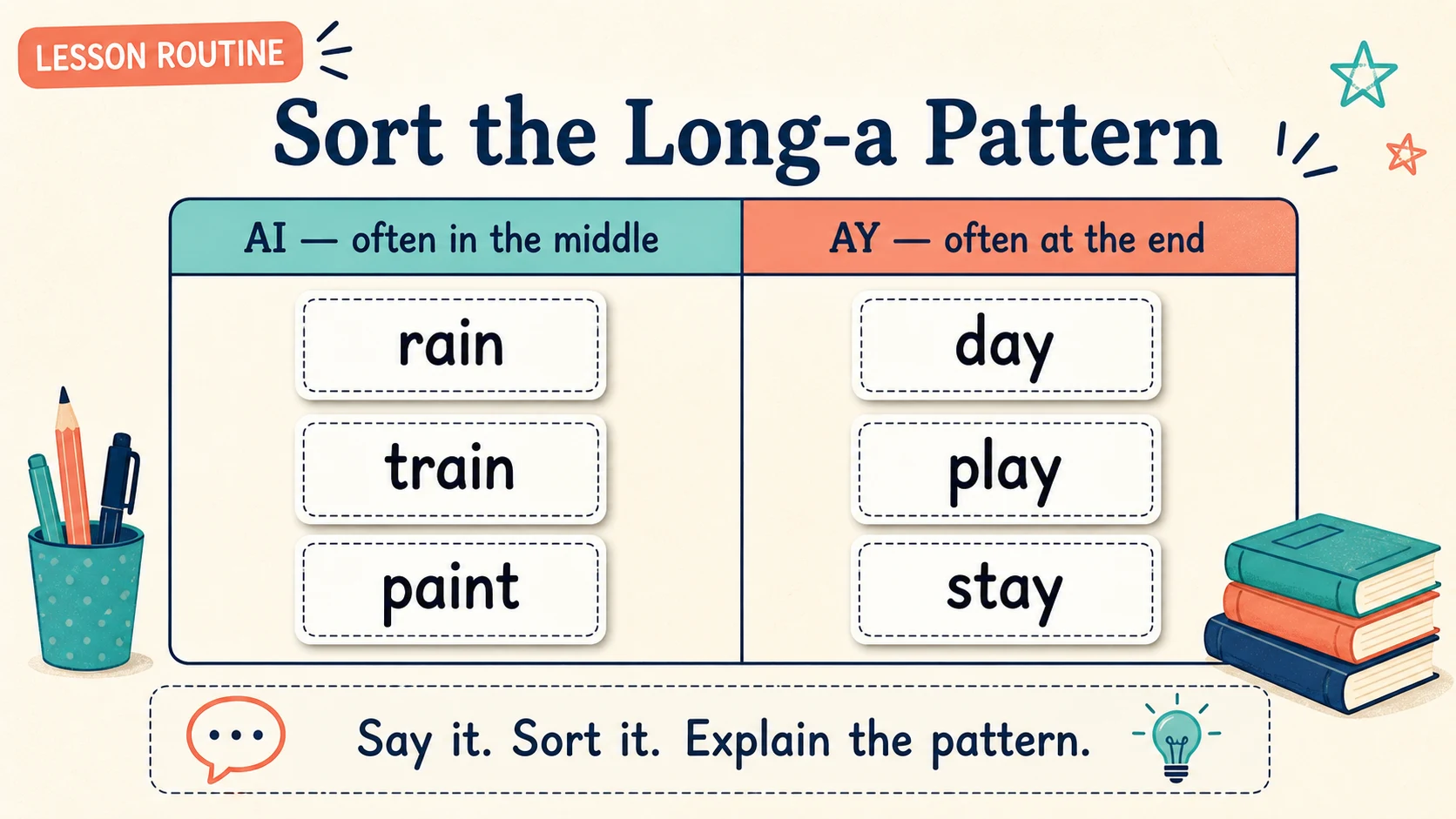
Name the error location, compare forms, correct it, and verify the complete word.
Use the Answer Key Responsibly
The answer key is most useful as a checking tool after genuine attempts. It should not replace reading the prompt, examining the learner’s process, or considering a defensible alternative.
Use this routine:
- Let the learner finish an item or mark it as uncertain.
- Read the worksheet prompt exactly as printed.
- Compare the learner’s full answer with the key.
- If they differ, identify the first differing letter or decision.
- Confirm that the keyed answer satisfies all prompt constraints.
- Have the learner write the corrected word from understanding, not while copying letter by letter.
- Return to the word later without displaying the answer.
For a misspelling correction, place the attempted and correct forms side by side:
- Attempt: frend
- Correct form: friend
- Changed part: e → ie
For a scramble, account for the letters:
- Given: ekac
- Answer: cake
- Check: four supplied letters, four used letters
If the learner gives another correctly spelled word from the same scrambled letters, inspect the item’s context. A sentence or picture may establish the intended response. If there is no distinguishing context, note the ambiguity rather than using the key as proof that another valid English word is misspelled.
The answer key can confirm the intended answers for this printable. It cannot tell you whether an error came from vocabulary, attention, task misunderstanding, handwriting, or incomplete spelling knowledge. Adult observation supplies that information.
Connect Spelling to Reading and Writing
Worksheet accuracy matters most when it supports later word recognition and written use. That transfer requires opportunities beyond selecting or repairing isolated forms.
After checking the page, choose two or three words rather than assigning every word again. Ask the learner to:
- Read each word aloud.
- Cover it and write it from memory.
- Compare the attempt with the correct form.
- Use one word in a complete oral or written sentence.
- Find the word or a clearly related spelling feature in familiar reading material.
The catalogue topic guidance recommends look-cover-write-check, sorting words by pattern, using words in sentences, and cumulative review. Treat those as instructional suggestions for extending practice, not as claims that this single worksheet measures transfer.
The IES guide to teaching elementary students to be effective writers provides broader evidence-based guidance about writing instruction and the writing process. It supports the high-level reason for giving learners opportunities to use words in meaningful writing, but it does not prescribe this worksheet or validate a particular follow-up schedule.
The Common Core English Language Arts standards include second-grade language expectations involving the use of learned spelling patterns when writing words. That offers useful context for connecting pattern knowledge with written application. It does not mean that completing this one printable demonstrates comprehensive alignment or mastery of all second-grade language expectations.
For additional grade-level material, browse the 2nd Grade worksheet hub or the more focused 2nd Grade Spelling collection.
Schedule Retrieval Instead of Immediate Recopying Alone
Correcting a word while looking at the answer shows that the learner can copy or compare it. Retrieving the spelling later provides different information: whether the corrected form remains available without the model.
A practical schedule might use the same day, the next study period, and another later review. These are adjustable checkpoints, not a universal timetable.
| Checkpoint | Suggested action | What to record |
|---|---|---|
| End of the lesson | Cover and rewrite 2–4 corrected words | Which words are recalled after a short delay? |
| Next study period | Dictate the selected words in a new order | Which spellings remain accurate without visual cues? |
| Several days later | Mix the words with previously secure words | Does accuracy hold in cumulative practice? |
| Later writing opportunity | Invite use of one suitable word in a sentence | Can the learner spell it while attending to meaning? |
At each checkpoint, test before showing. If the learner misses the same part again, compare only that section and then retry after another delay. If the learner recalls a word accurately more than once and uses it successfully in writing, reduce attention to that word and focus on less secure ones.
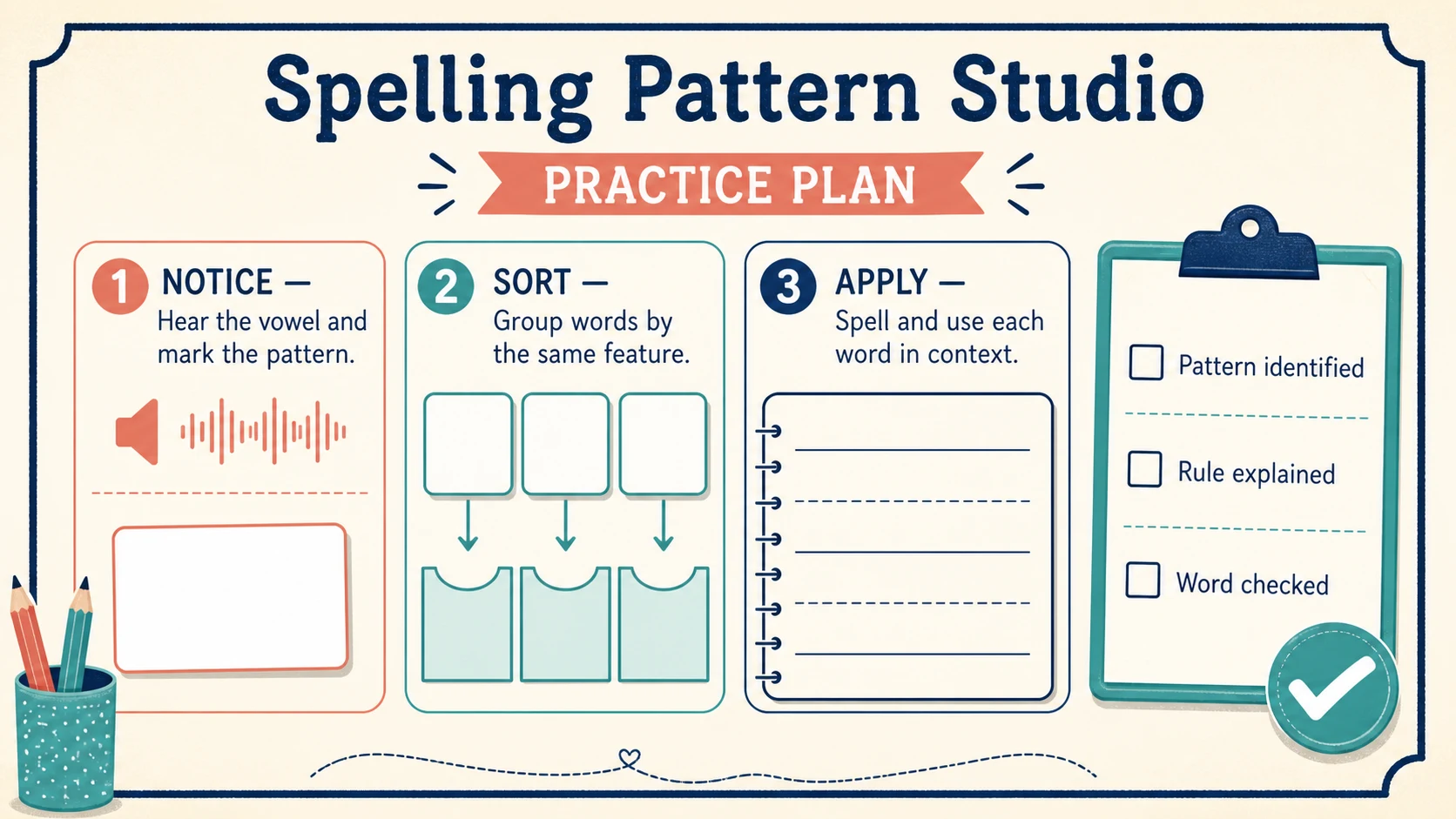
Short retrieval checks show whether a correction remains available after the model is removed.
Decide What to Do Next
Base the next step on patterns in the learner’s actual work, not solely on the percentage correct.
If most answers are accurate and independently checked, use a few words in delayed dictation or sentence writing. The learner may be ready for broader practice through the 2nd Grade Spelling Words Worksheet Pack, which contains 18 worksheets, or for another targeted printable from the topic guide.
If errors cluster in one activity type, keep the spelling level stable and reteach that format. For example, use movable letters and a cross-off routine for scrambles, or reread completed sentences when fill-in responses do not fit the context.
If errors cluster around letter patterns, consult the Spelling Words topic guide for the broader progression. Select a small group of words sharing a clear feature, model the comparison, and then return to mixed practice after the learner shows control.
If performance becomes less accurate across the page, divide the 20 items into shorter sessions. This does not change the target skill. It reduces the amount completed at one time so the adult can observe whether accuracy returns.
If the worksheet is consistently too easy, do not create artificial difficulty by imposing speed. Ask for independent checking, delayed retrieval, and use in an original sentence. Those tasks examine whether the spelling can be produced and applied rather than merely recognized.
If substantial adult help is needed throughout, record exactly what helped: reading the sentence aloud, isolating an item, supplying letter tiles, explaining vocabulary, or identifying the incorrect section. That record gives the next adult a clearer starting point than a score alone.
Limitations and an Honest Next Step
This worksheet samples spelling through 20 easy-level items in several formats. It can reveal useful patterns in word recognition, letter ordering, correction, and independent checking. It cannot, by itself, establish a learner’s complete spelling level, explain the cause of persistent errors, or predict spelling in unrestricted writing.
Some words are easier to recognize than to produce. Scrambles can introduce letter-order demands that ordinary dictation does not. Sentence blanks can depend partly on vocabulary and reading comprehension. A keyed response may show the intended answer without explaining the learner’s reasoning. These limitations are reasons to combine the completed page with observation and brief delayed retrieval.
Start with the free 2nd Grade Spelling Words worksheet, mark which items were independent, prompted, or corrected, and retest two to four missed words during the next study period. Then use the topic guide to choose practice that matches the error pattern—or create a narrowly focused follow-up with the free worksheet generators.
Put it into practice
Use the guide with a real printable
Move from explanation to a short, observable practice task. Check the first item together, then adjust the next session from the learner's actual work.
See the 18-worksheet pack