Complete guide
How to teach and practise 2nd grade sight words worksheets - standard theme (easy)
How to Use This 20-Item Sight Word Worksheet
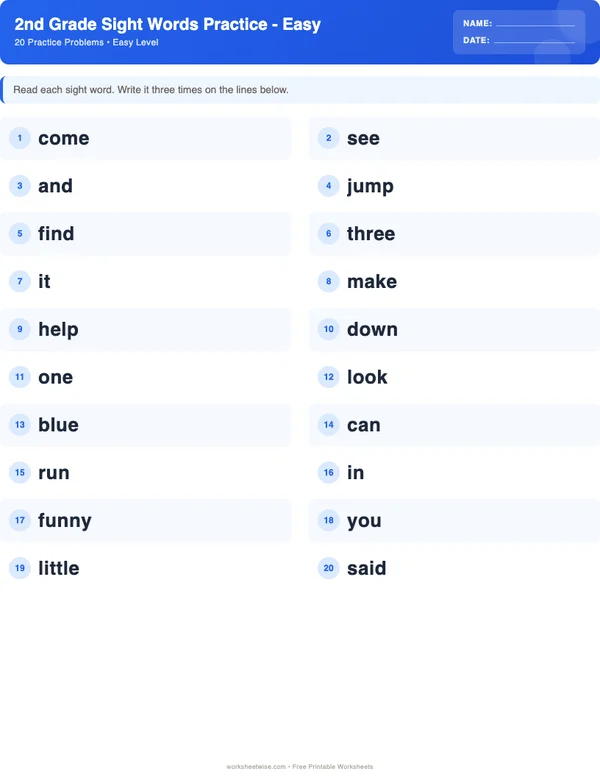
The free 2nd Grade Sight Words worksheet asks the learner to read each sight word and write it three times. Its 20 easy-level items provide practice in word recognition, reading fluency, word memory, and spelling. A separate printable answer key is included.
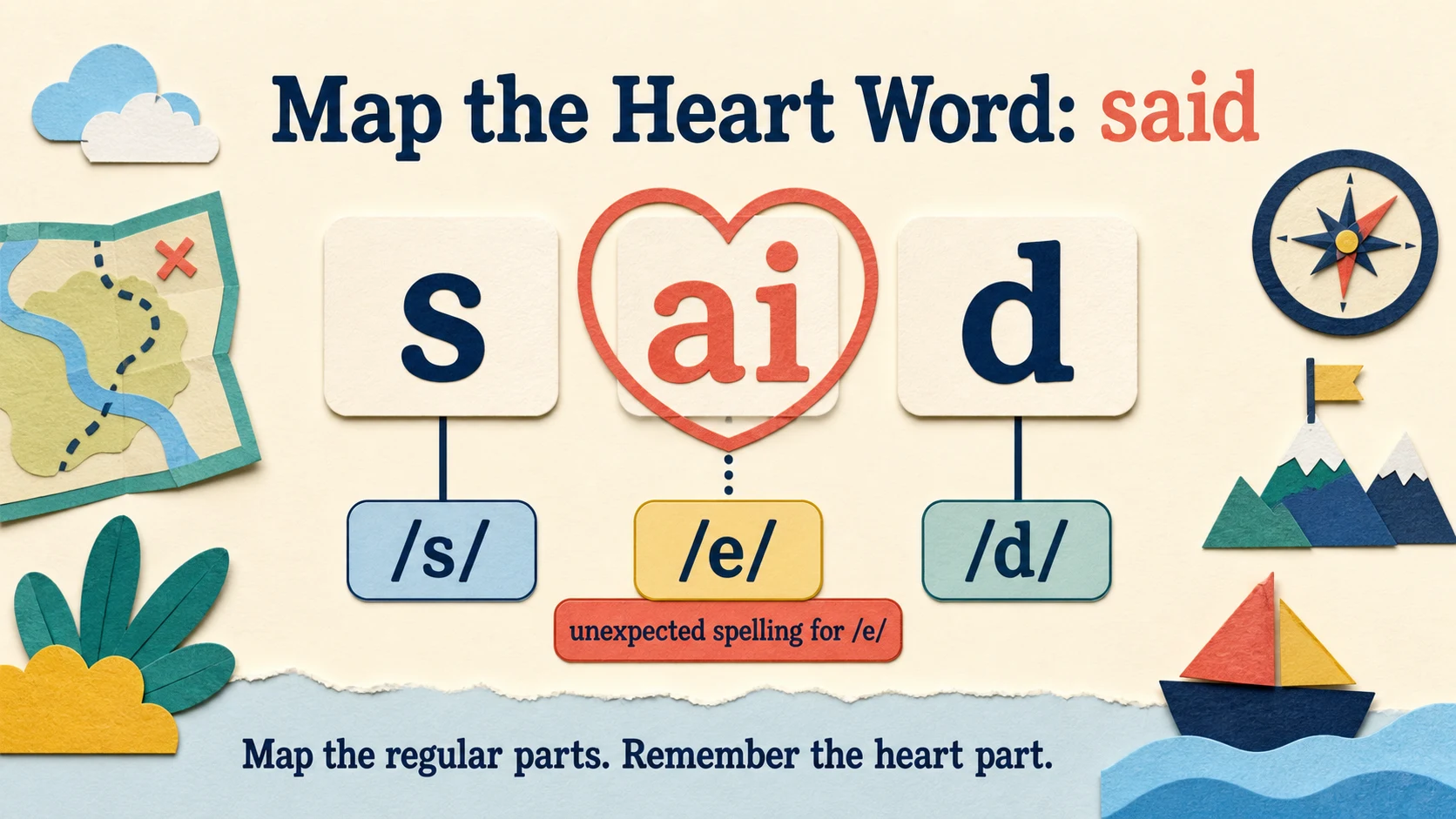
For a productive lesson, do not begin by assigning all 20 items silently. First model how to look carefully at a word, read it, notice its letters and sounds, and copy it accurately. Complete a few items together, release the learner to work independently, and then use errors to choose the next practice. The purpose is accurate, increasingly automatic word recognition—not merely filling every line.
Grade labels describe the intended practice level, not a guarantee that every second grader is ready for the same words or pace. Local curricula and instructional sequences differ. Use the learner’s observed reading and writing to decide how many items to complete at one sitting.
Preview, model, practice together, work independently, check, and schedule review.
What This Worksheet Practices—and What It Does Not
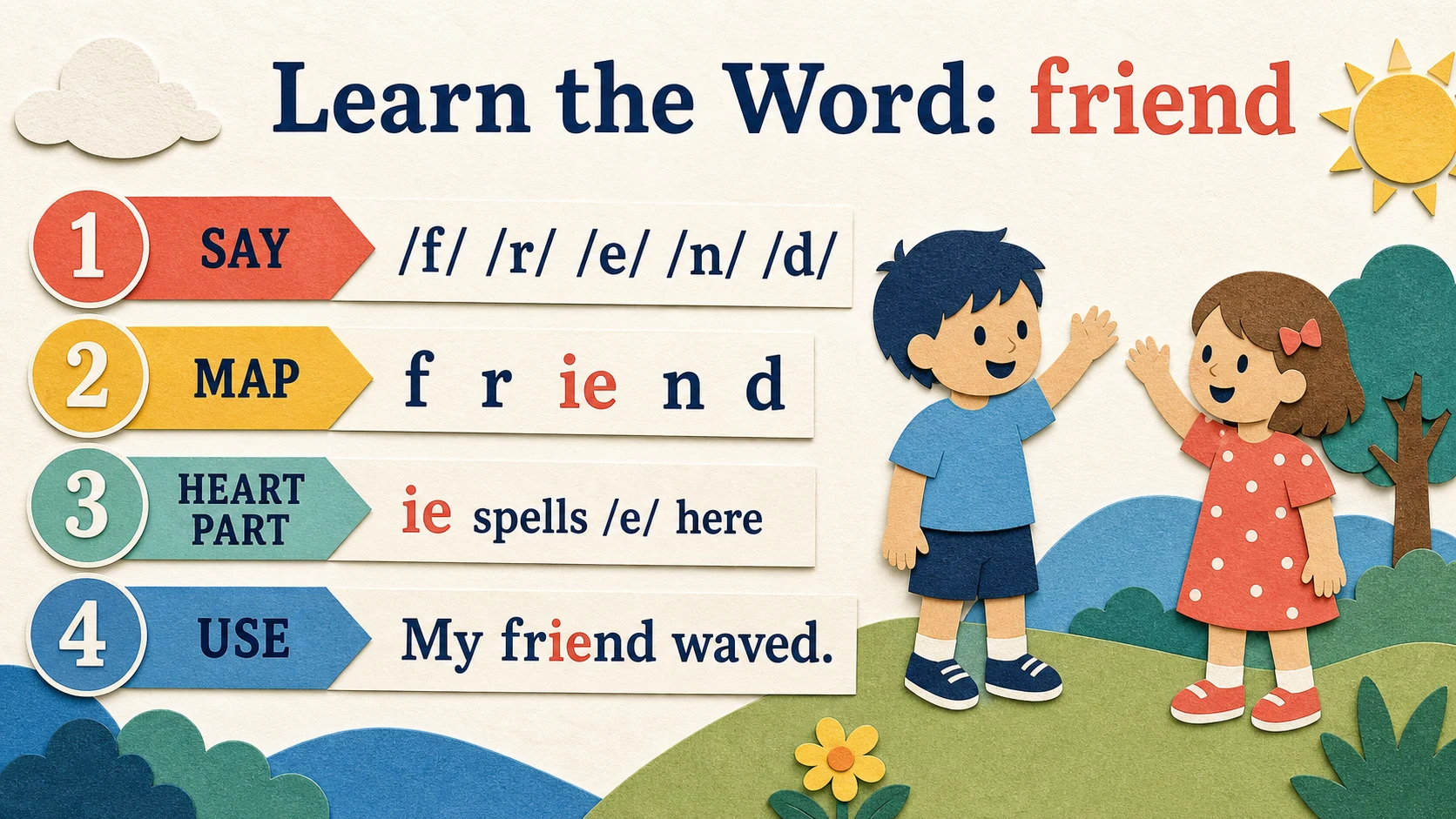
Sight words are high-frequency words that readers aim to recognize promptly. Some are fully decodable using familiar letter–sound relationships. Others contain an unusual spelling–sound relationship that requires special attention. For example, a learner may be able to connect the first and last sounds in said to s and d, while remembering that ai represents the unexpected middle sound in this word.
The worksheet’s repeated-writing format gives the learner three encounters with each printed word after reading it. That structure can support:
- Careful visual attention to letter order
- Repeated production of the spelling
- Oral recognition when the learner reads before writing
- Memory for the complete word
- Accurate handwriting within a short, predictable routine
Writing a word three times does not by itself demonstrate effortless recognition in connected reading. A learner can copy accurately while depending on the model every time. Conversely, a learner might read a word correctly but make a handwriting or copying error. These performances should be interpreted separately.
The IES foundational reading practice guide provides high-level guidance on foundational reading instruction, including explicit attention to sound–spelling relationships and practice reading words in text. It did not evaluate this WorksheetWise printable. The worksheet is best treated as one focused practice tool within broader reading instruction, not as a complete phonics or fluency program.
For the wider sequence of recognizing, spelling, and reading high-frequency words in context, use the Sight Words topic guide. That guide is the better place to consider the broader progression; this lesson guide stays focused on launching and responding to this exact 20-item format.
Prepare the Lesson Before the Learner Starts
Print the worksheet and keep the answer key out of the learner’s immediate view. Provide a pencil and, if needed, a blank strip of paper for covering later rows. Before teaching, scan all 20 items yourself so that you can pronounce each word promptly and identify any spelling feature that may need explanation.
Do not assume that “easy” means “already known.” The difficulty label describes the worksheet’s catalogue level. It does not predict an individual learner’s performance.
Run a brief word preview
Point to several items in different parts of the page and ask the learner to read them. This is a quick instructional preview, not a timed test. Note whether the learner:
- Reads the word immediately
- Pauses and then reads it accurately
- Attempts to sound it out
- Guesses from the first letter
- Confuses it with a visually similar word
- Says that the word is unknown
Use that information to set the starting amount. A learner who recognizes most previewed words can probably work through a larger section. A learner who misses several may benefit from five items at a time. Splitting the page changes the amount of work presented, but not the target skill.
Define the task precisely
Read the printed direction aloud: “Read each sight word. Write it three times on the lines below.”
Then explain what successful work looks like:
- Point to the printed word.
- Read the whole word aloud.
- Look across every letter from left to right.
- Write the word once.
- Compare it with the printed model.
- Repeat until the word has been written three times.
This comparison step matters. Without it, the learner may repeat the same incorrect spelling three times.
Set a stopping rule
Choose a stopping rule before independent work begins. For example: “Complete five words, and then we will check together.” Another reasonable rule is to pause after two consecutive words that the learner cannot read accurately.
A stopping rule keeps practice responsive. Repeatedly rehearsing an incorrect reading or spelling is not useful simply because blank lines remain.
A Practical Lesson Progression
The following plan can fit a classroom station, tutoring session, homework routine, or homeschool lesson. The suggested times are flexible instructional choices, not a universal timetable.
| Phase | Adult action | Learner action | Evidence to watch |
|---|---|---|---|
| Preview | Sample several words across the page | Read each sampled word | Immediate reading, hesitation, decoding, or guessing |
| Model | Demonstrate one complete read–write–check cycle | Watch and explain the steps back | Understanding of the routine |
| Guided practice | Complete two or three items together | Read, spell, write, and compare | Accurate word reading and letter order |
| Independent practice | Assign a manageable group of items | Complete the same routine alone | Whether accuracy continues without prompts |
| Check | Compare each response with the printed word and key | Locate and repair discrepancies | Ability to notice and correct errors |
| Retrieval | Hide the model and revisit selected words | Read or write from memory | Retention without immediate copying support |
| Connected use | Place reviewed words in short oral or written sentences | Read or use each word meaningfully | Recognition outside the worksheet row |
Suggested release of responsibility
For a learner new to this routine, use this sequence:
- Adult models item 1.
- Adult and learner complete items 2 and 3 together.
- Learner completes items 4 and 5 while the adult observes.
- Adult checks those items before assigning more.
- Learner continues in groups of five if accuracy remains steady.
A learner who already understands the routine may need only one model. A learner who struggles should receive another guided example rather than being sent back through a full page of independent copying.
Model the Task Without Turning It Into Guessing
Use one word from the actual printable when modeling. Because the catalogue does not supply the worksheet’s complete word list here, the examples below illustrate the same read-and-write routine but should not be taken as a claim that these words appear among the 20 items.
Think aloud through one item
Suppose the model word is said.
- Point under the word and say, “This word is
said.” - Read it once more without stretching it into a different word.
- Say, “I see four letters:
s-a-i-d.” - Identify what can be connected to familiar phonics: “The first sound matches
s, and the final sound matchesd.” - Identify the unusual part: “The
aiin this word has to be remembered as part of the word’s spelling.” - Copy
said. - Compare every letter:
s-a-i-dagainsts-a-i-d. - Write and check it two more times.
- Cover the model briefly and ask, “Can I still read
said?”
This approach preserves phonics information rather than presenting every sight word as an indivisible visual shape. It also avoids asking the learner to guess from the word’s outline.
Read the complete word, examine its spelling, write it, and compare it with the model.
Keep prompting language consistent
Helpful prompts include:
- “Read the whole word before you write.”
- “Say the letters as you check them.”
- “Which part is behaving as you expect?”
- “Which part needs special attention?”
- “Compare from the first letter to the last.”
- “Cover it. Can you read it again?”
Avoid prompts such as “Look at the picture” or “Guess what would make sense.” This worksheet presents isolated words, so there is no picture or sentence context to confirm a guess. The learner should attend to the printed letters and the known word.
Run Guided Practice and Independent Work
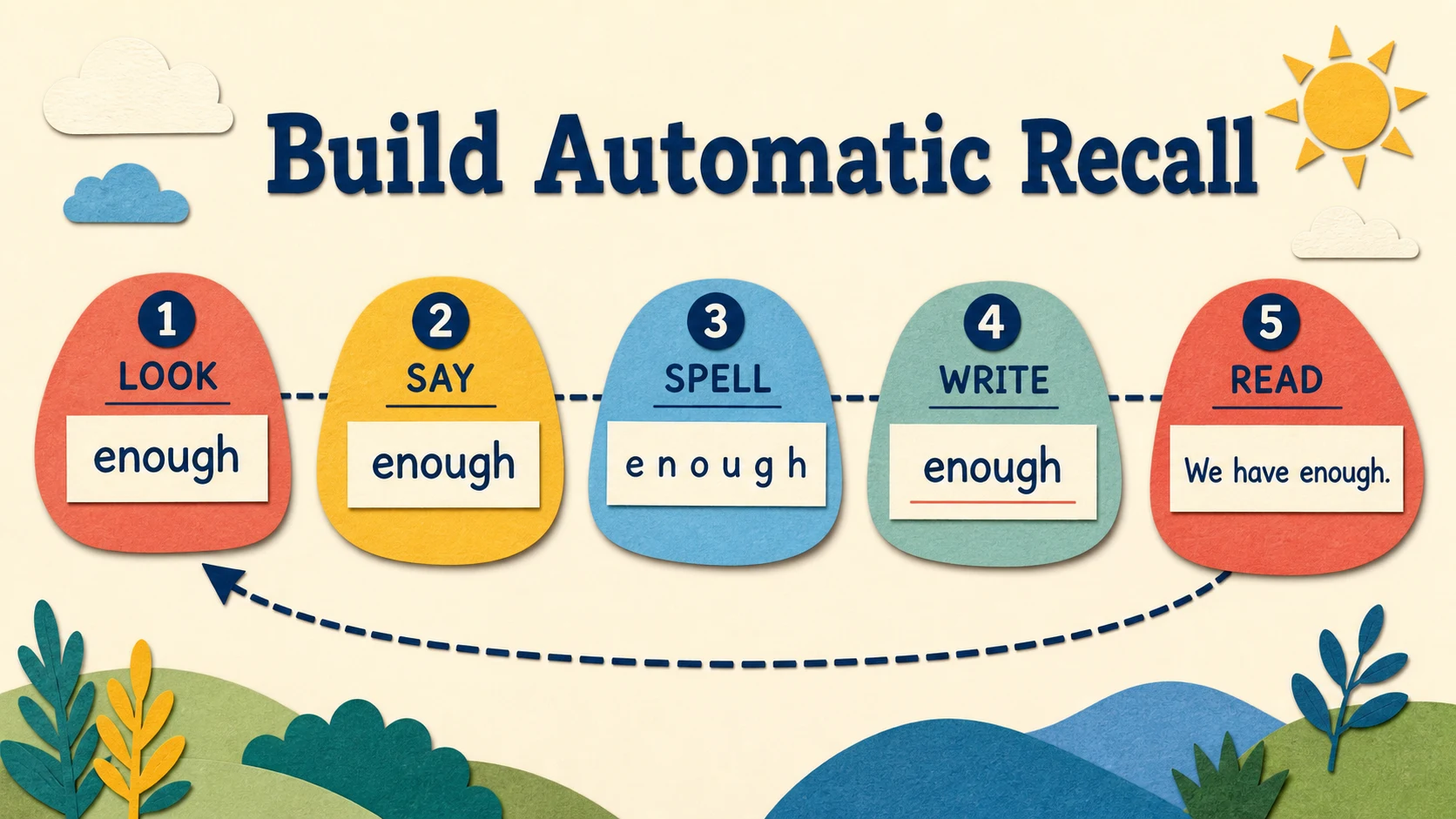
Guided practice should show whether the learner can carry out the routine with decreasing help. It is not simply a second adult demonstration.
Prompt only as much as needed, then check whether the learner can repeat the routine independently.
Guided practice: two or three words
For the first guided word, ask the learner to read it. If correct, have the learner spell the letters aloud, write the word, and compare it. Prompt any omitted step.
For the next word, reduce the directions: “Show me the routine.” Watch whether the learner reads before writing and checks after writing.
By the third guided word, wait before intervening. A productive pause gives the learner time to retrieve the word or inspect its letters. Step in if the learner begins guessing repeatedly, copies an error again, or becomes unable to continue.
Independent practice: use short sets
Assign a set based on the preview and guided work. Five items is a practical first set for a learner who needs monitoring. Ten or all 20 may be reasonable when the learner reads the words accurately and maintains careful spelling, but completion of the page should not override evidence of fatigue or error repetition.
During independent work, observe without supplying every word immediately. Record brief notes such as:
Rfor a reading errorSfor a spelling or copying errorHfor help requestedSCfor a successful self-correction
These notes are for instructional interpretation. They are not part of the printable’s official scoring system.
Preserve the target skill
Support should make the existing task accessible while keeping the learner focused on recognizing, reading, remembering, and spelling the same words.
Useful adaptations include:
- Covering unused rows to reduce visual load
- Completing five items, pausing, and then continuing
- Enlarging the printed page if letter size is a barrier
- Letting the learner point and read before picking up the pencil
- Asking the learner to spell aloud while writing
- Providing immediate feedback after each word rather than after all 20
- Using a second sheet for larger handwriting while retaining the same words
- Repeating a model for the routine without giving every answer

Adjust presentation, group size, or prompting while keeping word recognition and spelling central.
Replacing the printed word with a simpler word would change the content rather than support access. Telling the learner every word before any attempt would also hide what the learner can retrieve independently. Use such direct help during teaching when necessary, then check the word again later without that help.
Four Fully Checked Worked Examples
These examples use catalogue-supported sight-word illustrations. They demonstrate how to verify reading and spelling. They do not identify the undisclosed item order or claim that each example is printed on this specific worksheet.
Example 1: and
Model: and
Learner writes: and, and, and
Check each response letter by letter:
- Model:
a-n-d - First response:
a-n-d— correct - Second response:
a-n-d— correct - Third response:
a-n-d— correct
Then cover the model and ask the learner to read one written response. If the learner says and promptly, the item shows accurate copying and immediate recognition in that moment. It does not yet prove retention on another day or recognition in a sentence.
Example 2: the
Model: the
Learner writes: the, teh, the
Checks:
thematchest-h-e— correct.tehcontains the same letters but reverseshande— incorrect.thematches again — correct.
Repair the middle response rather than marking the whole row as generally “careless.” Ask the learner to compare from left to right: model t-h-e; response t-e-h. Have the learner cross out or erase the incorrect attempt according to the setting’s normal practice, write the accurately once, and read it.
This is a letter-order error. It does not, by itself, establish that the learner cannot recognize the word orally.
Example 3: was
Model: was
Learner reads: saw
Learner writes: was, was, was
The written responses match w-a-s, so the copying is accurate. The oral response, however, is not. Was and saw use the same three letters in different orders. Point to each letter from left to right and state the word: “This begins with w. The word is was.” Ask the learner to read was, mix it with one or two known words, and return to it after a short delay.
Do not award complete evidence of recognition based only on the correct copies. The learner may have reproduced the letters while still confusing the spoken word.
Example 4: said
Model: said
Learner writes: sed, said, said
Checks:
seddoes not match; it substituteseforai.saidmatchess-a-i-d.- The final
saidalso matches.
The first response suggests that the learner represented the sound with a more expected spelling instead of recalling this word’s conventional spelling. Revisit the unusual middle: the learner hears the middle sound but must remember that this word uses ai. Have the learner mark or point to ai, spell s-a-i-d, write the word once from memory, and verify it.
The response is understandable, but it is still incorrect for the target word. Clear feedback can recognize the reasonable sound connection while teaching the required spelling.
Boundary cases that need careful judgment
A response can be difficult to interpret. Consider these cases:
- A letter is poorly formed but clearly intended. Ask the learner to identify it and rewrite the word legibly; do not silently infer mastery.
- The word is copied correctly three times, but the learner cannot read it afterward. Record spelling-by-copy as accurate and recognition as not yet secure.
- The learner reads the word correctly but omits a letter while writing. Recognition may be stronger than spelling memory.
- The learner self-corrects before adult feedback. Keep the correction visible when practical and note successful monitoring.
- Capitalization differs because the learner used an initial capital on an isolated lowercase word. Point out the mismatch and ask for an exact copy unless handwriting conventions in the setting direct otherwise.
- The learner writes the word correctly from memory but in untidy script. Separate letter formation feedback from word-memory feedback.
These distinctions prevent one mark from carrying more meaning than the work supports.
Interpret Errors Before Assigning More Practice
An error is useful when it changes the next instructional move. Start by locating where the task broke down: reading the model, remembering the spelling, forming the letters, maintaining order, or checking the response.
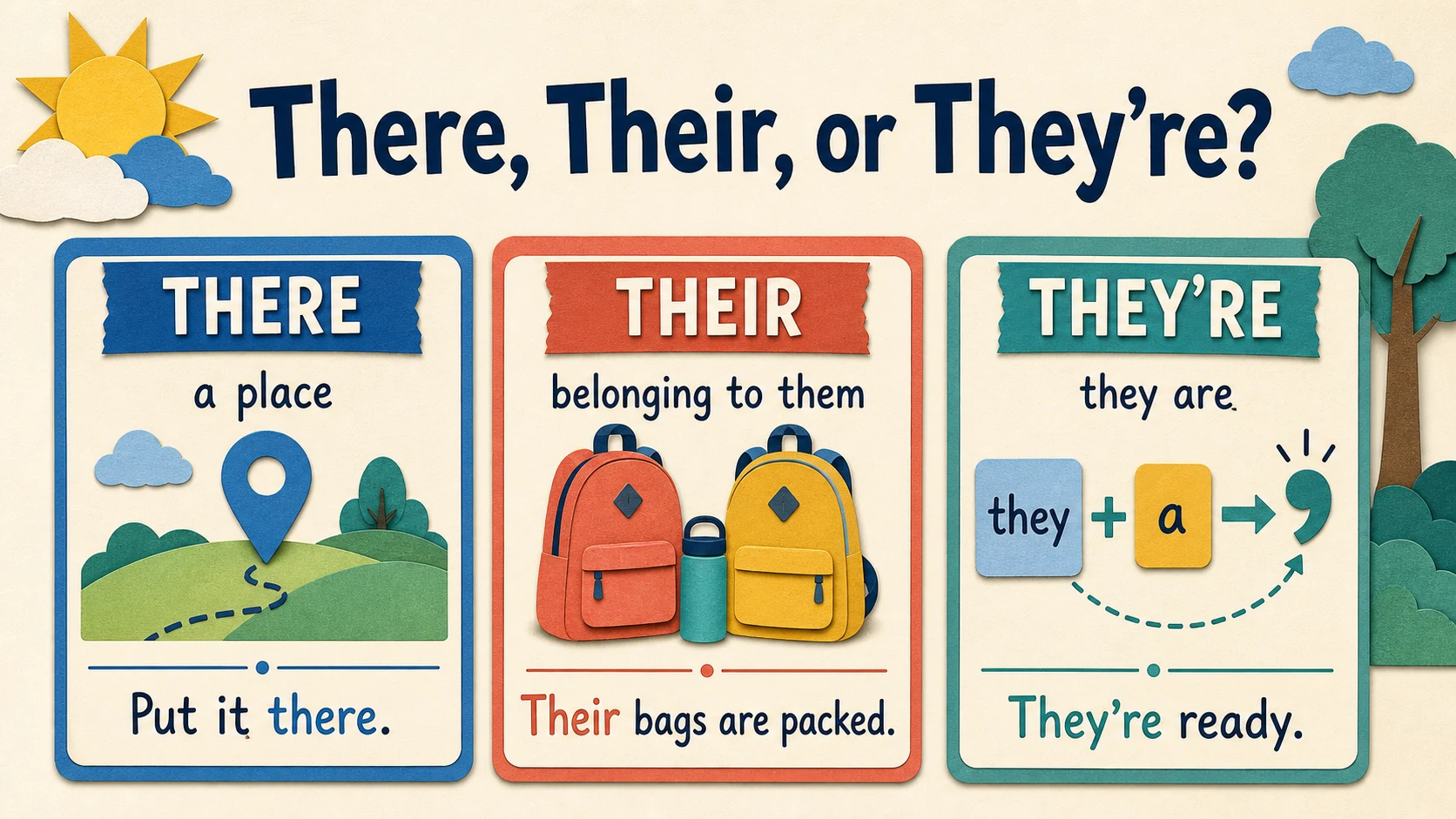
Identify the error type, repair the word, and verify it again after the model is hidden.
Common error patterns and responses
| Observed pattern | Possible task-level interpretation | Immediate response |
|---|---|---|
| Guesses from the first letter | Learner is not inspecting the entire word | Sweep under all letters and compare the guessed and printed words |
| Reads correctly but copies incorrectly | Recognition and written accuracy are not matching | Use letter-by-letter comparison before another copy |
| Copies correctly but cannot read | Learner may be relying on the visible model | Cover the model and check oral retrieval |
| Repeats the same misspelling three times | The learner is not checking each attempt | Stop repetition; compare and repair before continuing |
| Reads slowly but accurately | Recognition is not yet immediate | Provide additional brief retrieval opportunities |
| Confuses reversed letter orders | Whole-word guessing may be overriding left-to-right attention | Point through each letter and contrast the two sequences |
| Errors increase late on the page | The amount or duration may exceed current productive practice | Pause and resume with a shorter set |
| Asks for every word | Independent retrieval has not yet been established | Teach a small set explicitly, then recheck without prompts |
These are interpretations of the observed task, not diagnoses. One worksheet cannot establish the cause of a persistent reading or writing difficulty, and this guide does not offer medical or individualized clinical advice.
Misconceptions to avoid
“Three correct copies mean the word is mastered” is too strong. The model remained visible, so the task allowed copying.
“All sight words must be memorized only by shape” is also unhelpful. Some high-frequency words are decodable, while others contain both regular and unusual spelling features. Draw attention to usable letter–sound knowledge and explicitly identify what must be remembered.
“A slow response is automatically wrong” confuses accuracy with automaticity. Record the word as accurate if it was read correctly, while noting the hesitation for later retrieval practice.
“An incorrect spelling proves the learner cannot read the word” combines two different performances. Check oral reading separately.
“Finishing all 20 is always better than stopping” ignores the quality of practice. If errors are being repeated or attention has dropped, a pause followed by accurate review is more informative.
Check the Answer Key Responsibly
The printable includes a separate answer key for quick checking. Use it to confirm the expected responses, not as a replacement for observing how the learner read and completed each item.
First compare the learner’s response with the word printed on the worksheet. Then consult the answer key if any model, letter, or expected response is unclear. Because the direction requires each word to be written three times, all three written versions should match the target spelling.
A simple record can separate three forms of evidence:
| Mark | Meaning |
|---|---|
| Read | Learner pronounced the printed word accurately |
| Wrote | Learner produced the correct letter sequence |
| Retrieved | Learner read or spelled the word after the model was covered |
Do not calculate a formal percentage unless your setting already has a defined reason and method for doing so. A count such as “16 of 20 words read correctly on this attempt” is a description of one performance. It is not proof of permanent mastery, grade placement, or broad reading fluency.
The Common Core English Language Arts standards include grade-level expectations related to recognizing and reading irregularly spelled words. That provides general context for why this kind of practice may appear in elementary instruction. It does not certify this worksheet’s alignment with every local curriculum, and local sequences can introduce or review words differently.
Move From Copying to Retrieval and Connected Use
After checking, select a small group for follow-up:
- Words read and written accurately can move into delayed review.
- Words copied accurately but not read can receive oral retrieval practice.
- Words read accurately but misspelled can receive spelling-from-memory practice.
- Words both misread and misspelled need explicit reteaching before more independent repetition.
For spelling retrieval, show the word, read and examine it, cover it, write it, and reveal it for comparison. This is different from copying because the model is unavailable during production.
For reading retrieval, place a target word among two or three already known words. Ask the learner to read across the group in a new order. This reduces dependence on the worksheet’s fixed position.
Then use a short, comprehensible sentence. For example:
and: “Sam and Lee read.”the: “The dog ran.”was: “It was red.”said: “Mia said yes.”
Check the target word rather than turning the sentence into an assessment of every reading skill. If other words interfere, read those words for the learner and ask for the target word.
The IES elementary writing practice guide offers high-level guidance about explicit writing instruction and opportunities to practice. It did not study this worksheet. A modest extension consistent with the worksheet’s spelling focus is to ask the learner to use one or two successfully reviewed words in a short sentence, with adult support appropriate to the learner’s current writing.
Schedule Retrieval Without Using a Universal Timetable
Review should occur after some forgetting is possible, not only during the original copying session. The precise interval should respond to performance.
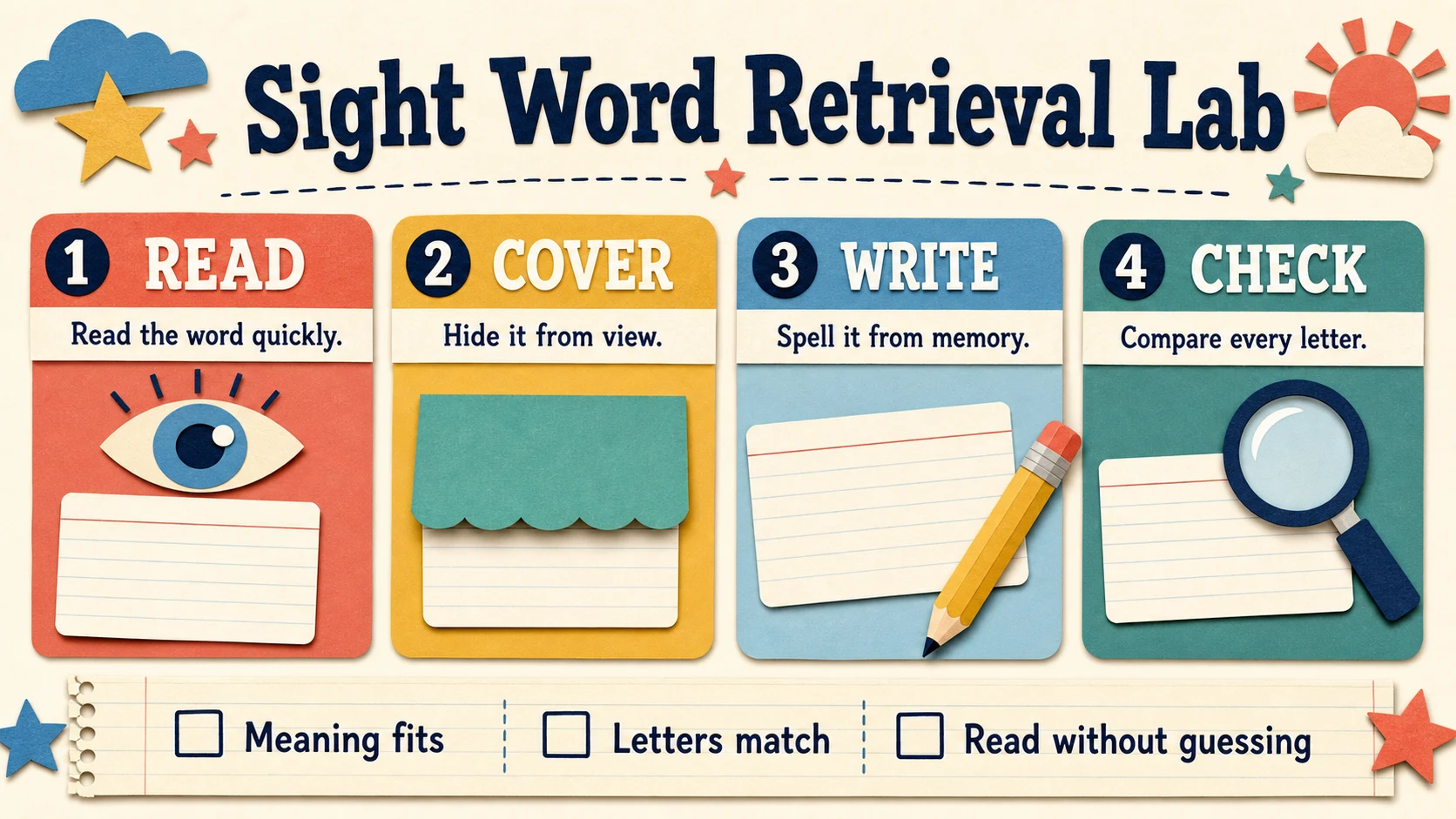
Revisit a small set after increasing delays, shortening the interval when retrieval is unsuccessful.
A practical starting schedule is:
| Review point | Suggested action | Decision |
|---|---|---|
| End of the lesson | Cover the models and check 3–5 selected words | Reteach any word that cannot be retrieved |
| Next learning session | Mix missed words with secure words | Keep the set small if errors remain |
| Two or three sessions later | Read the words in a changed order and in short sentences | Increase the delay when retrieval is accurate |
| About a week later | Sample previously successful and previously missed words | Return unstable words to a shorter review interval |
| Later cumulative review | Mix these words with words from other practice | Retire only words that remain accurate across separate occasions |
This is an instructional starting point, not a required calendar. If the learner misses several words at the next session, shorten the delay and reduce the set. If recognition is prompt and accurate across separate occasions, increase the interval and spend more time reading the words in connected text.
The catalogue’s broader sight-word guidance suggests retiring a word to a mastered group only after correct reading on three separate occasions. Treat that as a practical tracking rule within this resource sequence, not as proof that the word will remain permanently secure in every context.
Limitations and an Honest Next Step
This worksheet offers 20 easy-level read-and-write exercises with an answer key. It can show how accurately a learner reads and copies these words during the session. With the model covered, it can also support a limited check of short-term retrieval.
It cannot, by itself, measure overall reading comprehension, establish broad fluency, explain why a learner is struggling, or replace reading connected text. Its repeated-writing format gives useful spelling practice, but adults need to add oral reading, delayed retrieval, and brief contextual use if they want evidence beyond copying.
After completing and reviewing the page, choose the next resource from the observed work:
- If many words required prompting, revisit a smaller set through the Sight Words topic guide.
- If the learner handled this page accurately, continue with related practice from the 2nd Grade phonics collection.
- If sustained sight-word practice is appropriate, the 2nd Grade Sight Words Worksheet Pack contains 18 worksheets.
- If you need a different practice set, explore the free worksheet generators.
The most useful immediate next action is simple: select three words from this completed worksheet—one secure, one hesitant, and one initially incorrect—and check them again with the printed models covered at the next learning session.
Put it into practice
Use the guide with a real printable
Move from explanation to a short, observable practice task. Check the first item together, then adjust the next session from the learner's actual work.
See the 18-worksheet pack