Complete guide
How to teach and practise 2nd grade short vowels worksheets - standard theme (easy)
How to Use This 20-Item Short-Vowel Worksheet
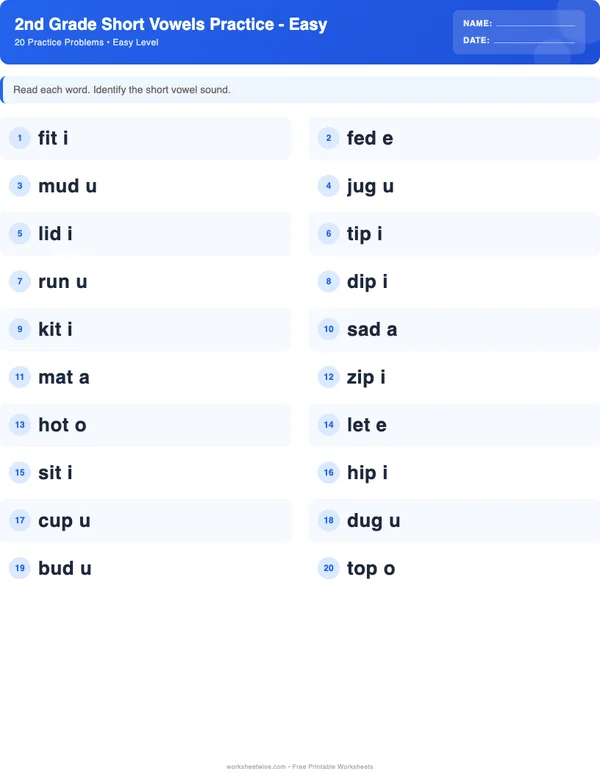
The free 2nd Grade Short Vowels worksheet gives a learner 20 easy-level exercises with one central direction: read each word and identify its short vowel sound. Use it as a focused check of short-vowel recognition, not as a race or a complete phonics lesson.
A practical sequence is:
- Review the five short-vowel sounds with familiar anchor words.
- Model two or three items aloud.
- Complete several items together.
- Let the learner attempt the remaining items independently.
- Check the work by sound pattern, not only by total score.
- Revisit uncertain sounds through brief reading and spelling practice.
- Schedule a short retrieval check after a delay.
The worksheet covers short vowel sounds, phonics, CVC patterns, and decoding. A separate printable answer key is included. Grade labels describe the intended practice level; local curricula and instructional sequences differ. A second grader may use this page for initial instruction, reinforcement, review, or a quick informal check, depending on the learner’s observed work.
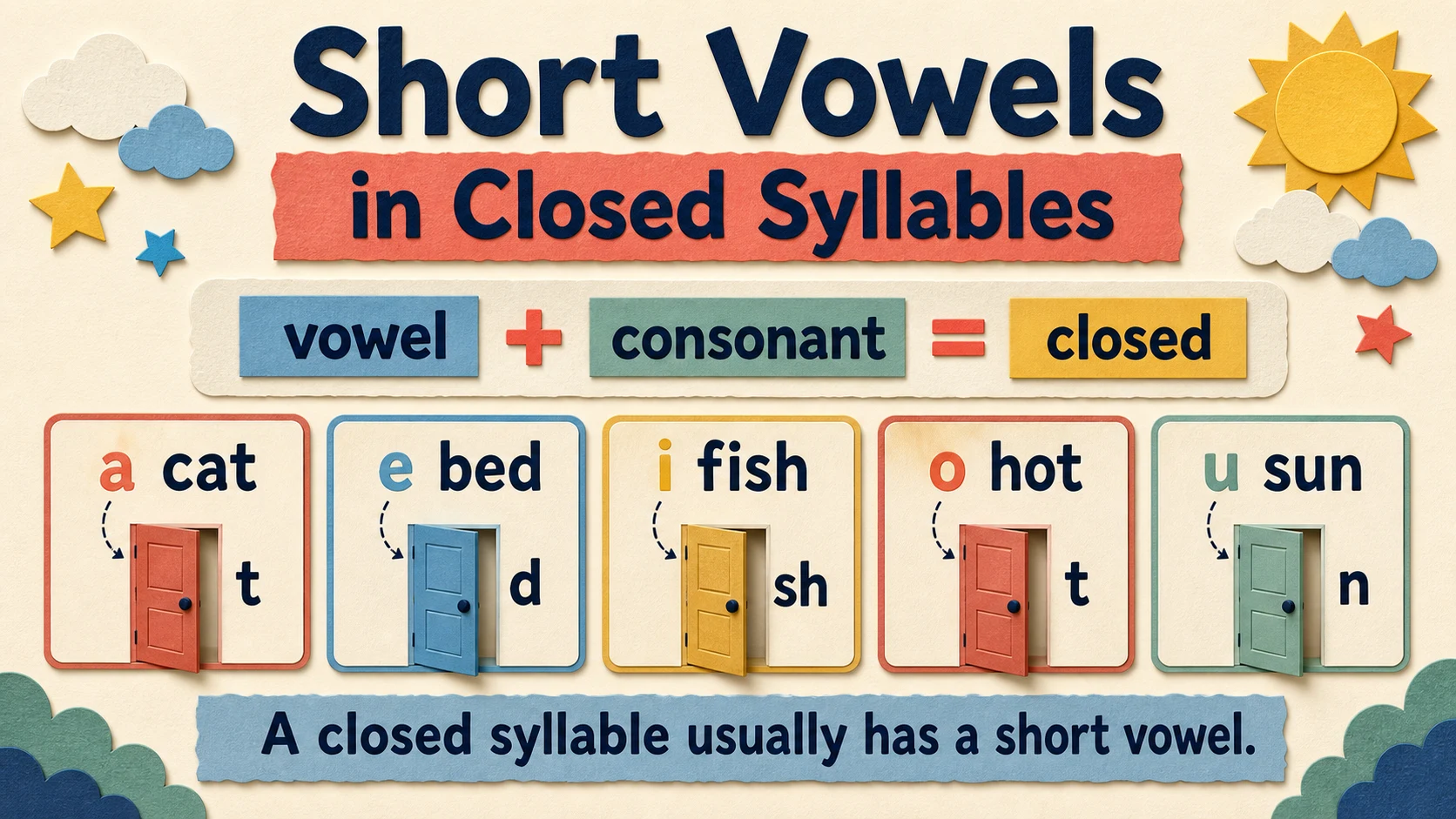
Move from a brief sound review to modeling, guided practice, independent work, correction, and later retrieval.
What This Worksheet Can—and Cannot—Show
This printable asks the learner to connect a written word with its short vowel sound. In a regular closed-syllable word such as cat, the vowel is followed by a consonant, and the vowel usually represents its short sound. The five target sounds can be anchored with the catalogue examples:
- short a as in apple
- short e as in egg
- short i as in itch
- short o as in octopus
- short u as in umbrella
A completed page can show whether the learner recognized the target sounds in these 20 exercises under the conditions in which the page was completed. It cannot, by itself, establish that the learner has mastered every short-vowel word, can transfer the skill to connected reading, or can spell the same patterns from dictation.
The page also does not explain why an error occurred. An incorrect response might reflect a vowel-sound confusion, incomplete blending, unfamiliarity with the response format, guessing, or a momentary lapse. Watch how the learner approaches the words. The process supplies information that a score cannot.
The IES foundational reading practice guide recommends teaching learners to connect speech sounds with letters and to decode, analyze, write, and recognize words. That supports the broad instructional frame used here. It does not mean IES reviewed or endorsed this particular WorksheetWise printable.
For the broader sequence beyond one page, use the Short Vowels topic guide. It covers the topic more fully, so this guide can stay centered on launching, teaching with, and following up on this exact 20-item resource.
Prepare a Focused Lesson
You need the worksheet, a pencil, and the separate answer key kept out of the learner’s view. A scrap sheet or five small vowel cards can help, but neither is required. Before beginning, inspect the printable so you know exactly how the learner is expected to record each answer. Do not assume whether the page requires circling, writing a vowel, or another response; follow the format shown on the actual sheet.
Choose a setting in which you can hear the learner read softly or explain an answer. That lets you distinguish a decoding problem from a recording mistake. If the learner becomes less attentive as the page continues, pause and resume later rather than treating fatigue errors as phonics evidence.
Give a brief sound review
Say the five anchor words and isolate the vowel sound in each one. Keep the review oral and direct:
- “Apple begins with short a.”
- “Egg begins with short e.”
- “Itch begins with short i.”
- “Octopus begins with short o.”
- “Umbrella begins with short u.”
The catalogue teaching notes suggest optional gestures: pretend to bite an apple, crack an egg, scratch an itch, move arms like an octopus, or hold an umbrella. These are memory prompts, not extra answers. Use them if they help the learner retrieve a sound; discontinue them when the learner no longer needs them.
Do not turn this opening into a long lecture. The purpose is to make the five sounds available before the learner reads the printed words.
Confirm that the directions are understood
Read the direction together: “Read each word. Identify the short vowel sound.” Ask the learner to restate the job in plain language. A useful restatement is, “I read the whole word, listen to its vowel sound, and mark the answer.”
If the learner focuses only on the vowel letter, clarify that the task concerns sound. In straightforward CVC words, the middle vowel letter and its short sound correspond, but the learner should still blend and read the word. Merely hunting for a middle letter does not demonstrate decoding.
Follow a Model-to-Independence Progression
The following plan is an instructional suggestion for using the printable. It is not a universal timetable. Shorten, extend, or divide the work according to the learner’s observed accuracy, attention, and ability to explain choices.
| Phase | Adult action | Learner action | Evidence to notice |
|---|---|---|---|
| Sound review | Name the five anchor words and isolate each vowel sound | Repeat or identify the sounds | Can the learner hear the contrast before seeing an item? |
| Model | Think aloud through two or three sample words | Watch, listen, and explain the final choice | Does the learner understand the routine? |
| Guided practice | Prompt only as much as needed | Read and solve several items with support | Which prompts lead to a correct response? |
| Independent practice | Observe without supplying answers | Complete an appropriate portion alone | Does accuracy hold when prompts are removed? |
| Check and correct | Compare responses with the answer key | Re-read and repair selected errors | Can the learner explain the corrected sound? |
| Retrieval | Return to a few words after a delay | Identify or spell the target sounds again | Is the skill available without immediate rehearsal? |
Model the thinking, not just the answer
Use a word similar to the worksheet’s skill rather than reading an actual item in advance. Point under each letter, blend the sounds, say the word normally, identify the vowel sound, and then demonstrate the required mark.
A concise think-aloud might be: “This word is cat. I blend /k/ /ă/ /t/: cat. I hear short a, as in apple. I will record short a in the way the worksheet shows.”
The learner needs to hear the decision process once or twice. Repeating a full explanation for many items can replace the learner’s thinking with adult talk.
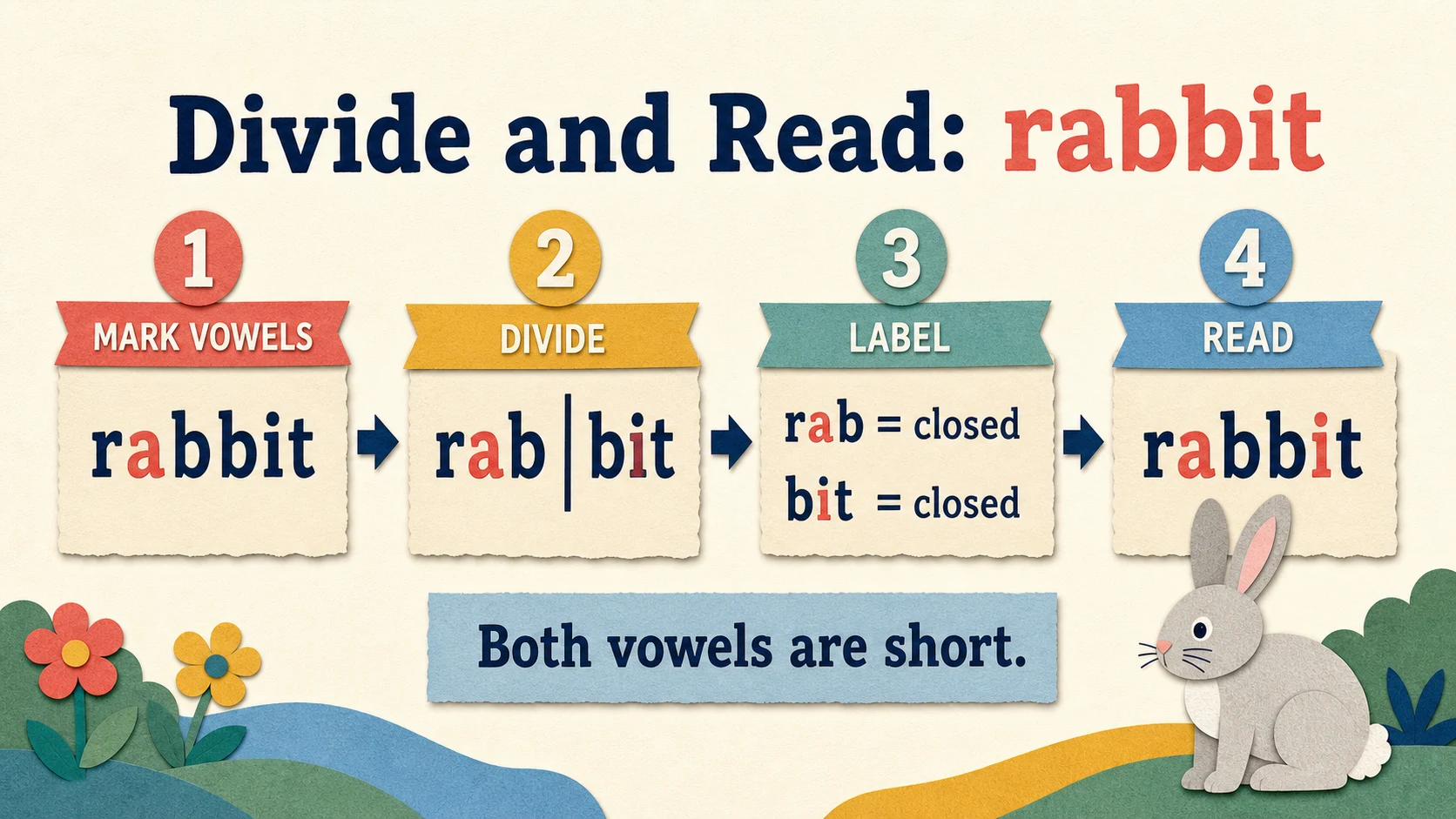
The useful routine is read, blend, identify the vowel sound, and record—not guess from one letter.
Work Through Fully Checked Examples
The examples below are created to model the skill. They are not presented as items from the printable.
Example 1: cat
Segment the word as c-a-t. Blend the sounds: /k/ /ă/ /t/, cat. The middle vowel is a, and the spoken word contains short a, as in apple.
Checked answer: short a.
A common weak response is “a because it is in the middle.” The letter location points the learner toward the vowel, but the stronger justification is, “I read cat and hear short a.”
Example 2: bed
Segment b-e-d and blend /b/ /ĕ/ /d/: bed. Compare the middle sound with egg. Both contain short e.
Checked answer: short e.
If the learner says short i, contrast bed with bid. Say each word naturally and ask which one matches the printed letters. Do not exaggerate either vowel so much that it becomes a different sound.
Example 3: pig
Segment p-i-g and blend /p/ /ĭ/ /g/: pig. The vowel sound matches short i in itch.
Checked answer: short i.
If the learner reads only the first and last consonants, cover neither letter. Instead, slide a finger beneath all three letters and have the learner blend from left to right.
Example 4: hot
Segment h-o-t and blend /h/ /ŏ/ /t/: hot. The vowel sound is short o, as in octopus.
Checked answer: short o.
If short o and short u are confused, compare hot with hut. Ask the learner to say both complete words and listen to the middle sound. The contrast should support attention to the vowel, not become a vocabulary quiz.
Example 5: sun
Segment s-u-n and blend /s/ /ŭ/ /n/: sun. Its vowel sound matches short u in umbrella.
Checked answer: short u.
These five checks represent one straightforward closed-syllable example for each target vowel. They verify the reasoning independently; they do not reveal the worksheet’s actual answer sequence.
Run Guided Practice Without Taking Over
After modeling, choose a small number of worksheet items for guided practice. Let the learner attempt each word before you speak. If the response is correct, ask for a brief explanation on only some items: “Which short vowel did you hear?” Constant explanation can make a simple page unnecessarily tiring.
When the learner hesitates, move through prompts from least to most supportive:
- “Read the whole word.”
- “Slide through each sound.”
- “Which sound is in the vowel position?”
- “Which anchor word has the same vowel sound?”
- Offer two contrasting choices, such as short e or short i.
- Model the word if the learner still cannot decode it.
Record mentally which level of support was needed. A correct answer after the adult supplies two choices is different from an immediate independent answer, even though both may look correct on paper.
The catalogue teaching notes specifically identify short e and short i, and short o and short u, as potentially confusable. If one of those patterns appears, use a minimal contrast such as pen/pin, set/sit, bed/bid, or hot/hut. The task remains short-vowel discrimination.
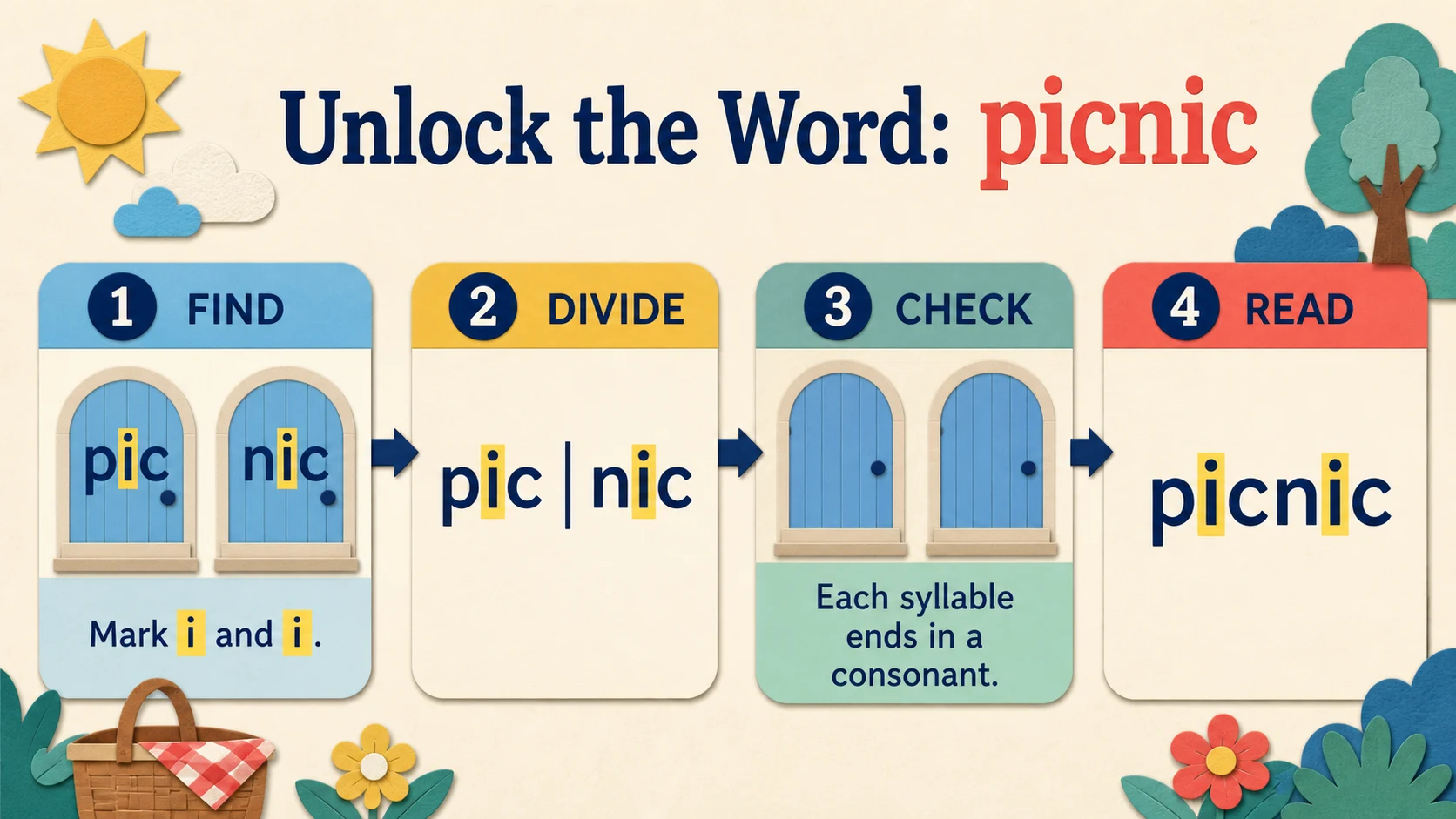
Guided practice should reveal the learner’s reasoning while prompts gradually decrease.
Release responsibility based on observed work
Move to independent practice when the learner can read the word, identify the sound, and use the worksheet response format without repeated reminders. Independence does not require perfect performance during the guided phase.
If the first independent items show a clear breakdown, return briefly to modeling. If the learner is accurate but slow, allow processing time. If accuracy drops only near the end, divide the 20 items into two sittings and keep the item numbers together when reviewing results.
Avoid announcing a required number of minutes. A universal completion time would ignore differences in decoding fluency, handwriting, attention, and familiarity with the task.
Adapt Support Without Changing the Skill
Differentiation should preserve the central demand: the learner reads a word and identifies its short vowel sound. Changing the page into copying, picture naming, or adult-led answer selection would measure something else.
For a learner who needs more support
Display the five vowel letters with their anchor words. Complete fewer items at one time. Allow the learner to point to an anchor before recording the answer. Use a finger sweep beneath the letters during blending.
You can also cover the unused portion of the page with a blank sheet, leaving one item visible. This changes the amount of visual information, not the phonics skill. If handwriting interferes with showing sound knowledge, let the learner point or say the answer during guided practice, then return to the printable’s expected response when practical.
For a learner ready for less support
Remove the anchor cards and gestures. Ask the learner to complete a short section without feedback. Afterward, select two answers and ask for the reasoning.
For an additional check, dictate one of the verified example words, such as pig or sun. Have the learner say the vowel sound and write the whole word. This reverses the direction from decoding to encoding while keeping attention on the same short-vowel pattern. The IES elementary writing guide includes fluent spelling among the foundational skills that support writing. That high-level recommendation provides context for adding brief spelling practice; it is not an evaluation of this worksheet.
For a learner who finishes accurately
Do not add arbitrary busywork. Ask the learner to sort several completed words by vowel sound, read each group, or write one new regular CVC word for two of the vowel categories. Check the new words before using them as examples, because not every three-letter word has a regular short-vowel pronunciation.
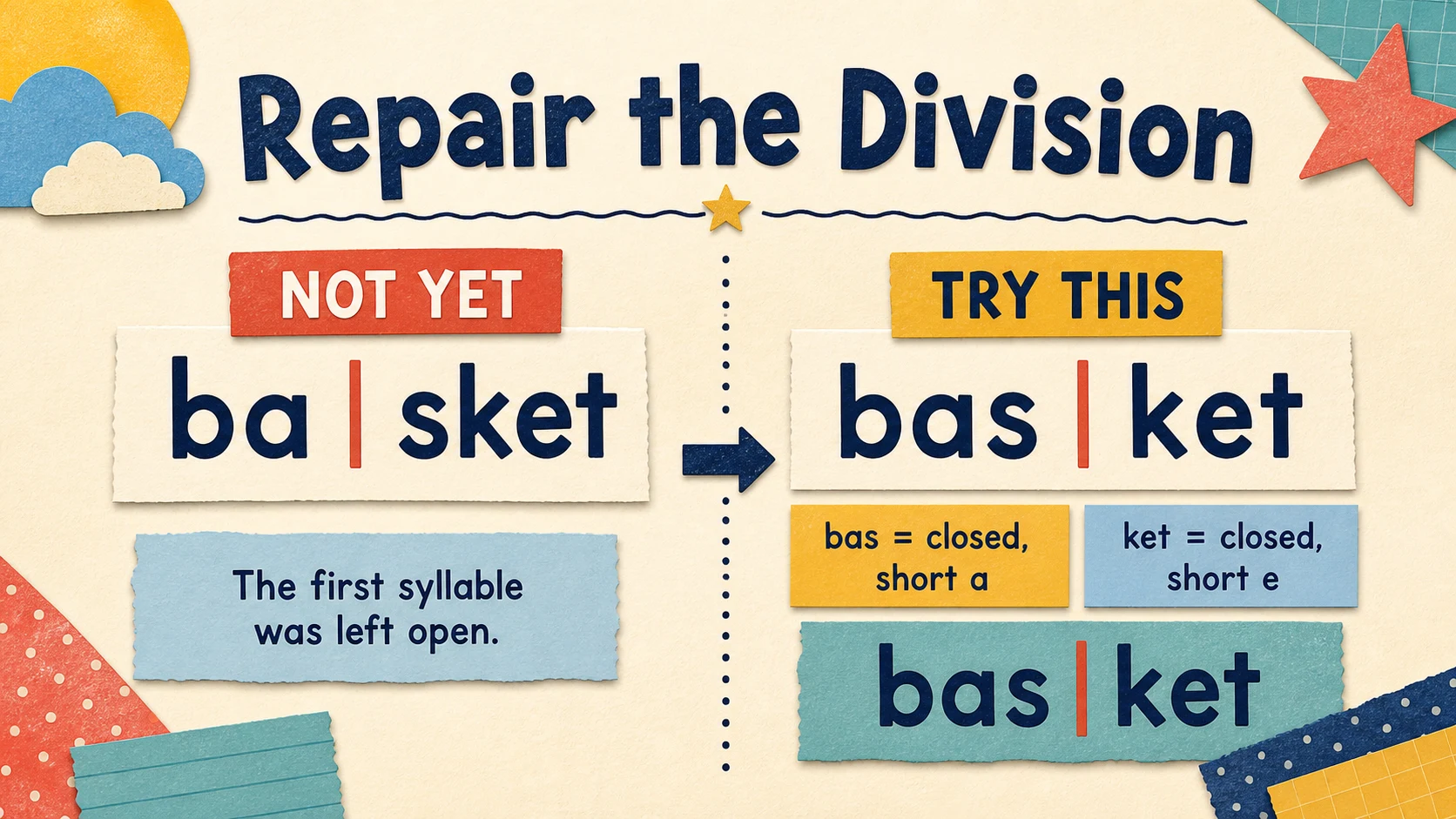
Adjust the amount of prompting, visible material, or follow-up response while preserving vowel-sound identification.
Keep Boundary Cases Outside the Main Task
The short-vowel pattern is easiest to see in regular closed syllables such as cat, bed, pig, hot, and sun. Several superficially similar words require different knowledge:
- Cake does not contain short a; its final e is associated with a long-vowel pattern.
- Boat does not contain short o; oa functions as a vowel team.
- Bird is not a plain short i example; the vowel is affected by r.
- A multisyllabic word may contain more than one vowel sound and may require syllable analysis rather than a single CVC blend.
- An unfamiliar word may be hard because of vocabulary or consonant patterns even when its vowel is regular.
Do not use these words to “catch” the learner during this easy worksheet lesson. Use them only to explain why the short-vowel rule should not be applied mechanically to every word containing a, e, i, o, or u.
The supplied topic progression places mastery of short vowel sounds before work with long vowels, vowel teams, and multisyllabic words. Link those later patterns to the broader 2nd Grade phonics collection rather than trying to teach all of them during one printable.
The Common Core ELA standards provide grade-specific literacy expectations within a larger reading, writing, speaking, listening, and language framework. The catalogue associates this topic with distinguishing long and short vowels in regularly spelled one-syllable words, among earlier related foundational skills. That catalogue association is useful context, but it is not a claim of comprehensive standards alignment for this individual worksheet.
Interpret Errors by Pattern
A raw total can summarize the page, but the pattern of errors is more useful for deciding what to teach next. Review the written response and, when possible, ask the learner to re-read the word.
Sound confusion
If bed-type words are repeatedly labeled short i, the likely instructional target is discrimination between short e and short i. Use two or three minimal pairs from the supplied examples: pen/pin, set/sit, and bed/bid. Say both words, then show the spellings and have the learner identify the middle sound.
If hot-type words are labeled short u, contrast a regular pair such as hot/hut. Keep the consonants stable so attention stays on the vowel.
Decoding breakdown
A learner may name the printed vowel correctly without reading the word. That can produce correct worksheet answers through letter spotting. Ask for one or two whole-word readings. If the learner cannot blend them, return to left-to-right sound blending rather than adding more vowel labels.
The reverse can occur as well: the learner reads a familiar word correctly but cannot name its vowel category. Return to the anchor word comparison: “Does the middle sound match apple, egg, itch, octopus, or umbrella?”
Response-format or attention error
A learner may say the correct sound and mark the wrong choice, skip a line, or shift an answer to the next item. That is not the same as a phonics misconception. Have the learner point to the item number, say the answer, and compare it with the mark.
If errors cluster near the bottom of the page after accurate earlier work, do not automatically infer that the later vowel is weaker. Recheck a small sample when the learner is attentive.
Mixed or isolated errors
One error across otherwise accurate examples may not justify reteaching an entire vowel set. Ask the learner to retry the word without telling the answer. If it is corrected and explained, schedule it for later retrieval. If the same confusion returns across several words, provide focused practice on that contrast.
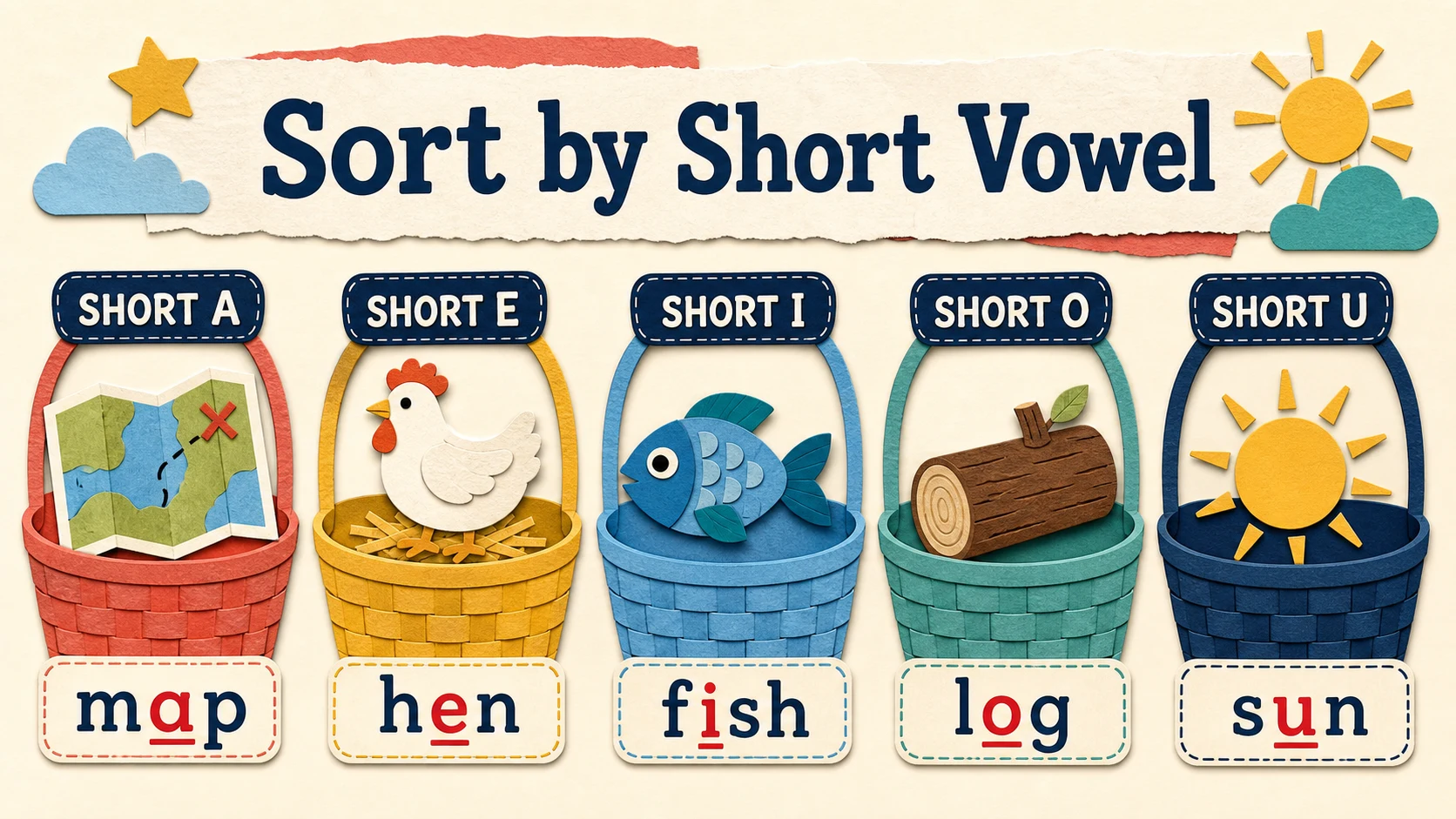
Re-read the word, identify the error type, correct it, and verify the reasoning before choosing more practice.
Check the Answer Key Responsibly
Use the separate answer key after the learner has made a genuine attempt. The key is useful for verifying the expected responses quickly, but it should not replace listening to the learner read.
Follow this routine:
- Match the worksheet and answer-key titles before checking.
- Compare one item at a time so answers do not shift between lines.
- Mark correct responses consistently.
- For an incorrect response, ask the learner to re-read the word before revealing the key.
- Have the learner explain the corrected vowel sound.
- Note the sound category or confusion pattern, not only the item number.
- Recheck any apparent discrepancy against the printed word and instructions.
Do not treat a corrected answer as if it had been independent from the start. You might use simple notes such as I for independent, P for prompted, and C for corrected. These are informal instructional notes, not grades or standardized measures.
If you believe the key and a printed item disagree, pause rather than teaching the learner that the key must always be right. Read the word aloud, segment it, compare it with an anchor, and verify that the correct worksheet version and key are paired. Report a genuine file issue through the site’s normal support route if one remains.
Decide What to Do Next
Let the learner’s work determine the next step.
- If most items are read and identified independently, move to a brief transfer task: sort regular words by vowel, spell a few CVC words from dictation, or read short-vowel words in simple connected text.
- If one contrast causes repeated errors, practice that contrast before repeating a mixed set.
- If several vowels are uncertain, return to one vowel at a time. The catalogue teaching sequence suggests a, i, o, u, e, with substantial practice before introducing the next.
- If the learner identifies letters but cannot blend words, work on CVC decoding rather than assigning another classification page immediately.
- If the learner decodes accurately but makes recording errors, simplify the visual presentation and check understanding orally.
- If the page is consistently easy, proceed to a more varied activity in the topic guide instead of repeatedly assigning equivalent easy pages.
The worksheet is limited to 20 exercises and a focused skill. It does not provide a complete reading program, a diagnosis, or evidence of performance across every text and setting. It also cannot determine whether difficulty comes from instruction, language experience, attention, vision, hearing, or another factor. This guide offers instructional suggestions, not medical or child-specific clinical guidance. Discuss persistent concerns through the learner’s established educational support channels.
Schedule Brief Retrieval
Do not rely only on immediate correction. Ask for the sounds again after some time has passed. The exact spacing should respond to observed work rather than follow a universal timetable.
A practical starting plan is:
| Review point | Suggested task | Adjustment |
|---|---|---|
| Later the same lesson | Revisit two corrected words without showing the answers | If still uncertain, model and blend again |
| Next study session | Mix three to five previously seen patterns | Narrow to one confusing pair if errors recur |
| Several days later | Read or sort a fresh small set of regular CVC words | Add dictation if decoding is secure |
| The following week | Recheck the weakest vowel contrast in a new order | Continue only if the learner still needs it |
These intervals are a scheduling suggestion, not a sourced requirement. A learner who retrieves the sounds accurately may need less frequent review. A learner who cannot recall them after a short delay needs smaller steps and more guided practice.
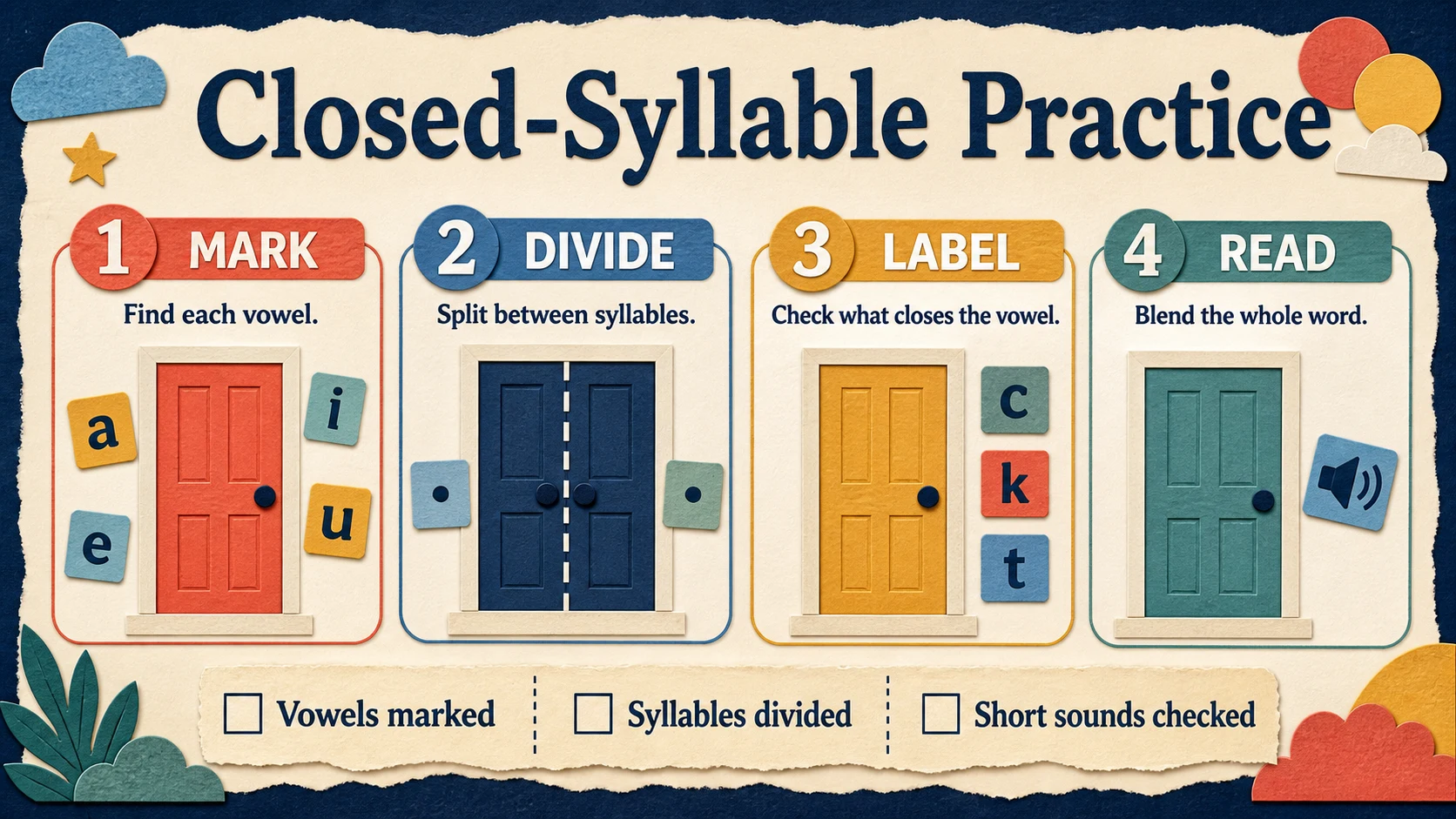
Return to a small, mixed sample after a delay and adjust the next review from the learner’s response.
Continue With a Purposeful Next Action
Print the 2nd Grade Short Vowels worksheet, choose five anchor words, and plan where you will shift from guided to independent work. After checking the page, record the learner’s weakest vowel contrast and schedule one brief retrieval session.
For continued focused practice, use the Short Vowels topic guide. If the learner needs a larger set of related materials, the 2nd Grade Short Vowels Worksheet Pack contains 18 worksheets and is listed at $4.79. For a fresh activity shaped around the pattern you observed, explore the free worksheet generators.
Put it into practice
Use the guide with a real printable
Move from explanation to a short, observable practice task. Check the first item together, then adjust the next session from the learner's actual work.
See the 18-worksheet pack