Complete guide
How to teach and practise 2nd grade long vowels worksheets - standard theme (easy)
What this 20-item worksheet is for
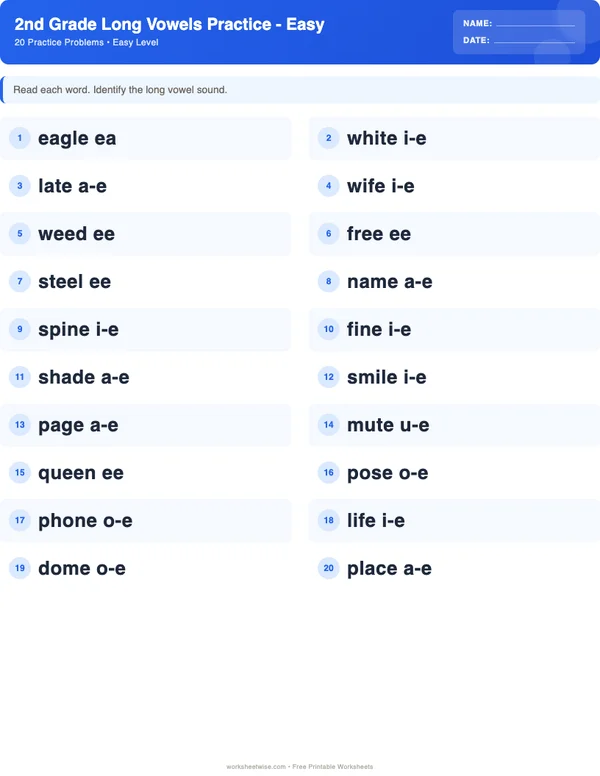
The free 2nd Grade Long Vowels worksheet gives a learner 20 easy-level exercises with one repeated direction: “Read each word. Identify the long vowel sound.” It practices recognizing long vowel sounds, noticing vowel patterns, and decoding printed words. A separate printable answer key is included.
The short answer: use the page after the learner can read short-vowel CVC words with reasonable accuracy. Model how to read the whole word, identify the vowel sound—not merely a visible letter—and name the long vowel as long a, e, i, o, or u. Complete a few items together, let the learner attempt the rest, and then examine errors by pattern. Do not treat the final score as the only useful result.
Grade labels describe the intended practice level; they do not guarantee that every learner in that grade has met the same prerequisite skills. Local school, district, state, and homeschool sequences also differ. Before assigning the page, check that its words and response format fit what the learner has already been taught.
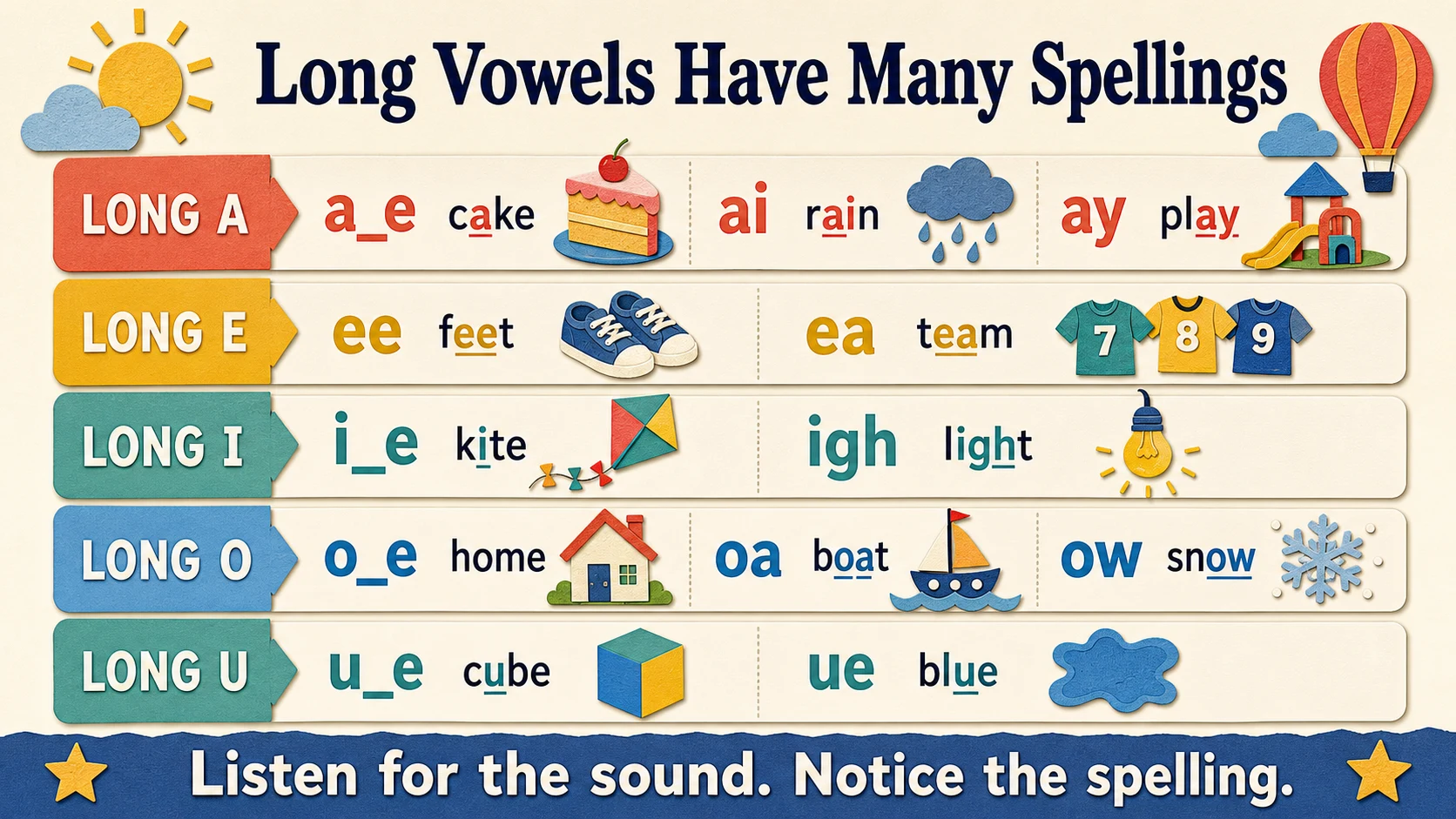
Preview the page, model the decision, guide several items, release responsibility, and review the resulting evidence.
Preview the worksheet before teaching
Print or open both the worksheet and its answer key, but keep the key out of the learner’s view during the first attempt. Then scan all 20 items. This brief preview helps you decide which spelling patterns need to be named in the opening explanation.
The broader Long Vowels topic guide covers the progression among silent-e words, vowel teams, open syllables, reading practice, word sorts, and encoding. Use that guide when you need the larger instructional sequence. The present lesson should remain focused on launching and interpreting this particular identification page.
Check the prerequisite
Ask the learner to read a few familiar short-vowel words such as cap, pin, hop, and cub. The purpose is not to administer a formal test. You are checking whether short-vowel decoding is stable enough for a useful long-vowel contrast.
If cap is read as cape, or pin is guessed without attending to its letters, pause before beginning all 20 items. Review sound-by-sound blending first. The catalogue teaching guidance places long-vowel work after fluent short-vowel CVC decoding because the contrast between forms such as cap/cape and hop/hope makes the new pattern easier to see.
Check the response demand
Look at how the printable asks the learner to record an answer. The task may require identifying the vowel sound through a mark, letter, label, or selection supplied on the page. Explain that exact response method before practice begins.
Do not accidentally turn the activity into a spelling test. The stated task is to read each word and identify its long vowel sound. Correct spelling can be discussed, but it should not replace the target decision.
Establish the five sound labels
Review the conventional names:
| Label | Example | What the learner listens for |
|---|---|---|
| long a | cake | The vowel sound says the name of the letter a. |
| long e | feet | The vowel sound says the name of the letter e. |
| long i | kite | The vowel sound says the name of the letter i. |
| long o | bone | The vowel sound says the name of the letter o. |
| long u | cube | The relevant vowel sound is the long u sound in cube. |
These examples establish the meaning of the labels. They should not be presented as a claim about which exact words appear among the worksheet’s 20 items.
A practical lesson sequence
A calm first use can fit into one instructional sitting, but there is no universal timetable. Let the learner’s observed reading and explanations determine whether to continue, pause, or divide the page across two sittings.
| Phase | Suggested use of the printable | What the adult watches |
|---|---|---|
| Preview | Read the title and directions; point out how answers are recorded. | Does the learner understand the task? |
| Model | Demonstrate two comparable words away from the scored items. | Can the learner follow the reasoning from spelling to sound? |
| Guided practice | Solve about three to five worksheet items together. | Can the learner read before naming the vowel? |
| Supported release | Let the learner solve a small group while explaining one answer. | Is prompting still needed on every item? |
| Independent practice | Have the learner complete the remaining appropriate items. | Are responses accurate, steady, and genuinely decoded? |
| Review | Compare work with the answer key and revisit selected errors. | Do errors cluster by sound, spelling pattern, or task habit? |
| Retrieval | Recheck a few examples later without displaying prior answers. | Can the learner recall the distinction after time has passed? |
This gradual release is an instructional suggestion for using the page. It is not a timing requirement from the worksheet or a promise that every learner will complete the sequence at the same pace.
The IES foundational reading practice guide provides high-level support for systematic work with sound–spelling relationships, decoding, and connected reading in the primary grades. It did not evaluate WorksheetWise or this specific printable. Here, its relevance is the general principle that phonics work should connect printed patterns with sounds and word reading.
Model the task explicitly
Write a comparable word where the learner can see it. Say what you are looking at and listening for, but keep the explanation short enough that the learner can imitate it.
A useful script is:
- “I will read the whole word.”
- “I will listen to the vowel sound.”
- “I will decide whether I hear long a, e, i, o, or u.”
- “I will record the answer in the way this page requests.”
- “I will reread the word to check.”
Avoid telling the learner to circle the “long vowel letter” without mentioning sound. A spelling can contain more than one vowel letter, as in feet, while the task asks for the vowel sound. Starting with the spoken result helps keep attention on the relationship between letters and sounds.
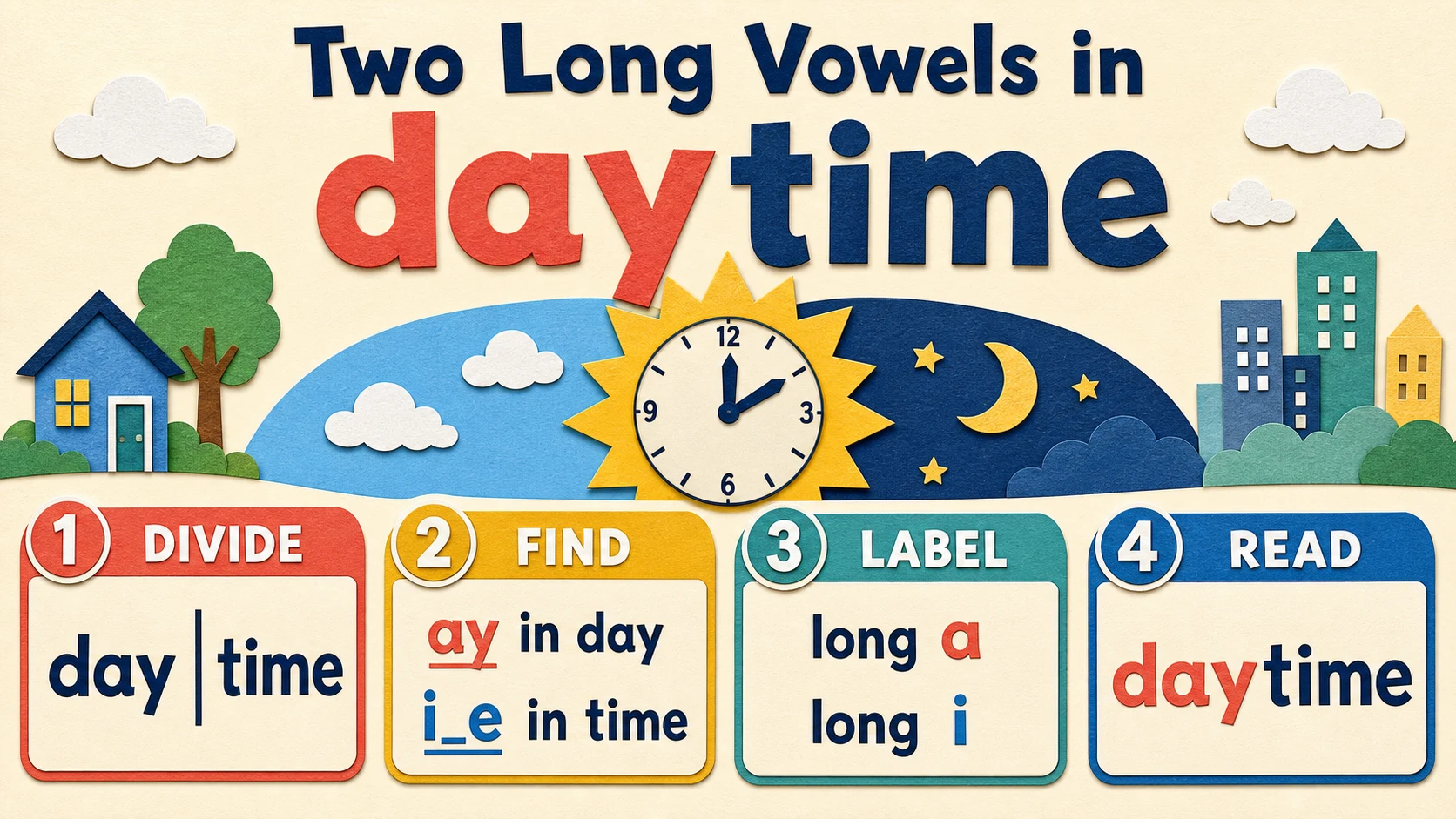
The learner reads the complete word, hears the vowel sound, identifies its name, and checks the choice.
Fully checked example 1: cake
- Read the word: cake.
- Contrast it with cap if support is needed.
- In cake, the vowel sound is /ā/, the sound heard when naming the letter a.
- The final e is not pronounced as a separate syllable in this word.
- Checked answer: long a.
The spelling pattern is CVCe: consonant, vowel, consonant, final e. The important conclusion for this task is the sound label, not merely the presence of the letter a.
Fully checked example 2: feet
- Read the word: feet.
- Identify the vowel spelling ee.
- The two letters work together here to represent /ē/.
- /ē/ is the sound heard when naming the letter e.
- Checked answer: long e.
This example prevents a common visual mistake: counting two written vowels as two vowel sounds. In feet, the vowel team represents one long vowel sound.
Fully checked example 3: kite
- Read the word: kite.
- Compare kit and kite aloud.
- Kit has a short i sound; kite has /ī/.
- /ī/ says the name of the letter i.
- Checked answer: long i.
The contrast is useful because it shows that reading the whole pattern matters. Selecting i simply because it is the first vowel seen would not demonstrate that the learner decoded kite correctly.
Fully checked example 4: bone
- Read the word: bone.
- Compare it with bon only as a decoding contrast, not as a vocabulary example.
- In bone, the relevant sound is /ō/.
- /ō/ says the name of the letter o.
- Checked answer: long o.
The learner should pronounce the word before responding. If the learner says a different word based only on its first letter, prompt another left-to-right blend.
Fully checked example 5: cube
- Read the word: cube.
- Notice the final-e pattern.
- The relevant vowel sound is the long u sound represented in cube.
- Checked answer: long u.
Long u can be less straightforward in spoken English than some other long vowels because pronunciation varies across words and accents. For this lesson, use the pronunciation intended by the familiar example cube, listen respectfully to the learner’s normal accent, and consult the page’s answer key for the worksheet’s classification.
Move from guided to independent practice
Begin with enough joint work to make the process visible. The goal is not to complete half the page for the learner; it is to discover whether the learner can carry out the decision independently.
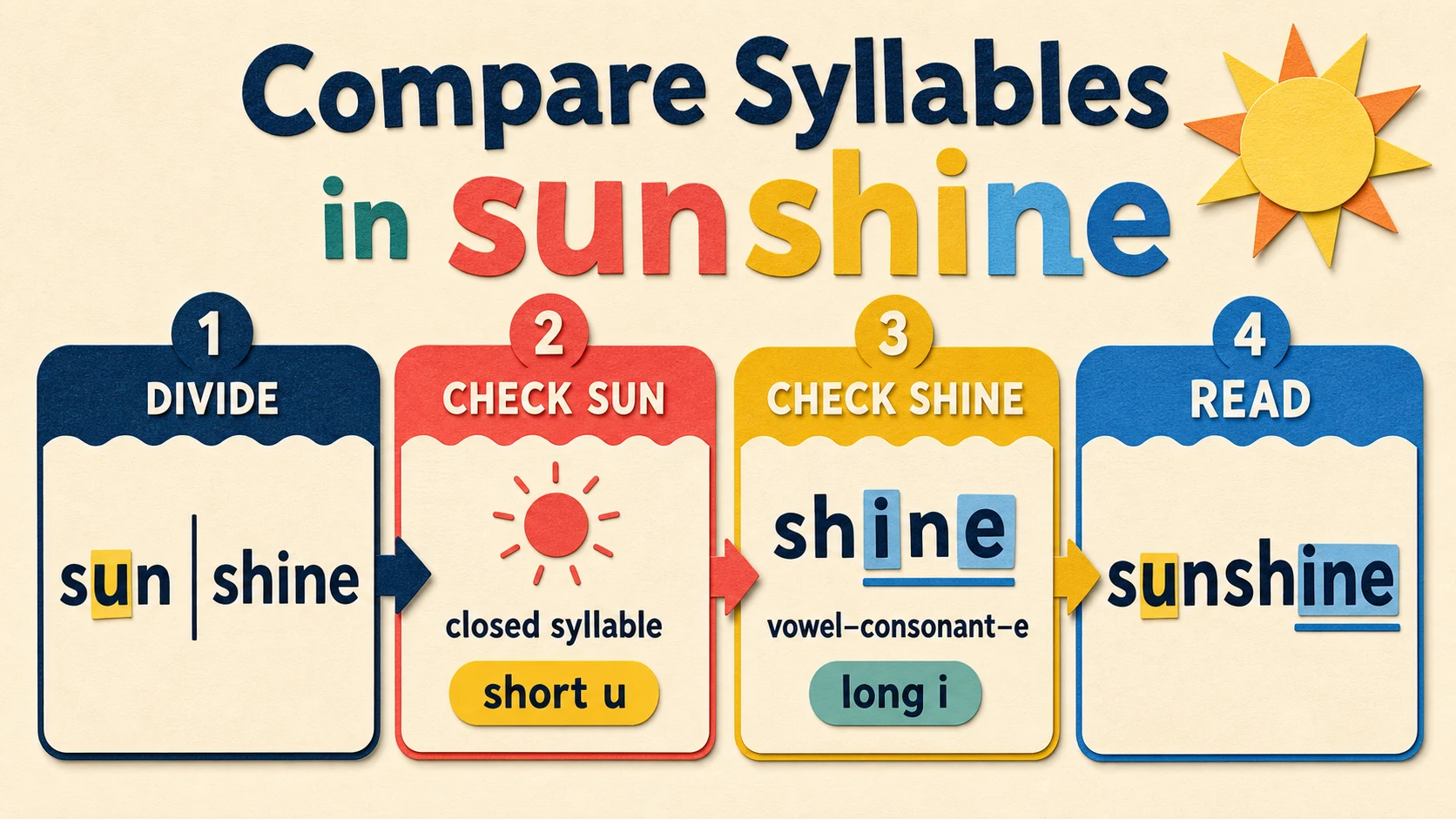
Prompts should direct attention to the word and sound, then fade as soon as the learner can manage the routine.
During guided items
For the first item, read and reason aloud yourself. On the next item, ask the learner to read while you prompt the decision. On another, ask the learner to complete the entire routine and explain the choice.
Use prompts that preserve the skill:
- “Read the whole word.”
- “What vowel sound do you hear?”
- “Does that sound say a vowel’s name?”
- “Which long vowel label matches it?”
- “Reread the word and check.”
If the learner hesitates, point to the spelling pattern or provide a short-vowel contrast. Do not immediately name the answer. A prompt such as “Compare hop and hope” keeps the learner involved in decoding.
Decide when to release responsibility
Move to independent work when the learner can:
- read the practice word rather than guess from its first letter;
- name the relevant long vowel sound;
- record the response in the required format; and
- explain at least one answer with a brief statement such as, “Hope has long o.”
If the learner needs the same full explanation on every guided item, more teaching is needed before independent completion. Stop after a manageable portion instead of converting the remaining items into repeated adult-led answers.
Protect the independent sample
Once the learner begins independently, avoid confirming each response. Constant confirmation can turn the exercise into a sequence of adult approvals rather than a sample of what the learner knows.
You can say, “Make your best choice and mark that one so we can review it.” A small dot beside uncertain items lets the learner continue without erasing the evidence of uncertainty.
Adapt support without changing the skill
Differentiation should make the sound-identification task accessible while preserving its central demand. Reading the word aloud for a learner, naming the vowel, and directing the learner to copy that answer would remove most of the intended work.
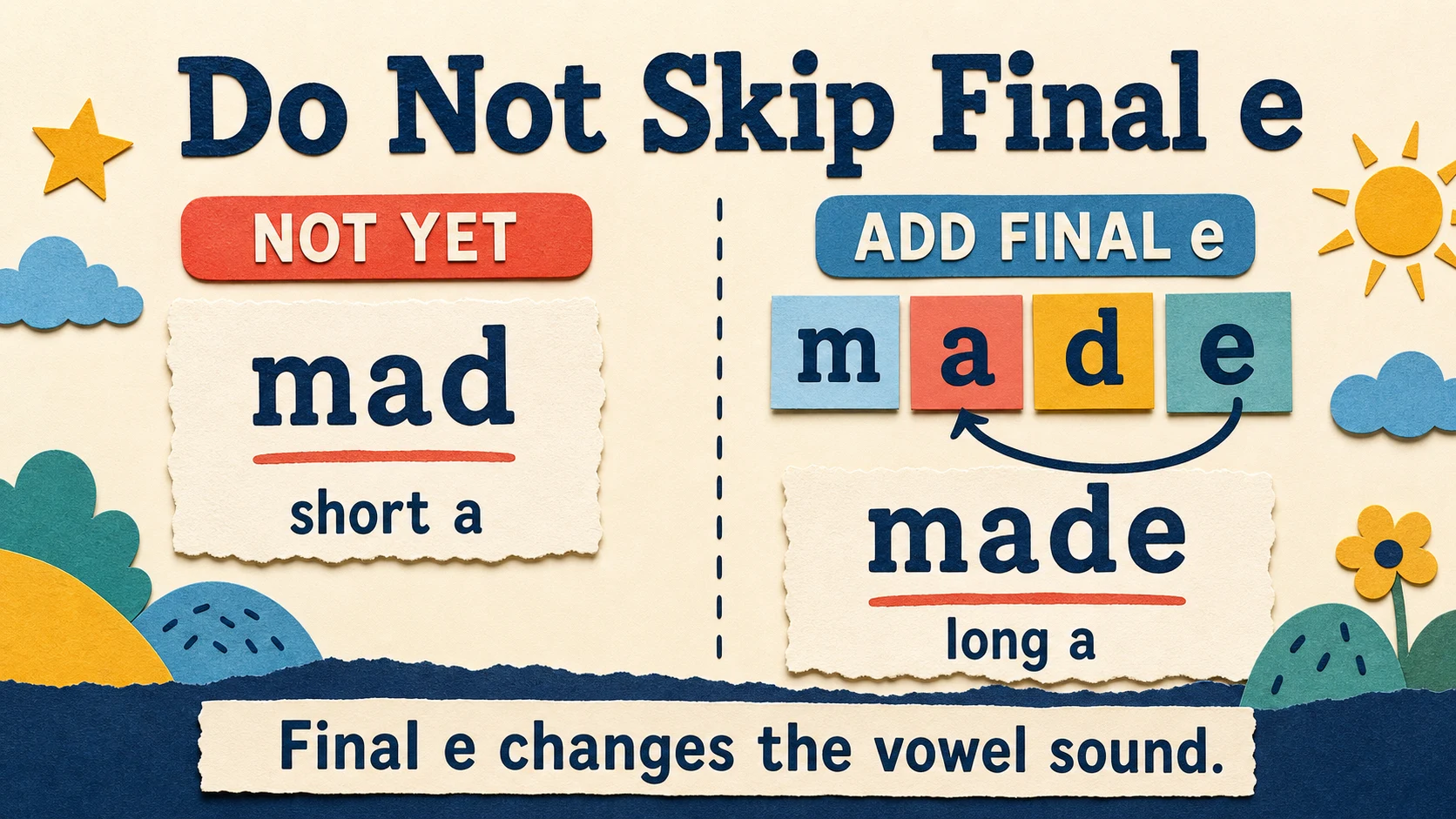
Adjust the amount, presentation, or prompting while keeping the learner responsible for identifying the long vowel sound.
When the learner needs more support
Cover all but one row or a few items with a blank sheet. This reduces visual load without changing the phonics skill. Ask the learner to point under each letter while blending. Provide a five-label reference—long a, long e, long i, long o, long u—if remembering the response vocabulary is interfering with sound analysis.
You may also divide the page into two sets. Complete one set, take a break, and return later if attention or effort is declining. Because there are 20 items, an unfinished page can still provide useful evidence.
For a learner who can hear the sound but has difficulty making the required mark, allow pointing or an oral answer first, then help with recording. Note that the oral response was supported so you do not mistake assisted written performance for fully independent work.
When the learner is ready for more explanation
Ask for a brief justification on selected items: “Which letters represent the long vowel sound?” This adds pattern awareness while retaining the original identification task.
After an answer, invite a contrast:
- cap → cape
- pin → pine
- hop → hope
- cub → cube
For each pair, have the learner read both words and describe what changed. These contrasts come from the supplied topic guidance and help reveal whether the learner notices final-e patterns instead of memorizing isolated answers.
When the page is easy
Do not automatically make the learner complete extra copies. Instead, sample transfer. Choose several correctly identified words and ask the learner to read them again in a different order. Then dictate one or two familiar long-vowel words for spelling, clearly labeling this as an additional encoding activity.
The IES elementary writing practice guide supports explicit instruction and practice in foundational writing skills at a broad level. It does not prescribe this worksheet routine. Using brief word dictation after identification is an instructional extension that checks whether the learner can move from hearing a word to representing its sounds in writing.
Handle boundary cases carefully
Long-vowel spelling is useful, but English spelling cannot be reduced to one slogan. The supplied topic guidance notes silent-e patterns, vowel teams such as ai, ay, ea, ee, oa, ow, and open syllables such as he, go, and the opening syllable of music.
A pattern is evidence, not the answer by itself
A learner might see final e and announce “long vowel” before reading. Ask for the whole word. The correct process is not “final e always means the first vowel says its name”; it is “use the taught pattern as a decoding clue, read the word, and check the sound.”
Likewise, “when two vowels go walking, the first one does the talking” can be a starting memory aid for several common teams, but the supplied guidance explicitly notes exceptions. Do not present it as a universal spelling law.
Sound and spelling are related but distinct
In feet, the spelling ee represents long e. In cake, a_e represents long a. In go, the open syllable ends in a vowel sound classified as long o. The same sound category can therefore appear through more than one spelling pattern.
Conversely, seeing a particular vowel letter does not settle the answer. The learner must decode the word. If the worksheet’s answer key and the learner’s pronunciation appear to disagree, reread the item, check whether another vowel sound is being targeted, and consider normal accent variation before marking the response wrong.
Keep vocabulary from hiding decoding
A learner may decode a word accurately without knowing its meaning. Since this worksheet targets vowel identification and decoding, give a brief, neutral definition if unfamiliar vocabulary blocks the task. Then ask the learner to read the word again and identify the sound. Avoid supplying a rhyming clue that effectively gives away the vowel unless you record that support.
Interpret mistakes as patterns
A total such as “16 out of 20” is incomplete information. Four errors on one spelling pattern call for a different response from four scattered slips caused by rushing.
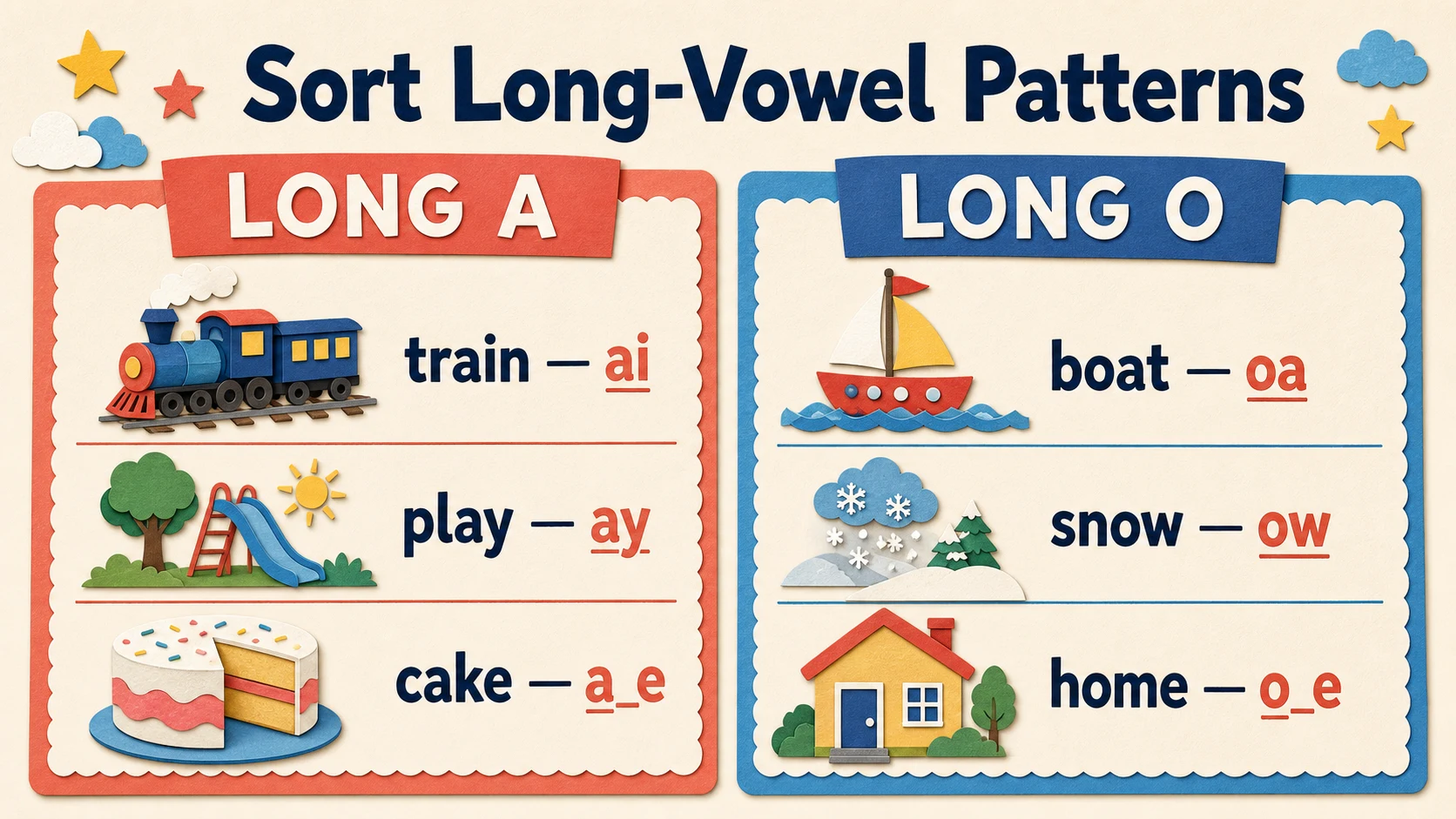
Reconstruct the learner’s process: read, listen, identify, record, and check where it broke down.
Sort errors by likely cause
Use the learner’s actual behavior, not a diagnosis, to classify an error provisionally.
| Observed work | Possible interpretation | Useful immediate response |
|---|---|---|
| Reads cape as cap | Final-e contrast is not secure. | Rebuild cap/cape and read both. |
| Reads the word correctly but names short a | Sound label and decoded pronunciation are disconnected. | Say both labels and ask which matches the spoken word. |
| Selects the visible vowel without reading | The learner is using a letter-finding shortcut. | Require oral reading before the answer. |
| Misses several ee or oa examples | That vowel team may need focused review. | Sort a small set by spelling pattern. |
| Changes a correct answer after seeking reassurance | Confidence or checking habits may be interfering. | Preserve the first answer and ask for one reread. |
| Makes errors mainly near the end | Effort, attention, or pacing may have changed. | Recheck those items after a break. |
| Gives an accurate oral answer but records the wrong choice | The response format, not the sound decision, may be the obstacle. | Separate oral identification from recording practice. |
These are hypotheses for instructional planning, not clinical conclusions. A single printable cannot establish a learning disability, attention disorder, hearing problem, or broader reading profile.
Recheck rather than overcorrect
Choose two or three informative errors. Ask the learner to reread each word without showing the answer key. Then use the least support necessary:
- Ask for the whole-word reading.
- Ask which vowel sound is heard.
- Point out the relevant pattern.
- Offer a contrast word.
- Model only if the learner remains stuck.
After the correction, return to a comparable item later. An immediate repeated answer may reflect short-term imitation; a delayed response provides better evidence of recall.
Use the answer key responsibly
The separate answer key makes checking efficient, but it should support analysis rather than replace listening to the learner read.
First, compare each recorded response with the key. Mark correct answers consistently. For an incorrect answer, retain the original response so the error remains visible. If the learner self-corrects, distinguish the revision from the first attempt with a different mark or a brief note.
Then ask three questions:
- Did the learner read the word accurately?
- Did the learner identify the vowel sound accurately?
- Did the learner record the intended response accurately?
The same written error can arise from different places in that sequence. If you only compare final marks, you may miss the difference between a decoding error and a recording slip.
If you suspect an answer-key problem, do not tell the learner that the key must be correct or incorrect without checking. Read the printed word carefully, pronounce it naturally, identify the targeted sound, and compare the item’s response format with the key. Record any unresolved discrepancy separately rather than adjusting the learner’s result silently.
The Common Core English Language Arts standards provide a broad reference point for foundational reading expectations, including distinguishing long and short vowels in regularly spelled one-syllable words and learning common vowel-team correspondences. This link supplies high-level context only. It does not certify comprehensive alignment of this worksheet, and local standards or instructional sequences may organize the content differently.
Decide what to teach next
Use the smallest next step supported by the work. Avoid advancing solely because all 20 spaces are filled or repeating the identical page solely because the score was imperfect.
If performance is accurate and independent
If the learner reads the words accurately, identifies the sounds without prompting, and handles more than one spelling pattern, move toward application. Suitable next steps include:
- sorting long-vowel words by spelling pattern;
- contrasting long- and short-vowel words;
- reading the words in short phrases or sentences;
- spelling a small selection from dictation; or
- practicing less familiar vowel teams already included in the learner’s sequence.
The broader 2nd Grade Phonics collection can help you choose a related skill without assuming that every learner should follow the same calendar.
If one pattern causes most errors
Teach that pattern directly with a small word set. For example, if final-e words are difficult, compare cap/cape, pin/pine, hop/hope, and cub/cube. Read each pair, identify the vowel sound in both words, and describe the spelling change.
Return to only a few relevant worksheet items afterward. The purpose is to test the repaired understanding, not to produce a cleaner-looking page.
If errors are widespread
Step back to long-versus-short vowel discrimination and reliable blending. Use fewer words, say them clearly, and connect each spoken word to its print. The 2nd Grade worksheet hub is available for broader practice, but choose materials according to the learner’s observed needs rather than the grade label alone.
If the learner cannot yet decode the words, repeated guessing at long-vowel labels is unlikely to clarify the underlying problem. Strengthen the prerequisite and revisit this printable later.
Schedule retrieval after the first lesson
A completed worksheet shows performance during one encounter. To find out whether the distinction is available later, revisit a small sample after time has passed.
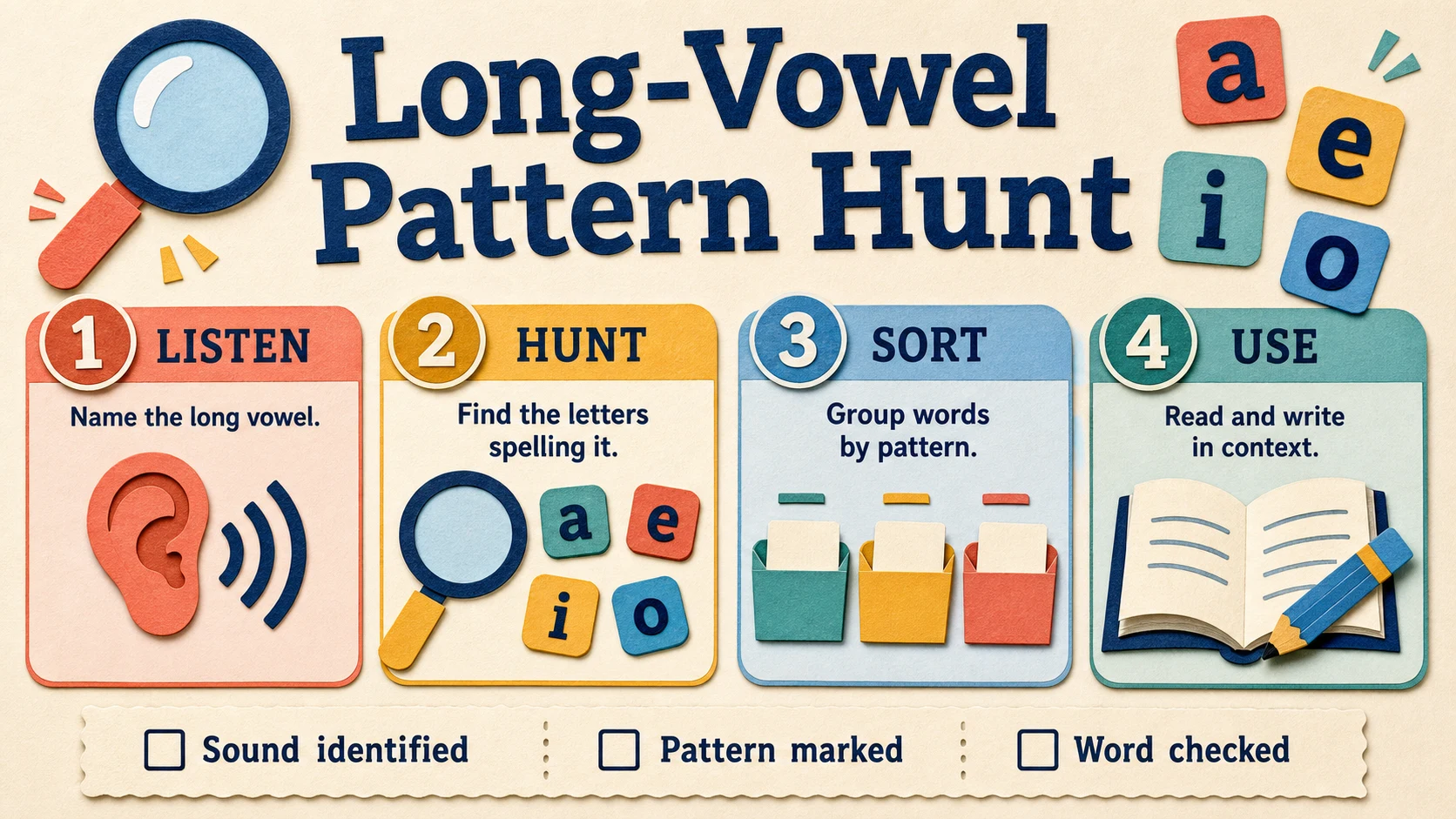
Use brief, delayed checks and adjust the intervals according to what the learner remembers.
One practical schedule is:
| Time | Retrieval task | Decision |
|---|---|---|
| Later the same day or next session | Read and classify three words without showing prior answers. | Reteach immediately if the process is unclear. |
| About two or three days later | Mix four or five long-vowel words with short-vowel contrasts. | Note whether errors cluster by sound or spelling. |
| About one week later | Revisit a few original items in a new order and add one comparable word. | Check retention and modest transfer. |
| In a later phonics review | Include several long-vowel examples among other taught patterns. | Determine whether recognition holds in mixed practice. |
This is a suggested framework, not a universal timetable. Shorten the gap if the learner forgets the procedure. Lengthen it if responses are accurate and immediate. Retrieval should be brief enough to inform instruction without turning every review into another full worksheet.
Limitations of the printable
This worksheet offers 20 easy-level identification exercises. It can show whether a learner recognizes the targeted long vowel sounds in the words and format presented. It cannot, by itself, demonstrate complete phonics mastery, fluent connected-text reading, spelling mastery, vocabulary knowledge, comprehension, or durable retention.
A correct response may come from decoding, memory, guessing, or a visual shortcut. Listening to several oral readings helps distinguish among those possibilities. An incorrect response may reflect the vowel concept, word decoding, unfamiliar vocabulary, pronunciation, attention at that moment, or confusion about how to mark the page.
The printable also should not be used to make medical, developmental, or diagnostic claims. If difficulty remains persistent across carefully taught examples, connected reading, and repeated observations, document exactly what the learner reads and says. Educators can use that evidence within their established support process; families can share it with the learner’s teacher or another appropriately qualified professional.
The next useful action
Download the free worksheet and its answer key from the 2nd Grade Long Vowels worksheet page. Preview all 20 items, choose two comparable words for modeling, and plan to preserve the learner’s first independent responses for error analysis.
After the lesson, follow the evidence. Use the Long Vowels topic guide for the broader progression. If the learner needs varied practice across the skill, consider the 18-worksheet 2nd Grade Long Vowels Worksheet Pack. If you need a fresh set matched to a particular review purpose, explore the free worksheet generators.
Put it into practice
Use the guide with a real printable
Move from explanation to a short, observable practice task. Check the first item together, then adjust the next session from the learner's actual work.
See the 18-worksheet pack