Complete guide
How to teach and practise 2nd grade digraphs worksheets - standard theme (easy)
How to use this 20-item digraph worksheet
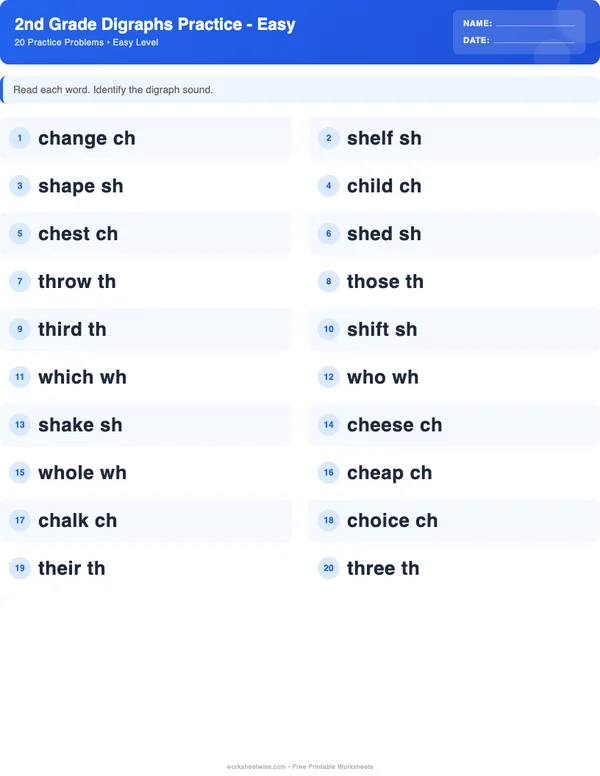
The free 2nd Grade Digraphs worksheet gives a learner 20 easy-level exercises with one direction: Read each word. Identify the digraph sound. Use it as a focused check of whether the learner can recognize two letters working together to represent one sound. It is suitable for initial instruction, extra reinforcement, classroom practice, homework, or homeschool work.
For a productive lesson, briefly review what a digraph is, model two examples, complete several items together, and then release the learner to work independently. Do not treat the page as a race. Listen to the learner read and explain a few choices because a correct written answer does not always show how it was reached.
The worksheet practices digraph identification, phonics, letter combinations, and word recognition. It does not, by itself, establish complete mastery of digraph reading or spelling. Use the learner’s observed work—accuracy, explanations, self-corrections, and reading effort—to decide whether to repeat, simplify, or extend the practice.
Grade labels describe the intended practice level, not a universal timetable. Local curricula and instructional sequences differ, so a learner may meet this material earlier or later than the label suggests.
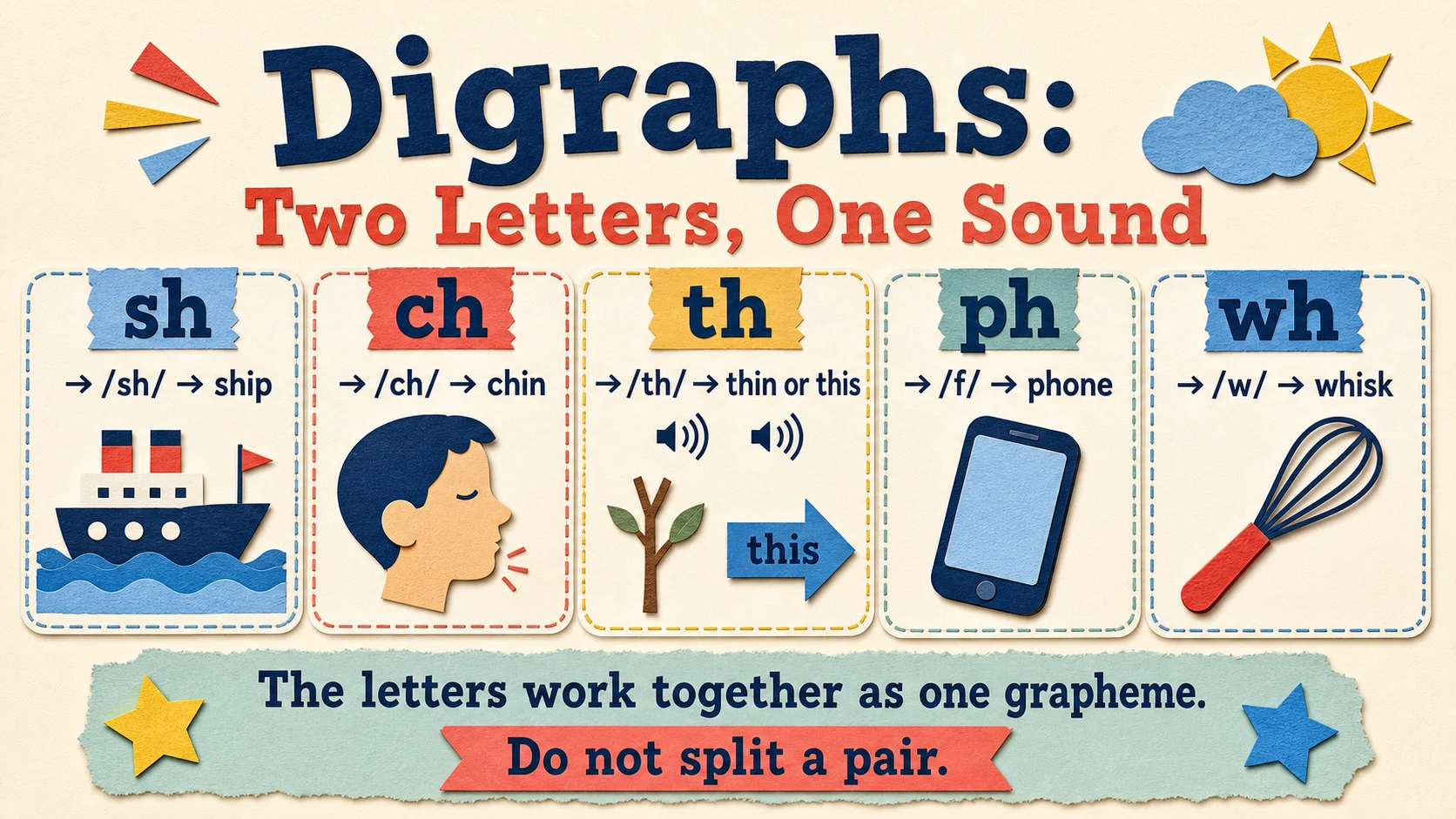
Move from a short sound review to modeling, guided work, independent practice, and a final check.
What the worksheet asks the learner to notice
A consonant digraph is a pair of letters that works together to represent one sound. Common examples include:
- sh in ship or wish
- ch in chip or much
- th in thin, this, or bath
- wh in when
- ck in duck
The central task is not merely to circle two adjacent consonants. The learner must connect a letter pair with the sound it represents in a word. That distinction matters because some neighboring consonants form a blend rather than a digraph.
In sl as in slip, both /s/ and /l/ can be heard. In sh as in ship, the letters work together as one sound. An adult can make this contrast audible without requiring lengthy terminology:
“Listen to slip: /s/ /l/ /ĭ/ /p/. I hear both consonant sounds at the beginning. Now listen to ship: /sh/ /ĭ/ /p/. The s and h work together for /sh/.”
The broader Digraphs topic guide provides the larger instructional progression. Keep this lesson narrower: reading each printed word and identifying its digraph sound.
The IES foundational reading practice guide supports high-level instruction that explicitly connects sounds with letters and gives learners opportunities to read words. That source did not evaluate WorksheetWise or this particular printable; it provides general instructional framing for foundational reading.
A practical lesson sequence
A full lesson can be brief, but its length should respond to the learner’s work rather than to a fixed timer. The following sequence is a planning guide, not a universal schedule.
| Lesson phase | Adult action | Learner action | Evidence to observe |
|---|---|---|---|
| Prepare | Print the worksheet and keep the answer key separate. Select a pencil and, if useful, two colored pencils. | Gets ready to read aloud or quietly. | Comfort with the page and directions |
| Review | State that a digraph has two letters working together for one sound. Contrast one digraph with one blend. | Repeats or identifies the sounds. | Whether the learner hears one sound or two |
| Model | Think aloud through two sample words that are not presented as worksheet items. | Watches and explains the adult’s steps. | Attention to the whole word and letter pair |
| Guide | Complete a small group of worksheet items together. Prompt rather than supply answers. | Reads, finds the pair, and says its sound. | Accuracy with support |
| Release | Ask the learner to complete a manageable group independently. | Works without immediate correction. | Independent strategy use and stamina |
| Check | Review selected answers and compare the finished page with the key. | Explains choices and corrects errors. | Reason for errors and ability to self-correct |
| Retrieve | Revisit a few words after a delay and mix them with earlier phonics patterns. | Reads and identifies digraphs again. | Retention beyond the original page |
Do not automatically assign all 20 items independently. A learner who is new to the skill may benefit from two modeled items, five guided items, and a small independent set. A learner who quickly explains the pattern may complete more before checking in.
Model the task before handing it over
Model with words similar to the worksheet’s skill rather than claiming that any particular sample appears among its 20 items. Keep the demonstration visible and concise.
Use a repeatable think-aloud
For each example:
- Read the whole word.
- Look for a likely two-letter digraph.
- Say the word slowly enough to hear the relevant sound.
- Name or mark the letter pair.
- Say the sound it represents.
- Read the whole word again.
This routine keeps the learner focused on both print and speech. It also reduces guessing from the first letter alone.
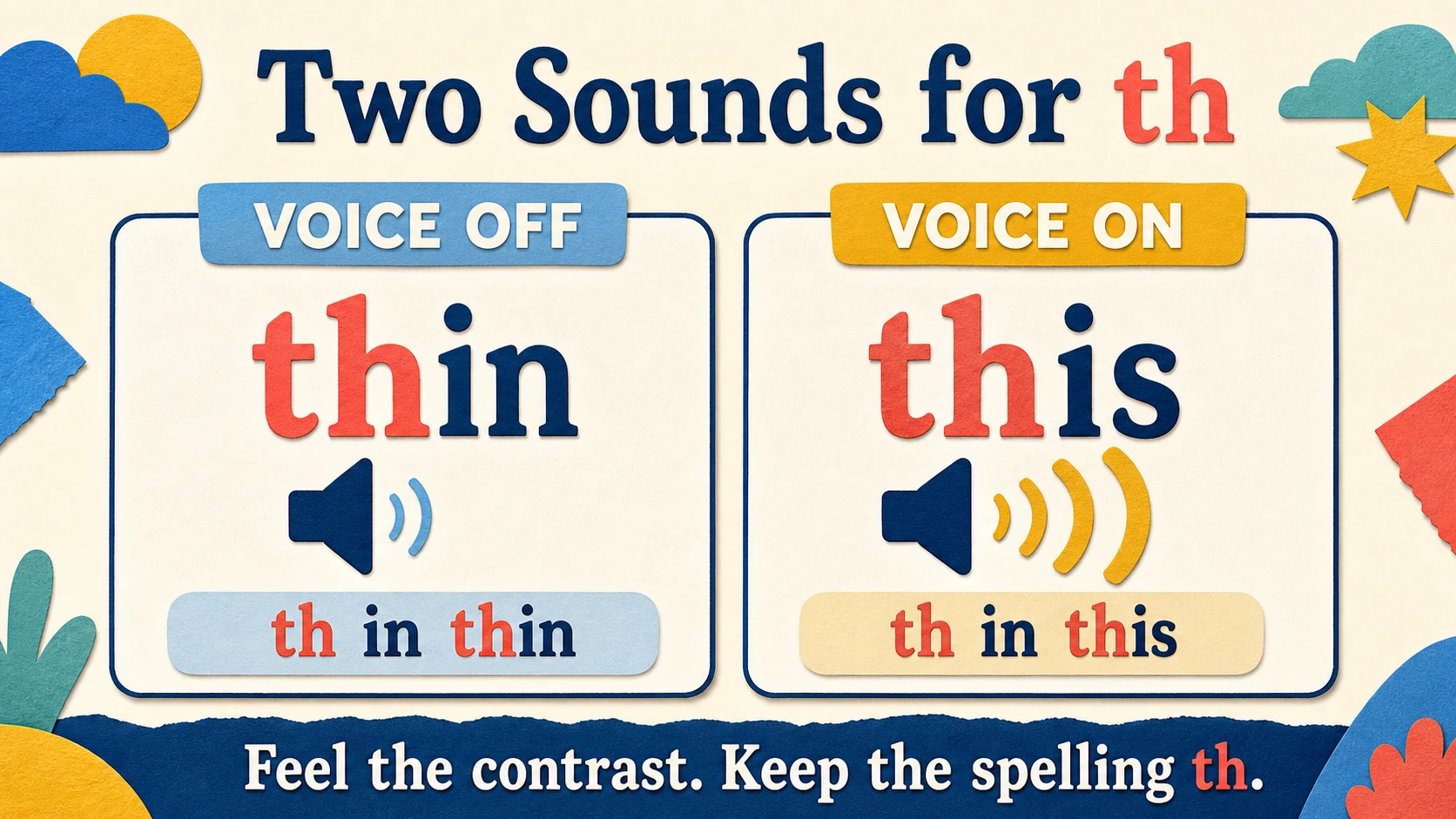
Read the whole word, locate the two-letter pattern, say its sound, and reread the word.
Worked example 1: ship
Read ship normally. Then segment it as /sh/ /ĭ/ /p/. The letters sh represent the initial /sh/ sound, so sh is the digraph.
A useful explanation is:
“I see s beside h. In this word, they work together for /sh/. I do not pronounce a separate /s/ and /h/.”
Checked result: ship → sh → /sh/.
Worked example 2: much
Read much and attend to its ending: /m/ /ŭ/ /ch/. The final letters ch represent /ch/.
Checked result: much → ch → /ch/.
This example shows that a digraph can appear at the end of a word, not only at the beginning.
Worked example 3: thin
Read thin: /th/ /ĭ/ /n/. The initial th represents the unvoiced sound heard at the beginning of thin.
Checked result: thin → th → the initial /th/ sound.
There is no need to require the learner to use the term unvoiced. Accurate reading and recognition are the targets.
Worked example 4: this
Read this: the initial letters are again th, but the sound is voiced. The throat vibrates when the word begins.
Checked result: this → th → the initial voiced /th/ sound.
The important point is that both thin and this begin with the written digraph th, even though the pronunciations differ. Do not mark one as “not th” simply because it does not sound identical to the other.
Worked example 5: duck
Read duck: /d/ /ŭ/ /k/. The final ck represents /k/.
Checked result: duck → ck → /k/.
In the supplied topic scope, ck appears at the end of words after a short vowel, as in duck, stick, and neck. On this worksheet, however, the immediate task remains identifying the digraph sound—not producing or proving a complete spelling rule.
Worked boundary example: slip
Read slip: /s/ /l/ /ĭ/ /p/. The beginning sl is not a digraph because both consonant sounds remain audible. It is a blend.
Checked result: slip → sl is a blend, not a digraph.
This boundary example helps prevent the misconception that any two consonants together must form a digraph.
Run guided practice without giving away the answer
Guided practice should reveal how the learner is thinking. Covering every moment with adult talk makes that difficult. Present an item, wait, and then use the least intrusive prompt that helps the learner continue.
Move from broad prompts to specific prompts
Begin with:
- “Read the whole word.”
- “Which two letters might be working together?”
- “Say it slowly. What sound do those letters represent?”
- “Do you hear one sound from the pair or two separate sounds?”
- “Read the word again and check whether your answer fits.”
If the learner is stuck, make the prompt more specific:
- “Look at the beginning and the end.”
- “Point to s and h. What sound can they make together?”
- “Compare the beginning of ship with the beginning of slip.”
Supply the answer only after the prompts have shown what the learner can and cannot do. Then model the reasoning and return to a similar example later.
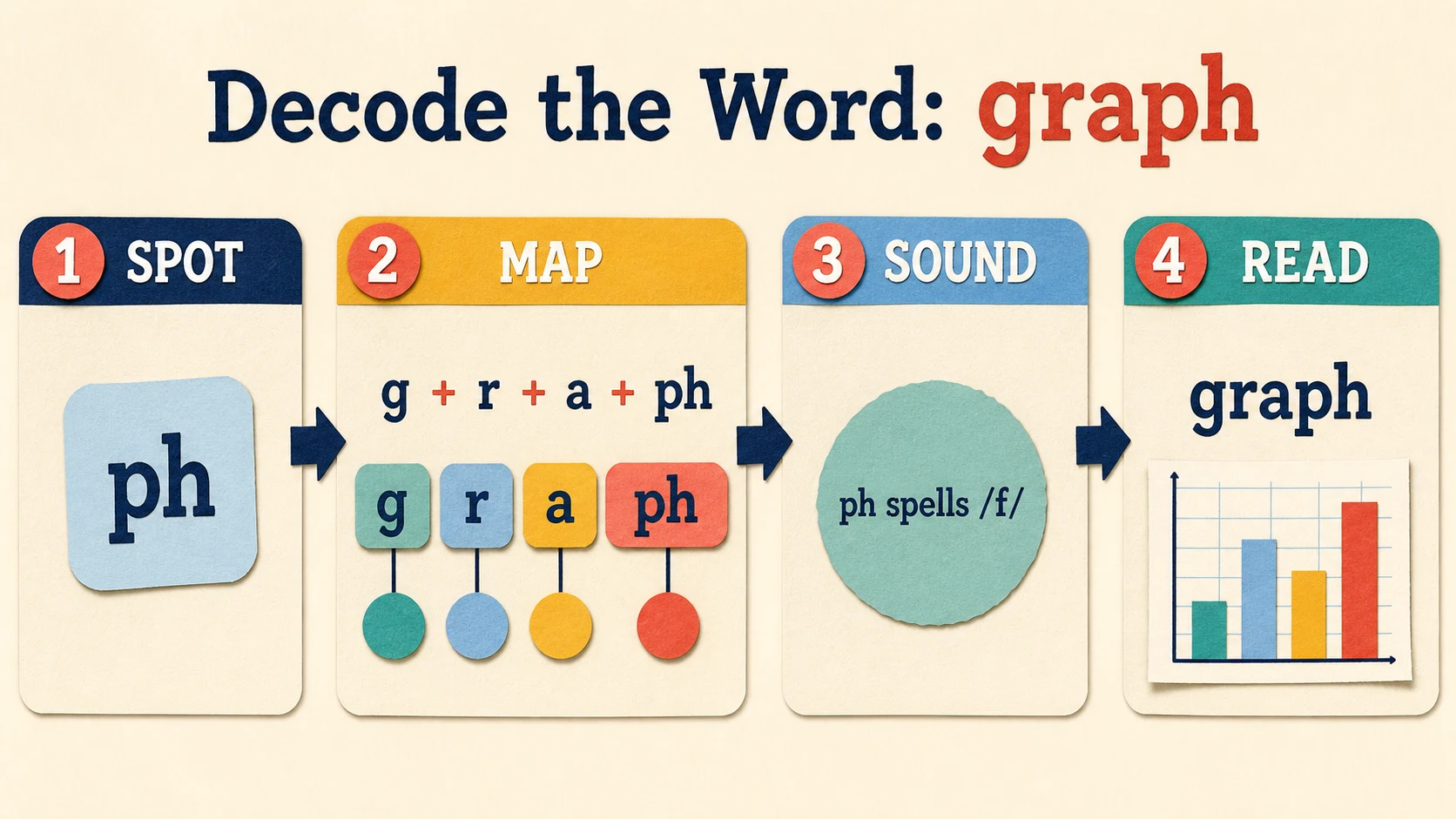
Guided practice should gradually reduce adult support while keeping the sound-to-letter connection explicit.
Decide when to release the learner
Independent work is appropriate when the learner can do several guided items while:
- reading the entire word rather than naming isolated letters;
- locating a plausible letter pair;
- identifying its sound;
- distinguishing at least one digraph from a blend;
- explaining a choice in simple language.
A learner does not need polished technical vocabulary. “These two make /sh/” is adequate evidence of the intended understanding.
During independent work, avoid confirming every response immediately. Ask the learner to complete a short group, then pause. If early responses show a repeated misunderstanding, return to teaching before that misunderstanding is rehearsed across the page.
Adapt support while preserving the digraph skill
An adaptation should make the same sound-letter task more accessible. It should not replace identification with copying, guessing from pictures, or waiting for the adult to say every answer.
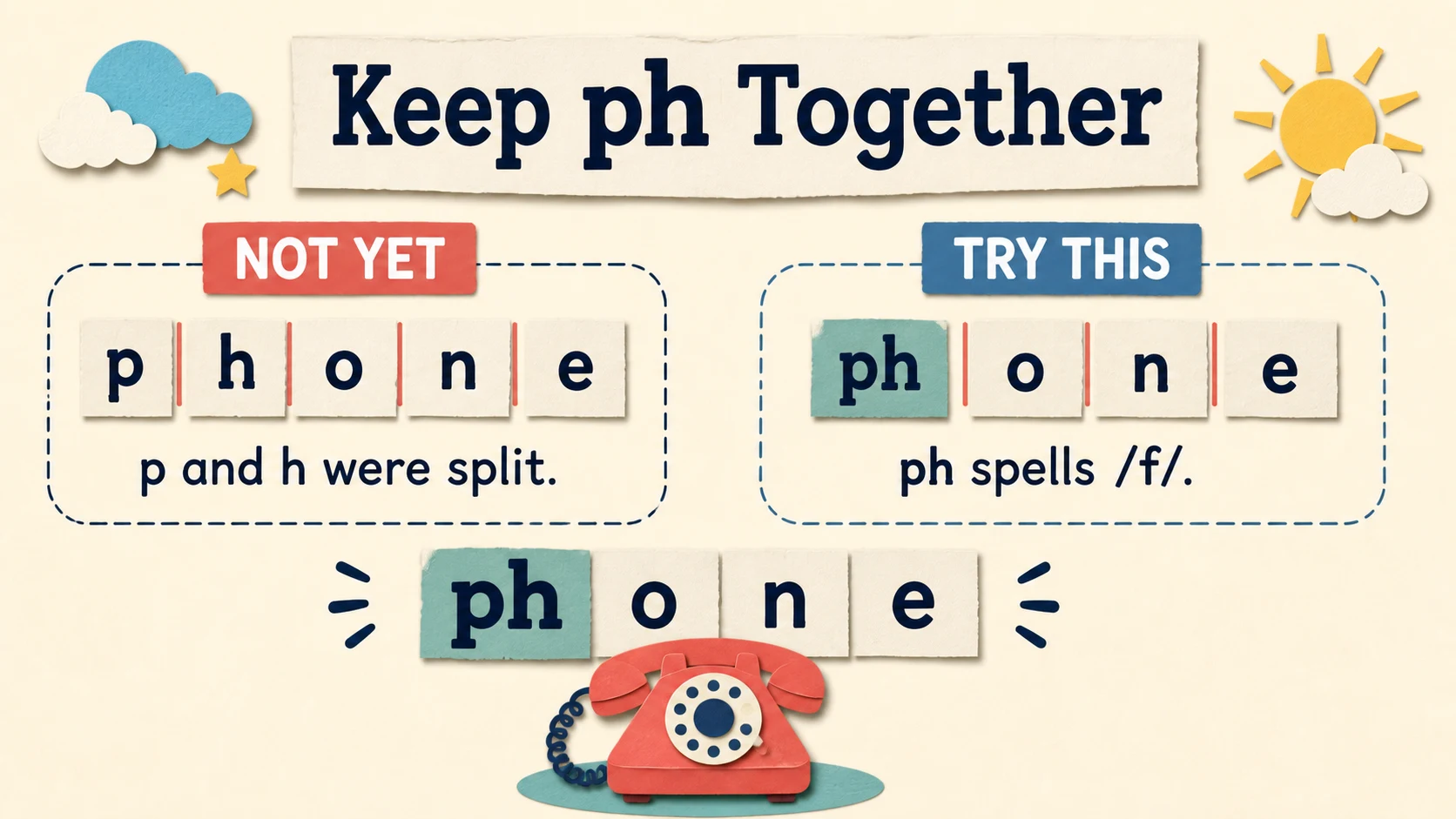
Adjust the amount of print, the response mode, or the level of prompting without changing the target skill.
For a learner needing more support
Fold or cover the page so only three to five items are visible. Point to each word as the learner reads. Permit the learner to underline the digraph rather than write a longer response, provided the learner also says the sound.
If several digraphs are being confused, temporarily provide a small reference strip such as sh, ch, th, wh, ck. The learner still has to read the word and choose the matching pair. Remove the strip when it is no longer needed.
A two-color routine can also help: one color for the two digraph letters and another for the remaining letters. For ship, sh receives one color while ip receives another. Color is a support for noticing the pattern, not the answer itself.
For a learner working at the intended level
Use a simple read-mark-say routine:
- Read the word.
- Mark the digraph.
- Say the sound.
- Reread the word.
Ask for an explanation on selected items rather than every item. This keeps the work manageable while still checking understanding.
For a learner ready for more challenge
Keep the same worksheet, but ask the learner to sort completed words by:
- digraph;
- initial or final position;
- the two pronunciations of th, when examples allow;
- digraph versus a separately supplied blend word.
The learner can also write one new word containing a target digraph and read it aloud. Treat this as an extension, not as evidence that the original identification task was too easy. Spelling a new word adds a production demand beyond recognizing a pattern in print.
The 2nd Grade phonics hub can help adults select other phonics practice when the learner needs work outside this page’s narrow focus.
Interpret errors before assigning more practice
A score summarizes responses, but it does not explain them. Two learners with the same number correct may need different next steps. Review the written page alongside a few oral responses.
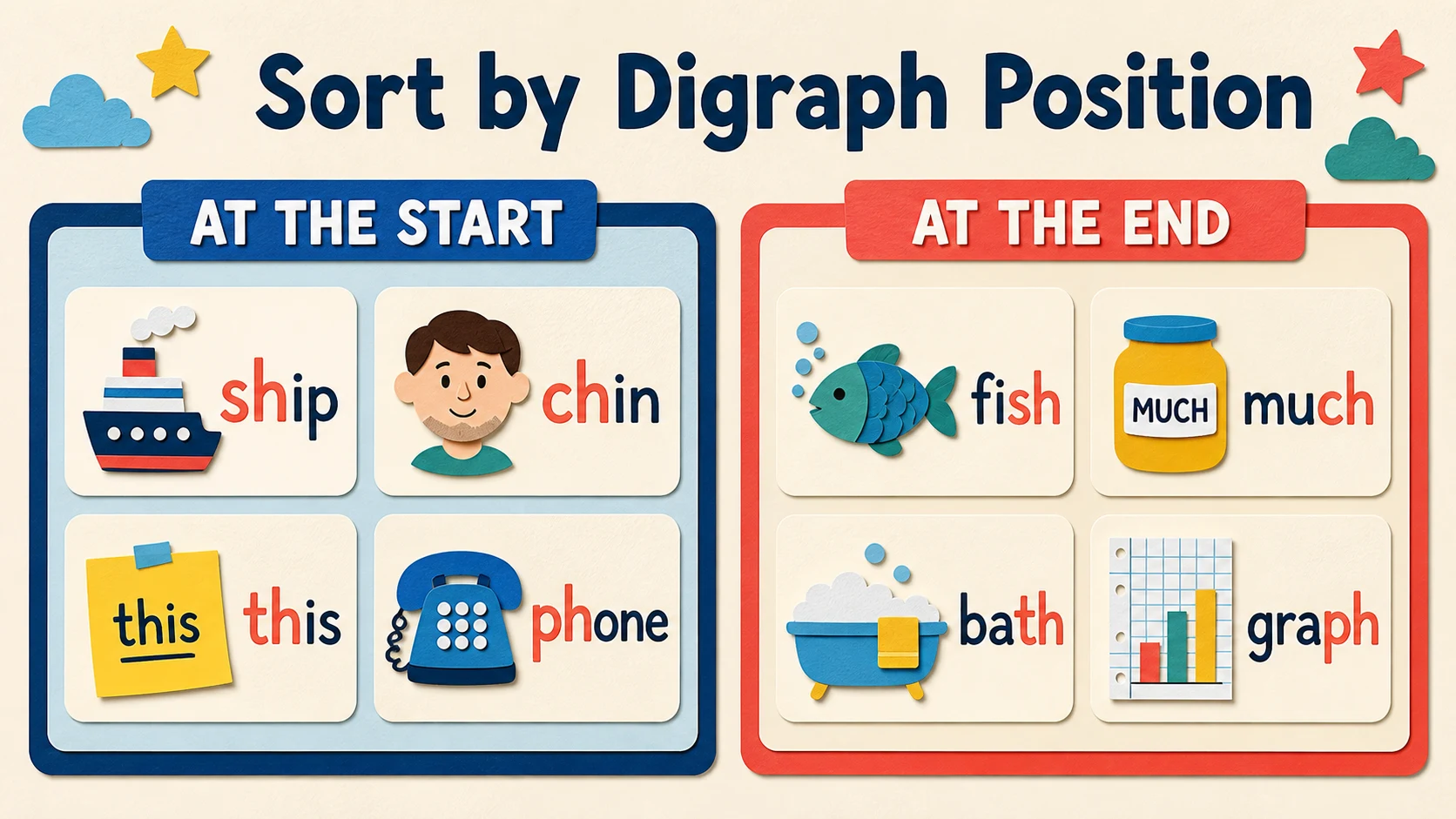
Check the word reading, the selected letters, the stated sound, and the learner’s correction process.
Misreading the entire word
If the learner identifies a sound based on a misread word, the immediate difficulty may involve decoding the surrounding letters rather than recognizing the digraph. Ask the learner to blend the word again. You may pronounce the digraph sound while leaving the learner to blend the rest.
Do not automatically turn every decoding error into a digraph error. Record what actually happened.
Choosing any two neighboring consonants
A learner may mark sl in slip because the letters are adjacent. Revisit the one-sound versus two-sound contrast:
- ship: sh represents one sound.
- slip: s and l retain separate sounds.
Have the learner place one finger down for each sound heard at the beginning. This is an instructional suggestion, not a sourced requirement.
Naming letters instead of giving the sound
A learner might say “s-h” when asked for the digraph sound in ship. Acknowledge that those are the letter names, then clarify the response:
“Yes, the letters are s and h. What sound do they represent together in this word?”
This is a response-format misunderstanding if the learner can then give /sh/. It is a skill error if the learner cannot connect the pair with its sound after clarification.
Treating both forms of th as identical
The learner may expect th always to sound like the beginning of thin. Compare thin and this. Both contain th, but the spoken sounds differ. Let the learner touch the throat while saying each word to notice vibration, without requiring formal labels.
Overgeneralizing ck
A learner who recognizes final ck may begin treating every /k/ sound as ck. Return to the printed word and ask what letters are actually present. This worksheet asks the learner to identify the digraph in a given word, not choose among all spellings of /k/.
Copying accurately without reading
A learner may locate a visually familiar pair while being unable to read the word. Ask for a small oral check: “Read this word and tell me the sound.” If the learner cannot read it, the written response alone is incomplete evidence.
The IES elementary writing practice guide concerns writing instruction broadly and supports high-level attention to explicit instruction and supported practice. It did not review this worksheet. Here, writing is only a response method; the primary target is phonics recognition.
Use the answer key responsibly
The separate printable answer key is useful for efficient checking, but it should come after the learner has attempted the work. Keep it out of view during practice unless the learner is explicitly learning how to self-check.
Use this sequence:
- Review the worksheet directions.
- Ask the learner to reread any item left blank.
- Compare responses with the answer key.
- Mark correct answers neutrally.
- Select errors for discussion rather than merely replacing them.
- Ask the learner to reread and correct each discussed word.
- Revisit one or two corrected examples after a delay.
When the learner’s answer differs from the key, first verify the printed word and the expected response format. Check whether the learner supplied the correct sound but wrote a different reasonable representation, such as identifying th without labeling its pronunciation. The worksheet instruction asks for the digraph sound; adult checking should remain tied to that instruction.
Do not calculate a percentage and use it as the only decision rule. Consider whether errors cluster around one pattern, whether the learner self-corrects, and whether the word can be read without prompting.
The Common Core State Standards for English Language Arts include grade-level foundational reading expectations, including phonics and word analysis. Local adoption and instructional sequences vary, and this worksheet should not be described as comprehensively aligned or as proof that a standard has been mastered.
Choose the next lesson from the error pattern
The next step should be specific to the evidence gathered.
| Observed pattern | Reasonable next instructional move |
|---|---|
| Most words are read accurately, digraphs are identified, and explanations are clear | Move to mixed digraph practice, initial and final positions, or connected reading |
| One digraph is repeatedly confused | Teach and practice that digraph with a small set of carefully chosen words |
| Digraphs are confused with blends | Contrast one digraph and one blend through listening, marking, and reading |
| Initial digraphs are secure but final ones are missed | Practice paired examples such as ship/wish or chin/much |
| th causes difficulty | Compare examples such as thin and this without demanding technical labels |
| Words can be copied but not read | Return to oral blending and word reading with fewer items |
| Performance declines late on the page | Shorten the work set and check whether accuracy returns after a break |
| Responses are accurate only with a reference strip | Continue supported practice, then fade the strip gradually |
These are instructional suggestions based on observable work, not diagnostic conclusions or guaranteed prescriptions. If the learner struggles broadly across familiar word-reading tasks, this page cannot determine the cause. Share the specific observations with the learner’s teacher or relevant educational professional when additional planning is needed.
For a broader sequence of identification, reading, and spelling practice, use the Digraphs topic guide rather than trying to make this single worksheet cover the entire progression.
Schedule retrieval after the page is finished
A correct response during the lesson does not show whether the learner will remember the pattern later. Brief retrieval gives the learner another opportunity to recall the sound-letter relationship without simply repeating the full page.
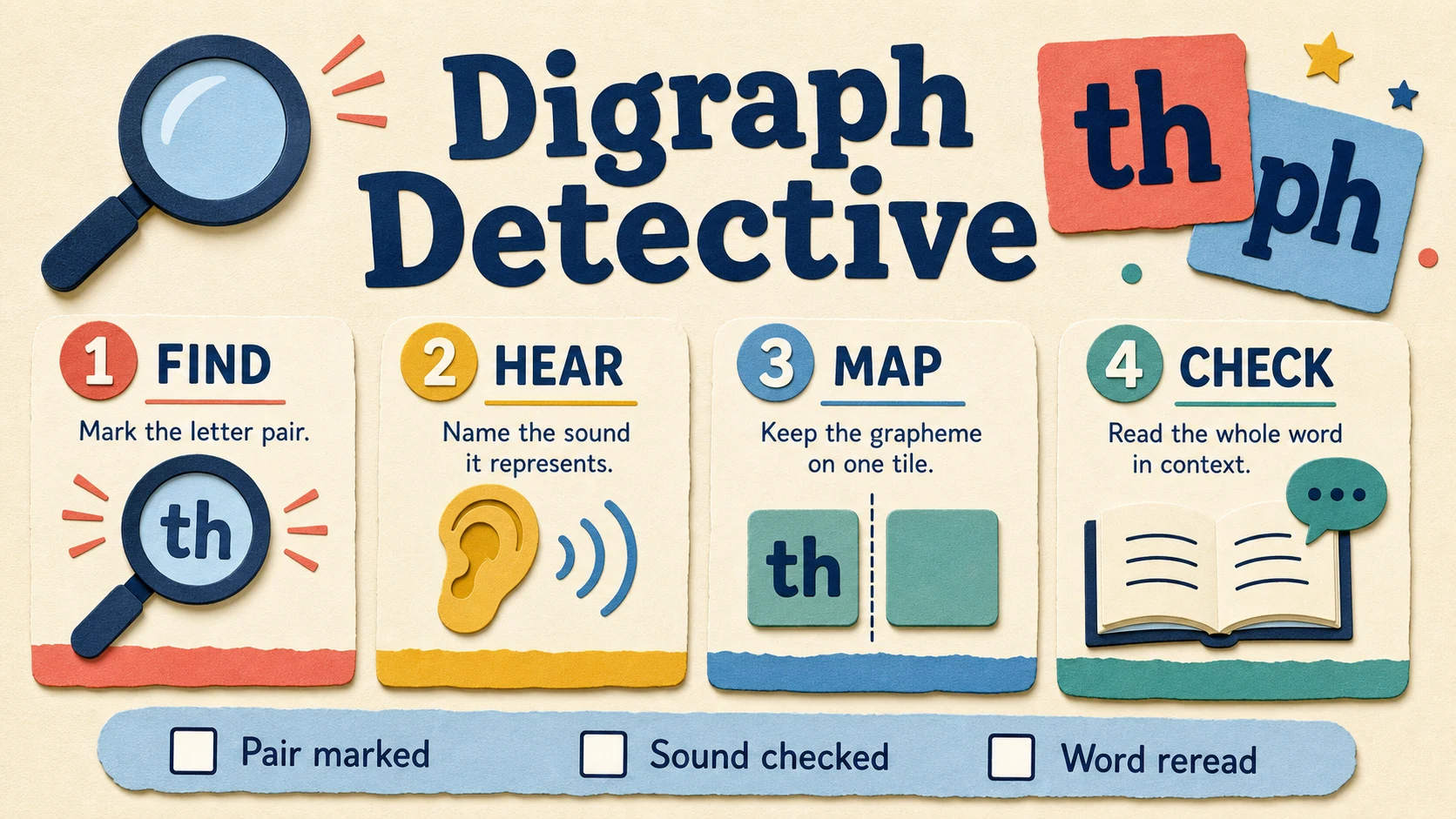
Revisit a few examples after increasing delays and let performance determine whether support is reduced or restored.
A flexible review plan might look like this:
| Review point | Suggested task | What to notice |
|---|---|---|
| End of the lesson | Reread two correct items and one corrected item | Can the learner explain each digraph? |
| Next learning session | Present three to five words without showing prior answers | Can the learner retrieve the sounds independently? |
| Several sessions later | Mix digraph words with CVC and blend words | Does the learner distinguish patterns rather than mark every consonant pair? |
| About a week later, if appropriate | Read a small mixed set or a suitable decodable passage | Does recognition transfer beyond the original page? |
| Later cumulative review | Include a few digraph words among other established phonics patterns | Is the skill retained when it is no longer the only focus? |
This is an example schedule, not a universal timetable. Shorten the interval if recall is weak. Lengthen it when the learner reads accurately, explains the pattern, and retains it without prompts. The supplied topic guidance recommends cumulative review that mixes digraph words with earlier CVC and blend patterns; the learner’s performance should determine the amount and frequency.
Know what this printable can and cannot show
This worksheet offers 20 easy-level exercises focused on identifying digraph sounds. It can provide useful evidence about performance on those printed items, especially when an adult listens to the learner read and explain selected answers.
It cannot, by itself:
- prove comprehensive phonics mastery;
- establish fluent reading in connected text;
- measure comprehension;
- explain the cause of persistent reading difficulty;
- guarantee transfer to spelling or independent writing;
- establish comprehensive standards alignment;
- determine an ideal instructional timetable for every learner.
The “Standard Theme” and “Easy” labels describe the worksheet format and catalogue difficulty. They should not become labels for the learner. A page may feel easy because the skill is secure, because the learner used effective strategies, or because substantial support was provided. It may feel difficult because one particular digraph is unfamiliar, the surrounding words are hard to decode, or the learner is tired. Observe before interpreting.
A calm close is more useful than emphasizing a total score:
“You identified sh independently. You also corrected ch after rereading. Next time, we’ll compare digraphs with blends again.”
That statement names evidence and a next step without making a broad judgment about ability.
Continue with a focused, honest next step
Start with the free 2nd Grade Digraphs worksheet, use the model-guide-release sequence, and save three to five words for later retrieval. After checking the learner’s explanations and error pattern, continue through the broader Digraphs topic guide.
If the learner needs a larger set of related practice, the 2nd Grade Digraphs Worksheet Pack contains 18 worksheets. If a more customized word set would better match the patterns observed, explore the free worksheet generators. Choose the next resource because it addresses the learner’s demonstrated need—not simply because the first page has been completed.
Put it into practice
Use the guide with a real printable
Move from explanation to a short, observable practice task. Check the first item together, then adjust the next session from the learner's actual work.
See the 18-worksheet pack