Complete guide
How to teach and practise 2nd grade word problems worksheets - standard theme (easy)
A focused guide to this 12-item word-problem worksheet
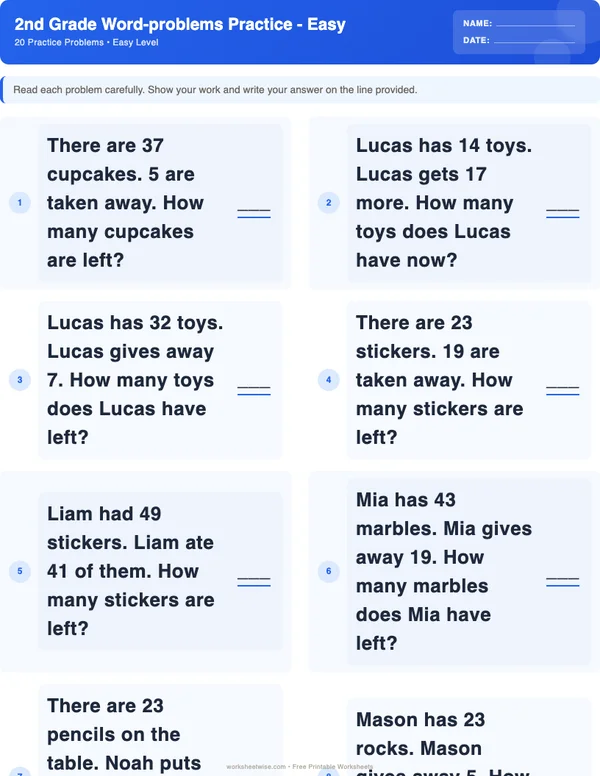
The free 2nd Grade Word Problems worksheet provides 12 easy-level story problems involving reading comprehension, problem solving, mixed operations, and multi-step reasoning. The learner should read each problem, show the mathematical work, and write an answer on the provided line. A separate printable answer key is included.
The short answer: use the first one or two items to establish a repeatable routine, complete several items together, and release the remaining problems gradually. Ask the learner to explain the situation before choosing an operation. Use the answer key after reasoning has been recorded, not as a substitute for examining that reasoning.
This worksheet is intended for learners beginning word-problem practice or needing reinforcement. “2nd Grade” describes the intended practice level; it does not determine where every learner must begin. Local curricula and instructional sequences differ, so compare the printable with the learner’s current work and the expectations used by the relevant school or homeschool program.
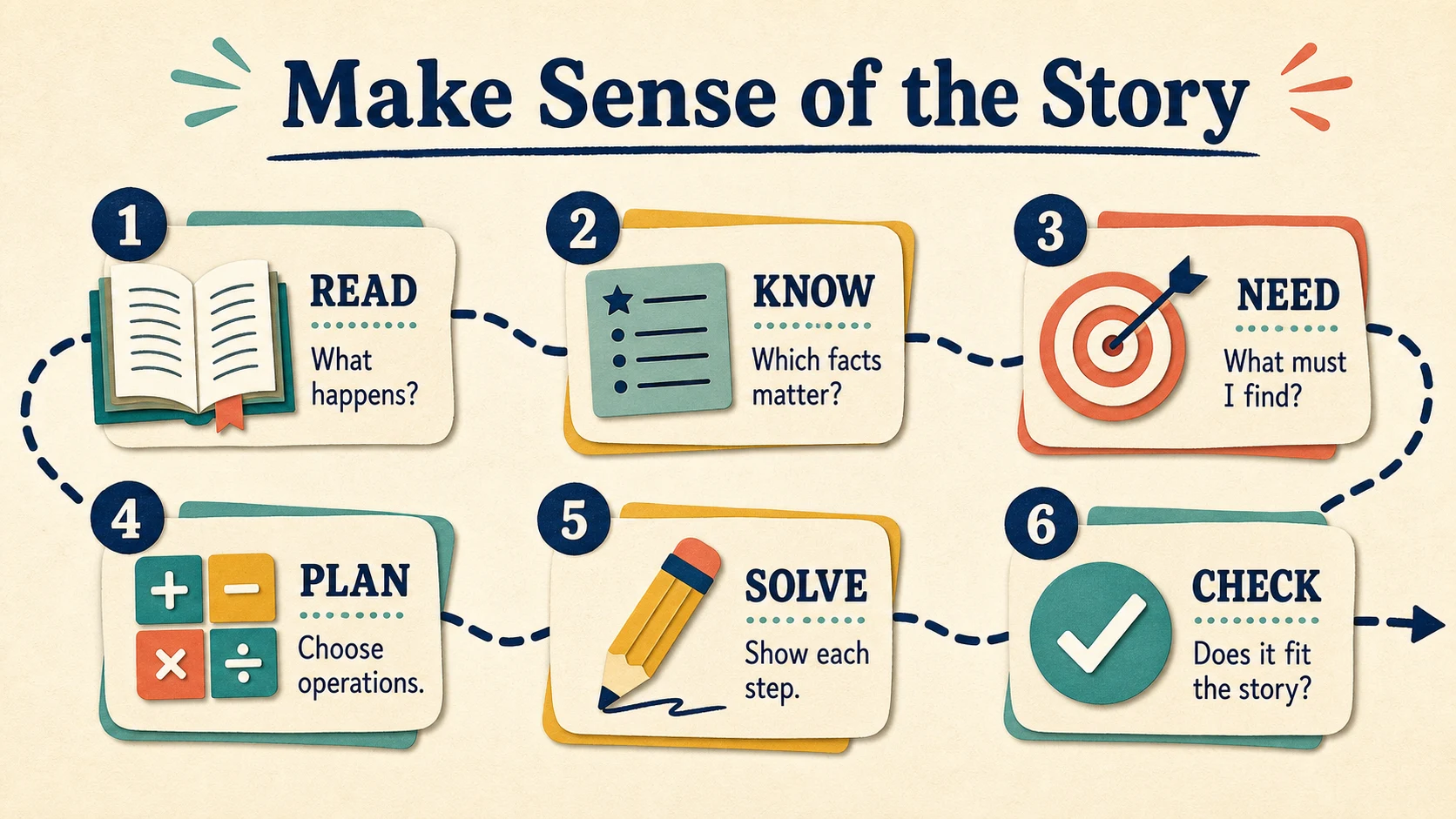
Move from understanding the story to guided solving, independent work, checking, and later retrieval.
What this printable is designed to practice
The worksheet combines four connected demands:
- Reading a short mathematical situation accurately
- Identifying known quantities and the quantity to find
- Selecting and carrying out an appropriate operation or sequence
- Recording work and a final answer clearly
These demands should remain connected. A learner who calculates correctly but answers a different question has not completed the word problem. Likewise, a learner who understands that a story describes subtraction but makes a small arithmetic error needs different support from a learner who adds because one familiar word appeared in the text.
The broader Word Problems topic guide explains the progression beyond this one printable. Use that guide when you need to place these 12 exercises within a longer sequence rather than trying to turn one worksheet into a complete word-problem curriculum.
The Common Core mathematics document describes a broad Grade 2 expectation involving one- and two-step addition and subtraction word problems within 100. That source provides context for the type of mathematical work associated with the grade; it does not certify this particular worksheet or establish alignment with every local sequence. See the Common Core State Standards for Mathematics for the complete framework.
Prepare the lesson before the learner begins
Print or open the worksheet, but keep the answer key separate. An adult should inspect the page first so that support can be planned without revealing answers.
Check three practical points:
- Can the learner read the problem text with reasonable accuracy?
- Can the learner add and subtract the quantities that appear?
- Can the learner represent a story with a drawing, objects, a bar, or an equation?
A difficulty in any one area can affect the final answer. That does not mean the mathematical skill should be replaced. It means the adult may need to separate reading support from mathematical decision-making.
Prepare simple tools if they are already familiar to the learner: scrap paper, a pencil, counters, a number line, or base-ten blocks. The catalogue identifies number lines, base-ten blocks, and mental math as strategies used in second-grade mathematics. The learner does not need to use every representation. Choose one that helps make the quantities and their relationship visible.
Use one stable routine
A concise routine prevents the lesson from becoming a hunt for isolated clues:
- Read the entire problem.
- Retell what is happening.
- Name what is known.
- State what must be found.
- Draw or write a representation.
- Solve and label the answer.
- Check whether the answer fits the story.
Do not begin with a rule such as “left means subtract” or “in all means add.” A word can appear in more than one kind of mathematical situation. The relationship between the quantities—not a single word—should determine the operation.
Set an observable lesson goal
A useful goal for this session is: “The learner will explain what each story is asking, choose a reasonable representation, and solve as many items accurately as current attention and understanding allow.”
That wording keeps the focus on observable work. Finishing all 12 items in one sitting is not automatically the best outcome. The learner’s explanations, representations, calculations, and error patterns should drive pacing.
Use a gradual lesson sequence
The following plan is an instructional suggestion for this exact 12-item format. It is not a universal timetable.
| Phase | Suggested worksheet use | Adult role | Learner evidence to watch |
|---|---|---|---|
| Launch | Preview directions and one item | Establish the routine | Can retell the situation |
| Model | 1 item | Think aloud without asking the learner to guess | Can identify known and unknown quantities |
| Guided practice | 2–3 items | Prompt only where needed | Selects an operation for a stated reason |
| Supported release | 2–3 items | Observe, then ask checking questions | Records an equation or useful representation |
| Independent practice | Remaining suitable items | Avoid interrupting productive work | Solves and labels answers independently |
| Review | Selected errors and one correct item | Compare reasoning with the key | Can explain or revise the work |
| Retrieval | 1–3 items on later days | Reduce support | Reconstructs the routine after a delay |
If the learner becomes less accurate because of fatigue, stop at a natural point and return later. If the learner is accurate but depends on repeated adult prompts, reduce the number of prompts before increasing difficulty.
Model the task without taking over
Choose an early item and read it aloud exactly as printed. Then model the reasoning process in plain language:
- “I know these two quantities.”
- “I need to find this quantity.”
- “The story shows parts joining, an amount changing, or two amounts being compared.”
- “I will draw or write something that matches that relationship.”
- “Now I can calculate.”
- “I will check the answer against the story.”
The adult’s model should reveal decisions, not merely display a polished equation. If the adult announces “This is subtraction” without explaining the relationship, the learner sees the result of reasoning but not the reasoning itself.
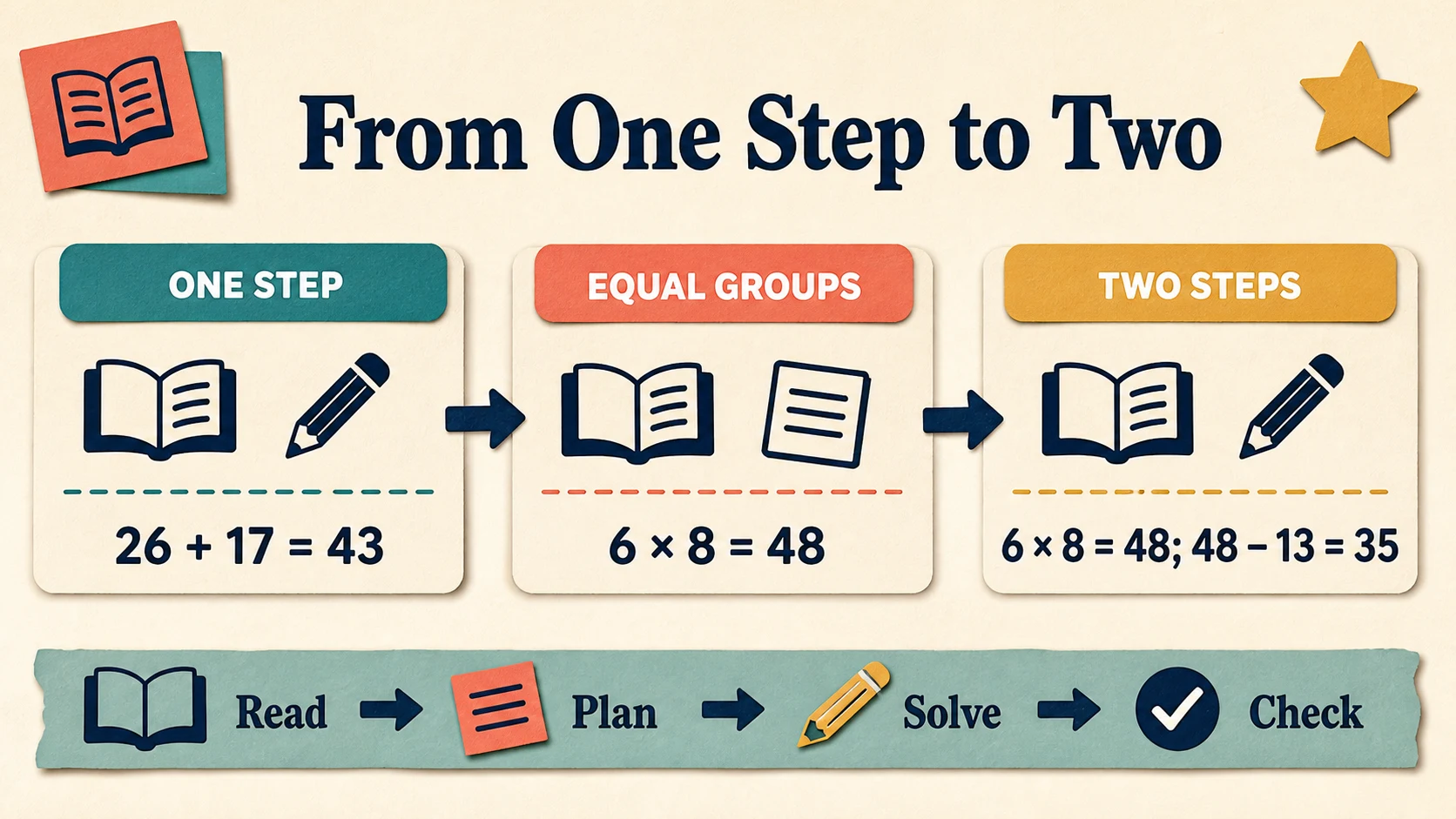
Model how to interpret the situation before expecting independent computation.
The IES guide on teaching mathematics to young children offers high-level instructional framing for helping young learners engage with mathematical ideas through purposeful teaching and representations. Applied here as an instructional suggestion, an adult can connect the words, a simple visual model, and an equation. The source did not evaluate WorksheetWise or this particular printable.
A short think-aloud
Suppose a similar practice story says:
A shelf has 18 animal books and 7 space books. How many books are on the shelf?
Think aloud:
- There are two groups of books: 18 and 7.
- The question asks for the total on the shelf.
- The groups are being combined.
- I can write .
- Break 7 into 2 and 5: , then .
- Therefore, .
Check: 25 is greater than both parts, which is reasonable when two positive groups are combined. The complete answer is 25 books.
This is a fully checked example created for instruction. It should not be presented as a quotation from the worksheet.
Work through four problem structures
The exact printable should remain the center of the lesson, but the following verified examples show how an adult can explain common relationships without relying on keywords.
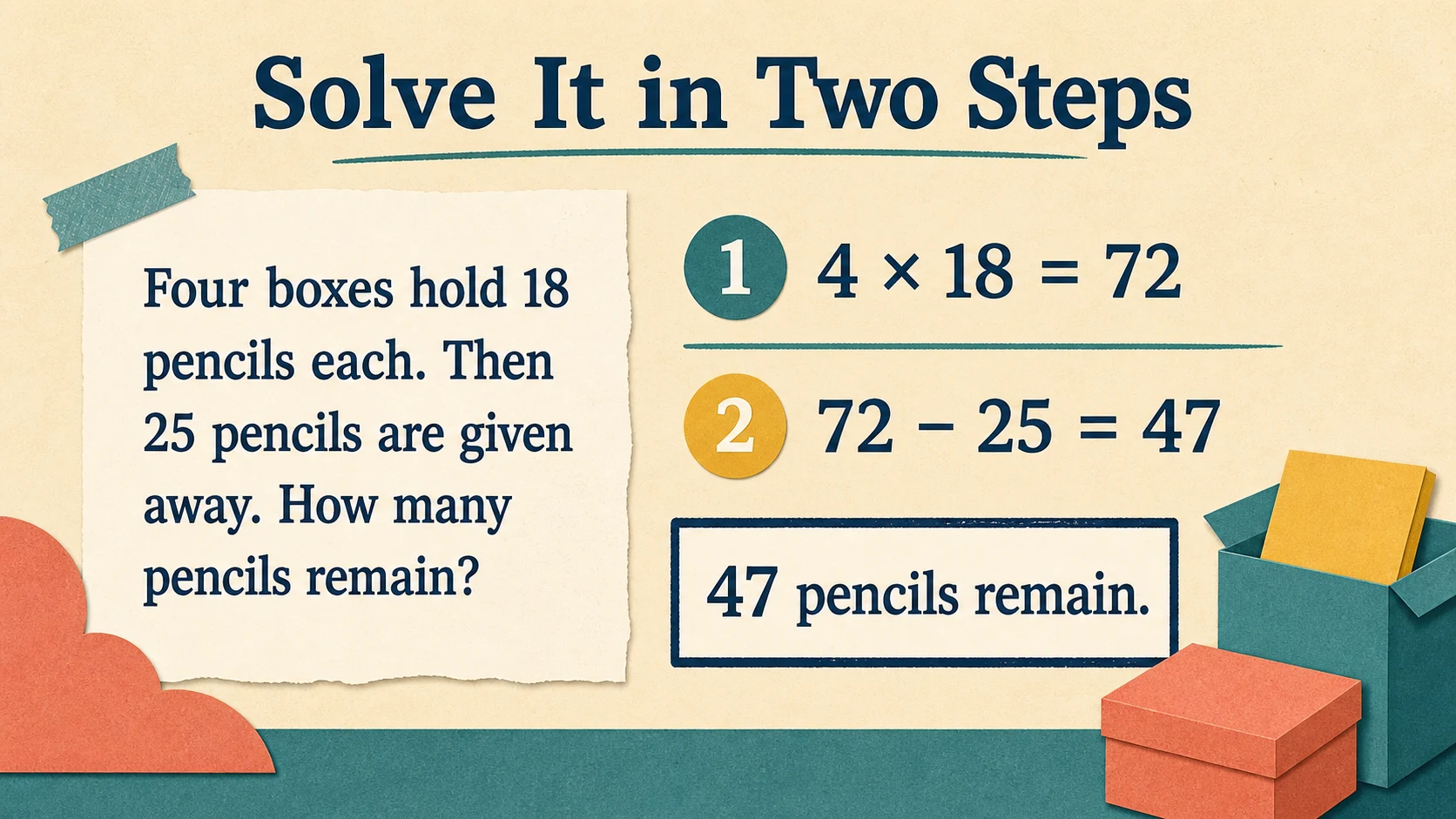
Connect the story, representation, equation, computation, and labeled answer.
Example 1: A quantity decreases
A jar holds 31 buttons. Nine buttons are used. How many buttons remain?
Known quantities: 31 buttons at the start and 9 used.
Unknown: the number remaining.
Equation:
Calculate by subtracting 10 and adding 1 back:
Therefore:
Check with addition:
The answer is 22 buttons. It is less than 31 because some buttons were removed.
Example 2: Compare two amounts
Noah has 26 cards. Elena has 18 cards. How many more cards does Noah have than Elena?
Known quantities: Noah has 26; Elena has 18.
Unknown: the difference between their amounts.
A comparison drawing can show bars of lengths 26 and 18 aligned at one end. The unmatched section represents the difference.
Equation:
Calculate:
Check:
Noah has 8 more cards than Elena. The answer is not 44, because the question asks for the difference rather than the total.
Example 3: The starting amount is unknown
A box had some crayons. Fourteen crayons were added, and then the box held 32 crayons. How many crayons were in the box at first?
Known quantities: 14 were added; the final amount is 32.
Unknown: the starting amount.
Equation:
Use the inverse relationship:
Check:
The box started with 18 crayons.
This example matters because the word “added” does not mean the learner should automatically add the two visible numbers. The story asks for the amount before the addition occurred.
Example 4: Two steps
A class made 20 paper stars in the morning and 13 in the afternoon. It used 8 stars on a poster. How many stars remained?
First find how many stars were made:
Then subtract those used:
Combined expression:
Check the sequence: 33 stars existed before 8 were used, and . The answer is 25 stars.
For a learner who finds two-step reasoning difficult, ask two separate questions: “How many were made altogether?” and “What happened after that?” Do not replace the two-step problem with unrelated single-step calculations. The support should expose the same reasoning in smaller, connected parts.
Example 5: A change amount is unknown
A basket held 24 apples. Some apples were taken out, leaving 17. How many apples were taken out?
Equation:
Find the difference:
Check:
The answer is 7 apples. This example separates the amount removed from the amount remaining.
Run guided practice, then release responsibility
During guided practice, ask the learner to do the parts you modeled:
- Retell the story without calculating.
- Point to or list the known quantities.
- Say what the question asks.
- Draw a quick representation or write an equation.
- Calculate.
- Give a labeled answer.
Use prompts that preserve the learner’s decision:
- “What changed in the story?”
- “Are these quantities parts of a total, a comparison, or a before-and-after situation?”
- “What does the blank represent?”
- “How does your equation match the story?”
- “What could you do to check?”
Avoid converting every prompt into a leading choice such as, “Is it addition?” If the learner waits for that cue, pause and return to the retelling or drawing.
Decide when independent work is appropriate
Move to independent practice when the learner can explain the situation and choose a representation with little or no help on at least a few consecutive items. This is a practical observation rule, not a sourced mastery threshold.
During independent work, do not correct each line immediately. Quietly note whether an error appears to come from reading, representation, operation choice, computation, or recording. Immediate interruption can prevent you from seeing whether the learner catches the mistake during the final check.
If all 12 items are too much for one sitting, divide the page while preserving the printed order. For example, complete a modeled item and several guided items, pause, and return to the rest later. Record where support was given so that assisted answers are not mistaken for independent performance.
Adapt support without changing the mathematical skill
An adaptation should make the task accessible while keeping the learner responsible for understanding and solving the word problem.
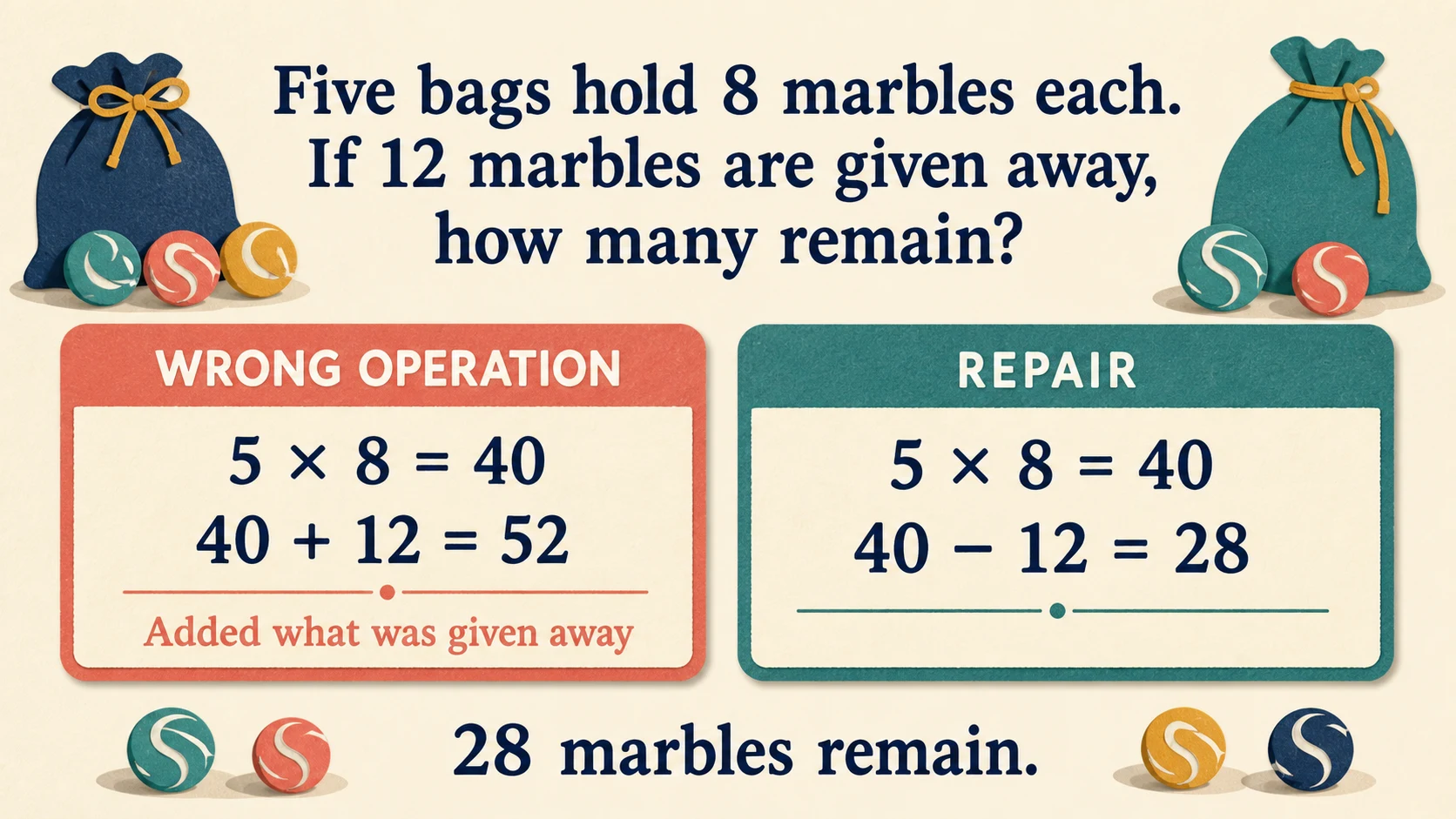
Adjust reading access, visual representation, or workload while preserving the same mathematical relationship.
When reading is the main barrier
Read the problem aloud once, or alternate sentences with the learner. Then ask the learner to retell the situation and make the mathematical decision. This supports access to the text without supplying the operation.
Clarify an unfamiliar nonmathematical word only if it blocks understanding. Do not paraphrase the whole problem in a way that announces the solution structure.
When representation is the main barrier
Offer counters, base-ten blocks, a number line, a part-part-whole drawing, or aligned comparison bars. Ask the learner to show what each object, mark, or bar represents.
If a drawing becomes decorative rather than mathematical, simplify it. Six circles and a labeled bar may communicate more than a detailed picture of six bicycles.
The IES practice guide for assisting students struggling with mathematics provides broad guidance about systematic support and the use of mathematical representations. For this worksheet, an instructional application is to make the connection among the story, model, and equation explicit. This is not a claim that the guide reviewed the worksheet or prescribed one representation for every learner.
When computation is the main barrier
Allow a familiar number line, counters, or base-ten blocks while keeping the story and operation decision intact. The learner can first state, “I need to find the difference,” and then use a tool to calculate it.
If the arithmetic repeatedly overwhelms the reasoning, complete fewer items and separately review the relevant calculation skill through the 2nd Grade Math collection. Do not count a tool-supported answer as mental fluency, but do recognize correct interpretation of the story.
When attention or writing is the main barrier
Cover later items with a blank sheet, present one item at a time, or let the learner state an explanation orally before writing the equation and answer. These changes reduce visual or recording demands without changing the problem.
Do not erase all work in pursuit of a neat page. Crossed-out equations, revised diagrams, and corrected answers can show how the learner monitored the solution.
Interpret errors before choosing a response
A total score cannot explain why an answer is wrong. Review the written work and the learner’s explanation.
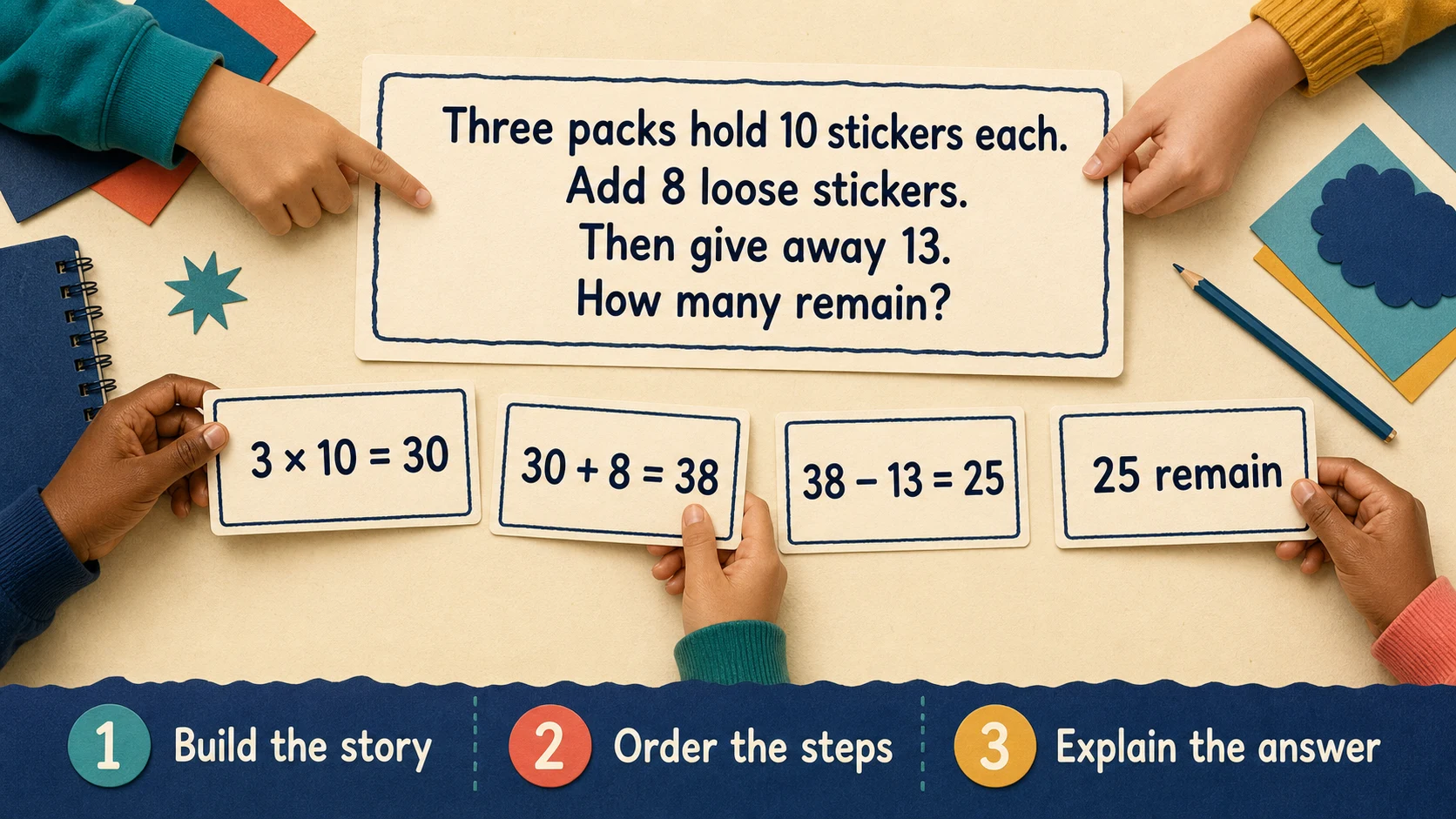
Locate the first point where the reasoning stopped matching the story.
| Error pattern | Evidence in the work | Useful response |
|---|---|---|
| Misread quantity | A number is copied incorrectly | Reread and point to each quantity |
| Answered the wrong question | Computation is correct but finds a total instead of a difference | Restate what the blank must represent |
| Keyword choice | Operation follows one word but contradicts the situation | Remove the numbers temporarily and retell the action |
| Reversed comparison | Learner writes the smaller amount minus the larger without interpreting the result | Align two bars and mark the unmatched part |
| Missed second step | First calculation is correct, but the final event is ignored | Mark the story’s events in order |
| Computation error | Equation matches the story but arithmetic is incorrect | Recalculate with a familiar strategy |
| Unlabeled response | A correct number appears without its meaning | Ask, “Twenty-five what?” |
| Implausible answer | Result conflicts with the story’s direction | Compare the answer with the starting quantities |
Correct the earliest mismatch
Suppose the learner writes for the card comparison example. The addition is accurate, but it answers “How many cards altogether?” The first mismatch occurred when the learner represented the question, not during computation. Return to the comparison rather than assigning more addition practice.
If the learner writes , the operation matches the situation but the arithmetic does not. Keep the equation, then recalculate using a number line, decomposition, or addition check.
This distinction helps preserve what the learner already understands.
Use boundary cases to test flexible understanding
Boundary cases are short oral extensions after the worksheet, not claims about what appears among its 12 items. Use them only when the learner has enough energy to explain the reasoning.
Similar words, different relationships
Compare:
- “Lena had 17 beads and got 6 more.” This gives .
- “Lena had 6 more beads than Sam, who had 17.” This gives for Lena’s amount.
- “Lena had 17 beads, which was 6 more than Sam.” This gives for Sam’s amount.
The phrase “more” appears in all three, but the unknown changes position. Ask the learner to state whose amount is unknown before calculating.
Extra or insufficient information
A story might say: “Ava has 12 red counters and 8 blue counters. Her box is green. How many counters does she have?” The box color is irrelevant; .
By contrast: “Ava has some red counters and 8 blue counters. How many counters does she have?” There is not enough information to calculate a total. Recognizing that boundary is mathematical reasoning, even though no numerical answer can be produced.
These examples extend the topic’s stated emphasis on identifying relevant information and what must be found. They should not be used to imply that the easy printable contains extra-information or missing-information items.
Check the answer key responsibly
The separate answer key supports efficient checking, but it should be used with the learner’s recorded work.
A sound checking sequence is:
- Let the learner complete the selected items without seeing the key.
- Ask for a self-check using the story, an inverse operation, or another calculation method.
- Compare final answers with the key.
- Mark correct, incorrect, and adult-assisted items differently.
- Investigate the reasoning behind errors.
- Ask the learner to revise one or two representative errors.
- Recheck the revised equation and answer.
Do not treat an answer copied after correction as evidence of independent understanding. Note the level of help: read aloud, prompted retell, supplied representation, operation cue, calculation help, or no help.
Also inspect correct answers. A learner can reach the correct number through an equation that does not represent the story, especially when quantities are small. Ask for an explanation on a sample of correct items rather than requiring a lengthy defense of every response.
The key confirms expected results; it cannot show whether the learner read independently, guessed an operation, used an effective model, or understood a two-step sequence.
Decide what should happen next
Base the next step on patterns across the work rather than one isolated mistake.
- If the learner interprets stories accurately but makes arithmetic errors, practice the needed addition or subtraction strategies while continuing a small amount of word-problem work.
- If calculations are accurate but operation choices are inconsistent, revisit retelling, known and unknown quantities, and visual representations.
- If one-step items are secure but two-step items break down, model the sequence of events and record an intermediate answer before the final equation.
- If the learner succeeds only with frequent prompts, repeat easy-level practice while fading one prompt at a time.
- If the learner independently explains, represents, solves, and checks most selected items, continue into a broader mix rather than repeating identical stories indefinitely.
The 2nd Grade worksheet hub can help when practice is also needed in reading or another subject area. For a concentrated continuation, the 2nd Grade Word Problems Worksheet Pack contains 18 worksheets and is listed at $4.79. Select additional material because it matches the learner’s observed need, not simply because more pages are available.
Schedule retrieval after the first lesson
Later recall reveals whether the learner can reconstruct the process without the original level of support.
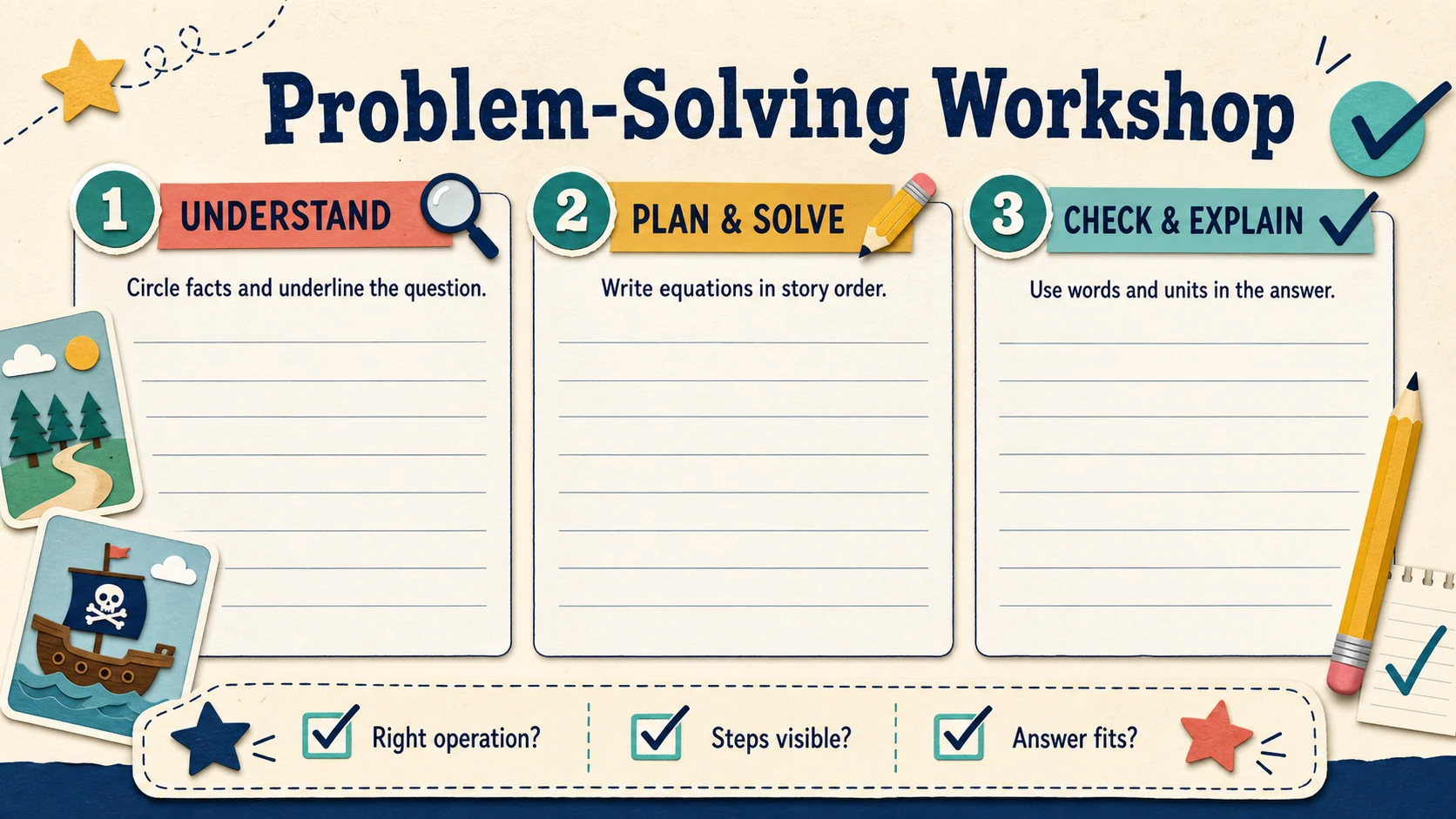
Revisit a few problems after increasing delays and reduce prompts when the learner is ready.
Here is one practical schedule to adjust:
| Time | Retrieval task | What to observe |
|---|---|---|
| End of the lesson | Explain one completed item without rereading the solution | Can connect the story and equation |
| Next practice day | Re-solve one previously difficult structure with work covered | Can recall the routine |
| Several days later | Complete one familiar and one unfinished item | Can transfer the routine independently |
| About one to two weeks later | Solve a similar new problem | Can interpret the relationship after a delay |
This is an instructional suggestion, not a universal timetable or guarantee. Shorten or extend the intervals based on observed retention. Avoid reviewing only previously correct items. Include a corrected error so the learner must reconstruct the improved reasoning.
If the learner remembers the numerical answer, change the quantities while preserving the structure. For example, change to . The new calculation is:
Check:
A changed number set makes it easier to see whether the learner remembers the relationship rather than a specific answer.
Limits of this worksheet
Twelve easy-level exercises can provide focused practice and useful evidence, but they cannot establish complete mastery of all word-problem forms. The worksheet description includes problem solving, reading comprehension, mixed operations, and multi-step reasoning; it does not specify that every possible unknown position, representation, operation sequence, or boundary case appears.
A completed page also does not separate every factor that may have affected performance. Reading assistance, familiarity with the context, arithmetic fluency, attention, available tools, and adult prompting can all influence the work. Record those conditions when interpreting results.
The grade label is an intended practice level, not a diagnosis or fixed placement. Local sequences differ. This guide offers instructional suggestions and high-level source context, not medical guidance, certification, guaranteed outcomes, or a claim of comprehensive standards alignment.
A practical next action
Download the free 2nd Grade Word Problems Worksheets – Standard Theme (Easy), select one item to model, and mark two or three for guided practice. Keep the answer key out of view until the learner has explained and recorded the reasoning.
After the lesson, use the learner’s first recurring error to choose the next step. If another matched page would help, browse the Word Problems topic guide. If you need fresh numbers or a more tailored practice set, use the free worksheet generators and preserve the same read–retell–represent–solve–check routine.
Put it into practice
Use the guide with a real printable
Move from explanation to a short, observable practice task. Check the first item together, then adjust the next session from the learner's actual work.
See the 18-worksheet pack