Complete guide
How to teach and practise 2nd grade subtraction worksheets - standard theme (easy)
How to Use This 20-Problem Subtraction Worksheet
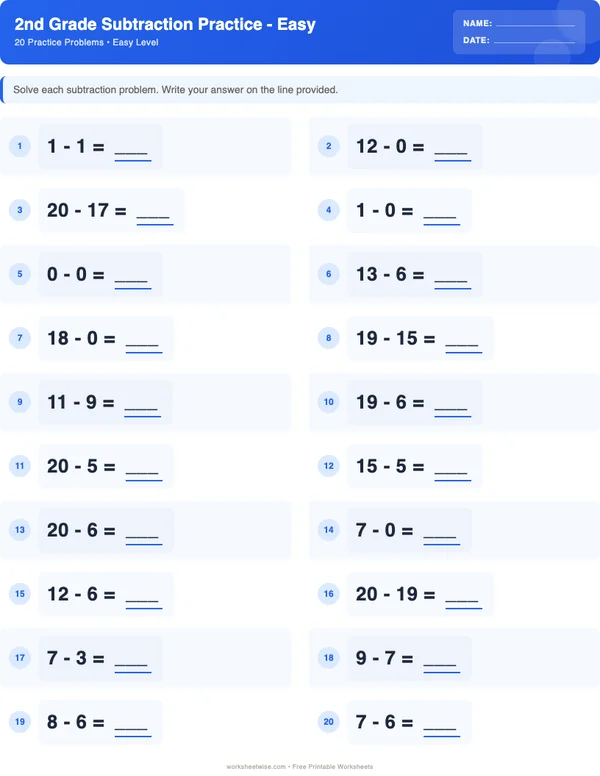
The free 2nd Grade Subtraction worksheet contains 20 easy-level exercises. The learner solves each subtraction problem and writes the answer on the provided line. The practice covers subtraction facts, mental math, number sense, and regrouping, and a separate printable answer key is included.
The short answer: first inspect the page, model one similar problem, solve two or three items together, and then release the learner to work independently. Check for understanding after a small group of problems instead of waiting until all 20 are finished. Use mistakes to decide whether the learner needs a representation, a strategy reminder, or more independent practice.
Grade labels describe the intended practice level, not a guarantee that every learner in that grade is ready for the same work. Local curricula and instructional sequences differ. The learner’s observed work—what they can explain, represent, and solve—should determine the pace.
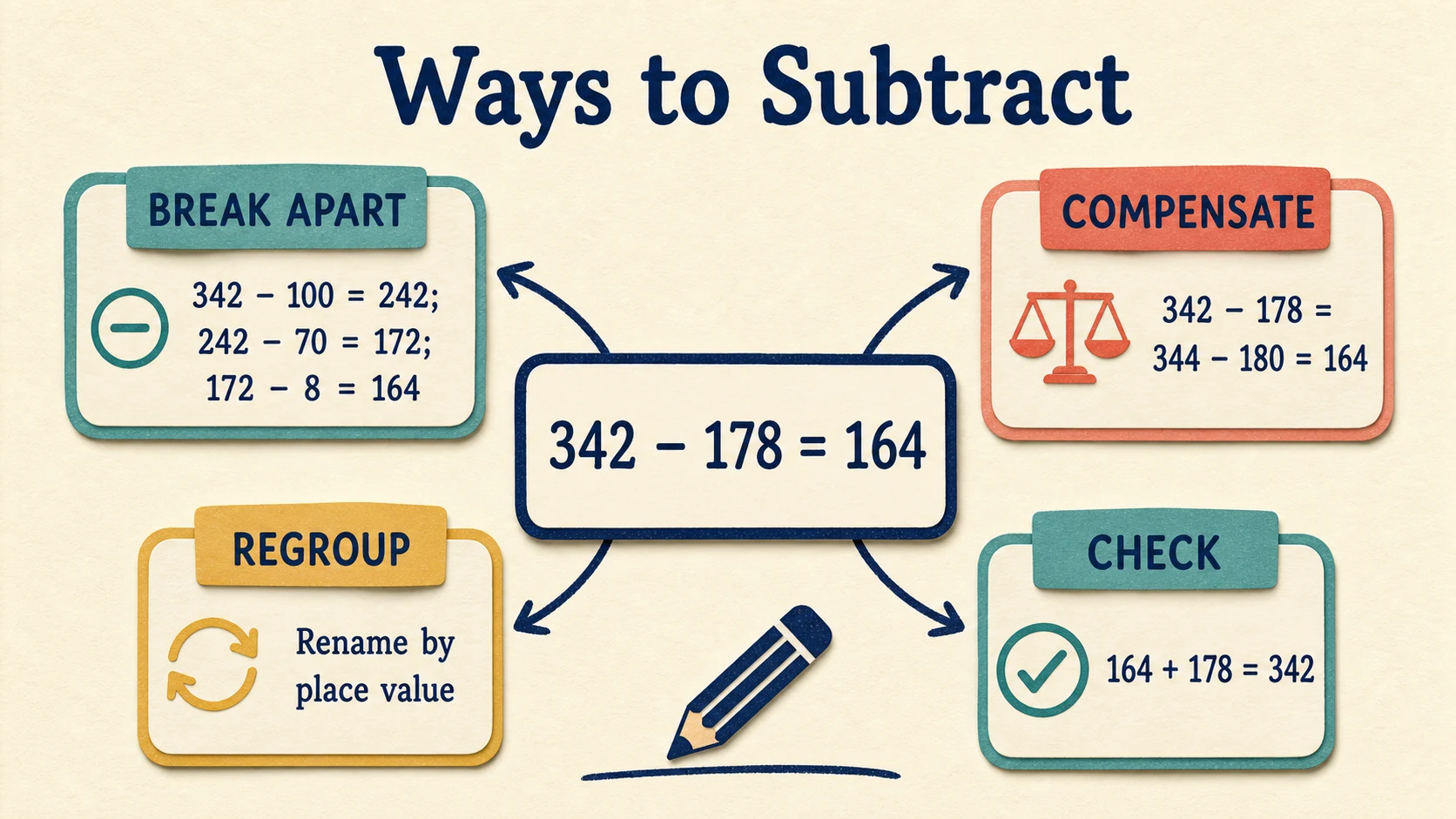
Move from a brief launch to modeling, guided practice, independent work, feedback, and later retrieval.
A Practical Lesson Map
This worksheet can support classroom practice, homework, tutoring, or homeschool instruction. It is most useful when the adult treats the 20 exercises as evidence of current understanding, not merely a page to complete.
| Lesson phase | Suggested use | What the adult watches for |
|---|---|---|
| Preview | Scan the problems and choose a similar example to model | Whether facts, place value, or regrouping may need review |
| Launch | Read the printed direction together | Whether the learner understands what to solve and where to record answers |
| Model | Demonstrate one parallel problem while explaining each decision | Whether the learner follows the meaning of subtraction, not just the written steps |
| Guided practice | Complete two or three worksheet items together | Strategy choice, digit alignment, regrouping, and explanation |
| Independent practice | Assign a manageable set of remaining items | Accuracy, steady effort, and appropriate self-checking |
| Review | Discuss selected correct and incorrect answers | Whether the learner can locate and repair an error |
| Retrieval | Revisit a few problems after a delay | Whether the method can be recalled without immediate prompting |
| Next step | Choose review, varied practice, or a broader resource | Whether support can fade or needs to remain |
This sequence is an instructional suggestion for using the printable. It is not a required timetable. The Institute of Education Sciences practice guide on teaching mathematics to young children provides broader, evidence-based instructional framing around helping learners engage with mathematical ideas, representations, and language. It did not evaluate WorksheetWise or this particular worksheet.
Prepare the Learner and the Materials
Print the worksheet and keep the answer key out of the learner’s immediate view. Have a pencil and blank paper ready. If concrete support may be needed, gather small counters or base-ten blocks before beginning. A drawn number line can provide another representation without changing the subtraction skill.
Before instruction, look over the page yourself. The catalogue identifies the worksheet as easy-level second-grade practice involving subtraction facts, mental math, number sense, and regrouping. Those labels describe the intended content, but the actual problems should guide your preparation. Select one example that resembles the easier-looking items and another that resembles any item requiring an exchange across place values.
Set a Clear Purpose
A useful opening is specific:
“You will solve subtraction problems and write each difference on the line. We will do a few together. Then you will try a group on your own and check whether each answer is reasonable.”
Subtraction vocabulary can be introduced briefly. In an equation such as , 24 is the difference. The learner does not need to repeat formal terms before every calculation, but the adult can use accurate language naturally.
Ask the learner to point to:
- the first number in a problem;
- the subtraction sign;
- the number being subtracted;
- the line where the answer belongs.
This quick orientation separates uncertainty about the page from uncertainty about subtraction.
Begin With Meaning
Before demonstrating a written method, connect the operation to a quantity. For , an adult might say, “There are 13 objects, and 5 are removed. We are finding how many remain.” Subtraction can also describe a comparison or an unknown part, but do not turn the launch into a complete lesson on every subtraction situation. The broader subtraction topic guide covers the larger progression.
The Common Core State Standards for Mathematics describe grade-level expectations that include subtraction fluency and place-value-based work. Local sequencing still varies, and this worksheet alone should not be presented as comprehensive standards coverage.
Model the Task With Fully Checked Examples
The following examples are parallel demonstrations, not a transcription of the worksheet’s 20 items. Choose the model that most closely matches the item types visible on the printable. Keep the written layout clear, and explain why each step preserves the value of the number.
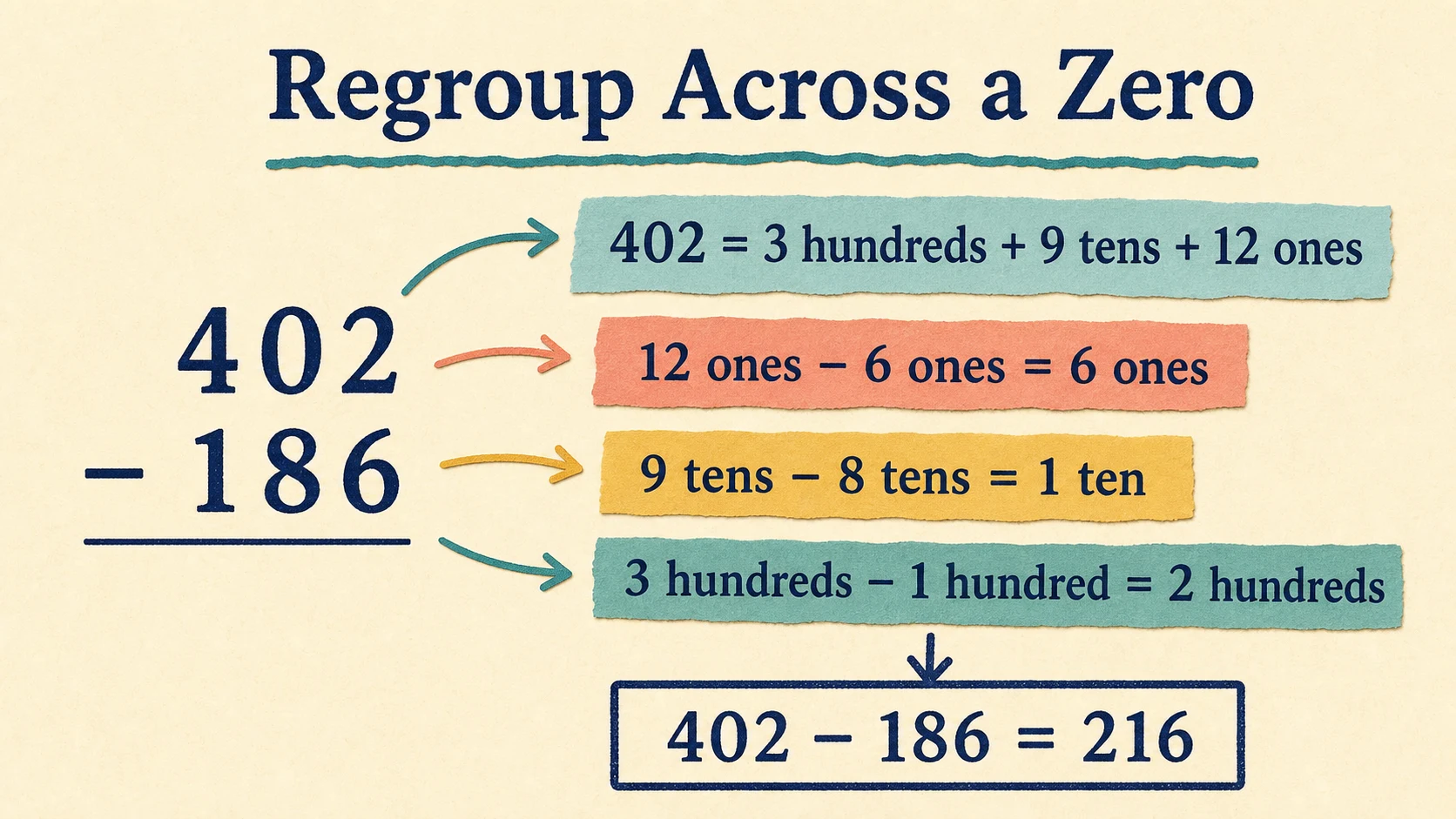
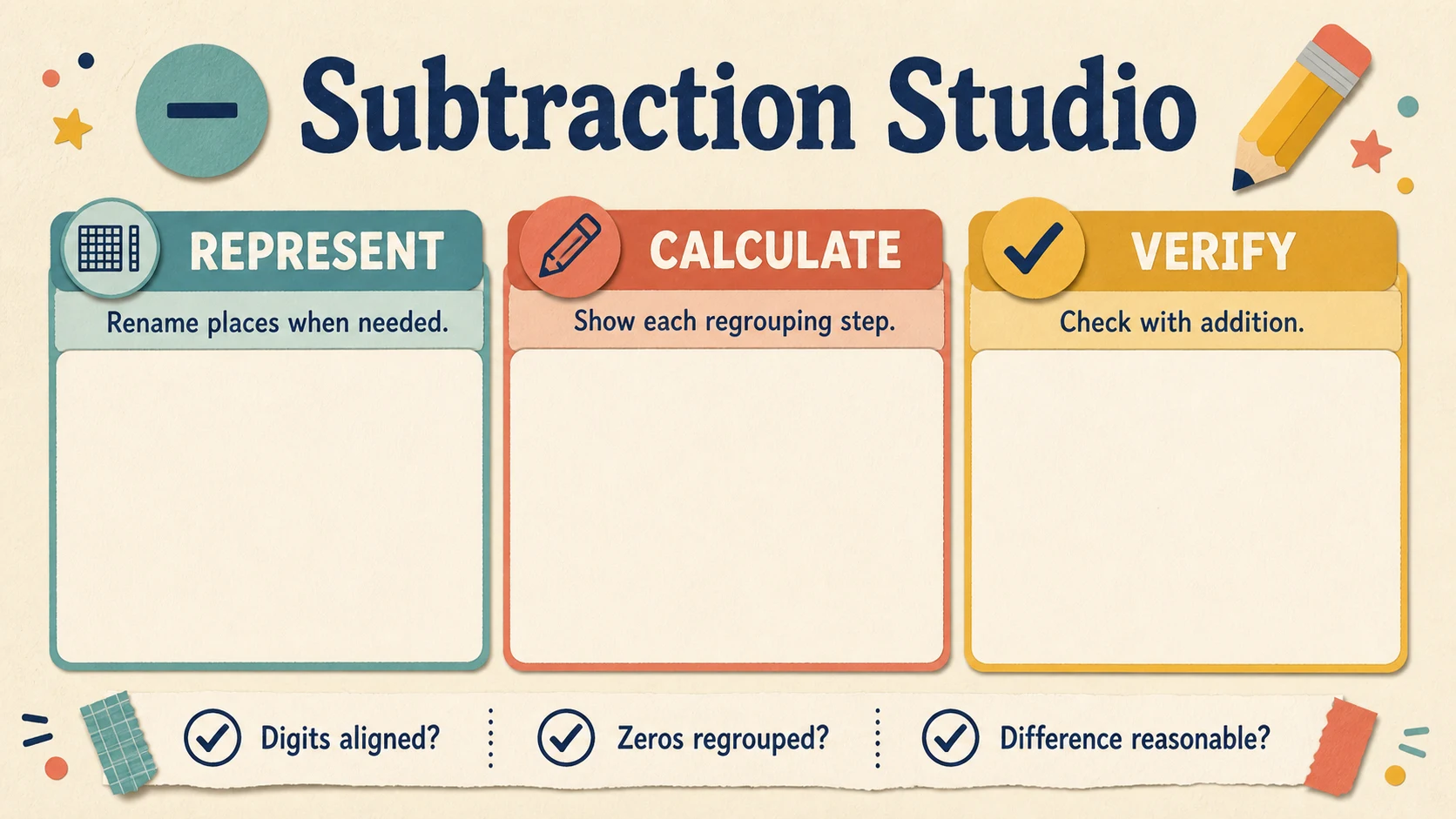
Show the calculation, explain the reasoning, and verify the result with addition.
Example 1: Use a Related Addition Fact
Solve:
Think of the related addition question:
Since ,
Check:
The answer is 8.
This model emphasizes the inverse relationship between addition and subtraction. It is particularly useful when the learner knows an addition fact but hesitates over the related subtraction fact.
Example 2: Subtract Without Regrouping
Solve:
Align the ones and tens:
  47
- 25
----
Subtract the ones:
Subtract the tens:
Therefore:
Check with addition:
The answer is 22.
The important feature is place value. The 4 in 47 means four tens, while the 7 means seven ones. Keeping the digits aligned prevents the learner from mixing tens and ones.
Example 3: Regroup One Ten
Solve:
The ones calculation cannot be completed by removing eight ones from two ones while staying within whole-number quantities. Regroup one ten from 42:
Now subtract the ones:
Then subtract the tens:
So:
Check:
The answer is 24.
With base-ten blocks, show four tens and two ones. Exchange one tens rod for ten ones, leaving three tens and twelve ones. Nothing has been added to or removed from 42 during the exchange; only its representation has changed.
Example 4: Regroup Across a Zero in the Ones Place
Solve:
Represent 60 as six tens and zero ones. To subtract seven ones, exchange one ten:
Subtract the ones:
Subtract the tens:
Therefore:
Check:
The answer is 33.
This is a useful boundary case because the top number begins with no ones. A learner who writes may have subtracted 0 from 7 and 2 from 6 without attending to which quantity is being removed.
Example 5: Estimate Before Calculating
Solve:
First estimate. Since 39 is close to 40:
Because subtracting 39 removes one less than subtracting 40, the exact answer should be one more than 31:
Verify with regrouping:
Then:
and:
So the difference is 32.
Check:
The estimate and exact calculation agree. Estimation here is a reasonableness check, not a replacement for finding the exact answer.
Move From Guided to Independent Practice
After modeling, invite the learner to solve a worksheet item while you ask short prompts. Avoid narrating every step for them.
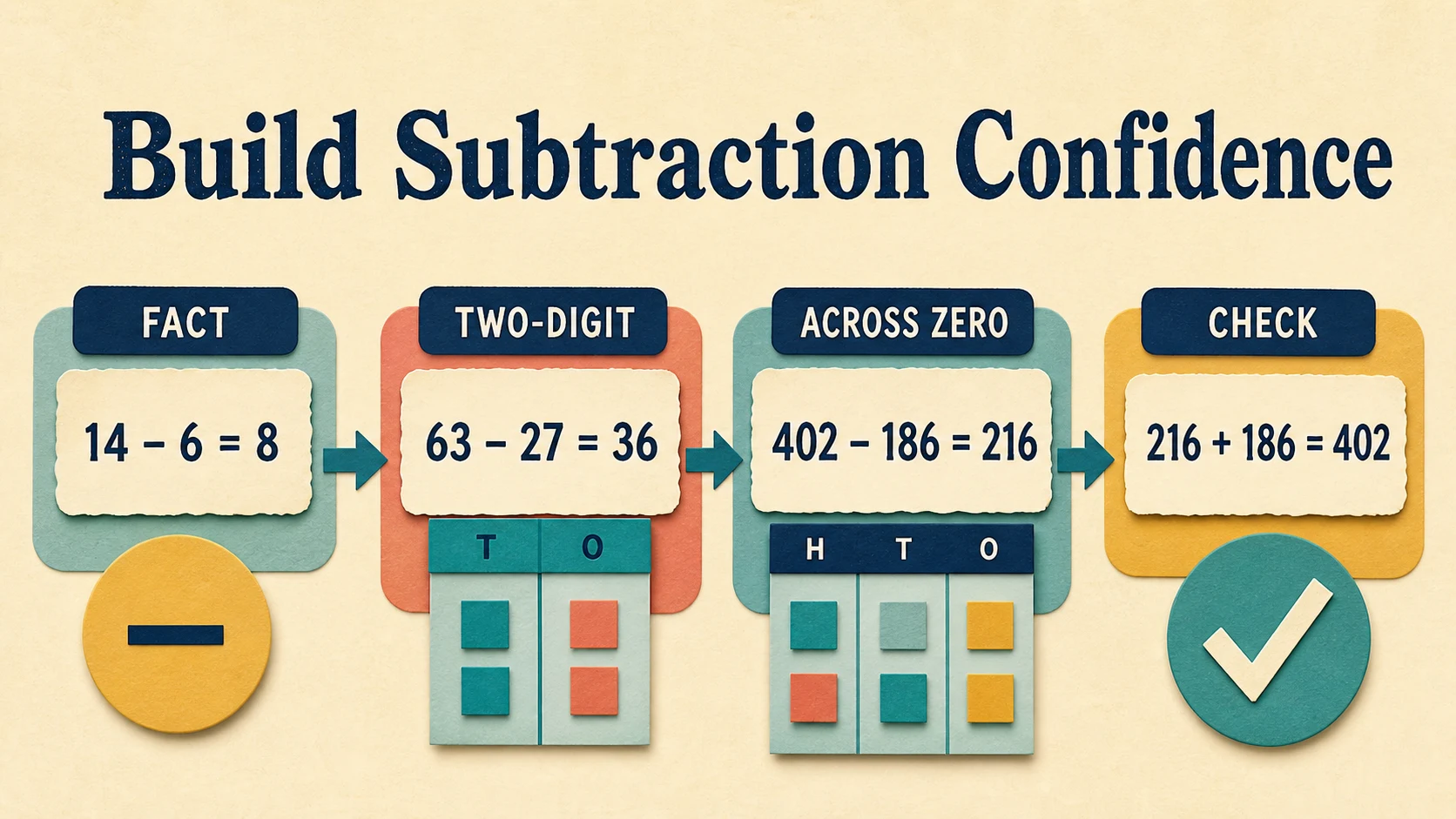
Use prompts during guided work, then reduce them when the learner shows a workable strategy.
Guided Practice Prompts
Choose prompts that reveal thinking:
- “What are you finding?”
- “Which digits are in the ones place?”
- “Can you subtract the ones as written?”
- “If you regroup, what does one ten become?”
- “What related addition fact could help?”
- “How could you check that difference?”
Ask the learner to complete two or three items with support. If the first item is accurate, do not assume the method is secure. Ask for a brief explanation or use a second item with a different feature, such as regrouping.
Then assign a small group independently—perhaps three to five items—before pausing to inspect the work. This grouping is a practical option, not a universal requirement. A learner who is accurate and can explain the method may continue with a larger set. A learner who repeats the same error should pause earlier.
What Counts as Independent Work
Independent does not mean unsupported under every condition. It means the learner makes the mathematical decisions without the adult supplying each step. The adult may still:
- restate the printed direction;
- provide a quiet workspace;
- remind the learner to align digits;
- ask for a reasonableness check;
- allow a familiar representation already used in instruction.
If the adult says which digit to subtract, when to regroup, and what to write at each step, the item is guided practice. Mark it mentally or on your notes as guided so it is not mistaken for evidence of independent mastery.
Adapt Support Without Changing the Skill
An adaptation should make the same subtraction accessible. It should not quietly replace the task with a different one or supply the answers.
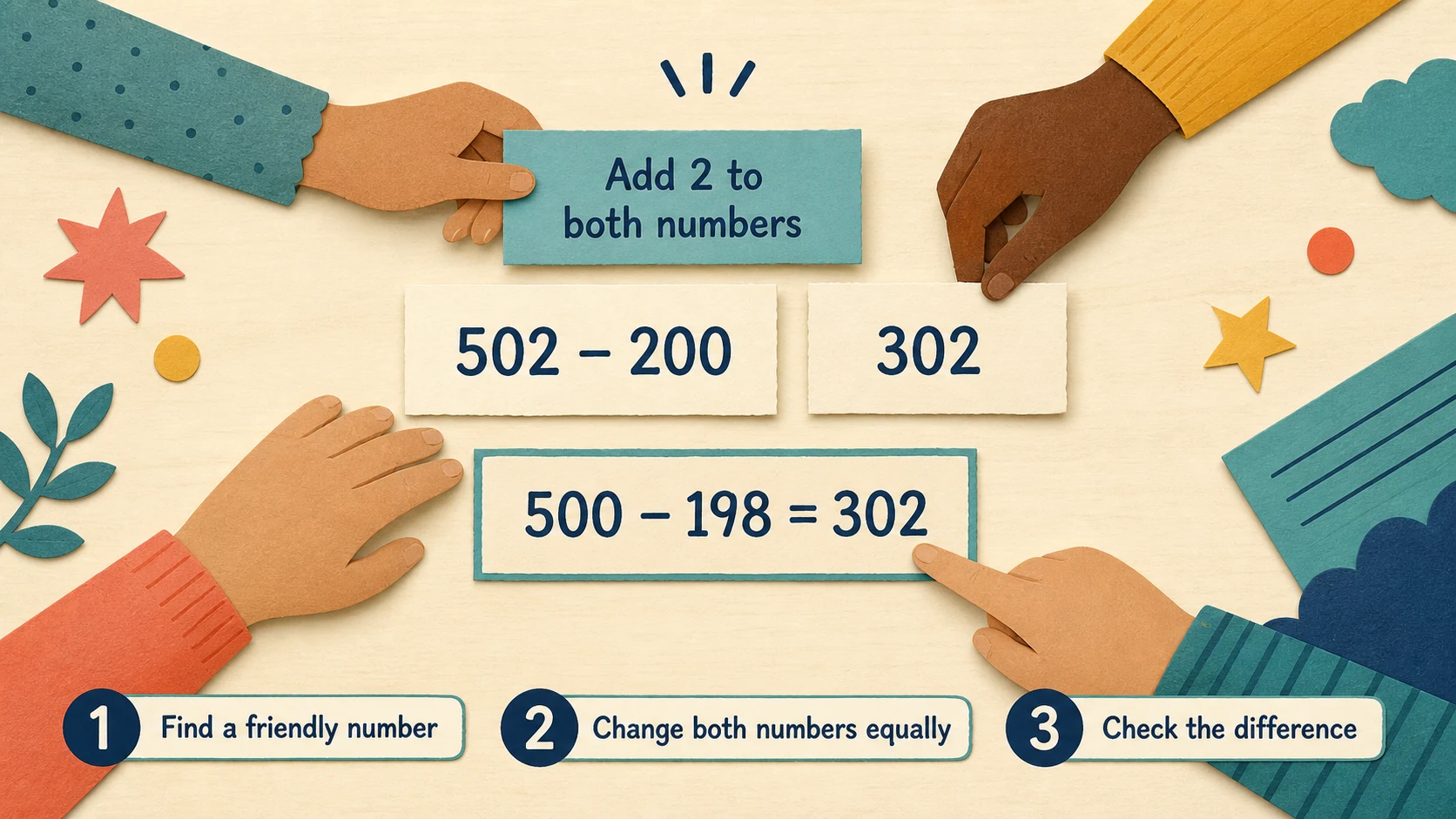
Adjust the amount, representation, or prompting while preserving the subtraction target.
When the Learner Needs More Support
Reduce visual load by covering the unsolved portion of the page and revealing one row at a time. The learner still completes the same problems, but attends to fewer items at once.
Use counters for fact-level problems or base-ten blocks for two-digit regrouping. Ask the learner to connect the objects to the written equation. For example, after exchanging a tens rod, have them record the new tens and ones above the written problem.
A number line can support counting back or finding the distance between numbers. If the learner solves by starting at 5 and counting up to 13, acknowledge that the difference is still 8. Then connect the jumps to .
You can also provide a short strategy card:
- Read the equation.
- Line up place values.
- Start with the ones.
- Regroup if needed.
- Check with addition or estimation.
Remove the card when the learner begins using the routine without it.
When the Learner Is Ready for Less Support
Ask the learner to choose and name a strategy before calculating. After several correct problems, request checks only for selected items instead of every item. You can also ask the learner to compare two approaches, such as regrouping and subtracting a nearby multiple of ten.
Do not increase difficulty merely because the page is going well. First look for accurate, explainable, and reasonably efficient work across different problem forms. Finishing quickly is not sufficient evidence by itself.
When Stamina Is the Main Barrier
Split the 20 exercises into two or more sessions while preserving the original problems. Record where the learner stopped so the second session begins cleanly. A shorter session may provide better evidence than a completed page produced through guessing or escalating frustration.
Do not penalize a mathematics error for handwriting alone. If a numeral is ambiguous, ask the learner to read it. At the same time, unclear placement can cause genuine calculation errors, so provide lined or grid paper when needed to keep tens and ones aligned. This is an instructional support, not medical or therapeutic guidance.
Interpret Errors Before Correcting Them
A wrong answer does not identify its own cause. Look at the written steps, ask the learner to explain, and compare the explanation with another problem.
Classify the error, revisit the relevant idea, and check the repair on a fresh problem.
Common Error Patterns
| Observed work | Possible interpretation | Useful response |
|---|---|---|
| after counting | A counting slip or an unclear starting point | Represent 13 objects, remove 5, and recount; then verify with and |
| The learner may have calculated one place incorrectly | Ask them to identify tens and ones and check whether | |
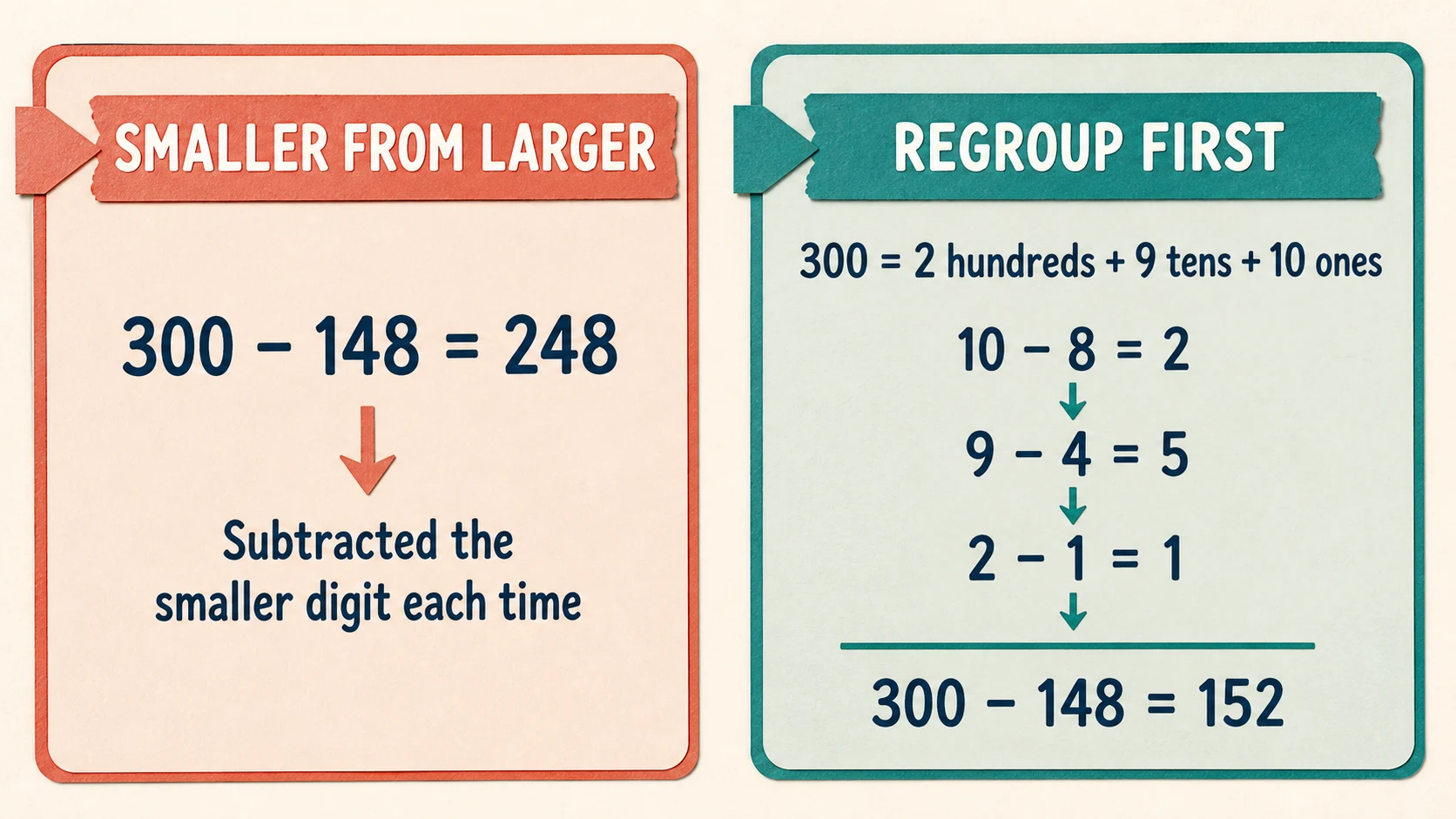
| The learner may have subtracted the smaller digit from the larger in each column | Model as tens and ones; show why does not represent | |
| The zero in the ones place may have disrupted regrouping | Exchange one ten for ten ones and rewrite 60 as five tens and ten ones | |
| Correct answer with no explainable method | The answer may be recalled, guessed, or copied | Ask for a representation, related fact, or addition check |
| Several correct items followed by scattered errors | Attention, pace, or checking may be affecting performance | Pause, inspect one error, and continue with a smaller set |
| Accurate regrouping but misaligned digits | Place-value recording may be unstable | Use grid paper and label tens and ones |
| Every item left blank | The task, notation, or starting strategy may be unclear | Complete one parallel example and begin a worksheet item together |
These are possible interpretations, not diagnoses. Confirm them by asking the learner to solve or explain another example. The IES guide on assisting students struggling with mathematics offers broader recommendations for systematic instruction, mathematical language, representations, and review. It does not provide child-specific advice or an evaluation of this printable.
Correct the Idea, Then Test the Repair
Suppose the learner writes:
Do not simply replace 36 with 24. Ask, “How did you handle the ones?” If the learner says, “Eight minus two is six,” identify the reversal: the problem asks for 18 to be removed from 42, so the ones column represents , not .
Rebuild 42 as four tens and two ones, regroup to three tens and twelve ones, and complete the calculation. Then use a fresh parallel example, such as :
Therefore:
Check:
If the learner solves the new example independently, the repair is more convincing than copying the corrected steps from the original.
Use the Answer Key Responsibly
The separate answer key makes checking efficient, but it should support diagnosis rather than replace mathematical review.
First, let the learner finish the assigned set. Compare each recorded answer with the key. Mark correct answers clearly, but avoid turning every mismatch into an immediate explanation from the adult. Invite the learner to recheck the problem using addition, estimation, objects, or a second calculation.
For example, if the answer to is recorded as 34, test it:
Because the sum does not return to 42, 34 cannot be the correct difference. The learner still needs to locate the calculation error, but the check establishes that revision is necessary.
Use the key carefully:
- Match each answer to the correct problem number.
- Confirm that a faint or reversed numeral has been read accurately.
- Distinguish self-corrections from answers corrected after prompting.
- Note whether an item was completed independently or with guidance.
- Recalculate if the worksheet, key, or learner’s notation appears inconsistent.
- Avoid showing the key before the work is attempted.
An answer key verifies expected answers; it does not explain why an error occurred. A score such as 16 out of 20 also hides patterns. Four unrelated fact slips require a different response from four regrouping errors.
Decide What to Do After the Worksheet
The next decision should come from the pattern of work, not from a fixed percentage applied without context.
Continue, Review, or Step Back
Continue to varied subtraction practice when the learner:
- solves most items accurately;
- explains at least one useful strategy;
- regroups without losing place value;
- notices or repairs an unreasonable answer;
- works independently on a representative set.
Provide targeted review when errors cluster around one feature. If facts are slow but place-value reasoning is sound, practice related addition and subtraction facts. If the learner understands facts but mishandles regrouping, return to physical or drawn tens and ones. If digit alignment is the issue, use grid paper and short sets.
Step back to simpler numbers when the learner cannot yet represent what subtraction means or repeatedly guesses despite modeling. Preserve the central skill: finding a difference. Use smaller quantities, then reconnect that understanding to the worksheet later.
The full 2nd Grade math collection can help you choose adjacent practice, while the 2nd Grade worksheet hub provides work in other subject areas. For a connected subtraction sequence, use the subtraction topic guide rather than trying to make this single page carry the entire progression.
Recognize the Worksheet’s Limits
This printable offers 20 easy-level exercises and an answer key. It can provide useful practice and a snapshot of written performance, but it cannot by itself establish comprehensive standards alignment, lasting fluency, or readiness for every later subtraction task.
A completed page may not show whether the learner can interpret a word problem, distinguish take-away from comparison, explain a missing-part situation, or transfer the method to unfamiliar numbers. It also does not reveal long-term retention unless some work is revisited after a delay.
The worksheet’s grade label describes intended practice level. It is not a certification of readiness, a developmental judgment, or a substitute for local curriculum expectations. Use observed strategy, accuracy, explanation, and later recall together.
Schedule Brief Retrieval After the Lesson
Reusing a few problems after time has passed can show whether the learner retrieves the method rather than relying on the just-completed model.
Revisit a small mixed sample after delays, adjusting the spacing to the learner’s observed work.
A practical schedule might look like this:
| Time | Retrieval task | Decision |
|---|---|---|
| End of the lesson | Rework one fact problem and one place-value problem without looking back | Clarify any step that is still dependent on prompting |
| Next suitable study session | Solve two or three previously completed problems in a different order | Note whether the learner recalls the strategy |
| Several days later | Mix one worksheet-style item with other familiar subtraction work | Check whether the method transfers beyond the original sequence |
| About one or two weeks later | Use a short mixed review rather than the entire page | Continue spacing if recall is accurate; reteach the specific weak feature if not |
This is an adaptable instructional plan, not a universal timetable. Shorten the interval if the learner cannot recall the method. Lengthen it when recall is accurate and independent. Do not require all 20 problems again merely to conduct retrieval; a small, representative sample may provide clearer evidence with less fatigue.
Record only what will inform instruction: the problem attempted, whether help was given, the strategy used, and the type of error. A note such as “regrouped correctly after base-ten model; fresh example independent” is more useful than “needs more practice.”
A Calm, Useful Next Step
After checking the page, choose one next action. Revisit a few missed items if the error pattern is narrow. Use the broader 2nd Grade Subtraction guide if you need to place the work within the larger progression. If the learner is ready for sustained practice across multiple sheets, review the 2nd Grade Subtraction Worksheet Pack, which contains 18 worksheets and is listed at $4.79. For newly generated practice, explore the free worksheet generators.
The most useful immediate action is simple: print the free 20-item worksheet, select one parallel example to model, and plan the first pause after a small set of independent problems. Let the learner’s work at that pause determine the support, pace, and next review.
Put it into practice
Use the guide with a real printable
Move from explanation to a short, observable practice task. Check the first item together, then adjust the next session from the learner's actual work.
See the 18-worksheet pack