Complete guide
How to teach and practise 2nd grade place value worksheets - standard theme (easy)
How to Use This 20-Item Place Value Worksheet
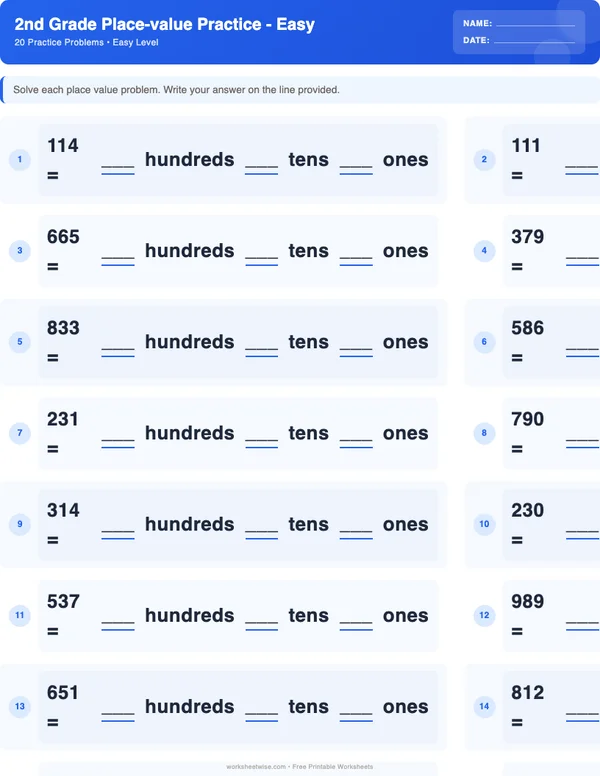
The free 2nd Grade Place Value worksheet provides 20 easy-level exercises covering four related skills: identifying place values, writing numbers in expanded form, comparing numbers, and rounding. A separate printable answer key is included.
The most effective way to use it is to preview the problem types, model one example of each type, complete a short guided set, and then let the learner work independently. Check for patterns in the learner’s reasoning—not merely the final score—before deciding whether to reteach, repeat, or move forward.
Grade labels describe the intended practice level, not a universal timetable. Local curricula and instructional sequences differ. In particular, an adult should confirm whether rounding is current instruction, review, or an extension for the learner.
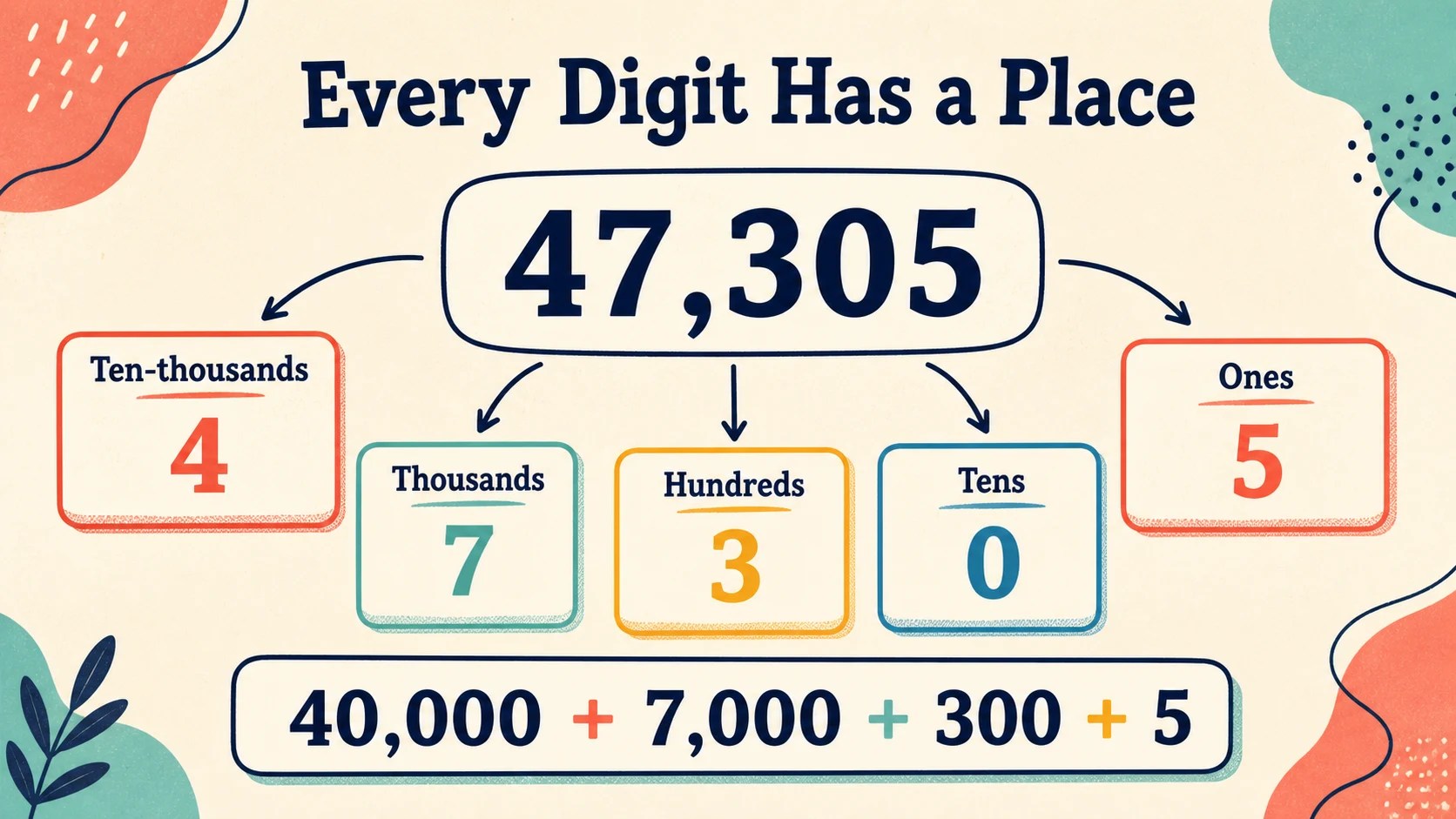
Preview, model, guide, release, check, and revisit the skill over time.
What This Worksheet Practices
The worksheet asks learners to solve each place value problem and write an answer on the provided line. Its 20 exercises draw from these four listed skills:
- Place value
- Expanded form
- Number comparison
- Rounding
These skills are connected, but they do not require exactly the same reasoning. A learner might identify the value of a digit accurately yet make mistakes when comparing two numbers. Another learner might understand hundreds, tens, and ones but be unfamiliar with a particular rounding procedure.
For that reason, avoid treating the worksheet as one undivided test. During review, sort errors by problem type. That gives you more useful information than a single percentage or total score.
The worksheet fits within the broader 2nd Grade math collection. For a fuller explanation of how place value develops through composing, decomposing, comparing, and later rounding, use the Place Value topic guide. This lesson guide concentrates on launching and interpreting this specific printable rather than repeating the topic’s complete progression.
The mathematical idea beneath all four skills
Place value means that a digit’s value depends on its position. In 352, the 3 represents 300, the 5 represents 50, and the 2 represents 2. Moving a digit one place to the left changes its value by a factor of ten within the base-ten system.
That positional structure supports each task on the worksheet:
- Identifying place value asks what a digit represents.
- Expanded form separates a number into the values represented by its digits.
- Comparison examines corresponding places from greatest to least.
- Rounding locates a number relative to selected benchmarks.
The Common Core State Standards for Mathematics provide useful context for second-grade work with hundreds, tens, and ones and for reading, writing, and comparing numbers to 1,000. They should not be used to claim that this particular printable has been independently evaluated or comprehensively aligned. Rounding appears later in the listed Common Core progression, so its place in a second-grade lesson may vary by curriculum.
Prepare the Lesson Before the Learner Begins
Print or open the worksheet and answer key separately. Keep the key out of sight during instruction so that it remains a checking tool rather than a source of answers.
Before the session, scan all 20 items and identify where the four problem types appear. Because the catalogue describes the included skills but does not provide every item’s wording here, read the actual prompts carefully. Note whether a question asks for a place name, a digit’s value, an expanded form, a comparison symbol, or a rounded number. Those responses are not interchangeable.
Gather only the tools that clarify the current skill:
- A place value chart labeled hundreds, tens, and ones
- Base-ten blocks, bundled sticks, or quick drawings
- Digit cards or scrap paper
- A number line for comparison or rounding
- A pencil and a blank sheet for showing reasoning
Concrete objects can help a learner connect written digits to quantities. The IES guide on teaching mathematics to young children supports high-level practices such as using representations, discussing mathematical ideas, and helping children connect informal understanding with mathematical language. That guidance is general; it is not an evaluation of WorksheetWise or this worksheet.
Choose a manageable stopping point
Twenty items may be appropriate for one sitting, or they may be better divided into two sessions. Base that decision on the learner’s observed work.
A reasonable first checkpoint is after several items representing more than one problem type. Continue if the learner is reasoning accurately and working steadily. Pause if answers become rushed, place labels are being confused repeatedly, or the learner can no longer explain a method used successfully a few minutes earlier.
Splitting the sheet does not change its skill or lower its expectations. It changes the amount of practice completed at one time.
A Practical Lesson Sequence
The following plan is a flexible instructional suggestion, not a required timetable. Shorten or extend each phase according to what the learner demonstrates.
| Phase | Adult action | Learner action | Evidence to notice |
|---|---|---|---|
| Preview | Point out the kinds of prompts without solving them | Identify what each prompt is asking | Can the learner distinguish value, expanded form, comparison, and rounding? |
| Model | Solve one representative example aloud | Watch, then restate the reasoning | Can the learner explain why each step is valid? |
| Guided practice | Complete two or three items together | Supply steps and use a representation | Does support lead to accurate reasoning? |
| Supported release | Begin an item, then let the learner finish | Complete the remaining reasoning | Can the learner continue without being told each step? |
| Independent practice | Step back and observe | Solve a selected group alone | Are methods accurate and consistent? |
| Review | Discuss selected correct answers and errors | Explain, revise, and check | Can the learner locate and repair an error? |
| Retrieval | Revisit a few mixed examples later | Solve without copying an earlier model | Is the idea retained after time has passed? |
A concise launch script
You might say:
“This page includes several kinds of place value problems. Before we begin, we will look at what each direction asks. I will show one example, we will solve a few together, and then you will try some independently. If an answer is difficult, show what each digit means or place the number on a number line.”
This makes the process predictable without telling the learner that the work will be easy. The catalogue’s “easy” label describes the worksheet level, but an individual learner may still need modeling or representations.
Model the Task with Fully Checked Examples
Use examples that are similar in skill but not copied from the learner’s unanswered items. Modeling with different numbers protects the worksheet as an opportunity for genuine practice.
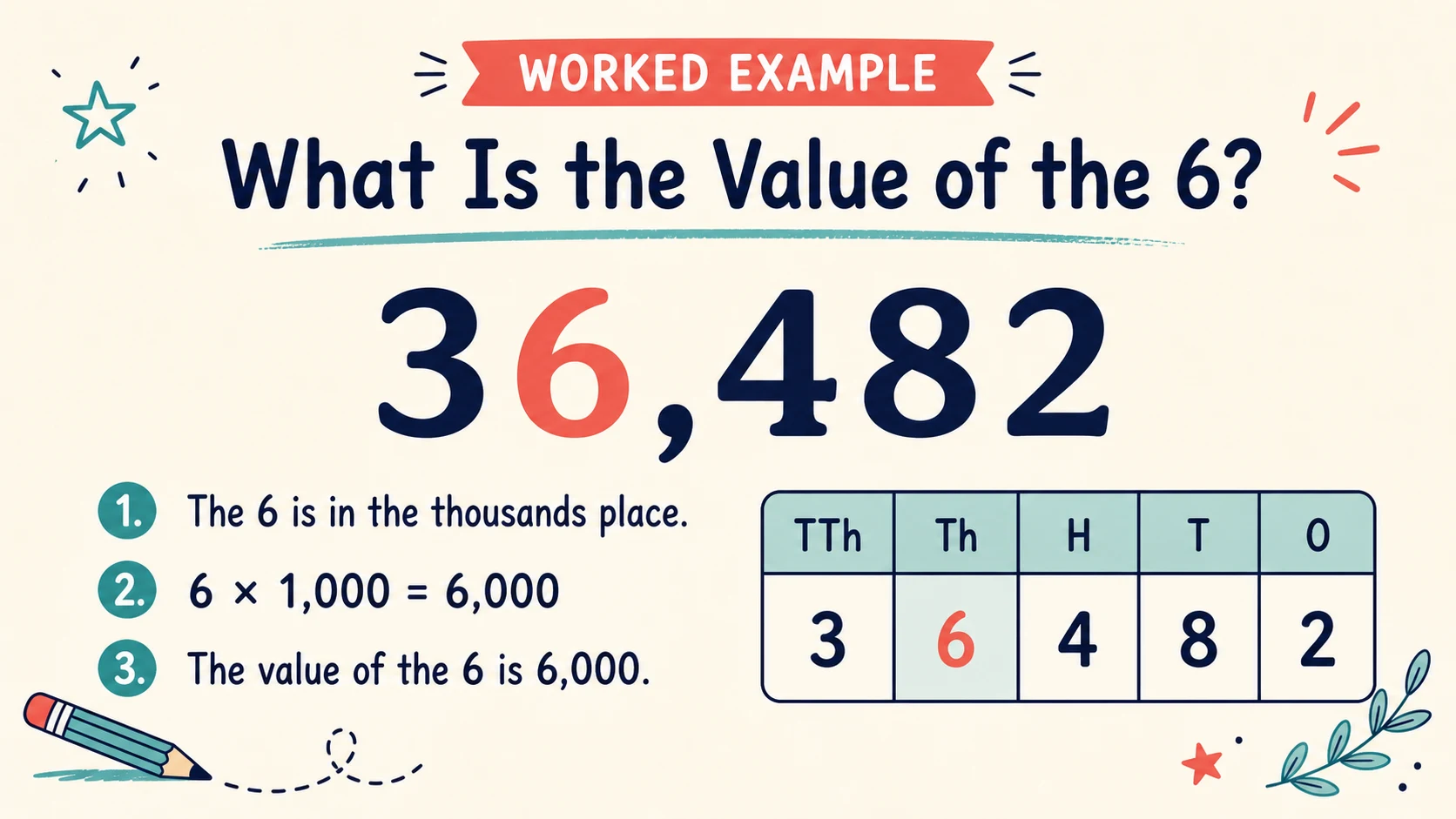
Connect each written answer to the value represented by the digits.
Example 1: Identify a digit’s value
Problem: What is the value of the 7 in 472?
Write the number by place:
| Hundreds | Tens | Ones |
|---|---|---|
| 4 | 7 | 2 |
The 7 is in the tens place. Seven tens equal 70.
Answer: 70
Check: Decompose the whole number:
The decomposition confirms that the 7 contributes 70.
Clarify the distinction between a digit and its value. The digit is 7; its value in 472 is 70. If the prompt asks for the place, the answer would be tens. Read the exact wording before responding.
Example 2: Write a number in expanded form
Problem: Write 306 in expanded form.
The 3 represents 300. The 0 represents no tens. The 6 represents 6 ones.
Answer:
Check: Add the parts:
Writing also displays all three places and has the same total. Follow the format taught locally or shown in the worksheet directions. The important mathematical point is that the zero holds the tens place; it does not turn 306 into 36.
Example 3: Compare two numbers
Problem: Compare 458 and 452 using , , or .
Compare from the greatest place:
- Hundreds: both have 4 hundreds.
- Tens: both have 5 tens.
- Ones: 8 ones are greater than 2 ones.
Therefore:
Answer:
Check: The numbers differ by 6:
A positive difference confirms that 458 is greater.
Avoid deciding from the first different-looking digit without considering its place. In this example, the hundreds and tens are tied, so the ones determine the comparison.
Example 4: Round to the nearest ten
Problem: Round 67 to the nearest ten.
The neighboring tens are 60 and 70.
Since 67 is 3 away from 70 and 7 away from 60, it is closer to 70.
Answer: 70
Check: Place 67 between 60 and 70 on a number line. It lies beyond the midpoint, 65, and closer to 70.
This explanation emphasizes distance to benchmarks. It is more informative than asking the learner to memorize an isolated digit rule.
Example 5: Compare numbers containing zero
Problem: Compare 409 and 490.
Both numbers have 4 hundreds. In the tens place, 409 has 0 tens while 490 has 9 tens. Nine tens are greater than zero tens.
Answer:
Check: Expanded forms show the difference:
Because 90 is greater than 9, 490 is greater than 409.
This example checks whether the learner respects the zero placeholder instead of ignoring it.
Move from Guided Practice to Independent Work
Begin guided practice with a problem type the learner can partly explain. Ask for the next reasoning step rather than supplying the complete method.
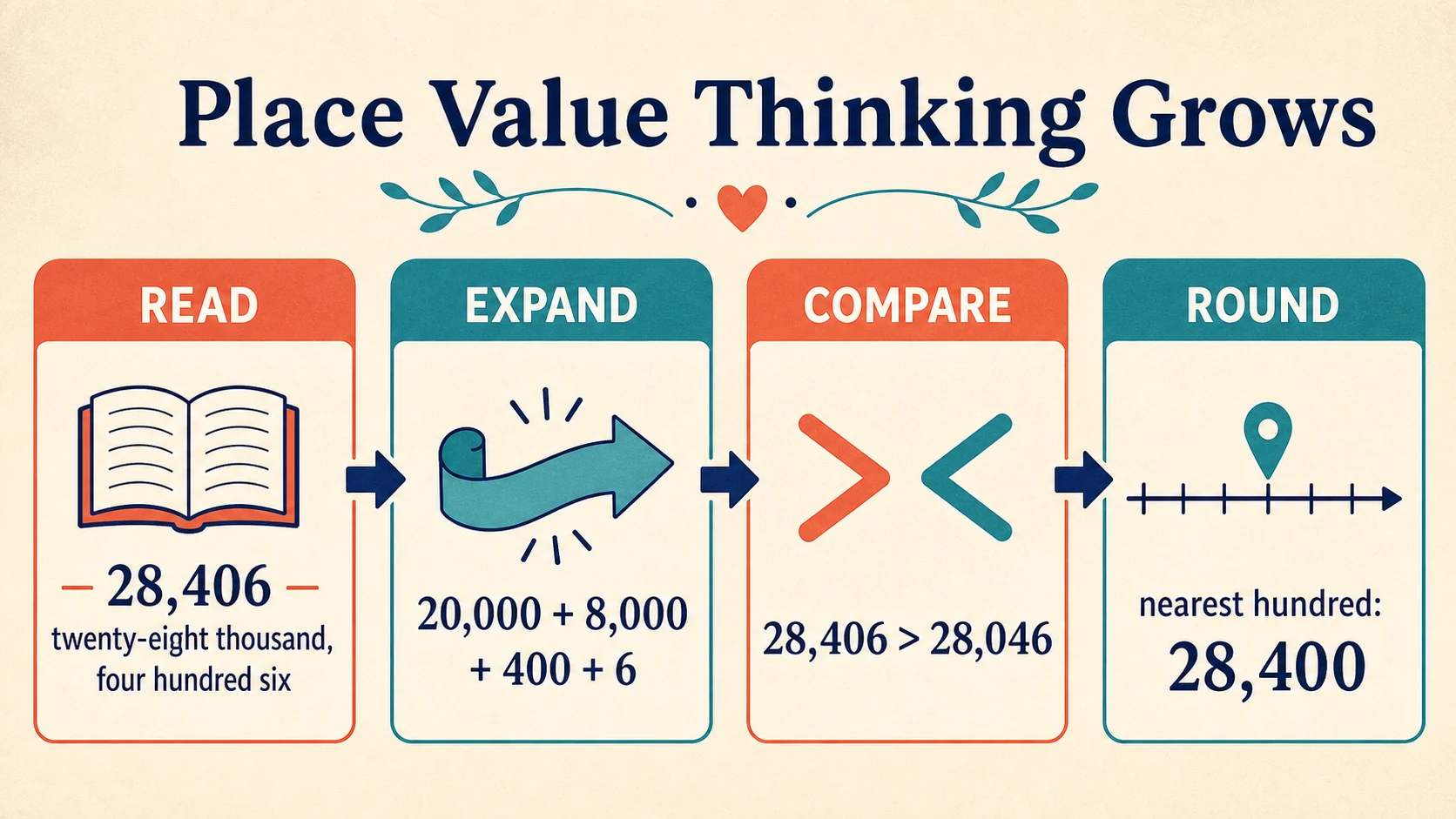
Transfer responsibility gradually while keeping the learner’s reasoning visible.
Useful prompts include:
- “Which place should we examine first?”
- “What does that digit represent?”
- “How could you show the number as hundreds, tens, and ones?”
- “Which places are equal in these two numbers?”
- “What are the two neighboring tens?”
- “How can you check that answer?”
These prompts preserve the mathematics. By contrast, “Look at the 7” or “The answer is the larger one” may direct attention so narrowly that the learner can respond without understanding.
Guided practice
For the first guided item, let the learner read the problem aloud or explain what it requests. If reading the directions interferes with showing the math skill, the adult may read the prompt without interpreting the numbers.
Ask the learner to use a place value chart, blocks, or a number line. Then have the learner record the written answer. The representation should support reasoning, not replace the expected response.
For the next item, reduce assistance. Instead of filling the chart together, ask the learner to fill it. Instead of naming the neighboring tens, ask the learner to identify them.
Supported release
Choose one or two items for a partial handoff. The adult might identify the problem type, while the learner completes all calculations and explains the result. On the following item, the learner should identify both the task and the method.
A learner is ready for an independent set when they can:
- State what the prompt is asking
- Select an appropriate method or representation
- Complete the steps without answer-leading hints
- Explain at least one check
This does not require perfect speed. Independence is about ownership of the reasoning.
Independent practice
Assign a small group of items first rather than automatically assigning all remaining problems. While the learner works, observe quietly. Record brief notes such as “confuses place and value” or “comparison accurate after chart” instead of interrupting every error.
Immediate correction is useful when the learner has misunderstood the directions and is repeating the wrong task. A single computational or recording error can often wait until the checkpoint, allowing you to see whether it is isolated or part of a pattern.
Adapt Support Without Changing the Skill
An adaptation should make the target reasoning more accessible while preserving what the learner must understand. If the skill is comparing numbers, for example, reducing visual clutter is appropriate; telling the learner which number is greater is not.
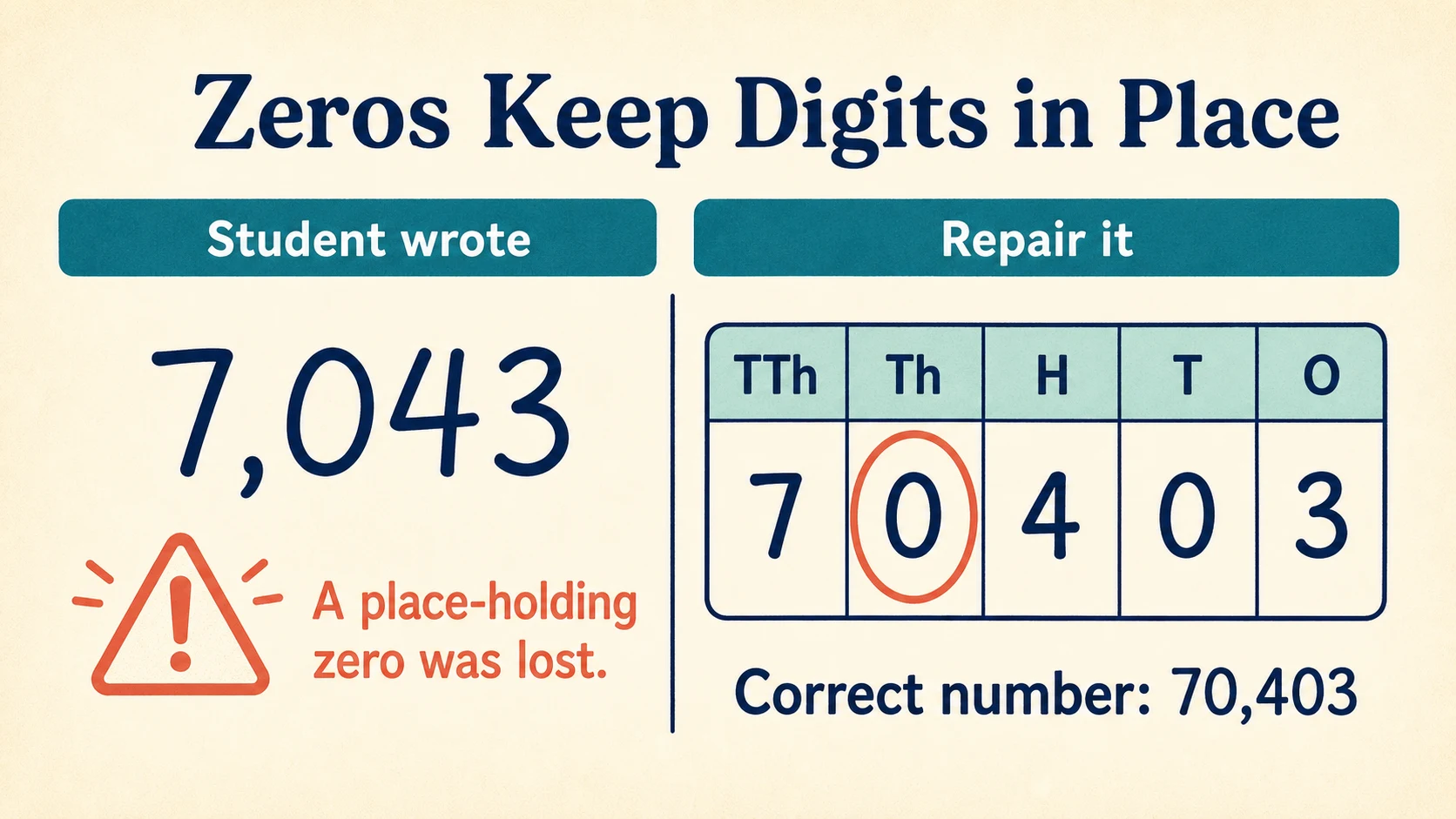
Adjust representation, quantity, or prompting while keeping the place value goal intact.
When the learner needs more concrete support
Build or draw each number using hundreds, tens, and ones. Have the learner match the model to the written numeral.
For 243, the learner might show:
- 2 hundreds
- 4 tens
- 3 ones
Then connect the model to . Keep the original worksheet item visible so the learner still records the required answer.
If physical blocks are unavailable, draw large squares for hundreds, lines for tens, and dots for ones. State clearly what each drawing represents.
When the learner understands but loses their place
Cover unrelated items with a blank sheet. Reveal one problem at a time, or fold the page so only a short section is visible. This reduces the amount of visual information without simplifying the mathematics.
A reusable place value chart can also organize digits. For comparison problems, align both numbers by place. For rounding, draw only the relevant interval between neighboring benchmarks.
When the learner is ready for less support
Remove the chart or model after several accurate explanations. Ask the learner to solve mentally or on paper and then justify one answer.
You can also request a second representation after the answer:
- Write 528 in expanded form.
- Explain the value of the 2.
- Compare 528 with 582.
Do not add so many extensions that the original 20-item practice becomes unnecessarily long. One carefully chosen explanation can reveal more than several extra exercises.
The IES practice guide for assisting students struggling with mathematics offers broad support for systematic instruction, mathematical language, representations, and cumulative review. Use those principles to guide support, but do not interpret them as a prescription for one child or as proof that this exact worksheet will produce a particular result.
Handle Boundary Cases Explicitly
Boundary cases show whether a learner understands the structure rather than relying on the appearance of familiar examples.
Zero as a placeholder
Numbers such as 405 and 450 are useful because zero changes what the other digits represent.
A learner who writes may be reading the visible nonzero digits while ignoring their positions. Return to the place value chart and ask how many hundreds the 4 represents.
Equal numbers
If a comparison presents the same quantity in different forms, the correct relation may be equality.
The learner should compare values, not the number of symbols or the length of an expression.
Comparison after tied places
In 631 and 628, the hundreds digits are equal. The tens digits, 3 and 2, determine the result:
There is no need to compare the ones after a greater place has already established the relationship.
Exact tens and rounding midpoints
An exact ten, such as 70, is already a multiple of ten, so rounding it to the nearest ten leaves it at 70.
A midpoint such as 65 is equally distant from 60 and 70. Before teaching a tie procedure, check the convention used by the worksheet, answer key, and local instruction. If the expected convention is to round a halfway value to the next higher ten, then:
Present this as the selected convention, not as evidence that 65 is physically closer to 70. It is equally distant from both benchmarks.
Interpret Errors Before Correcting Them
A wrong answer does not identify its own cause. Ask the learner to reconstruct the reasoning, then choose the smallest useful correction.
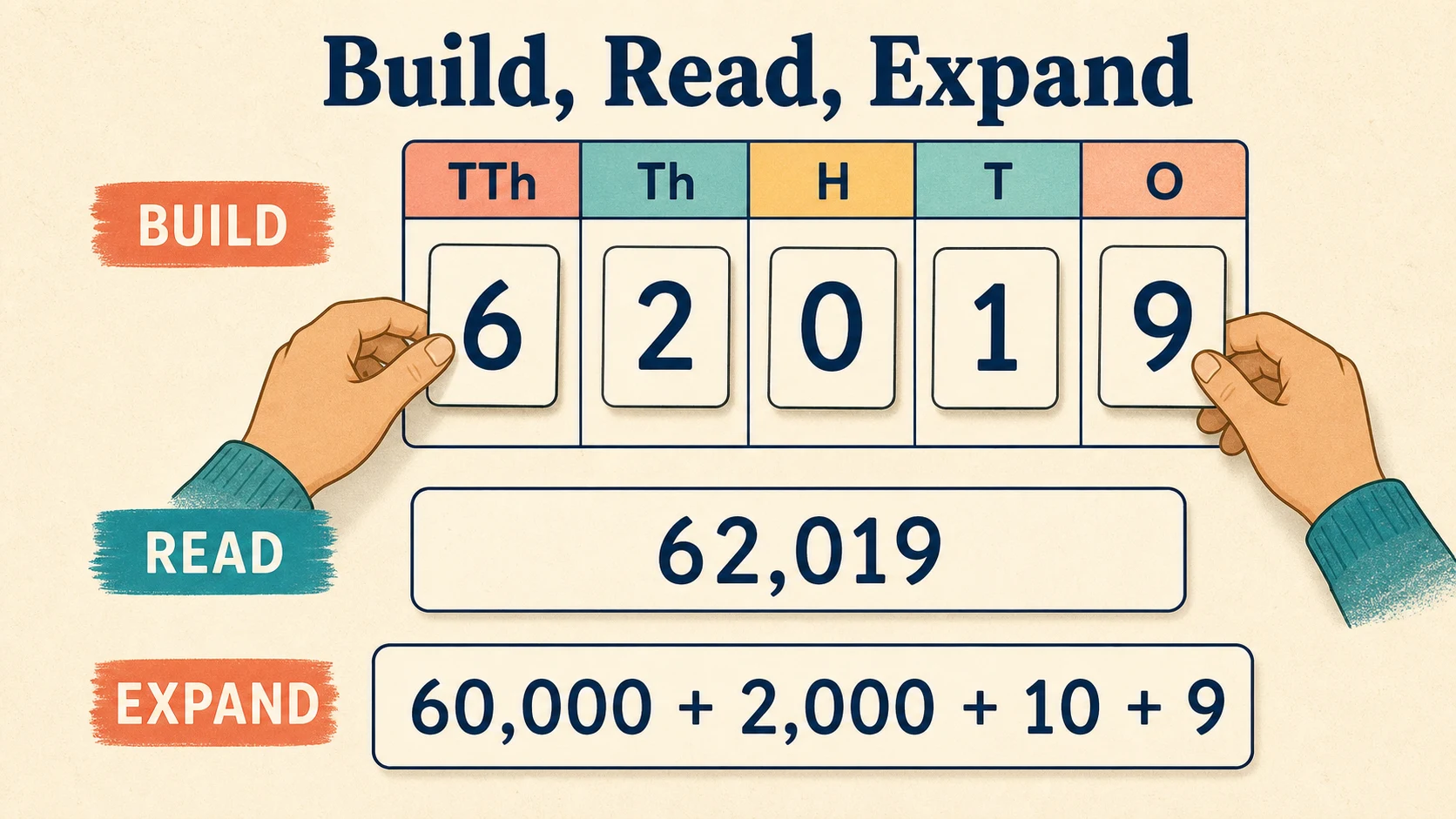
Name the task, represent the number, locate the first incorrect step, and revise.
| Observed work | Possible interpretation | Useful response |
|---|---|---|
| Says the 6 in 364 has a value of 6 | Confuses digit with value | Ask for the digit’s place, then represent 6 tens as 60 |
| Writes | Ignores the hundreds position or zero placeholder | Place 5, 0, and 2 in a labeled chart |
| Says 389 is greater than 412 because 9 is greater than 2 | Compares ones before hundreds | Compare the greatest place first |
| Reverses and while explaining the quantities correctly | Symbol-recording error may be separate from comparison understanding | Read the completed statement aloud and verify its meaning |
| Rounds 72 to 80 | May use an overgeneralized rule or misidentify benchmarks | Mark 70, 72, and 80 on a number line |
| Gives mixed answers without showing work | Cause is not yet visible | Ask for one representation and one verbal explanation |
These interpretations are possibilities, not diagnoses. Confirm them by asking the learner to explain or model a fresh example.
A short correction routine
Use four steps:
- Ask, “What is this problem asking?”
- Have the learner represent the number or identify the relevant places.
- Find the first step where the reasoning changes from correct to incorrect.
- Let the learner revise the original response and explain the change.
After correction, give one similar example with different numbers. If that example is accurate without heavy prompting, continue. If the same misconception returns, pause the worksheet and reteach that skill before assigning more items of the same type.
Use the Answer Key Responsibly
The printable answer key is designed for quick checking, but it should support instruction rather than replace it.
First, solve or inspect questionable items yourself. Then compare the learner’s response with the key. For expanded form, consider whether two equivalent notations express the same value, such as and , while still respecting any requested format.
Mark answers in a way that leaves room for revision. A dot, underline, or “check again” notation can invite the learner to revisit the item without revealing the answer immediately.
Separate accuracy from understanding
A correct answer can come from sound reasoning, a guess, or a copied pattern. Ask for an explanation on a small sample rather than requiring an explanation for every item.
Likewise, an incorrect written answer can follow mostly correct reasoning. A learner may correctly determine that 458 is greater than 452 but draw the comparison symbol backward. Record both pieces of evidence: the comparison concept appears secure, while symbol use needs practice.
Look for clusters, not just totals
Group missed items under the four worksheet skills. For example:
- Place value: 1 error
- Expanded form: 3 errors with zeros
- Comparison: no errors
- Rounding: 2 errors identifying benchmarks
That profile gives a clearer next step than “14 out of 20.” It shows where support should be concentrated and which skills do not need unnecessary repetition.
Do not use one worksheet score to make broad claims about grade placement, ability, or future performance. The page is a brief practice sample with four related skills, not a comprehensive assessment.
Decide What to Do Next
Use the learner’s observed work to choose among review, continued practice, or broader application.
Reteach one idea
Pause and reteach when errors share a clear cause. If the learner repeatedly treats the tens digit as ones, return to grouping and trading: ten ones compose one ten, and ten tens compose one hundred. Then retry only a few relevant problems.
If rounding is the only difficulty, first determine whether it has been taught in the learner’s current sequence. Unfamiliar content calls for instruction, not repeated correction.
Repeat with reduced support
Use another short set when the learner succeeds with a chart or model but cannot yet work without it. Begin with the support that produced accurate reasoning, then remove one element at a time.
The free worksheet generators can provide fresh items when a learner needs additional practice without memorizing the completed page. Choose numbers and problem types that match the observed need.
Move to mixed or extended practice
Move forward when the learner can explain the place values, use expanded form accurately, compare from the greatest place, and apply the taught rounding convention with little assistance.
The 2nd Grade Place Value Worksheet Pack contains 18 worksheets and can support broader practice. It is a paid pack listed at $4.79, so use the free worksheet and topic guide first to decide whether that additional volume suits your setting.
Schedule Retrieval Instead of Immediate Repetition Alone
Completing the page once shows current performance. Revisiting a few examples after a delay gives better evidence that the learner can retrieve the ideas again.
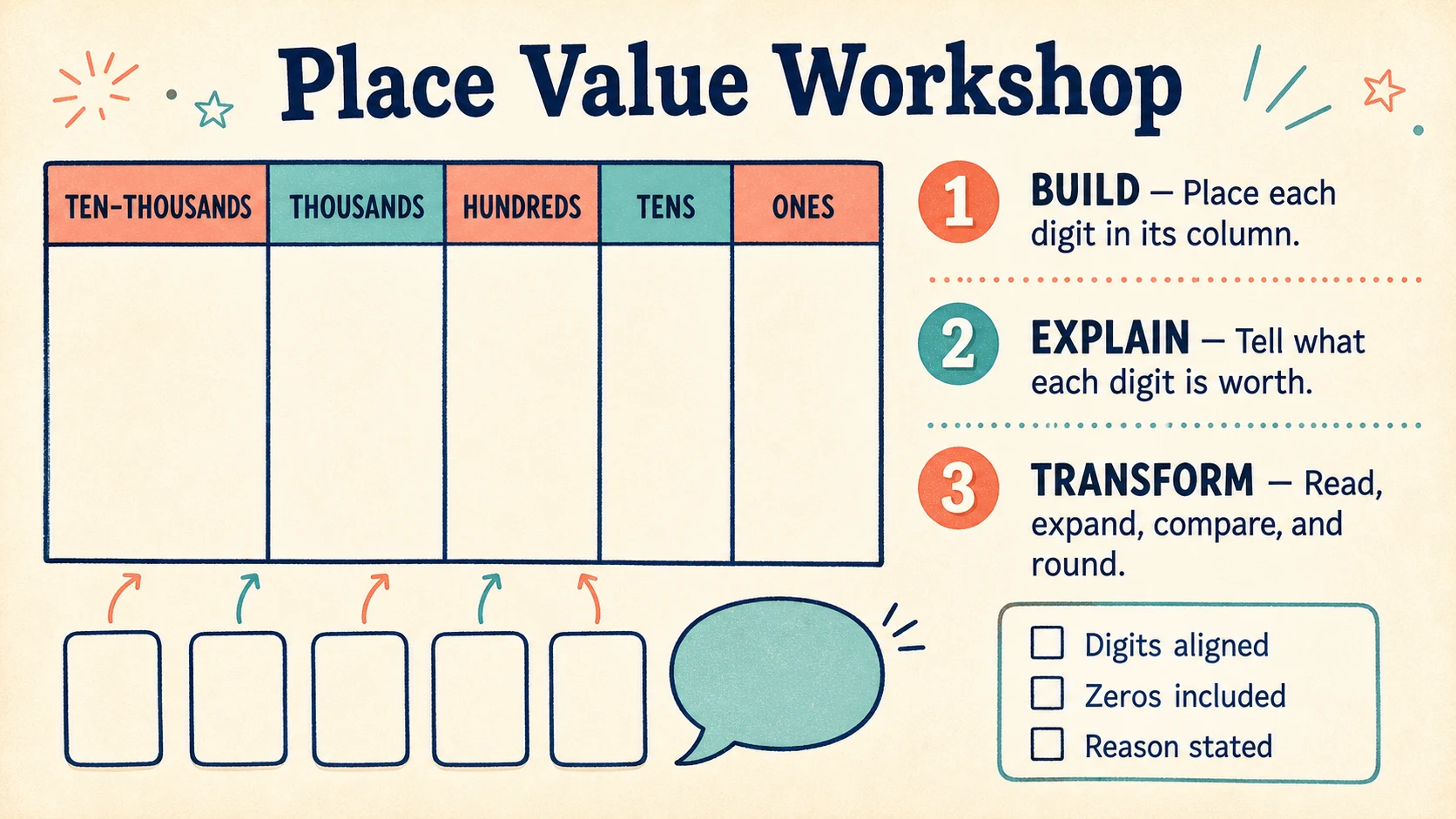
Revisit a small mixed sample after increasing intervals and adjust from observed work.
A practical, adjustable schedule might be:
| Time | Suggested review | Decision point |
|---|---|---|
| Same session | Correct selected errors and solve one parallel example | Can the learner explain the repaired reasoning? |
| Next study session | Solve three or four mixed problems without viewing the completed sheet | Which skill is retrieved independently? |
| Several days later | Complete a brief mix of place value, expanded form, comparison, and any taught rounding | Do earlier errors recur? |
| One or two weeks later | Include place value in a wider math review | Can the learner select a method without being told the problem type? |
This is an instructional suggestion, not a universal timetable. Shorten the interval if the learner forgets the method completely. Lengthen it if retrieval is consistently accurate. Keep delayed reviews brief enough that they test recall rather than become a second full lesson.
Limits of This Printable
This worksheet offers 20 easy-level exercises and an answer key. It can provide useful practice and a compact sample of work across four named skills, but it cannot by itself establish comprehensive mastery of place value.
It does not replace:
- Direct instruction when a skill is new
- Concrete representations when digits are not yet connected to quantities
- Conversation about the learner’s reasoning
- A broader sequence of place value experiences
- Local curriculum decisions about when rounding is introduced
- Formal evaluation when one is required by a school or qualified professional
The worksheet also should not be presented as medical, developmental, or child-specific guidance. Adults can observe mathematical work and adjust instruction, but should avoid drawing conclusions outside the evidence the page provides.
The Most Useful Next Action
Download the free 20-item worksheet and answer key, preview its four problem types, and select one unprinted example of each type to model. After the learner completes a short independent set, use the error categories above to choose the next step. For a broader sequence beyond this single printable, continue with the free 2nd Grade Place Value topic guide.
Put it into practice
Use the guide with a real printable
Move from explanation to a short, observable practice task. Check the first item together, then adjust the next session from the learner's actual work.
See the 18-worksheet pack