Complete guide
How to teach and practise 2nd grade multiplication worksheets - standard theme (easy)
What this worksheet is for
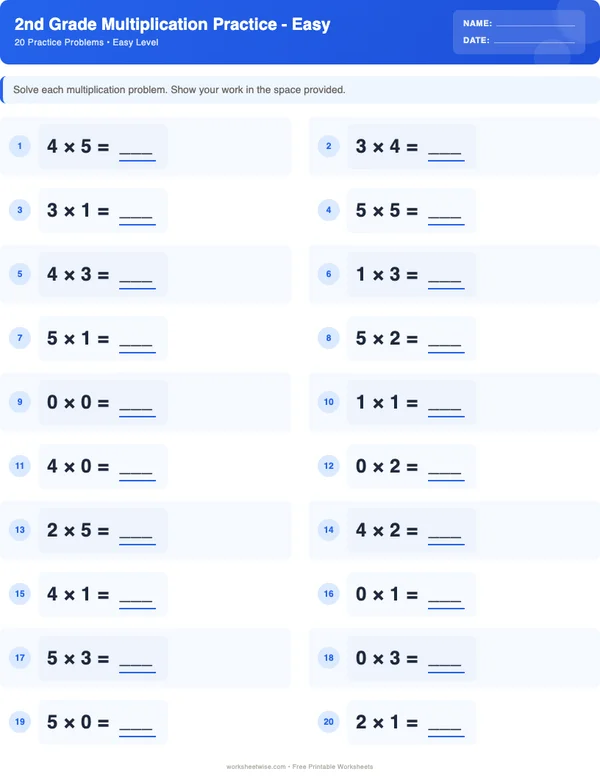
The free 2nd Grade Multiplication worksheet provides 20 easy-level multiplication exercises. It asks the learner to solve each problem and show work in the space provided. The practice targets multiplication facts, times tables, mental math, and number sense. A separate printable answer key is included.
The short answer: use this printable after the learner has met the idea of equal groups. Model one problem with objects or a drawing, solve two or three together, and then let the learner complete a manageable portion independently. Check not only the products but also how the learner reasoned. If an error appears, return to equal groups, an array, skip counting, or repeated addition before asking for another attempt.
This is introductory practice, not a complete multiplication course or a test of everything a learner understands. Early multiplication concepts can appear in second grade through equal groups and arrays, but grade labels describe an intended practice level, and local school or homeschool sequences differ. The Common Core mathematics standards place formal interpretation and fluency expectations for multiplication primarily in later grades. Consult the Common Core State Standards for Mathematics and your local curriculum when you need to determine formal grade-level expectations.
For a fuller sequence from models to fact practice and later computation, use the broader multiplication topic guide instead of trying to turn this single page into the whole progression.
A practical lesson map
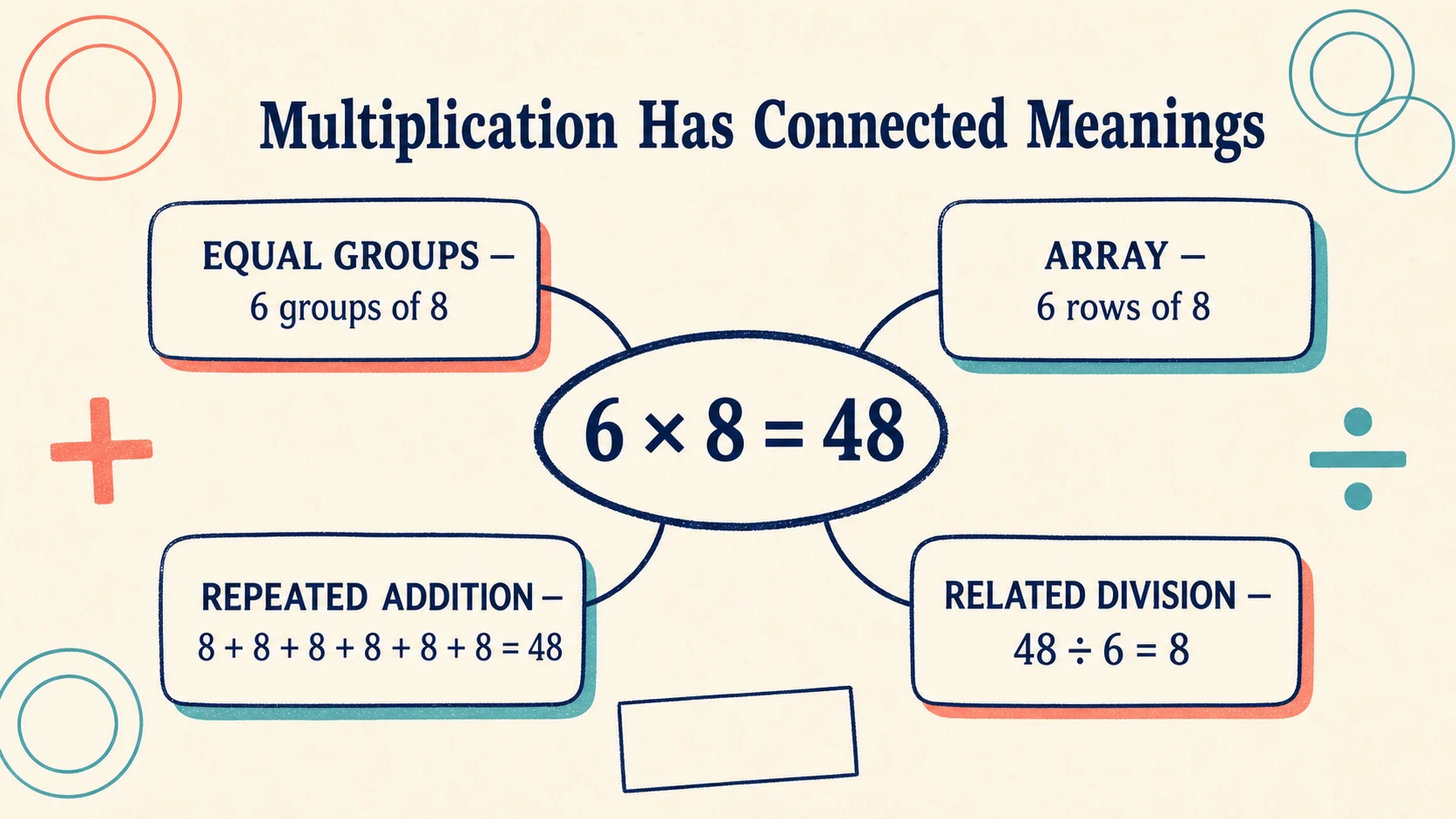
Move from meaning to supported practice, then to a short independent attempt and a careful review.
A first session can be brief and responsive. The following plan is a starting point, not a universal timetable. Shorten, divide, or extend it according to the learner’s observed work.
| Lesson phase | Adult action | Learner action | Evidence to notice |
|---|---|---|---|
| Prepare | Print the worksheet and keep the answer key out of sight. Gather counters or small objects and blank paper. | Get ready to explain multiplication with groups or drawings. | Comfort with counting equal sets |
| Launch | Read the directions and discuss what the multiplication sign means in one example. | Describe the factors and make equal groups. | Whether both factors have meaning |
| Model | Solve one problem aloud using a representation and an equation. | Watch, ask questions, and check the count. | Connection between model and product |
| Guide | Complete two or three problems together. Prompt rather than supply answers. | Draw, count, explain, and record. | Strategy choice and accurate counting |
| Practice | Assign a small set or the remaining items, depending on readiness. | Work independently and show enough reasoning to make the method visible. | Accuracy, pace, confidence, and self-correction |
| Review | Compare work with the answer key and inspect errors. | Rework selected items without copying. | Whether understanding improves after feedback |
| Retrieve | Revisit a few facts after a delay. | Solve from memory, then verify with a model if needed. | What remains accessible over time |
This structure is consistent with the high-level instructional emphasis in the IES guide on teaching mathematics to young children: adults can help learners connect mathematical language, representations, and purposeful practice. The source offers broad instructional guidance; it did not evaluate WorksheetWise or this particular printable.
Before the learner begins
Check the prerequisite idea
Ask the learner to make three equal groups of two counters. Then ask:
- How many groups are there?
- How many counters are in each group?
- How many counters are there altogether?
A learner who can build the groups and count the total has a concrete starting point for . The learner does not need instant recall before using the worksheet. However, if “equal groups” is unfamiliar, spend the first session on models and complete only a few printed items.
Unequal groups are an important boundary. A collection of 2, 3, and 2 counters does not directly model three equal groups of two. Help the learner adjust the sets so every group contains the same amount. This protects the central meaning of multiplication rather than reducing the task to symbol recognition.
Prepare simple supports
Useful materials include counters, blocks, coins used only as counters, buttons, or small paper squares. Blank paper can hold arrays and repeated-addition equations. A number line may help a learner track equal jumps.
Choose manipulatives that are easy to count and move. Ten identical counters are usually more useful than a distracting collection of unrelated toys. The materials support the mathematics; they are not a separate activity.
Before starting, decide how much of the page will be visible. A blank sheet can cover later rows if seeing 20 items feels overwhelming. This changes the amount presented at once, not the multiplication skill.
Launch the exact printable
Read the printed direction: “Solve each multiplication problem. Show your work in the space provided.” Clarify that showing work does not require one rigid method. Depending on the item and the learner, visible work might be:
- equal groups;
- an array;
- skip-counting marks;
- repeated addition;
- a known-fact note;
- a brief decomposition, when appropriate.
Give the learner a simple purpose: “We are practicing how equal groups can be recorded as multiplication. I will solve one, we will solve a few together, and then you will try some on your own.”
Avoid presenting all 20 items as a speed challenge. This worksheet includes mental-math and times-table practice, but fast answers alone do not reveal whether the learner understands the operation. Early accuracy with a sensible strategy is more informative than rushed completion.
Use precise language
For , say “four groups of three” when that is how the expression is being modeled. Point to 4 as the number of groups and 3 as the amount in each group. Then count the total.
Some adults and curricula describe factors in different orders when interpreting an array. That difference does not alter the product, but switching language without explanation can confuse a beginner. Choose one interpretation for the model, state it clearly, and acknowledge that rotating an array shows why and have the same total.
Model one complete multiplication problem
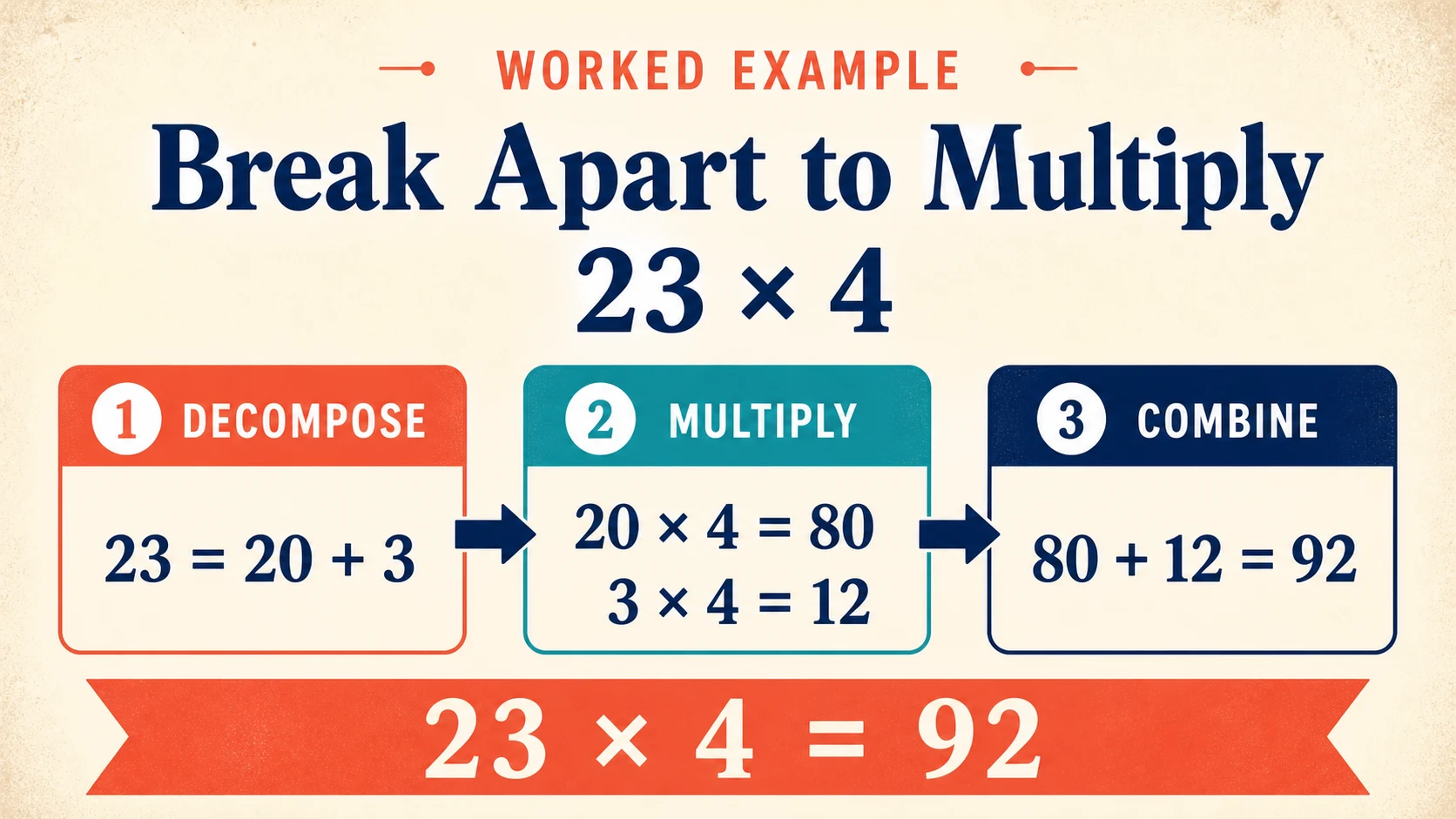
Connect the symbols to equal groups, repeated addition, and the checked product.
The examples below are illustrative problems similar to the worksheet’s stated skill; they are not a transcription of its 20 items.
Worked example 1:
Interpret the expression as three equal groups with four in each group:
- Group 1: ● ● ● ●
- Group 2: ● ● ● ●
- Group 3: ● ● ● ●
Write the matching repeated addition:
Therefore:
Check it a second way by skip counting three groups: 4, 8, 12. Both methods produce 12.
Model your thinking briefly: “The 3 tells me how many equal groups to make. Each group has 4. I can add 4 three times, so the product is 12.”
Worked example 2:
Make two groups of five:
Then record:
Check by counting an array with two rows of five. The first row contains 5 objects and the second contains 5 more, for 10 altogether. A learner might also skip count 5, 10.
This example can reveal whether the learner counts the number of objects or merely adds the factors. If the answer is 7, rebuild the two groups and compare with .
Move into guided practice
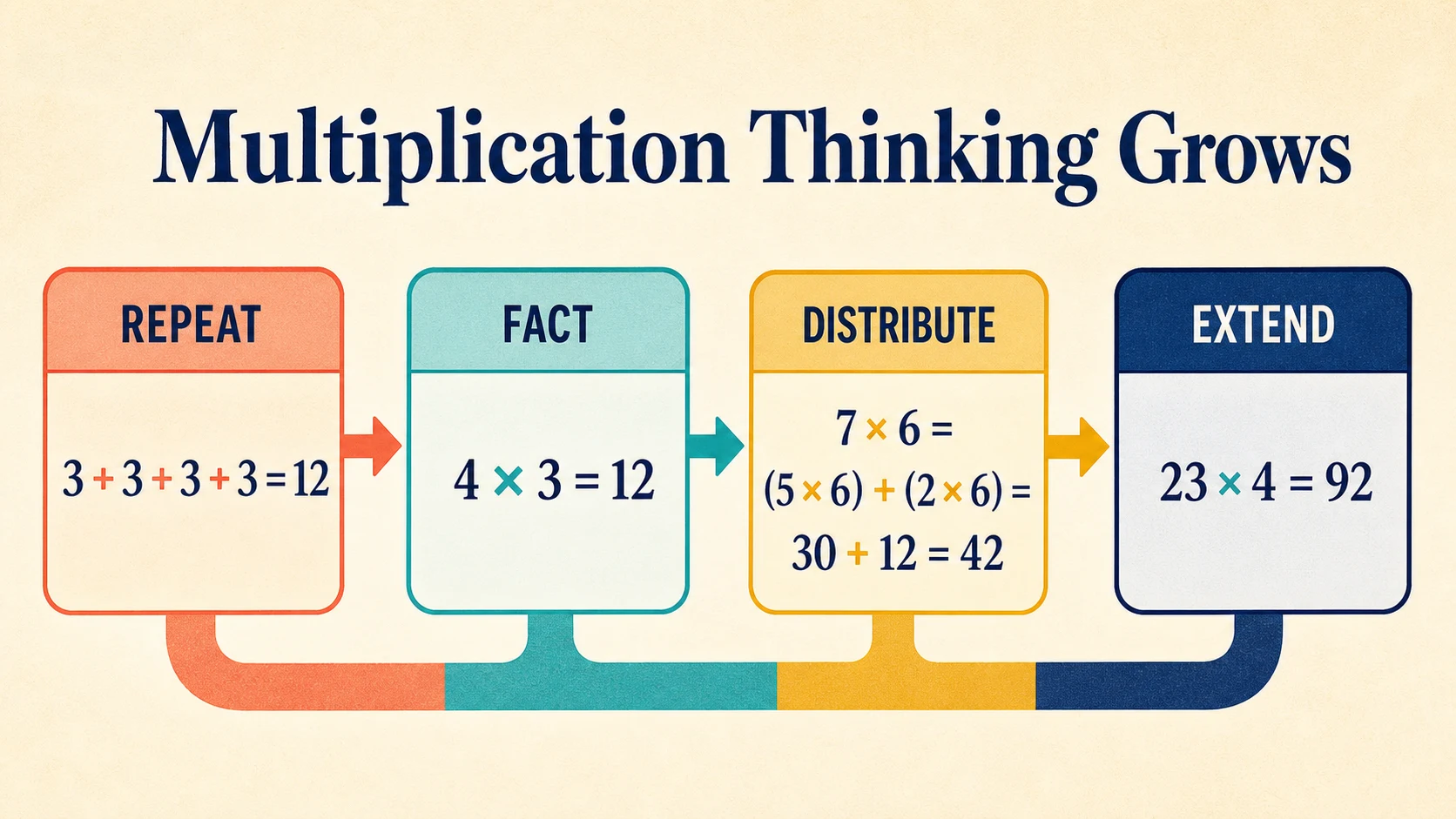
During guided practice, prompts should expose the learner’s reasoning without taking over the task.
Select two or three worksheet items. Ask the learner to choose a representation and explain what each factor means. Helpful prompts include:
- “How many equal groups will you make?”
- “How many belong in each group?”
- “What repeated addition matches your model?”
- “How can you check the total?”
- “Does your answer make sense for groups of this size?”
Give enough wait time for the learner to build or draw. If counting becomes disorganized, suggest arranging objects in rows or touching each item once. Do not immediately replace the learner’s strategy if it is correct and manageable.
Worked example 3:
Draw four groups of two:
So:
Check by doubling 4:
The first method treats the expression as four groups of two. The second uses the fact that multiplying by 2 gives two copies of a number. Both confirm the product.
Now rotate the array. Two rows of four also contain 8 objects:
This is a useful observation about the commutative property, but the learner should still be able to describe the original model.
Worked example 4:
Interpret the problem as five groups of three:
Skip-counting by 3 gives:
Therefore:
Check by rearranging the same 15 objects into three rows of five:
The two arrangements look different, but neither adds nor removes an object. The product remains 15.
After these guided items, ask the learner to summarize the routine: identify the groups, represent them, find the total, and check.
Set up independent practice
Independent does not have to mean completing all 20 exercises in one sitting. Use the learner’s guided work to set the first amount.
If the learner represented the examples accurately and explained the factors, assign a short run of items without help. If the learner still confused groups with the amount in each group, keep the next problem guided. If the mathematics was sound but counting was tiring, allow counters or a number line during independent work.
A neutral direction works well: “Try the next five. Mark any item you are unsure about, and I will look at your method afterward.” This invites persistence without implying that uncertainty is failure.
During the attempt, observe quietly:
- Does the learner recognize the multiplication sign?
- Is a strategy chosen without repeated prompting?
- Are groups kept equal?
- Does counting remain organized?
- Are facts recalled accurately or reconstructed successfully?
- Does the learner notice an unreasonable answer?
- Is the main difficulty mathematical, or is it related to recording and page management?
These observations should drive pacing. A learner who solves five carefully and explains them may be ready for another set. A learner who guesses, loses track, or becomes increasingly inaccurate needs a pause and a return to representation.
Adapt support without changing the skill
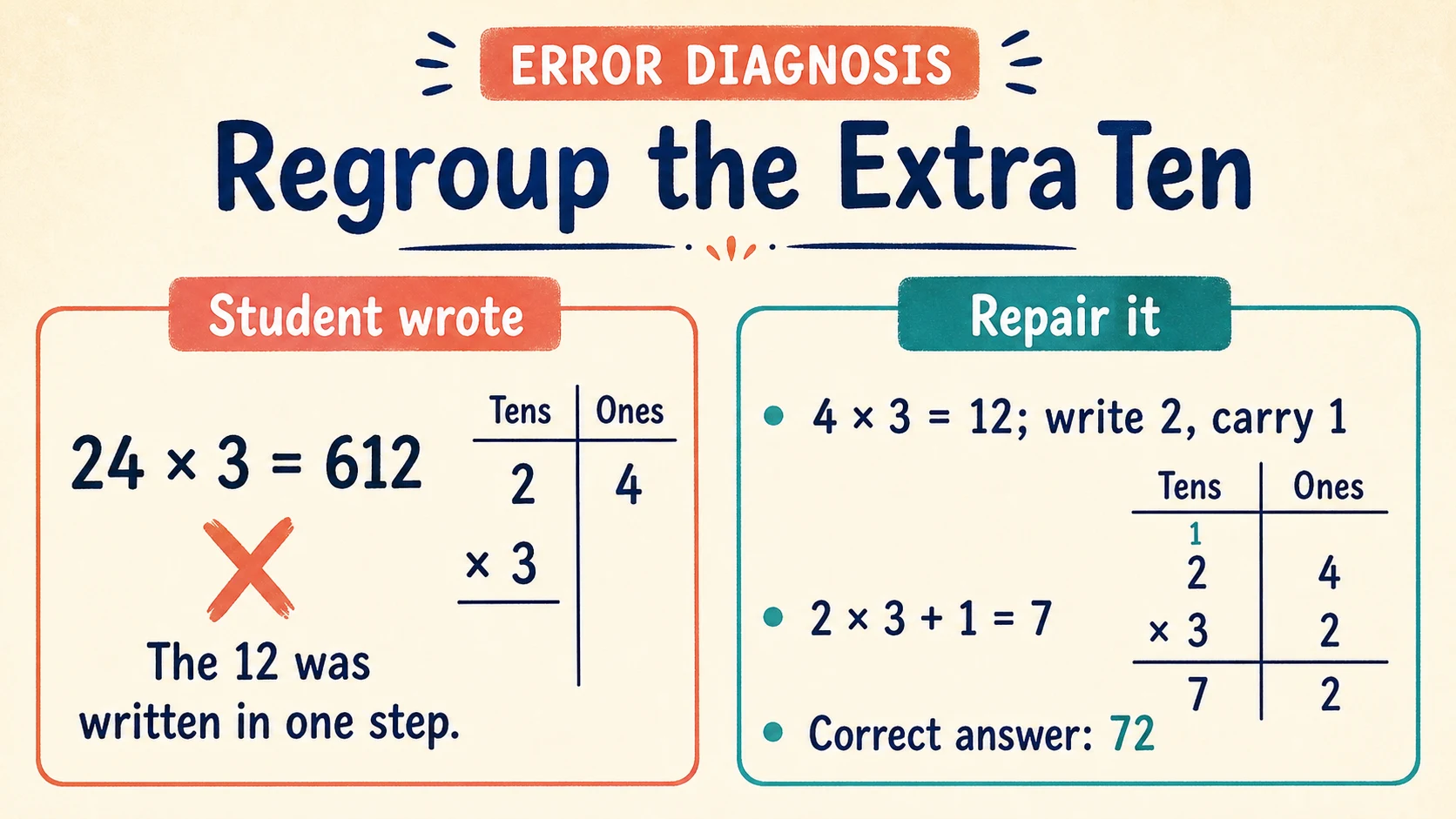
Adjust access, representation, or workload while keeping equal-group multiplication at the center.
When the learner needs more concrete support
Let the learner build each problem with counters before writing the answer. Place counters into cups, circles drawn on paper, or evenly spaced rows. Ask for the matching equation after the total is found.
You can also pre-draw empty group circles while leaving the learner responsible for placing the correct number in each. This reduces drawing demands without solving the multiplication.
For example, with , provide three empty circles. The learner places two counters in each, counts 6, and records:
When the learner understands but works slowly
Cover most of the page and reveal four or five items at a time. Permit a multiplication model card that shows equal groups, an array, and repeated addition as possible methods. Avoid placing completed facts on the support unless fact lookup is the intended accommodation; otherwise, the card may turn practice into copying.
Allow oral explanations when handwriting obscures what the learner knows. The learner can say, “Four groups of three make twelve,” and then record only the equation. The mathematical demand remains multiplication.
When the learner is ready for less support
Ask for a mental answer first, followed by a quick verification on selected items. Another option is to have the learner label one familiar fact, one fact reconstructed with a strategy, and one fact that still needs practice.
Do not increase difficulty merely by demanding speed. Instead, ask for a second representation or a relationship between facts. A learner who knows might explain why also equals 10.
The IES practice guide for assisting students who struggle with mathematics supports broad practices such as systematic instruction, clear mathematical language, representations, and purposeful review. Those recommendations provide instructional context, not a judgment about this worksheet or a prescription for an individual child.
Teach the boundary cases carefully
Worked example 5: multiplying by one
Consider:
One group of six contains six:
Check with repeated addition: there is only one addend, 6. The answer is not 7; multiplication by 1 keeps the other factor unchanged.
Now compare:
Six groups of one also total six:
Both expressions equal 6, although their group descriptions differ.
Worked example 6: multiplying by zero
Consider:
Four groups with zero objects in each group contain no objects altogether:
Therefore:
A common incorrect answer is 4, perhaps because the learner applies the “number stays the same” pattern from multiplying by 1. Contrast the models directly:
- Four groups of one contain 4.
- Four groups of zero contain 0.
Also examine:
Zero groups of four contribute no objects. The product is again zero.
These cases belong in instruction when they appear in the learner’s practice or are needed to clarify a misconception. The catalogue identifies this as easy-level fact practice but does not specify which individual facts occur among the 20 exercises, so do not assume every boundary case is printed on the page.
Interpret errors before correcting them
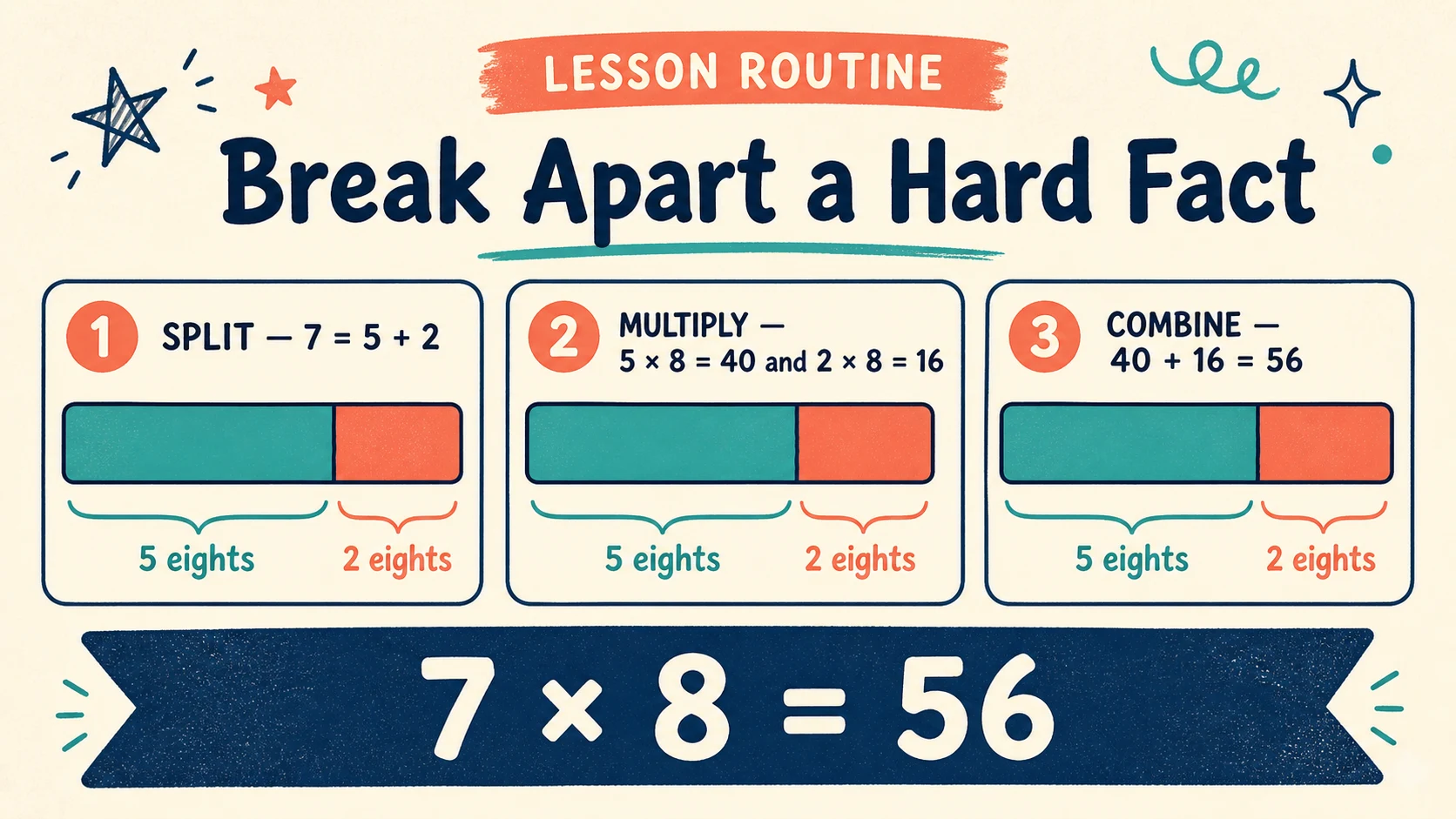
Identify the type of error, rebuild the meaning, and then ask for a fresh solution.
Wrong answers are not all evidence of the same problem. Inspect the written work and ask the learner to explain one item.
| Observed work | Possible interpretation | Useful response |
|---|---|---|
| The learner may be adding the factors. | Build three groups of four and compare with . | |
| Three groups contain 4, 3, and 4 objects | Equal-group meaning is not secure. | Have the learner make every group equal before recounting. |
| Correct groups, wrong total | The multiplication model may be sound, but counting failed. | Arrange objects into an array and count systematically. |
| after writing | One group may have been omitted. | Match each addend to one of the four groups. |
| Correct product with no visible reasoning | The learner may know the fact, or may have guessed. | Ask for a brief explanation or one quick check. |
| One isolated fact is wrong among many accurate answers | It may be a fact-retrieval slip. | Reconstruct that fact, then revisit it later. |
| Errors increase down the page | Attention or effort may be declining. | Stop, preserve the unfinished items, and resume later. |
| Factors are reversed but the product is correct | The numerical result is right, but the model language may be inconsistent. | Ask the learner to describe the original expression and its rotated array. |
Avoid telling the learner merely to “be careful.” Name the action that would help: make the groups equal, track each jump, point to every addend, or estimate whether the product should be larger than either positive factor in these introductory whole-number examples.
One caution about that last check: it has boundary exceptions. Multiplying a positive whole number by 1 leaves it unchanged, and multiplying by 0 gives 0. Teach those cases explicitly rather than treating “the answer gets bigger” as a universal rule.
Use the answer key responsibly
The printable answer key allows an adult to check the products efficiently, but it should not replace examination of the learner’s method.
First, solve or inspect the learner’s page without displaying the key. Compare each recorded answer with the corresponding key item carefully; keep row and item positions aligned. Mark correct answers simply. For an incorrect answer, avoid writing the key’s product directly beside it before the learner has another chance.
Use a three-step correction routine:
- Ask the learner to explain the original method.
- Rebuild or redraw the multiplication if the reasoning is unclear.
- Cover the first attempt and solve again, then compare with the key.
If the second answer still differs, check the adult’s reading of the problem and the answer-key position. Answer keys reduce checking time, but responsible use still includes matching the correct item and verifying unexpected discrepancies independently.
Record patterns rather than only a score. “Adds factors instead of making equal groups” is more useful for planning than “16 out of 20.” Likewise, one corrected counting slip should not be treated in the same way as repeated confusion about what multiplication means.
Do not use the key to infer a diagnosis, a guaranteed level of mastery, or readiness for every later multiplication task. The page samples 20 easy-level exercises within the listed skills. It cannot by itself establish broad achievement, standards mastery, or a child-specific learning need.
Decide what to do after the page
Use the learner’s observed work, explanation, and corrections to choose the next step.
Continue at the same level
Choose more introductory practice when the learner can model equal groups but still needs frequent reconstruction of facts. The 2nd Grade math collection can help you select nearby practice while keeping the broader grade context visible.
The goal is not to repeat pages automatically. Select another activity only if it addresses the pattern you observed, such as maintaining equal groups, connecting arrays to equations, or practicing a small set of facts.
Step back to meaning
Return to concrete equal groups when the learner adds factors, makes unequal sets, or cannot explain what the factors represent. Use objects and drawings before another full worksheet. Complete fewer problems, but require each model to match its equation.
The broader multiplication topic guide is the appropriate place to review the progression from concrete models toward fact fluency. Linking back to that sequence is more useful than trying to make this one worksheet cover every stage.
Add a modest challenge
Move forward when the learner solves accurately, explains at least one strategy, and checks work without depending on the answer key. A useful challenge is to compare related facts, rotate an array, or create a matching equal-groups story.
For sustained practice across the available set, the 2nd Grade Multiplication Worksheet Pack contains 18 worksheets and is listed at $4.79. That pack offers more practice material; it does not remove the need to select pages according to the learner’s current understanding.
Schedule retrieval after the first lesson
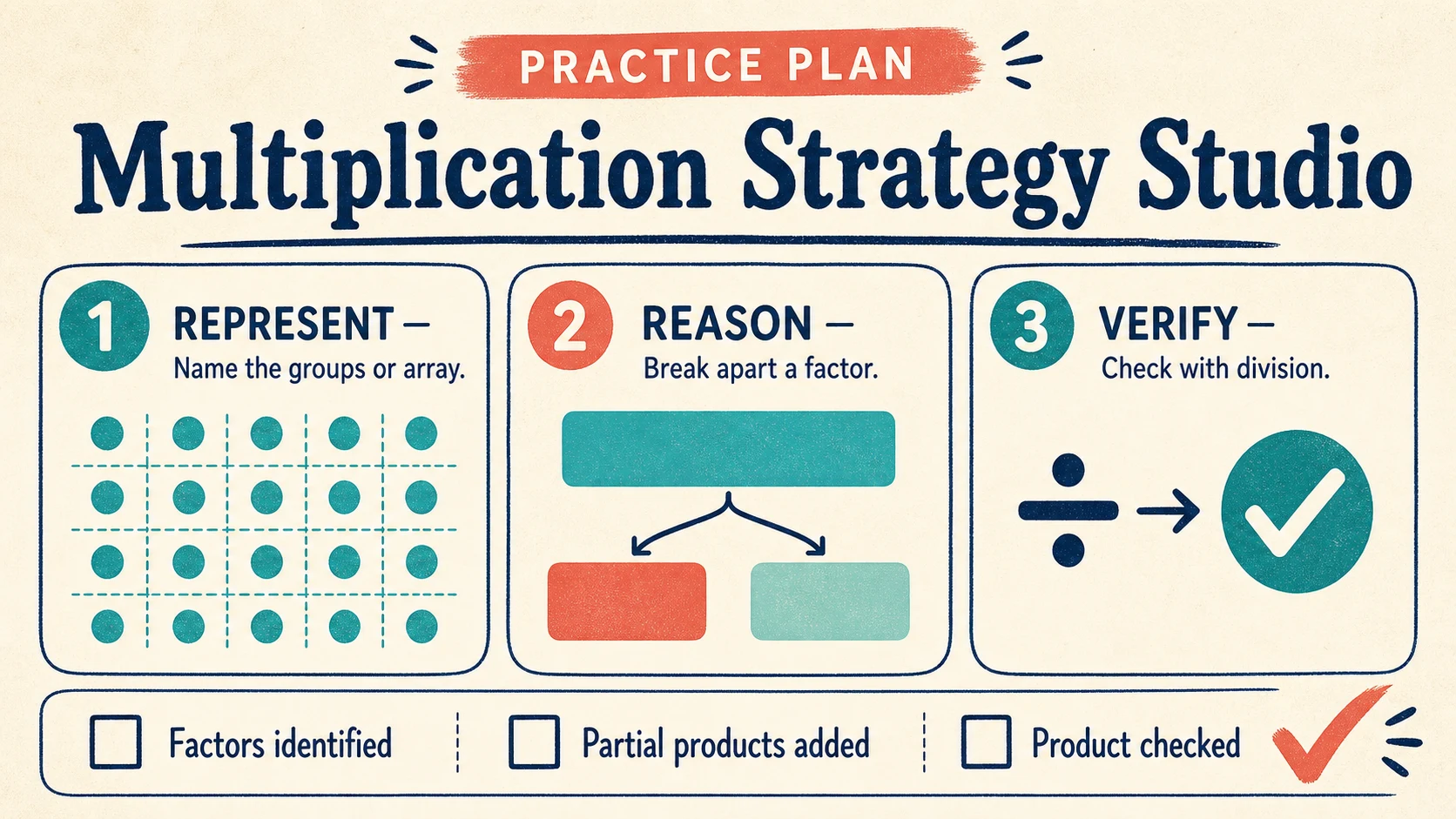
Revisit a small selection after delays and adjust the spacing from what the learner remembers.
Retrieval means asking the learner to bring a fact or method back to mind after time has passed. It is different from immediately repeating the same item while the answer is still visible.
A practical, adjustable schedule is:
| Time | Suggested task | Decision point |
|---|---|---|
| End of the first session | Rework one corrected problem without looking at the earlier answer. | Can the learner now explain the equal groups? |
| Next practice session | Mix three previously attempted facts with one modeled problem. | Are the products remembered or reconstructed accurately? |
| Several days later | Revisit four or five selected facts in a different order. | Which facts remain secure without prompting? |
| About a week later | Use a short mixed review, not necessarily the whole page. | Is the learner retaining both meaning and accuracy? |
| Later review | Include a few known facts among current work. | Does recall remain dependable over a longer delay? |
This is an instructional suggestion, not a sourced universal timetable. Shorten the interval when the learner cannot reconstruct the facts, and lengthen it when recall is accurate and explanations remain sound. If the learner remembers products but cannot connect them to groups or arrays, include a representation in the next review.
You can create a small, targeted follow-up through the free worksheet generators. Select only enough practice to revisit the facts or strategy that actually needs retrieval.
Limits of this worksheet
This printable has a clear, useful scope: 20 easy multiplication exercises with space for work and a separate answer key. It supports practice with multiplication facts, times tables, mental math, and number sense. It may be used in a classroom, for homework, or in a homeschool setting.
It does not, by itself:
- provide the entire conceptual progression for multiplication;
- show that a learner has mastered every multiplication fact;
- establish comprehensive standards alignment;
- determine an individual learner’s instructional placement;
- distinguish reliably between a brief counting slip and a persistent difficulty without conversation and follow-up;
- guarantee fluency, retention, confidence, or later success;
- prescribe how quickly every learner should finish.
The Common Core mathematics standards can help adults compare broad grade-level expectations, while local curricula may introduce or sequence early multiplication differently. The grade label on this resource describes its intended practice level, not a universal rule about when every learner must complete it.
A calm, useful next action
Print the free 20-item worksheet, prepare a few counters, and begin with one modeled equal-groups example. Complete two or three items together, then assign a short independent set based on the learner’s response. Use the answer key only after examining the reasoning.
After correction, choose three facts for delayed review. If the learner still needs conceptual support, return to the multiplication topic guide. If the method is secure and only selected facts need practice, make a short follow-up with the free worksheet generators.
Put it into practice
Use the guide with a real printable
Move from explanation to a short, observable practice task. Check the first item together, then adjust the next session from the learner's actual work.
See the 18-worksheet pack