Complete guide
How to teach and practise 2nd grade money worksheets - standard theme (easy)
How to use this 20-item money worksheet
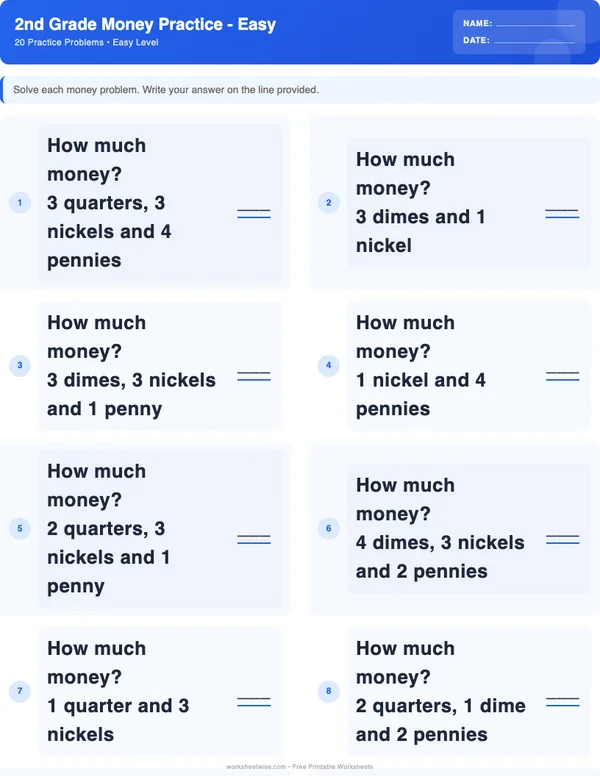
The free 2nd Grade Money worksheet gives a learner 20 easy-level exercises involving coin values, counting money, money operations, and making change. Use it as a short teaching sequence, not merely as a page to finish: model one representative problem, solve two or three together, release the learner to complete a manageable group independently, and then study the work before assigning more practice.
The most useful evidence is not the final score alone. Notice whether the learner can identify coin values, choose an operation, keep dollars and cents organized, and explain how an answer was obtained. If errors cluster around one of those steps, reteach that step while keeping the underlying money skill intact.
Grade labels describe the intended practice level; local curricula and teaching sequences differ. Check the learner’s current instruction rather than assuming every second grader has already encountered every type of money problem on the printable.
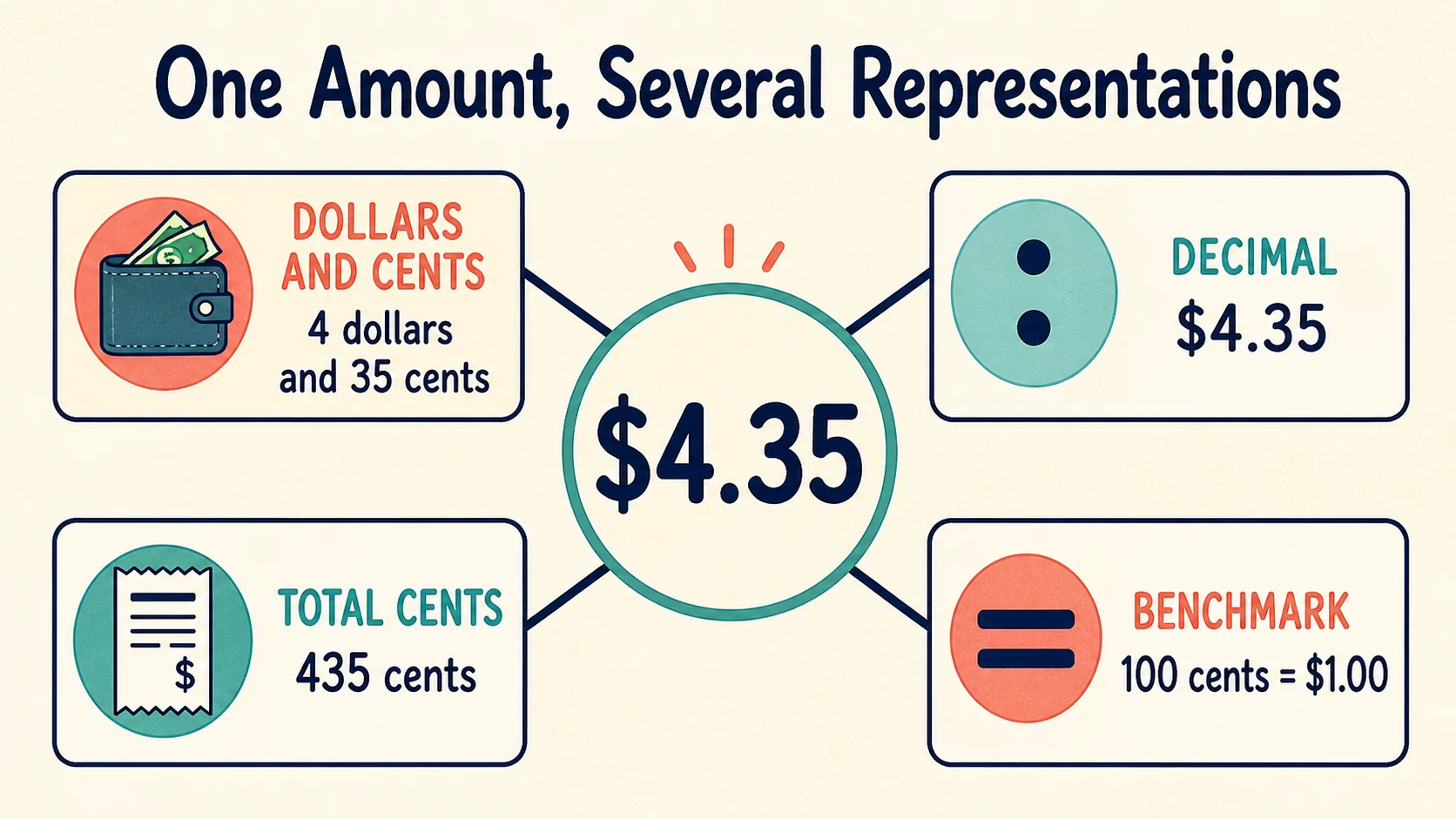
The worksheet works best as a model–guide–practice–review sequence.
What this particular printable practices
“2nd Grade Money Worksheets – Standard Theme (Easy)” contains 20 problems and a separate printable answer key. Its directions are: “Solve each money problem. Write your answer on the line provided.” The catalogue identifies four skill areas:
- Recognizing and using coin values
- Counting money
- Performing money operations
- Making change
The easy designation means the exercises are intended for beginning practice or reinforcement. It does not mean every learner should complete all 20 without instruction, nor does it make speed the main goal. A learner who understands addition but confuses a nickel with a quarter needs different support from one who identifies every coin correctly but subtracts inaccurately.
The broader catalogue progression begins with identifying pennies, nickels, dimes, and quarters and learning their values. It then moves through counting collections, comparing amounts, and solving more involved money problems. See the 2nd Grade Money topic guide for that wider progression rather than trying to turn this one worksheet into a complete unit.
The topic scope also relates to solving problems with dollar bills and common US coins and using dollar and cent notation. The Common Core mathematics standards describe grade-level expectations while emphasizing both understanding and procedural skill. That source did not evaluate this WorksheetWise printable, and the worksheet should not be treated as evidence of comprehensive standards coverage.
| Lesson phase | Adult action | Learner action | Evidence to notice |
|---|---|---|---|
| Preview | Scan the page and select a representative item | Review coin names and values | Which values are recalled without prompting |
| Model | Think aloud through one similar example | Watch, listen, and restate the steps | Whether the explanation makes sense to the learner |
| Guided practice | Solve two or three items collaboratively | Name values, select a method, and calculate | Where prompts are still needed |
| Independent practice | Assign a small group of items | Solve and record answers independently | Accuracy, notation, strategy, and persistence |
| Review | Discuss selected correct and incorrect work | Explain or revise reasoning | Whether an error can be found and repaired |
| Retrieval | Revisit a few examples later | Solve without looking at prior work | What remains available after a delay |
Prepare the learner without pre-solving the page
Gather only the materials that clarify the mathematics
Print the worksheet and keep its answer key out of sight during instruction. Have a pencil and eraser available. Real coins or realistic play coins can help if the learner is still establishing values or has difficulty interpreting coin pictures. A small blank sheet can cover later rows so that only a few problems are visible.
Concrete coins are a representation, not a substitute for thinking. Ask the learner to connect each object to its name and value: “This is a dime. A dime is worth 10 cents.” If the learner can already interpret the printed representations accurately, do not require manipulatives on every item.
The IES guide on assisting elementary students who struggle with mathematics supports systematic instruction, clear mathematical language, and carefully chosen concrete or semi-concrete representations. Those are broad instructional recommendations; they are not a review of this worksheet or a conclusion that every learner needs the same materials.
Run a brief readiness check
Before handing over all 20 items, show or name the four common coins in an order that does not depend on size. Ask for each value:
- Penny: 1 cent
- Nickel: 5 cents
- Dime: 10 cents
- Quarter: 25 cents
Then give one oral count-on prompt, such as “Start at 25 and add 10.” Finally, ask the learner to read 38¢ and $1.38. This check separates coin knowledge, computation, and notation.
Do not turn the check into a long preliminary test. Its purpose is to choose an appropriate starting point. If the learner cannot yet identify several coins, teach those values before expecting mixed-coin counting. If values are secure but counting on is hesitant, model a count-on routine and proceed with guided examples.
State a focused purpose
A useful launch is:
This page practices recognizing coin values, finding totals, working with money amounts, and finding change. We will solve one example together. Then you will try a few while I watch how you approach them.
Tell the learner that explanations matter. A correct answer reached through unclear or accidental reasoning needs another check; a calculation slip within a sound method calls for a smaller correction.
Model a repeatable money routine
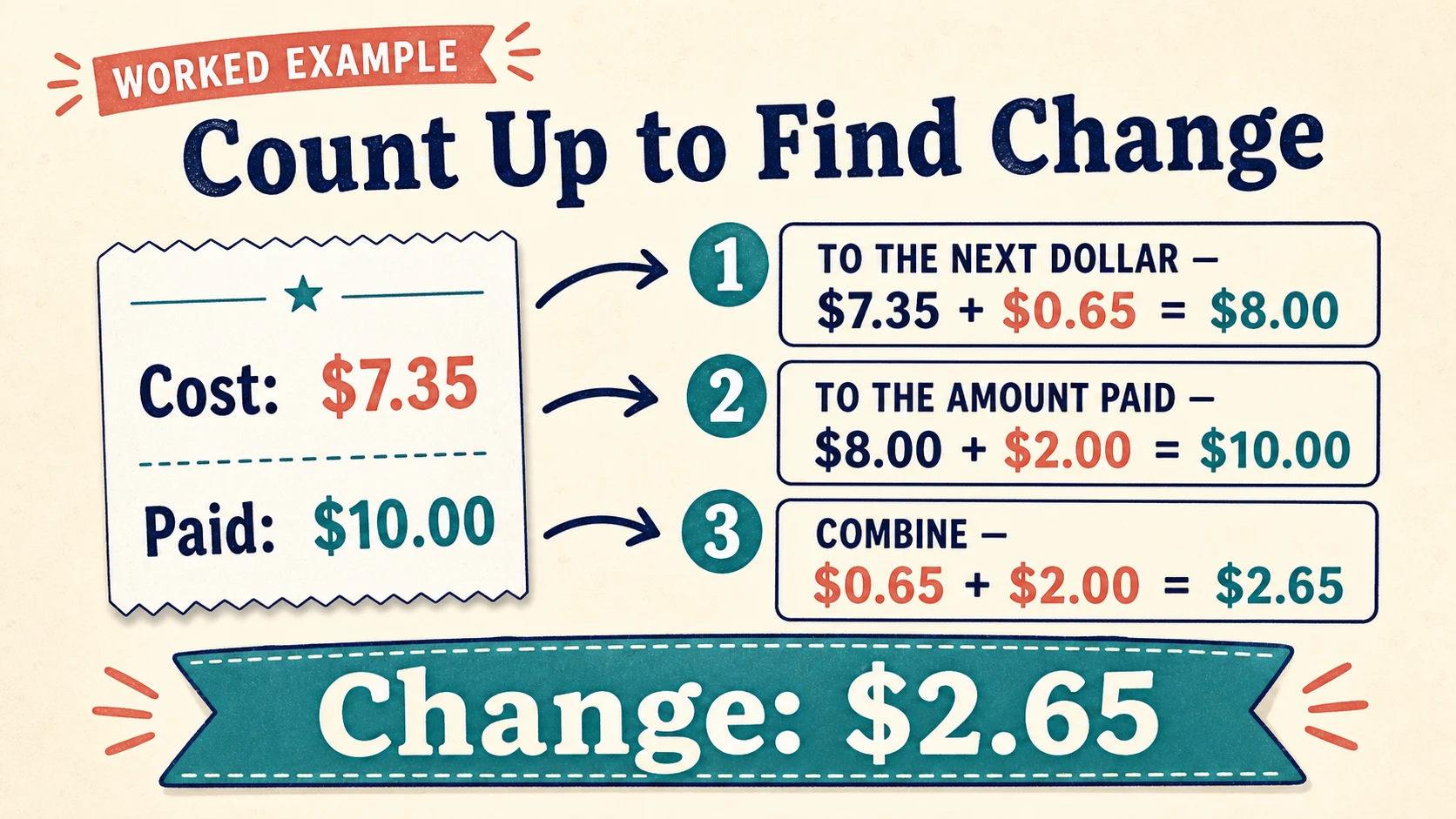
The examples below illustrate the worksheet’s listed skills but do not reproduce its unseen items.
Use four questions on each problem
Model this compact routine:
- What information is given? Name the coins, amounts, or purchase price.
- What must be found? A coin’s value, a total, a sum or difference, or change.
- What operation fits? Count on, add, or subtract.
- Does the answer include the correct unit? Use cents or dollars as the problem requires.
During the first model, say every decision aloud. On later examples, shorten the language and let the learner supply more of it. Consistent wording helps reveal whether the difficulty lies in understanding the task or carrying out the calculation.
Worked example 1: identify a coin value
Representative problem: What is the value of one quarter?
A quarter has a value of 25 cents.
Answer: 25¢
Check: one quarter is worth 25 cents, so both the number and the cent symbol are appropriate.
This example isolates coin knowledge. There is no need to add merely because the topic is money. If the learner answers “25” but omits the unit, acknowledge the correct value and ask what the 25 represents.
Worked example 2: count a mixed collection
Representative problem: Find the total value of one quarter, two dimes, one nickel, and three pennies.
Start with the greatest-value coin and count on:
- Quarter: 25¢
- First dime: 25¢ + 10¢ = 35¢
- Second dime: 35¢ + 10¢ = 45¢
- Nickel: 45¢ + 5¢ = 50¢
- Three pennies: 50¢ + 1¢ + 1¢ + 1¢ = 53¢
The same total can be verified by grouped addition:
25 + 10 + 10 + 5 + 1 + 1 + 1 = 53
Answer: 53¢
The catalogue teaching guidance suggests starting with the greatest-value coin and then counting successively smaller denominations. Present that as the method used here, not as the only mathematically valid order. A different order is acceptable if the learner counts every coin exactly once and obtains the correct total.
Worked example 3: add two money amounts
Representative problem: A pencil costs 35¢ and an eraser costs 24¢. How much do they cost altogether?
“Altogether” indicates addition:
35¢ + 24¢
Separate tens and ones if helpful:
30¢ + 20¢ = 50¢5¢ + 4¢ = 9¢50¢ + 9¢ = 59¢
Answer: 59¢
Check by counting on from 35: add 20 to reach 55, then add 4 to reach 59. Both methods agree.
Keep the notation consistent. Since the total is less than one dollar and the quantities are written in cents, 59¢ is clear. $0.59 represents the same amount, but the learner should follow the notation requested or modeled by the item.
Worked example 4: find change within one dollar
Representative problem: An item costs 67¢. You pay with $1.00. How much change should you receive?
One dollar equals 100 cents. Subtraction gives:
100¢ − 67¢ = 33¢
Verify by counting up:
- From 67¢, add 3¢ to reach 70¢.
- Add 5¢ to reach 75¢.
- Add 25¢ to reach 100¢.
- Total added:
3¢ + 5¢ + 25¢ = 33¢.
Answer: 33¢
A final check is 67¢ + 33¢ = 100¢, which equals $1.00.
The count-up method is especially useful because it keeps the starting price and payment visible. Do not require a specific set of physical coins unless the problem asks for coins; the mathematical target here is the amount of change.
Boundary cases worth modeling briefly
A boundary case exposes whether the learner understands the idea rather than relying on a surface pattern.
If an item costs 50¢ and the payment is 50¢, then:
50¢ − 50¢ = 0¢
The change is 0¢, not 50¢. The payment and cost are equal.
If two quarters and five dimes appear together, their values are:
25 + 25 + 10 + 10 + 10 + 10 + 10 = 100
The total is 100¢, which is also $1.00. This checks the relationship between cents and dollars.
If a collection contains a dime and a nickel, the dime is worth more even though it is physically smaller. Coin size alone does not determine value.
These examples need not all become extra exercises. Use one only when the learner’s work suggests the corresponding confusion.
Move from guided to independent practice
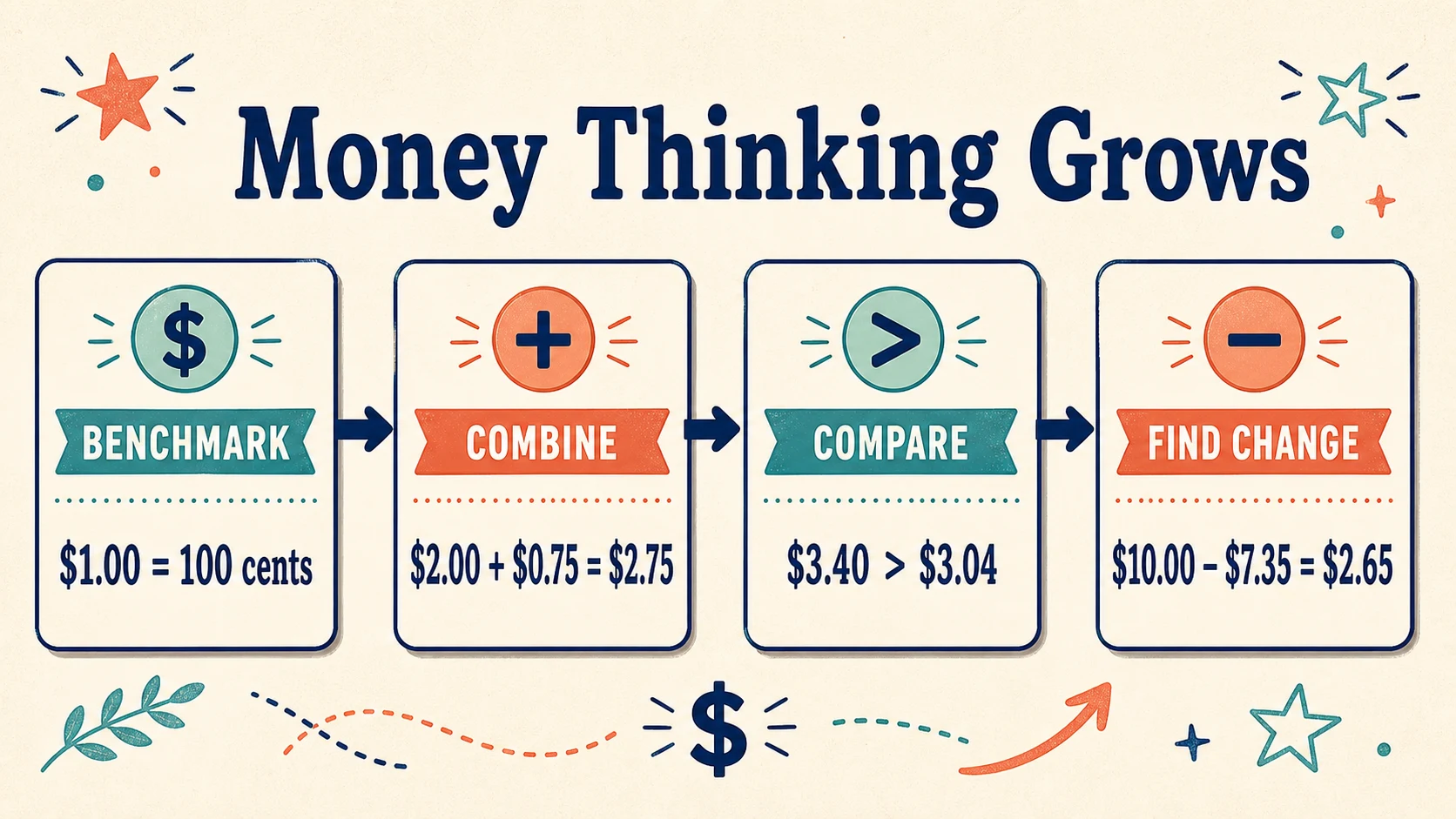
Guided practice should reveal the learner’s decisions before the adult steps back.
Guide with prompts, not answers
Choose two or three worksheet items that represent different listed skills when possible. Ask the learner to point, name, and calculate. Useful prompts include:
- “What is this coin called, and what is its value?”
- “What are you trying to find?”
- “Which amount will you start with?”
- “Will you add, subtract, or count on?”
- “How can you check that total?”
- “Should the answer use cents or dollars?”
Wait long enough to see the learner’s first move. An immediate prompt can hide what the learner knows independently. If the learner stalls, reduce the prompt gradually: first ask for the whole plan, then ask for the first step, and only then model that step.
The IES guide for teaching mathematics to young children is aimed at preschool, prekindergarten, and kindergarten, not second grade. Its broader framing around developmental progressions and monitoring what a child knows is still a useful planning principle here. It should not be presented as a second-grade worksheet endorsement.
Release the page in manageable groups
After guided success, assign a small section rather than automatically requiring all 20 in one sitting. For example, the learner might complete four items, pause for a quick review, and then continue if the method remains stable. This is an instructional suggestion, not a universal timetable.
During independent work, avoid confirming every answer. Observe silently and record brief notes:
- Identifies coin values without help
- Counts every coin once
- Starts with a useful amount
- Selects addition or subtraction appropriately
- Records a unit
- Checks an answer without being told how
If the first group is accurate and well explained, release another group. If the same conceptual error appears twice, pause before it becomes rehearsed. If the issue is a single arithmetic slip and the learner can repair it, continued practice may be reasonable.
Adapt support without changing the skill
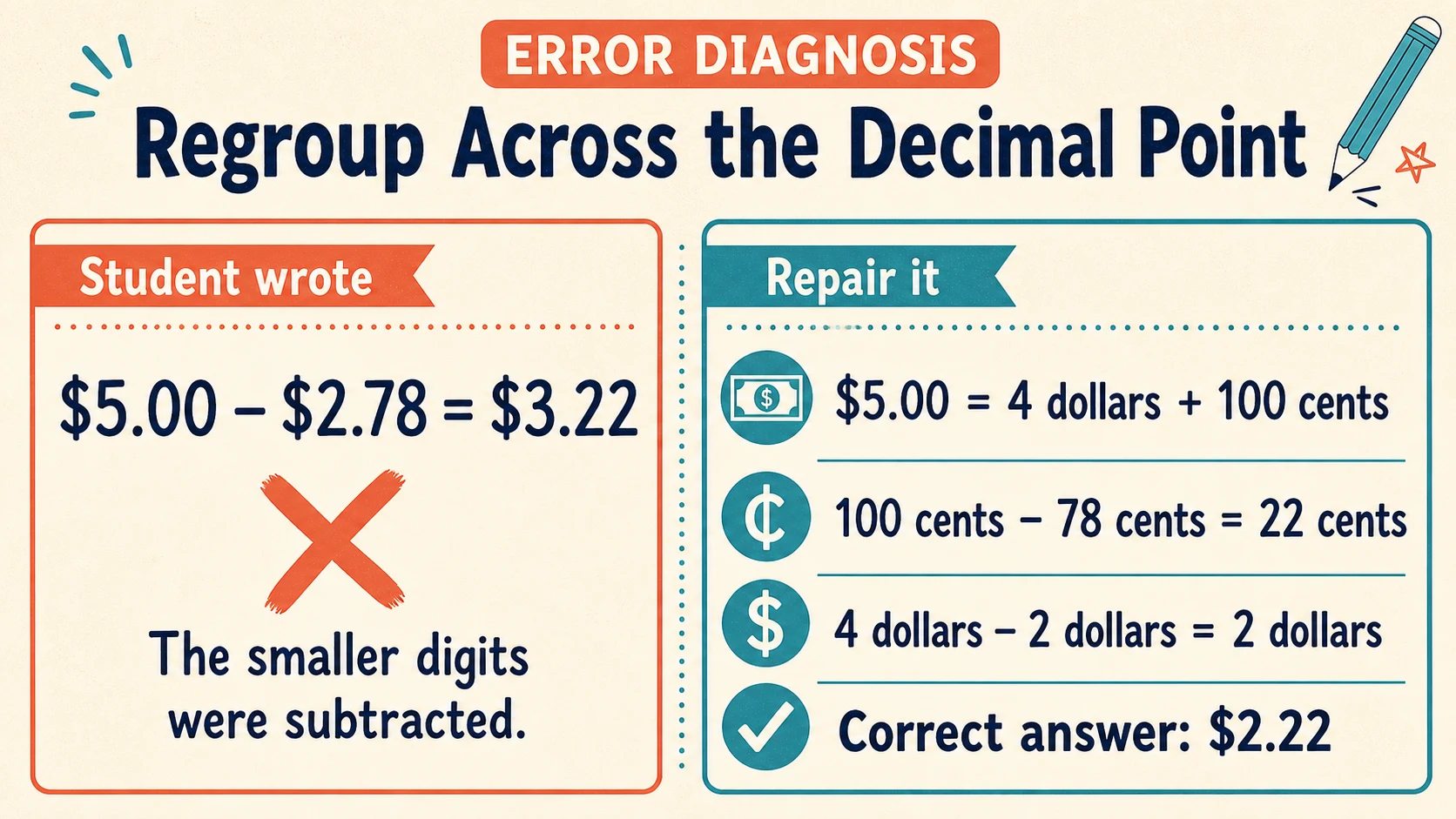
Adjust access, prompting, or amount of work while preserving the money objective.
Increase access for a learner who needs more support
Use real or play coins beside the printed problem. Ask the learner to match each printed coin to a concrete coin, name it, and state its value. The learner should still solve the same counting or change problem.
Cover all but one row to reduce visual load. Read written directions aloud if decoding the directions is interfering with the mathematics. Offer a coin-value reference during initial practice, then remove it for a later check. Let the learner write running totals such as 25, 35, 45, 50 instead of holding every value mentally.
These changes preserve the target. Replacing a mixed-coin problem with “count three pennies” would change its mathematical demand and would not show whether the original skill has been learned.
Support the learner who knows coins but loses track
Have the learner mark each coin once it has been counted. Coins can be numbered in counting order or lightly crossed off. For a mixed set, sort by value or write a list before calculating.
A simple recording format is:
25 + 10 + 5 + 1 + 1 = ___
This externalizes the sequence without completing the arithmetic. If the resulting equation is correct but the total is not, the evidence points toward computation rather than coin recognition.
For change, write a three-part frame:
payment − cost = change
The learner supplies the amounts and calculates. The frame clarifies the relationship while leaving the actual money problem intact.
Extend without racing ahead
A learner who completes the easy page accurately can explain two solutions rather than simply receiving more of the same. Ask for a second way to check a total, a different coin combination with the same value, or a short purchase problem using one of the amounts.
For example, after finding 40¢, the learner might show:
- Four dimes:
10 + 10 + 10 + 10 = 40 - One quarter, one dime, and one nickel:
25 + 10 + 5 = 40
This extension stays within coin values and money operations. Do not assume readiness for multi-step dollar-and-cent work solely because one worksheet was easy.
Interpret mistakes as evidence
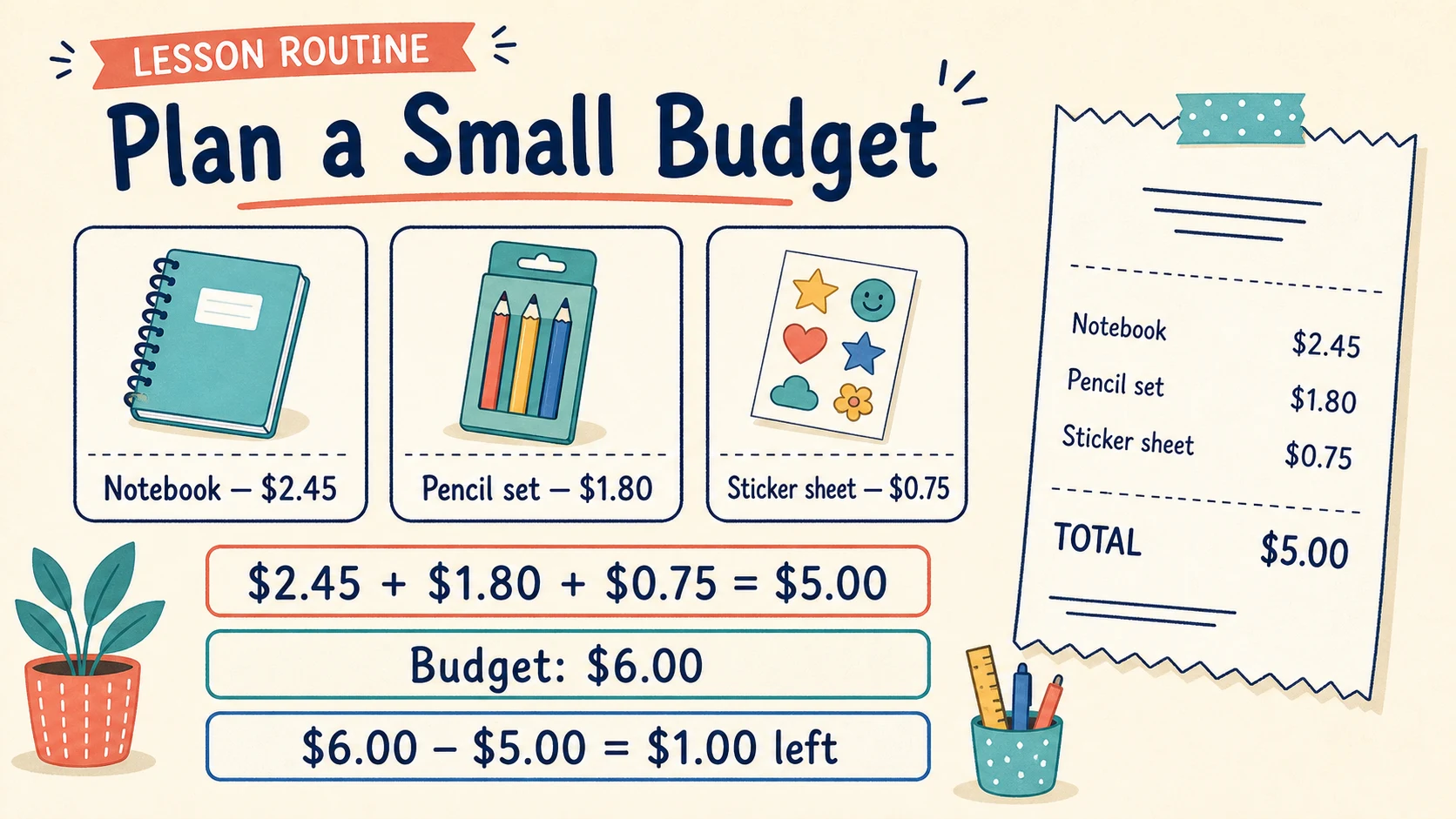
Locate the first incorrect decision, repair it, and then check a fresh item.
Separate conceptual errors from calculation slips
A wrong answer can come from several places:
| Observed work | Likely issue to investigate | Useful response |
|---|---|---|
| A nickel is repeatedly counted as 10¢ | Coin-value confusion | Compare a nickel and dime; name each and state its value |
| Coins are skipped or counted twice | Tracking difficulty | Mark each coin as it is counted |
| The learner starts with pennies and loses the total | Inefficient counting sequence | Model starting with the greatest-value coin |
| Addition is used when change is requested | Relationship or language confusion | Identify payment, cost, and the unknown before calculating |
100 − 67 = 43 |
Subtraction or count-on error | Count up from 67 and verify by addition |
45 is written with no symbol |
Unit or notation omission | Ask, “Forty-five what?” |
$35 is written for 35 cents |
Dollar–cent notation confusion | Contrast 35¢, $0.35, and $35.00 |
| Method is correct but one sum is off by 1 | Calculation slip | Recalculate without reteaching all coin values |
Do not infer a stable learning difficulty from one worksheet. Look for repeated patterns across items and explanations. Nor should this page be used for medical, diagnostic, or child-specific clinical conclusions.
Use a short repair cycle
For a repeated error, stop and follow four steps:
- Locate the first incorrect decision.
- Name it precisely: “The dime was counted as 5 cents.”
- Repair the problem with the learner.
- Check transfer on a different problem requiring the same idea.
Correcting the written answer without discussing the first faulty step provides little information. Conversely, re-explaining the entire money unit after one addition slip can overload a learner who already understands the concept.
Check the answer key responsibly
The separate answer key is designed for efficient checking, but it should confirm reasoning rather than replace it. Keep it unavailable during first attempts unless the learner is completing a deliberate self-check activity.
Check the page in this order:
- Compare each recorded answer with the key.
- Mark correct answers neutrally.
- Circle or note discrepancies without immediately writing the correct answer.
- Ask the learner to revisit one discrepancy using coins, an equation, or counting on.
- Consult the key again after the revision.
- Record the type of error, not only the number missed.
If the learner’s answer and the key differ, independently solve the problem before deciding what happened. Check coin identities, every quantity, the requested unit, and the operation. A responsible adult does not assume that either the first learner response or a quick reading of the key is automatically conclusive.
Accept mathematically equivalent notation when the item allows it. For example, 100¢ and $1.00 name the same amount. However, notation still matters when a prompt requests cents, dollars, or a particular symbol. Separate “equivalent amount” from “followed the requested form.”
A score can summarize performance, but it cannot identify why an error occurred. Keep a short note such as “coin values secure; change language needs prompting” or “method sound; three arithmetic slips.” That note is more useful for selecting the next task.
Decide what to teach next
Let observed work determine pacing
Use the learner’s independent items and explanations to choose among four next steps:
- Continue the page: Appropriate when the learner’s strategy is sound, most responses are accurate, and occasional slips can be self-corrected.
- Pause for focused reteaching: Appropriate when the same coin value, operation choice, or notation error recurs.
- Repeat the skill with changed representations: Appropriate when the learner succeeds with real coins but not printed images, or understands an oral problem but cannot organize the written amounts.
- Move to broader or more varied practice: Appropriate when the learner solves accurately, explains the method, and retains it after a delay.
These are decision rules, not fixed score cutoffs. The difference between 17 correct answers with three unrelated slips and 17 correct answers with one repeated misconception matters. Likewise, 20 correct answers completed by copying or constant prompting do not show independent command.
For continued grade-level practice across subjects, use the 2nd Grade worksheet hub. For related mathematics pages, browse the 2nd Grade Math collection. The 18-worksheet 2nd Grade Money Worksheet Pack, listed at $4.79 in the catalogue, offers a larger set when varied practice is needed; it is not necessary merely to correct one misunderstanding.
Schedule retrieval after the first lesson
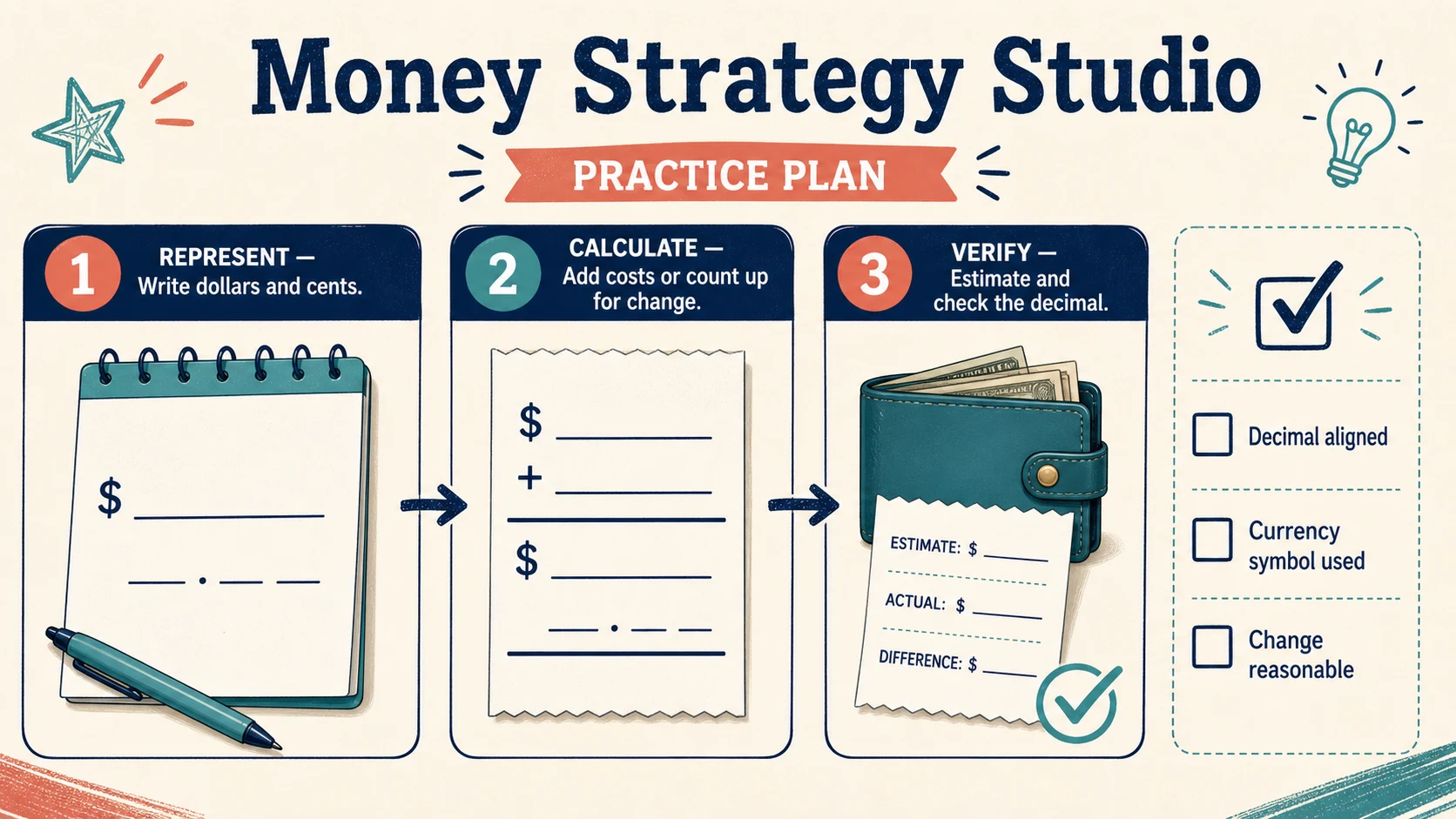
Brief delayed checks show what remains available without immediate rehearsal.
Use a flexible review sequence
A practical schedule might look like this:
| Time | Retrieval task | Adult response |
|---|---|---|
| End of the lesson | Re-solve one corrected item without looking | Confirm the repaired step |
| A day or two later | Solve two fresh examples from previously practiced skills | Note what is recalled without prompts |
| About a week later | Complete a short mixed review | Compare current independence with the first attempt |
| During a later money lesson | Include one coin-counting or change problem | Decide whether the skill is stable or needs another cycle |
This schedule is an instructional example, not a universal prescription. Shorten or lengthen the interval according to the learner’s observed work, the local teaching sequence, and opportunities for natural money practice.
Do not reuse only memorized answers. Change the coin collection or amounts while preserving the skill. If the learner previously counted one quarter, two dimes, and a nickel, a delayed check might use two quarters, one dime, and three pennies. Ask for a calculation and a brief explanation.
When retrieval is successful, mix the skill with another familiar type. When it is not, return to one clear model and guided example before another independent attempt. The aim is to make the next teaching decision from evidence, not to force completion on a predetermined date.
Limitations and the most useful next action
This printable is one 20-item practice resource. It can provide evidence about performance on its included exercises, but it cannot establish complete mastery of money, comprehensive standards alignment, or likely outcomes in later mathematics. It does not replace hands-on experience with coins, teacher observation, discussion, or varied problem contexts. Its grade and difficulty labels indicate intended practice level rather than a guarantee of fit for every learner.
The worksheet also covers several related skills, so a total score can conceal an uneven profile. A learner may know all coin values yet struggle with change, or calculate correctly while using dollar and cent symbols inconsistently. Preserve the completed page and one brief observation note so later work can be compared with actual evidence.
The honest next step is to print the free worksheet, model one representative example, and release only a small initial set. After reviewing that work, use the Money topic guide to choose the next appropriate practice level. If the learner needs fresh versions of an established skill rather than a new progression, explore the free worksheet generators for additional retrieval practice.
Put it into practice
Use the guide with a real printable
Move from explanation to a short, observable practice task. Check the first item together, then adjust the next session from the learner's actual work.
See the 18-worksheet pack