Complete guide
How to teach and practise 2nd grade geometry worksheets - standard theme (easy)
How to use this 20-item geometry worksheet
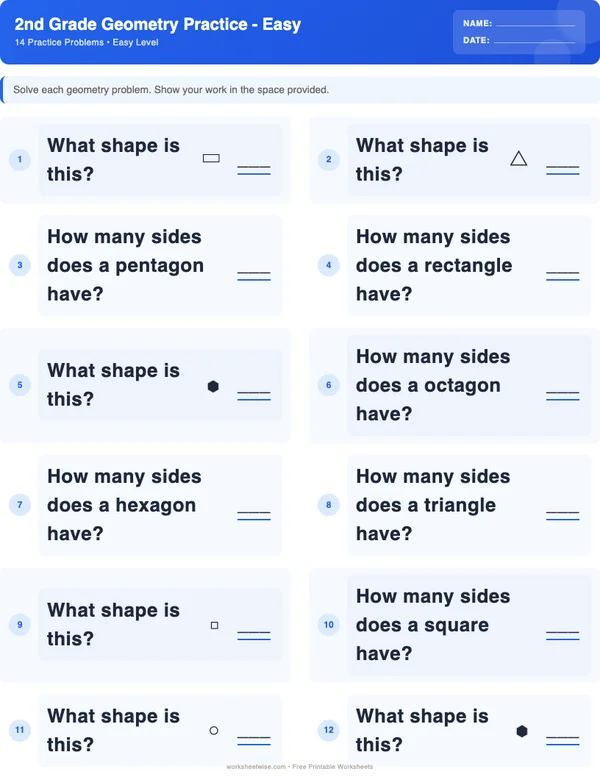
The free 2nd Grade Geometry worksheet gives a learner practice with four closely connected tasks: naming familiar shapes, counting sides or corners, comparing shapes by their number of sides, and deciding whether statements about shape properties are true or false. One item also asks the learner to draw and name a six-sided shape.
For most learners, the best approach is to model one example, solve several items together, and then assign a small group independently. Do not require all 20 items in one sitting if accuracy or attention begins to decline. The learner’s observed work—not the page length—should determine the pace.
Although the catalogue describes the broader skill set as shapes, perimeter, area, and geometric properties, the printable’s 20 visible items concentrate on shape names, sides, corners, comparisons, and basic properties. It does not directly ask the learner to calculate area or perimeter. Treat it as focused shape-attribute practice, not as a complete geometry assessment.
Grade labels describe the intended practice level. Local curricula and teaching sequences differ, so preview the page and confirm that the terms and shapes have already been introduced.
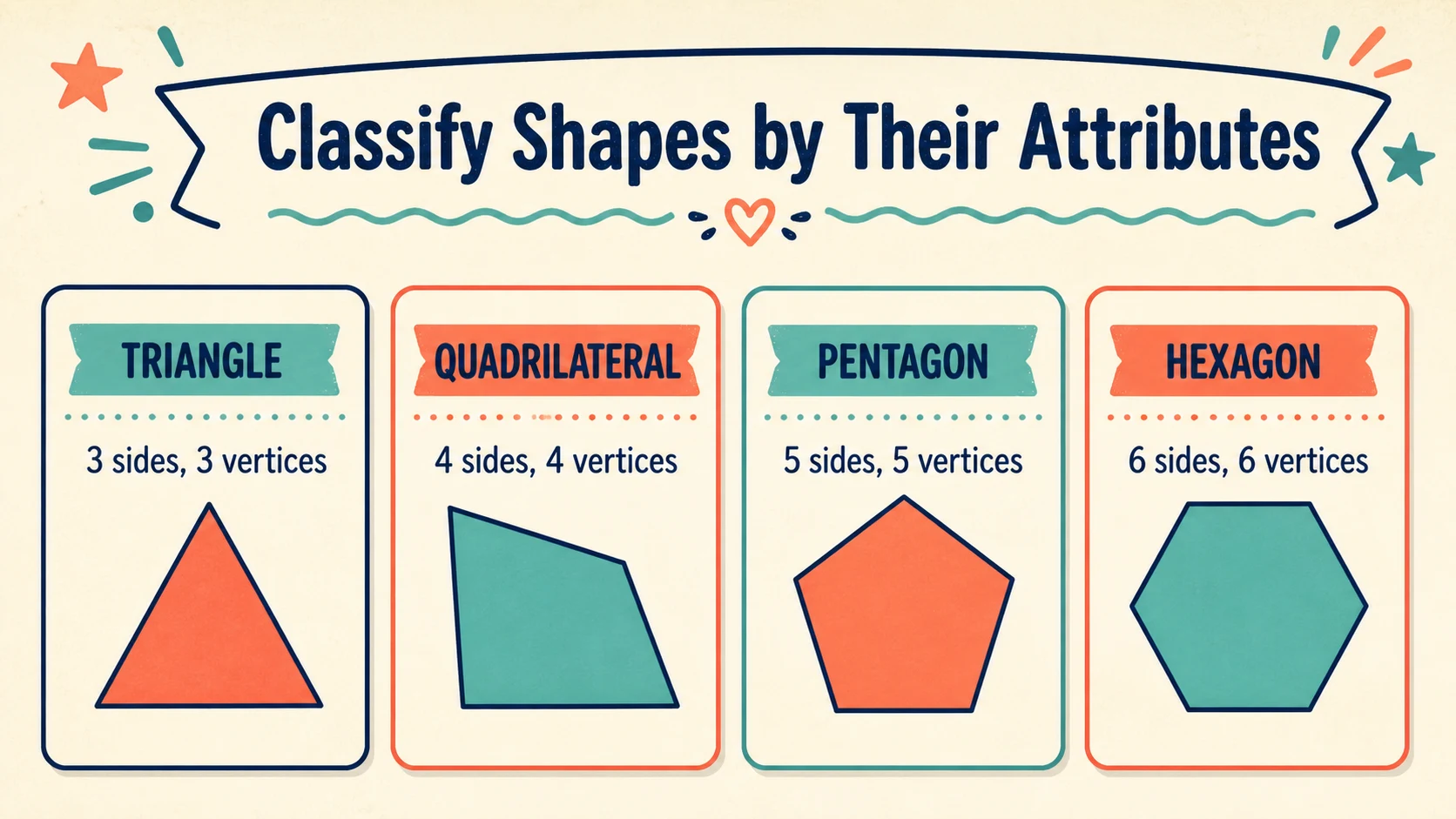
Move from a short readiness check to modeling, guided practice, independent work, and later retrieval.
What the learner will encounter
The worksheet mixes several question formats rather than presenting one format at a time. That makes it useful for checking whether the learner can recognize the relevant property and choose an appropriate response.
| Items | Task type | What the learner must do |
|---|---|---|
| 2 and 4 | Name a pictured shape | Recognize a triangle and a hexagon from their outlines |
| 1, 5, and 17 | Count sides | State the number of sides in a rectangle, triangle, or octagon |
| 8, 16, 18, and 19 | Count corners | State the number of corners in a hexagon, pentagon, octagon, or circle |
| 3, 6, 12, 13, and 15 | Compare shapes | Decide which of two named shapes has more sides |
| 7, 9, 11, 14, and 20 | Evaluate a statement | Mark a shape-property claim true or false |
| 10 | Draw from a property | Draw a six-sided shape and name it |
These tasks fit the high-level Grade 2 geometry emphasis on recognizing and drawing shapes with specified attributes, including a given number of angles or faces. The Common Core mathematics standards provide that broad context, but this guide does not claim that the worksheet covers every part of a standard or every local requirement.
For the wider sequence—from hands-on shape work through later geometry concepts—use the 2nd Grade Geometry topic guide. This lesson stays deliberately focused on using this particular printable well.
Prepare a short, concrete launch
A useful launch establishes the meaning of the words before asking the learner to complete written work. You need only the worksheet, a pencil, and two or three familiar flat objects or paper shapes. A sticky note or blank card is also helpful for covering later items.
Check four prerequisite ideas
Before beginning, show a triangle, rectangle, pentagon, and hexagon in any convenient form. Ask the learner to point to:
- one complete side;
- one corner;
- the shape with three sides;
- the shape with six sides.
This is a readiness check, not a scored quiz. If the learner cannot yet distinguish a side from a corner, pause the worksheet. Trace a side with one finger, stop at the corner, and then trace the next side. Repeat with two shapes. The skill remains identifying geometric attributes; the support simply makes those attributes visible.
Use the worksheet’s word corners when discussing its questions. You may also introduce vertex as the mathematical name for one corner and vertices for more than one, but do not make new vocabulary a barrier to completing the page.
Establish a counting routine
Give the learner one repeatable procedure:
- Choose a starting corner.
- Place a small dot there.
- Trace one side at a time.
- Count each side once.
- Stop when you return to the starting dot.
For corners, point to each meeting place once and move around the boundary in one direction. This routine prevents skipped or double-counted features, especially on hexagons and octagons.
The IES guide on teaching mathematics to young children supports broad instructional use of progressions, ongoing observation, and representations that connect mathematical ideas. Here, tracing a visible boundary is an instructional suggestion based on that general framing; it is not a claim that IES reviewed this worksheet.
Use a flexible lesson sequence
The following is a practical starting plan, not a universal timetable. Shorten or extend each phase according to what the learner says, draws, and records.
| Phase | Suggested items | Adult role | Evidence to watch |
|---|---|---|---|
| Readiness check | No scored items | Review side, corner, and shape names with objects or drawings | Can the learner point to the requested attribute? |
| Model | A parallel example, then item 1 | Think aloud and trace the boundary | Does the learner understand why each side is counted once? |
| Guided practice | 2, 3, 7, and 8 | Prompt, then gradually reduce help | Can the learner switch between naming, comparing, and true/false? |
| Independent practice | 4–6 and 9–14 | Observe without supplying answers | Are answers accurate without tracing every shape for the learner? |
| Review and finish | 15–20, now or later | Ask the learner to explain selected answers | Can the learner justify an answer with a property? |
| Retrieval | Selected items on later days | Re-present without showing prior answers | Is the idea still available after a delay? |
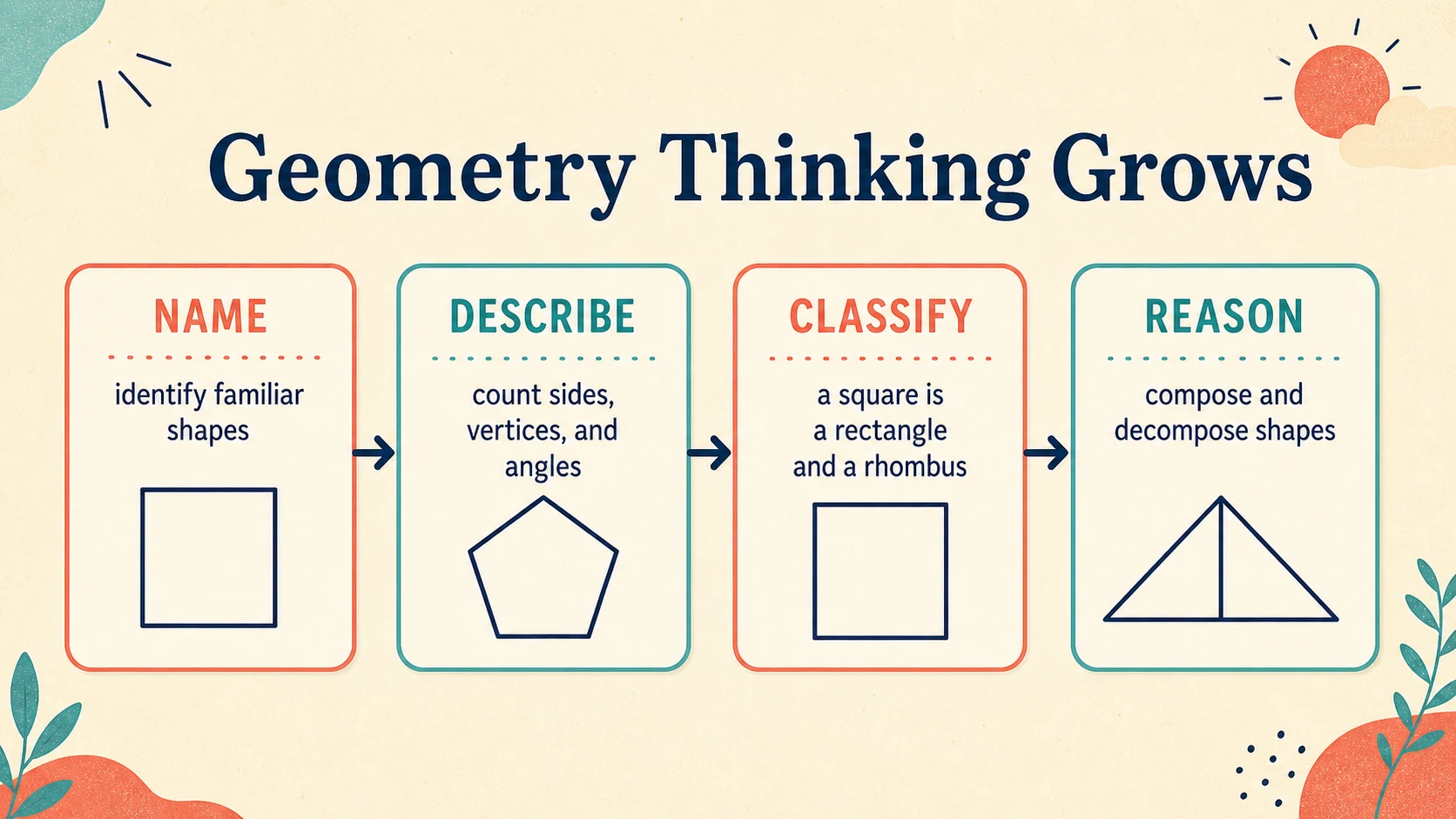
Model the reasoning and checking routine, then reduce prompts as the learner takes over.
A learner who completes the guided items accurately and explains the reasoning may continue independently. A learner who guesses, loses the starting point while counting, or confuses shape names needs another modeled example before continuing.
Avoid turning the launch into a lecture on every kind of polygon. The immediate goal is to identify and compare the familiar shapes used on this page.
Model the task without doing the worksheet for the learner
Model with an example that is similar to the printable but not copied from the item the learner will answer next. This preserves the page as meaningful practice.
Draw a simple pentagon. Say: “The question asks how many sides, so I will count straight boundary pieces. I will mark my starting corner, trace each side once, and stop when I return to the mark. I count five sides. I can check by counting the corners. There are also five.”
Then invite the learner to solve item 1, which asks for the number of sides in a rectangle. If needed, ask, “What feature are you counting?” That prompt directs attention without giving the answer.
Use restrained prompts
Move through these levels only as needed:
- “Read the question again. Is it asking for a name, sides, or corners?”
- “Where could you mark your starting point?”
- “Trace the boundary and count once.”
- Demonstrate the routine on a different shape.
- Return to the original item.
This sequence keeps the mathematical decision with the learner. Immediately naming the shape, supplying the first count, or pointing to the correct response can conceal whether the learner understands the property.
For learners who need additional structure, the IES practice guide on assisting students struggling with mathematics offers high-level guidance about systematic instruction, clear mathematical language, visual representations, and cumulative review. Using a consistent count-and-check routine is an application of that general guidance, not a sourced prescription for every learner.
Work through checked examples
The following examples use the same concepts as the worksheet. Each answer can be checked directly from the defining feature being counted or compared.
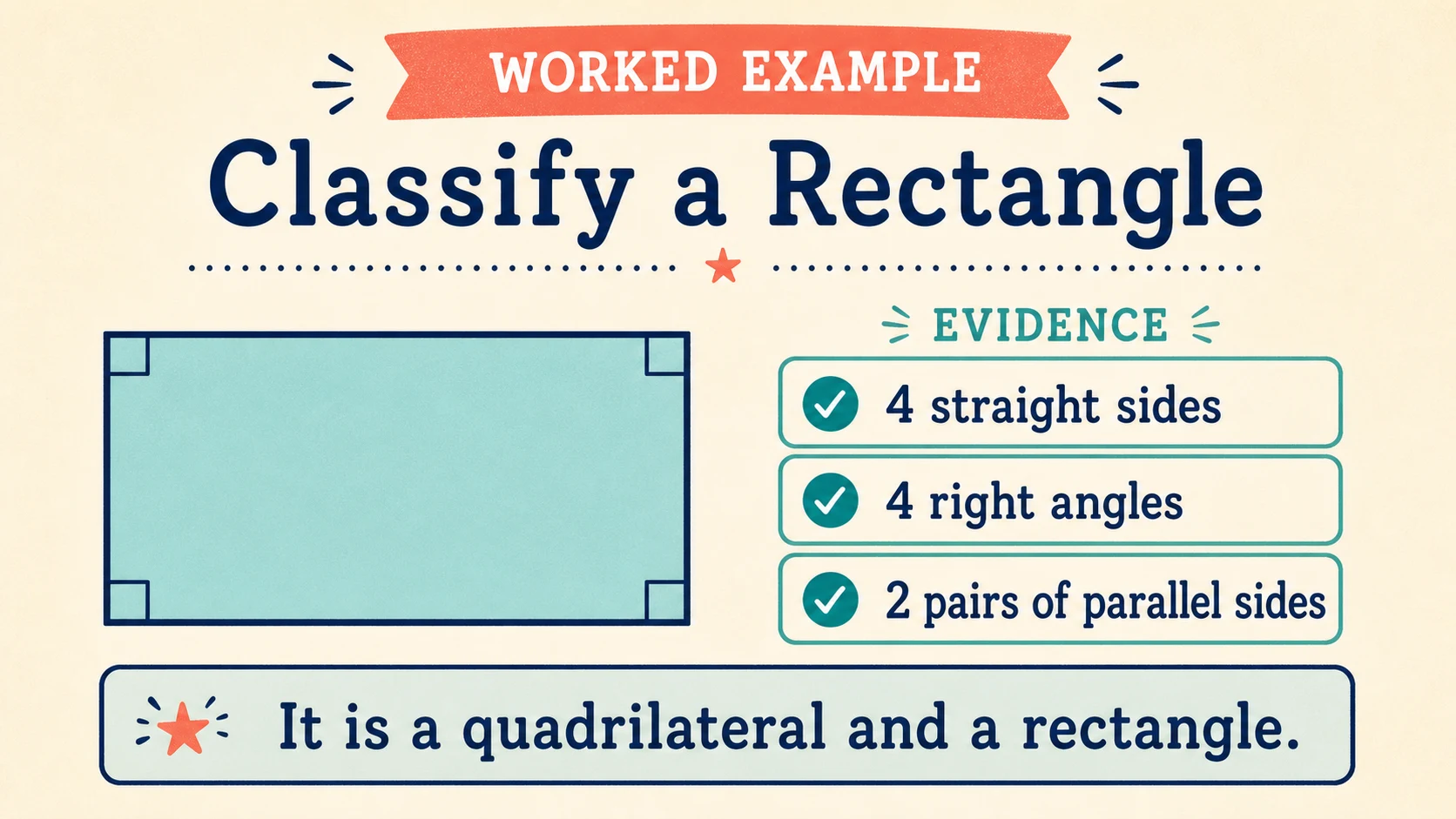
Name the requested attribute, show the count, and perform a separate check.
Example 1: Count the sides of a rectangle
Problem: How many sides does a rectangle have?
Work: Mark one corner. Trace the top, right, bottom, and left boundary pieces.
Answer: A rectangle has 4 sides.
Check: Count its corners. The four sides meet at four corners. This agrees with worksheet item 1 and the separate answer key.
The important reasoning is not merely recalling “four.” The learner should connect the number to the visible boundary. A tall or tilted rectangle still has four sides.
Example 2: Compare a pentagon and a hexagon
Problem: Which shape has more sides: a pentagon or a hexagon?
Work: A pentagon has 5 sides. A hexagon has 6 sides. Compare 5 and 6.
Answer: The hexagon has more sides because .
Check: Draw five tally marks for the pentagon and six for the hexagon. The second group has one more. This matches worksheet item 3.
If the learner selects the shape that looks larger on the page, return to the words more sides. Physical size is irrelevant to this comparison.
Example 3: Evaluate a false statement
Problem: True or false: A pentagon has 6 sides.
Work: Count or recall the sides of a pentagon: 1, 2, 3, 4, 5.
Answer: False. A pentagon has 5 sides, not 6.
Check: State the corrected sentence: “A pentagon has five sides.” This agrees with worksheet item 7.
Requiring a correction after a false answer helps reveal whether the learner knows the correct property or merely guessed between two choices.
Example 4: Draw a six-sided shape
Problem: Draw a shape with 6 sides. What is it called?
Work: Draw six connected straight sides that form a closed shape. Count around the boundary: 1 through 6.
Answer: It is a hexagon.
Check: Confirm that the drawing is closed, has six straight boundary pieces, and does not include an accidental extra side. This is the expected response for item 10.
The drawing does not have to resemble a regular honeycomb hexagon. Unequal side lengths or an unfamiliar orientation do not change the side count.
Example 5: Count the corners of a circle
Problem: How many corners does a circle have?
Work: Trace the curved boundary. There is no point where two straight sides meet.
Answer: A circle has 0 corners.
Check: Try to mark a corner without choosing an arbitrary point on the curve. No geometric corner is present. This matches item 19 and its answer key.
This is an important boundary case because the instruction “count around the shape” works differently here: there are no straight sides or vertices to count.
Example 6: Compare a square and a triangle
Problem: Which shape has more sides: a square or a triangle?
Work: A square has 4 sides. A triangle has 3 sides.
Answer: The square has more sides because .
Check: The square has exactly one more side than the triangle. This agrees with worksheet item 15.
The comparison concerns side count, not area, width, or how much space the drawing appears to cover.
Run guided and independent practice deliberately
During guided practice, ask the learner to say what kind of answer each item requires before solving it. For example:
- Item 2 requires a shape name.
- Item 3 requires choosing one of two shapes.
- Item 7 requires true or false.
- Item 8 requires a number of corners.
This small classification step reduces errors caused by answering the wrong question. It also lets you distinguish a reading or direction-following error from a geometry error.
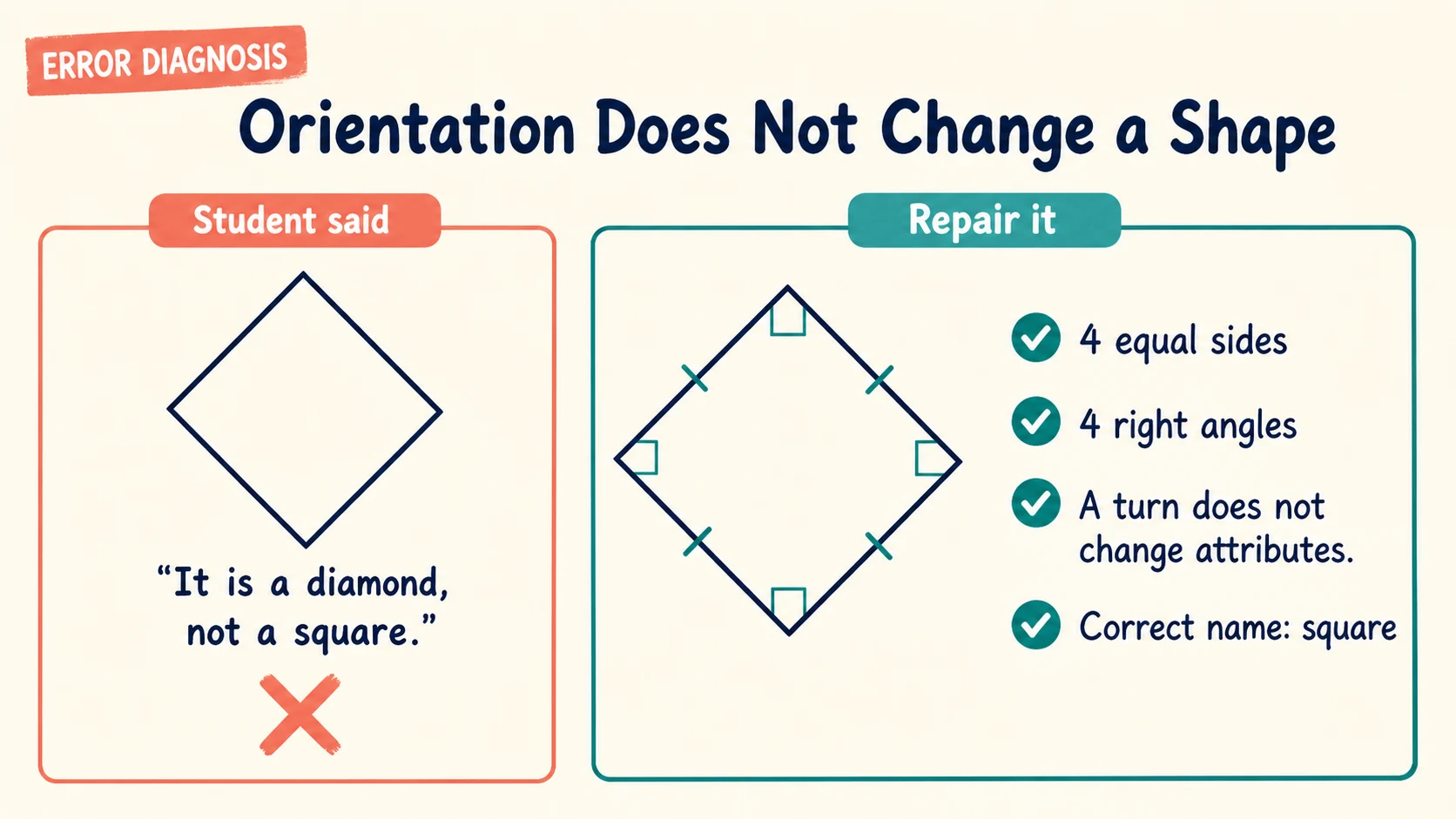
For item 2, allow the learner to turn the page if the triangle’s orientation feels unfamiliar. Then show that rotating the page changes the position but not the three sides. For item 8, have the learner point to each corner of the hexagon without writing a number until the count is complete. For item 7, ask for the corrected statement after the learner selects false.
Decide when independence is appropriate
Move to independent practice when the learner can do three things:
- identify whether the prompt asks about sides, corners, a name, or a comparison;
- apply the counting routine without an adult tracing for them;
- explain at least one answer using a shape property.
Independent does not have to mean completing every remaining item at once. Cover unused problems and offer a set of four to six. Check that set before assigning more. If the method remains accurate, continue. If errors begin to cluster, stop and examine them rather than using the rest of the worksheet as repeated guessing practice.
The instruction printed on the worksheet says to solve each geometry problem and show work in the space provided. For simple naming items, “show your work” can mean adding dots at counted corners, tiny tick marks on sides, a corrected true statement, or a side-count comparison such as .
Adapt support without changing the skill
Adaptations should improve access to the same geometry decision. They should not replace the learner’s reasoning with an easier, unrelated task.
Change visibility, response mode, or amount of work while preserving the shape-attribute goal.
When the learner needs more support
Enlarge the page or copy one shape onto blank paper. Let the learner place a counter on the starting corner and move it after each side is counted. Highlight the question word—shape, sides, or corners—but do not highlight the answer.
You can also separate the formats. Complete two side-count items together before attempting a true/false statement. Assign fewer items per sitting while retaining examples from several formats across the full lesson.
If writing is the obstacle, let the learner say the answer while pointing or tracing, then ask them to record only the final word or number. The mathematical demand remains unchanged.
When the learner is ready for less support
Remove counting marks and ask for a verbal justification: “The octagon has more sides because it has eight and the rectangle has four.” Ask the learner to check one response in a different way, such as comparing the side count with the corner count.
For item 10, accept an irregular but valid six-sided closed figure. Ask the learner to prove it is a hexagon by labeling the sides 1 through 6. Do not require a perfectly regular drawing unless regularity has been taught separately.
Boundary cases worth showing
Rotate a triangle or draw a narrow rectangle so the learner sees that orientation and proportion do not determine the name. Draw an open chain of six segments and contrast it with a closed six-sided figure: the open drawing is not the intended polygon because its boundary does not close.
A circle is another boundary case. It has a continuous curved boundary and zero corners, so it should not be counted as having “one curved side” for the purposes of the worksheet’s corner question. Keep the explanation tied to the prompt: item 19 asks for corners, and the answer is zero.
Interpret errors before assigning more work
An incorrect answer is useful only if the adult identifies what produced it. Look for patterns across items rather than treating every mistake as careless.
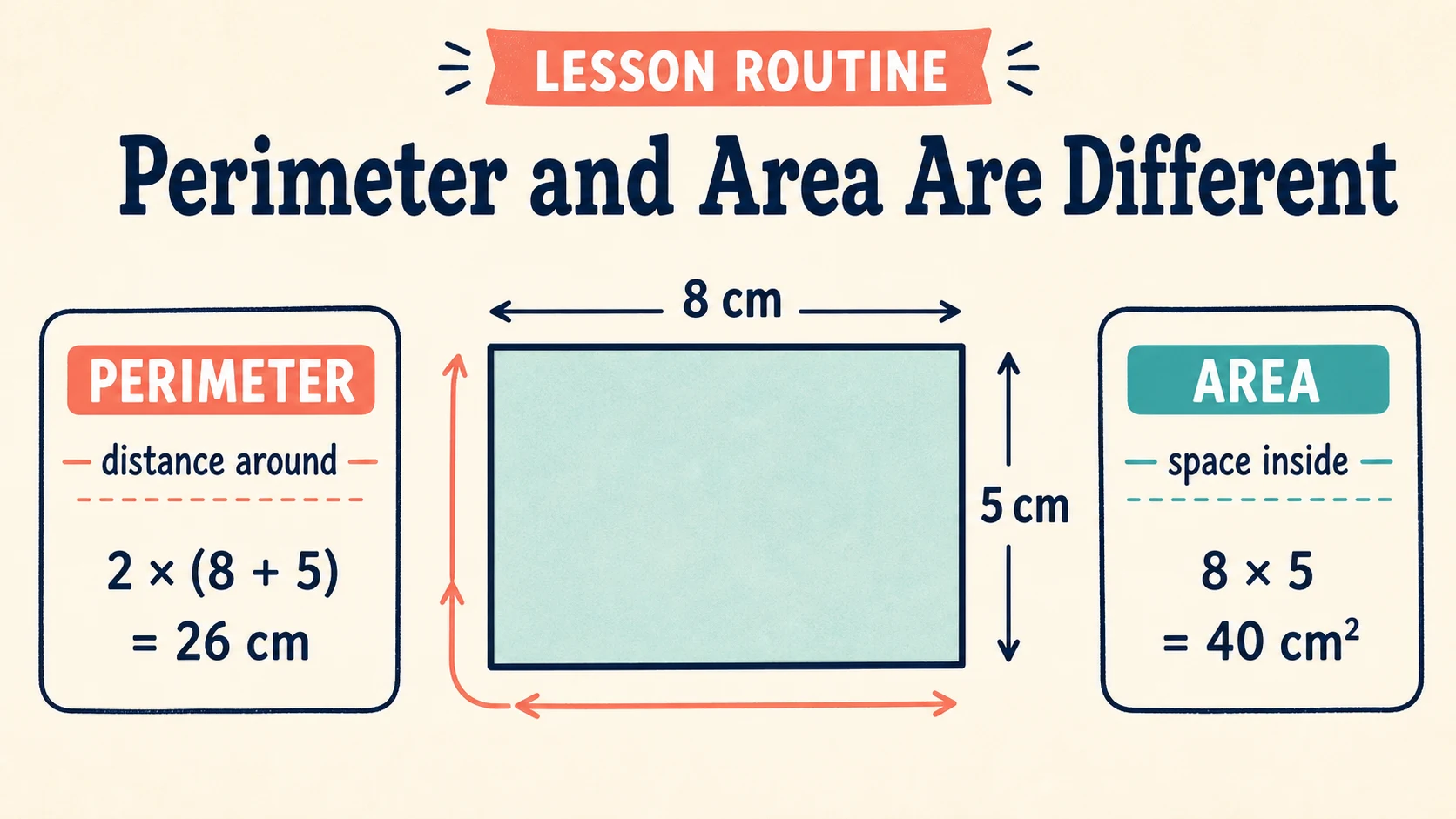
Identify the requested feature, recount or rename, explain the correction, and try a nearby example.
| Observed error | Likely interpretation | Useful response |
|---|---|---|
| Counts corners when the question asks for sides | The learner is not attending to the named attribute | Ask the learner to underline sides or corners, then point to one example of that feature |
| Calls a rotated triangle “not a triangle” | Recognition may depend on a familiar orientation | Rotate the page or shape while recounting the same three sides |
| Chooses the visually larger shape in a comparison | “More” is being interpreted as greater physical size | Write the two side counts, then compare the numbers |
| Says a pentagon has six sides | Shape name and property are not securely connected | Trace and count a pentagon, state the corrected fact, then test a differently drawn pentagon |
| Counts the starting corner twice | The counting path has no clear stopping point | Mark the starting corner and stop upon returning to it |
| Says a circle has one corner | Any marked location on the curve may be treated as a corner | Contrast the smooth curve with two straight sides meeting at a point |
| Marks several true/false items correctly but cannot explain them | Responses may be guesses | Ask for a corrected sentence or a quick drawing before interpreting the answers as secure |
Do not respond to a patterned misconception by immediately assigning ten more nearly identical questions. Model one contrasting example, let the learner explain the distinction, and then use one fresh item to check whether the correction transfers.
A single wrong answer caused by losing count calls for a recount. Repeated confusion across shapes calls for renewed instruction with tracing, drawing, or sorting before more independent paper practice.
Check the answer key responsibly
The separate answer key is useful for verification, but it should follow the learner’s attempt rather than guide it. Keep it out of view during independent work.
First, check the response against the key. Then inspect the method. A correct answer with double-counted corners and a lucky final correction does not show the same understanding as an orderly count. Conversely, an incorrect final number paired with a clear, repairable counting slip may require less reteaching than a confident shape-name confusion.
For item 10, inspect the drawing as well as the word hexagon. The figure should be closed and should have six sides. The key provides the intended name but cannot show whether every learner drawing is geometrically valid.
When an answer differs from the key:
- Reread the exact prompt.
- Recount or identify the requested feature.
- Compare the learner’s reasoning with the key.
- Correct the work in a different color or beside the original.
- Ask the learner to explain the correction.
- Revisit a similar item later without displaying the answer.
Record patterns in a few words: “confuses sides and corners,” “counts accurately with a start mark,” or “recognizes only upright triangles.” Such notes are more actionable than a total score alone.
Decide what to teach next
Use the learner’s explanations and corrected work to choose the next step.
If the learner still confuses sides and corners, return to hands-on tracing and drawing. If familiar shapes are named accurately but comparisons are weak, practice stating both side counts before choosing. If all four task types are accurate without prompts, vary the orientation and proportions of the same shapes before introducing a new geometry skill.
Do not use this page alone to conclude that the learner understands area, perimeter, composition of shapes, or the full Grade 2 geometry sequence. Those skills are not directly sampled by its visible questions. The broader geometry guide can help place this work within a fuller progression, while the 2nd Grade Math collection provides practice in other mathematical topics.
The 2nd Grade worksheet hub is useful when geometry is only one part of a broader weekly plan. If the learner needs additional shape practice in varied formats, the focused 2nd Grade Geometry Worksheet Pack contains 18 worksheets. The pack is optional; more pages are not a substitute for addressing an observed misconception.
Schedule retrieval without fixing an arbitrary timetable
Retrieval means asking the learner to recall and use the idea after some time has passed, without first showing the completed page. The schedule below is a flexible example, not a universal requirement.
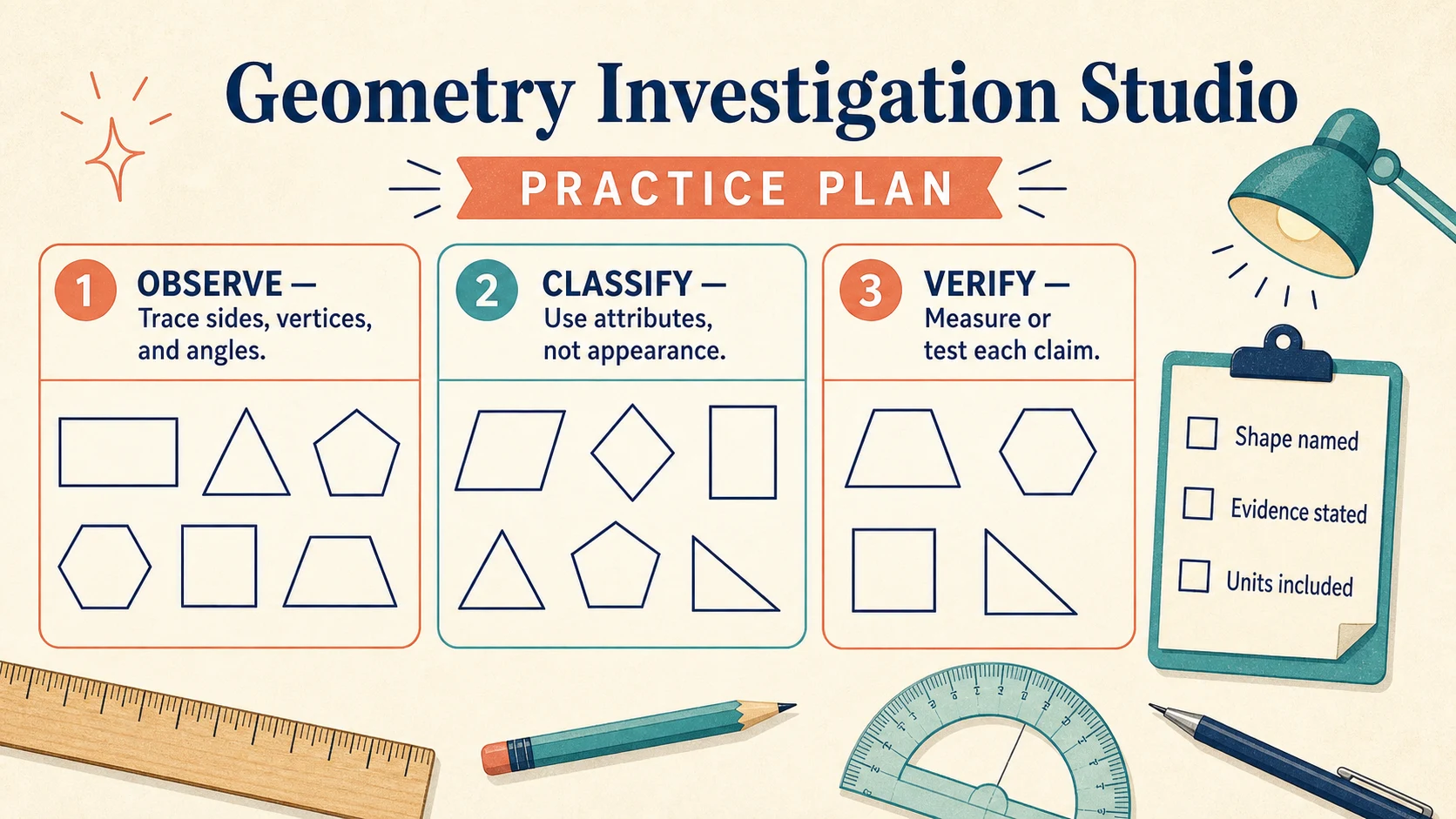
Revisit a small, mixed sample after increasing delays and adjust the schedule from observed work.
| Review point | Short task | Decision |
|---|---|---|
| Later the same lesson or the next suitable session | Name one shape and count its sides | If the learner needs the full model again, return to concrete tracing |
| A few days later | Mix one naming, one corner-count, and one comparison item | If one format causes errors, review that format rather than repeating everything |
| About a week later | Draw a six-sided shape and explain why it is a hexagon | If the drawing is valid and the explanation is clear, reduce support |
| During a later mixed math review | Include one rotated shape and the circle corner case | If recognition holds across representations, move to the next taught geometry concept |
Use blank paper, selected covered items, or a newly created parallel example. Avoid asking the learner to memorize the order of answers on the original sheet. The purpose is to retrieve the geometric relationship.
The honest next action is to print the free 20-item geometry worksheet, preview its shape vocabulary, and begin with items 1–3 after one modeled counting example; then use the learner’s work to choose either targeted review from the topic guide or fresh parallel practice from the free worksheet generators.
Put it into practice
Use the guide with a real printable
Move from explanation to a short, observable practice task. Check the first item together, then adjust the next session from the learner's actual work.
See the 18-worksheet pack