Complete guide
How to teach and practise 2nd grade fractions worksheets - standard theme (easy)
How to use this six-item fractions worksheet
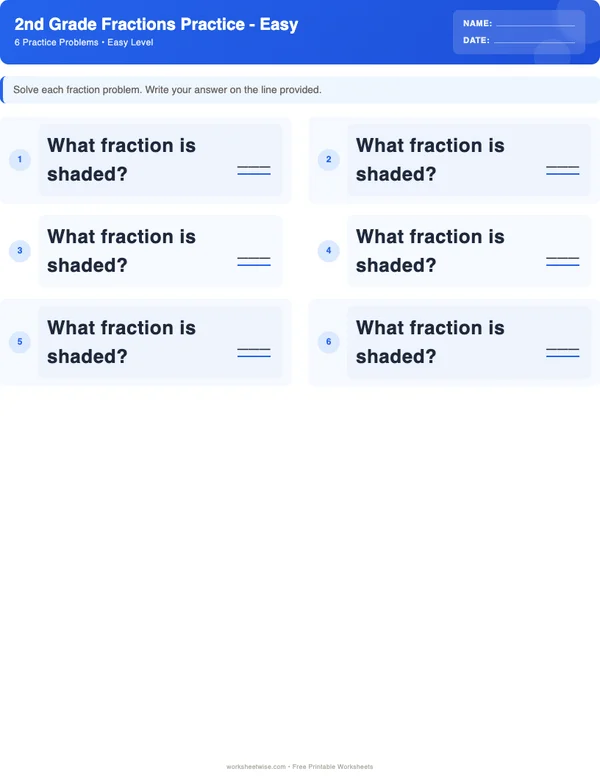
The free 2nd Grade Fractions Worksheets — Standard Theme (Easy) printable provides six exercises involving fractions, equivalent fractions, comparison, and fraction operations. The directions ask the learner to solve each problem and write an answer on the provided line. A separate printable answer key is included.
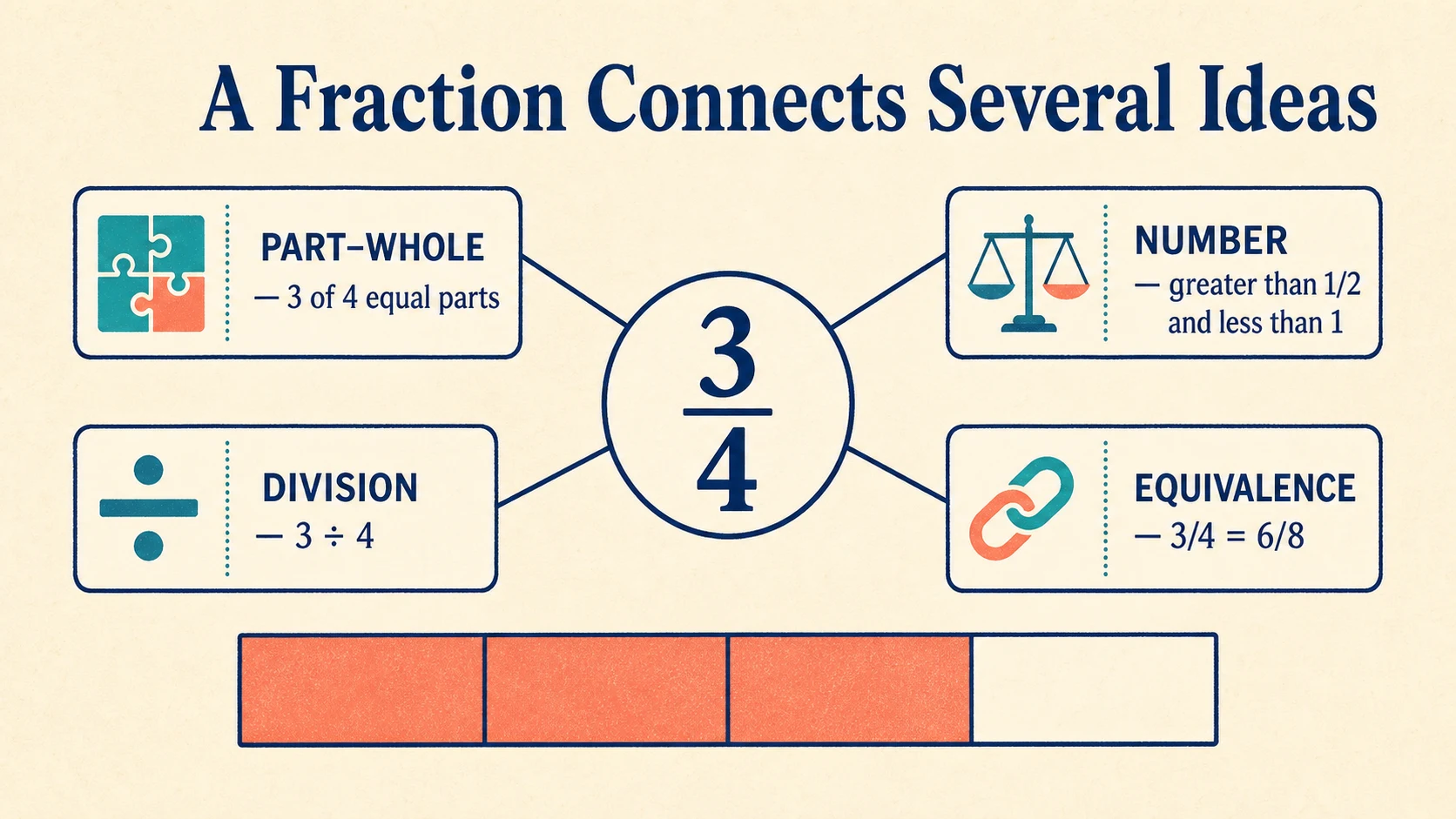
The short answer: preview the six items, identify the representation and operation each one requires, model one similar problem, complete one or two items with the learner, and then release the remaining items for independent work. Do not use all six questions merely to produce a score. Use the learner’s drawings, explanations, pauses, and corrections to decide whether to add support, continue, or stop and reteach.
Grade labels describe the intended practice level; local school, district, state, and homeschool sequences differ. An adult should therefore judge readiness from the learner’s observed work rather than assuming every listed fraction skill has already been taught.
Preview, model, guide, observe independent work, and review errors before selecting the next task.
What this printable can help you observe
This is a brief practice page, not a complete fractions lesson or comprehensive assessment. Its six items can nevertheless provide useful evidence about how a learner approaches several connected ideas:
- A fraction names equal parts of a whole.
- The denominator tells how many equal parts make the whole.
- The numerator tells how many of those parts are being considered.
- Two differently written fractions can represent the same amount.
- Fractions can be compared when their wholes are the same size.
- Some fraction operations can be interpreted with a visual model.
Because the catalogue identifies all four areas—fractions, equivalent fractions, comparing fractions, and fraction operations—look at the actual printable before teaching. Determine which items use pictures, symbols, comparison signs, or computation. The examples below are verified teaching examples based on those listed skills; they are not presented as copies of the worksheet’s six questions.
For a fuller sequence extending from partitioning shapes to later number-line, equivalence, comparison, and operation work, use the broader 2nd Grade fractions topic guide. That guide is the better place to see how this single page fits into a longer progression.
The IES guide on teaching mathematics to young children supports high-level practices such as using developmental progressions, monitoring what children know, and helping them connect mathematical ideas to representations. It did not evaluate this WorksheetWise printable. Here, those principles mean choosing models deliberately and responding to the work the learner actually produces.
Prepare the lesson before the learner begins
Print or open the worksheet and answer key separately. Keep the key out of the learner’s view during first attempts. Gather two or three simple materials:
- Paper strips or blank rectangles that can be folded or divided
- A pencil and two colored pencils
- Small counters, if the worksheet uses sets rather than shapes
- Scrap paper for drawing fraction bars
Then inspect every exercise. For each one, ask:
- What is the whole?
- Are the parts equal?
- What does the learner need to produce: a fraction, an equivalent fraction, a comparison, or a computed result?
- Would a fraction bar, folded strip, set model, or verbal explanation clarify the task?
- Is there unfamiliar notation that should be explained without solving the item?
Previewing matters because “fraction operations” can refer to more than one kind of task. The worksheet title alone does not establish the exact form of each problem. Your teaching model should resemble the reasoning required while using different numbers or a different drawing.
A practical lesson sequence
| Phase | Suggested adult action | Evidence to watch for |
|---|---|---|
| Launch | Establish the whole and review numerator and denominator | Learner identifies equal parts and uses the whole consistently |
| Model | Solve one similar example aloud with a drawing | Learner follows why the fraction matches the model |
| Guided practice | Work through one or two worksheet items together | Learner contributes decisions instead of copying |
| Independent practice | Ask the learner to attempt the remaining items | Learner selects a method and records answers without prompts |
| Error review | Discuss one error or uncertain response at a time | Learner can revise the reasoning, not merely replace an answer |
| Retrieval | Revisit selected ideas after a delay | Learner recalls the idea without being shown the prior solution |
This is not a universal timetable. One learner may complete the sequence in a single sitting; another may need the page divided across two or more short sessions. Pacing should follow attention, accuracy, and explanation quality.
Launch with the meaning of a fraction
Begin with a whole that is easy to see, such as a rectangular paper strip. Draw or fold it into four equal parts. Shade three parts.
Say, in plain language: “The whole has been divided into four equal parts. Four is the denominator. Three parts are shaded, so three is the numerator. The shaded fraction is three-fourths.”
Write:
Point to the 3 and the shaded parts. Then point to the 4 and all four equal parts. Ask the learner to explain each number. If the learner says only “three over four,” follow with, “What does the three count? What does the four count?”
The word equal deserves attention. Four sections are not automatically fourths. They must be four equal shares of the same whole. Show a rectangle divided into four visibly unequal sections and ask whether each section is one-fourth. The checked conclusion is no: although there are four pieces, unequal pieces do not represent fourths of that whole.
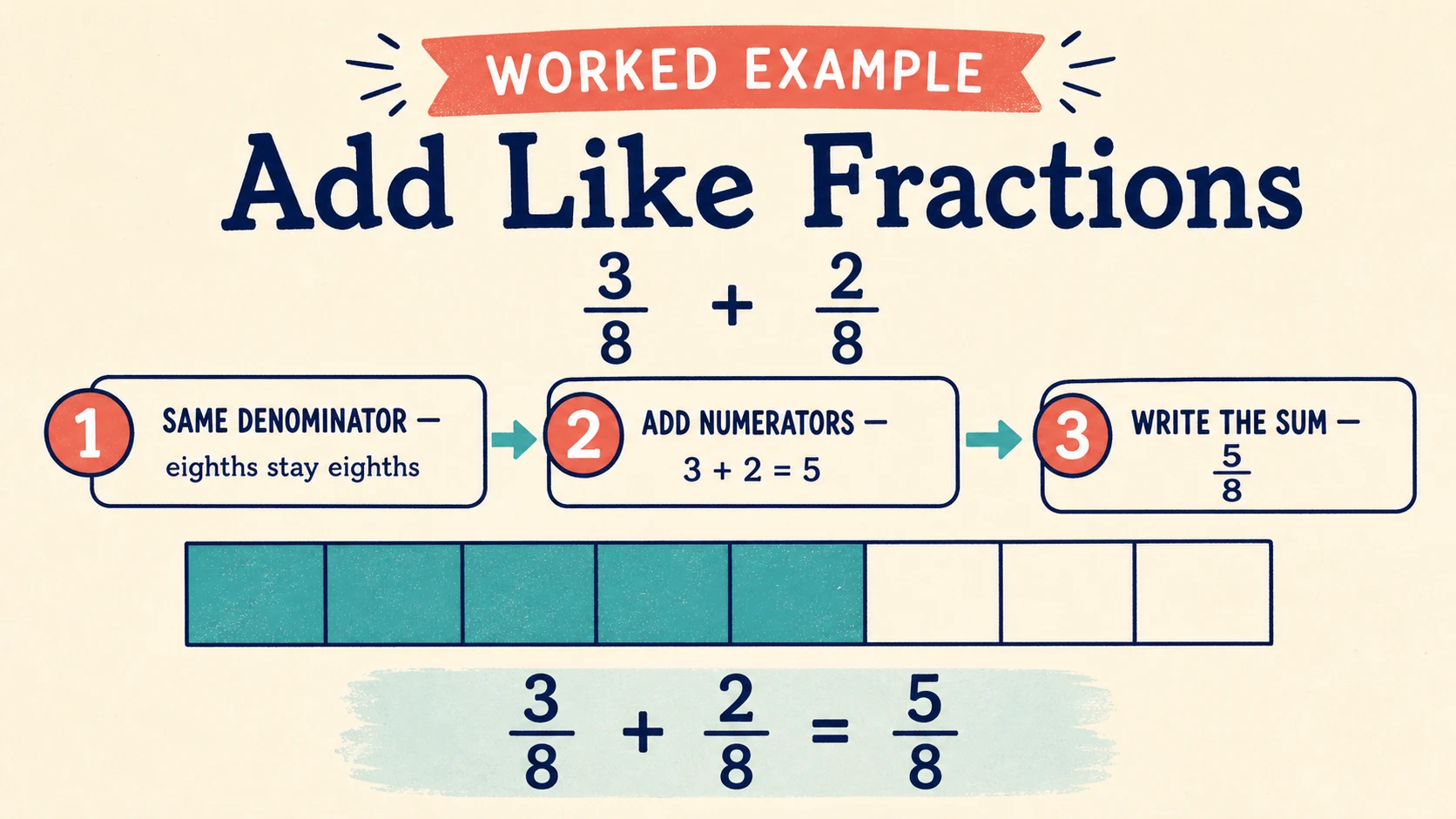
Worked example 1: Identify the shaded fraction
Suppose a bar is divided into four equal sections and three are shaded.
- Count every equal section: 4.
- Use 4 as the denominator.
- Count the shaded sections: 3.
- Use 3 as the numerator.
- Write .
Check: The denominator matches the four equal parts in the whole, and the numerator matches the three shaded parts. The answer is .
Count all equal parts for the denominator, then count the selected parts for the numerator.
Model without completing the worksheet for the learner
Use a think-aloud, but keep it brief. The purpose is to reveal decisions that are usually invisible.
For an identification problem, you might say:
“First I locate the whole. Next I check that its parts are equal. I count all the equal parts for the denominator. Then I count the shaded parts for the numerator. Finally, I compare my written fraction with the picture.”
Do not model with the same picture and numbers as an item the learner will complete. If a worksheet item appears to show two of three equal parts, model three of four instead. This preserves the problem as practice.
For comparison, model equal-sized wholes. For equivalence, place equal-length bars directly above one another. For an operation, draw the starting amount and show what is added or removed. The representation should explain the symbols, not decorate an unexplained rule.
Use questions that transfer responsibility
After modeling, replace statements with prompts:
- “What is the whole here?”
- “How do you know the parts are equal?”
- “Which number belongs in the denominator?”
- “Can you draw both fractions using equal-sized bars?”
- “What does the operation tell us to do?”
- “How could you check that result?”
Avoid turning the prompts into clues that reveal the answer. “Is the answer one-half?” tests agreement, not reasoning. “Show me how you decided” gives better evidence.
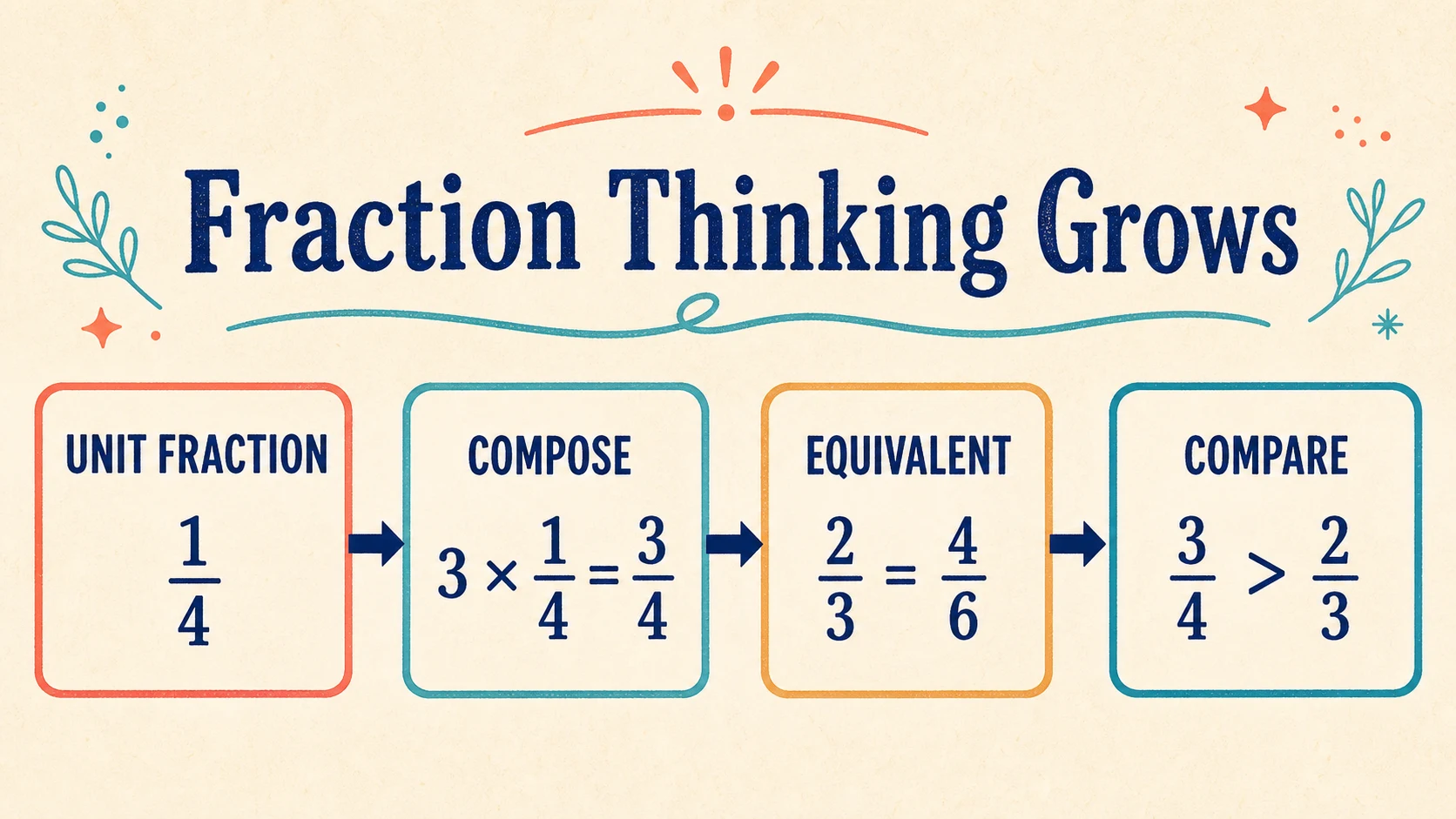
Run guided practice, then independent practice
Select one worksheet item that appears representative but not unusually difficult. Read its directions together. Ask the learner to name the required action before calculating or writing.
During guided practice, divide the thinking:
- The learner identifies the whole.
- You ask whether the parts are equal.
- The learner counts or draws the parts.
- You ask for the fraction and a reason.
- The learner records the response.
If the first item is correct and well explained, reduce your help on the next one. If the learner is correct but uncertain, ask for a quick drawing or explanation before moving on. If the learner has misunderstood the whole or denominator, pause the worksheet and return to a paper-strip model.
Transfer one decision at a time until the learner can choose and check a method independently.
For independent practice, say exactly what independence means: “Try these remaining items without hints. You may draw fraction bars on scrap paper. Put a small dot beside any item you want to revisit.”
A request for scrap paper is not evidence of failure. Drawing is a legitimate reasoning tool. The more important distinction is whether the learner chooses and interprets the model or waits for the adult to supply each step.
The IES practice guide for assisting students who struggle with mathematics provides high-level guidance about systematic instruction, clear mathematical language, representations, and deliberate practice. It does not recommend a fixed script for this exact page. A reasonable application here is to make support explicit, observe its effect, and remove it gradually.
Use checked examples across the listed skills
The following examples give you alternate numbers for modeling and reteaching. Each includes a complete check.
Worked example 2: Recognize equivalent fractions
Question: Are and equivalent?
Draw two bars of equal length.
- Divide the first bar into 2 equal parts and shade 1.
- Divide the second bar into 4 equal parts and shade 2.
- Align the bars at both ends.
The shaded lengths match, so:
Check: One-half of a whole and two-fourths of the same-sized whole cover the same amount. The fractions use different numbers but represent equal portions.
The important condition is that both bars represent wholes of equal size. One-half of a small bar need not be the same physical amount as one-half of a larger bar.
Worked example 3: Compare unit fractions
Question: Which is greater, or ?
Draw two equal-length bars. Divide one into 3 equal parts and the other into 4 equal parts. Shade one part in each.
When the same whole is divided into fewer equal pieces, each piece is larger. Therefore:
Check: Three thirds make a whole, while four fourths make the same-sized whole. A third must be larger than a fourth because only three thirds are needed to fill the whole.
This directly addresses a common mistake: choosing because 4 is greater than 3. The denominators tell the size of the shares; they are not whole-number scores.
Worked example 4: Compare fractions with the same denominator
Question: Which is greater, or ?
Both fractions divide an equal-sized whole into fifths. Compare how many fifths are selected:
Therefore:
Check: Draw two equal bars divided into fifths. Shading four sections covers more of the bar than shading two. The shared denominator makes the part size equal, so the larger numerator represents more parts.
Worked example 5: Add like-sized fractional parts
Question:
The pieces are all fourths. Begin with one fourth and add two more fourths:
Thus:
Check: Draw a bar divided into four equal sections. Shade one section in one color and two more in another. Three of the four sections are shaded, confirming .
Do not generalize beyond the example by telling the learner simply to “add the top numbers.” First connect the operation to equal-sized pieces. This example verifies addition with a shared denominator; it does not establish that every operation on the printable has this form.
Adapt support without changing the mathematical skill
An adaptation should make the intended reasoning accessible while preserving the question. If the task is to compare fractions, do not replace it with counting whole numbers. If the task is to identify a fraction, do not tell the learner which denominator to write.
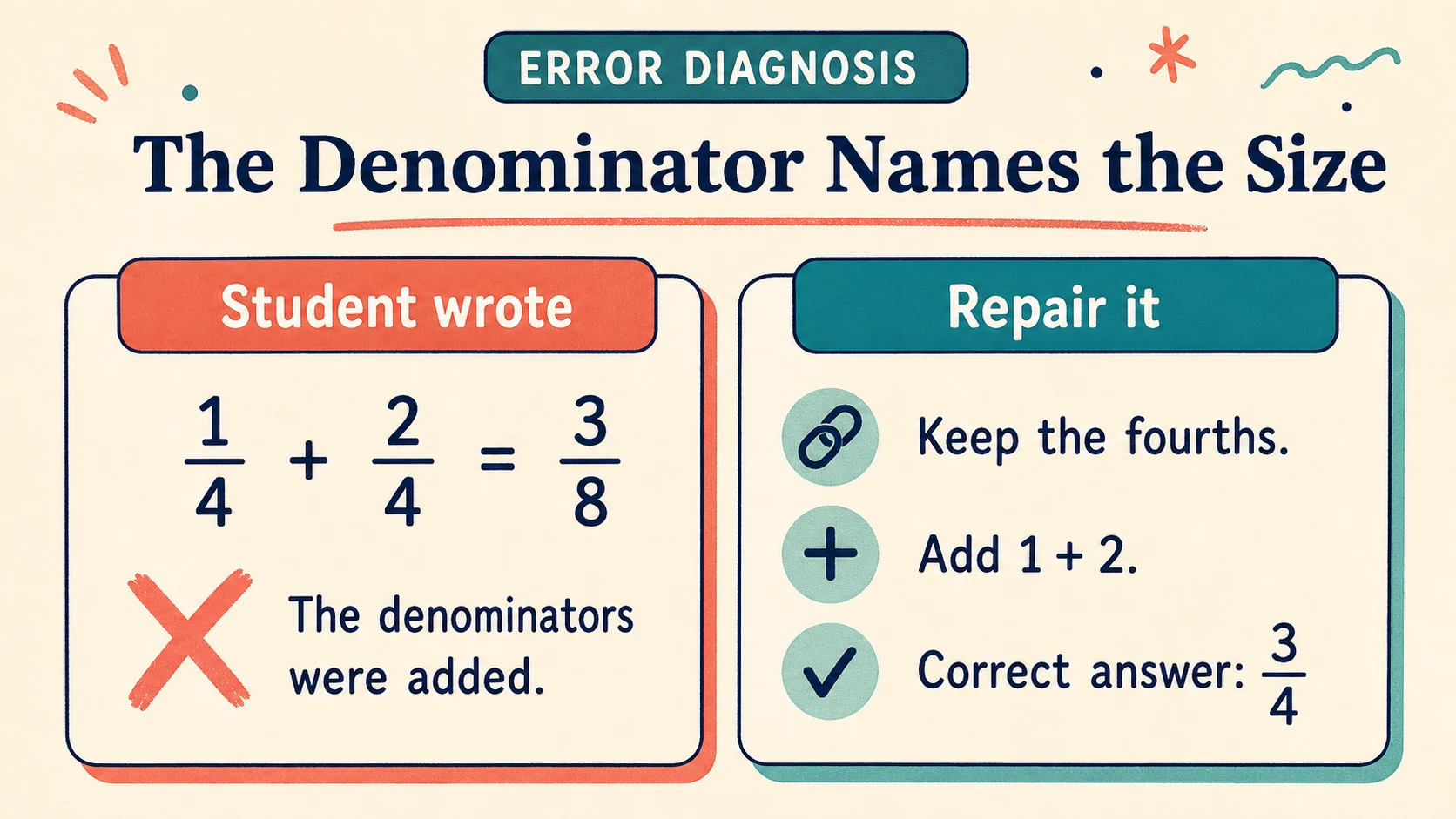
Adjust the representation, amount of prompting, or workspace while keeping the same fraction decision.
When the learner needs more support
Cover all but one item to reduce visual load. Read the directions aloud, but leave the mathematical choice to the learner. Provide equal-sized blank bars and ask the learner to partition them. If drawing equal parts is consuming all the learner’s attention, supply pre-partitioned bars and require the learner to shade and interpret them.
Use a stable prompt routine:
- Find the whole.
- Check for equal parts.
- Name the denominator.
- Name or compare the selected parts.
- Check with a picture.
This is an instructional suggestion, not a sourced universal prescription. Continue only if the routine helps the learner reason more independently.
When the learner is nearly independent
Let the learner work first, then ask for an explanation on one correct response and one uncertain response. Remove prepared models but allow blank scrap paper. Ask the learner to choose between a fraction bar, a folded strip, or words as a checking method.
When the learner finishes accurately and easily
Do not make the worksheet harder by introducing unrelated procedures. Ask for a second representation or a justification:
- “Draw another shape showing the same fraction.”
- “Write an equivalent fraction and prove it with equal-length bars.”
- “Create a comparison that uses the opposite sign.”
- “Write a short story for this fraction operation.”
These extensions preserve the central fraction ideas while increasing explanation and transfer.
Teach the boundary cases explicitly
Simple boundary cases reveal whether the learner understands the definitions.
The whole amount
If a shape has two equal parts and both are shaded, the fraction is:
Check: Two halves fill the entire whole. A fraction can represent one whole; it does not always mean an amount less than one.
No selected parts
If a shape has four equal parts and none is shaded, the shaded amount is:
Check: The whole is divided into fourths, but zero fourths are selected. Use this only if zero numerators fit the learner’s current instruction or arise during discussion; it need not be added to the worksheet.
Unequal divisions
A circle split into three differently sized regions does not show three thirds.
Check: Thirds must be three equal shares of the same whole. Counting regions without checking equality produces an invalid fraction model.
Different-sized wholes
One-half of a large rectangle and one-half of a small rectangle share the name , but their physical areas differ.
Check: Fraction comparisons using pictures require attention to the whole. Comparing shaded area directly is fair only when the wholes are equal in size or the task clearly defines a common whole.
These cases help prevent memorized rules from replacing meaning.
Interpret errors before correcting them
A wrong answer is a starting point for diagnosis, not a complete diagnosis by itself. Ask the learner to reconstruct the reasoning without showing the key.
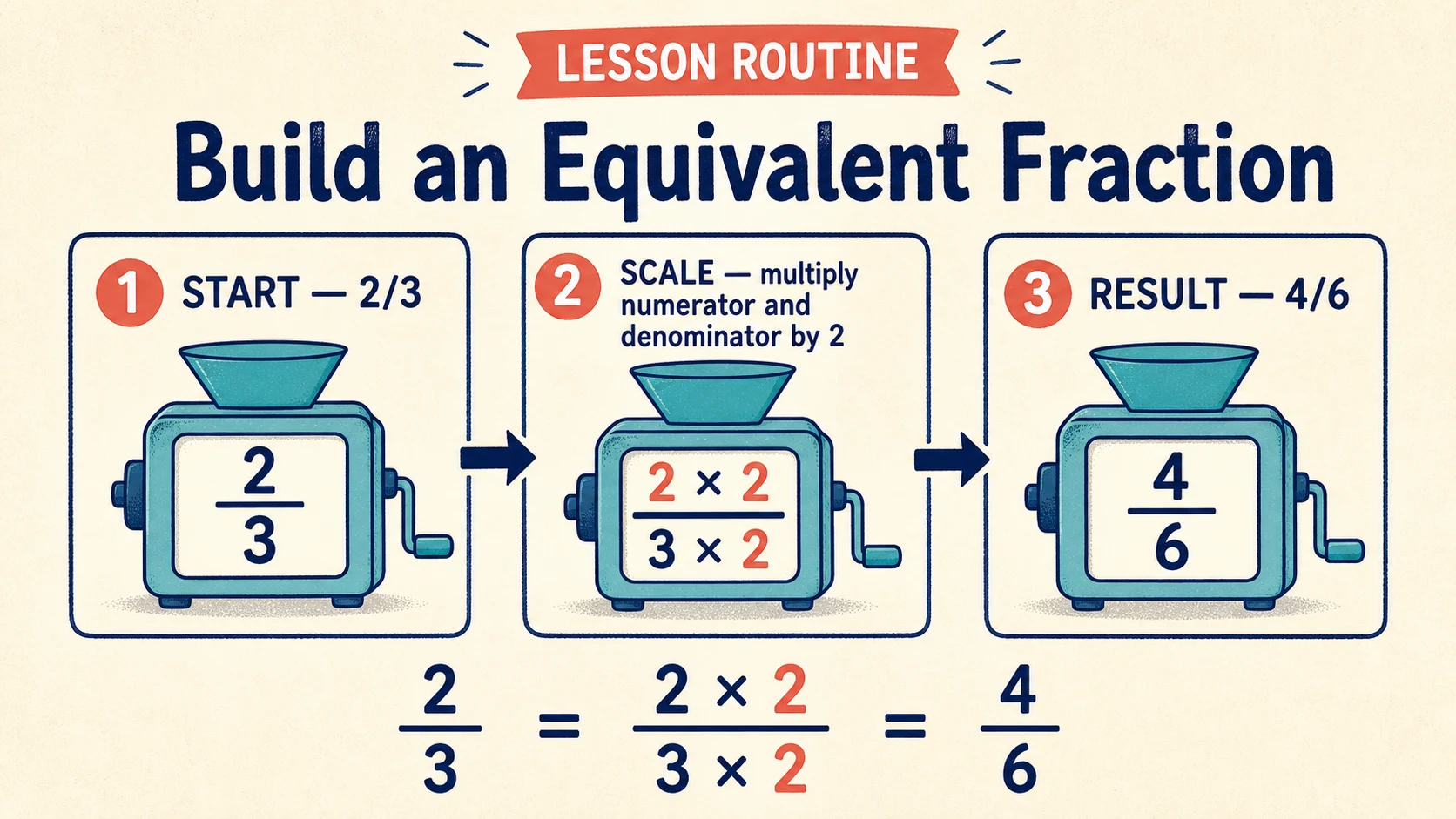
Recheck the whole, equal parts, notation, and operation before changing an answer.
Common patterns include:
| Observed work | Possible interpretation | Useful response |
|---|---|---|
| Writes for three shaded parts out of four | Numerator and denominator roles may be reversed | Recount all parts, then shaded parts, and label both numbers |
| Calls unequal sections fourths | Learner may be counting pieces without checking equal shares | Repartition a paper strip into equal and unequal examples |
| Says because 8 is larger | Whole-number reasoning may be overriding share size | Draw equal bars and compare one fourth with one eighth |
| Treats and as unequal because the numbers differ | Equivalence may be understood only symbolically or not yet understood | Align equal-length fraction bars |
| Writes for | Numerators and denominators may both have been added | Name the pieces aloud: one fourth plus two fourths |
| Gives a correct answer but cannot explain it | The result may be guessed or rule-based | Request a drawing, comparison, or verbal check |
These are possible interpretations, not child-specific diagnoses. More than one cause can produce the same written error. If the learner corrects the work immediately after rereading, the issue may be attention or notation rather than the underlying concept. If the same error persists across pictures, words, and symbols, return to concrete or visual models.
Check the answer key responsibly
Use the separate answer key after the learner has attempted the item. Compare more than the final symbols.
For each exercise:
- Mark whether the recorded answer agrees with the key.
- Ask the learner to explain or model at least one answer.
- Rework incorrect or uncertain items without revealing the keyed response first.
- Consult the key again after revision.
- Record the type of support required.
The answer key confirms expected responses; it does not explain why an error occurred or prove durable understanding. A learner who changes an answer after seeing the key has corrected the page, but has not necessarily corrected the reasoning.
If your own interpretation differs from the key, reread the directions, examine what counts as the whole, and solve the item independently with a model. Do not force the keyed response without reconciling the mathematics. Set that item aside if ambiguity remains.
Decide what to do after the six items
Avoid reducing the result to “five out of six” without considering how the work was completed.
- Accurate and independent: Move to another short fractions task that requires the same ideas in a different representation.
- Accurate with frequent prompting: Repeat the skill with less adult support before increasing complexity.
- One isolated, self-corrected error: Briefly revisit it, then continue.
- Repeated denominator or equal-parts errors: Return to partitioning shapes and naming fractions.
- Repeated comparison errors: Use equal-sized fraction bars before returning to comparison symbols.
- Operation errors despite sound fraction identification: Separate the meaning of the operation from the fraction notation and model the action.
- Visible fatigue or escalating guessing: Stop and resume later rather than treating more questions as a cure.
The Common Core State Standards for Mathematics provide one public reference point for grade-level mathematical expectations and show that fraction learning develops across grades. Local sequences and terminology can differ. This page’s catalogue lists skills across identification, equivalence, comparison, and operations, so completion should not be presented as proof of comprehensive standards alignment or mastery of the broader fraction progression.
Families and educators seeking more general second-grade material can browse the 2nd Grade worksheet hub or the more focused 2nd Grade math collection.
Schedule retrieval from the learner’s evidence
Retrieval means asking the learner to recall and use an idea after some time has passed. It should not become repeated copying of the same answers.
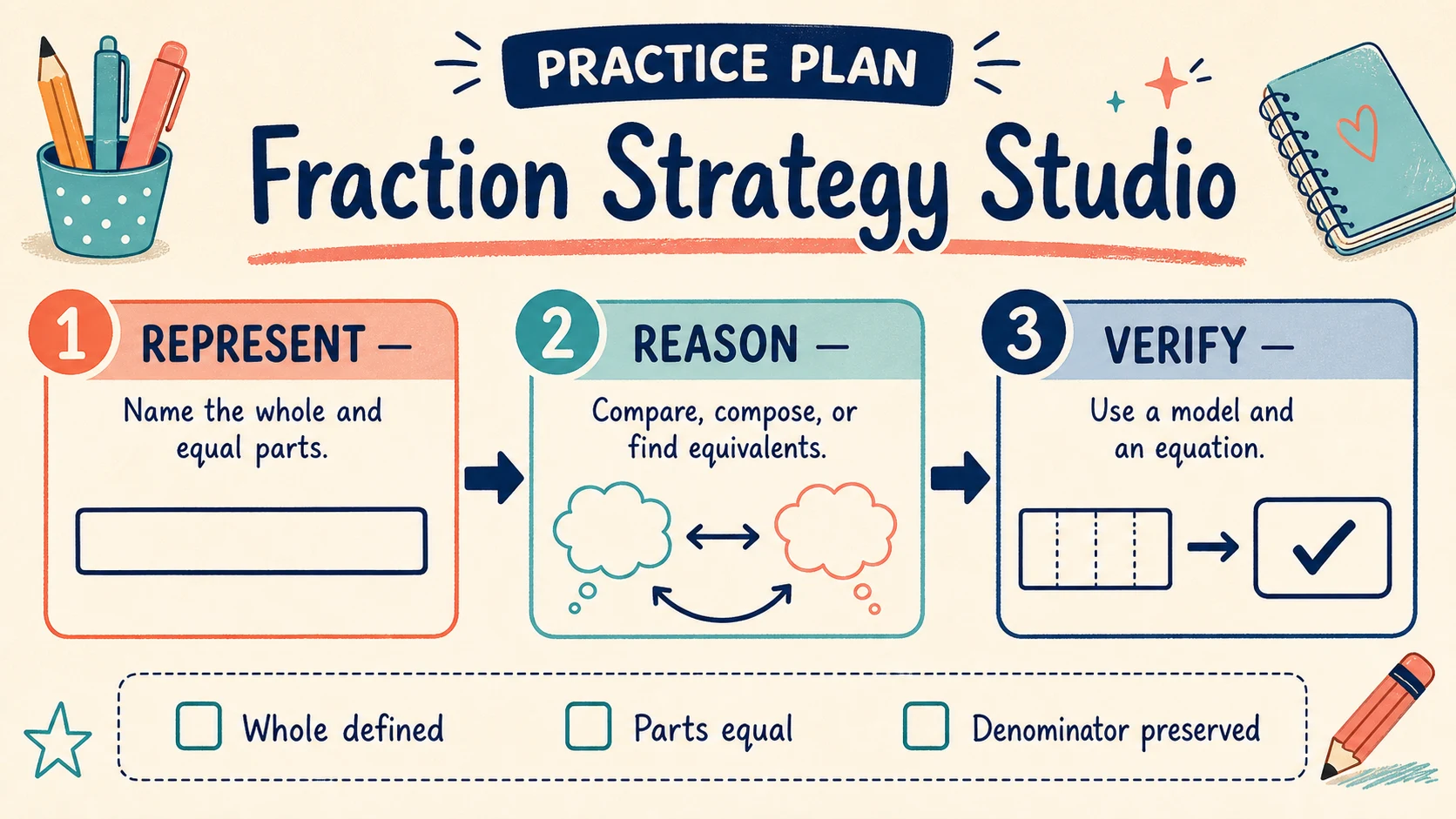
Revisit a small sample after a delay and adjust the spacing according to what the learner recalls.
A practical, adjustable plan is:
| Review point | Brief task | Decision |
|---|---|---|
| Later in the lesson | Explain one completed item without looking at prior steps | Reteach if the explanation depends on adult clues |
| Next study session | Solve one similar example with changed numbers or a different shape | Continue if the model and notation agree |
| Several days later | Complete one identification item and one comparison or equivalence item | Shorten the interval if an important misconception returns |
| About one or two weeks later | Mix a fraction item into other familiar math practice | Extend the interval if recall is accurate and independent |
This schedule is an instructional option, not a universal timetable. A learner who forgets after a delay needs a shorter interval or a clearer representation. A learner who recalls the idea easily can wait longer and encounter it in mixed practice. Preserve the original worksheet as evidence; create new examples rather than asking the learner to memorize its six answers.
Recognize the worksheet’s limitations
Six easy-level exercises can offer focused practice, but they cannot show everything a learner understands about fractions. The page may not sample every model, every listed skill equally, or every likely misconception. Performance can also be affected by reading the directions, notation familiarity, drawing demands, attention, or prior exposure.
The worksheet should not be used to claim:
- Complete mastery of fractions
- Comprehensive alignment with every local standard or curriculum
- Guaranteed academic outcomes
- A diagnosis of a learning difficulty
- A fixed readiness level based only on the grade label
- A universal pace for future instruction
Its best use is narrower and more useful: provide a small amount of structured work, observe the learner’s reasoning, correct misconceptions with an appropriate model, and select the next practice from evidence.
Take the next useful step
Start by downloading the free six-item worksheet, previewing every question, and choosing one different-number example to model. After the learner completes it, use the fractions topic guide to choose the next skill rather than jumping automatically to harder computation.
If the learner needs repeated practice across the topic, the 2nd Grade Fractions Worksheet Pack contains 18 worksheets and is listed at $4.79. If you need fresh problems that avoid memorized answers, use the free worksheet generators to prepare a short retrieval set matched to the exact error or skill you observed.
Put it into practice
Use the guide with a real printable
Move from explanation to a short, observable practice task. Check the first item together, then adjust the next session from the learner's actual work.
See the 18-worksheet pack