Complete guide
How to teach and practise 2nd grade division worksheets - standard theme (easy)
What This Worksheet Is For
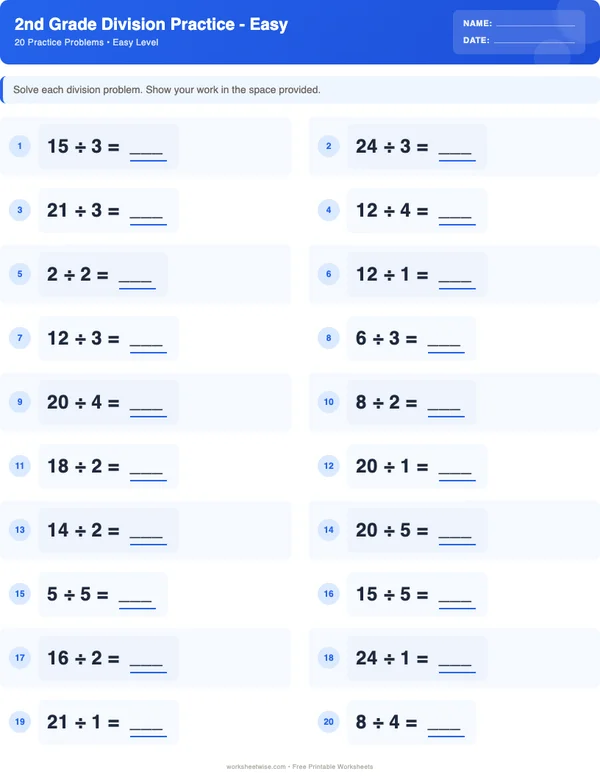
The free 2nd Grade Division worksheet provides 20 easy-level exercises on division facts, mental math, number sense, long division, and remainders. The learner is asked to solve each problem and show work in the space provided. A separate printable answer key is included.
The direct answer: use this printable as a short lesson followed by supported practice, not simply as a 20-question test. Begin with equal groups, model one or two problems, complete a small set together, and release the learner to work independently only when the written notation matches their understanding. Check answers by multiplication or equal grouping. If errors repeat, stop and reteach that specific idea before assigning more items.
Grade labels describe the intended practice level, but local curricula and instructional sequences differ. The Common Core Mathematics standards place formal interpretation of whole-number quotients and division equations in the Grade 3 operations-and-algebraic-thinking progression. Therefore, an adult should treat this 2nd Grade Division printable as introductory or reinforcing practice and pay close attention to readiness. The grade label does not mean every second grader should complete every exercise independently.
For the broader sequence from equal sharing through more advanced division, use the Division topic guide. This guide stays focused on teaching and using this particular 20-item printable.
Prepare the Lesson Before Printing
Download both the worksheet and its separate answer key. Keep the key out of the learner’s immediate view so it remains a checking tool rather than a source to copy. Gather 20 small counters, such as buttons, cubes, coins, or dry beans. Paper circles or drawn boxes can represent groups.
Before starting, scan the printable for three features:
- The smallest and largest numbers used
- Whether a problem divides evenly or leaves a remainder
- Whether the written layout is a fact, a horizontal equation, or long-division notation
This preview helps you choose a model that resembles the page without claiming that your model is one of its exact questions. It also lets you decide whether the learner needs counters, drawings, multiplication facts, or only a brief reminder of the notation.
Use a pencil, because revisions are part of the lesson. Have a separate piece of paper available if the printed workspaces are too small. “Show your work” can mean drawing equal groups, writing repeated subtraction, recording a related multiplication fact, or showing long-division steps. It does not need to mean the same representation for every learner.
Check readiness in two minutes
Place 12 counters on the table and say, “Make three equal groups.” Ask the learner to distribute the counters and report how many are in each group. Then rearrange the same 12 counters into groups of four and ask how many groups were made.
These are two related but distinct interpretations:
- Equal sharing: 12 objects shared among 3 groups gives 4 in each group.
- Equal grouping: 12 objects arranged 4 per group makes 3 groups.
If the learner can build and explain both arrangements, proceed to symbols. If the learner makes unequal groups, loses track while counting, or cannot explain what the answer represents, keep the counters available during guided practice. That is an instructional decision based on observed work, not a diagnosis.
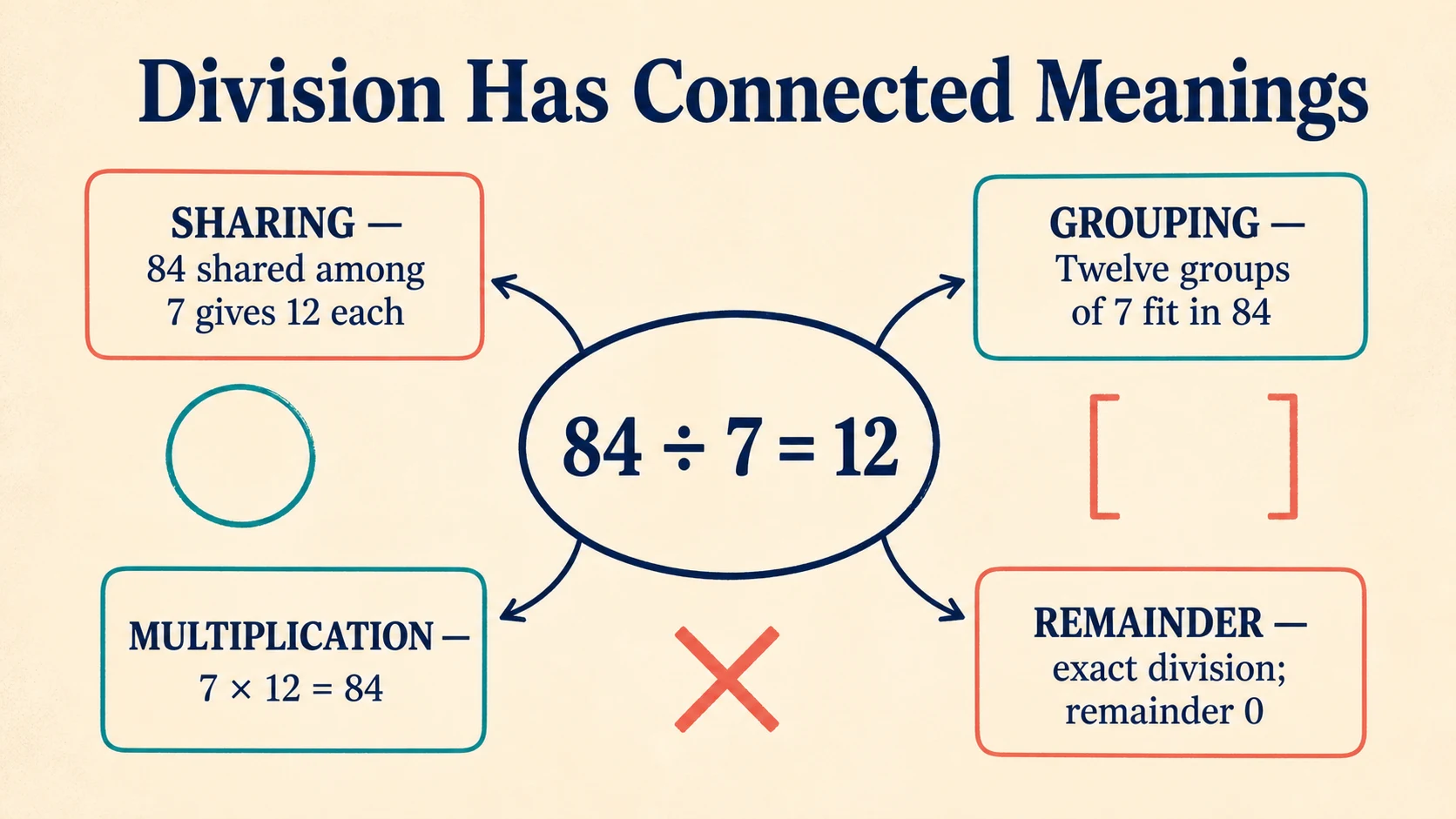
Move from a concrete readiness check to modeling, guided practice, independent work, and later retrieval.
Use a Clear Lesson Progression
A practical first session can last about 20 to 35 minutes, but this is not a universal timetable. Some learners will benefit from two shorter sessions. The learner’s accuracy, explanations, and effort should determine the pace.
| Phase | Suggested worksheet use | Adult’s role | Evidence to watch |
|---|---|---|---|
| Readiness check | No printed items yet | Build equal groups with counters | Groups are equal and the answer is explained |
| Model | 1 similar example | Think aloud and connect objects, symbols, and multiplication | Learner can identify the total and divisor |
| Guided practice | 3–5 items | Prompt, observe, and gradually reduce help | Strategy becomes more organized |
| Independent practice | 5–10 items | Step back but remain available | Answers and shown work agree |
| Review | Selected missed or uncertain items | Ask for correction and verification | Learner can explain the change |
| Later retrieval | 2–4 previously completed items | Provide minimal prompting | Strategy is recalled after a delay |
Do not require all 20 questions in one sitting merely because they fit on one page. A learner who solves eight carefully, explains the quotient, and checks the work may gain more than one who rushes through all 20. Mark a stopping place and return later if handwriting deteriorates, random guessing begins, or explanations become less coherent.
The IES guide on teaching mathematics to young children supports high-level practices such as using progressions, monitoring what children know, and helping them connect informal mathematical ideas with formal language and notation. It did not evaluate this WorksheetWise printable, so use that source as instructional framing rather than an endorsement of the page.
Model What Division Means
Start with a complete sentence, not just a symbol:
“Division helps us find the size of each equal group or the number of equal groups.”
Then demonstrate a problem similar in form and difficulty to the worksheet. Keep the language attached to the numbers.
Worked example 1: equal sharing
Suppose 12 counters are shared equally among 3 plates.
- Start with a total of 12.
- Deal one counter at a time onto each of 3 plates.
- Continue until no counters remain.
- Count each plate: there are 4 counters on every plate.
Write:
12 ÷ 3 = 4
Check with the inverse operation:
3 × 4 = 12
The result is correct because three equal groups of four reconstruct the original total. The quotient, 4, tells how many counters are in each group.
Worked example 2: finding the number of groups
Suppose 15 counters are placed into groups of 5.
- Take 5 counters for the first group.
- Take 5 for the second group.
- Take the final 5 for the third group.
- Count the groups: there are 3.
Write:
15 ÷ 5 = 3
Check:
3 × 5 = 15
Here, the quotient tells the number of groups, not the number in each group. This distinction matters even though both situations use division.
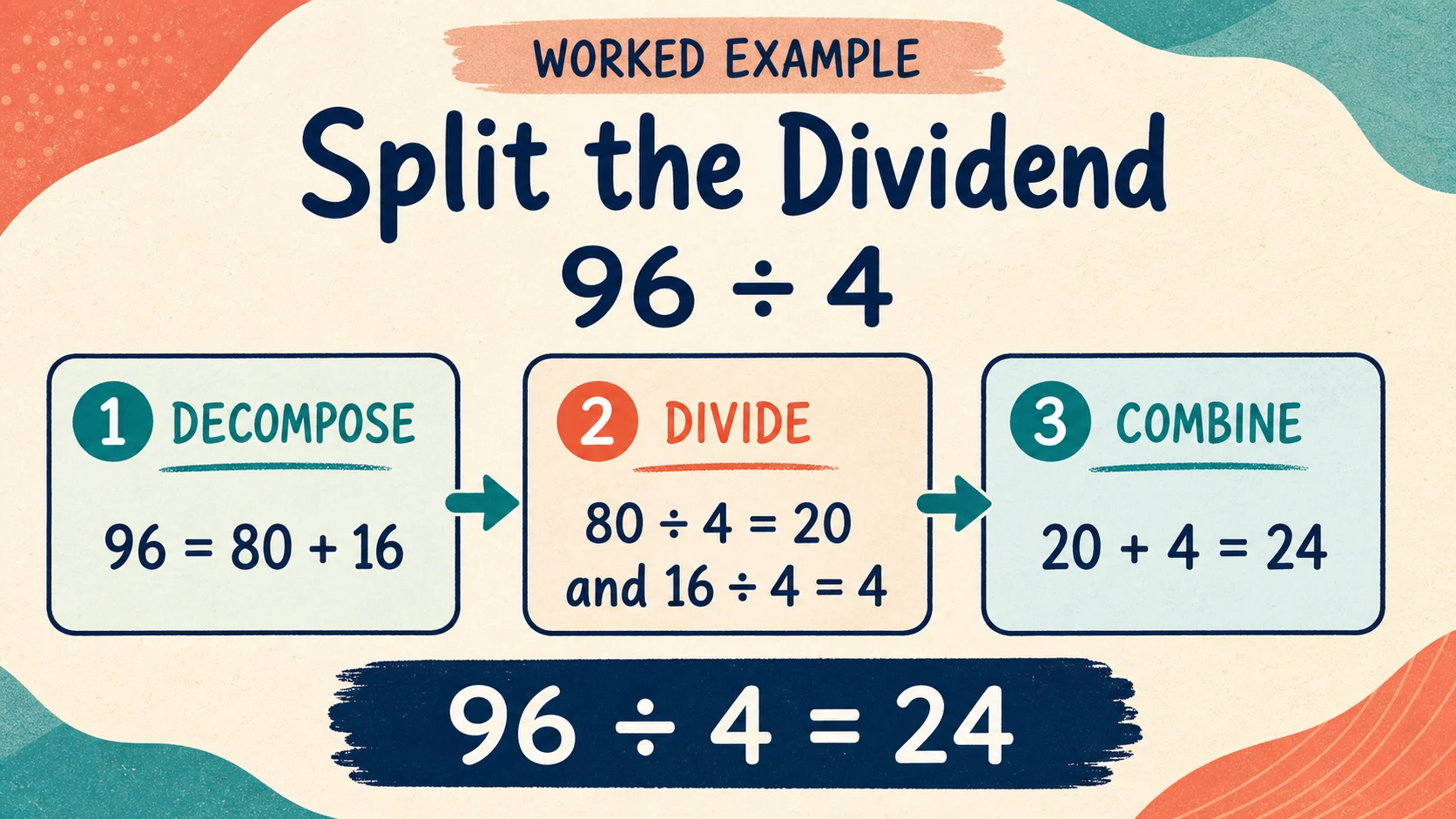
Connect every written quotient to equal groups and verify it with multiplication.
Translate the symbols aloud
For 18 ÷ 6 = 3, say, “Eighteen divided into groups of six makes three groups,” or, when the context calls for sharing, “Eighteen shared equally among six groups puts three in each group.”
Avoid teaching that division always means “make smaller.” That shortcut fails at boundary cases such as dividing by 1, where the quotient equals the starting amount. Instead, return to the dependable ideas of equal groups and related multiplication.
Move Through Guided Practice
Choose three to five printed questions rather than working the entire top row automatically. Select items that let you observe different demands: a familiar fact, a less familiar fact, and, if present, a problem involving written long-division notation or a remainder.
Use prompts in a fading sequence
Begin with specific prompts:
- “What total are we dividing?”
- “What does the divisor tell us?”
- “Are we finding the size of each group or the number of groups?”
- “Which multiplication fact could check the quotient?”
After the learner responds successfully, reduce support:
- “What is your plan?”
- “How can you check it?”
- “Explain what your answer means.”
Finally, offer no prompt beyond “Try this one and show your thinking.” This fading sequence keeps the mathematical work with the learner while giving enough structure to prevent unproductive guessing.
Worked example 3: a fact with no remainder
Consider:
20 ÷ 4 = ?
A learner might skip-count by fours:
4, 8, 12, 16, 20
That is five counts, so:
20 ÷ 4 = 5
Verify:
4 × 5 = 20
A repeated-subtraction check also works:
20 − 4 − 4 − 4 − 4 − 4 = 0
Five groups of four were removed. The quotient is 5, and the zero confirms that nothing remains.
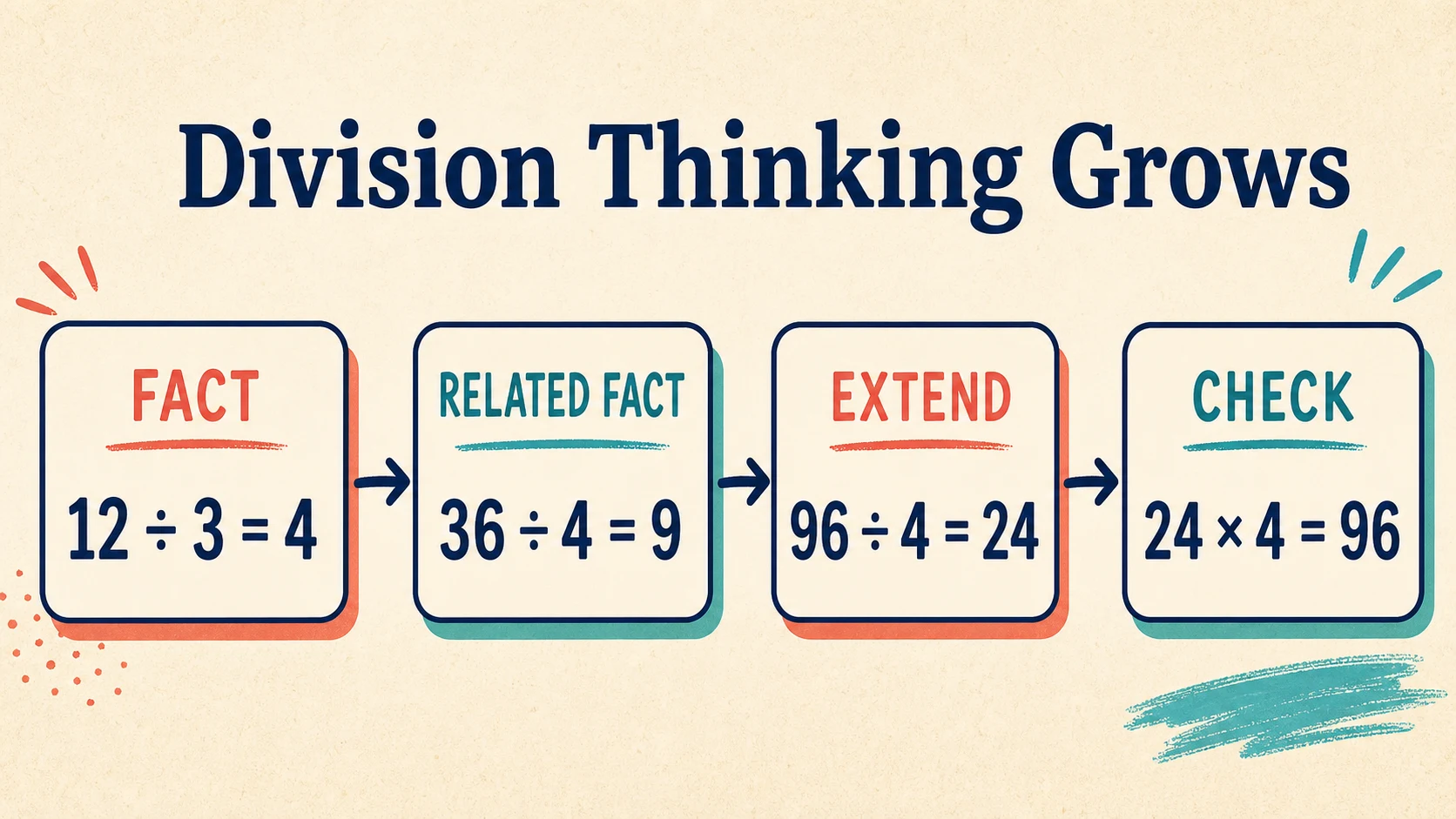
Give enough help to organize the reasoning, then reduce prompts as the learner takes over.
If the learner finds the answer mentally, still ask for a brief verification on selected items. A related multiplication equation is sufficient when it clearly demonstrates the reasoning. Requiring a large drawing for every familiar fact can turn useful practice into unnecessary copying.
The IES practice guide for assisting students who struggle with mathematics provides high-level support for systematic instruction, clear mathematical language, representations, and deliberate practice. It does not prescribe how many items this learner must complete. Use the learner’s current responses to choose the amount and type of support.
Teach Remainders and Boundary Cases Carefully
The catalogue identifies remainders as one of the worksheet’s practice areas. A remainder is what is left after making as many equal whole-number groups as possible. Do not let the learner treat it as an extra quotient digit.
Worked example 4: a remainder
Consider:
14 ÷ 4 = ?
Make groups of 4:
- First group: 4
- Second group: 4
- Third group: 4
Three groups use 12 counters, leaving 2. Therefore:
14 ÷ 4 = 3 remainder 2
Check the result with:
4 × 3 + 2 = 14
The check is exact: 12 + 2 = 14. Also confirm that the remainder is smaller than the divisor. Here, 2 < 4, so another complete group of four cannot be made.
If a learner writes 3 remainder 4, point out that the four leftover objects form one more complete group. The quotient should increase instead.
Worked example 5: dividing by one
Consider:
9 ÷ 1 = 9
Nine objects placed one per group make nine groups. Check:
1 × 9 = 9
This boundary case shows why “division makes a number smaller” is unreliable. Dividing a whole number by 1 leaves it unchanged.
Worked example 6: a number divided by itself
Consider:
8 ÷ 8 = 1
Eight objects placed into one group of eight make exactly one group. Check:
8 × 1 = 8
For the positive whole numbers used in these examples, a number divided by itself equals 1.
Do not introduce division by zero as a routine practice problem unless it appears in the chosen curriculum and the learner is ready for a careful explanation. No equal-group construction can answer how many groups of zero make a positive total. It should not be handled by guessing or by extending a memorized pattern.
Adapt Support Without Changing the Skill
Adaptation should preserve the division decision. The learner should still determine an equal share, a number of groups, a quotient, or a remainder. The support changes how the learner accesses the task—not what mathematical question is being asked.
When the learner needs more concrete support
Cover all but one printed question. Read the equation aloud and provide exactly the number of counters named by the dividend. Ask the learner to build the groups, draw the result, and then record the equation. Keep numbers and operations unchanged.
If counting errors interfere, arrange counters in tidy rows before grouping. The learner still performs division; the layout merely reduces visual confusion.
When notation is the main barrier
Mark the dividend and divisor with consistent visual cues on a separate modeled example. Say what each number represents. Then ask the learner to label the same parts on a printed problem.
For long-division notation, connect the layout to a known fact. For example, if 18 ÷ 3 is written with 18 inside the division bracket and 3 outside, solve it as “How many threes are in 18?” Record 6 in the quotient position and check 3 × 6 = 18. Do not rush into a memorized long-division procedure when equal-group meaning is not yet secure.
When the learner is ready for less support
Remove counters but retain the multiplication check. Ask the learner to solve a small set mentally, circle one item that required thought, and explain that item. Another useful extension is to write both interpretations for the same fact, such as sharing 16 objects among 4 groups and making groups of 4 from 16 objects.
Do not increase difficulty merely by demanding speed. Faster work is useful only when accuracy and explanation remain stable.
Change the representation, visible workload, or prompting while preserving the original division task.
Interpret Errors Before Correcting Them
A wrong answer is evidence about the learner’s current strategy. Look at the written work and ask for an explanation before naming the correction.
Unequal-group errors
Example: For 12 ÷ 3, the learner draws groups containing 5, 4, and 3.
Likely issue: the learner understands “put into groups” but has not maintained equality.
Response: return all 12 counters to one collection. Deal them one at a time across three marked spaces. Ask, “Does each group have the same amount?” Then record 12 ÷ 3 = 4 and check 3 × 4 = 12.
Multiplication-product answers
Example: For 15 ÷ 5, the learner writes 75.
Likely issue: the learner multiplied the two visible numbers.
Response: ask whether the answer represents the total, group size, or number of groups. Build 15 in groups of 5 and count the groups. Then compare 15 ÷ 5 = 3 with the check 5 × 3 = 15.
Reversed dividend and divisor
Example: The learner reads 18 ÷ 3 as 3 ÷ 18.
Response: identify 18 as the total being divided. Use the sentence frame, “___ objects are divided into groups of ___.” Fill it as “18 objects are divided into groups of 3.” Avoid relying only on positional vocabulary; attach each number to its role.
Remainder errors
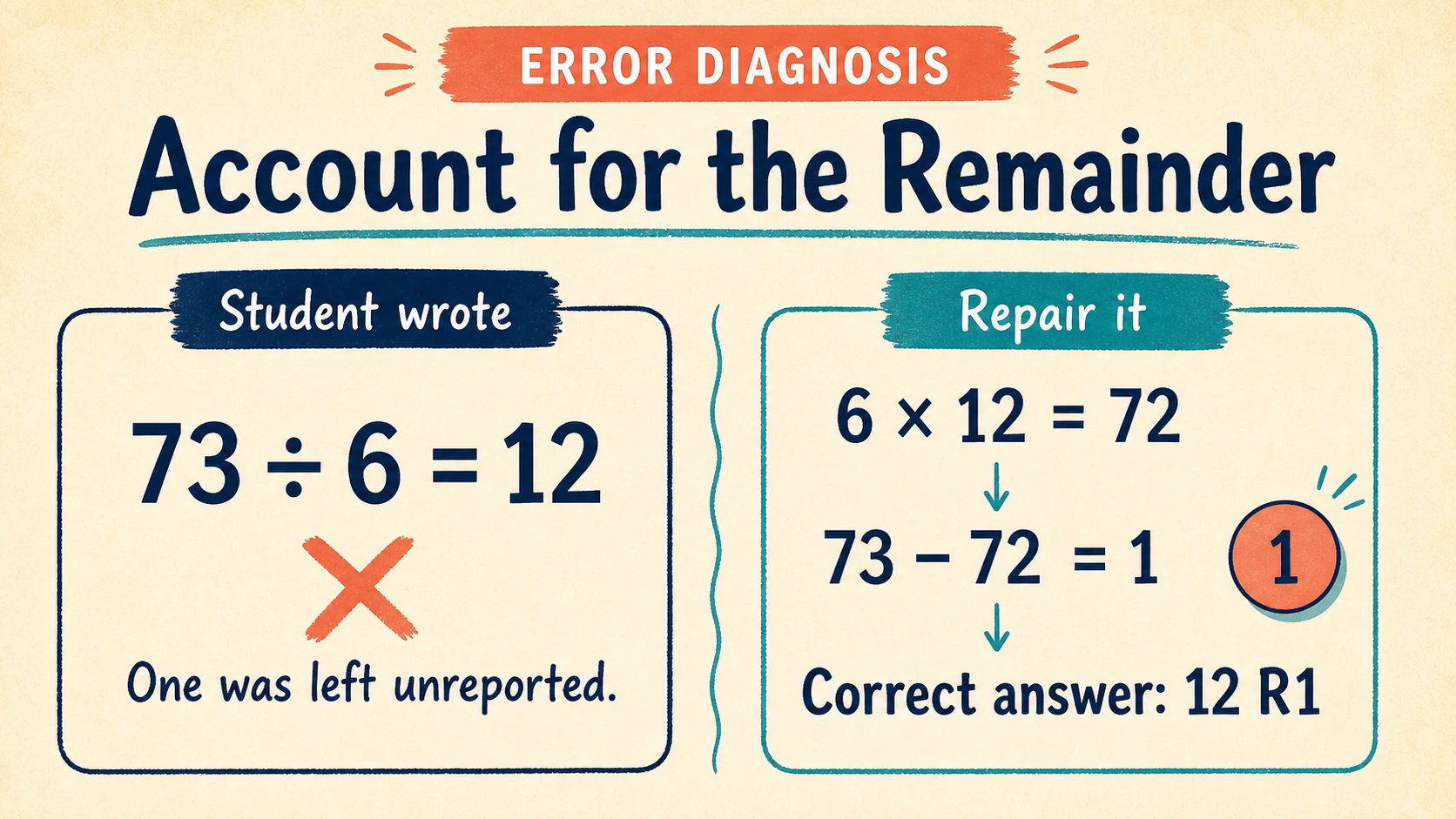
Example: For 17 ÷ 5, the learner writes 3 remainder 5.
Response: show that the five remaining counters make another complete group. Four groups of five use 20, which is too many, while three groups use 15 and leave 2. The checked answer is:
17 ÷ 5 = 3 remainder 2
5 × 3 + 2 = 17
Correct answer with unclear work
A correct quotient does not always show secure understanding. The learner may have guessed, copied, or used a valid mental fact without recording it. Ask for one concise check. If the learner can write the related multiplication equation and explain the quotient, accept that evidence. Do not require a full reconstruction of every correct item.
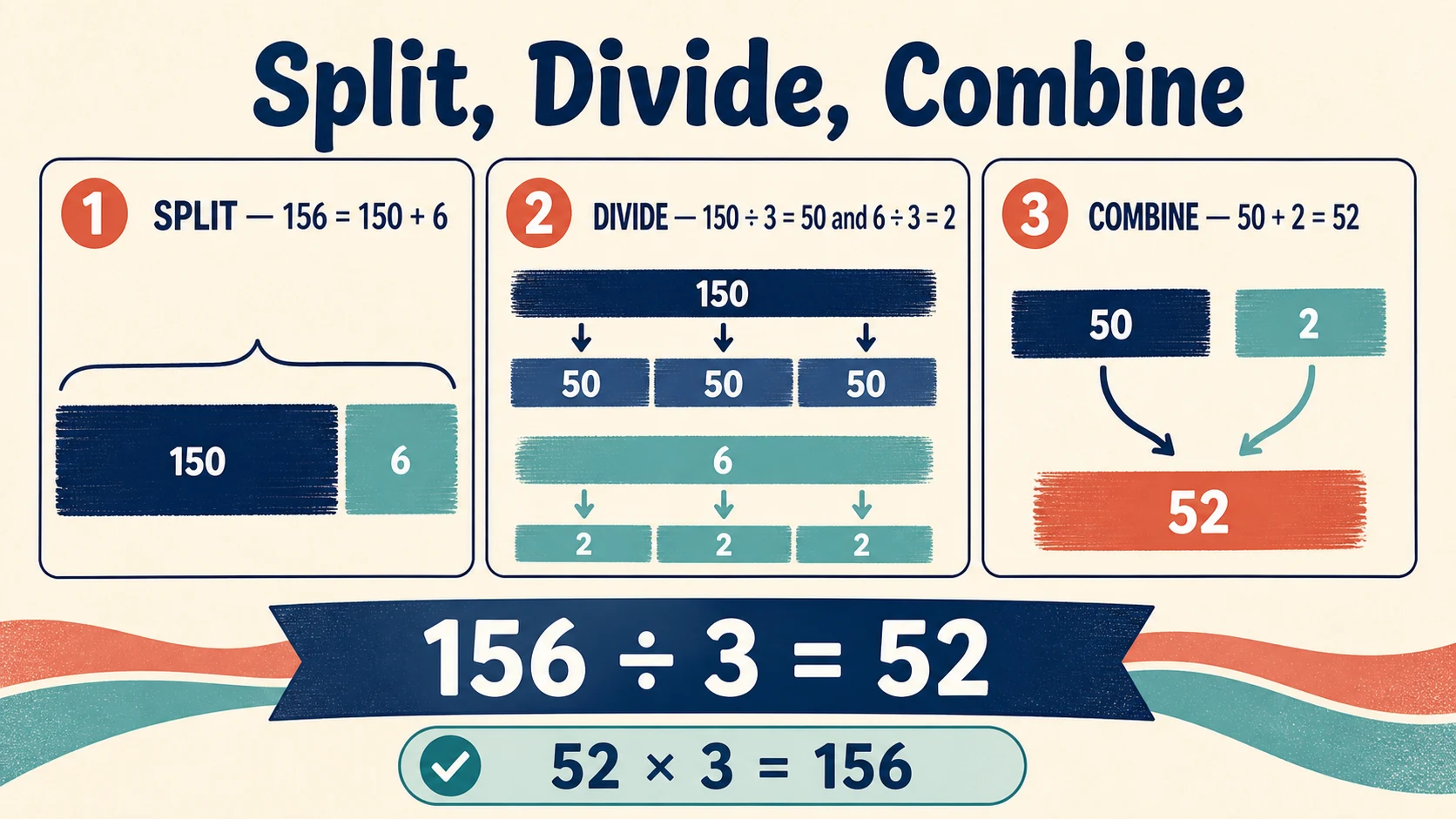
Read the work, identify the strategy, rebuild the meaning, correct it, and verify the correction.
Check the Answer Key Responsibly
The separate answer key makes checking efficient, but it should not replace mathematical review. First solve or verify the problem yourself. Then compare the learner’s response with the key. This reduces the chance that a printing issue, unclear mark, or misread remainder turns into an incorrect correction.
Use this routine:
- Compare the quotient.
- Check any remainder and confirm it is smaller than the divisor.
- Verify with
divisor × quotient + remainder = dividend. - Inspect whether the shown work matches the answer.
- Ask the learner to correct one error at a time.
For an exact division such as 24 ÷ 6 = 4, the check is 6 × 4 = 24. For a remainder example such as 19 ÷ 4 = 4 remainder 3, the check is 4 × 4 + 3 = 19. Both are fully checked because they reconstruct the dividend.
Do not announce only a score such as “16 out of 20.” Sort responses into useful categories:
| Pattern | Interpretation | Immediate response |
|---|---|---|
| Correct and explained | Current strategy appears usable | Continue with reduced support |
| Correct but uncertain | Fact or notation may be fragile | Ask for one check and revisit later |
| Isolated counting slip | Concept may be present | Correct the count and retry |
| Repeated unequal groups | Equal-sharing idea needs work | Return to counters |
| Repeated fact confusion | Inverse relationship needs support | Pair division with multiplication |
| Remainders equal to or above divisor | Grouping is unfinished | Make another complete group |
| Many blank or guessed items | Current load may be too high | Shorten the set and model again |
Retain the original attempt where possible. A crossed-out answer followed by a reasoned correction provides more information than an erased page that appears perfect.
Decide What to Do Next
Use the learner’s observed work, not the worksheet title alone, to select the next task.
Continue at the same level
Stay with easy division practice when the learner understands equal groups but still counts slowly, needs occasional counters, or makes isolated fact errors. Reuse only selected items rather than immediately repeating the full page. Additional choices are available through the 2nd Grade Math hub.
Step back within division
Return to concrete sharing and grouping if the learner regularly makes unequal groups, cannot explain the quotient, or treats division as an instruction to multiply. Preserve small whole-number examples and postpone long-division notation until the meaning is stable.
The broader Division topic guide is the appropriate place to review the full progression. Linking there avoids forcing this single printable to teach every stage of division.
Extend after secure work
Consider a larger or more varied set only when the learner independently solves most selected items, checks answers accurately, and explains both equal sharing and equal grouping. The 2nd Grade Division Worksheet Pack contains 18 worksheets, while the free worksheet generators can provide additional practice. These are options for variety, not evidence that a learner must advance immediately.
The catalogue also lists division facts, mental math, number sense, long division, and remainders for this worksheet. That is a broad set for one printable. Completion does not demonstrate mastery of the entire division progression, and an answer key cannot measure the depth of understanding by itself.
Schedule Retrieval Without Overloading the Learner
Retrieval means returning to previously practiced thinking after a delay. A simple schedule can use the same page without assigning all 20 items again.
| Time | Suggested review | What to observe |
|---|---|---|
| End of the first session | Rework 1 corrected item | Can the learner explain the correction? |
| 1–2 days later | Solve 2–3 previously completed items | Is the strategy recalled with fewer prompts? |
| About one week later | Mix 2 division items with familiar math work | Can the learner identify division independently? |
| About two weeks later | Solve 2 items, including one former difficulty | Is the understanding retained? |
These intervals are an instructional suggestion, not a sourced or universal timetable. Adjust them according to the learner’s work. If the learner remembers accurately, widen the interval. If the learner has forgotten the meaning of the notation, shorten the interval and restore a concrete model.
Vary the representation while preserving the fact. A previous equation such as 12 ÷ 3 = 4 can return as counters shared among three plates, groups of three counted from twelve, or the missing factor in 3 × ? = 12.
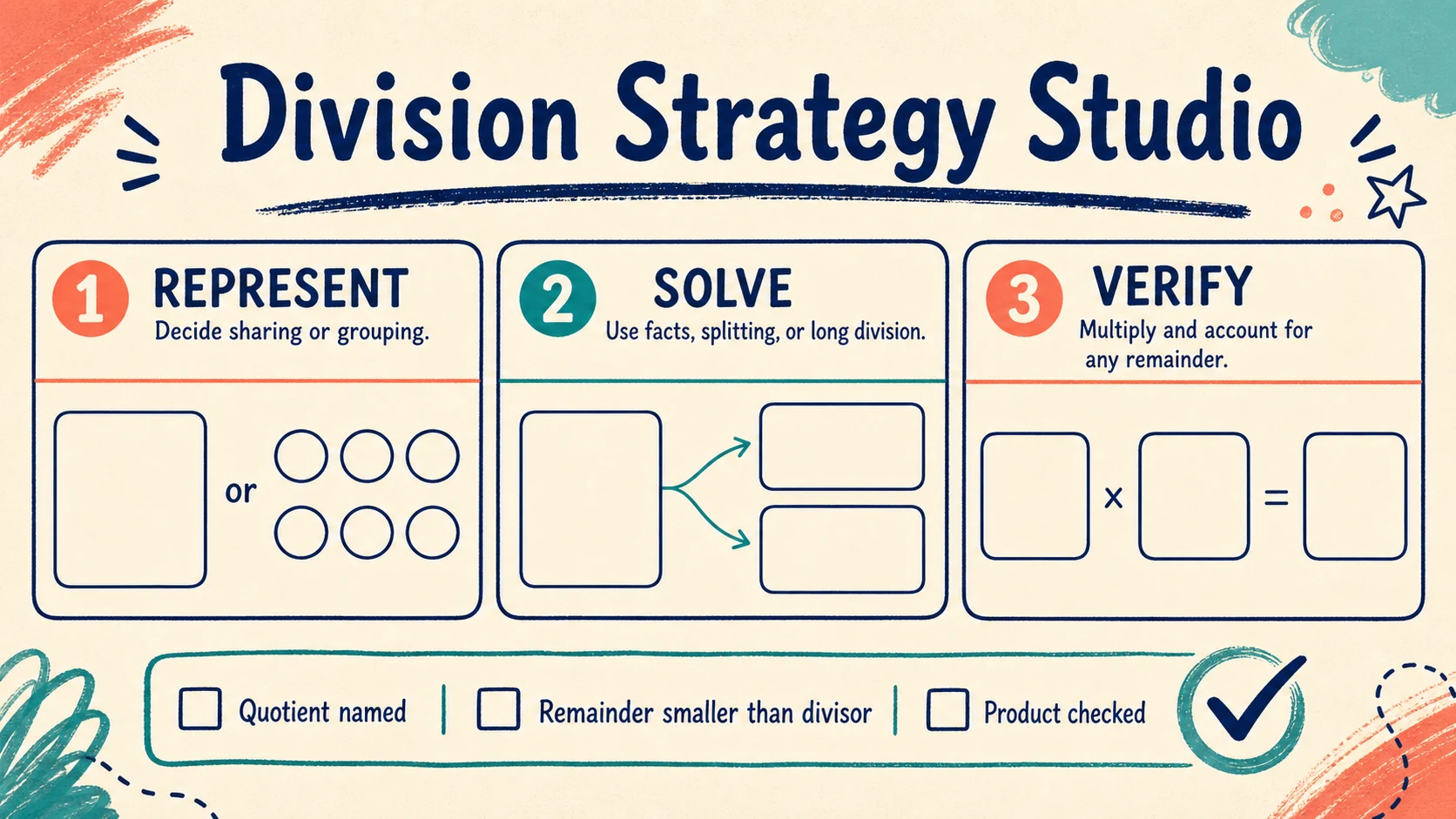
Revisit a few selected facts after increasing delays and let remembered performance set the next interval.
Keep the Worksheet’s Limits in View
This printable supplies 20 easy-level practice exercises and a separate answer key. It can support modeling, practice, correction, and retrieval, but it cannot by itself establish a learner’s complete understanding of division.
A worksheet response may not reveal whether the learner can interpret a word problem, choose between sharing and grouping, explain a remainder in context, or transfer a fact to an unfamiliar representation. Mental math can also hide reasoning unless the adult asks for occasional explanations. Conversely, heavy written work may understate understanding when a learner can build and explain the groups accurately.
The supplied grade label indicates intended practice level; it is not certification, a guarantee of outcomes, or proof of comprehensive standards alignment. Local sequences differ, and the Common Core progression is only one reference point. This guide offers educational support, not medical or child-specific guidance.
The most useful next action is to print the free 20-item worksheet and answer key, choose three items for guided practice, and reserve two completed items for retrieval later in the week. If the readiness check shows that equal groups are not yet secure, pause the printable and use the Division topic guide to select a more concrete starting point.
Put it into practice
Use the guide with a real printable
Move from explanation to a short, observable practice task. Check the first item together, then adjust the next session from the learner's actual work.
See the 18-worksheet pack