Complete guide
How to teach and practise 2nd grade addition worksheets - standard theme (easy)
How to use this 20-item addition worksheet
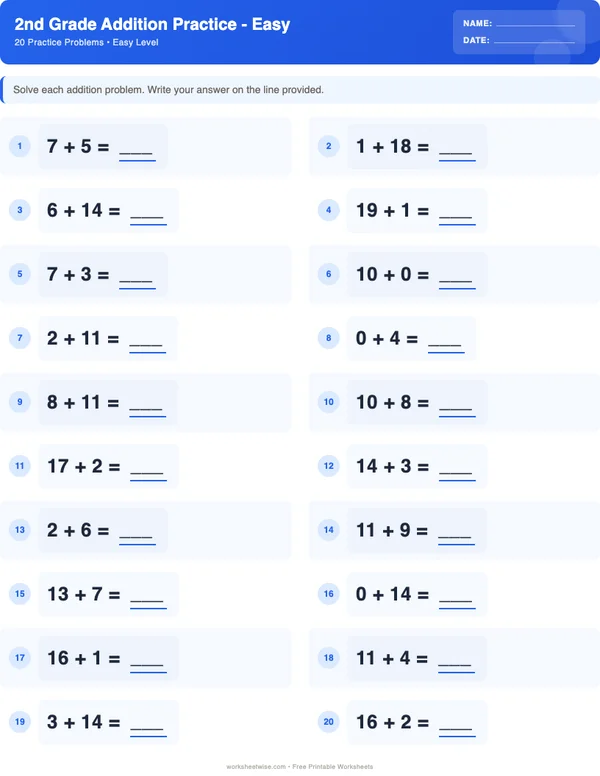
The free 2nd Grade Addition worksheet provides 20 easy-level addition exercises. The learner solves each problem and writes the answer on the line provided. A separate printable answer key is included.
A practical lesson is simple: model two or three problems, solve several together, let the learner complete a manageable group independently, and review the work by error type rather than by score alone. Use counters, drawings, a ten frame, or base-ten blocks when they help the learner explain the addition. Remove those supports gradually as the learner becomes accurate and confident.
Grade labels describe the intended practice level, not a guarantee that every second grader is ready for the same work at the same time. Local curricula and instructional sequences differ. Let the learner’s observed work determine whether to continue, add support, shorten the session, or move to a different worksheet.
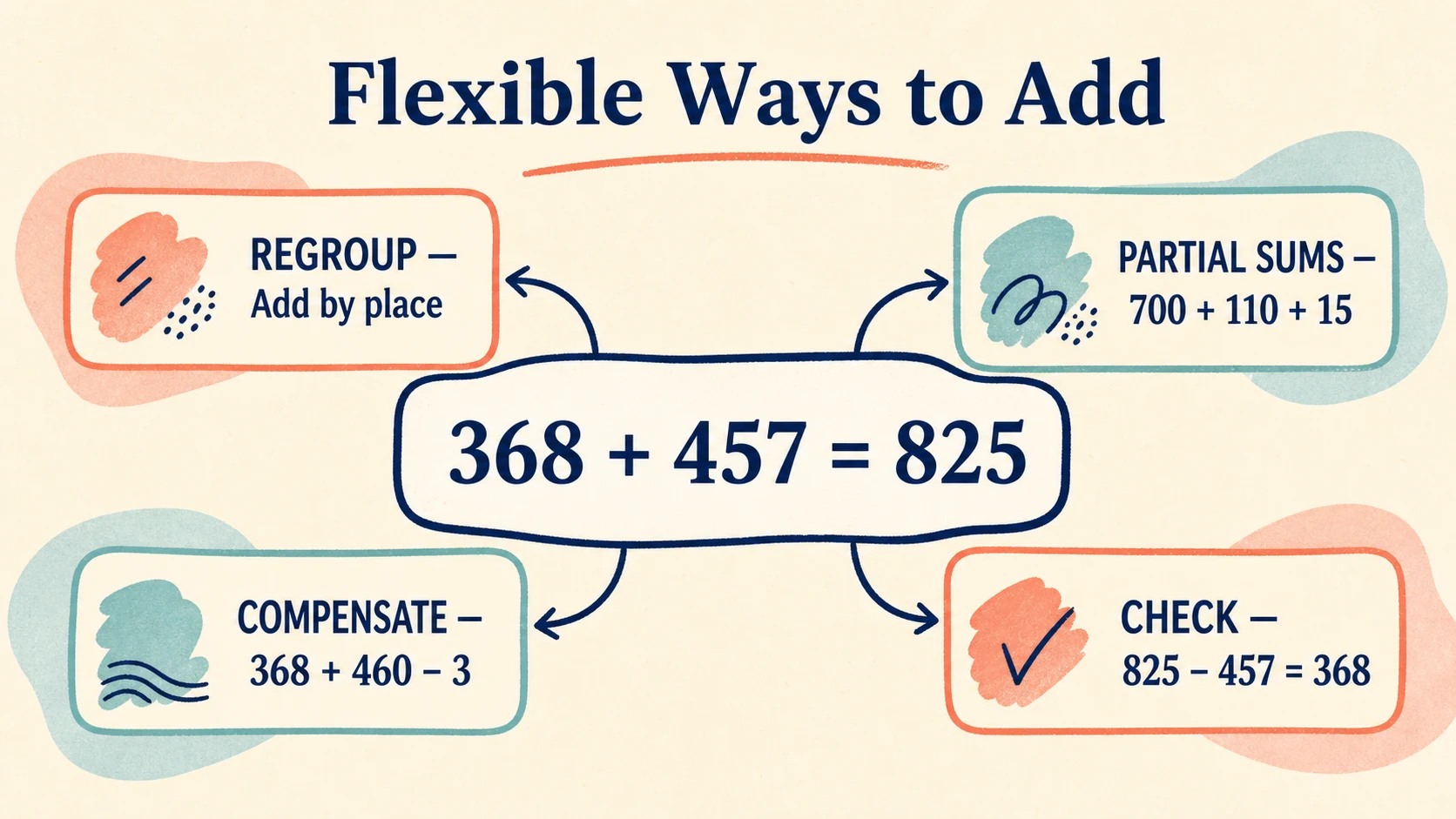
Move from a brief launch to modeling, guided practice, independent work, and a short review.
What this worksheet covers
The worksheet is catalogued as easy-level practice in addition facts, mental math, number sense, and place value. It contains 20 exercises in a standard, uncluttered format. It can be used for classroom practice, homework, tutoring, or homeschool instruction.
Because the individual problems are not reproduced in this guide, preview the printable before teaching. Notice the size of the addends, whether any sums cross a ten, and whether the problems require facts the learner has not practiced recently. The worked examples below are verified teaching models, not claims about the exact items printed on the worksheet.
For the larger sequence from early addition with objects through multi-digit work, use the broader 2nd Grade addition guide. This lesson concentrates on using this particular 20-item printable well rather than repeating the entire addition progression.
| Lesson phase | Suggested amount of work | What the adult watches for |
|---|---|---|
| Launch | 1 oral example | Does the learner understand that the two quantities are being combined? |
| Model | 2–3 written examples | Can the learner follow the representation and explain the total? |
| Guided practice | 3–5 worksheet items | Does the learner choose and carry out a workable strategy? |
| Independent practice | A small group of remaining items | Is the work accurate without step-by-step prompting? |
| Review | 2–4 selected items | Are errors factual, strategic, place-value related, or caused by recording? |
| Retrieval | A few problems on later days | Can the learner recall and apply the method after time has passed? |
These quantities are instructional suggestions, not a universal timetable. A learner who is accurate and independent may need a shorter model. A learner who is uncertain may need the worksheet divided across two or more sessions.
Prepare the lesson before handing over the page
Print or open the worksheet and keep the answer key out of the learner’s immediate view. Gather only the supports that might be useful: small counters, a ten frame, a number line, scrap paper, or base-ten blocks. Too many materials at once can make the method less clear.
Read the printed direction aloud: “Solve each addition problem. Write your answer on the line provided.” Then ask the learner to restate the task. A suitable response might be, “I add the two numbers and write the total.” This checks understanding of the direction without testing an addition fact yet.
Use a quick readiness check
Before beginning the 20 items, give one oral problem that resembles the level visible on the sheet. Ask, “How would you find 6 plus 3?” Do not require a particular strategy.
Listen for whether the learner can:
- identify that addition combines quantities;
- represent both addends without losing track;
- count on, use a known fact, make ten, or use place value;
- state a total that matches the representation; and
- write numerals legibly enough to distinguish the answer.
If the learner solves the readiness problem accurately and can explain the method, begin modeling briefly. If the learner guesses, recounts inconsistently, or cannot connect the symbols to quantities, add a concrete demonstration before using the worksheet.
Set a clear purpose
A calm launch could be:
“This page has 20 addition problems. First I will show how to solve and check one. Then we will do a few together. After that, you will try a group on your own. We can pause if your strategy stops making sense.”
This tells the learner what independence will look like while leaving room for support. Avoid presenting the page as a race. Speed is not useful evidence when the learner cannot yet explain or reliably reproduce the strategy.
Model the task with checked examples
Choose examples that match the forms you saw on the printable. Show one representation clearly, connect it to the equation, and check the answer with a second method. The purpose is not to display every possible addition strategy.
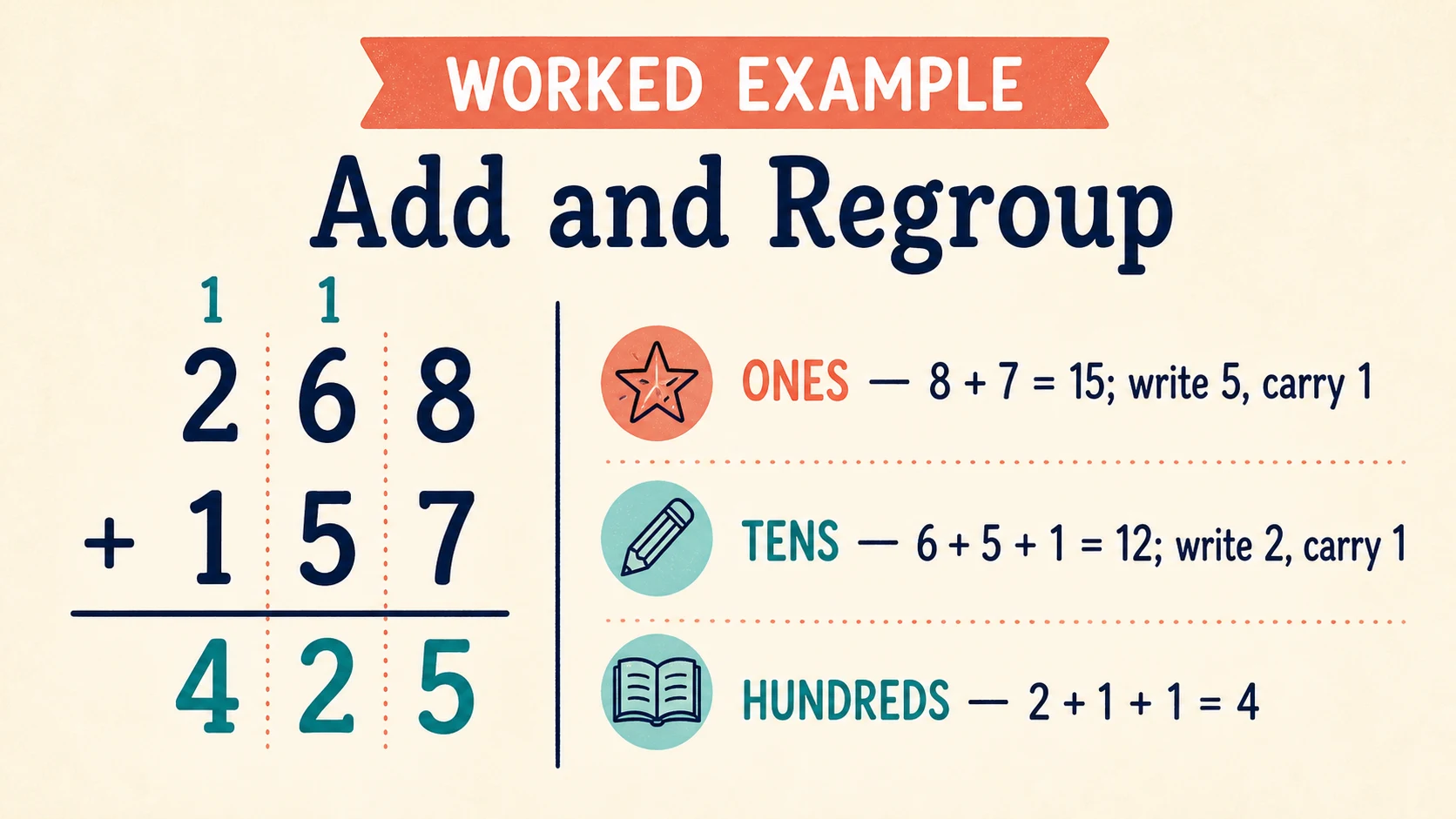
Connect the written equation to quantities, then verify the total in a second way.
Example 1: Count on from the larger addend
Solve:
7 + 5 = ?
Start at 7 and count on five numbers:
8, 9, 10, 11, 12
Therefore:
7 + 5 = 12
Check by representing the addends as two groups. Make a group of seven counters and another group of five. Combine them and arrange the counters as ten plus two. The combined quantity is 12, so the answer is checked.
The important detail is that 7 is already counted. Saying “7, 8, 9, 10, 11” counts only four new amounts after 7 and produces the wrong total. Mark five jumps or raise one finger for each counted-on number if the learner tends to lose track.
Example 2: Make ten
Solve:
9 + 6 = ?
Nine needs one more to make ten. Decompose 6 into 1 and 5:
9 + 6 = 9 + 1 + 5
Then calculate:
9 + 1 = 10
10 + 5 = 15
Therefore:
9 + 6 = 15
Check by counting on six from 9:
10, 11, 12, 13, 14, 15
Both methods give 15. When modeling, make clear that the 6 has not changed in value. It was separated into 1 and 5, and 1 + 5 = 6.
Example 3: Combine tens and ones
Solve:
24 + 13 = ?
Decompose each number by place value:
24 = 20 + 4
13 = 10 + 3
Combine tens:
20 + 10 = 30
Combine ones:
4 + 3 = 7
Recombine:
30 + 7 = 37
Therefore:
24 + 13 = 37
Check by adding in parts:
24 + 10 = 34
34 + 3 = 37
The answer remains 37. If using base-ten blocks, show two tens and four ones, then add one ten and three ones. The finished model contains three tens and seven ones.
Example 4: Cross a ten with place-value reasoning
Solve:
28 + 7 = ?
Twenty-eight needs two more to reach 30. Decompose 7 into 2 and 5:
28 + 7 = 28 + 2 + 5
Calculate:
28 + 2 = 30
30 + 5 = 35
Therefore:
28 + 7 = 35
Check with place value. Seven added to eight ones gives fifteen ones. Fifteen ones can be viewed as one ten and five ones. Combine that new ten with the two tens already in 28:
20 + 10 + 5 = 35
This example helps expose a common misconception: a learner may write 215 by placing 15 beside the 2 in 28. The correction is conceptual, not merely procedural. Fifteen ones must be regrouped as one ten and five ones.
Move from guided practice to independent work
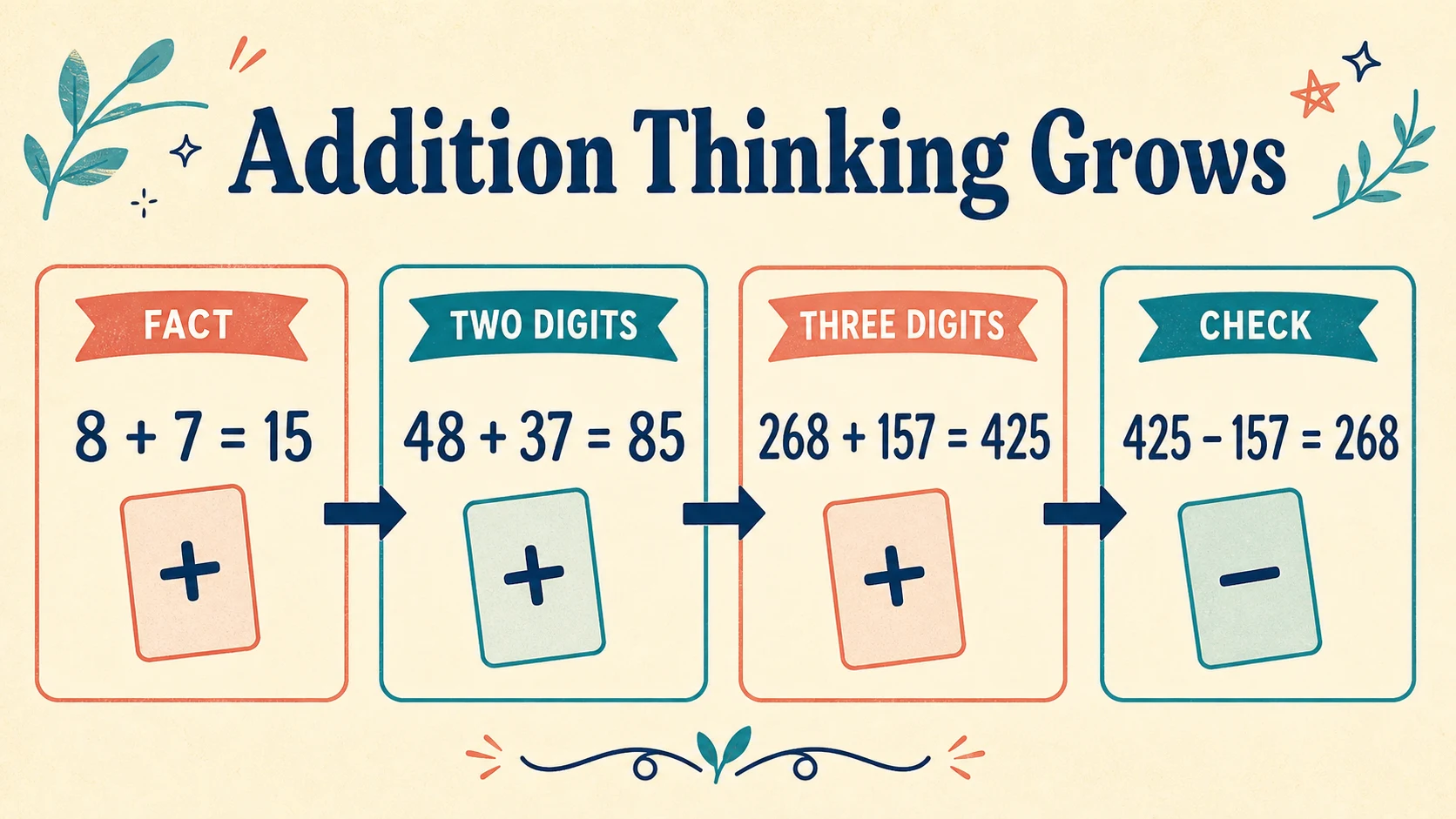
During guided practice, ask for the learner’s reasoning before supplying the next step.
Guide without taking over
Select three to five worksheet problems. On the first, ask the learner to represent the addends. On the next, ask for a strategy choice. By the final guided item, reduce the prompts.
Useful prompts include:
- “What quantities are being combined?”
- “Which addend would be easier to start from?”
- “Can you make a ten?”
- “What do the tens and ones represent?”
- “How could you check that total?”
Avoid turning every problem into a string of hints that leaves no decision for the learner. If an adult says where to start, which strategy to use, every number to write, and when to stop, the finished answer does not demonstrate independent understanding.
When the learner gives an incorrect answer, ask for the representation or steps before correcting it. “Show me how you got 14” produces more useful evidence than “Try again.”
Release a small group at a time
Cover part of the page or mark a stopping point after four or five problems. Ask the learner to complete that group without help. Then inspect the work before assigning the next group.
Continue if the learner is using a sensible strategy and answers are mostly accurate. Return briefly to guided practice if the same misunderstanding appears more than once. Pause the lesson if counting becomes increasingly disorganized, place-value representations deteriorate, or frustration makes the work unreliable.
A break does not change the skill being taught. It protects the quality of the evidence. Completing all 20 items in one sitting is less important than seeing what the learner can do accurately and explain.
Adapt support without changing the addition skill
Differentiation should change access, representation, pacing, or response demands while preserving the addition itself. Do not replace the problems with unrelated easier work merely to finish the page.
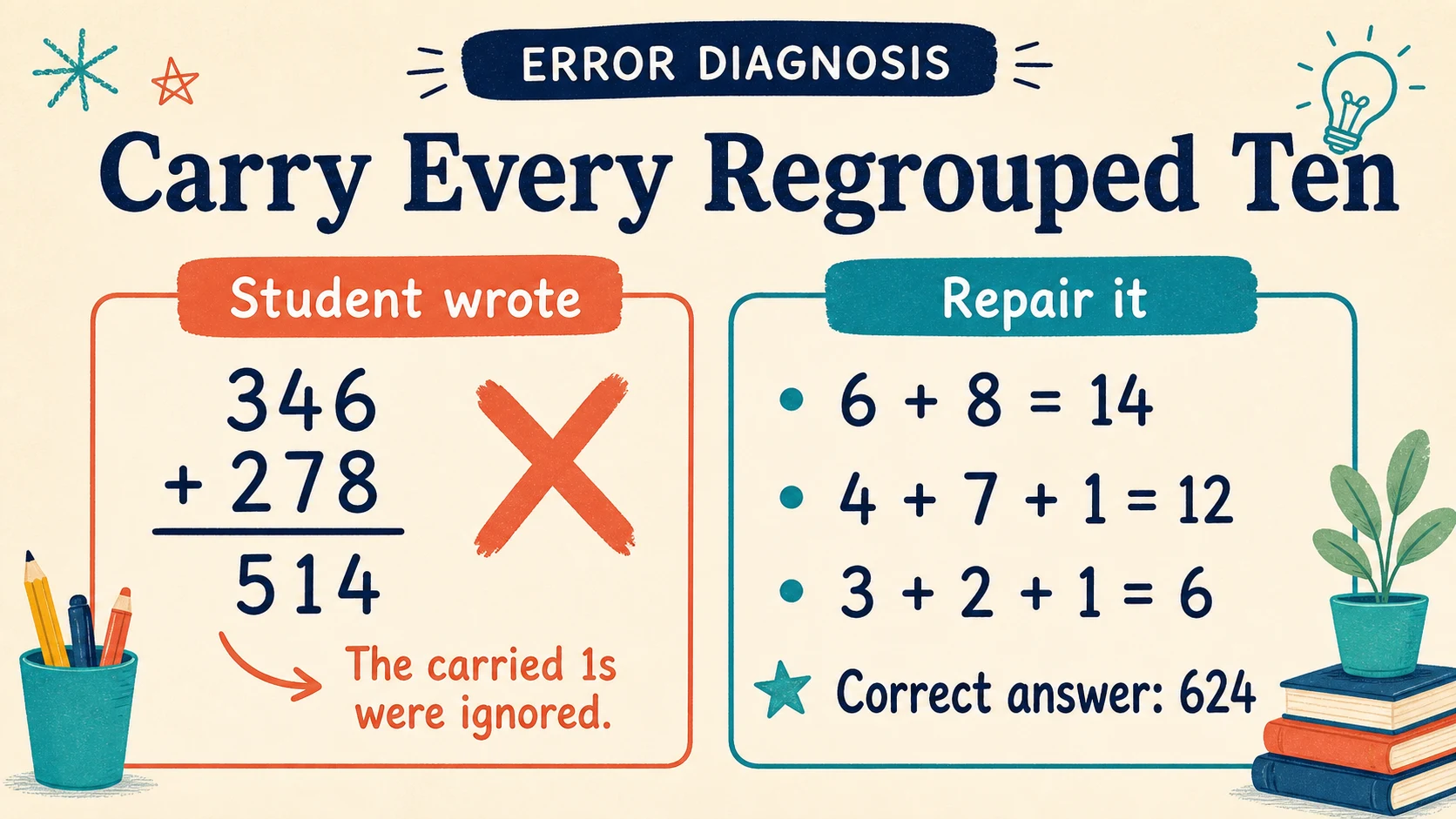
Adjust the amount shown, the representation available, or the pacing while keeping the addition target intact.
When the learner needs more support
Reveal one row or a few problems at a time. Allow counters, a ten frame, a number line, or base-ten blocks. Read the directions aloud and provide scrap paper for decomposing numbers.
If the learner recounts both addends from one, model counting on from the larger addend. If a sum crosses ten, let the learner build both addends and physically compose a group of ten. For multi-digit examples, separate tens and ones with a place-value mat.
Keep the original equation visible. The concrete or drawn model should explain the equation, not become a different task.
When writing is the obstacle
A learner may understand the addition but record answers unclearly or in the wrong place. Enlarge the page if possible, provide lined scrap paper, or let the learner point to a computed answer before copying it to the answer line.
This is an access adjustment, not medical guidance or a diagnosis. Record what you observed: for example, “Solved orally but reversed two written digits.” That is more precise than assigning a cause the worksheet cannot establish.
When the work is already secure
If the learner solves accurately and explains the methods, reduce repetition without introducing a harder skill mid-page. Ask the learner to complete selected items, explain one efficient strategy, and check one result in a different way.
Another option is to sort completed problems by strategy: known fact, counting on, making ten, or place-value decomposition. This keeps attention on flexible addition rather than turning easy practice into a speed contest.
Use boundary cases to test understanding
Boundary cases are short checks chosen because they reveal whether a strategy is understood beyond one familiar format. They need not appear on the printable.
Adding zero
Ask the learner to reason about:
8 + 0 = 8
Zero contributes no additional objects, so the quantity remains eight. A learner who answers 9 may be treating the plus sign as an instruction to increase by one regardless of the second addend.
Reversing the addends
Compare:
4 + 7 = 11
7 + 4 = 11
The total stays the same when the order of the addends changes. This can support efficient counting: starting from 7 requires four counted-on steps rather than starting from 4 and counting on seven. Do not require the learner to name a formal property unless that language is part of the local lesson.
Crossing versus not crossing ten
Compare:
12 + 5 = 17
18 + 5 = 23
In the first problem, two ones plus five ones remain fewer than ten ones. In the second, eight ones plus five ones make thirteen ones, which can be reorganized as one ten and three ones. If the learner uses the same inaccurate digit-joining method in both cases, return to a place-value representation.
These checks identify the edge of current understanding. They are not additional worksheet requirements and should not be used to inflate the learner’s workload.
Interpret errors before assigning more practice
A wrong answer does not by itself show what needs reteaching. Examine the learner’s marks, ask for a reconstruction of the method, and group errors by likely instructional need.
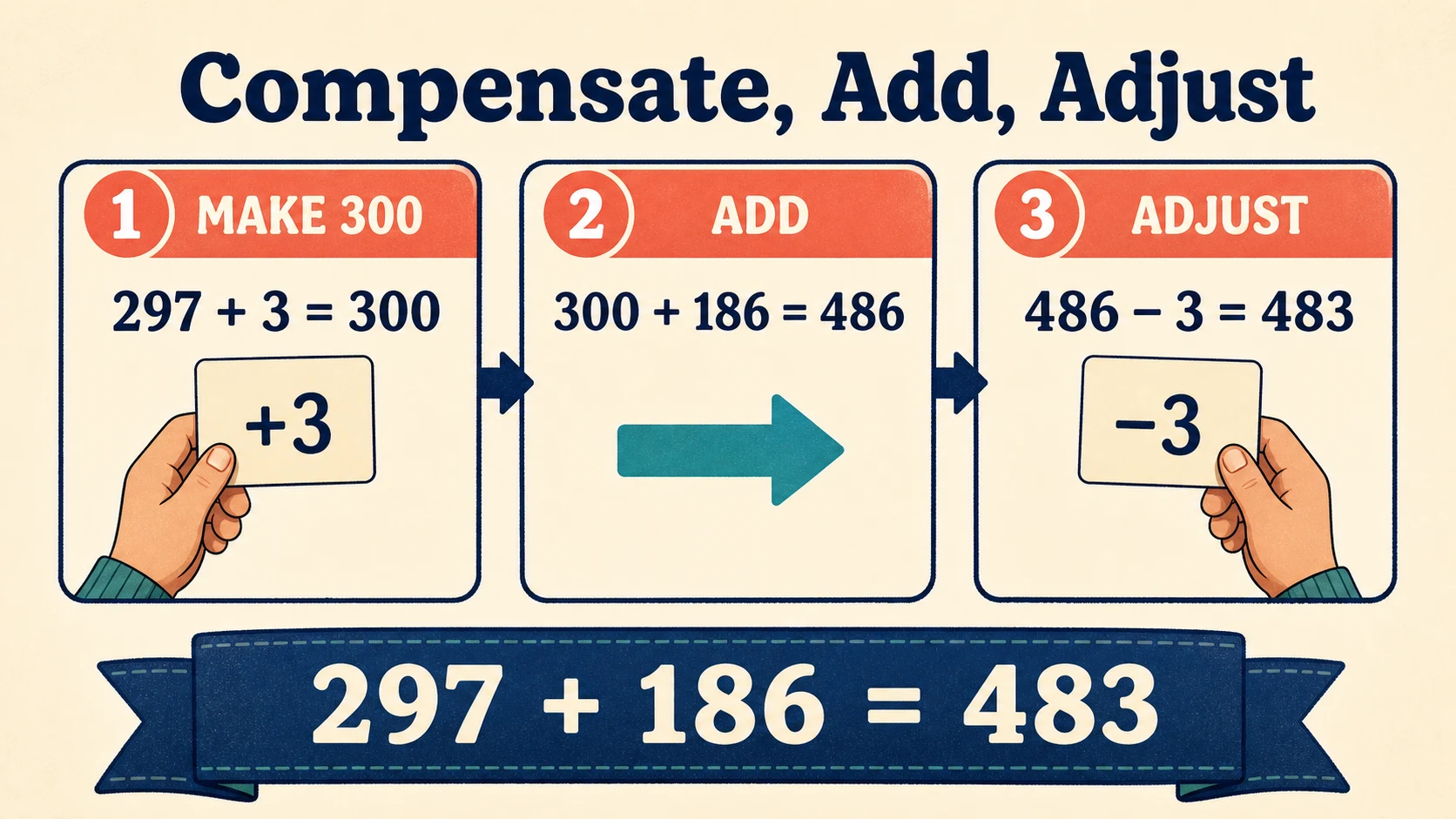
Rebuild the problem, locate the first incorrect step, and select one focused correction.
| Observed work | Possible interpretation | Focused response |
|---|---|---|
| Counts the starting addend as the first jump | Counting-on sequence is not coordinated | Mark one jump for each amount added |
| Gives different totals when recounting | Objects or spoken counts are not tracked consistently | Arrange counters in rows or use a ten frame |
Writes 9 + 6 = 14 after making ten |
Part of the decomposed 6 may have been omitted | Write 6 = 1 + 5 and account for both parts |
Writes 215 for 28 + 7 |
Fifteen ones were placed beside the tens digit | Build 15 ones and exchange 10 ones for one ten |
| Correct orally, incorrect on the answer line | Recording rather than addition may be the immediate issue | Have the learner point, say, and then copy the total |
| Several late errors after accurate early work | Attention or endurance may have changed | Stop, take a break, and sample again later |
Treat these as interpretations to investigate, not diagnoses. The same written error can come from different reasoning. For example, an answer of 14 for 9 + 6 could reflect a fact error, a missed count, or an incomplete make-ten decomposition.
Have the learner correct one representative problem from an error group, then try a fresh similar example. Copying the correct answer from the key does not show that the misconception has changed.
The IES guide on teaching mathematics to young children offers high-level instructional framing around helping learners connect representations, mathematical ideas, and language. The IES guide for assisting students who struggle with mathematics provides broader guidance on systematic instruction and purposeful practice. Neither source evaluates WorksheetWise or this exact printable.
Check the answer key responsibly
Use the separate answer key after the learner has completed an independent portion. Check each printed equation carefully rather than comparing only a row of answers; skipped problems can shift the apparent alignment.
Mark answers in a way that preserves evidence. A small dot beside an incorrect item is often enough before discussion. Do not erase the learner’s original reasoning. Ask the learner to solve the marked problem again on scrap paper and explain what changed.
Separate four kinds of evidence
Record results in categories:
- Accurate and explained: The learner reached the correct total and can reconstruct a sensible method.
- Accurate but uncertain: The answer is correct, but the learner cannot explain it or relied on guessing.
- Incorrect with a sound setup: The representation is appropriate, but a fact, count, or recording step failed.
- Incorrect because the model is misunderstood: The learner combined the wrong quantities, ignored place value, or could not connect the representation to the equation.
A raw total such as 16 out of 20 cannot show these distinctions. It also cannot establish broad mastery of second-grade addition, because this is one easy-level worksheet targeting a limited set of skills.
If an answer key entry appears surprising, solve the problem independently before changing the learner’s work. Use counters, place-value decomposition, or a second calculation. An answer key is a checking aid, not a substitute for mathematical verification.
Decide what to do after the worksheet
Use the learner’s independent work—not the amount of adult help during modeling—to choose the next step.
If most answers are accurate, the learner explains at least one method, and corrections are made with little support, schedule a short retrieval check rather than assigning the same page again immediately. Further addition practice is available through the 2nd Grade math collection and the fuller addition topic guide.
If errors cluster around one idea, teach that idea with two or three new examples before returning to mixed practice. For instance:
- For unstable counting, use organized counters and counted-on jumps.
- For difficulty making ten, practice decomposing the second addend while preserving its total.
- For place-value errors, build tens and ones and explain every exchange.
- For recording errors, separate calculation space from the final answer line.
If the learner needs repeated prompts on nearly every item, stop using the worksheet as independent practice. Return to concrete or drawn addition examples at a manageable number size. This preserves the addition goal while providing a representation the learner can reason with.
The Common Core mathematics standards can provide broad context for how addition facts, place-value strategies, and fluency develop across grades. They do not certify this individual worksheet or establish comprehensive alignment for a lesson built from one printable. Local expectations and teaching sequences may differ.
Schedule retrieval instead of one long repetition block
Retrieval means asking the learner to solve a small amount after time has passed, when the original page and immediate explanation are no longer doing the remembering.
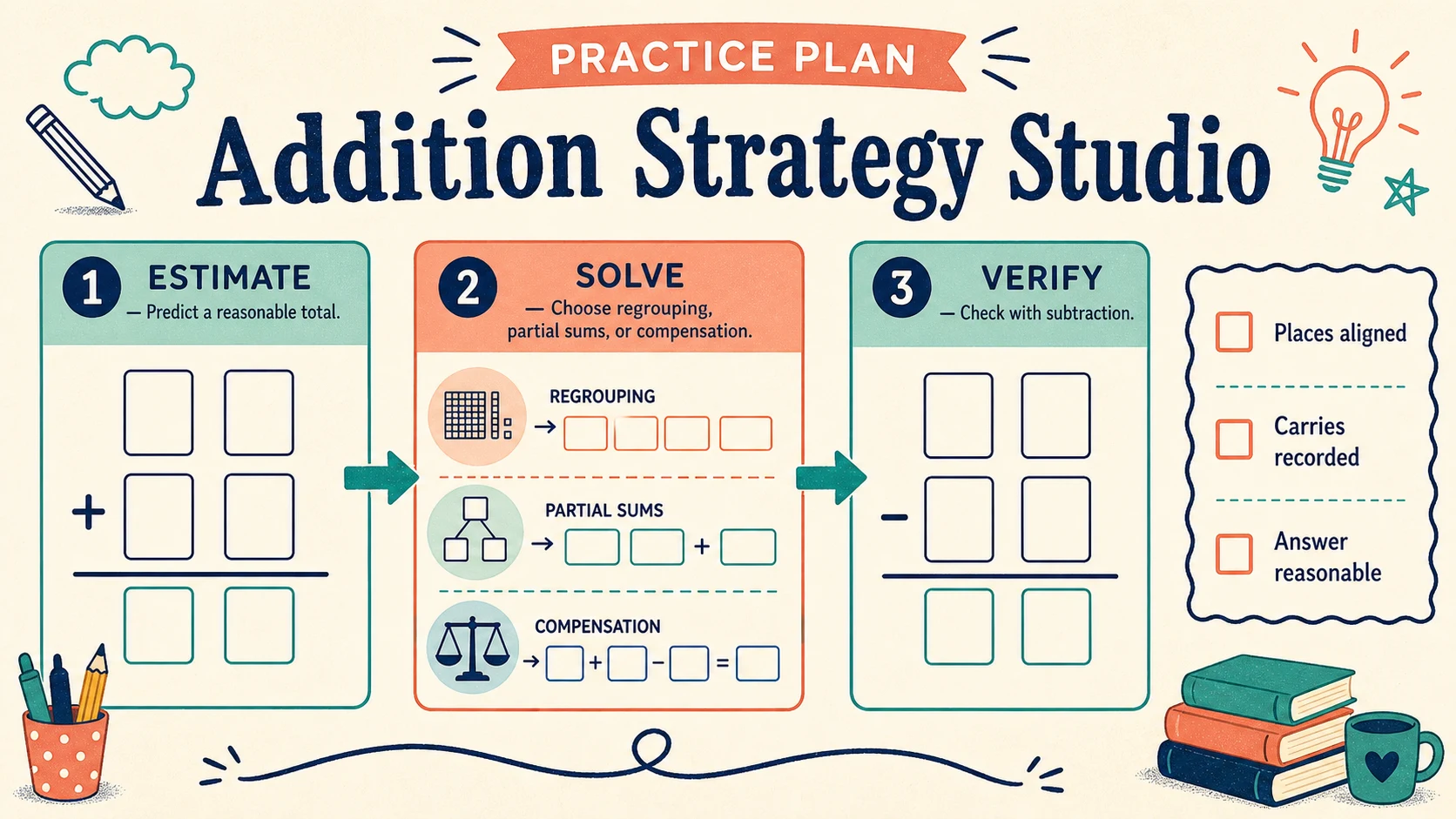
Revisit a few representative problems after increasing intervals and adjust the spacing from observed performance.
A practical, adjustable schedule is:
| Time | Retrieval task | Decision |
|---|---|---|
| Later the same day or next session | Solve 2 fresh examples representing practiced strategies | Reteach briefly if the method cannot be reconstructed |
| About 2–3 days later | Solve 3 mixed examples without looking at the completed sheet | Continue spacing if work is accurate and explainable |
| About 1 week later | Solve 3–5 examples, including one prior error type | Add support only where the error reappears |
| In a later addition lesson | Mix a few addition items with other familiar work | Check whether the skill remains available in a mixed context |
This is a practical plan, not a universal timetable or a sourced prescription for every learner. Shorten the interval when the learner cannot retrieve the method. Lengthen it when the work remains accurate and independent. Do not keep adding review merely because a calendar says to do so.
Limits of this printable and the honest next step
This worksheet offers 20 easy-level exercises and an answer key. It can provide useful evidence about addition facts, mental math, number sense, and place value within the problems presented. It cannot, by itself, demonstrate comprehensive addition mastery, guarantee fluency, identify a learning condition, or determine readiness for every later topic.
It also does not replace oral explanation, concrete modeling, word problems, or varied practice. A learner may calculate written equations accurately but still need opportunities to explain why an answer is reasonable or represent addition in another form.
The next action should match the observed work. If the learner needs a broader explanation of the sequence, open the 2nd Grade addition topic guide. If the learner is ready for more sustained practice, consider the 2nd Grade Addition Worksheet Pack, which contains 18 worksheets. If a specific error type needs a few carefully chosen examples, use the free worksheet generators to create a focused follow-up rather than repeating all 20 items.
Put it into practice
Use the guide with a real printable
Move from explanation to a short, observable practice task. Check the first item together, then adjust the next session from the learner's actual work.
See the 18-worksheet pack