Complete guide
How to teach and practise 2nd grade sentence structure worksheets - standard theme (easy)
How to Use This 12-Item Worksheet
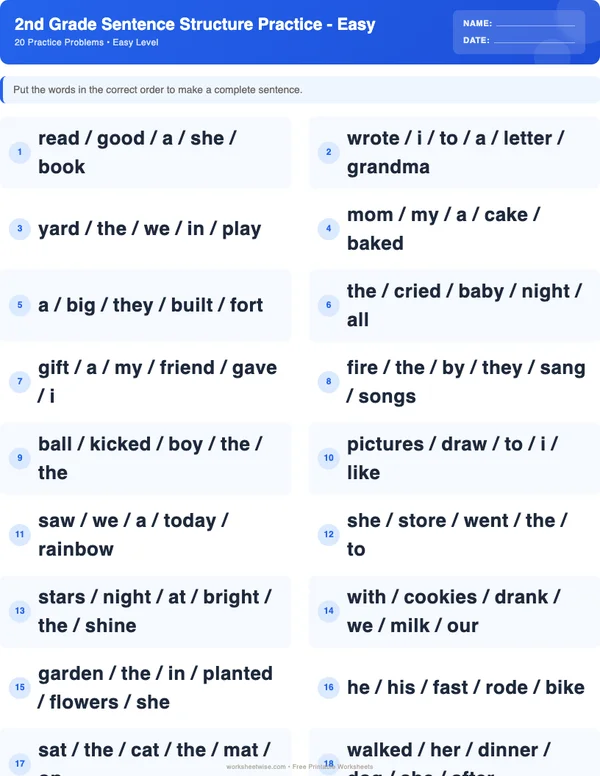
The free 2nd Grade Sentence Structure worksheet asks a learner to put scrambled words in the correct order to make complete sentences. It contains 12 easy-level items and a separate printable answer key. The focused skills are word order, sentence formation, syntax, and grammar.
For a productive lesson, model one similar example, solve two or three items together, and then let the learner attempt the remaining items independently. Ask the learner to read each completed sentence aloud before writing it. Afterward, examine errors for patterns instead of treating the total score as the only useful information.
This printable practices one defined task: arranging supplied words into a complete sentence. It does not, by itself, measure every aspect of sentence structure, punctuation, reading, spelling, or independent composition. Grade labels describe the intended practice level, and local school, district, state, and homeschool sequences differ.
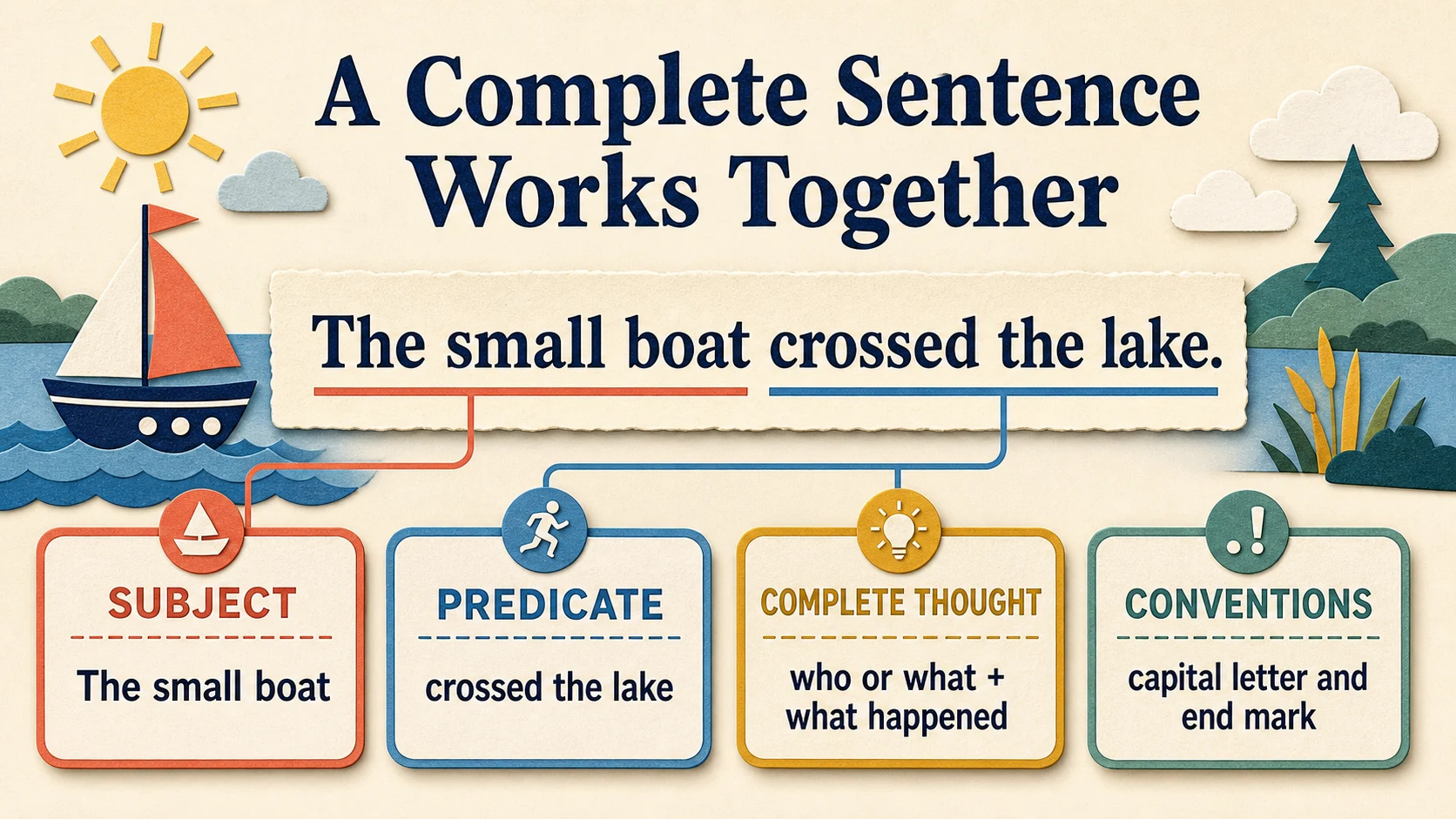
Use the lesson map to move from oral modeling to guided work, independent practice, checking, and later review.
Prepare the Lesson Before the Learner Begins
Print the worksheet and keep the answer key separate. The worksheet has 12 items, so it is short enough to use as a focused grammar lesson, homework assignment, or homeschool practice page. No additional materials are required, although a pencil, blank paper, and word cards can make modeling easier.
Read the printed directions together: “Put the words in the correct order to make a complete sentence.” Confirm that the learner understands both parts of the task:
- Every supplied word needs a sensible place.
- The finished word group must express a complete thought.
This worksheet is primarily about ordering words. Avoid turning the opening explanation into a long lesson on every possible sentence type. Broader instruction on subjects, predicates, fragments, run-ons, expansion, and sentence combining belongs in the Sentence Structure topic guide.
Establish a simple test for completeness
Use two oral prompts:
- “Who or what is this sentence about?”
- “What does that person, animal, place, or thing do or have?”
For example, in “The rabbit hops,” the rabbit tells who the sentence is about, and hops tells what it does. The two-part prompt is an instructional support, not a rule that explains every sentence in English. It is useful here because the worksheet’s easy-level rearrangement task centers on straightforward complete sentences.
Check readiness without preteaching every answer
Before opening the printable, say four words aloud: “runs / dog / the / fast.” Ask the learner to arrange them orally. If the learner says, “The dog runs fast,” ask for a final check: “Does that sound complete?”
If the learner cannot begin, model the process first. If the learner rearranges the words accurately and explains the result, shorten guided practice and preserve more items for independent work. The learner’s observed work—not a universal timetable—should determine pacing.
A Practical Lesson Progression
The following plan is a flexible instructional suggestion. It is not a schedule prescribed by the worksheet or by the cited sources.
| Lesson phase | Adult action | Learner action | Evidence to notice |
|---|---|---|---|
| Launch | Read the directions and state the goal | Restate the task | Understands that every word must be reordered |
| Model | Think aloud through a separate example | Listen, read, and verify | Can identify a sensible beginning and action |
| Guided practice | Prompt without supplying the full answer | Arrange two or three worksheet items | Uses meaning and grammar together |
| Independent practice | Reduce help and observe | Complete the remaining items | Maintains accurate word order without prompting |
| Review | Compare work with the key | Explain and repair differences | Can recognize why a correction works |
| Retrieval | Revisit a few rearrangement examples later | Reconstruct sentences from memory and reasoning | Retains the process beyond the first sitting |
The IES guide on foundational reading skills provides broad instructional framing for early literacy, including explicit teaching, modeling, practice, and attention to learners’ responses. The IES elementary writing guide likewise supports explicit instruction and a gradual move toward independent use of writing processes. These sources did not evaluate WorksheetWise or this particular printable.
Keep the launch brief
A concise opening might be:
These words are mixed up. We will arrange every word so the sentence makes sense and sounds complete. I will show you one. Then we will try a few together, and you will finish some independently.
This wording gives the learner a clear purpose without revealing answers from the page.
Model the Rearranging Process Explicitly
Use an example that is similar to the worksheet but not copied from it. Write:
the / small / bird / sings
Explain your decisions in order:
- Look for a likely subject. “Bird” names what the sentence is about.
- Look for words that belong with it. “The” and “small” can form “The small bird.”
- Find the action. “Sings” tells what the bird does.
- Assemble the sentence: “The small bird sings.”
- Read it aloud and check that every supplied word appears once.
- Add normal sentence conventions if the response space requires writing a sentence: a capital letter at the beginning and a period at the end.
The verified result is The small bird sings. It uses all four supplied words exactly once, begins with a sensible noun phrase, contains the action sings, and communicates a complete thought.
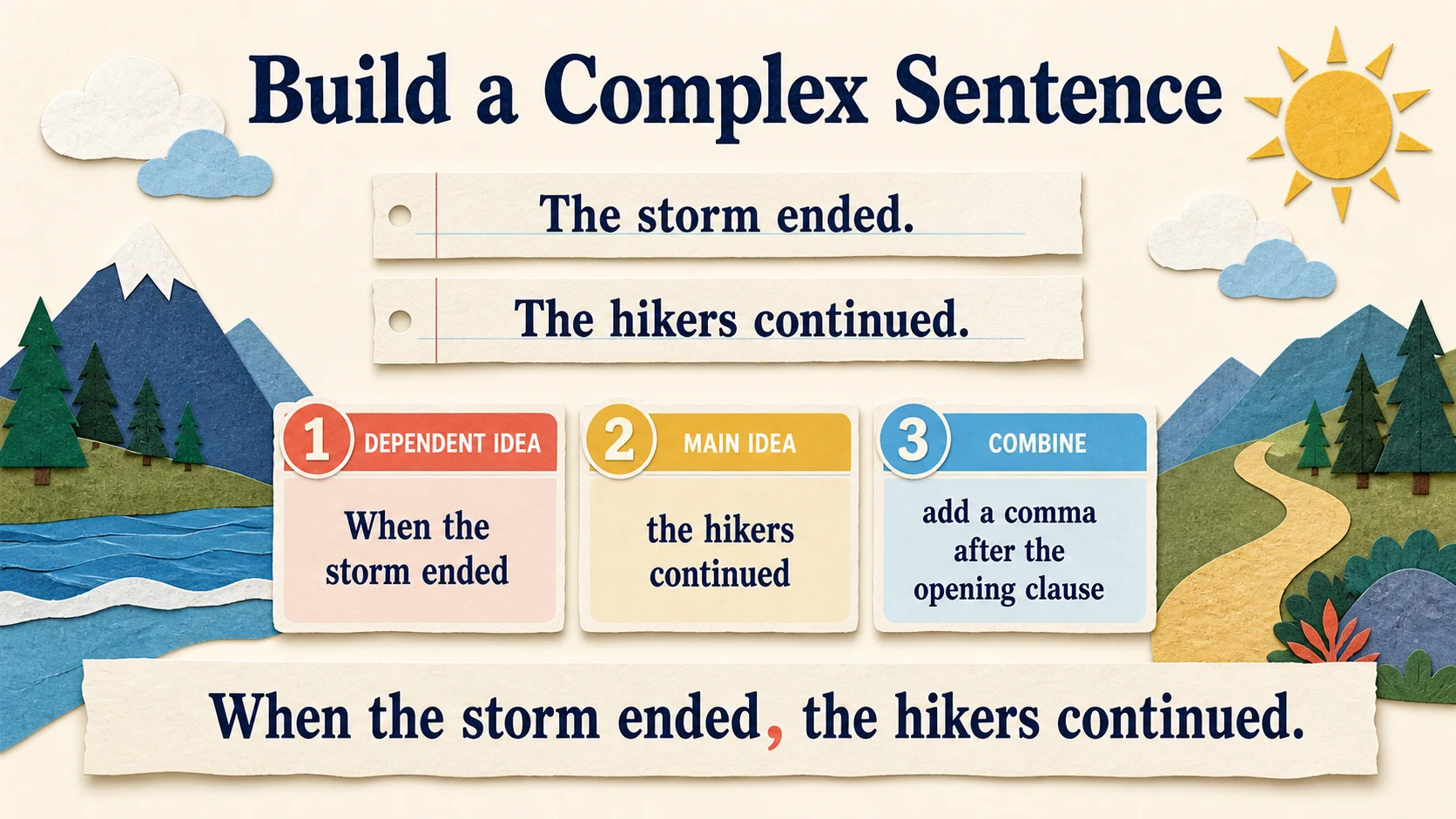
The example shows a repeatable process: group related words, locate the action, arrange the sentence, and reread it.
Model reasoning rather than guessing
Do not say only, “This sounds right.” Make the evidence audible:
- “The usually comes before the noun phrase here.”
- “Small describes the bird, so those words stay together.”
- “Sings tells what the bird does.”
- “I used every word once.”
Sound is still valuable. Reading aloud often makes awkward order easier to notice. However, the learner should also be able to point to the person or thing and the action rather than relying exclusively on intuition.
Preserve the worksheet’s actual skill
During modeling, do not allow the learner to replace difficult words, add several new words, or write an unrelated sentence. Those activities may be useful at another time, but they change the task. The target here is to arrange the supplied words into correct sentence order.
If a learner struggles to write neatly, permit oral arranging or movable word cards before copying the final sentence. That changes the response method while preserving the sentence-order skill.
Four Fully Checked Practice Examples
These examples are created for instruction and are not presented as items from the printable. Each answer can be verified by checking meaning, grammar, completeness, and use of all supplied words.
Example 1: A basic action sentence
Scrambled words:
jumps / the / frog
Reasoning:
- Frog names the animal.
- The belongs before frog.
- Jumps tells what the frog does.
Correct sentence: The frog jumps.
Check:
- Who or what? The frog
- Does what? jumps
- All words used once? Yes
- Complete thought? Yes
“The jumps frog” is incorrect because the does not properly introduce jumps in this sentence, and the words do not form a normal subject-and-action sequence.
Example 2: Keeping describing words with a noun
Scrambled words:
red / rolls / the / ball
Reasoning:
- Ball is the thing the sentence is about.
- The and red belong with ball.
- Rolls tells what the ball does.
Correct sentence: The red ball rolls.
Check:
- Who or what? The red ball
- Does what? rolls
- All words used once? Yes
- Complete thought? Yes
“The ball red rolls” includes every word, but inclusion alone is not enough. Red must be placed where it clearly describes ball.
Example 3: Adding a place phrase
Scrambled words:
park / we / the / visit
Reasoning:
- We can begin the sentence as the subject.
- Visit gives the action.
- The park names the place being visited.
Correct sentence: We visit the park.
Check:
- Who? We
- Do what? visit the park
- All words used once? Yes
- Complete thought? Yes
“Visit we the park” may resemble word order found in a question or stylized expression, but it is not the expected declarative order for this exercise.
Example 4: Placing an adverb sensibly
Scrambled words:
slowly / turtle / the / moves
A clear answer is The turtle moves slowly.
Check:
- Who or what? The turtle
- Does what? moves slowly
- All words used once? Yes
- Complete thought? Yes
“Slowly the turtle moves” can be grammatical in a particular style, especially with appropriate punctuation and context. That makes this a useful boundary case. On an easy word-order worksheet, The turtle moves slowly is the more direct, expected arrangement. When more than one grammatical arrangement seems possible, use the answer key to identify the worksheet’s intended response, but acknowledge that English sometimes permits alternatives.
Run Guided Practice Without Taking Over
Begin the printable together. The exact number of guided items should depend on performance. Two or three items may be enough for a learner who quickly adopts the process; another learner may need more supported trials.
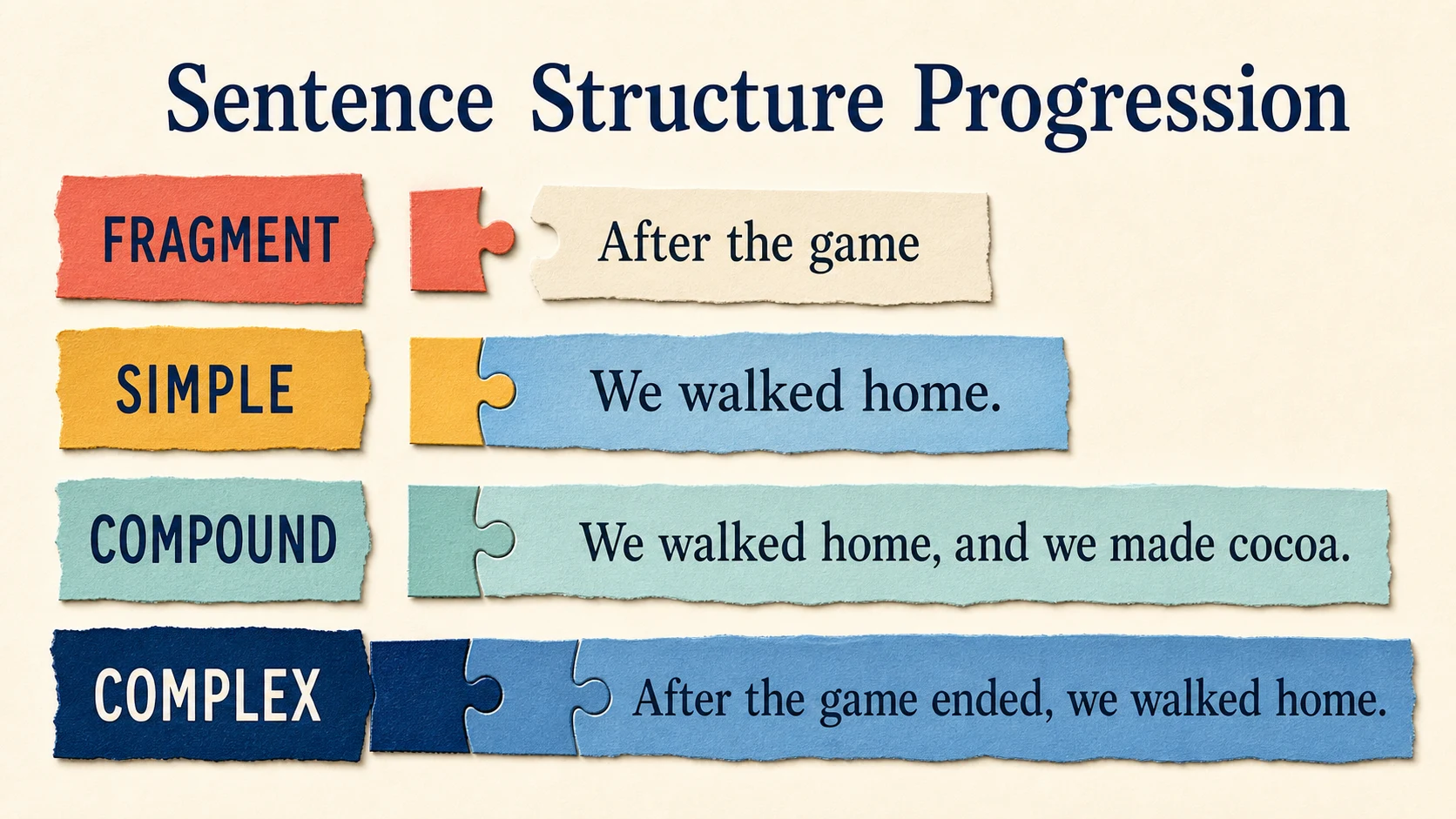
During guided practice, prompts should reveal the learner’s reasoning without supplying the whole sentence.
Use prompts in a decreasing sequence
Start with broad prompts and become more specific only when needed:
- “Read all the words.”
- “What might this sentence be about?”
- “Which word tells the action?”
- “Which words seem to belong together?”
- “Say the whole sentence before writing.”
- “Did you use every word exactly once?”
If those prompts are insufficient, offer two possible beginnings and let the learner select one. For cake / the / is / sweet, an adult might ask whether the sentence is more likely to begin with “The cake” or “Cake the.” This reduces the immediate choice without completing the sentence.
Once the learner succeeds, withdraw that extra support on the next item. The goal is not uninterrupted correctness with continuous adult direction. The goal is increasingly independent use of a reliable method.
Separate arranging from handwriting when necessary
A learner may understand word order but lose track while copying. Let the learner first point to the words in order, number them, or arrange copied word cards. Then ask for the complete written sentence.
This adaptation does not lower the grammatical demand. It makes it easier to see whether the difficulty lies in sentence formation or in managing the written response.
Ask for a brief explanation
After a guided item, ask the learner to explain one choice:
- “Why did you put those words together?”
- “Which word tells the action?”
- “How did you know the sentence was finished?”
One clear explanation is enough. Requiring a long explanation after all 12 items could distract from the worksheet’s focused practice.
Shift to Independent Practice
Tell the learner which items to complete without assistance. Remain available, but avoid approving each answer immediately. Constant confirmation can turn independent practice into a sequence of adult-led decisions.
A useful routine is:
- Arrange the words mentally or aloud.
- Write the sentence.
- Reread it.
- Mark each supplied word as it is checked.
- Make one correction before asking for help.
If the learner pauses, wait long enough to see whether rereading solves the problem. If help is needed, return to the least revealing prompt: “Who or what is the sentence about?” Record, informally, whether the learner needed help finding the beginning, locating the action, grouping a description, using every word, or checking completeness.
Independent practice does not mean withholding all support. It means giving the smallest useful prompt and noticing whether the learner can resume the process.
Adapt Support Without Changing the Target Skill
The same 12-item worksheet can be presented with different levels of access. Keep the central requirement unchanged: the learner must order the provided words to form a complete sentence.
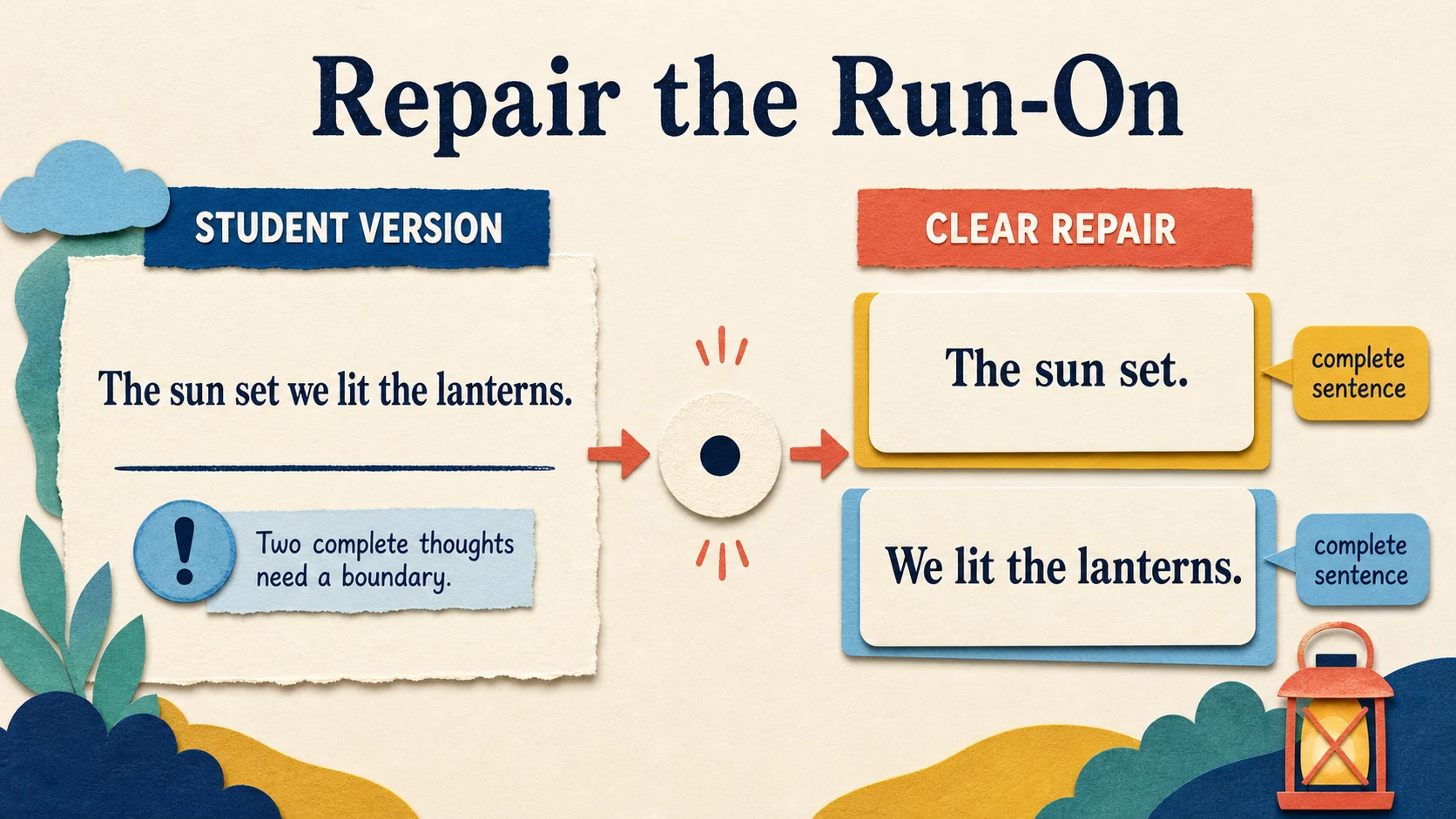
Support can change how words are handled, how many are visible, or how answers are recorded while preserving the ordering task.
When the learner needs more support
Cut apart a copied example so each word becomes a movable card. Ask the learner to arrange the cards, read the sentence, and then copy it. Other appropriate supports include:
- Covering later items so only one is visible.
- Reading an unfamiliar word aloud without arranging it.
- Underlining a likely naming word and circling the action after the learner identifies them.
- Providing the first word only, then asking the learner to complete the order.
- Completing fewer items in one sitting and returning to the rest later.
Do not simplify every item preemptively. Begin with enough support for a successful attempt, then remove a support and observe what happens.
When the learner is ready for added challenge
Keep the original arrangement task first. After checking an answer, ask the learner to make one controlled change:
- Add one describing word.
- Add where or when the action happens.
- Turn the sentence into a question when that transformation makes sense.
- Write a new sentence with the same basic pattern.
For example, after arranging The frog jumps, the learner might expand it to The green frog jumps into the pond. This extension adds sentence expansion, but it should not replace completing the original word-order item.
The wider 2nd Grade Grammar collection can support related practice, while the 2nd Grade worksheet hub provides access to other subjects and skills.
Handle Boundary Cases and Common Misconceptions
Sentence rearrangement is sometimes less absolute than a printed exercise appears. English can permit more than one grammatical order, especially when an adverb or phrase can move.
Consider:
today / we / read
Both We read today and Today, we read can form complete sentences when capitalization and punctuation are supplied appropriately. If the answer key lists one form, treat it as the intended answer, not proof that every alternative is ungrammatical.
Correct order is more than using every word
A learner may copy all the words but leave them scrambled. Check relationships among words:
- Articles such as a and the usually introduce a noun phrase.
- Describing words should clearly connect to what they describe.
- The subject and action must form a complete thought.
- Place or time words must occupy a sensible position.
These are practical checks for the worksheet, not a complete description of English syntax.
Capitalization cannot solve incorrect order
A learner might capitalize the first scrambled word and add a period without rearranging the sentence. Explain that capitalization and end punctuation mark sentence boundaries; they do not create meaningful word order.
The Common Core English Language Arts standards include grade-level expectations related to producing, expanding, and rearranging complete sentences. That provides high-level context for sentence work, but it does not establish comprehensive standards alignment for this single worksheet. Local instructional sequences and adopted standards may organize the material differently.
A sentence can sound familiar without being complete
“Under the big table” sounds natural, but it does not state what is under the table or what happens there. In contrast, “The cat sleeps under the big table” communicates a complete thought.
Use such contrasts orally if a learner repeatedly accepts fragments. Do not add fragment identification to every item unless the learner’s work shows that this distinction is causing the word-order errors.
Interpret Errors Before Choosing More Practice
After independent work, sort errors by type. A raw total indicates how many responses matched the expected answers, but the pattern explains what to teach next.
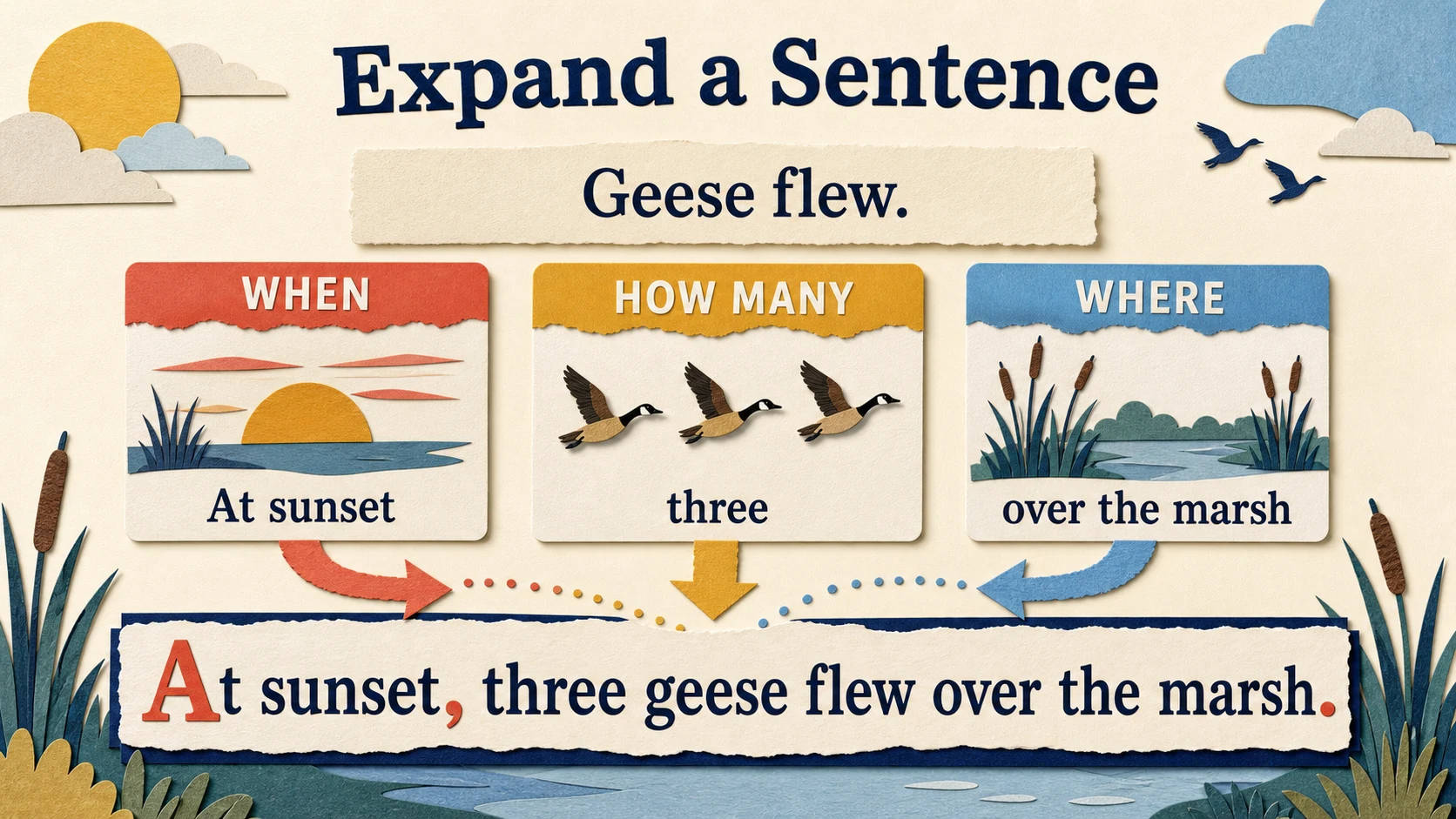
Identify the first point at which an answer stops working, then choose a correction prompt that matches that error.
Word-grouping errors
Example: The ball red rolls.
The learner has found the subject and action but misplaced the describing word. Return to the phrase the red ball. Ask what red describes, then rebuild the sentence.
Subject-and-action reversals
Example: Runs the dog fast.
The learner may have located the action but treated it as the expected beginning. Ask first who or what performs the action. Then place that noun phrase before the action for the straightforward declarative pattern used in this practice.
Missing, repeated, or added words
Example: The learner writes The dog runs from the / dog / runs / fast.
The sentence is complete, but it does not satisfy the item because fast was omitted. Have the learner touch or cross-check each printed word against the completed sentence. Conversely, if a word appears twice, match each written word to one supplied word.
Incomplete thoughts
If the learner produces a fragment, ask the two-part check: “Who or what?” and “Does what?” Model a contrast only if necessary. Repeated fragment errors may indicate that the learner needs explicit work from the broader topic progression before more independent rearranging.
Copying and convention errors
A learner may arrange the words correctly but omit a capital or end mark. Note that separately from word-order accuracy. Correct sentence conventions matter, but labeling the entire response as a sentence-structure failure hides the demonstrated skill.
Use the Answer Key Responsibly
The included printable answer key supports efficient checking, but it should follow the learner’s attempt rather than replace it.
First, read the learner’s sentence as written. Ask whether it makes sense, uses every supplied word, and forms a complete thought. Then compare it with the key.
Use three possible judgments:
- Matches the intended answer: Mark it correct.
- Does not form a grammatical complete sentence: Correct the arrangement and discuss the earliest misplaced word.
- Differs from the key but is grammatical and complete: Recheck all supplied words and punctuation. Accept or discuss the alternative based on the actual task, while noting the key’s intended order.
Do not expose the entire answer key during independent work. When correcting an error, cover unrelated answers and return attention to the learner’s reasoning. Ask the learner to rewrite or reconstruct only the missed sentence, then explain one change.
A correction is not complete merely because the learner copies the key. Remove the model and ask for the sentence again orally or with scrambled word cards. That brief reconstruction shows whether the ordering decision is now understood.
Decide What Comes Next
Use the 12 responses and the amount of prompting needed to choose the next step.
If the learner forms complete sentences accurately and independently, move toward sentence expansion or combining rather than repeating easy rearrangement indefinitely. The 2nd Grade Sentence Structure topic guide outlines the broader progression, including complete sentences, subjects and predicates, fragments and run-ons, combining, and expansion.
If answers become accurate only after oral rehearsal, retain the oral step for the next practice and gradually reduce it. If word order is generally correct but words are omitted, continue using the one-to-one word check. If the learner repeatedly cannot identify who or what the sentence is about or what happens, pause and teach that distinction with short oral examples before returning to the unfinished items.
For continued practice across the topic, the 2nd Grade Sentence Structure Worksheet Pack contains 18 worksheets and is listed at $4.79. It is an optional resource, not a necessary response to one difficult page. Free worksheet generators are also available through the WorksheetWise generators when an adult wants additional material.
Schedule Brief Retrieval Practice
A completed page should not automatically be assigned again in full. Revisit the process with a few fresh, similar examples and use the learner’s performance to decide whether further review is needed.
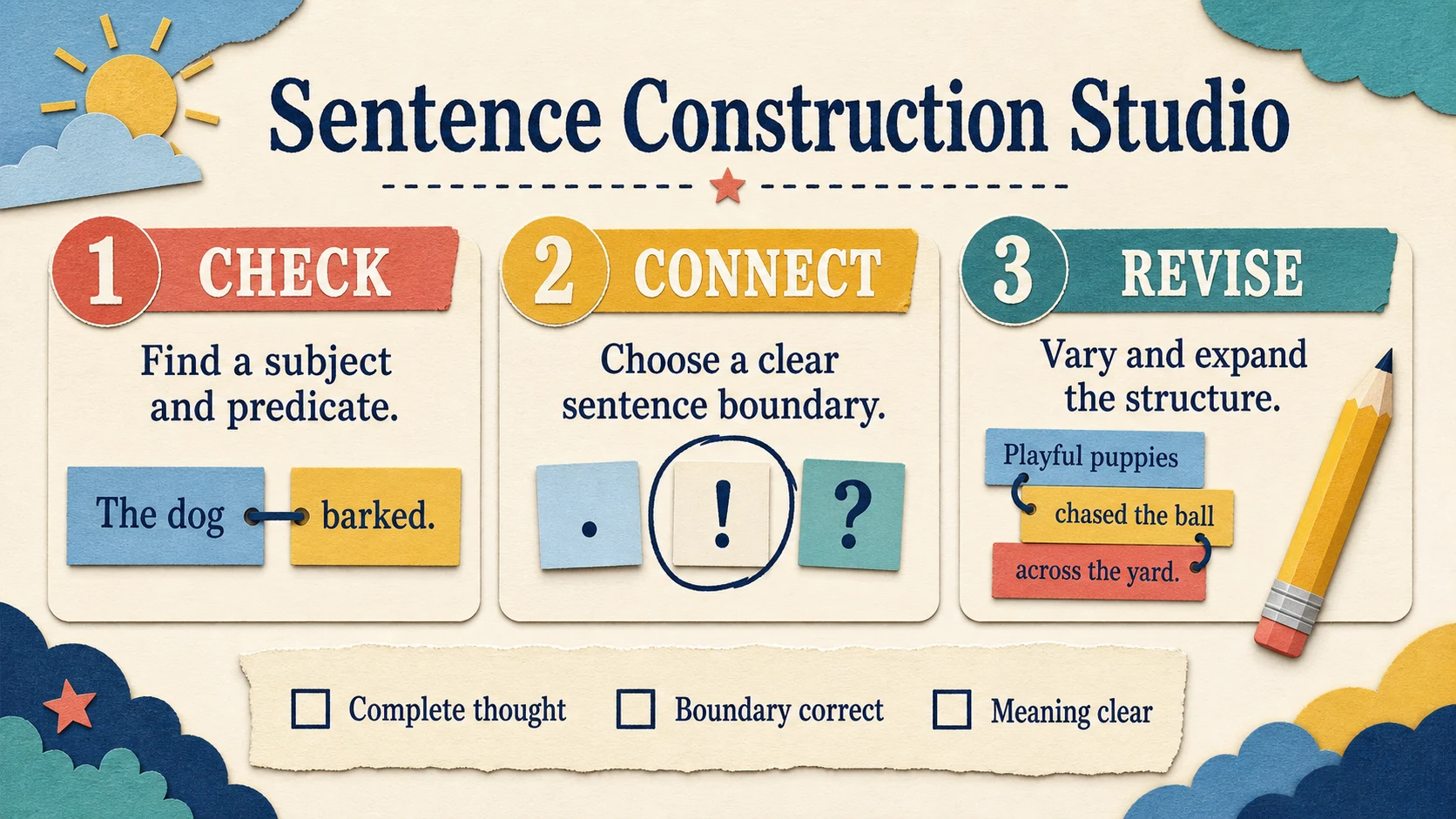
Short later checks can show whether the learner remembers the ordering process without relying on the original page.
A practical, adjustable sequence is:
| Review point | Suggested activity | Decision |
|---|---|---|
| Later in the same lesson | Rebuild one corrected sentence without viewing the answer | Continue if the learner explains the order |
| A later day | Arrange two fresh sentences orally or with word cards | Reduce support if both are completed confidently |
| Later that week | Complete two or three mixed examples in writing | Move forward if the process remains independent |
| During later grammar work | Include one sentence-order item among other tasks | Return to explicit modeling if the same error pattern reappears |
This is an instructional suggestion, not a universal timetable. A learner who recalls the process easily may need fewer reviews. A learner who loses the sequence may benefit from shorter, more frequent retrieval opportunities. Avoid repeating the entire worksheet simply to produce a higher score from remembered answers.
Limitations and the Most Useful Next Action
This printable gives focused practice with arranging words into complete sentences. Twelve easy-level items cannot establish mastery of the whole sentence-structure topic. The worksheet does not independently assess how well a learner generates original sentences, varies sentence beginnings, combines ideas, detects every kind of fragment or run-on, or applies sentence skills in extended writing.
It also cannot explain why an error occurred. An adult must observe whether the obstacle was vocabulary, reading a supplied word, holding several words in mind, copying, punctuation, or understanding sentence order. Keep those possibilities separate and avoid drawing broad conclusions from one page.
The most useful next action is to complete the free worksheet using the model–guide–independent sequence, record the learner’s recurring error type, and revisit two fresh examples later. Then use the Sentence Structure topic guide to select the next free practice that matches the learner’s observed work.
Put it into practice
Use the guide with a real printable
Move from explanation to a short, observable practice task. Check the first item together, then adjust the next session from the learner's actual work.
See the 18-worksheet pack