Complete guide
How to teach and practise 2nd grade punctuation worksheets - standard theme (easy)
A direct way to use this 12-item worksheet
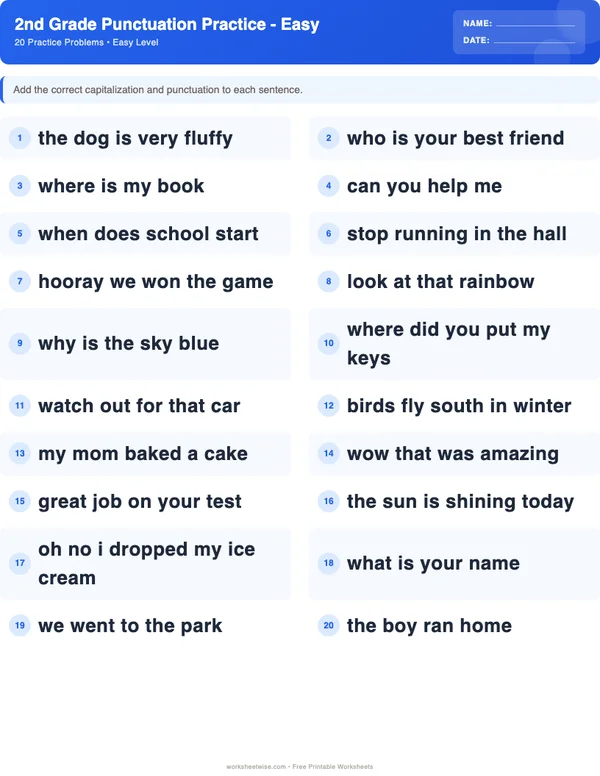
The free 2nd Grade Punctuation worksheet asks a learner to add correct capitalization and punctuation to 12 sentences. Its practice is limited to four listed skills: capitalization, periods, question marks, and exclamation marks. A separate printable answer key is included.
For a focused lesson, model one sentence, complete two or three items together, let the learner finish a manageable group independently, and then review the choices by reading each corrected sentence aloud. Pay attention to the reason behind each answer. A learner who writes the correct mark but cannot explain it may need another example before independent practice. A learner who explains the rule and applies it consistently may be ready for a short transfer task in original writing.
Plan for the observed work, not a fixed clock. Grade labels describe the intended practice level, and local curricula, school expectations, and instructional sequences differ. This easy-level sheet can serve as an introduction, reinforcement activity, homework assignment, or brief check of current understanding.
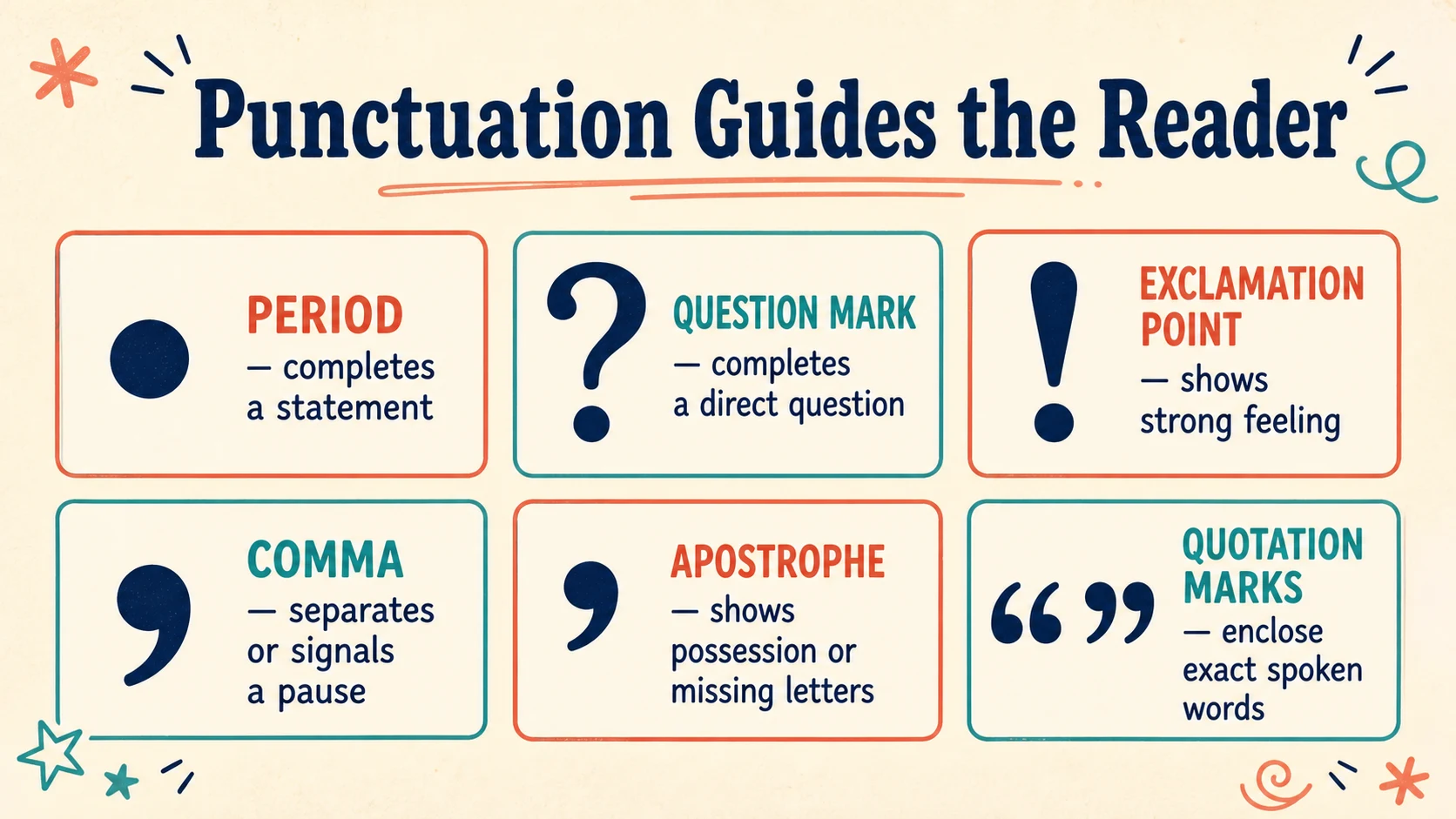
Move from a brief explanation to modeling, guided practice, independent work, checking, and later retrieval.
What this particular worksheet does—and does not do
The instruction printed for the learner is: “Add the correct capitalization and punctuation to each sentence.” Each item therefore combines two related editing decisions:
- Where does the sentence begin, and which letter needs a capital?
- What kind of sentence is it, and which end mark completes it?
The worksheet provides easy-level practice rather than a complete punctuation course. It does not cover every rule listed in the broader 2nd Grade Punctuation topic guide. In particular, its catalogue description identifies periods, question marks, and exclamation marks—not commas, apostrophes, quotation marks, or dialogue conventions. Keep the lesson centered on the stated skill instead of adding several new punctuation systems at once.
A useful teaching sequence is:
| Lesson phase | Adult action | Learner action | Evidence to notice |
|---|---|---|---|
| Preview | Read the direction and point out the two decisions in every item | Restate the task | Understands that both the beginning and ending may need correction |
| Model | Correct one comparable sentence aloud | Watches and explains the completed choice | Connects sentence meaning with the end mark |
| Guided practice | Prompt without supplying the answer immediately | Corrects two or three items with support | Uses meaning, not guessing |
| Independent practice | Assign a short group of items | Edits without continuous prompting | Maintains accuracy when support is removed |
| Review | Compare with the answer key and discuss differences | Explains or revises each choice | Can identify the reason for a correction |
| Retrieval | Revisit a few comparable sentences later | Applies the skill again from memory | Retains the distinction among the three marks |
The 2nd Grade Grammar collection can provide context for related mechanics work, while the topic guide shows the broader punctuation progression. This lesson should remain narrower: sentence beginnings and three types of end punctuation.
Prepare the learner for two decisions per sentence
Make the task visible before writing
Cover most of the page and display only one item. Ask the learner to locate the first word and the empty or incorrect ending. Explain that the job is not simply to “put a dot at the end.” The learner must read for meaning, decide what the sentence is doing, and then edit both ends.
Use a short routine:
- Read the whole sentence.
- Fix the first letter if needed.
- Decide whether the sentence tells, asks, or shows strong feeling.
- Add the matching end mark.
- Read the corrected sentence again.
That sequence helps prevent a common pattern: noticing the missing punctuation while overlooking capitalization. It also keeps capitalization connected to the structure of a complete sentence rather than treating capitals as decoration.
Check readiness without turning it into another test
Before starting the printable, say three oral sentences: one statement, one question, and one excited or emphatic sentence. Ask the learner to identify what each sentence is doing. Spoken responses are enough.
For example:
- “The rabbit is under the chair.” This tells something.
- “Where is the rabbit?” This asks something.
- “Look at that enormous rabbit!” This expresses a strong reaction or command.
If the learner cannot yet distinguish a question from a statement by meaning, pause before assigning all 12 items. Model the contrast with two sentences and continue only when the learner can explain the difference. If the learner understands the sentence types orally but makes errors on paper, the difficulty may lie in editing or remembering symbols rather than in sentence meaning.
The IES foundational reading practice guide offers broad instructional framing for foundational literacy teaching in kindergarten through grade 3. It does not evaluate this worksheet. Here, its relevance is limited to using explicit explanation, modeling, and supported practice while watching how the learner responds.
Model the editing process with checked examples
Do not begin by completing several worksheet answers for the learner. Instead, use separate examples that mirror the skill. Write each uncorrected sentence, think through the two required decisions, and then show the corrected version.
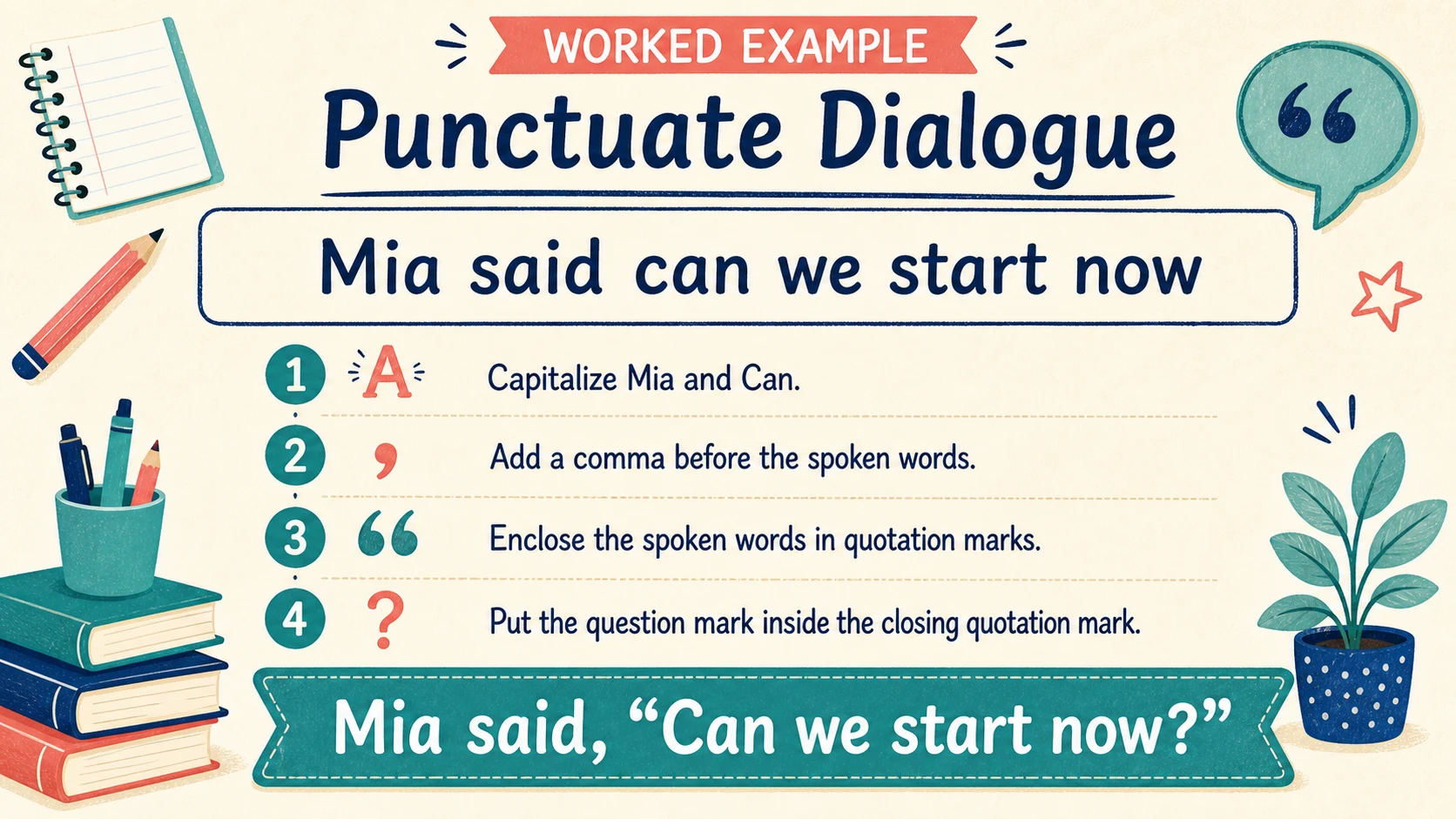
The model separates capitalization from the decision about end punctuation.
Example 1: A statement
Uncorrected:
the dog sleeps by the door
Checked correction:
The dog sleeps by the door.
Reasoning: The begins the sentence, so its first letter is capitalized. The sentence tells something. It does not ask a question or show a strong reaction, so it ends with a period.
Read the corrected sentence in a steady voice. The voice is a checking aid, but meaning remains the main reason for the period.
Example 2: A direct question
Uncorrected:
can we paint the box
Checked correction:
Can we paint the box?
Reasoning: Can begins the sentence and needs a capital. The speaker is asking whether painting the box is possible or allowed. A direct question ends with a question mark.
Contrast it with “We can paint the box.” The words are similar, but that version tells something and takes a period. This comparison shows why the learner must read the whole sentence rather than choosing a mark from the first word alone.
Example 3: Strong feeling
Uncorrected:
what a huge pumpkin
Checked correction:
What a huge pumpkin!
Reasoning: What needs a capital because it begins the sentence. In this wording, the sentence reacts strongly to the pumpkin; it is not asking for information. It therefore ends with an exclamation mark.
This is an important boundary case. A sentence beginning with what is not automatically a question. Compare:
What color is the pumpkin?
That sentence requests information, so the question mark is correct.
Example 4: An emphatic command
Uncorrected:
watch out for the puddle
Checked correction:
Watch out for the puddle!
Reasoning: Watch begins the sentence and needs a capital. The warning is urgent, so an exclamation mark is reasonable.
A calmer command can end differently:
Put the book on the desk.
This is still a command, but it does not necessarily show urgency or strong feeling. The period is appropriate. Do not teach that every command must have an exclamation mark.
Example 5: A calm statement containing a feeling word
Uncorrected:
i am happy to see you
Checked correction:
I am happy to see you.
Reasoning: The pronoun I is capitalized, and it also begins this sentence. Although the sentence mentions happiness, its form is a calm statement. A feeling word does not automatically require an exclamation mark.
A writer could choose “I am happy to see you!” to make the delivery emphatic, but the punctuation should match the intended force. On a worksheet, use the wording and the provided answer key together when checking an item that could reasonably be read more than one way.
Move through guided practice without giving away the choice
Guided practice should reveal how the learner decides. Complete two or three worksheet items together, depending on the learner’s responses. The adult may read an item aloud, but the learner should make the actual capitalization and punctuation choices.
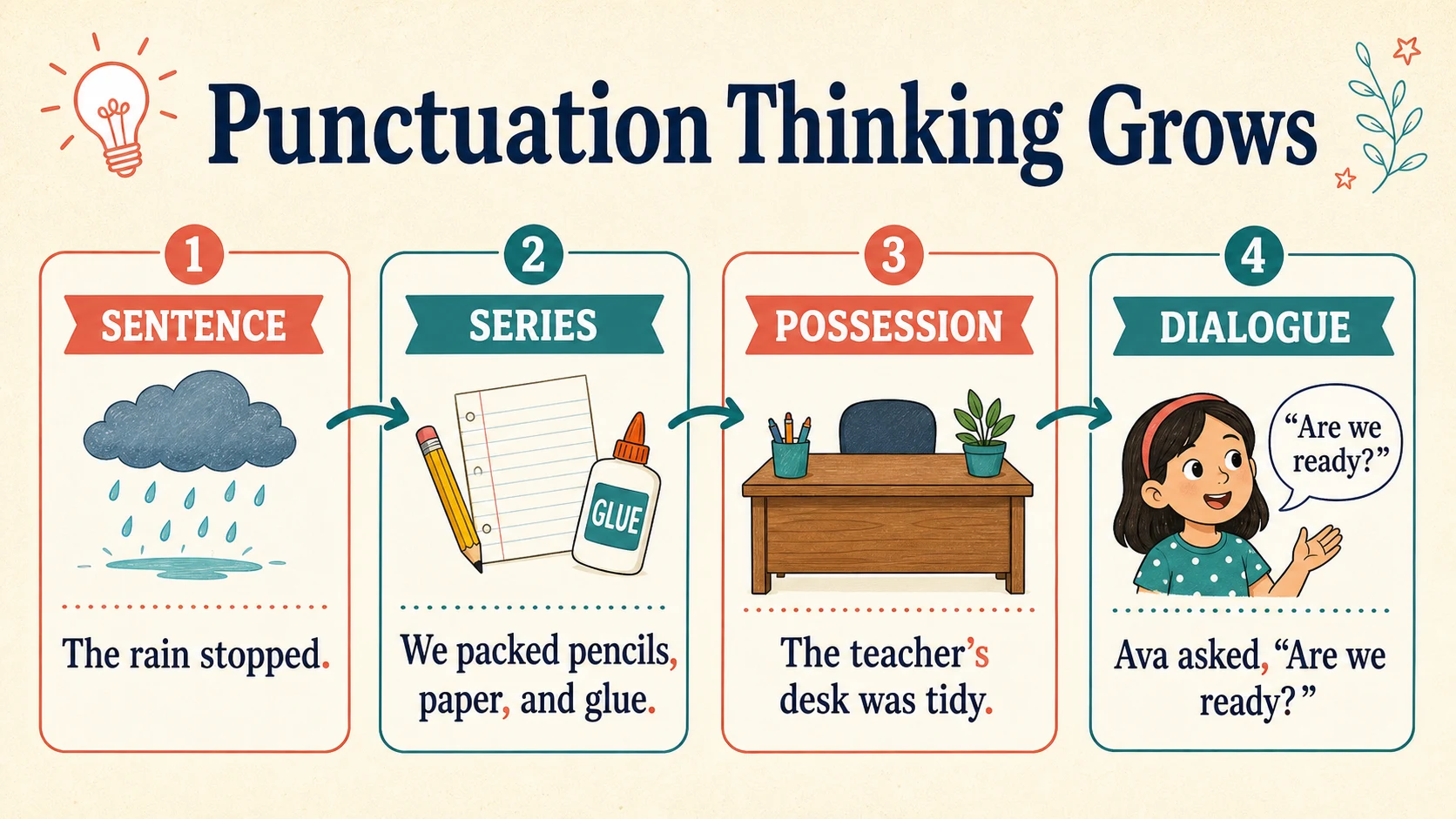
Prompt for the learner’s reasoning, then reduce support as the process becomes secure.
Use a gradual release across the first items
For the first guided item, ask both decision questions explicitly:
- “Which letter begins the sentence?”
- “Is this sentence telling, asking, or showing a strong reaction?”
For the next item, shorten the prompt to: “Check the beginning and the ending.” On the third, wait silently while the learner works. If the learner succeeds, move into independent practice. If the learner stalls, return to the full routine rather than supplying the answer.
Avoid turning the end marks into voice-only rules such as “questions always sound higher.” Reading aloud can clarify intended meaning, but speakers do not use identical intonation. The more dependable question is what the sentence is doing.
Keep explanation brief but specific
Useful explanations name the evidence:
- “It asks where the shoes are, so I used a question mark.”
- “It tells what the bird did, so I used a period.”
- “It is an urgent warning, so I used an exclamation mark.”
- “The first word begins the sentence, so I changed its first letter to a capital.”
Less useful explanations include “It looks right” or “Questions have question marks” without identifying why the sentence is a question. Ask for one short reason, not a lengthy grammar speech.
The IES guide to teaching elementary students to be effective writers provides high-level guidance about writing instruction, including teaching processes and skills explicitly. It does not make a claim about WorksheetWise or this printable. For this lesson, the practical application is to demonstrate the editing process and give the learner a chance to apply it with decreasing support.
Run independent practice in a manageable block
Choose the block from observed performance
Once the learner completes a guided item accurately and can state a reason, assign a small group from the remaining 12 items. Four items is a practical starting suggestion, not a sourced or universal requirement. A learner working steadily may continue. A learner who begins guessing should pause for feedback before errors become a repeated pattern.
During independent work, avoid confirming every answer. Frequent “Is this right?” checking can turn an independent task into adult-led guessing. Instead, point to the routine: beginning, meaning, ending, reread.
If writing the corrected sentence is physically or cognitively demanding, the learner can first mark the capital and end punctuation directly, provided that this still matches the worksheet’s task. The skill being assessed is the editing decision. Do not change the activity into choosing among unrelated sentence types or practicing commas.
Include a transfer check after the worksheet
After reviewing the printable, give one fresh sentence not found on the page:
where did my blue sock go
The checked correction is:
Where did my blue sock go?
Then ask the learner to compose one original statement or question and punctuate it. This is an instructional suggestion, not part of the catalogue worksheet. It helps distinguish memorizing corrected items from applying the same idea to new language.
If original composition creates too much extra demand, supply the words and ask only for editing. The target remains capitalization and end punctuation, not spelling, handwriting speed, or idea generation.
Adapt the support while preserving the punctuation skill
Different levels of help can be offered without changing what the learner must decide. Adjust the amount of visible text, oral support, or prompting—not the underlying capitalization and punctuation task.
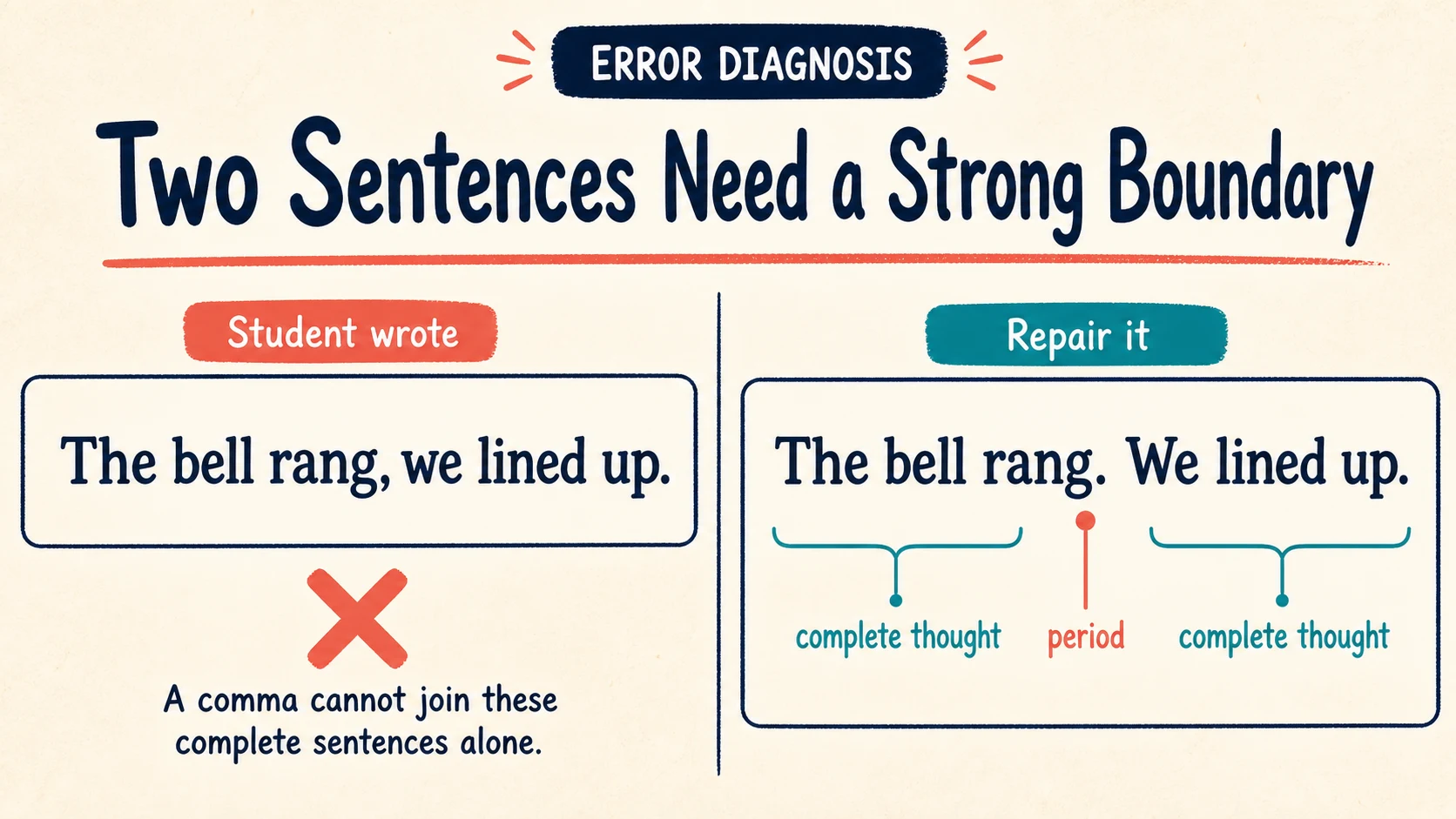
Reduce visual load, add a decision guide, or extend explanation while keeping the same editing target.
For a learner who needs more support
Show one item at a time with a blank sheet covering the rest. Read the sentence aloud once, then have the learner reread it. Place a simple reference card nearby:
- tells →
. - asks →
? - strong feeling or urgency →
!
The learner must still choose the category. Do not point to the correct symbol before the decision is made.
You can also separate the two edits. First, have the learner circle the letter that needs capitalization. Second, ask for the end mark. Once both choices are made, the learner writes the correction.
For a learner who is nearly independent
Ask the learner to complete half the page before checking. Mark only the items that need another look, without identifying the exact error. A small dot beside an item can mean, “Check the beginning and ending again.”
If the learner finds and fixes the problem, ask for the reason. Self-correction provides more useful evidence than an adult immediately replacing the answer.
For a learner who finishes accurately
Keep the same skill but increase the reasoning demand. Ask the learner to sort completed sentences into statements, questions, and exclamations, or to rewrite one statement as a direct question.
For example:
The bus is here.
can become:
Is the bus here?
Both the word order and punctuation change. This extension should follow secure worksheet performance; it should not be required to complete the printable.
Interpret errors before assigning more practice
A total score alone does not explain what went wrong. Review the location and pattern of errors across the 12 items.
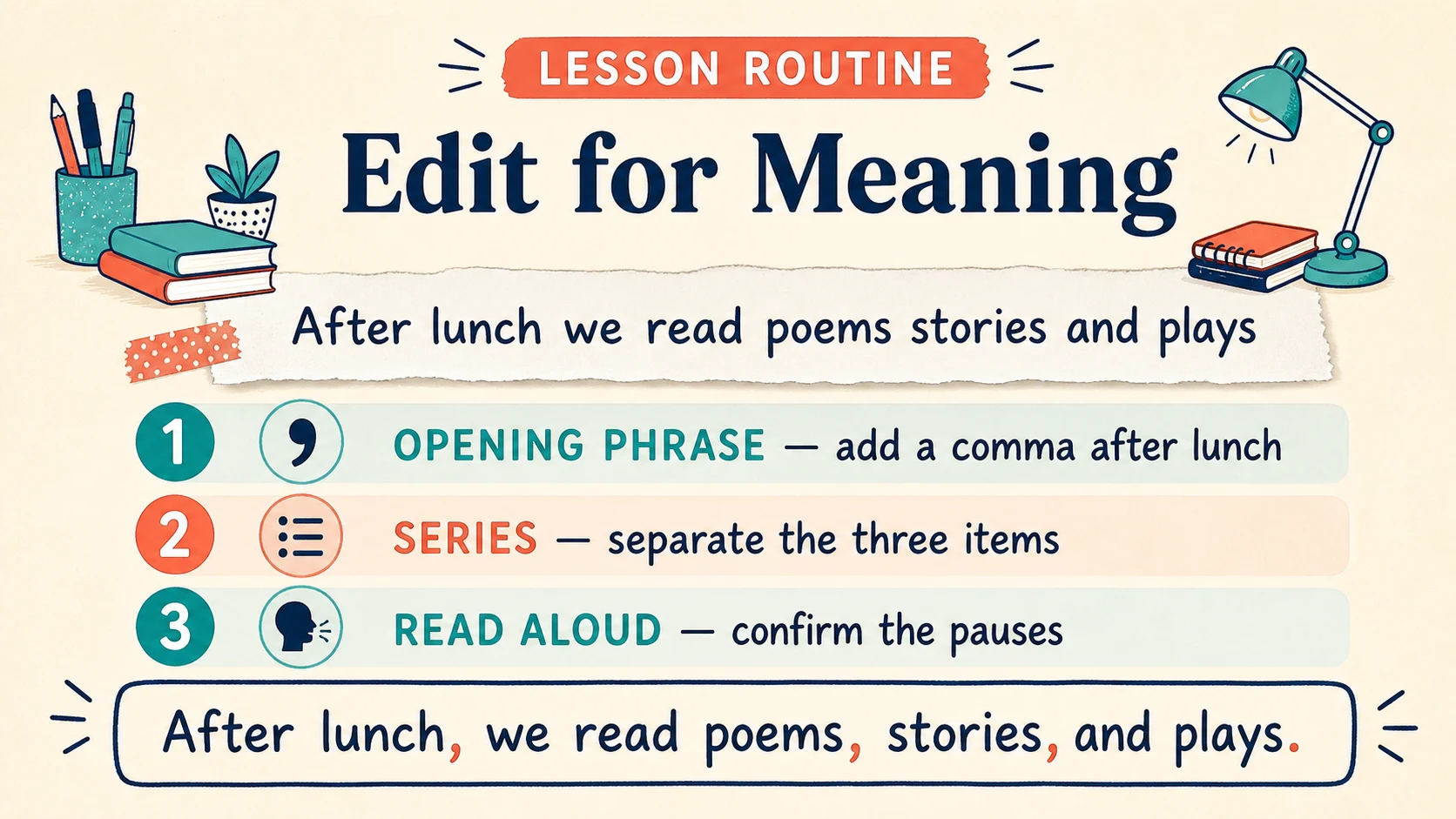
Classify the error, ask for the learner’s reason, reteach briefly, and check a new example.
Sort errors into useful categories
| Observed pattern | Possible interpretation to check | Immediate response |
|---|---|---|
| End marks are correct, but sentence beginnings remain lowercase | The learner may understand sentence type but overlook the capitalization step | Use a two-part checklist and ask the learner to point to both ends |
| Every sentence ends with a period | The learner may be defaulting to the most familiar mark | Contrast one statement with one direct question |
| Every lively sentence receives an exclamation mark | The learner may be choosing from interesting words rather than sentence purpose | Compare a calm statement about happiness with an urgent warning |
| A sentence beginning with what receives a question mark automatically | The learner may rely on the first word | Compare “What a tall tree!” with “What kind of tree is it?” |
| The learner explains correctly but writes a different symbol | The issue may be symbol recall or attention during recording | Have the learner name, point to, and then write the mark |
| Accuracy drops later on the page | The learner may need a shorter work block or a brief pause | Stop, review the last secure item, and resume with fewer items |
| Corrections appear only after adult hints | Understanding may not yet be independent | Return to guided practice and reduce prompts gradually |
These are hypotheses to check, not diagnoses. Ask the learner to explain one representative answer. The explanation may show whether the error came from misunderstanding, overlooking one part of the direction, or simply recording a different mark than intended.
Address common misconceptions directly
“Questions contain question words” is incomplete. Some questions begin with words such as can, is, or did, and what can introduce an exclamation.
“Exciting words need exclamation marks” is also unreliable. Sentence purpose and intended force matter more than a single word.
“Every sentence gets one capital” can mislead when a sentence begins with I, which is capitalized for two reasons in an example such as “I can help.” Keep the present lesson focused on the sentence beginning, but accept a correct explanation about the pronoun.
“An exclamation mark makes writing better” should not guide editing. It signals strong feeling or emphasis; it is not a reward for an interesting sentence.
Use the answer key as a checking tool, not the lesson itself
The worksheet includes a separate printable answer key. Keep it out of view during initial work so that the learner’s choices provide meaningful evidence.
Follow a responsible checking sequence
First, ask the learner to reread each corrected sentence. Second, compare the response with the key. Third, mark any difference without immediately writing the key’s answer over the work. Finally, ask the learner to reconsider the sentence and explain the revision.
If the learner’s punctuation differs from the key, inspect the wording carefully. Some sentences can sound more or less emphatic depending on context. The key gives the intended answer for the worksheet, but a plausible alternative should prompt a discussion about meaning rather than an accusation of careless work. For the worksheet score, record the intended keyed response consistently. Separately, acknowledge a defensible reading when one exists.
Do not count only punctuation and ignore capitalization, because the printed direction requires both. A simple record can use two columns—capitalization and end mark—for each item. This makes a pattern visible without inflating the worksheet into a complicated grading system.
The Common Core State Standards for English Language Arts provide a broad reference for language conventions across grades. Local sequences and expectations differ, and this article does not claim that one 12-item printable offers comprehensive standards alignment. Use local curriculum documents when formal reporting or alignment decisions are required.
Decide what comes next from the learner’s work
When to repeat, narrow, or extend
If most errors involve one category, narrow the next lesson. For repeated question-mark errors, contrast statements and direct questions. For capitalization omissions, use a short editing strip that makes the first letter visually prominent. For mixed errors, return to the complete five-step routine with only a few sentences.
If the learner corrects most items independently and explains the choices, avoid repeating an identical page immediately. Use one or two fresh sentences later, then move to another appropriate activity in the punctuation topic guide. That guide is the better place to see the broader sequence instead of reproducing it here.
If performance is inconsistent, retain the same skill while changing the examples. Completing the same page from memory can look like progress without showing flexible application.
Respect the worksheet’s limitations
This printable offers 12 easy-level exercises in capitalization, periods, question marks, and exclamation marks. Twelve responses can reveal useful patterns, but they cannot establish complete punctuation mastery. The page also does not, by itself, show how consistently the learner punctuates original writing, edits a paragraph, or applies other punctuation rules.
Do not use one score to make child-specific clinical, placement, or high-stakes decisions. This guide provides instructional suggestions, not medical guidance. It also does not prescribe a universal timetable. Learners may need different amounts of modeling, practice, rest, and review.
For additional practice within the catalogue, the 2nd Grade Punctuation Worksheet Pack contains 18 worksheets and is listed at $4.79. Choose further material because the error evidence supports it, not merely because more pages are available.
Schedule brief retrieval after corrections
A corrected worksheet is not the end of the lesson. Revisit the skill after some time has passed so the learner must recall the decision process rather than copy a recent answer.
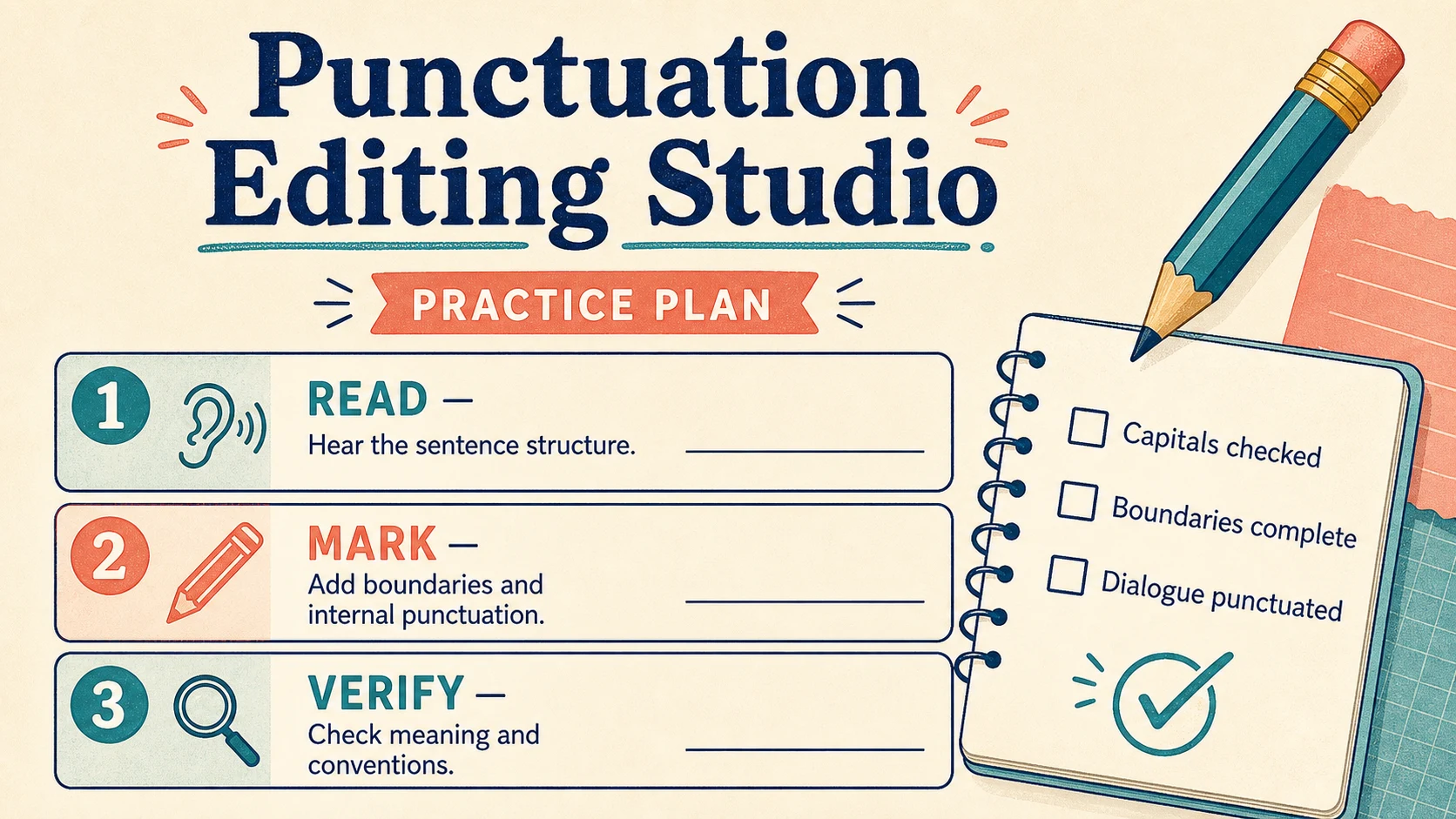
Use a few new sentences across later sessions and adjust the spacing from actual performance.
The following is a practical example schedule, not a universal or sourced timetable:
| Review point | Suggested task | Decision |
|---|---|---|
| Later in the same session | Correct one new sentence and explain both edits | Reteach immediately if the learner cannot identify sentence purpose |
| Next learning session | Edit three mixed sentences: a statement, question, and exclamation | Continue if choices are accurate without leading prompts |
| Several days later | Edit two new sentences and write one original sentence | Shorten the interval if earlier errors return |
| About one or two weeks later | Include capitalization and end punctuation in a brief mixed review | Move forward if the skill remains accurate and explainable |
Do not reuse only the most memorable worksheet sentences. Change the subject and wording while preserving the same decisions. For example:
did the turtle eat the leaf
becomes:
Did the turtle eat the leaf?
A later retrieval item might be:
is your coat in the car
which becomes:
Is your coat in the car?
The surface details change, but the learner still has to capitalize the beginning, recognize a direct question, and add a question mark.
Continue with a clear, evidence-based next action
Print the free 2nd Grade Punctuation Worksheets – Standard Theme (Easy), model one comparable sentence, and use the learner’s first two guided responses to choose the size of the independent block. Record capitalization and end-mark errors separately, then schedule a brief review with new sentences.
After the learner can explain and apply these four listed skills, consult the broader 2nd Grade Punctuation guide for an appropriate next focus. If you need fresh, narrowly targeted material instead, explore the free worksheet generators and create only enough practice to address the error pattern you actually observed.
Put it into practice
Use the guide with a real printable
Move from explanation to a short, observable practice task. Check the first item together, then adjust the next session from the learner's actual work.
See the 18-worksheet pack