Complete guide
How to teach and practise 2nd grade parts of speech worksheets - standard theme (easy)
What this worksheet teaches
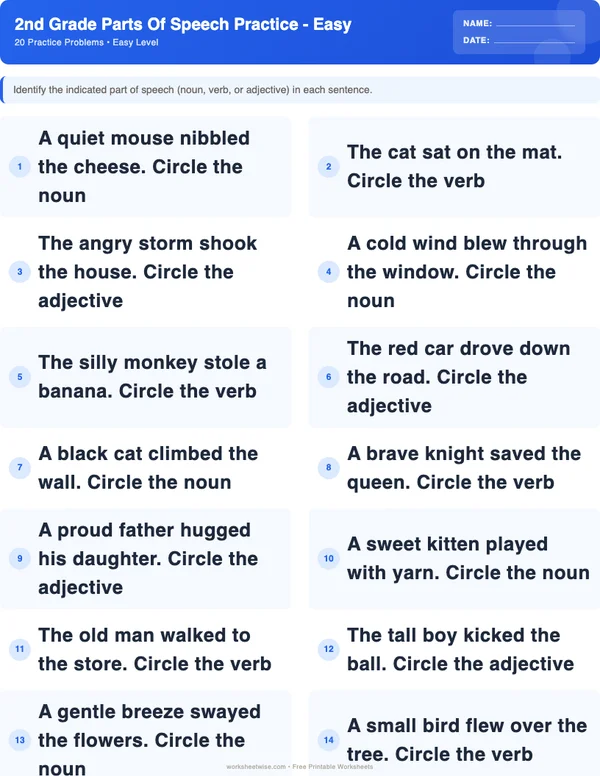
The free 2nd Grade Parts of Speech worksheet gives a learner 12 easy-level exercises. Each item asks the learner to identify an indicated noun, verb, or adjective in a sentence. The worksheet therefore practices two connected skills: recognizing what a word does and using the surrounding sentence as evidence.
The short answer: first confirm that the learner can explain the three target categories in simple language. Model one example by reading the whole sentence, naming the requested category, testing likely words, and marking only the answer. Complete a few items together, release the learner to finish independently, and then use the answer key to analyze reasoning—not merely count correct answers.
This printable is suitable for a grammar lesson, homeschool practice, tutoring, homework, or a brief review. “2nd Grade” describes its intended practice level; it does not establish a universal timetable. Local curricula, school expectations, and instructional sequences differ. Use the learner’s observed work to decide whether to slow down, continue, or move to a more demanding task.
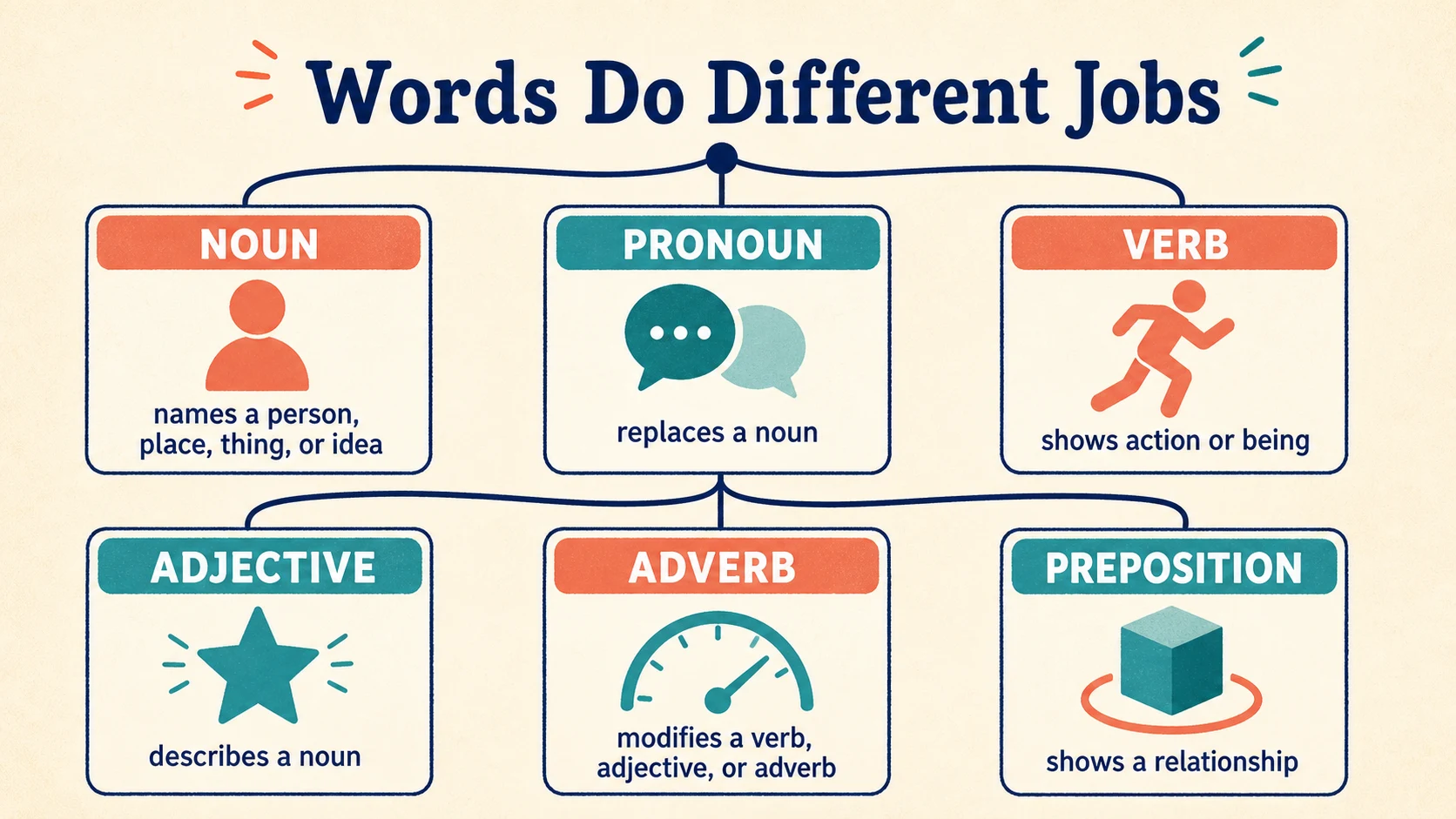
The lesson moves from a quick readiness check through modeling, guided work, independent practice, feedback, and later retrieval.
Plan the lesson around evidence from the learner
A first attempt should reveal what kind of support is needed. Avoid assuming that every wrong answer means the learner has forgotten a definition. A learner might understand nouns yet overlook the item’s direction, confuse an adjective with the noun it describes, or identify an action without locating its exact word.
A practical sequence is:
| Phase | Adult action | Learner action | Evidence to notice |
|---|---|---|---|
| Readiness check | Ask for a noun, verb, and adjective in a simple oral sentence | Names or points to each word | Whether the categories are available without prompting |
| Model | Think through one fresh example aloud | Watches and explains the final choice | Whether the learner follows the decision process |
| Guided practice | Share responsibility for two or three items | Answers with brief reasons | Which prompts remain necessary |
| Independent practice | Step back while the learner completes several items | Reads, decides, and marks answers | Accuracy, self-correction, and independence |
| Review | Compare responses with the separate answer key | Explains agreements and corrections | Whether errors reflect concepts or task habits |
| Transfer | Ask for one original sentence | Uses a target word intentionally | Whether identification connects to sentence use |
| Retrieval | Revisit a few examples later | Answers without copying prior work | What remains available after a delay |
This is an instructional suggestion for using the printable, not a timetable prescribed by WorksheetWise or an external authority. A learner who becomes more accurate after one model may need little guided practice. A learner who continues guessing may need the task divided into smaller sets.
For the broader order in which nouns, verbs, adjectives, and other categories can be developed, use the Parts of Speech topic guide. This lesson should stay focused on the three categories actually named in the worksheet rather than trying to reproduce the topic’s full progression.
Establish three clear meanings before printing answers
Keep the working definitions concise:
- A noun names a person, place, thing, or idea.
- A verb shows an action or serves another verb function, such as linking.
- An adjective describes a noun.
For this easy worksheet, the adult can begin with concrete action verbs and clear describing words. The topic itself includes broader territory, but adding every exception before the learner begins can obscure the immediate task.
Use meaning and sentence function together
A definition is a starting point, not a complete checking method. Ask what job the word performs in that particular sentence.
Consider “The small rabbit hops.”
- “rabbit” names an animal, so it is a noun.
- “hops” tells what the rabbit does, so it is a verb.
- “small” describes the rabbit, so it is an adjective.
This three-part comparison is useful because the words occur in one sentence but do different jobs. It also gives the learner questions that can be reused:
- Who or what is the sentence about?
- What happens, or what does someone or something do?
- Which word tells more about a noun?
Keep reading demands visible
The learner must read and interpret each sentence before classifying a word. If decoding a word is slowing the grammar decision, the adult may read that word or the whole sentence aloud, provided the goal remains identifying its part of speech. That support changes access to the sentence, not the grammar skill being assessed.
The IES foundational reading practice guide addresses high-level early literacy instruction, including academic language, word analysis, and daily work with connected text. It did not evaluate this WorksheetWise printable. Its relevance here is limited to the general value of attending to language and meaningful text while teaching young readers.
Model a repeatable decision process
Do not model by announcing the answer immediately. Demonstrate how to obtain it.
A concise think-aloud
Use a fresh sentence that is not one of the 12 printed items:
The bright kite soared.
Suppose the direction is “Identify the adjective.”
A clear model sounds like this:
- “I will read the entire sentence: The bright kite soared.”
- “The direction asks for an adjective, so I need a word that describes a noun.”
- “The noun is kite because it names a thing.”
- “Bright tells what kind of kite it is.”
- “Therefore, bright is the adjective. I will mark only bright.”
This model makes the direction, definition, context, and response visible. It is more useful than saying, “Bright is an adjective because it is a describing word,” without showing what the word describes.
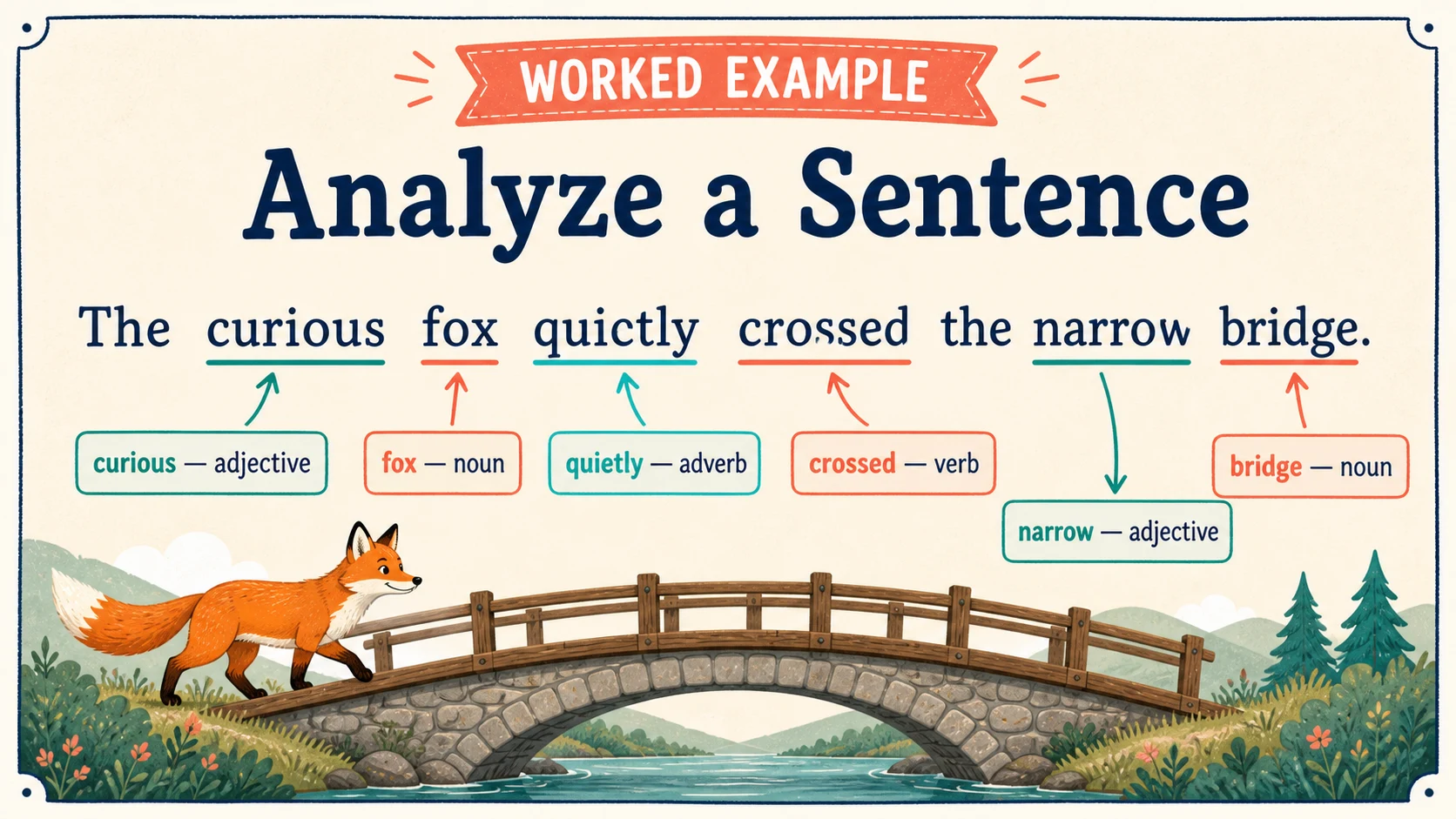
The complete sentence provides the evidence needed to identify the requested word.
Protect the learner’s turn
After modeling, ask the learner to restate the routine:
“What will you look for first if the direction asks for a verb?”
A workable answer is, “I will read the whole sentence and find the word that tells the action.” The wording need not match the adult’s definition exactly. What matters is that it leads to a defensible choice in the sentence.
Do not model all 12 items. The goal is to prepare the learner to reason independently, not to rehearse the worksheet’s answers before practice begins.
Work through four fully checked examples
The following examples are similar in form to the worksheet but are not presented as its actual items. Each is checked by identifying the requested category and explaining why competing words do not fit.
Example 1: Identify the noun
Sentence: “Maya carries the basket.”
Answer: Maya or basket, depending on whether the task permits every noun or indicates a particular target.
Check: Maya names a person, and basket names a thing. Carries tells an action, so it is the verb. The does not name a person, place, thing, or idea.
This example exposes an important response issue: a sentence can contain more than one noun. Follow the printed direction and layout carefully. If an item asks for “a noun,” either noun may satisfy the grammar requirement unless another cue selects one. If it asks for or visually indicates a specific noun, use that cue. Do not use the answer key to pretend that a grammatically valid alternative is impossible.
Example 2: Identify the verb
Sentence: “The puppy chases a leaf.”
Answer: chases
Check: Chases tells what the puppy does. Puppy and leaf name things, so they are nouns. The requested category is a verb; identifying the doer, puppy, does not answer the question.
A learner who selects puppy may be finding the sentence’s subject rather than its action. Ask, “What does the puppy do?” This prompt preserves the verb-identification skill because it directs attention to meaning without supplying the word.
Example 3: Identify the adjective
Sentence: “We found a smooth stone.”
Answer: smooth
Check: Stone names a thing. Found tells what happened. Smooth describes the stone by telling what kind of stone it is. The adjective and noun belong together in meaning, but they are not the same part of speech.
A useful confirmation is to remove the adjective: “We found a stone.” The sentence remains understandable, but one descriptive detail has disappeared. Removal is a support strategy, not an infallible grammar rule.
Example 4: Identify the noun
Sentence: “Birds sing loudly.”
Answer: Birds
Check: Birds names animals, so it functions as a noun. Sing shows the action. Loudly tells how the birds sing. It is not an adjective because it does not describe the noun birds.
This last comparison helps prevent the misconception that every word supplying detail is an adjective. The learner should ask what the detail modifies. This worksheet targets nouns, verbs, and adjectives; it does not require a complete lesson on adverbs to justify why loudly is not the requested noun.
Move from guided to independent practice
Guided practice should reveal whether the learner can use the modeled process with decreasing help.
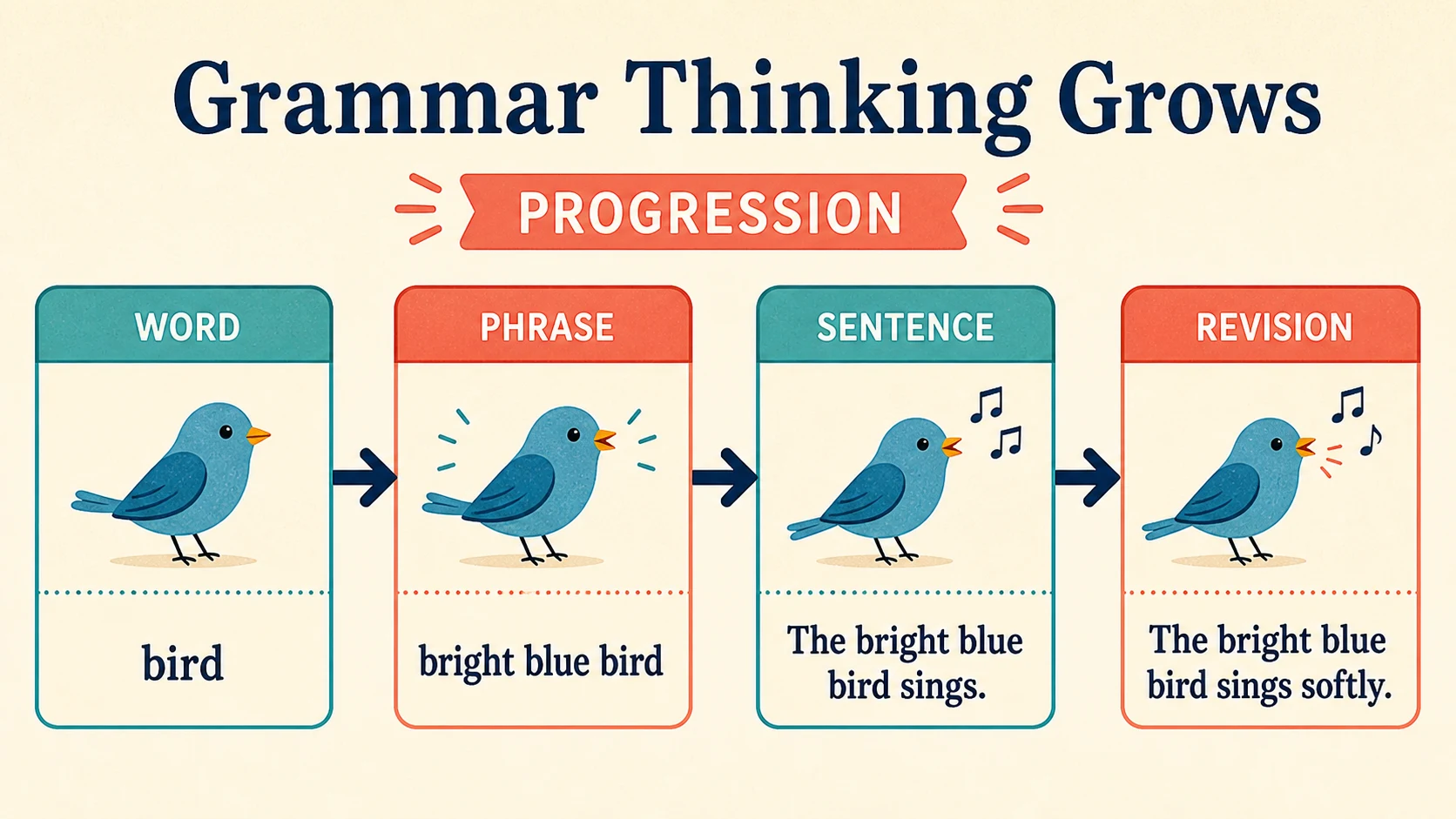
Guidance fades as the learner begins to read, classify, and explain without adult selection of the answer.
Share responsibility at first
For an early item, the adult might read the direction while the learner reads the sentence. Ask one focused prompt:
- For a noun: “Which word names someone or something?”
- For a verb: “What happens in this sentence?”
- For an adjective: “Which noun has a describing word?”
On the next item, point to the direction but let the learner generate the question. Then remove the prompt and observe.
Praise a useful action precisely: “You reread the direction before choosing.” Avoid treating quick completion as the main goal. Speed can hide guessing, while a deliberate reread may be productive.
Define independence by behavior
Independent work does not require the adult to leave the room. It means the learner makes the grammar decisions. The adult can remain nearby, note hesitation, and give neutral reminders such as “Read the direction again.”
Consider splitting the 12 items into short groups. After four items, pause and ask the learner to review one answer. Continue if the work shows stable reasoning. Return to guided practice if several answers are guesses or the same confusion repeats. The learner’s work—not the number of minutes elapsed—should control pacing.
Adapt support without changing the skill
An adaptation should make the same noun, verb, or adjective decision more accessible. It should not turn the exercise into copying or allow the adult to select every answer.
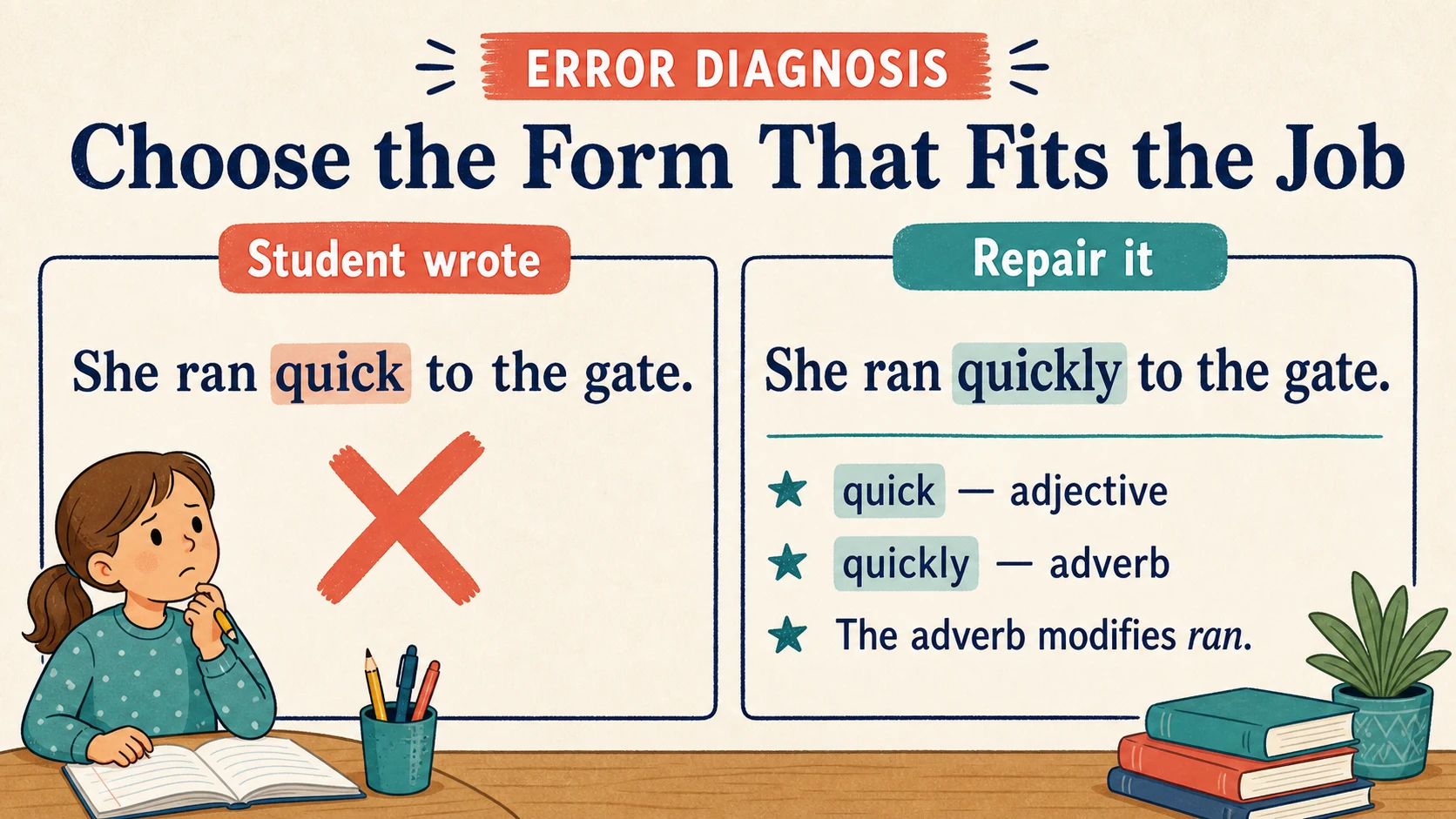
Reading access, visual organization, and reduced quantity can change while the classification target remains intact.
When reading is the barrier
Read the sentence aloud once, then ask the learner to identify the requested part of speech. Alternatively, take turns reading sentences. The learner should still make and explain the classification.
If one unfamiliar word blocks understanding, explain that word in plain language without labeling its part of speech. Then reread the complete sentence.
When attention or visual load is the barrier
Cover the items not currently in use with a blank sheet of paper. Reveal one sentence at a time. The original 12-item content remains unchanged, but the learner sees less competing print.
You can also mark the direction word—noun, verb, or adjective—before the learner analyzes the sentence. That is different from marking the answer.
When category recall is the barrier
Place a small reference card nearby:
| Category | Quick cue |
|---|---|
| Noun | names someone or something |
| Verb | tells an action or what happens |
| Adjective | describes a noun |
Ask the learner to point to the relevant cue, apply it, and then explain the selected word. Remove the card in a later attempt to see whether the definition is retrievable.
When the worksheet is already easy
Keep the original classification task, then add a brief transfer prompt after completion:
- Replace one noun with a more specific noun.
- Change one verb while keeping the sentence sensible.
- Add an adjective to a noun that does not already have one.
This extension connects analysis to writing without claiming that the worksheet itself teaches a full writing process. The IES elementary writing practice guide recommends high-level practices such as teaching sentence construction and providing opportunities to write. It does not assess this worksheet or prescribe these exact extensions.
Handle boundary cases with care
Words do not always belong to one permanent category. Their function can change with context.
The same word can do different jobs
Compare:
- “We play outside.” Here, play tells an action, so it is a verb.
- “The play was funny.” Here, play names a performance, so it is a noun.
- “I drink water.” Here, water names a thing, so it is a noun.
- “Please water the plant.” Here, water tells an action, so it is a verb.
The learner should not memorize “play is a verb” or “water is a noun” as an exceptionless rule. Ask, “What job is the word doing in this sentence?”
A sentence may contain several eligible words
“The playful dog carried the red ball” contains two nouns, dog and ball, and two adjectives, playful and red. A prompt that merely says “find a noun” has more than one defensible response. Check whether underlining, highlighting, blanks, or other item design identifies a specific target.
If the learner supplies a grammatically valid word that differs from the answer key, inspect the sentence and direction before marking it wrong. The key supports checking, but the sentence remains the evidence.
Not every action idea is the printed verb
In “The running child waved,” waved is plainly a verb. Running also expresses action-like meaning, but it describes child in this sentence. Such cases can exceed the intended simplicity of an easy identification task. If a boundary case creates genuine ambiguity, acknowledge it and return to a clearer sentence rather than forcing an inaccurate explanation.
Interpret errors before reteaching
A total score cannot show why an answer was wrong. Sort errors by pattern so that the response fits the need.
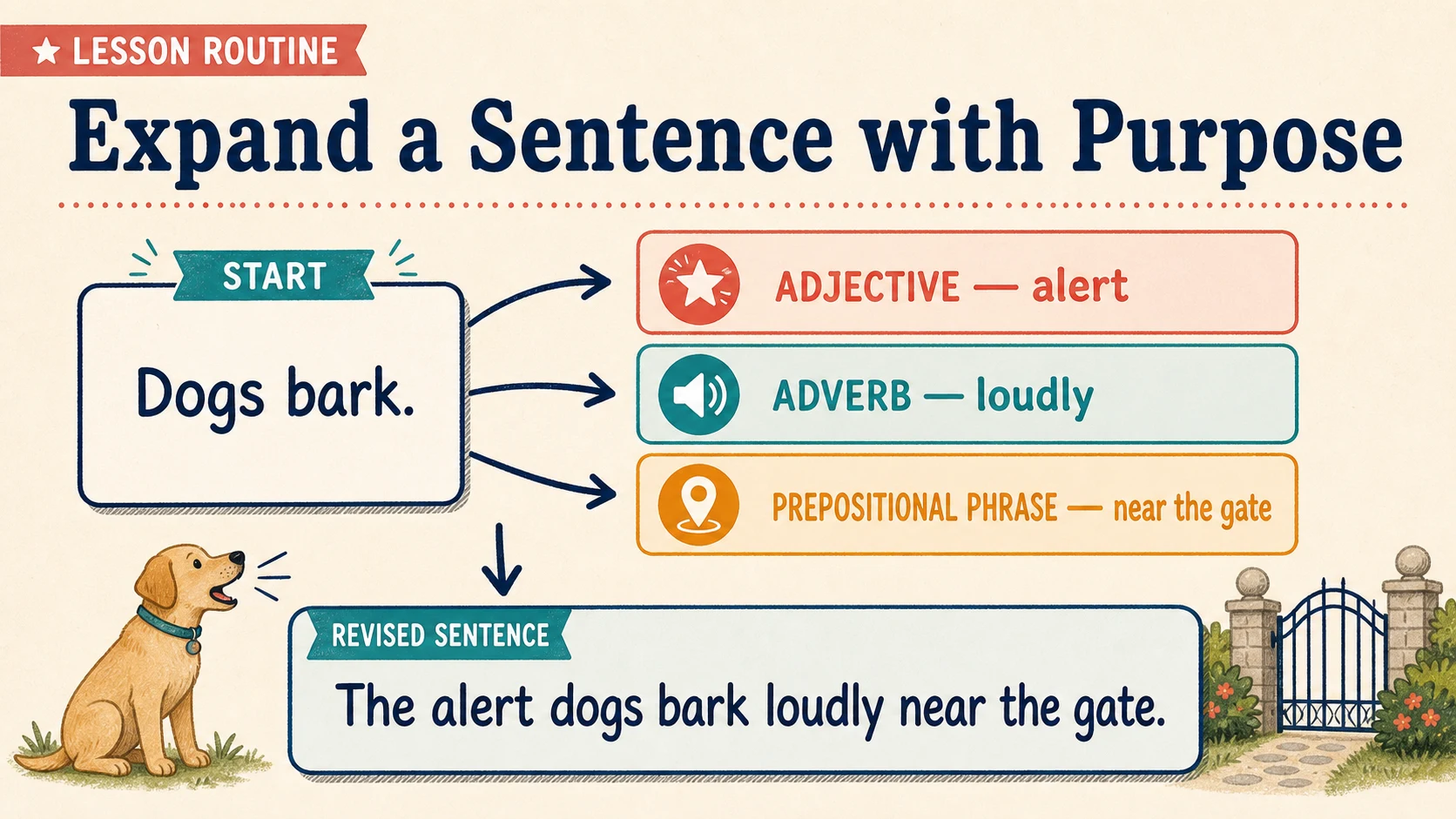
Review the direction, the sentence, the selected word, and the learner’s reason before deciding what to teach next.
Common patterns and useful responses
| Observed work | Possible interpretation | Next instructional move |
|---|---|---|
| Selects a noun when asked for a verb | Did not attend to the direction, or relies on “who or what” for every item | Have the learner circle the category named in the direction before solving |
| Selects the noun beside an adjective | Recognizes the described object but not the describing word | Ask, “Which word tells what kind?” and compare the two words |
| Selects any vivid word as an adjective | Treats “adds detail” as a complete definition | Ask which noun the chosen word describes |
| Gives different categories for the same kind of example | May be guessing or using surface clues | Require a one-sentence reason for two items |
| Answers correctly but cannot explain | Could reflect emerging knowledge, guessing, or difficulty verbalizing | Ask the learner to test the choice with a category question |
| Changes correct answers after seeing the key | May trust the key more than sentence evidence | Recheck the direction and justify the original response grammatically |
| Reads inaccurately, then classifies consistently from the misread sentence | Reading access interfered with the grammar task | Read the sentence aloud and reassess the same category decision |
Use cautious language. These observations suggest possible explanations; they do not diagnose a learning condition or provide medical guidance.
Correct with the learner, not for the learner
For a mistaken response, try this sequence:
- Reread the direction.
- Reread the full sentence.
- Ask the appropriate category question.
- Let the learner revise.
- Ask for a brief reason.
- Revisit a similar example later.
If the learner corrects the response after step one, the issue was probably task attention rather than the underlying category. If the learner still cannot distinguish the noun from its adjective, model that contrast again.
Use the answer key responsibly
The worksheet includes a separate printable answer key for checking the 12 items. Keep it out of sight during independent practice so the result reflects the learner’s decisions.
Check one item at a time. For every mismatch, compare four things: the exact direction, the sentence, the learner’s mark, and the keyed response. Ask the learner to explain before revealing the answer. When the explanation is sound and the item permits more than one grammatically valid selection, investigate the wording instead of automatically overriding the learner.
A corrected page should preserve useful evidence. Rather than erasing every first attempt, the learner can place a small line through the original response and add the revision. The adult can then see whether errors cluster around nouns, verbs, adjectives, or direction-following.
The Common Core English Language Arts standards organize grade-specific expectations within a broader framework for reading, writing, speaking, listening, and language. They offer context for examining local goals, but they do not establish that this one printable provides comprehensive standards coverage. Consult the learner’s school or homeschool sequence when formal alignment matters.
Decide what should happen next
The next task should respond to demonstrated performance, not the grade label alone.
If the learner is uncertain
Return to oral sentences with clear, concrete words. Work with one contrast at a time: noun versus verb, then noun versus adjective. After the learner explains several examples, retry selected worksheet items without showing the previous answers.
The 2nd Grade grammar hub can help an adult choose related practice while keeping the focus within grammar.
If the learner is mostly accurate
Revisit only the error pattern. If two adjective items were confused with their nouns, practice adjective–noun pairs such as cold water, striped sock, and tiny seed. Then ask the learner to classify the words inside complete sentences.
Do not require the whole worksheet again merely to repeat already secure items. A short, targeted check provides clearer information.
If the learner is accurate and independent
Ask for three original sentences:
- one containing a clearly identifiable noun,
- one with a strong action verb,
- one with an adjective that describes a named noun.
The learner should underline the target and explain its function. For additional practice across the same topic, the 2nd Grade Parts of Speech Worksheet Pack contains 18 worksheets. The pack is optional; move to it only when more practice fits the learner’s observed needs.
Schedule retrieval rather than immediate repetition
A correct answer immediately after instruction does not show what the learner will recall later. Brief delayed checks can reveal what remains available without the model in view.
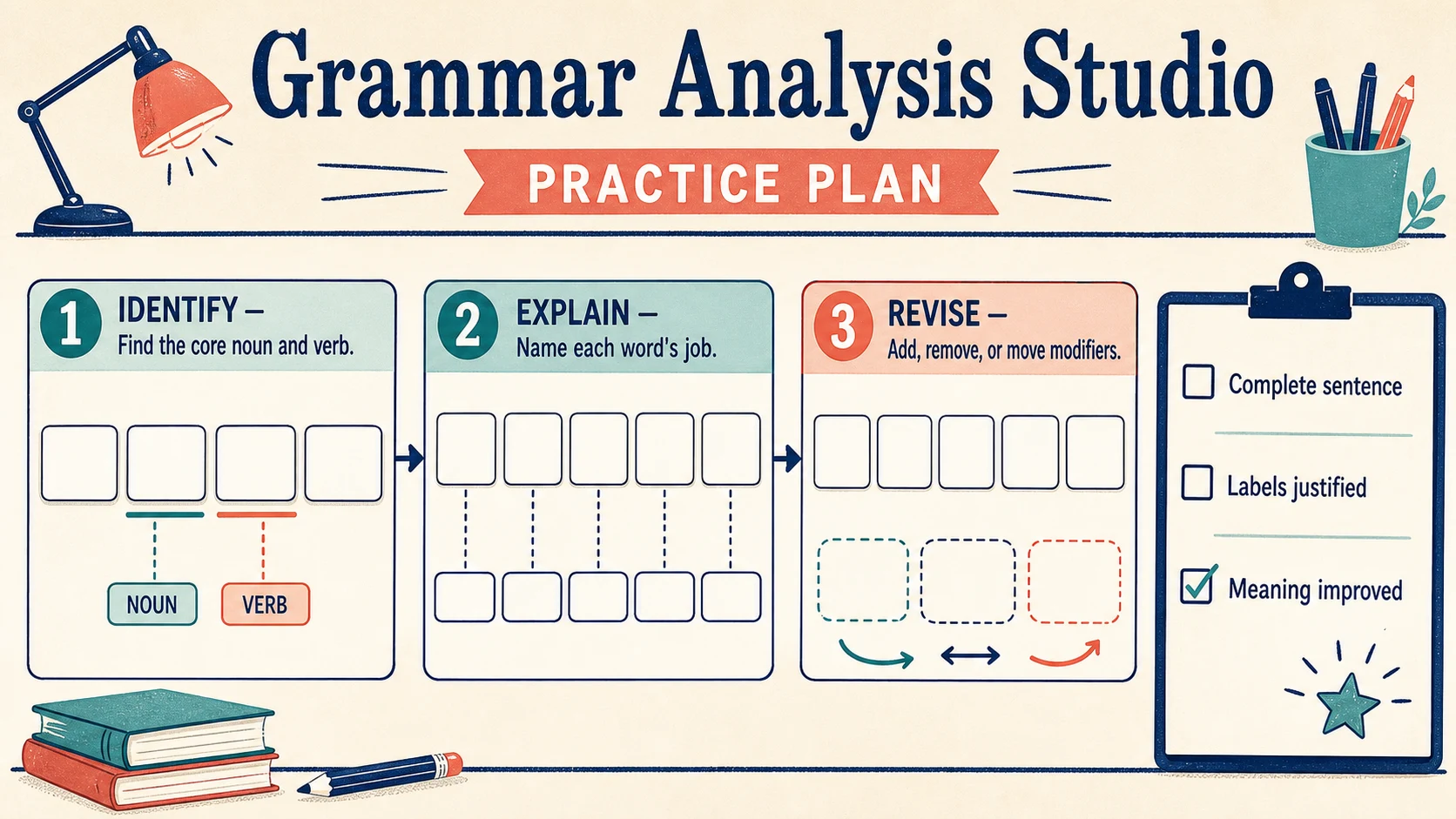
Short delayed checks can revisit the same distinctions in new sentences without repeating all 12 items.
A flexible retrieval plan might be:
| Review point | Suggested task | Decision |
|---|---|---|
| Later in the lesson | Recheck one corrected item without looking at the correction | Reteach only if the same confusion remains |
| On a later day | Classify a noun, verb, and adjective in three fresh sentences | Note which category is retrieved independently |
| Later that week | Mix all three categories in a short oral or written check | Continue if reasoning remains stable |
| In a later writing activity | Find or add a target word in the learner’s own sentence | Confirm transfer beyond worksheet recognition |
These intervals are practical suggestions, not a universal schedule. Increase or reduce spacing according to the learner’s responses and the local instructional plan. If a category is forgotten, give a brief prompt and schedule another fresh example rather than repeatedly displaying the completed page.
Recognize the worksheet’s limits
This printable provides 12 easy exercises focused on identifying nouns, verbs, and adjectives in sentences. It is not a comprehensive assessment of all eight parts of speech, complete sentence construction, reading ability, or writing quality. It cannot by itself establish mastery across unfamiliar texts.
The standard theme changes presentation, not the stated skill. The grade and difficulty labels describe intended practice level, while learner readiness and local sequences vary. The answer key makes checking more efficient, but it cannot replace grammatical judgment when wording permits multiple answers.
The worksheet is most informative when the adult records how the learner solved the items: independently, after rereading, with a definition card, or after a direct model. Those differences matter when selecting follow-up work.
Take the next useful action
Print the free 12-item worksheet and its answer key. Begin with one oral readiness sentence, model one fresh example, and let the learner’s first four responses determine how much support to provide. After checking and scheduling a short retrieval task, use the Parts of Speech topic guide to choose the next appropriate step rather than advancing automatically.
Put it into practice
Use the guide with a real printable
Move from explanation to a short, observable practice task. Check the first item together, then adjust the next session from the learner's actual work.
See the 18-worksheet pack