Complete guide
How to teach and practise 1st grade spelling words worksheets - standard theme (easy)
A practical way to use this 20-item spelling worksheet
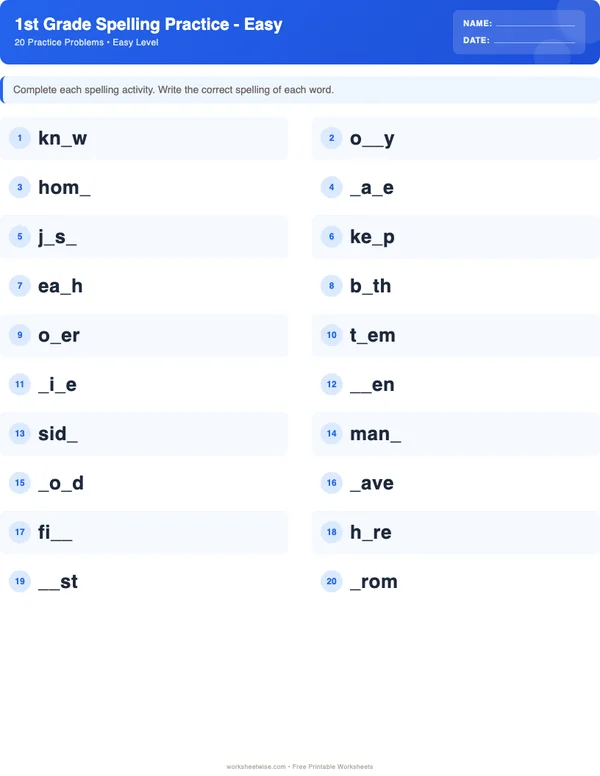
The free 1st Grade Spelling Words worksheet provides 20 easy-level activities involving fill-in-the-blank work, word scrambles, and misspelling correction. The learner writes the correct spelling for each item while practicing word recognition, vocabulary, and letter patterns. A separate printable answer key is included.
For most learners, the clearest approach is to model one example, complete two or three items together, and then release the learner to work independently. Do not require all 20 items in one sitting merely because they fit on one printable. The learner’s observed work should determine whether to continue, pause, add support, or schedule another short practice period.
Grade labels describe the intended practice level; they do not guarantee that every first grader has encountered the same words or spelling patterns. Local curricula and teaching sequences differ. Preview the page before presenting it so that you can identify unfamiliar vocabulary, explain the activity types, and decide how many items are reasonable for this learner today.
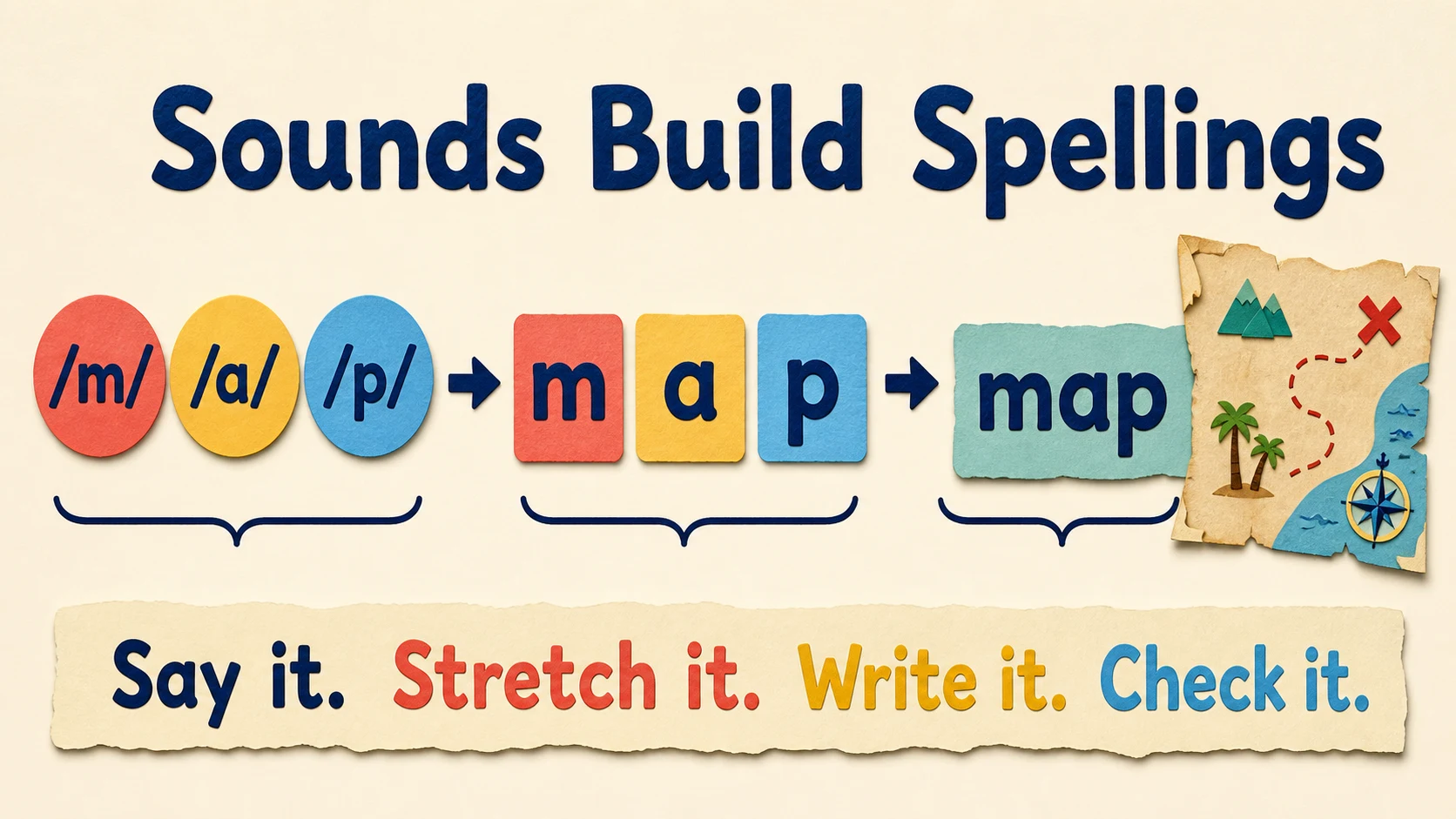
Preview, model, guide, release, check, and revisit rather than treating the worksheet as a single test.
What this worksheet does—and what it does not do
This printable offers structured practice with grade-appropriate spelling words through three named activity types:
- Completing words or prompts with missing information
- Unscrambling letters to form correctly spelled words
- Finding and correcting misspellings
Those formats ask the learner to do more than copy. A fill-in-the-blank item requires attention to the available letters or context. A scramble requires the learner to account for every supplied letter. A correction item requires comparison between an incorrect form and a known or inferred conventional spelling.
The worksheet is labeled easy and is intended for learners who are beginning this level of spelling work or need additional reinforcement. “Easy,” however, describes the catalogue level, not an individual child’s experience. A learner may recognize a word immediately but have difficulty writing it from memory. Another may solve a scramble quickly while struggling to explain which letter pattern made the answer plausible.
The page is useful for classroom practice, homework, tutoring, or homeschool instruction. It is not a complete spelling curriculum, a diagnostic instrument, or proof that a learner has mastered every first-grade spelling expectation. It also cannot show whether a correct answer came from memory, a visible clue, elimination, or adult help unless the adult observes the process.
For the broader sequence of spelling patterns and activity options, use the Spelling Words topic guide rather than expecting this single page to carry the whole progression. The first-grade spelling hub provides additional practice within the subject.
Prepare the lesson before the learner begins
Print or open the worksheet and answer key separately. Keep the key out of the learner’s immediate view. Read all 20 items yourself, confirm what each one asks, and notice whether the page changes from one activity format to another.
Identify the demand in each item
Mark each item privately as fill-in-the-blank, scramble, or correction. This quick preview helps you give the right directions. “Spell the word” is not always enough guidance because each format requires a different first move:
- For a blank, inspect the visible letters and any context.
- For a scramble, inventory the letters before rearranging them.
- For a misspelling, locate the questionable part before rewriting the word.
- For every item, read the completed answer and check the letters in order.
If a picture or sentence supplies meaning, make sure the learner understands it. Explaining a word’s meaning is acceptable support because vocabulary is one of the worksheet’s listed skills. Giving the spelling itself changes the task.
Choose a manageable stopping point
A learner who has not used the page before might begin with five items. After those five, look at accuracy, effort, letter formation, and the amount of prompting needed. Continue if the learner is working purposefully. Pause if attention has dropped enough that the remaining responses would tell you little about spelling.
This stopping rule is an instructional suggestion, not a universal timetable. Ten focused minutes can be more informative than a longer session filled with guessing or repeated adult correction.
Gather simple supports
A pencil and eraser are enough for ordinary use. Optional supports include scrap paper for rearranging letters, small letter tiles, or a blank card for covering nearby items. These supports preserve the spelling target as long as the learner still determines the word and its letter order.
Use a gradual-release lesson sequence
A short lesson can move from adult demonstration to shared work and then independent practice. The exact number of items at each stage should change in response to the learner.
| Lesson phase | Adult action | Learner action | Evidence to notice |
|---|---|---|---|
| Preview | Explain the three activity types without revealing answers | Look over the layout and restate the directions | Can the learner tell what each format requires? |
| Model | Think aloud through one similar example | Watch and explain the checking step | Does the learner attend to every letter? |
| Guided practice | Prompt on two or three worksheet items | Say the word, attempt it, and check it | Which prompts lead to a successful correction? |
| Independent practice | Step back while remaining available | Complete a selected set without answer-key access | Are answers accurate and strategies consistent? |
| Review | Discuss representative correct and incorrect responses | Explain or revise selected answers | Can the learner identify the changed part? |
| Retrieval | Revisit missed or uncertain words later | Spell from memory before seeing the answer | Does the spelling remain available after a delay? |
This structure is consistent with high-level foundational literacy instruction that connects attention to speech, print, decoding, and word analysis. The IES foundational skills practice guide provides broader instructional framing for early reading development; it did not evaluate WorksheetWise or this particular printable.
Model the task with a fully checked example
Use an example similar to the worksheet format rather than completing a live item for the learner. The purpose is to reveal the process while preserving the actual 20 items for practice.
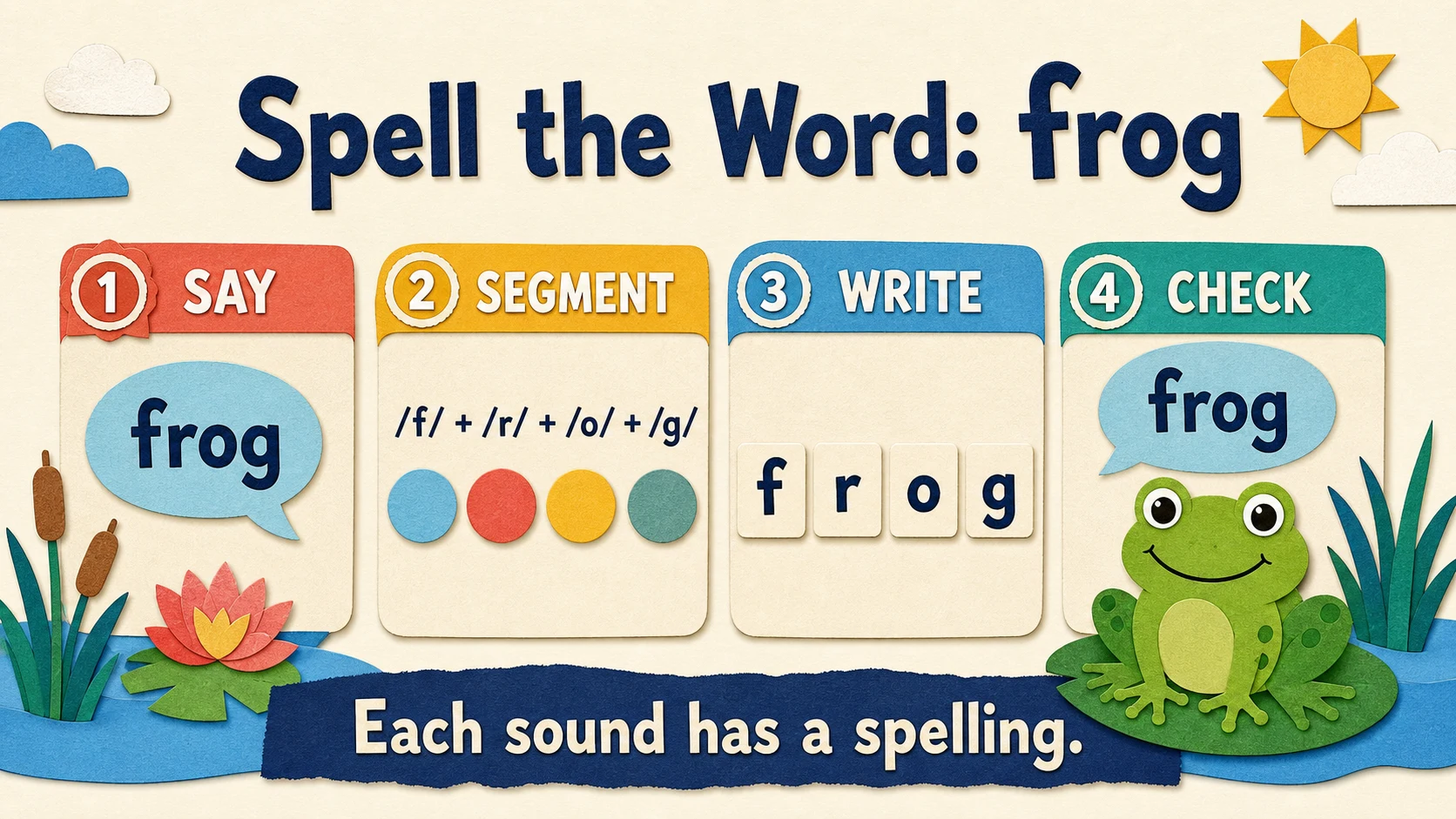
The model shows how to construct an answer and verify it, not merely announce it.
Worked example 1: complete a missing letter
Suppose the practice example is:
c _ t
A careful model could sound like this:
- “I see three letter positions:
c, a blank, andt.” - “I am trying the word cat: /c/ /a/ /t/.”
- “The middle sound is the short vowel sound represented here by
a.” - “I write
a, makingcat.” - “Now I check from left to right:
c-a-t, cat.”
The checked answer is cat. It contains three letters, matches the visible c and t, and supplies a in the blank.
This example has a boundary: c_t by itself does not always identify one word. Depending on the clue, it might also become cot or cut. The picture, sentence, spoken target, or other context must determine the intended answer. Teach the learner to use all available information rather than assuming every three-letter frame has only one possible completion.
Worked example 2: unscramble every letter
Suppose the letters are:
t – o – p
The learner might first form top. Check it by comparing the letters:
- Supplied letters:
t,o,p - Answer letters:
t,o,p - Each supplied letter is used once.
- No extra letter appears.
The checked answer is top.
Could pot also use the same letters? Yes. That is an important boundary case. A bare three-letter scramble can produce more than one correctly spelled English word. The intended response must therefore be determined by the worksheet’s picture, sentence, label, or answer key. If two answers genuinely fit all visible information, do not mark a reasonable alternative wrong until you have examined the key and prompt carefully.
Worked example 3: correct a misspelling
Suppose the displayed word is:
shp
Say the intended word aloud: ship. Stretch it slowly enough to hear the parts: /sh/ /i/ /p/. The written form already has sh and p, but it lacks the vowel letter between them.
Rewrite the whole word as ship.
Check:
- Beginning:
sh - Middle vowel:
i - Ending:
p - Complete spelling:
s-h-i-p
The answer is ship, not merely the missing letter i, because a correction activity asks for the correctly spelled word.
Worked example 4: preserve a consonant blend
Suppose a blank activity gives:
s t _ p
If the clue indicates stop, the missing letter is o. The completed word is stop.
Check the sequence: s-t-o-p. The beginning contains the blend st. Both consonants remain visible and both are pronounced in the word. A learner who writes sop may have identified a real word, but that response drops the given t and does not reproduce the target stop. The error is not random; it suggests that the learner needs to inspect every printed letter and attend to both sounds in the initial blend.
Move from guided practice to independent work
The adult’s role during guided practice is to prompt a useful action without quietly doing the spelling.
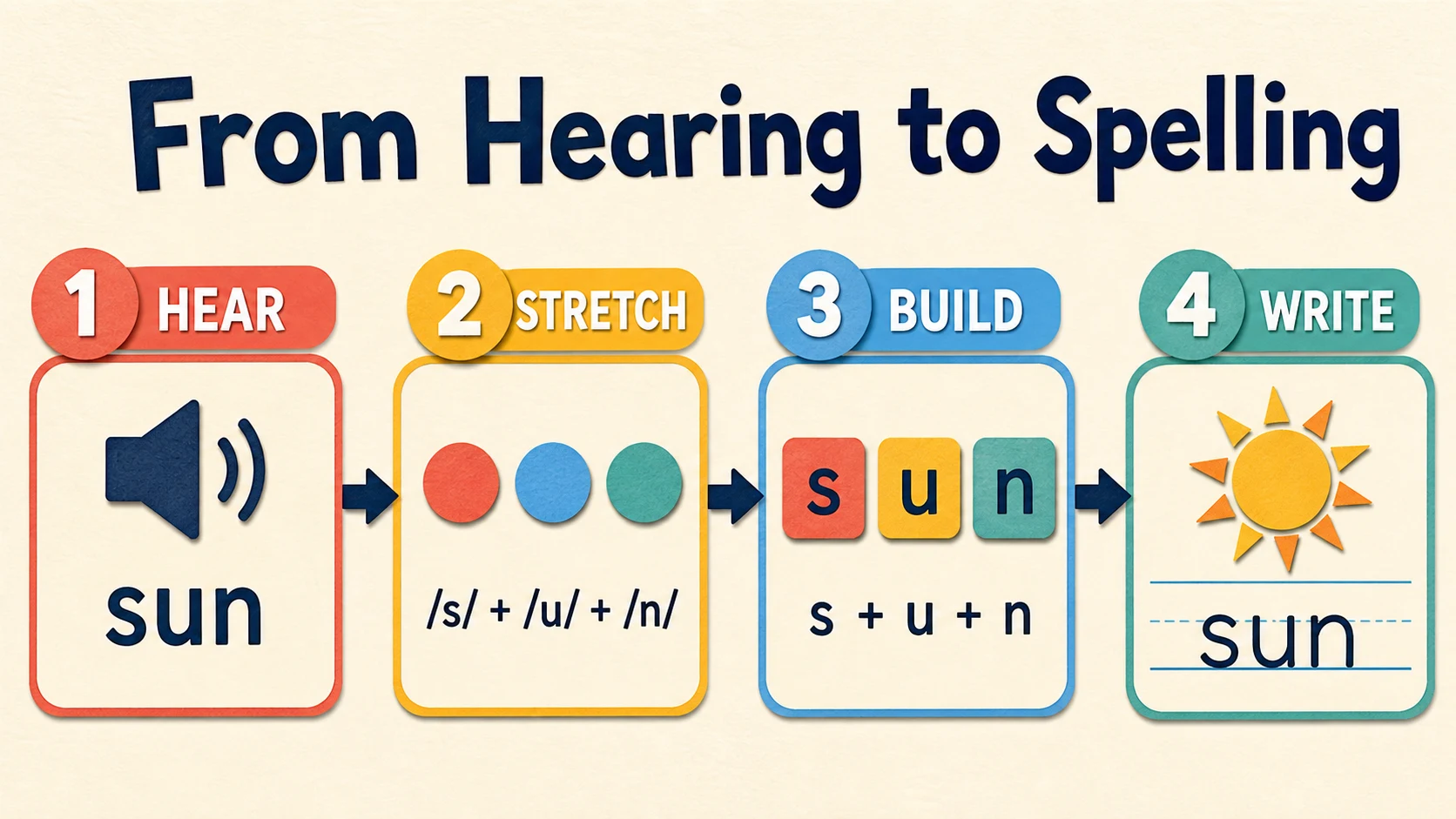
Guided practice supplies a strategy; independent practice shows whether the learner can use it.
Prompts that preserve the task
Useful prompts include:
- “Say the whole word.”
- “What letters are already given?”
- “Point to the part you trust.”
- “Which sound or letter position needs attention?”
- “Have you used every scrambled letter?”
- “Read your completed word from left to right.”
- “Compare the part you wrote with the part you said.”
- “What would you change after checking?”
These prompts direct attention without supplying an answer. Ask one, then wait. If the learner responds successfully, reduce the support on the next item.
Prompts such as “It starts with b,” “Put an e at the end,” or “The answer is this word” disclose part or all of the spelling. That may be appropriate during explicit reteaching, but the item should no longer be counted as independently completed.
Decide when to step back
Move toward independent work when the learner can explain what to do, begin without an answer prompt, and use a checking routine after writing. Independence does not require silence. A learner may whisper sounds, trace letters in the air, or use scrap paper and still be solving the spelling independently.
During independent work, record brief observations rather than correcting every item immediately. For example:
- “Used every scramble letter without prompting.”
- “Skipped vowels in two words.”
- “Asked what three vocabulary words meant.”
- “Corrected one answer after rereading.”
- “Copied from a nearby item.”
Those notes make the later review more useful than a score alone.
Adapt support without changing the spelling skill
Differentiation should change access, pacing, or response support—not replace the learner’s job of identifying and writing the correct spelling.
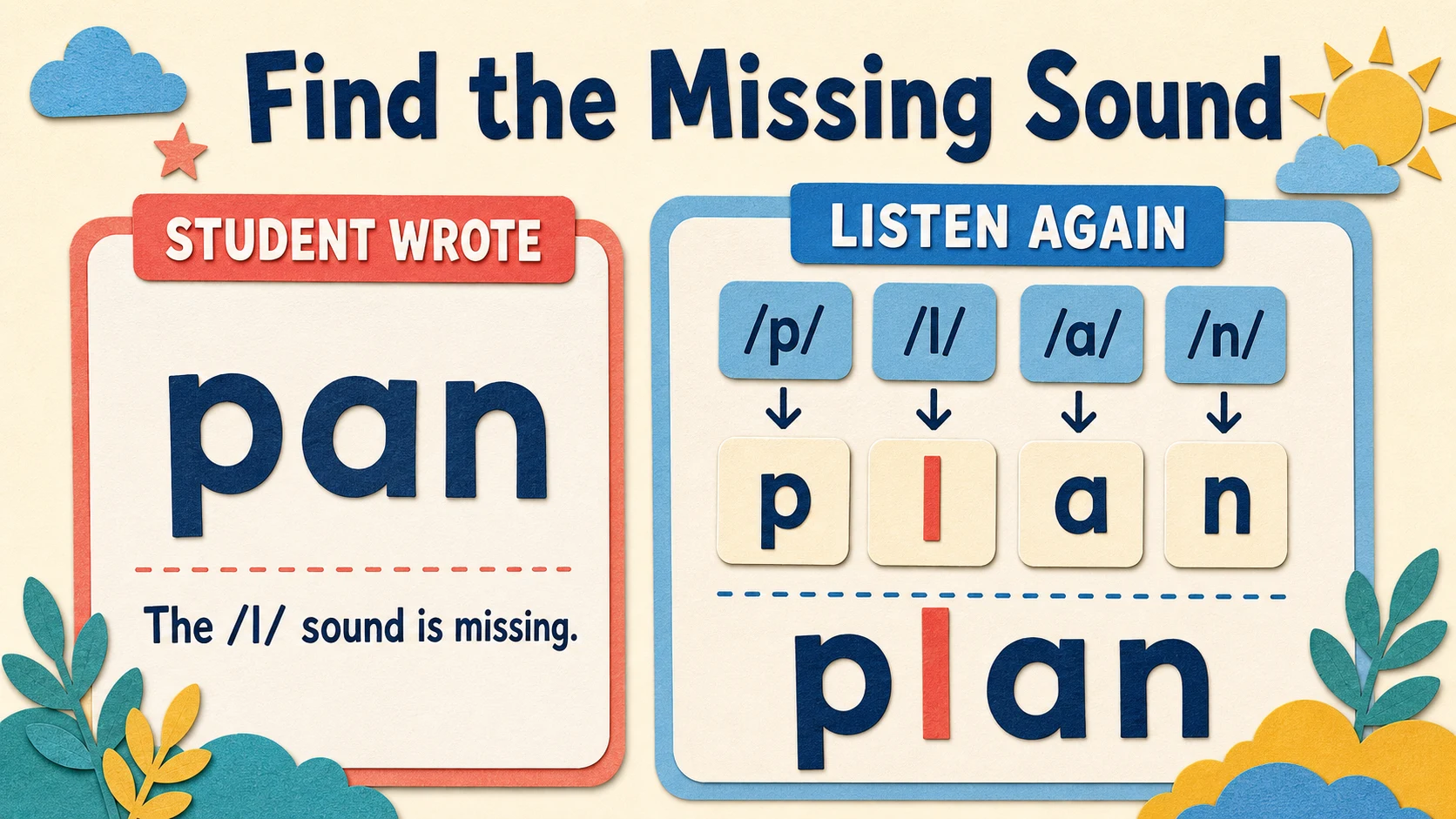
Adjust how the learner enters the task while preserving responsibility for the spelling.
When the page feels visually crowded
Cover the lower portion of the page and reveal one item at a time. Increase writing space by letting the learner write answers on lined paper. Read the directions aloud, but do not read a visible incorrect spelling as though it were correct. These adjustments reduce competing information while leaving the word analysis intact.
If copying from the worksheet is itself difficult, allow the learner to write only the corrected word or missing letters when that matches the printed directions. Do not require an additional sentence unless sentence writing is a separate instructional goal.
When letter order is the main difficulty
For a scramble, let the learner write each supplied letter on a separate scrap of paper and physically rearrange the pieces. The learner must still decide the order. After forming the word, have the learner copy it once and compare each position with the letter pieces.
For a correction item, draw a small dot under each letter. Ask the learner to point through the word while saying or naming the parts. This can make omissions and reversals easier to notice without revealing the correct form.
When the learner needs more challenge
Keep the original 20 items intact. After an accurate answer, ask the learner to use that word in an oral or written sentence, sort completed words by a visible letter pattern, or spell one selected word after it is covered.
A reasonable extension is to ask for a new word that shares an observed pattern. Treat it as exploration, not as evidence that the worksheet itself taught a general rule. Some words share letters without sharing the same sound pattern, so verify any extension example before presenting it.
For broader pattern work, consult the Spelling Words topic guide. It describes sorting, look-cover-write-check, sentence use, and cumulative review across a wider range of spelling practice.
Interpret errors before choosing a correction
A wrong answer is most useful when the adult asks what produced it. Two identical spellings can come from different causes: the learner may not know the target word, may omit a heard sound, may overlook a printed letter, or may understand the word but reverse its letters while writing.
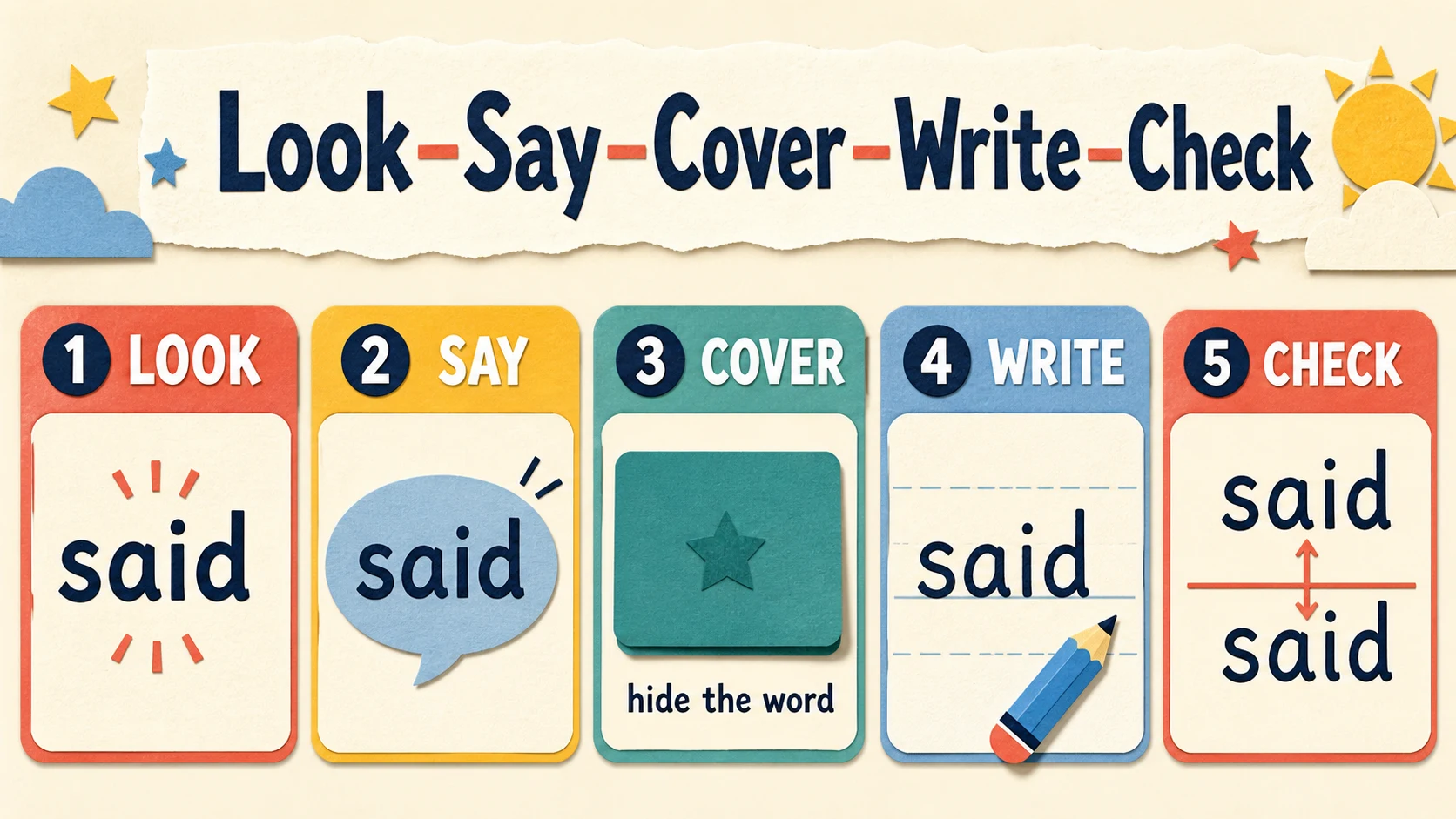
Identify the mismatch, repair the word, and then check whether the learner can retrieve it later.
Sort errors into practical categories
Vocabulary uncertainty: The learner cannot name the pictured object or explain the word in a sentence. Clarify the meaning first, then return to spelling. This prevents a vocabulary gap from being mistaken for a spelling failure.
Sound or letter omission: A required letter is missing, as in hypothetical sop for stop. Ask the learner to compare the spoken and written parts and locate what disappeared.
Incorrect letter order: All necessary letters appear but are rearranged incorrectly. Have the learner point to each supplied scramble letter and match it to the written response.
Pattern confusion: The learner repeatedly changes the same section of similar words. Select one clear example for explicit comparison rather than assigning more items immediately.
Task misunderstanding: The learner circles the error when the direction requires rewriting the correct word, or writes only one missing letter when the complete word is requested. Restate and model the response format.
Checking lapse: The learner can correct the word as soon as asked to reread it. The immediate need is a consistent checking routine, not necessarily new word instruction.
Avoid common misinterpretations
One missed word does not establish a stable misconception. Look for repetition across items or across later practice. Conversely, a correct response does not automatically demonstrate secure spelling if the learner copied it, guessed from choices, or received letter-level help.
Do not combine handwriting neatness and spelling accuracy into one judgment. A difficult-to-read letter may need clarification, but spelling analysis concerns the selected letters and their order. Record handwriting separately when necessary.
The Common Core English Language Arts standards include grade-level expectations related to conventions, common spelling patterns, and phonetic spelling of untaught words. That provides broad context, but it does not establish comprehensive standards alignment for this single worksheet. Local sequences may introduce or revisit particular patterns at different times.
Check the answer key responsibly
The separate answer key makes checking efficient, but it should confirm reasoning rather than replace observation.
First, let the learner finish the agreed portion. Then compare each response with the corresponding key entry. Mark correct answers clearly. For an incorrect answer, avoid covering the whole page in corrections. Choose a small number of representative errors and ask the learner to compare the response with the correct form.
Use a three-part correction routine
- Locate: Point to the exact letter or section that differs.
- Repair: Write the complete correct word.
- Verify: Read or spell through the repaired word from left to right.
If the adult supplies the answer from the key, note that the item was corrected with help. If the learner finds and fixes the mismatch independently, record that distinction too. Both outcomes matter, but they show different levels of control.
Check ambiguous-looking responses carefully. A poorly formed a should not automatically be treated as a different letter. Ask the learner what was intended, then address letter formation separately if needed. If a scramble appears to allow more than one real word, use every available clue and the key before deciding.
A total such as “16 out of 20” summarizes the page but does not explain the next lesson. Four errors involving omitted vowels call for a different response than four errors caused by misunderstanding directions.
Connect spelling practice to writing carefully
Spelling matters beyond isolated lists because learners use words while composing sentences and longer pieces. After worksheet review, choose one or two successfully spelled words and ask the learner to use each in a meaningful sentence. Keep the writing demand modest enough that spelling remains visible.
The IES guide to teaching elementary students to be effective writers offers broader guidance on elementary writing instruction and the writing process. It did not study this WorksheetWise page. Its relevance here is high-level: spelling practice can be connected to real writing, but a spelling worksheet does not substitute for instruction and practice in composing.
When reviewing the sentence, distinguish the target word from other conventions. For example, if the learner spells the selected word correctly but omits ending punctuation, acknowledge the correct spelling and address punctuation separately. Do not turn every sentence into a correction of every possible feature.
A sentence extension is also a useful transfer check. A learner may spell a word correctly when letters are supplied but misspell it when writing from memory. That difference tells you the visible support was doing part of the work.
Schedule retrieval instead of immediate repetition alone
Rewriting a corrected word can help the learner inspect it, but immediate copying does not show whether the spelling will be available later. Add brief retrieval opportunities after the original page is out of sight.
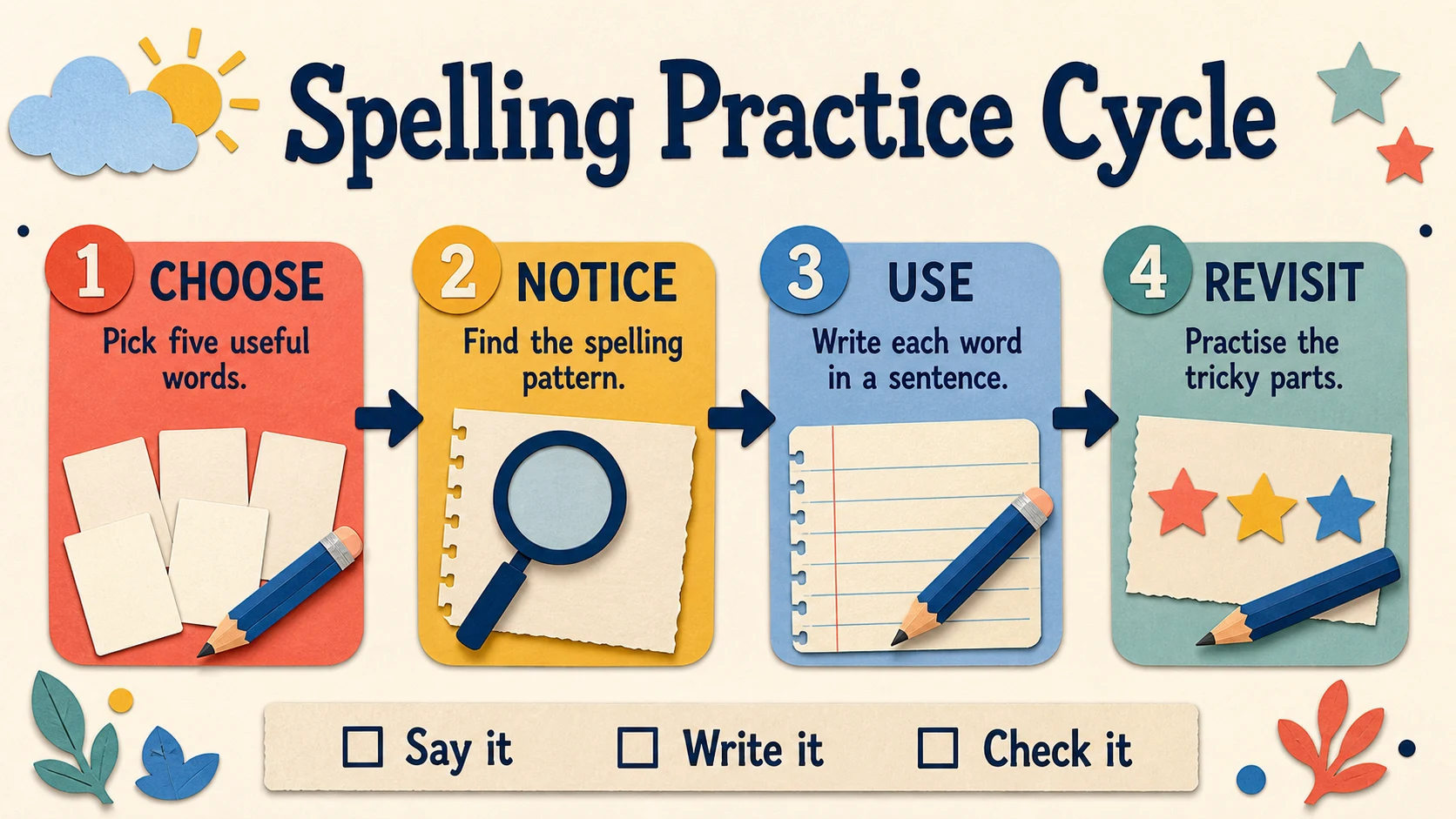
Short, delayed checks reveal more than repeatedly copying while the answer remains visible.
The following is a practical scheduling option, not a universal or sourced timetable:
| Time | Suggested action | What to record |
|---|---|---|
| End of the lesson | Recheck two corrected words after another activity | Independent, prompted, or not yet correct |
| Next practice session | Dictate three to five selected words without displaying them | Accurate letters, order, and hesitation |
| Several days later | Mix previously difficult words with known words | Whether old errors return |
| The following week | Use selected words in a short sentence or mixed review | Whether spelling transfers beyond the original format |
Choose words based on evidence. Include missed words, hesitant correct answers, and one or two secure words. A hesitant answer deserves review even if it was eventually correct; an immediate and independently checked answer may need less attention.
Keep retrieval brief. If several words remain difficult, return to the relevant letter pattern or word-analysis routine rather than scheduling repeated tests of the same unsupported response.
Decide what to do after the worksheet
Use accuracy, independence, and transfer together.
If the learner completes most selected items accurately, explains the checking process, and recalls sampled words later, move to fresh practice. Do not require endless repetition of an already secure page.
If answers are accurate only with visible letters, cover selected words and use look-cover-write-check. Have the learner look carefully, cover the word, write it from memory, and compare the result. Record the exact changed part.
If one error pattern recurs, provide a short focused lesson using verified examples that share that feature. Then return to one or two original items or similar new items. Avoid increasing difficulty merely to make the work feel more advanced.
If vocabulary caused several errors, review the meanings orally and in simple sentences before reassessing spelling. If the learner misunderstood a format, model that format again with a different word.
If the worksheet was frustrating or required continuous adult direction, divide the remaining items across later sessions. The learner’s observed work—not the grade label, page length, or a fixed calendar—should control pacing.
Limits and an honest next step
This printable samples 20 easy-level exercises. It can reveal useful patterns in how a learner completes blanks, rearranges letters, detects misspellings, and checks written words. It cannot establish comprehensive mastery of first-grade spelling, explain every error, or determine a universal instructional sequence. It does not provide medical guidance, certification, guaranteed outcomes, or evidence about an individual learner beyond the work actually observed.
Keep the completed page and a short note about prompts, corrections, and delayed recall. Then choose the next resource from the evidence:
- For more explanation of patterns and practice methods, open the Spelling Words topic guide.
- For broader first-grade materials, visit the 1st Grade worksheet hub.
- For a larger collection, review the 1st Grade Spelling Words Worksheet Pack, which contains 18 worksheets.
- To create fresh practice around words the learner actually needs to revisit, use the free worksheet generators.
The most useful immediate next action is simple: download the free worksheet, preview its 20 items, select a short starting set, and model one similar example before the learner begins.
Put it into practice
Use the guide with a real printable
Move from explanation to a short, observable practice task. Check the first item together, then adjust the next session from the learner's actual work.
See the 18-worksheet pack