Complete guide
How to teach and practise 1st grade word families worksheets - standard theme (easy)
How to use this 1st Grade Word Families worksheet
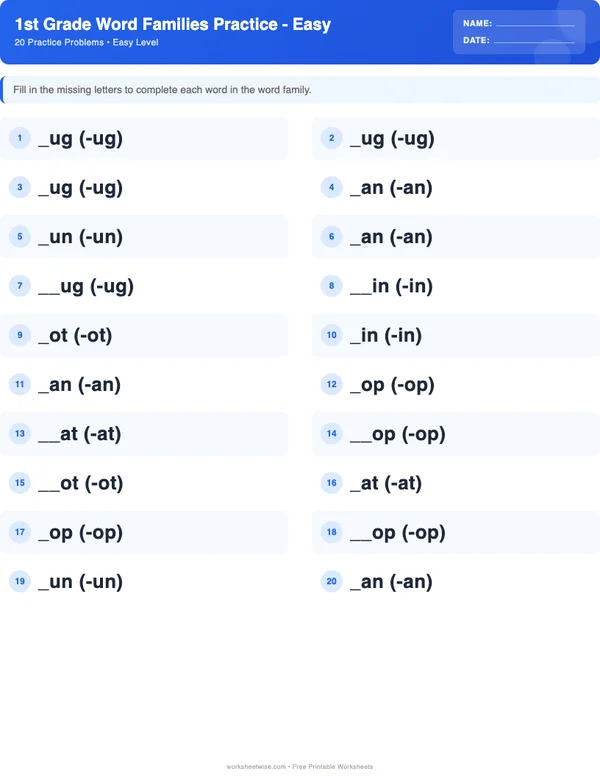
The free 20-item worksheet asks a learner to fill in missing letters to complete words in a word family. The most useful way to teach it is to model one example, solve several items together, let the learner complete a manageable group independently, and then review errors by rereading the completed words. Do not require all 20 items in one sitting if the learner’s work shows that a shorter set would be more productive.
This is easy-level practice in word patterns, onset and rime, rhyming, and word building. It is suited to a learner who is beginning word-family work or needs reinforcement. A separate printable answer key is included, but the key should confirm reasoning after the learner has attempted the words—not replace reading and checking them.
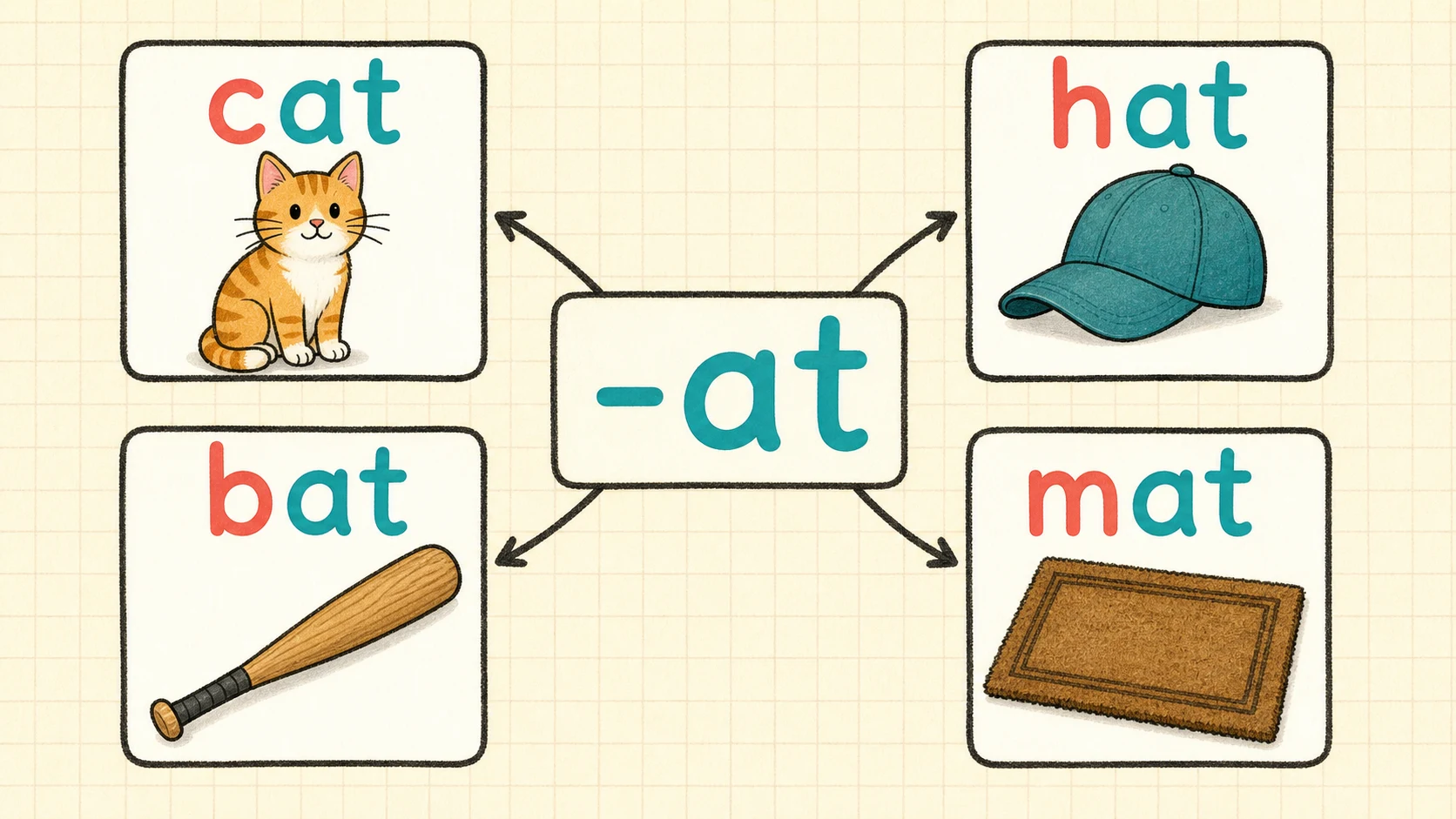
Move from a brief sound warm-up to modeling, guided practice, independent work, and a final reread.
Grade labels describe an intended practice level; local curricula and instructional sequences differ. A first grader may need earlier oral blending practice, may be ready for the whole page, or may already need more complex families containing blends and digraphs. Let the learner’s observed work determine the pace.
This guide concentrates on teaching this particular printable. For a broader explanation of families, sequencing, sorting, and related activities, use the Word Families topic guide rather than trying to turn one worksheet into a complete phonics sequence.
What the learner is practicing
A word family contains words with a shared ending pattern. In cat, for example, the initial consonant c is the onset and at is the rime. Changing the onset produces other words such as bat, hat, and mat while the rime stays unchanged.
That pattern can make a group of words easier to compare. It does not mean the learner should guess from the ending alone. The learner still needs to attend to every printed letter, connect letters with sounds, blend the parts, and decide whether the result is a real word that fits the item.
The worksheet’s four listed skills work together:
- Word patterns: noticing a repeated spelling unit such as -at or -ig.
- Onset and rime: separating the beginning from the shared ending.
- Rhyming: recognizing that words such as pig and dig share an ending sound.
- Word building: supplying missing letters and reading the completed word.
This use of word parts fits the high-level instructional framing in the IES foundational reading practice guide, which addresses linking speech sounds to letters, decoding words, analyzing word parts, and writing and recognizing words. That guide did not evaluate WorksheetWise or this particular printable.
What successful work looks like
On a successful item, the learner can do more than copy a letter from the answer key. The learner should be able to:
- Identify the visible word-family ending.
- Supply the missing letter or letters.
- Blend the completed word aloud.
- Check that the spelling forms the intended real word.
- Notice another word with the same ending, when prompted.
Correct spelling with no ability to read the result may reflect copying or guessing. Accurate oral reading followed by a letter-formation mistake is a different issue from misunderstanding the family. Keep those observations separate.
Prepare a short, focused lesson
Print the worksheet and keep the answer key out of the learner’s view. Have a pencil and eraser ready. Optional letter tiles or small paper letter cards can provide temporary support without changing the target skill.
Before starting, inspect the page yourself. Notice how the missing letters are displayed and how the family pattern is signaled. Because the catalogue description does not list the exact 20 words, use the actual printed items—not assumptions about common word lists—when choosing what to model.
Run a quick readiness check
Say a familiar word such as cat. Ask the learner to say the beginning sound and then the remaining part: /k/ and /at/. Next, ask the learner to blend /m/ and /at/ into mat.
This is an instructional check, not a scored test. Its purpose is to choose an appropriate entry point:
- If the learner can separate and blend the parts, begin the worksheet lesson.
- If the learner can rhyme orally but cannot connect the sounds to letters, model with visible letter cards first.
- If the learner cannot yet blend the two spoken parts, work orally for a few turns before returning to print.
- If the learner reads several related words immediately, shorten the modeling and preserve more items for independent practice.
Do not make the readiness check harder by introducing unfamiliar vocabulary or complex spellings. The worksheet is labeled easy and is designed for straightforward reinforcement.
Use one consistent prompt
A compact routine keeps attention on the skill:
“Find the family ending. Say the beginning. Blend the parts. Write the missing letters. Read the whole word.”
This wording is an instructional suggestion, not a sourced or mandatory script. It is useful because the same sequence can be repeated without supplying the answer.
Follow a model-to-independence progression
The entire lesson does not need a universal time limit. One learner may remain accurate through all 20 items; another may show declining attention or repeated guessing after six. Accuracy, independence, and the type of error matter more than finishing quickly.
| Lesson phase | Adult action | Learner action | Decision point |
|---|---|---|---|
| Sound warm-up | Orally separate and blend one familiar onset-rime word | Repeat the parts and blend them | If blending is difficult, add two or three oral turns |
| Model | Complete one actual worksheet item while thinking aloud | Watch, listen, and reread the result | Ask the learner to explain what stayed the same |
| Guided practice | Prompt without immediately naming the missing letters | Complete two to four items with support | Reduce help when the routine becomes accurate |
| Independent practice | Observe quietly while the learner completes a short group | Fill in and read each completed word | Pause if errors form a pattern |
| Review | Discuss selected correct items and errors | Explain, correct, and reread | Decide whether to continue, stop, or reteach |
| Retrieval | Revisit a few words after a delay | Read or rebuild them without copying | Compare with earlier performance |
Model one actual item
Cover the rest of the page if the full set is visually distracting. Point to the family ending and say what you notice. Then identify the missing position, try the likely onset, blend the sounds, and check the whole word.
A model might sound like this:
“I see -at at the end. The missing beginning is c. I will put c before at: c-at, cat. I read the whole word after writing it.”
Keep the explanation visible and specific. “It just looks right” does not show the learner what to do next time.
Move into guided practice
For the next two to four actual items, let the learner perform each step. Use the least revealing prompt that helps:
- “Which letters stay together?”
- “What is missing?”
- “Say the two parts.”
- “Blend them.”
- “Does that make the word shown or intended by the item?”
If the learner answers correctly, ask for a reread rather than adding a long explanation. If the learner hesitates, wait briefly. A prompt given too soon can make the adult responsible for the reasoning.
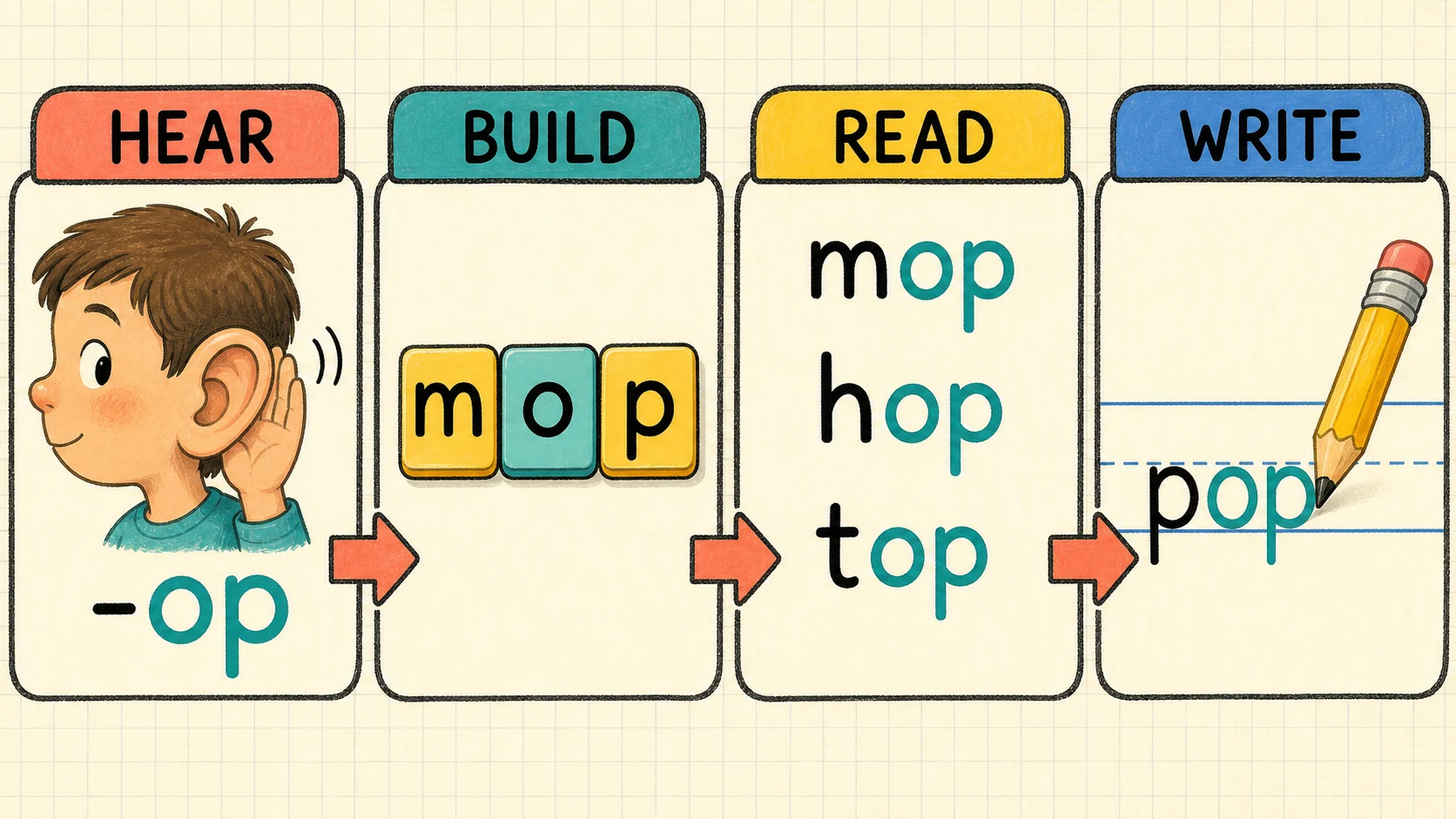
Guided practice should reveal the reasoning while gradually transferring each step to the learner.
Assign independent work in observable groups
Instead of saying “Finish the page,” try “Complete the next four and read each one quietly after you write it.” Watch for the learner’s method without correcting every stroke immediately.
After the group, check whether the learner:
- preserved the family ending;
- supplied letters in the correct position;
- blended rather than guessed;
- produced real words;
- maintained accuracy without repeated adult cues.
Continue with another group if the pattern is secure. Stop for a brief reteach if the same misunderstanding appears more than once. End the session if effort or attention has deteriorated enough that additional items would mostly measure fatigue.
Use fully checked examples to make the reasoning clear
The examples below are verified demonstrations of onset-rime word building. They are similar to the worksheet’s stated skill, but they are not presented as transcriptions of its 20 items. When teaching, model with an actual item from the printed page.
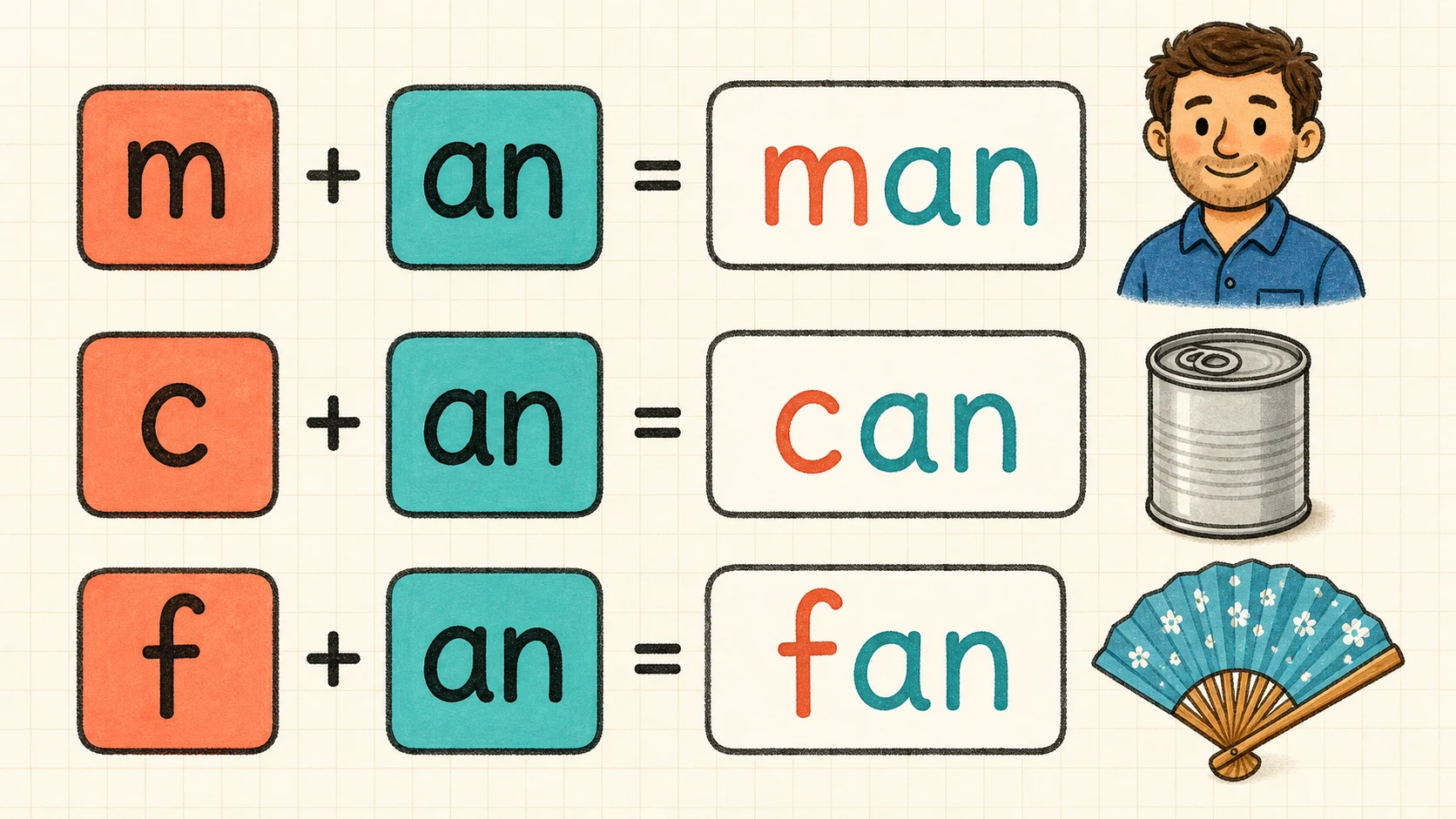
Keep the shared ending visible, add the missing onset, and verify the completed word by reading it.
Example 1: c + at = cat
Suppose an item shows c__ and identifies -at as the family ending.
- Onset: c
- Rime: at
- Built word: cat
- Sound check: /k/ + /at/ = cat
- Pattern check: cat shares -at with bat and hat
- Word check: cat is a real word
The completed spelling is cat, so the missing letters are a and t if both spaces are blank. If only the first letter is missing from _at, the missing letter is c. The exact response depends on what the printed item leaves blank.
Example 2: p + ig = pig
Suppose the family ending is -ig and the intended beginning is p.
- Onset: p
- Rime: ig
- Built word: pig
- Sound check: /p/ + /ig/ = pig
- Pattern check: pig shares -ig with dig and wig
- Word check: pig is a real word
The important feature is that ig stays intact. Writing peg would create a real word, but it would change the vowel and would not belong to the -ig family.
Example 3: m + op = mop
For the family -op, add m at the beginning.
- Onset: m
- Rime: op
- Built word: mop
- Sound check: /m/ + /op/ = mop
- Pattern check: mop shares -op with hop and pop
- Word check: mop is a real word
A learner who writes map may have attended to the initial consonant but not preserved the family ending. That response should be treated as a vowel-pattern error, not as evidence that the learner cannot identify m.
Example 4: s + un = sun
For the family -un, place s before the rime.
- Onset: s
- Rime: un
- Built word: sun
- Sound check: /s/ + /un/ = sun
- Pattern check: sun shares -un with run and fun
- Word check: sun is a real word
The spelling son is also a real word, but it does not preserve -un. Meaning alone therefore cannot determine the answer; the learner must use the displayed letter pattern.
Boundary cases: when a possible combination is not an answer
Not every letter can be attached to a family ending to form a standard word. Adding q to -at produces qat, which is not an appropriate ordinary beginning-reading example. The learner should not conclude that every onset-rime combination is valid.
Some words also require more than one beginning letter. ch + at = chat and fl + at = flat share the -at ending, but their onsets contain a digraph or blend. These are legitimate family members, yet they may be more complex than an easy item using a single initial consonant.
Finally, rhyme and spelling pattern are related but should not be treated as identical in every English word. For this worksheet, stay with the regular patterns actually printed. Save broader spelling exceptions for another lesson.
Adapt support without changing the skill
Adaptation should make the same word-building thinking accessible. It should not turn the activity into copying completed answers.
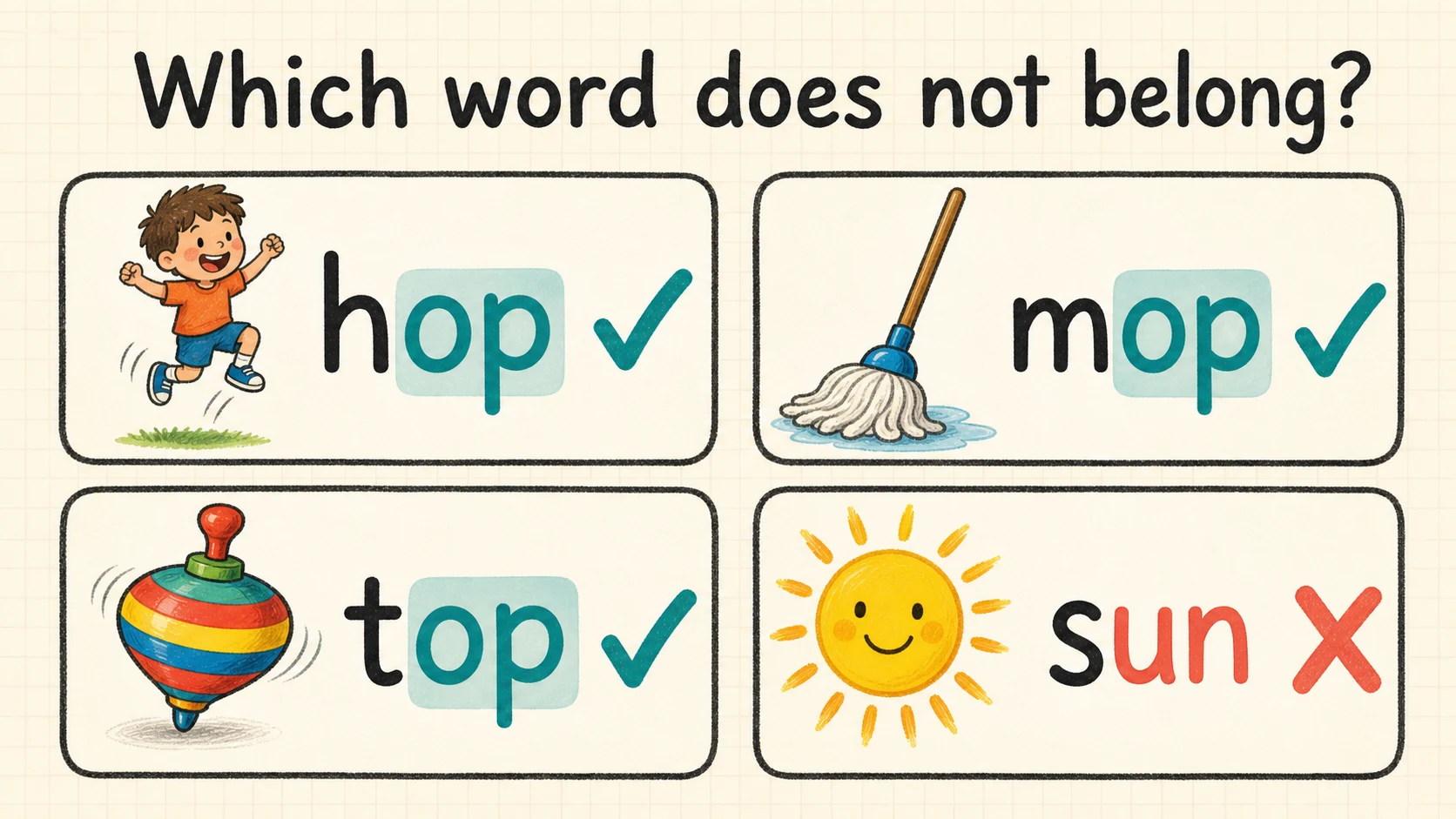
Change the amount of prompting, visible choice, or writing load while preserving onset-rime reasoning.
When the learner needs more support
Offer two or three letter choices for an onset, but still require the learner to test and blend each choice. For _at, for example, cards showing c, m, and s can be moved before at to build and read cat, mat, and sat.
Other useful adjustments include:
- covering later rows so only one small group is visible;
- highlighting the shared ending on several related items;
- having the learner point to or place a letter before writing it;
- letting the adult write one dictated answer when handwriting is masking phonics knowledge;
- returning to oral onset-rime blending before trying the printed item again.
If the adult writes for the learner, note that the item demonstrates oral analysis rather than independent spelling. That distinction matters when interpreting the finished page.
When the standard task is appropriate
Use the printed directions as written: fill in the missing letters to complete each word in the family. Ask the learner to read every completed word, but avoid adding clues unless a genuine difficulty appears.
A learner who solves accurately at a steady pace does not need repeated praise, hints, or explanations after every item. A brief acknowledgment and the next item are enough.
When the learner is ready for a modest extension
Keep the same family and ask for one additional word after a short set. The learner might build bat after completing cat, then explain that -at stayed the same.
Another extension is a short oral contrast: “Which belongs with pig: wig or wag?” The learner should identify wig because it preserves -ig. Do not require a long list of rhymes or introduce irregular spelling patterns merely to make an easy worksheet feel harder.
Interpret errors before correcting them
A total score can show how many responses match the key, but error patterns show what to teach. Record a few representative observations rather than marking every wrong answer with the same symbol.
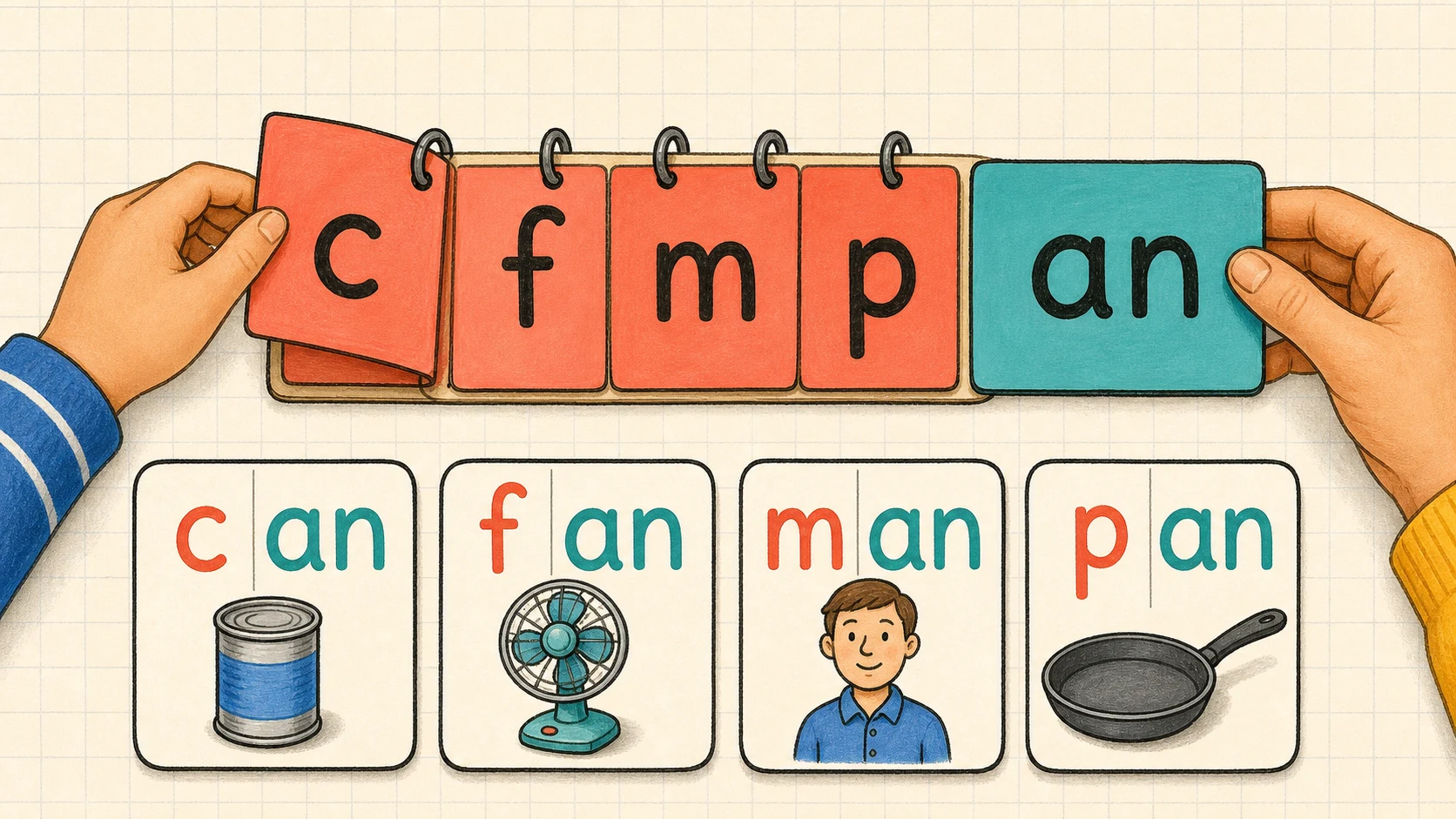
Identify the attempted pattern, reread the result, compare it with the family, and correct only after locating the mismatch.
| Observed response | Possible interpretation | Useful next check | Instructional response |
|---|---|---|---|
| Family ending is changed | Learner may not be tracking the fixed rime | Ask, “Which letters must stay the same?” | Highlight the ending and rebuild one item |
| Initial sound is plausible but wrong | Learner may be relying on rhyme without checking the full word | Ask the learner to read the entire result | Contrast two onsets and blend both |
| Correct letters are reversed or misplaced | The learner may know the sounds but be uncertain about order | Ask for oral spelling before rewriting | Use movable letters, then copy once |
| Answer forms no intended word | Learner may be combining letters mechanically | Ask, “Read what you made. Is that the word?” | Reblend and verify against the printed cue |
| Correct answer cannot be read aloud | Response may have been copied or guessed | Cover the key and request a reread | Rebuild the word from onset and rime |
| Oral answer is correct but writing is unclear | Handwriting may be obscuring phonics knowledge | Have the learner point to letter choices | Record oral accuracy separately |
| Early items are correct but later items decline | Attention or effort may be affecting performance | Retry one later item after a break | Shorten the next independent group |
Common misconceptions to address directly
“One ending makes every word.” Explain that the ending remains available, but only certain beginnings form intended words.
“Rhyming words begin with the same sound.” Demonstrate cat and hat: their beginnings differ, while -at is shared.
“If it is a real word, it must be correct.” Map is real, but it does not belong to the -op family. The printed family constrains the answer.
“The picture, if present, is enough.” A visual cue can help identify meaning, but the learner must still verify every letter. Otherwise, a guessed label may not match the spelling pattern.
“Fast means mastered.” Speed without accurate blending or independent explanation is not enough. Conversely, slow but accurate work may show sound understanding that is not yet automatic.
Check the answer key responsibly
First, let the learner attempt an agreed-upon group without seeing the separate answer key. Then compare each response with the key and classify it as correct, self-corrected, or still needing review.
For a mismatch, avoid immediately announcing the key’s answer. Try this sequence:
- Point to the family ending.
- Ask the learner to read the written response exactly as spelled.
- Compare the response with the fixed pattern.
- Let the learner revise.
- Consult the key to confirm the final spelling.
- Reread the corrected word.
Check the key itself against the visible item. Confirm that the letters fit the blanks, preserve the stated family, and form the intended word. If a printed prompt and key ever appear inconsistent, do not teach the learner to ignore visible evidence merely to match the key. Mark the item for adult review and continue with unambiguous examples.
A corrected page should not automatically be treated as independent mastery. Note how much help was needed. “18 correct after prompts” and “18 correct independently” describe different performances, even though the final papers look alike.
Connect word building with reading and writing
Word-family practice should sit inside a broader literacy routine rather than stand alone. The IES foundational reading guide includes daily connected-text reading among its high-level recommendations. After this worksheet, an adult can place one or two successfully decoded family words into a short, natural sentence for the learner to read, such as “The cat sat.” This is an instructional application; it is not a claim that the worksheet alone develops fluency or comprehension.
Writing can provide another careful check. The IES elementary writing practice guide includes high-level guidance about developing fluency with skills such as handwriting, spelling, and sentence construction. After completing the phonics task, the learner might write one selected word or use it in a brief dictated or self-composed sentence. Keep this extension short enough that it does not replace the worksheet’s main target.
The Common Core English Language Arts standards organize literacy expectations by grade and describe reading, writing, speaking, listening, and language as related areas. The catalogue associates this topic with skills including onset-rime work and decoding regularly spelled one-syllable words. However, this single printable should not be described as comprehensive standards alignment. Schools, states, programs, and homeschool curricula may arrange phonics instruction differently.
For additional practice within the same subject, browse the 1st Grade Phonics collection. Use the broader 1st Grade worksheet hub when planning work across subjects.
Schedule retrieval from observed performance
Retrieval means asking the learner to read or rebuild a small selection after some time has passed, without first copying the completed page. The schedule below is a practical suggestion, not a universal timetable. Adjust it to the learner’s accuracy, independence, and current instructional sequence.
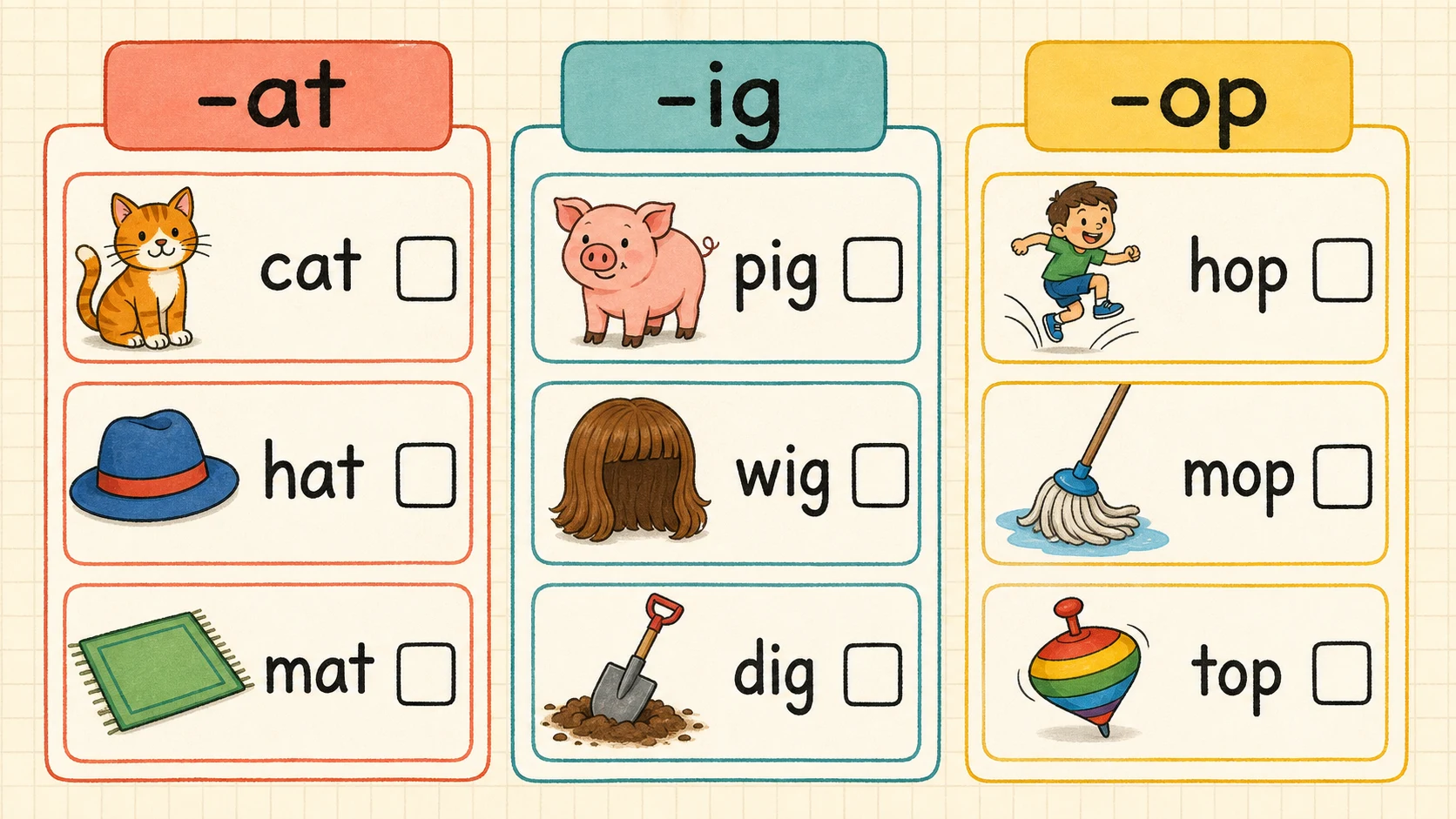
Revisit a small number of words after increasing delays and respond to what the learner actually remembers.
A practical review plan
| Review point | Suggested task | What to observe | Possible next move |
|---|---|---|---|
| End of the lesson | Reread four completed words, including one corrected word | Can the learner read them without reconstructing every answer? | Reteach one family if the same error returns |
| Next learning session | Rebuild three words with letters or write the missing parts on scrap paper | Does the learner preserve the ending without seeing the worksheet? | Repeat a short supported set if needed |
| A few days later | Mix two familiar families and sort or complete four to six words | Can the learner attend to both onset and rime? | Continue mixed practice only when accuracy holds |
| About a week later | Read selected words and one short sentence containing a known word | Does recognition carry into connected text? | Move forward, maintain, or return to guided practice |
Do not rehearse only the easiest correct answers. Include one item that originally required thought or correction, but avoid turning every review into a repeat of the full 20-item page.
If the learner remembers the words independently, reduce the frequency of review and introduce another appropriate family. If the learner remembers only after seeing the completed sheet, use rebuilding rather than rereading. If errors remain concentrated in one vowel family, revisit that family before mixing several patterns.
Understand the worksheet’s limits
This printable provides 20 easy exercises and a separate key. It can show how a learner handles missing-letter word-family items under the support conditions used that day. It cannot, by itself, establish complete phonics mastery, reading fluency, comprehension, or readiness for every later spelling pattern.
Performance can also be affected by vocabulary, attention, print tracking, letter formation, and familiarity with the task format. One wrong answer does not identify the cause. Repeated observations across reading, oral blending, word building, and brief writing provide a clearer instructional picture.
Word families are useful alongside systematic attention to letters and sounds; they are not a replacement for reading every part of a word. The worksheet also does not contain the whole topic progression. More advanced work may involve comparing families, sorting mixed patterns, reading words in sentences, or using onsets with blends and digraphs. Introduce those steps when the learner’s current work supports the move.
Decide what to do next
Use the learner’s completed work to choose one honest next action:
- Mostly accurate and independent: revisit several words after a delay, then move to another suitable family or a mixed-family activity.
- Accurate with frequent prompts: repeat a shorter guided set before expecting independent completion.
- Family endings repeatedly changed: reteach how the fixed rime remains constant.
- Oral answers are stronger than written answers: continue the phonics task with movable letters while separately supporting letter formation.
- The page is completed easily: add brief reading or word-sorting practice instead of assigning the same format repeatedly.
- The learner needs broader sequencing: consult the Word Families topic guide.
- The learner benefits from several related printables: consider the 18-worksheet 1st Grade Word Families Pack, listed at $4.79.
For the immediate next session, return to the free 1st Grade Word Families worksheet, select three completed words—including one that was corrected—and ask the learner to rebuild and read them without looking at the answers.
Put it into practice
Use the guide with a real printable
Move from explanation to a short, observable practice task. Check the first item together, then adjust the next session from the learner's actual work.
See the 18-worksheet pack