Complete guide
How to teach and practise 1st grade sight words worksheets - standard theme (easy)
How to use this 20-item sight-word worksheet
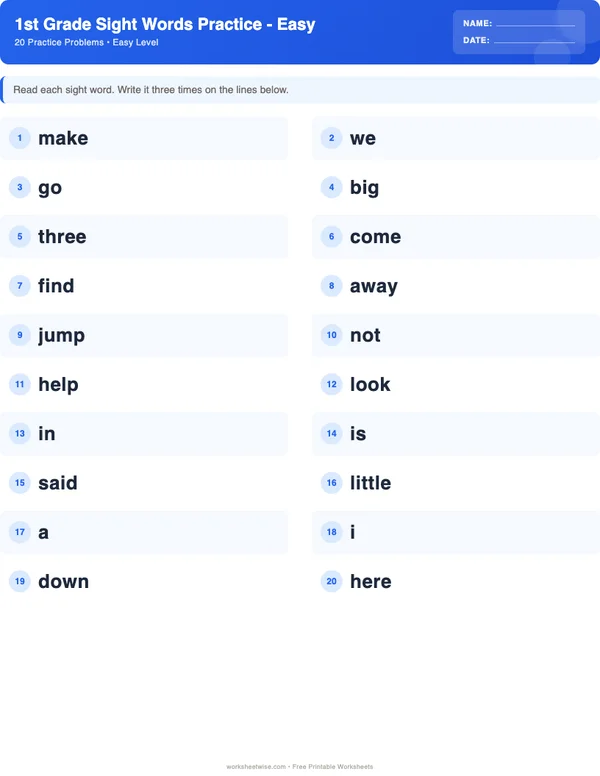
The free 1st Grade Sight Words worksheet asks the learner to read each printed word and write it three times. The most useful way to teach it is to model one item, complete a short group with support, pause before fatigue or guessing takes over, and then release only the secure items for independent work. Check both recognition and spelling; neat copying alone does not show that the learner can read the word.
The 20 target words are:
make, we, go, big, three, come, find, away, jump, not, help, look, in, is, said, little, a, i, down, here
This is an easy-level printable intended for 1st Grade practice. Grade labels describe the intended practice level, not a fixed timetable for every learner. School, district, homeschool, and intervention sequences differ. Use the learner’s observed reading and writing—not the label alone—to decide how many items to teach at once.
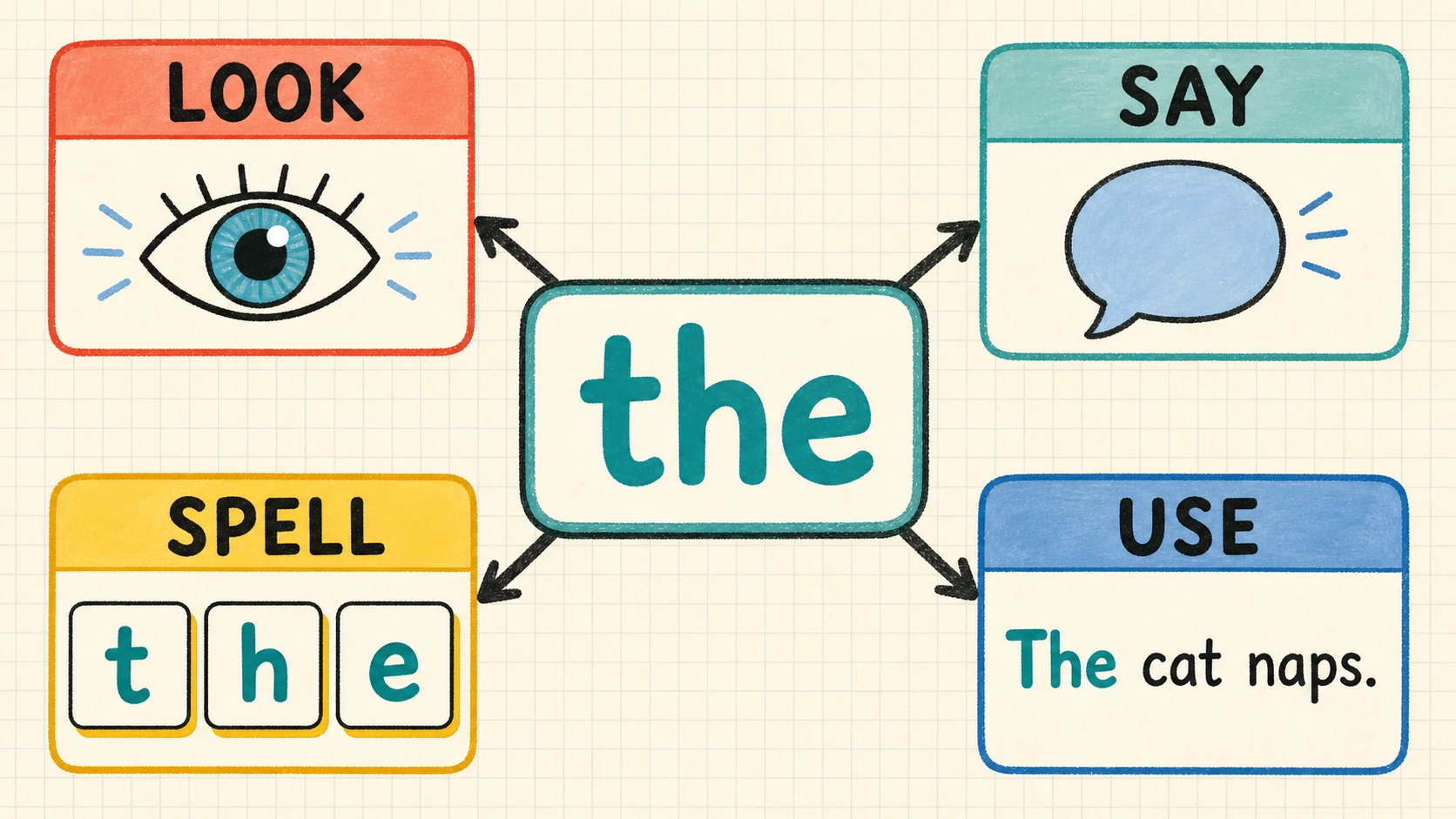
Move from a brief check to modeling, guided work, independent practice, and later review.
What the worksheet practices—and what it does not show
The page combines four related demands:
- recognizing a printed high-frequency word;
- saying that word accurately;
- remembering its letter sequence;
- producing the word in writing three times.
Those demands can separate. A learner might read little immediately but omit a t while writing. Another might copy said accurately without recognizing it when the model is covered. A third might know go in a book but hesitate when it appears by itself. Record these differences instead of reducing all three performances to “right” or “wrong.”
The IES foundational reading practice guide recommends teaching learners to decode words, analyze word parts, and write and recognize words. It also places word work alongside daily reading of connected text. That high-level framing supports using this worksheet as focused practice, followed by a short opportunity to meet the words in phrases or sentences. The source did not evaluate WorksheetWise or this particular printable.
The IES elementary writing guide separately addresses fluency with handwriting and spelling. Writing each target three times can contribute to that practice, but only if the learner attends to the letters rather than copying mechanically.
The Common Core English Language Arts standards organize literacy expectations by grade and include reading, writing, speaking, listening, and language. A single worksheet addresses only a narrow part of that larger picture. Its presence in a 1st Grade collection does not establish comprehensive standards alignment.
For a fuller explanation of high-frequency words, irregular spellings, and a broader teaching sequence, use the 1st Grade sight-words topic guide. The lesson below stays focused on this exact 20-item page.
Prepare a short, observable lesson
Print the worksheet and keep the separate answer key out of the learner’s view. Have a pencil, an eraser, and one blank card or piece of paper available. The card can cover a word during a memory check without changing the worksheet’s skill.
Before teaching, decide what success will mean. For this page, a practical definition is:
- The learner reads the printed target accurately.
- The learner writes three recognizable copies in the correct letter order.
- The learner can read at least some completed words again after attention has moved elsewhere.
This is an instructional definition for using the sheet, not a universal mastery rule.
Begin with a quick preview
Point to four words from different parts of the page—for example, make, three, is, and here. Ask the learner to read each one. Do not require writing yet.
Notice whether the learner:
- responds immediately;
- pauses and then reads accurately;
- attempts to sound through the word;
- substitutes another word;
- waits for the adult to supply it.
This preview should guide the session. If all four are easy, the learner may be ready for a larger independent block. If several are uncertain, begin with fewer items and more modeling. If the learner is unfamiliar with most of the page, completing all 20 at once would measure endurance and copying as much as word learning.
Separate an instructional prompt from an assessment prompt
During teaching, prompts are appropriate: “Look at every letter,” “Say the word,” or “Check the middle.” During a later check, reduce those prompts so you can see what the learner remembers.
Tell the learner which kind of turn it is. A simple distinction works:
- Practice turn: “I can help while you learn it.”
- Check turn: “Try this one without help so I can see what to practice next.”
That language keeps an error from becoming a judgment about ability.
Model the exact read-and-write routine
Choose one item and demonstrate the complete task before asking the learner to begin. Make works well because it permits attention to both the whole word and its letter sequence.
Say: “The word is make. I read it first: make. Now I look across the whole word: m-a-k-e. I say it again, and I write it: make. I compare my writing with the printed word. Then I write it two more times, checking each copy.”
Your model should show reading, writing, and checking. Avoid silently producing three copies; that demonstrates pen movement but not word recognition.
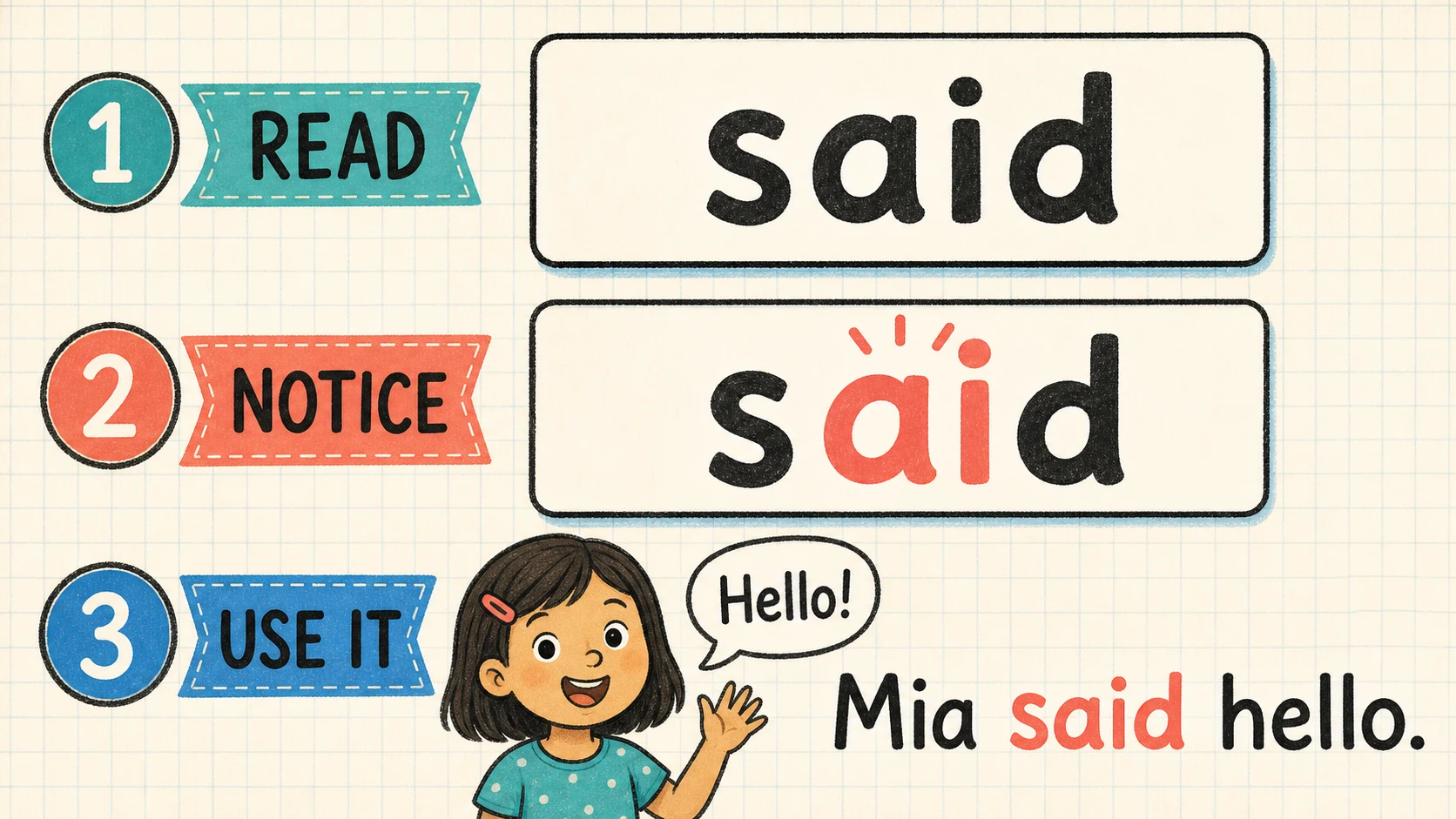
Read the target, attend to its letters, write three copies, and compare each copy.
Use a brief think-aloud
Keep the explanation specific to the item:
- “I started make with m, not n.”
- “I kept the letters in the order m-a-k-e.”
- “All three copies match the target.”
Do not turn every item into a long spelling lecture. The learner still needs time to respond. Likewise, do not insist that every word be memorized as an unanalyzed shape. Some words on the page are readily approached through familiar letter–sound relationships; others contain a part that may need extra attention. The immediate goal is accurate recognition and spelling of the printed word.
Add a memory check after copying
After the third copy, cover the printed model and the learner’s copies. Ask, “What was the word?” If the learner answers accurately, uncover the work and move on. If not, reveal the word, read it together, and try one supported recall.
This check is an instructional suggestion. It prevents three accurate copies from being mistaken automatically for word memory, but it is not required by the printed directions.
Move from guided to independent practice
A workable lesson can be divided into small blocks. The times below are flexible estimates for planning, not a universal timetable.
| Lesson phase | Suggested items | Adult role | Evidence to notice |
|---|---|---|---|
| Preview | 4 sampled words | Ask for reading only | Immediate, delayed, or inaccurate recognition |
| Model | 1 word | Demonstrate the full routine | Learner watches and can restate the directions |
| Guided practice | 3–5 words | Prompt reading and comparison | Accuracy with support |
| Independent practice | 4–10 words | Observe without supplying answers | Recognition, spelling, and self-correction |
| Review | 3 mixed words | Recheck after a short delay | Retention after attention shifts |
| Later retrieval | Selected uncertain words | Show words without completed copies | Recognition across separate occasions |
A learner does not have to finish all 20 items in one sitting. A natural break occurs after any pair of items because the worksheet is arranged in two columns of numbered words. Mark the stopping point lightly and resume later.
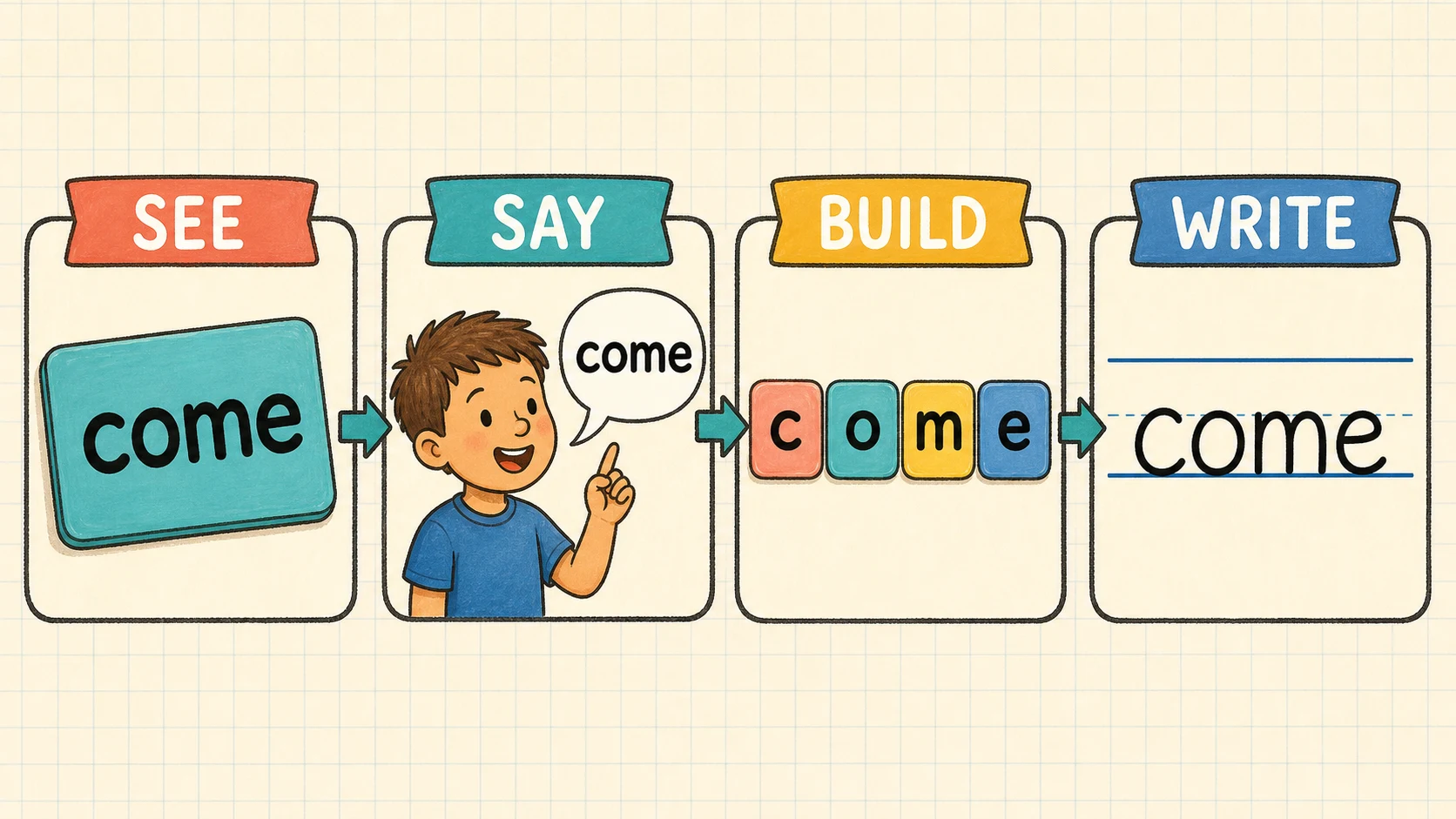
Model one complete response, practice a small set together, and release secure items.
Guided practice
For the first few learner-led items, use the same short routine:
- “Read the word.”
- “Say the letters as you look across it.”
- “Write it three times.”
- “Compare each copy with the printed target.”
- “Read your three copies.”
If the learner misreads a target, provide its pronunciation before asking for repeated writing. Copying a word under an incorrect pronunciation disconnects the written form from the intended word.
Gradually remove help. First stop spelling aloud with the learner. Then stop pointing to individual letters. Finally, ask the learner to run the routine independently.
Independent practice
Independent does not mean unattended. Watch quietly long enough to learn whether the learner:
- reads before writing;
- returns to the printed target for comparison;
- writes exactly three copies;
- notices an omission or reversal;
- begins guessing from the first letter;
- rushes as the page continues.
Intervene when repeated errors would rehearse an incorrect form. A neutral prompt such as “Compare that copy with the word at the start of the row” preserves the task better than supplying each missing letter.
Stop or divide the lesson if handwriting deteriorates sharply, the learner stops reading the targets, or responses become guesses. The observed work should drive pacing.
Four fully checked examples from the printable
These examples use actual targets from the worksheet. They illustrate how to verify the word, the three written attempts, and a brief transfer check.
Example 1: make
Printed target: make
Expected learner writing: make make make
Check:
- All three attempts begin with m.
- Each contains four letters in the order m-a-k-e.
- No attempt changes the target to made or omits the final e.
- The learner reads the completed word as make.
A useful transfer sentence is, “We can make a map.” The adult may read the rest of the sentence if necessary; the learner’s job is to locate and read make.
Example 2: three
Printed target: three
Expected learner writing: three three three
Check:
- Each copy begins with th.
- Each includes r after th.
- The ending contains two e letters: ee.
- The learner does not substitute the numeral 3 for the written word.
- The learner reads the word as three after writing.
A response such as thre is close but not correct. Say, “Compare the ending. What letter appears twice?” Then have the learner repair the existing attempt if it remains readable rather than automatically recopying the entire row.
Example 3: said
Printed target: said
Expected learner writing: said said said
Check:
- Every copy contains s-a-i-d in that order.
- The middle is ai, not e or ae.
- The learner reads the word as said, not as a regularized guess based only on the letters.
- A later uncovered presentation is still recognized.
For instruction, identify what is stable and what needs special attention: the initial s and final d are straightforward anchors; the middle spelling must be remembered as part of this word. Do not tell the learner that an inaccurate sed is “good enough” because it resembles the pronunciation. It is a reasonable clue about the error, but it is not the target spelling.
Example 4: little
Printed target: little
Expected learner writing: little little little
Check:
- Each copy has six letters.
- The middle contains two t letters.
- The ending is l-e.
- The learner does not write litle or littel.
- The word is read accurately after the copying routine.
If little overloads the learner, compare it in two visible parts—lit and tle—and then return to the complete word. The skill remains reading and spelling little; the parts are temporary supports.
Boundary cases: a and i
The worksheet prints a and i in lowercase. For this worksheet, a faithful copy of item 17 is a, three times. Item 18 should also match the printed target, i, three times.
In ordinary sentence writing, the pronoun I is capitalized. That language convention creates a genuine boundary case for item 18. Explain it plainly: “This row asks you to copy the printed lowercase form. When the word means yourself in a sentence, write capital I.” Do not use the worksheet’s lowercase display as a model for sentence capitalization.
For a, accept three clearly formed lowercase a letters. Do not require the learner to add an unrelated word merely because a one-letter response looks unusually short.
Adapt support without changing the skill
An adaptation should reduce an access barrier while preserving the central demand: the learner still reads the target and produces or recalls its spelling. It should not quietly turn the activity into adult dictation or tracing alone.
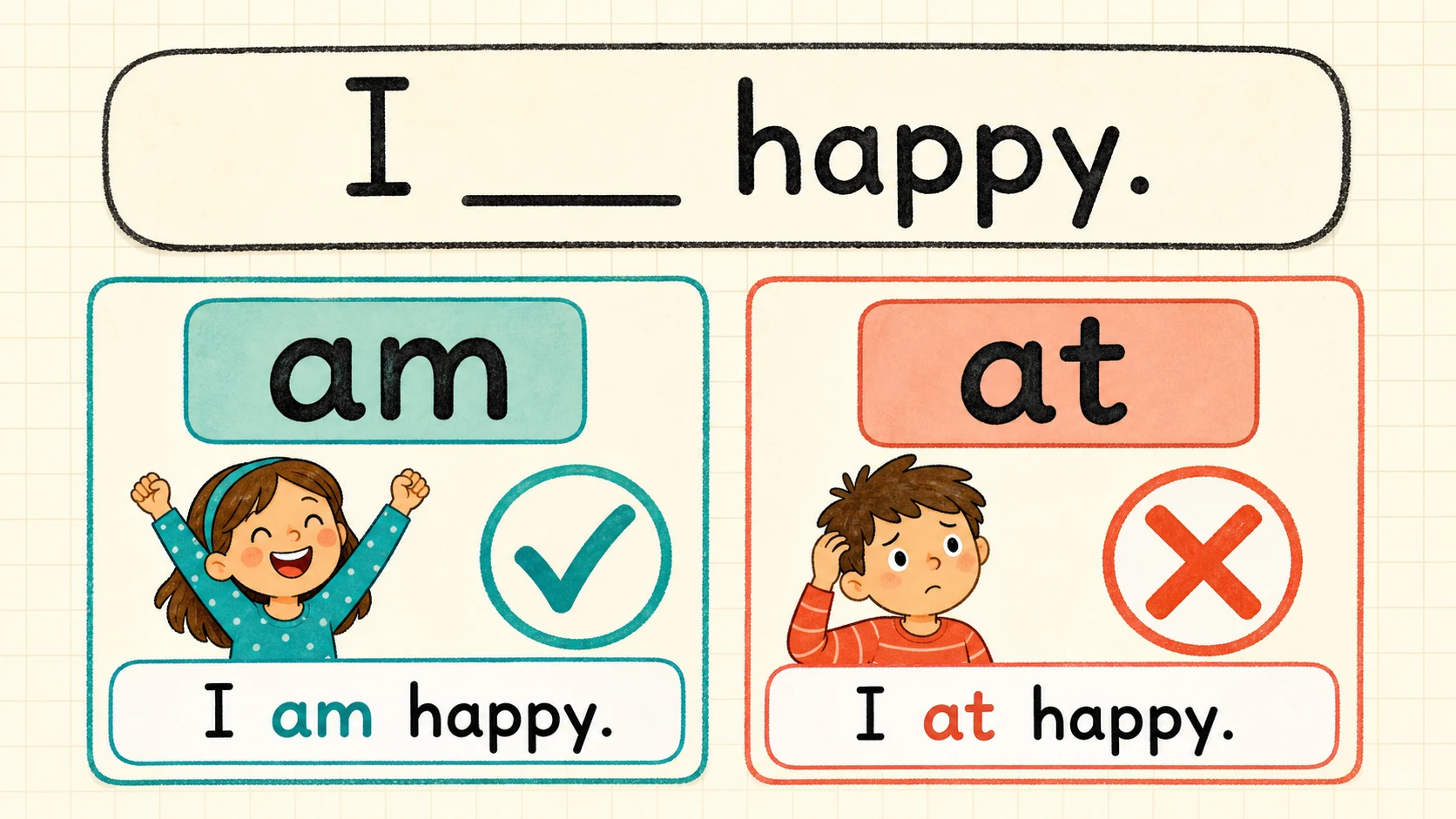
Adjust the amount, visibility, or writing load while keeping word recognition central.
When recognition is uncertain
Work with four or five items at a time. Cover the rest of the page with blank paper. Read one uncertain word together, examine its letters, and contrast it with a known word only when that contrast is useful. For example, distinguish is from in by pointing to the final letter, then ask the learner to read each again in mixed order.
Keep the printed target visible during the three written attempts. Hiding it too early changes supported spelling practice into a memory test.
When writing is the barrier
Allow a comfortable pencil grip and additional space on separate paper if the worksheet lines feel cramped. The learner should still write the target three times and read the copies. If three attempts cause clear physical fatigue, divide them across brief sessions rather than accepting unreadable work.
Tracing may serve as one initial supported movement, but it should not replace all independent formation if spelling and writing are being checked. No medical conclusion should be drawn from handwriting on this page.
When the page is already easy
Do not create extra copying simply to increase volume. Cover the printed model after the learner reads it, ask for one spelling from memory, and then reveal the word for self-checking. Follow with a short phrase or sentence containing the target.
For example:
- we → “We can go.”
- jump → “I can jump.”
- here → “Come here.”
- down → “Look down.”
These extensions use words from the printable, but they are adult-created practice rather than additional worksheet items. The learner may read only the target word while the adult supports the rest.
Interpret errors before assigning more practice
Errors indicate which part of the routine needs attention. They do not, by themselves, establish why a learner is struggling.
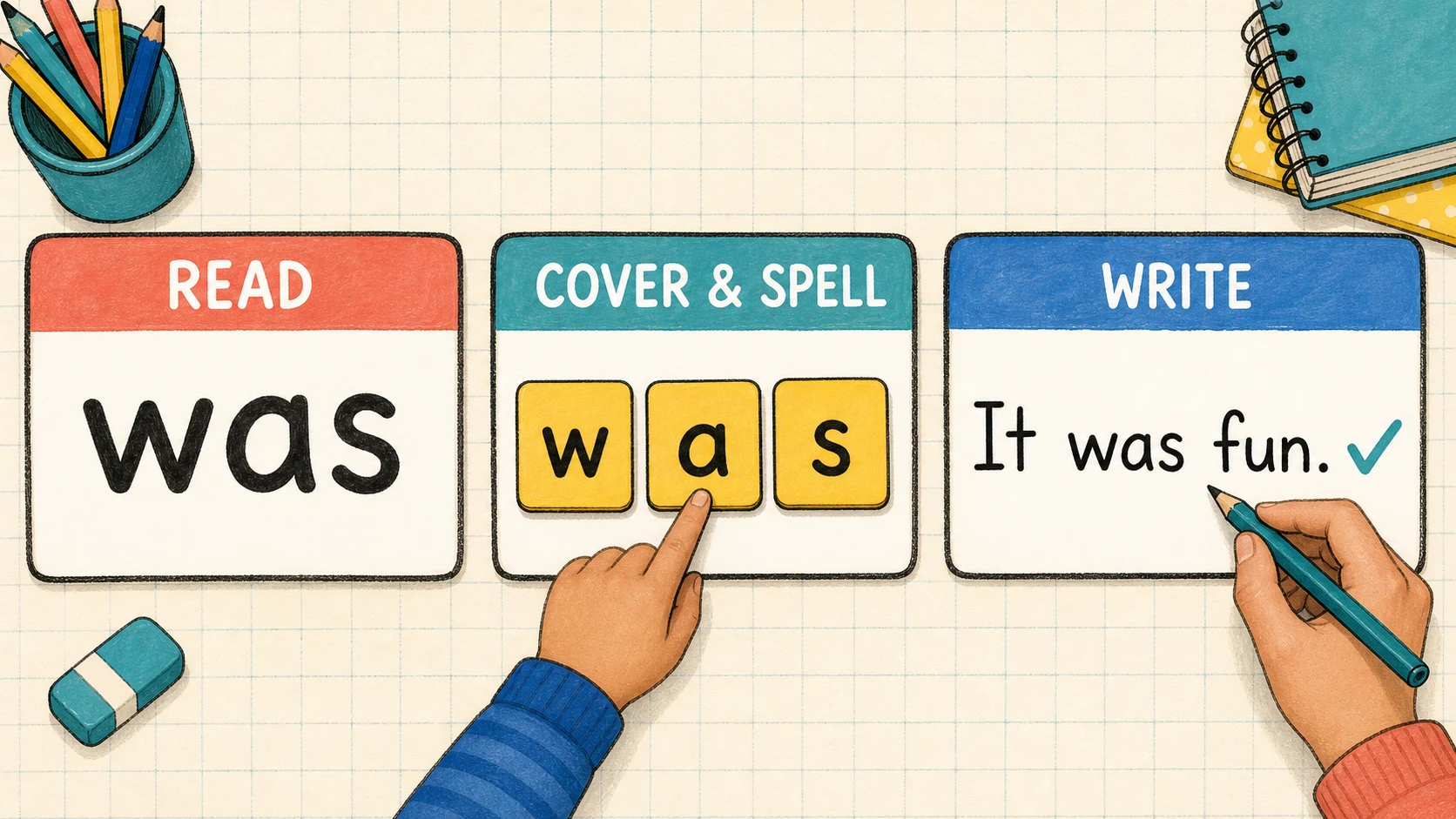
Identify whether the difficulty appeared in reading, letter order, production, or later recall.
| Observed response | Likely task-level issue | Immediate instructional response |
|---|---|---|
| Reads in as is | Final letter was not fully checked | Compare n and s; reread both words |
| Writes thre for three | One repeated ending letter was omitted | Compare endings and repair the missing e |
| Writes sed for said | Spelling followed pronunciation rather than the target | Highlight ai, say the word, and rewrite accurately |
| Copies accurately but cannot read the word | Visual copying did not establish recognition | Reread, cover, and retrieve after a brief delay |
| Reads accurately but misspells one copy | Letter-sequence or handwriting error | Compare that attempt with the model and correct it |
| First items are accurate; later items deteriorate | The practice block may be too long | Stop, record the point reached, and resume later |
| Asks for every answer before looking | Prompt dependence may be developing | Wait, direct attention to the word, then give only needed help |
Common misconceptions to avoid
“Three correct copies mean the word is mastered.” They show accurate performance with a visible model. Check recognition again later without displaying the completed row.
“A sight word should never be analyzed.” Recognition of the whole word is the goal, but attention to letter order and regular or unusual parts can support learning.
“Every hesitation is an error.” A correct response after a pause differs from an immediate response. Record the hesitation because it can guide review, but do not mark an accurate word wrong solely for being slow.
“Finishing all 20 is the lesson objective.” The objective is useful practice. Ten attentive items can provide clearer evidence than 20 rushed copies.
“Messy handwriting proves the word is unknown.” Ask the learner to read the attempt and compare it with the model. Word knowledge and letter production are related but distinguishable.
Check the answer key responsibly
Use the separate answer key to confirm each target’s exact spelling. For this activity, the learner’s response must match the printed target and provide three written attempts as directed.
Check in three passes:
- Completion: Are there three learner-written copies for each attempted item?
- Accuracy: Does each copy contain the correct letters in the correct order?
- Recognition: Can the learner read at least a sample of the completed words?
Do not count the worksheet’s printed target as one of the learner’s three attempts. If the answer-key layout displays repeated answer text differently from the response area, follow the student-facing direction: “Write it three times.”
Accept a self-correction when the final spelling is clear. A repaired three can provide better evidence than requiring the entire row to be erased and recopied. Mark the specific feature that needs review—such as “double e” or “middle ai”—instead of covering the page with undifferentiated marks.
The key cannot tell you whether the learner read independently, copied from a neighbor, received each spelling from an adult, or remembered the word later. Add those observations separately.
Schedule retrieval and choose the next step
Review should prioritize uncertain words rather than repeatedly assigning the entire page. A practical schedule is to revisit selected words later in the same lesson, on another day, and again after a longer gap. Change the schedule when the learner’s work shows that review is needed sooner or less often.
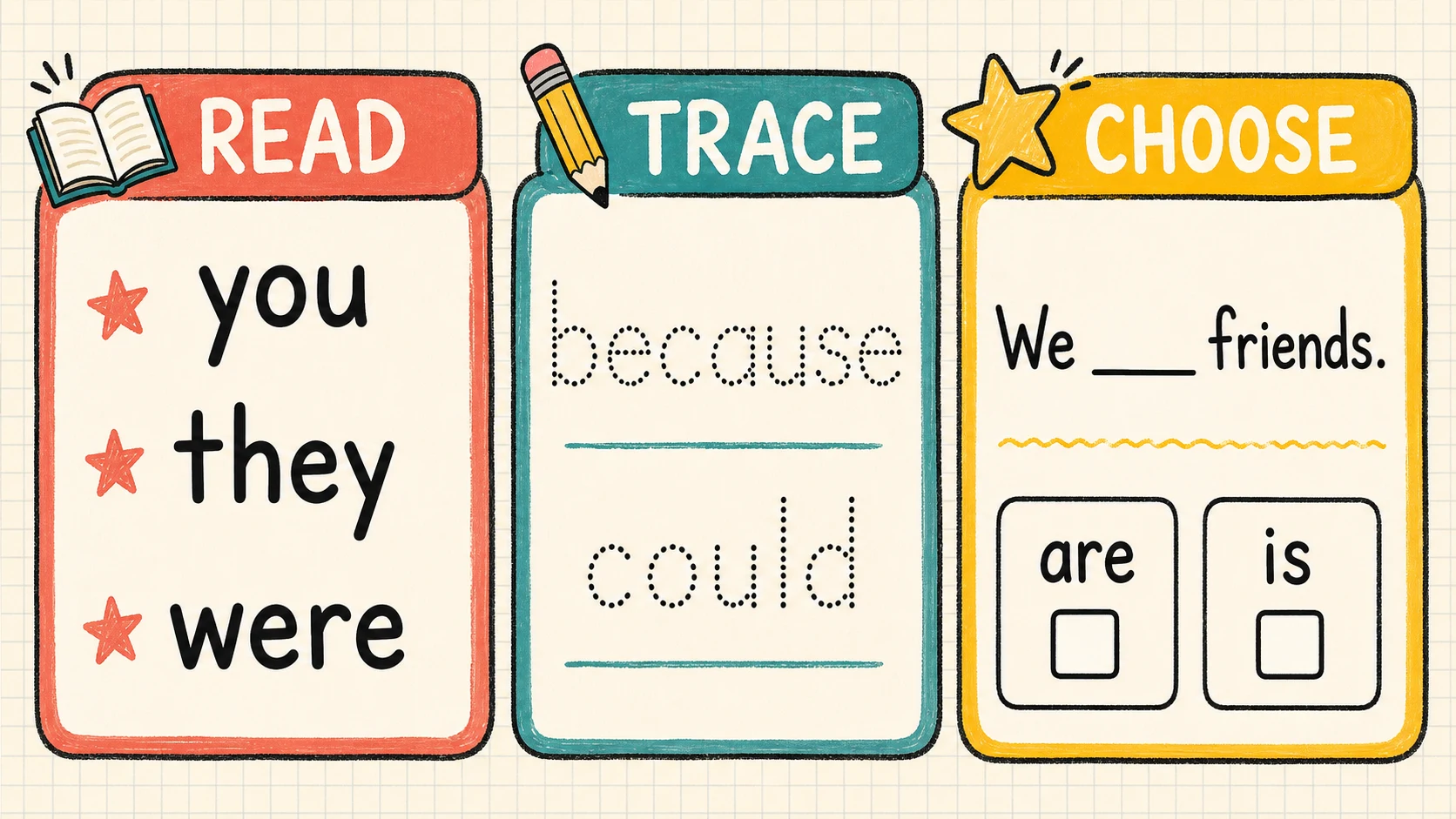
Revisit uncertain words after increasing gaps, while continuing to check them in connected text.
One usable plan is:
- Initial lesson: Teach a manageable block and mark words as immediate, delayed, or inaccurate.
- End of that lesson: Recheck three to five words after the worksheet is out of sight.
- Next practice day: Mix uncertain words with a few secure words.
- Several days later: Ask for reading first, then spelling of only the words that still need it.
- A later reading opportunity: Find or use the words in short, understandable sentences.
This is a practical instructional schedule, not a sourced or universal timetable. A learner who remembers make, we, and go across separate checks does not need the same repetition as one who continues to confuse in and is.
For each word, keep a simple record:
- R: read accurately;
- W: wrote accurately;
- D: accurate only after a delay or prompt;
- N: not yet accurate.
Retire a word from intensive copying only when later work gives enough evidence for your setting. Continue encountering secure words naturally in reading and writing.
Limitations and an honest next action
This worksheet offers 20 focused read-and-write exercises. It does not measure overall reading fluency, comprehension, oral language, or complete spelling development. It also does not establish why a learner makes a particular error. Connected reading, broader phonics instruction, and sentence writing remain necessary parts of literacy teaching.
If most words were uncertain, revisit the teaching approach in the Sight Words topic guide and use a smaller subset from this same printable. If recognition was secure but writing was difficult, explore additional practice through the 1st Grade phonics collection. If the learner completed this page accurately and recalled the words later, choose varied follow-up rather than more identical copying; the 18-worksheet 1st Grade Sight Words pack is one available source of additional practice.
The most useful immediate action is to print the free worksheet, preview four words, and teach only the number the learner can handle attentively. Record which words are immediate, delayed, or inaccurate, then schedule the first retrieval check from that evidence.
Put it into practice
Use the guide with a real printable
Move from explanation to a short, observable practice task. Check the first item together, then adjust the next session from the learner's actual work.
See the 18-worksheet pack