Complete guide
How to teach and practise 1st grade short vowels worksheets - standard theme (easy)
What this 20-item worksheet teaches
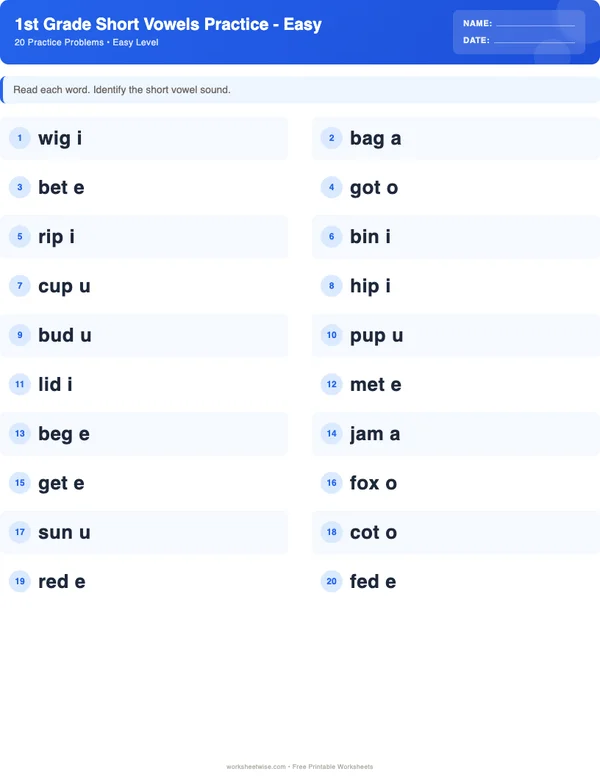
The free 1st Grade Short Vowels worksheet asks the learner to read each word and identify its short vowel sound. Across 20 easy-level items, the focus stays narrow: noticing the vowel in a word, connecting it with its sound, and using that information while decoding common consonant-vowel-consonant patterns.
The direct answer is simple: use the worksheet after the learner can say at least some short vowel sounds and blend simple words with support. Model two or three examples, complete several items together, and then release the remaining items gradually. Do not decide the next lesson from the score alone. Listen to how the learner reads, note which vowel contrasts cause trouble, and use the answer key to confirm—not replace—your analysis.
This printable is intended for classroom practice, homework, tutoring, or homeschool use. It includes a separate printable answer key. Its “1st Grade” label describes the intended practice level, not a promise that every first grader should complete it on the same timetable. Local curricula and instructional sequences differ, and learners may encounter particular vowel patterns earlier or later.
For a fuller explanation of short vowels, their typical sequence, and related activities, use the broader Short Vowels topic guide. This lesson focuses specifically on launching and learning from the 20-item printable rather than repeating that complete progression.
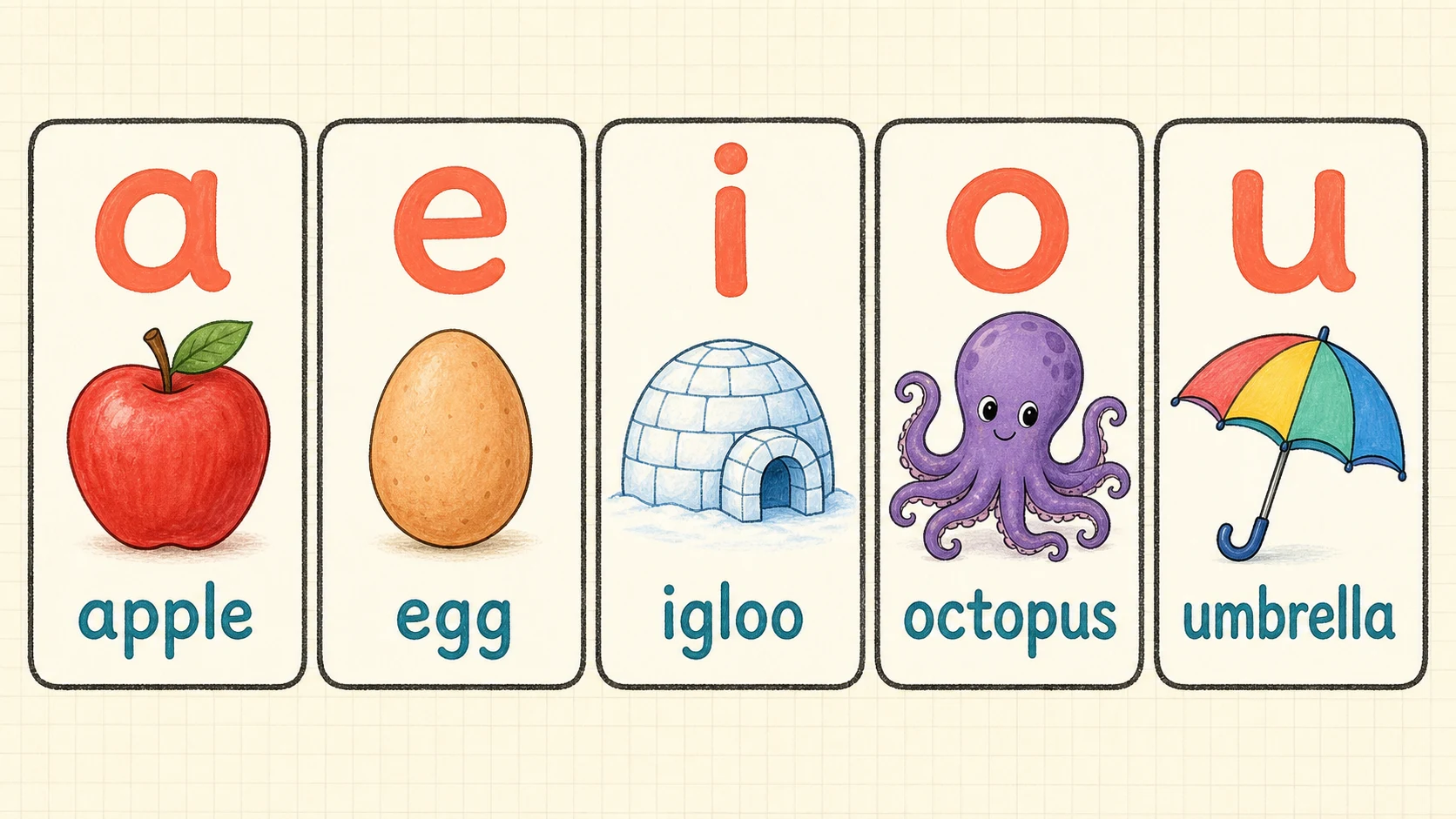
Move from a brief sound check to modeling, guided practice, independent work, feedback, and later retrieval.
Prepare the learner and the materials
Print the worksheet and keep the answer key out of the learner’s view. Have a pencil and a blank piece of paper available. The extra paper can be used to cover later rows, record a sound, or rebuild one troublesome word without marking over the original response.
Before beginning, scan the page yourself. The printed direction is: “Read each word. Identify the short vowel sound.” Make sure you understand how the response is recorded on the page. The catalogue establishes the skill and item count, but the adult should still inspect the actual printable before teaching from it.
A useful opening check takes only a few prompts:
- Ask the learner to say or recognize the short sounds represented by a, e, i, o, and u.
- Say a simple word such as map and ask for the middle sound.
- Ask the learner to blend three separated sounds, such as
/s/ /i/ /t/. - Notice whether the learner responds from sound, letter name, memory, or guessing.
This is not a second worksheet or a formal test. It tells you how much modeling will be useful. A learner who identifies the middle sound in map immediately may be ready for a short demonstration and independent work. A learner who says the letter name “A” but cannot identify /ă/ needs a clearer sound model before starting.
Keep the initial language consistent. You might say, “We are looking for the vowel sound we hear in the word. We will read the whole word, listen to its middle, and identify the vowel.” Avoid introducing long-vowel rules, vowel teams, or multisyllabic exceptions during this lesson. Those are important later, but they change the skill being practiced.
Use a gradual-release lesson sequence
The learner’s observed work should determine the pace. The following plan is a practical teaching suggestion, not a universal timetable.
| Lesson phase | Suggested items or prompts | Adult’s role | Evidence to watch |
|---|---|---|---|
| Quick sound check | 2–3 spoken words | Ask, listen, and identify needed support | Can the learner hear the middle sound without seeing a word? |
| Explicit model | 2 examples | Read aloud and explain each decision | Does the learner attend to the vowel sound rather than a picture or first letter? |
| Guided practice | 3–5 worksheet items | Prompt before correcting | Can the learner blend, isolate, and name the vowel? |
| Supported transition | 2–4 items | Reduce prompts and observe | Does the process remain accurate when help fades? |
| Independent practice | Remaining appropriate items | Stay available without coaching every answer | Is the learner reading or guessing? |
| Review | Selected correct and incorrect items | Discuss reasoning and correct errors | Can the learner explain or demonstrate the corrected sound? |
| Retrieval | A few words on later days | Revisit from memory in a new order | Does learning remain available after a delay? |
The IES foundational reading practice guide provides high-level support for explicit work with sound segments, letter-sound relationships, decoding, and connected reading. It did not evaluate this WorksheetWise printable. Here, its relevance is the instructional frame: demonstrate the sound process clearly and give the learner opportunities to apply it.
The IES elementary writing guide addresses broader writing instruction, including teaching foundational writing skills through explicit instruction and practice. It likewise does not review this worksheet. A brief write-the-word follow-up can connect sound identification with spelling, but writing should not overwhelm the worksheet’s main decoding task.
Model the exact thinking process
Show one complete example
Use a word similar to the worksheet format rather than assuming that any example below appears among its 20 items. Write map and say:
“First I read the word: map. I can stretch it into
/m/ /ă/ /p/. The sound in the middle is/ă/. That is the short a sound, so I identify a.”
Then point to each letter while blending the sounds back together. The important part is not merely announcing the answer. The learner needs to see the repeatable process:
- Look across the whole word.
- Blend or read it.
- Say it slowly without adding extra syllables.
- Listen to the vowel sound.
- Identify the vowel representing that sound.
- Reread the word to check.
If the page asks the learner to circle, write, match, or otherwise mark the vowel, demonstrate that exact response action too. Correct phonics reasoning can be hidden by confusion about what to put on the paper.
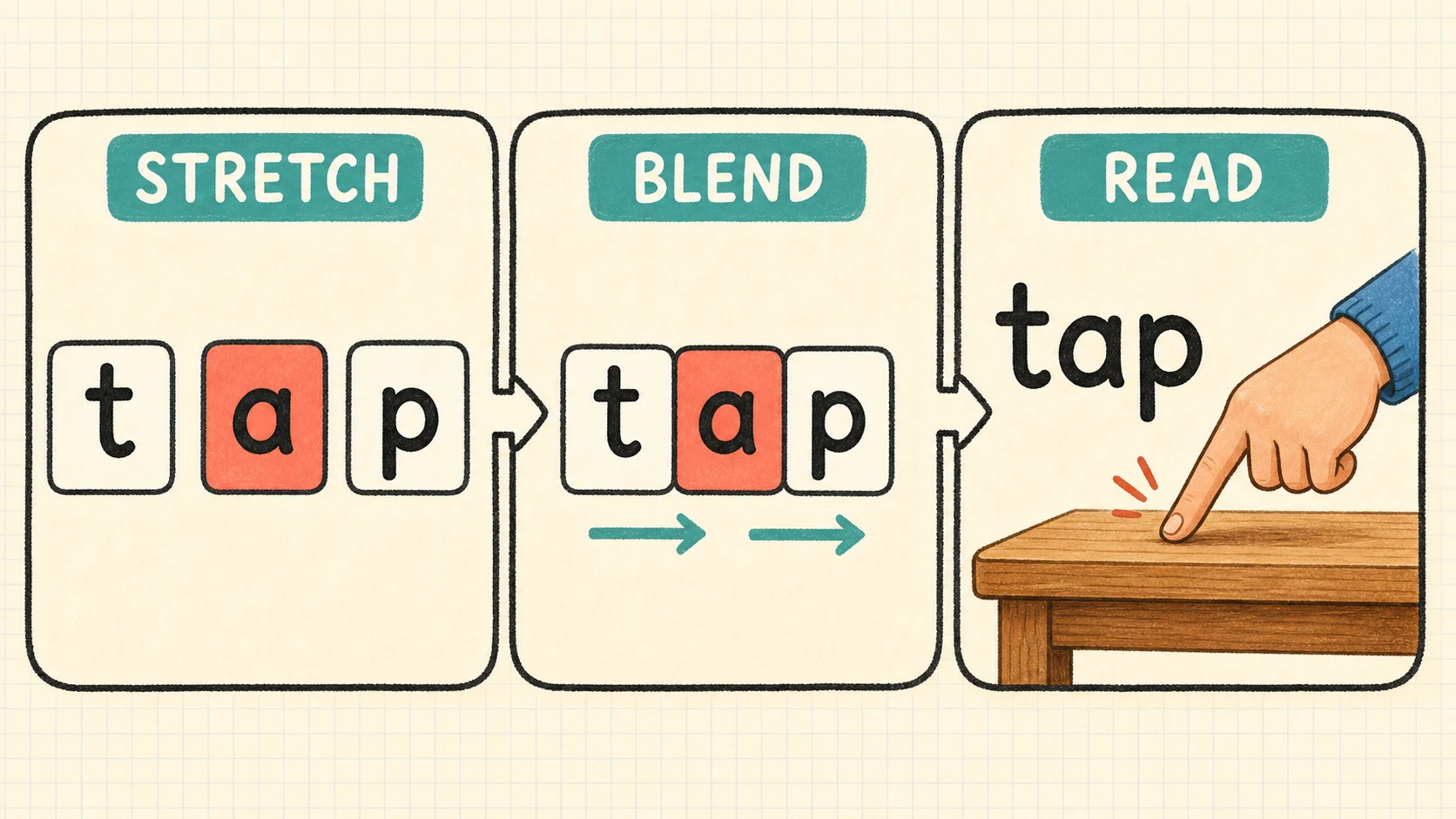
The model makes the sound-to-letter decision visible before the learner is expected to work alone.
Contrast a nearby example
Next, use sit:
- Letters: s-i-t
- Segmented sounds:
/s/ /ĭ/ /t/ - Middle vowel sound: short i
- Checked blend: sit
Say, “This is not short a just because we practiced map first. I have to listen again.” That small contrast discourages the learner from repeating the previous response mechanically.
Do not exaggerate the middle sound until it becomes a different sound. Say sit naturally, then segment it. It is fine to repeat the word, but the spoken model should remain recognizable.
Run guided practice before independent work
Prompt in an order that preserves the skill
Choose one worksheet item and ask, “Read the whole word.” If the learner cannot, point to the letters and ask for each sound. Blend the sounds together, then ask, “Which sound is in the middle?” Finally ask, “Which vowel shows that sound?”
This prompt order matters. Giving the vowel name first turns the item into copying. Reading the answer key aloud turns it into recognition of the adult’s answer. Instead, provide the smallest prompt that lets the learner do the phonics work.
A simple prompt ladder is:
- “Read the word.”
- “Say each sound.”
- “Blend those sounds.”
- “Say the word slowly.”
- “What sound do you hear in the middle?”
- “Which vowel represents that sound?”
If the learner answers after the second prompt, stop prompting. Extra cues can make it difficult to tell what the learner can do independently.
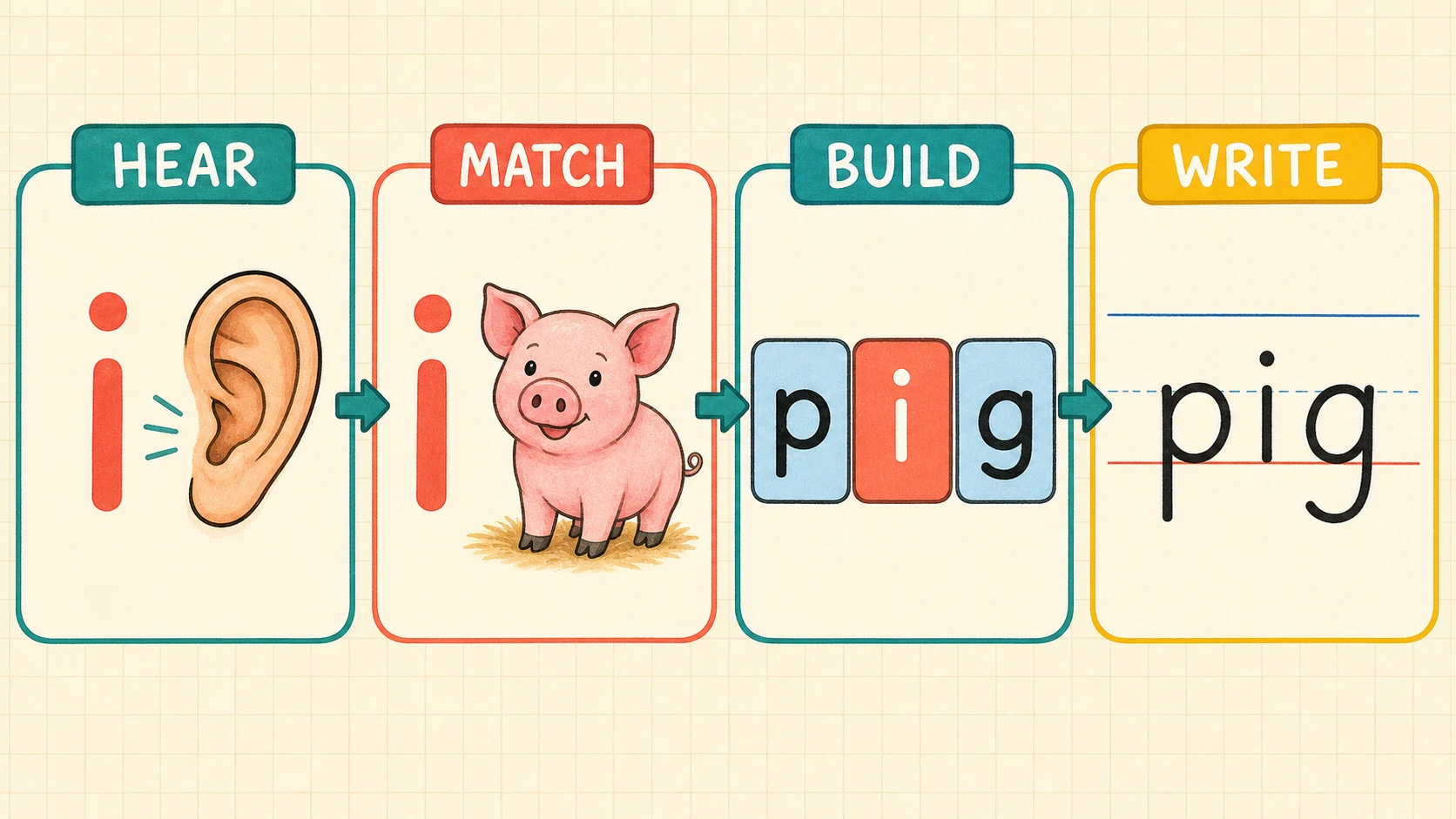
Guided practice supplies only enough help for the learner to complete the sound analysis.
Fade support deliberately
After several successful guided items, say, “Try the next one using the same steps.” Watch without immediately speaking. If the learner reads, pauses, isolates the vowel, and records an answer, the routine is becoming independent.
Release more items when the learner is accurate for a clear reason. Slow work can still be sound work. Conversely, quick answers are not necessarily secure if the learner looks only at the first letter or cycles through vowels.
Pause the independent section when errors begin to cluster, the learner stops reading the words, or attention deteriorates. Finishing all 20 items in one sitting is less informative than preserving careful responses. You can cover unfinished rows and return to them later without changing the worksheet’s skill.
Check four worked examples carefully
These checked examples illustrate the process. They are not presented as items from the actual answer key.
Example 1: map
Word: map
Segmentation: /m/ /ă/ /p/
Vowel: a
Reason: The closed CVC word has a between two consonants, and the spoken middle sound is short a.
Check by blending /m/ /ă/ /p/ back into map. The answer is not m, even though /m/ is the first sound, and it is not the letter name “A.” The target is the short vowel sound represented by a.
Example 2: pen
Word: pen
Segmentation: /p/ /ĕ/ /n/
Vowel: e
Reason: The sound between /p/ and /n/ is short e.
A learner might confuse pen with pin, especially if the two vowel sounds are not yet stable. Ask the learner to say both complete words and notice which one matches the printed spelling. The correction should return to the sound and letters, not to “remembering what the teacher said.”
Example 3: sit
Word: sit
Segmentation: /s/ /ĭ/ /t/
Vowel: i
Reason: The middle sound is short i, represented by i.
If the learner reports e, place sit beside set as an oral contrast. Read each naturally, segment both, and then return to sit. The contrasting word is a teaching aid; it does not change the original answer.
Example 4: hot
Word: hot
Segmentation: /h/ /ŏ/ /t/
Vowel: o
Reason: The middle sound is short o, represented by o.
If the learner chooses u, compare hot with hut. Keep the beginning and ending consonants fixed so the learner can attend to the changed middle. Speech varieties can affect how close vowel sounds seem, so rely on a clear local spoken model and the printed spelling rather than criticizing an accent.
Example 5: cup
Word: cup
Segmentation: /k/ /ŭ/ /p/
Vowel: u
Reason: The middle sound is short u, represented by u.
The first letter is c, but it represents /k/ here. That fact is not the target. A learner who becomes distracted by the consonant can cover the first and last letters briefly, inspect u, and then uncover and reread the complete word.
These five examples cover all five short vowels. They verify a process, not the contents or ordering of the printable.
Adapt support without changing the target
Differentiation should preserve the question: “Which short vowel sound is in this word?” Changing the task to tracing unrelated letters, naming pictures, or copying answers may reduce difficulty, but it no longer supplies evidence about the intended skill.
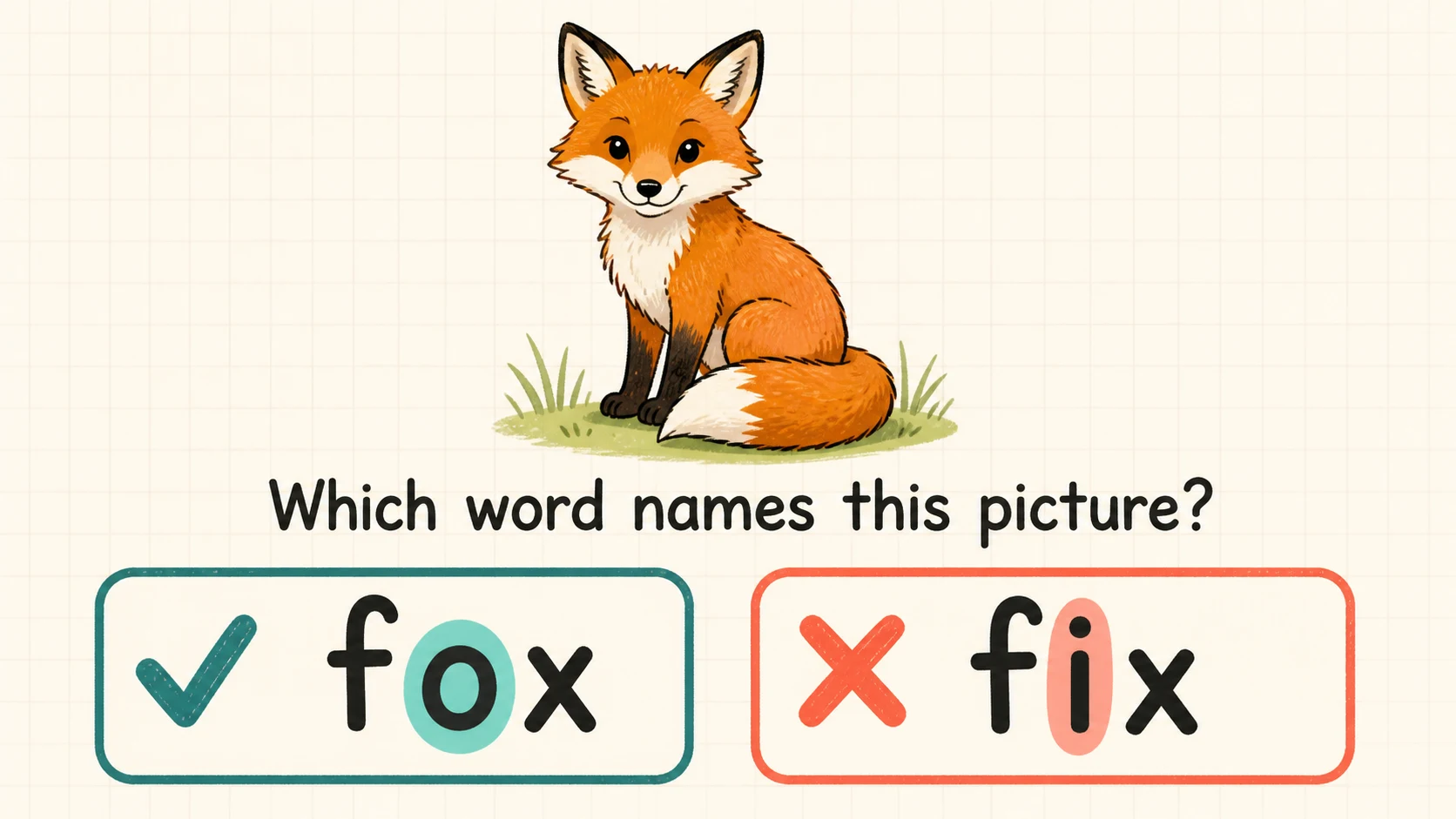
Adjust the amount of visible work, oral support, or response demand while keeping short-vowel identification central.
When the page feels visually crowded
Cover all but one row with blank paper. Reveal one item at a time, but leave the word itself unchanged. The learner still reads and identifies the vowel; there is simply less competing print.
You can also mark a starting point with a removable pointer. Avoid highlighting every vowel in advance because that performs part of the search for the learner. If locating the vowel is not part of the response format and visual access is the main barrier, highlight only during teaching, then try an unmarked item.
When blending is the main difficulty
Let the learner touch beneath each letter while saying the sounds, then sweep a finger beneath the word to blend. Model with a separate example before returning to the worksheet item. If necessary, say the consonant sounds while asking the learner to supply the vowel, then have the learner blend the entire word.
This support keeps the printed word and target sound intact. It also helps distinguish two problems: not knowing a short vowel and not yet being able to blend the surrounding consonants smoothly.
When writing interferes with phonics
If the required response involves writing and letter formation consumes the learner’s attention, allow pointing or an oral answer for selected items. Record that accommodation in your notes. Later, ask the learner to write one or two correctly identified vowels or whole words.
The writing extension is useful practice, but it should not blur what the original response showed. “Identified short o orally but reversed the written letter” is more precise than marking the entire item simply wrong.
When the learner is ready for a modest challenge
Ask for a brief explanation: “How did you know?” Or have the learner write one additional CVC word with the same short vowel and read it aloud. For map, possible checked examples include cat or jam.
Do not jump immediately to silent-e words, vowel teams, or unpredictable spellings. Those patterns introduce new decisions. For continued practice at this level, browse the 1st Grade Phonics collection or the broader 1st Grade worksheet hub.
Interpret errors instead of counting only marks
A total score summarizes performance, but it does not explain it. Record enough information to identify the likely source of difficulty.
| Observed response | Possible interpretation | Useful check |
|---|---|---|
| Names the printed vowel correctly but says its letter name | Sound and letter-name language may be mixed | Ask for the sound, then the letter name, as two separate responses |
| Reads the word correctly but identifies the wrong vowel | Task direction may be unclear, or the response was rushed | Ask the learner to point to and say the middle sound |
| Cannot read the word but identifies its printed vowel | Visual vowel recognition may be ahead of decoding | Ask for sound-by-sound blending |
| Confuses e and i repeatedly | That contrast may need focused listening and reading | Compare a controlled pair such as pen/pin |
| Confuses o and u repeatedly | The spoken distinction may be unstable | Compare hot/hut with a clear local model |
| Gives the same vowel for several consecutive items | The learner may be repeating a response rather than rereading | Ask for the complete word before accepting an answer |
| Misses later items after early success | Attention or workload may be affecting performance | Pause and retry a few later, unmemorized items after a break |
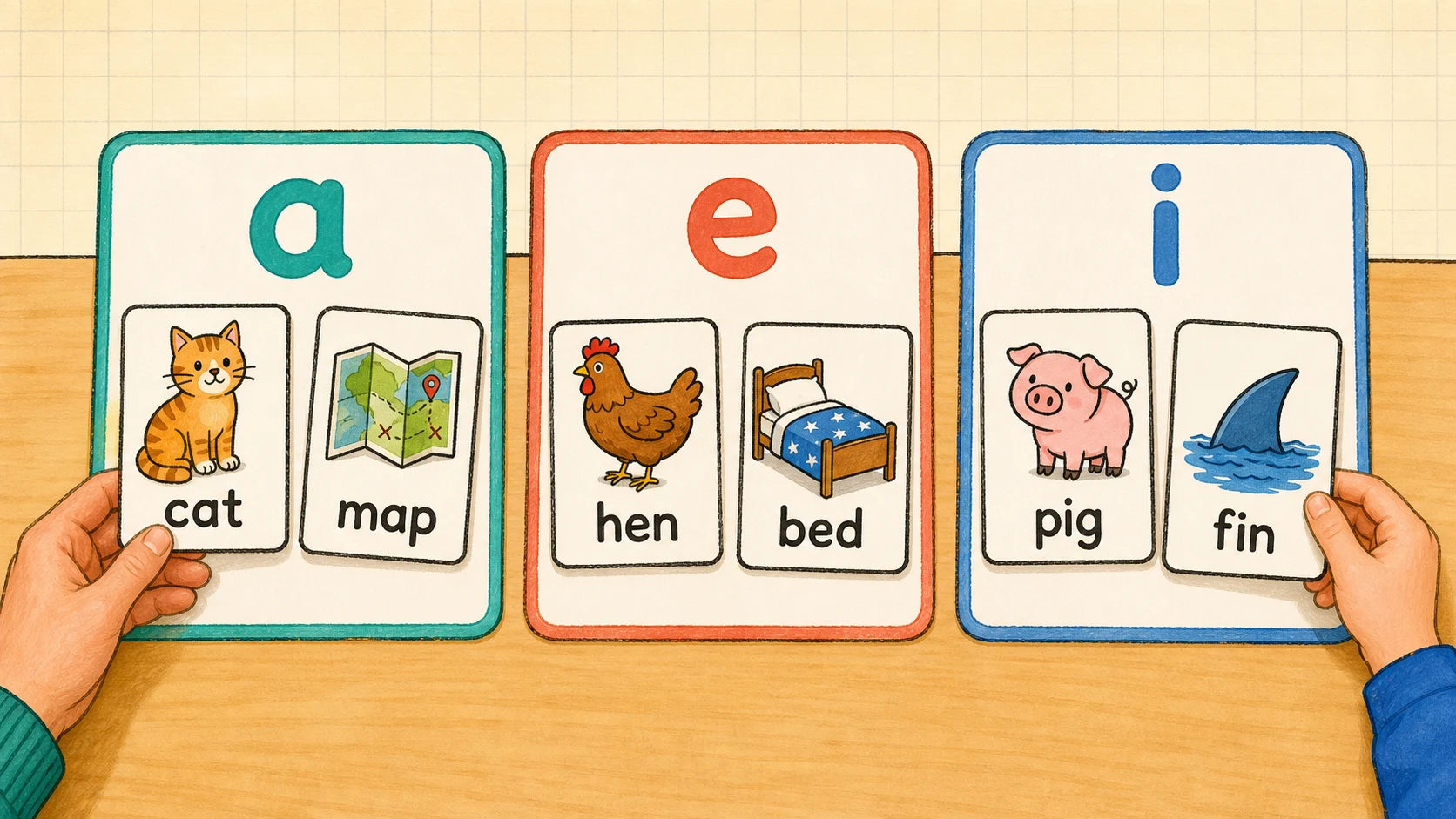
Check the word reading, middle sound, vowel choice, and final rereading before deciding what an error means.
One mistake does not establish a misconception. Look for a repeated pattern across several words. If pen is missed but other short e words are correct, revisit that item and check whether the learner misread a consonant or lost attention. If short e is repeatedly called short i, focused contrast work is more appropriate than repeating all five vowels equally.
Correct an error promptly during guided practice. During independent work, decide in advance whether you are measuring unaided performance or providing instruction. If the goal is a clean snapshot, mark the item for later discussion without coaching it immediately. If the goal is learning during practice, stop, guide the correction, and note that help was given.
Use the answer key responsibly
The separate answer key is a checking tool. It can confirm the expected response for each of the 20 items, but it cannot reveal how the learner arrived there.
First, review the learner’s page without the key. Mark observations such as:
- Read independently
- Segmented before answering
- Needed a blending prompt
- Self-corrected
- Confused two vowel sounds
- Gave an oral answer but struggled to record it
Then compare responses with the printable key. If your interpretation and the key differ, reread the printed word carefully and check that you are aligned to the correct item number. Do not alter a learner’s response silently. Keep the original mark visible and add the correction beside it.
Review selected items with the learner. Begin with one correct response and ask how it was solved. This confirms whether the answer came from decoding rather than chance. Then address one error at a time:
- Reread the word.
- Segment its sounds.
- Identify the vowel sound.
- Connect the sound to the printed vowel.
- Record the correction.
- Read the complete word again.
Avoid showing the entire answer key and asking the learner to copy corrections. Copied answers make the page look complete without providing evidence of improved decoding.
The Common Core English Language Arts standards provide broader grade-level reference points for foundational reading, including work with phonemes, common vowel spellings, and regularly spelled one-syllable words. The catalogue associates this topic with several foundational-skills references, but this single worksheet should not be described as comprehensive standards alignment. Local expectations and adopted sequences can differ.
Recognize boundary cases and limitations
This worksheet practices identifying short vowels in words, with CVC patterns and decoding named among its skills. It is not a complete phonics assessment or curriculum. A learner can complete all 20 items accurately and still need practice applying the same knowledge while reading sentences or spelling from dictation.
Several boundary cases require care:
- A word with silent e, such as cake, does not follow the simple short-vowel CVC pattern illustrated by cat.
- A word with a vowel team, such as rain, requires a different spelling pattern.
- A word with more than one syllable requires decisions beyond identifying one middle vowel.
- Some familiar words do not map neatly onto the simplest phonics pattern.
- Pronunciation varies across regions and communities, so some vowel contrasts may sound closer in one speech variety than another.
- Correct identification from visible print is not the same as spelling a word after hearing it.
- Correct work completed with continuous prompting is not yet independent performance.
Do not use this printable to diagnose a medical, speech, language, or learning condition. It can reveal an instructional pattern worth observing, such as repeated difficulty hearing a particular contrast, but it cannot establish the cause. If concerns extend beyond this practice activity, follow the learner’s school or local professional support process.
Decide what to teach next
Base the next step on the learner’s process across the page.
If the learner reads nearly all items accurately and explains the vowel choices, add a small transfer task. Dictate three regular CVC words, one at a time. Ask the learner to repeat each word, identify its vowel sound, write it, and read it back. Use new examples so the task requires retrieval rather than copying.
If the learner is accurate only with prompts, repeat a shorter set using the same routine. Fade one kind of help at a time. For example, stop supplying the segmented sounds but continue asking, “What do you hear in the middle?”
If errors cluster around one contrast, select a few controlled pairs. Pen/pin, set/sit, and bed/bid isolate short e and short i. Hot/hut isolates short o and short u. Say, read, sort, and later spell a small number of words. This focused instructional suggestion comes from the supplied topic guidance; it is not a claim that every learner needs the same sequence.
If errors occur across all five vowels, reduce the set. The catalogue’s topic guidance suggests introducing short vowels individually, using the sequence a, i, o, u, e, with e later because e/i can be especially confusable. Treat that as a suggested progression, not an inflexible schedule. The learner’s observed responses should decide whether to stay with one vowel, compare two, or return to mixed practice.
Schedule retrieval after the worksheet
A completed page should not be the final encounter with the skill. Retrieval means asking the learner to recall and apply the learning after some time has passed, preferably with words in a different order or a slightly different response format.
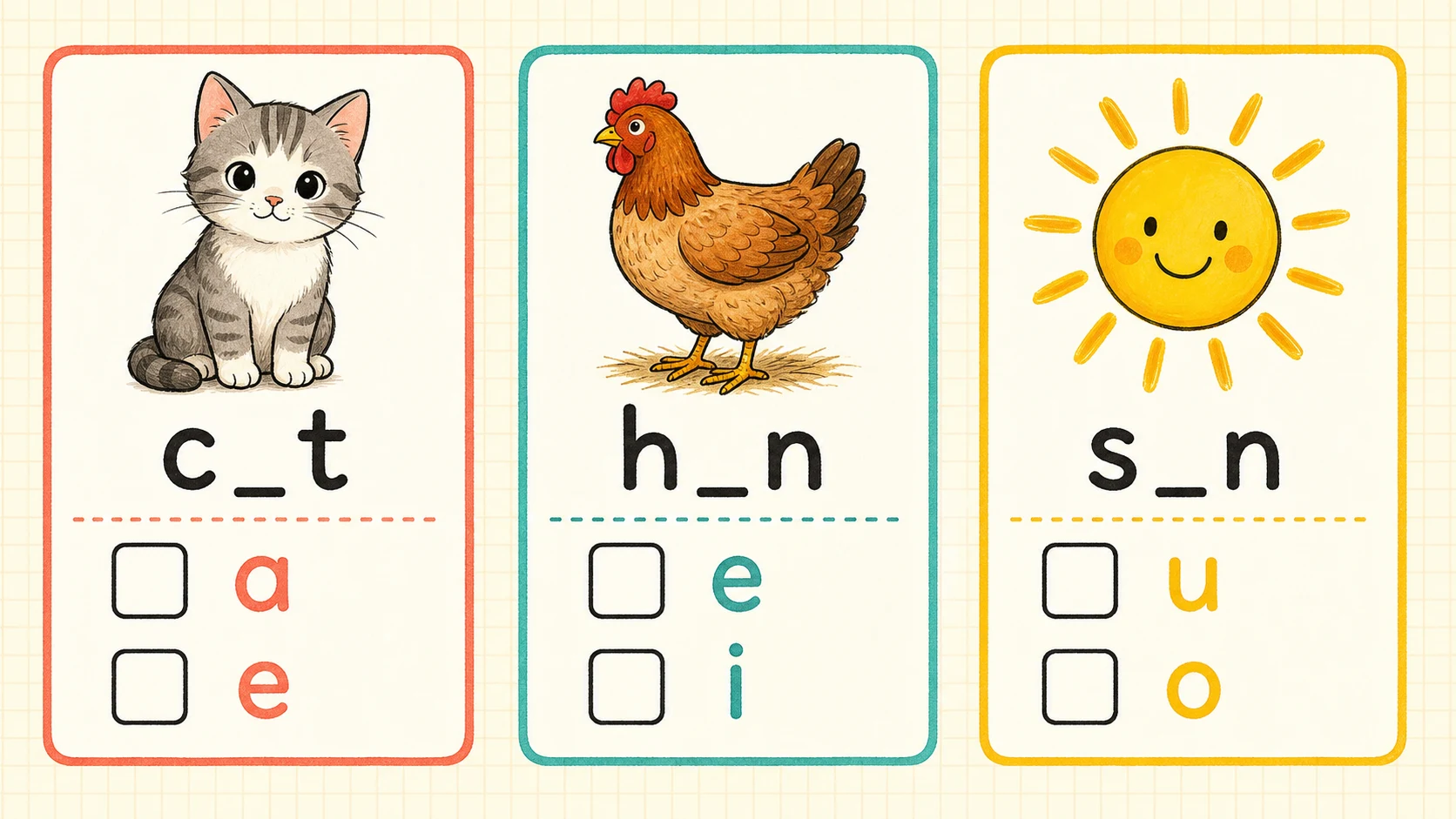
Short later reviews show whether the vowel decisions remain available beyond the original sitting.
A practical, adjustable plan is:
| Review point | Brief activity | What to record |
|---|---|---|
| Later the same lesson | Reread two corrected words without the answer key | Independent, prompted, or incorrect |
| Next learning session | Identify vowels in five mixed CVC words | Which sounds remain secure or confused |
| Several days later | Read three new words and spell one from dictation | Transfer to unfamiliar words and encoding |
| About a week later | Mix a few short-vowel words into other phonics practice | Whether the skill survives a changed context |
| During later phonics work | Revisit one or two contrasts as needed | Whether old errors reappear alongside new patterns |
These intervals are instructional suggestions, not a sourced universal timetable. Shorten the gap when the learner cannot retrieve the sound, and lengthen it when responses are consistently independent. Do not repeat the entire worksheet automatically. A few well-chosen words can reveal more than a full page completed from memory.
Keep a compact note such as: “Short a, i, o independent; e/i contrast needs a prompt; spelling less secure than reading.” That record gives the next adult a usable instructional picture and prevents a single percentage from standing in for the learner’s actual work.
Continue with an honest next step
This easy 20-item printable offers focused practice in reading words and identifying short vowel sounds. Its strongest use is as one part of a lesson: model the process, observe guided responses, allow appropriate independent work, analyze patterns, and retrieve the skill later. It does not by itself establish complete mastery of short vowels, fluent reading, spelling proficiency, or readiness for every later vowel pattern.
After reviewing the page, choose the smallest useful next action. Revisit the Short Vowels topic guide if one vowel or contrast needs focused teaching. If the learner is ready for varied continued practice, consider the 18-worksheet 1st Grade Short Vowels Worksheet Pack. To create a fresh retrieval set rather than repeating memorized items, use the free worksheet generators and keep the new words within the short-vowel skill the learner is practicing.
Put it into practice
Use the guide with a real printable
Move from explanation to a short, observable practice task. Check the first item together, then adjust the next session from the learner's actual work.
See the 18-worksheet pack