Complete guide
How to teach and practise 1st grade long vowels worksheets - standard theme (easy)
How to Use This 20-Item Long Vowel Worksheet
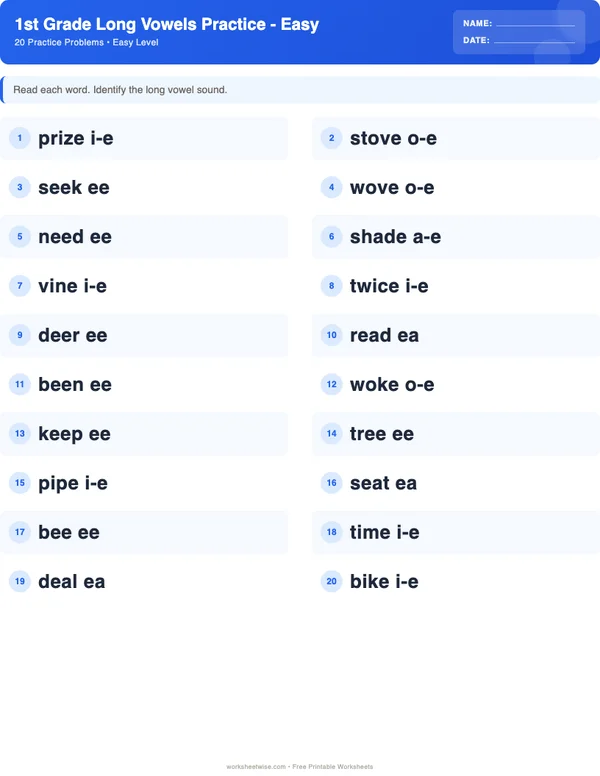
The free 1st Grade Long Vowels worksheet gives a learner 20 easy-level exercises built around one direction: Read each word. Identify the long vowel sound. Use it as a focused decoding lesson, not merely as a page to finish.
A practical session is simple: briefly review what a long vowel sounds like, model two or three words, complete several items together, and then let the learner try a manageable group independently. Check the response by asking the learner to read the whole word, name the vowel sound, and point to the spelling that represents it. The learner’s observed work—not the grade label or a fixed timer—should determine how quickly you proceed.
Grade labels describe the intended practice level. Local curricula, school sequences, and individual instructional sequences differ. A learner working on first-grade material may still need a review of short vowels, while another may be ready to compare several spellings for the same long vowel.
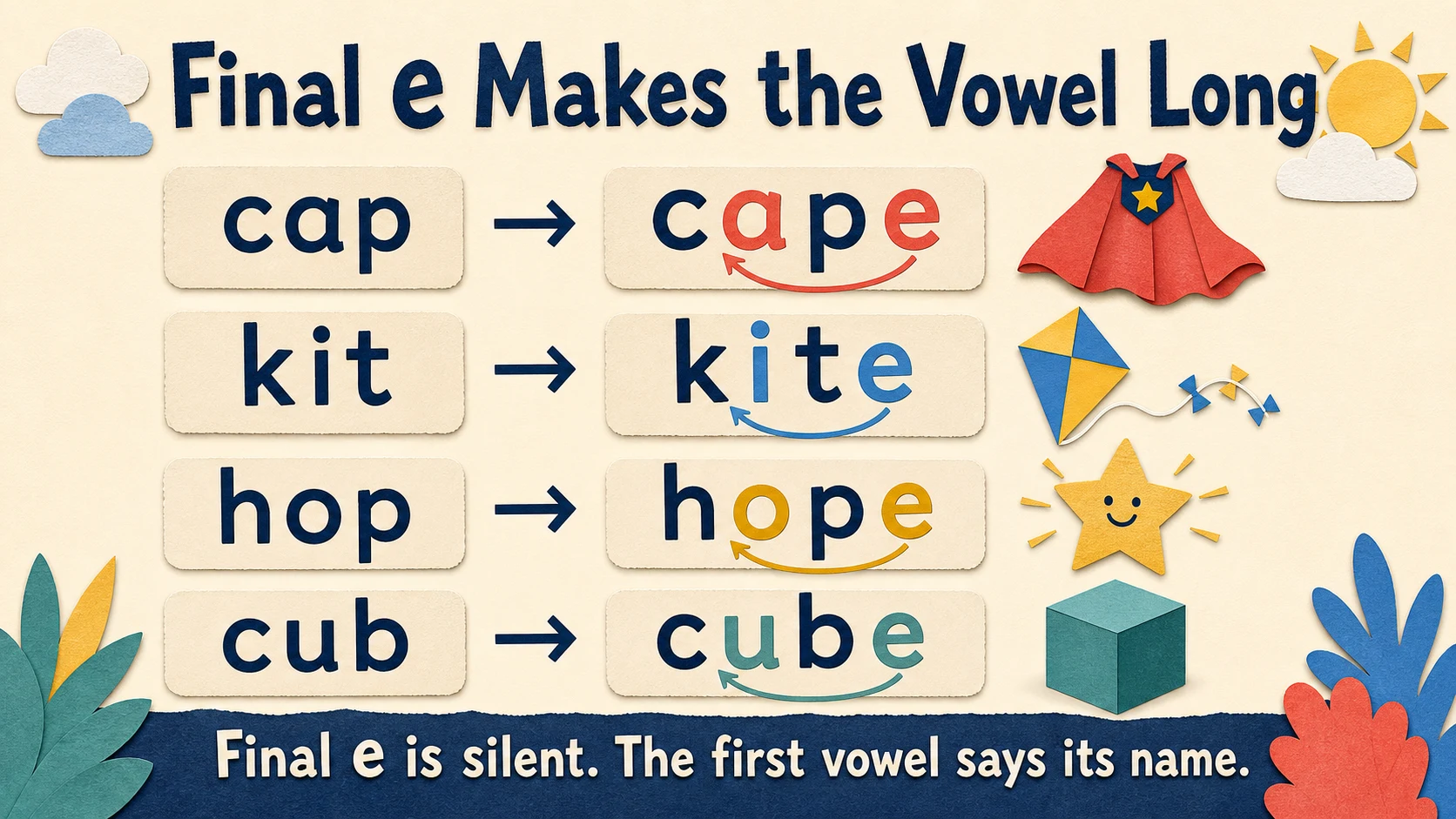
Move from a brief sound review to modeling, guided practice, independent work, checking, and later retrieval.
What This Worksheet Practices—and What It Does Not
This printable practices four connected skills from the catalogue:
- recognizing long vowel sounds;
- noticing vowel patterns;
- applying phonics knowledge;
- decoding written words.
The task is narrower than “learn everything about long vowels.” A learner reads a word and identifies its long vowel sound. That focus is useful because it lets the adult observe whether the learner can connect a complete written word to a vowel sound without juggling several unrelated directions.
The broader topic includes silent-e spellings, vowel teams, and open syllables. Examples include the long a in cake, long e in feet, long i in kite, long o in bone, and long u in cube. The long vowels topic guide is the better place to study that larger progression. Keep this worksheet lesson centered on its stated direction.
The worksheet should not be treated as proof that a learner has mastered every long-vowel spelling. Twenty responses provide a useful sample, but they cannot show performance across every pattern, exception, sentence context, or unfamiliar word. The page also does not independently measure reading fluency or comprehension.
The IES foundational reading practice guide provides high-level support for teaching learners to connect sounds with letters and use those relationships when reading words. That source did not evaluate this WorksheetWise printable. It supports the general instructional framing: explain the sound-spelling relationship clearly, model how to apply it, and give the learner opportunities to read words.
Prepare the Lesson Before the Learner Begins
Print or open the worksheet and its separate answer key. Keep the key out of the learner’s immediate view so it can support checking without turning the activity into copying. Have a pencil and, if useful, two colored pencils available. One color can mark the vowel spelling; the other can record the answer.
Before teaching, inspect the actual page. Confirm how learners are expected to show the long vowel sound. Depending on the printed response area, that may mean circling a vowel, writing a letter, or making another clearly indicated mark. Do not add a new response demand unless it helps reveal the same skill.
Check the prerequisite
Ask the learner to read two or three familiar short-vowel words, such as cap, pin, and hop. These are not claimed to be worksheet items; they are quick readiness checks.
Listen for whether the learner can:
- blend the sounds into a complete word;
- hear the short vowel in the middle;
- keep the consonants in their correct order.
If cap is read accurately but cape is difficult, the lesson can proceed with explicit comparison and support. If the learner cannot yet blend cap, completing 20 long-vowel identifications may obscure the more immediate need. Pause and review short-vowel CVC decoding through the first-grade phonics hub before returning to the printable.
Choose a starting amount
Do not assume all 20 items must be completed in one sitting. Select an initial group based on what you observe:
| Observed starting point | Opening move | First independent amount | What to watch |
|---|---|---|---|
| Reads familiar long-vowel words readily | Model one item and check understanding | 5–8 items | Accurate reading without guessing |
| Reads the words but hesitates over the vowel | Model two contrasting examples | 3–5 items | Whether the learner can isolate the vowel sound |
| Confuses short and long vowels | Use a CVC/CVCe comparison first | 2–4 items | Whether the sound changes when the spelling changes |
| Struggles to blend the whole word | Return to oral blending and simpler decoding | No independent set yet | Whether the difficulty occurs before vowel identification |
| Answers accurately but tires quickly | Use short sets with a brief pause | 3–5 items per set | Stable accuracy across the session |
These amounts are instructional suggestions, not a universal timetable. Increase or reduce the set according to the learner’s responses.
Model the Exact Thinking the Task Requires
The adult’s model should be brief enough to remember and explicit enough to imitate. Point to one example word, read it from left to right, stretch or emphasize the relevant vowel sound without distorting the word, name the long vowel, and connect the sound to the visible spelling.
A useful routine is:
- Read the whole word.
- Say it naturally.
- Listen for the vowel saying its name.
- Point to the spelling that represents that sound.
- Record the requested answer.
Avoid telling the learner to inspect only the first visible vowel. Some long-vowel spellings use more than one letter, and the important question is which vowel sound occurs in the spoken word.
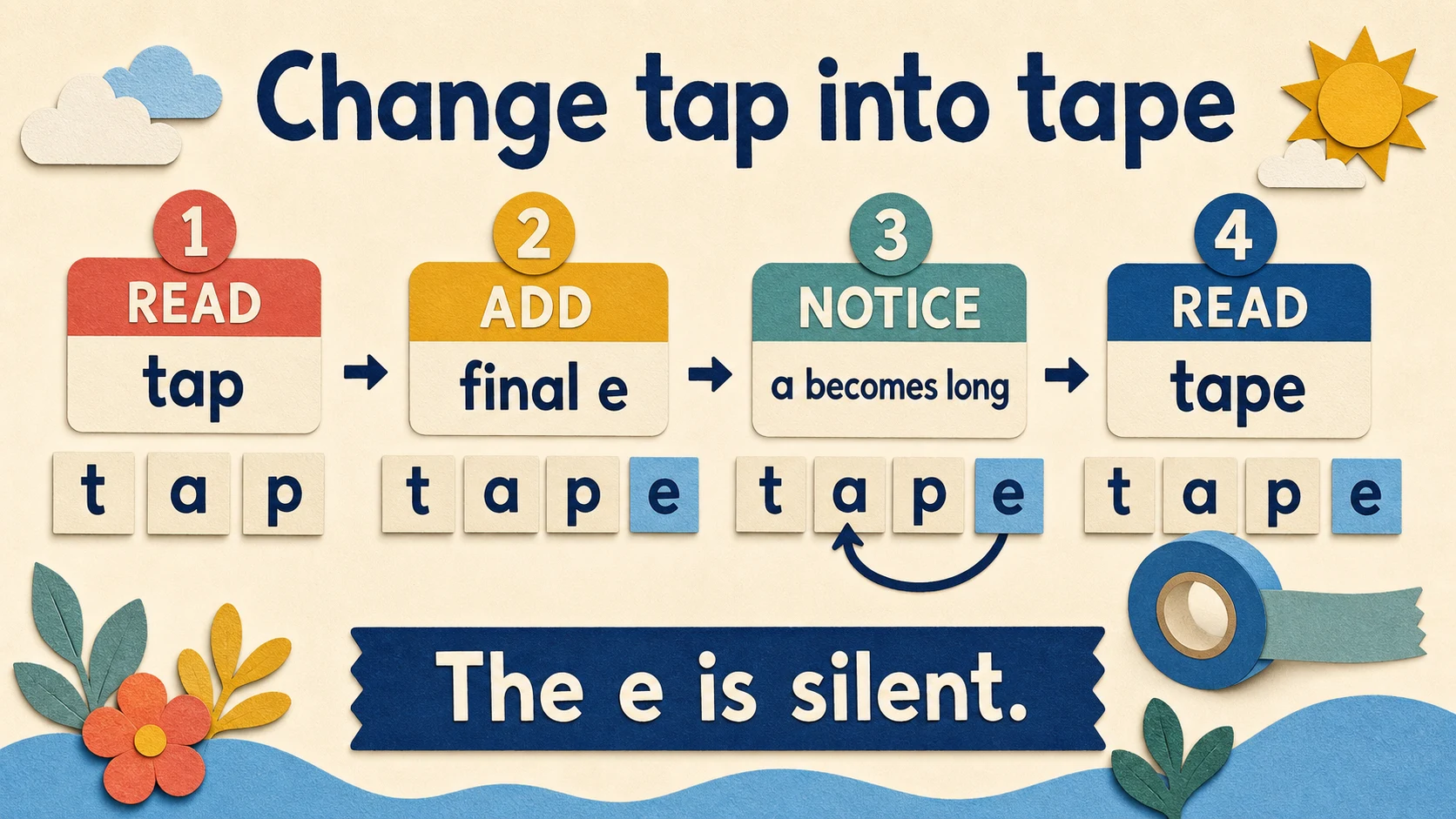
Read the complete word before naming the vowel sound; the examples below illustrate the process rather than reproducing worksheet items.
Worked example 1: cake
Read cake aloud. The vowel sound in the word is /ā/, the name of the letter a. The final e is not pronounced as a separate syllable. In this word, the spelling a_e represents long a.
Checked answer: long a.
A concise model sounds like this: “The word is cake. I hear /ā/. The long vowel is a.”
Worked example 2: feet
Read feet. The middle vowel sound is /ē/, the name of e. The two written e’s form the vowel team ee, but the task asks for the long vowel sound rather than the number of vowel letters.
Checked answer: long e.
Model: “I read feet. The middle says /ē/, so I identify long e.”
Worked example 3: kite
Read kite. The vowel says /ī/, the name of i. The i_e spelling represents long i, while the final e is not read as another syllable.
Checked answer: long i.
Model: “The word is kite. I hear /ī/. That is long i.”
Worked example 4: bone
Read bone. The vowel sound is /ō/, the name of o. The spelling o_e signals long o in this example.
Checked answer: long o.
Model: “I read the whole word bone. The vowel says /ō*, so the answer is long o.”
Worked example 5: cube
Read cube. The vowel is long u. In common US pronunciation, cube begins its vowel portion with a /y/ glide, sounding like /kyūb/. It still belongs to the long-u category used in elementary phonics.
Checked answer: long u.
Model: “The word is cube. I hear the long u sound /yū/. I mark u.”
This example is worth modeling because long u may not sound as simple as repeating the isolated letter name after every consonant. Keep the focus on reading the familiar word accurately and identifying its long-vowel category.
Move from Guided Practice to Independent Work
Guided practice is not the adult supplying the answer while the learner writes it. It is a short period in which responsibility moves gradually to the learner.
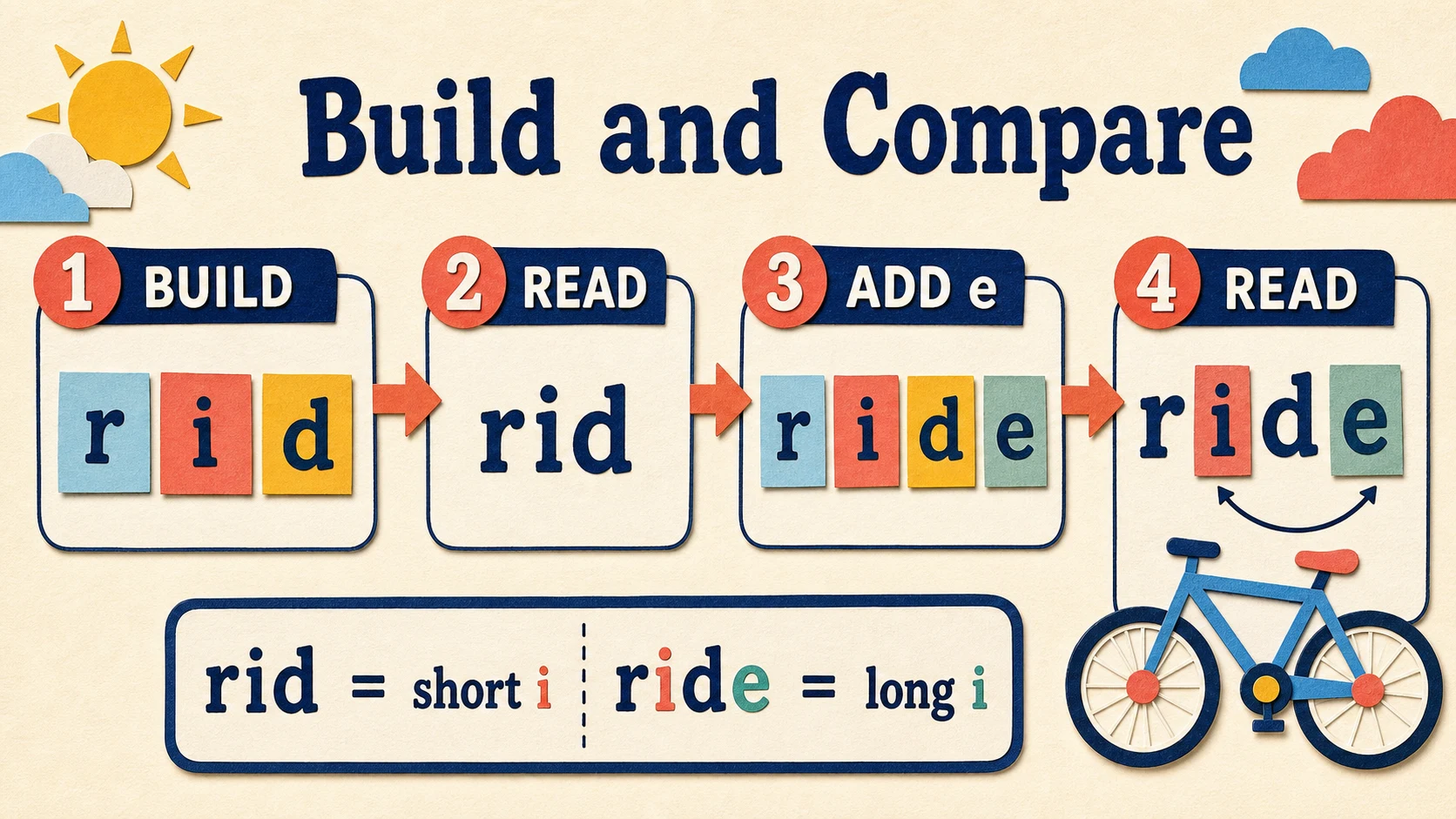
Use prompts that direct attention to the word and sound, then remove those prompts as the learner becomes accurate.
Try an “I do, we do, you do” sequence
For the first modeled item, do all the thinking aloud. For the next item, read the word with the learner and ask the learner to name the vowel sound. On the third, ask the learner to read, identify, and explain while you only listen.
A compact exchange might be:
- Adult: “Read the whole word.”
- Learner: “Kite.”
- Adult: “What vowel sound do you hear?”
- Learner: “Long i.”
- Adult: “Show me the spelling that helped you.”
- Learner points to i_e.
If the learner answers correctly and can repeat the process, begin a small independent set. If the learner guesses a letter before reading the word, return to the first step: “Read the whole word first.”
Keep prompts neutral
Prompts should help the learner use the skill without exposing the answer. Productive prompts include:
- “Say the word naturally.”
- “Which vowel sound do you hear?”
- “Does that vowel say its name?”
- “Point to the letters representing the vowel sound.”
- “Read it one more time and check.”
Less useful prompts embed the answer: “Isn’t that long o?” or “Remember, final e makes the a long.” Those statements can be part of instruction, but during a check they make it difficult to know what the learner can do independently.
Release independence in small groups
After three or four accurate guided responses, ask the learner to complete a short group. Watch without interrupting every hesitation. When the group is finished, review it before assigning more. This keeps an early misunderstanding from spreading through all 20 items.
A learner who completes the first group accurately can continue. A learner who misses several for the same reason needs a brief reteach, not a longer page. A learner who makes one isolated error may only need to reread that word.
Use Contrasts and Boundary Cases Carefully
Long vowels are easier to notice when the learner compares them with short vowels. The topic guidance recommends contrasting long and short sounds, and silent-e pairs provide a visually clear starting point.
Contrast one changed feature
Use these checked pairs orally or on scrap paper:
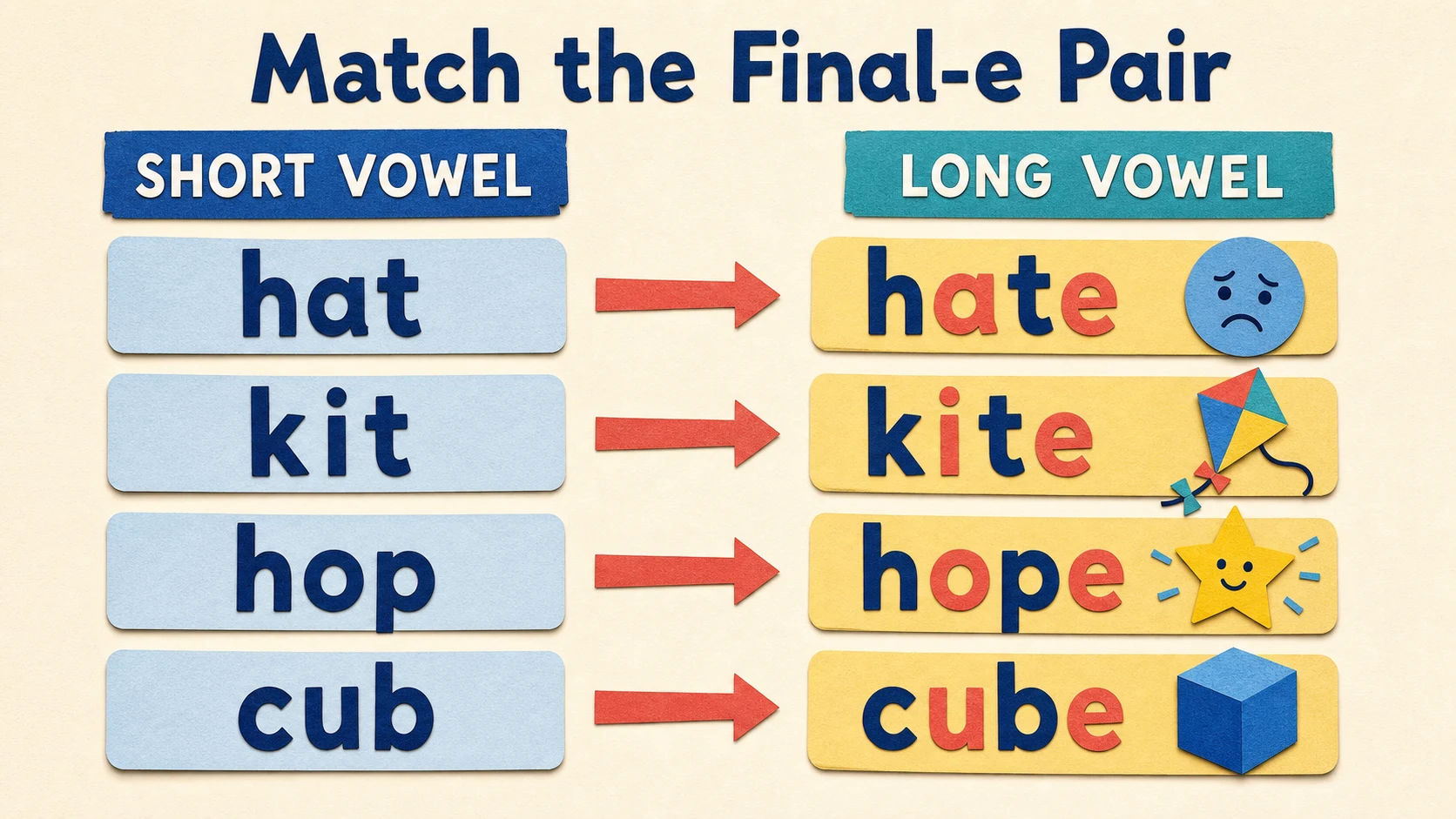
- cap has short a; cape has long a.
- pin has short i; pine has long i.
- hop has short o; hope has long o.
- cub has short u; cube has long u.
Ask, “What stayed the same? What changed? What happened to the vowel sound?” The learner should notice that the final e changes the vowel sound in these examples.
Do not turn “final e makes the vowel say its name” into an exceptionless rule for every English word. It is a useful starting description for regular CVCe examples, not a guarantee about all words. Likewise, a saying about the first vowel “talking” in a vowel team can help learners remember patterns such as ai, ee, or oa, but it is not universally reliable. Teach the actual words and patterns under study.
Separate sound identity from spelling pattern
A learner may correctly hear long a but be unable to name whether its spelling is a_e, ai, or ay. For this worksheet, first determine whether the requested response is the sound identity. If so, “long a” answers that question even though pattern naming could be a valuable follow-up.
The reverse can also occur. A learner may point to oa because it looks familiar but misread the complete word. That shows visual pattern recognition without secure decoding. Ask for the whole word again.
Open-syllable examples such as he and go also contain long vowels, even though they do not use final e or a two-letter vowel team. This is a useful boundary case if a learner believes that every long vowel must have two written vowel letters.
Adapt Support Without Replacing the Skill
An adaptation should reduce an unnecessary barrier while preserving the central demand: read a word and identify its long vowel sound.
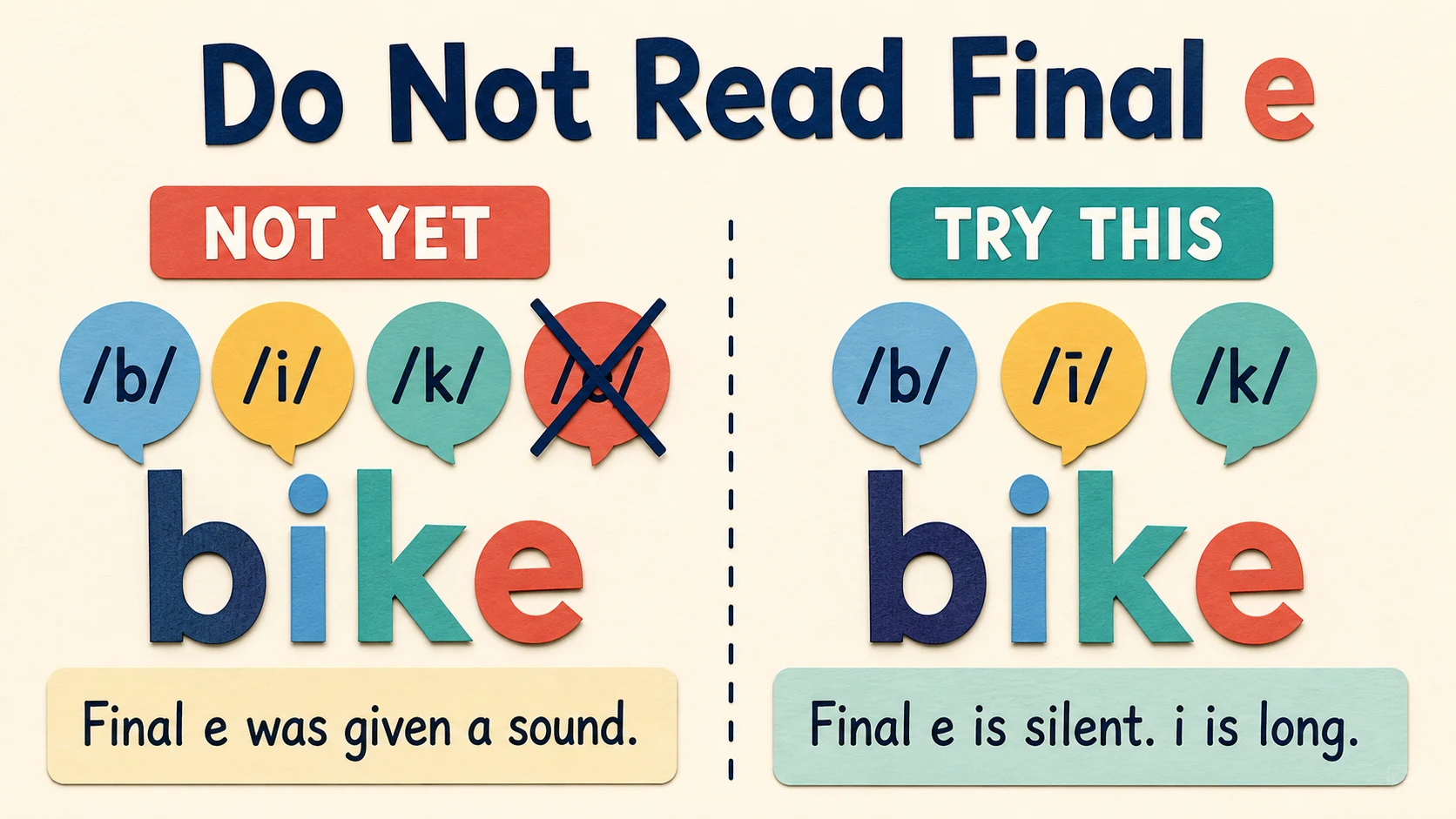
Adjust the amount, visibility, or prompting while keeping the learner responsible for identifying the vowel sound.
When the learner needs more support
Cover all but one row or small group of items. Visual reduction can make the page easier to scan without simplifying the phonics task. You can also place a small reference strip nearby showing a, e, i, o, u with familiar examples such as cake, feet, kite, bone, and cube.
Read the directions aloud, but do not automatically read every target word for the learner. If the purpose is decoding, supplying the word removes part of the task. When a word is genuinely inaccessible, note that you provided it and then ask the learner to identify the vowel sound. This separates supported sound identification from independent decoding.
For a learner who can decode but has difficulty writing or marking neatly, allow pointing or an oral answer first. Record separately whether the response was oral, prompted, or fully independent. The skill remains vowel identification; handwriting should not conceal what the learner knows.
When the learner is nearly independent
Ask for a brief explanation on selected items rather than every item: “I chose long e because I hear /ē/.” This provides evidence without making a 20-item page exhausting.
You can also ask the learner to underline the relevant vowel spelling after answering. That adds pattern attention while staying close to the original task. Do not require lengthy spelling terminology unless it has already been taught.
When the learner needs an extension
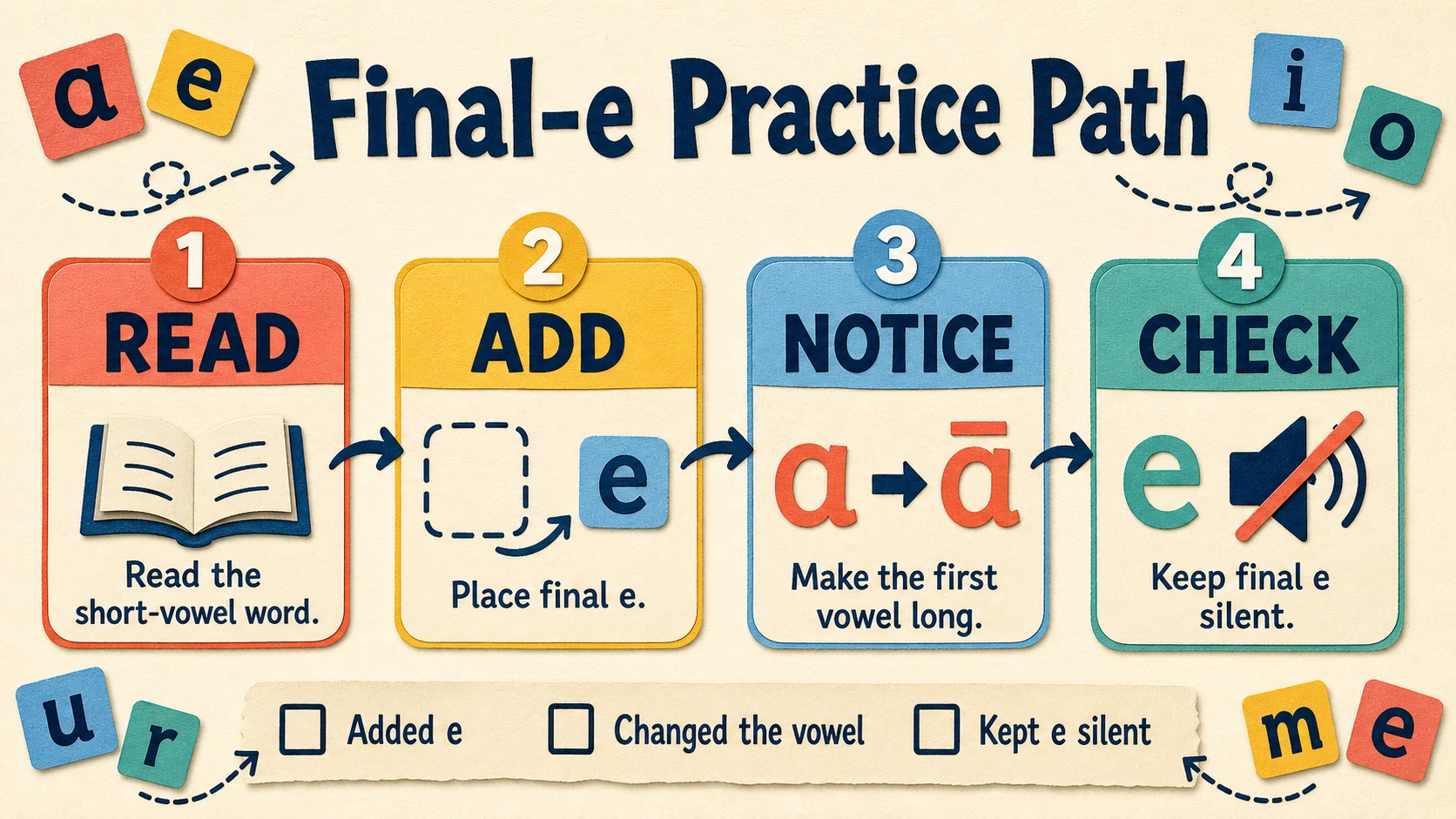
After the worksheet is complete, choose three accurately read words and ask the learner to sort them by spelling pattern. Another option is to build a word chain such as tap → tape or rip → ripe and ask what changes in the spelling and pronunciation.
For encoding practice, say one familiar long-vowel word and ask the learner to write it, then compare the spelling carefully. The IES elementary writing practice guide offers broad instructional guidance about teaching writing processes and foundational writing skills. It did not assess this worksheet. Here, writing a word from dictation is an optional extension that connects sound knowledge with spelling; it is not required to complete the identification task.
Interpret Errors Before Correcting Them
A total score tells you how many responses matched the key. It does not explain why errors occurred. Read the learner’s work closely enough to identify a pattern.
Reread the word, identify the sound, inspect the spelling, and then compare with the key.
| Observed response | Possible interpretation | Immediate instructional check |
|---|---|---|
| Names a short vowel after reading the word correctly | Long–short discrimination may be insecure | Contrast one CVC/CVCe pair |
| Names the visible first vowel without reading | Relies on letter spotting | Require the whole word before the answer |
| Reads the consonants inaccurately | Decoding difficulty may precede vowel identification | Blend the word from left to right |
| Identifies the sound but cannot point to its spelling | Sound recognition is stronger than pattern recognition | Mark the vowel spelling together |
| Recognizes silent-e words but not vowel teams | Knowledge may be limited to one pattern | Compare one known pattern with one taught vowel team |
| Gives correct oral answers but leaves written responses wrong or blank | The recording format may be interfering | Recheck orally, then clarify how to mark the page |
| Starts accurately and declines later | Fatigue or attention may be affecting the sample | Stop, record the stopping point, and resume later |
These are instructional interpretations, not diagnoses. One error does not establish a persistent misconception. Confirm a pattern with at least a few carefully chosen words before deciding what to reteach.
Correct with a short routine
For an error, avoid immediately saying the correct vowel. Ask the learner to:
- reread the word;
- say it naturally;
- identify the vowel sound;
- point to the relevant spelling;
- revise the answer if needed.
If the learner still cannot respond, model the word and then try a parallel example. After reviewing cap/cape, for instance, return to another regular final-e example rather than repeatedly rehearsing the missed answer alone.
Check the Answer Key Responsibly
The printable includes a separate answer key for quick checking. Use it after the learner has made a genuine attempt, not as the first teaching script.
First, verify that the key title and worksheet title match. Compare item numbers one by one so a skipped line does not shift every later response. Mark correct answers clearly, but preserve enough of the original work to see whether a revision occurred.
Separate three kinds of performance:
- Independent: the learner read and identified the sound without help.
- Prompted: a neutral reminder led to the answer.
- Modeled: the adult supplied or demonstrated essential information.
All three can be productive parts of a lesson, but they should not be counted as identical evidence. A corrected page may look perfect even though the learner needed substantial support.
If the learner’s pronunciation differs from yours, say the complete word naturally and consider whether the intended vowel category remains clear. Do not penalize an accent simply for sounding different. If pronunciation makes the sound genuinely ambiguous in the lesson, use a clearer comparison word and return to the printed item later.
The Common Core English Language Arts standards include foundational reading expectations involving final-e conventions, common vowel teams, and long-versus-short vowel distinctions. This provides context for why these patterns are commonly taught. It does not establish comprehensive standards alignment for this exact worksheet, and local expectations may organize instruction differently.
Decide What to Teach Next
Use both accuracy and the kind of help required. Avoid a rigid percentage rule detached from the learner’s actual reading.
If nearly all responses are accurate, independently read, and explained consistently, move to varied long-vowel spellings or a mixed review. The 1st Grade Long Vowels Worksheet Pack contains 18 worksheets and can provide broader practice, but select pages according to the patterns the learner is ready to study.
If errors cluster around one contrast, reteach that contrast. For example, confusion between pin and pine suggests returning to short i versus long i in CVC and CVCe words. If silent-e words are secure but vowel teams are not, practice one explicitly taught team at a time.
If the learner cannot blend the words, step back to simpler decoding rather than repeating vowel labels. If the learner reads accurately but struggles to state the sound category, use oral sorting: long a, long e, long i, long o, or long u.
The first-grade worksheet hub can help locate related practice, while the topic guide should remain the main reference for the broader long-vowel sequence. Free worksheet generators may be useful later for creating a small retrieval set, provided the generated words match patterns already taught and are checked by an adult before use.
Schedule Retrieval Without Overloading the Learner
A completed worksheet is a starting record, not a reason to abandon the skill or repeat the same 20 items immediately. Retrieval works best here when the learner must recall the vowel sound after some time has passed.
Revisit a few carefully selected words over time, adjusting the spacing according to observed accuracy.
A practical, adjustable plan is:
| Review point | Suggested task | Adult records |
|---|---|---|
| End of the lesson | Reread 2 correct words and 1 corrected word | Independent, prompted, or modeled |
| A later session | Identify vowel sounds in 4–6 mixed words | Which sounds or patterns remain difficult |
| Several days later | Read a small mix of familiar and new examples | Whether learning transfers to new words |
| The following week | Complete a brief sort or dictation using taught patterns | Whether decoding and spelling remain stable |
This is a sample schedule, not a universal timetable. Shorten the interval if the learner forgets most of the process. Lengthen it if retrieval is accurate and confident. Avoid scheduling extra repetitions merely to fill time.
Choose review words deliberately. Include one previously missed word, one word using the same pattern, and one word using a different taught long vowel. For example, after correcting kite, a later set might contain kite, pine, and bone. The first checks the corrected word, the second checks transfer within i_e, and the third checks discrimination from long o.
Do not show the old answer before asking for retrieval. Let the learner attempt the word, then provide the minimum prompt needed. Record prompted success separately from independent success.
Keep the Worksheet in Its Proper Role
This easy 20-item printable is useful for launching or reinforcing long-vowel identification. It offers a clear direction, a contained amount of practice, and a separate answer key. It is not a full phonics curriculum, a diagnostic assessment, or proof of mastery across every spelling pattern.
The most honest conclusion comes from the learner’s work:
- Which words were read without help?
- Which vowel sounds were identified accurately?
- Which spellings caused repeated confusion?
- Did the learner self-correct after rereading?
- Was performance stable across the page?
- Could the learner apply the same reasoning to a new example?
Use those observations to select the next task. If the learner is still mixing short and long vowels, revisit contrasting word pairs in the long vowels topic guide. If the 20 items are read and classified independently, choose one relevant page from the focused long-vowels pack and schedule a four- to six-word retrieval check in a later session.
Put it into practice
Use the guide with a real printable
Move from explanation to a short, observable practice task. Check the first item together, then adjust the next session from the learner's actual work.
See the 18-worksheet pack