Complete guide
How to teach and practise 1st grade digraphs worksheets - standard theme (easy)
How to use this 20-item digraph worksheet
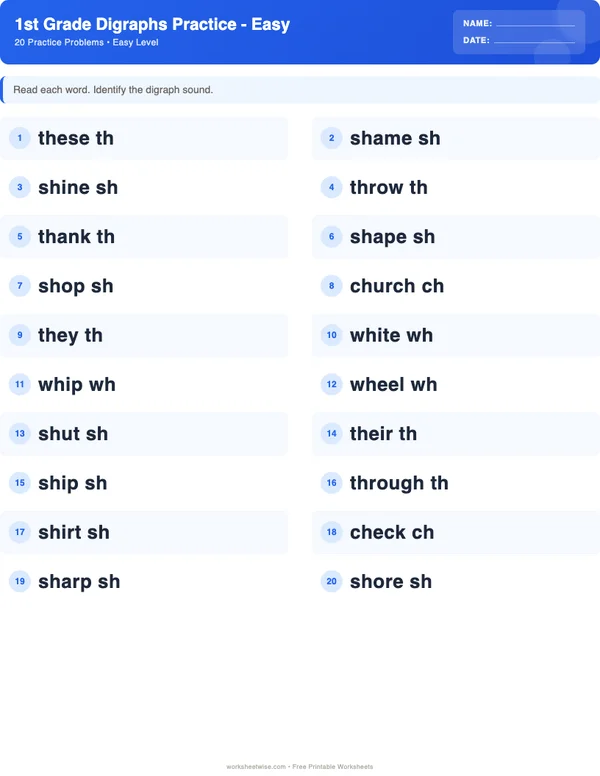
The free 1st Grade Digraphs worksheet gives a learner 20 easy-level exercises with one repeated direction: “Read each word. Identify the digraph sound.” Use it as focused practice in noticing two letters that represent one sound. It can work for a short lesson, guided review, homework, or homeschool practice.
For most learners, the strongest sequence is brief and direct: review what a digraph is, model two or three words, complete several items together, let the learner finish a manageable set independently, and then discuss errors before consulting the separate answer key. Accuracy matters, but the learner’s reading behavior matters too. Notice whether the learner reads the whole word, identifies the relevant letter pair, and connects that pair to its sound.
This worksheet covers digraphs, phonics, letter combinations, and word recognition. Its easy label describes the intended practice level; it does not guarantee that every first grader will find every item easy. Grade labels also describe intended practice levels, and local school sequences differ. Use the learner’s observed work—not the label alone—to decide how much modeling, prompting, or review is appropriate.
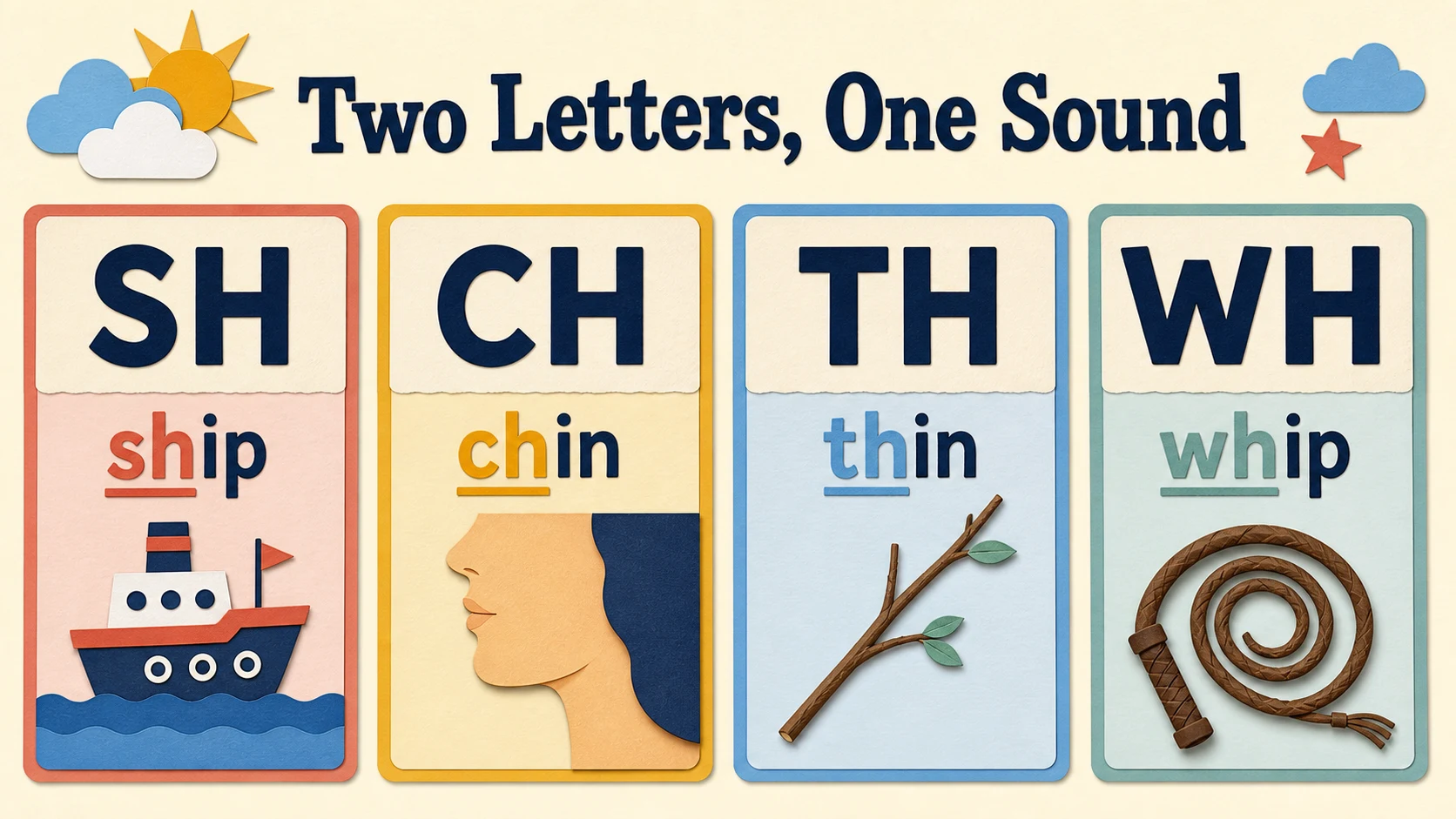
Preview the skill, model the thinking, guide a few items, observe independent work, and review errors.
What this worksheet is designed to practice
A consonant digraph is a pair of letters working together to represent one sound. Common examples include sh in ship, ch in chip, th in thin, wh in when, and ck in duck. The two letters are visible, but the learner treats them as one sound unit while reading.
That is different from a consonant blend. In a blend such as sl in slip, both consonant sounds remain audible: /s/ followed by /l/. In sh in ship, the letters do not contribute two separately pronounced consonant sounds. They work together as /sh/.
The worksheet is a good fit when the learner can already attempt simple words and is beginning to attend to common letter combinations. If the learner cannot yet blend a simple CVC word such as map, a 20-item digraph page may place too many demands into one task. In that case, use only a few items and provide oral blending support without changing the target skill.
The broader digraph topic guide explains the larger progression, including initial and final positions and the contrast between digraphs and blends. This lesson guide stays centered on launching, completing, checking, and revisiting this particular printable.
The high-level instructional framing is consistent with the IES practice guide on foundational reading skills, which addresses explicit work with speech sounds, letter–sound relationships, and word reading in kindergarten through third grade. That guide did not evaluate WorksheetWise or this worksheet.
Prepare a short, observable lesson
Before handing over the page, print or open the worksheet and keep the answer key separate. Read the directions aloud. Make sure the learner understands that the job is not merely to pronounce each word; the learner must also identify the two-letter spelling that represents the digraph sound.
A complete session does not need to use all 20 items at once. The following plan is an instructional suggestion, not a universal timetable. Adjust it in response to attention, accuracy, and the kind of help the learner needs.
| Lesson phase | Suggested action | What to observe |
|---|---|---|
| Quick review | Contrast one digraph with one blend | Can the learner explain “two letters, one sound”? |
| Adult model | Think aloud through two examples | Does the learner attend to both letters? |
| Guided practice | Solve three to five items together | Which prompts lead to a correct response? |
| Independent practice | Assign a manageable group of items | Can the learner apply the routine without cues? |
| Error review | Revisit selected responses before grading | Can the learner self-correct after rereading? |
| Retrieval | Return to a few examples later | Is the skill retained without immediate modeling? |
Have a pencil or crayon available for marking the two letters. If writing the digraph is difficult, the learner can underline, circle, or point to it. That adaptation preserves the phonics skill because the target is identifying the sound-spelling pair, not demonstrating handwriting fluency.
Use a quick readiness check
Say and show three words before beginning:
- ship
- chin
- map
Ask the learner to read each word and point to any two letters that work together as one sound. A useful response would identify sh in ship, ch in chin, and no consonant digraph in map.
Do not treat this three-word check as a formal score. It simply reveals what kind of launch is needed. If the learner identifies both digraphs and rejects map, move quickly to the worksheet. If the learner circles the first two letters of every word, model more carefully. If the learner cannot read any of the words, provide oral blending and reduce the initial item set.
State the task in learner-friendly language
Try this concise explanation:
“Some words have two letters that work together to make one sound. Read the whole word, find those two letters, say their sound, and mark them.”
This is an instructional script, not wording from an external source. Keep it brief so the explanation does not become harder than the task.
Model the reasoning before asking for independence
Model with examples that are similar to the worksheet rather than pretending they are confirmed items from the printable. Write one word at a time. Point under the letters as you read, then mark the digraph only after reading the whole word.
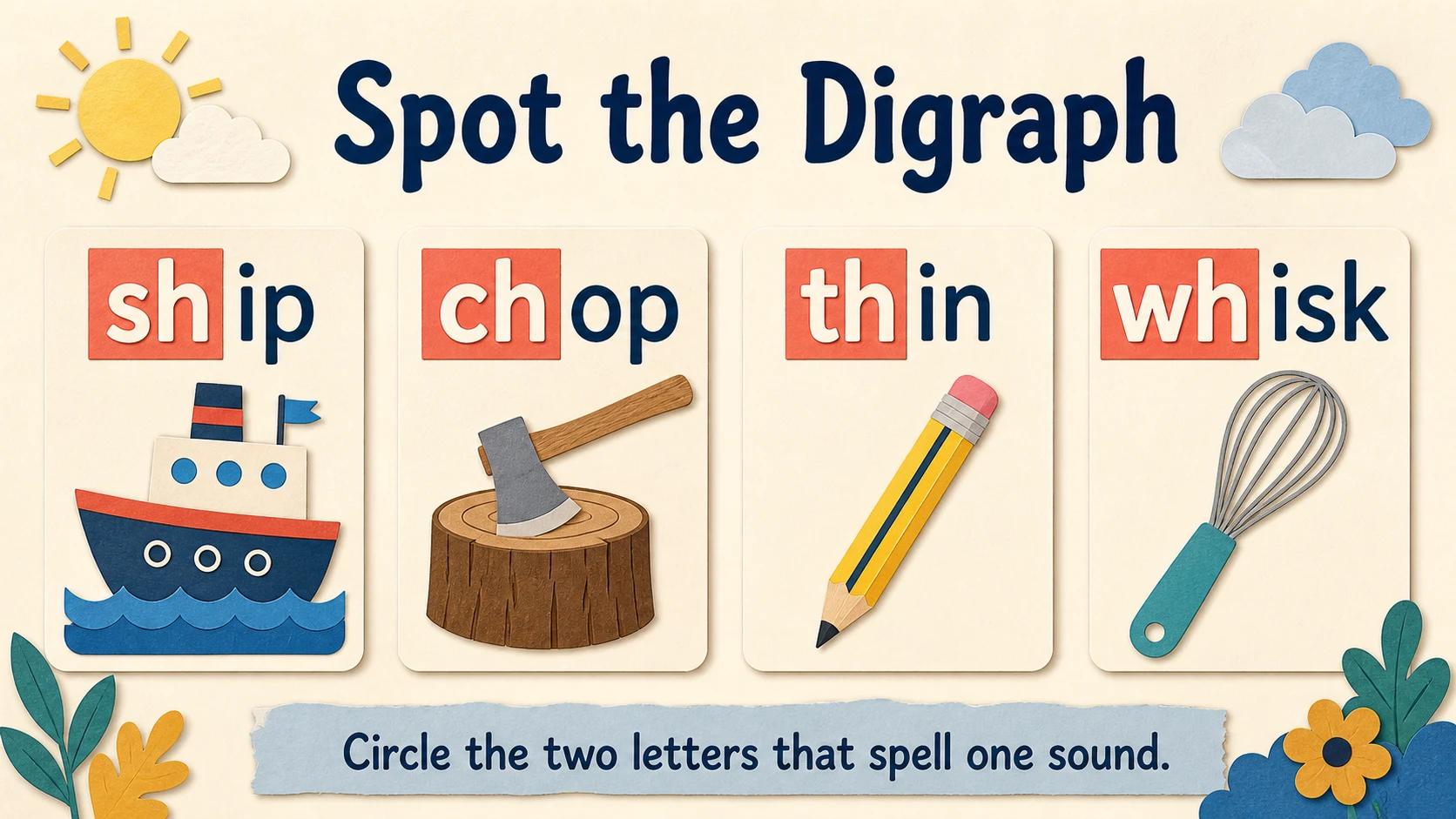
Read the whole word, locate the two-letter unit, say its sound, and mark the digraph.
Worked example 1: ship
- Look at the whole word: ship.
- Notice the opening letters s and h.
- Test them together: sh represents /sh/.
- Blend the word: /sh/ /ĭ/ /p/, ship.
- Mark sh as the digraph.
Checked answer: sh.
The important feature is that sh represents one sound at the beginning. The learner should not separate it into /s/ and /h/.
Worked example 2: much
- Read the whole word: much.
- Examine the ending letters c and h.
- Say them together: ch represents /ch/.
- Blend the word: /m/ /ŭ/ /ch/, much.
- Mark ch.
Checked answer: ch.
This example shows that a digraph can appear at the end, not only at the beginning.
Worked example 3: thin
- Read the word: thin.
- Check the opening pair th.
- In this word, th represents the unvoiced sound heard at the beginning of thin.
- Blend: /th/ /ĭ/ /n/, thin.
- Mark th.
Checked answer: th.
A first-grade learner does not need the label unvoiced to complete the task. The adult can simply model the sound accurately.
Worked example 4: duck
- Read the word: duck.
- Look at the final pair ck.
- The letters ck represent /k/ at the end.
- Blend: /d/ /ŭ/ /k/, duck.
- Mark ck.
Checked answer: ck.
The topic catalogue notes that ck occurs after a short vowel at the end of words. For this worksheet, the immediate goal remains identifying ck as the two-letter spelling for /k/.
Worked example 5: when
- Read the word: when.
- Inspect the opening pair wh.
- Treat wh as the target letter combination.
- Blend and say the word: when.
- Mark wh.
Checked answer: wh.
Pronunciation of wh can vary. The catalogue describes it as /w/ or /hw/. Accept the learner’s familiar pronunciation while requiring recognition of the two-letter spelling.
Move from guided practice to independent work
Guided practice should reveal the routine without doing all the thinking for the learner. Choose three to five worksheet items. Ask the learner to attempt each word before you prompt.
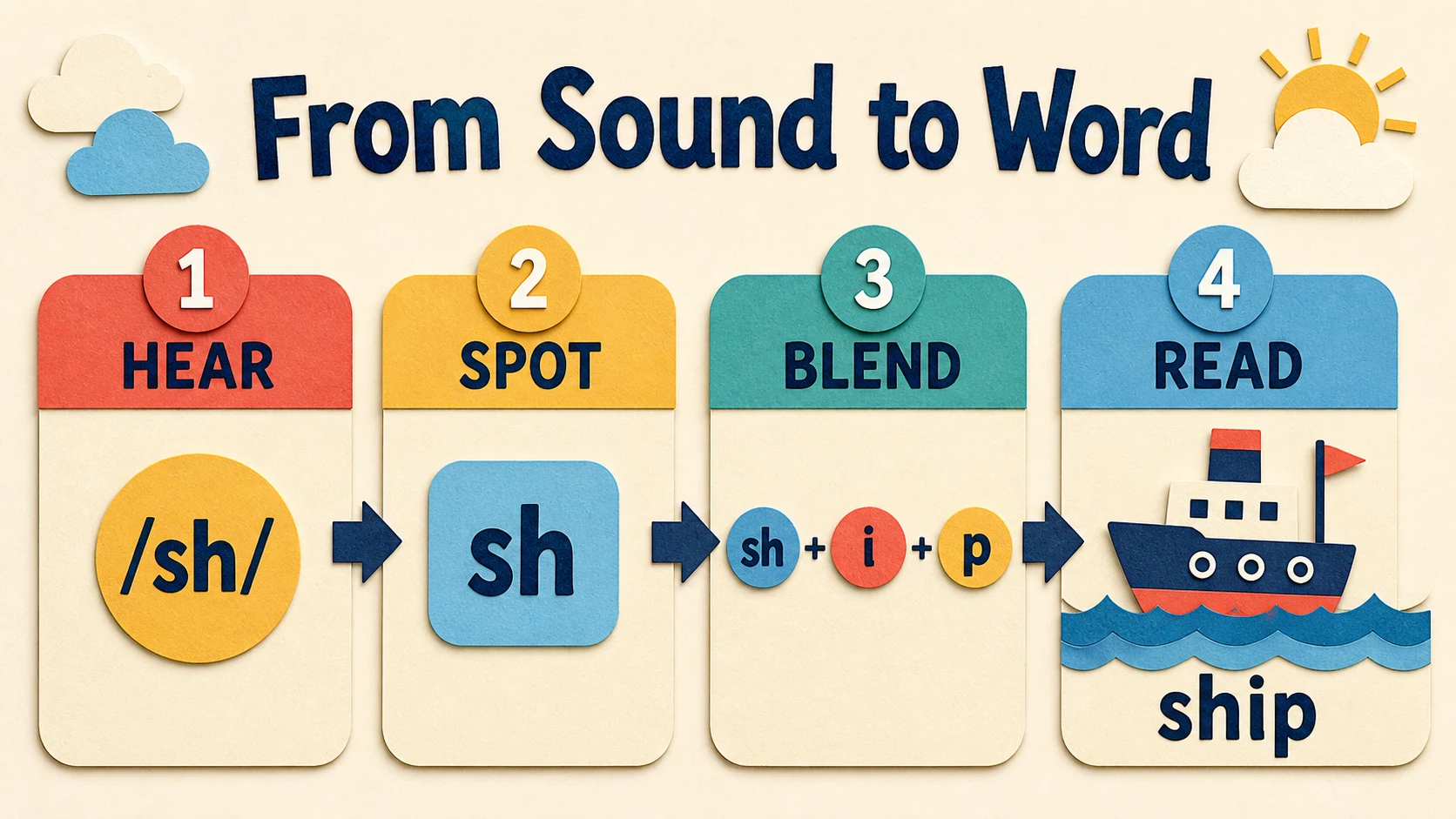
Use prompts that direct attention to the word and letter pair without immediately supplying the answer.
Use a prompt ladder
Begin with the least revealing prompt and add support only when needed:
- “Read the whole word again.”
- “Where do you hear one sound that might be written with two letters?”
- “Check the beginning and the end.”
- “Point to the two letters you think work together.”
- “Try this pair together. What sound does it represent?”
If the learner answers correctly after the first or second prompt, the difficulty may be attention or task interpretation rather than missing phonics knowledge. If the learner needs the final prompt repeatedly, more direct teaching is probably needed before a long independent set.
Avoid asking the learner to guess from a picture, the first letter alone, or the adult’s facial expression. The evidence should come from the printed word and its pronunciation.
Release responsibility gradually
After guided practice, assign a small group—perhaps five items—rather than automatically requiring all remaining items. Review the work briefly. Continue if the learner is reading carefully and identifying digraphs with reasonable independence.
Stop or pause when the learner begins marking arbitrary pairs, copying earlier answers without reading, or showing fatigue. Finishing 20 items is not more informative than completing a smaller set thoughtfully. The learner’s observed work should drive pacing.
For genuine independent practice, avoid correcting each response as soon as it is written. Immediate interruption can turn the activity back into guided practice. Instead, note the item, allow the learner to complete the small set, and then revisit it.
Adapt support without changing the skill
Adaptations should make the target more accessible while preserving the central demand: read a word and identify the digraph sound-spelling unit.
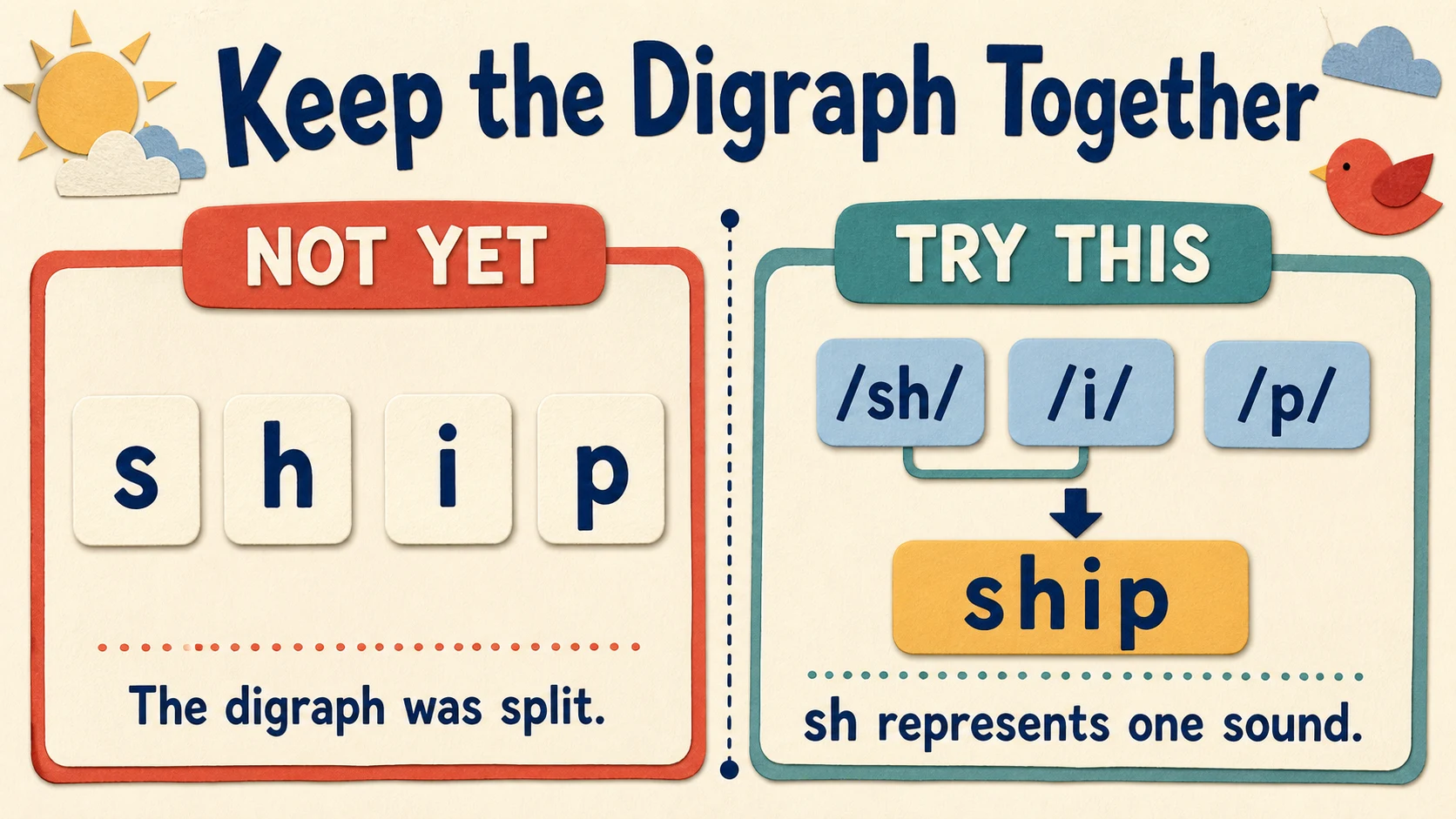
Reduce visual load, add oral support, or change the response method while keeping digraph identification central.
When the page feels visually crowded
Cover all but one row with a blank sheet of paper. Reveal a few items at a time. The learner still reads and analyzes the original words, but fewer items compete for attention.
You can also place a small dot beside the current item or use a reading window. Do not pre-circle the digraphs, because that removes the identification step.
When decoding is slow
Let the learner tap or slide under the sounds while blending. If necessary, pronounce the word once and ask the learner to repeat it, locate the digraph, and say the digraph sound. Record that oral support in your notes; identifying a digraph after hearing the word is not the same as independently decoding it.
A useful distinction is:
- Independent word reading and digraph identification
- Digraph identification after an adult supplies the word
- Identification after the adult also isolates the target sound
All three responses provide information, but they show different levels of independence.
When writing or marking is the obstacle
Allow pointing, highlighting, magnetic letters, or an oral answer. For example, the learner can say, “The digraph is ch,” while the adult records the response. This changes the response mode, not the phonics target.
If you add a writing extension, keep it separate from the worksheet score. The IES elementary writing practice guide provides high-level guidance for writing instruction, but it does not make handwriting or sentence composition part of this worksheet’s stated digraph task.
When the learner is ready for more challenge
Ask for one additional action after the original answer:
- Say whether the digraph is at the beginning or end.
- Think of another word with the same digraph.
- Sort completed words by sh, ch, th, wh, or ck.
- Read two or three completed words in a short, adult-created sentence.
Do not require these extensions when the learner is still struggling to identify the pair. Extra demands should follow secure performance, not conceal uncertainty about the original skill.
Handle boundary cases and common misconceptions
Some errors come from an incomplete idea of what counts as a digraph. Others come from trouble reading the word. Separating those causes makes the next teaching move more precise.
Digraph or blend?
Compare ship and slip:
- In ship, sh represents one sound. It is a digraph.
- In slip, sl preserves /s/ and /l/. It is a blend.
If the learner marks sl, ask, “Can you hear both consonants?” Stretch the beginning without distorting it: /s/ /l/. Then contrast it with /sh/. The goal is auditory comparison supported by print.
Two letters do not always mean a digraph
A learner may circle any adjacent pair, such as st in stop. Remind the learner that the letters must work together as the target sound unit. Simply appearing side by side is insufficient.
Likewise, a word can contain more than two letters around the target. In much, the answer is ch, not uch. The vowel belongs to another sound in the word.
The two sounds of th
The catalogue includes both the sound in thin and the sound in this. The learner does not need to name them “unvoiced” and “voiced.” The practical objective is to recognize th in both kinds of words.
If a learner accepts th in thin but rejects it in this, say both words naturally and show that the spelling remains th even though the pronunciations differ. Do not force the learner to pronounce the sounds identically.
ch and sh reversals
A learner may read chip with /sh/ or ship with /ch/. Return to two known comparison words. Write ch above chip and sh above ship, say both, and have the learner repeat them. Then revisit the missed item without pointing to its answer.
Confusing word reading with digraph identification
A learner might read a word correctly but mark the wrong letters. That suggests the spoken word is available, while the printed sound-spelling mapping is not yet secure. Conversely, the learner might correctly identify ch in a word that the adult supplied orally but be unable to decode the whole word independently.
Record these patterns separately. A single correct-or-incorrect mark can hide a useful distinction.
Interpret errors before consulting the key
The included printable answer key supports efficient checking, but it should confirm analysis rather than replace it. First ask the learner to reread and inspect the response. Then compare with the key.
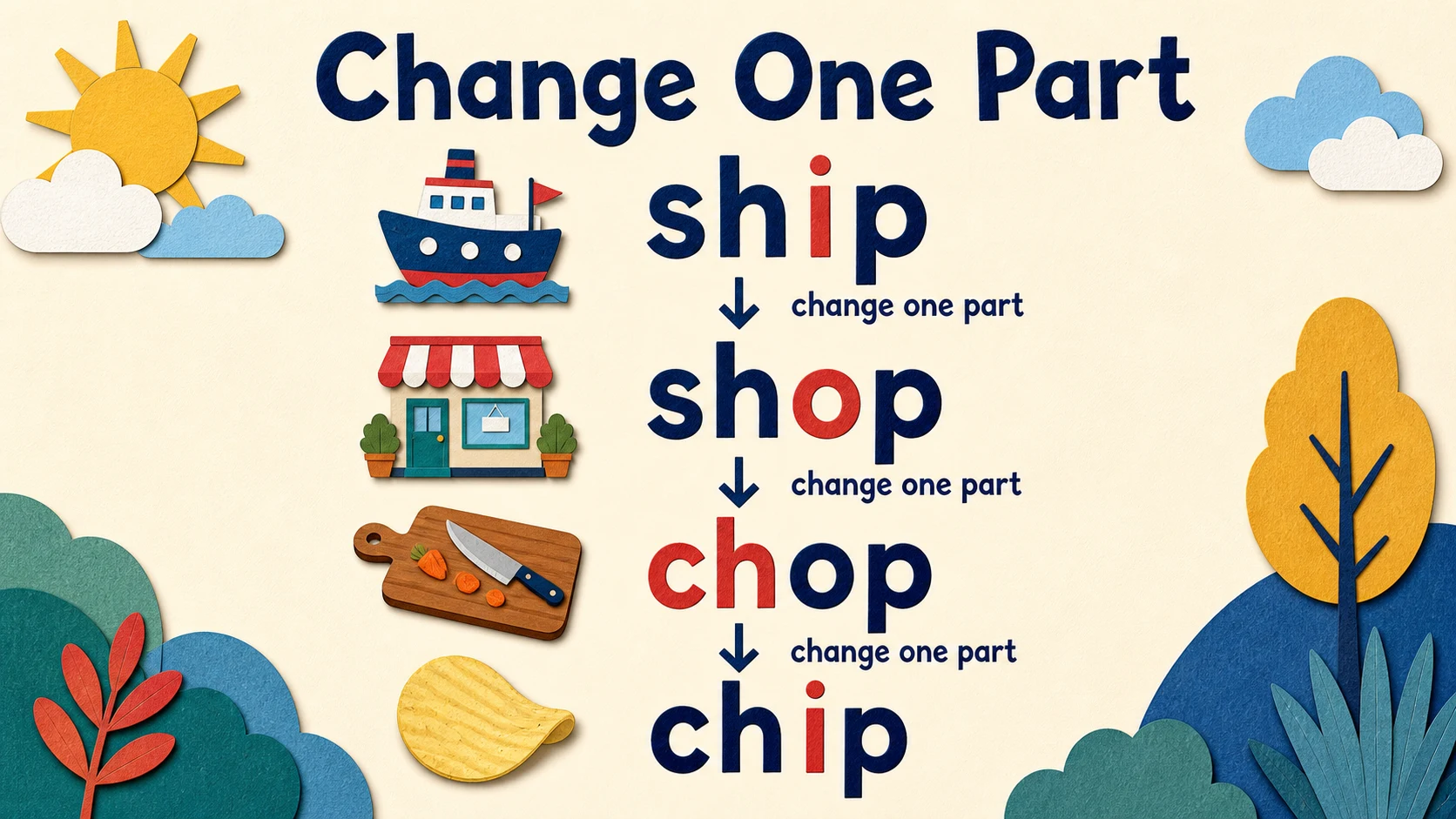
Reread the word, locate the sound, inspect the letters, explain the choice, and then verify it.
Use this correction routine:
- Read the entire word.
- Say the word slowly but naturally.
- Identify the relevant sound.
- Point to the letters representing that sound.
- Explain why they form the digraph.
- Check the answer key.
- Correct the response and read the whole word again.
Do not give the key to the learner as a copying sheet. A corrected page is useful only when the correction includes another attempt at the reasoning.
A simple error record can be more informative than a total score:
| Observed pattern | Possible interpretation | Useful response |
|---|---|---|
| Correct reading, wrong letters marked | Print-to-sound mapping is uncertain | Compare the word with a known example |
| Word supplied by adult, digraph found | Identification is stronger than decoding | Add supported blending practice |
| Initial digraphs correct, final ones missed | Learner may scan only the beginning | Prompt a beginning-and-end check |
| sh and ch repeatedly confused | The contrast is not stable | Practice a small two-column sort |
| Blends marked as digraphs | “Two letters together” is overgeneralized | Contrast one sound with two audible sounds |
| Random answers late on the page | Attention or endurance may be affecting work | Shorten the next set and revisit later |
A percentage alone cannot show these differences. For example, two learners could each miss four items: one may consistently confuse sh and ch, while the other may decode slowly and guess only near the end. Their next lessons should not be identical.
Check the answer key responsibly
The separate answer key is intended for checking the worksheet’s 20 items. Review each response against the printed word rather than relying on memory. If a response differs from the key, pronounce the word, identify the relevant letters, and verify that the key matches the task direction.
Use a neutral marking system. A dot beside an item can mean “revisit this,” while a check can mean “verified.” After correction, note whether the learner self-corrected, corrected after a general prompt, or needed the answer supplied. That small distinction helps you decide what comes next.
Avoid turning every pronunciation difference into an error. This is especially relevant for wh, which the catalogue describes with /w/ or /hw/. Focus on whether the learner recognizes the intended two-letter unit.
The catalogue references several English language arts standards codes. The Common Core State Standards for English Language Arts can provide broader context for foundational reading expectations. However, this single worksheet should not be described as comprehensive standards alignment, and local curricula may introduce or review digraphs in a different order.
Decide what to do after the worksheet
Use the completed work to choose among three practical paths.
Continue to mixed digraph practice
Choose this path when the learner reads most words independently, identifies initial and final digraphs, and can explain at least one contrast such as sh versus sl. The learner can continue with mixed words, short decodable passages, or additional pages in the 1st Grade Digraphs Worksheet Pack, which contains 18 worksheets.
Reteach one contrast
Choose focused reteaching when errors cluster around one pair, position, or concept. Examples include sh versus ch, initial versus final digraphs, or digraphs versus blends.
Use four to six carefully selected words rather than immediately repeating all 20 items. A small sort such as ship/chip/wish/much keeps the original skill visible and makes the contrast easier to inspect.
Step back to supported word reading
If the learner cannot read the words even with a brief prompt, continue phonics work at a level that strengthens blending and simple word recognition. The first-grade phonics hub provides nearby practice options. Returning to prerequisite work is not a penalty; it is a response to observed evidence.
Do not infer a diagnosis from one printable. The worksheet cannot determine the cause of persistent reading difficulty, provide medical guidance, or replace a broader educational evaluation. If concerns continue across different tasks and settings, document the specific patterns and discuss them with the learner’s teacher or another appropriately qualified professional.
Schedule retrieval instead of one-time repetition
A completed worksheet shows performance during one session. Brief retrieval later helps reveal whether the learner can recall and apply the digraphs without the original model still fresh.
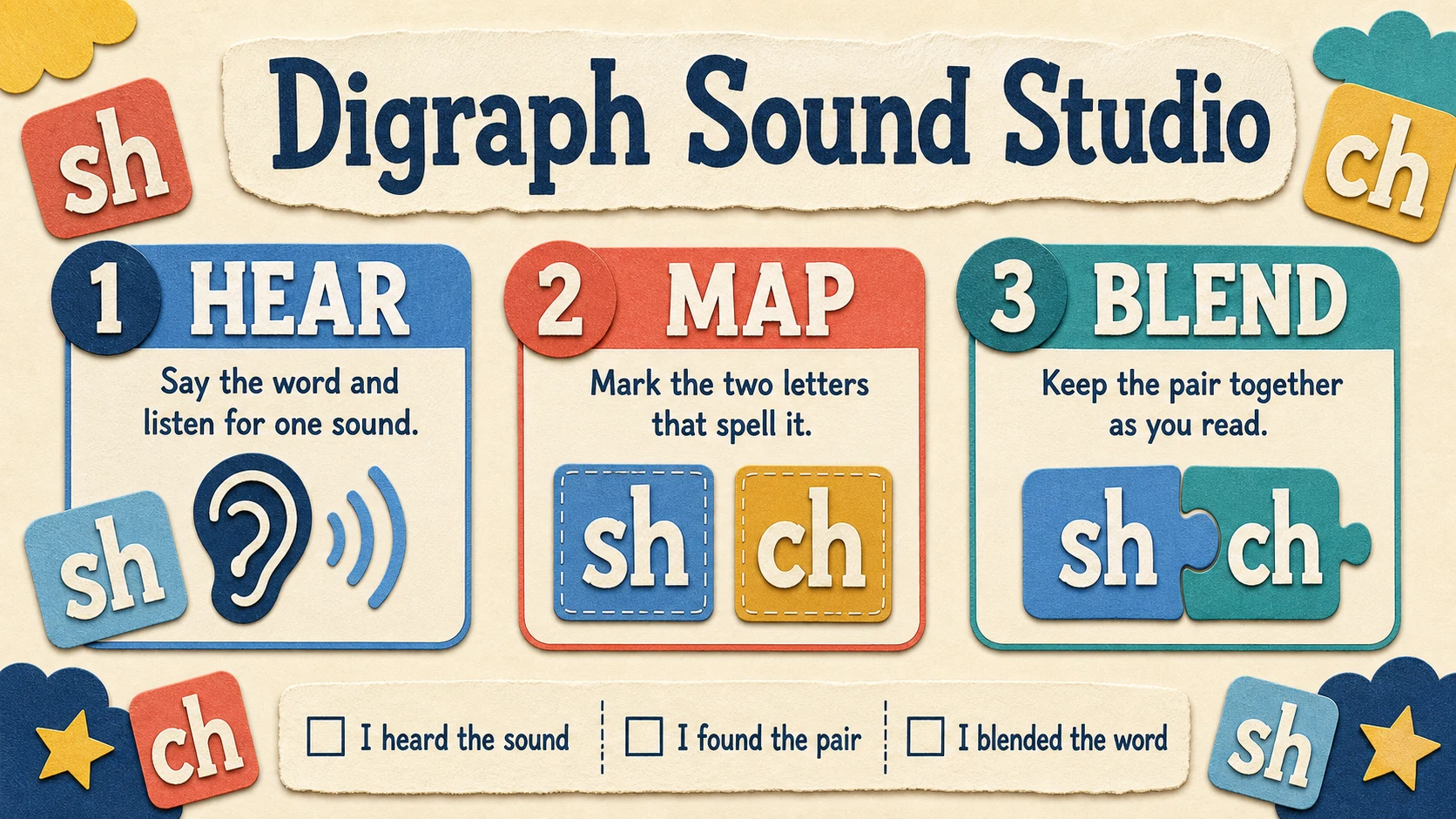
Revisit a small sample after increasing gaps, adjusting the schedule to the learner’s responses.
The schedule below is a practical suggestion, not a sourced or universal timetable:
| Review point | Short activity | Decision |
|---|---|---|
| Later the same session | Reread two corrected words | Check whether the correction is understood |
| About one day later | Identify digraphs in four mixed words | Note independent recall |
| Several days later | Mix digraph words with CVC and blend words | Check whether the learner overgeneralizes |
| About one week later | Read a new small set or a short passage | Look for transfer to unfamiliar examples |
| Later review | Revisit only unstable contrasts | Continue, reteach, or reduce support |
Use new examples when possible. Memorizing the position of an answer on the original page does not demonstrate transfer. Include a few words without digraphs so the learner must decide whether a target is present rather than assuming every word contains one.
Keep retrieval brief. If the learner remembers sh, ch, and ck but remains unsure about th, review th rather than repeating every category equally. If performance declines sharply after a gap, return to modeling and guided practice before asking for another independent set.
Limitations and the honest next step
This printable provides 20 easy-level opportunities to identify digraph sounds in words. It does not, by itself, measure complete reading development, guarantee mastery, cover every spelling pattern, or establish that a learner can apply digraph knowledge in connected text. It also cannot show whether a correct response came from independent decoding unless the adult observes the process.
The most useful evidence is the combination of the marked page and what happened during completion: which words were read independently, what prompts were needed, whether errors formed a pattern, and whether corrections were retained later.
Begin by downloading the free 20-item worksheet, model ship and much, and assign the first small group of items. After checking the learner’s actual responses, use the digraph topic guide to choose the next focused practice rather than repeating material the learner already handles securely.
Put it into practice
Use the guide with a real printable
Move from explanation to a short, observable practice task. Check the first item together, then adjust the next session from the learner's actual work.
See the 18-worksheet pack