Complete guide
How to teach and practise 1st grade cvc words worksheets - standard theme (easy)
How to Use This 20-Item CVC Worksheet
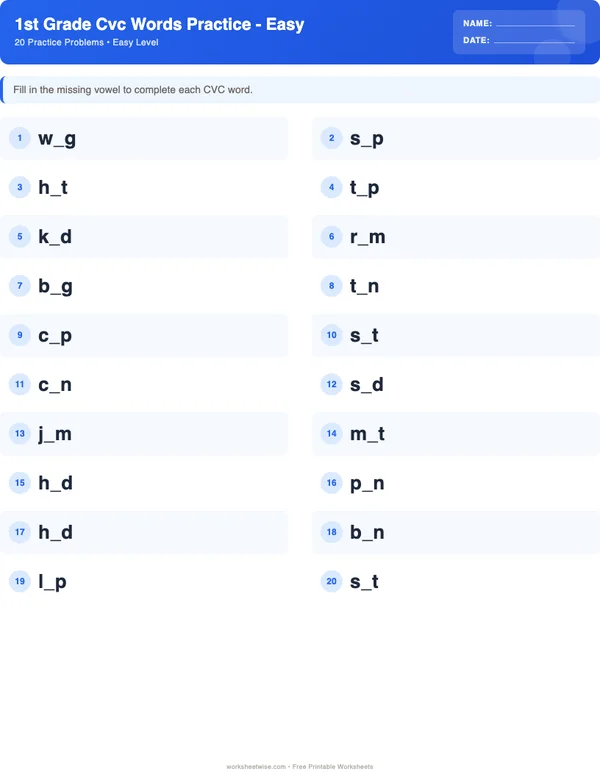
The free 1st Grade CVC Words worksheet gives a learner 20 easy-level items with one consistent direction: fill in the missing vowel to complete each consonant-vowel-consonant word. A separate printable answer key is included.
The most useful way to teach with it is straightforward:
- Confirm that the learner can hear the three sounds in a simple CVC word.
- Model how to say the sounds, identify the middle vowel, write it, and blend the completed word.
- Complete a few items together.
- Let the learner attempt the remaining items with as little prompting as is productive.
- Review errors by sound pattern, not just by total score.
- Revisit a small selection after a delay to see whether the skill is retained.
This worksheet practices phonemic awareness, short-vowel identification, decoding, and blending. It does not, by itself, establish mastery of every CVC pattern or the full first-grade phonics sequence. For that broader sequence, use the CVC words topic guide.
Grade labels describe the intended practice level; local curricula and instructional sequences differ. Use the learner’s observed work—not the printed grade label or a fixed timetable—to decide the pace and amount of support.
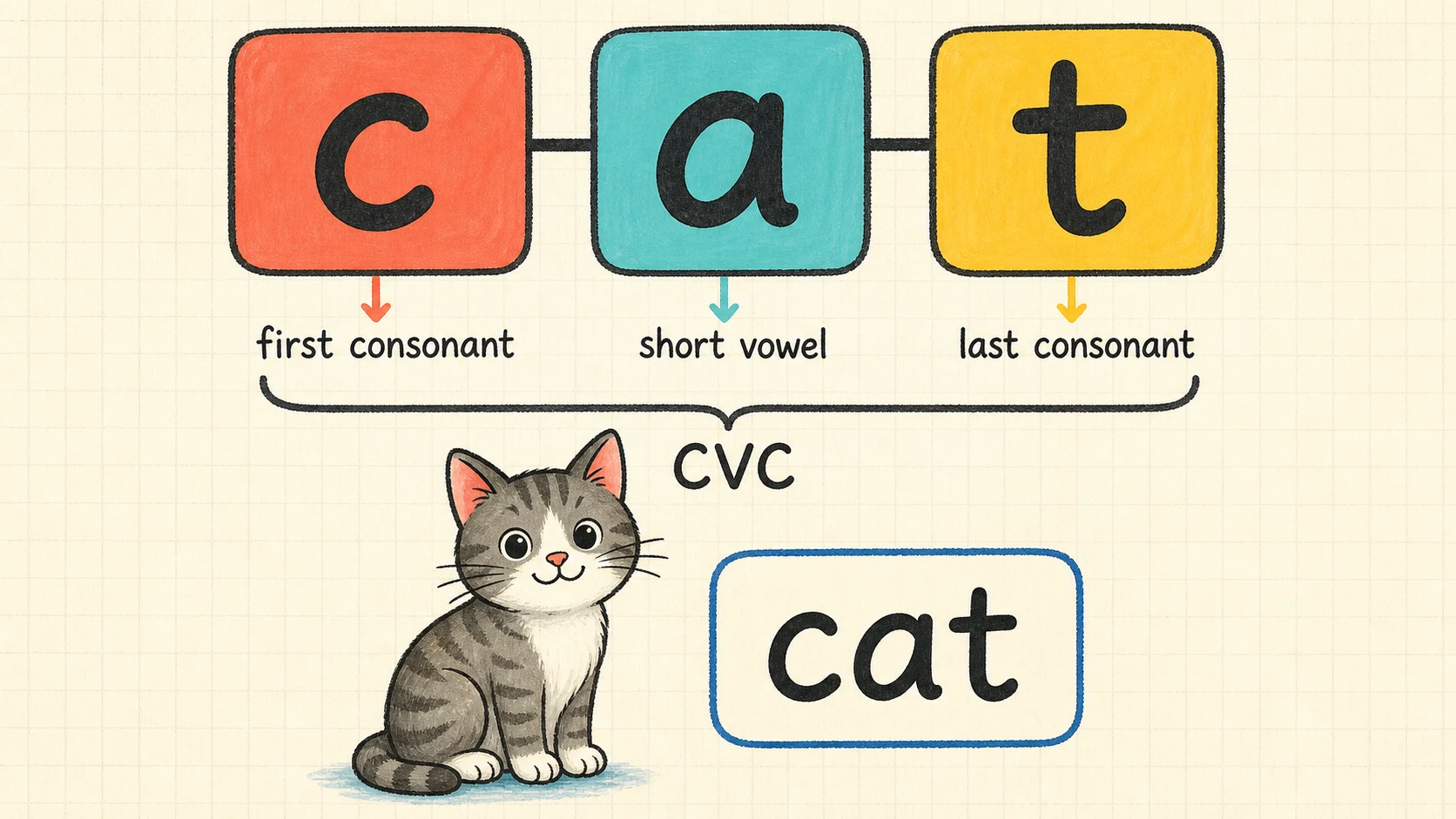
Move from a brief sound check to modeling, guided practice, independent work, feedback, and later retrieval.
What This Worksheet Does and Does Not Ask
Each item presents a CVC word with its vowel missing. CVC means consonant-vowel-consonant, as in cat, pin, and hug. The learner must determine which short vowel completes the word, write that vowel, and read the finished word.
That is more than a handwriting task. To complete an item thoughtfully, the learner coordinates several actions:
- Attend to the beginning and ending consonants.
- Say or infer the intended whole word.
- Hear the vowel sound in the middle.
- Match that sound to a vowel letter.
- Write the missing letter.
- Blend the three sounds to check the result.
The IES foundational reading practice guide supports high-level instruction that develops awareness of speech sounds and their links to letters, teaches decoding, and includes writing and recognizing words. That source provides general instructional guidance; it did not evaluate WorksheetWise or this particular printable.
The worksheet’s narrow format is useful for concentrated practice, but it also creates an important limitation: filling a blank can sometimes be easier than spelling a whole word from sounds. A learner may use the visible consonants, a picture if one appears, or familiarity with the word. Follow-up reading and spelling checks are therefore necessary before concluding that the learner can independently decode and encode similar words.
A Practical Lesson Sequence
The following plan is an instructional suggestion, not a universal timetable. Shorten, divide, or extend it according to the learner’s attention and responses.
| Lesson phase | Adult action | Learner action | Evidence to notice |
|---|---|---|---|
| Sound check | Say two or three familiar CVC words without showing print | Identify or repeat the middle sound | Can the learner hear the vowel before choosing a letter? |
| Model | Demonstrate one comparable example aloud | Watch, listen, and repeat the completed word | Does the learner understand what the blank represents? |
| Guided practice | Complete two to four worksheet items together | Say, choose, write, and blend with prompts | Which prompts are still needed? |
| Independent practice | Offer a manageable group of items | Complete items without immediate correction | Is the process accurate and reasonably steady? |
| Review | Compare responses with the answer key | Rework selected errors using sounds | Can the learner explain and correct an error? |
| Retrieval | Revisit a few words after a delay | Read and spell without copying | Does learning remain available later? |
Twenty items do not have to be completed in one sitting. If accuracy falls, the learner begins guessing, or blending becomes less controlled, stop at a natural break. Record where to resume. Completing fewer items with deliberate sound-to-letter work is more informative than rushing through all 20.
Prepare Before the Learner Starts
Print the student page without placing the answer key beside it. Keep the key available to the adult for later checking. A pencil and eraser are sufficient. Optional materials include three small counters, magnetic vowel letters, or three drawn sound boxes.
Before presenting the page, review the direction in plain language: “Each word is missing its middle vowel. We will listen for that sound, write the vowel, and read the whole word.”
Check the prerequisite orally
Say a familiar word such as map. Ask the learner to repeat it slowly and identify the middle sound. Repeat with sit or sun. Do not display letters yet.
If the learner can hear the middle sound, move to the printed task. If the learner cannot, spend a few moments segmenting the word into three sounds with counters. The goal remains identifying the medial vowel; the counters simply reduce the memory and print demands.
Introduce the five vowel choices
Briefly name a, e, i, o, u, but avoid turning the lesson into a long vowel recital. The immediate task is to connect a heard short-vowel sound with the appropriate letter.
If five choices are overwhelming, display two plausible vowel letters at first. For example, offer a and i for a practice item. This changes the amount of support, not the target skill: the learner must still listen for and select the middle vowel.
Model the Complete Thinking Process
Use an example comparable to the worksheet rather than giving away one of its actual answers. The examples below are fully checked CVC words, but they are not claims about which 20 words appear on the printable.
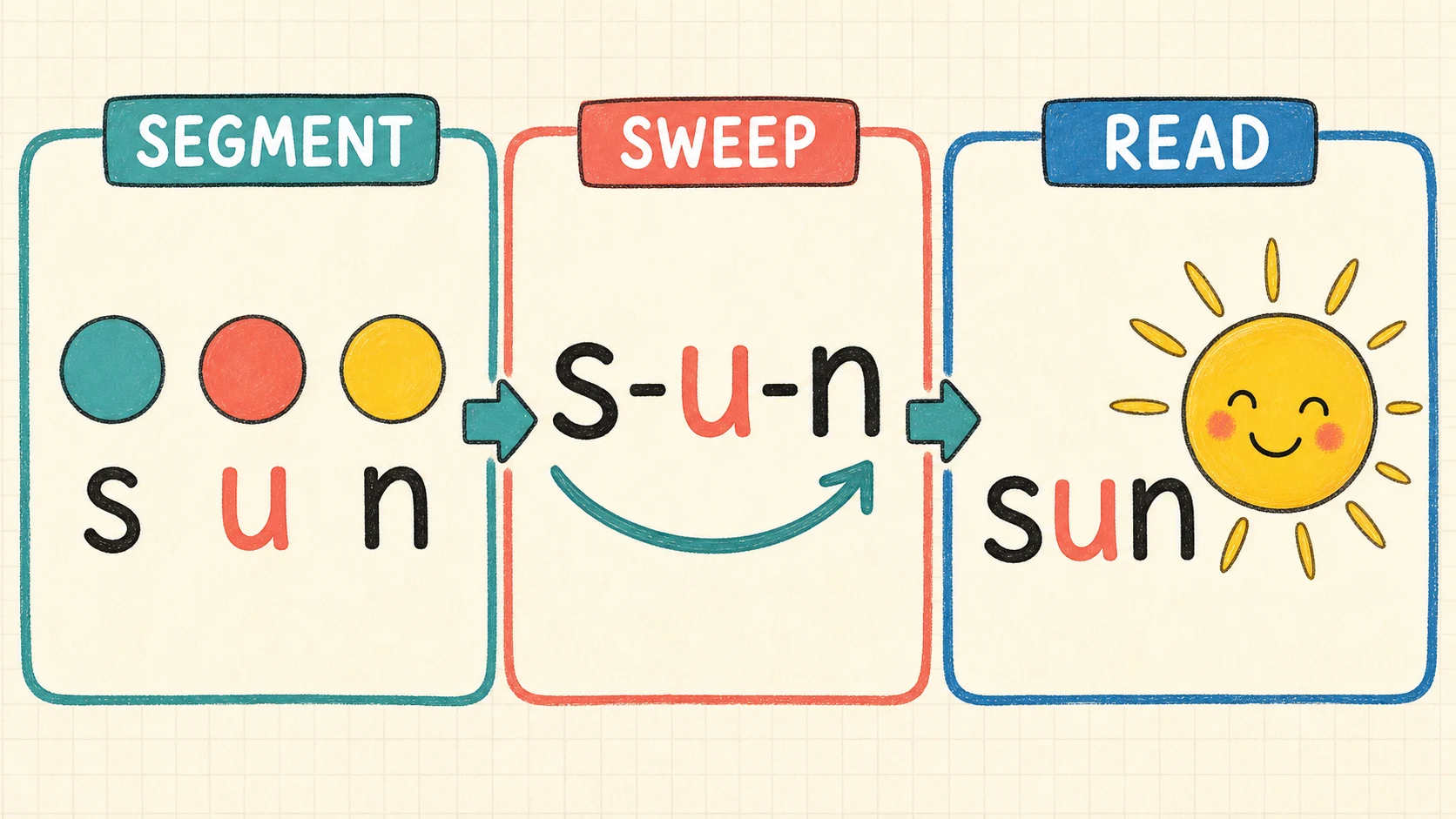
The learner should hear the middle sound, choose its letter, and blend the completed word.
Worked example 1: c_t becomes cat
Point to c_t and say: “I see c at the beginning and t at the end. I am trying the word cat: /k/ /ă/ /t/. The middle sound is /ă/, so I write a. Now I blend it: /k/–/ă/–/t/, cat.”
Check:
- Written form: c + a + t
- Sound sequence: /k/ /ă/ /t/
- Completed word: cat
The vowel a is correct because it represents the short middle sound in cat. Writing i would make cit, which does not produce the intended familiar word.
Worked example 2: p_n becomes pin
Say pin slowly while keeping the sounds connected: /p/–/ĭ/–/n/. Identify /ĭ/ as the middle sound and write i.
Check:
- Written form: p + i + n
- Sound sequence: /p/ /ĭ/ /n/
- Completed word: pin
After writing, sweep a finger beneath the letters and blend the whole word. This prevents the activity from becoming silent letter selection.
Worked example 3: d_g becomes dog
Read the outside letters, then test the intended word dog: /d/–/ŏ/–/g/. The short middle sound is represented by o.
Check:
- Written form: d + o + g
- Sound sequence: /d/ /ŏ/ /g/
- Completed word: dog
Pronunciations vary across speakers and regions. Use the learner’s ordinary spoken English while keeping the printed target in view. Do not criticize an accent or require an artificial pronunciation.
Worked example 4: s_n becomes sun
Stretch sun: /s/–/ŭ/–/n/. The missing letter is u.
Check:
- Written form: s + u + n
- Sound sequence: /s/ /ŭ/ /n/
- Completed word: sun
Have the learner repeat the completed word, then ask, “Which sound did u represent here?” The answer should refer to the middle sound, not merely the letter’s name.
Worked example 5: b_d becomes bed
Say bed: /b/–/ĕ/–/d/. Write e, then blend.
Check:
- Written form: b + e + d
- Sound sequence: /b/ /ĕ/ /d/
- Completed word: bed
Together, these five examples demonstrate all five short-vowel letters. They are teaching examples, not an assumed list of worksheet answers.
Move from Guided to Independent Practice
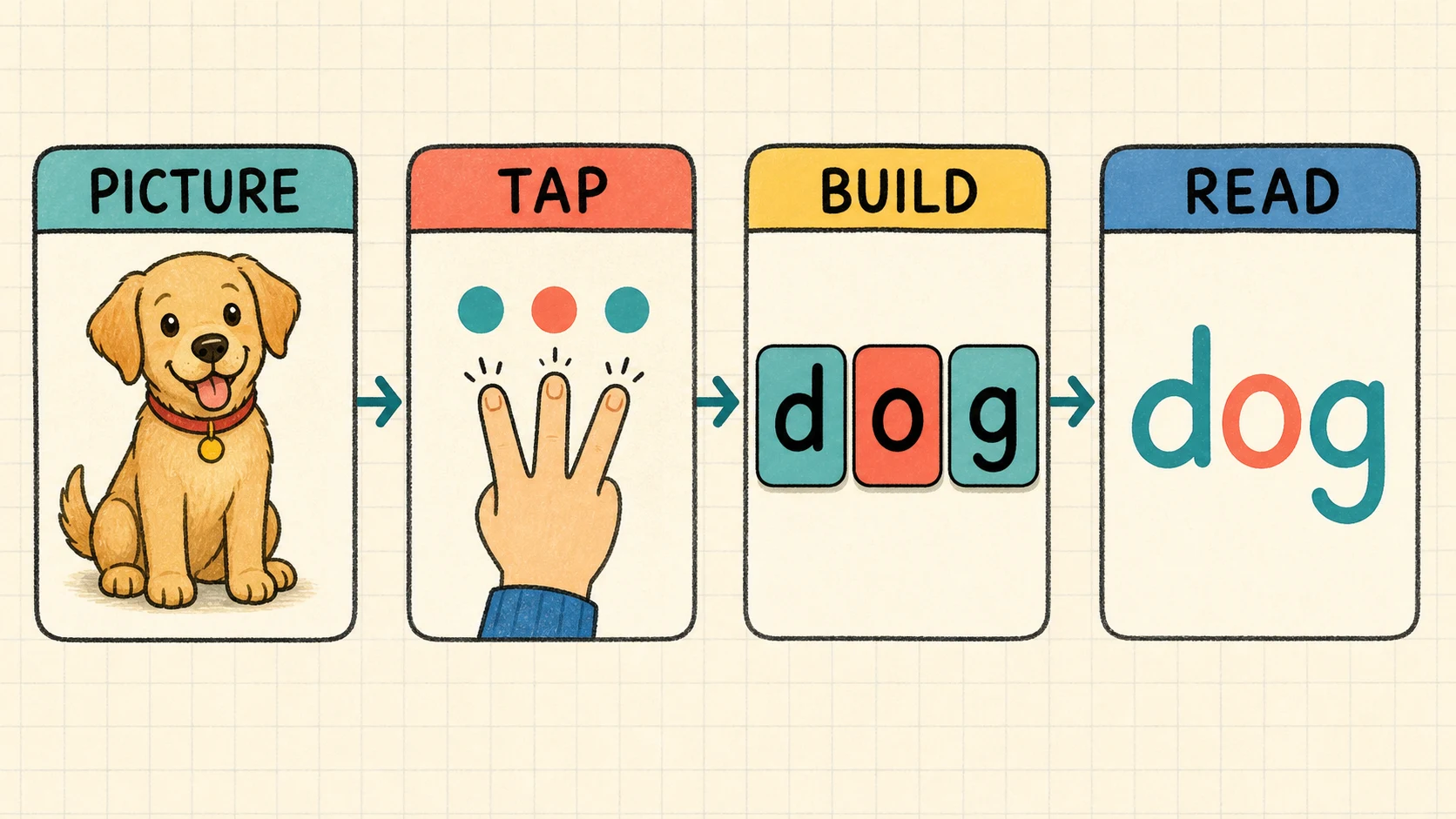
Demonstrate the routine, practice it together, and then reduce help gradually.
Guided practice prompts
For the first few worksheet items, use a stable prompt sequence:
- “What word are you making?”
- “Say it slowly.”
- “What sound is in the middle?”
- “Which vowel spells that sound here?”
- “Write it and blend the whole word.”
Pause after each prompt. Do not immediately supply the sound or letter. The learner’s response tells you where the process is breaking down.
If the learner identifies the correct sound but cannot recall the letter, show vowel options. If the learner names a vowel without listening, return to the spoken word. If the letter is correct but the learner does not blend, point under the finished word and ask for a continuous read.
Releasing support
Move to independent work when the learner completes several items using the routine with little assistance. Independence means the learner performs the sound check and blending process, not merely that the adult stops talking.
A quiet adult can still observe:
- whether the learner whispers or mouths the word;
- whether choices are made immediately or after listening;
- whether one vowel is used repeatedly;
- whether the completed word is reread;
- whether errors cluster after attention fades.
Avoid announcing correctness after every item once independent practice begins. Constant confirmation can turn the task into a sequence of guesses approved or rejected by the adult. Instead, let the learner complete a small group, then review it.
Adapt Support Without Changing the Skill
Differentiation should preserve the central demand: hearing a middle vowel and connecting it to the letter that completes a CVC word.
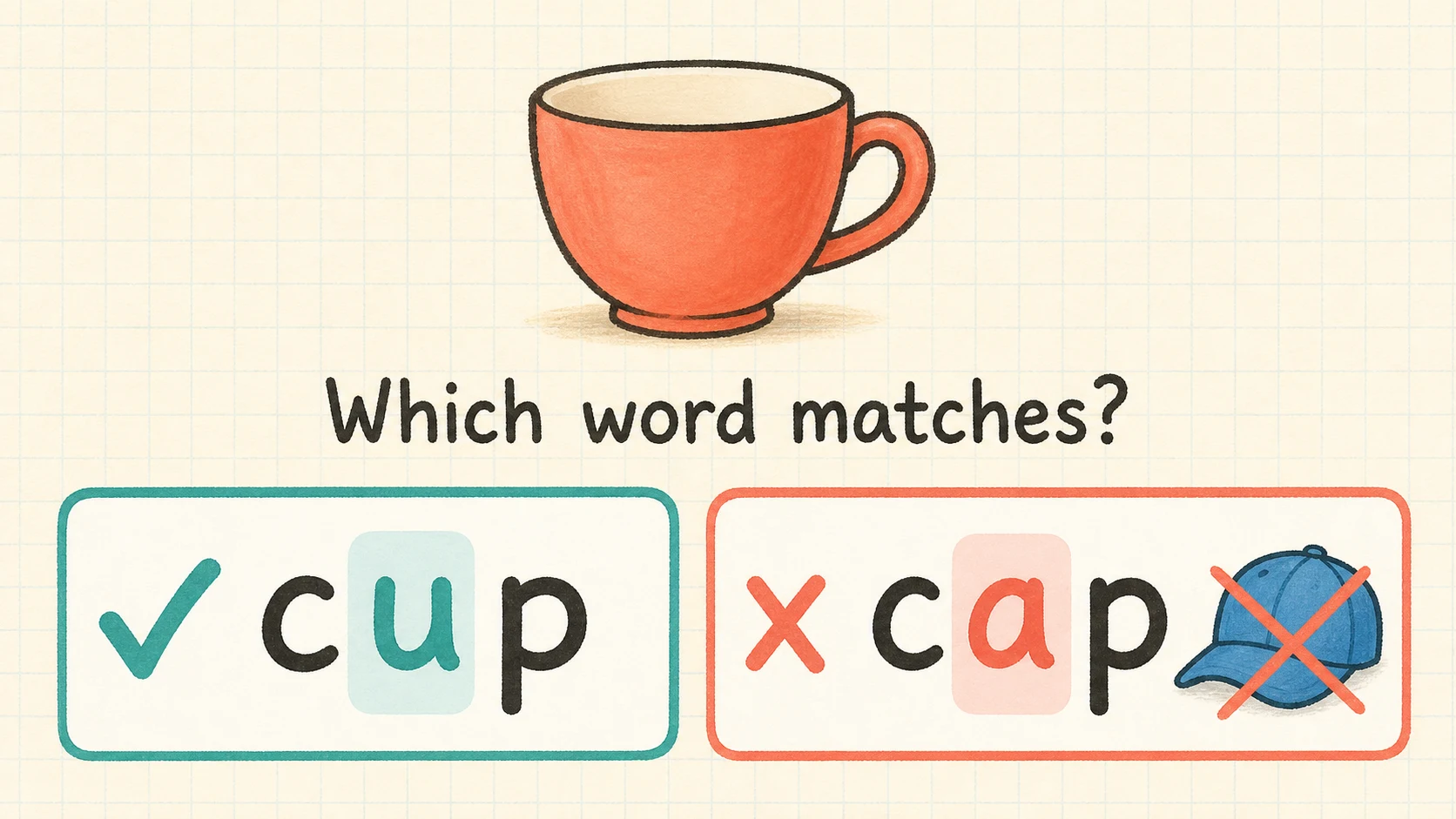
Adjust access, quantity, or response mode while keeping the short-vowel decision intact.
When the learner needs more support
Cover all but one row or a small group of items. Use three sound boxes and move one counter for each phoneme. Pause over the middle box, then ask for the vowel sound and letter.
Other suitable supports include:
- Say the intended word clearly without emphasizing the answer unnaturally.
- Let the learner choose from two vowel letters.
- Permit magnetic letters before pencil writing.
- Complete alternate items together.
- Ask the learner to point to the vowel before writing it.
- Return to five choices only after the smaller choice set is manageable.
These are instructional suggestions. They are not medical, diagnostic, or child-specific recommendations.
When handwriting interferes
The worksheet includes a written response, but handwriting difficulty can hide phonics knowledge. Let the learner point to, say, or place the missing vowel first. Then have the learner copy that single letter into the blank if appropriate.
The IES elementary writing practice guide includes general guidance about developing fluency with handwriting and spelling. In this lesson, separating the oral vowel decision from letter formation can help an adult see which part needs instruction. The source did not assess this worksheet.
When the worksheet is easy
Keep the same words but remove cues after completion:
- Cover each completed word and ask the learner to spell it from dictation.
- Ask for all three sounds in order.
- Change one sound to make another CVC word, such as cat to cot.
- Mix the reviewed words and ask for quick, accurate reading.
- Include a decodable nonsense CVC form as a separate check, clearly explaining that it is a made-up word.
Do not add blends, digraphs, silent-e patterns, or multisyllabic words merely to make the page harder. Those introduce different phonics demands. Use the broader first-grade phonics collection when the learner is ready for a different skill.
Interpret Errors Before Correcting Them
A total such as “16 out of 20” does not reveal why four responses were wrong. Examine the learner’s process and group errors by type.
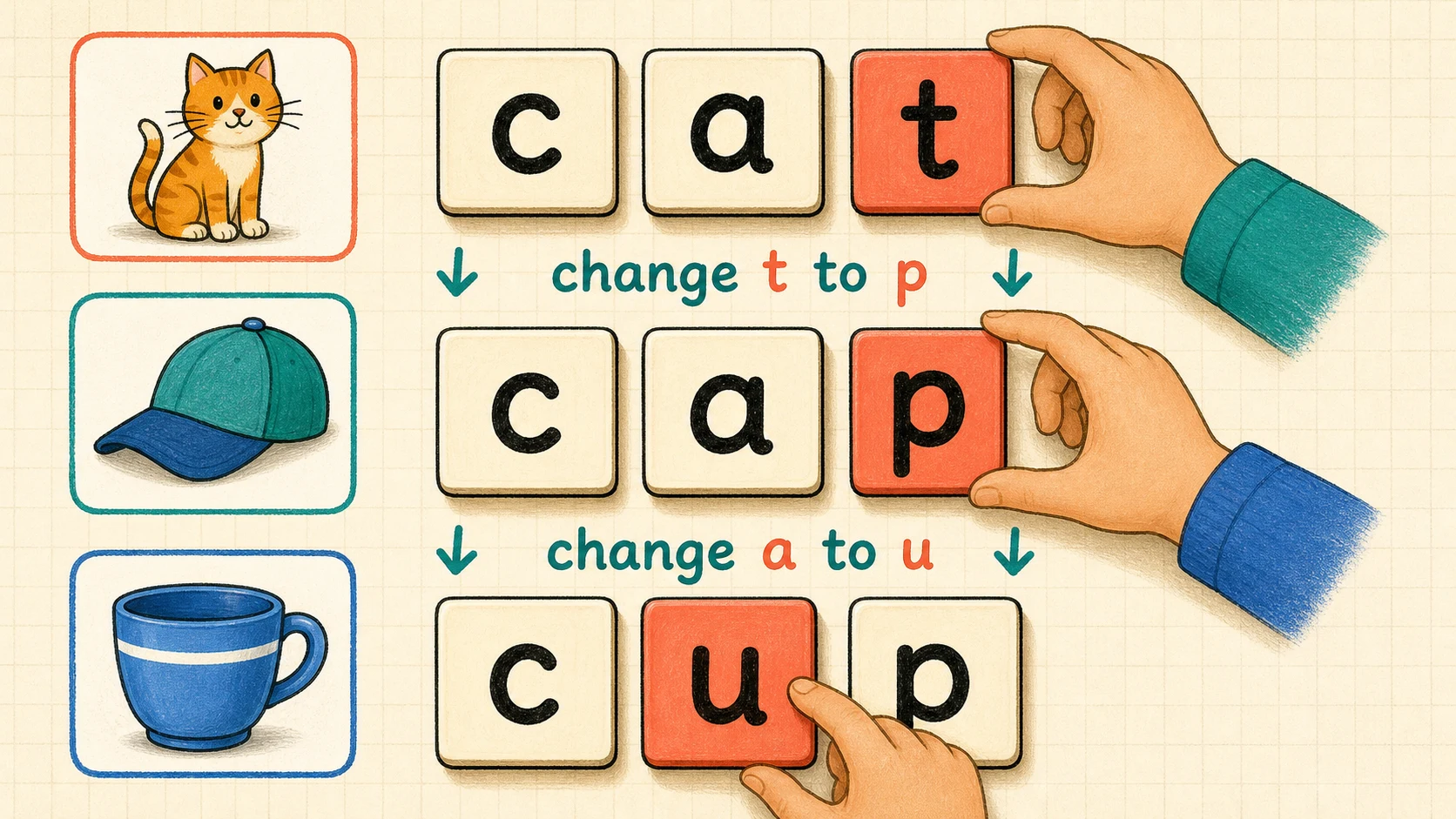
Check the spoken word, middle sound, chosen letter, and final blend in that order.
Sound confusion
The learner says the intended word correctly but identifies the wrong middle sound. For example, with the practice form p_n, the learner says pin but reports /ĕ/.
Return to oral comparison: pin, pen. Ask the learner to listen only to the middle. Use counters if necessary. This is primarily a listening and phoneme-identification issue, so repeatedly naming vowel letters may not address it.
Sound-to-letter confusion
The learner correctly hears /ĭ/ in pin but writes e. The spoken analysis is sound, but the letter association is not secure.
Show i and e, say the relevant short sounds, and let the learner select again. Then have the learner write the corrected word and blend it. Record that the learner needed help connecting the sound to its spelling.
Guessing from the outside consonants
The learner sees b_d, writes a vowel immediately, and does not say or reread the word. Because several letter strings may form real words—bad, bed, bid, and bud—the outside consonants alone may not determine one unique answer.
This is a boundary case inherent in missing-vowel tasks. The worksheet context, any included picture or prompt, and the official answer key determine the intended item. Do not tell the learner that every visible consonant frame has only one possible English completion. Ask for the intended word first, then its middle sound.
Letter-name reasoning
A learner may say, “It sounds like the name of e,” while working with bed. Short-vowel sounds are not the same as the vowel letter names. Briefly contrast the letter name with the sound used in the word, then return to blending. Keep the correction tied to the current example rather than launching an unrelated long-vowel lesson.
Correct vowel, weak blending
A correct written answer does not prove that the learner decoded the completed word. If the learner fills blanks accurately but cannot blend the results, practice continuous blending across all three letters. The IES foundational skills guide provides the relevant high-level framing for linking sounds with letters and teaching word decoding.
Errors caused by the task format
Check whether the learner misunderstood the direction, lost their place, copied a neighboring vowel, or formed a letter ambiguously. These are different from a short-vowel misconception. Clarify the format or response, then provide another comparable phonics item before drawing a conclusion.
Use the Answer Key Responsibly
Keep the printable answer key out of view during the initial attempt. When checking, compare one item at a time and mark the learner’s original response before making changes. An adult can use a simple notation:
- C: correct without help;
- P: correct after a prompt;
- R: corrected after reworking;
- N: not yet correct.
These labels are an optional recording system, not a standardized score.
When an answer differs from the key, first verify the printed item and intended word. Then ask the learner to repeat the sound-to-letter process. The answer key confirms the expected response; it does not explain the cause of an error or establish independent mastery.
Do not let the learner copy corrected vowels over every mistake without rereading. A responsible correction includes four actions: say the word, isolate the middle sound, write the correct vowel, and blend the completed word. Later, check one or two comparable words without the corrected page visible.
Decide What to Teach Next
The next step should follow the pattern in the learner’s work.
Continue with the same level
Stay with easy missing-vowel CVC practice when the learner understands the task but still needs occasional help hearing, selecting, or blending short vowels. Reuse only a portion of the page, change the order, or create comparable practice through the free worksheet generators.
Narrow the focus
If errors cluster around one contrast, such as short i and short e, practice that contrast with a small set of fully decodable examples. Keep the outside consonants clear and ask the learner to say each word before writing.
If oral segmentation is the main difficulty, use three sound boxes without print, then restore the letters. If vowel letters are the difficulty, maintain oral success while practicing the relevant sound-symbol matches.
Move beyond the blank format
When the learner fills missing vowels accurately and reads the completed words independently, check full-word spelling from dictation. For example, say sun without showing s_n and ask the learner to segment and write all three letters.
Next, mix reading and spelling so the learner must both decode and encode CVC words. The catalogue’s CVC words topic guide provides the broader progression, including practice across the five short-vowel families and other activity formats. Link back to that progression instead of treating this single printable as a complete course.
The Common Core ELA standards provide grade-specific literacy expectations within a broader framework for reading, writing, speaking, listening, and language. The catalogue associates CVC practice with blending, isolating sounds, letter-sound knowledge, and decoding regularly spelled one-syllable words. That context should not be presented as comprehensive standards alignment for this individual worksheet, and local sequences may organize the skills differently.
Schedule Retrieval Based on Observed Work
Retrieval means asking the learner to produce the sound, letter, word, or spelling again without copying the completed page. Its purpose here is to check whether the learning remains available after the original practice.
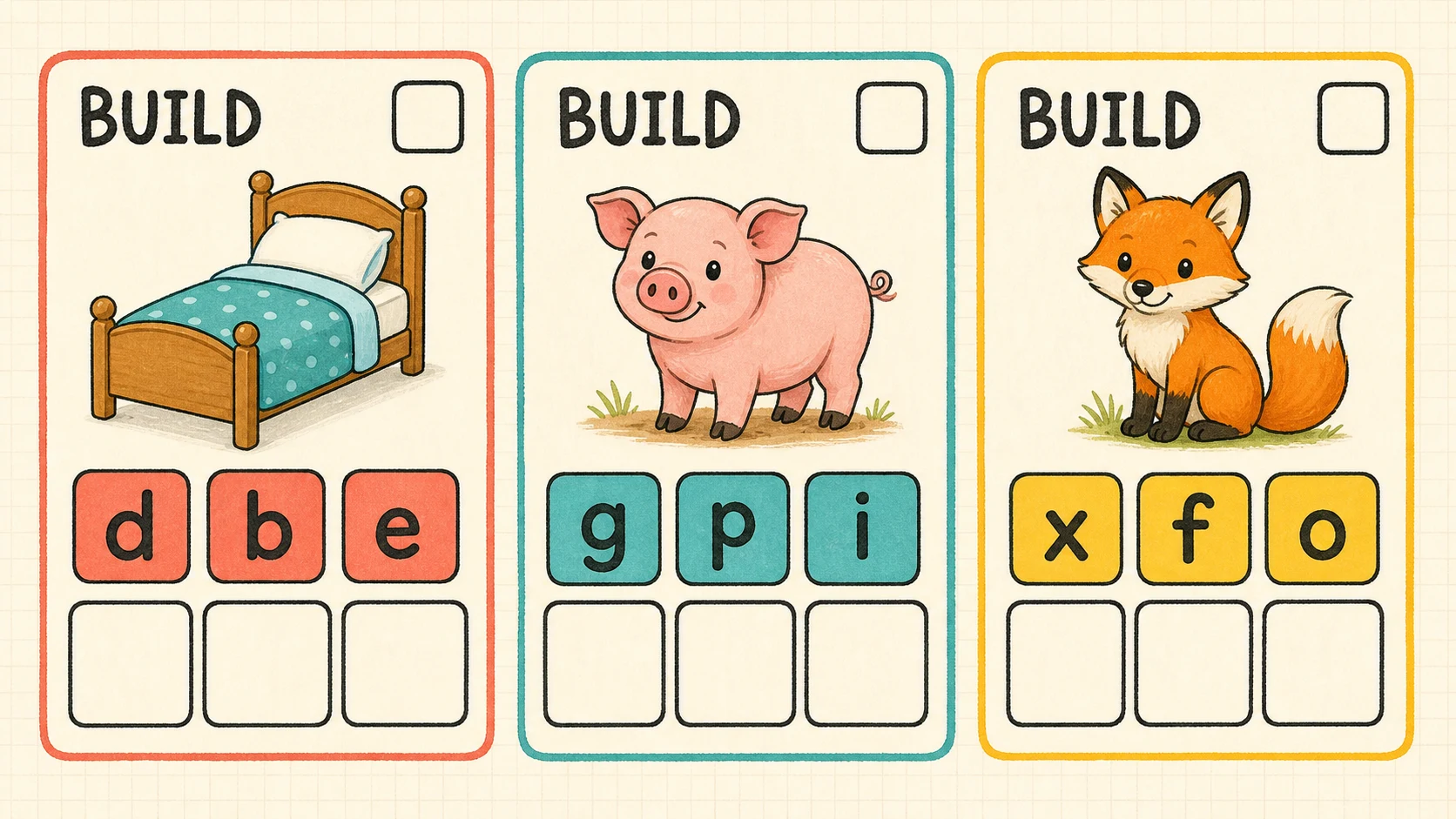
Revisit a small sample after increasing delays, adjusting the schedule when the learner’s work calls for it.
A practical, adjustable plan is:
| Review point | Suggested check | Decision |
|---|---|---|
| End of the lesson | Rework two corrected items and read two accurate items | Reteach immediately if the learner cannot explain the vowel choice |
| Next learning session | Complete three to five comparable missing-vowel words without the old page | Keep support if the same confusion returns |
| Several days later | Read some CVC words and spell two or three from dictation | Mix vowel families only if accuracy remains stable |
| A later weekly review | Include a small CVC sample among other taught phonics skills | Return to focused practice if errors reappear |
This is a practical suggestion, not a universal schedule. A learner who remembers the words but cannot handle new examples needs generalization practice, not more memorization of the same page. A learner who succeeds after a delay can move toward mixed CVC reading and full-word spelling.
Limits of the Printable
This worksheet is a focused 20-item exercise, not a diagnostic instrument. It cannot by itself show whether an error arose from hearing the word, identifying the phoneme, recalling the vowel letter, blending print, understanding vocabulary, managing attention, or forming letters.
It also does not cover every part of early reading. It does not replace connected-text reading, broader vocabulary work, or instruction in later phonics patterns. The IES reading guide includes connected text as part of its wider foundational-reading recommendations, but that high-level recommendation should not be misrepresented as an evaluation of this page.
Finally, familiar words can sometimes be recognized from memory. To verify transferable decoding, use unfamiliar but regular examples, and to verify encoding, ask for whole-word spelling without a printed frame.
The Most Useful Next Action
Print the free worksheet and answer key, choose four items for modeling and guided practice, and reserve the rest for an independent attempt. Record which responses were independent, prompted, or corrected. Then revisit three comparable words during the next learning session without showing the completed page.
If that retrieval check is secure, continue through the CVC words topic guide or use the 18-worksheet 1st Grade CVC Words Worksheet Pack for broader practice. If errors cluster around a particular vowel, use a free worksheet generator to create a short, focused follow-up while keeping the skill at the CVC level.
Put it into practice
Use the guide with a real printable
Move from explanation to a short, observable practice task. Check the first item together, then adjust the next session from the learner's actual work.
See the 18-worksheet pack