Complete guide
How to teach and practise 1st grade consonant blends worksheets - standard theme (easy)
What this consonant blends worksheet teaches
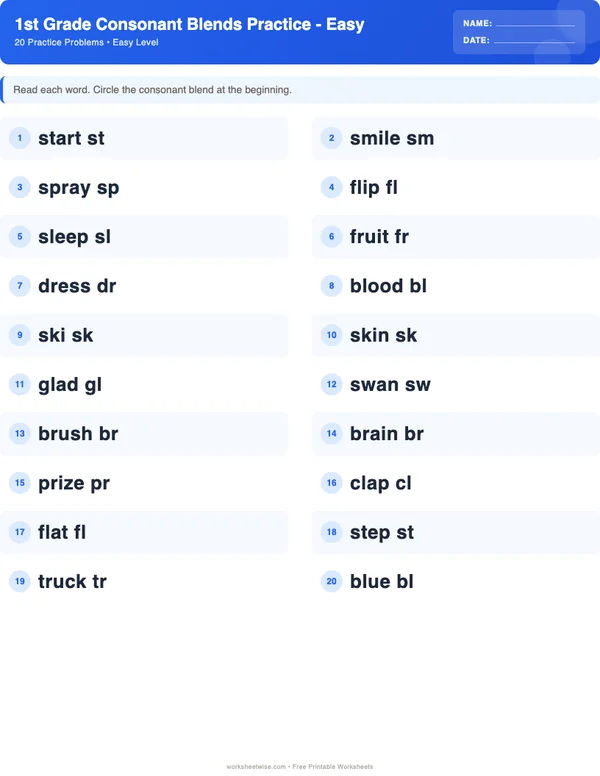
The free 1st Grade Consonant Blends worksheet gives a learner 20 easy-level exercises with one consistent direction: Read each word. Circle the consonant blend at the beginning. It practices identifying initial consonant blends while also supporting phonics decoding and word recognition. A separate printable answer key is included.
The short answer: model how to read the whole word, listen for both opening consonant sounds, and circle only the two- or three-letter blend. Complete a few items together, let the learner attempt the rest, and use errors to decide whether the next session should repeat the same skill, reduce the number of blends being compared, or move into connected reading.
The worksheet is intended for a 1st Grade practice level, but a grade label is not a timetable for every learner. Local curricula and instructional sequences differ. Begin with what the learner can currently hear, read, and explain rather than assuming that age or grade placement determines readiness.
Use a brief model, guided practice, independent work, error review, and later retrieval rather than treating the printable as a one-step assignment.
Prepare the lesson without overloading it
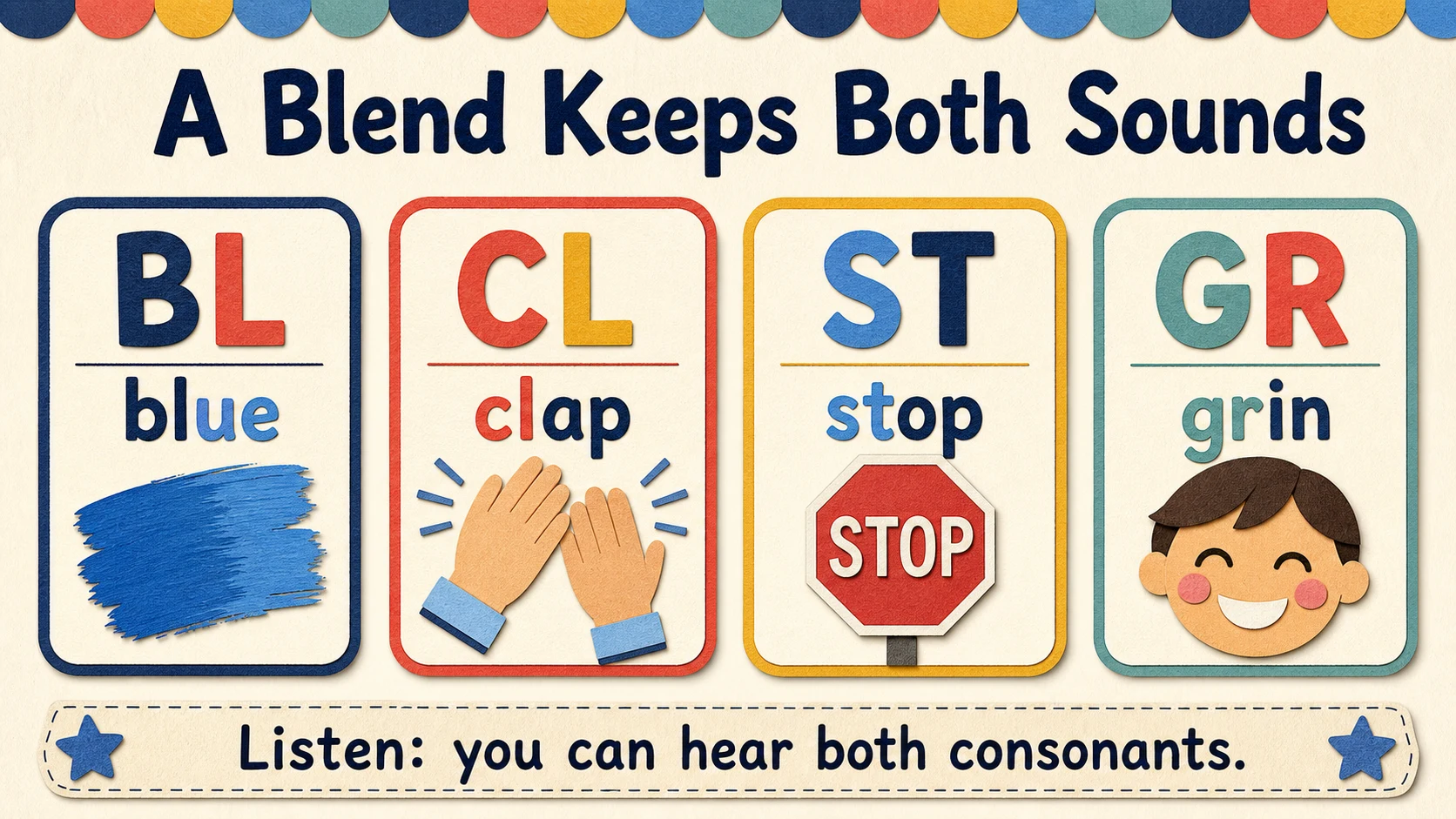
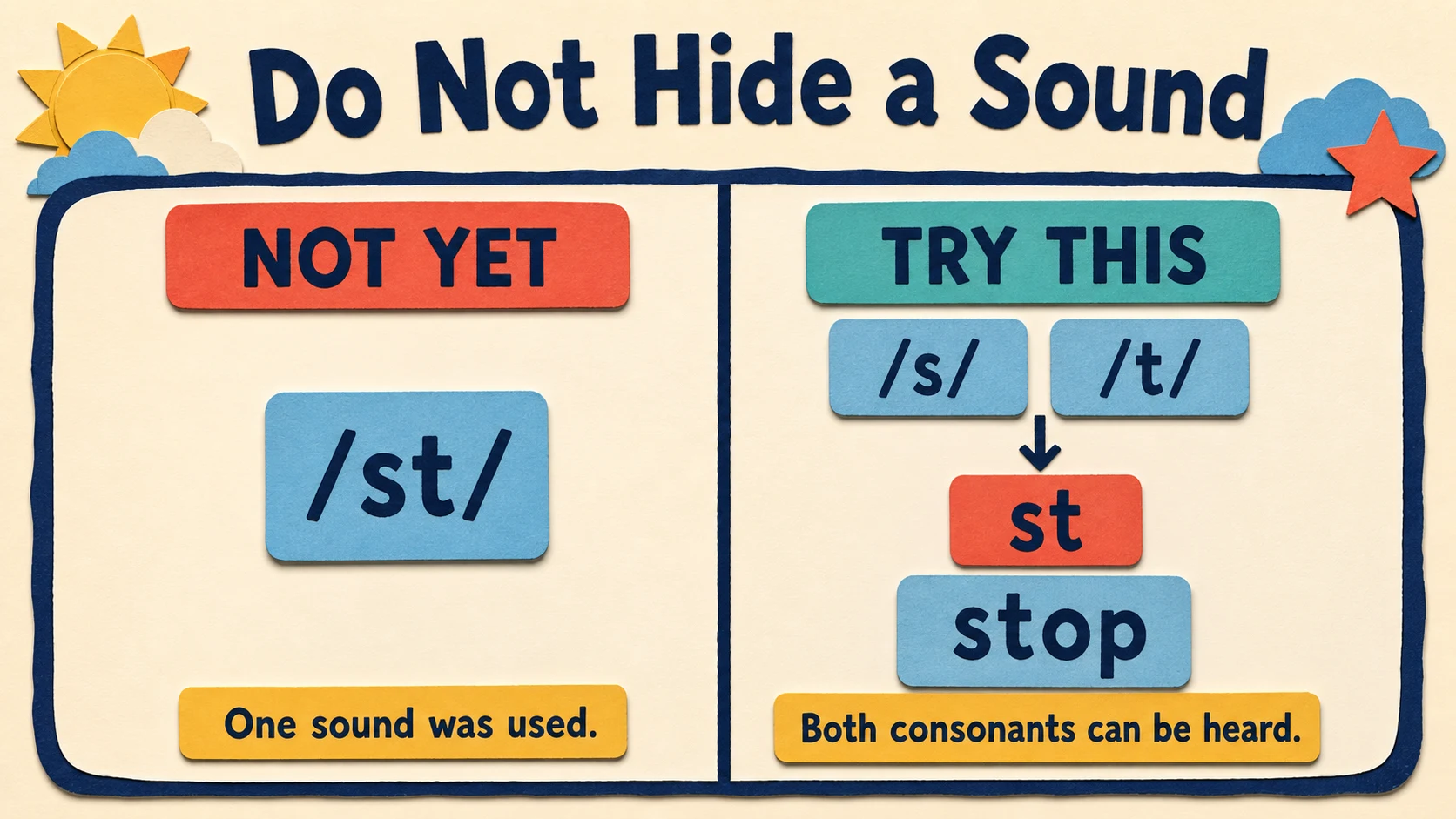
This printable has a narrow purpose: recognizing consonant blends at the beginnings of words. In a blend, each consonant keeps an audible sound. For example, the beginning of stop contains /s/ followed by /t/. The letters work closely together, but neither sound disappears.
Before the session, print the worksheet and keep the answer key out of the learner’s view. Have a pencil or crayon available. If circling tightly around two letters is difficult, a highlighter or underlining can be used during teaching, followed by circling when the learner is ready. That changes the response method, not the phonics skill.
Review the directions aloud. Ask the learner to restate the job in plain language, such as, “I read the word and circle the letters for the two sounds at the start.” This quick restatement helps reveal whether the learner understands the task before any reading difficulty becomes involved.
Do not preteach every blend that might appear. Instead, check a few prerequisite behaviors:
- Can the learner read or sound out a simple one-syllable word?
- Can the learner identify the first sound in a spoken word?
- Can the learner hear two opening sounds in a word such as flag or stop?
- Can the learner distinguish the beginning of a word from its middle and end?
If these are difficult, the worksheet can still be used in a more supported way. The adult may pronounce the word while the learner identifies the opening blend. If the learner cannot yet hear both consonants even with a clear model, pause the written task and practice orally with two or three examples.
The broader consonant blends topic guide explains the larger progression, including initial and final blends. Use that guide for sequence decisions rather than asking this single printable to cover the entire topic.
Follow a compact lesson progression
The following plan is an instructional suggestion for this particular worksheet, not a universal timetable. Shorten, extend, or divide the work according to the learner’s observed accuracy, effort, and explanations.
| Lesson phase | Adult action | Learner action | Evidence to notice |
|---|---|---|---|
| Orientation | Read the title and directions; explain what counts as an initial blend | Restate the task | Understands what to circle |
| Oral warm-up | Say two or three blend words without showing them | Repeats or separates the opening sounds | Hears both consonants |
| Modeling | Demonstrate one example similar to the worksheet | Watches and explains the choice | Connects sounds to letters |
| Guided practice | Complete two or three items together | Reads, points, and circles | Uses the routine with prompts |
| Independent practice | Release the remaining appropriate items | Reads and marks without immediate correction | Shows current independent control |
| Review | Discuss selected correct and incorrect responses | Rereads and explains | Can self-correct or use feedback |
| Retrieval | Revisit a small sample later | Identifies blends without copying prior marks | Retains the process over time |
The IES foundational reading practice guide supports explicit instruction in foundational reading skills and opportunities to apply sound–spelling knowledge in word reading. It did not evaluate WorksheetWise or this exact worksheet. Here, the source supports the high-level choice to model clearly and connect spoken sounds with printed letters; the particular lesson sequence above is a practical suggestion based on the worksheet’s stated task.
Model the task with a complete think-aloud
A useful model is brief enough to imitate. Avoid turning it into a long explanation that the learner must remember while also decoding.
Show what to look at first
Use a separate example such as flag. Point to the entire word and say:
- “I will read the whole word: flag.”
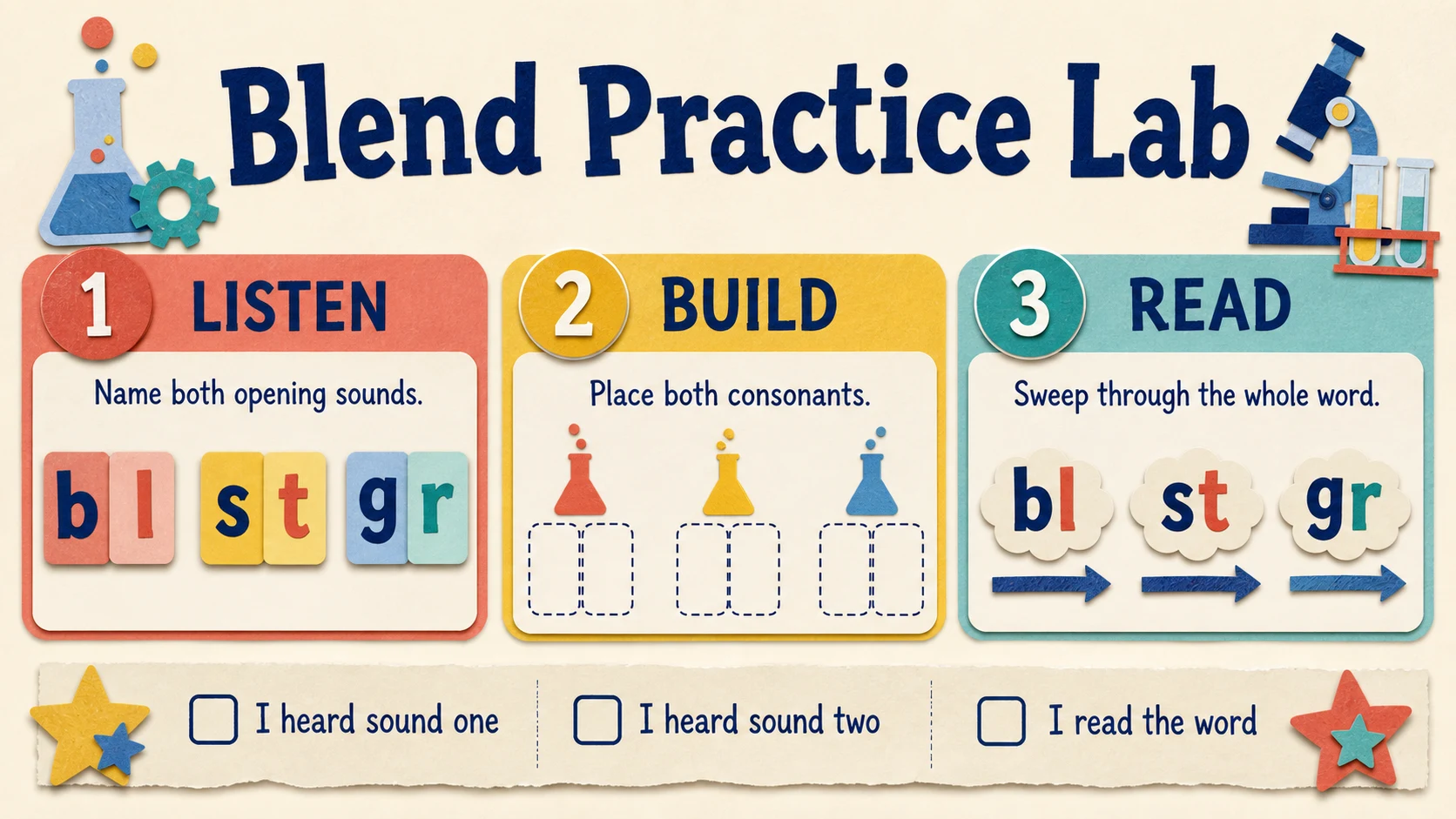
- “Now I will listen to its beginning: /f/ /l/.”
- “I can hear both sounds.”
- “The letters fl spell those opening sounds, so I circle fl.”
Then reread the word normally. The final rereading matters because the activity concerns a feature inside a whole word, not an isolated letter pair.
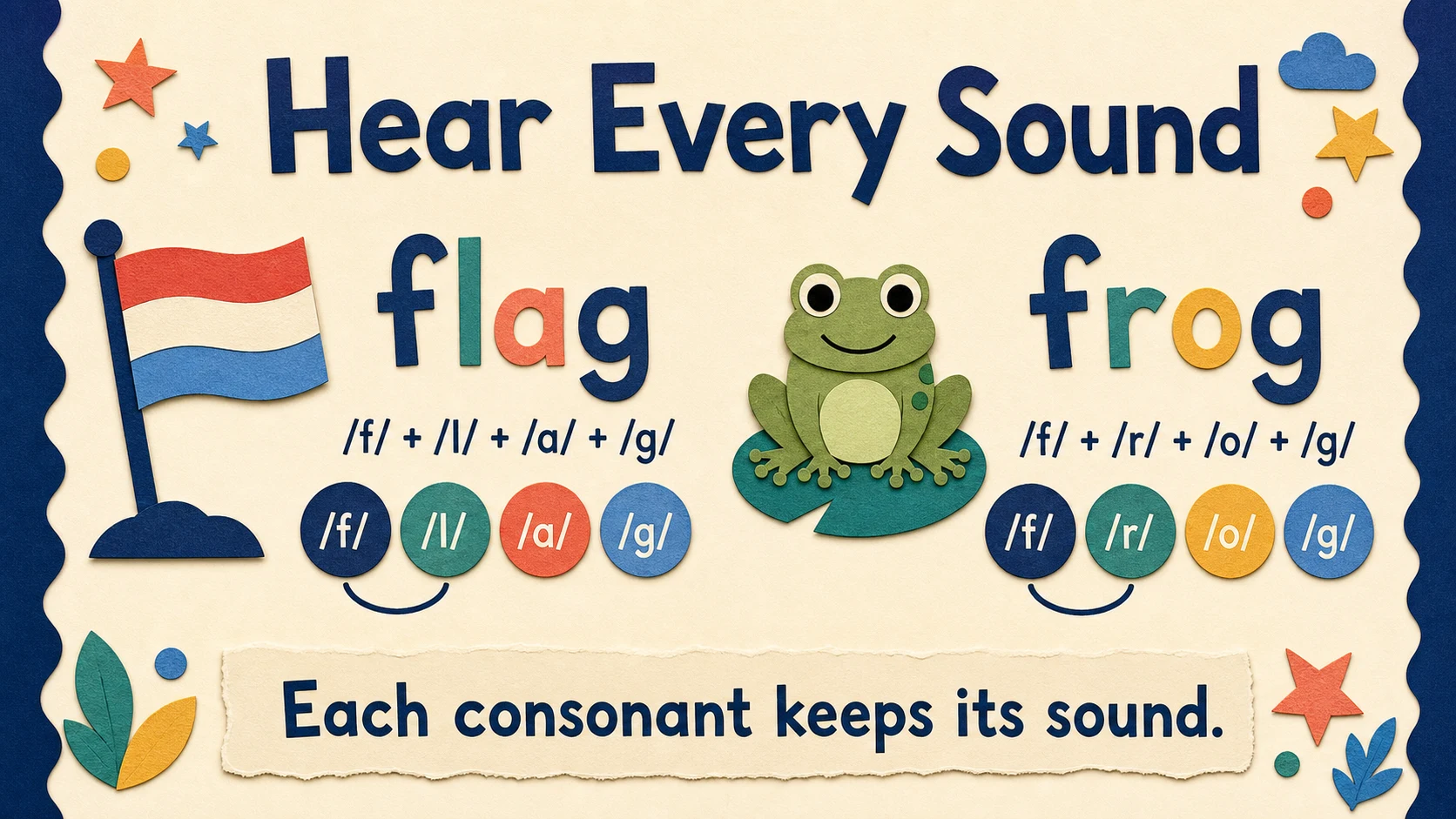
Read the whole word, separate its opening sounds, match those sounds to letters, and then circle the blend.
Contrast a correct choice with a tempting wrong one
With stop, compare st and sto. Say the word slowly without distorting it: /s/ /t/ /ŏ/ /p/. The opening blend is st. The o is the vowel and is not part of the consonant blend.
This contrast prevents a common task misunderstanding: circling the entire first syllable or the first three letters simply because they appear together. The learner should use both sound and letter information.
Keep the learner active during the model
After demonstrating, ask one focused question: “Which two sounds did you hear before the vowel?” If the learner says /f/ and /l/ for flag, ask them to point to the letters that represent those sounds.
Avoid asking only, “Do you understand?” A learner can agree without yet being able to perform the steps. Pointing, saying the sounds, and explaining the circle provide clearer evidence.
Use fully checked examples before independent work
The examples below are similar to the worksheet’s stated skill. They are not claims about which words appear among its 20 items.
Example 1: stop
Read the word: stop.
Segment it as /s/ /t/ /ŏ/ /p/. The initial consonants are s and t, and both sounds are retained. Circle st.
Checked answer: st is the initial consonant blend. Do not circle sto, because o is the vowel. Do not circle only s, because that omits the audible /t/.
Example 2: clap
Read the word: clap.
Segment it as /k/ /l/ /ă/ /p/. The spelling cl represents the first two consonant sounds. Circle cl.
Checked answer: cl is the blend. A learner who circles only c may be attending to the first letter but not yet holding both opening sounds.
Example 3: frog
Read the word: frog.
Segment it as /f/ /r/ /ŏ/ /g/. The opening sounds /f/ and /r/ correspond to fr. Circle fr.
Checked answer: fr is the blend. The letter r is not a vowel, and its sound remains audible after /f/.
Example 4: drum
Read the word: drum.
Segment it as /d/ /r/ /ŭ/ /m/. Circle dr.
Checked answer: dr is the initial blend. In ordinary speech, the beginning may sound compressed. Stretching it slightly as /d/ /r/ can make both consonants easier to notice without changing the word.
Example 5: slip
Read the word: slip.
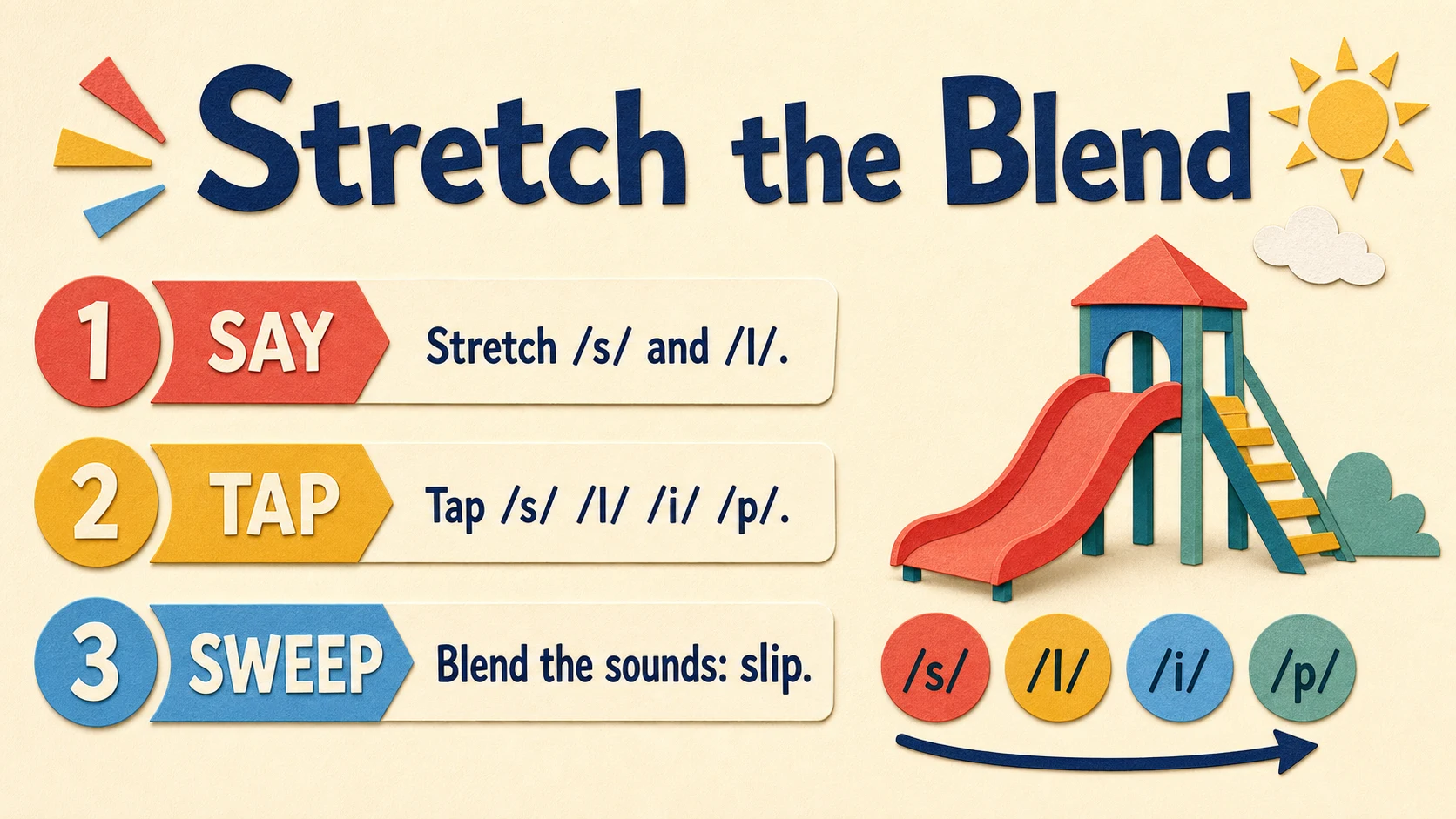
Segment it as /s/ /l/ /ĭ/ /p/. Circle sl.
Checked answer: sl is the blend. The continuous /s/ can be held briefly—“sssslip”—to make the transition into /l/ easier to hear.
Example 6: trip
Read the word: trip.
Segment it as /t/ /r/ /ĭ/ /p/. Circle tr.
Checked answer: tr is the initial blend. The learner should circle the printed consonants, not an approximate spelling based only on how the word sounds in conversational speech.
These examples verify the method across s-, l-, and r-blends. They do not imply that a learner must master all blend families in one sitting.
Move from guided practice to independent work
Guide the first few decisions
On a worksheet item, ask the learner to follow a repeatable routine:
- Read the whole word.
- Say it again slowly.
- Name or stretch the sounds at the beginning.
- Point to the matching letters.
- Circle the blend.
- Reread the word.
During guided practice, prompts should direct attention without giving away the answer. “Listen again to the beginning” preserves more thinking than “Circle the first two letters.” The latter can create a visual shortcut that fails when a word begins with only one consonant or with a different spelling pattern.
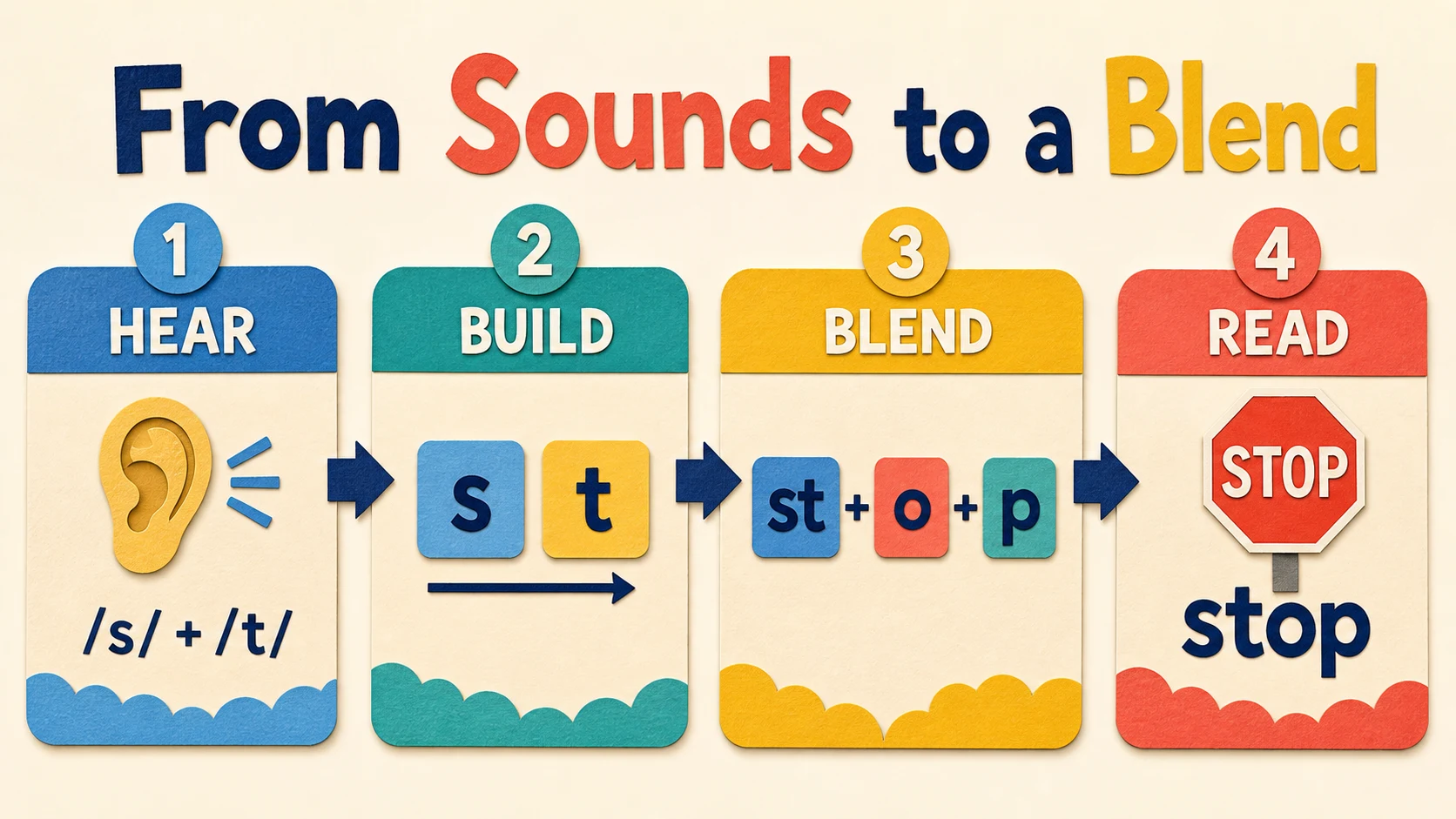
Guided practice should make the decision process visible before prompts are gradually removed.
Decide when to release responsibility
After two or three guided items, ask the learner to complete one while explaining the steps. If the word is read accurately and the blend is identified without the answer being supplied, reduce your prompting.
Independent practice does not require silence or isolation. It means the learner makes the phonics decision. An adult may still help with a confusing direction, a broken pencil, or an unfamiliar picture if one is present, but should avoid signaling the correct letters.
The 20 items do not have to be finished in one session. Stop or split the page if attention fades, guessing increases, or handwriting effort begins to obscure what the learner knows. Mark where to resume without labeling the unfinished work as failure.
Preserve a clean sample of independent performance
If possible, leave several consecutive items unprompted. This gives more useful information than alternating between adult hints and learner answers throughout the page. Note the kind of help given on earlier items so that a supported response is not later mistaken for independent mastery.
The IES writing practice guide addresses elementary writing instruction at a broad level, including explicit teaching and supported practice. It does not assess this worksheet. Its relevance here is limited: written marking should be taught clearly, while the phonics decision remains the central learning target.
Adapt support without changing the skill
Differentiation should alter access, amount, or prompting—not replace identification of an initial consonant blend with an unrelated activity.
Adjust sound support, visual load, or response method while keeping the same initial-blend decision.
When the learner needs more sound support
Read the word aloud after inviting an attempt. Then stretch only the beginning enough to reveal both sounds: “ssss-top,” “ffff-lag,” or “ssss-lip.” Ask the learner to repeat the word and touch one finger for each opening sound.
If two blend families are being confused, temporarily compare a small set. For example, practice clap, clip, and clog alongside frog, from, and fresh. The learner is still identifying blends in whole words, but the comparison is less crowded.
A word chain can also focus attention: lap → clap → clam. Ask what changed at the beginning and what remained. Use this as oral or written preparation, not as a substitute for returning to the worksheet.
When decoding load hides blend knowledge
The worksheet asks the learner to read each word, so decoding is part of the task. However, if an individual word prevents any attempt at the blend, pronounce that word and ask the learner to identify its opening consonants. Record mentally or on a separate note that the response was sound-supported.
This distinction matters. Identifying fl after hearing flag shows useful phonological and letter-pattern knowledge, but it is not identical to independently decoding flag. Both observations can guide instruction.
When visual or motor demands interfere
Cover nearby rows with blank paper and reveal one item at a time. Enlarge the page if the print is hard to track. Let the learner underline the blend before circling it, or point while the adult records the circle.
These accommodations preserve the target if the learner still makes the sound–letter decision. Do not interpret neater circles as stronger phonics knowledge.
When the work is immediately easy
Ask for a brief explanation on selected items: “How do you know?” Then have the learner read a short sentence or decodable passage containing familiar blends. The topic catalogue recommends applying learned blends in connected text, but this exact printable does not include a full reading progression.
Do not make the page harder by introducing unexplained digraphs, final blends, or multisyllabic words during the same assessment sample. Extension should be purposeful and separately identified.
Handle boundary cases and misconceptions carefully
A blend is not the same as every two-letter beginning
In a consonant blend, each consonant retains its sound. By contrast, a digraph such as sh, ch, th, or wh is treated as a different phonics pattern in the supplied catalogue. A learner who circles sh in ship may be following the visual rule “circle the first two letters,” but that does not demonstrate blend identification.
Likewise, a word beginning with a single consonant, such as map, has no initial consonant blend. If such a word is used for contrast outside the worksheet, the correct response is “no beginning blend,” not ma.
The blend does not include the vowel
In clap, circle cl, not cla. In frog, circle fr, not fro. If the learner consistently includes the vowel, revisit the definition and color-code consonants and the first vowel on a separate practice word.
Pronunciation can compress sounds
Some blends, especially those involving r, may sound tightly joined in natural speech. The instructional goal is not exaggerated pronunciation forever. A temporary, careful stretch helps the learner attend to both consonants before returning to normal word reading.
Initial and final blends are different locations
This worksheet specifically practices blends at the beginning. In hand, nd is a final blend, not an initial one. In stop, st is initial. A learner who finds a real blend at the end has noticed relevant phonics information but has not followed this page’s location requirement.
Three-consonant beginnings require the same principle
A word such as scrap begins with three consonants, scr, with each represented sound retained. Whether three-consonant blends appear on this exact printable is not stated in the supplied catalogue. Use such words only as an extension after the learner is secure with the worksheet’s actual items.
The Common Core English Language Arts standards include broad expectations involving phonological awareness and decoding regularly spelled one-syllable words. That context helps explain why blend work belongs within early reading instruction. It does not establish comprehensive standards alignment for this particular WorksheetWise page, and local standards or teaching sequences may organize the skill differently.
Interpret errors before choosing a response
A total score can summarize the page, but the pattern of errors is more instructionally useful. Review incorrect answers and a small sample of correct ones.
Check whether the difficulty came from reading the word, hearing both sounds, locating the beginning, or marking the letters.
| Observed response | Possible interpretation | Useful next check |
|---|---|---|
| Circles only the first consonant | May be dropping the second sound | Ask the learner to tap each opening sound |
| Circles the blend plus the vowel | May think “beginning” means the first chunk | Contrast st with sto in stop |
| Circles a middle or final pair | May not understand location language | Point to beginning, middle, and end in one word |
| Reads the word incorrectly but circles a plausible pair | Decoding and blend recognition may be interacting | Pronounce the word and ask for the blend again |
| Gets an item right but cannot explain it | May know the pattern or may have guessed | Ask for sounds and letters on a fresh example |
| Confuses a digraph with a blend | May be using a two-letter visual rule | Compare a blend with a digraph explicitly |
| Performs well early, then guesses | Attention or workload may be affecting the sample | Review the final section after a break |
These are hypotheses, not diagnoses. One response cannot reveal its cause with certainty. Ask the learner to reread, explain, or try a closely matched example before deciding what the error means.
Avoid replacing a wrong answer immediately. Say, “Read the word again. What two sounds come before the vowel?” If the learner self-corrects, note that the skill is emerging but not yet automatic. If the learner succeeds only after you isolate the sounds, plan more guided practice.
Use the answer key responsibly
The separate answer key makes checking efficient, but it should confirm analysis rather than replace it.
First, examine the learner’s page without the key. Notice which letters were circled, how words were read, and where prompting occurred. Then compare each response with the printable key. If your interpretation and the key appear to conflict, reread the printed word, identify each opening sound, and verify that only the initial consonant blend has been marked.
Do not give identical credit to answers completed under different levels of support. A simple notation can preserve context:
- I for independently correct
- P for correct after a prompt
- M for correct after an adult model
- R for not yet correct after review
These codes are an instructional record, not an official grading system. They help an adult avoid concluding that a learner independently controls a skill when most answers required assistance.
Let the learner participate in selected corrections. Cover the key, return to the word, and use the sound routine. After the learner makes a new decision, consult the key together if appropriate. The answer key should not become a copying sheet or a public ranking tool.
Decide what to teach next
Use several pieces of evidence: independent items, prompted items, oral explanations, and the ability to read a fresh example. A single percentage should not control the decision.
If the learner often omits one consonant, continue with a small set of initial blends and finger-tap both sounds before blending the word. If the learner hears both sounds but circles the wrong span, focus on matching sounds to printed letters. If reading the whole word is the main obstacle, use easier decodable words while preserving initial-blend identification.
If most responses are independently accurate and the learner can explain several choices, move beyond repeated circling. Read blend words in short phrases or sentences, sort words by their initial blend, or use a word chain. The 1st Grade phonics collection can provide related practice, while the broader 1st Grade worksheet hub places phonics alongside other intended grade-level work.
For a larger set of related materials, the 1st Grade Consonant Blends Worksheet Pack contains 18 worksheets and is listed at $4.79 in the supplied catalogue. That pack is an option, not a required next step. Choose it only if repeated practice in this topic matches the learner’s observed need.
Schedule retrieval instead of immediate repetition alone
Finishing the page once does not show whether the learner can retrieve the skill later. Revisit a few unmarked or newly written words after time has passed.
Sample a few blends after increasing delays and adjust the spacing when the learner’s work shows a need.
A practical, flexible schedule might be:
| Time | Brief retrieval task | Decision |
|---|---|---|
| Later the same session | Identify blends in two fresh words | Reteach immediately if both sounds are still being dropped |
| Next learning session | Read and mark three to five mixed words | Keep support only where errors recur |
| Several days later | Identify familiar blends in words or a short sentence | Continue spacing if performance remains independent |
| The following week | Mix initial-blend words with simple contrast words | Check that the learner is using the definition, not circling every first pair |
This is a suggested structure, not a universal timetable. Retrieval should be short and effortful enough to reveal memory, but not so difficult that it becomes repeated failure. If accuracy collapses after a delay, shorten the interval and restore a brief model. If the learner responds accurately and explains why, increase the interval or apply the skill in connected text.
Recognize what this printable cannot establish
This 20-item easy worksheet provides a focused sample of initial-blend identification. It cannot, by itself, establish complete phonics proficiency, reading fluency, comprehension, spelling mastery, or control of every initial and final blend.
Correct circles may reflect genuine understanding, a visual “first two letters” shortcut, memory from earlier prompting, or successful guessing. That is why occasional explanations and fresh examples matter. Conversely, an incorrect circle may result from decoding difficulty, misunderstanding the directions, losing place on the page, or trouble producing the mark. It does not automatically mean the learner lacks all knowledge of consonant blends.
The worksheet also should not be used for medical or diagnostic conclusions. If persistent reading concerns extend beyond this task, document specific observations and discuss them through the learner’s usual educational support process.
For the next session, revisit two missed patterns with fresh words, then choose a related activity from the consonant blends topic guide. If the learner is ready for varied practice, create a short, targeted follow-up through the free worksheet generators and check whether the skill transfers without copying the completed page.
Put it into practice
Use the guide with a real printable
Move from explanation to a short, observable practice task. Check the first item together, then adjust the next session from the learner's actual work.
See the 18-worksheet pack