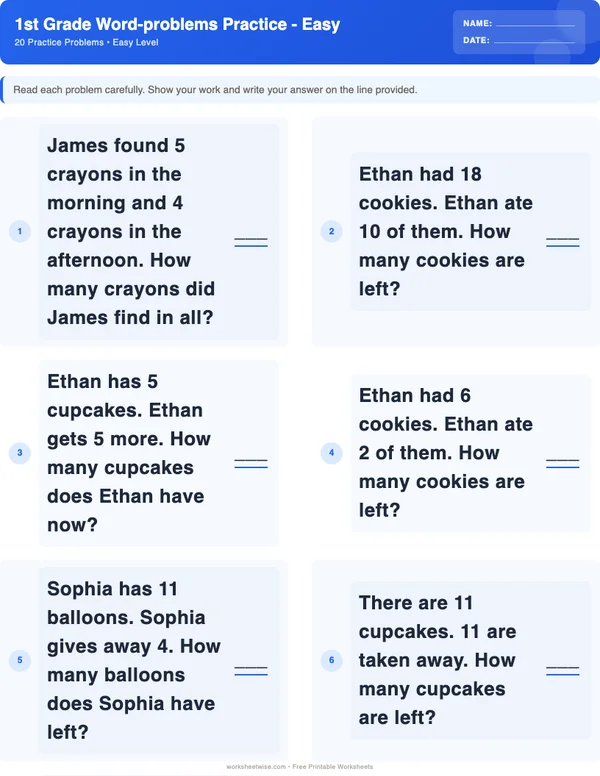
Complete guide
How to teach and practise 1st grade word problems worksheets - standard theme (easy)
How to Use This 12-Problem Worksheet
The free 1st Grade Word Problems Worksheets—Standard Theme (Easy) printable contains 12 story problems. It is intended for learners beginning word-problem practice or needing additional reinforcement. The directions ask the learner to read each problem carefully, show the work, and write the answer on the provided line. A separate printable answer key is included.
The short answer: use the first problem to demonstrate a repeatable routine, solve the next two or three together, and then release the remaining items gradually. Ask the learner to explain what is happening before choosing an operation. If the explanation is unclear, provide reading or visual support without supplying the mathematical relationship. Check the completed work against the answer key only after examining the learner’s equations, drawings, and answers.
This worksheet’s catalogue lists problem solving, reading comprehension, multi-step reasoning, and mixed operations among its skills. Because the individual items may not all create the same demand, let the learner’s observed work determine how many problems belong in one sitting. Finishing all 12 at once is not the goal; understanding the stories and representing them accurately is.
Grade labels describe an intended practice level, not a guarantee that every learner in that grade is ready for the same task. Local curricula and teaching sequences differ. The Common Core State Standards for Mathematics provide one useful reference point: first-grade operations and algebraic thinking include addition and subtraction word problems within 20. Use the actual quantities and structures printed on this worksheet—not the grade label alone—to judge whether it fits the learner’s current instruction.
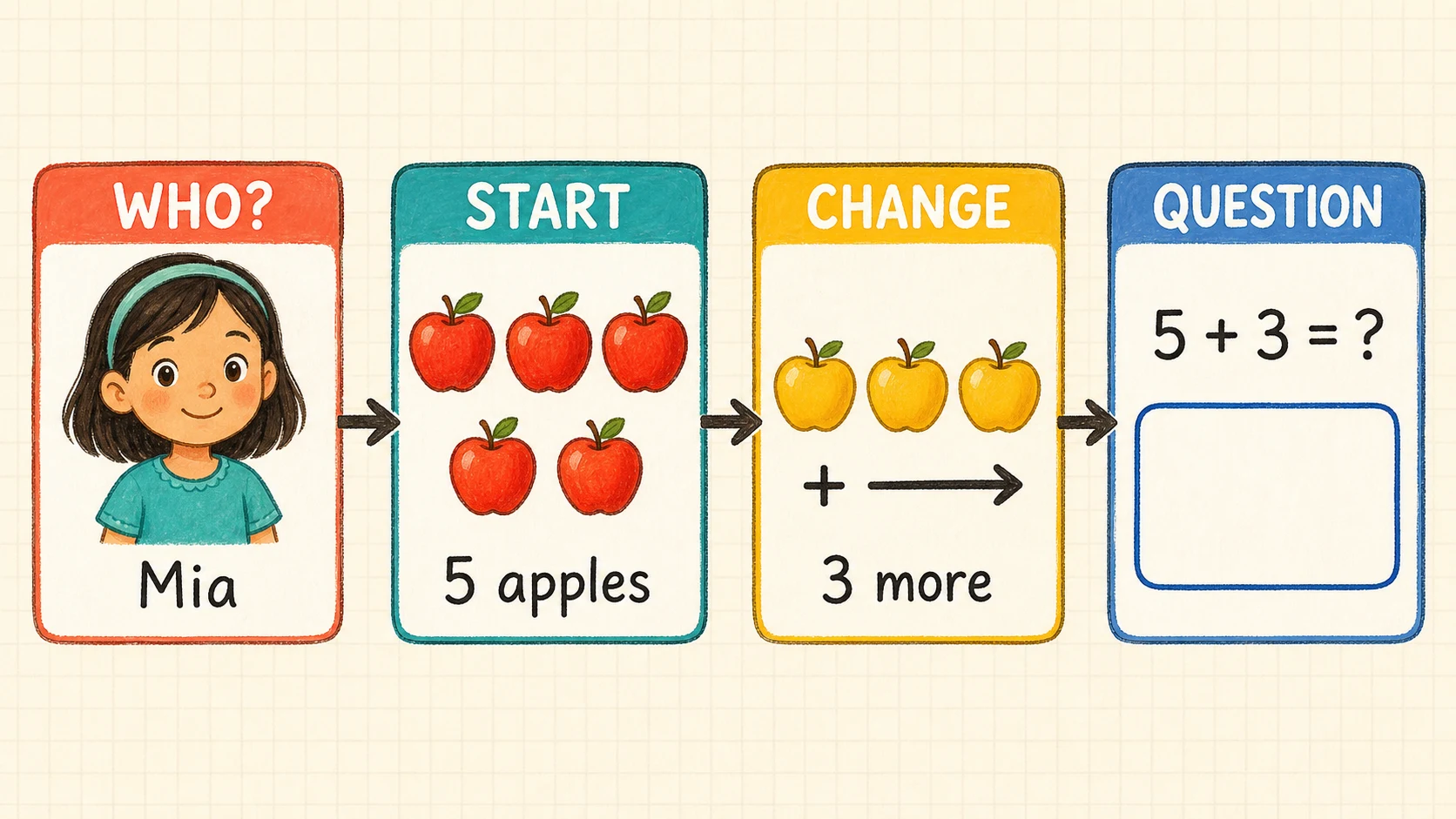
Move from a brief launch to modeling, guided practice, independent work, and a final check.
Prepare the Learner and the Materials
Print the worksheet and keep its answer key separate. The adult may also want blank paper, a pencil, small counters, and two crayons or colored pencils. These are optional supports, not separate activities. Each should help the learner understand or represent the same problem printed on the page.
Before beginning, confirm three prerequisites with quick oral prompts:
- Can the learner count the quantities used in the opening problem?
- Can the learner join or separate two small groups with objects?
- Can the learner tell what a simple story is asking them to find?
A learner does not need fast recall of every fact before attempting a word problem. Counters, fingers, drawings, or a number line can carry some of the computational load. However, if the learner cannot yet represent the quantities even with objects, pause the printable and practice that underlying number idea first through the 1st Grade Math collection.
Set a clear purpose
Say something concrete: “These stories give us numbers and ask us to find a missing amount. We will understand the story, show it with math, solve it, and check it.”
Avoid introducing an operation-keyword chart. A word such as “left” often appears in subtraction stories, but isolated words do not establish what happened. The broader Word Problems topic guide explains the progression and representation strategies in more depth. For this lesson, keep attention on one stable routine applied to the 12 printed items.
Use a six-step routine
Write or say these steps in learner-friendly language:
- Read the whole problem.
- Retell what happened.
- Name what is known and what must be found.
- Show the quantities with objects, a drawing, or an equation.
- Solve and label the answer.
- Check the answer against the story.
This routine is consistent with the high-level emphasis on systematic instruction, mathematical language, representations, and monitoring described in the IES guide on teaching mathematics to young children. That guide did not review this WorksheetWise printable; it simply informs the instructional framing used here.
Follow a Flexible Lesson Progression
The following plan is an instructional suggestion, not a required or universal timetable. Shorten, divide, or repeat stages according to the learner’s work.
| Stage | Suggested problems | Adult role | Evidence to watch |
|---|---|---|---|
| Launch | No worksheet item yet | Explain the routine with a tiny oral story | Learner can retell what changed |
| Model | 1 item | Think aloud and record every step | Learner follows the connection between story and equation |
| Guided practice | 2–3 items | Prompt, wait, and reduce help when possible | Learner identifies known and unknown quantities |
| Supported independence | 2–3 items | Observe; give one prompt only when needed | Learner begins without being told the operation |
| Independent practice | Remaining suitable items | Let the learner complete a manageable set | Work shows a representation, solution, and label |
| Review | Selected errors and successes | Compare work with the key and discuss reasoning | Learner can explain or repair an answer |
| Retrieval | 1–3 saved or recreated problems later | Give minimal prompting | Learner recalls the routine after time has passed |
A natural stopping point occurs when accuracy or explanations deteriorate, the learner starts guessing operations, or reading fatigue hides the mathematics. Mark the stopping point and return later. Twelve items can serve as one lesson, two shorter lessons, or an initial lesson plus review.
Model the First Problem Without Taking Over
Choose the first printed item that the learner can hear and discuss comfortably. Read it exactly as written. Then model how a solver makes sense of it.
Think aloud about the situation
Use language such as:
- “First I am finding out who or what the story is about.”
- “I know these two amounts.”
- “I need to find this missing amount.”
- “The amount grows, so my drawing needs to show two parts joining.”
- “Now I will check whether my answer describes the story.”
Do not merely announce, “It says ‘in all,’ so add.” Instead, connect the operation to the quantities: two groups are being combined, one group is being removed, or two amounts are being compared.
The following examples are teacher-created illustrations similar in level and purpose. They are not claims about the wording or numerical content of the 12 printable items.
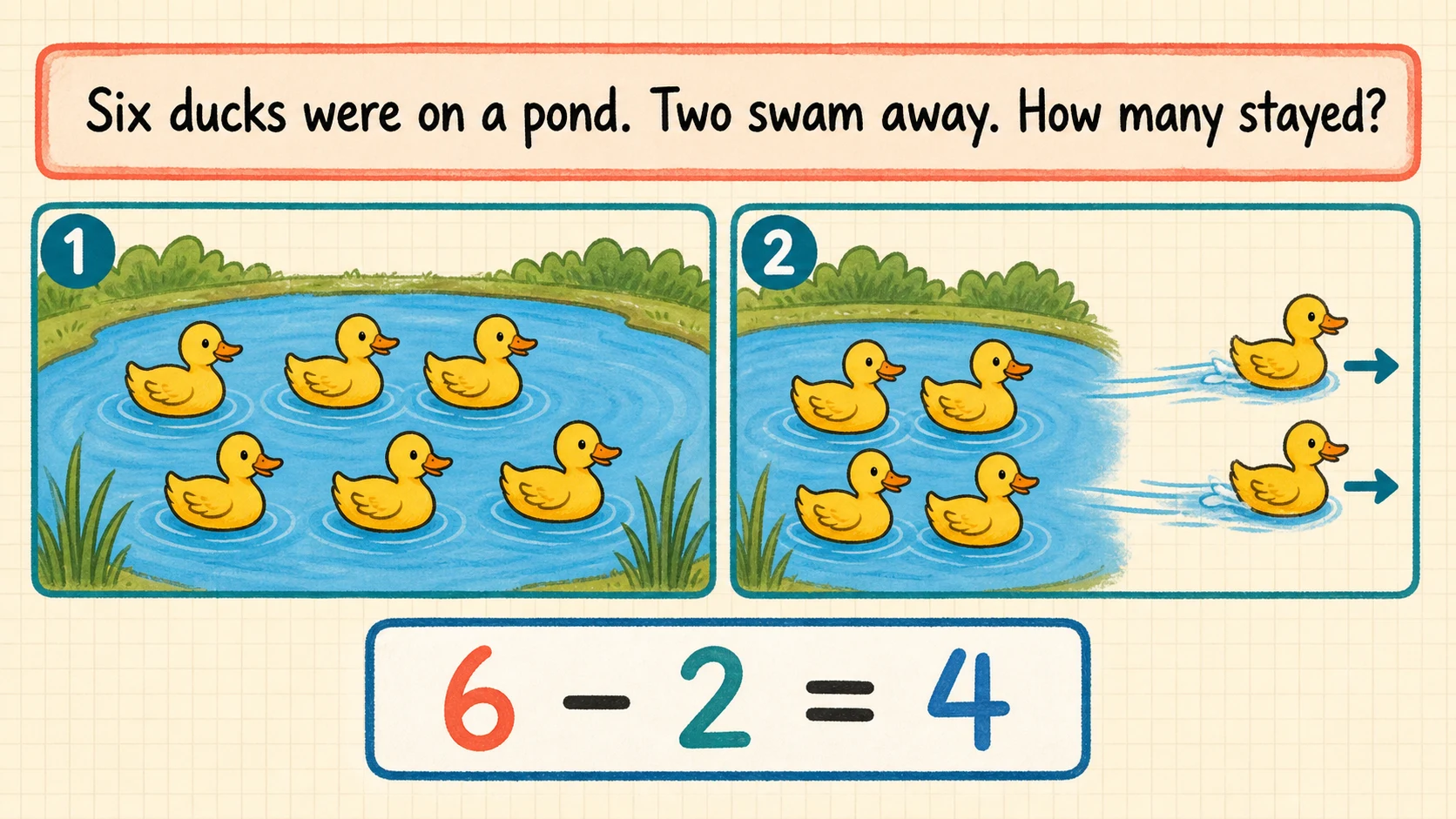
Model how the story, representation, equation, answer, and check refer to the same quantities.
Worked example 1: two parts make a whole
“Lena has 6 red blocks and 3 blue blocks. How many blocks does she have altogether?”
Known amounts: 6 red blocks and 3 blue blocks.
Unknown: the total number of blocks.
Draw six circles in one group and three in another, then join the groups:
6 + 3 = 9
Answer: Lena has 9 blocks altogether.
Check: Count all the drawn circles: 1, 2, 3, 4, 5, 6, 7, 8, 9. The picture and equation agree. Nine is also greater than each part, which is reasonable when two nonempty groups are joined.
This complete check matters. Saying “I got 9” verifies only a result; matching the result to the story verifies the interpretation too.
Worked example 2: a part is removed
“Mateo has 11 crayons. He gives 4 crayons to a friend. How many crayons does Mateo have now?”
Known amounts: a starting amount of 11 and a removed amount of 4.
Unknown: what remains.
Represent 11 marks and cross out 4:
11 - 4 = 7
Answer: Mateo has 7 crayons now.
Check by reversing the change:
7 + 4 = 11
The remaining 7 and the 4 given away reconstruct the starting amount of 11. The answer is smaller than 11, which fits a story in which objects leave Mateo’s group.
Move Through Guided Practice Deliberately
During guided practice, the learner should do the intellectual work while the adult controls the amount of support. Read the next item together, then ask for a retelling before discussing an equation.
A useful prompt sequence is:
- “What happened in this story?”
- “Which amounts do we know?”
- “What are we trying to find?”
- “Can you show that with counters or a drawing?”
- “What equation matches your model?”
- “How can you check it?”
Wait after each prompt. If the learner answers successfully, do not add another explanation. Extra talking can make a simple relationship harder to hold in mind.
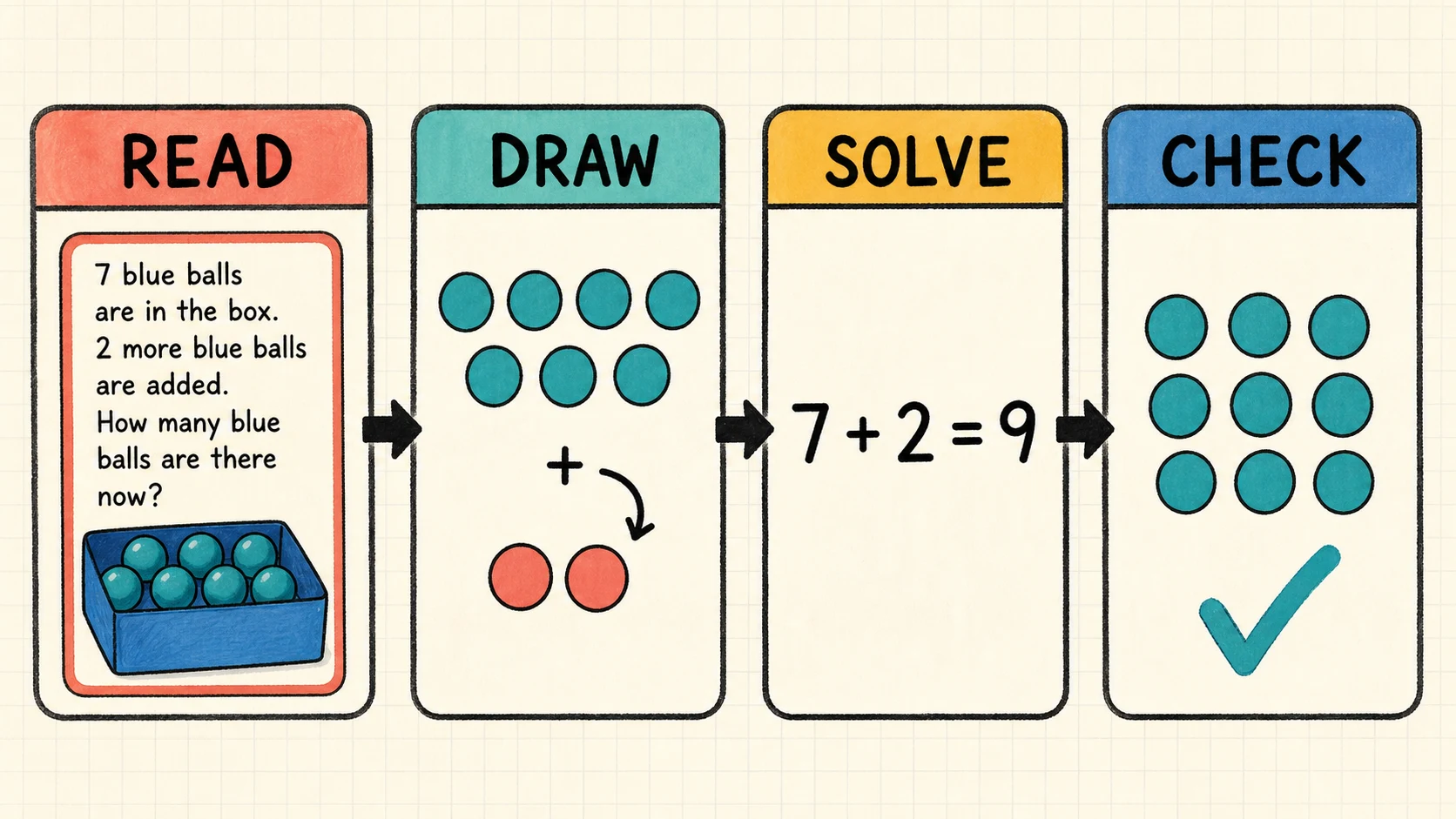
During guided work, prompts reveal the learner’s thinking while leaving the decision-making with the learner.
Worked example 3: find the missing part
“There are 13 birds in a tree. Five are blue, and the rest are yellow. How many are yellow?”
This boundary case can be mistaken for addition because both color groups appear in the same tree. Retelling reveals the structure: 13 is the whole, 5 is one part, and the other part is missing.
A part-part-whole model can be written as:
5 + ? = 13
Count on from 5: 6, 7, 8, 9, 10, 11, 12, 13. Eight counts were added, so:
5 + 8 = 13
The related subtraction equation is:
13 - 5 = 8
Answer: 8 birds are yellow.
Check: The two parts must reconstruct the whole. Five blue birds plus 8 yellow birds equals 13 birds. The answer cannot be 18 because 13 already names every bird in the tree.
Worked example 4: compare two quantities
“Nia has 12 stickers. Owen has 8 stickers. How many more stickers does Nia have than Owen?”
Known amounts: Nia has 12; Owen has 8.
Unknown: the difference between their amounts.
Draw or line up 12 marks over 8 marks. Eight pairs match, with 4 unpaired marks in Nia’s row:
12 - 8 = 4
Answer: Nia has 4 more stickers than Owen.
Check:
8 + 4 = 12
This is not a take-away event; nobody loses stickers. Subtraction is appropriate because the problem asks for the difference between two quantities. That distinction is worth discussing because learners sometimes think subtraction can represent only objects being removed.
Decide when to release responsibility
After two or three guided items, ask the learner to begin the next problem without an operation hint. Step in only if the learner cannot retell the situation, misidentifies the unknown, or produces a representation unrelated to the story.
A clean transition sounds like: “Try the six steps on this one. I will watch, and you can ask me to reread a sentence.” The adult can support decoding without converting the story into an equation for the learner.
Adapt Support Without Changing the Mathematical Skill
Adaptation should preserve the central task: understand a quantitative story, represent its relationship, solve it, and check the result. Making print accessible is different from removing the reasoning.
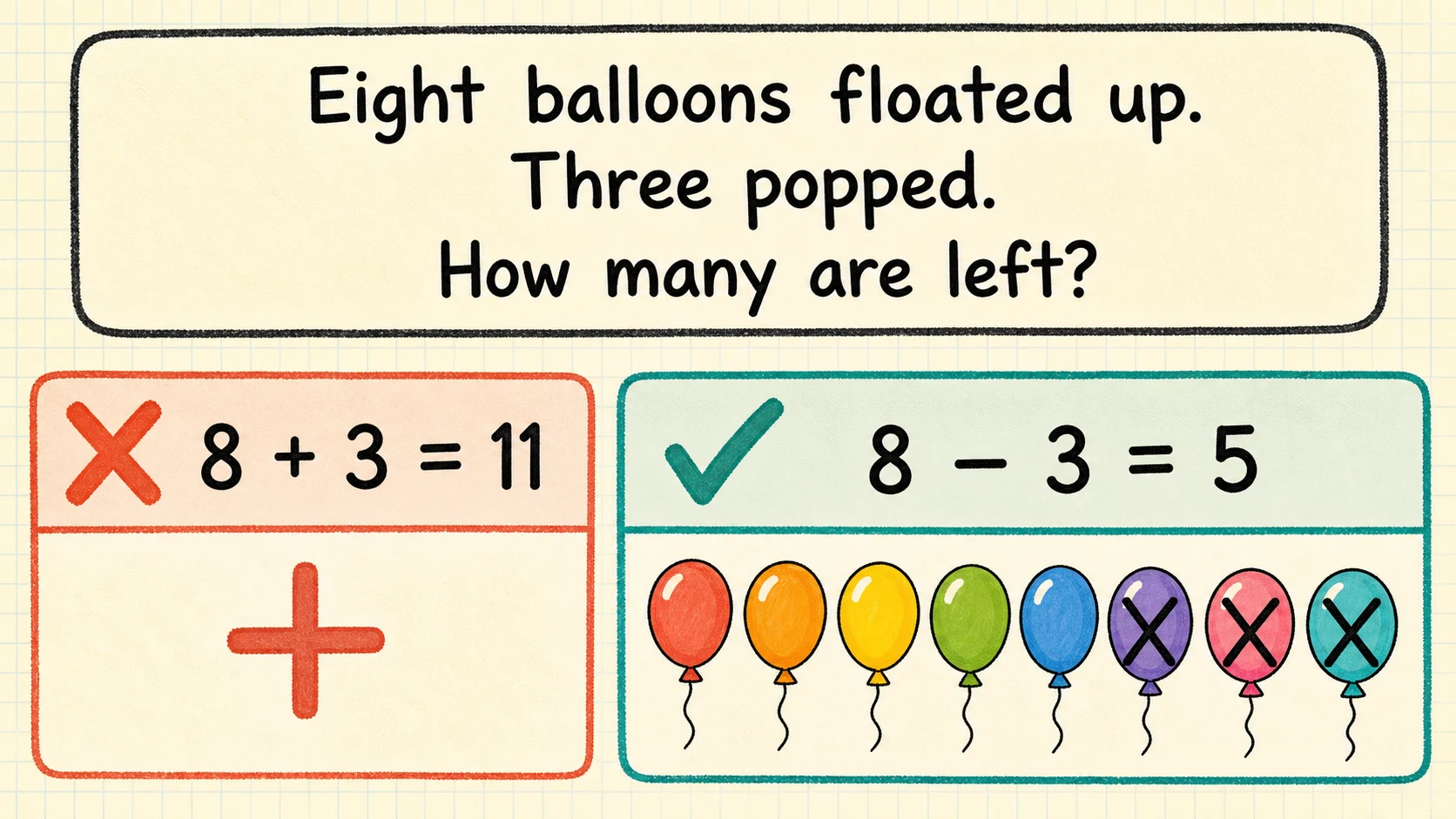
Adjust reading access, representation, or lesson length while keeping the same quantity relationship.
If reading is the main barrier
Read the printed problem aloud once at a natural pace. Ask the learner to retell it. If necessary, reread one sentence and clarify an ordinary word without replacing mathematical reasoning with a clue.
For example, explaining that “remaining” means “still there” supports vocabulary. Saying “remaining tells you to subtract” selects the operation for the learner and may conceal whether the story was understood.
You may cover nearby items with blank paper so only one problem is visible. This changes visual load, not the mathematical demand. The learner can answer orally while the adult records an exact dictated explanation if handwriting would otherwise dominate the task.
If the learner needs concrete representation
Give counters for both quantities and ask the learner to move them in a way that matches the story. Follow the objects with a quick drawing, then an equation. The sequence—objects, picture, symbols—helps reveal whether the written equation represents the action.
Do not leave counters arranged in the answer before the learner acts. For a “7 birds joined by 5 birds” story, provide enough loose counters, but let the learner make the groups and combine them.
If the learner is ready for less support
Remove one scaffold at a time. Ask the learner to draw rather than use counters, write the equation without a prepared template, or explain why another operation would not fit. Keep the numbers and problem intact.
A suitable extension is to ask, “What could the question ask if the answer were one of the parts instead?” This encourages structural thinking. It should follow a correctly solved item rather than replace unfinished practice.
If endurance is the barrier
Divide the page into sets of three or four. Preserve the printed order unless the worksheet itself clearly suggests another sequence. After each set, check one explanation and decide whether to continue.
A shorter set completed with sound reasoning provides better instructional evidence than a full page completed through guessing or adult prompting. No universal number of minutes or items suits every learner.
Interpret Errors Before Correcting Them
An incorrect answer does not identify its own cause. Look at what the learner read, drew, wrote, and said. The same numerical error can arise from comprehension, representation, operation choice, calculation, or recording.
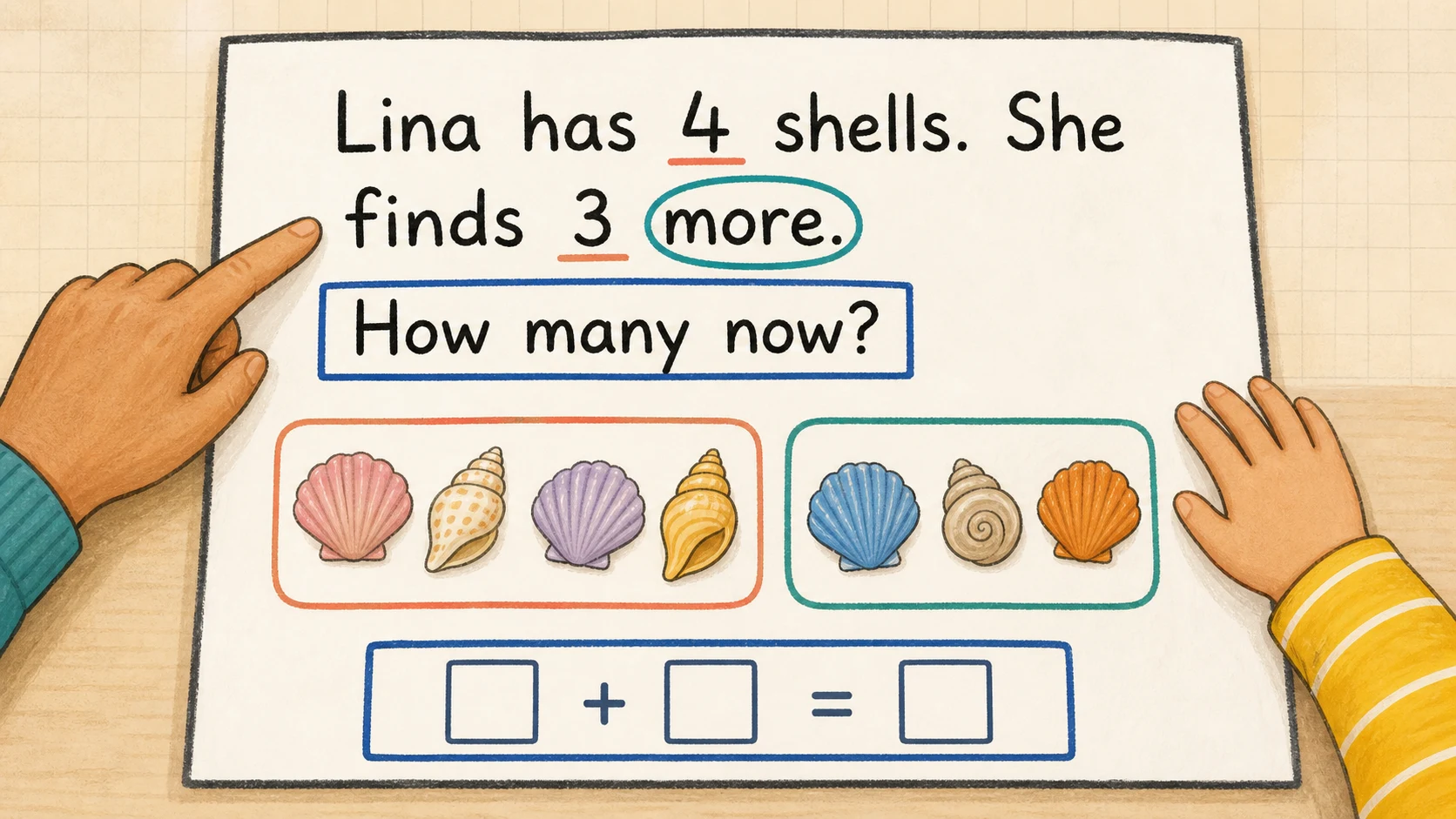
Trace an error from the story to the model, equation, computation, and labeled answer.
Common error patterns
| Observed work | Likely issue to investigate | Useful response |
|---|---|---|
| Learner combines every number mentioned | Unknown quantity or relationship was not identified | Ask for a retelling and circle only what must be found |
| Operation follows a single word | Keyword strategy replaced story analysis | Ask the learner to act out what changed |
| Drawing does not match the quantities | Representation or counting error | Rebuild one group at a time and recount |
| Equation fits the story, answer is wrong | Computation needs attention | Check with counters, counting on, or the inverse relationship |
| Number is correct but label is missing or wrong | Answer was detached from the question | Ask, “Nine what?” and reread the final sentence |
| Learner changes an answer immediately when questioned | Low confidence or answer-key dependence | Ask for evidence from the model before accepting any change |
| Work starts accurately and declines later | Fatigue, attention, or page-load issue may be involved | Stop, mark the place, and return in a later session |
These are hypotheses to test, not diagnoses. This worksheet cannot determine a learning disability, language disorder, attention condition, or broader instructional need. Persistent difficulty across settings deserves careful documentation and discussion with the learner’s teacher or another qualified professional, but the page itself cannot provide medical or diagnostic guidance.
Repair the smallest broken step
If the learner understands the story and chooses the right equation but computes 12 - 5 as 8, do not reteach word-problem comprehension. Recheck that fact with counters or counting on.
If the calculation is accurate but the equation does not match the story, return to representation. Ask, “Show me where each number appears in your drawing.” If the learner cannot retell the story, address language before symbols.
The IES practice guide for assisting students struggling with mathematics offers high-level guidance on systematic instruction, mathematical language, representations, and cumulative review. It did not evaluate this particular worksheet or prescribe an individual intervention. Here, its relevance is the principle of making instruction explicit and checking learner responses frequently.
Use Boundary Cases to Build Flexible Reasoning
Some stories sit near common decision boundaries. Discussing them prevents an oversimplified “add means together, subtract means take away” rule.
Zero change or an unchanged group
Suppose 8 shells are in a bucket and no shells are added. The amount remains 8:
8 + 0 = 8
If a learner insists every addition answer must be larger, the example reveals that adding zero preserves the starting quantity. Use this only if zero is already familiar.
The unknown is not always the result
“Some frogs sat by a pond. Three more arrived. Now there are 10. How many frogs were there at first?”
The unknown is the starting amount:
? + 3 = 10
Because 7 + 3 = 10, the answer is 7 frogs. A learner who automatically adds 10 and 3 has used the visible numbers without identifying their roles.
This example is useful for discussion, but do not assume the printable includes this exact problem structure. Use the broader topic guide when planning a fuller progression across result-unknown, change-unknown, start-unknown, and comparison situations.
Extra or missing information
If a story says a basket is red, that detail may provide context without contributing a number. If a story gives two groups but never asks a mathematical question, the correct response is that a needed question is missing—not to invent one silently.
The catalogue describes this worksheet as easy-level practice, so do not add distracting information to every item during the first use. Boundary cases are best used selectively after the learner demonstrates control of the printed task.
Check the Answer Key Responsibly
The answer key is a checking tool, not the lesson’s starting point. Keep it out of sight during initial work so the learner’s choices remain observable.
Use this sequence for each selected item:
- Read the learner’s final answer and its label.
- Inspect the drawing, objects, or equation.
- Ask for a brief explanation when the reasoning is unclear.
- Recompute the equation independently.
- Compare the result with the printable answer key.
- Investigate any disagreement rather than automatically replacing the learner’s work.
If the key and learner agree, still check whether the equation matches the story. A correct answer can result from an incorrect operation followed by a second error, a guess, or copied work.
If they disagree, first reread the original item. Confirm the printed quantities, operation, and unknown. Then solve it independently. The answer key supports quick checking, but responsible checking includes the reasoning shown on the page.
Mark errors lightly enough to allow repair. Instead of writing the correct number, place a small dot beside the step that needs another look. Ask the learner to use the six-step routine again. Record whether the learner corrected the item independently, after a general prompt, after a targeted prompt, or only after a model. That information is more useful for planning than a total score alone.
Decide What Comes Next
Sort the completed items by the type of support required.
- Independent and explained: The learner represented, solved, labeled, and checked the item without help.
- Correct after a general prompt: A reminder such as “What are you trying to find?” was enough.
- Correct after targeted support: The learner needed rereading, counters, or help connecting the model to an equation.
- Not yet secure: The learner could not complete or explain the item even after support.
If most attempted items are independent and explained, use a few uncompleted items for later retrieval and then move to varied problems in the 1st Grade Word Problems Worksheet Pack, which the catalogue lists as an 18-worksheet pack. The pack offers additional practice; it does not guarantee mastery.
If operation choice is inconsistent but calculations are accurate, stay with story retelling and visual models. If equations match but calculations are unreliable, pair word problems with focused addition or subtraction practice from the 1st Grade worksheet hub. If reading support is repeatedly necessary, continue reading items aloud while asking the learner to own the representation and solution.
Do not treat a percentage from one 12-item page as a comprehensive measure of first-grade mathematics, reading comprehension, or standards attainment. The worksheet samples practice under one theme and difficulty label. It cannot show what the learner does orally, with different representations, after a delay, or in a different context.
Schedule Brief Retrieval Practice
Retrieval means returning to the reasoning after some time has passed. The schedule below is a practical option, not a sourced requirement or universal timetable.
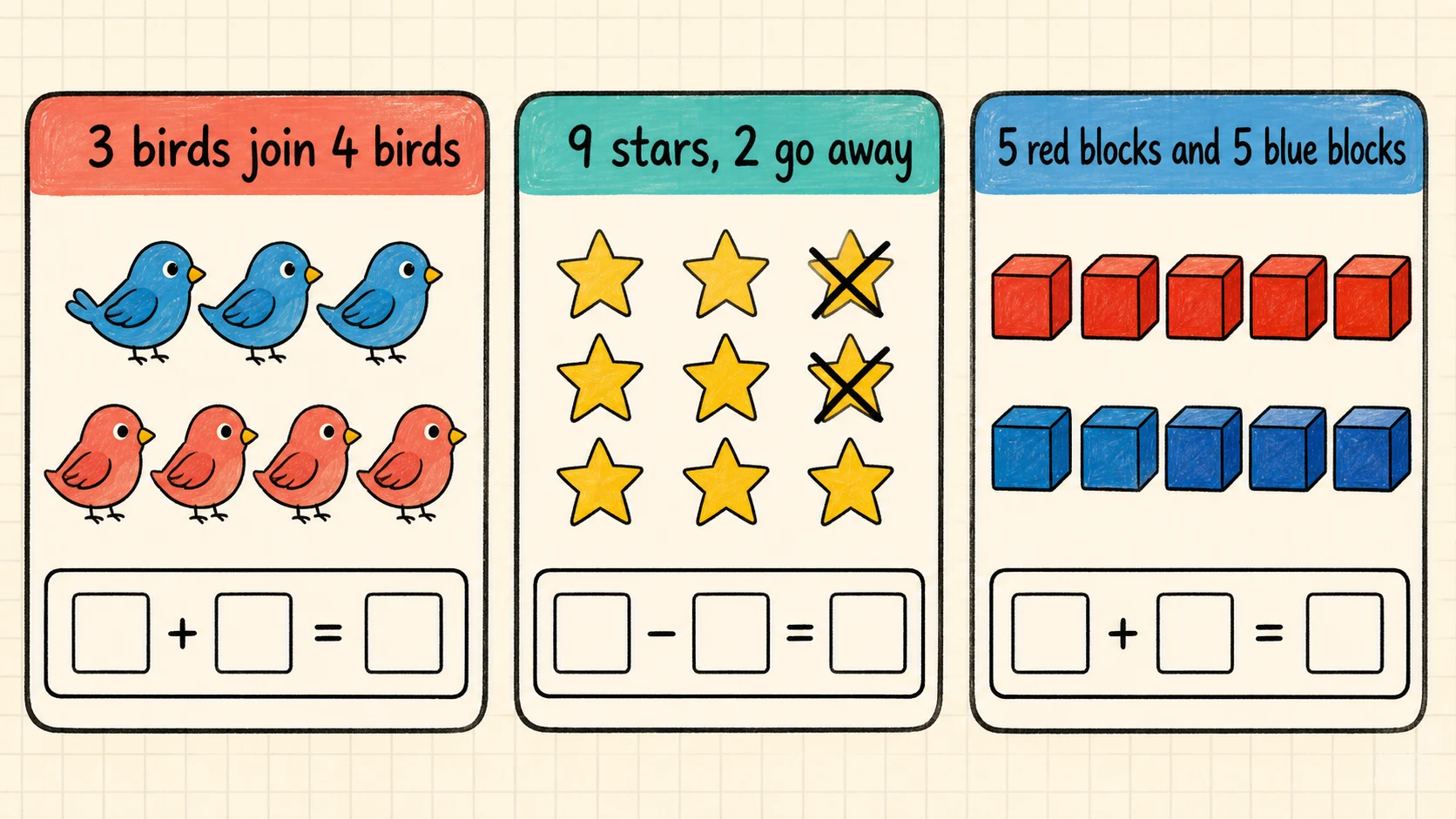
Revisit a small mix of problem structures after delays, reducing prompts when the learner is ready.
| Time | Suggested review | Adult support |
|---|---|---|
| Later the same day or next session | Retell and re-solve one repaired item | Offer the six-step routine if needed |
| About 2–3 days later | Solve one familiar and one uncompleted item | Read aloud only if reading blocks access |
| About 1 week later | Solve two mixed items without an operation hint | Ask for an equation and labeled answer |
| About 2 weeks later | Try a new problem with the same underlying structure | Compare it with an earlier representation |
Change the spacing when the evidence calls for it. If the learner cannot begin after a short delay, return sooner with a model. If the learner solves and explains easily, lengthen the delay or vary the position of the unknown. Preserve at least one fresh problem when possible; repeatedly memorizing the answer to the same story is not the same as interpreting a new one.
Keep the Worksheet’s Limits in View
This printable is a focused practice resource. Its 12 items, standard theme, easy difficulty, and separate answer key make it suitable for a compact lesson, homework follow-up, tutoring session, or homeschool practice. Those features do not make it a complete curriculum, assessment system, or individualized intervention.
The catalogue associates the worksheet with mixed operations and multi-step reasoning, but adults should inspect the actual problems before deciding what has been demonstrated. One correct response does not prove that every operation or problem structure is secure. Likewise, one error may reflect a momentary reading, counting, or recording mistake rather than a broad gap.
Use grade labels as orientation, observe the learner’s actual strategies, and respect the sequence used in the learner’s local curriculum. For the next step, open the free 1st Grade Word Problems topic guide, choose one additional worksheet that varies the story structure without making the numbers unmanageable, and schedule two of this printable’s unused items for retrieval later in the week.
Put it into practice
Use the guide with a real printable
Move from explanation to a short, observable practice task. Check the first item together, then adjust the next session from the learner's actual work.
See the 18-worksheet pack