Complete guide
How to teach and practise 1st grade subtraction worksheets - standard theme (easy)
How to Use This 1st Grade Subtraction Worksheet
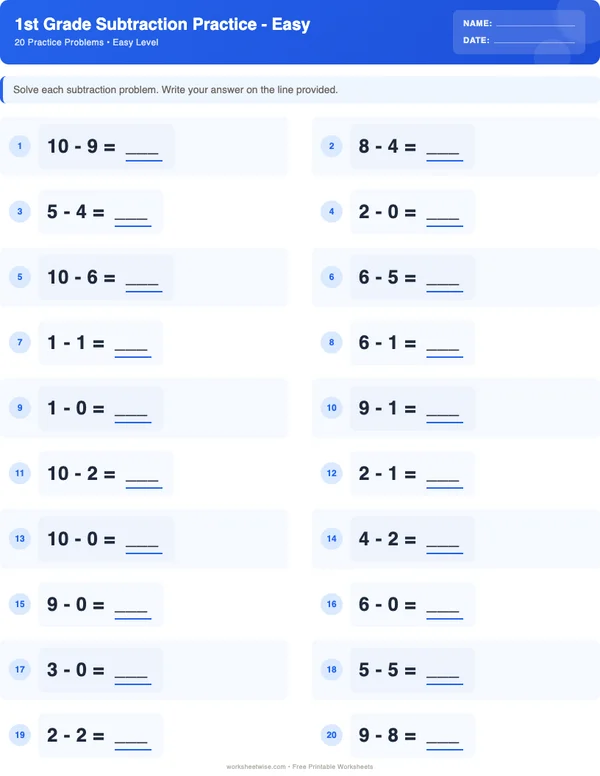
The free 1st Grade Subtraction Worksheets – Standard Theme (Easy) printable contains 20 subtraction exercises, space for written answers, and a separate answer key. Use it as a short lesson rather than simply handing over the page: preview the problems, model one or two similar equations, complete several items together, and then release the learner to work independently.
The concise plan is:
- Confirm that the learner understands the minus sign and the instruction, “Solve each subtraction problem. Write your answer on the line provided.”
- Model subtraction as finding what remains or finding a missing part.
- Guide the learner through a few printed items without supplying the answers.
- Let the learner complete a manageable section independently.
- Check the work for patterns, not just a total score.
- Revisit selected facts after a delay.
The observed work should determine the pace. A learner who accurately solves a few items and explains a strategy may need less guidance. A learner who guesses, reverses numbers, or loses track while counting needs a slower return to objects, drawings, or a number line.
Grade labels describe the intended practice level; local curricula and instructional sequences differ. The “1st Grade” label is therefore a useful starting point, not a guarantee that every learner has already met every prerequisite or that every printed item matches the order used by a particular school.
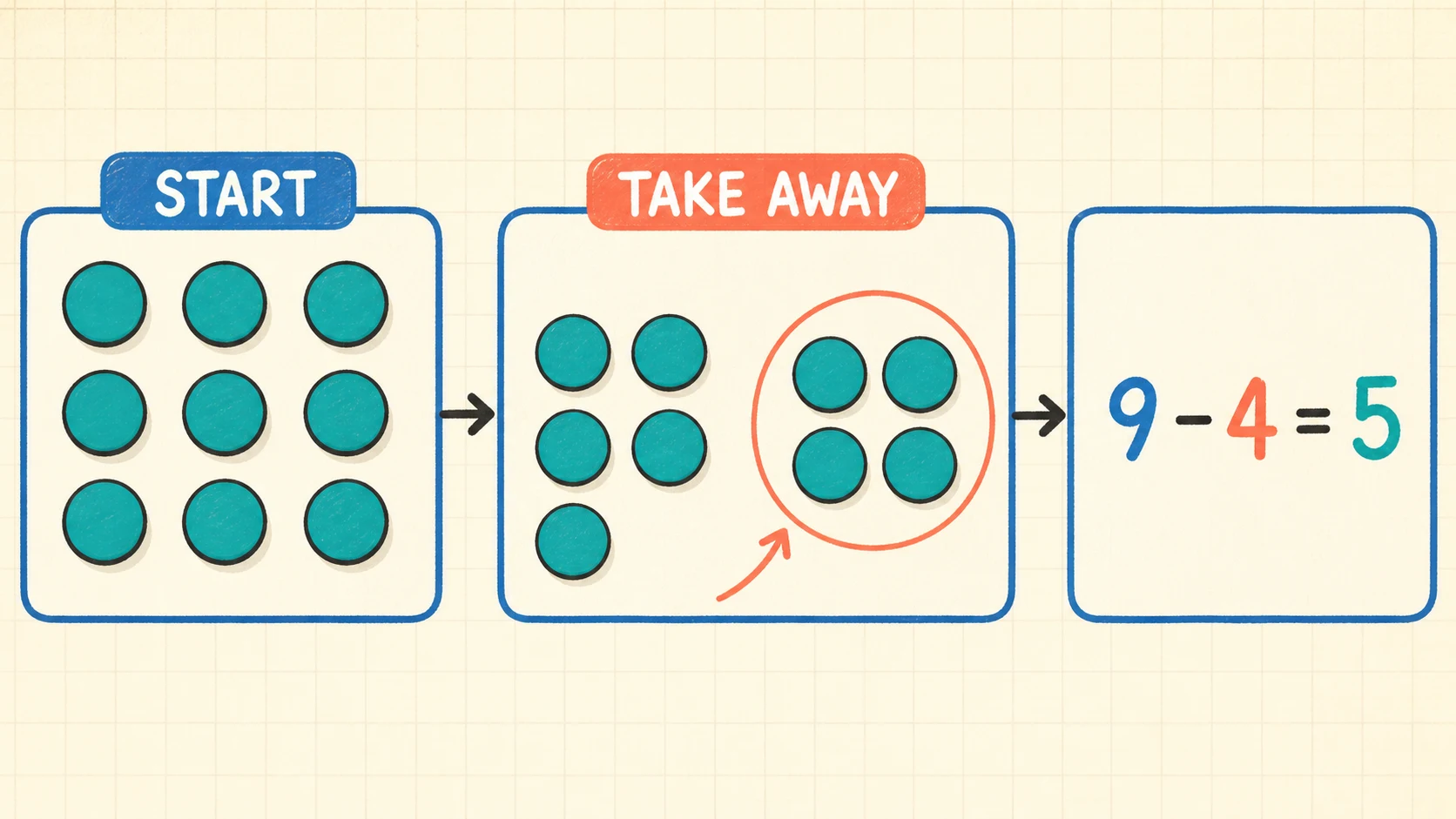
Preview, model, guide, observe, check, and revisit.
Preview the Exact Printable Before the Lesson
This worksheet is catalogued as an easy, standard-theme set of 20 exercises. Its listed skills are subtraction facts, mental math, number sense, and regrouping. Because those labels cover more than one possible form of subtraction, inspect the actual printable before teaching. Note the number sizes, how the equations are arranged, and whether any problem requires exchanging a ten for ones.
Do not assume that “easy” means effortless. It identifies the worksheet’s catalogue difficulty, while the learner’s written work tells you how much support is appropriate.
Prepare a small set of tools
Print the worksheet and keep the separate answer key out of the learner’s sight. Have a pencil and eraser available. For optional support, gather up to 20 small counters, connecting cubes, buttons, or similar objects. A blank number line or scrap paper can also help.
These tools are instructional supports, not alternate tasks. If the printed problem is , the learner should still solve . Counters or a drawing merely make the quantities visible.
The IES guide on teaching mathematics to young children recommends organizing number-and-operations instruction through a developmental progression and monitoring what a child knows. That is high-level guidance, not an evaluation of this WorksheetWise printable. Applied here, it means checking whether the learner can represent subtraction before expecting unsupported mental calculation.
Check essential readiness briefly
Before starting all 20 items, write a simple example such as . Ask:
- “What does the minus sign tell us to do?”
- “Which amount do we start with?”
- “Can you show what happens with counters or a drawing?”
- “How could you check the answer?”
A correct answer with a clear representation is evidence that the learner can begin. A correct answer produced by guessing is less informative. If the learner adds instead of subtracting, starts with the second number, or cannot represent the action, teach that prerequisite before assigning the whole page.
Keep this check short. It is a launch decision, not a separate test.
A Practical Lesson Progression
The following sequence is an instructional suggestion for this worksheet. It is not a universal timetable. Shorten, extend, or divide the session according to the learner’s attention and accuracy.
| Phase | Adult action | Learner action | Evidence to watch |
|---|---|---|---|
| Preview | Scan all 20 printed items and choose representative examples | Listen and examine the page | Notices the minus sign and answer lines |
| Model | Solve one similar problem aloud | Watch, then restate the steps | Identifies the starting amount and removed amount |
| Guided practice | Prompt through two or three printed items | Represent, solve, and explain | Uses a sensible strategy without being told the answer |
| Supported release | Ask the learner to solve a short group | Work while the adult observes quietly | Maintains the operation and records answers clearly |
| Independent practice | Assign the remaining appropriate items | Solve without step-by-step prompting | Applies the strategy consistently |
| Review | Compare work with the answer key | Rework selected errors | Can explain the correction |
| Retrieval | Revisit a small selection later | Solve from memory or with a chosen strategy | Retains facts and procedures after a delay |
It is reasonable to pause before all 20 items are finished. For example, if the first independent group reveals repeated operation confusion, continuing the page may rehearse the same mistake. Stop, model again, and return later.
For a wider explanation of how subtraction develops from taking away objects to facts within 20 and later multi-digit work, use the 1st Grade subtraction topic guide. This lesson guide stays focused on launching and interpreting this particular printable.
Model the Task With Fully Checked Examples
Model a problem similar to the worksheet rather than completing a large share of the printed page for the learner. Say enough to make the mathematical decisions visible, but avoid turning every thought into a long script.
A useful model has four parts:
- Read the equation.
- Identify the starting amount and the amount being subtracted.
- choose and carry out a strategy.
- Check that the answer is reasonable.
The Common Core mathematics standards describe mathematical understanding as more than producing an answer; learners should also be able to explain why an answer is true at an appropriate level. This broad framing does not certify this worksheet’s alignment with a particular local standard. Here, a short explanation, drawing, or related addition fact is enough to reveal whether the learner understands the calculation.
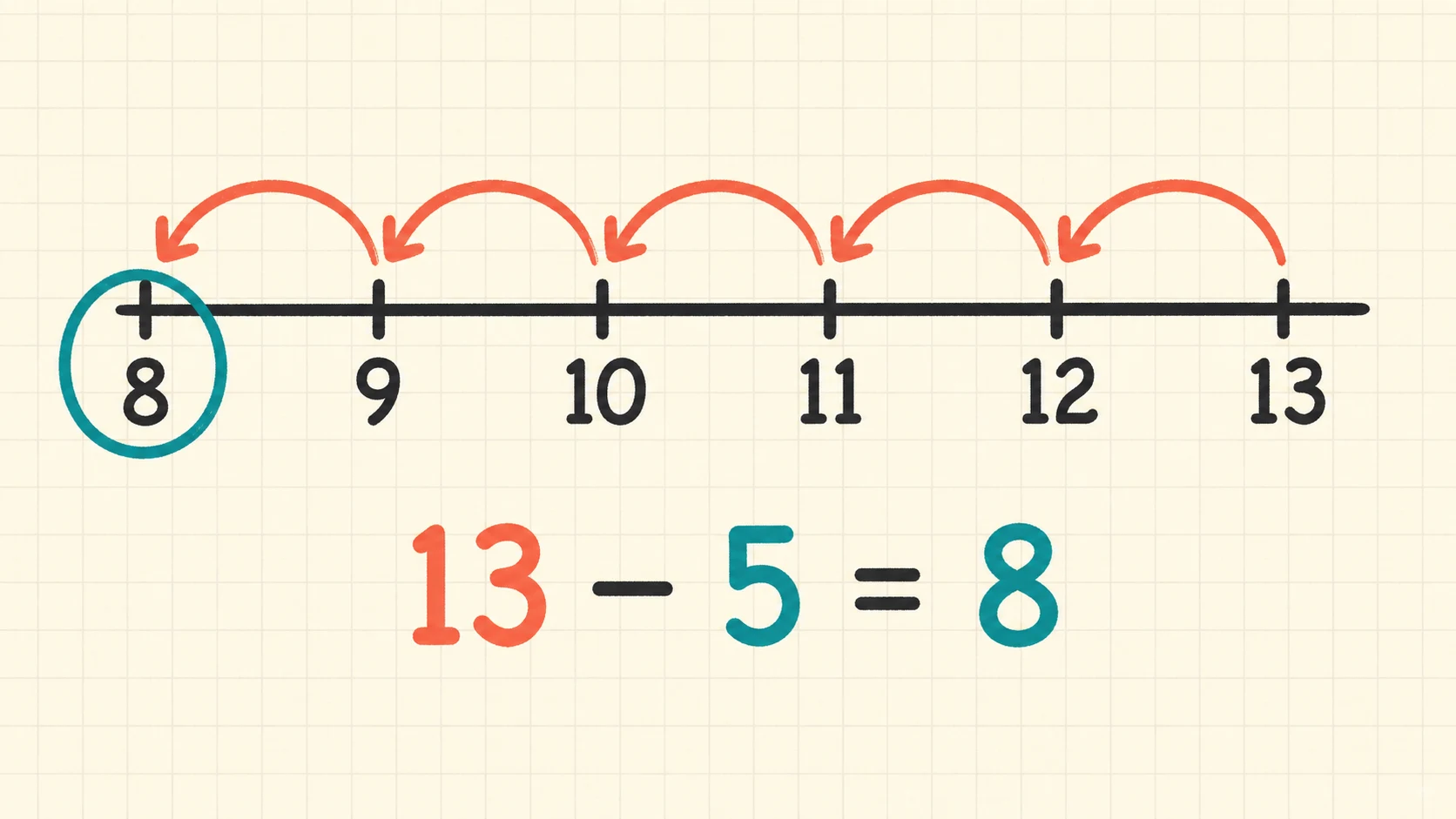
Name the starting amount, subtract, and verify what remains.
Example 1: Count back carefully
For , say:
“I start at 14 because that is the whole amount. I move back three counts: 13, 12, 11. Therefore, . I can check with addition: .”
This example is fully checked because the related addition equation rebuilds the starting amount.
A common counting error is to count 14 as the first backward step. Demonstrate that the first move lands on 13. The number of moves—not the number of spoken numbers before starting—must equal 3.
Example 2: Take objects away
For , place nine counters where the learner can see them. Move five counters aside, one at a time. Count the four that remain:
Check by returning the five removed counters:
The physical movement clarifies the removal meaning of subtraction. Once the learner can anticipate the result, reduce reliance on counters rather than removing them abruptly.
Example 3: Use a related addition fact
For , ask, “Six plus what equals thirteen?” Count on from 6 if needed:
Therefore:
Check both quantities: the missing part 7 and the known part 6 combine to make 13. This approach connects subtraction and addition without changing the original problem.
Example 4: Compare two quantities
For , draw one row of 12 marks and align a row of 8 marks beneath the first eight. Four marks in the longer row are unmatched, so the difference is 4:
Check:
Even when a worksheet presents only equations, showing more than one subtraction meaning can strengthen number sense. Removal asks what remains; comparison asks how far apart two quantities are; a missing-part interpretation asks what must be added to a known part to make the whole.
Example 5: Subtract zero
For , nothing is removed:
Check:
This boundary case helps expose the misconception that every subtraction answer must be smaller than the starting number.
Example 6: Subtract the entire amount
For , all six objects are removed:
Check:
Do not treat zero as “no answer.” It is a number and may be the correct difference.
These examples are verified illustrations of subtraction, not a claim that the same six equations appear on the printable.
Move From Guided Practice to Independent Work
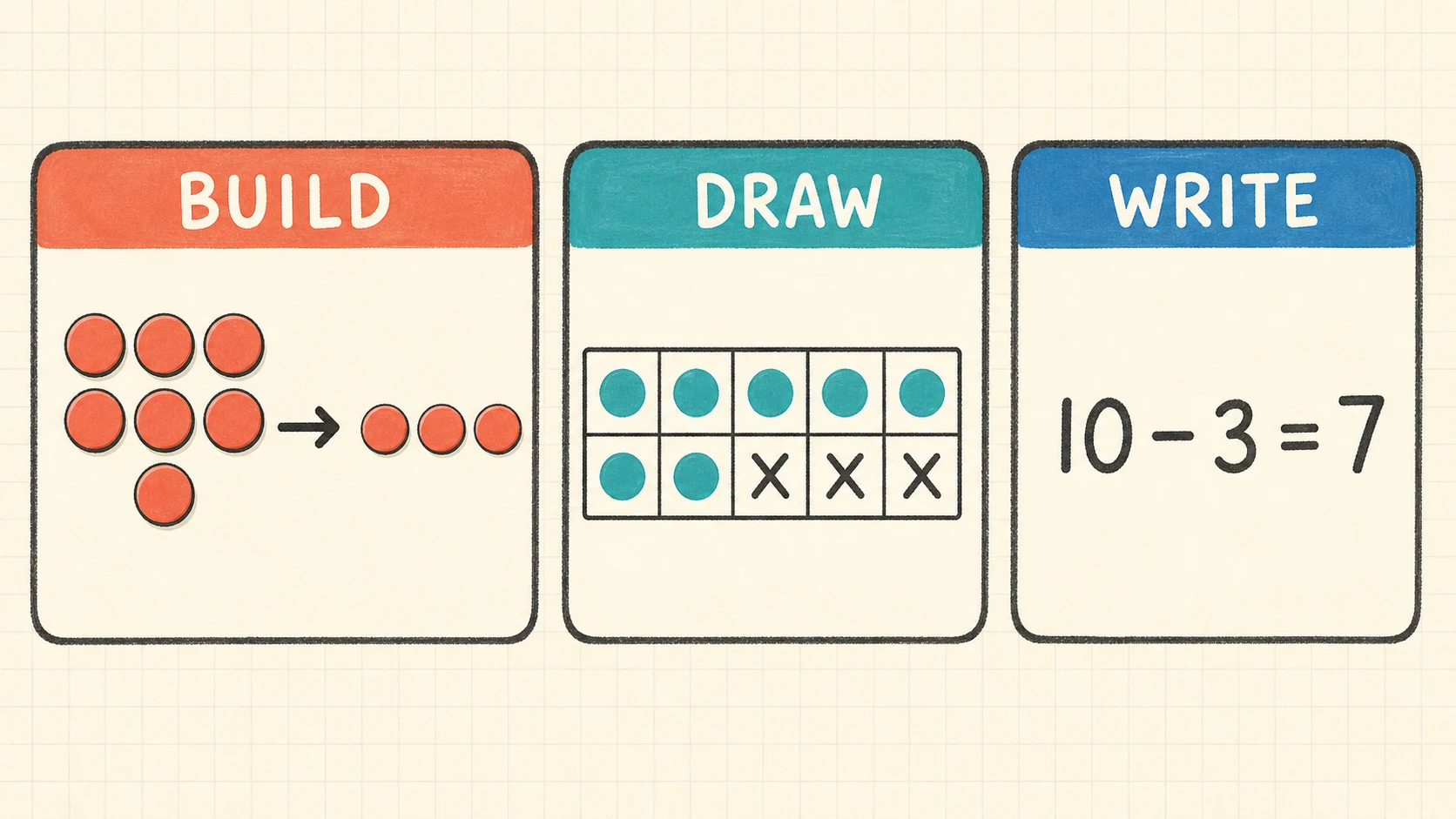
Reduce prompts only after the learner shows a repeatable method.
Launch the printed directions
Read the worksheet title and directions once. Ask the learner to point to the first subtraction sign and the first answer line. Then have the learner restate the task in their own words.
A useful restatement is, “I find the difference and write it on the line.” If the learner says, “I add the numbers,” correct the operation before calculation begins.
Guide without giving away the work
Choose a representative printed item. Use prompts in this order:
- “What number do you start with?”
- “How many are being subtracted?”
- “Which strategy will you use?”
- “What answer did you get?”
- “How can you check it?”
If the learner stalls, offer one level of support: counters, a drawing, counting back, or a related addition fact. Avoid presenting several strategies at once. Too many choices can obscure the central decision.
Complete another item together, but say less. For the third guided item, ask only, “Show me your plan.” The goal is to see whether the learner can initiate the process.
The IES elementary mathematics intervention guide recommends systematic instruction, clear mathematical language, and well-chosen representations for learners who are struggling. It also discusses number lines as an instructional representation. Those recommendations provide general teaching context; they do not mean this worksheet is an intervention program.
Release a short group first
Ask the learner to complete three or four items independently while you observe. Do not correct each answer immediately. Watch for:
- whether the learner continues to subtract;
- whether counting movements match the amount subtracted;
- whether answers are placed on the correct lines;
- whether tools support reasoning or replace it with untracked counting;
- whether accuracy changes as the numbers change.
If the short group is accurate and the strategy is clear, assign another group or the rest of the page. If errors follow one pattern, pause for a targeted correction. If the work deteriorates only after sustained effort, divide the worksheet across sessions.
“Independent” means solving without step-by-step coaching. It does not require mental calculation. A learner may independently choose counters or a number line when those supports have already been taught.
Adapt Support Without Changing the Skill
Differentiation should preserve the subtraction problem. Changing into may make the arithmetic easier, but it no longer provides evidence about the original item. Instead, adjust the representation, the number of items shown, the amount of prompting, or the response format.
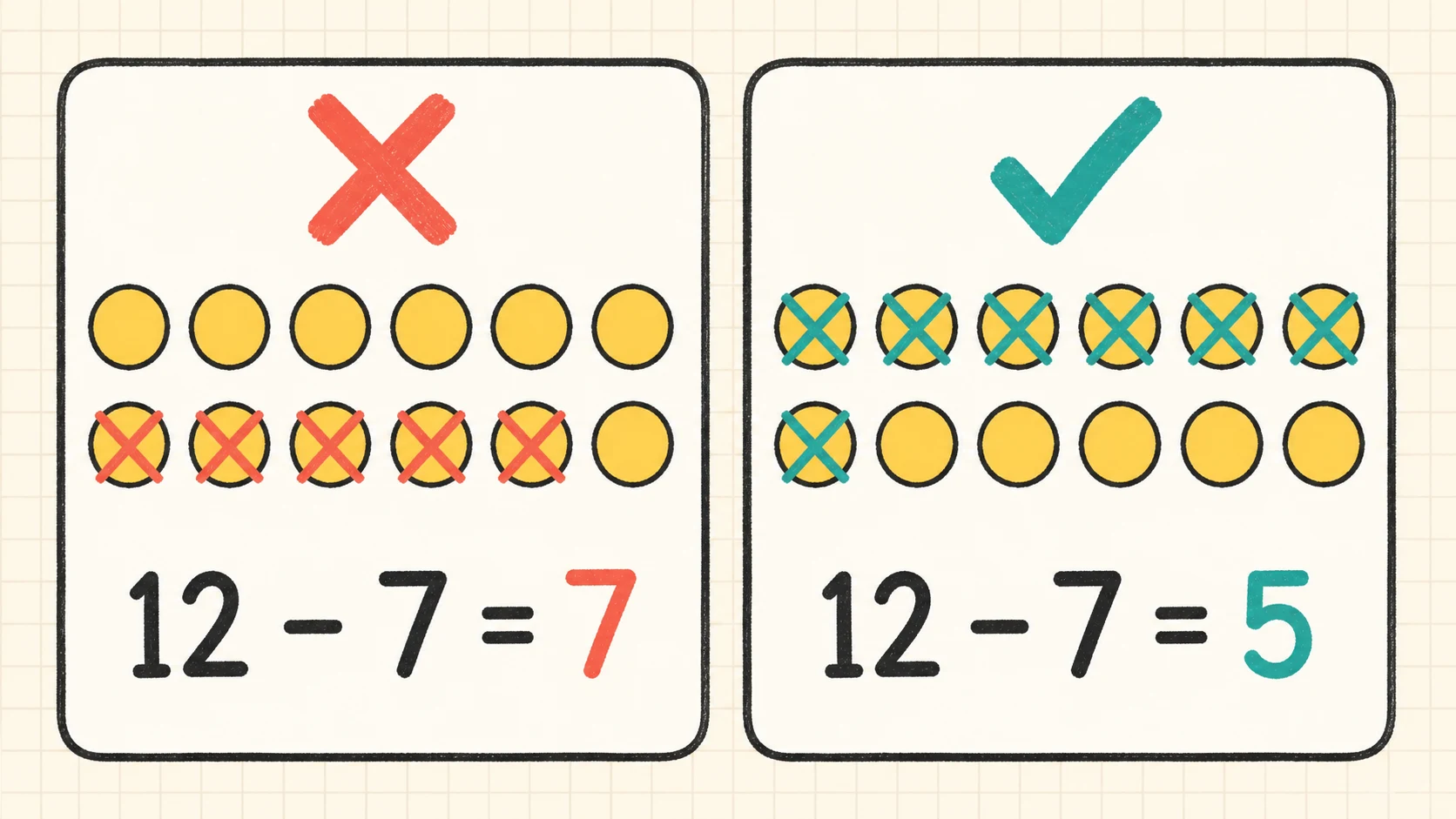
Change access, pacing, or representation while preserving each equation.
When the learner needs more support
Cover the lower part of the page with blank paper so only one row or small group is visible. This reduces visual load without removing any problem.
For a printed equation:
- Build the starting number with counters.
- Remove the second amount.
- Count what remains.
- Say the complete equation aloud.
- Record the answer on the original line.
If objects become disorganized, use a ten-frame, organized rows, or drawn circles. If the learner loses track while counting backward, draw a number line and mark one jump for each unit subtracted.
Use consistent language: “start with,” “subtract,” “difference,” and “check.” Avoid replacing subtraction with vague commands such as “do the numbers.”
When the learner is nearly independent
Allow a number line or small set of counters to remain available, but do not require their use. Ask the learner to circle one problem that felt difficult and explain it after finishing the group.
You can also fold or cover the answer area of later problems while the learner works on the current section. The mathematical demand remains unchanged, but attention is directed to a manageable amount of print.
When the learner completes the page accurately
Do not manufacture harder arithmetic during the same sitting merely to fill time. Ask for explanation and flexible checking instead:
- “Choose one answer and prove it with addition.”
- “Show one problem with a drawing.”
- “Which two facts seemed related?”
- “Which problem could you solve without counting every step?”
These prompts deepen the use of the existing facts. For additional practice at the same broad topic, choose a suitable resource from the 1st Grade math worksheet collection after checking its displayed difficulty and content.
Handle regrouping cautiously
Regrouping is included in the worksheet’s catalogue skill list. Before teaching an exchange procedure, inspect the actual problem that appears on the page. If an item is written in a form that requires trading one ten for 10 ones, model the exchange with base-ten materials or a clear drawing while keeping the total value unchanged.
Do not introduce multi-digit regrouping solely because the catalogue lists the skill if no printed item requires it. Likewise, do not expect the learner to infer an unfamiliar written procedure from the answer key. If the needed place-value understanding is not yet secure, stop and teach that prerequisite separately.
Read Errors as Evidence
A wrong answer does not identify its own cause. Ask the learner to show how it was produced before selecting a correction.
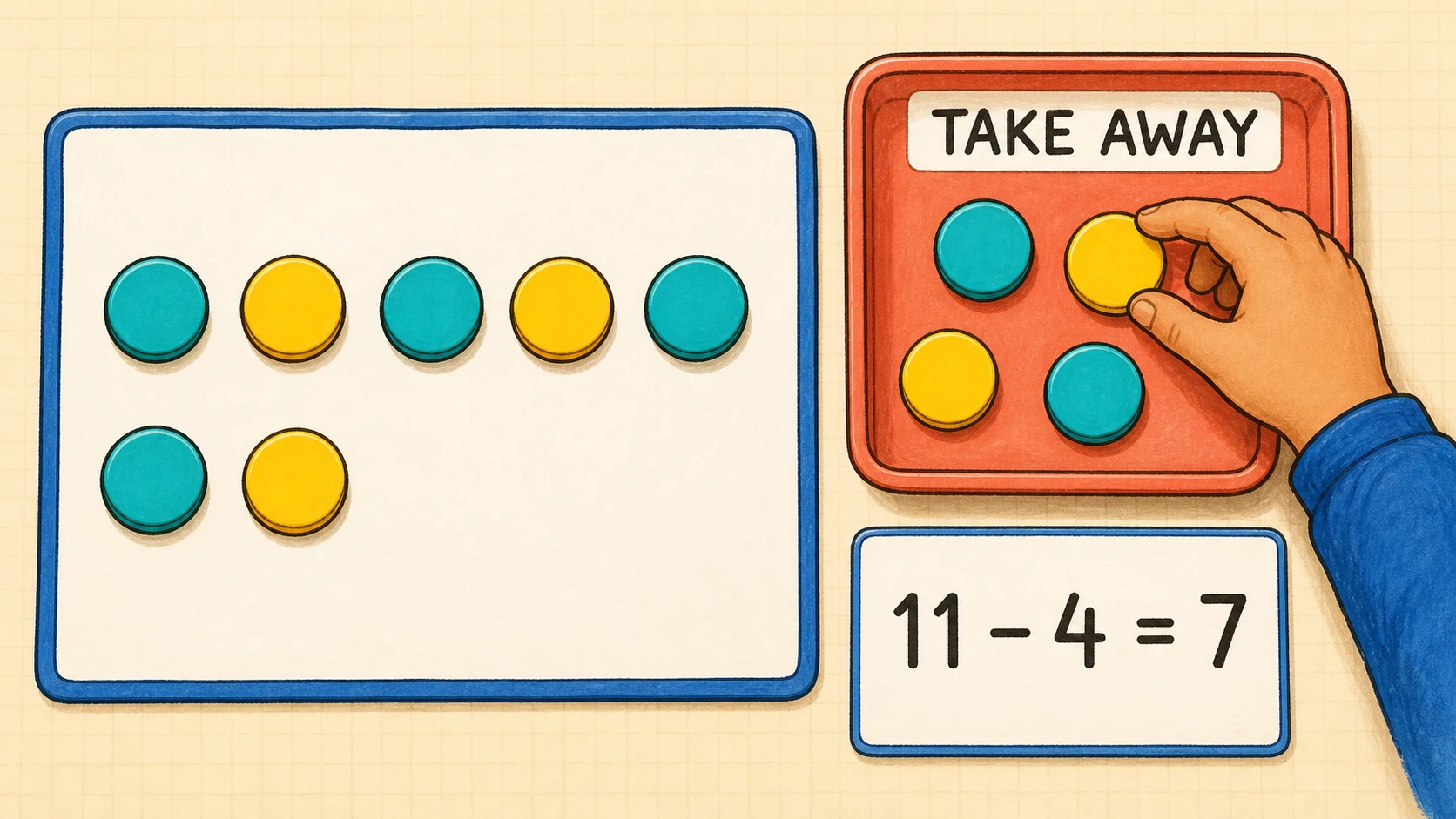
Reconstruct the method, locate the decision, and retry the original item.
Common patterns and useful responses
| Observed work | Possible interpretation to check | Targeted response |
|---|---|---|
| Learner adds the two numbers | The operation sign was overlooked or misunderstood | Contrast one addition and one subtraction equation using the same numbers |
| Learner begins with the second number | The roles of the whole and removed part are unclear | Point to and build the first quantity before removing anything |
| Answer is off by one | A starting number was counted as a move, or one object was skipped | Mark each backward move or physically separate each removed counter |
| Learner gives the smaller printed number as the answer | The equation may be read as a labeling task rather than an action | Ask the learner to build and enact the full equation |
| is answered as 0 | Zero may be interpreted as erasing the whole amount | Show that removing no objects leaves the starting set unchanged |
| is answered as | The learner may be confusing “remove none” with “remove all” | Compare and with counters |
| Several answers are correct but unexplained | Facts may be known, or guesses may have happened to work | Ask for one addition check and one representation |
| Early items are accurate but later items are not | Attention, page density, or endurance may be affecting performance | Divide the remaining items and compare performance later |
| Digits or answers are placed on the wrong line | Recording or visual tracking may be the issue | Reveal one row at a time and have the learner point before writing |
These are hypotheses to investigate, not diagnoses. The same written error can come from different reasoning. “Try harder” is not a mathematical correction; a more useful response identifies the exact step to revisit.
Protect important boundary meanings
Several cases deserve explicit attention:
- Subtracting zero leaves the starting amount unchanged.
- Subtracting a number from itself produces zero.
- In an elementary whole-number take-away example, the starting set must contain enough objects to remove the stated amount.
- Addition can check subtraction because the difference and the removed part should rebuild the starting amount.
Do not introduce negative-number procedures as an impromptu extension unless they are already part of the learner’s course. That would change the instructional scope rather than support this worksheet.
Also distinguish reversal from checking. If the problem is , changing it to is not a valid way to make subtraction easier. Subtraction does not generally give the same result when the order is reversed.
Use the Answer Key Responsibly
The separate printable answer key is provided for quick checking. Use it after the learner has attempted the assigned work, not as a visible prompt during calculation.
A responsible checking routine is:
- Compare each recorded answer with the corresponding key entry.
- Mark correct work neutrally.
- Put a small dot beside an incorrect or blank response rather than immediately writing the correct answer.
- Ask the learner to retry that item with a chosen strategy.
- If the retry is still incorrect, reconstruct the method together.
- Confirm that the key and worksheet item numbers or positions were matched correctly.
Check the arithmetic yourself if a result seems inconsistent. An answer key is a checking tool, not a substitute for mathematical reasoning.
Record patterns separately from the raw score. “Three counting-back errors” is more actionable than “17 out of 20.” Similarly, one copied digit or misplaced answer line should not automatically be interpreted as failure to understand subtraction.
Avoid asking the learner to erase every trace of an error. A neat correction beside the first attempt can preserve useful evidence. The important question is whether the learner can explain what changed.
Decide What to Do After the Worksheet
Use the learner’s work to choose the next move
The following decision rules are practical suggestions rather than sourced universal cutoffs:
- Mostly accurate with clear explanations: Revisit a small selection later, then continue with another appropriately matched subtraction resource.
- Accurate only with counters or a number line: Keep the same fact range and gradually reduce prompts while leaving the representation available.
- Repeated off-by-one errors: Practice controlled counting moves with a few equations before returning to unfinished items.
- Repeated operation confusion: Rebuild subtraction as removal, comparison, and missing part before assigning another full page.
- Difficulty concentrated in larger-number or regrouping items: Separate fact knowledge from place-value procedure. Teach the missing representation, then retry selected original items.
- Inconsistent work after a strong start: Shorten the next session and compare performance before concluding that the arithmetic is insecure.
One worksheet cannot establish complete mastery. The printable samples performance on 20 exercises under one set of conditions. Confidence should come from accurate work across more than one occasion, including some problems solved after a delay and some explained in the learner’s own words.
For the broader sequence—take-away situations, comparisons, missing parts, related addition facts, and later subtraction procedures—return to the subtraction topic guide rather than trying to turn this single worksheet into the entire progression.
Schedule Retrieval Without Fixing a Universal Timetable
Retrieval means returning to previously practiced material after some time has passed. It should be brief enough to reveal what the learner remembers without recreating the entire original lesson.
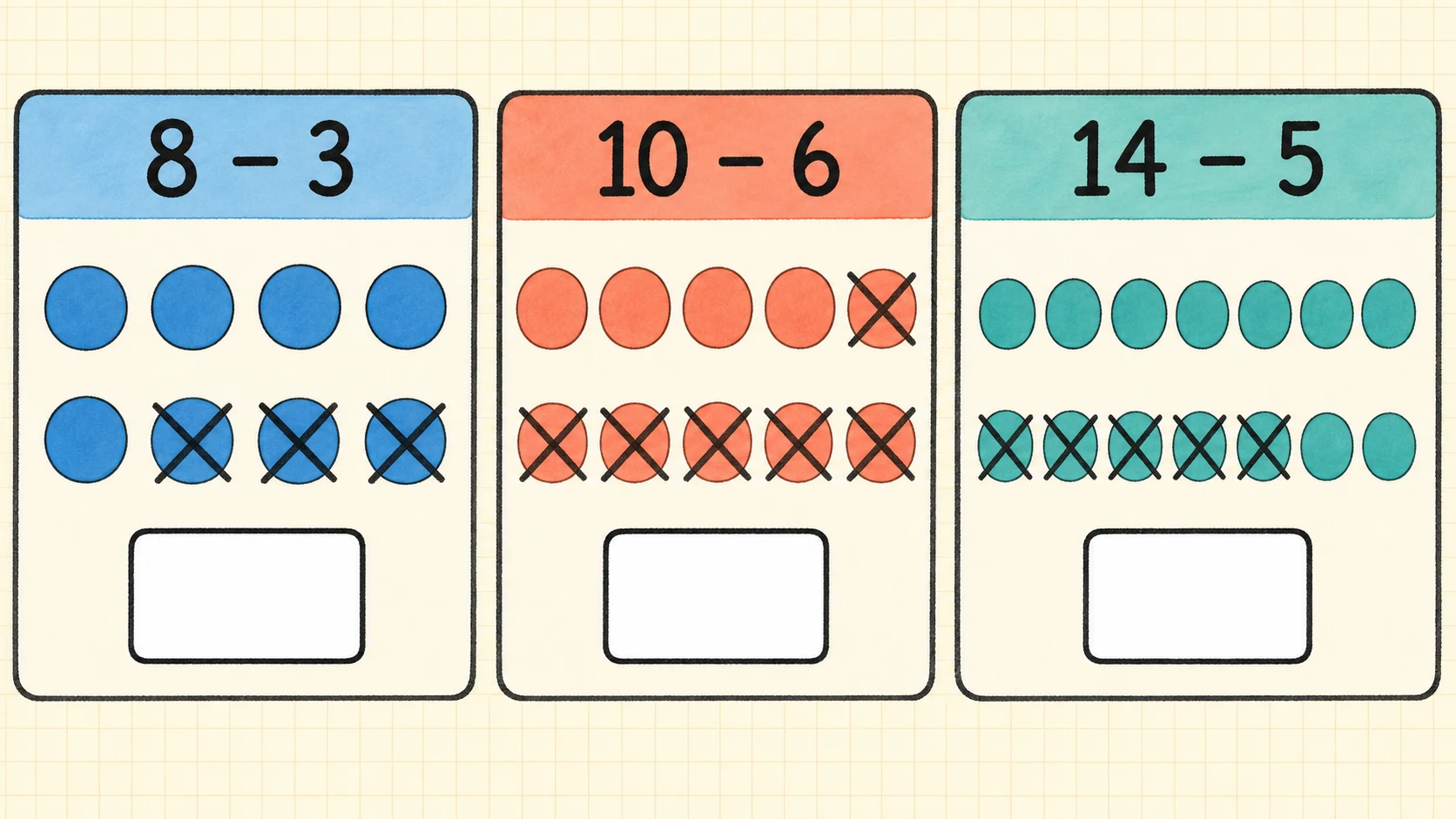
Revisit a few representative facts after increasing delays, then adjust from the results.
A flexible review plan
| Review point | Suggested task | What to notice |
|---|---|---|
| Later the same day or next learning period | Retry two corrected items without looking at prior answers | Whether the corrected method can be reconstructed |
| A few days later | Solve three to five representative facts on separate paper | Whether accuracy remains when page position and visual memory change |
| About a week later | Mix one boundary case, one previously difficult fact, and one secure fact | Whether knowledge is retained across different problem types |
| During later subtraction work | Ask for a related addition check on one item | Whether subtraction and addition remain connected |
These intervals are a sample schedule, not a required or universally effective timetable. Move the review sooner when the learner cannot reconstruct a recently corrected strategy. Increase the delay when responses are accurate and well explained. If repeated review produces the same misconception, stop repeating the items and reteach the underlying idea with a representation.
Avoid using the original answer order as the only retrieval format. Select a few facts, change their order, and ask the learner to solve them on blank paper. This helps distinguish remembered page positions from remembered mathematical relationships.
Limits of This Printable and the Honest Next Step
This worksheet offers 20 easy-level exercises in a clear practice format, plus a separate answer key. It can provide useful evidence about subtraction facts, mental calculation, number sense, and any regrouping shown on the printed page. It does not, by itself, provide a complete subtraction curriculum, establish comprehensive standards alignment, diagnose a learning need, or guarantee fluency.
The grade label indicates intended practice level, and local sequences differ. Match the resource to observed understanding rather than age or grade wording alone. For child-specific educational decisions that extend beyond ordinary practice support, use the learner’s school context and appropriate professional guidance.
The best next action is to print the free worksheet, preview all 20 items, and choose one model plus three guided problems before assigning independent work. After checking the results, use the broader subtraction guide to select the next skill. Families or educators who need a larger practice set can review the 18-worksheet 1st Grade Subtraction Pack, while those who need newly arranged practice can explore the free worksheet generators.
Put it into practice
Use the guide with a real printable
Move from explanation to a short, observable practice task. Check the first item together, then adjust the next session from the learner's actual work.
See the 18-worksheet pack